The Pennsylvania Medical Humanities Consortium, May 19-20, College of Physicians, Philadelphia PA


Friend of Morbid Anatomy Todd Vladyka has just let me know about a rather exciting looking consortium taking place next week at the College of Surgeons (home of the Mütter Museum); highlights include an entire panel devoted to "The 'Art' of Anatomy and Other Collections," which will consist of a presentation devoted to the art of Joseph Maclise (as seen above), and two other presentations entitled "The Exquisite Cadaver and the Evolution of the Anatomic Theater"and "Constituting the Syphilitic Collector."

The opening lecture--"What Mark Twain Might Tell Us (And Ask Us) If He Could Join Us Tonight"--is free and open to the public; $25 for students or $50 for non-students will gain you admission to all the other events.

Full details follow; very much hope to see you there!

The Pennsylvania Medical Humanities Consortium
Through the Lens of Time: Perspectives on Medicine and Health Care
May 19 – 20, 2010

Events on Wednesday, May 19, 2010

2 – 4 p.m. Visit the Ars Medica Collection at the Philadelphia Museum of Art’s new Perelman Building (across from the Museum’s main building, corner of Pennsylvania and Fairmount Avenues); Hosted by Peter Barberie, PhD, The Brodsky Curator of Photographs [Note: This tour is now full!]

6:30 – 8:30 p.m. What Mark Twain Might Tell Us (And Ask Us) If He Could Join Us Tonight, K. Patrick Ober, MD, Professor of Internal Medicine and Associate Dean for Education, Wake Forest University School of Medicine, Winston-Salem, NC; author of Mark Twain and Medicine: Any Mummery Will Cure.

At the College of Physicians of Philadelphia, 19 South Twenty-Second Street (between Chestnut and Market Streets).

Wine-and-cheese reception to follow. This program is open to the public.

Events on Thursday, May 20, 2010

At The College of Physicians of Philadelphia, 19 South Twenty-Second Street

8 a.m. Breakfast – Mitchell Hall

8:30 a.m. Welcome
Rhonda L. Soricelli, MD – Chair, Program Committee
Paul C. Brucker, MD – President, College of Physicians of Philadelphia
Mary Ellen Glasgow, PhD, RN – Associate Dean, Drexel University College of Nursing & Health Professions

8:45–9:45 a.m. Opening Session – Mitchell Hall
The Medical/Healthcare Humanities: Where We Are; Where We’ve Been; Where We’re Going
Moderator: David H. Flood, PhD

  • Humanism Versus Humanities in Medicine: An Historical Perspective, Jack Coulehan, MD, MPH
  • Medical Humanism/Professionalism Teaching in a Community Hospital Since WWII, Victor Bressler, MD
  • Disability, Medicine, and Representation: Integrating Disability Studies into Medical, Education and Practice, Rebecca Garden, PhD
  • American Missionary Health Care Projects in the late Ottoman Empire: Civilization, Hygiene, and Salvation, Sylvia Önder, PhD

9:45–10:15 a.m. Discussion: Flood, Coulehan, Bressler, Garden and Önder

10:15 – 10:30 a.m. Morning break – Mitchell Hall

10:30 – 11:30 a.m. Concurrent sessions

1. Cholera and Its Representations – Mitchell Hall
Moderator: Steven J. Peitzman, MD

  • Cholera, Commerce, and Contagion: Rediscovering Dr. Beck’s Report, Ashleigh R.Tuite, MHSc(c) and David N. Fisman, MD
  • The Epidemic Behind the Veil: Cholera in Fiction, Film and History, Agnes A. Cardoni, PhD; Molly Bridger; Angel Fuller; and Casey Kelly

2. Impact of Illness and Disabilty – Gross Library
Moderator: Jennifer Patterson, DO(c)

  • Home Sweet Home: The Impact of Poliomyelitis on the American Family, Richard J. Altenbaugh, PhD
  • Casualties of the Spirit: The Transatlantic Origins of Post Traumatic Neuroses, Susan Epting, PhD(c)
  • Turning a Blind Eye to the Rehabilitation Act: Meaningful Access and the Dollar Bill, Kenji Saito, MD/JD 2010(c)

3. The Medical Environment – Koop Room
Moderator: Todd Vladyka, DO

  • The Anemic Narrative: Will the electronic health record reduce the patient narrative to a footnote?, Valerie Satkoske, MSW, PhD
  • Gender Roles and the Changing Face of Medicine, Nina Singh, MD and Gabrielle Jones, PhD
  • The Changing Public Image of the American Catholic Hospital, 1925 – Present, Barbra Mann Wall, PhD

11:45 a.m. – Concurrent sessions

12:45 p.m.

4. Exploring the Text – Koop Room
Moderator: Jack Truten, PhD

  • Was Sherlock Holmes a Quack? Or, Why Arthur Conan Doyle’s Medical Stories Matter, Sylvia A. Pamboukian, PhD
  • Reaching Back Through Time: Constructing Genealogies of the Not-Neurotypical in Illness, Narratives, Elizabeth A. Dolan, PhD
  • Pathographies: Teaching Illness, Creating Theory, Karol Weaver, PhD and
  • A Recovery Narrative, Jenny Traig’s Devils in the Details: Scenes from an Obsessive Girlhood, Sara Kern

5. Alternative Dimensions in Health Care – Gross Library
Moderator: Steven Rosenzweig, MD

  • Cacao: From Ethnobotany to Translational Medicine, William J. Hurst, PhD
  • Just Language: The Key to Bridging the Gap Between Physicians and Patients, Kathryn M. Ross, MBE, DMH(c)
  • Historical Perspectives on Compensation in Human Subjects Research, Ilene Albala, JD/MBE(c)

6. On Stage and Screen – Mitchell Hall
Moderator: Joe Vander Veer, Jr., MD

  • Dramatizing the Local History of Medicine: An Early 21st Century Perspective on the Yellow Fever Epidemic of the Late 19th Century, Robert J. Bonk, PhD
  • Television’s Images of Health Practitioners and/or Health Care Institutions Through the Ages, Rosemary Mazanet, MD, PhD and Joseph Turow, PhD

12:45 – 1:45 p.m. Lunch with Performance – Mitchell Hall
My doc’s better than your doc: Medical advertising’s rinse and spin and the lost voice of Arthur Godfrey, Richard Donze, DO, MPH

2:00 - 3:00 p.m. Concurrent sessions

7. Narratives of Illness, Aging and Grief – Koop Room
Moderator: Kimberly Myers, PhD

  • Listening to the Stories of Patients, David Biro, MD, PhD
  • MY FATHER’S HEART: A Son’s Reckoning With the Legacy of Heart Disease, Steve McKee
  • Imagining Death: Contemporary Grief Narratives, Kate Dean-Haidet, RN, MSN, MA, PhD(c)

8. The “Art” of Anatomy and Other Collections – Mitchell Hall
Moderator: Jan Goplerud, MD

  • Joseph Maclise and the Anatomical Arts Tradition, Rebecca E. May, PhD
  • The Exquisite Cadaver and the Evolution of the Anatomic Theater, Sherrilyn M. Sethi, MMH(c), DMH(c)
  • Constituting the Syphilitic Collector, Elizabeth Lee, PhD

3:15 – 4:15 p.m. Closing Panel – Mitchell Hall
Moderator: Rhonda L. Soricelli, MD
The Virtual and the Real: Medical History at the 21st Century Mutter Museum, Robert Hicks, PhD; Anna Dhody, MA and Karie Youngdahl, BA

4:20 – 5:00 p.m. Wrap-up; future plans for consortium

Program Committee: Andrew Berns, PhD(c), David H. Flood, PhD, Jan Goplerud, MD, Steven J. Peitzman, MD, Rhonda L. Soricelli, MD (Chair), Joseph Vander Veer, Jr., MD and Todd Vladyka, DO.

This meeting is made possible through the generous support of The
College of Physicians of Philadelphia’s Francis C. Wood Institute for the History of Medicine and Sections on Medicine and the Arts and Medical History and Drexel University’s College of Nursing & Health Professions and College of Medicine with additional support from the Department of History and Sociology of Science, University of Pennsylvania

To register, please send an email to RLSoricelli@comcast.net no later than MAY14th midnight. Registration is mandatory for the symposium.

Image above, "Head and skull of malformed infants; conjoined twins, bilateral cleft lip and holoprosencephaly" from Joseph Maclise's book Surgical Anatomy, published in London in 1856. Click on image to see much larger version; Found on the N-66 Blog.

Various works by Francois Maréchal

Francois Maréchal began his artistic studies at the Ecole Des Beaux-Arts in Le Mans, then studied painting with Don Jose Manaut Viglietti and Don Julio Moises at the Academia Sari Fernando in Madrid. He also attended the studio of Dimitri Papageorgiu to learn etching and lithographpy. He opened a studio in Aix-en-Provence in 1988. He was a member of Xylon France from 1977 to 1983 and has been a member of the San Fernando royal academt of fine arts in Madrid since 1991.

The work and technique of Francois Maréchal have their roots in the tradition of Durer, Rembrandt and Goya. Against a background of varied iconography, it seems that no technique was unknown to this artist, who practised a figurative style of engraving as a form of testimony. The artist’s testimony pays homage to the past, through his series of animal and natural history engravings, but his art is also consciously contemporary and politically committed.

He lived through the years of Spanish popular engravings in the face of hatred, suffering and torture, as remembered in the Caprices and Disasters of War by Goya and death’s heads by the Mexican artist Jose Guadalupe Posada. Equally at ease with his engravings of female nudes and his erotic ex-libris, this Expressionist dimension prevails throughout his engraved work.

In 1995 he learned calligraphy and Chinese painting with Deanna Gao in Paris, and completed his training with the painter Li Chi Pang in Madrid. The formal approach, using lines and dots of ink, and the themes- essentially abstract landscapes- are indisputably different from this of his engravings. This transition from the ’steel tool to the bamboo tool’ should be understood as a deeper exploration of Chinese graphic culture, in which the artist had always been interested (notably, he had read the book on the life and work of the Japanese wood engraver Shiko Munakata).

He provided illustrations for Guillaume Apollinaire’s Le Bestiaire (Bestiary) (homage to Pablo Neruda), a book that was exhibited at the Biblioteca Nacional in Madrid in 1984. He has also illustrated Apocalipsi (Apocalypse), 11986; Testamento de Don Quijote (Legacy of Don Quixote), 1982; La Mitologia Asturiana (Asturian Mythology); Sonnets of Jose Maria de Heredia; and Les Seins (Breasts), 1992, over texts by Ramon Gomex de la Serna.

He has taken part in numerous collective exhibitions, including the Biennale d’Art Contemporain Espagnol at the Musee Galliera, Paris, in 1968; Key salons and collective exhibitions for the graphic arts and engraving (Salon del Grabado, Madrid, from 1972, Madrid, in 1997; and at the Galeroa Nela Alberca, Madrid, in 2ooo and 2oo1.

Tonight!!! "The Saddest Object in the World," An Illustrated Meditation, Observatory


Tonight! Evan Michelson on "The Saddest Object in the World," as experienced at this years Congress for Curious People.

Full details follow; hope to see you there!

The Saddest Object in the World
An Illustrated Meditation by Evan Michelson, Obscura Antiques and Oddities, Morbid Anatomy Library Scholar in residence
Date: TONIGHT! Friday, May 7th
Time: 8:00 PM
Admission: $5
Location: Observatory

“The Saddest Object in the World” is a meditation on one particular artifact; an exercise in Proustian involuntary memory, aesthetic critique, and philosophical bargaining.

Sometimes objects have consequences.

Evan Michelson is an antiques dealer, lecturer, accumulator and aesthete; she tirelessly indulges a lifelong pursuit of all things obscure and melancholy. She currently lives in another place and time.

You can find out more about this presentation here. You can get directions to Observatory--which is next door to the Morbid Anatomy Library (more on that here)--by clicking here. You can find out more about Observatory here, join our mailing list by clicking here, and join us on Facebook by clicking here.

"An Atlas of Topographical Anatomy after Plane Sections of Frozen Bodies," Christian Wilhelm Braune, 1877


Christian Wilhelm Braune (July 17, 1831 Leipzig – April 29, 1892) was a German anatomist and professor of topographical anatomy at the University of Leipzig. He is known for his excellent lithographs regarding cross-sections of the human body, and his pioneer work in biomechanics. Braune was son-in-law to German physician Ernst Heinrich Weber (1795–1878).

Braune was inspired by the photographic work of French scientist Étienne-Jules Marey (1830–1904) regarding anatomical movement. Marey believed that movement was the most important of all human functions, which he described graphically for biological research in Du Mouvement Dans Les Functiorls Da La Vie (1892) and Le Mouvement (1894). This led the way for Braune's experimental, anatomical studies of the human gait, being published in the book Der Gang des Menschen. This study of the biomechanics of gait covered two transits of free walking and one transit of walking with a load. The methodology of gait analysis used by Braune is essentially the same used today.

Braune and his student, Otto Fischer (1861–1917) did research involving the position of the center of gravity in the human body and its various segments. By first determining the planes of the centers of gravity of the longitudinal, sagittal and frontal axes of a frozen human cadaver in a given position, and then dissecting the cadaver with a saw, they were able to establish the center of gravity of the body and its component parts. Braune and Fischer also did extensive work regarding the fundamentals of resistive forces that the muscles need to overcome during movement.

In unrelated investigative work, Braune had a decisive role in the publication of the musical pieces composed by Frederick the Great of Prussia.

Text via Wikipedia; image via Ars Anatomica.

"The Saddest Object in the World," An Illustrated Meditation, Observatory, Friday, May 7th


This Friday, Observatory and Morbid Anatomy will host Morbid Anatomy Library Scholar in residence and Obscura co-proprietor Evan Michelson as she leads us on an illustrated meditation on what she has termed "The Saddest Object in the World." This event is a reprise of Michelson’s popular Congress for Curious People presentation which took place at the Coney Island Museum earlier this month; if you missed Michelson's beloved presentation the first time around, I cannot encourage you enough to come out tonight and find out all about The Saddest Object in the World.

Full details follow; hope to see you there!

The Saddest Object in the World
An Illustrated Meditation by Evan Michelson, Obscura Antiques and Oddities, Morbid Anatomy Library Scholar in residence
Date: Friday, May 7th
Time: 8:00 PM
Admission: $5
Location: Observatory

“The Saddest Object in the World” is a meditation on one particular artifact; an exercise in Proustian involuntary memory, aesthetic critique, and philosophical bargaining.

Sometimes objects have consequences.

Evan Michelson is an antiques dealer, lecturer, accumulator and aesthete; she tirelessly indulges a lifelong pursuit of all things obscure and melancholy. She currently lives in another place and time.

You can find out more about this presentation here. You can get directions to Observatory--which is next door to the Morbid Anatomy Library (more on that here)--by clicking here. You can find out more about Observatory here, join our mailing list by clicking here, and join us on Facebook by clicking here.

Original Fritz Kahn Posters and Key Booklet, Sotheby's Vintage Posters Auction, May 13


Morbid Anatomy reader Gotthold is a long time collector of Fritz Kahn books and posters. He is currently selling two of his original posters (as pictured above) along with a "key booklet" as part of Sotheby's May 13 Vintage Posters Auction.

I asked Gotthold to tell me and the Morbid Anatomy readership a bit about this special collection he is actioning off in the hopes of helping it find a proper and loving home; here is his response:

Dear Morbid Anatomy readers:

I have been a keen reader of this blog since I discovered it about a year ago when searching for information on anatomical posters I bought for use in an art project.

My personal artistic fascination with death, pornography, science and religion has taken me on a strange and fascinating journey over the past year through the cavernous bookshop cellars of Vienna, the seedy sex shops of London’s Soho, and the wonderful Morbid Anatomy blog in search of new materials and ideas. In my search for materials to use for my work, I spend a seemingly senseless amount of time and money looking for rare, obscure, and interesting materials to use and take inspiration from. It was on one of these escapades when visiting Vienna that I first stumbled upon the wonderful works of Fritz Kahn whose unique mechanical anatomy illustrations have earned much attention on this very blog (recent posts here, here, and here).

Since this initial discovery, I have managed to amass an extensive collection of Fritz Kahn's books, all featuring his wonderful illustrations, and have also had the luck to acquire a few original posters, including the famed ‘Der Mensch als Industriepalast’ or 'Man as Industrial Palace' of 1926 as seen above, top; you can found out more about that piece here.

Conducting more commercially oriented research around these works, I stumbled upon Morbid Anatomy for the first time to read a post on a Christies ‘Anatomy as Art’ auction in New York where this poster sold for some $3,500. The financially conscious side of myself forced me to reluctantly get in touch with Christies in London regarding a sale. I was informed by their experts there was no specialist auction coming up anytime soon but that I could still consign the poster to a ‘Vintage Posters’ auction in May. I chose to sell the two posters and a ‘key’ booklet together as a lot; I still believe this is extremely unique, given that the key booklet acts as an index to the numerical and alphabetical indicators on the poster without which it is difficult to fully comprehend the intended meaning of the illustrations.

The marketing around this auction has been weak, and there isn’t much explanation of the uniqueness of the key booklet or even an image of the second poster in the lot (as seen above, bottom). When I looked at the other posters for sale at this the auction I realized that my item is out of place and I doubt that it will strike the right chord with the bidders.

I have still however decided to proceed with the auction, not in the least because I need the proceeds of this sale to help further my artistic pursuits. I therefore implore anyone who knows relevant collectors to spread the word about the auction, and encourage anyone who’s interested to bid on these items as they are impeccable (the nice thing about Christies auctions is that anyone can place bids from anywhere in the world online). You can see the lot on the auction website by clicking here.

So please, any and all of you medical art aficionados out there, check out (and bid on!) Gotthold's Sotheby's lot on May 13th; you can find out more about the lot by clicking here and more about the auction by clicking here. And yes, online/remote bidding is very much a possibility! Also, please feel free to forward this post to any interested parties!

If you are interested in learning more about Fritz Kahn and seeing more of his incredible work, I highly recommend the beautiful, lavishly illustrated book Fritz Kahn: Man Machine / Maschine Mensch, which comes complete with a frame-worthy poster-sized reproduction of ‘Der Mensch als Industriepalast’ ('Man as Industrial Palace'). Good stuff!

Tonight!!! "Experimenting with Death: An Introduction to Terror Management Theory," Lecture, Observatory


Tonight! Michael Johns on all things Terror Management Theory! 8:00! Observatory!

Full details follow. Hope to see you there!

Experimenting with Death: An Introduction to Terror Management Theory
An Illustrated Lecture by Michael Johns, Former Assistant Professor of Psychology at the University of Wyoming
Date: Thursday, May 6
Time: 8:00 PM
Admission: $5
Presented by Morbid Anatomy

In his Pulitzer Prize-winning book, Denial of Death, cultural anthropologist Ernest Becker attempted to develop a unified theory of human behavior. He argued that it was the human capacity to grasp and contemplate our own mortality–and our need to suppress this knowledge–that was at the root of human culture and behavior, from genocide to altruism, religion to philosophy. Terror Management Theory (TMT) is a psychological theory directly based on Becker’s work, developed by a group of social psychologists interested in testing Becker’s assertions about death as a core motivator of human behavior. Over the last 25 years, psychologists in the North America, Europe and the Middle East have conducted hundreds of studies to test hypothesis derived from Becker’s work and the Terror Management Theory it inspired. This body of research compellingly supports Becker’s thesis and reveals the ways in which mortality salience influences behaviors ranging from aggression and stereotyping to creativity and sexuality. Using segments from the documentary “Flight from Death: The Quest for Immortality,” this lecture will introduce Terror Management Theory and discuss the often clever experiments that have been conducted to test its tenets.

Michael Johns is a social psychologist and works as a research scientist in the NYC Department of Health. He has published numerous research articles and book chapters on a variety of topics, including Terror Management Theory. Before moving to Brooklyn, Mike was an Assistant Professor of Psychology at the University of Wyoming.

You can find out more about this presentation here. For more on Ernest Becker's wonderful book Denial of Death, click here; for more on the film "Flight From Death - The Quest for Immortality," click here. You can get directions to Observatory--which is next door to the Morbid Anatomy Library--by clicking here. You can find out more about Observatory here, join our mailing list by clicking here, and join us on Facebook by clicking here.

The Taxidermy of Mr. Walter Potter and his Museum of Curiosities, Melissa Milgrom


Melissa Milgrom--author of Still Life: Adventures in Taxidermy and panelist at the recent Congress for Curious People--has just published a nice article about that undisputed king of Victorian anthropomorhic taxidermy, animal artist and museologoist Walter Potter; following is a brief excerpt:

Athletic toads? Rats gambling in a dollhouse of decadence? How about bespectacled gentlemen lobsters?

No, this isn’t Wes Anderson’s sequel to Fantastic Mr. Fox, but the work of English Victorian taxidermist Mr. Walter Potter. Potter was famous for his over-the-top anthropomorphic scenes—kittens at the tea table; guinea pigs playing cricket—which were displayed in his Museum of Curiosities from 1861 until 2003 when his wondrous collection was sold in a contentious auction, which I attended in Cornwall.

One of England’s oldest private museums, Potter’s belonged to the era of the amateur nature lover when museums were spirited jumbles, not the sober typologies they would become post-Darwin. Potter’s verged on the freakish: random, cluttered, crammed to the rafters with curios and oddities, weird accumulations and creatures that were stuffed, pickled, dissected, and deformed. And I was lucky, though it filled me with sadness, to wander through Potter’s crooked corridors on its very last day...

Had Potter attended the Great Expo (very likely) he would have seen among the taxidermy displays a comic depiction of Goethe’s fable Reinecke the Fox reenacted with semi-human foxes. Sounds childlike—and it was in the best, most passionate way—but in the days before irony anthropomorphism was a form of endearment (imagine Beatrix Potter, no relation). More so, the facial expressions were expertly manipulated, raising the taxidermic bar and inspiring followers.

Known as the Grotesque School, “mirth-provoking” characters were the equivalent of a blockbuster movie. Queen Victoria herself stopped to linger and laugh at a frog shaving another frog. And taxidermists began transforming all sorts of animals into tiny humans: crows playing violin, frogs doing the cancan, squirrels as Romeo. None were as ambitious as Mr. Walker Potter...

You can read the full article on the Wonders and Marvels blog by clicking here. You can find out more about Milgrom's Still Life--which contains a nice discussion of Potter and his work--by clicking here. If the life and work of Walter Potter is of interest, I also highly highly recommend that you check out the wonderful, lavishly-illustrated Walter Potter and his Museum of Curious Taxidermy, written by Congress for Curious People lecturer Pat Morris; you can do so by clicking here or by visiting Observatory (more on that here).

All images are of Walter Potter's work and are drawn from the wonderful Ravishing Beasts blog; you can see them in context by clicking here.

"Experimenting with Death: An Introduction to Terror Management Theory," Lecture, Observatory, Thursday May 6


This Thursday, May 6, join Morbid Anatomy and Michael Johns at Observatory for a night of all things Terror Management Theory! Full details follow; This will be a very good night and I hope very much to see you there!

Experimenting with Death: An Introduction to Terror Management Theory
An Illustrated Lecture by Michael Johns, Former Assistant Professor of Psychology at the University of Wyoming
Date: Thursday, May 6
Time: 8:00 PM
Admission: $5
Presented by Morbid Anatomy

In his Pulitzer Prize-winning book, Denial of Death, cultural anthropologist Ernest Becker attempted to develop a unified theory of human behavior. He argued that it was the human capacity to grasp and contemplate our own mortality–and our need to suppress this knowledge–that was at the root of human culture and behavior, from genocide to altruism, religion to philosophy. Terror Management Theory (TMT) is a psychological theory directly based on Becker’s work, developed by a group of social psychologists interested in testing Becker’s assertions about death as a core motivator of human behavior. Over the last 25 years, psychologists in the North America, Europe and the Middle East have conducted hundreds of studies to test hypothesis derived from Becker’s work and the Terror Management Theory it inspired. This body of research compellingly supports Becker’s thesis and reveals the ways in which mortality salience influences behaviors ranging from aggression and stereotyping to creativity and sexuality. Using segments from the documentary “Flight from Death: The Quest for Immortality,” this lecture will introduce Terror Management Theory and discuss the often clever experiments that have been conducted to test its tenets.

Michael Johns is a social psychologist and works as a research scientist in the NYC Department of Health. He has published numerous research articles and book chapters on a variety of topics, including Terror Management Theory. Before moving to Brooklyn, Mike was an Assistant Professor of Psychology at the University of Wyoming.

You can find out more about this presentation here. For more on Ernest Becker's wonderful book Denial of Death, click here; for more on the film "Flight From Death - The Quest for Immortality," click here. You can get directions to Observatory--which is next door to the Morbid Anatomy Library--by clicking here. You can find out more about Observatory here, join our mailing list by clicking here, and join us on Facebook by clicking here.

Head of Discovery and Engagement, Wellcome Library, Employment Opportunity


To quote the new call for applications for "Head of Discovery and Engagement at the Wellcome Library," "The Wellcome Library is the one of the world's great cultural treasures: a unique and irreplaceable collection, which documents medicine and its role in society, past and present." The Wellcome Library also happens to be one of my favorite places in the world, and the newly created position of "Head of Discovery and Engagement" seems like a potentially pretty darn great job.

The closing date for applications is May 10th; full job description and details follow:

Head of Discovery and Engagement
Wellcome Library
Closing Date: 5/10/2010
Salary: £50 000 - £60 000

Job Details
The Wellcome Trust is a global charity dedicated to achieving extraordinary improvements in human and animal health. We support the brightest minds in biomedical research and the medical humanities.

The Wellcome Library is the one of the world's great cultural treasures: a unique and irreplaceable collection, which documents medicine and its role in society, past and present. As Head of Discovery and Engagement, you will play a pivotal role in making these outstanding collections accessible, a key part of an ambitious strategy to transform the Wellcome Library. This will include revolutionising our web presence and reading-room services to meet the needs of existing and new audiences and developing the Library's role as not only a world-class research resource, but also as part of Wellcome Collection, one of London's most exciting cultural destinations.

A passionate advocate for our collections, you will lead the Library's outreach, communication and marketing activities and, by developing our understanding of users and their needs, ensure we have a robust framework for evaluating our success. As a key member of the senior management team, reporting to the Head of Library, you will need to demonstrate: significant experience in a public/user focused role in a cultural environment; a commitment to audience development and engagement programmes; a proven understanding of commissioning audience research and evaluation; a good knowledge of social media and web technologies and experience of creating/commissioning web content; previous staff management experience and an ability to manage budgets/resources; excellent written and verbal communication skills across a broad range of stakeholders; a demonstrable ability to contribute creatively and enthusiastically at a strategic level. In addition a strong interest in the history of health, medicine or science would be advantageous.

For more information on the Wellcome Library and the transformation strategy, please visit: http://library.wellcome.ac.uk For more information on this role or a job description and to apply online visit: http://www.wellcome.ac.uk/jobs Alternatively write to: HR, Wellcome Trust, 215 Euston Road, London, NW1 2BE. Please send a CV (including salary details) and covering letter explaining how you meet the criteria and what you feel you can bring to this role.

You can find out more by clicking here. To find out more about the astounding Wellcome Library, click here.

Image: The Wellcome Library via Himetop and drawn from chrisjohnbeckett's Flickr photostream.

Kabinett des Grotesken ("Cabinet of the Grotesque"), Berliner Medizinhistorisches Museum der Charité, Spiegel Online


My friend, German journalist Michael Kneissler, just sent me a link to an article and an amazing short film celebrating the world famous Berliner Medizinhistorisches Museum der Charité on its 300th birthday, prompted by a new exhibition at the museum entitled "Charité--300 years of medicine in Berlin."

Following is an excerpt from the article--found on Spiegel Online and entitled "Kabinett des Grotesken" ("Cabinet of the Grotesque")--via a sloppy Google Translation:

Human malformations, surgical instruments, the Dildo-box of a sex researcher: The Collection of the Berlin Charité shows the dazzling variety of medical research. To mark its 300th anniversary Clinic presents highlights from the world famous now its archive.

Hands upset, steal: impossible. In the showcases the treasures of the Lord Virchow are safe. Very safe. And yet the guards sneak past every now and again. Ready to intervene immediately. They know that the temptation is to press for the issue "Charité - 300 Years of Medicine in Berlin" on the trigger...

Brains, livers, lungs, testes, ovaries removed - from the different and peaceful perished miserably, preserved in jars for viewing, Educate and quenching. An exhibition of the Interior, without taboos. Even human fetuses are also included. One with legs fused together, one with eyes grown together in the middle of the forehead. A Cyclops. Unreal and yet real.

Virchow himself called this collection - eagerly gathered for medical students and the public in order to warn of an unhealthy lifestyle - his "favorite child", for some visitors to the house if these preparations now the favorite image design: "Krass," it escapes some...

This dazzling looking exhibition is on view at the Berlin-based Medizinhistorisches Museum der Charité until February 2011; very much hope to see it before it comes down!

You can read the whole article and watch the wonderful video walk-through on the same page (just click the play button!) by clicking here. You can find out more about the museum in English by clicking here. Image above is drawn from the video.

Thanks so much to Michael Kneissler for sending this along!

Tomorrow Night at Observatory! "Three Unique Medical Museums in Northern Italy," Lecture by Marie Dauenheimer


Just a quick reminder: tomorrow night at Observatory! Marie Dauenheimer--the curator of the "Anatomical Art: Dissection to Illustration" exhibition discussed in this recent post--will be on hand at Observatory to deliver an illustrated lecture that "will survey the collections of three unique and often over-looked anatomical museums in Northern Italy." You can read a full description here. Full event details follow; hope very much to see you there!

Three Unique Medical Museums in Northern Italy
An illustrated presentation by Marie Dauenheimer of the Vesalius Trust
Date: May 1, 2010
Time: 8:00 P.M.
Admission: $5
Presented by Morbid Anatomy

Tonight’s visual presentation by Marie Dauenheimer will survey the collections of three unique and often over-looked anatomical museums in Northern Italy which Dauenheimer toured as part of last years Vesalius Trust “Art and Anatomy Tour.” First, the University of Florence Museum of Pathological Anatomy, famous for its collection of wax pathological models created in the 19th century, including an amazing life size leper; then The Museum of Human Anatomy in Bologna featuring the work of famed wax modeling team of Anna Morandi Manzolini and her husband Giovanni Manzolini, whose life size wax models inspired Clement Susini and the wax-modeling workshop in Florence (see image above); and lastly the fascinating University of Pavia Museum of Anatomy, which houses the beautiful 18th century frescoed dissection theater, where anatomist Antonio Scarpa. So join us tonight for wine, fellowship, and a virtual and very visual tour of some of the finest and most fascinating medical museums of Italy!

Marie Dauenheimer is a Board Certified Medical Illustrator working in the Washington, DC Metropolitan area. She specializes in creating medical illustrations and animations for educational materials, including posters, brochures, books, websites and interactive media. Since 1997 Marie has organized and led numerous “Art and Anatomy Tours” throughout Europe for the Vesalius Trust. Past tours have explored anatomical museums, rare book collections and dissection theatres in Italy, The Netherlands, Belgium, France, Scotland and England. In addition to illustrating Marie teaches drawing, life drawing and human and animal anatomy at the Art Institute of Washington. Part of Marie’s anatomy class involves study and drawing from cadavers in the Anatomy Lab at Howard University College of Medicine in Washington, DC (for more on that, see this recent post).

You can find out more about this presentation here. You can get directions to Observatory--which is next door to the Morbid Anatomy Library--by clicking here. You can find out more about Observatory here, join our mailing list by clicking here, and join us on Facebook by clicking here. To learn more about Marie's "Anatomical Art: Dissection to Illustration" exhibition, click here. For more on the Vesalius Trust, click here.

Image: Self-portrait of wax modeller Anna Morandi Manzolini dissecting a human brain, Bologna, c. 1760; Via Scienza a Due Voci

"Three Unique Medical Museums in Northern Italy," Lecture by Marie Dauenheimer, Observatory, Saturday May 1


This Saturday night, Marie Dauenheimer--the curator of the "Anatomical Art: Dissection to Illustration" exhibition discussed in yesterday's post--will be on hand at Observatory to deliver an illustrated lecture that "will survey the collections of three unique and often over-looked anatomical museums in Northern Italy." One of the museums discussed will be The Museum of Human Anatomy in Bologna, which houses--among other works--an incredible wax self-portrait of Anna Morandi Manzolini dissecting a brain (c. 1760 ; see above). The other two musems she will discuss will be the fantastic and difficult-to-access University of Florence Museum of Pathological Anatomy and the University of Pavia Museum of Anatomy.

Marie--who also leads tours of medical museums for the Vesalius Trust (as discussed in this recent post)--is an excellent speaker; her lecture on Italian Wax Anatomical Models in European Collections, which she gave about a year ago, was beloved by all, and we are exceptionally pleased to be hosting her again!

Full details follow; hope very much to see you there!

Three Unique Medical Museums in Northern Italy
An illustrated presentation by Marie Dauenheimer of the Vesalius Trust
Date: May 1, 2010
Time: 8:00 P.M.
Admission: $5
Presented by Morbid Anatomy

Tonight’s visual presentation by Marie Dauenheimer will survey the collections of three unique and often over-looked anatomical museums in Northern Italy which Dauenheimer toured as part of last years Vesalius Trust “Art and Anatomy Tour.” First, the University of Florence Museum of Pathological Anatomy, famous for its collection of wax pathological models created in the 19th century, including an amazing life size leper; then The Museum of Human Anatomy in Bologna featuring the work of famed wax modeling team of Anna Morandi Manzolini and her husband Giovanni Manzolini, whose life size wax models inspired Clement Susini and the wax-modeling workshop in Florence (see image above); and lastly the fascinating University of Pavia Museum of Anatomy, which houses the beautiful 18th century frescoed dissection theater, where anatomist Antonio Scarpa. So join us tonight for wine, fellowship, and a virtual and very visual tour of some of the finest and most fascinating medical museums of Italy!

Marie Dauenheimer is a Board Certified Medical Illustrator working in the Washington, DC Metropolitan area. She specializes in creating medical illustrations and animations for educational materials, including posters, brochures, books, websites and interactive media. Since 1997 Marie has organized and led numerous “Art and Anatomy Tours” throughout Europe for the Vesalius Trust. Past tours have explored anatomical museums, rare book collections and dissection theatres in Italy, The Netherlands, Belgium, France, Scotland and England. In addition to illustrating Marie teaches drawing, life drawing and human and animal anatomy at the Art Institute of Washington. Part of Marie’s anatomy class involves study and drawing from cadavers in the Anatomy Lab at Howard University College of Medicine in Washington, DC (for more on that, see this recent post).

You can find out more about this presentation here. You can get directions to Observatory--which is next door to the Morbid Anatomy Library--by clicking here. You can find out more about Observatory here, join our mailing list by clicking here, and join us on Facebook by clicking here. To learn more about Marie's "Anatomical Art: Dissection to Illustration" exhibition, click here. For more on the Vesalius Trust, click here.

Image: Self-portrait of wax modeller Anna Morandi Manzolini dissecting a human brain, Bologna, c. 1760; Via Scienza a Due Voci

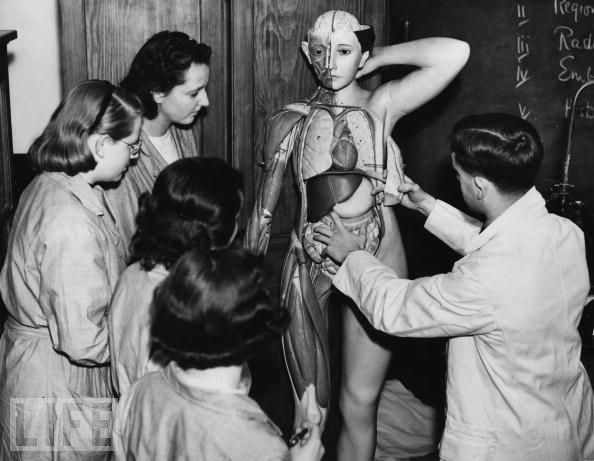
"Excellent Old-School Science Models," Life Magazine Photo Gallery


The images you see above--and the captions below--are drawn from a really fantastic Life Magazine online photo gallery entitled "Excellent Old-School Science Models." You can see the entire gallery of 29 images--well worth your perusal!--by clicking here.

Captions top to bottom, as supplied by the gallery:

  1. Isn't She Lovely: Trainee nurses examine a model of a human body to learn anatomy, Gerry Cranham, Oct. 7, 1938
  2. Behind It All: A technician works on life-like models for use in science and health lectures at the Cologne Health Museum in Germany, Ralph Crane, Feb 01, 1955
  3. Going Deep: A technician at the Cologne Health Museum gets into his work, Ralph Crane, Feb 01, 1955
  4. The Egg Factory: An exhibit illustrates the biology of the chicken at the World Poultry Exhibition at the Crystal Palace exhibition hall in London, Fox Photos, Jul 28, 1930
  5. Universal: A girl scout leans in to take a closer look at an enclosed model of the solar system, circa 1920s, George Eastman House, Jan 01, 1920

Found via Morbid Anatomy Library intern Amber Duntley's Facebook feed. Thanks, Amber!

"The Rogue Taxidermy Kunstkammer," The Minnesota Association of Rogue Taxidermists, La Luz de Jesus, Los Angeles


This just in from Congress for Curious People participant and Friend-of-Morbid-Anatomy Robert Marbury; if I was in the greater Los Angeles area, I'd surely be there:

The Minnesota Association of Rogue Taxidermists proudly presents The Rogue Taxidermy Kunstkammer
Our contemporary culture has seen a growing interest in taxidermy fueled by the internet, ambivalence about the food industry, and concerns over animal extinction. The representation of animal form is wide-ranging, and this exhibition presents the first major group show of Rogue Taxidermy. Rogue Taxidermy, a mixed-media art utilizing taxidermy materials, is more closely related to Surrealism than to mainstream taxidermy. Ranging from the macabre to the sublime, this exhibition explores the Borgesian imaginary made real.

Featuring:
SCOTT A. A. BIBUS
SARINA BREWER
MELISSA DIXON
ENRIQUE GOMEZ DE MOLINA
JESSICA JOSLIN
JEANIE M
ROBERT MARBURY
ELIZABETH MCGRATH
ALAN WADZINSKI
BROOKE WESTON
MIRMY WINN

The Show runs May 7th - May 30th

OPENING RECEPTION
Friday May 7th, 8pm-11pm

SQUIRREL MASTERCLASS/GAMEFEED
This event will include a taxidermy demo, followed by Squirrel Chili. A vegan "Mock-Squirrel" Chili will also be available. Sponsored by Schmaltz Brewing Company.
Saturday May 8th 6pm-10pm

LA LUZ DE JESUS
4633 Hollywood Blvd
Los Angeles CA 90027
Phone: 323-666_7667
http://www.laluzdejesus.com

* All members adhere to a strict ethics charter. Only animals procured in an ethical and environmentally responsible manner were used, and none of the animals were killed for the purpose of this artwork.
* A portion of the proceeds of this show will be given to a local wildlife rehabilitation center.

For more information, check out the La Luz de Jesus website by clicking here. You can find out more about The Minnesota Association of Rogue Taxidermists by clicking here. Click on image to see larger version.

"Museums, Monsters and the Moral Imagination" Lecture by Stephen Asma, Tonight!, Observatory


As discussed in this recent post, tonight professor Stephen Asma of Chicago's Columbia College will be at Observatory to deliver a much-anticipated lecture "Museums, Monsters and the Moral Imagination." This heavily-illustrated lecture will draw on the scholarship explored in two of his books--the very influential Stuffed Animals and Pickled Heads and his new On Monsters--and will examine how science museums and monsters both illustrate the essential yet problematic human "urge to classify, set boundaries, and draw lines between the natural and the unnatural the human" and to "try to excavate some of the moral uses and abuses of this impulse."

Asma's written work--which has influenced my own projects immeasurably--is scholarly yet conversational, fun yet of the utmost earnestness; I am sure his lecture will strike the same balance, making this lecture truly not-to-be-missed. Both of Dr. Asma's books will be available for sale and signing at the event. Full details follow; hope very much to see you there!

Museums, Monsters and the Moral Imagination
An Illustrated lecture with Professor Stephen Asma, author of Stuffed Animals and Pickled Heads: the Culture and History of Natural History Museums and On Monsters.
Date: Tonight, Thursday, April 22
Time: 8:00 PM
Admission: $5
Presented by Morbid Anatomy

In this illustrated lecture, professor Stephen Asma–author of the the definitive study of the natural history museum Stuffed Animals and Pickled Heads: the Culture and History of Natural History Museums–will draw upon his studies of science museums and monsters to reflect on their often hidden moral aspects. Museums are saying more about values than many people notice, and the same can be said about our cultural fascinations with monsters. The urge to classify, set boundaries, and draw lines between the natural and the unnatural are age-old impulses. In this lecture, Dr. Asma will try to excavate some of the moral uses and abuses of this impulse.

Stephen T. Asma is the author of Stuffed Animals and Pickled Heads: the Culture and History of Natural History Museums (Oxford) and more recently On Monsters: an Unnatural History of Our Worst Fears (Oxford). He is Professor of Philosophy at Columbia College Chicago and Fellow of the LAS Research Group in Mind, Science and Culture at Columbia. You can find out more about him at his website, http://www.stephenasma.com.

You can find out more about this presentation here. You can get directions to Observatory--which is next door to the Morbid Anatomy Library--by clicking here. You can find out more about Observatory here, join our mailing list by clicking here, and join us on Facebook by clicking here. To find out more about Asma's fantastic books, click here and here.

Image: From The Secret Museum; Pathological Cabinet, the Museum of the Faculty of Medicine at the Jagiellonian University, Krakow. © Joanna Ebenstein

"The Silken Web: The Erotic World of Paris, 1920-1946," Mel Gordon Lecture at Observatory, Tomorrow April 20th


Tomorrow night! At Observatory!

The Silken Web: The Erotic World of Paris, 1920-1946
An illustrated lecture by Professor Mel Gordon, author of Voluptuous Panic: The Erotic World of Wiemar Berlin

Date: Tuesday, April 20

Time: 8:00 PM

Admission: $5

Presented by Morbid Anatomy

In tonight’s illustrated lecture, Professor Mel Gordon–author of Voluptious Panic: The Erotic World of Weimar Berlin and Grand Guiginol: Theatre of Fear and Terror–will present a graphic look at the brothel worlds of interwar Paris. Each of the 221 registered maisons closes–French for “closed house”–had its own unique attractions for its specialized clientele: theatricalized sex, live music, pornographic entertainments, aphrodisiac restaurants, even American-style playrooms and wife-friendly lounges for the customers’ families and bored mistresses. Tonight, have some wine and partake in authentic French culture and their Greatest Generation, complements of Mel Gordon and Observatory.

Mel Gordon is the author of Voluptious Panic: The Erotic World of Weimar Berlin, Grand Guiginol: Theatre of Fear and Terror, and many other books. Voluptuous Panic was the first in-depth and illustrated book on the topic of erotic Weimar; The lavish tome was praised by academics and inspired the establishment of eight neo-Weimar nightclubs as well as the Dresden Dolls and a Marilyn Manson album. Now, Mel Gordon is completing a companion volume for Feral House Press, entitled The Silken Web: The Erotic World of Paris, 1920-1946. He also teaches directing, acting, and history of theater at University of California at Berkeley.

You can find out more about this presentation here. You can get directions to Observatory--which is next door to the Morbid Anatomy Library--by clicking here. You can find out more about Observatory here, join our mailing list by clicking here, and join us on Facebook by clicking here. To find out more about Gordon's books, click here and here.

"Stuffed Animals and Pickled Heads" Book and Lecture by Stephen Asma, Thursday April 22, Observatory


People often ask me how I first became interested in the topics that would lead me to launch the Morbid Anatomy blog and related projects, such as The Secret Museum and Anatomical Theatre exhibitions. When I am asked this question, I usually rattle off a few of my major serendipitous inspirations: my first trip to Europe and the death-symbolism-packed churches and osteo-architecture I was surprised to find there; The gift of a Mütter Museum Calendar for my birthday one year from a well-meaning friend; And, last but never least, the discovery of Stephen Asma's wonderful, incredible, perfect book Stuffed Animals and Pickled Heads: the Culture and History of Natural History Museums.

Asma's book has had such a profound impact on my work that it is difficult to exaggerate its importance. The book is a conversationally toned yet extremely scholarly "natural history of natural history museums," covering, with wit and intelligence, the history of specimens preparation and the artists and pioneers of the medium, the evolution of the museum from Cabinet to comparative anatomy collection to today's science museum, the history and follies of taxonomy, and what the drive to order the world reveals about human nature. Over the course of the book, Asma introduces us to a number of incredible museums I have now--inspired largely by this book!--visited and photographed many times, such as London's Hunterian Museum and Paris' Hall of Comparative Anatomy, and all this in an accessible, enthralling, humorous, and fascinating way.

This is why I am so extremely delighted that Stephen Asma will be visiting Observatory this Thursday, April 22, to deliver his much-anticipated lecture "Museums, Monsters and the Moral Imagination." This heavily-illustrated lecture will draw on the scholarship of both Stuffed Animals and Pickled Heads and new book, On Monsters, to examine how science museums and monsters both illustrate the essential yet problematic human "urge to classify, set boundaries, and draw lines between the natural and the unnatural the human" and to "try to excavate some of the moral uses and abuses of this impulse."

Both of Dr. Asma's books will be available for sale and signing at the event. Full details follow; hope very much to see you there!

Museums, Monsters and the Moral Imagination
An Illustrated lecture with Professor Stephen Asma, author of Stuffed Animals and Pickled Heads: the Culture and History of Natural History Museums and On Monsters.
Date: Thursday, April 22
Time: 8:00 PM
Admission: $5
Presented by Morbid Anatomy

In this illustrated lecture, professor Stephen Asma–author of the the definitive study of the natural history museum Stuffed Animals and Pickled Heads: the Culture and History of Natural History Museums–will draw upon his studies of science museums and monsters to reflect on their often hidden moral aspects. Museums are saying more about values than many people notice, and the same can be said about our cultural fascinations with monsters. The urge to classify, set boundaries, and draw lines between the natural and the unnatural are age-old impulses. In this lecture, Dr. Asma will try to excavate some of the moral uses and abuses of this impulse.

Stephen T. Asma is the author of Stuffed Animals and Pickled Heads: the Culture and History of Natural History Museums (Oxford) and more recently On Monsters: an Unnatural History of Our Worst Fears (Oxford). He is Professor of Philosophy at Columbia College Chicago and Fellow of the LAS Research Group in Mind, Science and Culture at Columbia. You can find out more about him at his website, http://www.stephenasma.com.

You can find out more about this presentation here. You can get directions to Observatory--which is next door to the Morbid Anatomy Library--by clicking here. You can find out more about Observatory here, join our mailing list by clicking here, and join us on Facebook by clicking here. To find out more about Asma's fantastic books, click here and here.

Image: From The Secret Museum; Pathological Cabinet, the Museum of the Faculty of Medicine at the Jagiellonian University, Krakow. © Joanna Ebenstein