Industrial Strength Lungs

Anatomical lung necklace by missyindustry at Etsy

Anatomical lung necklace by missyindustry at Etsy

Handmade from sterling silver.
1.5 inches long.
Curb chain is 20 inches long.
Oxidized finish

Industrial style lungs by missyindustry over at Etsy for $62.  Found this after a friend asked me to find a lung-themed gift for her boyfriend who recently quit smoking. Great idea!

Kabinett des Grotesken ("Cabinet of the Grotesque"), Berliner Medizinhistorisches Museum der Charité, Spiegel Online


My friend, German journalist Michael Kneissler, just sent me a link to an article and an amazing short film celebrating the world famous Berliner Medizinhistorisches Museum der Charité on its 300th birthday, prompted by a new exhibition at the museum entitled "Charité--300 years of medicine in Berlin."

Following is an excerpt from the article--found on Spiegel Online and entitled "Kabinett des Grotesken" ("Cabinet of the Grotesque")--via a sloppy Google Translation:

Human malformations, surgical instruments, the Dildo-box of a sex researcher: The Collection of the Berlin Charité shows the dazzling variety of medical research. To mark its 300th anniversary Clinic presents highlights from the world famous now its archive.

Hands upset, steal: impossible. In the showcases the treasures of the Lord Virchow are safe. Very safe. And yet the guards sneak past every now and again. Ready to intervene immediately. They know that the temptation is to press for the issue "Charité - 300 Years of Medicine in Berlin" on the trigger...

Brains, livers, lungs, testes, ovaries removed - from the different and peaceful perished miserably, preserved in jars for viewing, Educate and quenching. An exhibition of the Interior, without taboos. Even human fetuses are also included. One with legs fused together, one with eyes grown together in the middle of the forehead. A Cyclops. Unreal and yet real.

Virchow himself called this collection - eagerly gathered for medical students and the public in order to warn of an unhealthy lifestyle - his "favorite child", for some visitors to the house if these preparations now the favorite image design: "Krass," it escapes some...

This dazzling looking exhibition is on view at the Berlin-based Medizinhistorisches Museum der Charité until February 2011; very much hope to see it before it comes down!

You can read the whole article and watch the wonderful video walk-through on the same page (just click the play button!) by clicking here. You can find out more about the museum in English by clicking here. Image above is drawn from the video.

Thanks so much to Michael Kneissler for sending this along!

"The Saddest Object in the World," An Illustrated Meditation, Observatory, Friday, May 7th


This Friday, Observatory and Morbid Anatomy will host Morbid Anatomy Library Scholar in residence and Obscura co-proprietor Evan Michelson as she leads us on an illustrated meditation on what she has termed "The Saddest Object in the World." This event is a reprise of Michelson’s popular Congress for Curious People presentation which took place at the Coney Island Museum earlier this month; if you missed Michelson's beloved presentation the first time around, I cannot encourage you enough to come out tonight and find out all about The Saddest Object in the World.

Full details follow; hope to see you there!

The Saddest Object in the World
An Illustrated Meditation by Evan Michelson, Obscura Antiques and Oddities, Morbid Anatomy Library Scholar in residence
Date: Friday, May 7th
Time: 8:00 PM
Admission: $5
Location: Observatory

“The Saddest Object in the World” is a meditation on one particular artifact; an exercise in Proustian involuntary memory, aesthetic critique, and philosophical bargaining.

Sometimes objects have consequences.

Evan Michelson is an antiques dealer, lecturer, accumulator and aesthete; she tirelessly indulges a lifelong pursuit of all things obscure and melancholy. She currently lives in another place and time.

You can find out more about this presentation here. You can get directions to Observatory--which is next door to the Morbid Anatomy Library (more on that here)--by clicking here. You can find out more about Observatory here, join our mailing list by clicking here, and join us on Facebook by clicking here.

Skin Drawings

These ink drawings by Lynn Palewicz are really cool looking. Here’s what she has to say about the collection.

This series of drawings describes a relationship between touch, tension, and surface.  Each piece uses the body to distort a variety of images and marks drawn onto skin.  Pinches, creases, and scratches marked onto its surface function as drawing elements alongside these penned images and marks.  Photography more than documents the performance of these drawings; it disorients the viewer’s relationship to the body and represents the skin as a drawing surface.

Check the rest out here!

[via beautifuldecay]

"Experimenting with Death: An Introduction to Terror Management Theory," Lecture, Observatory, Thursday May 6


This Thursday, May 6, join Morbid Anatomy and Michael Johns at Observatory for a night of all things Terror Management Theory! Full details follow; This will be a very good night and I hope very much to see you there!

Experimenting with Death: An Introduction to Terror Management Theory
An Illustrated Lecture by Michael Johns, Former Assistant Professor of Psychology at the University of Wyoming
Date: Thursday, May 6
Time: 8:00 PM
Admission: $5
Presented by Morbid Anatomy

In his Pulitzer Prize-winning book, Denial of Death, cultural anthropologist Ernest Becker attempted to develop a unified theory of human behavior. He argued that it was the human capacity to grasp and contemplate our own mortality–and our need to suppress this knowledge–that was at the root of human culture and behavior, from genocide to altruism, religion to philosophy. Terror Management Theory (TMT) is a psychological theory directly based on Becker’s work, developed by a group of social psychologists interested in testing Becker’s assertions about death as a core motivator of human behavior. Over the last 25 years, psychologists in the North America, Europe and the Middle East have conducted hundreds of studies to test hypothesis derived from Becker’s work and the Terror Management Theory it inspired. This body of research compellingly supports Becker’s thesis and reveals the ways in which mortality salience influences behaviors ranging from aggression and stereotyping to creativity and sexuality. Using segments from the documentary “Flight from Death: The Quest for Immortality,” this lecture will introduce Terror Management Theory and discuss the often clever experiments that have been conducted to test its tenets.

Michael Johns is a social psychologist and works as a research scientist in the NYC Department of Health. He has published numerous research articles and book chapters on a variety of topics, including Terror Management Theory. Before moving to Brooklyn, Mike was an Assistant Professor of Psychology at the University of Wyoming.

You can find out more about this presentation here. For more on Ernest Becker's wonderful book Denial of Death, click here; for more on the film "Flight From Death - The Quest for Immortality," click here. You can get directions to Observatory--which is next door to the Morbid Anatomy Library--by clicking here. You can find out more about Observatory here, join our mailing list by clicking here, and join us on Facebook by clicking here.

This Friday at Observatory: Live Human Dissection, Lecture and Book Launch by The Hollow Earth Society


This Friday! At Observatory! Live human dissection, lecture and Book Launch by The Hollow Earth Society; full details follow. Hope to see you there!

Suspicious Anatomy: Lecture, Live Human Dissection, and Book Launch The Hollow Earth Society presents SUSPICIOUS ANATOMY Workbook No. 15: The Human Cranius Lecture, Live Human Dissection and Book Launch Date: Friday, July 16th Time: 8:00 PM Admission: $5

"Not since Galen’s De Elementis has been set in ink a single compendium of medicological knowledge so extensive & practicably useful as SUSPICIOUS ANATOMY Workbook No. 15: The Human Cranius. Having intrinsic value to all persons—piratical, mysterious, upright, or otherwise—The Human Cranius is a PEERLESS GEM of uncanny truth. If you are a living human, you should make frequent, unabashed forays into this field guide to your hideous secondary body—the cranius, an organ-matrix & carnival of fangs which is trying to destroy you even as you read this sentence…"

From the genre-chainsawing minds of the Hollow Earth Society (Ethan Gould and Wythe Marschall) comes “the definitive guide to the horrifying world inside you”—finally available in lush, illustrated paperback!

In the tradition of John Hodgman, David Cronenberg, and H. P. Lovecraft, The Human Cranius explores an alternative anatomy at once mesmerizing and deeply unsettling. Gould and Marschall ask: What do we know about our own bodies? The answer: Very little…

In many ways, the art and human studies of modernity have given us the keys to our unconscious minds, but have left entirely to dry science (fixing plumbing, testing drugs) the workings of our bodies. What does it feel like to have guts? To face disease, age, mutation—in short, a self that is not only not whole but not even on its own side?

The SUSPICIOUS ANATOMY series seeks to address these physio–psychomological imbalances by producing, for your benefit, the entire unconscious of the body, the shadow-self, in words and elaborate images.

The official Human Cranius book launch features a lecture, medicological film snippets, and a live human dissection. Join us!

About the Hollow Earth Society: For over one hundred years, the Hollow Earth Society has probed the world’s most bizarre and pertinent mysteries via an ever-mutating set of handbooks, rogue histories, and practical manuals. The Society is currently led by Colonels Ethan Gould and Wythe Marschall.

Ethan Gould is a Brooklyn-based artist working in drawing, puppetry, writing, and video to exploit the moments when the formerly robust process of perceptual categorization snaps like the fragilest of dry twigs. A graduate of the University of Rochester, he helped to create several development programs at the American Folk Art Museum. His work has appeared in such disparate places as the Ontological-Hysteric Theater, The Assembly Theater Company, The Brooklyn Review, Pomp & Circumstance, and ABC’s Wife Swap.

Wythe Marschall is writer. A graduate of Bennington College and the MFA fiction program at Brooklyn College, where he teaches undergraduate literature, Wythe has published stories and essays in McSweeney’s Quarterly Concern, Ninth Letter, and elsewhere. He is the senior editor of the Atlas Obscura and an editor of Pomp & Circumstance, as well as a frequent reader for Electric Literature. His thoughts on letters, postmodernity, and hip hop can be found on his website, chronolect.com.

You can find out more about these presentation here. You can get directions to Observatory--which is next door to the Morbid Anatomy Library (more on that here)--by clicking here. You can find out more about Observatory here, join our mailing list by clicking here, and join us on Facebook by clicking here.

Auction Report: "The Gallery of Creation, a Museum of Natural History, Created by Joseph Hurt Studio, Inc."


\
Video: The Gallery of Creation Adventure of Lion & Lamb
Watch robotic animals discuss the creation of the world from a biblical prospective. Found here.

Regular Morbid Anatomy readers might recall a recent blog post about the a Georgia-based creationist natural history (sic) museum--"The Gallery of Creation, a Museum of Natural History"--being disseminated at public auction. Morbid Anatomy reader Sarah of the blog A Discourse on the Arts and Sciences was curious to know the outcome of that auction; Following is her exclusive investigative report, for your reading pleasure:

While the contemporary art market has struggled over recent months in terms of desirable material entering the market, the antiques market has been blessed. In particular, the genres of natural history, taxidermy and, surprisingly, kitsch have been a virtual goldmine in recent weeks, which have been bolstered even further by interesting provenances as well.

The Australian sale of the Owsten Collection (see report here) sold extremely well, with numerous pieces of highly significant natural history selling well above high estimates. I was particularly in love with the collector’s cabinets, myself.

Another captivating sale which I heard of, via Morbid Anatomy (thank you), was the de-accessioning of the collection of "The Gallery of Creation, A Museum of Natural History" on June 25th and 26th in Social Circle, Georgia (more on that here).

This Creationist natural history museum was founded by William Hurt Studios and catered to church groups, school classes and family outings. I wish I had gotten a chance to see it before it closed.

I have to admit, my first reaction was one of sheer captivation. What a great combo, natural history and that special kind of kitsch which only seems to happen in the South. Maybe my family stopped at too many tourist destinations during my childhood, but I shamelessly confess to a love of this kind of nostalgia. I envisioned lots of big blonde hair waving paddles for--quite simply--one of the oddest assortment of items I have ever come across available for sale in one place.

This particular sale was one of those examples of the sometimes odd attractions collectors can have. It certainly wasn’t about the ‘finest’, or art--it was about the sometimes most determined aspect of our attractions --nostalgia --as well as an occasional appreciation for good old fashioned camp.

In following up to the sale, I found that many of the pieces did sell quite reasonably. Prices do not include buyer’s premiums.


Oil Painting on Canvas of the Ark
8’6” wide x 5’ high
$600


Model of a Velosoraptor
$425


Vitrine Display of Various Skeletons & Skulls
14 feet wide x 9 feet high x 4 feet deep
$4,250


Vitrine Display of Seascape with Animation Features
12 feet wide x 9 feet high x 4 feet deep
$2,600


Vitrine of Mounted Birds, including Peacock, Toucan,
numerous parrots (Sphinx Macaw) and others
13 feet wide x 9 feet high x 4 feet deep
$4,100


Large Animated Vitrine of Lion & Lamb Conversing
$3,750

Another upcoming auction item worthy of pangs of nostalgia, as well as camp, is none other than Trigger himself, the trusted companion of Roy Rogers to be sold on July 14th in New York. The dispersal of the Roy Rogers & Dale Evans Museum Collection is being handled entirely by Christies and will take place on July 14th and 15th; more on that here.


TRIGGER (1934-1965)
Estimated $100,000 - $200,000.
Roy Rogers & Dale Evans Museum Collection

Entertaining the masses so thoroughly for over two decades, Roy Rogers and Trigger were one of America's most recognizable duos, becoming instant classics in people's eyes, hearts and imaginations. Trigger also reached legendary status in his own right, and is undeniably one of the most memorable horses that ever lived. Trigger was apparently purchased for $2,500 back in the day.

Thanks so much, Sarah, for the excellent report. More information of the Museum of Creation can be found here. For backstory on the auction, click here. Click here to find out more about the Roy Rogers & Dale Evans Museum Collection auction. Click here to check out guest-poster Sarah's lovely blog A Discourse
on the Arts and Sciences
.

Head of Discovery and Engagement, Wellcome Library, Employment Opportunity


To quote the new call for applications for "Head of Discovery and Engagement at the Wellcome Library," "The Wellcome Library is the one of the world's great cultural treasures: a unique and irreplaceable collection, which documents medicine and its role in society, past and present." The Wellcome Library also happens to be one of my favorite places in the world, and the newly created position of "Head of Discovery and Engagement" seems like a potentially pretty darn great job.

The closing date for applications is May 10th; full job description and details follow:

Head of Discovery and Engagement
Wellcome Library
Closing Date: 5/10/2010
Salary: £50 000 - £60 000

Job Details
The Wellcome Trust is a global charity dedicated to achieving extraordinary improvements in human and animal health. We support the brightest minds in biomedical research and the medical humanities.

The Wellcome Library is the one of the world's great cultural treasures: a unique and irreplaceable collection, which documents medicine and its role in society, past and present. As Head of Discovery and Engagement, you will play a pivotal role in making these outstanding collections accessible, a key part of an ambitious strategy to transform the Wellcome Library. This will include revolutionising our web presence and reading-room services to meet the needs of existing and new audiences and developing the Library's role as not only a world-class research resource, but also as part of Wellcome Collection, one of London's most exciting cultural destinations.

A passionate advocate for our collections, you will lead the Library's outreach, communication and marketing activities and, by developing our understanding of users and their needs, ensure we have a robust framework for evaluating our success. As a key member of the senior management team, reporting to the Head of Library, you will need to demonstrate: significant experience in a public/user focused role in a cultural environment; a commitment to audience development and engagement programmes; a proven understanding of commissioning audience research and evaluation; a good knowledge of social media and web technologies and experience of creating/commissioning web content; previous staff management experience and an ability to manage budgets/resources; excellent written and verbal communication skills across a broad range of stakeholders; a demonstrable ability to contribute creatively and enthusiastically at a strategic level. In addition a strong interest in the history of health, medicine or science would be advantageous.

For more information on the Wellcome Library and the transformation strategy, please visit: http://library.wellcome.ac.uk For more information on this role or a job description and to apply online visit: http://www.wellcome.ac.uk/jobs Alternatively write to: HR, Wellcome Trust, 215 Euston Road, London, NW1 2BE. Please send a CV (including salary details) and covering letter explaining how you meet the criteria and what you feel you can bring to this role.

You can find out more by clicking here. To find out more about the astounding Wellcome Library, click here.

Image: The Wellcome Library via Himetop and drawn from chrisjohnbeckett's Flickr photostream.

Talking While Driving

talking while driving Mudra Group

talking while driving Mudra Group

talking while driving Mudra Group

From what I could gather from the awesome Google translate tool, the Bangalore traffic police teamed up with the advertising agency, Mudra Group, India, to make this series of public service announcements warning people of the risk of talking on the phone with people while they are driving. Pretty graphic and certainly attention grabbing, I think the last one is my favorite, epic expression.

[via designlenta and designyoutrust]

Tomorrow Night at Observatory! "Three Unique Medical Museums in Northern Italy," Lecture by Marie Dauenheimer


Just a quick reminder: tomorrow night at Observatory! Marie Dauenheimer--the curator of the "Anatomical Art: Dissection to Illustration" exhibition discussed in this recent post--will be on hand at Observatory to deliver an illustrated lecture that "will survey the collections of three unique and often over-looked anatomical museums in Northern Italy." You can read a full description here. Full event details follow; hope very much to see you there!

Three Unique Medical Museums in Northern Italy
An illustrated presentation by Marie Dauenheimer of the Vesalius Trust
Date: May 1, 2010
Time: 8:00 P.M.
Admission: $5
Presented by Morbid Anatomy

Tonight’s visual presentation by Marie Dauenheimer will survey the collections of three unique and often over-looked anatomical museums in Northern Italy which Dauenheimer toured as part of last years Vesalius Trust “Art and Anatomy Tour.” First, the University of Florence Museum of Pathological Anatomy, famous for its collection of wax pathological models created in the 19th century, including an amazing life size leper; then The Museum of Human Anatomy in Bologna featuring the work of famed wax modeling team of Anna Morandi Manzolini and her husband Giovanni Manzolini, whose life size wax models inspired Clement Susini and the wax-modeling workshop in Florence (see image above); and lastly the fascinating University of Pavia Museum of Anatomy, which houses the beautiful 18th century frescoed dissection theater, where anatomist Antonio Scarpa. So join us tonight for wine, fellowship, and a virtual and very visual tour of some of the finest and most fascinating medical museums of Italy!

Marie Dauenheimer is a Board Certified Medical Illustrator working in the Washington, DC Metropolitan area. She specializes in creating medical illustrations and animations for educational materials, including posters, brochures, books, websites and interactive media. Since 1997 Marie has organized and led numerous “Art and Anatomy Tours” throughout Europe for the Vesalius Trust. Past tours have explored anatomical museums, rare book collections and dissection theatres in Italy, The Netherlands, Belgium, France, Scotland and England. In addition to illustrating Marie teaches drawing, life drawing and human and animal anatomy at the Art Institute of Washington. Part of Marie’s anatomy class involves study and drawing from cadavers in the Anatomy Lab at Howard University College of Medicine in Washington, DC (for more on that, see this recent post).

You can find out more about this presentation here. You can get directions to Observatory--which is next door to the Morbid Anatomy Library--by clicking here. You can find out more about Observatory here, join our mailing list by clicking here, and join us on Facebook by clicking here. To learn more about Marie's "Anatomical Art: Dissection to Illustration" exhibition, click here. For more on the Vesalius Trust, click here.

Image: Self-portrait of wax modeller Anna Morandi Manzolini dissecting a human brain, Bologna, c. 1760; Via Scienza a Due Voci

Kim Joon

Kim Joon

Kim Joon

Kim Joon

Kim Joon

Kim Joon brings to life his surface patterns and textures by using the human body as his canvas.  The patterns he creates using repetitive color, skin tones, and body parts creates a finished work reminiscent of a wall paper or tapestry.  I love how he utilizes the skin to peek through his patterns.  So much more can be seen here!

[via BeautifulDecay]

"Imaging / Imagining the Skeleton," Symposium, Tomorrow, Friday, April 30, 1:00-4pm, CUNY Graduate Center


I just found out about a pretty intriguing looking event taking place in New York City tomorrow afternoon: "Imaging / Imagining the Skeleton," a free Symposium at CUNY Graduate Center. Participants include friend-of-Morbid-Anatomy and future Observatory lecturer (click here for details) Mark Dery.

Full details below; hope to see you there!

Imaging / Imagining the Skeleton
Friday, April 30, 1:00-4pm
CUNY Graduate Center, 365 Fifth Ave. (at 34th St.), NYC
Rooms 9206 / 9207
No reservations. First come, first seated
Caroline Jones KEYNOTE, MIT, History, Theory, Art History
Vincent Stefan, Lehman College CUNY, Anthropology
Lisa E. Farrington, John Jay College CUNY, Art History and Race
Mark Dery, Independent Scholar
Tatiana Garmendia, Artist
Dr. Joseph Lane, Hospital for Special Surgery, Orthopedic Surgery
Co-Sponsored by the Ph.D. Program in Art History and Science & the Arts CUNY Graduate Center; Funded by the John Rewald Endowment of the Ph.D. Program in Art History

Imaging/Imagining the Skeleton is a symposium organized to explore how social conceptions of the human form have evolved alongside the increasing ability of science/medicine to represent the body. The speakers will present a constellation of inter-disciplinary discussions about the relationship between representing/exhibiting the body, evolving conceptualizations of the body and bones, and artistic and professional responses to new medical imaging technologies. The underlying proposition is that the ability to investigate and represent the body—at the levels of both anatomy and function—has exerted a profound impact on how the relationship between the physical body and human experience is conceived. Those changing conceptions, in turn, have had far-reaching consequences for the humanities, social sciences, public policy, and artistic practice.

Symposium attendees will receive a catalogue from the exhibition Visionary Anatomies, originally presented at the National Academy of Sciences.

Introductory remarks by Kevin Murphy, Professor of Art History. Panel discussion moderated by Adrienne Klein, co-Director, Science & the Arts.

Speaker Bios and Paper Topics
Professor Caroline Jones will speak on “Senses, mediation, and selves beyond the skin.” Jones explores selected art works that use the trope of the skeleton to indicate “penetrating” views of the self, but contrasts these with a recent sensory turn that suggests a broader critique of modern ocularity. Caroline Jones studies modern and contemporary art, with a particular focus on its technological modes of production, distribution, and reception. Previous to completing her art history degree, she worked in museum administration and exhibition curation, holding positions at The Museum of Modern Art in New York (1977-83) and the Harvard University Art Museums (1983-85), and completed two documentary films. In addition to these institutions, her exhibitions and/or films have been shown at the San Francisco Museum of Modern Art, the Hirshhorn Museum and Sculpture Garden in Washington DC, the Hara Museum Tokyo, and the Boston University Art Gallery, among other venues. She is the recipient of fellowships from the National Endowment for the Humanities and the John Simon Guggenheim Foundation (among others), and has been honored by fellowships at the Wissenschaftskolleg zu Berlin and the Max Planck Institüt (2001-02), the Institute for Advanced Studies in Princeton (1994-95), and the Stanford Humanities Center (1986-87). Her books include Machine in the Studio: Constructing the Postwar American Artist, (1996/98, winner of the Charles Eldredge Prize from the Smithsonian Institution); Bay Area Figurative Art, 1950-1965, (1990, awarded the silver medal from San Francisco's Commonwealth Club); and Modern Art at Harvard (1985).

Professor Vincent H. Stefan, Lehman College CUNY, will speak on “Human Skeletal Variations” as it relates to analysis of skeletal structures both prehistoric and contemporary. Dr. Stefan's field of general interest is physical anthropology with specialization in human skeletal biology. His fields of study include human osteology and skeletal biology; forensic anthropology; paleoanthropology; quantitative methods; Rapa Nui (Easter Island) skeletal biology; Polynesian skeletal biology. Current research interests include the documentation and analysis of contemporary and prehistoric human skeletal variation. Future research will focus on the use of these same procedures to assess metric cranial/skeletal variation for understanding the peopling of all of Polynesia and Oceania. Currently Professor Stefan regularly consults with the Nassau County Medical Examiner, East Meadow, NY, the Suffolk County Medical Examiner, Hauppauge, NY, and the Westchester County, Department of Laboratories & Research, Office of the Medical Examiner, Valhalla, NY in cases involving human skeletal remains. He is expert in the recovery of decomposed/ skeletonized human remains, and in the identification of victims from skeletal remains.

Professor Lisa E. Farrington will speak on “de Bouffon's 1805 published autopsy findings on the body of Sartjie Baartman” Professor Lisa E. Farrington is the founding Chair of John Jay’s Art & Music Department, as well as an accomplished curator, author, and art historian. In 2007-2008 she was awarded the prestigious William and Camille Cosby Endowed Scholars chair at Atlanta University’s historically black women’s college, Spelman. She has earned numerous academic degrees, including PhD and Master of Philosophy degrees from the CUNY Graduate Center in New York, an MA in art history from American University, a BFA (magna cum laude) from Howard University, and an Honors Degree in painting and illustration from New York's School of Art & Design. Dr. Farrington worked for many years at the Museum of Modern Art and, from 1994 to 2007, was senior art historian at Parsons School of Design (the fine arts division of The New School). She specializes in Western and Non-Western Art, Haitian Art and Vodou Culture, African-American Art, Women’s Art, and Race and Gender studies. She has also taught the on-site museum art history course at Parsons Atelier in Paris, France. Dr. Farrington is a Mellon, Magnet, U.S. State Department, and Ford Foundation Fellow, and was a consultant for The College Board’s Advanced Placement (AP) Art History program. She has published ten books and a dozen scholarly essays in the past decade, including two monographs on artist Faith Ringgold, and a 2005 textbook for Oxford University Press entitled Creating Their Own Image: The History of African-American Women Artists, which recently won three major academic literary awards, including the American Library Association Award for Outstanding Contribution to Publishing, the American Association of Black Women Historians Annual Book Award, and the Richard Wright/Zora Neale Hurston Foundation nomination for non-fiction. She recently won the Andy Warhol Foundation / Creative Capital Arts Writers prize for 2010.

Mark Dery will speak on "The Anatomical Unconscious: X-Ray Specs, Visible Women, and the Eros of the Unseen," a cultural critique of the eroticizing of the scientific gaze. Mark Dery is a cultural critic. His byline has appeared in publications ranging from The New York Times Magazine to Rolling Stone to Salon to Cabinet, and his lectures have taken him to Australia to Aust
ria, Belgium to Brazil, Macedonia to Mexico. He has been a professor in the Department of Journalism at New York University, a Chancellor’s Distinguished Fellow at UC Irvine, and a Visiting Scholar at the American Academy in Rome. Dery is best known for his writings on the politics of popular culture in books such as The Pyrotechnic Insanitarium: American Culture on the Brink and Escape Velocity: Cyberculture at the End of the Century. He is widely associated with the concept of “culture jamming,” the guerrilla media criticism movement he popularized through his 1993 essay “Culture Jamming: Hacking, Slashing, and Sniping in the Empire of the Signs,” and “Afrofuturism,” a term he coined and theorized in his 1994 essay “Black to the Future” (included in the anthology Flame Wars: The Discourse of Cyberculture, which he edited). More at http://www.markdery.com.

Tatiana Garmendia, MFA, will speak by remote uplink on her “X-ray Painting and Graphite Series”and explore some of the dichotomies between actual and conceptual representations of body and bones. Tatiana Garmendia is a figurative artist with a conceptual twist. Her work synthesizes formal concerns and a humanist engagement with history and culture. Born in Cuba, she was raised a devotee of Santeria - the syncretic mix of Yoruba mysticism and Spanish Catholicism. She also hails from a family of doctors and medical researchers. “I grew up in a household where the human body, in various guises of dejection and exaltation, was a primary theme in devotional and medical imagery. In my earliest recollections, the body is both flesh and mythological certainty." Repatriation from the Spanish government took the artist’s family first to Madrid, and later to the U.S.A. She studied at the School of the Museum of Fine Arts in Boston, and has degrees from Florida International University, and Pratt Institute of Art, Brooklyn.

Dr. Joseph Lane, MD, Professor Orthopedic Surgery and Assistant Dean, Weill Cornell Medical College and Chief Metabolic Bone Disease Hospital for Special Surgery, will speak on “Reconstructing the Skeleton.” He presents the skeleton including radiographs, bone scans, PET scans, CT scans and MRI, and will suggest some of the implications of changing methods for “reading” skeletons and bones. Joseph M. Lane, MD has published extensively on bone biology, tissue injury and repair, trauma, bone and soft tissue sarcomas (including osteogenic sarcoma and Ewing’s sarcoma), limb preservation, functional amputations, limb regeneration, and metabolic bone diseases (osteoporosis, Paget’s disease, rickets, osteomalacia, fibrous dysplasia). He has served on numerous committees for the AAOS, including the Board of Directors and Chairman of COMSS, the Chairman Oversight Panel on Women’s Health Issues. He was President of the Orthopaedic Research Society, Musculoskeletal Tumor Society, Chairman of NIH Orthopaedic Study Section, OREF grants review board, ABOS Question Writing Task Force. He is a member of the AAOS, AOA, ABJS, ASBMR, ORS, MSTS, and OTA. He has earned NIH career and R01 grants, OREF grants, and foundation awards. He has been a visiting professor at educational institutes and is on the editorial board of several peer journals.

Thanks so much to friend, artist, and book-club partner Laura Splan for tipping me off to this!

Image (click on image to see much larger version): from Mike Sappol and the National Library of Medicine's incomparable Dream Anatomy Exhibition; Caption reads: Elementi di anatomia fisiologica applicata alle belle arti figurative, Turin, 1837-39. Lithograph. National Library of Medicine; Francesco Bertinatti (fl. mid-1800s) [anatomist]; Mecco Leone [artist]. The anatomical studies for real, imaginary and prospective sculptures and paintings became a genre in its own right in the early and middle decades of the 19th century.

Synthetic Being

Luke Hart created these surreal sculptures called “Synthetic Being” that mimic human body features like skin, hair and veins, showcasing the connections between our bodies and foreign elements. Very cool looking. I would love one of these in my home!

[via Freshbump]

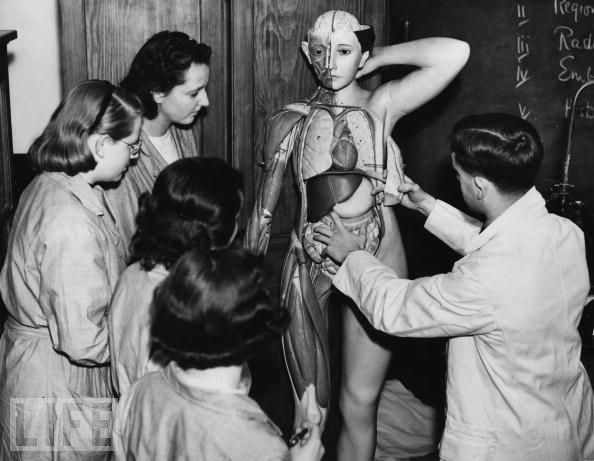
"Excellent Old-School Science Models," Life Magazine Photo Gallery


The images you see above--and the captions below--are drawn from a really fantastic Life Magazine online photo gallery entitled "Excellent Old-School Science Models." You can see the entire gallery of 29 images--well worth your perusal!--by clicking here.

Captions top to bottom, as supplied by the gallery:

  1. Isn't She Lovely: Trainee nurses examine a model of a human body to learn anatomy, Gerry Cranham, Oct. 7, 1938
  2. Behind It All: A technician works on life-like models for use in science and health lectures at the Cologne Health Museum in Germany, Ralph Crane, Feb 01, 1955
  3. Going Deep: A technician at the Cologne Health Museum gets into his work, Ralph Crane, Feb 01, 1955
  4. The Egg Factory: An exhibit illustrates the biology of the chicken at the World Poultry Exhibition at the Crystal Palace exhibition hall in London, Fox Photos, Jul 28, 1930
  5. Universal: A girl scout leans in to take a closer look at an enclosed model of the solar system, circa 1920s, George Eastman House, Jan 01, 1920

Found via Morbid Anatomy Library intern Amber Duntley's Facebook feed. Thanks, Amber!

Ventricle Vase

Ventricle Vase designed by eva milinkovic

Ventricle Vase designed by eva milinkovic

This gorgeous vase, designed by Eva Milinkovic of Ontario-based Tsunami Glassworks, does a wonderful job of representing the beauty and flux of emotion attributed to the heart.  Eva is actually the creative director of Tsunami Glassworks and imbues each piece she does with her passion for “bright colors, organic, fluid forms and tactile objects.”

[thanks to everyone who submitted this beautiful piece!]

John C. Miller

John C. Miller

John C. Miller

John C. Miller

These amazing pieces were created by visual & audio artist John C. Miller.

A bit from his artist statement:

“The human anatomy is the main focus of my work. My work explores the organs, tendons, tissues and muscles in their varied internal environments… The focus for several years now has been the heart’s interior.  The series, Interiors, attempts to explore the blood flow and constriction of flow.  More specifically it is inspired by my open heart surgery at age five…”

I seriously recommend checking out all of his work!