BioImagene to show its digital pathology solutions at European Congress

Comany sees increasing European demand for BioImagene solutions prompts expansion

Berlin, Germany,  May 27, 2010 – BioImagene, Inc., the leading provider of end-to-end digital pathology solutions, launched its suite of digital pathology solutions in Europe. The company will showcase these digital pathology solutions at the Woche der Pathologie Congress in Berlin, which takes place from May 27-30, 2010.

The solutions can also be viewed at the 10th European Congress on Telepathology and 4th International Congress on Virtual Microscopy, that will be held in Vilnius, Lithuania from July 1 – 3, 2010.

 to read the full press release.

Hastings Center Report – Medical Tourism

Came across this interesting article from The Hastings Center Report © 2010 The Hastings Center by I. Glenn Cohen reprinted on Medscape. The numbers and scenarios are staggering.  Its worth the read.

Medical Tourism: The View from Ten Thousand Feet

Medical tourism—the travel of patients from their home country to another for the primary purpose of seeking medical treatment—is already big business. In 2005, Bumrungrad International Hospital in Bangkok, Thailand, saw 400,000 foreign patients, 55,000 of whom were Americans, and centers in India, Malaysia, Singapore, Mexico, and elsewhere also attract significant foreign patient populations. Some of these patients are seeking care that is unavailable at home, such as surrogacy services or stem cell treatments. Others are uninsured or underinsured Americans looking for price savings (in some cases upwards of 80 percent) compared to what they would pay out of pocket in the United States. 

Governments, too, have taken interest. The U.S. Senate held a hearing, "The Globalization of Health Care: Can Medical Tourism Reduce Health Care Costs?" West Virginia considered (but ultimately rejected) a bill that would have given its public employees financial incentives to get treatment abroad (something many self-insured U.S. firms already do). Texas has taken steps to ban insurers from making their covered populations use health care services abroad. 

Medical tourism raises a panoply of legal and ethical questions. In this short space I offer only the view from ten thousand feet, setting out the different types of medical tourism and the kinds of concerns they can pose. Consider this as a statement of a kind of research agenda, one that I hope readers will join me and other scholars in developing. 

One can usefully distinguish three kinds of medical tourism.

Medical tourism for services that are illegal in both the patient's home and destination countries. Organ sale, which is illegal in all countries except Iran, is a good example. While in such cases both the patient's home and destination countries have decided to ban the practice, medical tourism raises a set of questions about extraterritoriality and the coordination of domestic and foreign regimes of criminal law. If a foreign country criminalizes organ sales but has a lax enforcement regime that essentially tolerates a gray market, should the United States use also its own criminal law against its citizens that purchase organs abroad? One model here would be the Protect Act of 2003, which levies either a fine or thirty years in prison or both in the United Statesfor any U.S. citizen or permanent resident "who travels in foreign commerce, and engages in any illicit sexual conduct" including "any commercial sex act … with a person under 18 years of age." Another possible approach (that is potentially even more draconian) currently in place to curb organ tourism is sketched in Medicare regulations requiring that physicians inform patients seeking organ transplantation that transplantation by an unapproved center "could affect the transplant recipient's ability to have his or her immunosuppressive drugs"—required to avoid tissue rejection—"paid for under Medicare Part B."

One set of ethical questions is whether these approaches go too far in their penalties; perhaps we should defer to the level of enforcement and penalties in the destination country. A corresponding set of pragmatic questions asks how we can do a better job of detecting this kind of medical tourism if we decide to penalize it through domestic criminal sanction.

Another set of questions focuses on the duties of U.S. doctors. If a patient is waiting for an organ and appears unlikely to get it, does his doctor have a duty if asked to inform the patient of better versus worse transplant centers dealing with such purchased organs abroad, or at least to refer the patient to a colleague who will? May a physician faced with a patient she determines has purchased an organ abroad and who now requires follow-up care decline to provide that care? Can she decline only if she finds another physician willing to provide care?

Medical tourism for services that are illegal in the patient's home country but legal in the destination country. Let me give three quite different examples of what might fall within this second category: (1) A same-sex married couple has difficulty in securing a traditional surrogate in their home state of Massachusetts (where surrogacy agreements involving compensation to traditional surrogates are unenforceable) and turns to a clinic in the village of Anand, India, where many women serve as surrogates and a clinic offers surrogacy services at one-third of the cost in the United States. (2) A patient with squamous cell carcinoma has run out of treatment options approved by the Food and Drug Administration and is also barred from joining a clinical trial of the experimental drug Erbitux because she does not meet the inclusion criteria, but travels to France, where the drug is available for purchase. (3) A patient travels abroad for physician-assisted suicide, which is illegal in her home country. 

These cases raise many interesting questions: for the surrogacy case, should we respect a country's sovereignty in deciding that this form of "exploitation" is not worthy of legal condemnation, and does the answer depend on our views about whether the exploited group was sufficiently enfranchised and able to participate in the democratic process? Should we view the development of fertility tourism markets as a welcome "safety valve" to our domestic prohibition, or should we instead view ourselves as responsible for creating the market through our domestic prohibition and thus complicit in whatever exploitation occurs?

For the assisted suicide or surrogacy case, if the fear is "corruption"—if we fear that the practice will change moral attitudes and lead to disrespect of the female body or those at the end of life then is the corruption likely to be contagious across cultures? For the drug case, will medical tourism make it more difficult to recruit people for randomized, double-blind clinical trials of experimental drugs in the United States? Does medical tourism produce problematic socioeconomic status inequalities in access to experimental drugs, in that the wealthy can travel abroad, while the poor cannot?

If, based on any of these concerns, we decide we want to try to reign in our citizens' activities abroad, then we face difficult challenges in designing regulation. Detection can be difficult if the activity is sanctioned—and, therefore, not policed—in the destination country (although our control of immigration may allow us to detect cases of fertility tourism).

Medical tourism for services legal in both the home and destination countries. Traveling to India for cardiac bypass or to Thailand for hip replacement is paradigmatic of this kind of medical tourism, which may result from purchasing care either out of pocket (sometimes via an intermediary) or through an insurer that gives incentive to seek treatment abroad. For example, the West Virginia bill discussed above would not only have covered travel, lodging, and sick leave for the employee using medical tourism but would also have waived all deductibles and copayments, as well as offering the employee a "rebate" of up to 20 percent of the cost savings realized by undergoing treatment in a foreign facility. We can usefully divide the issues raised by this kind of medical tourism into three categories.

The first category, patient-protective concerns, focuses on the welfare of the tourist-patient. The concerns are both about the quality of care and, should medical error occur, about medical malpractice recovery. Here we face both theoretical and practical difficulties in trying to provide patients with the kind of information needed to make informed choices. We also face questions about the limits of justified paternalism, and whether a laissez-faire approach to medical tourism can be squared with our domestic practice of prohibiting the contractual waiver of medical malpractice or the protections of state licensure statutes. The answers to these questions (and our policy options for intervention) differ depending on whether medical services abroad are purchased out of pocket or are prompted by an insurer.

A second category, concerns about others in the home country, looks at the possible effect of medical tourism on the cost and availability of health care in the home country. If patients frequently seek care abroad, will that fact dampen or promote efforts to secure universal access to health care? Will increased competition from global providers have salutary or destructive effects on the U.S. health care industry? Would regulatory competition give legislators incentives to weaken or strengthen parts of health care law, and would those changes be beneficial? Would it further fragment insurance markets, or would the volume of medical tourism expected be too small?

A final category consists of concerns about patients in the destination country. These require both an examination of how medical tourism affects access to health care for patients who live in the destination country and a normative analysis of our obligations to people in those countries. If medical tourism improves access to health care for people in the United States while limiting access in the destination country (a big "if," to be sure), is that a reason to curb the practice? This in turn depends on how we resolve practical questions about how to curb medical tourism and theoretical debates about different conceptions of global justice.

The globalization of health care is an increasing fact of life. Medical tourism is but one piece of that puzzle. Beyond posing ethical and regulatory challenges in its own right, medical tourism offers us a welcome opportunity to reexamine some fixed stars in the constellation of domestic health care regulation.

References

  1. A. Milstein and M. Smith, "America's New Refugees—Seeking Affordable Surgery Offshore," New England Journal of Medicine 355 (2006): 1637.
  2. See D.M. Herrick, "Medical Tourism: Global Competition in Health Care," NCPA Policy Report No. 304, November 2007, at 14, table 1, available at http://www.ncpa.org/pdfs/st304.pdf; The Globalization of Health Care: Can Medical Tourism Reduce Health Care Costs? Hearing before the Special Senate Committee on Aging, 109th Cong. 1, 18 (2006) (statement of Dr. Arnold Milstein), available at http://purl.access.gpo.gov/GPO/LPS78404.
  3. Ibid.; H.B. 2841, 78th Leg. (W. Va. 2007); Tex Ins. Code Ann. sec. 1215.004 (Vernon 2008).
  4. I offer in-depth analysis of patient protection concerns about medical tourism in "Protecting Patients With Passports: Medical Tourism and the Patient-Protective Argument," Iowa Law Review 95 (forthcoming, 2010), draft available at http://ssrn.com/abstract=1523701. Other excellent work in this emerging field includes N. Cortez, "Patients without Borders: The Emerging Global Market for Patients and the Evolution of Modern Health Care,"Indiana Law Journal 83, no. 1 (2008): 71–131; T.R. Maclean, "The Global Market for Health Care: Economics and Regulation," Wisconsin International Law Journal 26, no. 3 (2008): 591–645.
  5. 18 U.S.C. sec. 2423(c), (f).
  6. 42 C.F.R. sec. 482.102(b)(9).
  7. These hypotheticals are loosely based on real world events. See A. Gentleman, "India Nurtures Business of Surrogate Motherhood," New York Times, March 10, 2008; R.R. v. M.H., 689 N.E.2d 790 (Mass. 1998); Culliton v. Beth Israel Deaconess Medical Center, 756 N.E.2d 1133 (Mass. 2001), and Complaint, Abigail Alliance for Better Access to Developmental Drugs v. McClellan, No. 03–1601 (D.D.C. Jul. 28, 2003), and R (Purdy) v. DPP (2009) UKHL 45.
  8. See I.G. Cohen, "Note, The Price of Everything, the Value of Nothing: Reframing the Commodification Debate,"Harvard Law Review 117 (2003): 689–710.

Hamner Institutes for Health Sciences Selects Definiens Software For Liver Toxicology Study

North Carolina-based Hamner Institutes for Health Sciences has selected Definiens image analysis software for comprehensive liver toxicology study

The Hamner Institutes will utilize Definiens TissueStudio and Definiens Developer XD to develop an application that automatically analyzes images of liver tissue slides. The application will identify and quantify apoptotic nuclei in hundreds of whole-slide liver tissue section images, expediting the image analysis process.

Staining liver tissues with terminal transferase and biotin-16-dUTP antibodies (TUNEL Fluorescent Staining), researchers at The Hamner Institutes aim to measure changes in the background rate of apoptosis following chemical treatment.

The goal of the study, which includes 1680 slide sections from 168 animals and is projected to conclude in the spring of 2011, is to better understand whether changes in the background rate of apoptosis contribute to the tumor-promoting effects of the chemicals studied.

According to Definiens, the addition of TissueStudio and Definiens Developer XD provides The Hamner Institutes with the ability to analyze large numbers of histological and cell-based images to study these chemical effects.

Definiens image analysis software provides the flexibility to generate and modify algorithm rule-sets to identify and measure rare occurrences, such as apoptosis in liver tissue sections.

The Hamner Institutes plan to conduct a pilot study to statistically detect changes in the background apoptosis rate following chemical treatment and, eventually, measure the change in background rates of apoptosis in a full-time course and dose-response study.

Russell Thomas, senior investigator and director of genomic biology and bioinformatics at The Hamner Institutes, said: “We are using Definiens digital pathology software to measure small changes in the background rate of apoptosis. This capability allows us to assess the effects of chemicals at environmentally-relevant doses. Initial studies demonstrated that Definiens’ software delivers highly accurate and reproducible analysis results.”

Thomas Colarusso, general manager and vice president sales North America for Definiens Life Sciences division, said: “Definiens’ digital pathology software is uniquely suited to the complex challenges of this liver toxicology study. Our context-based image analysis technology will enable The Hamner Institutes to automate, identify and quantify biomarkers quickly and efficiently.”

CBLPath Announces Department of Integrated Diagnostics

Saw this press release yesterday that looks interesting.  Admittedly I do not know much about CBLPath beyond what I saw on their website.  It seems they are a national subspecialty laboratory independent of a clinical facility associated with the laboratory.  While news such as this always seems exciting I often wonder how one gets from diagnosis through integrated diagnostics to personalized treatment at a distance from the bedside.  I am not being critical of the effort but certainly to do so from a free standing laboratory merging data and integrating that information without the convenience of "next door" communications and outcomes analysis seems like a challenge particularly in an effort to reduce redundancy with potential information being obtained from, resulted from and reported to numerous physicians and health care settings.  The flip side is with such models is that local pathologists and physicians may have access to many sources of disparate data that may be able to integrate in the care of an individual patient.

Look forward to seeing where this may go.

RYE BROOK, NY -- 05/17/10 -- CBLPath today announced the creation of its new Department of Integrated Diagnostics under the direction of Madeline Vazquez, M.D., who is based at the company's Manhattan Reading Station in New York City.

This new department provides a convergence of laboratory diagnostics, medical imaging and digital medicine solutions, resulting in improved patient care from diagnosis and prognosis through to treatment.

"By integrating electronic patient information from the laboratory and imaging systems, the process of diagnosis becomes faster and patient care becomes more cost effective, with a reduced possibility of redundant testing," said William W. Curtis, CBLPath Chairman and CEO. "The creation of our Integrated Diagnostics department is just one more way that CBLPath is providing novel solutions to support the convergence in the pathology market."

Chief Medical Officer Carlos D. Urmacher, M.D. concurs that the focus of this new offering is clearly on the patient. "Anatomic pathology is changing and the role of the pathologist is becoming more 'patient-centric,' moving the field beyond proficient diagnostic reporting to advanced integrated reporting," he said.

Although sharing similar aims with CBLPath's existing Histology and Cytology Departments, the Integrated Diagnostics Department will function independently with specific goals, objectives and expectations set forth by Dr. Vazquez in concert with the leadership of the laboratory, the Medical Department and Dr. Urmacher, who tapped Vazquez for her leadership ability and initiative.

"Under the direction of Dr. Vazquez over the past year, CBLPath's small reading station in Manhattan has experienced tremendous growth and exhibits great potential for expansion and achievement," Dr. Urmacher said. "We anticipate that this growth pattern as led by Dr. Vazquez will continue on with our Integrated Diagnostics Department."

Dr. Vazquez is well renowned and respected nationally and internationally for being at the forefront of her field. Prior to joining CBLPath, she was the Chief of Cytopathology at New York Presbyterian Hospital-Weill Cornell. She pursued her specialty training in the Aspiration Biopsy Services of New York University Medical Center and the Karolinska Hospital in Stockholm, Sweden.

In addition to her clinical work, Dr. Vazquez actively participates in a number of professional societies and organizations. She is a Committee Member of the American Society of Clinical Oncology/International Association for the Study of Lung Cancer (ASCO/IASLC) Consensus Conference on Bronchoalveolar Cell Carcinoma, a Member of the Steering Committee of the International Early Lung Cancer Action Program (I-ELCAP), a Contributor to the World Health Organization (WHO) Classification of Tumors, and an ELCAP Cytologist of the International Consensus on Screening for Lung Cancer.

Dr. Vazquez has served as guest lecturer at many national and international conferences and she is the author of numerous peer-reviewed articles, book chapters, and abstracts.

About CBLPath
CBLPath is a national specialty lab offering a full convergence of anatomic, molecular and digital pathology services. The company provides a one-stop solution for comprehensive sub-specialized diagnostics, and timely, accurate, patient-centered disease management guidance. Through its Best Practice™ Partnership Program, CBLPath partners with pathologists to help them grow their practices, while giving them the ability to stay independent and "keep medicine local." The company also provides sub-specialty physicians access to comprehensive, high-quality testing in their local market. Founded in 1988, CBLPath established a reputation for providing timely, highly accurate diagnoses along with extraordinary customer service and a true patient-centered commitment. For more about the company, please visit http://www.CBLPath.com.

Book Review- Lies The Government Told You

Book Review:  Lies The Government Told You – Myth, Power, and Deception in American History

Contrary to the famous quote by Mark Twain there are four, not three, types of lies. Twain’s famous trio is Lies, Damn Lies and Statistics. To his credit he never envisioned the Big Lie.  In short, the Big Lie can [...]

Smart Green Shopping in Short Supply

More junk for the landfill, or green choices?

There was a good article called “Going Green? Good Luck” about consumers really going green versus just thinking they are in the Star Tribune on Sunday.  It was based in part on an article in Discovery magazine by Thomas M. Kostigen about water use.

“Water is a precious resource, and there is embedded or “virtual” water in everything we consume. According to a Discover magazine article by Thomas Kostigen, “Virtual water is a calculation of the water needed for the production of any product from start to finish.”

Kostigen goes on to quote the virtual water for everything from a banana (27 gallons) to a cup of coffee (37 gallons) based on calculations from Waterfootprint.org, which has a virtual water footprint calculator that allows you to see how much water is in the food you are consuming.” — From The Lifecycle of Your Dinner, another related article.

Of course, American consumerism is a big source of CO2 emissions in the first place.  But our economic systems demands we shop or it all collapses.  So we should make choices in what we buy that are as smart as possible (or stop being capitalists, which is always an option).

The point of “Going green? Good Luck” is to show us how we never think of all the energy and water that goes into our great ideas that we think are “green”, when it turns out they are not.  For instance, in Canada there is a push, like everywhere else, to “eat local” food.  That involves eating locally grown tomatoes, which are grown in a giant 1,600 greenhouse covered in glass, even in the winter.  What they save in transportation costs to get tomatoes from California in the winter is completely overcome by the energy required to light and heat a greenhouse in Canada in the colder months of the year.  So there is a net rise in CO2 emissions overall from that locally-grown tomato.  “When you consider how much water is used in growing, processing, transporting and selling coffee, the virtual water use of a single cup of coffee is 37 gallons”.  That’s enough to make you think twice about throwing out that half pot of coffee that you don’t want to drink.  Maybe you could refrigerate it and drink it over ice later instead of making new coffee tomorrow.

How much water is used to make leather shoes?   This is shocking — 4,400 gallons.  Even the “green” shoes use hundreds of gallons of water to manufacture.  The greenest shoes are the ones you already own.  That goes for clothes, furniture, books, and other things that don’t use energy to operate.

Another example is going electronic with your books and other reading.  It seems like a no-brainer. With an e-reader you save paper, and trees,  and read on an electronic device.   It sounds like common sense.  But it’s not the greenest way to read [...]

Singularity Summit 2010 in San Francisco to Explore Intelligence Augmentation

Kevin: I’ve been volunteering for the Singularity Institute these last few months. Each year, the Singularity Institute hosts the Singularity Summit, a two-day conference in San Francisco this August that may be of interest to many of the readers of this blog.

Will it ever become possible to boost human intelligence using brain implants, or create an artificial intelligence smarter than Einstein? In a 1993 paper presented to NASA, science fiction author and mathematician Vernor Vinge called such a hypothetical event a “Singularity“, saying “From the human point of view this change will be a throwing away of all the previous rules, perhaps in the blink of an eye”. Vinge pointed out that intelligence enhancement could lead to “closing the loop” between intelligence and technology, creating a positive feedback effect.

This August 14-15, hundreds of AI researchers, robotics experts, philosophers, entrepreneurs, scientists, and interested laypeople will converge in San Francisco to address the Singularity and related issues at the only conference on the topic, the Singularity Summit. Experts in fields including animal intelligence, artificial intelligence, brain-computer interfacing, tissue regeneration, medical ethics, computational neurobiology, augmented reality, and more will share their latest research and explore its implications for the future of humanity.

“This year, the conference shifts to a focus on neuroscience, bioscience, cognitive enhancement, and other explorations of what Vernor Vinge called ‘intelligence amplification’ (IA) — the other route to the Singularity,” said Michael Vassar, president of the Singularity Institute, which is hosting the event.

Irene Pepperberg, author of “Alex & Me,” who has pushed the frontier of animal intelligence with her research on African Gray Parrots, will explore the ethical and practical implications of non-human intelligence enhancement and of the creation of new intelligent life less powerful than ourselves. Futurist-inventor Ray Kurzweil will discuss reverse-engineering the brain and his forthcoming book, How the Mind Works and How to Build One. Allan Synder, Director, Centre for the Mind at the University of Sydney, will explore the use of transcranial magnetic stimulation for the enhancement of narrow cognitive abilities. Joe Tsien will talk about the smarter rats and mice that he created by tuning the molecular substrate of the brain’s learning mechanism. Steve Mann, “the world’s first cyborg,” will demonstrate his latest geek-chic inventions: wearable computers now used by almost 100,000 people.

Other speakers will include magician-skeptic and MacArthur Genius Award winner James Randi; Gregory Stock (Redesigning Humans), former Director of the Program on Medicine, Technology, and Society at UCLA’s School of Public Health; Terry Sejnowski, Professor and Laboratory Head, Salk Institute Computational Neurobiology Laboratory, who believes we are just ten years away from being able to upload ourselves; Ellen Heber-Katz, Professor, Molecular and Cellular Oncogenesis Program at The Wistar Institute, who is investigating the molecular basis of wound regeneration in mutant mice, which can regenerate limbs, hearts, and spinal cords; Anita Goel, MD, physicist, and CEO of nanotechnology company Nanobiosym; and David Hanson, Founder & CEO, Hanson Robotics, who is creating the world’s most realistic humanoid robots.

You can watch videos from past summits and register at http://www.singularitysummit.com.

Sprint’s EVO Phone in a 4G Zone: How Fast Is It? – PC World


Washington Post
Sprint's EVO Phone in a 4G Zone: How Fast Is It?
PC World
Moving rightward across the chart, you can see the speeds (upload and download) that I recorded with the same phone in each of 14 testing locations--first ...
Video: Sprint HTC EVO 4G video recording quality testIntoMobile (blog)
Is the HTC EVO 4G on Sprint the best Android phone yet?ABC15.com (KNXV-TV)
Qik's premium services for EVO 4G detailedBoy Genius Report (blog)
NewsFactor Network
all 1,050 news articles »

Alfonzo Rachel Guest on "Libertarian Politics Live"

Stop the bigotry of "stick it to the white man"

Always controversial, "Zo" takes Bill Mahr to task; he discusses Bush bashing by the Left. he talks about Obama; and asks, Is he really a "Black President?"

"95% of Blacks voted for Obama based on skin color... Obama is a puppet. He's a figurehead of the Socialists that put him in power."

Host - Andre Traversa from Chicago, Co-Host Jim "Right Guy" Lagnese.

America's Number One black conservative YouTube sensation makes a guest appearance on LR's radio show "Libertarian Politics Live."

Listen to the podcast (click radio button above.)

How to Change Your Profile

There are lots of different things that you can change on your profile and how you view things. This blog will tackle some of the most common questions that can be answered by editing your profile.

How to Navigate to "Edit Your Profile"

The easies

Can Physicists Make Quantum Entanglement Visible to the Naked Eye? | 80beats

handsA pair of quantum entangled photons sure makes a cute couple. Of course, the two might have opposite states–one might be spin up and another spin down, for example–but they promise they’ll always stay that way.

They’re also fiercely loyal, respecting their opposite-spin preferences no matter how long-distance their relationship. (That means that by checking the state of one entangled photon, you can instantly know the state of the other, distant photon, a handy way to “teleport” information.) Unfortunately, because the couple is merely two light particles, their shining example of old romance has been too dim for our eyes to see.

Until now. As announced in their recently published Arxiv.org paper, physicists led by Nicolas Gisin at the University of Geneva in Switzerland believe they have found a way to watch this love affair unfold: by boosting the light emitted by one member of a quantum entangled pair, they think they can make this quantum effect visible to a human eye.

Measuring quantum states such as spin up or spin down is like looking at whether a switch is on or off. This closely matches the concept of a bit, a single 1 or 0, in computing. With entangled photons, physicists call these on/off states quantum bits or “qubits.” What an observer would see while observing an entangled photon is really a choice between two states. The observer could then confirm entanglement by checking to see that the photon was loyal to its partner.

In the traditional set-up, two widely separated particle detectors are used to measure the entanglement of the two photons. But Gisin and his colleagues want to let the human eye do some of the work.

The researchers would send one photon to a standard detector and the other to a human observer in a dark room. The human would see a dim point of light in either the right or left field of view, depending on the photon’s quantum state. If those flashes of light correlate strongly enough with the output of the ordinary photon detector, then the scientists can conclude that the photons are entangled. [Wired]

But since the human brain won’t register the flash caused by one single photon, researchers need to increase the light coming to a person’s eye. More light requires more photons, but the original entanglement was a monogamous relationship. Gisin’s team proposes entangling a group of similar state photons with one member of the pair, creating enough light for a person to see.

First, Gisin and his colleagues will entangle a pair of photons, and then amplify these signals by entangling each of these photons with another ensemble of, say, 100 photons. In the arrangement they are currently developing, one pulse of photons would then be sent at a person, whereas the other would be sent at a conventional photon detector to test what the volunteer saw, Gisin says.[Scientific American]

The observer sees the group–what the researchers call a “macroscopic” qubit. One photon entangles with a second, and that second with the group. Though the observer won’t directly see the relationship between the first two photons, the second’s romantic indiscretions, it’s entanglement with the hoard of 100 or so photons, will be impossible to miss.

This probably won’t lead to any big scientific breakthroughs, Gisin admits.

“Why do we do it nevertheless?” he says. “We find entanglement fascinating.” [Wired]

Related content:
80beats: Tiny LEDs Pump out Quantum-Entangled Photons
80beats: Physicists Achieve Quantum Teleportation Across a Distance of 10 Miles
80beats: Quantum Physics’ Big News: Weird Quantum State Observed in the Largest Object Yet

Image: flickr / Katie Tegtmeyer


Congrats SpaceX !!

Click here to view the embedded video.

On Friday, June 4th, the Falcon 9 test rocket from the private company Space Exploration Technologies or SpaceX was  successfully launched from Cape Kennedy and reached orbit about 9 minutes later.

This is the first flight of the Falcon 9 and the first of three demo flights on tap for this year. The second demo flight is going to include the Dragon. The Dragon is an autonomous vehicle capable of carrying cargo OR astronauts to the ISS.

From the SpaceX website:

This “COTS 1” Dragon will perform several orbits of the Earth, followed by reentry and splashdown off the coast of Southern California. We will gather performance data and retire significant amounts of risk on key spacecraft systems, including Draco thrusters, the Dragon communication systems, PICA-X high performance heat shield material, and other critical navigation, reentry, landing and recovery systems.

Note: COTS stands for NASA’s Commercial Orbital Transportation Services program.

They even have cargo pricing on the site, if you have some time go poke around they have LOTS of information.

Perhaps the Shuttle to US human spaceflight void will not be very long.  If they can pull it off they (and the US) will have something nobody else in the world has – a functioning private space program.

Yes this is VERY good news.

Oh yeah, here’s the source for the video.

Jesse Jackson, Jr. has a Republican opponent

From Eric Dondero:

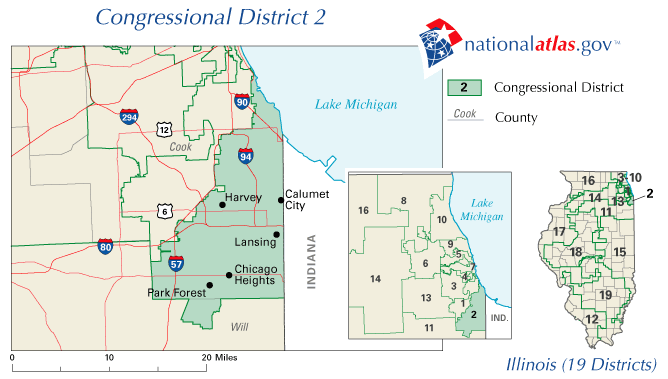
Meet Isaac Hayes. No, not that Isaac Hayes. The same name is purely coincidental. This Isaac Hayes is the Republican nominee for US Congress in Il CD-2. The District includes the southside of Chicago to the Indiana border.

Hayes is a graduate of ISU, a young entrepreneur and a staff minister for Youth Ministries.

He was recently interviewed by RedState radio:

We need someone who has honesty and integrity leading this district. He is the third consecutive congressman to be clouded in scandal in the 2nd congressional district. Gus Savage. Mel Reynolds before him. And now my opponent. We haven't had a break from corruption. We just need someone who can get through office without being caught up in scandal and corrpution.

Hayes's top issue: Education. He's a fierce proponent of vouchers and tuition tax credits:

The answer is not just more money. The answer is competition.

School vouchers open the door of possibility for our children to attend better and more racially integrated schools. Our legislators overwhelmingly send their children to private schools in DC because they can afford to. Even our current president enrolled his two daughters in private school. Unfortunately, the communities that are experiencing poor academic performance cannot afford to pay for alternative schools. School vouchers and tax credits can help to offset that disparity.

IsaacHayesforCongress.com

Anchor of a Ship

HOW DOES THE ANCHOR OF THE SHIP HOLDS THE SHIP. HOW TO CALCULATE THE WEIGHT OF ANCHOR REQUIRED FOR A PARTICULAR SHIP. CAN ANYBODY EXPLAIN THE THEORY?