Testing a Chinese Herbal Flu Remedy

During the early days of the 2009 H1N1 influenza A pandemic, the popular herbal formula maxingshigan–yinqiaosan was used widely by TCM practitioners to reduce symptoms. (It’s hard to pronounce and spell, so I’ll refer to it as M-Y.) A new study was done to test whether M-Y worked and to compare it to the prescription drug oseltamivir. It showed that M-Y did not work for the purpose it was being used for: it did not reduce symptoms, although it did reduce the duration of one sign, fever, allowing researchers to claim they had proved that it works as well as oseltamivir.

“Oseltamivir Compared With the Chinese Traditional Therapy: Maxingshigan–Yinqiaosan in the Treatment of H1N1 Influenza” by Wang et al. was published in the Annals of Internal Medicine earlier this month. The study was done in China, which is notorious for only publishing positive studies. Even if it were an impeccable study, we would have to wonder if other studies with unfavorable results had been “file-drawered.” It’s not impeccable; it’s seriously peccable.

It was randomized, prospective, and controlled; but not placebo controlled, because they couldn’t figure out how to prepare an adequate placebo control. They considered that including a no treatment group compensated for not using a placebo control, and that objective temperature measurement could be expected to get around any bias. It might not: the nurses who took the temperatures were blinded to the study, but the patients were not. It’s possible that those who knew they were getting M-Y might have believed in it and their bias might have somehow subtly influenced data gathering so that M-Y appeared more equivalent to oseltamivir than it actually was.

There are other problems besides the lack of blinding.


Background

It’s always fun to read the introduction section of a CAM paper. It gives insight into the researchers’ beliefs and frequently includes footnote references to studies that don’t say what they seem to think they say. In their introduction, Wang et al. say

Traditional Chinese medicine has been used to treat seasonal influenza for thousands of years.

The article they reference to support that claim doesn’t support it. It is an opinion piece about “Chinese medicinal materials and their interface with Western medical concepts.” It’s not a historical study, and it doesn’t directly address influenza . Anyway, thousands of years ago TCM did not recognize influenza as a unique disease entity or have any way of diagnosing it accurately.  And TCM does not equate to M-Y.

Next they cite a meta-analysis that they say showed the effectiveness and safety of TCM, but it was not about flu or about M-Y. It was about studies of common cold patients with wind-cold syndrome. It concluded

TCM new drugs developed in recent years for preventing and treating common cold have better therapeutic effects than the old ones. They can accelerate the onset time of lowering body temperature and improve the symptoms of common cold without any significant adverse reactions. Because of lacking of placebo-controlled and blank-controlled studies, further high-quality trials are still needed.

The abstract is too garbled to understand, but it indicates that if there was any significant effect of “TCM” it was very small in magnitude. Saying that a study of TCM for colds shows that M-Y works for influenza is like saying that a study of Western medicine for pneumonia proves that penicillin works for bronchitis.

Design

the decision about whether to initiate antiviral therapy is individualized on the basis of the clinician’s judgment and on what is known about the benefits of therapy. Therefore, it was ethically possible for us to include a control group that received no intervention.

If individual decisions are ethically acceptable, how can it be ethical to decide that a whole random group of patients will be consigned to treatment or no-treatment groups?

The new study had over 400 subjects and few dropouts. Patients were admitted to the hospital and followed closely. Viral studies confirmed H1N1 influenza. There were 4 arms: M-Y, oseltamivir, M-Y plus oseltamivir, and a no treatment group. Endpoints were both objective (temperature and viral shedding) and subjective (reported symptoms).

Results

Time to resolution of fever was significantly shorter in all treatment groups than in no-treatment control group, and was comparable in the different treatment groups. There were no differences between groups on symptoms or viral shedding.  There was no difference in acetaminophen use between groups. Patients in the control group were more likely to be prescribed antibiotics, even though they acknowledge that physicians often respond inappropriately to persistent temperature elevations by administering antibiotics that are not called for in that situation.  If they knew that, why did they allow it to happen?

Complications like pneumonia were rare and not significantly different between groups.

Side effects were incomprehensibly rare: Two patients reported nausea and vomiting while taking M-Y and there were no side effects in the other groups. This is puzzling, since studies of oseltamivir have shown a 9-10% incidence of nausea and vomiting with the drug and 3-6% with placebo.

They interpreted their findings as showing that maxingshigan–yinqiaosan does not act as an antiviral, whereas the benefit of oseltamivir derives entirely from its antiviral activity. Their data do not justify that interpretation.

The Mixture

When herbs are mixed, I always wonder how they decided which ones to use. In this case, maxingshigan studies have shown immunomodulatory effects, but what about the other 11 ingredients?

M-Y is a mixture of 12 herbs. In this study the herbs were tested to rule out contamination with heavy metals, insecticides, and microbes. The need for such testing brings up a concern: when patients buy M-Y on the market, what are they getting?

The 12 ingredients, as far as I could determine from the information in the paper, correspond to ephedra, anemarrhena rhizome, artemisia (wormwood), gypsum, honeysuckle, skullcap, bitter apricot kernel, forsythia fruit, peppermint, fritillaria bulb, burdock, and licorice. Only about half of these are listed in the Natural Medicines Comprehensive Database. For most of these, flu is not listed as an indication (although allergies and respiratory infections are sometimes mentioned), and most say there is insufficient evidence to rate safety or to rate effectiveness for any indication. Some include warnings: ephedra is unsafe and is illegal in the US; apricot kernels are a source of cyanide. It is hard to imagine a rationale for combining these particular 12 ingredients for any purpose, much less for flu. Maybe I lack imagination.

An appendix that lists Chinese and English names for the ingredients includes this helpful explanation:

Chinese herbs are usually prescribed in formulas that contain “king” medicines, which provide the strongest therapeutic action; “minister” medicines, which assist the “king” medicine in its therapeutic actions; “assistant” medicines, which aid the “minister” medicine in treating a lesser aspect of the disease; and “ambassador” medicines that are intended to reduce the toxicity of the other medicines in the formula or guide the formula to the targeted organ or region of the body.

They offer no justification for which ingredient has which of these purposes or how they knew whether they actually work for those purposes. These terms are not scientifically meaningful and are unexpected in a journal like the Annals of Internal Medicine.

Conclusion

Most patients with influenza recover with no specific treatment; but oseltamivir is often used with the goals of faster recovery, reduced symptoms and fewer complications. It is also used to prevent influenza. But it is far from perfect. Studies have shown that it reduced the risk of pneumonia and of pneumonia, fever, and viral shedding. Its symptom-reducing effects are not very robust, and it can have some side effects. It would be nice if we had a safer, more effective remedy.

They concluded:

Maxingshigan–yinqiaosan can be used as an alternative treatment of H1N1 influenza A virus infection when oseltamivir is not available.

I can’t really argue with that, but why not try to make oseltamivir available? Why not try to insure the purity and safety of available preparations of M-Y? More importantly, why not try to figure out what each of those 12 herbs does, whether all 12 are essential for its effectiveness, and whether worrisome ingredients like ephedra and cyanide could be eliminated?

It is admirable that TCM practitioners are trying to study their remedies scientifically; but this study doesn’t convince me that M-Y offers any advantage over oseltamivir, or even that it is a reasonable substitute.


Facebook Google Buzz Digg <!--<!--LinkedIn StumbleUpon LiveJournal Share

The College of Physicians and Surgeons of Ontario’s muddled draft policy on “non-allopathic” medicine

Detroit is my hometown, and three and a half years ago, after nearly twenty years away wandering between residency, graduate school, fellowship, and my first academic job, I found myself back in Detroit minted as surgical faculty at Wayne State University and practicing and doing research at the Barbara Ann Karmanos Cancer Institute. One thing that I had forgotten about while I was away for so many years is just how intimately southeast Michigan interacts with Canada. This closeness is not surprising, given that Detroit and Windsor are separated by only about a half mile of Detroit River. Indeed, a there are a lot of Canadians who cross the border on a daily basis to work in the Detroit area, many of them in the medical center within which my cancer center is located. The reason I point this out is not to wax nostalgic for trips to Windsor or for the occasional trip to Stratford to see plays but to point out that Ontario is right next to us. What happens there is of concern to me because I know quite a few people who live there and because it can on occasion influence what goes on over here on the U.S. side of the border.

I recently learned that the College of Physicians and Surgeons of Ontario (CPSO) has been working on updating its policy on the use of nonconventional medical therapies. The wag in me can’t help but wonder why such a policy would need to say anything other than that, if it isn’t science- and evidence-based, the CPSO doesn’t support using it, but in a less sarcastic moment I realized that such a policy is probably not that bad an idea, as long as it doesn’t legitimize pseudoscience, which is, of course, the biggest pitfall to be avoided when writing such a policy. Not too long ago, the CPSO released its draft policy and has asked for public comments, with the deadline being September 1. I was happy to learn that I had not missed the deadline, because there is much to comment about regarding this policy, but it’s definitely true that time’s short. Unfortunately, I wasn’t so happy when I read the title of the draft policy, namely Non-Allopathic (Non-Conventional) Therapies in Medical Practice, with a subtitle of “Formerly named Complementary Medicine.” The full policy in PDF form can be found at this link.

“Allopathy” versus everything else?

Regular readers of SBM will probably notice one thing right away, even before clicking on either of the links and reading the draft policy. The problem is right there in the title and, in fact, I was floored when I first read the title. My jaw dropped, and dropped hard. Basically, I couldn’t believe that the CPSO had decided to use the term “allopathic” to describe science- and evidence-based medicine. True, that wasn’t the only problem, but it gave me a sinking feeling to see such a term right there in the title. So what’s the problem?

“Allopathic medicine” was a derogatory term originally coined by Samuel Hahnemann, the inventor of homeopathy to contrast homeopathy with the medicine of the time, namely that of 200 years ago. Hahnemann, as you may recall, believed in what he called the Law of Similars, which states that “like cures like,” or, to be more clear, that medicines that cause the same symptoms as a disease should be used to treat the disease. Doing this would stimulate the “vital force” and lead to resolution of the symptoms. Of course, this is nothing more than the principles of sympathetic magic transmuted (if you’ll excuse the term) into a different element, namely that of medicine; there has never been any convincing evidence—or even much in the way of evidence at all—that “like cures like” (or, using the Latin that Hahnemann favored, similia similibus curentur) is a general principle in biology or medicine. According to Hahnemann, “allopathy,” as opposed to homeopathy, is medicine that violated the law of similia similibus curentur and treats disease using remedies whose effects differ from those produced by that disease, the term meaning “other than the disease.” From its very origin, in fact, “allopathy” has been a derogatory term for medicine that is not homeopathy. Indeed, you can even find quotes to that effect documented in—of all places—the Wikipedia entry on allopathy. For instance, James Whorton points out in his book Nature Cures: The History of Alternative Medicine in America:

One form of verbal warfare used in retaliation by irregulars was the word “allopathy.” Coined two hundred years ago by Samuel Hahnemann, founder of homeopathy, it was taken from Greek roots meaning “other than the disease” and was intended, among other things, to indicate that regular doctors used methods that were unrelated to the disharmony produced by disease and thus were harmful to their patients. “Allopathy” and “allopathic” were liberally employed as pejoratives by all irregular physicians of the nineteenth century, and the terms were considered highly offensive by those at whom they were directed. The generally uncomplaining acceptance of [the term] “allopathic medicine” by today’s physicians is an indication of both a lack of awareness of the term’s historical use and the recent thawing of relations between irregulars and allopaths.

The other aspect of the term “allopathy” is that it was consciously used by practitioners of “unconventional” medicine to relegate “conventional” medicine to nothing more than another “competing” school of medicine. The term thus serves the simultaneous purpose of bringing “allopathic medicine” down to homeopathy’s level and elevating homeopathy to the level of conventional medicine. Far better, albeit still imperfect, characterizations could be:

Science-based medicine versus nonscientific medicine
Conventional medicine versus unconventional medicine
Medicine versus unproven medicine

Other possibilities come to mind. Of course, my preferred one (reality-based medicine versus magic) is probably a bit too stark. Be that as it may, I would contend that accepting the language of practitioners of unscientific medicine and using it in an official policy statement is not a good idea. Language has power and meaning. No one knows that better than promoters of “complementary and alternative medicine” (CAM) or “integrative medicine” (IM) or whatever it is that quacks decide to call it next. While the use of language in the CPSO draft is disturbing enough in and of itself, there are more substantive problems with the draft that need to be discussed.

Beyond “allopathic medicine”

The opening of the CPSO statement does not begin any more auspiciously than the title, after which the statement quickly devolves into meaningless platitudes that accept many of the false equivalencies promoted by CAM practitioners when arguing for pseudoscience. For example, check out how the draft opens:

In increasing numbers, patients are looking beyond allopathic medicine to nonallopathic therapies for answers to complex medical problems, strategies for improved wellness, or relief from acute medical symptoms. Patients may seek advice or treatment from a range of health care providers, including Ontario physicians.

The College supports patient choice in setting treatment goals and in making health care decisions, and has no intention or interest in depriving patients of non-allopathic therapies that are safe and effective. As a medical regulator, the College does, however, have a duty to protect the public from harm. Thus, the object of this policy is to prevent unsafe or ineffective non-allopathic therapies from being provided by physicians, and to prohibit unprofessional or unethical physician conduct in relation to these therapies.

Right from the beginning, all the buzzwords and false equivalencies are right there. There’s the appeal to popularity in the form of the unreferenced, unsupported statement that more patients are embracing non-science-based medicine. That’s rapidly followed by the platitude assuring us that the CPSO supports patient “choice,” which implies by contrast that those who might not be as open to “non-allopathic” medicine are somehow against “patient choice.” particularly given the line of how the CPSO has “no intention or interest” in “depriving” (note the word choice) of their woo. Of course, one wonders what these “non-allopathic” treatments are that are both safe and effective might be. After all, if they were both safe and effective they wouldn’t be “alternative.” I’m tempted to repeat that old trope that alternative medicine that is proven to be safe and effective ceases to be “alternative” and becomes simply “medicine.” Never mind. I just did. So did the CPSO:

The categorization of specific therapies as non-allopathic is fluid: as clinical evidence regarding efficacy is accumulated, certain non-allopathic therapies may gain broad acceptance and thus be accepted in allopathic medicine.

I’ve tried to think of an example of any such therapies that have made the leap from “non-allopathic” to “allopathic” medicine and am hard-pressed to do so. Be that as it may, just because this is an old trope doesn’t mean it isn’t true. Substituting the term “non-allopathic” medicine for term “alternative” medicine or CAM in this draft statement not-so-subtly equates what was once called CAM or “alternative medicine” with “allopathic medicine.” Again, language matters, and the CPSO knows it. Its choice of the the term “non-allopathic” was deliberate:

Different operative terms have been adopted that were deemed to be value-neutral: ‘Allopathic medicine’ refers to traditional or conventional medicine (as taught in medical schools) and ‘non-allopathic therapies’ refer to complementary or alternative medicine.

Notice also how the CPSO chooses to characterize patients looking for CAM as “looking beyond” allopathic medicine, which implies that CAM modalities are somehow ahead of or superior to “allopathy.” A more appropriate way to phrase this concept would be to say that patients are looking “outside of” science-based medicine or “elsewhere than” science-based medicine. But, no. Patients are “looking beyond” that tired, old, hidebound scientific medicine.

Imagine my relief that the College is committed to preventing unsafe or ineffective “non-allopathic” therapies from being provided by physicians. You know, ineffective like homeopathy.

Platitudes mixed with disturbing statements

If there’s one thing about this draft that impresses me about the CPSO draft policy is the sheer number of meaningless platitudes the CPSO packed into it. Mixed in with these platitudes are statements that range from disturbing to just plain puzzling. For instance, one puzzling aspect of the draft occurs where the CPSO points out that physicians should “refrain from exploitation” and abusing his power over patients and avoid conflicts of interest. No one, least of all I, would argue that physicians should exploit their patients or engage in activities that represent a blatant conflict of interest, but nowhere in the draft is this principle related to the use of “non-allopathic” medicine by patients or physicians. At least for the other principles the draft at least takes a stab at trying to relate them to patient autonomy, which, of course, the CPSO supports. The CPSO also expects physicians to:

  1. Act in patients’ best interests, in accordance with fiduciary duties;
  2. Respect patient autonomy with respect to health care goals, and treatment decisions;
  3. Communicate effectively and openly with patients and others involved in the provision of health care;
  4. Maintain patient trust through a commitment to altruism, compassion and service.

As opposed to, I suppose, advocating not acting in patients’ best interests, not respecting patient autonomy, not communicating effectively and openly, and not being committed to altruism, compassion, and service. I know, I know, I’m being a bit curmudgeonly, and I realize that these sorts of principles have to be repeated and emphasized, but it’s about the specifics of how physicians will adhere to such principles “where the rubber hits the road,” so to speak that such a policy should provide guidance. I would argue that it is a physician’s responsibility always to be honest with his patients and to pull no punches when it comes to giving his professional opinion. That is the very essence of acting in the patient’s best interest and communicating effectively and openly. What, then, am I to make of some of the statements in this draft that sound suspiciously like advocating pulling punches? For instance:

The College expects physicians to respect patients’ treatment goals and decisions, even those which physicians deem to be unfounded or unwise. In doing so, physicians should state their best professional opinion about the goal or decision, but must refrain from expressing non-clinical judgements.

I can’t help but wonder whether calling, for example, homeopathy “quackery” would be viewed as a “non-clinical” judgment by the CPSO. The language used smacks of the CAM-enabling sort of language that demands that we physicians above all remain “nonjudgmental.” Personally, I would counter that it is our professional responsibility to be judgmental when it comes to evaluating the evidence for a treatment. It is our duty to judge what treatments are safe and effective and which are not; that’s what our patients come to us for.

Here’s another problematic passage:

When providing non-allopathic therapies, physicians are expected to demonstrate the same commitment to clinical excellence and ethical practice, as they would when providing allopathic care.

The problem here is that providing “non-allopathic” care that is not evidence- and science-based (in other words, virtually all of it) is inherently unethical and represents anything but “clinical excellence.” This is a rather amusing conundrum to me. Consider this example. If a physician (and, make no mistake, there are a fair number of physicians who do this) offers homeopathy, which is nothing more than magical water supposedly imbued with mystical healing caused by the “memory of water” remembering whatever remedy that was in it before and forgetting, as Tim Minchin puts it, all the poo that’s been in it. How can any physician ethically offer homeopathy, for example, to a patient? Similar arguments construct themselves for other “non-allopathic” therapies, such as reiki (which is faith healing that substitutes Eastern mysticism for Christianity as its basis) or acupuncture, which postulates that sticking needles into “meridians” that have no detectable anatomic counterpart somehow “unblocks” the flow of vitalistic mystical life energy to healing effect. Yet, the CPSO goes on to state:

Physicians must always act within the limits of their knowledge, skill and judgement9 and never provide care that is beyond the scope of their clinical competence.

This expectation applies equally to treatments or therapies that the physician proposes and those that may be requested directly by patients. Where patients seek care that is beyond the physician’s clinical competence, physicians must clearly indicate that they are unable to provide the care. Physicians should consider whether a referral can be made to another physician or health care provider for care the physician is unable to provide directly.

While this is simply a restating of basic physician ethics when it comes to science-based medicine, I can’t help but wonder: Does this policy in the context of emphasizing patient autonomy and choice somehow obligate or imply an obligation for an Ontario physician to refer to a “non-allopathic” practitioner if that is what the patient wants? Shouldn’t there be a clear statement that a physician is not obligated to support the use of “non-allopathic” medicine if he believes it—and correctly so—to be quackery? The whole thing is a muddle, particularly given the statements elsewhere in the policy about how diagnosis and treatment should be based on the principles of “allopathic” medicine?

A brief policy statement

It’s obvious from the wishy-washy approach to the scientific basis of medicine, the waffle words when it comes to whether an “allopathic” physician should support “non-allopathic” therapies, and the apparently inadvertent use of language favored by quacks that there were far too many “alternative” practitioners involved in drafting this policy. Similarly, the comments are dominated by believers, although I must admit that one of them does point out the conflict inherent in this policy, as the CPSO tries to have it both ways:

“To act in accordance with the standards of allopathic medicine, physicians providing non-allopathic care must reach an allopathic diagnosis”

This doesn’t make sense! If I want non-allopathic care, then that includes a non-allopathic diagnosis. Allopathic labelling is only useful for determining which prescription to write and has no business in non-allopathic medicine!

This would be a bit of a problem in traditional Chinese medicine, where the diagnoses are based on “imbalances” in heat, moisture, etc., and some diagnoses come about by mapping organs to locations on the tongue. Similarly, in homeopathy, diagnoses are not necessarily based on physiology and treatments are based on homeopathic “provings.” Yes, this believer nailed the conundrum that the CPSO is trying to dance around.

To that end, let me propose a much briefer policy statement for the CPSO to consider in a few bullet points:

  • Medicine should be science- and evidence-based. “Alternative” and “evidence-based,” “allopathic” and “non-allopathic,” “conventional” and “unconventional” are all false dichotomies. If a treatment is not evidence- and science-based, it is not medicine. Such a treatment becomes “medicine” only when it is demonstrated to work by science.
  • Competent adults have every right to seek out non-science-based medicine if that is what they desire. However, informed consent mandates that physicians who encounter such patients provide an honest professional assessment of such treatments based on science.
  • Physicians should always inquire about the use of non-science-based medicine when evaluating their patients, so that they can take into account possible interactions with medical treatments.
  • Physicians are in no way obligated to refer patients to “alternative medical” practitioners. For many forms of “alternative medicine” doing so is unethical because such modalities are not science- or evidence-based.

I’m sure readers can come up with their own versions or suggest modifications and/or additions to the bullet points above.

In the meantime, there is still more than a week left before the September 1 deadline for supporters of science-based medicine to let the CPSO know the problems in its draft policy by e-mailing ComplementaryMedicine@cpso.on.ca or filling out CPSO’s online survey. It’s clear from the comments that are there now that more input from supporters of science-based medicine is needed.

Michael Kruse at Skeptic North has more.

Facebook Google Buzz Digg <!--<!--LinkedIn StumbleUpon LiveJournal Share

Dummy Medicine, Dummy Doctors, and a Dummy Degree, Part 2.0: Harvard Medical School and the Curious Case of Ted Kaptchuk, OMD

Review

The recent albuterol vs. placebo trial reported in the New England Journal of Medicine (NEJM) found that experimental subjects with asthma  experienced substantial, measured improvements in lung function after inhaling albuterol, but not after inhaling placebo, undergoing sham acupuncture, or “no treatment.” It also found that the same subjects reported having felt substantially improved after either albuterol or each of the two sham treatments, but not after “no treatment.” Anthropologist Daniel Moerman, in an accompanying editorial, wrote, “the authors conclude that the patient reports were ‘unreliable,’ since they reported improvement when there was none”—precisely as any rational clinician or biomedical scientist would have concluded.

In Part 1 of this blog we saw that Moerman took issue with that conclusion. He argued, with just a bit of hedging, that the subjects’ perceptions of improvement were more important than objective measures of their lung function. I wondered how the NEJM editors had chosen  someone whose bibliography predicted such an anti-medical opinion. I doubted that Editor-in-Chief Jeffrey Drazen, an expert in the pathophysiology of asthma, had ever heard of Moerman. I suggested, in a way that probably appeared facetious, that Ted Kaptchuk, the senior author of the asthma report, might have recommended him.

Editorial Cronyism?

I wasn’t being facetious, even if I was a bit snide. In a 2009 article Kaptchuk touted Moerman’s notion of “the meaning response,” also discussed in Part 1. In a 1998 article, one of Kaptchuk’s early forays into the placebo topic, he had thanked Moerman and others “for advice, discussion, and feedback.” In the Acknowledgments for his 2002 book Meaning, Medicine, and the “Placebo Effect,” Moerman returned the complement to Kaptchuk. In a very recent essay on “placebo studies and ritual theory,” Kaptchuk showed some serious cultural anthropology chops with a serviceable impression of Moerman:

…healing rituals are never simply enactments of plots, stories or assertions of truth. Instead, they are compelling multi-sensory dramas involving evocation, enactment, embodiment and evaluation. Rituals and their sensory, affective, moral and aesthetic components transmute the mythos into an experiential reality for participants. Metaphors and symbols, the healer’s prestige, social interactions with relatives and community members in the course of preparation and performance of the ritual, and gesture, recitation, costume, iconography, touch, ingestion and the physical ordeal—all provide vehicles for and multi-dimensional guideposts to a process that is meant to transform a patient from brokenness to intactness.

Authorship by Committee and Mixed Messages

The asthma trial authors themselves seemed ambivalent about the meaning of their results. Here is the larger passage from which Moerman culled the “unreliable” comment:

…although improvement in objective measures of lung function would be expected to correlate with subjective measures, our study suggests that in clinical trials, reliance solely on subjective outcomes may be inherently unreliable, since they may be significantly influenced by placebo effects. However, even though objective physiological measures (e.g., FEV1) are important, other outcomes such as emergency room visits and quality-of-life metrics may be more clinically relevant to patients and physicians.

David Gorski has previously mentioned that his “jaw dropped” when he read those words; so did mine, and so, everywhere, should jaws of asthmatic patients and competent physicians drop. The two sentences are contradictory: if the first is true, the second—essentially similar to the theme in Moerman’s editorial, weasel words and all—is perverse. How could the same authors have written both? Perusing the list of authors provides some hints:

Michael E. Wechsler, M.D., John M. Kelley, Ph.D., Ingrid O.E. Boyd, M.P.H., Stefanie Dutile, B.S., Gautham Marigowda, M.B., Irving Kirsch, Ph.D., Elliot Israel, M.D., and Ted J. Kaptchuk

Thus there were eight authors, suggesting that there may not have been a unanimity of opinion. Of the eight, five—M.E.W., I.O.E.B., S.D., G.M., and E.I.—are identified as “from the Division of Pulmonary and Critical Care Medicine, Brigham and Women’s Hospital and Harvard Medical School” (the same Division, as I mentioned in Part 1, that spawned NEJM Editor Jeffrey Drazen). It’s a safe bet that those five subscribed to the first sentence quoted above, but not to the second.

I don’t know about the other two authors, but Ted Kaptchuk would appear to agree with the second sentence. Here he’s quoted in the Brigham and Women’s Hospital press release:

“We chose to study patients with asthma because earlier evidence had suggested that placebos would change the underlying medical problem,” explains senior author Ted Kaptchuk, Director of the Program in Placebo Studies at BIDMC and Associate Professor of Medicine at HMS. “While I was initially surprised that there was no placebo effect in this experiment [after looking at the objective air flow measures] once I saw patients’ subjective descriptions of how they felt following both the active treatment and the placebo treatments, it was apparent that the placebos were as effective as the active drug in helping people feel better.”

…adds Kaptchuk, the study results imply that placebo treatment is just as effective as active medication in improving patient-centered outcomes.”It’s clear that for the patient, the ritual of treatment can be very powerful,” notes Kaptchuk. “This study suggests that in addition to active therapies for fixing diseases, the idea of receiving care is a critical component of what patients value in health care. In a climate of patient dissatisfaction, this may be an important lesson.”

Let’s see: “patient-centered outcomes” are now defined as feeling better but not being better? (I wonder if Don Berwick, the nation’s most influential exponent of patient-centered care, would agree). According to whom? Other press reports were even worse:

Treatment, not medicine, helps asthma patients feel better

NEW YORK, July 15 (Reuters Life!) – Inhaling albuterol helps asthmatic lungs work better, but patients who get it don’t feel much better than those treated with a placebo inhaler or phony acupuncture, according to a U.S. study.

The results, which appeared in the New England Journal of Medicine, demonstrate the importance of, literally, caring for patients and not just providing drugs, said co-author Ted Kaptchuk of Harvard Medical School.

The findings also demonstrate the impact of the so-called “placebo effect,” or the phenomenon seen in clinical trials when people given inactive, fake “treatments,” such as a sugar pill or saline, show improvements.

“My honest opinion is that a lot of medicine is the doctor-patient relationship,” Kaptchuk told Reuters Health.

“A lot of doctors don’t know that, they think it’s their drugs. Our study demonstrates that the interaction between the two is actually a very strong component of healthcare.”

Treatment of Asthma now Possible with Placebo Treatments

A New study says, “Placebo treatments are equally effective in the treatment of asthma like [sic] any asthma medications.”

According to the researchers, the main reason behind proposition of this study is that several asthma patients have reported that they felt improvement in their asthma symptoms after they received placebo treatments. These treatments also include inhaler treatments and fake acupuncture. The improvement is similar to what they feel after taking asthma medication such as albuterol.

But the researchers also mentioned that unlike asthma medications, the placebo treatments are not capable of affecting the functioning of the lung.

The researcher of the study, Mr. Ted Kaptchuk said, “The practice of treatment can be highly effective for the patients”. “The study also recommends that patients should value not only the treatments for improving diseases but also the intensive care they receive from their healthcare providers” he added.

Mr. Ted Kaptchuk also said, “In the initial stage of the experiment, placebo treatments fail to make any impact. But later, when I observed that patient’s subjective descriptions about what they felt after receiving the two treatments then I concluded that placebo treatments work as well as other asthma treatments”.

At least one blog, citing the Reuters report quoted above, reported that “placebos were just as effective as real therapy” without even mentioning the trial’s having found a discrepancy between objective findings and subjective reports.

I am aware that authors of journal articles can’t be expected to control how every reporter characterizes those articles, but it’s fair to say that the emphasis of the various quotations attributed to Kaptchuk—which, as far as can be gleaned from the web, are accurate—was essentially the opposite of the study’s most important finding.

From Campus Radical to AltMed Superstar

You might have noticed that Kaptchuk’s is the only name on the list of authors that is not accompanied by the mark of an advanced degree, as I will eventually discuss. Like Moerman, Kaptchuk lacks formal training in either modern medicine or biomedical science, although he has learned a lot about the history and methods of clinical trials. How did he get to be Senior Author of an article published in the New England Journal of Medicine, and how did he become Associate Professor at the Harvard Medical School?

Here is the short version:

I was interested in science for a long time. In college, I studied religion and philosophy. Then I studied Chinese medicine in China and I came back and was a practitioner of Chinese medicine. When people became interested in alternative medicines, they asked me to help out at Harvard Medical School. I realized that in order to survive there, one had to become a scientist. So I became a scientist.

Here is the beginning of the longer version. Kaptchuk graduated from Columbia University in 1968, having majored in Asian philosophy. While there he was Chairman of the radical group Students for a Democratic Society (SDS), just prior to the emergence of its more famous chairman, Mark Rudd. I mention this not to commie-bash, but because it helps to elucidate some of Kaptchuk’s later opinions (hint: he has no trouble agreeing with both sentences in the jaw-dropping paragraph quoted above) and to demonstrate some of the ironies of his later choices.


After graduation, in Kaptchuk’s own words, ”I worked in the welfare and social services trying to help people.” During this time “I decided that I wanted to learn a healing art but was disillusioned with some of the aspects of Western allopathy and decided to learn acupuncture.” Kaptchuk pursued training with Asian practitioners in California and “studied every book in English on the subject,” but by 1972 had decided that this would not be sufficient:

Because of the relative unknowness [sic] among non-Chinese Americans of acupuncture and Dr. Hong’s limited practice, I cannot get enough experience to adequately master this healing art. In addition, there is a greater reluctance among other Chinese doctors who have more patients to have a student observe because of legal restrictions concerning their practice in the United States.

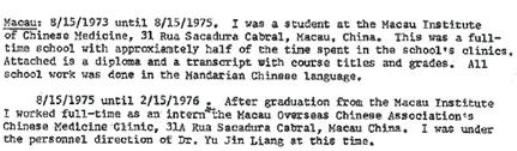
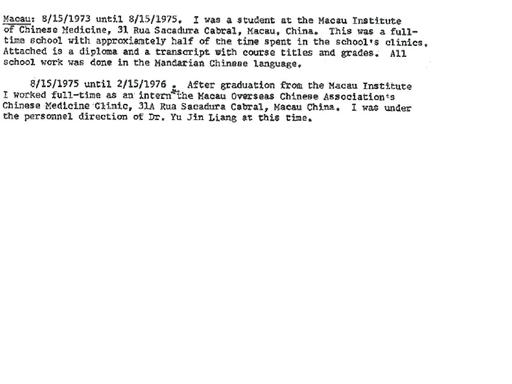
Kaptchuk reports having next spent a year in Taiwan, followed by 2.5 years in Macau (click on the image to enlarge):


Within a few years of his return to the United States, Ted Kaptchuk published the book that made him an alt-med superstar:


It is this book that I will discuss in the next part of this series.


?

Facebook Google Buzz Digg <!--<!--LinkedIn StumbleUpon LiveJournal Share

Oh yeah? Thalidomide! Where’s your science now?

Online discussions on the merits of alternative medicine can get quite heated. And its proponents, given enough time, will inevitably cite the same drug as “evidence” of the failings of science. Call it Gavura’s Law, with apologies to Mike Godwin:

As an online discussion on the effectiveness of alternative medicine grows longer,  the probability that thalidomide will be cited approaches one.

A recent comment on my own blog, regarding the homeopathic product Traumeel, is typical:

If the scientific method is all that separates an accepted claim, ie Thalidomide, Vioxx, Bextra, Darvon, from mere anecdote, of what benefit is the Science?

As a non-scientist consumer, I’ll take the anecdotes and my own experience. Thank you.

If scientists want to be taken seriously, they must stop selling themselves to the highest bidder becoming corporate whores without a shred of decency. To my mind, that’s how the claims for Thalidomide, Vioxx, Bextra, Darvon were accepted, making the scientific method utterly worthless.

To this commenter, “science has been wrong before.” And that invalidates science, and apparently validates homeopathy. It’s a fallacious argument. But does thalidomide actually represent a failing of science-based medicine? No, not even close. It’s so wrong, it’s not even wrong. Thalidomide is good example of the importance of science-based medicine and why allowing alternative medicine to be sold in the absence of good science is a concern.

The broad strokes of thalidomide causing thousands of birth defects are well known. But the details are important to understand the implications to regulation, and to science-based medicine, today.

Thalidomide was first marketed in 1958 in Germany by Chemie Grünenthal. While its developmental origins are somewhat unclear, it was initially marketed as a treatment for seizures, and later as an anti-nauseant and sedative. At the time, barbiturates were frequently used as sedatives. And compared to barbiturates, which were highly toxic in overdose, thalidomide was well tolerated, even in overdose. Based on its apparent safety, no prescription was required. Eventually its attractiveness as an anti-nauseant led to its use in pregnancy for morning sickness.

It wasn’t known at the time, but fetal exposure to thalidomide between days 35 and 48 was causing severe limb and organ defects in 20-30% of children. In the 1950′s it wasn’t even recognized that drugs could cross the placenta and cause adverse effects to the fetus. Thalidomide hadn’t been tested on pregnant animals prior to marketing for use in pregnancy. Regulators didn’t require it. And the consequences were horrific.

Thalidomide became a popular drug because of its apparent safety and effectiveness, and it was marketed alone and in combination with other drugs in Germany, the UK, Canada, and other countries. But within a few years, babies started being born with characteristic limb and organ deformities. In 1961, two independent researchers identified thalidomide as the likely causal agent. The manufacturer sought to undermine and discredit the findings, but it was clear – the drug had caused catastrophic harm to thousands of fetuses. Subsequent animal testing confirmed this.

The USA largely escaped the thalidomide tragedy – due to stronger regulations, and the action of a single employee.

American drug regulations have evolved over time. The Pure Food and Drugs Act (1906) did not require that drugs be tested for safety and efficacy before sale. It was the regulator’s responsibility to demonstrate a product was unsafe. In 1938, the S.E. Massengill company manufactured a liquid version antibiotic sulfanilamide, mixing it with diethylene glycol -a poison more commonly used as antifreeze. When patients started dying, a massive recall was implemented – but not before over 100 people died. The tragedy brought about significant reforms to drug regulations in the form of the Food, Drugs and Cosmetics Act (1938) that required manufacturers to obtain FDA approval for any drug sold, prior to any sale.

Frances Oldham Kelsey was a reviewer with the FDA in 1960, and was responsible for evaluating the thalidomide marketing application. Kelsey refused to approve the drug in the absence of safety data. Her concern was peripheral neuropathy – not teratogenicity, which wasn’t even considered at the time. She described the application process in a paper she published in 1965:

The New Drug Application for thalidomide was presented in September, 1960. The drug had been marketed in Germany since 1957 where it was available without prescription, and in Great Britain since 1958. However, it was felt that the evidence submitted in the application was not adequate to indicate the safety of the drug. In particular, although this drug appeared to be remarkably nontoxic in animals and human beings, little or no information was available concerning its absorption, distribution in the body, or its excretion. Since the possibility existed that the low toxicity of the drug in certain species might be related to poor absorption in those species, and that under certain conditions the absorption in other species might be increased, further work was requested relative to the metabolism of the drug.

As the FDA studied the side effect profile, the teratogenicity of the drug became clear as and the application for licensure was discontinued. Kelsey was hailed as hero. Yet despite the refusal to formally approve the product for sale, millions of doses had been administered as part of “clinical trials” (in name only). Yet due to Kelsey’s refusal to approve the drug, the drug was not widely used, and only 17 children were born in the USA with thaldomide-induced effects.

Regulators worldwide acted to ensure another thalidomide tragedy would not occur. In 1962 the Kefauver-Harris Drug Amendments were passed, increasing the rigor of the drug approval process, requiring the demonstration of safety and effectiveness via objectively designed and executed clinical trials. These amendments also implemented the requirement for adequate preclinical trials before any human studies, including animal studies to evaluate fetal risks. Marketing requirements were also implemented, restricting manufacturers from making unfounded, unsubstantiated claims of safety and efficacy. Finally, the amendments ushered in the requirement for manufacturers to collect and report all adverse events associated with drug use – measures designed to capture any events not otherwise identified in pre-marketing clinical trials. Similar actions occurred in other countries. Today, over 100 countries now collaborate with the World Health Organization to pool adverse event reporting and look for signals of drug harms.

Lessons Learned
The worldwide disaster of thalidomide led to most of the current framework we have in place today to evaluate the safety and efficacy of drug products. Ironically, these are the same requirements that manufacturers of supplements and other “alternative” medicine products have been largely successful in circumventing. In the USA, it’s DSHEA, which (as blogged about regularly at SBM) removed the onus of demonstrating safety and efficacy from the manufacturer and put the requirement to demonstrate harm on the FDA – exactly the same scenario as drugs in the early 1900′s. In Canada, the Natural Health Product regulations has introduced a lowered bar for non-drug supplements: Today even homeopathic remedies are deemed safe and effective and approved with unique recommended uses.

The Resurrection of Thalidomide

Almost 30 years after thalidomide was withdrawn, it’s back on the market in the United States, Canada and many other countries. It’s been found to be effective for a number of conditions including erythema nodosum leprosum, multiple myeloma, and is being investigated for efficacy in an array of other conditions. There’s an analog of thalidomide now marketed, lenalidomide, also used to treat cancer. To minimize the teratogenicity risk,  intensive programs are in place to minimize any possibility of use in pregnancy. So while the drug has known harms, it seems to be highly effective for some medical conditions where few effective alternatives exist. Access, therefore, is based on a careful evaluation of the risks and benefits.

Does Thalidomide Invalidate Science-Based Medicine?
Cases like thalidomide provide a good example of why SBM authors argue against regulatory double-standards, and advocate for a single, science-based standard for evaluating all products: drugs as well as supplements.  There is no intrinsic reason to think any product, regardless of its source, is safe or effective – we must evaluate it, objectively. Thalidomide’s history is a cautionary tale reminding us that assumptions without good evidence can lead to terrible consequences.

And that leads to the logical fallacies that the thalidomide retort represents.  Thalidomide is an effective drug for some conditions – but it is a teratogen. It’s not alone in this regard – other drugs have been identified as teratogens. The sale of any drug is based on an evaluation of the known benefits and risks.And getting back to the comment I received at the top, those that support alternative medicine will reject the science-based approach: This is the system that gave us thalidomide (and Vioxx, etc). Therefore, it’s a failure, and we should reject it. This is the perfect solution fallacy.

Admittedly, medicine is not perfect. Regulators don’t identify all the harms before a drug is licensed. Drug manufacturers can behave badly. And drugs don’t always work the way we want them to, and they can cause harms. They commenter I cite above took objection to an evaluation of homeopathy.  Yes, homeopathy has no toxic side effects (usually) and causes no teratogenicity – but it also has no demonstrated efficacy beyond placebo effects. The harms and problems of science-based approaches add no support to the efficacy claims of any alternative medicine system.  Homeopathy, acupuncture, and reiki don’t become effective because drugs can have side effects. SBM may not be perfect, but it delivers the goods.

More generally, comparing science-based medicine to any alternative medical system a is false dichotomy. Unlike the different alternative medicine systems (homeopathy, naturopathy, reiki, etc) which are typically based around a fixed set of rules, the only thing that science-based medicine interventions have is common is that they work. SBM is not immutable to change – treatment shown to be safe and effective become medicine, and those that are not, are discarded.  So although thalidomide causes birth defects, it is also an effective medication when used properly. We don’t have to make a choice between a system that produced drugs that cause birth defects, and alternative medicine. We choose to use treatments where the expected benefits outweigh the known risks.

Citing thalidomide as an argument against science-based approaches is also a straw man argument. The way drugs are regulated today bears little resemblance today to when thalidomide was licensed and sold. Safety standards are far more rigorous, in part because of the lesson of thalidomide. Today, the only products that are not subject to these same strict safety and efficacy standards are usually the alternative medicine treatments.

Citing thalidomide is also an appeal to fear. We hear the word and we immediately think of children born with birth defects. We don’t want that to happen. But like the perfect solution fallacy, the catastrophic side effects of thalidomide in pregnancy add no merit to to claims of efficacy of any alternative medicine treatment or system. We still need the evidence.

Conclusion
Thalidomide was a very real tragedy with a huge human cost. It’s most important lesson is that assumptions of safety and efficacy, in the absence of evidence, can be catastrophic.  Citing thalidomide as a a reason to reject science-based medicine is not only fallacious, it reflects a fundamental lack of understanding of the lessons learned.

Facebook Google Buzz Digg <!--<!--LinkedIn StumbleUpon LiveJournal Share

Homeopathic Thuggery

There have been many cases now of big companies or organizations, or wealthy individuals, threatening to sue or actually suing a blogger for libel. The most famous case is that of Simon Singh who was sued by the British Chiropractic Association over comments he made in an article. Simon braved through the expensive and exhaustive legal process (which is especially onerous in England), but he is not just a lone blogger. He is a successful author and was writing for the Guardian. Eventually the BCA was forced to drop the case – but only after the blogging community rallied behind Simon, magnifying his criticisms of the BCA by orders of magnitude. By all accounts it was a PR disaster.

The blogging community as a whole is rather passionate about this issue. We exist on the premise of free and open public discourse about important issues. At SBM we take on many controversial issues and we don’t pull our punches when criticizing what we see as pseudoscience in medicine. So of course we take notice when a large company tries to bully a blogger to silence their legitimate criticism.

According to the BMJ this has happened yet again – this time the international homeopathy producer, Boiron, is threatening a lone Italian blogger because he dared to criticize their product, Oscillococcinum. The blogger, Samuele Riva, wrote two articles on his blog, blogzero.it, criticizing what our own Mark Crislip has called “oh-so-silly-coccinum.”  The blog is entirely in Italian, but he is maintaining a page in English with updates on the Boiron vs Blogzero affair.

Criticizing homeopathy is always fun, because it is at the extreme absurd end of the silly pseudoscience spectrum, even among some stiff competition. But now homeopathy has a corporate face in Boiron – a large multinational corporation based in France. Boiron is the largest manufacturer of homeopathic products in the world and the second largest manufacturer of over-the-counter products in France.

What they are doing to this small blogger, in my opinion, is nothing less than corporate thuggery. They are using their resources and their corporate lawyers to try to silence completely legitimate criticism of their pseudoscientific products. Of course, they will only succeed in magnifying that criticism.

For example, Riva suggested that Boiron’s oscillococcinum has no active ingredient. Well, let’s see- the company lists the active ingredient in this product as “Anas barbariae hepatis et cordis extractum 200CK HPUS.” The “200C” means that the listed ingredient was diluted with a 1:100 dilution 200 times. Serial dilution is a funny thing – a 200c dilution is the equivalent of diluting 1ml of original ingredient into a volume of water that is the size of the known universe. This is far far beyond the point where there is any reasonable chance of there being even a single molecule of original ingredient left.

So Riva was completely justified (as have many other critics) in saying that Boiron’s 200c product has no active ingredient. In fact it is deceptive to list something that has been diluted 200C as an “active ingredient.”

Not that it matters in this case, because the original ingredient is a pseudoscience unto itself. Mark Crislip gives the full details, here is his summary:

In the 1919 flu epidemic a physician who did not understand that artifacts on the slide, probably bubbles, move randomly due to Brownian motion. Looking at the tissues of flu patients with a microscope, he found what he thought was not only the cause of influenza, but the cause of all diseases: small cocci (round balls) that oscillated under the microscope. He found these wiggling bubbles in all the tissues of all the ill people he examined and thought he discovered the true cause of all disease. Sigh. Yet another cause of all illness. He is the only person, before or since, to see these oscillating cocci. Hence the name.

That’s right, oscillococcinum does not even exist – essentially Boiron takes fairy dust and then dilutes it out of (non)existence. The “anas barbariea hepatis” is basically duck liver, which is supposed to contain the most concentrated nonexistent oscillococcinum. It’s a pseudoscience trifecta.

Boiron claims that their product treats the symptoms of flu. What does the evidence show? (Yes, there is evidence – someone bothered to test whether diluted fairy dust actually works)? Well, this is yet another  interesting story. Oscillococcinum was at the center of another embarrassing controversy, this one involving the Cochrane Collaboration. They published a Cochrane review of Oscillococcinum for the flu, and the author’s concluded:

Though promising, the data were not strong enough to make a general recommendation to use Oscillococcinum for first-line treatment of influenza and influenza-like syndromes. Further research is warranted but the required sample sizes are large. Current evidence does not support a preventative effect of Oscillococcinum-like homeopathic medicines in influenza and influenza-like syndromes.

This review became the poster child for what is wrong with Cochrane’s particular application of evidence-based medicine (EBM). Notice that the evidence is essentially negative, but with some positive studies – which is what we expect when studying a fancy placebo because of researcher and publication bias. But the authors concluded that the treatment is “promising” and “further research is warranted.” An SBM review of the same data would come to a very different conclusion – the data is what we would expect from an ineffective treatment. Further, the highly implausible nature of the treatment (on several levels) warrants a conclusion that it does not work, it holds no promise, and not another dime of precious research money should be wasted chasing this fantasy.

Eventually the Cochrane review was withdrawn. We interpreted this as a minor victory for SBM, although we have no way of knowing what role, if any, our criticism played in the decision to withdraw the review.

Conclusion

I hope Boiron does draw a line in the sand over their oscillococcinum product, and that it becomes the center piece of a broader public discussion about homeopathy. Most of the public does not understand what homeopathy actually is. They think it means “natural” or “herbal” medicine. They have no idea that homeopathy is about taking fanciful ingredients with a dubious connection to the symptoms in the first place, and then diluting them into oblivion, then placing a drop of the pure water that remains and placing it on a sugar pill. The resultant pill is then supposed to contain the magic vibrations of the original substance.

This rank pseudoscience, which has no place in 21st century medicine, is the business of Boiron. Let’s see them try to defend themselves and their products. Let’s see them harass bloggers and those who are just trying to expose the public to the truth. Let’s see them argue in public how air bubbles in duck liver fantastically diluted can treat the flu.

Facebook Google Buzz Digg <!--<!--LinkedIn StumbleUpon LiveJournal Share

Wishing Away Warts

Common warts (verruca vulgaris) are more of a nuisance than a serious health problem, but they are interesting. There is a whole mythology surrounding their cause (touching toads?) and treatment (everything from banana peels to vitamin C).  Many people believe they can be made to vanish by suggestion or hypnosis. I used to believe that too.

Every doctor has wart stories. Here are some of mine.

  • A patient made an appointment to see me because he had a wart, but when he tried to show me his wart he discovered that it had vanished! Apparently, just making the appointment cured it.
  • Another patient did have obvious warts and I prescribed the “wart medicine” that our pharmacy tech compounded, based on salicylic acid. He was out of one of the ingredients and had to ask my patient to return in a week. When she returned, her warts were already gone. The wart medicine apparently worked so well that you didn’t even have to use it!
  • I worked with a dermatologist who used a colorful laminated card with a picture of a toad to stroke children’s warts, telling them it was a wart remover. In his experience, this would frequently make the wart vanish over the next few days. Was this ethical? Was he lying and deliberately deceiving patients, or could this be excused as playing make-believe to distract the child and improve his attitude about the wart?

He was certainly deceiving himself in thinking that this foolishness was actually effective based on his own uncontrolled observations. Hypnotists claim success in treating warts with direct suggestion: they say that prepubertal children respond almost without exception, although it is less effective in adults.  I was taught that if a patient had multiple warts and you treated just one of them, the others would likely vanish too. This might sort of make sense if the treatment stimulated an immune response, but I haven’t seen any evidence to support it.

What can science tell us about warts?

A new review article in American Family Physician, “Treatment of Nongenital Cutaneous Warts” by Mulhem and Pinelis provides a thorough update of the current evidence.

Cutaneous warts are epidermal proliferations caused by over 100 types of human papillomavirus. They are spread person-to-person or by contact with contaminated objects. They are most common in children. Walking barefoot is a risk factor for plantar warts (warts on the sole of the foot that that have a different appearance due to being under pressure). Nail-biting, meat handling, and immunosuppression are also risk factors. 90% of renal transplant patients develop warts.

Warts are usually self-limited. Half resolve spontaneously in a year, two-thirds within two years. Watchful waiting is an option, but patients often want treatment because of discomfort or social stigma. Two treatments have been clearly proven effective by scientific studies: salicylic acid and freezing with liquid nitrogen. There is limited evidence for silver nitrate, topical fluorouracil, and topical zinc. There is little to no good evidence for cantharidin, dinitrochlorobenzene, oral cimetidine, oral zinc sulfate, podophyllin, propolis ointment, retinoids and topical garlic extract. A few years ago, duct tape was reported to work, but subsequent studies showed that it probably does not. Warts can also be surgically removed, and dermatologists can offer specialized treatments such as intralesional bleomycin and pulse dye laser.

I found it interesting that the AFP review didn’t even bother to mention hypnosis, suggestion, or CAM.

Salicylic acid preparations are available over the counter for self-treatment. They are well tolerated and produce a 73% cure rate in 6 to 12 weeks. Cryotherapy with liquid nitrogen is equally effective but is more expensive, requires multiple office visits, and can cause pain, blistering, pigment changes, and other complications (tendon or nerve damage, scarring), especially if used too aggressively. A combination of cryotherapy and salicylic acid may give the best results. If a treatment caused permanent scarring, that would be worse than the disease.

To take a page from Mark Crislip’s job description, the patient has the mindset “Me have wart. You cure wart. Me go home.” The health care provider can re-frame the issue as “You have wart. Me educate. You think. We discuss.” Since warts are benign and self-limited, the option of not treating should always be on the table.

What about CAM?

Warts provide a fertile field for CAM. Various CAM modalities (chiropractic, acupuncture, homeopathy, energy medicine, etc.) have been claimed to cure warts. Acupuncturists have claimed a 90% success rate in only 1-3 weeks. PubMed lists a recent article about treatment with “sparrow-pecking” moxibustion that sounds intriguing, but no abstract is available. When warts follow their natural history and resolve, CAM is happy to take the credit. When they fail to resolve, CAM can continue treatments and continue to generate income. It’s a cash cow and ideal CAM fodder. Since warts are so common, potential clients are plentiful.

I used to believe that warts could be wished away. Now that I am older and wiser, I think warts vanish because of the natural course of the disease, not because of suggestion. Observers have reached false conclusions due to the post hoc ergo propter hoc (correlation is not causation) fallacy. Warts that went away after suggestion didn’t go away because of suggestion. The many folk remedies, like banana peels, were perpetuated by similar errors in reasoning. No matter how much we wish mind-over-matter worked, warts can’t be wished away: that’s the truth, warts and all.


Facebook Google Buzz Digg <!--<!--LinkedIn StumbleUpon LiveJournal Share

Everthing Old is New Again!

I have as much of a sense of nostalgia as anyone.  I love history.  I think that there is lots to be said about the “good old days,” whenever the heck they were.  I do not, however, think that the “good old days” generally include medicine.

nostalgiaThe fact is that it’s only been about 100 or so years since medical practitioners really got their acts together and started to be able to figure out if they were actually doing anything good.  Prior to that, medicine was a world of humo(u)rs and miasms, treated by bleeding, burning, and purging, plants and animal matter of all sorts (the 6th century Chinese apparently liked otter feces) and all sorts of other awfulness.  In light of some of the things that were done, it’s kind of amazing that anyone survived their treatments.  Mostly, people (and horses) survived in spite of the crazy things that were done to them.

Nevertheless, in those wild and wooly days of yesteryear, enterprising medical entrepreneurs turned out an endless stream of products, with some pretty fantastic claims.  They designed some absolutely artistic advertising cards to go along with those claims, too.  These trade cards surged onto the scene in the 1870′s, coinciding with the advent of color printing.

Look as hard as you’d like – you won’t find any of those products today.  But the claims?  Well, the claims are still around, and they’re pretty much the same as they were 100+ years ago!  Seriously, today, you will find people making the same ridiculous claims for their particular nostrums as they did over a century ago.  Here are some examples -

1.  Are you worried about your horse’s blood being impure?  According to an archaic and somewhat ridiculous line of thinking, “impurities” of the blood are one serious problem.  Of course, no one ever says what those impurities might be, but, no worries, you can get the blood purified anyway!  And, according to a modern text on veterinary herbal medicine, the herbs turmeric and sweet Basil are “Blood purifiers”  – Wynn, S and Fougère, B.  Veterinary Herbal Medicine, 2007, p. 69.

You could have purchased this “blood purifier” over 100 years ago!

2.  Worried about pain?  Why not try some “essential oils?”  According to the website, “The Holistic Horse,” essential oils of peppermint and eucalyptus are a must!  It’s hard to say what the oils are essential for – certainly not for the relief of pain!  There’s certainly nothing wrong with the pungent smells of eucalyptus or peppermint, and, of course, peppermint is a popular flavoring agent.

Of course, oils as pain relievers are nothing new.  If you wanted to buy some pain oil in 1897, you could!  Who knew that people would still be buying this stuff 127 years later?

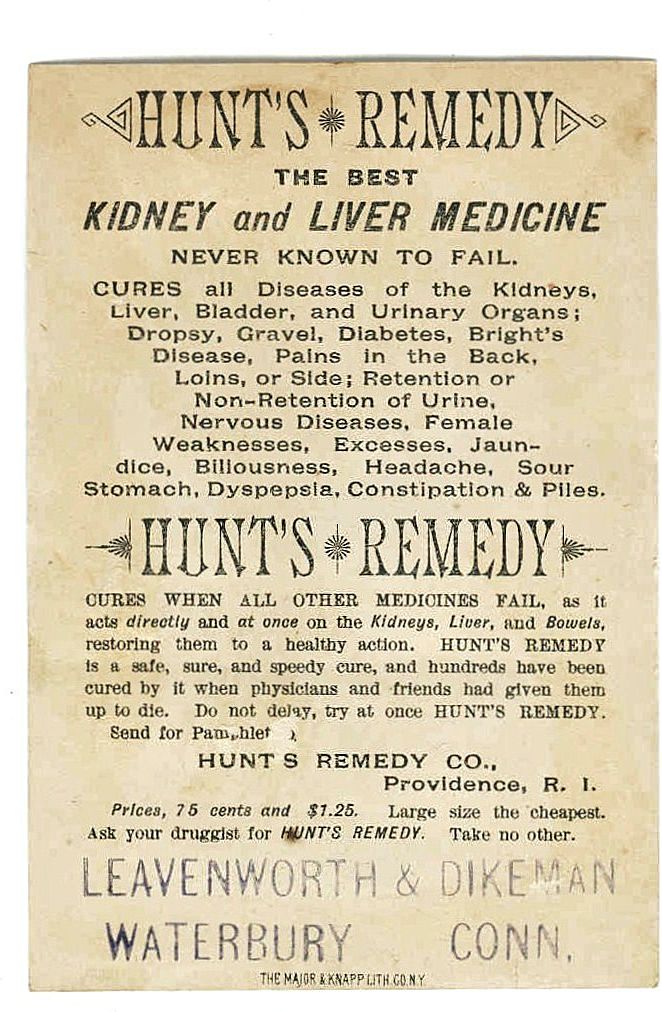
KidneyandLiverRemedy3.  Concerned that your horse’s kidneys need rejuvenating?  Don’t worry if you didn’t know that they weren’t juvenile enough – inventing problems is one of the great ways to come up with a cure.  If you’re concerned, just go to the website for WolfCreek Ranch and pick up some “Kidney Rejuvenator.” In case other members of your menagerie have problems, it also works on elephants and giraffes.

Or, if you were around 127 years ago, you could have picked up some Hunt’s Remedy.  Not only was it “Never Known to Fail,” you could take care of a lot of other stuff, a sort of one stop medical shop.  I’ve never seen a medicine that never failed – I wonder why you can’t buy any today?  After all, it was good for your cattle, hogs, and poultry, too!

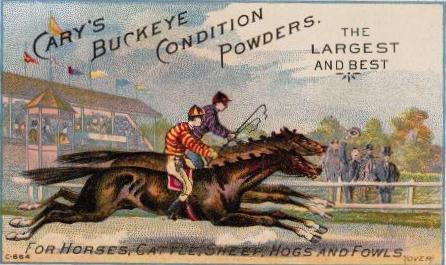
4.  Worried about your horse’s condition?  Who wouldn’t be?  If so, why not try “Pink Powder?” As advertised by Wessex Animal Health in the UK, “For everyday equine life, Pink Powder maintains perfect condition.”

TradeCardsOr, perhaps you might be persuaded by this ad, from 1905?


Look, medical conditions occur for specific reasons.  Horses don’t have unnamed “toxins” circulating around in their body, their blood doesn’t need to be “purified,” their kidneys don’t need “rejuvenating,” and as long as you feed them properly, their “condition” will generally be just fine.  If you look at most any of the claims made for supplements, you’ll find that, at the bottom of it all, they’re pretty much nonsense.

Don’t expect that some untested over-the-counter product that you can buy in a bucket in the feed store is going to somehow bring health and longevity to your horse (or any other animal that you want to take care of.  The best way to do that is REALLY old-fashioned – it was known even prior to glitzy advertising and vague promises – through good feed, regular exercise, and attention to a few routine health details (such as deworming, and vaccination).

Remember, if it sounds too good to be true, it probably is!


Facebook Google Buzz Digg <!--<!--LinkedIn StumbleUpon LiveJournal Share

Train Therapy

Summertime and the living is busy.  Finally we have sun in the Northwest.  While the rest of the country has been melting in heat, this year we have rarely cracked 85.  Global heating has avoided Oregon this year, and I will need some green tomato recipes.  Good weather, work is busy, and it is the last two weeks with my eldest before he is off to Syracuse, so there is little time for writing, so a brief entry this week.

I always wince at the way anything can be called ‘therapy.’ We have music therapy and garden therapy and pet therapy and art therapy.  I do not deny that it is beneficial for people to participate in those activities while in the hospital, although I am never happy to see disease vectors, er, animals in a hospital.   Dinner should be food therapy, reading should be book therapy, and using the internet should be computer therapy.  I guess it is like calling something ‘medical’ grade, and you can bill more for it.

Some ‘therapies’ are a wee bit more odd.  Indonesians are using railroad therapy.  People lie down on electric railroad tracks because “the electricity current from the track could cure various diseases.”  To date no one has been either electrocuted or squashed, but I suppose it is only a matter of time.

Why train tracks?  Why not a tongue in a light socket or other source of electricity?  Evidently rumor has it that “an ethnic Chinese man who was partially paralyzed by a stroke went to the tracks to kill himself, but instead found himself cured.”  Sounds good to me.  It seems as likely as Palmer cracking a neck leading to a cure in deafness as the basis for a therapeutic intervention.

And so others are using train therapy for their hypertension, diabetes, strokes and other medical problems.  Train therapy is evidently a panacea for a variety of diseases and used by those with no other medical options.  Like all alternative therapies, it is effective against numerous diseases, regardless of the underlying pathophysiology. If only antibiotics could cure hypertension, diabetes and stroke in addition to bacteria.

Does train therapy work?  The patients say it does, despite those know it all skeptical MDs who point to a lack of evidence.  And who would gainsay a patient’s response to the therapy?  If a patient says they are better, are they not better?

Medical experts say there is no evidence lying on the rails does any good.
But Mulyati insists it provides more relief for her symptoms — high-blood pressure, sleeplessness and high cholesterol — than any doctor has since she was first diagnosed with diabetes 13 years ago.

I was worried they would forget to tell both sides of the story.  And just who is expert on the medical effects of lying on electric train lines?  They go on to note that

Pseudo-medical treatments are wildly popular in many parts of Asia — where rumors about those miraculously cured after touching a magic stone or eating dung from sacred cows can attract hundreds, sometimes thousands.

It would be easy to be snotty and superior about the Indonesians and their use of train therapy, but really, is it any different than the West?  They eat dung from sacred cows, we have the bullshit from the NCCAM.  We have reiki and homeopathy and Tong Ren healing, and all the other therapies that are subject of this blog,  all equally nonsensical.  I see little difference between the use of train healing and much of the published literature in the SCAM world.  A series of uncontrolled interventions with soft endpoints.

Indonesians have the same rationale for the use of train therapy: anecdotes. Every homeopathy apologist mentions  that the millions who have used homeopathy with good effect can’t be wrong, and neither can the hundreds who are using train therapy.  I suppose we could say the Indonesians are doing a pragmatic, real world trial.  Who needs the old randomized, placebo controlled nonsense?  Lie on an electric train track and you feel better. ’nuff said.

Are the patients who believe they are getting better experiencing a placebo effect?  Is this an example where patient centered outcomes are more important that doctor centered outcomes?  Maybe we should use train therapy for the treatment of asthma.  Conductors and engineers, like doctors, “often dress up in special uniforms that convey power and authority… (and) They have very expensive machines”  Probably less expensive than sham acupuncture and sham albuterol.

Train therapy fits the criteria noted in the recent NEJM editorial;  it should be sufficient to “simply to show that a treatment yields significant improvement for the patients, has reasonable cost, and has no negative effects over the short or long term. This is, after all, the first tenet of medicine: Do no harm.”  The train track users say they are improved, it is free, and as long as they get up in time, should have no negative effects.  I would avoid TGV tracks, just to be safe.  I expect train therapy to be come incorporated in Integrative Medicine programs everywhere, or at those near light rail.

There was a time when I was inclined to think that the people who participated in SCAMs were either stupid or ignorant.  I have long ago abandoned that idea.  Some people, as evidenced by occasional comments in this blog, are apparently deranged, but not most.  I have realized that while most SCAMs are stupid, the people who use them are not.  It seems to be a universal human characteristic to participate in nonsense of one kind or another, but the nonsense varies by culture and opportunity. ‘We’ detox our colons and avoid vaccines, ‘they’ eat dung and lie on train tracks.  All are human. Or are they?

Most biologic characteristics have variability. Height, strength, intelligence all vary about the infamous bell shaped curve.  I have also wondered about more intangible characteristics: the ability to think rationally or empathy or a sense of humor.  Like jumping or math, some people seem to be better at these tasks than others.  It does not, I hasten to add, make them better people, except for the task at hand.  I wonder if the uber-rational, the skeptics, are mutants, given what appears to be the relative rarity of rational/scientific thought.  And to judge from the vitriolic response towards the scientific/rationally inclined, the rational must be mutants as they are feared and hated by those they were sworn to protect.

I don’t know.  Idle speculation caused by vitamin D deficiency.  I am going to lie in the sun, not on the Max line. I know this will make me feel better, although I doubt it will cure any illness.

Facebook Google Buzz Digg <!--<!--LinkedIn StumbleUpon LiveJournal Share

The Scam Scam

In 1994 Congress (pushed by Senators Harkin and Hatch) passed DSHEA (the Dietary Supplement Health and Education Act). As regular readers of SBM know, we are not generally happy about this law, which essentially deregulated the supplement industry. Under DSHEA supplements, a category which specifically was defined to include herbals, are regulated more like food than like medicinals.

Since then the flood-gates opened, and there has been open competition in the marketplace for supplement products. This has not resulted, I would argue, in better products – only in slicker and more deceptive claims. What research we have into popular herbals and supplements shows that they are generally worthless (except for targeted vitamin supplementation, which was already part of science-based medicine, and remains so).

A company can essentially put a random combination of plants and vitamins into a pill or liquid and then make whatever health claims they wish for their product, as long as they stay within the “structure-function” guidelines. This means they cannot claim to cure or treat a specific disease, but this has proven to be an insignificant limitation on marketing supplements.

It has been fascinating to watch the evolution of supplement marketing claims and strategies. One new twist caught my eye – what I am calling the “scam scam.” Some companies realize that the internet is the primary battle ground for the marketing of their product. Many companies also probably know that their claims are largely scientifically baseless – if you’re in the meeting where the claims are crafted and the marketing strategy developed, it would be hard to be delusional about their scientific validity. I suspect most companies just don’t care about the science or understand it, and you can find some justification to cherry pick for most any supplement claim you wish with just a little Googleing.

It also appears that many companies are starting to realize that “those meddling skeptics” are starting to cramp their style, at least a little bit. If you search on the name of a supplement product, you are likely to get a link for a consumer protection or skeptical site revealing the claims to be a scam, or at least scientifically dubious. Invariably when I write about a specific product in a blog post a company marketing rep will show up in the comments to claim that I was unfair and that they do have evidence for their claims. Of course, when asked for the evidence it rapidly becomes clear that they don’t have any, outside a worthless in-house study or two.

Companies cannot silence the scientific analysis of their claims. Some have tried using the libel laws, but that has generally not worked out well for them. That approach instantly raises the visibility of the criticism by orders of magnitude, and the companies or individuals generally lose in the end.

So now some companies have hit upon a different strategy – if you cannot silence the skeptics, then bury them with fake skeptics of your own. That way at least their websites won’t appear on the first page of Google searches (at least that’s the hope). One product, Shakeology, seems to be marketed entirely as “Shakeology Scam” (trek2befit (dot) com/shakeology-scam). The website starts out saying – “Do Not buy Shakeology” with “Skakeology Scam” in big letters. Of course, when you read down even a little bit you find:

Ok, I couldn’t let this question linger any longer. I’ve got to tell you right now, that it’s not a scam. Why, and how do I know? Because I’ve had first hand experience with this product.

Then you get a standard sales pitch – but it’s more believable, because the person making the pitch started out as a skeptic – right? What do these magic shakes do? The claims are typical – lose weight without food cravings, have more energy, and they throw in that they will lower your cholesterol. What are in these shakes:

- Antioxidants: Will help to boost your immune system to prevent you from getting sick. Antioxidants will also help to lower free radical damage which can lead to stroke, heart attacks, high blood pressure, and heart disease.
- Prebiotics AND Probiotics: Will help to support your immune and digestive health.
- Phytonutrients: Will help to support healthy immune function. They also have anti-inflammatory properties, and antioxidant properties.
- Vitamins and Minerals: Will help you to maintain optimal health.
- Whey Protein: Will help you to lose weight, build muscle, supports brain functions, as well as keeps your bones and skin healthy.
- Digestive Enzymes, Fiber and More…

Antioxidants are of no proven benefit, and may actually be associated with a higher death rate. Prebiotics and probiotics are of no benefit when taken routinely, and of dubious benefit (and only if taken very early and in sufficient amounts) for antibiotic-associated GI syndromes. Phytonutrients and routine vitamin supplementation – again, no proven benefit. Whey protein is protein, and you can get this a lot cheaper by drinking Yoohoo. And again, digestive enzymes are of no proven benefit for routine use. Fiber is good, but you don’t need to buy expensive shakes to get it.

The claims are typical and you can find them on thousands of websites selling all sorts of supplements. But the “scam scam” marketing is a nice twist. I especially like the glowing comments at the bottom that read like ad copy.

I have encountered this strategy before also – with some of the “superfood” products. Specifically, there has been an acai scam marketing campaign going on. If you search on “acai scam” you will find sites with headlines like, “Acai Berry Scam – the Untold Truth about Acai Berry Scams.” Once again, when you read the copy you find that an “independent reporter” investigated the alleged scam and found that that a particular acai berry product was not a scam and really worked. Some are formatted as if they are news sites, complete with stock photos of fake reporters.

So don’t be scammed by the scam scam. It’s all just another marketing ploy in the wild west of the supplement marketplace.

Facebook Google Buzz Digg <!--<!--LinkedIn StumbleUpon LiveJournal Share

What to Expect When You’re Expecting

A correspondent asked me to review the book What to Expect When You’re Expecting by Heidi Murkoff and Sharon Mazel. She wrote “I’m very worried about this book.”

She had just seen an NPR article about the book and was alarmed because it provided an excerpt from the book recommending that patients with morning sickness “Try Sea-Bands” and “Go CAM Crazy.” She knew from reading SBM and other science blogs that “going CAM crazy” is not a good idea. She was savvy enough to search Google Books with the title and “CAM” and found more alarming advice

The book is billed as the #1 bestselling pregnancy book and is now in its 4th edition. It has been widely praised by the media and by doctors. In Amazon’s sales rankings it’s number 1 in its category and number 57 overall. It even has its own article on Wikipedia that tells us

Originally published in 1984, the book consistently tops the New York Times bestseller list in the paperback advice category, is one of USA Today’s “25 Most Influential Books” of the past 25 years and has been described as “the bible of American pregnancy.” As of 2008, over 14.5 million copies were in print. According to USA Today, 93 percent of all expectant mothers who read a pregnancy guide read What to Expect When You’re Expecting.

So it’s certainly worthwhile to look at this book to get an idea of what American women are learning about pregnancy.

It’s an impressive tome (616 pages) that does a good job of explaining everything an expectant mother might want to know as well as some things she mightn’t (critics have called it too alarmist because it covers scary complications).  It covers fetal development, diet and lifestyle recommendations for a healthy pregnancy, common symptoms, labor and delivery, the postpartum period, and much more. It is well-organized and easy to read. It has question and answer sections to cover pretty much every question a pregnant woman has ever asked, even rather silly ones (“All my pregnant friends seem to have problems with constipation. I don’t — in fact, I’ve remained very regular. Is my system working right?”) and it has separate chapters on every month of pregnancy.

Most of the book is so good I wish I could recommend it. But it has a disturbing flaw: misinformation about CAM. Here are some examples from its section on CAM:

The Place of CAM

CAM is more and more likely to find a place in your life…[Its practitioners examine and integrate] the nutritional, emotional, and spiritual influences, as well as the physical ones. CAM also emphasizes the body’s ability to heal itself, with a little help from some natural friends, including herbs, physical manipulation, the spirit, and the mind.

Acupuncture

The Chinese have known for thousands of years that acupuncture can be used to relieve a number of pregnancy symptoms… Scientific studies now back up the ancient wisdom. [No they don’t, and it’s not ancient wisdom.]

It recommends acupuncture for pain, nausea, speeding progress in labor, and treating infertility. It warns against stimulating certain acupressure points in the ankle before term because it can cause uterine contractions. If only! Wouldn’t overdue women and frustrated obstetricians love it if they could bring on labor that easily!

Chiropractic

This therapy uses physical manipulation of the spine and other joints to enable nerve impulses to move freely through an aligned body, encouraging the body’s natural ability to heal. Chiropractic medicine can help pregnant women battle nausea; back, neck, or joint pain; and sciatica (plus other types of pain), as well as help relieve postpartum pain.

Reflexology

Similar to acupressure, reflexology is a therapy in which pressure is applied to specific areas of the feet, hands, and ears to relieve a variety of aches and pains, as well as to stimulate labor and reduce the pain of contractions.

As with acupressure, the book warns against stimulating contractions before term.

Moxibustion

…combines acupuncture with heat (in the form of smoldering mugwort, an herb) to gradually help turn a breech baby.

Aromatherapy

Scented oils are used to heal body, mind, and spirit and are utilized by some practitioners during pregnancy; however, most experts advise caution, since certain aromas …may pose a risk to pregnant women.

Herbal Remedies

At last, a voice of reason: it points out that “natural” is not synonymous with “safe.”

Most experts do not recommend herbal remedies for pregnant women because adequate studies on safety have not yet been done.

But even here it quickly degenerates as it continues,

Even the most traditional ob-gyns are realizing that [CAM] is a force to be reckoned with, and one to begin incorporating into ob-business as usual.

Homeopathy

Homeopathy is inappropriately included under herbal remedies and there is no explanation of what it is or whether it is effective. They only say the safety of the remedies has not been established by any regulatory system so they recommend that it be avoided unless it has been specifically prescribed by a traditional practitioner who is knowledgeable in CAM and who knows you’re pregnant.

The section concludes

CAM can still be strong medicine. Depending on how it’s used, this potency can be therapeutic or it can be hazardous.

Advice for Specific Problems

CAM misinformation pops up in several other sections of the book.

  • For labor pain: acupuncture, hypnosis, hydrotherapy, and reflexology.
  • For symphysis pubis pain: acupuncture or chiropractic.
  • For carpal tunnel syndrome: acupuncture.
  • For indigestion: meditation, visualization, biofeedback, or hypnosis.
  • And for morning sickness:
    • Try Sea-Bands to put pressure on acupressure points or use a battery-operated ReliefBand that uses electrical stimulation.
    • “Go CAM crazy. There are a wide variety of complementary medical approaches, such as acupuncture, acupressure, biofeedback, or hypnosis, that can help minimize the symptoms of morning sickness — and they’re all worth a try.”

Conclusion

There is no credible scientific evidence to support any of these recommendations. It could be argued that this is all feel-good, “keep-the-patient entertained” advice with little chance of direct harm. But it is deceptive and dishonest to represent these modalities as effective treatments based on science, especially in a book that is otherwise scientifically reliable. It would be interesting to find out whether the coverage of CAM has changed from earlier editions. It could be much worse: at least there is no hint of anti-vaccine propaganda.

It’s an “almost very good” book that I can’t recommend. There is no way for the average reader to separate the accurate science-based information from the misinformation about CAM.  It’s unfortunate that so many women are reading and presumably trusting everything it says.


Facebook Google Buzz Digg <!--<!--LinkedIn StumbleUpon LiveJournal Share

Revisiting Daniel Moerman and “placebo effects”

About three weeks ago, ironically enough, right around the time of TAM 9, the New England Journal of Medicine (NEJM) inadvertently provided us in the form of a new study on asthma and placebo effects not only material for our discussion panel on placebo effects but material for multiple posts, including one by me, one by Kimball Atwood, and one by Peter Lipson, the latter two of whom tried to point out that the sorts of uses of these results could result in patients dying. Meanwhile, Mark Crislip, in his ever-inimitable fashion, discussed the study as well, using it to liken complementary and alternative medicine (CAM) as the “beer goggles of medicine,” a line I totally plan on stealing. The study itself, we all agreed, was actually pretty well done. What it showed is that in asthma a patient’s subjective assessment of how well he’s doing is a poor guide to how well his lungs are actually doing from an objective, functional standpoint. For the most part, the authors came to this conclusion as well, although their hedging and hawing over their results made almost palpable their disappointment that their chosen placebos utterly failed to produce anything resembling an objective response improving lung function as measured by changes (or lack thereof) in FEV1.

In actuality, where most of our criticism landed, and landed hard—deservedly, in my opinion—was on the accompanying editorial, written by Dr. Daniel Moerman, an emeritus professor of anthropology at the University of Michigan-Dearborn. There was a time when I thought that anthropologists might have a lot to tell us about how we practice medicine, and maybe they actually do. Unfortunately, my opinion in this matter has been considerably soured by much of what I’ve read when anthropologists try to dabble in medicine. Recently, I became aware that Moerman appeared on the Clinical Conversations podcast around the time his editorial was published, and, even though the podcast is less than 18 minutes long, Moerman’s appearance in the podcast provides a rich vein of material to mine regarding what, exactly, placebo effects are or are not, not to mention evidence that Dr. Moerman appears to like to make like Humpty-Dumpty in this passage:

‘When I use a word,’ Humpty Dumpty said, in rather a scornful tone, ‘it means just what I choose it to mean — neither more nor less.’

‘The question is,’ said Alice, ‘whether you can make words mean so many different things.’

‘The question is,’ said Humpty Dumpty, ‘which is to be master — that’s all.’

Let’s dig in, shall we?

The interviewer, Joe Elia, begins by framing the question of the significance of the NEJM placebo/asthma study as asking what matters more, subjective responses of patients or objective responses? Right off the bat, this is a problem for several reasons, the most glaring of which is that it’s a false dichotomy. Both matter, but for different diseases and conditions one can matter more than the other. For example, in the asthma study, as all the SBM bloggers who wrote about it pointed out, objective measures matter a lot. If, for example, a patient with asthma has a very low FEV1, he might still feel OK or have only mild shortness of breath and yet still be just a tiny push away from total respiratory collapse. Another example that comes to mind is diabetes, particularly type I diabetes. Before we had an effective treatment in the form of injected insulin to restore blood glucose levels to something resembling normal, many diabetics, other than symptoms such as thirst and frequent urination, felt more or less fine. Yet they could easily be just a piece a cake away from diabetic ketoacidosis. In such conditions, objective improvement matters, and it matters a lot—far more than subjective symptoms. That doesn’t mean that subjective symptoms aren’t important, but concentrating on the subjective and dismissing the objective can be dangerous. Moerman, not being a physician, seems not to recognize this and doesn’t even address the issue. Indeed, he seems blithely unaware that relying on placebo responses in diseases that produce a real, life-threatening physiological derangement is the way to kill at least a few patients. But they’ll feel great—until right before they crump.

Elia asks Moerman right off the bat what he sees in medical studies such as the NEJM placebo study that’s common to other human situations. Moerman responds:

…I see actors and responders. I see uniforms. I see symbols of power. I see authoritarian and all sorts of other kinds of interactions between people. I see lots of interactions between people. I see lots and lots and lots of meaning.

And I see dead people. (Sorry, couldn’t resist.)

Time and time again, Moerman returns to this word, “meaning.” But what does he—if you’ll excuse the awkward sentence construction—mean when he uses the word “meaning”? Elia asks him just that question, pointing out that the word featured prominently in the title of his book Medicine, Meaning and the “Placebo Effect”. Moerman responds with a bit of a waffle dance before he tries to actually answer the question:

…given that we’re talking to a bunch of physicians, let me start by saying why it is I put “placebo effect” in quotation marks. What we mean ordinarily by “placebo effect” is unproblematic. It’s an inert substance designed to mimic a medical procedure. The key thing is that it’s inert. If it’s inert, what that means is, it can’t do anything. That’s what “inert” means. But there simply can’t be such a thing as a placebo effect. It’s a contradiction in terms, sort of like “king of America.” So, I think that “placebo effect” is like “king of America.” It doesn’t exist. Now, at the same time we all know that if you give people inert medications they often respond dramatically, and they get a lot better. So, the only thing that we know for sure is that it’s not the placebo that did it. So what did do it? And what I argue is that what did it is all of the other meaningful stuff that’s associated with medicine, starting with the behavior of the parking lot attendant, going through the receptionist, to what’s hanging on the walls to the art in hospital. I said in the article, our hospital has two helipads.

When you walk into a place like that you know you’re in a place of great overweaning power. It’s incredibly meaningful. And I would argue that that meaning, that and all sorts of other kinds of meaning—the stethoscope around the neck, the uniforms, the funny white shoes, you know, on and on and on—all of that stuff goes together to create a generic system of meaning which is then sort of instantiated by the specific red or orange or blue pills that the doctor gives you and tells you when to take it this way and that way and to drink lots of water, which is a healing substance all of its own. And the meaning that’s attached to all of that stuff can be at least as powerful as whatever is in the pill, whether it’s inert or not.

Alright, I’ll give Moerman credit for a bit of a sense of humor. That line about his hospital having two helipads wasn’t half-bad. Of course, back when I was doing residency in Cleveland, our county hospital had three helipads. So there. (Actually, the reason it had three helipads is because it was the main base for Metro LifeFlight, where I actually moonlighted as a flight physician for nearly three years while I was in graduate school.) In any event, Moerman seems to miss a huge point. He seems to be arguing that placebo effects come from the atmosphere of medicine; i.e., the lab coats, the halls of “power,” the helipads, the medical jargon, the mysterious language that only medical personnel (the high priests or shamans of whom are, presumably, the doctors) can understand. Here’s the problem. In the NEJM article, the patients in the no-treatment, “watchful waiting” group in the asthma/placebo study experienced all of that medical awesomeness, yet they didn’t feel better. They only felt better after they got either active treatment or placebo treatment. In fact, all that medical awesomeness didn’t affect them very much at all. True, even some of those who received no treatment at all reported feeling better, but that’s not uncommon in a clinical trial, and it was a far fewer number who spontaneously felt better than those who were treated with an albuterol inhaler or placebo treatments. In this study at least, the aura of medicine didn’t do much compared to the actual placebo intervention. Moerman completely missed the point here.

He does a bit better, although not a lot, in one of his articles from 2002 to which he refers in his interview entitled Deconstructing the Placebo Effect and Finding the Meaning Response. After listing studies in which, for example, medical students reported feeling a stimulant response after taking a red placebo and a sedative response after taking a blue placebo; people with headache reported more pain relief after taking a branded aspirin as compared to aspirin in a plain bottle and after placebo aspirin in the same branded bottle compared to placebo in a plain bottle; and it was found that people who were told that exercise would improve their psychological—surprise! surprise!—reported that exercise improved their psychological well-being. In the article, he also tries to have it both ways. While arguing time and time again that placebos, because they are inert, can’t do anything, he takes pains to point out that placebo responses leading to pain relief can be blocked by an opiate antagonist, naloxone, concluding, rather disingenuously in my opinion, “To say that a treatment such as acupuncture ‘isn’t better than placebo’ does not mean that it does nothing.” This is, of course, a massive straw man. If, as Mark Crislip jokes, placebo effects due to CAM are the “beer goggles of medicine,” altering perceived pain and symptoms without actually affecting the underlying physiology, it is not surprising that the brain function might—oh, you know—actually change in response to placebo.

In the podcast, Moerman chooses two more recent studies to try to make his point—and misinterprets them both. First, he cites a famous article from 2009 in which patients were randomized to individualized acupuncture, standardized acupuncture, simulated acupuncture (twirling a toothpick against the skin), and usual care and makes exactly the same mistake interpreting it that CAM practitioners made in trying to promote the study. In essence, he concluded that because sham acupuncture (the toothpicks) did as well as “real acupuncture” and that both did better than usual care that acupuncture “works.” Wrong, wrong, wrong. Moerman then cites a famous German acupuncture study (the GERAC study, published in 2007) as evidence that acupuncture “works” as a “meaningful” intervention. Wrong, wrong, wrong, wrong, wrong as well. This latter study preselected patients with a long history of back pain whose pain didn’t respond well to standard treatment but who were naive to acupuncture. In other words, these studies do not show that “acupuncture works very well for low back pain, much better than standard care” (Moerman’s exact words). In actuality, they showed the exact opposite.

He then mentions a study on depression in which St. John’s wort, sertraline, and placebo all had similar results in depression and asks:

What do you conclude from that study? That nothing has any effect against depression because a placebo was involved. That doesn’t follow.

Actually, yes it does. It does indeed follow. Well, it doesn’t follow that nothing has any effect against depression; rather, it follows that in this study apparently neither sertraline nor St. John’s wort had any effect. This, by the way, appears to be the study to which Moerman referred. If this is the study, then it’s not entirely true that sertraline had no effect different from placebo; it only affected one of three measures of depression, but it demonstrated “much improvement” in that measure. Disappointing, but not “no effect,” and there were a number of potential explanations. The authors note that “Failure of established antidepressants to show such superiority occurs in up to 35% of trials, which illustrates the difficulties plaguing randomized placebo-controlled trials in this population.” They also noted that only 36% of the sertraline group had their dose maximized, pointing out that “if any protocol bias existed at all, it would favor hypericum [St. John's wort], which could be dosed to the maximum of its permissible range, whereas the maximum permitted dose of sertraline was only 50% of its highest recommended amount.” So, in this study, it is reasonable to conclude that neither sertraline nor St. John’s wort “worked” in this population at this time at the doses used, but when the totality of evidence and the shortcomings of this trial are taken into account, sertraline does have an effect.

Another issue that Moerman completely ignores is that placebo responses might very well also be largely influenced by artifacts inherent in the structure of clinical trials. It’s not as though these issues haven’t been heavily studied, including expectancy effects (people are suggestible), observer effects (people often report improvement just from the process of being observed, also known as the Hawthorne effect), observer bias, training effects from repeated testing, and cheerleader effects from being encouraged. One wonders what Moerman would say about recent research, including an (in)famous NEJM meta-analysis and a recently updated Cochrane review, that suggest strongly that, when all these nonspecific effects and experimental biases are controlled for adequately, the placebo effect disappears. I think it’s worth quoting each briefly.

First, the NEJM:

…we found little evidence that placebos in general have powerful clinical effects. Placebos had no significant pooled effect on subjective or objective binary or continuous objective outcomes. We found significant effects of placebo on continuous subjective outcomes and for the treatment of pain but also bias related to larger effects in small trials. The use of placebo outside the aegis of a controlled, properly designed clinical trial cannot be recommended.

Then the Cochrane review:

We did not find that placebo interventions have important clinical effects in general. However, in certain settings placebo interventions can influence patient-reported outcomes, especially pain and nausea, though it is difficult to distinguish patient-reported effects of placebo from biased reporting. The effect on pain varied, even among trials with low risk of bias, from negligible to clinically important. Variations in the effect of placebo were partly explained by variations in how trials were conducted and how patients were informed.

Be that as it may, in a way Moerman (sort of) agrees with Crislip, just not in a way that supports his argument that the “meaning” behind placebos is this wonderful, powerful thing. Crislip makes a strong argument dismissing placebo effects as a myth. Moerman is dismissing placebo effects in a different manner, but in a way infused with his background as an anthropologist. He’s denying placebo effects by renaming them. In a way, they are (again, sort of) arguing the same thing. Crislip argues that placebo effects are an example of mild cognitive therapy in which the pain stays the same but it’s the perception of pain that changes. Moerman argues something similar, ascribing changes in pain perception to all trappings of “power” and interactions with health care providers in medical settings and the “meaning” that patients find in them. None of this is inconsistent with placebo responses being in actuality altered perceptions of symptoms. It’s just that Moerman seems to think that the “meaning” that alters these perceptions is far more powerful than it is. Unfortunately, while Crislip is rooted in hard-nosed “materialistic” science, Moerman seems more rooted in postmodern, relativistic thinking:

Practitioners can benefit clinically by conceptualizing this issue in terms of the meaning response rather than the placebo effect. Placebos are inert. You can’t do anything about them. For human beings, meaning is everything that placebos are not, richly alive and powerful. However, we know little of this power, although all clinicians have experienced it. One reason we are so ignorant is that, by focusing on placebos, we constantly have to address the moral and ethical issues of prescribing inert treatments (73, 74), of lying (75), and the like. It seems possible to evade the entire issue by simply avoiding placebos. One cannot, however, avoid meaning while engaging human beings. Even the most distant objects—the planet Venus, the stars in the constellation Orion—are meaningful to us, as well as to others (76).

One notes that reference #76 is a book by Timothy P. McCleary entitled, The Stars We Know: Crow Indian Astronomy and Lifeways. Perusing the information about the book, I see that the author states very early on that the purpose of his book was to “provide insight into a little known aspect of Crow culture—Crow ethnoastronomy. Ethnoastronomy, a fairly recent development in human sciences, attempts to elicit how non-Western peoples’ perceptions of cosmic phenomena are utilized in structuring behaviors, values, and mores.” All of this might be fascinating reading as far as learning about the history and culture of various peoples, but it would appear to stretch the bounds of what is a science and what it has to do with medicine I’m having a hard time grasping. It must be that reductionistic “Western” scientist in me. Is Moerman trying to say that because humans find “meaning” (whatever that means) in stars and constellations that placebos work? How would understanding “meaning” improve medicine above and beyond what we currently do to understand the effect of patient-provider interactions on health care delivery. Moerman either can’t or doesn’t specify, nor does he provide concrete examples of how his ideas would improve medicine. Maybe he does so in his book, but given that his article to which he referred is billed as the “abstract” or a “synopsis” of his book, somehow I doubt it. Worse, Moerman adds nothing new to the conversation, nor does he provide any testable hypotheses that would allow us to use his concept of “meaning” to better medical care by maximizing nonspecific effects as we use effective medicines.

The lack of specific examples aside, the problem remains for diseases for which there is a real derangement in physiology, such as asthma, diabetes, and the like. If placebo responses make the patient perceive his symptoms as being less severe, that doesn’t help the underlying pathophysiology or work to prevent the very real, very dangerous complications that can result from that pathophysiology. Again, nowhere in Moerman’s editorial or podcast do I see a recognition of that. What I do see is Moerman trying to make like Humpty-Dumpty and make the word “meaning” mean just what he chooses it to mean—neither more nor less, except that, now having read his NEJM editorial and his earlier paper and listened to his podcast interview, I’m still not sure he even knows what it’s supposed to mean.

The bottom line is that we as physicians are indeed called upon to relieve patients’ symptoms, but our obligation goes far beyond that. As physicians, we understand the pathophysiology of disease; we know the consequences of leaving a disease untreated. It is not enough for us to make the patient feel better. If that were the case, then there would be no reason not to give patients sedatives or stimulants for almost everything. Those certainly “make patients feel better”! But there are a lot of conditions where physiology trumps subjective complaints, or at least threatens to. Asthma, the topic of the NEJM placebo study from last month, is, of course, a classic example. A patient can be feeling fine (or at least not too bad) but be perilously close to a respiratory arrest. The same is true of diabetes, where a more or less asymptomatic patient can be on the verge of diabetic ketoacidosis. In these cases, our obligation as physicians is not just to make the patient feel better, but to make the patient better.

Facebook Google Buzz Digg <!--<!--LinkedIn StumbleUpon LiveJournal Share

New Dietary Ingredient (NDI) rules planned for the supplement industry

A rumble of discontent is being heard across the dietary supplement industry since a draft guidance document was published last month by the US Food and Drug Administration. In response to the FDA Food Safety Modernization Act signed into law in January by President Obama, the FDA was required to produce a documents requiring dietary supplement and foods companies to submit safety information on any new dietary ingredient (NDI) placed into products after 1994.

The guidance document is open for comments from industry but, when issued, a final rule will require dietary supplement products to file a claim of a New Dietary Ingredient (NDI) for any supplement component that was not part of the diet before 1994. What seems to be riling up the industry is that any change in supplement composition after 1994 will require filing of a NDI disclosure. That is, if you as a manufacturer add more DHA to your fish oil supplement, you have to file a NDI notification.

Stepping back, the goal of the FSMA makes perfect sense: it shifts regulators attention from responding to food contamination issues to preventing them. And because the Dietary Supplement Health and Education Act of 1994 (DSHEA) treats herbal and non-botanical dietary supplements as foods and not drugs, the supplement industry has largely been immune to requirements of prospective demonstration of safety and efficacy. Perhaps the greatest change has been that manufacturing standards have improved greatly since FDA issued a final rule in 2007 on Good Manufacturing Practices for dietary supplements.

But to be sure, the FDA draft guidance on New Dietary Ingredients is a bit complicated. The draft guidance indicates that FDA doesn’t have a reference list of dietary ingredients that could be grandfathered in (i.e., sold before 1994). Instead, companies are required to provide that information. And the NDI notification process is complex, leading to at least one consulting company with NDI experience offering its services. While prospective safety testing is not required, the NDI process requires a reasonable calculation of safety based upon known LD50 values for dietary components in non-human species relative to the intended human dose.

The guidance indicates that FDA will even require companies to produce NDI documentation even if their solvent extraction processes have changed for a product intended to contain the same dietary ingredients.

Regular reader Jeff Engel dropped me a note with links to a spectrum of reactions from dietary supplement advocates. Most have the same type of objections from back in the early 1990s when FDA Commissioner David Kessler indicated that soem regulation was going to be placed on the supplement industry, efforts that led to the rather watered-down DSHEA legislation.

For example, Byron Richards spends most of his screed arguing that the FDA is putting in these regulations because of the influence of Big Pharma. There, the straw man is out in force, with much of the article citing challenges in the drug industry as driving FDA to kill the dietary supplement industry.

The FDA Law Blog (not an FDA site) made the interesting observation that FDA measures to regulate the dietary supplement industry have come in two 17-to-18-year cycles.

The Life Extension Foundation goes even further calling the draft guidance, “FDA’s Latest Attempt to Ban Your Dietary Supplements”:

It appears that the FDA is claiming that dietary supplements are unsafe, and in order to “protect consumers” the agency must place a stranglehold on the dietary supplement industry by requesting exorbitant safety testing. These ludicrous safety thresholds are in excess of those required by pharmaceutical drugs despite studies showing supplements are far safer than drugs. [The emphases are theirs - DJK]

I hate to tell the LEF folks this but drug companies have themselves been saddled with terrific troubles in having to demonstrate that long-marketed drugs are actually approved products. The Unapproved Drugs initiative revealed that many formulations of recognizable drugs (codeine, ergotamine, nitroglycerin) were never formally approved as drugs. In the last two years, FDA has fined companies for $20 million to more than $300 million dollars for selling “old” drugs without providing evidence that they were actually approved. One of the best known of these drugs is the expectorant, guaifenesin. The fact that big companies were opened the door for then-small company Reckitt Bensicker to gain over-the-counter approval for the drug and the highly successful launch of Mucinex products. Mucinex has benefitted further by FDA’s subsequent action against companies selling timed-release versions of guaifenesin – again, the Mucinex products are the only ones thus far with FDA approval.

My view is that the FDA is consistently applying rules across the industries and that the dietary supplement industry is still treated far, far less stringently. Remember, dietary supplement companies do not have to demonstrate effectiveness of their products. Yet they are still marketed with thinly-veiled claims for “effectiveness.”

NutraIngredients-USA.com has a good roundup on industry reactions. One of the more reasonable discussions includes an interview with Mark Blumenthal, executive director of the non-profit American Botanical Council (ABC), an organization that actively cultivates input from top academic pharmacognosy experts. Blumenthal makes a very good point on whether a biochemical supplement extracted from a plant vs. made by fermentation is truly different – what about synthetic vitamin C?

“ABC is willing to concede, in principle, that synthetic ingredients might be considered NDIs ipso facto. However, we add one reservation: Chemical synthesis makes a ‘synthetic’ material, per se. However, a process like fermentation creates an ingredient via biosynthesis, and this is the source of numerous dietary ingredients.

“While ABC prefers to focus on natural plant materials, plant extracts, and plant-derived compounds, we are aware that some plant-based dietary ingredients are now produced – for the sake of cost and efficiency – via fermentation.

“L-theanine may be an example, where the resulting ingredient made via fermentation is claimed to be chemically identical and, presumably, biologically similar or identical in action to the L-theanine found in green tea leaves.”

For now, those objecting to the proposed FDA guidelines can submit their objections, as did Bill Sardi who posted his letter at his Knowledge of Health website.

By the end of reading through all of the confusing information necessary to put together this post, I’ve come to at least one conclusion: I doubt very much that these rules will affect what I’ve seen as the greatest threat to public health with dietary supplements: the adulteration of supplement products with prescription drugs.

What do you think?

Facebook Google Buzz Digg <!--<!--LinkedIn StumbleUpon LiveJournal Share

Tylenol: Safe painkiller, or drug of hepatic destruction?

What do Tylenol, Excedrin Extra Strength, Nyquil Cold & Flu, Vicodin, and Anacin Aspirin Free have in common? They all contain the drug acetaminophen. Taking multiple acetaminophen-containing drugs can be risky: while acetaminophen is safe when used at appropriate doses, at excessive doses, it is highly toxic to the liver. Take enough, and you’ll almost certainly end up hospitalized with liver failure. Acetaminophen poisonings, whether intentional or not, are a considerable public health issue. In the USA, poisonings from this drug alone result in 56,000 emergency room visits, 26,000 hospitalizations, and 458 deaths per year. [PDF] This makes acetaminophen responsible for more overdoses, and overdose deaths [PDF], than any other pharmaceutical product.

Last week, Johnson & Johnson announced that it’s lowering the maximum recommended daily dose for its flagship analgesic, Extra Strength Tylenol, from 8 tablets per day (4000mg) to 6 tablets per day (3000mg). Why? According to the manufacturer,

The change is designed to help encourage appropriate acetaminophen use and reduce the risk of accidental overdose.


What’s an appropriate acetaminophen dose?

The dosage of any drug is based in part on its therapeutic window — the difference between the dose needed to cause a beneficial effect, and that which causes unwanted effects. In the case of acetaminophen, the limitation is how acetaminophen is eliminated from the body. Once ingested, acetaminophen is quickly absorbed from the gastrointestinal tract into the bloodstream. About 25% of the drug is immediately metabolized by the liver because of the first-pass effect. And the liver acts on the rest as it circulates through the body. Liver metabolism involves converting acetaminophen into substances (metabolites) that are easier to eliminate by the kidneys — and that’s where the risk of toxicity comes from.

Multiple liver enzymes can act on acetaminophen. The main metabolic pathways, sulfation and glucuronidatation, transform acetaminophen into harmless products that can then be excreted in the urine. In overdosage situations, however, these pathways become saturated, and eventually exhausted — so other metabolic pathways kick in. Unfortunately, these other pathways create toxic versions of acetaminophen that attach to, and destroy, liver cells. So at normal doses, acetaminophen causes no toxicity. At high doses, liver injury is almost a certainty. This chart illustrates the science of metabolism and toxicity: blue is good, and red is bad.

(Paracetamol is another name for acetaminophen.)

What leads to poisonings?

While many acetaminophen overdoses are intentional poisonings, a substantial number of cases are unintentional. In adults, the maximum recommended daily dose has traditionally been 4000mg. That’s eight extra-strength (500 mg) Tylenol tablets, or twelve regular-strength (325 mg) tablets.  A single dose of 7,500mg can cause liver injury, and consumption of 10,000 to 15,000 mg can be fatal. It’s important to note that 4000mg is the maximum daily dose from all sources — and that’s where many accidental poisonings come from. Combining cough and cold products, or taking too many painkillers, and bumping your total daily dose slightly over 4000mg in a single 24 hour period is unlikely to cause any harm. But take enough at once, or take regular moderately excessive amounts (say in the case of someone abusing Vicodin, Percocet, or even cough syrup), and unplanned overdoses can result. Chronic consumption of acetaminophen is is not uncommon: I’ve seen patients taking well over a dozen Percocet per day, for weeks or months — pushing acetaminophen consumption into the toxic range. They are surprised when I tell them my primary concern isn’t the narcotic consumption, but rather the huge amount of acetaminophen they’re consuming daily, which is almost certainly damaging their liver.

In 2009, the FDA held a series of hearings to address this issue of acetaminophen toxicity. (Harriet Hall covered it then.) It’s not a problem unique to J&J’s Tylenol. Acetaminophen is in hundreds of prescription and non-prescription products, and is used at all stages in life, starting in infancy: 28 billion doses of acetaminophen were consumed by Americans in 2005. Besides fever, headaches, and other everyday aches and pains, acetaminophen is the usual first drug of choice for treating chronic conditions like osteoarthritis. And hydrocodone-acetaminophen combination drugs (e.g., Vicodin) are among the most frequently prescribed drugs.

The FDA’s hearings resulted in an  expert panel making several recommendations, including advice that the maximum recommended daily dose of acetaminophen should be reduced, to lower the likelihood that patients will exceed a safe daily dose. This recommendation was made despite some advice (PDF) to the contrary. So while there remains some debate about the toxic dose, it was felt this measure would reduce the incidence of poisoning.

Unexpected consequences?

From a public health perspective, we should try to reduce the risk of acetaminophen poisoning. Cutting the maximum daily dose of Tylenol Extra Strength should reduce the risk of poisoning in the event it’s combined with other acetaminophen-containing drugs. There’s even some evidence that suggests that 4000mg per day for prolonged periods may cause elevations in liver enzymes — data which led to the American Liver Foundation recommending (PDF) the maximum chronic dose should be 3000mg per day. So there may be a clinical rationale, too. But changing the maximum dose won’t mean much to consumers that don’t read the label. And from the individual patient perspective, forcing a hard maximum of 3000mg per day for all patients may have unwanted consequences, too. To start, you may need to take 650-1000mg of acetaminophen at a time to achieve analgesic effects beyond placebo. So achieving prolonged pain control, while also not exceeding 3000mg per day, may be difficult. Yet higher doses could be preferable to alternatives, such as anti-inflammatory drugs, or narcotics, especially when used regularly, for chronic conditions. So will the dose change have any measurable effect? Here’s your control group: The maximum dose isn’t changing in Canada.

Conclusion

Acetaminophen is a remarkably safe and effective drug when taken at appropriate doses, yet it is also the cause of hundreds of deaths per year. Manufacturers are now acting, based on the FDA’s advice, with the intent of reducing the chance of accidental poisoning. The pragmatic approach? Read labels and be cautious when combining different over-the-counter drugs. For most adults, keeping daily consumption below 4000mg is the safest approach to minimizing risk.  And in some cases, a maximum of 3000mg may be more appropriate. But these are general approaches, that may not appropriate for everyone. A maximum dose of 3000mg make make sense at the population level, but may be problematic in terms of individual pain control. Regardless of the dose, if you regularly take high doses of acetaminophen, either alone or as a combination of products, a discussion with a health professional to discuss the risks and benefits may be warranted.


Facebook Google Buzz Digg <!--<!--LinkedIn StumbleUpon LiveJournal Share

The Power of Faith and Prayer?

Part of the Complementary and Alternative Medicine (CAM) movement is an attempt to insert spirituality into the philosophy and practice of medicine. Most energy healing modalities, for example, have spiritual underpinnings. At the same time there are many attempts to use science to validate the healing power of faith.  This is also an issue that is very attractive to the media, who love articles and headlines about the power of prayer. In our culture – faith sells.

A recent article in the Detroit Free Press is an excellent example of bad reporting and the sensationalizing of this issue. It does a good job of maximally confusing the issue.

To be clear, SBM is not anti-faith or anti-religion. But the issue of faith in medicine raises two main areas of concern. The first is the misrepresentation of the scientific evidence, both for intercessory prayer and the health effects of faith. The second are the ethical and professional implications of mixing faith with medical practice.

Intercessory Prayer

The Detroit Free Press article makes no attempt to distinguish the various issues with faith and medicine, and confuses them together in a misleading way. Intercessory prayer is, essentially, praying for the health of another person. There have been about a dozen such trials with reasonable design. In most the subjects know they may be prayed for. But of course, none of the trials can control for those who are not part of the study praying for a study subject.

Every time such a study shows a hint of positive results the media have a frenzy of reporting that “science proves faith.” When such studies are negative, the footprint in the media is much smaller. What we find when we look at all the studies of intercessory prayer is the type of scatter of results we would expect from a null intervention – one with no effect at all. A 2009 Cochrane review of intercessory prayer studies concluded:

These findings are equivocal and, although some of the results of individual studies suggest a positive effect of intercessory prayer,the majority do not and the evidence does not support a recommendation either in favour or against the use of intercessory prayer. We are not convinced that further trials of this intervention should be undertaken and would prefer to see any resources available for such a trial used to investigate other questions in health care.

These wishy washy conclusions are essentially saying the evidence is negative. The review was also criticized for its methods and discussion of the results – specifically mixing theological and scientific arguments in the discussion and failing to mention significant flaws of the positive studies. But even with these complaints, the results of the review are what we would expect from a treatment effect of zero.

The results of existing research are not sufficient to rule out a small and inconsistent effect – but medical research is never designed to reach such a conclusion, and not being completely disproved is hardly a sufficient reason to endorse a medical intervention.

Again – to be clear – the point of reviewing the evidence is not to argue that individuals should not pray for their loved-ones who are ill. Rather it is important to accurately report the results of the research that has been done – there is no scientific evidence that intercessory prayer is efficacious. Therefore the scientific evidence cannot be used as a justification for inserting religious faith into the practice of medicine.

The Health Effect of Faith

A completely separate question from intercessory prayer is that of the health benefits of having or practicing faith. This is a much more difficult question to assess scientifically. With intercessory prayer there is a specific intervention that can be isolated as a variable. The variable of faith, however, is very difficult to isolate, and most studies barely attempt to do so at all. Most such studies are retrospective and use surveys or questionnaires to gather data, which are plagued by artifacts.

One such study, highlighted in the recent Detroit Free Press article, looked at 88 patients who had suffered Traumatic Brain Injury in the last 10 years. They found a positive correlation between feeling a personal connection with god and having better rehabilitation outcomes. The authors concluded that personal faith “predicts” a good outcome, and the press release (dutifully reprinted by most news outlets) reported that personal faith improves TBI outcomes.

There are two major problems with this study, however. The first is that the survey process itself is likely to bias reporting. If you ask people about their faith (or that of a family member) and then ask them how they are doing, the answer to the one question is likely to influence the answer to the other.

Second – the study found a correlation only, and was not designed to infer any cause and effect. One possible interpretation is that those who were doing better in terms of their recovery from TBI were more likely, as a result, to feel positive about their connection to god.

Much of the research into the question of faith and health is similarly plagued by such flaws, which makes interpreting the research problematic at best.

However, my reading of the literature on this question leads me to conclude that there is a consistent signal in the noise – having a social network consistently positively correlates with better health outcomes. This can be through reduced stress and better practical and emotional support. Humans are social animals, and we simply do better when we are part of a social network than when we are isolated. Religion can provide a useful social network. Faith and religion itself, however, are not the important variable – it’s the social network.

Further, faith both encourages and may result from a positive and hopeful outlook, which can certainly influence the reporting of health outcomes in addition to reducing stress and encouraging better self-care. These variables are rarely controlled for or isolated, however.

Conclusion

The existing research does not support the conclusion that there is any efficacy to intercessory prayer. The research also does not allow for the conclusion that there are health benefits to faith or religion as specific variables. This latter question is open to further research, however.

The scientific evidence can therefore not be used to support the intermingling of faith with the practice of medicine. In any case – doing so raises serious ethical and professional concerns. For example, such practices raise the potential of faith-based discrimination against both physicians and patients. Mixing of faith with medicine can also compromise the professional doctor-patient relationship.

Even if one accepts that there is a health benefit to faith – such a benefit can be entirely realized through private means, without involving the medical profession.

Facebook Google Buzz Digg <!--<!--LinkedIn StumbleUpon LiveJournal Share

Belief in Echinacea

Note: The study discussed here has also been covered by Mark Crislip. I wrote this before his article was published, so please forgive any repetition. I approached it from a different angle; and anyway, if something is worth saying once it’s probably worth saying twice.


Is Echinacea effective for preventing and treating the common cold or is it just a placebo? My interpretation of the evidence is that Echinacea does little or nothing for the common cold. Initial reports were favorable, but were followed by four highly credible negative trials in major medical journals. A Cochrane systematic review was typically wishy-washy  The Natural Medicines Comprehensive Database rates it as only “possibly effective” commenting that

Clinical studies and meta-analyses show that taking some Echinacea preparations can modestly reduce cold symptom severity and duration, possibly by about 10% to 30%; however, this level of symptom reduction might not be clinically meaningful for some patients. Several other clinical studies found no benefit from Echinacea preparations for reducing cold symptoms in adults or children…

A review on the common cold in American Family Physician stated that Echinacea is not recommended as a treatment.

I have a friend who believes in Echinacea. She says for the last several years she has taken Echinacea at the first hint of a cold, and she hasn’t developed a single cold in all that time. I told her that if that was valid evidence that it worked, I had just as valid evidence that it didn’t. For the last several years I have been careful not to take Echinacea at the first hint of a cold, and I haven’t had a single cold in all that time either. So I could claim that not taking Echinacea is an effective cold preventive! I thought my “evidence” cancelled out hers; she said we would just have to agree to disagree.

A recent study looked at the effect of belief on response to Echinacea and dummy pills. “Placebo Effects and the Common Cold: A Randomized Controlled Trial” was published by Barrett et al. in the Annals of Family Medicine

A news report about the study said “the placebo effect reduced the duration of common colds.” And that the study “reflected the power of mind over body.” But that is not what the study showed.

Methods

719 subjects with colds were randomized into 4 groups:

  1. No pills
  2. Placebo, blinded (didn’t know whether they were getting placebo or Echinacea)
  3. Echinacea, blinded (didn’t know whether they were getting placebo or Echinacea)
  4. Echinacea open label (knew they were getting Echinacea)

How do we know the subjects had colds? We don’t, really.

  • They answered yes to either “Do you think you have a cold?” or “Do you think you are coming down with a cold?”
  • They scored at least two points on the Jackson scale (8 self-reported symptoms rated from 0 to 3 for severity).

How was improvement measured? Were they really improved? We don’t know.

  • Twice a day they answered “Do you think you still have a cold?”
  • They answered a questionnaire rating 19 cold symptoms and functional impairment.
  • Biomarkers of immune response and inflammation were measured from nasal wash on day 1 and day 3: interleukin 8 and neutrophil counts. Are these biomarkers a reliable way to measure objective improvement in colds? I don’t know. It doesn’t matter anyway, since they didn’t change significantly.

Belief in Echinacea was assessed by asking if they had ever taken Echinacea before and how effective they thought it was on a 100 point scale.

Blinding was adequate: on an exit interview, patients in groups 2 and 3 couldn’t tell which group they were in.

Results

Compared to those receiving no pill, those receiving any pill reported modest improvement regardless of the content of the pill. They reported that their illness was 0.16 to 0.69 days shorter and 8% to 17% less severe. But these results were not statistically significant! Rather than showing that placebos reduced the duration of common colds, it showed that they didn’t have any statistically significant effect.

Contrary to expectations, open label was not superior to blinded Echinacea. (“I know I’m getting it” was no better than “I might be getting it.”) I found that intriguing.

Changes in biomarkers were not statistically significant.

Interestingly, four of the 6 assessed side effects were reported most frequently in the no-pill group. Headache was reported by 62% of those without pills compared with less than 50% in the other 3 groups. Statistical analysis showed that this was not due to chance. Does this mean that not taking pills causes headaches? Or that Echinacea and dummy pills are effective headache remedies? 62% seems like an unusually high incidence of headaches; does that mean that people who enroll in studies are unusually susceptible to headaches? Even if it was “greater than chance,” I suspect that it just represents noise in the data.

The most interesting finding was that those who believed in Echinacea did better regardless of which pill group they were in.  Among the 120 participants who had rated Echinacea’s effectiveness as greater than 50 on a 100-pointscale, illness duration was 2.58 days shorter in those given Echinacea or placebo than in those who got no pill, and mean global severity score was 26% lower but not significantly different.

A Further Question

In his book Snake Oil Science, R. Barker Bausell analyzed research showing that those who believed they got real acupuncture reported more relief than those who believed they got sham acupuncture, regardless of which they actually got. I wondered if this would be true for the Echinacea study as well, if those who believed they got Echinacea reported more improvement than those who believed they didn’t, regardless of whether they actually did or didn’t. I wrote the lead author to ask that question, and he replied

that data hasn’t [sic] been properly analyzed or presented.  Given small subsample sizes, confidant [sic] conclusions would likely be impossible.

I asked if it would be possible for someone to go back and look at the data and he answered:

It would take many dozens of hours to adequately address the question, and I’m afraid that the sample size is too small.  And resources too limited. I am advising several post-docs and leading several papers and this one just doesn’t merit the attention.  If you want to come to Madison for a month and can write up the background and methods section for the paper beforehand, I could probably get someone to do the data analysis and join you as a co-author.

I’m still curious, but I don’t want to know that badly!

Conclusion

The significant new finding of this study was that belief in Echinacea was more important than the content of the pill, regardless of whether subjects received Echinacea or placebo. To be more precise, it showed that subjects who thought they had a cold and who thought Echinacea was effective and who got either Echinacea or a placebo and who either knew they were getting Echinacea or thought they might be getting Echinacea were more likely to think their cold was gone sooner than if they got no pills.

Otherwise, the study only confirms some things we already knew. Patients report more subjective improvement with any pill than with no pill, and with any intervention compared to no intervention. Administering a placebo elicits self-reports of improvement. Echinacea is no more effective than placebo. The placebo phenomenon in colds is subjective and of such small magnitude that it can be considered not clinically important.

The authors said

Overall, this trial could be interpreted either as an appropriately powered trial that failed to conclusively show placebo effects, or as a trial suggesting small but perhaps meaningful effects related to expectation and pill-allocation.

Then they misrepresented their findings in the abstract when they said

Participants randomized to the no-pill group tended to have longer and more severe illnesses than those who received pills.

Yes, they “tended” to have (more correctly, to “report”) longer and more severe illnesses, but the tendency was not statistically significant. Why didn’t they follow the usual convention for scientific articles and say there was no significant difference between the groups?

No matter how you look at it, the news report was wrong:  the study is interesting, but it didn’t show that the placebo effect reduced the duration of common colds and it didn’t show the power of mind over body. It did show the power of mind to put a spin on study findings.

Facebook Google Buzz Digg <!--<!--LinkedIn StumbleUpon LiveJournal Share

Answering another criticism of science-based medicine

In the three and a half years that the Science-Based Medicine blog has existed, we contributors have come in for our share of criticism. Sometimes, the criticism is relatively mild; often it’s based on a misunderstanding of what SBM is; but sometimes it’s quite nasty. I can’t speak for the rest of the SBM crew on this, but I’ve gotten used to it. It comes with the territory, and there’s little to do about it other than to skim each criticism as it comes in to see if the author makes any valid points and, if he doesn’t, to ignore it and move on. Indeed, there’s enough criticism being flung our way that I rarely respond directly anymore. Exceptions tend to be egregious examples, incidents that spark real problems, such as when Age of Autism blogger and anti-vaccine activist Jake Crosby tried to paint me as being hopelessly in the thrall of big pharma, which resulted in the anti-vaccine horde who read that blog to try to get me fired by sending complaints to the Board of Governors at my university and the dean of my medical school. Other examples tend to be what I call “teachable moments,” in which the mistakes made in the criticism provide fodder for making a point about SBM versus alternative medicine, “complementary and alternative medicine” (CAM), or “integrative medicine” (IM)—or whatever the nom du jour is.

File this next one under the “teachable moment” variety of criticism directed at SBM.

A pain researcher takes Steve and me to task

In order to stoke my massive ego (if you don’t believe I have a massive ego, just ask my critics), I have a Google Alerts set to my name. One thing I learn from these alerts is that there are a lot of people out there named David Gorski, few of them doing medicine and not all of them particularly reputable. The other thing I learn is that I’m actually mentioned on the web and in the blogosphere more times than I ever would have imagined possible a few years ago. More importantly, I’m quickly aware of criticisms directed my way. So it was that I found out about an article by someone named Stewart B. Leavitt, MA, PhD entitled A Burgeoning Klatch of Science Skeptics, which managed to attack both Steve Novella and myself in a manner that’s so off-base that it presents said “teachable moment,” much as an earlier criticism by Steve Simon provided such a moment.

You know right off the bat that Dr. Leavitt is going to go far off base when his opening paragraph contains the passage:

As it turns out, skepticism regarding modern science, including the field of pain medicine, is somewhat of an international movement. Its mantra might be “Stop the B.S.” (with the irreverent logo at right); yet, there is an apparent danger of skepticism becoming close-minded cynicism falling into the trap of contempt prior to investigation that might preclude truly objective analyses of research.

The community of skeptics, worldwide, serves an important function in modern society, as they always have. It was probably skeptics who asked, “What makes you think the Earth is flat — where’s your proof?” When it comes to healthcare, skeptics at their best evaluate medical treatments and products in a scientific light, promoting the highest standards and traditions of scientific inquiry; however, at their worst, skeptics may merely be naysayers, stirring up the pot of already-established evidence to draw attention to themselves.

This is the classic confusing of skepticism with nihilism or cynicism. In my experience, sometimes skepticism and cynicism are conflated intentionally by opponents of SBM in order to dismiss skepticism as nothing more than a cynical “Dr. No” approach in which claims are reflexively rejected without consideration, but sometimes (and perhaps more frequently) the two are conflated through ignorance because the difference between the two is not understood. I rather suspect that Dr. Leavitt does not understand the difference. (At least, I will give him the benefit of the doubt.) And this criticism can be true to a point: As skeptics we have to be very careful to avoid falling into the trap of cynicism, of rejecting claims without giving them a fair hearing. Indeed, most of us have said as much ourselves on this very blog on multiple occasions, particularly how we ourselves have to try to avoid falling into the trap of motivated reasoning, which is wielded to great effect by proponents of pseudoscience to protect themselves from having to change their minds about cherished views. On the other hand, how many times do clinical trials of pseudoscience like, for example, homeopathy have to fail and how often do we have to point out that the principles by which homeopaths claim homeopathy works violate well-established laws of physics and chemistry before we’re allowed the shorthand of provisionally rejecting homeopathy until its proponents produce data compelling enough to make us question the laws of physics as currently understood?

I won’t take on Leavitt’s criticism of Steve Novella (much). After all, Steve is more than capable of taking care of himself, having been in the skeptic biz at a higher level several years longer than I have. I do note, however, that, although Leavitt links to both Steve’s blog and SBM, he does not directly link to the posts that he cites, making it difficult to see what is being said in context. For example, Leavitt cites Novella as saying:

I have become thoroughly convinced of the axiom that there is no claim so absurd that it cannot attract flocks of true believers. The default mode of human psychology is to think with our emotions, then deftly rationalize our decisions. As a result there do not appear to be any practical limits to human gullibility.

An excellent quote, succinctly summing up the situation. It comes from a post in which Steve deconstructed an example of pure health supplement quackery. In the context of Steve’s post, it makes perfect sense. Yet Leavitt dismisses this as an “emotive” appeal. Similarly, he is very unhappy when I say things that he views as similarly emotive, in particular, when I refer to the “integration” of alternative medicine modalities into medicine as “quackademic medicine” and refer to “integrative medicine” as “integrating quackery with medicine.” I’ll be the first to admit that I came up with these sorts of pithy phrases (aside from “quackademic medicine,” whose origin I cannot claim, as much as I would like to) to make a point in a memorable way that can be easily repeated. This is how one communicates complex topics in a sound bite world, and it worked at TAM in that my point about “integrating quackery with medicine” was Tweeted and re-Tweeted rather extensively.

Of course, it is rather amusing to note that Leavitt dismisses our appeals as “emotive,” while he himself denigrates skeptics using language at least as emotive as ours, describing us, in essence, as cynics who “posture” and preach to the choir in the proverbial echo chamber, such as meetings like TAM, which Leavitt describes as:

The most recent TAM brought together skeptics from around the world and a long list of guest speakers and panelists. Workshops included: Defending Evolution, Skeptical Activism , Advancing Skepticism Online, Investigating Monster Mysteries, Raising Skeptics, and others. And, among the sessions discrediting UFOs and paranormal phenomena were the usual attacks against “alternative therapies” in healthcare and pain management.

Note the dismissive tone about sessions including the “usual attacks” against “alternative therapies.”

More telling is Leavitt’s attempt to contrast the type of skepticism that he claims he promotes, which he characterizes as “healthy skepticism” and “educated skepticism,” with our skepticism. He begins with a nonsequitur:

Along with that, however, we have acknowledged that it is far easier to criticize science — asking tough questions, pointing out flaws or weaknesses — than it is to do good science. Therefore, we were somewhat dismayed by the writings and posturing of the self-proclaimed community of professional skeptics.

So what if it’s easier to criticize science and to point out flaws or weaknesses than it is to do good science? Even if true, this observation on Leavitt’s part serves no other purpose besides denigrating critics of CAM. As someone who does what I like to think is good science myself and has been funded by the NIH, the Department of Defense, and the Conquer Cancer Foundation of ASCO, I find Leavitt’s comment profoundly insulting. His argument boils down to, in essence, a claim that if you don’t do pain research science you aren’t qualified to criticize bad CAM research about pain treatments. From my perspective, though, good science is good science, and bad science is bad science. It doesn’t matter who is doing the criticism; what matters is whether the criticisms are valid. In fact, Leavitt’s use of language is as clever as that of the CAM proponents we routinely discuss. His skepticism is “healthy” and “educated.” Left unspoken is what our skepticism must be—presumably by contrast “unhealthy” and “uneducated”—while Leavitt also characterizes us as “posturing.”

Logical fallacies and false dichotomies on parade

After the warmup, Leavitt gets to the meat of his objections, or so it would appear:

For example, their diatribes against CAM and integrative therapies — which actually can be vital modalities for effective pain management — seem guided more by emotional arguments than a systematic study of all available evidence. Hence, when Novella writes (as noted above), “The default mode of human psychology is to think with our emotions, then deftly rationalize our decisions. As a result there do not appear to be any practical limits to human gullibility,” we wonder if he also is describing how a credulous community of skeptics approach their subjects of scorn.

And, when Gorski asserts that “integrative medicine is all too often in reality nothing more than ‘integrating’ pseudoscience with science, quackery with medicine,” we might assume he has solid evidence to justify such claims; but, if so, he is keeping it secret. And, his far-reaching denigration of NCCAM, the Bravewell Collaborative, and unnamed medical schools adds emotive impact to arguments that might have no basis in fact.

Leavitt amuses me in this passage. His first criticism of Steve is a deftly executed tu quoque argument, in which he seems to concede that the default mode of human psychology is to think with our emotions (which it is, by the way) but turns it around to accuse skeptics of the same thing. Here’s the difference, though. Skeptics know that the default mode of human thought is to think with our emotions, to leap to conclusions first and then to try to find evidence to justify our opinions. Skepticism, science, and critical thinking are all methods designed to try to minimize that very human tendency and to minimize the effects of the cognitive quirks we all share that mislead us, including confusing confirmation bias, confusing correlation with causation, regression to the mean, and placebo responses.

I’m further amused that Leavitt would think that I don’t provide solid evidence to justify my claims. Once again, he doesn’t directly link to the post from which that quote comes, which is entitled The ultimate in “integrative medicine,” continued, which described a cooperative agreement between Georgetown University School of Medicine and the Bastyr University, the latter of which is a school of naturopathy. Clearly, Leavitt doesn’t support the notion that much of naturopathy is quackery and pseudoscience. Even if that’s the case and he disagrees, Leavitt reveals pure laziness in his statement, given that I’ve written copiously, logorrheically even, about this issue, providing numerous examples. For example, here are a few:

  1. The ultimate in “integrative medicine”: Integrating the unscientific into the medical school curriculum
  2. The ultimate in “integrative medicine,” continued
  3. A University of Michigan Medical School alumnus confronts anthroposophic medicine at his alma mater
  4. An open letter to NIH Director Francis Collins regarding his appearance at the Society for Integrative Oncology
  5. “Integrative” oncology: Trojan horse, quackademic medicine, or both?
  6. The National Center for Complementary and Alternative Medicine (NCCAM): Your tax dollars hard at work
  7. Cancer Treatment Centers of America and “naturopathic oncology”
  8. NCCAM Director Dr. Josephine Briggs and the American Association of Naturopathic Physicians
  9. Surprise, surprise! Dr. Andrew Weil doesn’t like evidence-based medicine

As I particularly glaring example selected from the posts above, I submit that the “integration” of anthroposophic medicine with real medicine at my alma mater is the integration of quackery and pseudoscience with medicine.

I’ve also provided multiple lines of evidence on my other blog, and my fellow SBM bloggers have written about this issue, in particular Kimball Atwood. Gratifyingly, we’re even starting to have some success, as the Cochrane Reviews editors have been showing signs of starting to “get” SBM.

Then, after stating that neither Steve nor I have taken the time to study the issues of “integrative medicine” in depth, Leavitt concedes:

Admittedly, the comments above from Gorski and Novella are mere snippets of their voluminous writings, described out of context. Readers can themselves visit the blogs of these skeptics (linked above) to decide the merits of their arguments. For example, we find using words like “pseudoscience” and “quackery,” as they do, to be rather slanderous and empty invectives.

In other words, Leavitt admits to quoting us out of context and then just links to our blogs in general, all the while not providing a single concrete example of our committing the offenses of which he accuses us. These tactics are disingenuous at best and intellectually dishonest at worst, particularly given that Leavitt never bothered to link directly to the posts from which he extracted our comments out of context. Basically, this gambit allows Leavitt to give the appearance of being fair while misrepresenting our arguments and trying to paint us as emotion-driven, biased, and “uneducated” about CAM. Think of it this way. It’s asking a lot—and I do mean a lot—for anyone to visit two blogs that have been in existence for several years, each with thousands of posts, and to try to evaluate the core of the voluminous arguments there. What will happen is that without guidance regarding where to start even the small minority who click on links in a blog post will be quickly overwhelmed by the volume of verbiage and tend simply to accept Leavitt’s characterization without too much investigation.

Leavitt concludes with a false dichotomy:

The lesson in all this is that our understanding of “healthy skepticism,” as advocated in these Pain-Topics UPDATES, may have an objective of “stopping the B.S.,” but it is not necessarily bent on “spoiling anyone’s fun.” And, it is not a close-minded approach that encourages contempt prior to adequate investigation.

Skepticism in pain research should drive a search for truth that recognizes and acknowledges the boundaries of uncertainty. Unfortunately, a great deal of research in the pain field seems driven by political agendas and hidden self-interests, so educated skeptics have much work ahead. We hope our readers are up to the task.

There are two problems here. (Actually, there are more than that, but I’ll concentrate on two.) First, as I said, it’s a false dichotomy. Either you accept Leavitt’s dismissive definition of skepticism, or you’re necessarily “spoiling someone’s fun.” And make no mistake, Leavitt is a pretty credulous fellow. For instance, he has made a holiday “wish list” for “holistic care” that includes a number of pseudoscientific alternative medicine modalities—is that an oxymoron?—including acupuncture, ayurveda, energy medicine (healing touch and reiki), and traditional Chinese medicine, among others. About homeopathy, Leavitt says, “Homeopathy is a therapeutic modality practiced worldwide, it is very popular among some patients, and it has withstood the test of time,” while expressing disappointment in a study of homeopathy for rheumatoid arthritis showed no therapeutic effect and trying to attribute the negative result of the study to its being underpowered. In yet another example, Leavitt critiques Edzard Ernst’s recent review of acupuncture systematic reviews, and while much of what he writes in this particular post is not unreasonable, he can’t help but drop bombs of credulity on the science, saying, for example, that “comparing acupuncture to a molecular entity, such as a drug for pain, may reflect a Western bias regarding how medical treatments are expected to work” and citing an acupuncture proponent who concludes that “it is probably no coincidence that many positive trials of [acupuncture and related techniques] have come from China where the techniques have been practiced for centuries; whereas, studies conducted in other countries often use divergent forms of acupuncture that also may be hindered by poor or improper technique, such as using only a limited number of sites or incorrect acupoints.”

Leavitt then concludes about acupuncture:

Considering the multitude of patients worldwide who have benefitted from acupuncture in one way or another, it still appears premature to broadly dismiss it as being of little or no value for pain relief.

This is yet another appeal to popularity devoid of science.

Finally, I can’t help but cite one last example in which Leavitt discusses “biofield therapies” (reiki, healing touch, etc.):

Although many traditionally-trained practitioners may remain skeptical, significant numbers of patients apparently seek biofield therapies, often without telling their healthcare providers, and the techniques have been used over millennia in various cultures to allegedly heal physical and mental disorders. In general, complementary and alternative therapies are used by 38% of adults and 12% of children in America, and it is a $34 billion per year business; so, these approaches cannot be easily ignored. The customary caveat — more research is necessary to arrive at definitive conclusions — would seem very appropriate regarding biofield-based therapies for pain. However, as the 16th Century Swiss physician Philipus Aureolus Paracelsus advised, “The art of healing comes from nature, not from the physician. Therefore the physician must start from nature, with an open mind.”

I submit that this more than approaches being so open-minded that one’s brains fall out. It embraces such unskeptical open-mindedness and gives it a big, sloppy kiss on the lips. Basically, what we have here is an appeal to popularity plus an argument from ignorance; i.e., that something is likely to be true simply because it hasn’t been proved false or, equivalently, that something is likely to be false because it hasn’t been proved true. Of course, for modalities like energy healing and homeopathy, it’s a fallacy to say that we don’t know. Basic science, such as physics, can tell us with a high degree of probability that homeopathy can’t work, for instance.

Dr. Leavitt’s straw man caricature of skepticism versus positive skepticism

Near the end of his post, Leavitt defines skepticism as “encouraging contempt prior to adequate investigation.” At the risk of sounding “contemptuous,” I am going to say that this is a fetid load of dingo’s kidneys. It’s a favorite straw man characterization of skepticism by the credulous, be they believers in the paranormal, alternative medicine aficionados, evolution denialists, or other promoters of pseudoscience. Personally, in response to such arguments, I like to cite the writings of Michael Shermer regarding positive skepticism:

This brings me to the larger issue of two forms of skepticism, negative and positive. Stephen Jay Gould began his foreword to my 1997 book, Why People Believe Weird Things, by noting: “Skepticism or debunking often receives the bad rap reserved for activities — like garbage disposal — that absolutely must be done for a safe and sane life, but seem either unglamorous or unworthy of overt celebration.”…

Positive skepticism, however, involves much more than the negative disposal of false claims. In fact, the word “skeptic” comes from the Greek skeptikos, for “thoughtful.” According to the Oxford English Dictionary, “skeptical” has also been used to mean “inquiring,” “reflective,” and, with variations in the ancient Greek, “watchman” or “mark to aim at.” What a positive meaning for what we do! We are thoughtful, inquiring, and reflective, and we are the watchmen who guard against bad ideas in order to discover good ideas, consumer advocates of critical thinking who, through the guidelines of science, establish a mark at which to aim. “Proper debunking is done in the interest of an alternate model of explanation, not as a nihilistic exercise,” Gould concludes. “The alternate model is rationality itself, tied to moral decency —the most powerful joint instrument for good that our planet has ever known.”

In other words, not only is “negative skepticism” not cynicism, but it’s actually a good thing. Indeed, skepticism is far more than just the debunking of claims. It’s the application of the best of human reason, including science, logic, and critical thinking to claims. When properly done, skepticism represents the highest intellectual aspirations of humankind. As Shermer points out, skepticism keeps the borders of science from moving too far into the realm of pseudoscience and non-science, and for every Copernicus, Newton, and Einstein, there are hundreds, if not thousands, of cranks and quacks whose ideas never pass scientific muster because they are nonsense. It might be some day that a CAM modality such as homeopathy or energy healing will pass scientific muster. Unlikely, but possible, and if and when that day comes I will examine the evidence and, if appropriate, change my mind to embrace what I formerly considered pseudoscience. That’s what skepticism really is. Moreover, science-based medicine is not an attempt to turn medicine into a pure science; rather it is the philosophy that science should inform and guide medicine.

To conclude, I realize that I perhaps cite this too often and that some might be offended by its language, which some might consider NSFW, but Tim Minchin put it best in his beat poem Storm:

Science adjusts its beliefs based on what’s observed
Faith is the denial of observation so that Belief can be preserved.
If you show me that, say, homeopathy works,
Then I will change my mind
I’ll spin on a…dime
I’ll be embarrassed as hell,
But I will run through the streets yelling
It’s a miracle! Take physics and bin it!
Water has memory!
And while its memory of a long lost drop of onion juice is Infinite
It somehow forgets all the poo it’s had in it!

You show me that it works and how it works
And when I’ve recovered from the shock
I will take a compass and carve “Fancy that!” on the side of my cock.

And I will, too. Well, except perhaps for the part about the compass and carving. We wouldn’t want to go too far, now, would we? On the other hand, one wonders how rapidly Dr. Leavitt will abandon beliefs that he possesses that are not supported by science. Apparently not very quickly. After all, he remains “open-minded” to energy healing, acupuncture, and other unscientific forms of medicine and shows no sign of changing.

Facebook Google Buzz Digg <!--<!--LinkedIn StumbleUpon LiveJournal Share

CAM: The Beer Goggles of Medicine

It is summer, the kids are off, and time to write dwindles in the face of sun and golf.  Nonsense knows no season, and in my readings this week I came across the phrase “the undeniable power of the placebo.”  I will do my best to deny that power at least three times before the I crow my conclusion.

One of my first entries for SBM, back in the mists of time, was the Placebo Myth (0), where I argued that the placebo has no clinical effects,  has clinically irrelevant alleged physiology and at most leads to a slight change in perception on the part of the patient that they have less pain. Essentially placebo does nothing. It has no power.

Two studies this month continue that argument: demonstrating that placebo has no practical benefit and the crowing in the media mistakenly trumpets that it does. The headline on Medscape (1) reads “Placebo Effects Modest in Treating the Common Cold.” How modest?719 patients with new-onset common cold were randomly assigned to  no pills, placebo, blinded to echinacea, and open-label echinacea. Illness duration and  severity were the main study endpoints, and neutrophil count and interleukin 8 levels from nasal wash at enrollment and 2 days later were secondary endpoints.

No surprise that for the hard endpoint, WBC and interleukin levels, the sciency part of the study, there was no difference. Placebo and echinacea (as if there were a difference) had no effect on measurable reality.

There were no difference in the severity scores in any of the groups as well.

Those who thought they received eccinacea thought they were better faster (2.58 days, not statistically significant) than those who did not know they were getting echinacea.  As is usual with CAM studies, only when the patient believed they were getting a potentially effective treatment did the subjective aspects of their illness improve.

The authors said “Participants randomized to the no-pill group tended to have longer and more severe illnesses than those who received pills.”  What was the difference between 3 placebos and no treatment over an illness that lasted a week?

The  difference was 0.16 days.  Two decimal points.  That’s accurate. That would be 3 hours, 50 minutes, and 24 seconds faster improvement.  Seriously.  That is a clinically relevant number?  Is there anyone who can mark both the onset and end of a cold with that kind of precision? Over a week they improved  2.2% faster.  That is modest.  Is such an ‘improvement’ likely to be a real effect or part of random clustering seen in all studies.

So another study that demonstrates that the only effect of placebo is to change the perceptions of illness, not the illness itself.  Placebos of all kinds, and all CAM is placebo, do nothing for objective findings, only change the perception of diseases.  It is a curious phenomena.  If someones perceptions convinces them that they were abducted by aliens, or see ghosts, or witnessed a UFO,  or psychic phenomena, many would say, and rightly so, that perceptions are unreliable and that they are being mislead and misinterpreting what has occurred.  If the same thing happens with SCAM, we fund studies by the NCCAM.

The second study was the NEJM asthma report, already discussed at length at this blog.  Patients with mild asthma had no objective changes in their lung function, but were subjectively better if they had a placebo inhaler or sham acupuncture when compared to no treatment. Again, no objective change, only subjective change.

If a patient says they are subjectively better, then they are better even if they are objectively unchanged, right?

It is an interesting question, almost a Zen koan, the sound of one hand clapping, or if a tree falls in the forest and no one is there to hear it, does it make a sound  (2)?  If there was an over arching theme to TAM 9, it was that humans have an amazing ability to convince themselves that phenomena that have no basis whatsoever in reality are in fact real.  It may be UFO’s, or ghosts, or psychic abilities or libertarianism (3);  people believe these phenomena are real but they are only fooling themselves.  The placebo effect is not an effect,  but only a change in perception. Illness appears better through the beer goggles of placebo and CAM.  But in the morning, when you wake up, the disease is unchanged.

Virtually all SCAM’s have no effect beyond that of placebo. So I hearby declare a new law:  Since SCAM  effect= placebo  and Placebo effect = nothing, therefore  the SCAM effect= nothing.  Lets call it Crislip’s Law of the CAM Transitive Relationship ™, as I do so want something named after me, and, as Hanneman demonstrated, by declaring a random concept a Law, it imbues it with a fundamental validity.   Get it on the wikipedia this week, OK?

Both the AFP and NEJM have the same duh moment:  these studies “support the general idea that beliefs and feelings about treatments may be important and perhaps should be taken into consideration when making medical decisions.”

Of course it is important to take into consideration the patients beliefs and feelings when treating them.  The more involved the patient is with their treatment plan, the better the outcome.  A huge part of the practice of medicine is just that interaction.  After 25 years, most of the time my practice is not that difficult.    Most consults would take at most 15 minutes from start to finish if only my clinical needs were the issue: Me find bug, me kill bug, me go home.  It is really not that hard anymore.  The time in a consult is not in making the diagnosis and starting the treatment plan, its is talking with the patient and their family about all the ramifications of their diseases.

The NEJM, however, bordered on the ludicrous.  Most busy clinicians do not have the time or inclinations to read most articles critically.  We rely on a hierarchy of trust, and know from prior experience that some journals are more trusted than others.  The Annals of Internal Medicine lost my trust years ago, and I always read their articles with a grain of salt substitute, knowing that they can publish gullible nonsense.  First the acupuncture article, now the current asthma article, and the NEJM has fallen from trusted journal to read with suspicion.  I long ago was taught that you judge a person by the company they keep, and the NEJM has now been frequently spotted in the company of nonsense.

Look at the abstract, which is all most people will read:

“Although albuterol, but not the two placebo interventions, improved FEV1 in these patients with asthma, albuterol provided no incremental benefit with respect to the self-reported outcomes. Placebo effects can be clinically meaningful and can rival the effects of active medication in patients with asthma. However, from a clinical- management and research-design perspective, patient self-reports can be unreliable. An assessment of untreated responses in asthma may be essential in evaluating patient-reported outcomes. (Funded by the National Center for Complementary and Alternative Medicine.)”

Placebo effects can be clinically meaningful.  You are receiving a SCAM based/placebo based therapy.  You think you are better.  Your tumor, your HIV, your rheumatoid arthritis, your asthma is unchanged and the basic pathophysiology, with its physiological consequences, metastasis, immune destruction, joint damage, lung inflammation,  continues unabated and unchecked.  That is good?

The accompanying editorial has what has to be the most dumb ass straw man in the history of the NEJM.

“What is the more important outcome in medicine: the objective or the subjective, the doctor’s or the patient’s perception?  This distinction is important, since it should direct us as to when patient-centered versus doctor-directed care should take place.”

I am rarely insulted by the SCAM world; mostly I roll my eyes and give a snort of laughter.  However, this is the NEJM, a formally respected journal.

The goal of medicine always has been and always well be about both.  The heart of patient care is establishing a therapeutic relationship, and everything that is the placebo ‘effect’ is part of the patient -HCW interaction.  To suggest otherwise is both disingenuous and insulting.  The issue for as long as I have been in medicine is the best way, within time and financial constraints,  to apply and nurture the non-objective parts of medicine. What is not needed is to wrap up the patient-physician interaction in pseudomystical nonsense, lies or non reality based therapies that are SCAM.

“Maybe it is sufficient simply to show that a treatment yields significant improvement for the patients, has reasonable cost, and has no negative effects over the short or long term. This is, after all, the first tenet of medicine: “Do no harm.”

They are advocating for a form of Fernando medicine:  it is better to feel improved than to be improved.

I suppose not being effective is not considered a ‘negative effect over the short term or long term.’  And I always though the first tenet of medicine was “Heal the patient.”  If you can to that without harm, so much the better.

A positive subjective response plus no objective response yields nothing.
A negative subjective response plus a positive objective response yields a suboptimal clinical outcome.
A positive subjective response plus a positive objective response yields the best of clinical outcomes. It is what we, in real medicine, strive for.

SBM at its best offers the last, SCAM at its best offers only the first.  It offers nothing but beer goggles.

Footnotes

(0). Have I really been writing for this blog for over three years?  Where does the time go?

(1).  I am a paid Infectious Disease blogger for Medscape, and I realized during an interview with Rachael Dunlop that since Medscape is supported by pharmaceutical advertising, and I am paid by Medscape, I am, in fact, a paid Big Pharma Shill once removed.

(3) We know from the work of Elliot and Goulding that in fact it does not.

(3) The last is a joke. Please, do not send me copies of the Watchtower in an attempt to convince me of the righteousness of your cause.

Facebook Google Buzz Digg <!--<!--LinkedIn StumbleUpon LiveJournal Share

Consumer Reports drops the ball on alternative medicine

Ever since I was a teenager, I’ve intermittently read Consumer Reports, relying on it for guidance in all manner of purchase decisions. CR has been known for rigorous testing of all manner of consumer products and the rating of various services, arriving at its rankings through a systematic testing method that, while not necessarily bulletproof, has been far more organized and consistent than most other ranking systems. True, I haven’t always agreed with CR’s rankings of products and services about which I know a lot, but at the very least CR has often made me think about how much of my assessments are based on objective measures and how much on subjective measures.

Until now.

I just saw something yesterday on the CR website that has made me wonder just how scientific CR’s testing methods are, as CR has apparently decided to promote alternative medicine modalities by “assessing” them in an utterly scientifically ignorant manner. Maybe I just haven’t been following CR regularly for a while, but if there’s an article that demonstrates exactly why consumer product testing organizations should not be testing medical treatments; they are ill-equipped to do so and lack the expertise and knowledge. The first red flag was the title, namely Hands-on, mind-body therapies beat supplements. The second red flag was the introduction to the article:

A new survey of subscribers to Consumer Reports found that prescription drugs generally performed better than alternative therapies for 12 common health problems. But hands-on treatments such as chiropractic care and deep-tissue massage, as well as mind-body therapies such as yoga and meditation, held their own, especially for certain conditions. Far fewer said that dietary supplements helped a lot.

Prescription drugs helped the most for nine of the conditions we asked about: allergies, anxiety, colds and flu, depression, digestive problems, headache and migraine, insomnia, irritable bowel syndrome, and osteoarthritis.

But chiropractic care performed better than drugs for back pain, and deep-tissue massage beat drugs for neck pain. Massage was as also as good as drugs for fibromyalgia. Those hands-on therapies also scored near the top for osteoarthritis as well as for headaches and migraines.


Whatever rigorous testing methodologies CR might bring to various products, its editors clearly have zero clue when it comes to science- and evidence-based medicine if they think that a survey is the appropriate way to determine which treatments work or how well treatments work relative to each other. There was a perfect example of what that is so just the other day with the study that appeared in New England Journal of Medicine that was touted as evidence that the placebo effect is powerful but in reality what the study showed is that, while placebos can make patients think they feel better, they don’t actually do anything to change the underlying pathology of the disease for the better. That’s why science and randomized clinical trials are necessary to determine what therapies work, which ones do not, and which ones work better than others. Surveys are a notoriously unreliable and deceptive (as in self-deceptive) way of trying to assess the relative merits of various therapies, representing as they do, mainly an aggregation of testimonials. Yet that’s what CR is using to try to rank alternative medicine therapies.

Worse, CR concludes its introduction:

For details, see our full report on alternative therapies, including advice on how to find a good chiropractor, massage therapist, yoga instructor, or other alternative-medicine practitioner.

I would submit to you that any reputable testing organization should not–I repeat, should not–be providing advice on how to find alternative medicine practitioners. On the other hand, note the bait and switch. Massage therapy is not necessarily “alternative.” At least it’s not alternative until it’s infused with woo like talk of “life energies” and such. Ditto yoga instructors, given that yoga, stripped of its woo, is basically stretching exercises. As for chiropractors, my standards for what would constitute a “good” chiropractor would be a bit different than most; I’d choose chiropractors who function primarily as physical therapists, eschewing any suggestion that they can cure any disease or treat anything other than musculoskeletal complaints. Any chiropractor who still believes in those mystical, magical “subluxations” that only chiropractors can find or who promote the idea of “innate intelligence” would not be a “good” chiropractor in my book; he’d be a quack.

My scientific orientation aside, it is nonetheless rather interesting to peruse CR’s report on “alternative” treatments entitled Alternative treatments More than 45,000 readers tell up what helped. The first thing I noticed was a rather obvious logical fallacy in the form of argumentum ad populum (i.e., appeal to popularity):

Done anything alternative lately? If so, you have a lot of company. When we surveyed 45,601 Consumer Reports subscribers online, we found that three out of four were using some form of alternative therapy for their general health. More than 38 million adults make in excess of 300 million visits to acupuncturists, chiropractors, massage therapists, and other complementary and alternative practitioners each year in the United States.

One wonders how long it will be before quacks start quoting the figure of three quarters of CR readers using alternative medicine or subtly misrepresenting the figure as three-quarters of Americans. After all, “complementary and alternative medicine” (CAM) and “integrative medicine” (IM) practitioners try very, very hard to paint those of us who are skeptical of their claims as hopeless Luddites trying to resist the inevitable CAM wave washing over medicine. Argumentum ad populum is one of the strongest logical fallacies that CAM proponents use. In fact, CR virtually admits that its survey is utterly useless for telling its readers what does and doesn’t work (although no doubt that’s not how the editors see it) when it states:

A total of 30,332 survey respondents gave us their perceptions of the helpfulness of treatments for their most bothersome conditions over the past two years. The respondents were Consumer Reports subscribers, and our findings might not be representative of the general population. Respondents based their opinions on personal experience, so the results can’t be compared with scientific clinical trials. And our results do not take into account the power of the placebo effect, the tendency of people to find even simulated or sham interventions helpful.

None of these caveats stops CR, though, which bravely dives right into the pool of pseudoscience promoted by appeals to popularity.

Even though this survey is pretty much useless (as CR admits while carrying it out anyway) for providing guidance about what therapies to use, I do have to admit–grudgingly–that this article does provide some rather interesting information, chief of which is that its results show that those nasty, evil, reductionistic prescription drugs in general outperformed any alternative therapy, even in a subjective, self-reported, Internet survey of CR’s subscribers like this. For instance, for allergy, prescription medications and over-the-counter medications were listed by CR readers by far as the top two therapies that “helped a lot.” It’s also interesting to note that only 2% of its readers used chiropractic to treat allergies, although 41% said that it “helped a lot.” Surprisingly, even for conditions for which “mind-body” therapies might be considered effective, prescription medications ruled the roost, including depression and anxiety. Other favorite conditions for which alt-med is used and for which alt-med claims success even though its success is virtually all placebo response yielded to the power of big pharma: Irritable bowel syndrome, insomnia, headache, and colds and flu.

In fact, for only two conditions did any “alternative” modality beat or even come close to conventional medicine even in this biased, self-reported survey: back pain/neck pain (which I lumped together because they’re both the spine), osteoarthritis, and fibromyalgia. And what was effective? For neck/back pain chiropractic for neck/back pain, chiropractic and massage were reported to be as effective as or more effective than prescription medication, which is not surprising because conventional medicine prescribes physical therapy for these conditions anyway and for spine problems chiropractic is generally physical therapy with woo liberally sprinkled on top. For fibromyalgia deep tissue massage was in a dead heat with prescription medication, which is probably more an indication of the lack of good therapies for fibromyalgia right now than it is an indication that alternative therapies work. Ditto osteoarthritis, where the effectiveness of massage probably indicates the same thing.

There are three other results of this survey that are worth mentioning, for instance this passage:

For most conditions we asked about, the No. 1 reason respondents gave for choosing an alternative treatment was simply that they were “a proponent” of it.

“Some people use these therapies because it’s just the way they were raised,” says Richard Nahin, Ph.D., M.P.H., senior adviser for scientific coordination and outreach at the National Institutes of Health’s National Center for Complementary and Alternative Medicine.

Some say they have gone through a transformational process, such as a major illness that has caused them to look at their life in a different way, Nahin says. Others believe dietary supplements are safer than prescription medication because they’re natural, even though that’s not necessarily the case, he says.

In other words, CAM is belief-based medicine, not science-based medicine, and here we appear to have a senior advisor from NCCAM admitting just that.

The second thing is that this article once again tries to make the claim that conventional, scientific medicine is “embracing” CAM by including a section discussing doctors and CAM. Of course, the interesting thing about this section is that it actually portrays physicians who practice CAM as being relatively uncommon, while representing one as being a “brave maverick doctor” who practices acupuncture. Even though I’ve seen doctors who practice acupuncture before (I’m talking to you, Brian Berman), I still can’t figure out the mental contortions and cognitive dissonance that must be necessary to make that happen. Still, in this article, we have a family practitioner named Dr. Rick Hobbs sticking needles into people to realign their qi. He’s even a kindly-appearing, bespectacled old guy wearing a bow tie! Can it get any more Norman Rockwell than that? Not without extreme difficulty or resurrecting Norman Rockwell himself to paint something.

Finally, CR’s Hands-on and mind-body therapies: A user’s guide is depressing to behold. First, one notes the classic bait and switch, where therapies that could be considered part of science-based medicine, such as massage, yoga (which is just gentle stretching exercise), and meditation (which is more or less relaxation) are represented as “alternative” and then lumped in with quackery (acupuncture) as though the quackery were equivalent. Chiropractic itself would be a form of physical therapy if it were stripped of its vitalistic woo. In other words, not only has CR apparently decided that pointless Internet surveys where the respondents are all self-selected are a valid way to assess the efficacy of therapies, even while in essence admitting that they are not, but it’s apparently bought into the pseudoscientific world view at the heart of CAM. Whether it did so through belief or cynically in order to pander to a large, woo-loving segment of its audience, I don’t know and don’t care. What I do know is that CR has in this article utterly failed its readers and betrayed its history of rigorous product testing.

I hope it was worth it for CR to shoot its own credibility in the foot with such abandon.

Facebook Google Buzz Digg <!--<!--LinkedIn StumbleUpon LiveJournal Share

Varicella Vaccination Program Success

One of the basic human “needs” is the desire for simplicity. We have limited cognitive resources, and when we feel overwhelmed by complexity one adaptive strategy is to simplify things in our mind. This can be useful as long as we know we are oversimplifying. Problems arise when we mistake our schematic version for reality.

In this same vein we also like our narratives to be morally simple, so there is a tendency to replace the complex shades of gray with black and white. This is perhaps related to cognitive dissonance theory. We have a hard time reconciling how someone can be both good and bad, or how a good person can do bad things. So there is also a tendency to see people as all good or all bad. We can transcend these tendencies with maturity and wisdom, but that takes work.

A good example of the desire for simple moral clarity is the anti-vaccine movement. Their world is comprised of white hats and black hats (guess which one they perceive themselves as wearing), as evidenced by the blog posts and comments over at Age of Autism. There is a certain demand for purity of thought and message that seems to be getting worse over time in a self-reinforcing subculture. Many now see their struggle in apocalyptic terms.

The desire for simplicity even extends to factual claims. They oppose vaccination, and so they tend to make every argument against vaccines possible – even arguing, against all the evidence, that vaccines do not work. If vaccines were effective but carried significant risks, that would cause a genuine dilemma (cognitive dissonance). But if vaccines are both ineffective and risky, there is no dilemma, the cognitive dissonance is resolved, and the brain is given a nice dose of dopamine as a reward.

This means that defenders of science-based medicine have to counter anti-vaccine propaganda stating that vaccines do not work. For example, the data on measles is overwhelmingly clear, but this has not stopped vaccine deniers from distorting the data to argue that measles just happened to decline all on its own. It’s a massive exercise in not seeing the forest for the trees. Deniers look for anomalies in the data (usually artifacts of data collection) and then use that to call the big picture into question. Or they confuse death rates with incidence rates (death rates can decline just by improvements in medical care – this does not mean that the spread of the disease was decreasing). Meanwhile the big picture is dramatically clear – vaccine introduction lines up nicely with plummeting disease incidence.

So forgive us if we take the time to point out when further evidence comes to light that vaccines are effective public health measures. A recent study published in Pediatrics reviews the evidence for the effect of the varicella (chicken pox) vaccine on varicella-related deaths. They found:

During the 12 years of the mostly 1-dose US varicella vaccination program, the annual average mortality rate for varicella listed as the underlying cause declined 88%, from 0.41 per million population in 1990–1994 to 0.05 per million population in 2005–2007. The decline occurred in all age groups, and there was an extremely high reduction among children and adolescents younger than 20 years (97%) and among subjects younger than 50 years overall (96%). In the last 6 years analyzed (2002–2007), a total of 3 deaths per age range were reported among children aged 1 to 4 and 5 to 9 years, compared with an annual average of 13 and 16 deaths, respectively, during the prevaccine years.

That’s an impressive decline, if the absolute numbers are low. But when you are talking about childhood deaths, any reduction is welcome. Although it was not covered in this study, other studies also have looked at varicella incidence and hospitalizations, also finding a dramatic decrease. For example:

The vaccination program reduced disease incidence by 57% to 90%, hospitalizations by 75% to 88%, deaths by >74%, and direct inpatient and outpatient medical expenditures by 74%.

All of this data is also with the single doses vaccine, which was found not to produce adequate antibody levels in some children. The current recommendation is for a second follow up dose to boost immunity levels. It is probable that the two-dose vaccine will produce even more impressive results.

And so as not to oversimplify the picture – the varicella vaccine did come with a possible unintended consequence. Previous generations were often exposed to chicken pox in children throughout their life, resulting in a natural immunity booster. With the near elimination of chicken pox due to the vaccine, older adults have waning immunity and this has possibly led to an increase in herpes zoster. Once infected with varicella the virus is never completely eliminated from the body. It goes dormant in the dorsal root ganglia (packets of sensory nerve cells just outside the spinal cord) and can be reactivated later in life. It’s possible that decreasing antibody levels in older adults who are no longer getting exposed to cases in children are allowing more cases of zoster to occur.

The data on this is currently mixed. Models predict an increase, but actual surveillance has produced unclear results. The worst case scenario is that the older generation will experience an increase in herpes zoster, but this will be a temporary effect as the next generation will never have had chicken pox due to the vaccine. There is also available a varicella zoster vaccine to reduce the risk of zoster in the at risk generation.

Conclusion

There is a large and growing body of scientific data from which we can draw a few very reliable conclusions. Vaccines work. The general concept is sound, and specific vaccines have clearly been effective in significantly reducing (and in two cases eliminating) infectious disease. They are not risk free, but the incidence of adverse events is orders of magnitude lower than the benefits of the available vaccines.

We need to continue active surveillance of vaccine safety and effectiveness, as well as tight regulation of vaccine manufacturing. Vaccines are an important public health intervention, and we need to watch the vaccine program closely.

Despite this, vaccine opponents have continued to argue that vaccines are not safe or effective. Thankfully the data is so clear that the public is largely ignoring them.

Facebook Google Buzz Digg <!--<!--LinkedIn StumbleUpon LiveJournal Share

Angell’s Review of Psychiatry

Marcia Angell has written a two-part article for The New York Review of Books: “The Epidemic of Mental Illness: Why?” and “The Illusions of Psychiatry.” It is a favorable review of 3 recent books:

and an unfavorable review of the most recent version of the Diagnostic and Statistical Manual of Mental Disorders, DSM-IV-TR. It paints a disturbing picture of psychiatry. It raises a number of serious concerns but it borders on psychiatry-bashing, a sport that I deplored in a previous post.

Angell has good credentials. She is an MD trained in internal medicine and pathology, a former editor of The New England Journal of Medicine, and is currently a Senior Lecturer at Harvard Medical School. When she speaks, she usually has something interesting to say. In a 1998 editorial she and Jerome Kassirer wrote

It is time for the scientific community to stop giving alternative medicine a free ride… There cannot be two kinds of medicine — conventional and alternative. There is only medicine that has been adequately tested and medicine that has not, medicine that works and medicine that may or may not work. Once a treatment has been tested rigorously, it no longer matters whether it was considered alternative at the outset. If it is found to be reasonably safe and effective, it will be accepted.

She has previously criticized the U.S. healthcare system and the pharmaceutical industry in her books Science on Trial: The Clash of Medical Evidence and the Law in the Breast Implant Case and The Truth About the Drug Companies: How They Deceive Us and What to Do About It.

Is There an Epidemic? We are seeing an apparent epidemic of mental illness. 46% of adults are diagnosed with mental illness at some point in their lives. Mental illness is now the leading cause of disability in children, with a 35-fold increase over the last two decades. The tally of those who are so disabled by mental disorders that they qualify for Supplemental Security Income (SSI) or Social Security Disability Insurance (SSDI) increased nearly two and a half times between 1987 and 2007—from one in 184 Americans to one in 76.

Is the incidence of mental illness really increasing? Or are we just getting better at diagnosing it? Or have we expanded the criteria for mental illness to where almost everyone can be classified as mentally ill?  It’s not clear.

My skeptical psychiatric consultant, Dr. William Hoffman, comments:

I suspect that the studies overestimate the lifetime prevalence of depression, anxiety, ADHD, etc. either because the diagnostic criteria are sufficiently vague or because normal individuals are incorrectly diagnosed with mental illness (Aragones et al., 2006).  The problem stems, in part, because depression, anxiety disorders and ADHD (this is a subset, but accounts for most of the problem) overlap with sadness, anxiety and inattentiveness that is not pathological. As there is no independent diagnostic test for these disorders, their prevalence depends critically on where the severity line is drawn in the diagnostic criteria.  Tighten the depression criteria and there are fewer depressed people.  Additionally, in clinical practice, diagnostic criteria may simply not be used (Zimmerman and Galione, 2010).

There are several forces that drive looser diagnostic criteria (Mulder, 2008):

  1. Pharmaceutical companies certainly benefit from more inclusive criteria, higher prevalence rates and more prescriptions written. An indication for depression is a gold mine for a pharma company; witness the stampede to get depression indications for antipsychotics. Industry influence can be felt in the design of clinical trials, industry supported education of providers (remember, most antidepressants are prescribed by primary care providers) and direct marketing of the drugs.
  2. Looser diagnostic criteria can give the illusion that the clinician is helping more people. Coupled with the (almost certainly erroneous) belief that pharmacotherapy is at worst harmless, this leads to prescriptive practices treat people who do not even meet the permissive DSM-IV criteria (“Dr. Hoffman, why would you deny this patient the possibility that Superdrug might help them? Can’t you see that she’s suffering?”).
  3. Permissive criteria also indirectly foster the clinical impression of efficacy. Normative sadness is by definition a time limited phenomenon and, if a sad person is treated with an antidepressant, they certainly cease being sad sometime after drug initiation. Clinicians don’t have as much experience with sad people who weren’t treated with drugs and got better sometime after the decision to withhold pharmacotherapy.

It’s reasonable to hypothesize that permissive diagnostic criteria are responsible for the high rate of failed trials of antidepressants and of the meta-analytic finding that ‘mild’ depression responds to antidepressants no better than to placebo. There are other possible (not mutually exclusive) explanations for these findings (diagnostic heterogeneity, e.g.), but criterion creep probably accounts for a lot of the problem.

How much are pharmaceutical companies to blame? The three authors agree that the pharmaceutical industry has unduly influenced our thinking about diagnosis and treatment. Studies have shown that psychiatrists receive more money from pharmaceutical companies than physicians in any other specialty. In his book, Carlat explains that psychiatrists are an easy target because

Our diagnoses are subjective and expandable, and we have few rational reasons for choosing one treatment over another.

It is illegal for pharmaceutical companies to encourage off-label prescription in their marketing efforts. Several firms have been charged with such offenses in recent years. Angell thinks the laws should cover not just companies, but physicians. She says:

I believe doctors should be prohibited from prescribing psychoactive drugs off-label.

I disagree. Sometimes off-label indications are justified by published evidence before formal approval is obtained. A blanket prohibition on off-label prescribing would slow the incorporation of new knowledge into clinical practice and would be an unwarranted interference with physician autonomy and clinical judgment.

Financial considerations affect individual providers and patients as well as pharmaceutical companies.

Like most other psychiatrists, Carlat treats his patients only with drugs, not talk therapy, and he is candid about the advantages of doing so. If he sees three patients an hour for psychopharmacology, he calculates, he earns about $180 per hour from insurers. In contrast, he would be able to see only one patient an hour for talk therapy, for which insurers would pay him less than $100.

Children are increasingly being given psychoactive drugs that have not been studied in children. Children from low-income families are four times as likely to be on these drugs. SSI income is a strong incentive for labeling them with a qualifying diagnosis.

Are These Diseases Caused by Chemical Imbalance? None of the three authors subscribes to the popular belief that mental illness is caused by a chemical imbalance in the brain.  Indeed, the evidence for it is very shaky.  All we really know for sure is that the chemistry of the brain changes in patients on medication.

My psychiatric consultant Dr. Hoffman agrees that the chemistry imbalance hypothesis is simplistic, misleading, and essentially wrong. However, he argues that this is not a reason to abandon psychoactive medications:

This is not to say that major depression, anxiety disorders and ADHD don’t exist or that no one should be treated with psychotropics for these disorders. Severely depressed people, e.g. those with melancholia, do not improve in a short time, are markedly unresponsive to normal rewards, have group differences in fMRI responses and are much more likely to respond to pharmacotherapy and much less likely to respond to placebo (Heinzel et al., 2009; Horn et al., 2010).  Are patients with melancholia qualitatively different from more mildly unhappy people? That is, does the mechanism by which they are unhappy differ from more usual sadness? Do they have a ‘chemical imbalance’? Let’s look at a more straightforward example.

Schizophrenia is a brain disease. ECA (Epidemiologic Catchment Area) estimates of the prevalence of schizophrenia have not changed. The prevalence of schizophrenia is the same (about 1%) in every human culture and ethnic group. The phenotype of schizophrenia is markedly different from normality and does not overlap much with normal behavior. Schizophrenics as a group have many biologically replicable differences from non-psychotic individuals, although the pathognomonic diagnostic test eludes us still. This qualitative and quantitative difference is reflected in the lower rate of failed clinical trials of antipsychotics and the very low rate of placebo response. Is schizophrenia due to a ‘chemical imbalance’?

Nope. But then, neither is any other neuropsychiatric disorder.

Schizophrenia is one of the most intensely studied neuropsychiatric disorders. No credible neuroscientist doubts that the schizophrenic syndrome arises from genetically influenced brain abnormalities present at birth that interact with subsequent brain development and environmental contributors in a manner that increases the risk of undergoing a psychotic transition sometime in adolescence or early adulthood. Dopamine D2 family antagonists are the only (even partially) effective treatment for some of the symptoms. Despite three decades of looking, there does not seem to be a large primary abnormality in the dopaminergic system in schizophrenics’ brains. Contemporary conceptions of schizophrenic pathology concern abnormalities in brain circuitry (Swerdlow, 2011).  DA modulates the function of some of those circuits and, through this mechanism, DA blockade exerts its influence. Greater DAergic stimulation (like by cocaine) makes schizophrenic symptoms worse and DA blockade makes it a bit better, but the actual state of affairs is quite complex and not due to a simple chemical imbalance.  Depression fits this simplistic model even more poorly, particularly because depression (perhaps of lesser severity) will respond to psychosocial interventions while schizophrenia does not.

Borderline personality disorder, another syndrome that is relatively reliably (don’t know yet about validity) defined responds poorly to drugs and best to specific psychosocial interventions (Gunderson, 2011; Leichsenring et al., 2011). Does response to non-pharmacologic interventions mean that the disorder under consideration is not a brain disease? Does this mean that the individual is somehow more responsible for their disorder than someone with, say Parkinson’s disease? Certainly not. The affective, behavioral and cognitive dysregulation in borderlines is based on genetic and developmental variance from the norm. No one would choose borderline personality disorder as a lifestyle.  It’s just that that disorder, like milder depression, occurs in a brain that is able to respond to techniques that get the patient to practice behaviors that preclude their more troubling symptoms.

This is a source of some confusion and is reflected in some of the authors’ work in the review. Just because the chemical imbalance model is too simplistic (or just plain silly) as an explanation of a disorder does not suggest that the disorder doesn’t exist or imply that (and this is never explicitly stated, only implied) the disorder is not really dependent on brain function in the same way as, say, Parkinson’s Disease. To the extent that the disorder can be reliably diagnosed and has adequate validity (one could readily argue that some DSM-IV disorders lack validity), it must, of necessity, reflect variant brain function.

So why does the model persist? William Hoffman again:

There are many reasons why the chemical imbalance model persists despite no real evidential support of its primary form. Busy clinicians like simplicity. It frees them from uncertainty and provides a guide to purportedly healing actions. A common complaint from psych residents about presentations of the neurobiology of psychiatric disorders is, “But how does this neuroanatomical circuit stuff tell me what to do?” And it doesn’t always tell clinicians what to do, although sometimes it might tell them what to avoid. If one can go through the depression checklist, determine that the person meets criteria, prescribe the first antidepressant on the algorithm (or the miracle drug discussed at the drug dinner last night) and then move on to the next person, one can avoid the anxiety of saying, “Ms. Smith, it sounds like you’ve had a tough time lately. A lot of people react with feelings of sadness in this situation. But most people also pull out of it without having to use antidepressants. I’d like to prescribe an activity schedule that will get you out of the house and doing some of the things that you enjoy. I’m glad you identified a friend who’d be willing to be a short term coach and get you out even when you don’t feel like it. I’d also like you to see Dr. X, who can teach you some new mental techniques that have been shown to help with your kind of sadness. You’ll see him twice a week at first and I’d like you to meet with our activity therapist to review your activity schedule. I’ll see you in a couple weeks to see if you’re able to benefit from this plan.” That’s a complex plan and, because it involves extra visits, it might be more expensive than saying, “Here are some samples of Sliced Bread and a prescription for when those run out. Antidepressants take about three weeks to start working, so I’ll see you for 15 minutes in three weeks.” Pharma is able to exploit clinicians’ desire to help patients and their anxiety in the face of scientific indeterminacy with drugs (Newer! Better! More powerful! [More expensive]) and a plan for their use.

How do psychiatrists arrive at a diagnosis?

[Carlat’s] work consists of asking patients a series of questions about their symptoms to see whether they match up with any of the disorders in the DSM. This matching exercise, he writes, provides “the illusion that we understand our patients when all we are doing is assigning them labels.” Often patients meet criteria for more than one diagnosis, because there is overlap in symptoms.

How do psychiatrists decide which drug to prescribe? Carlat says:

Guided purely by symptoms, we try different drugs, with no real conception of what we are trying to fix, or of how the drugs are working. I am perpetually astonished that we are so effective for so many patients.

Are psychoactive drugs merely placebos? Kirsch has been on something of a crusade to prove that hypothesis. His interpretation of the data on anti-depressants differs from Erick Turner’s interpretation of the same data because of a different understanding of effect size., as I explained in a previous post.

Studies showing that psychoactive drugs are more effective than placebo do not show a very large difference, and it has been speculated that the side effects of these drugs reveal to the patient that he is not getting a placebo, thereby enhancing the placebo effect of the drug. Studies using an “active” placebo that causes side effects seem to support this hypothesis. But a more definitive way to test it would be to do an “exit poll” asking subjects whether they thought they had been assigned to the placebo group or the drug group. In acupuncture studies, subjects who believed they were in the true acupuncture group improved more than those who believed they were in the control group — no matter which group they were actually in! As far as I know, no similar studies have been done for psychoactive medications.

Are these drugs harmful? Whitaker argues that psychoactive drugs may be responsible for turning episodic illness into chronic illness. He says antipsychotic drugs shrink the brain. By altering brain chemistry, they may cause disease. For instance, anti-depressants can cause episodes of mania resulting in a new diagnosis of bipolar disorder. He thinks we are seeing an iatrogenic epidemic of brain dysfunction. It can be difficult to get off the drugs because the brain has adapted to their presence. He particularly demonizes Zyprexa. His arguments are not convincingly supported by evidence, but they do suggest directions for research.

Is the DSM based on science? It appears to be strongly influenced by opinion. It is disturbing that the number of diagnoses keeps increasing, from 182 to 365.

Even Allen Frances, chairman of the DSM-IV task force, is highly critical of the expansion of diagnoses in the DSM-V. In the June 26, 2009, issue of Psychiatric Times, he wrote that the DSM-V will be a “bonanza for the pharmaceutical industry but at a huge cost to the new false positive patients caught in the excessively wide DSM-V net.”

As Angell says,

It looks as though it will be harder and harder to be normal.

The DSM is a noble but flawed effort to standardize psychiatric diagnosis and make it more rational. I’m afraid we are stuck with it. It won’t go away, but we can hope to make it better and more scientific. Despite its flaws, it’s arguably better than going back to pre-DSM days.

Are non-drug options preferable? Angell argues that:

At the very least, we need to stop thinking of psychoactive drugs as the best, and often the only, treatment for mental illness or emotional distress. Both psychotherapy and exercise have been shown to be as effective as drugs for depression, and their effects are longer-lasting.

Yes, but. Non-drug options are not effective for the most severe cases. Psychotherapy can be next to impossible in severely impaired patients, and drug therapy must be added to enable them to respond and cooperate with psychotherapy. And how successful has anyone ever been in getting a severely depressed patient to go out and exercise? Sometimes they can’t even get out of bed.

Conclusion

Angell calls the books she reviews “powerful indictments of the way psychiatry is now practiced.” Indictments have their place, but we mustn’t ignore all the things modern psychiatry gets right. It has (mostly) rejected Freud and is making a valiant effort to become more evidence-based. It has prevented suicides, alleviated incapacitating symptoms, and helped patients enjoy a reasonably normal life at home instead of in a locked ward. Instead of throwing out the baby with the bathwater, how can we employ common sense and rigorous science to improve psychiatric care? Neither Angell nor the books she reviews offer any concrete proposals for improvement. Angell says one thing I can heartily agree with:

Our reliance on psychoactive drugs, seemingly for all of life’s discontents, tends to close off other options… we need to do better.

Hear, hear!

Acknowledgement: Thanks to Dr. William Hoffman for his input. He is a psychiatrist at the Portland VA Medical Center and the Oregon Health & Science University.

Disclaimer: Dr. Hoffman’s opinions expressed herein are his alone and not the opinions of the Department of Veterans Affairs, OHSU, or his cat.

Reference List

Aragones E, Pinol JL, Labad A (The overdiagnosis of depression in non-depressed patients in primary care. Fam Pract 23:363-368.2006).

Gunderson JG (Clinical practice. Borderline personality disorder. N Engl J Med 364:2037-2042.2011).

Heinzel A, Grimm S, Beck J, Schuepbach D, Hell D, Boesiger P, Boeker H, Northoff G (Segregated neural representation of psychological and somatic-vegetative symptoms in severe major depression. Neurosci Lett 456:49-53.2009).

Horn DI, Yu C, Steiner J, Buchmann J, Kaufmann J, Osoba A, Eckert U, Zierhut KC, Schiltz K, He H, Biswal B, Bogerts B, Walter M (Glutamatergic and resting-state functional connectivity correlates of severity in major depression – the role of pregenual anterior cingulate cortex and anterior insula. Front Syst Neurosci 4.2010).

Leichsenring F, Leibing E, Kruse J, New AS, Leweke F (Borderline personality disorder. Lancet 377:74-84.2011).

Mulder RT (An epidemic of depression or the medicalization of distress? Perspect Biol Med 51:238-250.2008).

Swerdlow NR (Are we studying and treating schizophrenia correctly? Schizophr Res 130:1-10.2011).

Zimmerman M, Galione J (Psychiatrists’ and nonpsychiatrist physicians’ reported use of the DSM-IV criteria for major depressive disorder. J Clin Psychiatry 71:235-238.2010).

Facebook Google Buzz Digg <!--<!--LinkedIn StumbleUpon LiveJournal Share