Some Encouraging Backlash Against Nonsense

One of the themes of SBM is that modern health care should be based upon solid scientific ground. Interventions should be based on a risk vs benefit analysis using the best available scientific evidence (clinical and basic science).

As an extension of this, the standard of care needs to be a science-based standard. Science is (or at least should be) objective and transparent, and without such standards there is no way to have meaningful quality control. Without the filter of science there is no limit to the nonsense and magical thinking that can flow into the health care system. Increasingly we cannot afford the waste of fanciful and ineffective interventions, and even if limited resources were not an issue – individual patients deserve better.

It is for these reasons that we oppose the attempts by proponents of so-called complementary and alternative medicine (CAM) to erode or eliminate the science-based standard of care in medicine. Proponents differ mostly on how open they are about this goal, but there is no escaping the reality that at the heart of the very concept of CAM is at least a double standard – one in which the science-based bar for inclusion is lowered for some favored modalities.

Proponents will sometimes argue (against all evidence) that this is not the case but rather that there is prejudice and closed-mindedness against certain types of treatments. This is reminiscent of the claims by proponents of creationism/intelligent design that their beliefs are unfairly treated by scientists and school systems. In fact both cultural movements use the same language and tactics to promote their ideology against the defenders of a science-based standard -the “academic freedom” and “health-care freedom” strategies are two sides of the same coin.

Our primary mechanism for opposing the weakening of the science-based standard in medicine is simply to point to the rhetoric and tactics of the CAM proponents themselves. While they largely operate below the radar, when the light is shone on what they are actually doing the “shruggie” masses sometimes take notice. This occurred recently in Ontario, and provides an excellent example of all that I described above.

The conflict is about the College of Physicians and Surgeons of Ontario’s (CPSO) draft guidelines on Non-Allopathic (Non-Conventional) Therapies in Medical Practice. The first clue that these guidelines are likely to be problematic is in the title – the word “allopathic” is only used by CAM proponents. The term was coined by Samuel Hahnemann, the inventor of homeopathy, to refer to the conventional medicine of his day – prior to the incorporation of scientific methods into medicine. It does not reflect the philosophy or practice of modern medicine, and it is a pejorative term.

The guidelines also assume that “non-conventional therapies” should be incorporated into medical practice. Shouldn’t that be the real question, rather than just assuming they should be then exploring how to do so? The only justification given (the most common one given) is popularity (a fallacy deconstructed numerous times on this blog).

But that aside, here are the recommendations for how “non-conventional” therapies should be incorporated into practice:

Physicians are expected to propose both allopathic and non-allopathic therapeutic options that are clinically indicated or appropriate.

Any non-allopathic therapeutic options that physicians propose to patients must:
- have a demonstrable and reasonable connection, supported by sound clinical judgement, to the diagnosis reached;
- possess a favourable risk/benefit ratio, based on the merits of the option, the potential interactions with other treatments the patient is receiving, and other considerations the physician deems relevant;
- take into account the patient’s socio-economic status when the cost will be borne by the patient directly; and
- have a reasonable expectation of remedying or alleviating the patient’s health condition or symptoms.

Reasonable expectations of efficacy must be supported by sound evidence. The type of evidence required will depend on the nature of the therapeutic option in question, including, the risks posed to patients, and the cost of the therapy.

This superficially may sound fine, but is clearly crafted to lower the bar of scientific evidence for allowing “non-allopathic” treatments into medical practice. The guidelines stress “clinical judgment” rather than evidence-based standards. Further, the only time “sound evidence” is mentioned, it is immediately watered down by qualifying that the type of evidence will depend on the modality in question. Why is that?

The purpose of this language is to allow things like pragmatic studies (unblinded, uncontrolled studies) to serve as evidence for efficacy, something for which they are not designed. This is the sort of thing CAM proponents have been constantly calling for. Andrew Weil has advocated the inclusion of what he calls “uncontrolled clinical observation,” or what has traditional been called “anecdotal evidence.” David Katz from Yale’s Integrative Medicine program has called for “a more fluid concept of evidence.”

The evidence is absolutely clear – the CAM movement is about creating a double standard to allow in medical modalities that are not adequately science based, or to decrease the overall standard of care for medicine with healthcare freedom laws and guidelines that water-down what qualifies as evidence.

Fortunately there has been pushback against these proposed standards. The Canadian Medical Association had this to say:

“The use of complementary and alternative medicine in Canada should be founded on sound scientific evidence as to its safety, efficacy and effectiveness: the same standard by which physicians and all other elements of the health care system should be assessed. When alternative treatment modalities do demonstrate effectiveness, they are usually incorporated into the mainstream of medicine. Therefore, one could argue that complementary and alternative therapies are by definition less demonstrably effective than conventional medical treatment.”

This is exactly correct – CAM modalities by definition have not been adequately shown to be safe and effective, else they wouldn’t be CAM. In other words – we don’t need this special category of treatment. Its only practical functions are marketing and to create a double standard.

Even worse, these standards try to muzzle science-based professionals who would criticize unscientific modalities by including a provision that “non-clinical judgement” should be avoided. This too has caused push-back:

The guidelines may be “interpreted as impressing tight limits on physicians’ ability to state their honest, scientifically sound objections to pseudo-scientific medical theories and ideas,” the Committee for the Advancement of Scientific Skepticism contended. “Their non-conventional medical counterparts feel no such compunction in spreading misinformation about legitimate medical practices such as vaccination, as well as in misrepresenting the scientific standing of dubious non-conventional practices.”

This has also been a long time strategy of the CAM movement – the use of political correctness to silence legitimate criticism. This is a strategy with which I am personally very familiar – attempts at appropriately criticizing unscientific philosophies or claims are often countered with accusations of being closed-minded, bigoted, or even on the take.

Conclusion

The proposed Ontario guidelines are a transparent attempt to water down the science-based standard of modern medicine to allow for what was once called fraud and quackery into medicine, and further to shield such quackery from appropriate science-based criticism. It is no an isolated incident, but is a primary strategy of those hoping to advance CAM into modern medicine.

It is heartening, however, to see that such attempts are now meeting some backlash. Perhaps the CAM proponents have overplayed their hand a bit and those who have been uneasy with the claims of CAM proponents have felt a little more empowered to speak up. Let’s hope this trend continues.

Facebook Google Buzz Digg <!--<!--LinkedIn StumbleUpon LiveJournal Share

Scientific American Mind Is Not So Scientific

When Scientific American first announced that they would publish Scientific American Mind, I hurried to subscribe, thinking it would keep me informed about new developments in a field I am passionately interested in. I have enjoyed the magazine, particularly the regular columns, the news items about research findings, the reviews that alert me to books I will want to read, the “Ask the Brains” Q and A, the challenging “Head Games” quiz, and the presentation of many intriguing ideas. The board of advisers is impressive, and the columns by Christof Koch, Scott Lilienfeld, Hal Arkowitz, the Ramachandrans and others have been consistently excellent. Unfortunately, some of the other articles have descended into pop psychology, speculation, poor science and even pseudoscience. Contributing editor Robert Epstein’s articles have particularly raised my blood pressure.

Love-Building Exercises

In December 2009 I was annoyed enough to write this letter to the editor:

After reading Robert Epstein’s article in the last issue, I had to go back to the cover and verify that the word “scientific” was indeed part of the title of your magazine. The Love Building Exercises he recommends are more appropriate to a magazine of fantasy and science fiction.

Two as One — feeling that the two of you have merged?
Soul Gazing — looking into the very core of your beings?
A Mind-Reading Game — wordlessly trying to broadcast a thought to another person?
Love Aura — feeling “eerie kinds of sparks” when your palm is close to another’s?

Thought transfer? Auras? Come on! Shame on you for publishing such metaphysical pseudoscientific psychobabble!

They published my letter to the editor with the heading “Hating ‘Love’.” There was no response from the author.

 Are You Mentally Healthy?

In a March, 2010, article, “Are You Mentally Healthy?”  Epstein presented a screening test that he had developed for mental health disorders and named after himself. He thought his test was more reliable than any of the other tests he found on the Internet because those other tests had not been scientifically validated. His “validation” consisted of his own findings that scores on his test predicted seven important factors related to mental health, such as whether they were employed, how highly they rated their personal and professional success, and whether they had ever been in therapy. (John Nash had been treated for his schizophrenia, but he was employed, won a Nobel prize, and had lasting personal relationships. One wonders how he would have done on Epstein’s test.) Essentially Epstein tried to defend one unvalidated test by showing that it correlates with another unvalidated list of factors.

For fun, I took Epstein’s test. I could see that most of the questions were designed to elicit specific symptoms of depression, mania, anxiety, compulsions, etc. and it appeared to be little more than part of a checklist that a psychiatrist might use to remind him of questions to ask in taking a conventional psychiatric history.

Epstein has not tested people who are known to have mental illness and people who are known to be mentally healthy, but only random people who found his questionnaire on the Internet. He has not defined mental health, much less measured it.  He has only shown that his test scores predict a person’s answers to specific questions that are part of the test itself, questions that he personally thinks are related to mental health.  People with mental illnesses may not answer the way he thinks that they will.  And on the other hand, mentally healthy people might answer the way he thinks only mentally ill people would.  The only way to be sure that a survey works is to “test the test”: to see if mentally ill people actually score high on the test.  Epstein hasn’t done that.

Any test, questionnaire or instrument must be checked for both reliability and validity: reliability means it will give consistent, reproducible results, and validity means it has been compared to some other standard to ensure that it is actually measuring what it claims to measure. For instance, a new kind of thermometer might reliably give the same result every time, but the readings wouldn’t be valid for diagnosing a fever unless they agreed with the readings on a mercury thermometer. A stopped watch reliably shows the same time each time it is consulted, but it is not valid for telling the time.   Epstein may think he has “validated” his questionnaire, but he hasn’t.” He has not shown that the test has any validity for predicting the presence of mental illness.

I tried checking none of the items, and it told me

You haven’t checked off any items, which suggests that your mental health is excellent. If you still have concerns, you can find qualified, licensed counselors and therapists at websites such as Find-a-Therapist.com, GoodTherapy.org, NetworkTherapy.com, PsychologyToday.com, Metanoia.org, AskTheInternetTherapist.com, and TherapistLocator.net. You can also get referrals through your family physician, HMO, or local hospital or clinic. If you are worried that you are losing control of your life, consider taking the test at HowInfantilizedAreYou.com.


Then I tried checking all of the items. This time it told me

In some respects [sic] you scored outside the range of functioning that is usually considered normal. This suggests that you should probably [sic] consult with a qualified mental health professional for further testing or treatment. Area(s) of possible concern (expressed in the diagnostic language that will be familiar to your therapist):

Substance Abuse
Psychosis
Depression
Mania
Bipolar Disorder
Mood Disorder
Phobia
Social Phobia
Obsessive-Compulsive Disorder
Posttraumatic Stress Disorder
Generalized Anxiety Disorder
Anxiety Disorder
Relational Disorder
Sexual Disorder
Eating Disorder
Impulse Disorder
Personality Disorder
Somatoform Disorder

You can find qualified, licensed counselors and therapists at websites such as Find-a-Therapist.com, GoodTherapy.org, NetworkTherapy.com, PsychologyToday.com, Metanoia.org, AskTheInternetTherapist.com, and TherapistLocator.net. You can also get referrals through your family physician, HMO, or local hospital or clinic. If you’re worried that you’re losing control of your life, consider taking the test at HowInfantilizedAreYou.com.

Then I tried checking all the odd-numbered items, resulting in a verdict of pretty healthy but having a possible eating disorder, followed by the same canned universal suggestions.

Checking all the even-numbered items gave me a possible diagnosis of social phobia. Just for the halibut, that time I also reported that I was 10 years old and had a doctorate. That kind of question doesn’t go into the scoring, but Dr. Epstein uses it for his research-by-Internet-stealth. Underlining just how unreliable such research is.

How Do You Handle Stress?

Epstein’s latest article is another example unworthy of Scientific American. In the September/October 2011 issue he gives us “Fight the Frazzled Mind: A new study suggests that preventive, proactive approaches are the most helpful — and that our stress management IQ is painfully low.” The new study is one Epstein did himself and presented at a conference but did not publish in a peer-reviewed journal.

The study looked at 3304 subjects who completed an online test. They were asked to rate, on a 10-point scale, how stressed they were, how generally happy they were, and how much success they had had in both their personal and professional lives. The main body of the test involved questions in four areas of competency: manages sources of stress, practices relaxation techniques, manages thoughts, and prevents stress from occurring. As far as I can see, this identification of four competencies and the corresponding questions are nothing but his own invention. Some examples of individual questions that he thinks can be used to measure those competencies:

  • I try to schedule appointments and meetings so that they won’t overlap.
  • I schedule some relaxation time every day
  • I’m aware that my thinking is sometimes unclear or irrational
  • I keep an up-to-date list of things I’m supposed to do.

He says he was surprised by one of his findings: that prevention is by far the most helpful competency when it comes to managing stress. His take-away message is that it is better to avoid stress in the first place than to use techniques like relaxation after stress has developed. I am surprised that he finds this surprising.

He says his study also shows that people who have had training in stress management are better at it, and the greater number of hours of training, the better the skills. He doesn’t explain, elaborate, or quantify. “Stress management training” is not defined.

Then, out of the blue, he offers six strategies he says were “suggested by the new study” to fight stress before it starts:

  • Seek [stressors] and kill
  • Commit to the positive
  • Be your own personal secretary
  • Immunize yourself (through exercise, thought management and relaxation techniques)
  • Make a little plan (for each day)
  • And make a big plan (for the long term)

But these weren’t really suggested by the study, they were strategies that he had already decided ought to be stress-reducing and therefore ought to be included in his questionnaire. Do I smell circular reasoning? And of course, he has no evidence that efforts to adopt these strategies will have any measurable effect.

Then he says the worst news is that on his 100 point scale, people scored an average of 55.3.

If you think of that as a score on an exam at school, that means that on average, people get a grade of F when it comes to managing the inevitable stress they face in their lives.

A Faulty Method

This seems to be Epstein’s modus operandi: he thinks up his own questionnaire to try to measure something, and without even trying to validate it he proceeds to use it in a study, and then gives talks and writes popular articles about his results and gives pop psychology advice allegedly based on the studies. But these studies never get published in peer-reviewed journals and never show up in PubMed. Epstein’s website offers the stress questionnaire and a book of stress relief games, along with tests he has developed to measure such things as “adultness” and “love competency.” No, I’m not making this up! I took the adultness test and found it very entertaining. You might too.  His questionnaires are reminiscent of the kind of questionnaires that are ubiquitous in popular magazines, where your score allegedly predicts whether your marriage is likely to last or tells you whether your self-esteem is high or low.

The flaws of this method are obvious, as can be seen in the new “Stress” article. Questionnaires must be validated before they can be used to measure anything. Terms like “stress” must be objectively defined. Self-reports of stress, happiness and success may not correspond reliably to any quantifiable reality. Subjects who self-report as happy, successful and non-stressed can be expected to answer the questionnaire items from the biased perspective of their self-image. And a score on a made-up test can hardly be compared to an F grade in school.

Conclusion

Epstein is much better at self-promotion than at science. In my opinion, Scientific American Mind would be better off without him. Let this stand as an open letter recommending that they remove him from the position of contributing editor and that if they consider publishing any more of his articles, they first submit them to peer review by rigorously scientific psychologists with good critical thinking skills, such as Scott Lilienfeld, who is already on their board of advisers and is also a fellow of the Committee for Skeptical Inquiry and the editor of The Scientific Review of Mental Health Practice. I’m picking on Epstein as a bad example (and a particularly prolific one), but he is not the only offender. Other similarly questionable articles have slipped past the editors. With a little weeding, Scientific American Mind could be what its name promises: scientific.

Facebook Google Buzz Digg <!--<!--LinkedIn StumbleUpon LiveJournal Share

Survey says, “Hop on the bandwagon of ‘integrative medicine’!”

A Brief Clinical Vignette

In researching this post, I found an article published nearly two years ago in The Hospitalist entitled Growth Spurt: Complementary and alternative medicine use doubles, which began with this anecdote:

Despite intravenous medication, a young boy in status epilepticus had the pediatric ICU team at the University of Wisconsin School of Medicine and Public Health in Madison stumped. The team called for a consult with the Integrative Medicine Program, which works with licensed acupuncturists and has been affiliated with the department of family medicine since 2001. Acupuncture’s efficacy in this setting has not been validated, but it has been shown to ease chemotherapy-induced nausea and vomiting, as well as radiation-induced xerostomia.

Following several treatments by a licensed acupuncturist and continued conventional care, the boy’s seizures subsided and he was transitioned to the medical floor. Did the acupuncture contribute to bringing the seizures under control? “I can’t say that it was the acupuncture — it was probably a function of all the therapies working together,” says David P. Rakel, MD, assistant professor and director of UW’s Integrative Medicine Program.

The UW case illustrates both current trends and the constant conundrum that surrounds hospital-based complementary medicine: Complementary and alternative medicine’s use is increasing in some U.S. hospitals, yet the existing research evidence for the efficacy of its multiple modalities is decidedly mixed.

My jaw dropped in horror when I read this story. Acupuncture for status epilepticus? There’s no evidence that it works and no scientific plausibility suggesting that it might work. And what does the questionable research suggesting that acupuncture might ease chemotherapy-induced nausea and vomiting or radiation-induced xerostomia (which, if you look more closely at the studies, it almost certainly does not, but that’s a post for another time) have to do with this case, anyway? Nothing. Worse, Dr. Rakel fell for the classic post hoc ergo propter hoc fallacy; i.e., despite his disclaimer, he appears to be implying that, because the child recovered, acupuncture must have contributed to his recovery. He also repeats the classic fallacy that I’ve written about time and time again in the context of cancer therapy, namely that if a patient is using quackery as well as science-based medicine, then either it was the quackery that cured him or the quackery somehow made the conventional medical care work better.

I expect better from an academic medical center like the University of Wisconsin. Unfortunately, increasingly I’m not getting it. Quackademic medicine is infiltrating such medical centers like kudzu.

A survey, a survey, my kingdom for a survey!

One of the most frequently used arguments by promoters of “complementary and alternative medicine” (CAM) or, as it’s more frequently called these days, “integrative medicine” (IM) has nothing to do with science at all. Actually, few of the arguments put forth for “complementing” or “integrating” quackery (which, let’s face it, is all the vast majority of IM really is) with science-based medicine actually have anything to do with science, favoring vague and fuzzy appeals to “holistic” medicine and the “whole patient,” as though it’s not possible to be holistic without adding a heapin’ helpin’ of magical thinking to medicine. It’s the classic false dichotomy: Either we inject a generous dose of woo into our medicine, or medicine remains “non-holistic” or, even worse, reductionistic, and we all know how evil “Western” reductionistic science is, right?

No, one of the favorite tactics used to market CAM/IM comes straight out of the Madison Avenue playbook. Indeed, I can imagine Don Draper of Mad Men cooking it up. It’s a classic argumentum ad populum, whereby CAM/IM advocates try to represent their “product” as being very popular and gaining in popularity every day. These sorts of appeals on the part of CAM/IM frequently emphasize the various subcategories of argumentum ad populum, such as the “bandwagon fallacy,” in which it is argued that, because most people believe something (or because large numbers of people; i.e., a sizable majority) you should believe it too, or at least consider it more seriously. Regular readers should be able to see the problem inherent in that approach. After all, many people believe in ghosts or astrology; the fact that such beliefs are popular does not make them true. The second form of argumentum ad populum is known as “snob appeal,” in which CAM proponents try to persuade you of a conclusion by appealing to what an elite or a select few (but not necessarily an authority) in a society thinks or believes. Of course, I view this variety of argumentum ad populum as more an appeal to authority than anything else, and, as I point out from time to time, an appeal to authority is not always a fallacy, which is why legitimate authorities need to be careful and responsible in what they say. What they say matters to non-experts.

We in medicine have apparently been failing in this respect utterly with respect to CAM/IM.

What led me to this conclusion yet again is a recent survey that’s being flogged in the CAM/IM blogosphere that reports to have found that CAM/IM programs are becoming more common in hospitals and medical centers. My first reaction was almost shruggie-like in that I just wanted to shrug my shoulders and agree with Steve Novella that pseudoscience sells. But then I decided to take a closer look.

What I’m referring to is the 2010 Complementary and Alternative Medicine Survey of Hospitals, a survey that was carried out by the Samueli Institute in collaboration with Health Forum, which is listed as an American Hospital Association Company.” Oddly enough, this survey was not funded by the National Center for Complementary and Alternative Medicine (NCCAM), but rather by the US Army Medical Research and Materiel Command under Award No. W81XWH-10-1-0938. With two wars going on, one would think that the Army would have better things to spend taxpayer dollars on. Apparently you’d be wrong.

For those of you who don’t remember the Samueli Institute, it’s one of the major forces, along with the Bravewell Collaborative, promoting the infiltration of quackademic medicine into academic medical centers. It even describes itself thusly on the cover page of its survey report:

Samueli Institute is a non-profit research organization investigating the safety, effectiveness and integration of healing-oriented practices and environments. We convene and support expert teams to conduct research on natural products; nutrition and lifestyle; mind-body practices; complementary and traditional approaches such as acupuncture, manipulation and yoga; and the placebo (meaning) effect. We support a knowledge network that assists in integrating evidence-based information about healing into mainstream health care and community settings and in creating Optimal Healing Environments.

The “meaning” effect“? Holy Dan Moerman, Batman!

Professor Moerman aside, in a couple of talks I’ve given, I’ve used the Samueli Center for Integrative Medicine at UC-Irvine as an example of just how egregious quackademic medicine can get. Indeed, right there on the SCIM website you can see a homeopath, along with acupuncturists and naturopaths. Some of these might well recommend something called FirstLine Therapy, which is basically a program marketed by Metagenics. Not surprisingly, dietary supplements are part of the program, as is “Ultrameal,” which is billed as “medical food” and takes the form of expensive drink mixes and bars. Yum.

But I digress. What about the survey itself? Let’s go to the Samueli Institute’s press release first:

Hospitals across the nation are responding to patient demand and integrating complementary and alternative medicine (CAM) services with the conventional services they normally provide, according to the results of a new survey released today by Health Forum, a subsidiary of the American Hospital Association (AHA) and Samueli Institute, a non-profit research organization that investigates healing oriented practices. The survey shows that more than 42 percent of responding hospitals indicated they offer one or more CAM therapies, up from 37 percent in 2007.

Note how this is a clever combination of the bandwagon appeal and an appeal to authority. After all, there is “patient demand,” and the authorities (i.e., hospitals) are responding. The unspoken subtext is the assumption that hospitals wouldn’t respond to such a demand if there weren’t something to it. They are, after all, health care institutions made up of health care professionals, right? Well, yes, but hospitals are also businesses, and many of these health care professionals have either bought into the myth that “holism” and improving the doctor-patient relationship requires woo, or they are shruggies.

Meanwhile, CAM/IM apologists and supporters are jumping all over this survey as “evidence” that they are winning. John Weeks of the Integrator Blog, for instance, crows:

The most significant data point here is that 74% say that “clinical effectiveness” is a top reason for inclusion. This growth took place in a down economy and despite the lack of good payment models for CAM. These findings will be interesting to view after new incentive structures that might support CAM inclusion kick in with the growth of accountable care organizations (ACOs).

“Clinical effectiveness”? Based on what? Certainly not science in most cases.

In any case, the story has gotten some traction in the mainstream media, such as the L.A. Times, which, tellingly, chose to report on the survey on its Money & Company blog under the title Alternative medical services growing at U.S. hospitals, quoting widely from the joint press release of the AHA and Samueli Institute.

But does the survey actually show what it claims? Let’s go to the report itself. The first thing I noticed when I read the report was that it’s full of the typical “bait and switch” language of CAM designed to inflate the numbers of people who apparently use “CAM modalities.” For instance, diet, exercise, and the like are represented deceptively as being somehow “alternative” when their utility not only can be studied by science but has been studied by science. None of this is surprising, but it is harmful in that it applies a layer of “mystery” and “danger” to modalities that physicians have been prescribing their patients for a long time, such as better nutrition and more exercise. These modalities are, in effect, “woo-ified.” Then, they are lumped together with the real woo, such as acupuncture, homeopathy, and “energy healing,” in order to provide legitimacy by association. For instance, if you look at Figure 2, you’ll see that natural products are the most commonly reported CAM modality, which tells me that the supplement industry’s marketing hype has been effective. More tellingly, other than chiropractic, all of the top nine modalities are nothing that couldn’t be considered SBM. True, homeopathy just barely squeaks into the top ten at number ten, but only 1.8% of adults in the U.S. have reported using it. (I suspect the number would be higher in Europe.) Where’s traditional Chinese medicine? Where’s acupuncture? Where’s “energy healing”? Apparently none of them made the top ten. For instance, if you go to the 2007 National Health Interview Survey Report, you’ll find that only 1.4% reported using acupuncture; 0.4% reported using naturopathy; 0.1% reported using Ayurveda; and 0.5% reported using reiki.

No wonder the bait and switch move is necessary, at least if CAM practitioners want to represent the popularity of their methods as being higher than single digit percents (or in some cases higher than 1%).

Here’s how the survey was done:

The 2010 Complementary and Alternative Medicine Survey of Hospitals, a 42-question instrument, was mailed to 5,858 hospitals from American Hospital Association’s inventory of opened and operating member and nonmember hospitals in March 2010. Respondents had the option to either complete the survey online or mail back a hard copy. A total of 714 responses were received for a response rate of 12%. Of responding hospitals, 299 (42%) stated that they offered one or more CAM therapies in the hospital—which could be either in the form of services provided to patients or employees.

Does anyone see the problem here? It’s fairly obvious, namely the response rate. It’s pretty hard to say much of anything based on a 12% response rate. Basically, all we can say is that 42% of the respondents have a CAM program of some sort or another, but we have no idea whether the respondents are a representative sample. Indeed, they almost certainly are not; there is probably major selection bias going on here, with respondents more likely to be the ones who have some sort of CAM program. Just the geographic distribution of responses makes me wonder, though, with 23% coming from the Midwest and only 11% coming from West Coast states. Later in the report, it is pointed out that “most of the hospitals responding to this survey would be considered ‘early adopters’” who are, apparently, adopting CAM “because they believe it’s the right thing to do or because it’s important to respond to the needs of their communities and patients.” Clearly, this is not a representative sample. Be that as it may, it can still be informative to examine this non-representative sample. For example, the “bait and switch” continues here, with the top six outpatient modalities being:

  1. Massage therapy
  2. Acupuncture
  3. Guided imagery
  4. Meditation
  5. Relaxation
  6. Biofeedback

And the top six inpatient modalities being:

  1. Pet therapy
  2. Massage Therapy
  3. Music/art therapy
  4. Guided imagery
  5. Relaxation training
  6. Reiki and therapeutic touch

The authors of the survey report conclude with amusing understatement:

Looking at the top modalities offered in hospitals it is clear that hospitals are “playing it safe” and starting with fairly conservative and non-invasive therapies to appeal to the broadest range of patients and consumers in the their community. Pet therapy has been growing in popularity. Massage therapy is provided predominantly for pain and stress management and for cancer patients, according to the American Massage Therapy Association’s 2007 Survey of Massage Therapy Utilization in Hospitals.

Other key findings include:

  • Majority of respondents offer wellness services for patients and staff, including nutritional counseling, smoking cessation, fitness training and pastoral care;
  • Massage therapy is in the top two services provided in both outpatient and inpatient settings;
  • The majority of hospitals that offered CAM were urban hospitals (72 percent); and
  • Seventy-five percent cited budgetary constraints as the biggest obstacle for implementation of CAM programs.

It is rather instructive, though, to look at the differences between inpatient and outpatient. First of all, who decided that “pet therapy” was in any way alternative? It’s not really “therapy,” either: it’s a great way to raise spirits among hospitalized patients, but lumping it in as a “CAM” therapy seems a major stretch to me. (If pet therapy is an “alternative” or “integrative” therapy, then sending hospitalized patients a card and flowers to lift their spirits must also be alternative or integrative therapy.) Secondly, it is interesting how reiki and therapeutic touch are major offerings in the inpatient realm but not in the outpatient realm. Very likely this is due to the decades-long infiltration of therapeutic touch in the nursing profession, leading too many nurses to come to believe that they can somehow realign a patient’s energy field to healing effect by waving their hands around. Reiki fits right into that, particularly given that reiki practitioners have been making a concerted effort to get into hospitals and offer their “services” to patients.

Money vs. ideology

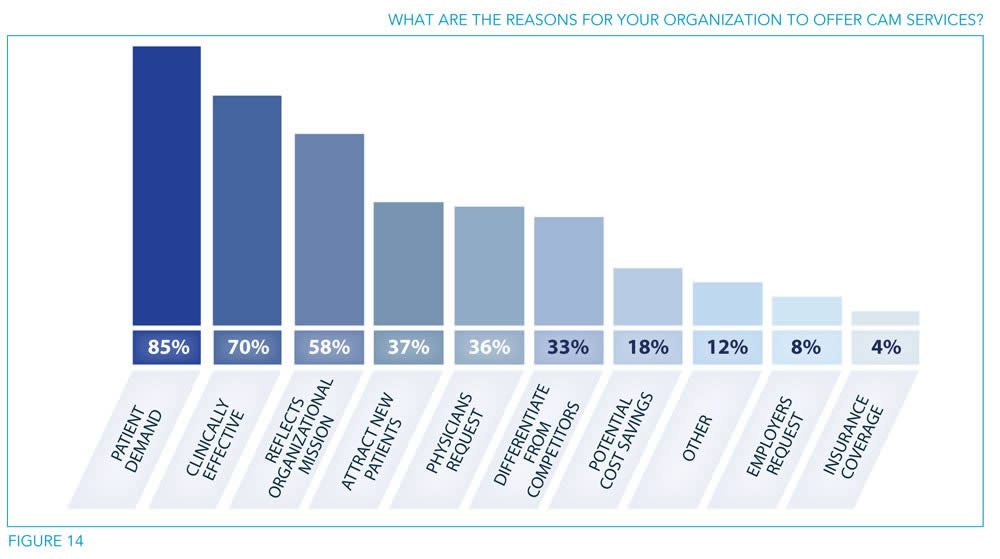
It’s even more instructive to look at the reasons given for starting up a CAM program. Inevitably, financial considerations, plus popularity and a perceived demand among patients, are among the handful of factors that predominate:

Look at what comes in as number one: patient demand at 85%. None of this is surprising, given that in the introduction it is stated:

The American public is also demanding that their hospitals offer more than conventional allopathic health care and begin to integrate CAM therapies into the care they receive in the hospital. In response, hospitals have been looking to meet the needs of their communities. The demand for CAM services is significant, even though insurers may not cover all services or products, with the American public spending approximately $12–19 billion on CAM providers and a total of $36–47 billion on all services and products combined.

Which at first suggested to me that it’s almost all about the business. There’s a lot of money to be made in CAM, and it’s paid for out of pocket. It’s also instructive to look at the reasons given for choosing the CAM modalities offered:

There are, however, a couple of anomalies here. Most prominent, given that only 27% state that market research drove their decision to offer CAM, one wonders how all the others who didn’t do any market research (78%) knew that there was enough patient demand to justify spending the money to offer specific CAM services. In any case, I consider it also telling that the survey reports that 85% will use patient satisfaction as a metric to evaluate the CAM program while only 42% plan on evaluating health outcomes and 31% will evaluate quality. Don’t get me wrong, patient satisfaction is important, and we measure it for science-based medicine. However, there’s something wrong when twice as many hospitals with CAM programs will be looking at patient satisfaction as will be looking at health outcomes.

Perhaps the most interesting part of this study suggests that it may actually not be all about the money, despite the listing of how lucrative CAM can be. For example, only 57% of facilities will be using volume as a criterion for evaluating their CAM program. Is there a clinical program on earth (or at least in the U.S.) that doesn’t use volume as part of its criteria for evaluating it? It may be one of many, and it might not even be one of the more important criteria, but it’s usually a significant criterion. Adding to this, only 39% will use revenue; 20% will use profit; and 8% will use market share. To me these suggest that perhaps CAM is indeed more ideological than financial, particularly when coupled with the finding that 75% of hospitals reported that budgetary constraints are the biggest obstacle to implementing a CAM program, even though such programs can cost as little as $200,000 to start up. (One notes, in contrast, that only 43% reported that a “lack of evidence-based studies” was a major obstacle.) No wonder quackademic medicine is trying so hard to entice third party payers to reimburse for their services; if that were to happen, no doubt many CAM programs that are currently not financially viable will become viable. Perhaps, for as unrepresentative a sample as was surveyed, this survey serves the inadvertent purpose in providing evidence to suggest that the infiltration of quackademic medicine is not driven primarily by money, as skeptics and supporters of SBM (myself included) have on occasion speculated.

Maybe it really is about the ideology.

Facebook Google Buzz Digg <!--<!--LinkedIn StumbleUpon LiveJournal Share

Dummy Medicine, Dummy Doctors, and a Dummy Degree, Part 2.1: Harvard Medical School and the Curious Case of Ted Kaptchuk, OMD (cont.)

Rave Reviews

In 1983, Ted Kaptchuk, the senior author of the recent “albuterol vs. placebo” article, and soon to become the long-time Second-in-Command of the Harvard Medical School “CAM” program, published The Web that Has No Weaver:

The book received rave reviews:

A major advance toward the synthesis of Western and Eastern theory. It will stimulate all practitioners to expand their understanding of the causes and treatment of disease.

–Paul Epstein, MD, Harvard Medical School

A lucid and penetrating exposition of the theory and practice of Chinese medicine. While the book’s rich detail makes it of great use to practicing healers, it is in its entirety very simply written, enjoyable reading for the layman…it brings a demystifying balance…Instructive, profound, and important!

Professor Martin Schwartz, University of California, Berkeley

…demystifies Oriental medicine in a remarkably rational analysis…

—Science Digest, Nov. 1982

…an encyclopedia of how to tell from the Eastern perspective ‘what is wrong.’

Larry Dossey

Dr. Kaptchuk has become a lyricist for the art of healing…

—Houston Chronicle

Although the book is explicitly detailed, it is readable and does not require previous knowledge of Chinese thought…

—Library Journal

The 2nd edition was published in 2000, to more acclaim:

…opens the great door of understanding to the profoundness of Chinese medicine.

—People’s Daily, Beijing, China

…weaves a picture…that is eminently understandable from a Westerner’s point of view…adds a valuable analysis of the current scientific understanding of how the therapies work and their effectiveness.

Brian Berman

Ted Kaptchuk’s book was inspirational in the development of my acupuncture practice and gave me a deep understanding of traditional Chinese medicine…

Dr. George T. Lewith

…a gift for all who share an interest in deep understanding of healing. This new edition is essential reading…

Michael Lerner, President, Commonweal

Even Edzard Ernst, still in his foggy period, called the 2nd edition “a brilliant synthesis of traditional and scientific knowledge…compulsory reading…”

Andrew Weil, who wrote a forward for the 2nd edition, praised Kaptchuk for “merg[ing] the insight of a Taoist sage with the skepticism of a modern, inquiring scientist,” and asserted that

…the emphasis of Chinese practitioners on energy and its balanced flow throughout the body is a stumbling block for Westerners who cannot see beyond the limitations of the paradigm of materialistic science.

Margaret Caudill, who wrote forwards to both editions, praised Kaptchuk for having written

…an important exposition of the ancient art of Chinese medicine in terms that can be understood by a Western audience. The author has deftly avoided, as much as possible, the pitfall of interpreting Chinese theory through Western terminology, thereby leaving the central Chinese concept of medical patterns and disharmonies undisturbed.

(One wonders if Caudill had read the book that she introduced. Kaptchuk himself, on the third page of his own introduction, states that he tried to “explain Chinese concepts with a Western vocabulary,” although he’d found that “at times [this] was a very great problem.”)

What readers might expect to find, then, is a book that is easy to read and understandable to Westerners, that is rational, that ‘demystifies’ its subject, that will provide a ‘deep’ understanding of healing, that will “expand their understanding of the causes and treatment of disease,” and that heralds a ‘synthesis’ of Eastern and Western medicine.

I perused the first edition of The Web around 10 years ago, when I was trying to learn something about acupuncture for my work on the Massachusetts Special Commission on Complementary and Alternative Medical Practitioners. A friend had it on his bookshelf, and let me borrow it; he hadn’t read it himself. A few days later I reported back to him: “there is sophistry on nearly every page.”

This review is mostly concerned with the first edition; I’ll mention some things about the 2000 edition in the next post.

“A Coherent and Independent System of Thought”

Kaptchuk begins by dismissing two, presumably dominant Western notions of Chinese medicine:

Some…see it as hocus-pocus—the product of primitive or magical thinking. If a patient is cured by means of herbs or acupuncture, they see only two possible explanations: either the cure was psychosomatic or it was an accident, the happy result of hit-or-miss pin-sticking that the practitioner did not understand. They assume that current Western science and medicine have a unique handle on truth—all else is superstition.

Other people have an equally erroneous view of Chinese medicine. Deeply and often justifiably disturbed by many of the products of Western science and culture, they assume that the Chinese system, because it is more ancient, more spiritual or more holisitic, is somehow more “true” than Western medicine. This attitude threatens to turn Chinese medicine from a rational body of knowledge into a religious faith system. Both attitudes mystify the subject—one by arrogantly undervaluing it, the other by setting it on a pedestal. Both are barriers to understanding.

But no more a barrier to understanding than the passage just quoted. We who ‘arrogantly’ undervalue Chinese medicine do so not because we see only two possible explanations for its apparent successes; we see many explanations, none involving hit-or-miss pin-sticking, accidental or otherwise. We deny that science is ‘Western,’ any more than the physics of Einstein was ‘Jewish’ (I confess to having used this quip repeatedly, but in my opinion it can’t be repeated enough). We immediately detect, in the phrase “current Western science,” the Galileo Gambit, and we reject that bit of sophistry. We’ve seen precious little evidence of cures by means of herbs or acupuncture, and 28 years later we’re still waiting. Those who think Chinese medicine is more true than ‘Western medicine’ have a problem with science other than merely being disturbed by its “products.” They are, er, deeply ignorant of it.

What, then, is Kaptchuk’s view of Chinese medicine?

Actually, Chinese medicine is a coherent and independent system of thought and practice that has been developed over two millennia. Based on ancient texts, it is the result of a continuous process of critical thinking, as well as extensive clinical observation and testing. It represents a thorough formulation and reformulation of material by respected clinicians and theoreticians. It is also, however, rooted in the philosophy, logic, sensibility and habits of a civilization entirely foreign to our own. It has therefore developed its own perception of the body and of health and disease.

If you’re bracing for an onslaught of the usual sCAMbits—unfalsifiable assertions, propaganda language devices, arguments from ignorance, arguments from tradition, special pleading, changing the rules ad lib, breezy contradictions, and all the rest—yer on the right track. Right off the bat, Kaptchuk asks that you check your own critical thinking skills at the door:

In order to understand it, we must first accept two principles: that another perspective, though different from our own, can be logical and have predictive validity, and that there can exist another method of healing. In other words, the world can contain two rational and effective medical systems, both describing the same phenomena, but describing them differently. Once we accept these premises, we can begin to understand the Chinese view of physiology.

I’ll give you a taste of that ‘physiology’ below, but first know that for Kaptchuk, Western medicine suffers from a severe case of reductionism, whereas Chinese medicine is far more interested in you as a whole person:

Western medicine is concerned mainly with isolable disease categories or agents of disease, which it zeroes in on, isolates, and tries to change, control, or destroy. The Western physician starts with a symptom, then searches for the underlying mechanism—a precise cause for a specific disease

The Chinese physician, in contrast, directs his or her attention to the complete physiological and psychological individual. All relevant information, including the symptom as well as the patient’s other general characteristics, is gathered and woven together until it forms what Chinese medicine calls a “pattern of disharmony.”…Oriental diagnostic technique does not turn up a specific disease entity or a precise cause, but renders an almost poetic, yet workable, description of a whole person.

“An Effective Healing Method”

Kaptchuk asserts that Chinese medicine considers some things important that Western medicine does not, and vice versa:

…Chinese medical theory does not have the concept of a nervous system. Nevertheless, it has been demonstrated that Chinese medicine can be used to treat neurological disorders. Similarly, Chinese medicine does not perceive an endocrine system, yet it is used to treat what Western medicine calls endocrine disorders. Nor does traditional Chinese medicine recognize the bacteria Streptococcus pneumoniae as a pathological cause of pneumonia [sic], yet often it effectively treats the disease.

The first two claims are trivially true, of course, but beg the relevant question: the humoral system of medicine was also used to treat all sorts of diseases, as has every pre-scientific form of medicine. The pneumonia claim is another matter, for which Kaptchuk doesn’t offer particularly convincing evidence:

…the Chinese performed thousands of experiments and clinical studies during the fifties. The result was that in 1958 the Central Committee decided to give traditional and modern medicine equal respect and place in China…

The pages of such studies fill entire libraries, yet it is not their quantity that is important, but rather their conclusions: that traditional Chinese medicine can hold its own, that it does work clinically.

It is now evident that Chinese medicine is an effective healing method.

Kaptchuk proceeds to cite numerous, presumably positive or at least promising studies from China, involving heart disease, cancer, kidney disease, asthma, encephalitis, diphtheria, acupuncture anesthesia, and more. He points out that when these are “diseases recognized by the West,”

the actual application and methodology are clearly Western in orientation. The theory of Yin and Yang and other traditional concepts are left behind…

Fortunately for its future, however, the results of the studies generally demonstrate that traditional Chinese medicine does work best when left in the context of Chinese logic.

Continuing to plead the case for the unfalsifiable:

…the Chinese view of health and disease as inseparable from a specific person means that the treatment will be well tailored to that person. Such personal shaping seems to maximize the effectiveness of the therapies.

Nevertheless,

Western clinical studies (done in China) of traditional Chinese medicine, by proving its practical efficacy, have helped it win its battle for survival in the twentieth century, and promise it a place in the future of medicine.

Later, in a footnote, Kaptchuk mentions that those weren’t, like, real studies: they weren’t controlled or anything, and many used “imprecise assessment methods. They would most properly be called clinical observations.” Throughout the book he continues to cite them in support of various unlikely cure claims.

Sometimes he just makes stuff up without even attempting to justify it:

Chinese remedies are often more effective than Western ones, and they are always gentler and safer. Chinese prescriptions, for example, do not produce side effects because they are balanced to reflect a patient’s entire state of being.

Chinese medicine, because it emphasizes balance and relationship more than measurable quantity, can also frequently discover and treat a disorder before it is perceptible by the most sophisticated Western diagnostic techniques. Chinese medicine is capable of touching those places that evade the microscope…

Woah. Dr. Epstein, did you even read this stuff? Dr. Ernst? OK, Dossey, Weil, Berman, we expect them to quack right along, but really. Dr. Delbanco? (Not one of the reviewers quoted above, but one of my former mentors at Harvard, who told me a few years ago that he’d been Kaptchuk’s patron. Did he read this book?)

Kaptchuk never explains the real reasons that “the Central Committee decided to give traditional and modern medicine equal respect and place in China,” previously discussed here. In that post I also showed how one of the passages quoted above morph’d from the 1983 edition to the 2000 edition of The Web; it isn’t flattering to the ideal of intellectual honesty.

“Images of the Macrocosm”

What about that Chinese view of physiology? It turns out that Kaptchuk, who coined the phrase, asserts only a few pages later that there is no such thing. We already suspected that, but let’s play along:

The highly developed constructs [sic] of chemistry, biochemistry, anatomy, and physiology that form the groundwork for modern Western medicine are of little importance to the Chinese…Chinese medicine therefore has a very limited theory of the human organism itself.

But didn’t he tell us that the Chinese physician directs his or her attention to the complete physiological and psychological individual? I guess it depends on what your definition of “truth” is:

The essential ideas of Chinese medicine…are cultural and speculative constructs that provide orientation and direction for the practical patient situation…The ‘truth’ of these ideas lies in the way the physician can use them to treat real people with real complaints.

Maybe we’re getting somewhere, because the essential ideas are certainly cultural and speculative constructs; but there are those real complaints again, just like pneumococcal pneumonia. I thank Kaptchuk for now having made it clear that I needn’t go into excruciating detail about what I’d imagined he meant by the “Chinese view of physiology,” even as I cringe when I consider that he probably hadn’t intended to insult Chinese people in general.

But wait:

For the Chinese, Qi is not a metaphor; it is a real phenomenon that makes possible integrative descriptions of bodily changes.

Such contradictions are rampant throughout the book (and ya gotta love those “integrative descriptions”):

Chinese medicine is not primarily quantitative.

But:

It has standards of measurement that allow practitioners systematically to describe, diagnose, and treat illness.

Aren’t measurements quantitative? Silly, Western me:

Its measurements, however, are not the linear yardsticks of weight, number, time, and volume used by modern science but rather images of the macrocosm.

Hmmm. Images of the macrocosm: simple, lucid, rational, understandable, demystifying—and each one a measurement to boot! Heck, no less a measurement than Dolores Krieger’s, and the macrocosm’s been around for a helluva lot longer.

The “Chinese View of Physiology”

The ancient Chinese, according to Kaptchuk, were totally into Functions and Relationships, as I’ll explain a bit more below. I had therefore imagined that by “physiology” he must have meant the “Fundamental Substances”—Qi (“we can perhaps think of Qi as matter on the verge of becoming energy, or energy at the point of materializing”), Blood (“not the same as what the West calls blood), Jing (“Essence”), Shen (“Spirit”) and Fluids (“bodily liquids other than Blood”)—; and the Organs (“The Harmonious Landscape”: Yin Organs are Heart, Lungs, Spleen, Liver, and Kidneys; Yang Organs are Gall Bladder, Stomach, Small Intestine, Large Intestine, Bladder, and Triple Burner; Curious Organs are Brain, Marrow, Bone, Blood Vessels, Uterus, and Gall Bladder again); and, of course, how they all work together to get things done. That’s physiology!

The Chinese view, according to Kaptchuk? Let’s see:

The Heart:

  • ‘rules the Blood and Blood vessels’
  • ‘stores the Shen [Spirit]‘
  • ‘opens into the tongue’

The Lungs:

  • ‘rule Qi’
  • ‘move and adjust the Water channels’
  • ‘are the upper origin of water’
  • ‘rule the exterior of the body’
  • ‘open into the nose’

The Spleen:

  • ‘rules transformation and transportation’
  • ‘governs the blood’
  • ‘rules the raising of the pure’
  • ‘rules the muscles, flesh,’ and the four limbs
  • is the origin of Qi and Blood
  • ‘opens into the mouth’

Organs vs. organs

It goes on and on, but I think you get the point. Kaptchuk insists that the ancient Chinese did not seriously intend to portray those Organs as real:

…the Chinese have no system of anatomy comparable to that of the West.

In China, internal anatomy is generally irrelevant to clinical practice.

The Heart, Lung and Kidneys of this volume are not a physical heart, lung, or kidneys; instead they are personae in a descriptive drama of health and disease.

The Organs of the body, defined as they are by their functions and relationships, are another part of the bodily web. They cannot be discussed out of context. The Chinese notions about Organs (or anything else) are not meant to be hard pieces of a theory that can be proved or disproved. They are part of an organizing network to be used when convenient. The Chinese would be indifferent to proof in our accustomed scientific sense.

China’s lack of an anatomical theory like the West’s does not mean its system is unscientific; it means only that there exist alternate systems of thought, one Eastern, one Western.

What are the differences between the two? Here is the remainder of the paragraph partially quoted above:

The tendency of Chinese thought is to seek out dynamic functional activity rather than to look for the fixed somatic structures that perform the activities. Because of this, the Chinese have no system of anatomy comparable to that of the West. Thus, for example, the Organ known as the Liver is for the Chinese very different from the Western liver. The Chinese Liver is defined first by the functions associated with it, the Western liver by its physical structure. This divergence makes it possible for Chinese medicine to identify Organs not recognized by the West—such as the Triple Burner—and for it not to recognize organs and glands clearly identified by Western medicine—such as the pancreas and the adrenal glands.

So it seems that in the West, physicians view organs in much the same way that butchers do: as mere “somatic structures,” without regard to their functions and relationships. This is nonsense, of course. I’m sure that every MD who was trained at least since the Flexner Report has thought of organs as being part of an anatomical and physiological whole, with countless, real functions and functional relationships among them, more of which are being discovered all the time. That’s physiology!

In reality, the ancient Chinese rarely dissected cadavres, so a straightforward explanation for their Organ confusion is the same as that for the centuries-long persistence of Galen’s erroneous anatomy in the West: prior to the last few hundred years the Chinese, like the Europeans, didn’t know any better. What anatomical information they had likely came from fleeting observations of mangled soldiers on battlefields, by extrapolating from the butchery of farm animals or occasional dissections of primates, and from very rare, mostly secretive dissections of human cadavres. Because such dissections were frowned upon, and Arguments from Authority were ‘privileged’ in both cultures until recently, even legitimate challenges to conventional wisdom, if there were any, were not appreciated.

Kaptchuk knows some of this but, once again, you have to go to the small print of a footnote at the end of the chapter to find the relevant passage:

China…had Confucian religious and ethical prohibitions against dissection…

The straightforward explanation is supported by some of Kaptchuk’s Organ descriptions being crudely accurate (the lungs really do “open into the nose”; the Stomach does “receive and ripen” food) and by some being inaccurate in ways that are understandable from a simplistic, purely anatomical point of view. For example, according to Kaptchuk, the “Kidneys are called the ‘root of life’…the source of reproduction,” and dysfunctions thereof are responsible for “sterility or impotence…or lack of sexual maturation.” Well, no, the kidneys have almost nothing to do with those things, but you might think otherwise if you knew only that there are tubes that connect them to the bladder and the bladder to the external genitalia. So much for an understanding of function and relationships.

An “Important Taoist Notion”

There is nothing shameful about a pre-scientific history; all cultures have gone through it. So why the subterfuge? Apparently the straightforward explanation evokes a Pattern of Disharmony with Kaptchuk’s central claim:

Chinese medicine is a coherent system of thought that does not require validation by the West as an intellectual construct. Intellectually, the way to approach Chinese concepts is to see whether they are internally logical and consistent, not to disguise them as Western concepts or dismiss them because they do not conform to Western notions. And the system is internally consistent—it is an organization of all the observable manifestations of the body into an integrated set of functions and relationships. Understanding of these functions and relationships enables the practitioner to identify and treat a disharmony in them.

And finally, his absolute, you-got-no-answer-for-this trump card:

The important Taoist notion—that the Tao (or Dao, the balanced and harmonious Way) that can be talked about and described is not the Tao—pervades medicine.

Ya gotta love the Gish Gallop. You also gotta appreciate how that important Taoist notion morphs, almost seamlessly, into current Quantum Quackery, with its own purported trump cards, misplaced versions of the Observer Effect and of Quantum Entanglement. This is no mere coincidence: Quantum Mysticism was all the rage during the 1970s, especially with the publication of Fritjof Capra’s annoying book, The Tao of Physics. Kaptchuk had apparently read another such book, The Dancing Wu-Li Masters, from which he borrowed this quotation attributed to physicist David Bohm:

Parts…are seen to be an immediate connection, in which their dynamical relationships depend, in an irreproducible way, on the state of the whole system (and, indeed, on that of broader systems in which they are contained, extending ultimately and in principle to the entire universe). Thus, one is led to a new notion of unbroken wholeness which denies the classical idea of analyzability of the world into separately and independently existent parts…

That works perfectly for someone who is hell-bent on dissing “reductionism” in Western medicine. There is that little problem of physiology, though…ya gotta wonder how all those wise reviewers missed it and just about everything else.

But back to ‘observable manifestations of the body’: doesn’t their being ‘observable’ imply that they are real, not just ‘internally logical and consistent’? Which, by the way, sounds awfully ‘Western’ to me. Oops, I stumbled again: throughout the book Kaptchuk refers to “Chinese logic”; that must be different from Western logic.

OK, I’ll try to be a little less snide. It’s possible that a system of thought can be coherent and internally logical and consistent, and yet still not be valid. Astrology, or at least some schools of it, could be such a system. Homeopathy could be another. So could the activities of the Tooth Fairy. There is also the question of just how coherent and logical and consistent Chinese medicine is. I hope this is becoming evident throughout this review.

Meridians: Interior vs. Exterior

Meridians are another important part of the Chinese view of anatomy and physiology:

Meridians are channels or pathways that carry Qi and Blood through the body. They are not blood vessels. Rather, they comprise an invisible network that links together all the Fundamental Substances and Organs…The Nei Jing says: ‘The Meridians move the Qi and Blood, regulate Yin and Yang, moisten the tendons and bones, benefit the joints.’

Are we to take such pronouncements literally? After all, “The Chinese notions about Organs (or anything else) are not meant to be hard pieces of a theory that can be proved or disproved.” Remember, there are many contradictions in this book:

In Chinese Meridian theory, these channels are unseen but are thought to embody a physical reality—the Substances Qi and Blood move along them, carrying nourishment and strength.

The Meridians connect the interior of the body with the exterior. (As has been said earlier, the distinction between inner and outer has more to do with significance than with place—the interior is more important than the exterior.)

Huh? But we were just told that the Meridians embody a physical reality. So do they or don’t they?

This is the basis for acupuncture theory, that working with points on the surface of the body will affect what goes on inside the body, because it affects the activity of the Substances that are traveling through the Meridians. Most acupuncture points relate to the Meridians and most herbs a doctor prescribes will enter one or more Meridian pathways.

Well, the ‘exterior’ seems to really mean the exterior, i.e., the surface. But does “inside the body” not mean the “interior”? After all, “the interior is more important than the exterior.” But “the distinction between inner and outer has more to do with significance than with place,” and elsewhere Kaptchuk tells us that “in China, internal anatomy is generally irrelevant to clinical practice.” This is making me dizzy.

Kaptchuk next discusses the number of meridians and the number of acupuncture points, without mentioning their relation to astrology. Throughout the book he also fails to deal adequately with the abundance of military, political, geographical, and meteorological metaphors in pre-scientific Chinese medicine, as well as the conspicuous numerology (the number 5 recurs over and over again).

More rigorous historians, such as Paul Unschuld, have made compelling arguments that the Chinese actually thought of those entities as offering important insights—not merely convenient terms—for medical ‘theory.’ Unschuld reports that what Kaptchuk calls “Yin and Yang Organs,” the Chinese call “depot and palace organs,” respectively, even if they are “yin-yang pairs.” Unschuld does not agree with Kaptchuk’s mythologic view of Chinese ‘organs’; he (Unschuld) states that they were “understood as actual morphologic entities.” He also spells them in the lower case. According to Unschuld, such concepts as “stagnant qi” or “blocked qi” were likely derived from irrigation systems in farming. Such views would be an embarrassment to the claim that

…the world can contain two rational and effective medical systems, both describing the same phenomena, but describing them differently.

Patterns of Disharmony

Kaptchuk tells us that the Chinese are (were) not concerned with ultimate causes, but with patterns:

There is no distinction between the illness itself and the factor that “caused” it. The question of cause becomes incidental. In this sense, the word ’cause’ is almost a synonym for ‘effect.’ In Chinese pattern-thinking, what might at first seem to be a cause becomes part of the pattern, indistinguishable and inseparable from the effect. Pattern-thinking subsumes the cause, defining it in terms of the effect and making it part of the total pattern. What we in the West call a cause has little importance in Chinese thought. The lines of causality are bent into circles.

This concept is the basis for the title of the book: The Web that Has no Weaver. I have no reason to doubt that such circular thinking was true for some periods or for some aspects of pre-scientific Chinese medicine, because I don’t really know all that much about it other than what I’ve read in Kaptchuk’s book, in a couple of Unschuld’s books, and in a few essays here and there. I do suspect that Chinese physicians who held this view would have nevertheless jumped at the chance to learn about the real causes of disease, as they did in the late 19th century when the Germ Theory reached them, and as modern Chinese physicians are now doing through scientific research.

It seems, however, that not all pre-scientific Chinese physicians subscribed to the “cause has little importance” doctrine. According to Unschuld,

When a doctor who felt bound to the tradition of the medicine of systematic correspondence treated a patient, it was necessary for him to determine categorically which evil was afflicting the patient, via what organ the evil (if of exogenous origin) had found its way into the body, where it was currently located in the organism, what damage it had already caused in the economy of qi, and what other spheres it could possibly move into.

Back to Kaptchuk. Here are some of the “signs” that he would call ‘both cause and effect’ in Patterns of Disharmony: the Six Pernicious Influences (also called the Six Evils)—Wind, Cold, Fire or Heat, Dampness, Dryness, Summer Heat; the Seven Emotions—joy, anger, sadness, grief, pensiveness, fear, fright. Here are the Eight Principal Patterns of Disharmony: Yin/Yang, Interior/Exterior, Deficiency/Excess, Cold/Hot. According to Kaptchuk, the Eight Principal Patterns “are the fundamental model for mediating between [the] two realms” of Yin/Yang and the “signs of disharmony.”

Various combinations of these, which are countless, are beyond my patience to attempt to comprehend. The book is sprinkled with “clinical sketches,” however, which can help to give a flavor of how such Patterns are used. I’ll reproduce a couple of them shortly.

Tongue Diagnosis, Pulse Diagnosis and the $1 Million Challenge

Of the Four Examinations in Chinese medicine—Looking, Listening and Smelling, Asking, and Touching—there are two “pillars”: observing (Looking) at the tongue and feeling (Touching) the pulse. Kaptchuk writes that one of his own teachers “described the tongue as a piece of litmus paper that reveals the basic qualities of a disharmony.” Let’s see if this is credible. The following is a small sample of nearly four pages of tongue descriptions:

A scarlet tongue is deeper red than a red tongue, and points to an extreme Heat condition. In a disharmony characterized by External Heat, it indicates that Heat has entered the deepest levels of the body.

A purple tongue usually indicates that the Qi and Blood are not moving harmoniously and that there is a pattern of Stagnant Qi or Congealed Blood…A purple tongue may also be associated with the Liver’s failure to flow or spread properly.

Moss that is puddled with moisture is a sign of Excess Fluids, usually due to Deficient Yang (or Fire, the body’s internal Heat), but is also a possible sign of other patterns, such as Dampness.

A moss that appears firmly implanted on the tongue body, like grass sprouting from the ground, signifies strong Spleen and Stomach Qi. Moss that appears to be floating on the surface of the tongue is a sign of weak Spleen and Stomach Qi.

A greasy moss appears to be a thick, oily film covering the tongue or a portion of it. It can resemble a layer of white petroleum jelly or butter, and is a sign of Mucus or Dampness in the body.

A peeled tongue may be a sign of Deficient Yin or Fluids, or of Spleen Qi too weak to raise smoke.

A stiff tongue lacks flexibility…This type of tongue usually implies a Wind Pernicious Influence or Mucus obstructing the Heart Qi.

A trembling tongue seems to wiggle uncontrollably. When this type of tongue is pale, it is a sign that Qi is insufficient to regulate proper movement. If the tongue is red, the diagnosis is usually Internal Wind moving the tongue.

…particular areas of the tongue are said to correspond to particular Organs…which are helpful but are never considered absolute.

I quoted those passages not so much to demonstrate their absurdity—although I consider them to be absurd—as to demonstrate their obvious hopelessness as repeatable, agreed-upon physical findings (remember that there are many more where these came from). They remind me of the 35 or so shades of sputum that are listed in homeopathic repertories, each one requiring a match with about the same number of sputum textures, that must further be matched to each of hundreds or thousands of other multi-faceted “symptoms”; and even one little “mistake” among all those choices will purportedly make the crucial difference between choosing the simillimum and choosing a dud. (Look here, pp. 79-81)

Has a study ever shown inter-rater reliabilty for Chinese tongue diagnosis? Not that I know of. A couple of abstracts suggest the opposite, as you’d expect.

What about pulse diagnosis? This is the most important of all the Examinations, and is “far more complex than what we know in the modern West.” Kaptchuk takes it quite seriously. He spends about 16 pages describing “the 28 basic pulses.” They are categorized according to Depth, Speed, Width, Strength, Shape, Length, and Rhythm; some of them are the Floating Pulse, Sinking Pulse, Thin Pulse, Big Pulse, Full Pulse, Empty Pulse, Slippery Pulse, Choppy Pulse, Tight Pulse, Short Pulse, Long Pulse, Knotted Pulse, Flooding Pulse, Soggy Pulse, Leather Pulse, Spinning Bean Pulse. If these weren’t trouble enough, according to Kaptchuk they “are more often found in combination than in their pure form…”

Thus, writes Kaptchuk,

…pulse taking approaches the subtlety and complexity that bespeaks an art. It requires thorough training, great experience, and the gift of sensitivity. When the physician takes a pulse, he or she is alert to a tremendous array of sensations that must be expertly understood and arranged as a unity—the “feel” of an individual pulse…

…it is clear that the system is extremely complex, capable of infinite refinement. Pulse diagnosis is a very sophisticated art. It demands sublety and wisdom on the part of the physician to discern the relative importance of each variable and to make of them all an intelligent and precise diagnosis—to weave a useful pattern.

Wiser Weasel Words of Woo have Warely been Weaved

How is the pulse taken and what can it tell the physician? Rather than quote Kaptchuk, I’ll turn to Unschuld, who explains it in a clearer fashion, complete with a topographical metaphor that the ancient Chinese apparently took seriously. He notes that there are several methods:

One method was based on the notion that at the high point of the styloid process below (medial to) the wrist there was an imaginary line, called the “pass,” as a narrow passage through mountains. When a finger feels the pulse with light pressure above the “pass,” i.e., toward the wrist, the pulse offers evidence about the state of the lung and heart. The connection lies in the fact that the imaginary line, the “pass,” corresponds to the diaphragm in the human body. The lung and heart are located above this separation, in the yang area of the body. The lung and heart therefore manifest in pulse above the “pass” in the yang region. Below the pass, in the yin region, the pulse reflects the condition of the liver and kidney, organs which lie below the diaphragm in the yin region of the body. Right on the pass, the middle of the three fingers feels the state of the spleen, the organ that lies closest to the diaphragm.

A second method of pulse taking uses the pressure of a single finger. The finger exerts a light pressure in the area of the pass and feels the pulse just below the skin, that is, in a yang region, which provides information about the lung and heart. Somewhat greater pressure allows the finger to penetrate the level where the pulse of the spleen can be felt. Applying still greater pressure so that the fingertip enters the yin region and almost reaches the bone, the level of the liver and kidneys is reached.

This method stands alongside yet another by which the finger, by application of different degrees of pressure, feels the state of the five organs each at five different levels.

The “states” of the organs include the same possibilities that we saw for tongue diagnosis, e.g., dampness, cold, heat, congealed blood, stagnant qi, etc. It should be obvious to anyone with even a passing knowledge of anatomy and physiology, and with even a passing sense of reality—which apparently excludes the reviewers quoted above, assuming that they read the book—that the claims made for ancient Chinese pulse-taking are ridiculous. Dampness aside, if I were in charge of the Randi $1 million challenge, I’d offer it to anyone who could demonstrate that the maneuvres described above can repeatably yield information distinctly referable to each of the named organs, other than, of course, the heart.

The reports of dismal inter-rater reliability for tongue diagnosis also apply to pulse diagnosis.

“Clinical Sketches”

A patient suddenly gets a high fever and a severe sore throat. She has a red face, a dry, hacking cough, and no fear of cold. A Western physician takes a throat culture and discovers the presence of Group A beta hemolytic streptococcus. Antibiotics are prescribed, with good results. If the same patient had gone to a Chinese physician, he very likely would have diagnosed a Heat Pernicious Influence. Herbs like Coptis and Scutellena, which disperse and cool Fire, would have been prescribed. The results would have been adequate though perhaps slower to achieve than with the antibiotic treatment. Modern research shows, incidentally, that both Coptis and Scutellena inhibit the growth of streptococcus bacteria. Acupuncture treatment, such as needling Large Intestine 4 (He-gu, Adjoining Valleys), to cool Fire, would in this case have offered some symptomatic relief and heightened the body’s resistance, but would have been less effective than herbs.

Oh really? I haven’t pursued the claim made for the two herbs, but I suspect it goes something like this. Acupuncture would have “heightened the body’s resistance”? Spare me. The bigger problem is the blithe, ignorant dismissal of effective medicine: antibiotics don’t shorten the duration of uncomplicated acute streptococcal pharyngitis, so the ‘results’ of Chinese intervention, at least the results that Kaptchuk seems to be talking about, would have been no “slower to achieve.” What antibiotics do in this case—and the entire reason for taking them—is to prevent complications, most importantly post-streptococcal rheumatic fever. And you can bet, dollars to donuts, that neither the herbs nor acupuncture will accomplish that. Oops.

Here’s another Clinical Sketch, “taken from the author’s private practice”:

A woman, aged twenty-six, complained of wheezing, difficulty in breathing, and coughing, especially in the middle of the night. The pattern had begun suddenly when the patient was sixteen years old and had gotten steadily worse. The patient constantly felt tightness in her chest, unrelated to seasonal changes, and when an attack started, there was much sneezing and coughing. Phlegm with a thick and yellow quality was produced. The patient’s medical history was otherwise insignificant. Her appetite was good and her stools and urination were normal. She was very thin, with dark rings under her eyes. Her energy level was good except during an attack, and she did not report any emotional stress but seemed jumpy and anxious. Otherwise, her Shen was harmonious and clear. Her tongue was red and cracked in the middle and had scattered red dots. Her pulse was rapid (ninety-six beats per minute) and also slippery and slightly thin.

When she came for treatment, she was taking Western medication but wanted an alternative because the drugs made her dizzy, tired, and nauseated.

Many of the signs pointed to the pattern of Heat in the Lungs: yellow phlegm, rapid pulse, red tongue, and thirst. Other signs, such as the thin body, the chronic nature of the disorder, the peeled and cracked tongue, and thin pulse, pointed to Deficient Yin. The wheezing, thick phlegm, and slippery pulse indicated that Mucus was present. A combination of acupuncture and herbal treatments was administered to cool the Lung Heat, nourish the Yin of the Lungs, and eliminate Mucus. This therapy brought the symptoms under control within two weeks.

Although the patient is still subject to occasional attacks, they are much less frequent and intense. When needed, she takes herbs or uses an herbal inhalator [sic].

Kinda sounds like asthma, no? You’d think he might’ve asked about cigarette smoke, or maybe cats or dust in her abode. How about listening to her lungs, or maybe even considering (gasp) an objective test? Wasn’t he expected to gather “all relevant information?” (No matter, he kicked ass on the tongue and pulse exams.) An “herbal inhalator”?

Conclusion

How does the Web that Has No Weaver measure up (in the macrocosmic sense, of course) to the reviewers’ promises? Let’s see: is it a book that’s easy to read and understandable to Westerners, that is rational, that ‘demystifies’ its subject, that will provide a ‘deep’ understanding of healing, that will “expand [our] understanding of the causes and treatment of disease,” and that heralds a ‘synthesis’ of Eastern and Western medicine?

Wow. No. In a nutshell, there is sophistry on nearly every page. It continues to astound me that such drivel could have been taken seriously by academic physicians. I suppose the two most likely explanations are, in this order, that they didn’t read the book—can’t say I blame’em, it was like wading through molasses—or that they were utterly fooled by the rampant, misleading language. This post could have been the rilly advanced course in that little bundle, and let’s face it, most academics have just not had the privilege of learning about such esoterica. Whatever else you can say about Kaptchuk, he’s a Master of Misrepresentation.

Some might quibble with my not having cited some reasonable or even insightful passages in the book. It’s true that there are a few, and if taken out of context they can make the author look quite respectable, if you’ll excuse the tongue-in-cheek Bostonian observation. Put’em back in context, however, juxtaposed with all the meaningless adjectives, fallacies, contradictions, unsupported claims and the rest, and it’s ever more clear: sophistry. Ya gotta look at the whole.

I heard Kaptchuk speak at the 2001 Harvard Medical School “CAM” conference. Early in his talk he recounted, in a defiant and triumphant tone that brought cheers from the partisan audience, an episode during the 1980s—perhaps at about the time that he’d treated the woman in the second clinical sketch—when he’d been under threat of arrest for practicing medicine without a license. Go figure.

Next part: Dialectical materialism, PoMo gibberish, and an academic career built on sand.

Facebook Google Buzz Digg <!--<!--LinkedIn StumbleUpon LiveJournal Share

Caffeine for ADHD

“I don’t want to give my child any drugs or chemicals for their ADHD,” says a parent. “Instead, I’m thinking about using caffeine. Sound strategy?”

It may be dispensed by a barista and not a pharmacist, and the unit sizes may be small, medium and large, but caffeine is a chemical and also a drug, just as much as methylphenidate (Ritalin) is. Caffeine is even sold as a drug — alone and in combination with other products. But I regularly speak with consumers who are instinctively resistant to what they perceive as drug therapy — they want “natural” options. Caffeinehas been touted as a viable alternative to prescription drugs for ADHD. But is caffeine a science-based treatment option? This question is a good one to illustrate the process of applying science-based thinking to an individual patient question.

I’ve already described my personal fondness of caffeine, particularly when it’s in the form of freshly-roasted coffee. I’m not alone in my love. Caffeine is the most widely consumed drug in the world — more than alcohol, and more than tobacco: 90% of adults worldwide consume it daily.  The average American consumption is 280mg per day — about two cups of coffee.  The main source is coffee, but tea consumption is growing. And caffeinated soft drinks and energy drinks are a growing source of caffeine for children. Why do we love it so much?

Caffeine is quickly absorbed once consumed — and it immediately gets to work stimulating neurotransmitter release. Besides psychiatric effects, it has effects on alertness (positive), headache (also effective, except in withdrawal situations), athletic performance (another win), the cardiovascular system (my fingers are crossed), and the endocrine system, where it may improve diabetic control. It’s also being studied for effects on the gastrointestinal system, as well as its impact on cancer risk. In adults, caffeine consumption is associated with a negative relationship with all-cause mortality, largely due to a reduction of cardiovascular effects. Causation hasn’t been established though. Most of you are very familiar with the side effects of caffeine: agitation, tremors, insomnia, headache. Overall, despite documented cases of dependence and withdrawal, caffeine consumption has a generally attractive safety profile with a wide therapeutic range.

The symptoms of Attention Deficit Hyperactivity Disorder (inattention, impulsiveness and hyperactivity) have been identified for at least 100 years.  But once the diagnosis appeared in the DSM-IV, its standardized criteria became commonly used, and the prevalence is now estimated at about 3-7% of children. The term Attention Deficit Hyperactivity Disorder is somewhat of a misnomer, as the dysfunction appears related to an inability to regulate attention — not a deficit. Magnetic resonance studies suggest ADHD may manifest as a weakening of inhibitory signalling in the frontal cortex.The cause appears most likely to be genetic, with environmental influences.

The two main interventions for ADHD are behavioural treatments and drug therapies. The traditional therapies are the stimulant drugs, including amphetamine (Adderall), methylphenidate (Ritalin), and dextroamphetaime (Dexedrine). Some have been in use since the 1960’s. Over time, a wide array of dosage forms including controlled-release versions have emerged, driven by the desire to stabilize blood levels. The basic drugs themselves are short-acting, leading to a fluctuation of effects and the need for mid-day treatments — not ideal for school-age children. Non-stimulant drug therapies (e.g., antidepressants) have more recently emerged as treatment options and may be combined with stimulants, as additional therapies where symptom control isn’t reached with stimulants.

The treatment goals with ADHD are symptom based, so dosing is dependent on the effects observed. Treatment goals usually include reductions in disruptive behaviours, improvements in relationships (with peers, siblings, teachers, and parents), or specific academic parameters. Ideally, treatment goals should be objective and measurable, and agreed-up by parents, teachers, physicians, and children.

The stimulant medications have an impressive safety record and are generally well tolerated. There’s a long history of use. Are they effective? There’s reasonably good data to suggest they are, although comparative data are lacking. [PDF] Response rates to ADHD treatments appears high — 60-80%, and side effects are generally mild and manageable.

So that brings us back to the original question — I developed a focused clinical question using the PICO framework:

  • Patient: Who are what are we treating? In this case, children.
  • Intervention: What are we treating with? Caffeine
  • Comparison: Compared to what? Let’s assume stimulants.
  • Outcome: The effect we want to measure. In this case, symptomatic control.

So the question may be summarized as: In children, how does caffeine compare to stimulants for symptomatic control of ADHD?

It’s helpful to start with pharmacology to consider plausibility before we look at clinical trials. Caffeine, or more properly, 1,3,7-trimethylxanthine, has central nervous system effects, mainly thought to be due to blocking adenosine receptors in the brain. Given we don’t know the specific mechanism of action of the ADHD drugs, I’ll accept caffeine as a plausible treatment: it crosses into the brain, and it has CNS stimulant effects.

So let’s look at the data. I started with a tertiary reference: the Natural Medicines Comprehensive Database rates caffeine as “possibly ineffective”. Then I went to PubMed, and ran my own search.  Are there placebo-controlled, or head-to-head trials? Yes, and they’re disappointing:

The data are limited by small trials, mostly conducted in the 1970s. There doesn’t appear to be many trials exploring the dose-response relationship, and trials don’t seem to titrate doses — so it’s not clear if we’re evaluating comparable doses. While there don’t appear to be any systematic reviews, there are trials comparing caffeine to other drugs. In one comparison, 20mg of methylphenidate was found to be superior to 160mg of caffeine. In another trial, seventeen children who had positively responded to stimulant drugs were trialed on placebo, or two different doses of caffeine.  Caffeine didn’t have any statistically significant effects on behavioural measures.  In a trial  comparing amphetamines to 600mg caffeine daily, plus amphetamines,  caffeine was reported to provide incremental benefit, but side effects were noted. That’s not surprising: 600mg is the caffeine in two Starbucks Grande-sized coffees.  A double-blind crossover examination of caffeine, methylphenidate, and dextroamphetamine in 29 children concluded that while the two stimulants had meaningful effects, caffeine was indistinguishable from placebo. Overall — no strong signals of efficacy in the evidence.

Conclusion

Caffeine is a questionable treatment option for ADHD. There is mixed to negative efficacy data, and no long-term safety information in children. Depending on the form given, there’s challenge of ensuring standard doses (especially when using coffee) and maintaining stable blood levels.  In comparison, prescription stimulant medications offer a variety of drug  choices that have more convincing efficacy data, and are accompanied by a long history of use. There’s also a wide array of product types, making it easier to customize a treatment regimen. So while I can understand the hesitation to medicate and to “go natural” instead, it’s not a trade off that’s attractive. “Go science” instead — look to the data, and make treatment decisions based on the best evidence.


Facebook Google Buzz Digg <!--<!--LinkedIn StumbleUpon LiveJournal Share

Pseudoscience Sells

It is an unfortunate truth that there is money in pseudoscience, particularly medical pseudoscience. Money both attracts charlatans and also funds their activities, which includes marketing pseudoscience and defending their claims from scientific scrutiny. In this way the game is rigged in favor of pseudoscience.

With0ut effective regulation, sites like ours are forced to play whack-a-mole with the medical pseudoscience du jour. The latest case in point is Titanium Ion Bands – which are just another version of the Power Balance bands that have been previously exposed as nonsense. The idea is that by wearing a small bracelet on one wrist you will experience improved athletic performance. This sounds impossible – because it is. But companies have successfully bamboozled enough of the public to rake in millions.

The marketing strategy is three-fold. First, get naive professional athletes to endorse the product. Second, give live demonstrations (deceptive parlor tricks) that convince the unsuspecting that something must be going on. And third, wow the scientifically illiterate with a confusing barrage of medical techno-babble. The combination is sadly effective.

Power Balance, for example, makes vague references to frequencies and energy as the explanation for how a little piece of rubber (with embedded holograms) can have any effect on human physiology. The company was eventually legally forced to admit: “”We admit that there is no credible scientific evidence that supports our claims.” The admission has not ended their sale, however.

Next up is the Titanium Ion Bands. Their claims are essentially the same – wear a little bracelet on your wrist and you will have improved performance. Instead of holograms and frequencies, their bands are alleged to work through negative ions. This is just another recycled pseudoscientific claim that has been around for years. Just search on “negative ions” and you will see a variety of products claiming to improve health with negative ions.

The bracelet claim is nonsense for two independent reasons. The first is that a piece of anything does not generate negative or positive ions. You cannot change the net electrical charge spontaneously – you need a source of energy. The only devices that actually generate negative ions are powered in some way, such as a machine that you plug into an outlet. A chemical reaction, such as occurs in a battery, is also a possible source – but not tourmaline and titanium discs, as the company claims.

Even if the bracelets did give off negative ions, there is no evidence of any healthy benefit from this. You might build up a static charge and get shocked when you grab the doorknob, but there is no evidence or reason to suspect that negative ions will increase blood flow, as the company claims. “Increasing blood flow” seems to be the go-to explanation for a wide variety of dubious health products, especially for those that involve magnets or any kind of electrical force. Such claims, however, are evidence-free.

The company touts “reports” of their own “inspections” using fancy technology like thermography to demonstrate their claimed effects. It’s all very sciencey, while being scientifically worthless. None of the proper controls are in place to make the information anything other than a marketing demonstration, similar to the parlor tricks used by Power Balance.

On the company website there are links to celebrity endorsements and testimonials – but no links to published peer-reviewed quality research backing up any component of their claims.

Conclusion

There is every reason to believe that these titanium bands are medically worthless. However current regulations allow the company to market them with deceptive health claims without the burden to provide reliable scientific evidence to back up their claims. The endless chain of such products will continue as long as the lax regulations allow them to.

At present the best we can do is to continue to educate the public about the underlying science and to be skeptical of all such products. Further, we can pressure pharmacies and other outlets not to sell pseudoscientific products. Further, there are mechanisms to force companies to retract deceptive or unsupported claims for their products. It is a game of whack-a-mole, but it’s better than nothing.

Facebook Google Buzz Digg <!--<!--LinkedIn StumbleUpon LiveJournal Share

TIME Magazine, Dr. Oz, What to Eat, and Supplements

Here on SBM we have frequently had cause to criticize the media for poor science reporting and for spreading misinformation. Among many other individual offenders, we have criticized Dr. Oz for promoting alternative medicine on his TV show and gullibly promoting guests who pretend to talk to the dead and pretend to heal people with carnival sideshow tricks. We tend to be negative and critical because somebody has to do it, but it’s not pleasant.  For once, I have some good things to say.

The September 12 issue of TIME magazine was a Special Nutrition Issue. The cover featured pictures of food and the title “What to Eat Now: Uncovering the Myths about Food by Dr. Oz.” It devotes 7 pages to an article by him entitled “The Oz Diet: No more myths. No more fads. What you should eat — and why.” This is followed by a 5 page article by John Cloud “Nutrition in a Pill? I took 3000 supplements over five months. Here’s what happened.” Both articles have a rational, science-based perspective without any intrusions of woo-woo.

Oz on What to Eat

Oz acknowledges that the science of nutrition is not simple and that much of what we once believed has been discarded in the face of new knowledge. He debunks a number of popular misconceptions about diet. Most of what he says is consistent with scientific evidence and with mainstream diet advice.

  • It’s not necessary to restrict ourselves to low-fat foods.
  • It’s OK to eat eggs, whole milk, salt, fat, nuts, wine, chocolate and coffee — as long as we don’t overindulge.
  • The only fat accepted as “bad” is trans-fat, and that has been stripped out of most foods.
  • Dietary cholesterol is less important than we used to think and is irrelevant to some people who have good genes.
  • Excess salt is dangerous mainly for the minority of people with salt-sensitive high blood pressure.
  • Foods labeled “fat free” don’t taste as good, so manufacturers add more salt, sugar, and thickeners, and people tend to eat more calories.
  • Fad diets work by restricting food choices: they result in fluid loss and decreased calorie intake, and the weight lost comes right back when people stop the diet.
  • The low carb diets change nutritional balance in ways that may not be desirable.
  • The paleo diet?  Maybe not ideal: cavemen were shorter than modern people and died earlier.
  • Individualized nutrition? Blanket recommendations don’t fit all individuals, but nutrigenomic studies do not yet have clinical applications.
  • Weight loss is hard. To maintain a healthy weight, calories consumed must equal calories burned.
  • High fiber foods augment satiety.
  • One study showed that the foods most associated with weight gain are French fries, potato chips, sugary drinks, meat, sweets and refined grains and the foods most associated with successful weight loss are yogurt, nuts, whole grains, fruits and vegetables.
  • There are no elusive “superfoods.”
  • Exercise is important, but we mustn’t over-estimate its caloric benefit.

He mentions that coffee is the number one source of antioxidants in the Western world. I knew there was a reason I like coffee so much! Isn’t it refreshing to read an article about diet that doesn’t tell you to give up any of the foods you love? Isn’t science wonderful?

He doesn’t recommend vegetarianism, saying we are omnivores and there are multiple food groups for a reason. He concludes with the advice to

  • Eat in moderation
  • Choose foods that look like they did when they came out of the ground (minus the dirt, I hope!)
  • Be an omnivore
  • And get some exercise.

This is entirely consistent with what we have been hearing from other sources, from Mom to the American Dietetic Association, and with Michael Pollan’s advice to “Eat food. Not too much. Mainly plants.”

Going Beyond the Evidence

He does say a few things that I would argue with because I think he goes beyond the (good) evidence:

  • Since red wine is good for you, you should drink some every day and also take resveratrol supplements.
  • When you take all the fat out of milk, you’re left with too high a concentration of natural sugars, which interacts like candy with your hormones.
  • Berries have a profound impact against age-related diseases
  • Broccoli is good for the liver and strengthens the body’s natural detoxification systems.
  • You should take a multivitamin.

Some of these are open to discussion and I can’t object strongly to any of them. On the whole, his advice is moderate and mainstream, without a hint of the kind of woo-woo he promotes on TV. Maybe writing for TIME has a restraining influence on him.

Nutrition in a Pill?

John Cloud experimented on himself. He consulted a supplement company and followed a plan custom-designed just for him. It involved 22 pills a day plus protein bars, powder drinks and psyllium fiber. He followed the plan for 5 months. It cost $1200 but TIME paid the bill. He had a panel of blood tests done before and after, and found that the supplements made no difference. Only two measurements changed significantly: his vitamin D level (which he could have raised much more cheaply with a generic vitamin D tablet) and his HDL level (which was unexplained by the supplements). He felt better on the supplements, but he attributed that to placebo effect.

He had one unfortunate side effect: he gained 10 pounds over 2 months. He attributes that to “the licensing effect.” He felt virtuous. He knew he was getting his nutrition in the pills, so he felt licensed to eat a less healthy diet with more calories. He managed to lose the weight, but it took him 3 months. When the experiment was over, he threw the rest of the supplements away. He discusses the history of vitamins and the inconclusive science behind supplement recommendations. He provides insight into way nutraceuticals are marketed. He interviews skeptical scientists including one who calls the vitamin business “the damnedest racket ever perpetrated upon the public.”

His conclusion makes a lot of sense to me:

On nutraceuticals, I had come to believe that health could be a set of tablets to take rather than a series of responsibilities to meet — water instead of soda, an apple instead of chips, real fish instead of giant fish-oil capsule. You can take vitamins on the faith that they will make you better and if you have a real vitamin deficiency, they will. But there’s more science behind another way of getting your vitamins: eating right.

Conclusion

Both of these articles are informative and reasonable, well written and entertaining, and are examples of good science journalism. TIME is no Science-Based Medicine, but it does a pretty good job for a popular publication.  All too often, the media get science wrong; but sometimes they get it right. And when they do, we should say so. Good job, TIME!


Facebook Google Buzz Digg <!--<!--LinkedIn StumbleUpon LiveJournal Share

Chemotherapy doesn’t work? Not so fast…

“CHEMOTHERAPY DOESN’T WORK!!!!!”

“CHEMOTHERAPY IS POISON!!!!”

“CHEMOTHERAPY WILL KILL YOU!!!!”

I’ve lost count of how many times I’ve come across statements like the ones above, often in all caps, quite frequently with more than one exclamation point, on the websites of “natural healers,” purveyors of “alternative medicine.” In fact, if you Google “chemotherapy doesn’t work,” “chemotherapy is poison,” or “chemotherapy kills,” you’ll get thousands upon thousands of hits. In the case of “chemotherapy kills,” Google will even start autofilling it to read “chemotherapy kills more than it saves.” The vast majority of the hits from these searches usually come from websites hostile to science-based medicine. Examples include Mercola.com, the website of “alternative medicine entrepreneur” Dr. Joe Mercola and NaturalNews.com, the website of Mike Adams, where you will find cartoons like this one, which likens the administration of chemotherapy to a Nazi death camp:


Here’s another example, entitled The truth about chemotherapy and the cancer industry:

Note how Adams portrays screening for cancer and chemotherapy as a deadly scam designed solely to enrich the “cancer industry” as it kills patients.

As my final example, there’s this cartoon:

An article by Mike Adams entitled Chemotherapy Stickup that accompanies the cartoon above makes this astounding claim:

There is not a single cancer patient that has ever been cured by chemotherapy. Zero. They don’t exist. Not a single documented case in the history of western medicine.

And why is that? Because conventional medicine operates from the false belief that there is no cure for cancer! Thus, anyone offering a cure (or assisting in the body’s own natural reversal of the disease) is immediately dismissed as a quack. Meanwhile, the real quackery is found in the pushing of toxic chemotherapy chemicals that are injected into the bodies of patients and called “treatment” when they should really be called “torture.” (Nancy Pelosi, by the way, was never briefed on the fact that chemotherapy is torture…)

When I first encountered that cartoon a few years ago, I was a bit surprised that even Mike Adams would go so far as to make such an absolutist statement that not a single person has ever been cured of cancer by chemotherapy in the entire history of “western medicine.” All it would take is a single example to prove him wrong, like—oh, you know—Lance Armstrong, the patients cared for by my pediatric oncology colleagues, or the patients I saw during my training cured of anal cancer by the Nigro protocol. The Nigro protocol, by the way, consists of combined chemotherapy and radiation and is still the standard of care for anal cancer. That doesn’t even count all the patients with leukemia or lymphoma cured primarily by chemotherapy.

Unfortunately, this attitude isn’t just limited to cranks. There are legitimate scientists, even those who have published in magazines devoted to skepticism, who make very similar statements, although perhaps not quite as absolutist. Not quite, but close. For example, there’s Reynold Spector, whom Mark Crislip and I took to task for his article earlier this year in Skeptical Inquirer entitled Seven Deadly Medical Hypotheses. One of his “seven deadly medical hypotheses” read thusly:

From a cancer patient population and public health perspective, cancer chemotherapy (chemo) has been a major medical advance.

In other words, to Dr. Spector, the very idea that chemotherapy is a notable advance in the treatment of cancer is a “deadly medical hypothesis.” Of course, his statement is not a hypothesis at all, deadly or otherwise, as what one means by a “major medical advance” is very subjective (Dr. Spector really needs to get himself hence to a medical dictionary) and the weasel words of “from a patient population and public health perspective” give Dr. Spector wiggle room, but it’s very clear what his intent is. He doesn’t think chemotherapy works very well, if at all, even as he admits:

However, it cannot be denied that there are a few populations for which chemotherapy is marvelously effective, as noted above, and must be used.

So which is it?

In previous posts, such as Why haven’t we cured cancer yet? and Skepticism versus nihilism about cancer in science-based medicine, I explored some of these questions. In the former article, I pointed out just how complex the problem is, with cancer being hundreds of different diseases and using the example of just how messed up the prostate cancer genome is to provide an idea of the magnitude of the problem. In the second article, I pointed out an example of a specific cancer for which advances in chemotherapy have made a meaningful difference in both survival and quality of life outcomes. What I haven’t yet done is to look at the arguments cancer cranks use to try to convince people that chemotherapy doesn’t work.

Attacking chemotherapy

Any rational assessment of the efficacy of chemotherapy must be forced to include an admission that chemotherapy is only rarely curative in solid malignancies, particularly advanced solid malignancies. Notable exceptions include testicular cancer (which is what Lance Armstrong was cured of) and anal cancer. In contrast, for hematological malignancies, such as leukemia and lymphoma, chemotherapy is usually the mainstay of therapy. However, not being curative doesn’t mean that chemotherapy is useless anymore than the fact that beta blockers don’t cure hypertension and metformin doesn’t cure diabetes makes them “useless” drugs. Before we take a rational look at what chemotherapy can and can’t do, let me just point out that there are three studies that are frequently used by cranks to try to argue that chemotherapy is useless.

The first one is easily dismissed, but you’ll see it a lot anyway. It’s frequently cited in articles with titles like 75% of MDs Refuse Chemotherapy Themselves and the claim will go something like this:

Several full-time scientists at the McGill Cancer Center sent to 118 doctors, all experts on lung cancer, a questionnaire to determine the level of trust they had in the therapies they were applying; they were asked to imagine that they themselves had contracted the disease and which of the six current experimental therapies they would choose. 79 doctors answered, 64 of them said that they would not consent to undergo any treatment containing cis-platinum – one of the common chemotherapy drugs they used – while 58 out of 79 believed that all the experimental therapies above were not accepted because of the ineffectiveness and the elevated level of toxicity of chemotherapy. (Source: Philip Day, “Cancer: Why we’re still dying to know the truth”, Credence Publications, 2000)

Wow! This sounds really damning, doesn’t it? What hypocrites those oncologists are! Right?

Wrong.

It turns out that this survey is over 25 years old and was about a specific kind of chemotherapy, cisplatin for non-small cell lung cancer, which was a new therapy at the time and didn’t have a lot of evidence for it. As Anaximperator describes, a followup survey was conducted in 1997 at a session on the National Comprehensive Cancer Network (NCCN) clinical practice guidelines. Participants were asked to respond to the same question regarding chemotherapy:

You are a 60-year-old oncologist with non-small-cell lung cancer, one liver metastasis, and bone metastases.

Your performance status is 1. Would you take chemotherapy? Yes or no?

The results? Let Anaximperator tell the tale:

The overall results of the 1997 follow-up survey show that 64.5% would now take chemotherapy – which is almost a doubling from 34% to 64.5% of those willing to have chemotherapy and radiotherapy and a quadrupling from 17% to 64.5% of those who would take chemotherapy alone.

Anaximperator adds:

The study from 1991, “Oncologists vary in their willingness to undertake anti-cancer therapies,” pertains to many kinds of cancer and cancer stages, from early stage to terminal, as well as to experimental therapies. It shows percentages as high as 98% of doctors willing to undergo chemotherapy, while the remaining 2 % were uncertain, and none answered “definitely no” or “probably no” to chemotherapy.

Should another survey be conducted today, there’s a good chance the results would be even higher in favour of chemotherapy, given that over the years chemotherapy has shown enhanced clinical benefit and less side effects.

Indeed. One should also note that this question was constructed such that the clinical presentation of the cancer was incurable. Participants were presented with a scenario in which they are diagnosed with stage IV metastatic disease, a situation where opting for palliative care rather than aggressive treatment often makes sense, which makes the results even more striking. Also, I know from personal experience that it is not true that oncologists tend to turn down chemotherapy, even for advanced disease. having known oncologists who developed various cancers and underwent standard-of-care chemotherapy. Indeed, just this week, I was saddened to learn that an oncologist I used to know at my old job recently developed cancer and is currently undergoing chemotherapy. He’s also lost all his hair, just like many of his patients. In the end, this particular ploy serves two purposes. First, it implies that oncologists are hypocrites who don’t believe that the treatments they are giving patients are worthwhile. Second, it feeds into the conspiracy theories beloved of quacks with the implication that oncologists are hiding something about chemotherapy effectiveness. They’re not.

My favorite example of the use of the next study beloved of anti-chemotherapy cranks is by Andreas Moritz, who describes himself as “a medical intuitive; a practitioner of Ayurveda, iridology, shiatsu, and vibrational medicine; a writer; and an artist.” The article is entitled Can you trust chemotherapy to cure your cancer? and in it Moritz cites a study from Australia published in 2004:

An investigation by the Department of Radiation Oncology, Northern Sydney Cancer Centre, Australia, into the contribution of chemotherapy to 5-year survival in 22 major adult malignancies, showed startling results: The overall contribution of curative and adjuvant cytotoxic chemotherapy to 5-year survival in adults was estimated to be 2.3% in Australia and 2.1% in the USA.” [Royal North Shore Hospital Clin Oncol (R Coll Radiol) 2005 Jun;17(4):294.]

The research covered data from the Cancer Registry in Australia and the Surveillance Epidemiology and End Results in the USA for the year 1998. The current 5-year relative adult survival rate for cancer in Australia is over 60%, and no less than that in the USA. By comparison, a mere 2.3% contribution of chemotherapy to cancer survival does not justify the massive expense involved and the tremendous suffering patients experience because of severe, toxic side effects resulting from this treatment. With a meager success rate of 2.3%, selling chemotherapy as a medical treatment (instead of a scam), is one of the greatest fraudulent acts ever committed. The average chemotherapy earns the medical establishment a whopping $300,000 to $1,000,000 each year, and has so far earned those who promote this pseudo-medication (poison) over 1 trillion dollars. It’s no surprise that the medical establishment tries to keep this scam alive for as long as possible.

Here is the study to which Moritz refers and which is the origin of the claim that “chemotherapy only provides 2% benefit,” a favorite talking point used by cancer quacks. I’ve seen it on websites ranging from Moritz’s website to NaturalNews.com, to Mercola.com, to Whale.to (my favorite), to I forget how many others. Always it’s the same thing, a variant of a statement claiming that chemotherapy only contributes 2% to five year survival in adult malignancies, followed by conspiracy-mongering of the sort above in which chemotherapy is portrayed as a huge scam designed to enrich big pharma. Indeed, so common is this particular favorite that I proclaim it “The 2% Gambit.” It turns out that this is not such an impressive study. Indeed, it appears almost intentionally designed to have left out the very types of cancers for which chemotherapy provides the most benefit, and it uses 5 year survival exclusively, completely neglecting that in some common cancers (such as breast cancer) chemotherapy can prevent late relapses. There were also a lot of inconsistencies and omissions in that leukemias were not included, while leukemia is one type of cancer against which chemotherapy is most efficacious. Indeed, the very technique of lumping all newly diagnosed adult cancers together is guaranteed to obscure benefits of chemotherapy among subgroups by lumping in patients for whom chemotherapy is not even indicated. A letter to the editor listed these problems and several really egregious errors and omissions, too:

The authors omitted leukaemias, which they curiously justify in part by citing the fact that it is usually treated by clinical haematologists rather than medical oncologists. They also wrongly state that only intermediate and high-grade non-Hodgkin’s lymphoma of large-B cell type can be cured with chemotherapy, and ignore T-cell lymphomas and the highly curable Burkitt’s lymphoma. They neglect to mention the significant survival benefit achievable with high-dose chemotherapy and autologous stem-cell transplantation to treat newly-diagnosed multiple myeloma [4]. In ovarian cancer, they quote a survival benefit from chemotherapy of 11% at 5 years, based on a single randomised-controlled trial (RCT), in which chemotherapy was given in both arms [5]; however, subsequent trials have reported higher 5-year survival rates. In cancers such as myeloma and ovarian cancer, in which chemotherapy has been used long before our current era of well-designed RCTs, the lack of RCT comparing chemotherapy to best supportive care should not be misconstrued to dismiss or minimise any survival benefit. In head and neck cancer, the authors erroneously claim the benefit from chemotherapy given concomitantly with radiotherapy in a meta-analysis to be 4%, when 8% was in fact reported [6].

The authors do not address the important benefits from chemotherapy to treat advanced cancer. Many patients with cancers such as lung and colon present or relapse with advanced incurable disease. For these conditions, chemotherapy significantly improves median survival rates, and may also improve quality of life by reducing symptoms and complications of cancer.

Of course, those using this particular gambit almost invariably never include the criticism of this particular article. Another aspect of this particular study that always bothered me is that it appeared to lump patients undergoing adjuvant chemotherapy in with those undergoing chemotherapy for cure or palliation. Adjuvant chemotherapy is given after surgery in order to decrease the rate of recurrence, but the truly curative modality is the surgery itself. In early stage cancer, the absolute benefit of chemotherapy in terms of prolonging survival tends to be modest, often single digit percentages. Lumping adjuvant therapy in with other uses of chemotherapy again appears custom-designed to minimize the survival benefit due to chemotherapy observed.

The second study frequently cited by cancer quacks as evidence that “chemotherapy doesn’t work” is, not surprisingly, also cited by Moritz:

In 1990, the highly respected German epidemiologist, Dr. Ulrich Abel from the Tumor Clinic of the University of Heidelberg, conducted the most comprehensive investigation of every major clinical study on chemotherapy drugs ever done. Abel contacted 350 medical centers and asked them to send him anything they had ever published on chemotherapy. He also reviewed and analyzed thousands of scientific articles published in the most prestigious medical journals. It took Abel several years to collect and evaluate the data. Abel’s epidemiological study, which was published on August 10, 1991 in The Lancet, should have alerted every doctor and cancer patient about the risks of one of the most common treatments used for cancer and other diseases. In his paper, Abel came to the conclusion that the overall success rate of chemotherapy was “appalling.” According to this report, there was no scientific evidence available in any existing study to show that chemotherapy can “extend in any appreciable way the lives of patients suffering from the most common organic cancers.”

I looked for this study. In fact, I went to The Lancet’s website and looked up the August 10, 1991 issue. I could find no study by Ulrich Abel or anything about chemotherapy other than this study on stroke after chemotherapy for testicular cancer. So I went to PubMed and searched on Ulrich Abel’s name for 1991. All I could find were two articles, one on common infections in chemotherapy patients and another on Crohn’s disease. Nor was I the only blogger who couldn’t find this ethereal Lancet paper by Dr. Abel. So I started searching other years, and then I found what appears to be the paper to which Moritz referred, only it wasn’t published in 1991 but rather in 1992 and it wasn’t published in The Lancet but rather in Biomedicine & Pharmacotherapy, a much lower tier journal. Somehow, through the magic of playing “telephone” over the Internet, this article has morphed from being in a lower tier journal to having been in The Lancet—even published on a specific date!

It turns out that the Dr. Abel’s article is rather odd. It’s not really a study, and it’s definitely not a meta-analysis. Nor is it really a particularly good systematic review, given that the methodology of selecting papers isn’t exactly transparent, and the larger “review” to which he refers readers appears to be in German and not readily available on the web, as far as I can tell. In the abstract, Dr. Abel states that “as a result of the analysis and the comments received from hundreds of oncologists in reply to a request for information, the following facts can be noted.” More importantly, Dr. Abel was addressing a fairly limited situation that excludes two of the most effective uses of chemotherapy, as described in this English translation of a Der Spiegel article describing his work:

  • Abel’s verdict against the medicinal treatment of cancer is emphatically untrue for various kinds of lymph cancer, Hodgkin’s disease, leukemias, sarcomas, and testicular cancers in the male. These kinds of malignancies can be cured by chemotherapy with a high degree of probability, especially in children — an undisputed success. But these are, in any case, only a very small part of the new cases of cancer diagnosed every year.
  • Abel’s doubts are not directed against chemotherapy when it is used in support of a curative operation, in order to shrink the tumor beforehand; nor do they apply to chemotherapy used prophylactically after an operation, to prevent a relapse (as an adjuvant).

These are, of course, the two most effective uses of chemotherapy that there are. I’ll grant critics that the types of tumors that can be cured with chemotherapy with a high degree of probability are a minority of tumors, but, contrary to what is implied in many uses of Dr. Abel’s work, they are not insignificant. For example, leukemias and lymphomas (Hodgkins and non-Hodgkins) add up to almost 10% of newly diagnosed cancers every year, and they are cured primarily with chemotherapy. Sarcomas and testicular cancers are much less common, but add them in and the total exceeds 10%. A distinct minority, yes, but the fact that many of these cancers can be cured with chemotherapy puts the lie to statements like the one by Mike Adams quoted above, which, not surprisingly, is parroted in Andreas Moritz’s little screed.

The second indication left out of Dr. Abel’s analysis, adjuvant chemotherapy, can, depending on the circumstance and tumor, be highly effective. Admittedly in early stage breast cancer adjuvant chemotherapy adds on an absolute basis only low single digit percentages to five and ten year survivals, but in more locally advanced breast cancer, particularly so-called “triple negative” breast cancer, the benefit is much more substantial. For instance, using Adjuvant Online, it’s possible to use the latest literature to estimate the benefit of chemotherapy in specific clinical situations. Here’s an example of a hypothetical 40 year old woman with an estrogen receptor negative tumor measuring between 3 and 5 cm with 1-3 axillary lymph nodes positive for metastatic disease:

Note that standard chemotherapy increases this woman’s chance of survival by 18% on an absolute basis and by 35% on a relative basis. Either way, the survival benefit is substantial. These are women who otherwise would have died but did not, thanks to chemotherapy. These women could be your mother, your wife, your sister, or even your daughter. The bottom line is that, even though I wasn’t particularly impressed with his methodology, Dr. Abel was actually reasonably nuanced in his discussion in that he discussed overdiagnosis and stage migration as confounders that can make a treatment seem more effective than it is, as I myself have discussed many times on this blog, starting with this post.

Besides, few oncologists would disagree with this statement at the end of Dr. Abel’s abstract, “With few exceptions, there is no good scientific basis for the application of chemotherapy in symptom-free patients with advanced epithelial malignancy.” And, indeed, most oncologists do not recommend chemotherapy for patients with stage IV epithelial malignancies who are asymptomatic, because at that point all treatment is palliative, and you can’t palliate symptoms that don’t exist. That’s why chemotherapy is, in most cases, reserved for when tumor progression leads to symptoms. Moreover, this study only examined epithelial malignancies. These are cancers for which surgery can be curative if the tumor has not metastasized. Since 1991, also, we have made significant advances in improving survival using chemotherapy. I’ve used the example of colorectal cancer before, where, thanks to newer and better chemotherapy regimens developed over the last couple of decades that have improved survival in patients with liver metastases from 6 months to close to two years.

I also note that since 1992, Dr. Abel has been co-author on a number of studies involving chemotherapy, for instance, a trial in nephroblastoma and a clinical trial of high dose chemotherapy in aggressive lymphoma. As recently as 2009, Dr. Abel was co-author on a randomized multicenter study comparing two different chemotherapy regimens in pancreatic cancer. Yes, pancreatic cancer, that most intractable of cancer problems with a five-year survival rate of only around 20% in the most favorable cases; i.e., the ones that can be completely resected surgically. Clearly, Dr. Abel buys into the evil big pharma propaganda that chemotherapy can cure at least some forms of cancer and, as far as I can tell, has never written a followup to his 1992 paper.

The bottom line is that the “evidence” used by cranks and quacks to prove that “chemotherapy doesn’t work” is most often based on intellectually dishonest tactics. They either misrepresent studies, as they frequently do with the McGill study claiming that oncologists won’t use chemotherapy. True, thanks to the way these studies have been misrepresented over the years, many of these quacks probably honestly think they’re accurately representing them, but that just goes to show how lazy they are about going back to the primary sources to back up their claims. As for the rest, the Australian study was custom-designed to minimize the apparent utility of chemotherapy, while Dr. Abel’s study intentionally left out the types of situations where chemotherapy is most useful and looked at primarily advanced malignancies. In this latter case, there’s nothing wrong with that approach; the problem comes when the quacks either intentionally or unintentionally fail to disclose that qualification, lose any hint at nuance, and use the results to imply that chemotherapy doesn’t work for anything.

Framing the question

Considering the question of whether chemotherapy “works” or not is very similar to asking the question, “Why haven’t we cured cancer yet?” The reason is that it’s a question that’s so vague as to be almost meaningless. Cancer is, as I have pointed out, hundreds of diseases, each driven by a plethora of different combinations of disruptions in cell growth control mechanisms. A more appropriate question is whether we’ve cured this cancer or that cancer, not whether we’ve cured cancer. Similarly, asking the question of whether chemotherapy “works” is similarly vague and meaningless. The real questions are (1) whether this specific chemotherapy regimen “works” for this cancer, although there are some examples that in aggregate we can make some conclusions about and (2) whether specific chemotherapy regimens can cure specific cancers. As noted above, even some “skeptics” of chemotherapy admit that chemotherapy can be “marvelously effective” for some cancers; the argument that usually follows is that the cancers for which chemotherapy is effective are so few as not to matter. The other issue is that few cancers are treated only with chemotherapy. Multidisciplinary and multimodality therapy are more the rule than the exception, particularly for solid malignancies and includes chemotherapy, radiation therapy, surgery, hormonal therapy, and a variety of other less common therapies.

What needs to be understood is that chemotherapy is very good for some things. For instance, it’s very good for treating and curing leukemias and lymphomas. For certain cancers, it’s also very good at decreasing the chance of relapse after curative surgery. When given before curative surgery, chemotherapy can also make organ-preserving surgery possible. Prominent examples include using neoadjuvant chemotherapy (chemotherapy before surgery) to shrink breast cancers so that they can be removed without mastectomy and shrinking rectal cancers so that sphincter-sparing surgery is possible (i.e., surgery that leaves the anal sphincter intact and thereby spares the patient having to have a permanent colostomy). For specific tumors, chemotherapy has also contributed to significant increases in survival, but it is not a panacea. For example, chemotherapy usually does very little for pancreatic cancer, and metastatic melanoma laughs at most chemotherapy (although there are newer agents that provide hope that this will no longer be the case). For all its uses and advantages, chemotherapy alone is not very good at prolonging survival in advanced epithelial malignancies, and it’s not at all unreasonable to ask whether it is overused in such patients, who are, for the most part, currently incurable.

This reasonable skepticism devolves into nihilism or crankery, however, when tactics such as those used by Mike Adams, Andreas Moritz, or, yes, even the esteemed Reynold Spector are used to “prove” that chemotherapy is “useless.” Moreover, such “skepticism” completely dismisses as worthless survival benefits of a few months, which certainly aren’t “worthless” to many patients. Such briefly lengthened survival times can mean the difference between seeing a child graduate from college or not, seeing a child get married or not, or seeing the birth of a grandchild or not. It must also be remembered that the measured improvements in survival due to chemotherapy are usually medians. Not uncommonly, buried in that median are “outliers” who derive a huge survival benefit from the chemotherapy and survive many more months than expected, sometimes many more years than expected. Moreover, it does patients no favor to try to use the observation that chemotherapy has at best relatively modest benefits in patients with advanced epithelial malignancies to try to imply that chemotherapy doesn’t work for all patients. In particular, patients have to remember that just because chemotherapy doesn’t do that well against advanced malignancies does not, as the quacks would have you believe, imply that “alternative medicine” can do better.

Facebook Google Buzz Digg <!--<!--LinkedIn StumbleUpon LiveJournal Share

Quoth the anti-vaccine group SANE Vax: Beware HPV DNA in Gardasil!

Every so often, there’s a bit of misinformation that starts spreading around the Internet that shows up in enough places that our readers take notice and e-mail us about it. What happens is that these in essence become “requests.” We at SBM are, of course, happy to consider all requests and sometimes will actually take them on, particularly when doing so will be educational about the mission of this blog, namely discussing science-based medicine and providing much needed critical analysis to the pseudoscience that is, alas, becoming more and more common in medicine. A frequent topic of this blog is, not surprisingly, the anti-vaccine movement, which is arguably the most dangerous (to public health, at least) pseudoscience movement currently in existence. The misinformation about vaccines that anti-vaccine activists spread through websites, podcasts, radio, TV, and other media is protean, and it’s difficult to keep up with it all.

Which is probably why I hadn’t heard this bit of misinformation about the HPV vaccine from an anti-vaccine group I hadn’t heard of before (or at least didn’t remember) called SANE Vax. (I include the “Inc.” because SAFE Vax, Inc. itself insists on using it frequently in all its press releases.) If you’ve been in the biz a while, as I have, you can tell right away from the very name of this website exactly where its creators are coming from. Here’s a hint. It’s not the mission that the website claims that it is, which is stated thusly:

The Sane Vax Mission is to promote Safe, Affordable, Necessary & Effective vaccines and vaccination practices through education and information. We believe in science-based medicine. Our primary goal is to provide the information necessary for you to make informed decisions regarding your health and well-being. We also provide referrals to helpful resources for those unfortunate enough to have experienced vaccine-related injuries.

Oh, no. SANE Vax didn’t go and claim that its members believe in science-based medicine, did it? Science-based medicine. You keep using that term. I do not think it means what you think it means. (I know, I know, I use that quip far too often, but I like it.) In any case, SANE Vax appears to be anti-vaccine to the core, which should be obvious from its name. Clearly, if its creators think they’re promoting “sane vaccination,” by implication they very likely think that by comparison the current vaccination schedule is not sane. Further supporting the rather mind-numbingly obvious conclusion that SANE Vax is indeed anti-vaccine are videos featuring Andrew Wakefield, Barbara Loe Fisher, and other luminaries of the anti-vaccine movement, as well as a Vaccine Victims Memorial, the latter of which is a page taken right out of the playbook of the National Vaccine Information Center (NVIC), one of the oldest anti-vaccine groups still in existence. Meanwhile, it’s list of “vaccine groups” contains all the usual anti-vaccine suspects, like the Australian Vaccination Network, Age of Autism, ThinkTwice, Generation Rescue, and Impfschaden.

I also don’t believe for a minute that SANE Vax is, as it bills itself, a “vaccine safety” group. For one thing, in the comments of two of the SANE Vax posts I’m about to discuss, Australian skeptic Peter Bowditch shows up to ask, “Which vaccines are “necessary” and “effective” to match the ‘N’ and ‘E’ in SANE?” He has yet to receive an answer. This fulfills one of my key criteria of an anti-vaccine activist in that when, after hearing her piously pontificate that she is “not anti-vaccine,” you ask her which specific vaccines she supports and get either no answer or dancing around the question with no real answer.

So what’s got SANE Vax in an uproar? DNA. But not just any DNA. Recombinant DNA. But not just any recombinant DNA. HPV recombinant DNA. Take a look at some posts that appeared on the SANE Vax blog over the weekend and on Tuesday:

Oh, no! DNA! The horror…the horror.

Does this sound familiar? It should. It’s almost exactly the same fear mongering nonsense that Helen Ratajczak used to try to claim that homologous recombination of fetal DNA in vaccines with the DNA in babies’ brains resulted in autoimmune inflammation that led to autism. In this case, the vaccine is the HPV vaccine, but the arguments are merely a variation on the same scientifically ignorant theme. Here’s what SANE Vax is :

SANE Vax Inc. contracted with an independent lab to test for contamination and found HPV recombinant DNA (rDNA) in 13 vaccine vials. The Gardasil vials with different lot numbers were from New Zealand, Australia, Spain, Poland, France and three states in the U.S. 100% of the samples tested positive for the presence of the genetically modified HPV DNA.

Dr. Sin Hang Lee, a pathologist at the Milford Hospital pathology laboratory well-known for using cutting-edge DNA sequencing for molecular diagnoses, was initially contracted to examine a single sample of Gardasil for possible contamination. This sample tested positive for recombinant HPV-11 and HPV-18 residues, both of which were firmly attached to the aluminum adjuvant.

Wow. Sounds pretty scary, doesn’t it? Actual HPV DNA! But not just any HPV DNA. Oh, no. We’re talking recombinant HPV-11 and HPV-18 residues, which–horror of horrors!–were attached to the dreaded aluminum adjuvant! Stop the factories! Stop injecting our little girls with that evil vaccine whose only purpose is to encourage them to go out and have unprotected sex, knowing that they won’t get HPV!

Now hold on just a minute. I got a little carried away.

Let’s take a look first. First of all, one notes that there is not a single scientific paper–or even scientific report–describing the methodology used and the specific tests used. True, in SaneVax’s letter to the FDA, Norma Erickson provides an actual picture of an actual graph from an actual DNA sequencing run in order to look all science-y, but then she also says:

The SANE Vax Inc. data, including the electropherograms of short target sequencing used to validate the HPV DNA detected in the thirteen (13) Gardasil samples, each with a different lot number, are available for your review, provided appropriate safeguards are in place to protect the proprietary processes and information utilized by our laboratory to test the samples.

Protect the “proprietary” processes used to test the samples? Why on earth does the Milford Hospital Pathology Laboratory need to use “proprietary” processes to test for recombinant DNA in the vaccine? Whenever I see a result like this attributed to proprietary, non-transparent methodology, it sends up huge red flags, particularly when it comes to doing something like detecting DNA contamination. I could do it in my own laboratory using simple polymerase chain reaction (PCR) and then sequencing the DNA sequences (if any) that I managed to amplify up! There’s no need for anything proprietary, other than choosing the PCR primers properly! I could use PCR kits right off the shelf and any of a number of PCR machines, either the old warhorse in my lab or the spiffier, newer machines that some other investigators in nearby labs have. Again, the key is choosing the right primers and working out the right conditions, but none of that is anything particularly difficult, although testing different conditions can be time consuming and require a fair amount of trial-and-error drudgery.

Before I get to the significance (or, far more likely, lack of significance) of this finding. Let’s take a look at the methodology. As is my wont when I see someone making a claim I haven’t seen before, I did a bit of Googling for Dr. Sin Hang Lee, and it turns out that he is rather well known in the Lyme disease community for having apparently invented a new test for Lyme disease. That may or may not be dubious. What is definitely dubious is that he’s also teamed up with SANE Vax—excuse me, SANE Vax, Inc.—to offer an HPV genotyping test announced on the quackery-promoting NaturalNews.com. This latter link actually suggested to me what Dr. Lee’s “proprietary” methodology might be, as it’s described as “nested PCR with short target DNA sequencing for HPV genotyping.” Going back to look at his Lyme disease DNA test, I find this paper, which also used nested PCR to detect sequences from the Lyme disease spirochete Borrelia burgdorferi.

So what is nested PCR? As readers might recall, PCR is a method to amplify nucleic acid sequences, like those of DNA or RNA. Believe it or not, the Wikipedia entry for PCR contains a pretty good description. Having a great deal of experience with PCR, I know, as does anyone who works with PCR, that the greatest power of PCR also leads to its greatest difficulties in its usage, namely its extreme sensitivity. PCR is so sensitive that it’s very, very easy to amplify a contaminant or for the primers to bind to (and thereby amplify) DNA sequences other than the one of interest. This problem goes double (or even quadruple) for nested PCR. The reason is that nested PCR involves using one set of primers to amplify a DNA sequence, and then taking some of the resultant reaction mixture and using a second set of primers that amplifies a smaller sequence within the sequence amplified in the first PCR run. The process is illustrated below. First, here’s routine PCR:

And here’s nested PCR:

The usefulness of nested PCR is two-fold: First, because two different sets of primers are used, specificity is increased and the amplification of contaminants decreased because, although there might be contaminants amplified in the first PCR run, it’s very unlikely that any of the unwanted PCR products so amplified contain binding sites for both of the new primers used in the second PCR run. Second, nested PCR can be very, very sensitive, even more sensitive than “simple” PCR, depending upon the number of amplification cycles used in each PCR step. It’s that sensitivity that allows nested PCR to amplify very tiny amounts of target sequence.

Which brings me to the lack of any detail in this report.

Let’s say, for the moment, that Dr. Lee did everything right and actually did detect a bit of recombinant DNA from the HPV DNA used to make the vaccine still remaining in the 13 vials of vaccine he tested. It’s possible. He’s apparently made a name for himself in developing PCR-based diagnostic tests and has published in the peer-reviewed literature. Would it matter? One factor to consider is how much DNA was present, which was almost certainly very, very tiny, given that it took nested PCR to detect it. However, we don’t know how much was detected, because nothing on the SANE Vax posts tells us enough to let us know approximately how much was detected. Did Dr. Lee amplify his template with 40 cycles, followed by another 40 cycles? That would imply an incredibly tiny amount of DNA, indeed, and would actually be very difficult to do without a lost of false positives. Given that, and given the probably minuscule amount of DNA detected, even assuming these aren’t false positives, there is no justification for statements like this:

In an effort to help her now very sick daughter the mother went to an MD practicing naturopath who conducted a toxicity test that eventually found HPV DNA in the girl’s blood. The significance of this finding is that it is highly unusual to find HPV DNA in the blood. HPV, if present in the body, exists in the epithelial (skin and mucosa) membranes. HPV or its DNA, by itself does not survive for any great length of time in the bloodstream. Why was the HPV DNA in her bloodstream two years post-vaccination?

My answer would be: Probably because the naturopath, like most naturopaths, didn’t have a clue what he was doing or how when he “detected” HPV DNA in the blood. If Dr. Lee had clue one, that’s what he would have said. But he didn’t. He said this instead:

According to Dr. Lee, “‘Natural HPV DNA does not remain in the bloodstream for very long. However, the HPV DNA in Gardasil™ is not ‘natural’ DNA. It is a recombinant HPV DNA (rDNA) – genetically engineered – to be inserted into yeast cells for VLP (virus-like-particle) protein production. rDNA is known to behave differently from natural DNA. It may enter a human cell, especially in an inflammatory lesion caused by the effects of the aluminum adjuvant, via poorly understood mechanisms.

“Once a segment of recombinant DNA is inserted into a human cell, the consequences are hard to predict. It may be in the cell temporarily or stay there forever, with or without causing a mutation. Now the host cell contains human DNA as well as genetically engineered viral DNA.”

This is utter nonsense. First off, as I described before, it’s not a trivial matter to get recombinant DNA into human cells and expressing the protein that its sequence codes for. It’s worth repeating what I described when I first encountered this sort of claim in a different context. For rDNA to do what Dr. Lee worries about, the minute amount of rDNA in the HPV vaccine would have to:

  • Find its way into human cells in significant quantities, which is highly unlikely given the tiny amount that, even in the worst case, is there.
  • Express the protein that it codes for, which would require that the DNA be intact, complete with its promoter and regulatory regions. Again, this is incredibly unlikely, given the amount of DNA we’re talking about unlikely.

I actually have some experience with direct intramuscular injection of DNA to try to get gene expression, at least in the distant past. Indeed, some of the earliest experiments studying gene regulation in rat muscle by direct injection of plasmid DNA were performed in the laboratory where I did my PhD work. I knew the graduate student who was doing it, and even now I know investigators who are working on DNA vaccines. In humans, it takes microgram quantities of intact plasmid DNA, and even then expression levels are usually low without special help, such as the “gene gun” or other techniques. Indeed, this is arguably the single biggest problem that needs to be overcome in developing effective DNA-based vaccines. Also remember that the HPV vaccine is made of non-infectious HPV-like particles, which are basically formed from the L1 surface protein of the HPV virus, which makes the outer coat of the virus particle. Even in the highly unlikely situation that the tiny amount of recombinant DNA alleged to be left behind in Gardasil could get into human cells and actually make detectable amounts of VLP, the only place it’s likely to be able to do that is in the muscle in the immediate vicinity of the injection site.

None of this prevents SANE Vax from extrapolating beyond science and reason:

SANE Vax Inc. wants to know how many adolescents who have suffered adverse reactions post Gardasil vaccination have HPV DNA in their blood. What are the medical ramifications should HPV DNA remain in the bloodstream for an extended period of time?

Does the aluminum adjuvant become the carrier for HPV DNA causing said DNA to remain in the blood and/or organs for an extended length of time?

Since viral DNA cannot replicate by itself (it needs a host cell) what happens if genetically engineered viral DNA enters a human host cell?

In a followup post, SANE Vax demands:

  • What autoimmune-related disorders could result from this contamination?
  • Is it possible for this contamination to initiate gene mutations which may lead to cancer?
  • What genetic changes (mutagenesis) could occur should the residual HPV DNA enter and begin reproducing in a human cell?

All of this is putting the proverbial cart before the horse. First things first. Before anyone takes the claim that there is HPV DNA left in HPV vaccines and, more importantly, before anyone does anything (if, indeed, anything even needs to be done, which it probably doesn’t), an external laboratory needs to replicate Dr. Lee’s results. Interestingly, SANE Vax now appears to be backpedaling a bit:

The HPV DNA testing was performed by Dr. Sin Hang Lee, a pathologist at the Milford Hospital pathology laboratory known in using cutting-edge DNA sequencing for molecular diagnoses. This methodology was first reported to the FDA in 2006 and has been published in various peer-reviewed scientific journals, stated Erickson.

If Dr. Lee’s methodology was reported to the FDA in 2006 and has been published in peer-reviewed scientific journals, then what’s “proprietary” about it, and why is he so reluctant just to publish his results regarding the HPV vaccine? I challenge Dr. Lee and SANE Vax to publish in full the complete methodology used to make this finding, along with the results, and, no, this claim in the comments of one of the press releases doesn’t fly:

Question #3 – The results are already included as an attachment in the SANE Vax press release.

I tried to figure out what she meant, because if the results are included anywhere on the SANE Vax website, I couldn’t find them. Then I looked again at the original press release. The “attachment” there is simply a snippet of the graph from a DNA sequencing reaction. That’s not “results.” That could have come from anywhere, including just directly sequencing a plasmid containing HPV sequences. At the very least, any full report should include a description of the methodology, including sequences of the PCR primers, the temperatures and times of the PCR cycles, and gels of the PCR results, complete with positive and negative controls at each step of the nested PCR, plus sequencing of the PCR products. What SANE Vax has provided as “results” is meaningless and does not allow scientists to determine whether Dr. Lee detected what he claims to have detected. Sorry, Charlie. This won’t fly.

I find it most ironic that SANE Vax repeatedly calls on the FDA and Merck to be “transparent,” but nothing about the way SANE Vax has publicized its “results” is in the least bit transparent, nor has Dr. Lee’s methodology to obtain these results been peer-reviewed. Worse, in the SANE Vax letter to the FDA, SANE Vax demands assurances that the FDA will protect Dr. Lee’s proprietary methodology before it will provide the FDA with its results. The hypocrisy and intellectual dishonesty are staggering. More importantly, without SANE Vax’s alleged results being available to the FDA and independent scientists to examine, all we have to support the claim that there is recombinant DNA in the HPV vaccine is the word of an anti-vaccine group.

Color me not particularly worried. Until there is independent verification, it’s utterly pointless even to worry about these other questions because the source, being rabidly anti-HPV vaccine, is suspect, and there is no way to determine if the methodology used is valid and not likely to produce false positives. After all, the HPV vaccine is tested for the presence of recombinant DNA, and it’s below the limit of detection of standard techniques; otherwise, Merck, the FDA, and other scientists would have detected it before. Only a scientist affiliated with an anti-vaccine group can seemingly detect it. Moreover, even if Dr. Lee did detect what previously couldn’t be detected before, clearly he’s detecting rDNA at such a low quantity that it’s doubtful that it would be harmful in the least. Certainly, given such a tiny amount of rDNA, it’s downright silly to talk about whether the aluminum adjuvant could somehow become a “carrier” for HPV DNA that allows it to be present in the blood for an extended period of time. Given that the HPV rDNA couldn’t replicate, the law of conservation of mass is enough to dismiss this concern as ridiculous, because it would take far more DNA than could possibly be in the adjuvant to produce detectable levels in the blood for long periods of time, particularly given that the way the L1 protein is made is to use expression plasmids designed to work in yeast, most of which will not work (or will work very poorly) in human cells. Finally, even in the incredibly unlikely event that a tiny amount of L1 rDNA could be expressed by surrounding muscle cells, what would it do? It would make more L1, arguably slightly increasing the efficacy of the vaccine.

Maybe Dr. Lee should be come a homeopath. He seems to think that the more the HPV DNA is diluted, the stronger it becomes.

Facebook Google Buzz Digg <!--<!--LinkedIn StumbleUpon LiveJournal Share

Comparative Drug Research

The latest issue of the BMJ contains an editorial recommending that regulators (this is in the UK, but the argument applies in the US and elsewhere) should require pharmaceutical companies to provide research on direct comparison to existing therapies as part of the approval process. The authors, Sorenson, Naci, Cylus, and Mossialos, write:

When a drug comes to market, evidence on the comparative risks and benefits is needed to help regulatory authorities to safeguard public health from inferior and unsafe treatments, to ensure that health technology assessment agencies and payers make funding decisions based on the best available evidence of different treatments, and to aid clinicians’ and patients’ understanding of what therapies work best and their appropriate position in the treatment pathway.

They make a persuasive argument, but there are some interesting angles to this topic.

Comparative efficacy research is definitely valuable, for all the reasons stated by the authors above. In order to get approval, typically a new drug has to demonstrate that it is safe and more effective than a placebo treatment. For many common indications there are also often more than one drug for the same indication. Therefore there may be several drugs approved to treat migraine, gastric ulcers, hypertension, etc., all of which have been compared to placebo, but perhaps not to each other (at least not prior to approval).

Clinicians, therefore, may have difficulty in comparing available options. You can compare the relative effect size with respect to placebo, but this is fraught with confounding factors. No two trials are exactly the same: outcome measures may be different, the subject population may be different, etc.  and therefore comparing the results of two different trials is problematic. There is no substitute, therefore, for a head-to-head comparison of two or more drugs (or any treatments, for that matter) in the same trial.

The issue is also not simply a matter of which drug is better – each may have different strengths and weaknesses, or be more efficacious or safe in different subpopulations. Comparitive efficacy research is often performed, but it is done post-market. The authors are advocating that such research be required pre-market. The primary criterion they are recommending is lack of inferiority – demonstrating that the new drug is at least as effective as existing treatments.

There are advantages and disadvantages to such regulation, in my opinion. The advantages are outlined above – more information for clinicians, regulators, and payors that cannot be obtained any other way. Further they argue that pharmaceutical companies are often reluctant to initiate or sponsor head-to-head research because it is risky for them if their product comes out on bottom. They would rather have ambiguous evidence that all sides can spin to appear to favor their product.

The one potential downside I see is that it would make the drug research and approval process more expensive and longer than it already is. This could delay or even prevent the introduction of new effective drugs to the market. This is always the trade off – the more evidence we require for approval the safer and better evidenced our drug market will be, but the higher the barriers to getting potentially effective drugs to patients. Would this new requirement (for comparative efficacy research) be worth the higher barriers?

Some have also criticized the practice of pharmaceutical companies producing “copy cat” or “me too” drugs for the market, simply to capture their piece of a lucrative pie. There is some legitimacy to this criticism – decisions about which potential new drugs to research are corporate marketing decisions, not decisions made on the basis of societal welfare.  (I am not criticizing the capitalist system we employ in the US for drug development – that is a separate issue I do not intend to explore here – I am simply pointing out one relevant consequence.)

However, I find it very useful to have multiple drug options for a single indication. There are always differences, and this allows for individualization for patients. Some patients may be allergic to one drug, so having another option is critical. And also sometimes one drug simply does not work in a patient while another “copy cat” drug may (perhaps due to genetic differences).

In the end, I find direct head-to-head comparative efficacy research highly valuable, but I am not sure it should be required pre-market. That may be one burden too many on the approval process. Perhaps we should explore other mechanisms to facilitate such research, such as funding independent academic comparative efficacy research (which happens now, but could be increased through funding). Regulations could even require pharmaceutical companies to participate in some way in such research of their drugs, by providing free drugs for the trial or even contribute to funding.

Facebook Google Buzz Digg <!--<!--LinkedIn StumbleUpon LiveJournal Share

Menstrual Synchrony: Do Girls Who Go Together Flow Together?

When women live together, do their menstrual cycles tend to synchronize? It’s been a long time since I first heard that claim. I didn’t believe it, for a number of reasons. I had never observed it myself, I saw no plausible mechanism to explain how it could happen, I thought the statistics to prove it would be problematic and complicated, and I suspected that confirmation bias and selective memory might have persuaded people that a spurious correlation existed. How often do women say “Oh, look! We’re having our periods at the same time”? How often do they say “Oh, look! We’re having our periods at different times”?  Now that many years have passed since my first encounter, I thought it would be fun to revisit the claim and see whether science has supported it or rejected it.

A perusal of PubMed and other Internet sources left me confused and amused.

Synchrony Is Difficult to Define

Consider that the normal menstrual cycle can vary from 21 to 35 days and can last 2 to 7 days. Consider that some women are regular and consistent, while others have variable patterns, even “regularly irregular” patterns. Consider that anovulatory cycles and other conditions often lead to menstrual irregularities that fall outside the normal range. Consider that strenuous exercise and other life events can affect menstruation. Put all that together, and you can see that often cycles will overlap simply by chance, and that it is difficult to define synchrony.

If two women have regular 28 day cycles and 7 day periods, the maximum number of days they could not overlap is 14. On average, their periods will be 7 days apart, and half the time they will be closer.

How could a 21 day cycle ever “synchronize” with a 35 day cycle? For example if you compare a woman with a regular 35 day cycle who starts on January 1 to a woman with a 21 day cycle who starts two weeks later on January 15, their next periods will coincide almost perfectly (Feb 4-10 and Feb 5-11) but they will diverge after that. Would it count if the last day of one woman’s period overlapped with the first day of another woman’s? What if half the periods coincide and half don’t? The whole thing is problematic.

What Does the Literature Say?

It all started with Martha McClintock. In a paper published in Nature in 1971 she found that “social interaction” in a college dormitory setting could have a strong effect on the menstrual cycle. A follow-up study in 1998 tended to support the hypothesis that pheromones were involved: smelling armpit secretions of other women could either lengthen or shorten cycles depending on what part of her cycle the donor was in.

I’ll summarize rather than trying to cover everything published on the subject.  A Scientific American article did a good job of reviewing the literature as of 2007. Suffice it to say that about half the published papers support the synchronization hypothesis and half don’t; and the half that do have been harshly criticized for their poor design and poor statistical analyses. So we haven’t reached a consensus, but it’s looking more likely that synchronization is a myth.

A study in a nursing journal assumes that synchronization occurs and addresses the subjective meaning of the experience to

assist nurses to understand the holistic aspects of this everyday experience of women and to design effective strategies and techniques to help women gain knowledge about their cycle functions, promote healthy attitudes toward menstruation as a process, and acknowledge and honor this natural, healthy aspect of their menstrual cycle.

I will be kind to those nurses and apply Thumper’s rule. (In Bambi, he said “If you can’t say something nice, don’t say nothing at all.”)

What About Non-Humans?

It was originally thought that other primates and other mammals demonstrated menstrual synchrony due to pheromones, but recent studies have shown that it doesn’t occur in chimpanzeeshamsters, mandrills, or golden tamarins.

Do Human Pheromones Exist?

The existence of human pheromones is controversial. Pheromones are chemical signals released by one individual that affect the behavior of another individual of the same species. They can be useful for alarms, food trails, sex attractants, and other purposes. They have been well documented in insects and even in plants. In one memorable demonstration, a drop of oleic acid was all it took to persuade other ants that a live ant was dead; they dragged it back to the trash heap over and over, ignoring the fact that it kept protesting its trips to the ant graveyard by vigorously kicking, and that it kept “coming back from the dead.”

In humans, pheromones have been postulated and even sold as sexual attractants. But there is little or no peer-reviewed evidence to suggest that any pheromone influences human behavior. No human pheromones have been identified, and the vomeronasal organ that detects pheromones in other mammals is rudimentary and nonfunctional in humans.

Other Explanations

Not knowing if it occurs hasn’t stopped people from speculating about why it occurs or about why it doesn’t. The evolutionary reasoners have chimed in with just-so stories both about why it would and wouldn’t offer a survival benefit. For instance, if everyone ovulated at the same time, it would be harder for a woman to get a man. Or being banished to the menstrual hut at the same time would allow women to bond and collaborate on social enterprises. I was particularly amused by one chain of reasoning:

Synchronization also doesn’t make sense because during their mentrual cycles, women often experience lack of energy. These spells of low energy among women in a tribe would be detrimental to a hunter-gatherer lifestyle. Furthermore, if all of the women get pregnant at the same time, they won’t be able to help each other. Given our anthropological history, evolution should select that women do not cycle together. (errors in the original)

And this comment on the Scientific American article left me rolling on the floor:

Astrology explains this for better than modern science. Normally close friends have similar sun, moon positions in their horoscopes. The moon and mars determine the menstrual cycles. Astrological harmony makes them friends than living together which in turn is the cause of synchronization. Even if they are living far in different continents they will be in sync. In India any normal astrologer can check a woman’s horoscope and can tell the date of her menstruation time ( especially used when they have to attend auspicious ceremonies) and plan the events. (errors in the original)

Conclusion

Do women’s menstrual cycles tend to synchronize when they live together? As so often in medicine, science doesn’t provide a clear answer. Even if the phenomenon occurs, and even if human pheromones cause it, so what? It’s a matter of curiosity, not of clinical importance.  When there is a reason to manipulate ovulation or menstrual timing, pharmaceutical hormones work very well. The paucity of evidence for human pheromones suggests that if they do exist, their effects must be too small in magnitude to be very important.

Facebook Google Buzz Digg <!--<!--LinkedIn StumbleUpon LiveJournal Share

Economically-Motivated Herb Adulteration

As early as 2006, I used to be able to write monthly about US FDA warnings on erectile dysfunction supplements being found adulterated with prescription drugs such as sildenafil, the phosphodiesterase-5 inhibitor found in Viagra. These adulteration episodes raised the question of how many anecdotal reports of herbal products “working” had to do with them containing approved medicines.

So common was this practice that FDA created a site in 2008 that was dedicated to this problem: Hidden Risks of Erectile Dysfunction “Treatments” Sold Online. Indeed, these products were more commonly encountered from online retailers and not in health food stores. Other similar practices include bodybuilding supplement being spiked with anabolic steroids and weight loss supplements being adulterated with sibutramine (formerly Meridia), an anorectant removed from the market last year after showing increased incidence of heart attacks and stroke in patients with preexisting cardiovascular disease.

The herbal industry, led by the American Herbal Products Association (AHPA), aimed to clean up this problem and launched an initiative called, KeepSupplementsClean.org. Spurred by an FDA letter to the industry on 15 December 2010 of increased scrutiny on the adulteration problem, AHPA actually encouraged FDA to root out manufacturers who adulterated their products or failed to qualify suppliers of their raw materials.

AHPA has publicly expressed its support for FDA actions against marketers of products that masquerade as dietary supplements but contain illegal ingredients. AHPA encourages FDA to use its regulatory authority to hold accountable those who violate the law and jeopardize the public confidence, including all legal means to enforce the law.

The initiative seems to have been effective. This week, the independent testing organization ConsumerLab.com reported that testing of 11 “sexual enhancement” products revealed no adulteration with prescription drugs. On the other hand, the organization showed that, “[f]our products contained less of a key ingredient than claimed on the label, one product was contaminated with an unacceptable level of lead, and two products lacked FDA-required information on their labeling.”

Economically-Motivated Adulteration

This week also saw increased attention on another problem: herbal supplements containing less-expensive plant materials, some of which can cause liver damage. A US Department of Agriculture group has published an analytical method to detect adulteration of Scutellaria lateriflora L. (American skullcap) with two species of germander, a plant well known to contain compounds bioactivated by cytochrome P450 to reactive chemicals that damage the liver. The group of Vanderbilt University biochemist Larry Marnett showed in an elegant 2007 Chemical Research in Toxicology paper how the germander compound teucrin A is activated and identified key proteins in the liver that are chemically attacked by the reactive metabolite.

Skullcap supplements are normally taken to relieve anxiety and do indeed contain flavone compounds that bind to the benzodiazepine site on GABAA receptors like some prescription drugs. However, the herb hasn’t fared well in clinical trials for anti-anxiety activity.

Well, how’s this for increasing anxiety: In the current USDA study, 13 Scutellaria lateriflora products were tested using the new method and four were found to contain teucrin A, indicating that the products contained germander.

But this is apparently old news. In a NutraIngredients USA article that discussed the paper’s findings, American Botanical Council founder and Executive Director Mark Blumenthal called the finding, “disappointing, but by no means surprising,” noting that,

Many experts in the herb community have known about this misidentification for many years, he said. “ABC published an article by botanist Steven Foster about this problem in HerbalGram in the fall of 1985! Foster cited this problem as having been around for decades.

Indeed, one can find on the ABC website a nice monograph by Gayle Engles on the history of skullcap use and the cases of human hepatotoxicity from the 1980s.

The use of cheaper materials in drug and supplement products came to light with melamine used to artificially boost apparent protein content in pet food and infant formula products in China. In 2009, the Council for Responsible Nutrition released a statement on the problem of economically-motivated adulteration in the supplement industry. While the new Good Manufacturing Practice guidelines for the industry were intended to address this issue, the current USDA analytical paper tells us that more stringent enforcement of the rules is necessary.

Until then, be careful when taking herbs for anxiety. Because that’s exactly what you might get.

?

Facebook Google Buzz Digg <!--<!--LinkedIn StumbleUpon LiveJournal Share

Who’s to Blame for Drug Shortages?

All the best effort to practice science-based medicine are for naught when the optimal treatment is unavailable. And that’s increasingly the case – even for life-threatening illnesses. Shortages of prescription drugs, including cancer drugs, seem more frequent and more significant than at any time in the past. Just recently manufacturing deficiencies at a large U.S.-based contract drug manufacturer meant that over a dozen drugs stopped being produced. This lead to extensive media coverage, speculating on the causes and implications of what seems like a growing problem. So who’s to blame?

First, some perspective. Drug shortages are not a new problem. I’m a pharmacist who has worked in almost every healthcare setting – and dealing with shortages is a time-consuming and frustrating part of the the profession. However, the perception, even among health professionals, is that this situation is worsening. Statistics back this up. U.S. sources accurately track the prevalence of drug shortages and it hit a record high in the first half of 2011, with over 180 drugs reported to be in short supply. Before you blame the dysfunctional American health care system – it’s not just there. The same issues are occurring in Canada, and the United Kingdom, an some are worldwide. Managing shortages is a problem that affects all aspects of a patient’s treatment. Consider the impact of a cancer drug that disappears suddenly from the market, which looks to the be the case with the chemotherapy drug Doxil:

  • Pharmacists struggle to ensure inventory levels are in place to meet treatment demands. Managing supplies can be a daily crisis.
  • Cancer centres and hospitals struggle to coordinate treatment plans, unsure if necessary drugs will be available. In some cases, substitutes may be necessary. So called “grey market” vendors may take advantage of the shortage, buying up dwindling stock and then reselling it, at tremendously inflated prices [PDF].
  • Insurance plans need to confirm payment of alternative treatments and elevated prices.
  • Physicians are concerned about the impact on treatment regimens and the consequences of substitutions and delays on treatment plans.
  • Cancer patients, already dealing with a cancer diagnosis, may be concerned about access to their treatments, and the possible health consequences of delays and changes. They’re at a greater risk of medication errors due to switches in drugs and doses.

The shortage is so bad with Doxil that new patients may not start therapy – the dwindling supplies are restricted only to patients already on treatment.  While not all shortages are this bad, sterile injectable drugs seem to have the biggest supply problems problem. And when generic versions don’t exist, there’s no exact substitute. So where are these shortages coming from?

Causes

Drugs can be in short supply for two main reasons. Demand can grow and outpace supply, or the supply can be reduced, and there’s an inability to meed demand. All signs point to current shortages being a consequence of supply problems.

There is no single cause to supply interruptions. One of the biggest factors is changes in the generic drug industry. (Generic drug manufacturer can produce a product after it losses patent protection). Consolidation in the industry means there are fewer companies that will produce any product. And the manufacturers may outsource their production to contract organizations, due to the technical requirements involved. (Take a look at this Health Canada advisory which notes that one plant manufactures drugs for several different companies) .

What causes manufacturing issues? Problems emerge throughout the supply chain. In many cases, it’s regulatory agencies like the Food and Drug Association that identify quality or safety issues, interrupting production. With manufacturing increasingly becoming a global endeavor, the FDA now sends inspectors to plants in China and India where all or part of the supply may originate. It may be difficult to obtain or process raw materials that meet FDA quality standards. When problems emerge, manufacturers may decide that supporting production for low-profit or low-volume products doesn’t make economic sense. Combined with industry consolidation, the result is a dwindling number of companies willing to produce a product – and no excess capacity when there are interruptions with one supplier. A survey conducted [PDF] by the American Society of Health-System Pharmacists identified that product quality issues were the most common reason for interruptions, followed by discontinuations, capacity issues and delays, and raw material issues.

Some have attributed shortages to being a consequence of generic drug reimbursement policies. That’s what Ezekiel J. Emanuel argued in a recent New York Times op-ed. He argues that (U.S.) Medicare pricing policies have made selling generic drugs unprofitable, driving companies from the market.  But given shortages are are nothing new, sometimes involuntary, and exist worldwide, there’s no persuasive evidence that directly links reimbursement rates to supply issues. Tendering and bulk purchasing of pharmaceuticals, another common approach to purchasing, have the potential to impact supply, if a manufacturer given market exclusivity is suddenly unable to meet demands. But again, there’s no direct evidence that’s been the case, either in Canada or the USA.

A drug shortages summit in 2010 [PDF] pointed to FDA regulations and barriers as significant factors that contribute to shortage. Problems included the inability to require shortage notifications from manufacturers, as well as a FDA initiative to require manufacturers to properly license previously unapproved drug products.

Analysis

While there is no shortage of policy papers, summits and calls for greater (or reduced) regulation, there’s been very little concrete action taken to actually solve the problem. And that’s because no group, agency or even country has control and influence over the entire supply chain. And more importantly, no group or regulator has the responsibility for ensuring that shortages don’t occur.

The supply chain that links the chemical synthesis to the administration to a patient is intricate, to put it mildly. This process involves companies that manufacture the active pharmaceutical ingredient (the active ingredient), to the company that packages it for administration, to the pharmaceutical company that sells and distributes the product. Regulators (one for each country) verify manufacturing standards before allowing sale. Once licensed for sale, wholesalers distribute the drug, group purchasers consolidate purchasing among hospitals or HMOs, insurers and public payers decide which drugs will be benefits, and then hospitals purchase and administer the drug.  Depending on your health system, the players may be different. But one feature is universal between health systems:There is no single organization responsible for ensuring this complicated process ensures that once started, supply isn’t interrupted.

Looking for solutions

There’s no sign that drug shortages will disappear in the future. Signs point to continued or worsening challenges, if no action is taken. Can this problem be solved?

In the USA, legislation has been proposed that would require manufacturers to notify the market six months before any supply interruption, and make other changes to improve transparency about supply interruptions. There have also been proposals that the US Centers for Disease Control should stockpile chemotherapy products, like it already does for other drugs.

But these approaches don’t affect underlying challenge: No-one “owns” the supply issue.  And there is no single cause of shortages. That’s the challenge: Building accountability for drug supply throughout this complex pathway. There are other complicated supply chains in the world – perhaps there’s something that can leveraged from other industries and transplanted into healthcare. Because we all need to stay focused on who is at the receiving end of the supply chain: The patient, wondering if they’re going to get their medicine.

Facebook Google Buzz Digg <!--<!--LinkedIn StumbleUpon LiveJournal Share

Acupuncture and Acoustic Waves

Here is yet another study claiming to show “how acupuncture works” when in fact it does nothing of the kind. It does, however, reveal the bias of the researchers – it is, in fact, surprising that it was published in a peer-reviewed journal. Unfortunately, the mainstream media is dutifully reporting the biased claims of the researchers without any independent verification or analysis.

There are numerous fatal problems with this study. The first, like in many physiological studies that purport to be about acupuncture, is that the connection to acupuncture is tenuous. The researchers claim that they are testing the effects of an acupuncture needle – but what makes a needle an acupuncture needle? Other such studies were ultimately just seeing the effects of local tissue trauma. The fact that this trauma was induced by an “acupuncture needle” is not necessarily relevant.

This study is far worse, because it is simply using the acupuncture needle as a mechanism for inducing an unrelated physiological stimulus. This is similar to “electroacupuncture” where electrical current is applied through an acupuncture needle – what you are actually studying is the effects of electricity, not “acupuncture.” Applying electrical stimulation, or some other physiological stimulus, is the equivalent of injecting morphine through a thin needle and then claiming this demonstrates how “acupuncture works.”

This is the most significant fatal flaw of this study. What the researchers did was use an”acupuncture needle” (i.e. a needle) to apply a mechanical vibration (through a piezoelectrical device – one that converts electricity to mechanical force, or vice versa) to the tissue. They justify this procedure by likening the vibration to manual manipulation that acupuncturists will do to the needle after insertion.

However – they were vibrating the needle at up to 50 hz – 50 times per second. There own data shows that low frequencies have no physiological effect. Essentially the researchers were measuring acoustic shear waves (ASW) in the tissue in response to this vibration. This is less than shocking – vibrational waves in tissue in response to vibration. But they also measured the release of calcium by the cells. They argue that the ASW cause the local cells to release calcium which then in turn triggers the release of endorphins – and that’s how acupuncture works.

What they actually showed, if anything, is that acupuncture does not work through this mechanism. They proved the opposite of what they claim, because their own data shows that the calcium release is present at 40hz, it is barely present at 20hz, and completely absent at 10hz and 5hz. So, to be generous, unless the acupuncturist is continuously vibrating the needle at 20 times per second, the physiological mechanism they are seeing is not relevant. It’s impossible, using just your hands, to vibrate a needle at 20hz. Further – acupuncturists don’t vibrate the needle, they may twist them or move them up and down, but not at anything approaching 20hz. The authors themselves state:

In studying acupuncture, an important and frequently overlooked procedure is the manual needle manipulation performed by acupuncturists after needle insertion. The needle manipulations are typically a series of rapid bidirectional rotation or up-and-down piston movements.

The authors failed in the most basic sense to demonstrate that their physiological model is at all relevant to acupuncture; they failed to note the relevance of the frequency of the vibrations they were using or the plausibility that this relates to the “rapid” movements of the needle that acupuncturists sometimes make.

It should be further noted that in clinical studies the movement of the needle by the acupuncturist, when controlled for, does not contribute to a measured clinical effect. The effect of the needle movement is the major premise of this research, and yet it does not appear to be true.

The study also looked at the acoustic waves themselves and claim that they were more pronounced when the needle was inserted at an acupuncture point than when at a non-acupoint. I find this result frankly unbelievable. A review of the research does not support the notion that acupuncture points or meridians exist. Further, the clinical research shows that there is no difference in effect between needling acupuncture points or non-points (sham vs “true” acupuncture). About this the authors write:

Along with it is a system of tracks called meridians by the practitioners but invisible anatomically.

By “invisible anatomically” they mean – there is no evidence they exist. Meridians are the floating, invisible heatless dragons of Carl Sagan.

The fact that these researchers found results that depend on the existence of acupuncture points seriously calls into question their methods. Their results should be viewed as the equivalent of N-rays or Bem’s future cognition results – likely artifacts of sloppy research and researcher bias.

It should also be noted that this study did not even look at clinical effects from acupuncture, so they were unable to correlate any of the physiological parameters they were looking at with any putative effect. Therefore there are good reasons for thinking the effects they are seeing are not relevant to acupuncture, and the researchers provide no evidence that they are.

The flaws outlined above are enough to render this study useless as support for acupuncture, but I think it’s also worthwhile to consider the bias of the researchers. I usually don’t spend time doing this, but there are a few points worth making with respect to this study. This study comes out of Hong Kong. There is a Columbia University author, but he is a non-MD electrical engineer who provided only technical assistance, and is not a medical researcher. This is relevant because a prior review of acupuncture research published in 1998 showed that 100% of the acupuncture studies coming out of Hong Kong (and several Asian countries) were positive. This is in stark contrast to acupuncture studies from the West or overall.

The most reasonable conclusion to draw from this is that there is extreme researcher and/or publication bias in these countries. Proponents might argue that Asian researchers know how to do acupuncture properly, but that explanation is not credible, and doesn’t apply to physiological studies like the current one.

I also note that one of the lead authors, Siu Kam Lam, was convicted of stealing 3.8 million dollars in donations while in public office and served jail time for this crime. Facts like this are always difficult to deal with. Withholding this information from this article seems like an omission, as this might be relevant in putting the honesty of the researchers into context. But it can also be interpreted as poisoning the well. In any case – I see it as full disclosure, and the reader can make of it what they will.

I will also note that the authors, in their introduction, give a glowing review of acupuncture, and shamelessly cherry pick the evidence to make it seem as if there is good published support for acupuncture. The opposite is true – systematic reviews show that there is no specific effect from acupuncture. It is nothing more than a ritualized placebo.

Conclusion

There is no evidence for any of the underlying claims of acupuncture – not even the existence of acupuncture points. The clinical research shows that acupuncture does not work – in other words, that it does not matter where or even if you stick the needles. Acupuncture is a placebo treatment.

Acupuncture proponents, however, continue to study the non-specific local physiological effects of sticking needles into tissue, and often even producing a physiological stimulus through the needle that has nothing to do with how acupuncture is practiced. They then claim that “finally” they have discovered how acupuncture works – begging the question of if acupuncture works.

This current study is no exception. But interestingly, this study may be the first that actually proved that they found a mechanism by which acupuncture cannot work. The effect they found was only present when the needle was vibrated at 20hz or more – something which is not done and seems impossible for the acupuncturist to achieve.

Facebook Google Buzz Digg <!--<!--LinkedIn StumbleUpon LiveJournal Share

Are Prenatal Ultrasounds Dangerous?

Several questionable sources are spreading alarms about the possible dangers of prenatal ultrasound exams (sonograms). An example is Christine Anderson’s article on the ExpertClick website. In the heading, it says she “Never Liked Ultrasound Technology.”

[She] has never been sold on the safety using Ultrasounds for checking on the fetuses of pregnant women, and for the last decade her fears have been confirmed with a series of studies pointing to possible brain damage to the babies from this technology.

Should We Believe Her?

Should we avoid ultrasounds because Anderson never liked them? Should we trust her judgment that her fears have been confirmed by studies? Who is she?

“Dr.” Christine Anderson is a pediatric chiropractor in Hollywood who believes a lot of things that are not supported by science or reason. Her website mission statement includes

We acknowledge the devastating effects of the vertebral subluxation on human health and therefore recognize that the spines of all children need to be checked soon after birth, so they may grow up healthy.

It also states that “drugs interfere… and weaken the mind, body, and spirit.” Anderson is a homeopath, a craniosacral practitioner, a vegan, and a yoga teacher. She advises her pregnant patients to avoid toxins by only drinking filtered water and only eating organic foods. She sells her own yoga DVD.

In her own pregnancies she refused ultrasound and other prenatal screening tests. This was her idiotic reasoning:

I trusted in my body’s innate wisdom that if the pregnancy was moving forward, then everything was going OK in my baby’s development.

Apparently on her planet if a pregnancy has not spontaneously aborted that means the baby is developing normally, and no abnormal child is ever born. And perhaps all the children are above average?

She believes in many alleged benefits of chiropractic that are not substantiated by any evidence. She says that our emotions create chemical changes in our bodies that can affect our developing babies; and that chiropractic helps to keep those feel good chemicals flowing freely. She believes that chiropractic frees up any interference to the nervous system and since the nervous system controls all the functions in the body, chiropractic manipulations allow the organs to optimally process any toxins they encounter. She believes getting regular chiropractic care reduces labor times.

Based on this, I am not impressed by her medical judgment or her understanding of biology or science, but that doesn’t necessarily mean she is wrong about ultrasound. What does she say?

Alleged Risks of Ultrasound According to Anderson

  • Ultrasound heats the tissue and researchers suspect that the waves cause small local gas pockets which vibrate and collapse called cavitation. The gas can reach up to temperatures of thousands of degrees (Celsium) [sic] leading to production of potentially toxic chemical reactions.
  • Studies done on mice have shown intestinal bleeding caused by changes in the cells. Scientists conclude that there would be similar effects in humans.
  • Ultrasound has been linked to the following abnormalities:
    • Left handedness in children who are supposed to be right-handed. Although there is nothing inherently wrong with being left handed, the change is attributed to a subtle damage to the brain. Males are more affected than female fetuses, probably because the male brain develops later.
    • Early labor, premature birth, miscarriage, low birth weight, poorer health at birth, and perinatal death.
    • Increased learning disabilities, epilepsy, delayed speech development, dyslexia

She also alleges that no studies have been done to prove the safety of these devices. This is demonstrably false.

Elsewhere, prenatal ultrasound exposure has even been accused of causing autism although a study found no association.

Risks According to Scientists

Obstetricians and radiologists who have evaluated the peer-reviewed literature have found no evidence of harm except for an apparent correlation between ultrasound exposure and left-handedness (in males only!).  Such odd-sounding correlations are usually not significant, and are mostly good for a chuckle.

Experts place little reliance on the mouse studies, since the dosages tested were higher than what humans are exposed to and since no corresponding clinical consequences have been detected in humans. Nevertheless, they acknowledge theoretical reasons for concern, and they recommend that medically unnecessary ultrasounds be avoided under the precautionary principle.

Does Routine Ultrasound Affect Outcomes?

A large study (15,530 women) published in The New England Journal of Medicine found that routine screening did not reduce perinatal morbidity and mortality.  There were no significant differences in the rate of preterm delivery, distribution of birth weight, or outcomes within the subgroups of women with multiple gestations, small-for-gestational-age infants, and post-date pregnancies. Finally, the detection of major anomalies by ultrasound examination did not alter outcomes. The authors pointed out that routinely screening more than 4 million pregnant women annually in the United States at $200 per scan would increase costs by more than $1 billion.

A Finnish study found that perinatal mortality was significantly lower in the screened than in the control group (4.6/1000 vs 9.0/1000); but this was attributed to improved early detection of major malformations which led to induced abortion. All twin pregnancies were detected before the 21st gestational week in the screening group compared with 76.3% in the control group; perinatal mortality in the small series of twins was 27.8/1000 vs 65.8/1000, respectively.

Caveats: These studies did not look for long-term consequences like learning disabilities. And there are other considerations besides morbidity and mortality. Ultrasound can reassure patients or allow them to plan ahead for multiple births or abnormal infants, and it can guide obstetric management.

Reasons for Doing Ultrasounds

Ultrasounds can detect fetal abnormalities and can help guide obstetric care by detecting problems like multiple fetuses and placenta previa. There are many legitimate reasons for doing them, especially in high-risk pregnancies or when a specific problem is suspected.

Reasons for Not Doing Routine Ultrasounds

False alarms can be raised. Apparent abnormalities may cause worry but turn out not to be significant. Placenta previa detected early in pregnancy frequently resolves before delivery.

There is no way to completely rule out the possibility of a low risk of long-term consequences. Trying to identify such consequences by even the most careful epidemiologic studies is fraught with pitfalls, since if you look for every possibility you will inevitably find a few spurious correlations. Experts agree that routine ultrasound screening is not necessary in low-risk pregnancies and that ultrasounds for nonmedical reasons should be discouraged.

Some nonmedical uses are particularly objectionable. Ultrasounds are being used in India and elsewhere to determine sex for the purpose of aborting undesired female fetuses.  Ultrasound is being commercially promoted for “keepsake” pictures and movies like this 5 minute video. Tom Cruise was roundly criticized by doctors for buying his own ultrasound machine for home use.

Conclusion

There is no reason to fear prenatal ultrasounds that are ordered by science-based medical professionals and performed by qualified technicians, but it seems prudent to exercise caution and not do them for frivolous reasons.

Considering that Anderson practices homeopathy, subluxation-based chiropractic, and craniosacral therapy, disparages drugs, and manipulates the spines of newborn infants, I think her own practices are far more worrisome than the ultrasounds she fears.


Facebook Google Buzz Digg <!--<!--LinkedIn StumbleUpon LiveJournal Share

Seven Deadly Medical Hypotheses revisited

Back in February, Mark Crislip and I both deconstructed an article written by Dr. Reynold Spector that appeared in the March/April issue of Skeptical Inquirer (SI), the flagship publication for the Committee for Skeptical Inquiry (CSI). The article was entitled Seven Deadly Medical Hypotheses, and, contrary to the usual standard of articles published in SI, it used a panoply of spin, bad arguments, and, yes, misinformation to paint a picture of seven horrifically deadly “medical hypotheses,” most of which, even if the reader accepted Dr. Spector’s arguments at face value in a worst case scenario, weren’t actually all that deadly at all, with the alleged deadliness of the others being in dispute. In addition, Dr. Spector painted a picture of medical science that is not nearly rigorous enough. While we at SBM would probably agree that much of medical science is insufficiently rigorous, given how so-called “complementary and alternative medicine” (CAM) or “integrative medicine” (IM) has found a prominent place in medical practice in all too many academic and private medical centers, Dr. Spector got it so wrong that he wasn’t even wrong when he conflated preliminary, hypothesis-generating studies with the big, randomized, phase III clinical trials necessary to achieve FDA approval for a new drug or device. This latest article by Dr. Spector seemed to be of a piece with his previous article in the January/February 2010 issue of SI entitled The War on Cancer A Progress Report for Skeptics, which was so negative in its assessment of scientific progress against cancer that for a moment I was wondering if I were reading NaturalNews.com or Mercola.com.

Unfortunately, Seven Deadly Medical Hypotheses itself is not yet online on the CSI website; so readers without a subscription to SI cannot at the present time judge for themselves whether Mark and I were too harsh on Dr. Spector, but our criticisms, along with that of SBM partner-in-crime Harriet Hall, did have an impact. Seemingly genuinely stunned at the level of criticism leveled at an article published in SI, SI’s editor Kendrick Frazier, to his credit, invited several responses to Dr. Spector’s article, which Harriet Hall, Mark Crislip, Carol Tavris, Avrum Bluming, and I eagerly provided. These letters were originally scheduled to be published a couple of issues ago, along with Dr. Spector’s response. Unfortunately, publishing in dead tree media being what it is, Harriet Hall and I were disappointed to find that the latest issue of SI still didn’t contain our rebuttals. Fortunately, Mr. Frazier has posted this material online for your edification, although, again, I wish he had also published the original article as well.

What other skeptics said about Seven Deadly Medical Hypotheses

Before I deconstruct Dr. Spector’s response to criticism, I think it’s worth briefly commenting on some of the other criticism that Dr. Spector garnered, the first of which appeared in the letters section of the July/August 2011 issue of SI in the form of two letters, one by Dr. James Kolter and one by a professor of social science named Robert J. Miller. Unfortunately, both appear to be primarily single issue critiques, rather than taking on the entire wrong gestalt of Dr. Spector’s article. For example, Dr. Kolter, as both Dr. Crislip and I did in our SBM blog posts, pointed out that the evidence indicting hormone replacement therapy (HRT) after menopause as a cause of breast cancer is not as definitive and clear-cut as Dr. Spector represented it, while Dr. Miller took Dr. Spector to task for a “seeming too-easy dismissal of a positive role of fresh fruit and vegetables in disease prevention.” Both of these are, of course, valid criticisms, but the miss the meta-issues underlying Dr. Spector’s medical pseudoskepticism, one of which Mark Crislip, in his usually insightful manner, picks up on right away:

The article “Seven Deadly Medical Hypotheses” has fundamental flaws. The argument, as I understand it, is that medical researchers fail to use the hypothetical/deductive approach to decide upon research agendas and therefore waste a “vast quantity of resource to disprove them.”

The argument as presented is circular. The author uses information from completed studies to prove the studies should not have been done in the first place. He fails to consider the state of knowledge at the time the studies were done and the cumulative nature of medical knowledge.

Meanwhile, Carol Tavris and Avrum Bluming pointed out a more irritating aspect of Dr. Spector’s entire attitude:

Of course, scientists and other skeptics can and do disagree with one another when it comes to interpreting data. Our primary objection to Spector’s discussion of HRT is not his conclusion but his tone of certainty, his oversimplification of an enormous body of research, and his unwillingness to question received wisdom from the WHI. Even some investigators who share his belief that the relative risks of HRT warrant concern acknowledge that the absolute risks from this treatment are small. In one worst-case analysis, researchers calculated that a fifty-year-old woman taking estrogen and progestin for ten years has a 96 percent chance of remaining free of breast cancer versus a 98 percent risk if she does not take HRT.

I will note that, as a breast cancer surgeon, I do not quite agree with Tavris and Bluming with their apparent glee in trashing the Women’s Health Initiative study that led to the publication of the famous paper in the Journal of the American Medical Association back in 2002 concluding that estrogen/progestin combined HRT increased the risk of breast cancer, a finding that Tavris and Blum apparently do not accept. Of course, this is an example of how scientists and other skeptics can disagree when it comes to interpreting data.

Finally, Harriet Hall, a.k.a. The Skepdoc, weighs in with a devastating characterization of Seven Deadly Medical Hypotheses:

Spector’s article was doubly disappointing because he had so many excellent points that were sabotaged by the way he presented them. Medical science is far from perfect, but it is a cooperative, self-correcting endeavor that constantly criticizes itself and is constantly improving. We need continued rational skepticism and constructive dialog, not oversimplified contrarian polemics.

Dr. Hall nailed it (as usual). Dr. Spector could have made some very valuable points about the complexity and difficulty of interpreting scientific evidence in medicine or in designing clinical trials. Instead, he decided to go all Mike Adams on us.

Since I’m the one writing this particular post, I won’t bother to quote from my own letter in response to Dr. Spector’s article. If you’re enough of a glutton for punishment or for some odd reason need more David Gorski in much the same way that the world needs more Mark Crislip, feel free to read it yourself. Regardless of your opinion of my characteristic verbosity and false sense of modesty, at the risk of using a reverse argumentum ad populum, I will point out that, in the several months since Dr. Spector’s article appeared, I had a hard time finding any medical skeptic with anything positive to say about it. Still, just because Dr. Spector’s article garnered a lot of negative attention in the skeptical blogosphere doesn’t necessarily mean that he didn’t make some valid points. No doubt, if he is as right as his dogmatic certainty would appear to indicate, Dr. Spector will have prepared excellent rebuttals to our criticisms that address each salient point that each of us raised, at least within the space constraints allowed (which, in all fairness, were significant), right?

Wrong.

Dr. Spector doubles down

The first thing I noticed reading Dr. Spector’s response to criticism is that Dr. Spector does not respond particularly well to criticism. Perhaps he should become a blogger. Of course, not responding well to criticism is not necessarily that horrible a thing in and of itself, as long as it doesn’t devolve into never listening to anyone and some well-intentioned criticism can still get through. On the other hand, these latter two conditions can be a death knell for a scientist, because one of the chief skills needed to succeed in science other than the ability to do good science is the ability to handle criticism with grace and to respond to it with evidence. Outside of science, though, the ability to double down when criticized can be a required positive job skill, particularly in politics, public relations, and, of course, punditry. How else can one explain Rush Limbaugh, Sean Hannity, and Ann Coulter? Like Limbaugh, Hannity, or Coulter, Dr. Spector reacts to criticism primarily by doubling down on his previous statements.

The second thing that I noticed in Dr. Spector’s response is that he is the poster child for a common saying we have in medicine that goes something like, “‘Perfect’ is the enemy of the good.” In other words, yes, in an ideal world it would be lovely if every single medical study had a perfect hypothesis and followed the rigorous methodology of the randomized clinical trial analyzed using exactly the correct statistical analysis. However, many questions don’t easily lend themselves to that approach, and, more importantly, I point out again that there is a difference between hypothesis-generating studies, which are generally smaller, less controlled, and sometimes don’t even have a hypothesis at all (after all, they’re called “hypothesis-generating” for a reason) and final, hypothesis-testing experiments and clinical trials that lead up to FDA approval. Both have their role in science, the former early on in the discovery process, the latter after the discovery process is well under way and approaching an actual, usable treatment that needs to be validated in a phase III randomized clinical trial. Also, such a rigid insistence on methodological perfection above all else smacks of what a favorite blogger of mine (alas, now retired) Revere called “methodolatry.” No doubt Dr. Spector would retort that I say that as though it were a bad thing, to which I would respond that it is a bad thing when taken to an extreme and Dr. Spector does take it to an extreme. Each type of study has its proper place in medical research, from basic science, to translational, to animal studies, to preliminary clinical trials, to the final, big phase III trials whose results are used to apply for FDA approval.

Be that as it may, the last thing that comes through in Dr. Spector’s response is that he appears to think that we do not understand his arguments or the basics of medical science. In fact, Dr. Spector arrogantly doubles down on his previously bad arguments while at the same time accusing skeptics of not understanding him:

It is clear from reading these letters that the correspondents do not understand how to evaluate the medical literature—how to discriminate the wheat from the chaff. They do not understand the hierarchical nature of proffered evidence. For example, I doubt any of the correspondents understand Hill’s criteria for assessing causal relationships in epidemiology/observation studies (see below). I recommend they read Spector and Vesell (2006) or the online methodological supplement to my paper on nutrition in SKEPTICAL INQUIRER (Spector 2009). They should also consult the FDA regulations for what constitutes proof in drug development.

I realize that we’re not supposed to use NSFW language here on SBM. Heck, I’m even the managing editor who says that we bloggers are not supposed to use NSFW language here on SBM, with Dr. Novella’s agreement. So instead of saying what I was thinking as I read this paragraph, I will instead say, “What a pair of fetid dingo’s kidneys!” In any case, I’ll simply point out that reading the medical literature and “separating the wheat from the chaff” is part of my job. It’s what I do, both in my “real world” job and as editor and blogger at SBM. Readers can peruse my work here at SBM and judge for themselves whether I (and all the other bloggers) do a good or poor job at it. As for not understanding “Hill’s criteria,” well, I must admit to a tiny chuckle when I read that sentence, given how often we’ve written about it here on SBM in the context of countering the use and abuse of Hill’s criteria by promoters of unscientific medicine. In fact, Mark Crislip, who wrote one of the letters, also wrote a rather nice discussion of Hill’s criteria. While no one would expect that Dr. Spector would have searched SBM for posts on Hill’s criteria, it is rather presumptuous of him to leap to such conclusions based solely on our letters.

It’s also rather presumptuous of Dr. Spector to assume that I (or others) didn’t read any of his other papers. For instance, I read Spector and Vesell (2006). I also read his SI article Science and Pseudoscience in Adult Nutrition Research and Practice. The latter article spent a great deal of verbiage to conclude that “In general, the most powerful method to establish the truth of many nutritional hypotheses, when contributory causality is postulated, is the prospective, randomized, controlled trial.” No kidding. Nowhere in the article, however, does Dr. Spector acknowledge just how difficult, sometimes impossible even, it often is to do a prospective, randomized, controlled trial studying hypotheses involving the role of nutrition in disease. Sure, it’s possible to do for a subset of nutritional trials (supplementation with individual vitamins or nutrients, for instance), but even then it’s not easy. When it comes to more general questions, such as whether a diet rich in certain fruits and vegetables prevents cancer, it might be either too expensive or too difficult to ensure adequate adherence to control and experimental diets, making such a trial impractical or even downright impossible. What would Dr. Spector have us as scientists do when confronting such questions? Throw up our hands and say, “Since we can’t do a rigorous, randomized, controlled clinical trial, I guess we’ll never know the answer”? Apparently so. I would counter: For such questions, science is either forced to use less rigorous methodology and try to determine if there will be a confluence of evidence from a variety of techniques that leads to an answer or give up, and I’m not one for giving up on important questions. Once again, Dr. Spector doubles down:

Three correspondents claim I don’t understand that the evaluation of clinical science is not easy. Gorski talks about the “messiness of science-based medicine.” Crislip states “medicine advances slowly and erratically.” Hall states that “scientists are doing the best they can.” What they do not understand is that one of the reasons for this sorry state of much of the clinical literature is that many published studies do not have a clear hypothesis, are underpowered, or use inadequate methods (e.g., epidemiology/observation studies attempting to “prove” causal connections).

One wonders what Dr. Spector thinks of the epidemiological studies that first demonstrated a causal link between smoking and lung cancer. It’s notoriously difficult (albeit not impossible), for example, to induce lung cancer in experimental rodents using tobacco smoke or extracts from tobacco smoke. It would also be highly unethical to do a randomized clinical trial to test whether smoking causes lung cancer in humans. Seriously. I ask Dr. Spector in all earnestness how he would have demonstrated that smoking causes lung cancer in humans, if not accepting strong results from epidemiological studies as sufficient.

Ironically, Austin Bradford-Hill (yes, that Hill, of Hill’s criteria) was a pioneer in demonstrating the link between smoking and lung cancer, and his criteria came partially out of that work. Teaming up with Sir Richard Doll, Austin Bradford-Hill published a case-control study in 1950 that showed that smoking greatly increases the risk of lung cancer. The two followed up that study with a long-term prospective study known as the British Doctors Study, which followed the health of 30,000 British doctors for several years, which was a prospective cohort study. Neither of these were controlled, randomized clinical trials. In any case, Hill’s criteria were designed specifically to determine when a disease or condition associated with an environmental exposure could be considered to be caused by that exposure, which, of course, can’t ethically be done in general through a randomized clinical trial. Thus, Dr. Spector implicitly recognizes that for environmental exposures causality can be scientifically inferred from a confluence of epidemiology and other evidence. For everything else, apparently, if it isn’t a randomized clinical trial, to Dr. Spector it’s crap. In any case, Dr. Spector seems to leap back and forth between advocating randomized clinical trials for everything and invoking Hill’s criteria, the latter of which do not necessarily require randomized clinical trials specifically, although #8 (experiment) can, depending on the specific exposure, be interpreted as requiring an RCT of some kind. The problem is, again, that because it’s not acceptable ethically to do an RCT for an environmental exposure that results in disease in a lot of questions, Hill’s criteria #8 will automatically go unfulfilled.

Dr. Spector seems particularly stung over the criticisms of his take on hormone replacement therapy, so much so that he spends a considerable fraction of his limited space in answering them, pointing out that estrogen can cause mammary cancer in female rodents (true) and that it can cause uterine cancer in humans (also true). All of this is rather beside main criticisms I had, given that in general I accept that mixed progestin/estrogen HRT increases the risk of estrogen receptor-positive breast cancer, although more recent evidence suggests that estrogen-only HRT probably does not, or if it does it does so so modestly that it is difficult to detect the increased risk in epidemiological studies. I also can’t help but point out that more recent work suggests that in some cases estrogen HRT can be protective against breast cancer. Once again, the evidence is more complex than how Dr. Spector represents it, as this analysis of the Women’s Health Initiative Estrogen-Alone Trial demonstrates.

In any case, Spector’s arguments miss the point entirely, as he piously proclaims:

In fact, I believe a good physician should use only proven therapies for which the risk/benefit ratio favors the patients. That was never the case with HRT, a known carcinogen. Fortunately, when my sister asked me if she should take HRT for her menopausal symptoms in the mid-nineties, I said no; it’s too risky and its benefits are uncertain.

How condescending of Dr. Spector! As if we believe that a physician should use unproven therapies for which the risk/benefit ratio doesn’t favor the patient! (Look for that sentence to be quote-mined some day.) The point was that it wasn’t so clear at the time and medicine has to use the best available evidence that it has at the time. Even now, the situation is not as clear as Dr. Spector makes it out to be.

Finally, I must admit that Dr. Spector truly disappointed me with his last paragraph, where he doubles down yet again, in essence referring readers to an article many of whose points were easily refuted:

To answer the questions on cancer chemotherapy, I recommend my SKEPTICAL INQUIRER article “The War on Cancer” (Spector 2010). Moreover, the problems with chemotherapy keep surfacing. For example, it was shown that for lung cancer patients, hospice care with minimalist chemotherapy was better than standard chemotherapy in terms of both quality of care and longevity (Temel et al. 2010). The scandals associated with the so-called targeted chemotherapy—such as the ineffective, incredibly expensive, and risky Avastin in breast cancer treatment—escalate (Tucker 2011). Finally, the authors of a recent long, thoughtful article (Smith and Hillner 2011) argue persuasively, as I did, that there is tremendous overuse of chemotherapy. The authors point out that “some oncologists choose chemotherapy in order to maximize their practice income. A system in which one half the profits in oncology [practice] are from drug sales is unsustainable.” Where is the well-being of the patient in this? A thoughtful, empathetic reader will weep.

Actually, I suspect that if Austin Bradford-Hill were alive today, he’d weep at Dr. Spector’s obsessive worship of his nine criteria to the exclusion of all else, but I digress.

When called out on his claims, note how Dr. Spector retreats and revises his argument to something that is more easily defensible. Remember, Dr. Spector didn’t argue just that chemotherapy is overused and that it doesn’t do much good in certain circumstances, such as advanced solid malignancies like non-small-cell lung cancer. He went far, far beyond simply suggesting that we need to be more science- and evidence-based in our use of chemotherapy. In fact, let’s revisit what he did say, which was to label chemotherapy as a “deadly medical hypothesis”:

From a cancer patient population and public health perspective, cancer chemotherapy (chemo) has been a major medical advance.

I also note that I spent quite a bit of verbiage in my last post on this issue refuting much of what Dr. Spector wrote in his “war on cancer” article; so I will not repeat it here. I also pointed out how including chemotherapy as a treatment for cancer as one of his Seven Deadly Medical Hypotheses was off-base and exaggerated the problems with chemotherapy as a cancer treatment far beyond the oncological evidence. On the one hand, while it disappoints me that Dr. Spector apparently never bothered to click on the link I provided to my original criticism of his article, it does not surprise me.

As for the rest, Temel et al is a relatively small but nonetheless provocative study telling us something we already know, namely that chemotherapy doesn’t do very much good for metastatic non–small-cell lung cancer, and I’ve already written quite a bit about the problems with Avastin in breast cancer. This is a controversy that has gone both ways in breast cancer even as Avastin has proven value in other cancers, such as colorectal cancer. Again, if all Dr. Spector had argued was that chemotherapy is overused in some cancers, he’d have gotten little or no argument from me. As for what Smith and Hillner actually argue in their NEJM article, it is not primarily that there is huge overuse of chemotherapy, but rather that oncologist behavior should be changed in the following ways:

  1. Target surveillance testing or imaging to situations in which a benefit has been shown.
  2. Limit second-line and third-line treatment for metastatic cancer to sequential monotherapies for most solid tumors.
  3. Limit chemotherapy to patients with good performance status, with an exception for highly responsive disease.
  4. Replace the routine use of white-cell–stimulating factors with a reduction in the chemotherapy dose in metastatic solid cancers.
  5. For patients who are not responding to three consecutive regimens, limit further chemotherapy to clinical trials.

Among other things, they also suggest switching to symptom-directed care when chemotherapy success is highly unlikely. While there is an implication that chemotherapy is overused, the article is more about sticking as closely as possible to science- and evidence-based treatment and recalibrating expectations in order to activate hospice earlier in cases when treatment success can’t be expected. None of these are radical; none of these question the paradigm of chemotherapy use against cancers for which its use is evidence-based. All the authors do is to advocate for integrating hospice care and sticking to evidence-based chemotherapy regimens whose toxicity is lower, all in order to increase the quality of life of cancer patients.

Science: A spectrum of evidence

As I’ve pointed out before, Dr. Spector appears to be someone whose career has been primarily involved in drug development in the later stages. At least, if that’s not the case, I have a hard time figuring out how he can (1) conflate the necessary evidentiary burden required for hypothesis-generating experiments with late-stage randomized clinical trials designed to win FDA approval; (2) lecture critics with a straight face by telling us to read FDA regulations regarding what constitutes proof in drug development and referring us to a paper of his in which he concludes the breathtakingly obvious, namely that the controlled randomized clinical trial is the gold standard for clinical evidence; and (3) dogmatically present a simplified view of scientific and clinical evidence that brooks no ambiguity. All of this bespeaks a narrowness of vision that probably serves him well for defined, limited projects that ask questions like, “How can we design a drug to target this receptor?” and “How do we confirm or refute that the drug works?” However, when it comes to vision that will lead to medical breakthroughs that aren’t simply using existing knowledge to design better new drugs? Not so much, given his obvious contempt for the necessarily less rigorous preliminary studies, the majority of which will fail but a few of which will lead to more rigorous studies demonstrating the efficacy of a new therapy. In other words, sticking to Dr. Spector’s methodology will produce science that is rigorous, safe, and completely uninnovative. I also can’t help but wonder when was the last time Dr. Spector actually took care of a patient, given his obvious intolerance for ambiguity.

No one is arguing against more scientific rigor, least of all me, and where Dr. Spector notes deficiencies in the science being presented that seem reasonable, I’ll be with him. However, when he labels medical hypotheses that are not really hypotheses as deadly when they are not really deadly and then doubles down on the same pseudoskeptical arguments when criticized for them, I’m most definitely not with him there. It needs to be remembered that each of the types of experiments and studies used in science, from small basic science investigations to hypothesis generating genome-wide association studies and next generation sequencing studies of tumors, to the most rigorous phase III clinical trials designed to win FDA approval, are all tools designed to answer specific questions. Each has its place, and a “one size fits all” approach to scientific evidence doesn’t work. Demanding FDA-level evidence for every question makes little sense. This is not a straw man, either; it is what Dr. Spector genuinely appears to be advocating, at least to me. The problem is that Dr. Spector dogmatically clings to the methodolatry of his randomized clinical trials and his FDA regulations in much the same way that a minister, rabbi, or imam holds on to his holy book. That might be a form of science, but it is not good science, and it’s definitely not skepticism, which is why I hope not to see any more of Dr. Spector’s work in SI.

Facebook Google Buzz Digg <!--<!--LinkedIn StumbleUpon LiveJournal Share

The Annals of Internal Medicine Qualifies for Fail Blog.

As most readers of the blog know, I am mostly an Infectious Disease doc. I spend my day diagnosing and treating infections and infectious complications. It is, as I have said before, a simple job. Me find bug, me kill bug, me go home. Kill bug. It is the key part of what I do everyday, and if there is karmic payback for the billions of microbial lives I have erased from the earth these past 25 years, my next life is not going to be so pleasant. I will probably come back as a rabbit in a syphilis lab.

It is always fun when my hobby, writing for SBM, crosses paths with my job. This month the Annals of Internal Medicine published “Oseltamivir Compared With the Chinese Traditional Therapy Maxingshigan–Yinqiaosan in the Treatment of H1N1 Influenza. A Randomized Trial.”

I though big pharma was good at coming up with names I do not know how to pronounce. If someone could provide a pronunciation guide in the comments, it would be ever so helpful, so I will not have to embarrass myself when this entry becomes a Quackcast. Dr. Hall wrote about this article on Tuesday, and I have avoided reading her post until this one is up, so there may be overlap in what is discussed.

What is Maxingshigan–Yinqiaosan (MY)? Twelve herbs, one better than the Colonel (and speaking of pronunciation, why is it pronounced “kernel”?) but lacking the spices. It contains

zhimahuang (honey-fried Herba Ephedrae), 6 g; zhimu (Rhizoma Anemarrhenae), 10 g; qinghao (Herba Artemisiae Annuae), 15 g; shigao (Gypsum Fibrosum), 30 g; yin- hua (Flos Lonicerae Japonicae), 15 g; huangqin (Radix Scutellariae), 15 g; chaoxingren (stir-baked Semen Armeniacae Amarum), 15 g; lianqiao (Fructus Forsythiae), 15 g; bohe (Fructus Forsythiae), 6 g; zhebeimu (Bulbus Fritillariae Thunbergii), 10 g; niubangzi (Fructus Arctii Tosum), 15 g; and gancao (Radix Et Rhizoma Glycyrrhizae), 10 g.

Quite the melange of products. Could there be antiviral or immunomodulating molecules in such a hodgepodge? Certainly. There is no a priori reason that Maxingshigan–Yinqiaosan would, or would not, have efficacy against influenza or its complications.

The reasons to test MY are partly appeals to antiquity, “Traditional Chinese medicine has been used to treat seasonal influenza for thousands of years,” plus a reference that, upon searching, does not contain the word influenza. Or pneumonia. Or respiratory tract infection.

You have to wonder, when you are in the second paragraph of the introduction and looking up the primary sources and they do not match the text, just how careful the researchers and the editors of the journal are. It’s the Annals. Not very. Which is why my subscription lapsed. And, to demonstrate just how infantile I can truly be, when I discuss the journal with residents, I pronounce it as if it had one ‘n’. But do not accidentally type in the url at work with Annals spelled with one ‘n’; I discovered our firewall filter has an Anals.org weakness.

In Europe, pandemic influenza has been recognized for perhaps 500 years: “Then suddenly, in July and August 1510, a ‘gasping oppression’ with cough, fever, and a sensation of constriction of the heart and lungs began to rage, seemingly everywhere at once.” And local flu has been known for maybe 650 years. Given those numbers, “thousands of years” seems a wee bit of hyperbole, especially when the reference doesn’t support the assertion. And as best I can tell from the Googles, no influenza was reported in China until the 1800s, and given traditional diagnostic testing modalities, I doubt they were looking at patterns of disease that would be identified today as influenza.

Then they say

In a recent meta-analysis of 31 randomized clinical trials including 5514 cases of influenza, the authors concluded that TCM had significantly increased clinical efficacy compared with placebo or no intervention.

And that analysis was? A systematic review of chuanhuning for acute respiratory tract infections. Chinese Archives of Traditional Chinese Medicine. 2007;25:2200-3.

The abstract said “There were 31 RCTs with 5514 cases were involved.” 5514 cases of acute respiratory tract infections, not 5514 cases of influenza.  Although I may be slapped down for this, as the original is in Chinese and there is nothing on the Pubmeds relating to chuanhuning.

Looking for the primary references of the systematic review as best as I could given the language issues, the Googles find “etiological diagnosis by clinical experiments and tissue civilization experiments show namely the product of inactivated influenza virus A type ?, ? type A, pneumonia, adenovirus (Adv) ? type, ? type, intestinal syncytial virus and respiratory syncytial virus (Rsv) have inactivation” and the few trials I could locate were for a hodgepodge of viral and other upper and lower respiratory infections.

Chuanhuning is not in the current regimen to be tested, and the authors of the systemic review mention “the evidence is not strong due to the general poor methodological quality.”

The argument, not supported by the references, for testing MY is: product A may work for influenza, so let’s try an entirely different product for influenza. Could the editors of the Annals be doing a worse job at reading the papers in their journals?

They then mention “Modern pharmacologic studies demonstrated that some TCM formulas had antiviral and immunomodulating effects (13, 14).” Reference 13 is Chen N, Ren L. [Modern pharmacology research and clinical use of max- ingshigan]. Academic Journal of Guang Dong College of Pharmacy. 2004;545-6. and reference 14 is Huang JM, Chen DP, Yang LP. [The immunomodulating effects of maxingshigan on asthma mice models]. Journal of Fujian Traditional Chinese Med- icine. 2003;34:38-9. At least both references have maxingshigan in the title, but whether the content matches the assertions, well, let’s say their credibility has not been demonstrated.

Of course, no study of “Eastern” medicine would be complete without the appeal to popularity:

During the early days of the 2009 H1N1 influenza A pandemic, the popular herbal formula maxingshigan–yinqiaosan was used widely by TCM practitioners to reduce symptoms.

Years ago, at conference, one of my attendings was being detailed about a new antibiotic, and the rep finished up with “and it is popular in Europe.” To which my attending replied “So was Hitler for a while.” A pre-Interweb version of Godwin’s Law.

Searching for Maxingshigan–Yinqiaosan in the Pubmeds yields little but the intriguing, yet unavailable, Two hundred and thirty-five cases of high fever caused by exopathogen treated with yinqiao maxing shigan tang.

I went through the tedium of searching each component of MY in the Pubmeds and its relationship to influenza and found nothing of note.

So the reason for the study, really, is that people were using it. Let’s see if it really works.

They randomized people with mild PCR proven influenza to

Oseltamivir, 75 mg twice daily; maxingshigan– yinqiaosan decoction (composed of 12 Chinese herbal medicines, including honey-fried Herba Ephedrae), 200 mL 4 times daily; oseltamivir plus maxingshigan–yinqiaosan; or no intervention (control). Interventions and control were given for 5 days.

Primary outcome was time to fever resolution. Secondary outcomes included symptom scores and viral shedding determined by using real-time reverse transcriptase polymerase chain reaction.

It was not blinded, only a small flaw given the endpoint, and most patients did not receive an intervention until relatively late in the disease, when the impact would be lessened

In our study, the median time from onset of illness to randomization was 34.5 hours; 23.2% of patients presented 48 to 72 hours after the onset of symptoms.

Sooner is better with the treatment of all acute infections, and given the delay in therapy, they are approaching a natural history of disease study more than a therapeutic intervention study.

They found

Significant reductions in the estimated median time to fever resolution compared with the control group (26.0 hours [95% CI, 24.0 to 33.0 hours]) were seen with oseltamivir (34% [95% CI, 20% to 46%]; P < 0.001), maxingshigan–yinqiaosan (37% [CI, 23% to 49%]; P < 0.001), and oseltamivir plus maxingshigan– yinqiaosan (47% [CI, 35% to 56%]; P < 0.001). Time to fever resolution was reduced by 19% (CI, 0.3% to 34%; P < 0.05) with oseltamivir plus maxingshigan–yinqiaosan compared with oseltamivir. The interventions and control did not differ in terms of decrease in symptom scores (P < 0.38).

The actual numbers: control had fever for 26 hours, oseltamivir for 20, the MY 16 and the oseltamivir plus MY was 15, in real numbers the results are almost clinically irrelevant. And the treatment groups were randomized later than the no treatment group, and temperatures measurement started at randomization. So if the treatment groups have a head start in temperature measurement, that wipes out at mostly of the therapeutic advantage doesn’t it? Most of the difference due to when they started counting.

If you measure from symptom onset to resolution of fevers, you get

Control: 56 hours
MY: 51 hours
Oseltamivir: 55 hours
MY plus oseltamivir: 47 hours

It is the duration of illness that is clinically the important feature, so even if the effects are statistically significant, the difference is not clinically significant.  And besides fever, there was no improvement in other symptoms: “No difference in any individual symptom, including cough, sore throat, headache, or fatigue, was observed after treatment.” Fever often remits before other symptoms of influenza, and given the duration of illness, from a clinical perspective, none of the interventions did much of anything.

As to viral shedding

the median viral titer in throat swabs at enrollment was similar, and a rapid decrease in virus shedding was observed in all 4 groups (P < 0.001) Changes in virus shedding from baseline to day 5 did not differ by treatment group (P < 0.69 for time-by-treatment interaction).
Both baseline swab specimens and specimens collected on days 1 to 5 for evaluation of virus shedding were available for 148 participants. Compared with the 262 patients without viral shedding measurements, these 148 patients had lower symptom scores; a lower proportion of cough, headache, and fatigue; lower leukocyte counts; and longer time from onset of illness to randomization. Therefore, the virus shedding results from these 148 patients were not representative of the entire study population

But when you look at the actual curves,

there is separation between the oseltamivir containing regimens and those without, with the MY closer to the control. It suggests that the effect of MY is anti pyretic/immunomodulatory rather than antiviral. And given that the control group started the PCR measurements earlier as well, yo would expect slighly higher viral levels. If there is an effect from MY, it is a small one, and it appears to be less antiviral and more antipyretic, although the authors state

The study could not determine whether the observed effects of maxingshigan–yinqiaosan were due to anti- pyretic or antiviral effects.

I bet the former.

Given that the patients were all healthy, had mild illness and were treated relatively late in the disease, I would expect to any intervention to have a modest effect, and theirs was modest indeed.

Non sequitur central continues in the discussion where they discuss potential mechanisms of action and note

During the outbreak of the severe acute respiratory syndrome in Hong Kong, Poon and associates (24) showed that 2 herbal formulas had immunomodulating effects. In their study of healthy volunteers, they found that the CD4 –CD8 ratio of T lymphocytes was significantly increased after participants received Chinese herbal medicine for 14 days (24).

The reference, Immunomodulatory Effects of a Traditional Chinese Medicine with Potential Antiviral Activity: A Self-Control Study, states

We investigated the immunomodulating effects of an innovative TCM regimen derived from two herbal formulas (Sang Ju Yin and Yu Ping Feng San) for treating febrile diseases.

I am limited by language, variability in TCM medications and lousy editors at the Annals, but apparently Sang Ju Yin is Mulberry & Chrysanthemum Pills and Yu Ping Feng San, or Jade Screen Teapills, and neither have any ingredients in common with MY.

Sang Ju Yin and Yu Ping Feng San has to do with the mechanism of MY how? That is the kind of discussion the Annals has for its readers: randomness. Linear, logical thought appears passé these days. The authors seem to think all TCM are the same, and there is no reason to differentiate one TCM over another for mechanism of action: “More studies are needed to clarify the mechanisms of TCM.”

Me and my reductionist Western approach, thinking that different products, with different constituents, are actually different, with perhaps different, unrelated mechanisms of action, if they have a mechanism of action at all.

There were articles, again not available in English, that demonstrate in vitro effects of shigan on influenza A. That the references indeed demonstrate what the authors purport, well, I will have to trust the researchers and the editors of the Annals. They have done a fine job to date.

It would appear from one abstract, that 31.25 mg/ml of maxing shigan had multiple effects on viral replication in the test tube and that 31.25 mg/ml was the optimal concentration of the product.

In the study patients received 200 mL of MY orally 4 times daily. So for fun, assume 100% bioavailabilty. Lets assume 31.25 mg/ml in the preparation the patients received. Who knows. 200 x 31.25 is 6250 mg. A human volume is about 70,000 mls.  Assuming a uniform volume of distribution, that gives the concentration of MY at 0.089 mg/ml. Seems a wee bit below the needed MIC. Of course, a lot of assumptions in the calculation, mostly around the concentration of the medication, its absorption and the volume of distribution. The first and third were guesses, the second was probably a large overestimation (medications are rarely 100% absorbed). The real concentrations of MY are probably much less that 0.089 mg /ml.

50% alcohol will also inactivate influenza in vitro. Outside of a frat party, those levels are not achievable in vivo. Always the issue of going from in vitro to in vivo studies

The authors finish up with

In conclusion, in previously healthy young adults and adolescents who presented with uncomplicated 2009 H1N1 influenza A virus infection, therapy with oseltamivir and maxingshigan–yinqiaosan (alone and in combination) was associated with faster resolution of fever. Maxingshigan– yinqiaosan can be used as an alternative treatment of H1N1 influenza A virus infection when oseltamivir is not available.

and the abstract, which is all most people will read, ends with

These data suggest that maxingshigan– yinqiaosan may be used as an alternative treatment of H1N1 influenza virus infection

So here is where I am going to get picky.

My take, looking at the PCR data, is that MY does not treat influenza. There is no real change in the PCR viral concentrations. When you treat an infection, you kill it, or at least prevent it from reproducing. They did not treat influenza, they treated an epiphenomena of influenza, the fever. Treating fever is not the same as treating infection. And of course, it looks like the effect is an artifact of when they started counting, and given the lack of response of other symptoms, this is a mostly a natural history of influenza study.

And should you treat fever? Well, no. There is an interesting literature, with many a methodological issue, that suggests treating a fever is not a good idea.

In animal models and human studies, treating a fever is associated with prolonged illness and, depending on the study, increased mortality. There is no definitive study, but an hour of perusing the literature will show an interesting pattern. Fevers are usually good. Treating fevers is usually bad.

Fevers are an important and ancient response to infection. Most parts of the immune system function better at higher temperatures. Sometimes the patient lacks the physiologic reserve to cope with the metabolic demands of fever (poor cardiac or lung function) and strokes and heart attacks may be larger if the patient has a fever. So sometimes you need to treat fevers. But for most acute infectious diseases that have been evaluated, patients  and animals that have their fever suppressed are have a more prolonged illness, more complications, or increased mortality.

I never treat my kids fevers. They make less noise when they are 102 and will probably resolve their infection faster if I let the fever go, and that will get them to school and me to work that much sooner. Of course, when my wife takes over, she gives them Tylenol. No man is a hero to his valet. Not that my wife is my valet. It is a saying.

I could find no specific data regarding outcomes in treating influenza associated fevers, but I expect like most other infections, it would be a bad idea. And there is always that point in the inflammatory response where the beneficial effects are overwhelmed by the adverse effects of too brisk a response: SIRS, sepsis, TSS and the ever popular cytokine storm, although the fever per se is not issue in those processes.

What annoys, and concerns me at the end, is the confusion between treating influenza and treating the symptoms of influenza. The first was not demonstrated, the second perhaps was and is usually a bad idea.

Conclusion

The effects of MY on fever are probably not real, and if real are mostly clinically irrelevant and probably counterproductive for the treatment of influenza.

As to the mechanics of the paper (proper use of references, critical thinking), if it were from a college student, I would give it a ‘C’.  If it were from a resident on service? Flunk.

And the Annals? In my professional lifetime they have gone from a first tier journal to second tier to now? Now, I shed a tear. Almost as funny as Fail Blog.

Facebook Google Buzz Digg <!--<!--LinkedIn StumbleUpon LiveJournal Share

When a “scientific study” is neither

There is quite a bit of art to the practice of medicine: knowing how to get and to give information to a patient, how to create a sense of worry without creating a feeling of panic, how to use the best available science to help them maintain or return to health.  Underlying all of the art is the science: what blood pressure is likely to be harmful in a particular patient?  What can I offer to mitigate this harm?  This science is developed over years by observation and systematic study.  We have a very good idea of what blood pressure levels are optimal to prevent heart attacks in various populations.  These data are hard-won.  It has taken decades and it continues.

If a researcher were to discover a promising, new blood pressure intervention, they would have a long way to go from bench to bedside.  They would have to prove as well as possible that it is safe and effective—and from a science-based medicine perspective, that it is even plausible.  If the discovery is a drug that relaxes blood vessels, or a type of exercise, we have good reason to believe it might work and can go on to figuring out if it does work.  If the intervention is wearing plaid every day, we have little reason to think this would be effective, and it probably isn’t worth the time and cost of looking into it.

The well-respected journal Cancer has just wasted space in the study of wearing plaid.  Well, not really; it’s worse than that.  The article is called, “Complementary medicine for fatigue and cortisol variability in breast cancer survivors: A Randomized Controlled Trial.”  There is nothing that isn’t wrong with this study, and if it weren’t published in a major journal, it might even be light comedy.

Tragedy wins the day, however, because cancer is a big deal, and I don’t like it when people mess around with cancer.

People with cancer suffer from a number of vague and specific discomforts related to the disease and its treatment.  Everything from life-threatening blood clots, to intractable pain and nausea, to depression threaten to kill or disable people with cancer.  One symptom common to many illnesses is fatigue, and during chemotherapy, fatigue can be debilitating.  This new “study” allegedly investigates an intervention to alleviate fatigue.

Fatigue is one of those symptoms whose study can be difficult and deceptive.  It rarely has a single cause, is subjective, and waxes and wanes naturally.  Because of this natural variability, it is easy to attribute changes in fatigue to an intervention when if fact we may be observing the natural course of the symptom.  My patients with colds often want antibiotics.  Without antibiotics, their cold will likely last a week or two; with them, 7-14 days.  If I give them antibiotics, they will certainly credit me with curing their cold, but were I to take credit I would be riding nature’s coattails.

In the current study, the authors have chosen to ride the coattails of nature but rather than cling to them with medicine, they have chosen “biofield therapy”.  My spell checker doesn’t recognize “biofield” and neither should you.  The authors at least acknowledge this in passing:

Biofield therapies are complementary and integrative medicine modalities often used by breast cancer patients,
and have been described as therapies that are intended to affect energy fields that purportedly surround and penetrate the human body for the purposes of healing. (Emphasis mine, PalMD)

I have a big problem with studies built around something that only purportedly exists. What’s next, a study of cancer rates in Sasquatch?

This paragraph effectively nullifies everything that follows, but what follows is so horrid and humorous that we can’t just stop here.

The “biofield healing” technique chosen for the study?  ”Energy Chelation”.  It’s almost as if they looked for a term that took all of quackery and combined it into two simple words.  Nowhere does it tell us what sort of “energy” is being “chelated”; so I looked it up.

According to the study, the technique was chosen by one of the authors, Reverend Rosalyn L. Bruyere.  Is she an oncologist?  A physicist?

Rosalyn L. Bruyere is an internationally acclaimed healer, clairvoyant and medicine woman.

You don’t need to be a capital-S Skeptic to translate that as “con-artist”, although that would simply be an opinion.  The real question isn’t whether or not she is a con-artist (she may in fact be very sincere despite a website that makes her look like a cult leader) but why in the world any real physician or scientist would take such a person seriously?

Still, I want to know what the hell “energy chelation” is. It’s not an easy question to answer, but various searches describe it as a hands-on energy healing technique that, analogous to chelation therapy, “chelate” and remove negative energies from the body.  In other words, it’s a fantasy spun out of happy thoughts and a juvenile imagination.

The “science-y” bit of the study isn’t any better, relying of famously inaccurate “saliva cortisol” measurements, and something called “cortisol variability”, which does not appear to be a validated marker of the symptom in question (fatigue).  From my reading, I’m unclear that it’s ever been validated to measure anything.

For all I know, the editors of Cancer are detoxifying themselves in a sweat lodge to rid themselves of the embarrassment of publishing such dreck.  I just hope they remember to drink lots of water—faith healers do not have a great track record for patient safety.
References

Jain S, Pavlik D, Distefan J, Bruyere RR, Acer J, Garcia R, Coulter I, Ives J, Roesch SC, Jonas W, & Mills PJ (2011). Complementary medicine for fatigue and cortisol variability in breast cancer survivors: A Randomized Controlled Trial. Cancer PMID: 21823103

Facebook Google Buzz Digg <!--<!--LinkedIn StumbleUpon LiveJournal Share

Legislative Alchemy I: Naturopathy

Via the magic of “legislative alchemy,” state legislatures transform implausible and unproven diagnostic methods and treatments into perfectly legal health care practices.[1] Without the benefit of legislative alchemy, chiropractors, naturopaths, homeopaths, acupuncturists and other assorted putative healers would be vulnerable to charges of practicing medicine without a license and consumer fraud. Thus, they must seek either their own licensing system or exemption from licensing altogether.

Licensing bestows an undeserved air of legitimacy on “alternative” practitioners. Because a state’s authority to regulate health care lies in its inherent power to protect the public health, safety and welfare, the public understandably assumes licensing actually accomplishes this purpose. In fact, the opposite occurs. Any attempt to impose a science-based standard of health care becomes impossible when vitalism and similarly debunked notions of human functioning are enshrined into law.

Initial licensing is just a beginning. Once the beach head is established other benefits can follow, such as expansion of the scope of practice. If not granted in the initial legislation, “alternative” practitioners can return, seeking more goodies like self-regulation and mandatory insurance coverage.

Each year brings a fresh round of eager petitioners to the state house doors hoping to transform their base ideas into licensing gold through legislative alchemy. In this post, we look at how the naturopaths are faring. We’ll leave chiropractors, acupuncturists and the rest to a later post.

Naturopathy 101

Three years ago, Dr. Kimball Atwood wrote an excellent series of SBM posts on naturopathy, including efforts to license naturopaths in several states (In four parts: 1, 2, 3, 4)[2] Since then, naturopathy has fairly regularly appeared on SBM, its pseudoscientific practices and threats to public health offering plenty of grist (gluten-free or not) for the scientific mill in posts by Drs. Gorski (also this one), Lipson, and Kroll.

All posts are highly recommended, but if you’re pressed for time, here’s Dr. Gorski’s description of naturopathy:

…a hodge-podge of mostly unscientific treatment modalities based on vitalism and other prescientific notions of disease. As a result, typical naturopaths are more than happy in essence to ‘pick one from column A and one from column B’ when it comes to pseudoscience, mixing and matching treatments including traditional Chinese medicine, homeopathy, herbalism, Ayurvedic medicine, applied kinesiology, anthroposophical medicine, reflexology, craniosacral therapy, Bowen Technique, and pretty much any other form of unscientific or prescientific medicine that you can imagine.

As well, according to a recent article in Maternal and Child Health Journal “published reports suggest that only a minority of naturopathic physicians actively support full vaccination.”[3] This should surprise no one, as it fully accords with naturopathy’s long standing opposition to vaccination (see also QuackWatch).

A review of Washington state insurance records reported in the article showed that children were significantly less likely to receive each of four recommended vaccinations (measles/mumps/rubella, chickenpox, diphtheria/tetanus/pertussis, and H. influenzae type B) if they saw a naturopathic physician. It would naturally follow then that pediatric use of naturopathy was associated with significantly more diagnoses of vaccine-preventable disease.

The Scorecard

In the first half of 2011 alone, bills to license naturopaths were pending before ten state legislatures. To date, only one has been successful, in North Dakota. Licensing bills failed in four states because they never made it out of committee. They remain pending in committee in five states.

Of the 15 states already licensing naturopaths, bills to expand the scope of practice (including expansion via self-regulation) were introduced in seven. These bills remain pending in two states, passed in two states, and failed in three states, again because they never made it out of committee. (A bill to expand naturopathic scope of practice is also pending in Washington, D.C.) Legislation mandating public and/or private health insurance coverage for naturopathic services is pending in one state, and failed to make it out of committee in two.

Licensing happens

In July, 2008, Dr. Atwood began the first of his four-part series, “Another State Promotes the Pseudoscientific Cult that is ‘Naturopathic Medicine,’” with the observation that Minnesota had just become the 15th state to license naturopaths. In July, 2011, North Dakota became the 16th state.[4]

North Dakota departs from those states giving naturopaths their own governing authority by establishing a State Board of Integrative Health Care. “Integrative health care,” that ever shape-shifting term, is not defined in the statute, but the Board appears to be a place to park things the state otherwise doesn’t know exactly what to do with. For starters, the Board will license and regulate both naturopaths and music therapists, but the barn door is left open for other “integrative” health care practitioners to apply for regulation.

The new Board must have at least five members, including one member of each profession (such as they are) regulated. One member must be an M.D. or D.O., although if no medical or osteopathic doctor is willing to serve the governor can appoint an advanced practice registered nurse (APRN) instead. Perhaps this indicates the level of enthusiasm for board service the legislature anticipates. The governor must also appoint a pharmacist, an APRN and a layperson, although no provision is made if none of them want to do this either.

The new law contains the typical boilerplate found in other naturopath licensing bills (discussed further below) although this one is unusually short on details and leaves it to the State Board of Integrative Health Care to sort out the specifics. The law does say that NDs cannot prescribe or administer drugs or ionizing radioactive substances or perform surgery. And even though the statute describes naturopathy as “a system of primary health care … for the prevention, diagnosis, and treatment of human health conditions, injury, and disease” a licensed naturopath “may not hold out to the public that the naturopath is a primary care provider.”

The law has two laudable provisions. First, naturopaths are prohibited from “the making of false or misleading statements about the licensee’s skill or the efficacy of any medicine, treatment, or remedy.” (Emphasis mine.) That last phrase is going to make it pretty quiet around the N.D. office. After all, if you can’t misrepresent the efficacy of, for example, homeopathic preparations or herbal supplements it’s going to be hard to come up with an explanation of exactly why you’re prescribing (or selling) them.

Second, another provision prohibits “the representation to a patient that a manifestly incurable condition, sickness, disease, or injury can be cured.” Too late for Hulda Clark, but at least the legislature had the good sense to take care that end on the bell curve of charlatanism.

Pending licensing legislation

Naturopathic licensing bills are now before the legislatures of Massachusetts (House Bill 2367, Senate Bill 1158), North Carolina (House Bill 847, Senate Bill 467) Illinois (House Bill 3350), Pennsylvania (House Bill 1717), and New York (Assembly Bills 1937 and 3057, Senate Bill 1803).

As with all naturopathic licensing legislation, these bills are based on three unproven notions: that the general public wants access to naturopaths, that naturopathic licensing protects the public from substandard health care practices, and that “educated” naturopaths are the answer to quality of care issues.

And as is true of other bills pending in 2011, both successful and not, these proposals to license naturopaths buy into the same false premise set forth in Massachusetts House Bill No. 02367:

Naturopathic health care [is] a system of health care practices for the prevention, diagnosis, evaluation and treatment of illnesses, injuries and conditions of the human body through the use of education, nutrition, natural medicines and therapies and other modalities which are designed to support, stimulate or supplement the human body’s own natural self-healing processes.

Yes, it’s those famous “self-healing processes,” which, if we can only hit them with the right plant, or animal part, or mineral, or electric current, or needle, or pressure, or thrust, or energy field, they will spring forth and do their job. They’re just being stubborn, you see, lurking there in the body, refusing to heal. Like little gods, they must be appeased with food and other amusements. And they like theirs natural.

Pennsylvania in particular wants to go after the body’s self-healing processes full bore. Its proposed licensing act would allow naturopaths to practice “behavioral medicine,” including cognitive therapy. As well, they could employ “naturopathic musculokeletal therapy” on, among other things, scar tissue and visceral organs, and “reposition … displaced body tissues and organs.” Then there’s electromagnetic energy, colon hydrotherapy, electrotherapy, magnetic therapy, low-level laser light, neural therapy, diathermy, dietary supplements and “bio-identical” hormones.

And what naturopathy licensing act would be complete without homeopathy, now with a new, improved statutory definition in Pennsylvania: “a system of employing substances of animal, vegetable or mineral origin which are given in microdosage in the prevention and treatment of disease.” “Microdosage”? How about “nonexistentdosage”?

One means of poking the body’s “self-healing processes” not available under any state’s proposed legislation is acupuncture. It is specifically prohibited except under one version of New York’s licensing bill, where it is not mentioned either as part of the permissible scope of practice or as a prohibition.

A Learner’s Permit to Practice Medicine?

One version of a New York Assembly licensing bill (A01937) and a Senate bill would prohibit the practice of naturopathy except under the supervision of a physician. (Assembly bill A03057 does not include this prohibition, and further allows “naturopathic childbirth.”)

Neither North Carolina’s Senate or House bill require actual physician supervision, but applicants for licensure must provide the North Carolina Naturopathic Doctors Licensing Board with a list of physicians from at least four specialty areas who have “agreed to work with … and accept referrals from the applicant.” The Senate bill would create an “Advisory Council” to “foster coordination and collaboration” between N.D.s, M.D.s and other health professionals “for the purpose of providing appropriate care for patients.” Naturopaths could not prescribe drugs in N.C.

In Pennsylvania, naturopaths would be regulated by the Board of Medicine. A “Naturopathic Formulary Committee” must include two physicians, a pharmacist, and someone with an advanced degree in pharmacology or pharmacognosy. Massachusetts establishes a naturopathic board which includes physicians and a pharmacologist. It does not give naturopaths prescribing privileges.

On the other hand, in Illinois, naturopaths would have their own board, which has no M.D. or D.O. physician members. However, both physicians and pharmacists must be on the “Naturopathic Formulary Council,” which would establish a formulary that can include prescription drugs.

The Illinois House licensing bill establishes a “Naturopathic Childbirth Attendance Advisory Committee” (which must include an M.D. obstetrician and a certified nurse midwife) to look into naturopathic education and training, then make recommendations regarding naturopathic childbirth attendance, which the Department of Financial and Professional Regulation must adopt as rules. The N.D. must pass the North American Registry of Midwives examination to practice “naturopathic childbirth attendance.”

All of these proposals indicate to me that the state legislatures don’t quite trust naturopaths. Naturopathy, as defined by naturopaths, is a free-standing health care philosophy (if you will) perfectly capable of operating without supervision from “mainstream” medicine. But the states aren’t buying it. While they are willing to consider licensing, it’s clear the state legislatures are not willing to unleash naturopaths on the public without some version of physician oversight. This is especially obvious regarding childbirth and prescription drugs. After all, for example, if one believes naturopaths are “real doctors” then why do they need to pass a midwifery exam to deliver babies?

This is an unfortunate half-baked approach. If the states don’t believe the education and training of naturopaths is up to par, then they shouldn’t license them at all. Instead naturopaths are given learner’s permits to practice medicine – they can be doctors, but only with adult supervision.

And now, for the good news

Naturopathic licensing bills failed in four states in 2011: Maryland, Virginia, Colorado, and Iowa. In Colorado it failed for the eighth time, largely due to the indefatigable Linda Rosa, RN, Larry Sarner and Mark Johnson, MD. In the past, the Colorado Medical Society has failed science-based medicine by supporting naturopathic licensing. This time around, according to Ms. Rosa, the Colorado Medical Society leadership stuck to their deal with the naturopaths to allow registration in exchange for naturopaths not using the term “physician” and limiting some of their scope of practice.

You can’t always get what you want…

But you can always go back and ask again, which is what’s happening in states already licensing naturopaths.

New laws in Washington and Arizona expand the scope of naturopathic practice. Arizona now allows IV administration of “nutrients.” The Arizona Naturopathic Medical Association requested “parenteral” administration authority but that word was changed to “intravenous” in committee.

In Washington, naturopaths will now be governed by their very own Board of Naturopathy, free of the meddling influence of M.D.s, D.O.s or pharmacists – the Board is composed of five N.D.s and two public members. In addition, naturopaths may now give orders to respiratory therapists and prescribe contraceptive drugs. A limitation on the use of “physical modalities” to those that are “non-invasive” was lifted.

Other bills failed to make it out of committee before the legislatures adjourned:

Alaska: would create a Naturopathic Medical Board for purpose of expanding allowed practices and procedures, including limited prescriptive authority.

Idaho: attempt to establish something called a “registered naturopathic practitioner,” which required no formal education if one had “practiced as a doctor of naturopathy” for 20 years.

Kansas: would expand the scope of naturopathic prescribing authority to include intramuscular, subcutaneous or intravenous administration of vitamins, minerals and homeopathic preparations, as well as prescription and administration of, among other things, whole gland thyroid. (If I may be permitted a comment: EEWWWW!)

Hawaii: would allow naturopaths to prescribe controlled substances.

New Hampshire and Oregon: would mandate insurance coverage of naturopathic services.

Still pending are bills in California to expand drug prescribing authority and in Hawaii to mandate insurance coverage for naturopathic services.

Hawaii law, very sensibly, requires the state auditor to submit a report assessing “both the social and financial effects of proposed mandated coverage.” In what I personally consider a new low in legislative drafting sleaziness, the Hawaii Senate’s concurrent resolution requesting the auditor’s study states:

WHEREAS, according to the American Cancer Society, naturopathy is ‘a complete alternative care system that uses a wide range of approaches such as nutrition, herbs, manipulation of the body, exercise, stress, and acupuncture … .’

Here’s a more, um, holistic view of the American Cancer Society’s statements on naturopathy for the state auditor’s consideration:

Available scientific evidence does not support claims that naturopathic medicine can cure cancer or any other disease, since virtually no studies on naturopathy as a whole have been published.

Available scientific evidence does not support claims that naturopathic medicine is effective for most health problems. Most of the claims of effectiveness are based on individual cases, medical records, and summaries of practitioners’ clinical experiences.

Excessive fasting, dietary restrictions, or use of enemas, which are sometimes components of naturopathic treatment, may be dangerous. Naturopathic treatment may involve taking unregulated herbs, some of which may have harmful effects.

As if that weren’t enough, the Hawaii Senate’s resolution adds:

WHEREAS, naturopathic medicine has become recognized as a therapy that is comparable in its effectiveness to more traditional medical and surgical practices for many types of illnesses…

Gosh, I looked and looked on PubMed and couldn’t find a single thing to support that statement. Maybe the state auditor’s research will turn up something.

By the way…

It would cost a whole lot of money – I don’t know how much, but a whole lot for sure – to draft and introduce licensing legislation and shepherd it through the legislative process in any one state. To do this in ten states in one year must cost an astronomical amount, especially in states the size of New York, Pennsylvania and Illinois. Who’s paying for this?

Conclusion

No person should be subjected to scientifically implausible diagnostic methods and treatments. States should be working to eliminate such practices, not giving out licenses to perpetuate them.

Passage of naturopathic licensing bills in the five states where legislation is pending would substantially increase the population subject to this conglomeration of pseudoscientific practices. But even one more licensing law in one state is one too many. Supporters of science-based medicine should actively oppose the “legislative alchemy” that is naturopathic licensing and, where licensing is already entrenched, oppose expansion of scope of practice and insurance mandates.

In fact, it is possible to eliminate existing licensing of naturopaths altogether, as Florida has done.

Notes

  1. See, Bellamy J., Legislative Alchemy: the US state chiropractic practice acts, Focus on Complementary and Alternative Therapies (2010)15(3): 214–222.
  2. For an excellent primer on naturopathy, see also, Atwood K., Naturopathy: A Critical Appraisal, Medscape, General Medicine. (2003);5(4). http://www.medscape.com/viewarticle/465994
  3. Downey L, et al, Pediatric Vaccination and Vaccine-Preventable Disease Acquisition: Associations with Care by Complementary and Alternative Medicine Providers, Matern Child Health J (2010) 14: 922-930.
  4. N.D. Cent. Code Ch. 43-58 (2011).

Facebook Google Buzz Digg <!--<!--LinkedIn StumbleUpon LiveJournal Share

Homeopathy and Plausibility

The fundamental concept of science-based medicine (SBM) is that medical practice should be based upon the best available science. This may seem obvious, but there are many important details to its application, such as the relationship between clinical and basic science. Clinical claims require clinical evidence, but clinical evidence can be tricky and is often preliminary. It is therefore helpful (I would say essential) to view the clinical evidence in light of all of the rest of science.

A thorough basic and clinical science analysis of a medical claim can be summarized by the term “plausibility,” or “prior probability” if you want to put it into statistical terms. When we say a certain belief is plausible we mean it is consistent with what we know from the rest of science. In other words, because of the many weaknesses of clinical evidence, in order for a therapy to be generally accepted as part of SBM it should have a certain minimal supporting clinical evidence and overall scientific plausibility.

These can exist in different proportions – for example one therapy may be highly plausible (it would be shocking if it were not true) and have modest supporting clinical evidence, while another may have unknown plausibility but with solid clinical evidence of efficacy. But no therapy should have clinical evidence that suggests lack of efficacy, nor extreme implausibility (not just an unknown mechanism, but no possible mechanism).

The poster child for extreme scientific implausibility within medicine is, arguable, homeopathy. Its “law of similars” is little more than sympathetic magic, and its “law of infinitessimals” leads to concoctions diluted to the point that they have zero active ingredient and only the magical memory left behind. It is this reality which inspired a recent review to characterize homeopathy as “witchcraft.”

What about the clinical evidence? The clinical evidence, when taken as a whole, and even if we set aside the question of plausibility, shows that homeopathy does not work. Decades of research have failed to provide supporting evidence for any application of homeopathy. It has failed to reject the null hypothesis, to show efficacy, to allow for the recommendation of homeopathy for any indication, to differentiate homeopathy from a placebo – in other words, homeopathy does not work.

If we consider the SBM criteria above, we can summarize homeopathy by saying it has extreme implausibility and the clinical evidence shows lack of efficacy. It should not work, and it does not work. There is no legitimate controversy about this. The only think keeping homeopathy alive are delusional proponents and a public (including many regulators) who do not know what homeopathy truly is.

Proponents, however, are desperately trying to keep their pseudoscience alive by misrepresenting the evidence and the arguments of homeopathy critics. A recent example of this is a paper by Peter Fisher, the Clinical Director Royal London Hospital for Integrated Medicine, and a prominent homeopath. He is trying to coin the phrase “negative plausibility bias.” His argument, essentially, is that the evidence shows homeopathy works (at least as well as medical treatments that do not work, which is an odd argument), but there is a negative plausibility bias against homeopathy which motivates scientists to reject this evidence. Fisher is both wrong and irrelevant in this position.

Fisher is wrong in arguing that the clinical evidence supports the efficacy of homeopathy. He does this by cherry picking positive studies (which are part of the noise of any clinical research), a common strategy. Meanwhile, systematic reviews do not show supporting evidence for homeopathy. Worse for homeopathy, there is a clear pattern in the research. The better designed and controlled the study, the more negative the results – a clear pattern of lack of efficacy. Even reviews that desperately try to spin the results in a positive way in the end show there is no evidence to support the efficacy of homeopathy.

The main point of the article, however, is to dismiss the scientific assessment of homeopathy as a “bias.” It seems like it is news to Fisher that plausibility is not a bias – it’s science.

Interestingly, Fisher claims that the law of similars part of homeopathy is not even controversial – and then he makes the same, tired analogies to hormesis and paradoxical drug effects, which actually have no relevance to homeopathy. Homeopathy “ingredients” are chosen for magical reasons that have no relationship to actual biology or chemistry. Further, the high dilutions of homeopathic preparations render such analogies invalid. Fisher and other homeopaths are just fishing for any possible hand-waving justification for homeopathy, but they lend nothing to its plausibility because they fail to make a scientifically coherent argument.

Fisher then essentially argues that the clinical evidence shows homeopathy works (wrong) but is rejected because of the “negative plausibility bias.” There is a kernel of truth to his view in that, in the face of extreme scientific implausibility, even modestly positive clinical evidence is looked upon as insufficient and not definitive. We can look at it this way – what are the odds that a mountain of solid basic science is wrong vs some sloppy and tricky clinical research is wrong? It would take overwhelmingly rigorous and positive clinical evidence to call into question long established principles of basic science. Homeopathy does not come anywhere close – even if we take the distorted and incorrect view of the clinical evidence Fisher is pushing.

The article is essentially Fisher whining that the scientific community is not ignoring the extreme scientific implausibility of homeopathy.

Fisher also tries to make a tu quoque argument – recycling yet another old ploy of medical pseudoscientists. He says that the evidence for antibiotic use in upper respiratory tract infections (URTI) is no different than homeopathy but practitioners use antibiotics and not homeopathy. The evidence base for any other practice is irrelevant to homeopathy, but even that aside his argument is a curious one. I agree that systematic reviews fail to show efficacy for routine antibiotic use in URTI. Therefore – they should not be used. In fact there are efforts within mainstream medicine to reduce the use of antibiotics in URTI, and to eliminate their routine use.

The story with URTI is more complex, however, because some people do get bacterial interference with URTI and there may be a role for antibiotics in selected cases – the trick is in knowing how to select those cases. More research is legitimately needed to explore these issues.

The only consistent position, therefore, is to favor the elimination of routine antibiotic use in URTI, based upon current evidence, and also to favor the complete elimination of homeopathy as a practice. Meanwhile, it is reasonable to do more research into a possible limited role of antibiotics in selected cases (based partly on plausibility). It is also reasonable to favor the abandonment of any further research into homeopathy, based on its extreme scientific implausibility.

You can call it a “negative plausibility bias” or you can call it science, based upon your perspective.

Facebook Google Buzz Digg <!--<!--LinkedIn StumbleUpon LiveJournal Share