On the Orwellian language and bad science of the anti-vaccine movement: “SmartVax” versus “MaxVax”?

If there’s one thing that’s true of the human race, it’s that when it comes to persuasion language is has power. Words have power. Just ask the advertising industry or politicians, who rely on their skills manipulating language to persuade for their very livelihood and authority. In the specific bailiwick of this blog, Science-Based Medicine, many of us have spent considerable verbiage describing how advocates of unscientific modalities rebranded as “complementary and alternative medicine” (CAM) and/or “integrative medicine” (IM) are incredibly skilled at the manipulation of language and renaming of terms in order to make them sound more persuasive, particularly to make it sound as though their modalities are scientifically supported or that it’s just another “alternative” to SBM. In fact, Kimball Atwood has made a special study of the language of CAM, even going so far to do an amusing feature that he used to call the Weekly Waluation of the Weasel Words of Woo. Indeed, the very name “integrative medicine” is a masterful term that makes it sound as though they’re just “integrating” the best of scientific medicine and “traditional” or “alternative” medicine when in fact what is happening all too often is the “integration” of quackery with medicine or, as I sometimes like to call it, “integrating” fake medicine with real medicine. Unfortunately, my definition of “integrative medicine” doesn’t appear to be winning, although I was gratified that I got several Tweets during our panel at TAM9 quoting my line about integrating quackery with medicine.

The anti-vaccine movement has been pretty good, albeit not as masterful as, say, Andrew Weil, when it comes to manipulating language to its own end. Who can forget three years ago, when the meme started spreading throughout the anti-vaccine movement that it’s “not anti-vaccine but rather ‘pro-safe vaccine’” and started demanding that the government and pharmaceutical companies “green our vaccines.” The reason is obvious; even anti-vaccine activists know that it’s a public relations loser to be explicitly anti-vaccine, which is Jenny McCarthy and the anti-vaccine groups that participated in her “Green Our Vaccines” rally did their best to downplay and hide their radical anti-vaccine base. They failed. (The signs about vaccines as “weapons of mass destruction” rather undercut the “pro-safe vaccine” message. I’ve dealt with this fallacy before in depth, explaining why it is appropriate to call them “anti-vaccine,” even as they strenuously deny that they are. More recently, the preferred narrative has been “too many, too soon,” which leads me to another term coined by the group SafeMinds and promoted on—where else?—Age of Autism.

Now, the SafeMinds/AoA approach is being dubbed “SmartVax.”

The Orwellian language of the anti-vaccine movement

I have to hand it to the anti-vaccine movement in general and SafeMinds in particular. I really do. Whatever the deficiencies in their knowledge of science, anti-vaccine advocates sure can spin the Orwellian language, where up is down, left is right, and vaccines are alway, always, always the cause of autism, or at least more harmful than good. The first stroke of propaganda genius about this site is the term “SmartVax” itself. Yes, it’s painfully obvious. After all, who wants to be in favor of the implied opposite of “SmartVax,” such as “DumbVax” or “StupidVax”? Of course, I fervently hope that some day a vaccine against dumb and stupid will one day be invented, but most likely I hope in vain. If there is one thing that isn’t vaccine-preventable, it’s stupidity. Yet that’s not the propaganda genius, at least not in and of itself. What elevates the dreck on the SmartVax website into the realm of brilliant P.R. is how the anti-vaccine activists contrast “SmartVax” with what they call “MaxVax.” Let’s take a look, shall we? It begins with a bit of revisionist history in a section entitled Overview of the SmartVax Philosophy:

In the early 1900′s, scientists coined the terms “allergy” and “anaphylaxis” to describe vaccine-injuries; at present, the mechanism by which vaccines cause injury is still not scientifically understood. Historically, the vaccine-injury risk has caused vaccine manufacturers and public health officials to be conservative when recommending new vaccines or administration of vaccines at earlier ages. However, vaccines proved effective against some deadly diseases and by the 1970′s a “maximize vaccination” philosophy arose that viewed vaccines as always having more benefits than risks.

Not exactly. The assertion that scientists coined the terms “allergy” and “anaphylaxis” to describe vaccine injuries is a distortion, with one minor grain of truth. Let’s start with the term anaphylaxis, the coining of which had nothing to do with childhood vaccines. Rather, it derived from the studies of Charles Richet and Paul Portier over 100 years ago of the toxin produced by a jellyfish, the Portuguese Man of War. During an oceanographic expedition, Richet and Portier managed to isolate the toxin and thought that they might be able to use the toxin in order to obtain protection, or, as they called it, “prophylaxis” in order to protect swimmers who came into contact with the jellyfish. When they returned to France, they didn’t have access to the jellyfish anymore; so they turned their attention to the toxin produced by the sea anemone Anemona sulcata, the “sea nettle”, which could be harvested in large quantities from the Mediterranean Sea. They injected venom from the sea nettle at various doses into dogs. The dogs that survived were allowed to recover and then reinjected. To their surprise, subsequent small doses of the toxin produced a dramatic illness that resulted in difficulty in breathing followed by rapid decline and death. Richet and Portier called this reaction “anaphylaxis,” meaning “against protection.” They concluded correctly that the immune system becomes sensitized to the toxin and that re-exposure to the same substance could result in a severe reaction, a discovery for which Richet won the Nobel Prize in Physiology or Medicine in 1913. Vaccine injury is not exactly the same thing as what the SmartVax website is referring to.

SafeMinds is also distorting the history of the term “allergy,” which actually was not coined to describe vaccine “injuries.” Rather, the term “allergy” was first coined in 1906 by Clemens von Pirquet. A year earlier, von Pirquet studied the describe adverse reactions of children who were given repeated shots of horse serum to fight infection. Here’s a hint: Injecting horse serum to fight infection is not the same thing as being vaccinated. Indeed, Emil Adolf Behring won the Nobel Prize in Physiology or Medicine in 1901 for the development of the diptheria antitoxin, having observed that injecting extracts of diptheria cultures containing diptheria toxin into an experimental animal induced the animal to produce something in its serum that could protect another animal against infection with diptheria. Ultimately, this led to a treatment for humans in which horse serum antitoxin was used in order to treat and prevent the disease, but unfortunately proteins in the horse serum could at times result in allergic reactions upon repeated doses. The following year, the term allergy was proposed to explain this unexpected “changed reactivity” in response to exposure to the horse serum. Later, in 1907 Pirquet characterized the same effect due to repeated doses of the smallpox vaccine–after he had coined the term for his previous observations.

After that little paragraph of revisionist history follows more revisionist history that consists largely of confusing correlation with causation (the “autism epidemic” that isn’t), claiming that the anti-vaccine groups that arose during the 1980s advocated a “smarter” vaccine schedule, and pointing out the 1986 law that created the National Vaccine Injury Compensation Program without mentioning that anti-vaccine grande dame Barbara Loe Fisher was a driving force behind the passage of that law. Anti-vaccine groups only turned on the law when they didn’t like how the Vaccine Court had the temerity to try to use actual science to determine what does and doesn’t constitute a true vaccine injury. It didn’t matter that the Vaccine Court bent over backwards to give parents the benefit of the doubt, that it came up with a list of “table injuries” that are presumed to be due to vaccines even when the evidence is somewhat questionable, and that it paid most legal fees fo its petitioners, whether they won or lost. When the Vaccine Court didn’t accept the pseudoscientific view that vaccine injuries cause autism, the anti-vaccine movement turned on it and now generally rant that the requirement that vaccine injury claims go through this special court has allowed vaccine manufacturers to avoid any accountability. Never mind that the FDA and FTC regulate them and that the regulations covering pharmaceutical products (like vaccines) require considerably testing and oversight.

The revisionist history here didn’t exactly make me confident in anything else on this website, but let’s move on. Here is where we get to the meat of the matter; this is what SafeMinds describes as the difference between what it calls the “SmartVax” and the “MaxVax” philosophies:

SmartVax and Max-Vax are both “pro-vaccine” philosophies, in that both philosophies consider vaccines an important component in an overall children’s health program, but SmartVax differs from Max-Vax in important aspects of safety, research, and policy. The SmartVax philosophy is all about being smart with vaccinations: don’t over-use them, don’t bypass good science, understand the risks, and ensure that the risks are not hidden from the public.

Uh, no. Not even close.

Does SafeMinds really think we’re stupid enough to believe that its philosophy is in any way “pro-vaccine”? Think about it this way? Have you ever seen SafeMinds advocate the routine use of any vaccine or defend any vaccine? I certainly haven’t, and I’ve scoured its website looking for such a statement. What I see instead are unending claims that vaccines are unsafe or haven’t been adequately tested based on misinterpretation and cherry picking of studies, fear mongering, and rejection of studies failing to find a link between vaccines and autism almost before they are published. Just type the word “SafeMinds” into the search box in the upper left hand corner of this page, and you’ll see copious evidence of the anti-vaccine activism of SafeMinds, including, most recently, its purchasing public service announcement time in AMC Theaters for its anti-vaccine message, which, not surprisingly, has led to complaints of “censorship” and conspiracy theories about big pharma, pediatricians, and the government trying to shut SafeMinds down. That’s hardly about “not bypassing good science,” which is exactly what SafeMinds does every time it trashes studies that fail to find a link between vaccines and autism.

Basically, SafeMinds contrasts its “SmartVax” (i.e., its anti-vaccine policy in disguise) with “MaxVax” (what it labels the current vaccine schedule) by two “pillars”:

  1. Evidence-Based Scientific Research (go where the evidence leads)
  2. Appropriate Checks-and-Balances on Vaccine Policy

Pillar one is based on a delusion coupled with a massive straw man:

The first rule of SmartVax is the pursuit of evidence-based scientific research on vaccine-injuries to an unbiased conclusion, without being afraid of what the evidence might show, to develop the knowledge for a safer and more effective vaccine program in the long-term. This is in stark contrast with the Max-Vax tenet that such research should be avoided because the results might undermine public confidence in the current vaccine program.

The delusion is, of course, that SafeMinds or any other anti-vaccine group does or advocates anything resembling unbiased, evidence-based research. Quite the opposite, as we’ve documented time and time again over the last three years right here on this very blog, for example here. The straw man is that scientists claim that research should be avoided because the results might undermine public confidence. A more accurate and honest representation of the Orwellian-named “MaxVax” position would be that a link between vaccines and autism is highly implausible and that, although it is impossible ever to prove a negative completely (i.e., that there is absolutely no link between vaccines and autism), enough studies have been done to estimate the chances of such a link existing to be very, very, very low. After all, even Generation Rescue’s attempts at finding a link between vaccines and autism have failed utterly. In actuality, it is SafeMinds and its ilk that require more and more such research for the very purpose of undermining public confidence in the current vaccine program; that’s the raison d’être of anti-vaccine groups. And, of course, the “MaxVax” moniker itself is a not-so-subtle attempt to paint the public health establishment with the brush of unreasoning extremism and dogma.

Here’s pillar two:

The SmartVax view holds that appropriate checks-and-balances on vaccine policy will produce the most beneficial vaccine program long-term for children’s health. Government-owned research data on vaccine-injuries should be made open to the public and easily accessible to all researchers. Long-term double-blind placebo studies tracking both acute and chronic health conditions (e.g. asthma, allergies, ADHD, and autism) should be required prior to any vaccine approval. Philosophical exemption, by which a parent can opt to delay or exempt certain vaccines for the child without discrimination such as loss of federal benefits or access to public schools, should be a fundamental right in the USA (as it is in Canada and other countries).

Clearly, the message hasn’t gotten through to SafeMinds, although perhaps I shouldn’t be surprised about that, given how research ethics appears not to concern anti-vaccine groups very much when it comes to their own, which is in marked contrast to their attacks on pharma and “conventional” science. Performing randomized, double-blind, placebo-controlled studies of currently used vaccines is completely unethical because it leaves the control group unprotected against vaccine-preventable disease. In fact, the only time such a trial could be ethical is if there is no currently existing vaccine for the disease; i.e., the vaccine is a new vaccine for a condition for which there currently isn’t a vaccine. If the vaccine is for a condition for which a vaccine currently exists, then the appropriate design of a clinical trial is to test the new vaccine against the old vaccine; doing otherwise would leave the control group unprotected against a vaccine-preventable disease. In addition, even doing epidemiological studies looking at health outcomes in vaccinated versus unvaccinated children is highly problematic, both on practical, scientific, and ethical grounds. On the other hand, in a perverse way, I’m glad that SafeMinds has put itself on the record as supporting an unethical clinical trial design motivated by its anti-vaccine views. It makes it so easy for me to go after its position.

The rest of its position is the same sort of superficially plausible-sounding nonsense that we’re accustomed to hearing from SafeMinds and its ilk. The real reason it wants access to data on vaccine injuries is so that it can “reanalyze” it and come to different conclusions, the way Mark and David Geier tried to do several years ago, and, of course, its call for “philosophical exemption” is nothing more than warmed-over “health freedom” rhetoric. Overall, then, there appears to be nothing new in the “philosophy” behind SmartVax. It’s nothing more than what we’ve been hearing from the anti-vaccine movement for a long time. It is, however, wrapped up in an appealing-sounding package. Unfortunately, the material is rotten to the core, just as pillar two of the SmartVax philosophy is unethical to its very core.

Where’s the beef?

Now that I’ve dealt with the revisionist history and Orwellian language of the “philosophy” section of the SmartVax website, let’s look at the “beef,” so to speak. What, exactly, is it that SafeMinds says about its “SmartVax” philosophy and what science does it use? The answer to the first question is, in essence, to claim that SafeMinds advocates “rigorous science” to justify its warmed over “too many too soon” complain coupled with an even more warmed over Bob Sears-stylealternative vaccine schedule” that would leave children unprotected against diseases like measles and pertussis for far too long. Perhaps the best example of the scientifically bankrupt and deceptive “SmartVax” reasoning can be found in a section entitled Weigh the Risks of Vaccination. One thing that is very apparent upon trying to wade through this site is that it superficially looks very “science-y.” However, the more I waded in, the more frustrated I became. In many cases, I couldn’t figure out how SafeMinds calculated its numbers and, worse, in many cases references weren’t easily locatable because they weren’t cited properly. For example, SafeMinds takes huge leaps based on a study of asthma rates in children in Manitoba based on vaccination timing but doesn’t actually cite the study on the page where it makes the claim or on the page where it explains the claim. This is a perfect lead-in to an example of the intellectual bankruptcy that is the SmartVax website.

Let’s take a look at the sorts of methodologies that SafeMinds recommends for estimating the “risks” of vaccination. Before I do this, however, let me just reiterate that it is a strawman argument that is being attacked when it is claimed that the “MaxVax” philosophy denies the possibility of vaccine injury. Scientists most definitely do not; in fact, it is scientists and physicians who study vaccine injury and estimate the frequency with which it happens, as well as potential predisposing factors. Think of it this way. Who did the studies that SafeMinds cherry picks? Not The difference is that scientists and science-based physicians base their estimates on science and epidemiology, not anecdotes, and most especially not on cherry-picked studies. Perhaps the most egregious example occurs when SafeMinds attributes a risk of 1 in 13 of “vaccine-induced asthma.”is administered according to schedule compared to a delay of three months, which leads it to produce this meaningless table. I also note that the Manitoba study was not a study of whether vaccination itself was associated with the later development of asthma but rather a study of whether the timing of vaccination with DPT was associated with asthma. There is a difference; yet SafeMinds uses the data from that study to make an estimate that 7.9% of the population is at a risk of “vaccine-induced” asthma from the DTP and Hib vaccines, even though the actual experimental group still got the vaccines, just three months later. One also notes that whole cell pertussis, as in the DTP vaccine, is no longer used in most countries. In any case, the authors themselves stated in the discussion:

On the other hand, McKeever et al did not find an association between asthma onset and the age at first injection of diptheria, polio, pertussis, and tetanus vaccine in their database of study of 29,000 children. To our knowledge we are the first to report that delay in adminstration of the first dose of DPT immunization is significantly associated with reduced risk of developing asthma in childhood.

One wonders why SafeMinds didn’t acknowledge this. It also fails to acknowledge that in the CDC study it also cites as evidence that the Hib and hepatitis B vaccines were associated with a weakly increased risk of asthma the relative risks were very low and the authors themselves did an analysis to determine whether a confounding factor might account for the elevated relative risk and concluded:

To evaluate the magnitude of possible medical care utilization bias, we performed a subanalysis restricted to children whom we knew were using two of the VSD HMOs (GHC and NCK) for their health care because they had made at least two medical care visits during their first year of life. In this subanalysis the relative risks for almost all of the vaccines of interest decreased, including those for Hib and hepatitis B. In another subanalysis in which we tried to reduce possi- ble health care utilization bias by restricting the analysis to children who had received at least two OPV, two DTP and one MMR, the relative risk of asthma associated with hepatitis B vaccine was less than that found in the main analysis. We conclude from these findings that the results of our main analysis are probably biased upward and tend to overestimate the relative risks associated with vaccination.

In conclusion medical care utilization bias did seem to influence the results for Hib and hepatitis B vac- cines, for which we found weak associations with asthma. Despite a similar bias that would favor finding an increased risk, we found that DTP, OPV and MMR vaccines did not increase a child’s risk of developing asthma.

In other words, the CDC Vaccine Safety Datalink team found no increased risk of asthma associated with vaccines for most vaccines, and for the two where they did the risk appeared to be very small and likely attributable to confounding factors. Yet SafeMinds mentions none of this, nor does it mention a recent meta-analysis that asks the question, “Is Childhood Vaccination Associated With Asthma?” The answer, in case you’re wondering, is a resounding no. Several other studies also support this conclusion, for example with respect to vaccination against pertussis and a recent German study that demonstrate no differences in allergic diseases between vaccinated and unvaccinated children. I will be honest here; the question of whether any vaccines are associated with an increased risk of asthma is not an entirely settled question yet, but one thing we can say. The vast majority of studies do not support such a link, and the Manitoba study is an outlier that needs to be confirmed, particularly given that it disagrees with a previous study. Moreover, the Manitoba study looked at a vaccine that is no longer used because its problems were recognized—by scientists!—and a safer version of the vaccine developed. Yet SafeMinds deceptively handwaves and in essence extrapolates a risk from a single outlier study to a more general risk and exaggerates a possible risk found in an old CDC study.

Such deceptive or incompetent (take your pick) biased cherry picking does not give me confidence in the rest of the “scientific” analyses of vaccine risks presented on the SmartVax website. Perhaps if I have time for a future post doing so, I’ll delve into the even more science-y tables presented as overall risks of vaccination versus the diseases protected against, but this post is already reaching a long length, and I’m getting tired. Also, I don’t want to finish without mentioning one last aspect of the SmartVax website.

Promoting anti-vaccine advocacy

Perhaps the most telling part of the SmartVax website is the About Us section. It’s all very confused, starting out focusing on mercury in vaccines as a cause of autism, even though it’s clear from numerous epidemiological studies that it almost certainly is not. It also parrots a number of anti-vaccine tropes:

Vaccines contain a number of components that have been linked to vaccine-injury, including aluminum adjuvants, mercury, antigens, and endotoxins. Research indicates that combining multiple vaccines into a combination vaccine can increase adverse reactions from vaccines, and also that adminstration of vaccines at an earlier age can increase risk of vaccine-injury. Research has not been performed on most vaccines in vaccinated vs unvaccinated children to determine whether there are links to the autism, ADHD, and allergy epidemics; research on asthma indicates that there is a link to vaccines. The entire USA vaccination schedule, which has approximately tripled since the 1986 law which protects manufacturers from vaccine lawsuits, needs to be studied and analyzed with an unbiased approach to find scientific answers. Similarly, there is a dearth of research on “Environmental X Factors” that contribute to these epidemics.

Yes, indeed. It’s the “toxin gambit,” coupled with “too many too soon” and the myth of an “autism epidemic” all rolled into one. SafeMinds then goes on to say:

Beyond the personal impact to individuals and families, the epidemic of vaccine-injuries has enormous implications to the public. A future America will be competitively disadvantaged due to medical costs, lost wages, reallocation of personnel into care-giving roles, and a smaller pool of qualified military recruits. Such a bleak future can be avoided, but it will require the American public to take action. Synergistic research from diverse scientific fields such as toxicology, endocrinology, and immunology could lead to a fundamentally new scientific understanding of how vaccines work and how vaccine injuries occur. This could provide the knowledge of how to design a new vaccination program that is both safer and more effective. But recent history indicates that Max-Vax proponents in the government and public health industry will suppress such science, unless there is a “SmartVax” consumer advocacy movement to protect these researchers from discrimination and encourage elected officials to insist that the CDC and FDA take action to recognize and reduce vaccine-injuries.

At its essence, the SmartVax philosophy is all about being smart with vaccinations: don’t over-use them, pursue the science, understand the risks, and ensure that the risks are not hidden from the public. A SmartVax approach will lead to improved children’s health by minimizing vaccine-injuries and protecting against infectious diseases. With SmartVax, the future vaccine program will be both safer and more-effective.

Except that, as I have just shown, SmartVax isn’t so smart about pursuing the science. The purported link between vaccines and asthma is but one example. In every case I’ve taken a look at, SafeMinds has cherry picked data, choosing only the research that suggests the highest risk and discounting all the other research that finds no risks. In the rest, SafeMinds distorts history, uses logical fallacies, and in general does its best to hide its anti-vaccine agenda. Amusingly, that is not enough. Looking through the comments of the announcement of the SmartVax site on AoA, I find it apparent that anti-vaccine advocates are not happy, nor are they necessarily fooled. Here are some examples:

Ray Gallup:

I’m anti-vaccine as well because I have seen first hand the effects of vaccines especially the MMR and in your case the DPT. Vijendra Singh noted that in his studies but of course the pro-vaccine lobby ignored his studies and focused their attacks on Andy Wakefield. The moderates in the community are basically kissing up to the pro-vaccine lobby. The moderates are timid and don’t support families and kids, unfortunately by their timid behavior.

None of us can change this behavior because these people are afraid of their own shadows. So families and kids will continue to suffer because of this cowardly behavior….on the part of parents/organizations.

Shameful. We can expect it from vaccine companies….but can we expect it from parents and autism/vaccine organizations????

Apparently so!!!

Next, here’s someone by the pseudonym veritas:

I agree with Elizabeth. Only no vax guarantees the total safety. All pediatric infectious diseases are trivial at our time, as can be treated or managed with antibiotics or proper care. I would not risk my child life with any vaccine now. They become more and more toxic and we have no idea what is in them. Experience of EU, where only a small fraction of parents vaccinate, is the best evidence that mass vaccinations are not needed and harmful. More children now die from vaccines than from infectious diseases; although tens of thousands vaccinated or not get sick from infectious diseases, they very rarely die in developed coutnries. The reverse is true with vaccines. You can recover from infectious diseases, but it is very difficult to recover to recover from vaccine-induced injuries, such as diabetes, asthma, chronic encephalopathy, autism, etc.

Actually, let’s look at the experience of the EU, where measles has returned with a vengeance, all thanks to a large pool of unvaccinated children. As for verities’ comment about all pediatric infectious diseases being “trivial” at our time, I would remind this ignorant person that, yes, even in 2011 children die of pertussis in the United States. Children still get hepatitis B and later develop cirrhosis or liver cancer at a young age. In 2011. This doesn’t even take into account the morbidity and suffering that many vaccine-preventable childhood diseases can cause.

Truly, veritas has chosen poorly for his pseudonym, given the misinformation he or she is peddling.

To conclude this post, here’s Kathy Blanco, whom I quote in her entirety:

Here we go again, the spineless approach to this worldwide epidemic, yeah, let’s be politically correct now? Not. Although I appreciate the EFFORT, to appear non aluminum foiled hatted, I know without a shadow of doubt, that it is and can trigger autism in our children. I believe NO vaccine has value or efficacy and so do top experts who have any job left. Perhaps when they read the site they may as in BIG may come to that conclusion. However, I have come to the further conclusion, that as not only a recipient of a damaging vaccine in my children (which sways opinion/vested interest, no lying), but, that the science does not support they are safe in any way, shape or fashion. That means the crowd that ashews no mercury, etc, are in fact, half right and half wrong. And I am afraid the mixed message of compliance, we can work with you attitude, is like saying, a murderer can get off or out of jail after good behavior. These people KNEW it was causing damage, and there is the bigger item for interests, and to be frank…the average parent gets the narly vision of a double breasted suit wearing liar in a vaccine regulatory chair/aka dollar signs, rather than explaining by statistic how this or that would cause or MAY cause something in their child. I think people sense the lying on pharma adds, and see the double standard business as usual stance on vaccines. Since we have started this “workable” parent routine, more vaccines have been added to the schedule. Do you know what they really don’t want to happen? Take a guess, it’s called the pocketbook. It’s called a general boycott, furthering exemptions or keeping them. That’s what they listen to. Not our sad puppy eyes, signs of damaged children at a march. Not even lawyers get them going. They know they are protected from damage claims even by the highest levels of our government, and they will continue their carnage until we finally get it, or they have completed their mission of the “soft kill”. The reality is…we are the consumers, and not consuming their garbage will stop their lying son of a gun asses. Sorry, thats this mommies humble wordly view of it. I tried to many years ago, to illuminate what child would become autistic if given a vaccine, just like this website, however, I had the balls to say it, no vaccine is safe, and don’t experiment on YOUR child. I know this won’t go pass the moderator, but it makes me feel better just typing it. What I was doing however, was suggesting to an unknowledgable average citizen, is that vaccines represent an immune challenge for which our children, in general can not handle, even on it’s premise, is the fact it is never tested in immune damaged children. And how can one “determine” such…it is more than autoimmunity in the mother, a a whole HOST of factors, generally felt by all in our community at large (toxic poisoning of our bodies by industry), that is WIDELY felt. No one goes unscathed. So therefore, no vaccine is safe. None. Deleyed reactions, of course, it’s called oncogenicicity (cancer forming), or to put it more mildly, chronic immune activation, and more mildly, WITCHES BREW.

In the end, SafeMinds is fooling no one. Its protestations otherwise that it is not “anti-vaccine” do not fool those of us who know better. Its torturing of the science, liberal use of revisionist history and bad arguments, and its favoring of Orwellian language, all coupled with never, ever conceding that any vaccine is safe and effective and never, ever accepting the evidence consistent with vaccines having no etiological role in autism pathogenesis, speak much louder than any “SmartVax” website. Even more amusingly, SafeMinds’ attempts to paint itself as a “pro-safe vaccine” organization appear to be backfiring spectacularly among the real anti-vaccine underground. Perhaps SafeMinds would do better to let the mask drop and let its anti-vaccine freak flag fly. However, if it ever did so it would lose any tiny bit of credibility that it can snooker the press into giving it. Consequently, SafeMinds’ attempts at twisting science and language will likely continue, as it walks the tightrope between disillusioning its anti-vaccine base and making it undeniably clear to everyone what a crank organization it is.

In a way, I almost feel sorry for SafeMinds. Well, not really.

Facebook Google Buzz Digg <!--<!--LinkedIn StumbleUpon LiveJournal Share

Asthma, placebo, and how not to kill your patients

A number of years ago I was walking along Lake Michigan with a friend (a fellow medical resident) when she turned to me and said, “are you wheezing?  Do you have asthma?”  I had always been physically active and assumed my breathlessness while walking down the trail was due to the thirty extra pounds of pizza and doughnuts I’d acquired during residency.  But she was right: I was wheezing and breathless and it didn’t feel good at all.  I made an appointment with one of the hospital’s lung docs who took a good history, did a physical, and ran some pulmonary function tests.  And I did have asthma.  And it felt much, much better when I used proper medication, a feeling confirmed by my improving lung function tests. (Not too surprisingly, the asthma got even better when I lost 40 lbs and started treatment for my acid reflux.)

I still get mild asthma symptoms from time to time, especially when I get sick, but for many others, the picture isn’t so pretty.  Asthma kills at least a quarter of a million people every year around the world.   If you’ve ever worked in an ER and seen a kid with a bad asthma attack, you’ve earned a healthy respect for the disease.  If you’ve ever watched your own kid gasping for breath, begging you to make it better, you’ve learned to fear it.

As our understanding of asthma has improved, so has our ability to treat it (an ability that is strongly linked to a patient’s socio-economic status.  Mortality has been rising despite the discovery of better treatments.  Wait: let’s pull this out of the parentheses…)…  Asthma deaths and hospitalizations are largely preventable, and disproportionately affect Black and Hispanic Americans. We know how to treat the disease asthma, but don’t know how to treat the people who are affected most.

We understand that asthma is not just a tightening of the airways but also an inflammation that can cause long-term damage.   Not only can we treat asthma, but we have objective ways of measuring how well our patients are doing.   It’s easy and inexpensive to measure airway obstruction and response to medications.  We know what works.
For this reason, a new study in the New England Journal of Medicine seems both wise and foolish.

(I thought I was so on the ball.  I really did. But while I was busy riding my bike, playing with my kid, and looking at rentals with my wife, David Gorski and my other medical blogger pals were out in Las Vegas at TAM discussing the very study I wanted to tell you about.)

The study, called “Active albuterol or placebo, sham acupuncture, or no intervention in asthma,” was done for reasons that are not clear to me. It may have been done not to test the effectiveness of asthma therapy but to look at what a “placebo” might really be or do.  At least, I think that was the idea.  When reading the abstract and full text, it’s not actually clear why the study was done.  At first it seems as if it were done to see why asthmatics treated with placebo improve:

In prospective experimental studies in patients with asthma, it is difficult to determine whether responses to placebo differ from the natural course of physiological changes that occur without any intervention.

Why ask such a question? We know that poorly-treated asthma is deadly, and well treated asthma much less so.  Why do we care about placebo effects here?  The authors explain further:

Placebo effects (i.e., benefits resulting from simulated treatment or the experience of receiving care) are reported to improve signs and symptoms of many diseases in clinical trials and in clinical practice. On this basis, the accepted standards for clinical-trial design specify that the effects of active treatment should ideally be compared with the effects of placebo. Despite this common practice, it is unclear whether placebo effects observed in clinical trials (or those that presumably occur in clinical care) influence both objective and subjective outcomes and whether placebo effects differ from the natural course of disease or regression to the mean.

In other words, the authors want to know what placebos actually do to real people, and they chose asthmatics because they are easy to study (there are symptom-assessment tools for subjective data and spirometry for objective data).   This makes asthma both the right and wrong choice for the study.  It’s an excellent model to assess the affect of placebo, but one in which the use of placebo is hard to justify on an ethical basis.

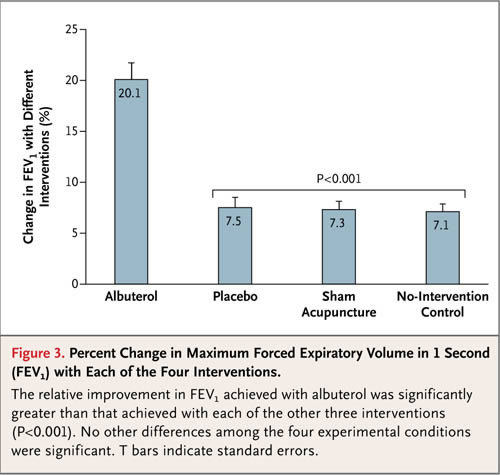
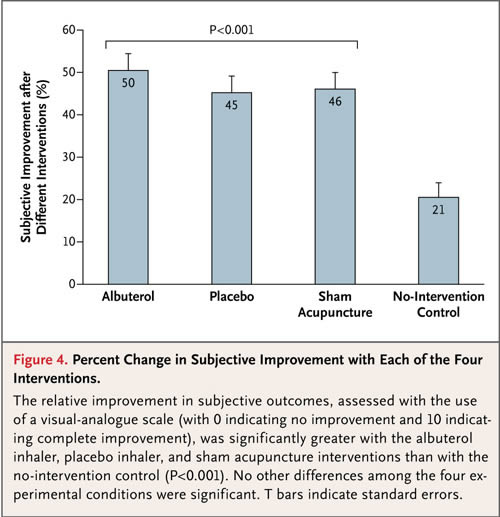
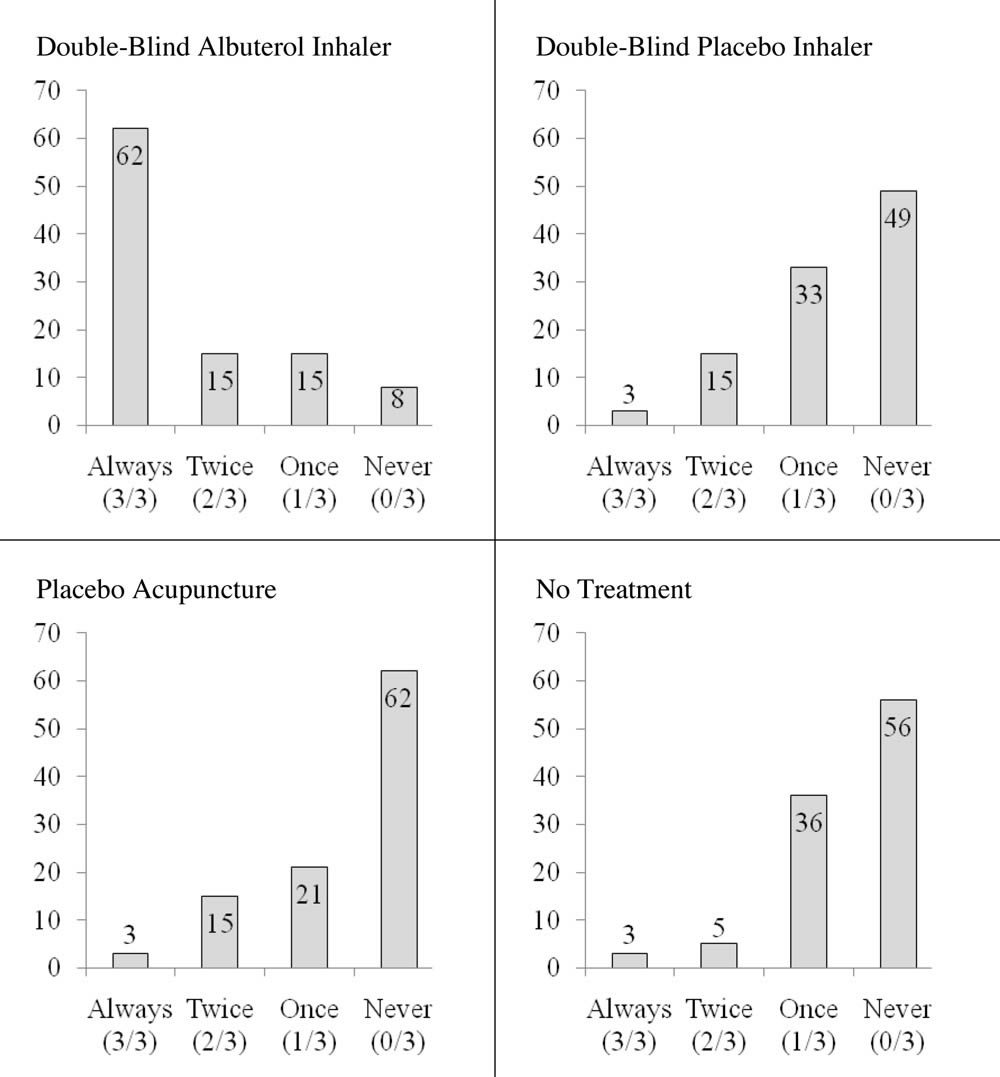
Not surprisingly, they found that “doing something” worked better than doing nothing.  More specifically, they found that any placebo will make a patient feel subjectively better than doing nothing at all.   They also found that all three placebos (sham acupuncture, fake inhaled medicine, and simply being enrolled in the study without treatment) improved objective measures of lung function, but not nearly as much as real medicine (in fact, not much at all).

In other words, simply attending to a patient makes them feel better.  But to get a significant objective improvement (in asthma at least) you must also give them real medicine.  Real medicine comprises both active medications and attending to the patient.  There is no separate “placebo” that can be given to treat asthma effectively.

This is actually a quite beautiful study.  It demonstrates that “placebo effect” is not the same as a real treatment, that real treatment always includes whatever benefit placebo provides, and that placebo is mostly an effect on subjective rather than objective measures of health.  You can’t fix asthma with placebo, only with real treatment.  But we’ve already known that from decades of studying asthma.  So what other justification is there for doing this study?

Our research has important implications both for the treatment of asthma and for clinical-trial design in general. Many patients with asthma have symptoms that remain uncontrolled, and the discrepancy between objective pulmonary function and patients’ self-reports noted in this study suggests that subjective improvement in asthma should be interpreted with caution and that objective outcomes should be more heavily relied on for optimal asthma care. Indeed, although improvement in objective measures of lung function would be expected to correlate with subjective measures, our study suggests that in clinical trials, reliance solely on subjective outcomes may be inherently unreliable, since they may be significantly influenced by placebo effects. However, even though objective physiological measures (e.g., FEV1) are important, other outcomes such as emergency room visits and quality-of-life metrics may be more clinically relevant to patients and physicians. Although placebos remain an essential component of clinical trials to validate objective findings, assessment of the course of the disease without treatment, if medically appropriate, is essential in the evaluation of patient-reported outcomes. (Emphasis mine, PalMD)

This is folly.  First, we have a huge literature on quality of life metrics in asthma.  Huge.  And we also know that objective changes in asthma are what save patients’ lives.  Yes, I care how my patient feels, but it is not more “clinically relevant” than how they are actually doing physiologically.  Both are important, but not equal.  And the idea that comparing active treatment to placebo is not ideal is not new to researchers.  It’s simply that following the natural history of the disease as a “control” is not usually appropriate (cf. Tuskegee syphilis experiment).

No good clinician would consider treating an asthmatic with placebo.  Improper treatment of asthma leads to debility and death.  This study chose mild asthmatics, but I still feel very uncomfortable with the ethics of the study design.  Rather than using a disease we know how to treat to study placebo, we should be finding ways to get treatment to the millions of people who aren’t getting it.

References

Wechsler ME, Kelley JM, Boyd IO, Dutile S, Marigowda G, Kirsch I, Israel E, & Kaptchuk TJ (2011). Active albuterol or placebo, sham acupuncture, or no intervention in asthma. The New England journal of medicine, 365 (2), 119-26 PMID: 21751905

Facebook Google Buzz Digg <!--<!--LinkedIn StumbleUpon LiveJournal Share

Dummy Medicines, Dummy Doctors, and a Dummy Degree, Part 1: a Curious Editorial Choice for the New England Journal of Medicine

Background

This post concerns the recent article in the New England Journal of Medicine (NEJM) titled “Active Albuterol or Placebo, Sham Acupuncture, or No Intervention in Asthma.” It was ably reviewed by Dr. Gorski on Monday, so I will merely summarize its findings: of the three interventions used—inhaled albuterol (a bronchodilator), a placebo inhaler designed to mimic albuterol, or ‘sham acupuncture’—only albuterol resulted in a clinically important improvement of bronchial airflow; for that outcome the two sham treatments were equivalent to “no intervention.” For all three interventions, however, self-reported improvements were substantial and were much greater than self-reported improvements after “no intervention.” In other words, dummy treatments made the subjects feel better, whereas real medicine not only made them feel better but actually made them better.

Before proceeding, let me offer a couple of caveats. First, the word ”doctors” in the flippant title of this post refers mainly to two individuals: Daniel Moerman, PhD, the anthropologist who wrote the accompanying editorial, and Ted Kaptchuk, the Senior Author of the trial report itself. It does not refer to any of the other authors of the report. Second, I have no quarrel with the trial itself, which was quite good, or with the NEJM having published it, or even with most of the language in the article, save for the “spin” that Dr. Gorski has already discussed.

My quarrels are the same as those expressed by Drs. Gorski and Novella, and by all of us on the Placebo Panel at TAM. This post and the next will develop some of those points by considering the roles and opinions of Moerman and Kaptchuk, respectively.

A True Story

Late one night during the 1960s a friend and I, already in a cannabis-induced fog, wandered into a house that had been rented by one of his friends. There were about 8-10 ‘freaks’ there (the term was laudatory at the time); I didn’t know any of them. The air was thick with smoke of at least two varieties. After an uncertain interval I became aware of a guy who was having trouble breathing. He was sitting bolt upright in a chair, his hands on his knees, his mouth open, making wheezing sounds. He took short noisy breaths in, followed by what seemed to be very long breaths out, as though he was breathing through a straw. You could hear the wheezing in both directions. Others had also noticed that he was in distress; they tried to be helpful (“hey, man, ya want some water or somethin’?”), but he just shook his head. He couldn’t talk. My friend, who had asthma himself, announced that this guy was having an asthma attack and asked if he or anyone else had any asthma medicine. No one did.

No one had a car, either, and for obvious reasons no one, not even the wheezing guy himself, was about to call 911. The nearest hospital was about 5 miles away. My friend said that the thing to do when someone has an asthma attack is leave him alone so he won’t get too excited, and he’ll get through it. Yeah, that must be right, we all figured; he has asthma too so he knows. We were all blowing smoke into the wheezing guy’s face as we expressed our concern.

At some point my friend and I left. The next day I heard that the guy with the asthma attack was eventually taken to the ER after another freak had come along who happened to have a car. The guy did alright, I guess. I don’t really know, but if he’d died I probably would’ve heard about it.

Several years later I went to medical school and began to learn about asthma, and as an internal medicine resident I saw enough patients with acute asthma attacks to realize, in a way that still makes me cringe, just how sick that guy had been and how totally clueless and selfish were we, his supposedly concerned companions. If the freak with the car hadn’t shown up…

Cultural Anthropology and Cultural Relativism

All of which has something to do with the surprise I felt a few days ago upon reading the following in the aforementioned editorial in the NEJM, the world’s most prestigious medical journal:

For subjective and functional conditions — for example, migraine, schizophrenia, back pain, depression, asthma, post-traumatic stress disorder, neurologic disorders such as Parkinson’s disease, inflammatory bowel disease and many other autoimmune disorders, any condition defined by symptoms, and anything idiopathic — a patient-centered approach requires that patient-preferred outcomes trump the judgment of the physician. Under these conditions, inert pills can be as useful as “real” ones…

Let’s see: asthma is a “subjective and functional condition”? In the bad old days of paternalistic medicine, the term “functional” meant “without demonstrable pathology.” It was usually synonymous with ”in your head”—whether the physician openly expressed that opinion or not. Doesn’t sound very “patient-centered” to me. I’m happy to report that you hardly ever hear ”functional” anymore, which reflects at least some measure of social progress for the profession. Since the term’s other possible meanings are nearly limitless and therefore vague beyond utility—every complaint or medical condition is in some way “functional,” after all—it seems reasonable to assume that the editorial’s author intended the old meaning, even if it and “subjective” are redundant.

Yet asthma is based in demonstrable pathology, as are most of the other named conditions, and in most of those (migraines, Parkinson’s disease, inflammatory bowel disease, and “many other autoimmune disorders”) there are specific treatments based on pathophysiology that, like albuterol for asthma, effect substantial, objective and subjective improvements. ”Idiopathic” refers to any condition whose cause is unknown, which includes most of those already mentioned and many other diseases for which medicines are effective for both objective and subjective outcomes (diabetes, Grave’s disease), and even some that are, for practical purposes, curable: Hodgkin’s disease, acute lymphocytic leukemia in children, some testicular cancers (remember Lance?), temporal arteritis, pernicious anemia, and many more. How could the author of a NEJM editorial be unaware of such commonplace medical facts?

The answer is that the author, Daniel Moerman, is not a doctor or even a biomedical scientist. He’s an anthropologist who seems to have confused sentimental and poetic aspects of his major academic interests—native American culture, medicinal plants, and healing rituals—with modern science and medicine. I urge you to consider his CV and the excerpts from his book Medicine, Meaning and the “Placebo Effect,” discussed by Dr. Gorski a few days ago. In the very first chapter he betrays more ignorance of medicine when he expresses surprise that a gastroenterologist didn’t find it odd that in a cohort of experimental subjects given only placebos for peptic ulcer disease, nearly half demonstrated healed ulcers after 4 weeks—about the percentage, I’d wager, whose ulcers would have healed with no trial intervention.

Regarding Prof. Moerman’s view of the sort of science that physicians need to know, along with Dr. Gorski I detect shades of Deepak Chopra, although I also detect a bit of down-home, folksy, isn’t-he-wise midwestern ambiguity, possibly delivered in a Mr. Ed voice, such as to give the good professor a way to deny it all. Consider this excerpt from the NEJM editorial, also noted by Dr. Gorski:

What do we learn from this study? The authors conclude that the patient reports were “unreliable,” since they reported improvement when there was none — that is, the subjective experiences were simply wrong because they ignored the objective facts as measured by FEV1. But is this the right interpretation? It is the subjective symptoms that brought these patients to medical care in the first place. They came because they were wheezing and felt suffocated, not because they had a reduced FEV1. The fact that they felt improved even when their FEV1 had not increased begs the question, What is the more important outcome in medicine: the objective or the subjective, the doctor’s or the patient’s perception? This distinction is important, since it should direct us as to when patient-centered versus doctor-directed care should take place.

Does he really believe that the subjective is the more important outcome? It certainly seems so; next he writes:

In a number of other trials in which both sham and actual treatments were evaluated, results were very similar. In one study of major depressive disorder, placebo, hypericum (St. John’s wort), and sertraline all resulted in about the same level of improvement on the Hamilton Rating Scale for Depression. Similarly, in studies of low back pain in both the United States and Germany, true acupuncture and sham acupuncture had about the same effectiveness yet were substantially better than usual medical care in relieving the pain. A number of surgical procedures — such as arthroscopic knee surgery and spinal vertebroplasty — have led to similar results with actual and sham treatments. In these studies and many more, inert treatments have had effects similar to their “active” analogues.

Woah! Sure, the subjective results of those trials “were very similar” to those of the albuterol trial, but so what? What distinguishes those trials from the albuterol trial is that there were no objective outcomes to measure! Moerman has missed the point of the distinction. He seems to prefer that medicine be about “a profound meaning response,” as he explained in an article written jointly with homeopath Wayne Jonas a few years ago, which comes awfully close to asserting that all “healing” is culturally determined:

Anthropologists understand cultures as complex webs of meaning, rich skeins of connected understandings, metaphors, and signs. Insofar as 1) meaning has biological consequence and 2) meanings vary across cultures, we can anticipate that biology will differ in different places, not because of genetics but because of these entangled ideas…

In the NEJM editorial Prof. Moerman doesn’t seem bothered by an inconvenient truth about objective outcomes. That is, maybe he doesn’t:

Maybe it is sufficient simply to show that a treatment yields significant improvement for the patients, has reasonable cost, and has no negative effects over the short or long term. This is, after all, the first tenet of medicine: “Do no harm.”

Prof. Moerman, what about the harm that comes from the NEJM seeming to judge treatments that offer favorable subjective outcomes as being equivalent to those that offer favorable objective outcomes? This kind of harm, for example. Asthma isn’t just a “subjective and functional condition,” whatever that is. It’s a real and potentially lethal disease. Oh, but you wrote “maybe.” Silly me.

Dr. Drazen, Where art Thou?

It is especially puzzling, considering the identity of its Editor-in-Chief, that the New England Journal of Medicine asked Daniel Moerman to write the editorial to accompany the report of the albuterol study. Jeffrey Drazen is not only a pulmonologist, but an expert in the pathophysiology of asthma. He has been instrumental in developing new drugs for asthma, drugs whose effects—I’m willing to bet, but I’ve no time to research right now—have been demonstrated objectively. If memory serves, Dr. Drazen trained at the old Peter Bent Brigham Hospital under ‘Reggie’ McFadden, whose chapter on asthma in my 2001 edition of Harrison’s Principles of Internal Medicine includes this passage:

The most effective treatment for acute episodes of asthma requires a systematic approach based on the aggressive use of sympathomimetic agents and serial monitoring of key indices of improvement. Reliance on empiricism and subjective assessment is no longer acceptable.

I’d be surprised if Dr. Drazen had ever heard of Moerman before the albuterol report was accepted for publication, and I wonder who recommended him. Kaptchuk, perhaps? Heh.

Unfortunately, someone isn’t minding the NEJM store when it comes to certain dubious topics, as Dr. Gorski mentioned and as I’ve written about previously.

Good News, Bad News

Perhaps Dr. Drazen imagines that the editorial won’t do any real damage, because real doctors will immediately identify it for what it is: Bullshit. That is probably true, except for the small but possibly growing number of “integrative” aficianados out there. I worry more about other Dummy Docs, such as naturopaths (ND=Not a Doctor, according to one apostate), who already believe wholeheartedly what Prof. Moerman “maybe” believes, and a lot more:

For an acute asthma attack try a steam inhalation (draping a towel over your head and a bowl of hot water) with a few drops of eucalyptus oil in the water. Be careful that the water is not so hot that the steam burns your face.  Some doctors recommend taking baths with a cup or so of 3% hydrogen peroxide in the water to bring extra oxygen to the entire surface of the skin, thus making the lungs somewhat less oxygen hungry. This method  can be performed preventively. Another technique for an acute attack is to drink some hot water with the juice of one clove of garlic. [etc.]

And:

How Can Homeopathy Help Asthma?
Like with Traditional Chinese Medicine, each individual is analyzed for their specific symptoms and an appropriate  therapy is chosen, not for the disease, but for the person displaying signs of health out of balance.  This is a very  important distinction, and, very generally speaking, one of the main differences between conventional and  “complementary” approaches to health care.

After the homeopath, naturopath or medical doctor trained in homeopathy (they should have the title “Diplomat  of Homeopathy” after their other credentials) listen carefully to your story, one of the following remedies are likely to  be prescribed. [etc.]

What Kind of Subtle Energy Techniques Are Useful for Asthma?
Some folks like to work with flower essences.  Some of the more popular ones to help with asthma are:

  • oak
  • mimulus
  • larch
  • wild rose
  • hornbeam
  • crab apple
  • impatiens
  • gentian
  • Shasta daisy
  • blackberry
  • chamomile
  • agrimony
  • clematis

Other people find it useful to work with color, either by using thin plastic filters over light sources in their home or office environment, or by wearing clothes of specific colors.  The following serves as a guide to experiment with color therapy to help asthma.

During an asthma attack try:

  • purple (raises the threshold of pain and is soporific; is a vasodilator; slows heart rate) on face, throat and chest
  • scarlet (acts as a stimulant to the kidney and adrenals) on kidneys
  • orange (an antispasmodic) on throat and chest
  • indigo or violet on throat, chest and upper back for 15 minutes

Etc., ad nauseam. Boy, do Dummy Docs love it when their pet treatments seem to be endorsed by real medicine, especially the highest bastions of real medicine. Science, even! Is it any surprise when something like this happens? Josephine Briggs, are you reading this? If so, please look here for more discussion of that case. You also won’t want to miss the sequel to this post.


Facebook Google Buzz Digg <!--<!--LinkedIn StumbleUpon LiveJournal Share

Salt: More confirmation bias for your preferred narrative

Judging by the recent press reports, the latest Cochrane review reveals that everything we’ve been told about eating salt, and cardiovascular disease, is wrong:

The New York Times: Nostrums: Cutting Salt Has Little Effect on Heart Risk

The Daily Mail: Cutting back on salt ‘does not make you healthier’ (despite nanny state warnings)

Scientific American: It’s Time to End the War on Salt

Sometimes it’s possible to completely miss this point. And that’s what’s happened here.

When it comes to health, it’s the hard outcomes we care about. We pay attention to measures like high blood pressure (hypertension) because of the relationship between hypertension and events like heart attacks and strokes. The higher the blood pressure, the greater the risk of these events. The relationship between the two is well established. So when it comes to preventive health, we want to lower blood pressure to reduce the risk of subsequent effects. Weight loss, diet, and exercise are usually prescribed (though often insufficient) to reduce blood pressure. For many, drug treatment is still required.

There is reasonable population-level data linking higher levels of salt consumption with higher blood pressure. From a population perspective, interventions that dramatically lower salt intake result in lower blood pressure. Not everyone responds in the same way — many people with normal blood pressure can regularly consume a high salt load without any apparent change in blood pressure. But not everyone, and not forever. Salt sensitivity seems to increase with age and is more pronounced in some ethnic groups, as well as in those with salt-sensitive conditions such as kidney disease. And chronic high levels of salt consumption may be associated with the subsequent emergence of hypertension. There may be additional effects, unrelated to blood pressure, too. However, the causality between salt consumption, and all of these negative effects, is less clear.

So does reducing dietary salt reduce cardiovascular events? That’s the key question. To definitively answer the question, we’d randomize patients to high- and low-sodium diets, force them to follow these diets for years or decades, and monitor consumption, blood pressure, and cardiovascular events. We’d also want to explore the factors that seem to make some more sensitive to the effects of salt than others. To ensure we could see a difference (if it exists), we’d need a large sample size — hundreds or thousands of people, ideally. See any problems with the feasibility? Like any dietary intervention trial, this type of study would be exceptionally difficult to do — forcing dietary changes is very difficult, and cannot be done in a blinded manner. Even randomization is unlikely to be effective in ensuring there’s adherence — established dietary habits don’t lend themselves to long-term change easily. So we must look to lower-quality evidence — inferences from observational studies that have tracked consumption, or indicators like blood pressure and salt consumption in the short-term. And there are fair criticisms of the data. Some see relationships, and others dismiss them.

When it comes to clinical practice guidelines, low salt diets are the mainstays of pretty much every set of guidelines on the management of high blood pressure. The evidence supporting the relationship with hard outcomes is robust, but not rock-solid. We don’t have causal data, but we do have considerable epidemiologic evidence to suggest that reducing dietary salt consumption is likely to offer net benefits in the management of hypertension.

And that’s where the recommendations to cut salt come from. The vast majority of the salt we eat (75%) is from processed foods. Restaurants are a large source, too. Few foods in their original state are naturally high in salt, and in general, we don’t add that much at the table. Interestingly, when foods are reduced in sodium, we don’t tend to add the same amount back at the table. So public health initiatives have concentrated on a few strategies: education on how to reduce your own salt consumption, and putting pressure on packaged food manufacturers to reduce the amount of sodium that they use in their products. But reducing salt may hurt sales: if we’re accustomed to eating salty foods, low-salt foods taste unpalatable. Just last week Campbell Soup Company announced that it’s raising the salt content in its products in an attempt to boost sagging sales.

So do dietary intervention strategies work? That’s what a recent Cochrane review attempted to answer. But you wouldn’t know it, based on the headlines above. Scientific American described the paper as:

This week a meta-analysis of seven studies involving a total of 6,250 subjects in the American Journal of Hypertension found no strong evidence that cutting salt intake reduces the risk for heart attacks, strokes or death in people with normal or high blood pressure.

The Daily Mail?

Eating less salt will not prevent heart attacks, strokes or early death, according to a major study.
Its findings contradict all recommendations by the Government and medical profession urging the public to reduce the amount of salt they consume.

Neither statement accurately describe the findings. Rod Taylor and colleagues set out to do a meta-analysis of dietary intervention studies. They analyzed only studies that measured the effects of dietary interventions that restricted salt consumption, or where the intervention was advice to reduce salt consumption. This was an update of a prior analysis.

Seven studies made up this meta-analysis, including 6,489 patients in total. Three studies looked at those with normal blood pressure, two included patients with high blood pressure, and one was a mixed population, including patients with heart failure. The overall effect? Interventions had small effects on sodium consumption, which led to small effects on blood pressure. There was insufficient information to analyze the effects on cardiovascular disease endpoints.

The authors go on to make the following point, which was ignored in the media coverage:

Our findings are consistent with the belief that salt reduction is beneficial in normotensive and hypertensive people. However, the methods of achieving salt reduction in the trials included in our review, and other systematic reviews, were relatively modest in their impact on sodium excretion and on blood pressure levels, generally required considerable efforts to implement and would not be expected to have major impacts on the burden of CVD.

The authors did not conclude that reducing salt consumption is ineffective. They concluded that interventions such as dietary advice, do not result in substantial reductions in consumption. As expected, blood pressure didn’t change much as a consequence. This finding should not be a surprise. Given the vast majority of salt is consumed via processed foods, it should come as no surprise that dietary approaches are modestly effective at reducing consumption.

Despite the modest and equivocal results, the authors seem to have lost the narrative on their own research findings:

Professor Rod Taylor, the lead researcher of the review, is ‘completely dismayed’ at the headlines that distort the message of his research published today. Having spoken to BBC Scotland, and to CASH, he clarified that the review looked at studies where people were advised to reduce salt intake compared to those who were not and found no differences, this is not because reduced salt doesn’t have an effect but because it’s hard to reduce salt intake for a long time. He stated that people should continue to strive to reduce their salt intake to reduce their blood pressure, but that dietary advice alone is not enough, calling for further government and industry action.

Conclusion

The true finding from the Cochrane review is that dietary interventions to reduce salt intake are largely ineffective at reducing salt consumption. Salt’s impact on cardiovascular events is less clear than its effects on blood pressure. And the long-term benefits of population-level interventions to reduce dietary salt consumption are not yet well established. Until the data are more clear, you can find the data to support whatever narrative you believe. If you want to demonize salt and ignore other factors that contribute to poor cardiovascular outcomes, you can do that. And if you believe that interventions to reduce salt consumption are misguided and unwarranted, and symptomatic of an overreaching nanny state, then you can find data to support that position, too.

My personal take is that most of us will ultimately end up with salt-sensitive conditions. Odds are good we’ll be hypertensive, too. Gradually reducing our chronic salt consumption would seem to be a conservative approach — not by focusing strictly on the salt, but by working to reduce the consumption of salty, processed foods, and substituting healthier, more nutritious choices instead. But I won’t worry when I finish an entire bag of chips — I’ll consider it in the context of an overall strategy: a diet that minimizes processed foods, maintaining an appropriate weight, and getting regular physical exercise.

Reference
ResearchBlogging.org
Taylor RS, Ashton KE, Moxham T, Hooper L, & Ebrahim S (2011). Reduced dietary salt for the prevention of cardiovascular disease. Cochrane database of systematic reviews (Online), 7 PMID: 21735439

Facebook Google Buzz Digg <!--<!--LinkedIn StumbleUpon LiveJournal Share

Behavior and Public Health – To Nudge or Legislate

As health care costs rise and great attention is being paid to the health care system in many countries (perhaps especially the US), the debate is heating up over how to improve public health. Many health problems are greatly increased by the lifestyle choices individuals make – smoking, weight control, and exercise to name a few. The problem is that it is notoriously difficult to change behavior.

There are different ways to approach the challenge of improving lifestyle choices to reduce chronic illness. We can take actions aimed at the individual or aimed at society. These actions can gentle or passive (the so-called “nudge theory”), or they can be more draconian, such as banning certain activity. We can, of course, do all of these things simultaneously, and may need to in order to have a significant impact.

Affecting Individual Behavior

A common criticism of mainstream physicians is that they do not have much impact on the lifestyle of their patients. This is largely true – although there is no convincing evidence that any practitioners have a significant impact on lifestyle. This is mainly the result of the fact that it is extremely difficult to get people to change their behavior.

The default tactic has been to give people information on the assumption that they will then be able to make a rational choice about their health. Psychologists have long known that we are much more likely to simply rationalize our behavior than take the more difficult path of changing it. This is true even of the “scared straight” approach – trying to frighten people with scary images or stories about lung cancer or diabetes.

It is true that physicians can affect patient behavior. For example, even brief physician counseling to quit smoking (less than 5 minutes) increases smoking cessation by 1.6 times. This sounds impressive, but this only increases the rate to 2-10%. Even if we use the higher number in that range, a 10% decrease in unhealthy behavior is very modest (worthwhile, but still modest). It seems that in general you can get about 5% of people to change their behavior with counseling alone.  Meanwhile, using medications to aid smoking cessation (nicotine patches and bupropion) can result in up to a 35% decrease in smoking.

The technology of changing individual behavior is advancing, however. The strategy of giving information and assuming rational behavior, while still useful, is highly limited and not sufficient. Psychologists recognize that the way to alter behavior is through psychosocial interventions – exploiting human psychology and peer pressure. One such technique is called motivational interviewing. Essentially, the patient is asked leading questions that gets them to to state their own health goals and concerns. Apparently we are better at persuading ourselves than being persuaded by others.

Sounds good, and generally the research shows that this approach is an improvement – but the effect size is still depressingly small. A systematic review of motivational interviewing for smoking cessation, for example, revealed only a 1.27 relative increase in cessation. So spending 5 minutes with a patient once improves smoking cessation by 1.6 times, and spending multiple 20 minutes sessions of motivational interviewing increases success a further 1.27 times. This is worthwhile in terms of public health outcomes, but it does look like such methods yield diminishing returns.

Motivational interviewing may be more effective for behaviors not related to addiction, such as weight loss and exercise. But still there is huge room for improvement.

Public Health Measures

It is increasingly looking like the way to have a huge impact on public health is at the societal, not individual, level. The goal is to make healthful lifestyle choices easier. Using heavy-handed legislation, however, is not popular (at least not in the US). Such strategies evoke images of a Big Brother nanny state trying to take away our freedoms. There are legitimate concerns about draconian state measures, especially if they are not rigorously science-based, but the looming health care crisis is making public health measures seem more attractive.

One approach is simply to ban unhealthy behavior. Outright bans of products, such as alcohol, have a disastrous history. Another alternative is to restrict the use of such products in certain locations and situations. The best example of this strategy is banning smoking in public locations. A systematic review of 10 studies indicates that such bans reduce the incidence of myocardial infarction in the population by an average of 17%. Banning smoking in public seems to be a clear public health win.

But banning unhealthy behavior gets more tricky when not dealing with addictive substances. Bans of fatty or high-calorie food, for example, are likely to meet much more resistance than restrictions on public smoking. New York City’s ban on trans fat, for example, has been highly controversial. Other states are considering laws to ban toys in kid’s meals, limit advertising, and limiting marketing behavior such as inviting fast food patrons to “go large.”

Resistance to heavy handed strategies has led to the proposal of the nudge theory – using more subtle legislation to influence behavior. Nudge strategies include printing the calories next to menu items. This is a situation in which information is likely to have a significant impact on behavior – because it addresses what may be a significant contributor to the increase in obesity. It is easy to consume far more calories than we think, especially when restaurants prepare menu items that are calorie dense in order to make them tasty and appealing. Having calorie information right in front of you when making menu choices does reduce caloric intake (in this study by 250 calories), although again, not as much as we might hope.

Another nudge approach is to make healthful choices the default choice. This still leaves consumers the freedom to choose what they want, but many more people will go with the healthier choice if it is the default.

Yet another approach is to regulate manufacturers. At present voluntary guidelines are being suggested, and the debate is ongoing about using legislation to require food manufacturers, for example, to produce healthier and lower calorie products. The public has been passively eating more calories simply because the products they buy contain more calories. They have also been lulled by false security – low fat products tend to make up their calories in carbohydrates, while low-carb products make up their calories with increased fat. Either way people eat more because they feel they are eating a healthier products.

Conclusion

It is clear that we need to take a long science-based look at public health and ways to improve lifestyle choices. We need to reverse the obesity epidemic and further reduce smoking. Doing so is not easy – there is no silver bullet to changing human behavior. It is likely that we will need to use a combination of strategies while researching new and better ways to influence behavior.

Facebook Google Buzz Digg <!--<!--LinkedIn StumbleUpon LiveJournal Share

Antidepressants and Effect Size

Antidepressant drugs have been getting a bad rap in the media. I’ll just give 3 examples:

  • On the Today show, prominent medical expert :-) Tom Cruise told us Brooke Shields shouldn’t have taken these drugs for her postpartum depression.
  • In Natural News, “Health Ranger” Mike Adams accused pharmaceutical companies and the FDA of covering up negative information about antidepressants, saying it would be considered criminal activity in any other industry.
  • And an article in Newsweek said  “Studies suggest that the popular drugs are no more effective than a placebo. In fact, they may be worse.”

Yet psychiatrists are convinced that antidepressants work and are still routinely prescribing them for their patients. Is it all a Big Pharma plot? Who ya gonna believe? Inquiring minds want to know:

  • Are antidepressants more effective than placebo?
  • Has the efficacy of antidepressants been exaggerated?
  • Is psychotherapy a better treatment choice?

The science-based answers to the first two questions are clearly “Yes.” The best answer to the third question is “It depends.”

In 2008, Erick Turner and four colleagues published an article in The New England Journal of Medicine (NEJM) entitled “Selective Publication of Antidepressant Trials and Its Influence on Apparent Efficacy.” The FDA is able to make sure that drug companies don’t pick and choose which trials, and which outcomes within those trials, get seen. Using clinical trial data from the FDA as a gold standard, Turner, et. al. examined how these same trials were reported in published journal articles, They found that:

…according to the published literature, the results of nearly all of the trials of antidepressants were positive. In contrast, FDA analysis of the trial data showed that roughly half of the trials had positive results.

And some of the negative trials were published with a “spin” that made them appear positive. The data did show that each drug was superior to placebo, but the true magnitude of that superiority was less than a diligent literature review would indicate. They warned that

By altering the apparent risk–benefit ratio of drugs, selective publication can lead doctors to make inappropriate prescribing decisions that may not be in the best interest of their patients and, thus, the public health.

Irving Kirsch has been outspoken about antidepressants’ alleged lack of efficacy. In a controversial meta-analysis published in 1998, he found that placebos provided approximately 75% of the improvement provided by active drug. He suggested that the other 25% is debatable and could be due to an enhanced placebo response when patients experience side effects that convince them they are getting an active drug. In a further study in 2002, he “questioned the clinical significance of antidepressants.”

Kirsch recently looked at the FDA data for 4 of the 12 drugs that Turner examined. In spite of the smaller sample, where Turner found an effect size of 0.31, Kirsch got 0.32. So they got almost exactly the same result. But it was their interpretations of that result that were very different. Kirsch concluded that antidepressants are ineffective, while Turner found that the drugs were indeed superior to placebo. As the figure below shows, each drug’s effect size was positive. Also, none of the confidence intervals overlapped zero. This means that, while there is some probability that the true effect size is zero, meaning that antidepressants and placebo are equal in efficacy, that probability is negligibly small.


The discrepancy between Turner’s and Kirsch’s interpretations hinges on what these effect size numbers mean in terms of clinical significance,. Values of 0.2, 0.5, and 0.8 were once proposed as small, medium, and large effect sizes, respectively. The psychologist who proposed these landmarks admitted that he had picked them arbitrarily and that they had “no more reliable a basis than my own intuition.” Later, without providing any justification, the UK’s National Institute for Health and Clinical Excellence (NICE) decided to turn the 0.5 landmark (why not the 0.2 or the 0.8 value?) into a one-size-fits-all cut-off for clinical significance. In an editorial published in the British Medical Journal (BMJ), Turner explains with an elegant metaphor: journal articles had sold us a glass of juice advertised to contain 0.41 liters (0.41 being the effect size Turner, et al. derived from the journal articles); but the truth was that the “glass” of efficacy contained only 0.31 liters. Because these amounts were lower than the (arbitrary) 0.5 liter cut-off, NICE standards (and Kirsch) consider the glass to be empty. Turner correctly concludes that the glass is far from full, but it is also far from empty. He also points out that patients’ responses are not all-or-none and that partial responses can be meaningful.

Incidentally, NICE is no longer using the 0.5 effect size cutoff.

If we followed Kirsch’s interpretation and rejected antidepressants, how would we treat depression? Psychotherapy avoids the side effects of drugs, but it has its own drawbacks: it is expensive, time-consuming, and variable in quality. How effective is psychotherapy? Psychotherapy trials also suffer from publication bias, just like antidepressant drugs. And when one weeds out low quality studies, psychotherapy has an effect size of only 0.22, lower than the value for antidepressants reported by Kirsch himself, So if we reject any treatment below the (arbitrary) 0.5 cutoff, when a mental health care provider is faced with a patient in need of help, is he or she to do nothing at all?

I don’t doubt that antidepressants have sometimes been over-prescribed and used inappropriately for lesser levels of depression where they are less effective or even ineffective, but this is probably true for psychotherapy, as well. On the other hand, it has been estimated that only about half of depressed patients are getting any kind of treatment. Severe depression is a life-threatening disease. A recent study showed that antidepressants reduced the risk of suicide by 20% in the long term. The risk/benefit ratios are still not clear cut for either form of treatment.

Once more, science fails to give us the black-and-white answers we crave. And once again we are reminded that we can’t rely on the media for accurate, nuanced information about medical science.

For his assistance in preparing this article and for providing the figure, I want to thank Erick Turner, M.D., Department of Psychiatry, Oregon Health and Science University; Staff Psychiatrist, Portland Veterans Affairs Medical Center; Former reviewer, FDA.


Facebook Google Buzz Digg <!--<!--LinkedIn StumbleUpon LiveJournal Share

Spin City: Using placebos to evaluate objective and subjective responses in asthma

As I type this, I’m on an airplane flying home from The Amazing Meeting 9 in Las Vegas. Sadly, I couldn’t stay for Sunday; my day job calls as I’ll be hosting a visiting professor. However, I can say—and with considerable justification, I believe—that out little portion of TAM mirrored the bigger picture in that it was a big success. Attendance at both our workshop on Thursday and our panel discussion on placebos on Saturday was fantastic, beyond our most optimistic expectations. There was also a bit of truly amazing serendipity that helped make our panel discussion on placebo medicine an even bigger success.

If there’s one thing about going away to a meeting, be it TAM or a professional meeting, it’s that it suddenly becomes very difficult for me to keep track of all the medical and blog stuff that I normally keep track of and nearly impossible to keep up with the medical literature. This is the likely explanation for why I had been unaware of a study published in the New England Journal of Medicine (NEJM) on Thursday that was so relevant to our discussion and illustrated out points so perfectly that it was hard to believe that some divine force didn’t give it to us in order to make our panel a total success.

Just kidding. It was TAM, after all. It was, however, embarrassing that I didn’t see the study until the morning of our panel, when Kimball Atwood showed it to me.

Before I get to the meat of this study and why it fit into our nefarious plans for world domination, (or at least the domination of medicine by science-based treatments), a brief recap of the panel discussion would seem to be in order. First, for the most part, we all more or less agreed that the term “placebo effect” is a misnomer and somewhat deceptive because it implies that there is a true physiologic effect caused by an inert intervention. “Placebo response” or “placebo responses” seemed to us a better term because what we are observing with a placebo is in reality a patient’s subjective response to thinking that he is having something active done having something done. In general, we do not see placebo responses resulting improvement in objective outcomes; i.e., prolonged survival in cancer. The relative contributions of components of this response, be they expectancy effects (if you expect to feel better you likely will feel better), conditioning, or one that is frequently dismissed or downplayed, namely artifacts of the design of randomized clinical trials and even subtle (or even not-so-subtle) biases in trial design. This issue of placebo responses being observed only in subjective patient-reported clinical outcomes (pain, anxiety, and the like) and not in objectively measured outcomes is an important one, and it is one that goes to the heart of the NEJM study that so serendipitously manifested itself to us. As Mark Crislip so humorously pointed out, the placebo response is the beer goggles of medicine (this is not a spoiler or stealing Mark’s line; several TAM attendees have already tweeted Mark’s line), and much of what is being observed are changes in the patient’s perception of his symptoms rather than true changes in the underlying pathophysiology. This study drove the point home better than we could.

Another point discussed by the panel is also quite relevant. As more and more studies demonstrate very convincingly that “complementary and alternative medicine” (CAM) or “integrative medicine” (IM) therapies do not produce improvements in symptoms greater than placebo. Moreover, multiple studies, including a famous NEJM meta-analysis and a recently updated Cochrane review, demonstrate, placebo responses probably do not constitute meaningful responses. In light of these findings, CAM apologists, driven by ideology rather than science and masters of spin, have begun to admit grudgingly that, yes, in essence their treatments are elaborate placebos. Not to be deterred, instead of simply concluding that their CAM interventions do not work, they’ve moved the goal posts and started to try to argue that it doesn’t matter that CAM effects are placebo effects because placebos are “powerful” and good and—oh, yes, by the way—there are a lot of treatments in science-based medicine that do little better than placebos. In other words, CAM advocates elevate the subjective above the objective and sell the subjective, and that’s exactly what they are doing with this study.

Perception versus physiology

The study under question was performed at Harvard, with Michael E. Wechsler as its first author and Ted Kaptchuk as its senior author. Studies done by groups including Ted Kaptchuk have actually presented us here at SBM with copious blog fodder before, all designed to promote placebo medicine, either through making an argumentum ad populum, claiming in a truly Humpty Dumpty moment that it is possible to have placebo effects without deceiving the patient, and or rebranding of exercise as “alternative” in the New England Journal of Medicine (NEJM) last year.

The current study is entitled, Active Albuterol or Placebo, Sham Acupuncture, or No Intervention in Asthma. Personally, I like this title. It’s a fine title, as it tells the reader in essence what the trial design is in only a few words. And it’s actually a reasonably good pilot study. Of course, it’s not so much the trial design that goes disastrously awry. Rather, it’s the interpretation of the results of the RCT that devolves into propaganda for quackademic medicine in which subjective improvement is used to argue that placebo medicine is good, even when no objective improvement is observed in a disease for which we have good drugs that produce objective improvements as well as subjective improvements.

This study basically compared four different interventions

  • Treatment with Albuterol
  • Sham acupuncture using the classic retractable needle (note that this was only single-blinded)
  • Placebo inhaler
  • No treatment at all

Inclusion criteria were as follows:

  • Men and women age>or= 18 with a diagnosis of asthma
  • Meet American Thoracic Society diagnostic criteria for asthma
  • Currently using a stable asthma regimen (no med. changes for 4 weeks)
  • Ability to withhold short-acting bronchodilators for 6 hours prior to each visit (see Spirometry description)
  • Ability to withhold long-acting bronchodilators for 48 hours prior to each visit (see Spirometry description)
  • Presence of reversible airflow obstruction as demonstrated by an improvement in FEV1 of at least 12 % following the inhalation of a ?-agonist after 10 am. at screening visit.

Exclusion criteria were straightforward:

  • Lung disease other than asthma
  • Respiratory tract infection within the last month
  • Active tobacco use
  • Asthma exacerbation requiring the use of systemic
  • corticosteroids within the past 6 weeks
  • Prior experience with acupuncture

These criterial guaranteed that the patients selected have only mild to moderate asthma with no complications from the asthma, such as pneumonia or pulmonary fibrosis. Of course, it would be highly unethical to take people with severe asthma off of their bronchodilators; so medical ethics pretty much prevents testing placebos on people with more severe disease. Still, I can’t help but wonder whether the results reported would have been different in more severe asthma and if the subjective improvement would have been nearly as great. In any case, this study ended up including 39 patients, after 79 were screened, 46 underwent randomization, and 7 dropped out during the protocol. Patients who completed the protocol underwent the following procedure:

These patients returned within a week and were assigned to a randomly ordered series of four interventions — active albuterol inhaler, placebo inhaler, sham acupuncture, or no-intervention control — administered on four separate occasions, 3 to 7 days apart (block 1) (Figure 2). This procedure was repeated in two more blocks of four visits each (blocks 2 and 3), during which the interventions were again randomly ordered and administered. Thus, each subject received a total of 12 interventions. Albuterol and the placebo inhaler were administered in a double-blind fashion and sham acupuncture in a single-blind fashion, and the no-intervention control was not blinded. As before, short-acting and long-acting bronchodilator therapy was withheld for 8 hours and 24 hours, respectively, before each intervention. The no-intervention control condition differs from the natural history of asthma, since it controls for nonspecific factors such as attention from study staff, responses to repeated spirometry, regression to the mean, natural physiological variation, and any effects arising from the hospital setting. Nonetheless, no-intervention controls are the best approximation of no treatment in an experimental design. The study was conducted in accordance with the protocol (available at NEJM.org).

I’m not entirely sure why Kaptchuk thought he had to place a comment in there about no-intervention controls being only an approximation of no treatment in an experimental design. After all, that’s the sort of thing that clinicians and clinical researchers simply know; it does not need to be pointed out to them, much as it shouldn’t need to be pointed out that an RCT is an intentionally artificial method designed to remove as many biases as possible. Be that as it may, one thing that is clear is that these patients could not have truly severe asthma. Ruling out anyone requiring steroids for an acute exacerbation in the recent past and only including patients who could be off their long-acting bronchodilators for 48 hours and their short-acting bronchodilators for 6 hours pretty much guaranteed that.

Everyone’s heard the old cliche that a picture is worth a thousand words, and this is exactly the sort of situation where that’s true. All I need to do is to show you two graphs, and instead of one of my usual 5,000 word blog posts, you can have a 4,000 word post. Funny how that works. In any case, for your edification, here a graph of the objective results of this study, namely the FEV1 for the four groups:


(Click to embiggen)

Not surprisingly, a known, effective bronchodilator had a very strong effect on the actual, objectively measured lung function of these patients. However, it should be noted that all groups improved, even the no-treatment group; it just improved much less than the albuterol group, and the sham acupuncture and placebo albuterol groups were indistinguishable from the no-treatment arm. In fact, in the supplemental data, there is also a table showing that in 32 of the patients exhaled nitric oxide (FENO) was measured, with identical results. Immediately after treatment, FENO increased in patients treated with double-blind albuterol by 5.9%, in contrast to patients treated with placebo inhaler, placebo acupuncture, and no treatment, all of whom demonstrated no significant change in FENO. This graph is about as clear and compelling evidence as there can be within the limits of a relatively small trial, that placebo responses do not change the underlying physiology of the disease of asthma or produce any objectively measurable improvements in lung function the way that real medicine does.

Now, for your edification and comparison, here is a graph of the self-reported subjective improvements.


(Click to embiggen.)

The results are pretty striking, aren’t they? They were so striking that Steve couldn’t resist flipping back and forth between these two graphs for several seconds in order to drive home the point to the audience. The albuterol, sham acupuncture, and placebo albuterol groups all demonstrated a significant improvement in symptoms, while the no-intervention control did not. However, here’s an important point. The scale used was a visual analog scale from 0 to 10 in which 0 means no improvement and 10 means complete resolution. So, again, even though the albuterol, sham acupuncture, and placebo albuterol groups all demonstrated subjective improvement, so did the no-treatment control arm, just less. In other words, all groups reported improvement, even those who received no treatment.

There’s another graph buried in the back of the supplemental data that I now wish we had also shown. Basically, it’s a look at how many patients responded objectively to treatment, as defined by an improvement in FEV1 of 12% or more, at each of the three sessions they did. The results and pattern are striking


(Click to embiggen.)

Notice that, as expected, the vast majority of the patients responded at each session to the albuterol (3/3 sessions). In contrast, only 3% of patients responded 3/3 times to placebo, sham acupuncture, or no treatment. In fact, what’s striking is how similar the three graphs look and how different they look from the graph of patient responses to albuterol. Again, the message is very clear: Real medicine produces real, objectively measurable changes in physiology towards a more normally functioning state. Placebo medicine does not. In any rational, science-based discussion, this would be the end of the story. Placebos don’t work in asthma.

But that’s not the message that was being spread about this story, and here’s where the NEJM, less than a year after its massive fail in publishing a credulous Michael Berman acupuncture article and a clever bait-and-switch article looking at Tai Chi in fibromyalgia, allowed quackademic language to try to make left right, up down, and a negative result an indication that placebo medicine is a good thing.

Spin, spin, spin, spin

As I read the discussion of this paper, I could almost hear the cracking of bones as Kaptchuk went into major contortions to try to explain his negative result. Even though nowhere did the authors really explicitly state their real hypothesis, the design of the study made it painfully clear to anyone who understands clinical research that their hypothesis going in was that placebo responses would result in changes in objectively measured lung function in asthma. They were sorely disappointed, and the contortions of language that went into the discussion were plain to see. The authors implied that it might have been their use of a new, not really validated, patient-reported measure of asthma improvement. Or maybe, they argue, FEV1 isn’t a good measure of the severity of constriction of the airways in asthma, even though spirometry has been a reliable, well-validated test for asthma severity for decades. This is especially true in an academic medical center with a lot of pulmonary specialists. While spirometry can be unreliable in primary care settings and other settings where there isn’t a lot of experience performing it, such a description does not apply to Harvard-affiliated hospitals. At least I would hope not.

Overall, the spin on this study is not that placeboes don’t result in objectively measurable improvements, which is the correct conclusion. Rather, the spin is that subjective symptoms are as important or more important than objective measures; so let’s use placeboes. In the paper itself, Kaptchuk doesn’t quite say that. He first makes a perfectly reasonable point that, if subjective and objective findings don’t correlate, go with the objective findings. Then he does some handwaving:

Indeed, although improvement in objective measures of lung function would be expected to correlate with subjective measures, our study suggests that in clinical trials, reliance solely on subjective outcomes may be inherently unreliable, since they may be significantly influenced by placebo effects. However, even though objective physiological measures (e.g., FEV1) are important, other outcomes such as emergency room visits and quality-of-life metrics may be more clinically relevant to patients and physicians.

My jaw dropped when I read this. “Other outcomes” besides objective measures of disease severity may be “more clinically relevant”? The spin goes way beyond that, though. I have to think that the reviewers kept the authors from getting too frisky with their desire to advocate placebo medicine and promote subjective outcomes as being more important than objective outcomes. No such restraint seemed to inhibit the author of the accompanying editorial, Daniel E. Moerman, Ph.D., who, alas, appears to be based practically in my back yard at the University of Michigan-Dearborn. I had never heard of him before; so I did what all bloggers do when they encounter an unknown. I Googled him. His CV is here, and this is what I found:

Daniel E. Moerman is the William E. Stirton Professor of Anthropology at the University of Michigan — Dearborn, so recognized for his distinguished scholarship, teaching, and professional accomplishments. Because of his work in the field of Native American ethnobotany, Professor Moerman often receives calls from the American Indian community, such as an inquiry from the Menominee in Wisconsin, asking him what kinds of plants they should include in the restoration of their indigenous ecosystem. He acknowledges that we are deeply indebted “to those predecessors of ours on the North American continent who, through glacial cold in a world populated by mammoths and saber-toothed tigers, seriously, deliberately, and thoughtfully studied the flora of a new world, learned its secrets, and encouraged the next generations to study closer and to learn more. Their diligence and energy, their insight and creativity, these are the marks of true scientists, dedicated to gaining meaningful and useful knowledge from a complex and confusing world.”

He’s also known for having written a book entitled Medicine, Meaning and the “Placebo Effect,” part of which can be found here, in particular this doozy of a quote:

There is much objection among physicians to the very existence of something called the placebo effect. It often seems to bother doctors enormously that the fact of receiving medical treatment (rather than the content of medical treatment) can initiate a healing process. Why? I think it is because medicine is rich in a particular kind of science. Medical education is filled with science. In the US, all students must score high on the “Medical College Admission Test” in order to be admitted to medical school. Students are allowed a total of 345 minutes to complete the exam. Eight five minutes are devoted to “verbal reasoning,” and 60 minutes to “writing sample.” The remaining 200 minutes (58.5%) are split evenly between “physical sciences” and “biological sciences.” It is apparently important that physicians understand levers, inclined planes, the acceleration of falling bodies, the life cycle of insects, and the process of photosynthesis. The kind of science that doctors have to learn is the simpler sort of science, the mechanical kind. Physicists worked out the mechanics of simple machines (levers, planes) in the seventeenth century. In our times, they have been working on much slipperier subjects: quarks, chaos, the “weak force,” and the oddest of quantum phenomena. Cause and effect are far less easy to detect in these matters than in the study of falling bodies…But it is the latter, not the former, in which physicians are schooled. And there is very little social science in medical education where one must address the complexities and subtleties of, say, emotion, or ritual, or culture.

If you detect shades of Deepak Chopra in there, you are correct, all with a dollop of utter contempt for Newtonian physics, which, I will remind you, are still accurate enough for most real-world purposes here, where few things we do reach relativistic speeds. Instead, Moerman invokes quarks, quantum theory, and other complexities and contrasts it to the “simpler” sciences that physicians apparently learn. One can almost feel the contempt for us poor, deluded physicians. Perhaps if I had known a bit about Professor Moerman, my jaw ouldn’t have dropped so far when I read this in the editorial accompanying the NEJM study:

What do we learn from this study? The authors conclude that the patient reports were “unreliable,” since they reported improvement when there was none — that is, the subjective experiences were simply wrong because they ignored the objective facts as measured by FEV1. But is this the right interpretation? It is the subjective symptoms that brought these patients to medical care in the first place. They came because they were wheezing and felt suffocated, not because they had a reduced FEV1. The fact that they felt improved even when their FEV1 had not increased begs the question, What is the more important outcome in medicine: the objective or the subjective, the doctor’s or the patient’s perception? This distinction is important, since it should direct us as to when patient-centered versus doctor-directed care should take place.

Apparently Moerman thinks that patient-centered care means inducing a patient through placebo responses to think that he feels better when in actuality the disease-impaired function of his organ (in this case, the lungs) puts him at risk for serious complications. He then goes on to write:

For subjective and functional conditions — for example, migraine, schizophrenia, back pain, depression, asthma, post-traumatic stress disorder, neurologic disorders such as Parkinson’s disease, inflammatory bowel disease and many other autoimmune disorders, any condition defined by symptoms, and anything idiopathic — a patient-centered approach requires that patient-preferred outcomes trump the judgment of the physician. Under these conditions, inert pills can be as useful as “real” ones; two inert pills can work better than one; colorful inert pills can work better than plain ones; and injections can work better than pills.

I find it hard not to notice that Moerman has cast a very wide net; virtually any condition outside of trauma could fit into his definition. I can’t help but think that, if I, for instance, had asthma and the severity of my symptoms didn’t correlate well with my objectively measured lung function as estimated by FEV1, then I would want my lung function tuned up. And if I didn’t want my lung function to be improved, I would hope that my doctor would be able to educate me as to why it is important to make my lungs function better, even though I feel OK. Moerman would seem to advocate telling me, “Oh, no, Dr. Gorski, don’t worry about those blue lips you have. That’s just an ‘objective’ finding. You feel OK, and, since I practice ‘patient-centered’ care, which teaches, among other things, that symptoms are the most important thing and the reason why you come to a doctor in the first place, your feeling better is all that matters!”

I’ll give you another example. Consider an epidural hematoma. If you crack your head hard enough, it can sheer or damage one of the epidural arteries. The typical clinical course is that the patient will be knocked unconscious due to head trauma. Later, he will regain consciousness and experience what is known in the biz as a “lucid interval” that can last several hours. What’s happening during that “lucid interval” is that the blood is still accumulating, but the hematoma hasn’t reached a large enough size yet to cause damage, but when it does the patient deteriorates rapidly. Frequently, one of those “objective findings” is a CT scan that shows a little epidural hematoma, which may or may not blossom into a life threatening epidural hematoma that can squash the brain against the inside of the skull. That’s an “objective” finding. Even though the patient feels well; that hematoma could expand and kill him in a few hours.

No doubt Professor Moerman or Ted Kaptchuk would claim that these are ridiculous and unfair examples. No doubt they would say that this is not what they’re talking about, and that’s probably true. I’ll even concede that the example of the epidural hematoma example was a bit over the top, but that was intentional.
However, whether they realize it or not, by elevating the subjective beyond the objective, and then offering placebo medicine for the subjective, these are exactly the sort of arguments they are making, when you strip them to their essence. No doubt Moerman or Kaptchuk would like to think that they would never, ever use such an approach for diseases with such potentially bad outcomes, but where do they draw the line? When, exactly, do we decide that subjective improvement is more important than objective improvement and by what criteria?Moerman makes a great show of saying, “First, do no harm”:

Do we need to control for all meaning in order to show that a treatment is specifically effective? Maybe it is sufficient simply to show that a treatment yields significant improvement for the patients, has reasonable cost, and has no negative effects over the short or long term. This is, after all, the first tenet of medicine: “Do no harm.”

Clearly implicit in Moerman’s statement is the assumption that not intervening in the abnormal physiology of some diseases (for instance, asthma) doesn’t do harm. He’s wrong. Sometimes doing nothing is harmful, as it allows the disease to continue unchecked, possibly resulting in permanent end organ damage or even the death of the patient, and placebo medicine does nothing to prevent that.

Let’s return to asthma, since that is the disease that this study examined. Even if a person with asthma seems to feel fine with a lowered FEV1, there is a price to be paid for leaving asthma untreated, which, let’s face it, is what placebo medicine is, leaving the functional disorder untreated. For instance, there is evidence that early treatment after the diagnosis is made can prevent the airway remodeling that occurs in chronic asthma, in which airway constriction and inflammation lead to further narrowing of the airway and further functional decline. Moreover, if a case of asthma’s severe enough, a patient could be walking on the proverbial tightrope, where all it would take is a small insult to push him over into a life-threatening asthma exacerbation or pneumonia, whereas if lung function in an asthmatic is tuned up as well as it can be, I’ll have a lot farther to deteriorate to reach that dangerous point. Let’s also not forget: Asthma can and does kill, some 250,000 deaths per year worldwide. Choosing alternative medicine over effective asthma treatment because placebo responses lead to feeling better without altering the underlying illness, could very well lead to preventable asthma deaths.

In the end, I’m a bit torn about this study. On the one hand, it irritates me to no end how it is being sold to the public as evidence of “powerful” placebo effects and as evidence that we physicians should be doing more placebo medicine. On the other hand, the fact that CAM advocates are reduced to spinning studies like this the way they are is pretty darned conclusive evidence that they now know that, from the standpoint of therapy, the vast majority of CAM modalities do nothing and are in fact placebo medicine. The problem is, in some diseases, such as asthma, placebos run the risk of allowing serious harm from lack of effective intervention that actually alters the course of disease. If the therapeutic relationship is so damaged in the U.S. that the beneficial effects of provider-patient interactions are not being realized, whether you want to refer to these effects at the “placebo response” or something else, the answer is to fix medicine to make it easier and more rewarding for physicians to spend that time with patients. The answer is not to embrace magical thinking like that behind acupuncture, homeopathy, and huge swaths of CAM. To argue otherwise is a false dichotomy.

Facebook Google Buzz Digg <!--<!--LinkedIn StumbleUpon LiveJournal Share

Honey

I cram for TAM, and, combined with other commitments, not the least of which is that it is finally sunny and warm in Portland, after a year that has resembled All the Summer in a Day,  which leads to a relatively short post.  There are just so many hours in a day and if possible those days need to be spent in the sun.

In my first year in practice I was sitting on a nursing station writing a note when a patient started howling in pain.  Further investigation revealed that the patient had a chronic, open surgical wound and the (old) surgeon had ordered sugar poured into the wound as part of wound care.  The cafeteria mistakenly sent up salt, and a metaphor became reality.  It did pique my interest in both sugar and honey for wound care,  an area where you have to be careful not to fall prey to all the errors in CAM thinking: a reliance on anecdotes, using suboptimal studies as evidence, mistaking a gobbet of basic science as a meaningful clinical application, and not realizing the warping effect of confirmation bias.

That being said, I have suggested honey and sugar for years for patients, and many patients with prior refractory wounds had healing.  And what are the three most dangerous words in medicine?  In my experience.  I have recommended honey less in the era of the wound vac, but there are not an insignificant number of people with insufficient financial resources who cannot afford even simple wound care supplies. Many  of the ointments, creams and special bandages for wound care costs too much.  Patients also like honey as it is natural (people do love to fall for the naturalistic fallacy) and inexpensive, and I always tell patients that the data is iffy, but not stupid.

Wound  itself is mostly a combination of tradition and hype.  One doc learned from his attending who learned from their attending, in a line that stretches back to the first barber-surgeon.  I was told as a medical student, never put in a wound what you wouldn’t put in your eye, which seemed to be a good guiding principle, although it is expensive to pack a wound with soft contact lenses.  New products, often combinations of old treatments, come out monthly with flashy brochures and little good data.

“There is a lack of large, high-quality published RCTs evaluating debridement per se, or comparing different methods of debridement for surgical wounds, to guide clinical decision-making. ”

So I rely on basic principals. Keep the wound clean, keep the new tissue from drying out, remove the dead meat, and keep the bacteria at bay, and do not let your pet lick it are more or less guiding rules in wound care.  That, and no matter what you do, most people will heal.  My rule remains: take credit for success, blame nursing when things go wrong.  That’s ‘humor’ for the sarcasm impaired.

What is the rationale for sugar and honey for wounds and burns?

Basic Biologic Plausibility

The first is mechanism of action is primarily mechanical.  The high osmolality of sugar and honey prevents bacterial overgrowth.  Food can be preserved in sugar (jam is a good example) so the honey and sugar can prevent or decrease bacterial colonization of wounds.  Honey has a low pH and contains hydrogen peroxide, both of which are antibacterial, but I doubt clinical relevance of the latter.  And there may be bee and flower constituents that aid in antibacterial properties, although again I wonder about clinical relevance. Also, sugar and honey do not damage new tissues and when the honey is washed off, it painlessly removes the dead tissues with it, so it is good for debridement.

Honey, and to make sure you can charge a premium amount call it medical grade honey, can kill bacteria and decrease skin colonization.  Avoid raw honey, as it can contain C. botulinum and has been the source of botulism in children.  I don’t expect it would be of much use on facial wrinkles

At least from a basic science perspective, honey and sugar have mechanical, perhaps biochemical, and certainly financial, reasons it could be beneficial in wound care.

Clinical trials

So how are the clinical trials? There are lots of poor quality studies.  Almost 400 references if you are in the mood for cherry picking.  The preponderance of the poor quality studies points to benefit.

For burns?

“Available evidence indicates markedly greater efficacy of honey compared with alternative dressing treatments for superficial or partial thickness burns, although the limitations of the studies included in the meta-analysis restrict the clinical application of these findings.”

and

“Honey may improve healing times in mild to moderate superficial and partial thickness burns compared with some conventional dressings”

For Wounds?

From the ever helpful  and potentially flawed Cochrane reviews:

Honey dressings as an adjuvant to compression do not significantly increase leg ulcer healing at 12 weeks. There is insufficient evidence to guide clinical practice in other areas.

and as they note

The poor quality of most of the trial reports means the results should be interpreted with caution.”

So be it.  I have read many of the 400 references over the years, and the sense is that honey is of some value in wound care.

There is even less information of granulated sugar, where it looks encouraging and has been used to treat mediastinitis , diabetic foot ulcers and sloughing wounds.

Of course, honey is not the end all and bee all of treating soft tissue infections. Depending on the process, surgery and antibiotics will do far more to resolve the infection and promote healing, espcially for acute and/or acutely infected wounds. Relying on only natural products has lead to one death in a complimentary practitioner who treated himself with honey:

“a minor injury became infected with gangrene, the judge was told. He died, aged 52, in April 2007. Instead (of standard care)  he used honey and magnesium sulphate.”’

The doctor who treats themself has a fool for a patient and an idiot for a doctor.

So in the end, do I recommend honey and sugar?  Yes.  The literature is interesting and I give patients a long  list of caveats.  It is maybe sort of probably useful in patients with chronic wounds who cannot afford other interventions.  In my experience it always works.  Back to TAM.

Facebook Google Buzz Digg <!--<!--LinkedIn StumbleUpon LiveJournal Share

Electrodermal Testing Part II: Legal and Regulatory Aspects

Last week I described electrodermal testing. I’m sure many readers thought, “There oughta be a law against that.” Well, there are laws. Unfortunately, having laws and enforcing them are two different things.

Some of these devices are not approved at all. Most have received 501(k) approval from the FDA as biofeedback devices so similar to previous devices that they do not require new approval — for biofeedback. It is illegal to use the devices for anything other than biofeedback. The FDA has prohibited their sale or importation for unapproved purposes like electrodermal testing; it has sent warnings to companies, raided clinics, and confiscated machines. States have prosecuted users for practicing medicine without a license. Medical boards have chastised licensed providers. The Quackwatch website lists these regulatory actions but points out that there has been no systematic effort to drive these devices from the marketplace.

Excuses, Excuses

One electrodermal testing website admits that what it is doing is illegal and tries to fight back with this specious disclaimer:

It is important to understand that the laws in the USA forbid me from being able to treat, diagnose, cure or prevent disease. The AMA has a patent on those words and only a licensed medical doctor can do that.  And although it is legal for a licensed medical doctor to violate the Hippocratic oath and prescribe toxic drugs that cause harm and sometimes even kill patients, it is illegal for me to claim you can be cured using natural, nontoxic remedies, even though thousands of people can testify how they have been healed using natural remedies.

These machines are being used to practice medicine without a license, but they think they can get around the law by offering a disclaimer and by espousing the fiction that they are not diagnosing or treating diseases but only detecting energy imbalances and advising patients about how to restore balance.

Here are some typical protestations:

  • I can only find imbalances that may be causing problems. It would be up to a medical doctor to determine if what I am finding IS the cause.
  • I wouldn’t call EAV biofeedback “treatment”. You don’t treat anything with EAV. Creating a vial of treated water for a client to take may help balance their energy. Balancing energy is not medical treatment. It is perfectly legal to own one for home usage.
  • And the reason all these people are spending money on this equipment is what??? Would they continue to invest in something that is “bogus”?
  • EAV is not anything like the medical tests that we are used to. It works by quantum physics not biology.
  • Yes, there are a bunch of enforcement actions. I assume that what is listed is about the entire list. Do you also want to list the claims made against regular M.D.s?
  • Something that shows up energetically does not necessarily mean that it is a physical condition!
  • We are only just now getting the scientific ability to test these [homeopathic] remedies by quantum physics.

In the training videos I mentioned in my previous article, the demonstrator answers questions from the audience that reveal more about the way they operate:

Q: I’m not a doctor. I have to send patients to an MD for IV infusions. What do you say when the doctor questions how you determined the patient needs it?

A: Tell him you determined it by electrodermal testing, similar to muscle testing [applied kinesiology] and ask him if what he does is any better. At least we have some monitoring device.

Q: One remedy you recommended is acid, but she has an acid problem.

A: That seems contradictory but we need it for her circulation, and the body can sort out what it needs.

Q: Is the circulation due to blockage in her superior vena cava?

A: No.

Q: Should she stop other medications or products?

A: Bring in the products and put them on the test tray. Medicine is a legal issue, so we can only show her what it does to her pancreas, we can’t tell her to stop using it. You might be liable if you told them to go off their meds.

Q: Will other medications interfere with our treatment?

A: Our treatment will not be as effective if they stay on their meds. Cancer treatments like chemo and radiation will usually interfere with our efforts.  If the patient needs to stay on medication, we can give more products to balance out the effect of prescription meds on liver and to reduce med side effects.

Q: [Something about] cancer showed up on the readings. Does that mean she has cancer?

A: I don’t think she has cancer, but if she doesn’t correct the problems in her body, I can guarantee you down the road she will have problems like that. Cancer loves miasms, acidosis, poor circulation, emotional issues, and immune dysfunction. She’s got ‘em all. It’s just a matter of time. You can’t tell a person they have cancer — just that that matches the picture. Biopsy is needed for medical diagnosis. You can treat it before it gets to the biopsiable stage.

Q: What if the patient says “Every time I come in you give me something different.”

A: Well duh, do you want to be on the same thing all your life if it’s not working? If it’s fixed, why keep taking it? The body prioritizes all the time, so what it needs today will not be what it needs tomorrow.

Regulatory Actions

The FDA, state attorney generals, professional licensing boards, and foreign regulatory agencies have all taken action to stop electrodermal testers.  Details of many of these cases can be found on Quackwatch.

An examination of 3 cases from my own state, Washington, highlights some of the problems with regulation.

The Ames Case

A licensed physician was using a LISTEN device to diagnose allergies. The findings of fact are interesting:

  • After he used the LISTEN machine, he wrapped the probe in tissue paper and had the patient hold the probe with tissue paper wrapped around it. When the patient asked why, he answered that he has done this so long, that he could do what the machine could do, and that he did not need the machine anymore.
  • He used the machine not only to diagnose, but to treat allergies.
  • He also used applied kinesiology, a phoney muscle testing procedure.
  • He used dubious hair and urine tests to determine that the patient had a mineral imbalance, and told him he needed treatment for metal poisoning.
  • He used what sounds like a chiropractic “activator” device on acupressure points.
  • He prescribed the Metabolic Type Diet, a diet with no scientific justification.

The Washington State Department of Health Medical Quality Assurance Commission suspended his license for 5 years. Only they didn’t, because the suspension was stayed as long as he (a) stops using the device, (b) undergoes quarterly practice reviews, and (c) pays a $5,000 fine. The MQAC’s decision was appealed but the state Supreme Court upheld the decision, saying that Ames had “led patients to believe that LISTEN could diagnose and treat allergies, when in fact it could do neither.”  Note that the board and the courts only considered his use of the device and did not even address any of his other questionable practices or his basic competence to practice medicine.

The Trasker Case

Joyce Trasker was convicted of practicing medicine and veterinary medicine without a license. She used the Orion and the Asyra devices to determine a patient’s “energy signature” and to prescribe homeopathic remedies. She offered testing on saliva and blood samples sent to her by mail. Eventually she began taking these samples and the machine onto an Indian reservation to do the testing, claiming that the State had no jurisdiction there. She claimed she was not practicing medicine. She even claimed that the right to free speech protected what she was doing. Her case went all the way to the state Supreme Court. She was ordered to cease and desist and to pay a fine of $10,000.

No problem: she simply moved a short distance across the state line to Idaho where she is still offering the same electrodermal testing for $295 per test. You can mail in saliva samples, even from Washington State: her website says “Washington may not prohibit its residents from patronizing an Oregon or Idaho business.” She is also involved in a long term campaign for the freedom to choose safe unregulated health care.

A Dropped Complaint

A few years ago I found a website for a local clinic offering electrodermal testing. After I filed a complaint with the medical board, all references to electrodermal testing mysteriously vanished from the website. The doctor and his lawyers threatened the medical board with legal action if they tried to act on the complaint. The complaint was dropped.

Confusing Terminology

The variety of devices and the many variants of terminology make it difficult to identify the magnitude of the problem. These devices are illegal and cannot be sold or imported, but they are still available. On E-bay I found 6 Biomeridian systems for sale. They seem to be going for around $5000 compared to an original price of $12,000 to $17,000.

If these systems do use some kind of frequency analyzer to capture EMF and then use a frequency generator to re-introduce that same signal back into the human body for “testing”, now they have produced what the FDA considers a radiation emitting device and not a galvanic skin response meter. The QXCI, EPFX, or SCIO falls into that category. The FDA banned importation of this device after an embarrassing exposé by investigative reporters in The Seattle Times featuring patients who died because they relied on the device to treat cancer.

What Can We Do?

In his exposé, Quackwatch’s Stephen Barrett says:

The devices described in this article are used to diagnose nonexistent health problems, select inappropriate treatment, and defraud insurance companies. The practitioners who use them are either delusional, dishonest, or both. These devices should be confiscated and the practitioners who use them should be prosecuted. If you encounter any such device, please report it to the state attorney general, any relevant licensing board, the FDA, the FTC, the FBI, the Better Business Bureau, and any insurance company to which the practitioner submits claims that involve use of the device.

I echo his plea. There is an online directory of practitioners that could be helpful in identifying some of the offenders, but there are undoubtedly many more who are avoiding publicity for fear of legal consequences. We have the tools to stop most of these offenders, but first we need to identify the offenders and then we need to actually use the tools.


Facebook Google Buzz Digg <!--<!--LinkedIn StumbleUpon LiveJournal Share

Anti-vaccine propaganda in The Baltimore Sun

The hypothesis that vaccines cause autism has been about as thoroughly falsified through research as any health hypothesis can be. Even if, by bending over backward into a back-breaking contortionist pose to be “open-minded”, some people will concede that there’s still a bit of room for reasonable doubt about whether there is no link between vaccines and autism in “susceptible” populations, there is no room for reasonable doubt left over whether vaccines caused the so-called “autism-epidemic” of the last two decades. They did not. Similarly, the mercury-containing preservative thimerosal, which used to be in several childhood vaccines until the end of 2001, when thimerosal was removed from all but some flu vaccines, has been about as cleared of being a cause of autism as it is possible for a substance to be. Basically, if thimerosal-containing vaccines were a cause of autism, we would have expected to see a decrease in autism prevalence beginning three to five years after the removal of thimerosal. Epidemiological studies have failed to find such a decline and have also failed to find evidence of correlation. I realize that anti-vaccine activists argue that there are still trace amounts of thimerosal in some vaccines, but, even so, thimerosal exposure in children fell almost overnight to levels lower than the 1980s, which was before the beginning of the “autism epidemic.” At the very least, one would expect autism rates to fall back to 1980s levels if thimerosal in vaccines were a driving force behind this “epidemic.” They haven’t. Quite the contrary, they’ve continued to climb.

So why does the manufactroversy that vaccines cause autism persist? There is no longer a scientific controversy; by and large, the question has been asked and answered. Vaccines do not cause autism, as far as we can detect. True, it’s impossible to completely prove a negative hypothesis, but if there is any way that vaccines do cause autism, it’s at a level below the ability of large epidemiological studies with tens or even hundreds of thousands of children to detect. Yet the fear persists.

One reason is that it’s very hard to eradicate a false belief, once entrenched. I’ve discussed many times how difficult it is to change people’s minds, as motivated reasoning leads them to seek confirming evidence and discount all else. Disconfirming evidence can even lead people to harden their beliefs even more. In particular, the hardcore anti-vaccine activists who persist in spreading the vaccine-autism myth have an interest and motivation in this mythology at least as potent as the interest pharmaceutical companies have in defending vaccines—more so, arguably, given the emotional attachment people have for their children. After all, all pharmaceutical companies are interested in, according to this mythology, is profit. If a parent, correctly or incorrectly, somehow comes to believe that something or someone has hurt his or her child, it is among the most potent motivations known to do something about it.

Another reason is that the concept has become entrenched in our culture—or at least parts of our culture—to the point where it appears regularly in the media, thus reinforcing the idea among those who don’t pay attention to the issue or those who do but haven’t decided if they believe that vaccines cause autism that maybe there is something to fear. Maybe there is still a controversy. A perfect example appeared in The Baltimore Sun over the weekend entitled We don’t know enough about childhood vaccines and subtitled Researcher asks: Are 36 doses of vaccine by age 2 too much, too little, or just right? I contend that the editors of The Baltimore Sun, by publishing this anti-vaccine propaganda, which would have been at home on the websites of the anti-vaccine blog Age of Autism or on the website of anti-vaccine groups SafeMinds, Generation Rescue, the International Medical Council on Vaccination or the National Vaccine Information Center (NVIC). Examining this article, written by Margaret Dunkle, described as a “senior research scientist at the Department of Health Policy at George Washington University and director of the Early Identification and Intervention Collaborative for Los Angeles County” and as having “a family member who is vaccine-injured,” is what I would consider a “teachable moment” in analyzing the tactics of the anti-vaccine movement.

Anti-vaccine propaganda in a major newspaper

Dunkle’s article begins rather oddly. At least, it could easily strike someone as odd if he isn’t familiar with the rhetorical techniques and bad science favored by propagandists like Dunkle:

The topics of vaccines and vaccine safety spark emotional outbursts at scientific meetings and family dinner tables alike. But many of these debates are remarkably fact-free. Surprisingly few people — not just concerned parents but also doctors, policy makers and even immunization experts — can answer this seemingly simple question: How many immunizations does the federal government recommend for every child during the first two years of life?

The answer is important because most states, including Maryland, faithfully follow the recommendations of the federal Centers for Disease Control and Prevention, codifying CDC guidelines into requirements for children to enroll in school, kindergarten, preschool and child care.

The irony of someone like Dunkle referring to debates over vaccines being “fact-free” is left for the amusement of the reader. Consider the old adage that everyone is entitled to his or her opinions but no one is entitled to his or her own facts. In the case of determining the number of vaccines that the Centers for Disease Control and Prevention recommends for children before age two, the anti-vaccine movement is a master at counting vaccines in such a manner as to make the CDC-recommended vaccine schedule appear to contain as large and scary a number of vaccines as possible. It does this by counting multivalent vaccines, such as the measles-mumps-rubella vaccine (MMR), as individual components, thus multiplying one dose or shot into three vaccines. If you count it up the right way, you can get a total of 36 vaccines, a number and anti-vaccine talking point that appears to date back to a full page ad run in USA Today by Generation Rescue three years ago:

Notice a number of fallacies all rolled up into one big poster-sized ad: “Too many too soon”; the “toxin” gambit; and confusing correlation with causation. Around the same time, Jenny McCarthy started showing up on Larry King Live! using this particular talking point. Prometheus once pointed out that he couldn’t find a way to come up with a total of 36 and thought that Generation Rescue screwed up. Be that as it may, Dunkle continues:

The critical number is how many doses of vaccine a child receives. Why? If a vaccine is strong enough to confer immunity against a disease, it is important enough to count separately.

No, the critical number is not how many doses of a vaccine a child receives. It is the number of antigens to which a child is exposed, and the number of antigens to which children are exposed is much lower than it was 25 years ago as whole cell-derived vaccines have been replaced with acellular vaccines, whatever the “true” number of vaccines as counted by Dunkle is. That’s what really matters.

Going back to find up that old chestnut of an ad on Archive.org, it occurred to me that Dunkle is a bit behind the times. Since that ad ran over three years ago, anti-vaccine groups have managed to find ways to inflate the seeming number of vaccines even higher than 36, such as 48. I tried to find the link, but I’ve even seen a blog post where the blogger was trying to claim that babies get over 60 vaccines before age two. Dunkle needs to get with the program. On the other hand, the number 36 appears to be the “official” talking point number used by most anti-vaccine groups since around 2008; so I’m not surprised that she chose it. I’m also not surprised that she’s bought into the “too many too soon” mantra that groups like Generation Rescue began promoting—surprise, surprise!—about three years ago, when Jenny McCarthy and her then-boyfriend Jim Carrey led a “march on Washington”-style rally under the banner of “Green Our Vaccines” to protest the vaccine schedule.

So where is Dunkle going with all this? Easy. She uses her complaint about the “36 vaccines” or “36 shots” as a prelude to citing a paper that claims to have found that there is a correlation between vaccine uptake and the prevalence of autism spectrum disorders:

A new Journal of Toxicology and Environmental Health study reports that the higher the proportion of infants and toddlers receiving recommended vaccines, the higher the state’s rate of children diagnosed with autism or speech-language problems just a few years later. This analysis is sure to rekindle the debate about vaccine safety.

Not really. It takes solid evidence and a quality scientific paper analyzed well to rekindle a debate. The paper to which Dunkle refers is anything but. Actually, it’s a truly execrable bit of data-mining by Gayle DeLong published earlier this year and entitled A Positive Association found between Autism Prevalence and Childhood Vaccination uptake across the U.S. Population. Prometheus and Sullivan have already had a go at this wretched bit of autism “science,” but I’ll comment as well, given that Dunkle used the paper as ammunition in her op-ed piece, that other anti-vaccine activists point to it as “proof” that “too many too soon” is a valid concern, and that DeLong’s paper has not yet been discussed here on SBM. In this case, better a month or two late than never, I say.

How bad can an epidemiology paper be?

Dunkle is actually a bit late promoting this study, as it’s been floating around the anti-vaccine blog underground for well over a month now. One thing that is very apparent from the article and DeLong’s analysis: DeLong is not a scientist. A quick perusal of almighty Google reveals that she is, rather, a faculty member in the Department of Economics and Finance in the Zicklin School of Business, Baruch College/City University of New York. As always, the fact that DeLong is clearly not a scientist doesn’t necessarily mean that she is wrong. Rather, her poor study design, clear lack of some very basic background knowledge about her study subject, and biased presentation are far more likely to indicate that she is wrong. Even so, somehow DeLong managed to get her manuscript accepted to the Journal of Toxicology and Environmental Health, a journal I only vaguely remember having heard of.

I can’t resist pointing out a bit of misinformation right in the abstract. For example, the reason for the rapid rise of autism in the U.S. is not, as DeLong characterizes it, really much of a “mystery.” It’s very likely the result of diagnostic substitution in the wake of the broadening of the diagnostic criteria for autism and autism spectrum disorders that occurred in the early to mid-1990s, as Paul Shattuck has shown and Steve Novella has discussed. Yes, there may have been a genuine increase in autism prevalence over the last 20 years (although even that is debatable), but, if such an increase has occurred, it appears to be so small that it’s not even clear that there was one.

DeLong carries on this sort of misinformation right in the text. Here’s one thing you should know about reading scientific papers. The introduction is where the authors try to “frame” the issue that led them to do the research and the hypothesis that derives from that issue in the most favorable way possible. To the knowledgeable reader or reviewer, a botched up introduction section that misrepresents the scientific consensus and the issues is almost always a sure sign that the science that follows will either (1) not support the authors’ hypothesis; (2) be of such poor quality that it doesn’t really support or refute any hypothesis at all; or even (3) cast doubt upon the authors’ hypothesis, even though the authors spin it otherwise. In this paper, for instance, DeLong argues that there “are several reasons why vaccines may trigger autism,” after which she lists a veritable laundry list of long-discredited anti-vaccine notions, bringing up (naturally!) old anti-vaccine bogeymen like mercury and aluminum. Nowhere is it mentioned that DeLong’s view is not the scientific consensus. Only one side is presented, the anti-vaccine side.

Another way you can recognize a bad introduction to a research paper is by the quality of the research that is cited. In DeLong’s case, the research cited is awful indeed, with citations to papers by SafeMinds and Age of Autism stalwart Mark Blaxill, the anti-vaccine father-son tag team of Mark and David Geier (otherwise known as the doctor with a suspended license and his son busted for practicing medicine without a license), Russell Blaylock (who counts HIV/AIDS denialism, antivax, and many other forms of pseudoscience as part of his repertoire), and Laura Hewitson, whose “monkey business” research was also published in the very same journal in which DeLong’s study appears. There’s more, but these are just some of the examples, perhaps the most egregious of which is a reference by anti-vaccine homeopath James Compton Burnett writing in 1884.

Then there’s the design of the study itself. First (and most egregious), there’s the issue of why DeLong combined speech or language impairments (SLIs) with autism diagnoses to do her analysis. DeLong appears to have used statistics that states are required to maintain under federal legislation, the Individuals with Disabilities Education Act (IDEA). Under IDEA, every school is required to provide data on children who have an Individual Education Plan (IEP), including the students’ primary classification. As Liz Ditz pointed out, IDEA classifications are not medical diagnoses. A child with a diagnosis of autism under IDEA may or may not actually have autism. Also, children with an IDEA classification of SLI are most commonly children with problems in fluency, articulation, or voice, not autism. Examples include apraxia and aphasias, voice disorders, stuttering, and language-based learning disabilities. It’s not for nothing that James Laidler characterized IDEA data as not being a reliable measure that can be used to track autism prevalence accurately.

Naturally, DeLong cites papers to justify lumping together SLIs and autism for purposes of her analysis. None of them support her hypothesis, and her citing them demonstrates that she does not have even a very basic understanding of her subject. For example, she confuses SLI (speech or language impairment) with SLI (specific language impairment). True, this nomenclature can be confusing, but if you’re going to write a scientific paper involving these topics, you need to know the language. DeLong clearly doesn’t know the language. At the very least, that this remained in her paper is a massive failure of peer review on the part of the journal, whose peer reviewers should have picked up on this. Finally, one of the three papers DeLong cited was apparently an error, but she later stated that she had meant to cite other papers, neither of which actually support her decision to lump SLIs together with autism either.

I’m left with the not-so-sneaking suspicion that the only reason that SLIs were lumped together with autism and ASDs for purposes of correlation with the percentage of children in each state receiving their full vaccine schedule is because the numbers somehow worked out the way that DeLong wanted them to. Otherwise, DeLong’s looking at mostly unrelated phenomena that have some degree of overlap. Certainly there appears to be no valid scientific or medical justification for combining the data from the IDEA classifications of SLI and autism.

Then there’s the methodology chosen for trying to find correlations, described here:

Children who are vaccinated at age 2 years may not develop autism until they are older. To determine the prevalence of autism for a specific cohort of children, the vaccination data from when the children were 2 years old is compared with autism prevalence when they are 8 years old. The relevant vaccination data for children who were 8 years old in 2001 are those from 1995, when the children were 2 years old. For children who turned 8 years old in 2002, the relevant vaccination data are from 1996, and so on. The earliest available data–vaccination data from 1995–were matched with autism prevalence up to 2007.

Besides DeLong’s having fallen for the ecological fallacy (group level comparisons rather than individual-level comparisons), she doesn’t provide much in the way of a good justification for why she chose ages 2 and 8 as their vaccine time point and prevalence time point. Then there’s the issue of confounders. DeLong tried to control for ethnicity, but in explicably she used the CDC’s National Immunization Survey rather than, say, U.S. Census data to derive ethnicity figures. Other potential confounders examined included family income, other disabilities, and the number of pediatricians in each state. Of course, states range in size from small to very large, and it can easily be argued that state level data are not “fine” enough to be used for this purpose. After all, many states are quite large, with huge differences in urbanicity. Think, for instance, California, with several large cities separated by huge swaths of rural and mountainous land. Or think Pennsylvania, which is in essence a 360 mile wide state with two very large cities, one east and one west, and several medium-sized cities clustered mostly in the east, all separated by miles upon miles of farm land or mountains. Urbanicity, as you might recall, can have a huge effect on the number of autism diagnoses, as I discussed three years ago. Naturally, DeLong made no attempt to control for urbanicity.

In other words, there’s no reason to put any real credence in DeLong’s study, especially given how small the observed effect appears to be. After reading this study, I was left wondering why on earth DeLong did it. After all, most of DeLong’s previous work appears to involve the study of banking, the FDIC, and financial risk taking. Why did she embarrass herself so by moving out of her specialty? After all, I would never think of trying to do a paper on economics or business and expect it to be accepted to peer-reviewed journal in the relevant academic discipline. As Dirty Harry Callahan once said, “A man’s got to know his limitations,” and I do, for the most part, know my limitations. DeLong apparently does not, and unfortunately Dunkle doesn’t recognize DeLong’s limitations, either.

Sprinkle in anti-vaccine fallacies, mix, and bring to simmer

Besides the invocation of yet another bad study, the rest of Dunkle’s article is a concise listing of a number of common anti-vaccine fallacies. There is, of course, repetition of the “too many too soon” mantra. Then, of course, there’s the “aluminum” gambit:

In addition to the number of doses, vaccine ingredients can be problematic, especially for susceptible subgroups. First are adjuvants, substances added to boost effectiveness and allow smaller doses of vaccine antigen to be used. The most common adjuvant is aluminum, which is found in vaccines for hepatitis and diphtheria-pertussis-tetanus.

There is no convincing evidence that aluminum adjuvants in vaccines are dangerous or cause autism as administered, and there is a lot of evidence that they are safe.

Dunkle follows this up with a combination of the “mercury” gambit and the “toxins” gambit:

Second are preservatives — such as thimerosal, which is 49.6 percent mercury. Thimerosal is still contained in many flu shots, although it was, except for trace amounts, removed from other child vaccines a decade ago. Many child vaccines (including those for diphtheria-pertussis-tetanus, HIB, and hepatitis) contain formaldehyde, which was just added to the government’s list of known human carcinogens.

The hypothesis that mercury in vaccines somehow causes autism or autism-spectrum disorders is a failed hypothesis.

Moreover, the attempt to scare mothers with claims of all sorts of nasty chemicals in vaccines is nothing more than a toxic myth. I once chastised Santa Monica pediatrician to the stars’ children (including Jenny McCarthy’s son Evan), Dr. Jay Gordon, for invoking the “formaldehyde” bogeyman. Formaldehyde is actually a normal byproduct of human metabolism, and a typical 5 kg two-month-old infant has about 1.1 mg of formaldehyde circulating in his blood, which is five times more than any vaccine contains. As for formaldehyde’s recent addition to the list of carcinogens by the National Toxicology Program, it should be noted that this is for higher exposures. As the National Toxicology Program itself points out on its fact sheet:

Studies of workers exposed to high levels of formaldehyde, such as industrial workers and embalmers, found that formaldehyde causes myeloid leukemia, and rare cancers including sinonasal and nasopharyngeal cancer.

As always, the dose makes the poison, and the tiny amount of formaldehyde in vaccines is not the same thing as the amount of formaldehyde that to which industrial workers are exposed in industries where formaldehyde is manufactured or used extensively or to which embalmers are exposed. If you peruse the scientific report issued by the National Toxicology Program, you’ll see that all the supporting studies involved rather large exposures, far more than any vaccine exposure. Dunkle’s citing formaldehyde as a carcinogen has about as much relevance to vaccine safety as the observation that people can drown in lakes does to discussions of the optimal amount of water people need to drink each day.

Unfortunately, either through advocacy, knowing an editor, or taking advantage of an editor’s desire to publish something interesting and controversial, anti-vaccine groups and activists manage to get articles like this one by Margaret Dunkle into major newspapers. Sometimes, it’s reporters themselves who fall for harmful pseudoscience like this. (Sharyl Attkisson, Steve Higgs, and Steve Wilson, I’m talking to you.) In either case, such articles and reporting represent massive failures of fact-checking, objectivity, and journalistic responsibility, and that’s exactly what The Baltimore Sun is guilty of by publishing Margaret Dunkle’s propaganda.

Facebook Google Buzz Digg <!--<!--LinkedIn StumbleUpon LiveJournal Share

Scientific evidence for synergy in a botanical product

So, you’re curious about herbal medicine. Is there any truth to this stuff?

Uncle Howie tells you that he read in the National Enquirer about an herb that has better antibacterial effects on cuts and scrapes than Neosporin ointment — never mind that Neosporin is composed of three different antibiotics that come originally from bacteria themselves.

So you set out on a quest to purchase some of this herb, known colloquially as goldenseal. When you go to your local Whole Hippie Dump-a-Load-of-Cash Emporium you find goldenseal alright, in about twenty different forms. On one side of the aisle are containers with loose, crushed up leaves and roots that look like medical marijuana. On a shelf, you find see-through capsules that seem to contain a powdered version of the herb. Down the aisle a bit you find boxes of blister-packs containing a proprietary extract of free-range goldenseal from the Appalachians harvested under moonlight by bare-breasted virgins. The same company also makes an ointment, allegedly procured the same way.

A scraggly young man with a rainbow-colored Whole Hippie tam comes by and says, “Dude, can I help you?” As you wave away the cloud of patchouli oil and three days of body odor, you ask him, “So, this goldenseal — which one should I buy?”

Hippie Boy looks both ways down the aisle and motions with his finger to come close.

“Dude, all this expensive stuff is just a ploy by The Man trying to make a buck with their fancy scientific words and processes. What you want is the whole herb, man — the stuff given to us by the sprites and spirits. Those capsules miss the point. Part of the magic is missing. You pay extra to get less.”

“But, dude,” you say. “I want to try the ointment, you know, for cuts and scrapes. How do I use this herb?”

The fine young man then explains how to make a poultice, an old-fashioned decoction of plant material that one wraps on a cut — sort of like collard greens.

This really seems like more trouble than it’s worth. You’re about a millisecond away from just heading down to the Done-Rite Drugs, Liquor, and Tobacco to buy a simple tube of Neosporin. But hey, it’s an experiment and you’re curious.

While you’re checking out from the health food store, a local scientist friend is in line at the next register, checking out your stash of goldenseal.

“You know, you should really go read Science-Based Medicine to get the straight dope on that stuff.”

And so, here you are. And I’m here for you.

[Note to readers: Apologies to my hippie friends. I love you all. No hippies were harmed in the drafting of this blogpost.]

Is there any scientific evidence to support a common herbalist claim that whole plant materials are “better” than semi-purified extracts or pure, individual chemicals made by the plant?

And I can tell you this — it depends.

ResearchBlogging.orgBut as long as the National Center for Complementary and Alternative Medicine (NCCAM) is in existence, this is the exactly the kind of work that should be supported by this arm of the US National Institutes of Health. In a recent paper to appear in the Journal of Natural Products, Dr. Nadja Cech and colleagues from the University of North Carolina at Greensboro, Dept. of Chemistry & Biochemistry, used traditional separation chemistry and cutting-edge analytical chemistry techniques to address this very question.

[Update: I neglected to note at the time of posting that Catherine M. Cooney wrote a nice article on this work at the online site for Chemical & Engineering News.]

The medicinal use of goldenseal (Hydrastis canadensis L. (Ranunculaceae)) dates back to Native Americans of the Cherokee and Iroquois tribes. Goldenseal was used externally for skin and eye infections and internally for relief from gastrointestinal symptoms. Today, goldenseal ranks among the 20 top-selling herbal products in the US.

In her group’s paper, Cech demonstrates the cooperative action in goldenseal between berberine, a weak, naturally-occurring antibacterial compound in the plant, and other chemicals that make the berberine more active. Even more fascinating is that these berberine-enhancing chemicals have no antibacterial activity on their own. In other words, these other chemicals potentiate the bacteria-killing effects of berberine. This potentiation is a form of synergy, a process where the combined action of two or more chemicals is greater than the sum of the parts.

(Disclosure: I have a NIH-funded collaboration with co-authors on Dr. Cech’s paper but not with her laboratory.)

Cech and her co-workers had already known that berberine killed Staphylococcus aureus bacteria at relatively high concentrations. Microbiologists use a term called, “minimum inhibitory concentration,” or MIC, to describe the minimum concentration of a drug required to kill a population of bacteria. But Cech had also observed that some parts of the goldenseal plant could increase the action of berberine.

To find out what these chemicals were, Cech’s lab purchased whole goldenseal plants, crushed them up in a series of alcohols and solvents, and separated out the constituents using a process called flash chromatography. Picture a tube filled with a specialized type of sand, silica gel. When you pour a gimmish on top of this column of separation material, some chemicals stick to it and flow through the bottom of the tube rather slowly while others wash past the silica quickly. Other chemicals bind somewhere in between, allowing this complex plant extract to be separated into smaller groups of chemicals.

Each fraction of these chemicals were then tested in multiple combinations alone and together with pure berberine. The research team observed that some of these fractions could increase the antibacterial action of berberine by a factor of 16. This synergistic action was not due to berberine in the plant extract of other related antibacterial alkaloid compounds.

After repeating the separation and antibacterial assay several times, Cech used a molecular sizing technique called mass spectrometry to identify two compounds whose size had not been previously known to occur in goldenseal. The group then used nuclear magnetic resonance spectroscopy to determine the strengths of bonds between individual atoms in the chemicals.

This combination of techniques led to the identification of three flavonoid compounds responsible for this synergy. One of the goldenseal chemicals is called sideroxylin. The other compound turned out to be two isomers that share the same molecular size, 8-desmethyl-sideroxylin and 6-desmethyl-sideroxylin. But how do these chemicals work?

Staphylococcus aureus has a protein that pumps toxic compounds out of the cell. This pump called NorA considers the plant chemical berberine to be toxic to its survival. The siderloxylin compounds block the action of the NorA pump and allow berberine to accumulate in the S. aureus cells to cytotoxic levels. Cech demonstrated that in S. aureus cells lacking the NorA pump, these chemicals could no longer potentiate berberine’s antibacterial action.

Cech’s team then went back to the original plant material to investigate where these synergistic compounds were present. Interestingly, the sideroxylin compounds were up to 50-fold more concentrated in the leaves relative to the root and rhizomes. In contrast, berberine was 5-fold more prevalent in the roots. Cech writes,

The finding that goldenseal leaf extracts have higher levels of synergists while root extracts contain higher levels of alkaloids suggests the potential benefit of using a mixture of root and leaf material in the production of dietary supplements from goldenseal. Further studies would, however, be needed to evaluate the safety and efficacy of goldenseal leaf extracts in vivo.

Indeed, goldenseal still needs to be studied in living models of bacterial infections rather than on laboratory dishes containing an optimal growth medium. Nevertheless, the traditional use of goldenseal alone has caused the plant to be endangered due to overharvesting in the wild. The plants used for this study were instead cultivated in their native environment of hardwood forest understory. Cech’s work provides a strong argument for herbalists and herbal compounds to be more responsible in sourcing their products and use cultivated plants.

But the primary significance of this work is that substantiation of common claims for combined or synergistic action in herbal products requires intensive chemical and biological investigation by a multidisciplinary research team. In this one case of goldenseal, synergy does indeed exist. This synergy-directed fractionation research strategy should be applied to other natural products where similar cooperative activity is suspected.

Reference:

Junio HA, Sy-Cordero AA, Ettefagh KA, Burns JT, Micko KT, Graf TN, Richter SJ, Cannon RE, Oberlies NH, & Cech NB (2011). Synergy-Directed Fractionation of Botanical Medicines: A Case Study with Goldenseal (Hydrastis canadensis). Journal of Natural Products PMID: 21661731

Facebook Google Buzz Digg <!--<!--LinkedIn StumbleUpon LiveJournal Share

Vaccine Confidence: Attitudes and Actions

Few groups are more hazardous to public health than the anti-vaccine movement — because there’s a body count affiliated with their actions. When vaccination rates drop, communicable diseases re-emerge, and people suffer. While anti-vaccine sentiment will probably persist as long as vaccines are around, we’re fortunate that vaccination rates, on balance, remain very high. In 2009, U.S. vaccination rates for most childhood vaccines were over 90%. And less than 1% are completely unvaccinated. But do high vaccination rates mean that parents have confidence in the safety and effectiveness of vaccines? Most states and provinces maintain public health regulation that require documentation of vaccination status for school or day care admission. So vaccines may be seen as a requirement or obligation which may override lingering concerns. Do concerns remain? That’s what a recent survey undertook to explore.

I’ve blogged before on antivaccination sentiment, and its drivers.  It’s remarkable that viewing anti-vaccination material for even five to ten minutes can increase the perception of risk of vaccination, and decrease the perceived risk of omitting vaccines, leading to lowered vaccination intentions.  It tells me that as a health professional, I need to be ready to address vaccines concerns directly, honestly and completely. To do that, I need to be prepared for the common arguments and concerns about vaccinations. The SBM archives are a good resource, serving as a compilation for issues and topics of interest to its authors.

Allison Kennedy, an epidemiologist at the Centers for Disease Control (CDC) and other colleagues at the CDC used a consumer survey of parents to examine intentions, behaviors and concerns about vaccines. The survey also sought to understand common sources for vaccine information.This paper, Confidence about vaccines in the United States: Understanding Patient Perceptions, is unfortunately behind a paywall. So I’ll touch on the highlights of this survey, and what it means for those “in the trenches” of vaccine advocacy.

Kennedy’s analysis is data cut from a large survey on consumer behaviors and intent, the 2010 HealthStyles survey, which included 4,198 households. The analysis was limited only to households with children aged six or younger, shrinking the pool to 376 responses. It’s a small sample size, admittedly, so how representative these data are isn’t clear. In addition, the authors comment that one cannot infer causality: We don’t know if cited concerns preceded or followed vaccination actions.

Intentions

The majority of respondents (94%) intended to vaccinate their child with all recommended vaccines. Only 5% intended to partially vaccinate, and 2% (seven people) intended to leave their children completely unvaccinated. (Number don’t add to 100 because of rounding.) These number look good and seem consistent with the (U.S.) national vaccination goals. Reason to be reassured? Not quite.

Despite an overwhelming majority intending to vaccinate, only 23% reported no concerns about childhood vaccines.  The rest reported a number of concerns:

  • 38% — painful to receive so many shots during one visit
  • 36% — too many vaccines at once
  • 34% — too many vaccines during first two years of life
  • 32% — vaccines may cause fevers
  • 30% — vaccines may cause learning disabilities, such as autism
  • 26% — ingredients in vaccines are unsafe
  • 17% — vaccines are not tested enough for safety
  • 16% — vaccines may cause chronic disease
  • 11% — vaccines are given to prevent diseases children are not likely to get
  •  9% — my child will not be vaccinated on time because there’s not enough of some vaccines
  •  8% — vaccines are given to prevent diseases that are not serious
  • 23% — no concerns

This list should look pretty familiar. With the exception of concerns about shortages (which isn’t a negative against vaccines), this is a succinct summary of standard anti-vaccine arguments the contributors to this blog has addressed again and again.

The authors attempted to distill differences in concerns between parents that fully intended to vaccinate their children, and those that stated an intent to reduce or eliminate vaccines. As expected, everyone without concerns intended to fully vaccinate.  And as would be expected, there were more concerns among parents who intended to reduce or avoid recommended vaccines.  While there were some modest differences in the incidence of some specific concerns between the two groups, the sample size of the latter is too small to draw any meaningful observations.

Sources of Information

Fully 60% of parents sought out “some” or “a lot” of information on vaccine safety prior to any vaccination — not surprising given the movement for patients to become more involved as partners in care decisions.  Other people were cited as one of the three most important source of information, including health care professionals (85%), family members (46%) and friends (22%). The internet is a growing source of information, with 24% including it in their top three sources ( I discussed popular sites in a prior post) while traditional media, including television, newspapers, and magazines, are infrequent sources of information. Reassuringly, daytime television was a top information source for less than 1% of respondents, so Dr. Oz, no friend of science, may not have the influence on vaccination that his viewership might suggest.

Among professional organizations, the American Academy of Pediatrics and the Centers for Disease Control were also among the top sources of information. No SBM (yet).

Most respondents, when asked about their relationship with health professionals, gave generally good evaluations. Over half “strongly agreed” they trusted the advice of their health care professional, while 31% “somewhat agreed”.

Implications

We cannot be complacent when it comes to vaccination rates: Concerns about vaccine safety are prevalent in parents, even among those that intend to complete the vaccination schedule for their children. Clearly, anti-vaccination arguments are resonating, though thankfully they’re not translating into vaccine refusal in most parents. Given the dual importance of both the internet, and personal advice, on vaccine confidence, this survey reinforces the need to be aware of the shifting goalposts from the anti-vaccine movement, in order that we can be prepared to proactively discuss these concerns.  Moreover, non-professionals that are familiar with and can address typical anti-vaccine concerns should be able to have a meaningful impact on vaccine confidence.

This paper ultimately left me thinking about the complexity of understanding and addressing vaccine concerns. Parental concerns are far more nuanced than can be summed up in a single confidence parameter.  As advocates we need to do a better job of understanding the relationship between attitudes and behaviors, recognizing that simply having the facts available is just on component of maintaining confidence in vaccination.

Reference
ResearchBlogging.org
Kennedy A, Lavail K, Nowak G, Basket M, & Landry S (2011). Confidence about vaccines in the United States: understanding parents’ perceptions. Health affairs (Project Hope), 30 (6), 1151-9 PMID: 21653969

Facebook Google Buzz Digg <!--<!--LinkedIn StumbleUpon LiveJournal Share

The Neurontin Seeding Trial

Any institution that is based upon science is also dependent upon the integrity of the scientific process, and must guard that integrity jealously. That is certainly one of the missions of Science-Based Medicine. A particular challenge is that medicine is a massively expensive enterprise, and growing in both absolute and relative terms. This means that there is a great deal of money at stake (to be potentially earned and spent) and this fact constantly threatens to distort the process of science that is supposed to underlie medicine.

In particular, wherever there are millions or billions of dollars to be made, the motivation to find clever and subtle ways to distort the scientific process is huge. We find such behavior among any industry that has a medical product or service to sell. A recent example of this behavior was recently published in the Archives of Internal Medicine – Study of Neurontin: Titrate to Effect, Profile of Safety (STEPS) Trial.

Krumholz et al. reviewed the documents resulting from Harden Manufacturing vs Pfizer and Franklin vs Warner-Lambert and concluded:

The STEPS trial was a seeding trial, used to promote gabapentin and increase prescribing among investigators, and marketing was extensively involved in its planning and implementation.

Seeding Trials

A seeding trial is a pharmaceutical industry term for a clinical trial whose true and stealthy purpose is not to do science but to expose the investigators to a drug. There  are often many comparable drugs that can be prescribed for the same indication, and manufacturers therefore want their brand to compete with the others. Also, many drugs are underprescribed and raising awareness among physicians and patients about a disease or condition and the availability of treatments will also serve to increase sales. There are perfectly legitimate ways to accomplish these goals — through honest advertising and medical education, for example.

A seeding trial is a dishonest way to promote a drug. The goal of the trial is to make the physicians who are the investigators in the trial more familiar with the company’s drug. This will demonstrably increase their use of the drug. Further, since “clinical leaders” at academic institutions are often chosen to be investigators, the hope is that they will spread their familiarity and use of the drug to their communities (hence the term “seeding” trial).

The authors of the study make note that marketing was involved in the planning and implementation of the STEPS trial. This is a no-no. Pharmaceutical companies have marketing divisions and research divisions, and they must never “cross the streams.” For example, in optimizing a trial as a seeding trial a company may choose many centers, each of which will recruit a few patients (the STEPS trial had 772 investigators). This maximizes the number of investigators, but is probably not optimal for doing good science.

This type of practice is unethical because it violates the trust of the subjects who enter the trial. As a society we have come to recognize that we have a great responsibility to human subjects of research. People offer themselves up to be experimented on with the understanding — the contract — that the research is legitimate, worthwhile, and every attempt is made to ensure that it is safe and that there is a reasonable probability of benefit. People who entered the STEPS trial did so with the understanding that the study would help improve the practice of medicine, while the real purpose was to promote a product.

The Archives paper gives ample evidence that the STEPS trial was not good science. It was uncontrolled and unblinded, with vague outcome measures. These concerns were even raised prior to implementing the trial. In short — it was bad science, probably because it was designed by marketers.

Conclusion

We can add seeding trials to the list of deceptive practices by industry that distort the science of medicine. This practice was known about prior to the Archives paper — but this is perhaps the best documented instance. I have also written before about companies ghostwriting scientific papers as another example of a deceptive marketing tool. These practices erode the institution of medicine. It seems that eternal vigilance is not only the price of freedom, but scientific integrity as well.

Facebook Google Buzz Digg <!--<!--LinkedIn StumbleUpon LiveJournal Share

Electrodermal Testing Part I: Fooling Patients with a Computerized Magic Eight Ball

Remember the Magic Eight Ball toy? You could ask it a question and shake it and a random answer would float up into a window: yes, no, maybe, definitely, etc. There is even a website where you can ask an Eight Ball questions online.

I have been meaning to write about bogus electrodiagnostic machines for a long time. These devices supposedly diagnose diseases and/or energy imbalances, indicate which remedies will correct the problem(s), and sometimes even treat the imbalances by transmitting a balancing frequency to the patient. I knew they were bogus, but I had never really realized the full extent of the deception until I viewed a set of training videos recently sent to me by a correspondent. I had never realized how similar electrodermal testing was to the Magic Eight Ball. I was further amazed at how they managed to combine every kind of alternative medicine into one incoherent package and to bamboozle patients with an appalling display of pseudoscientific babble.

This will be a two-part series. In the first, I will describe what the machines and their operators do. In the second (next week), I will address the legal and regulatory issues.

The History of EAV Devices

The first electrodermal diagnostic device was invented in 1958 by Reinhold Voll, a German medical doctor and acupuncturist. He combined acupuncture theory with measurement of galvanic skin responses in the Dermatron. He thought he had discovered that skin conductance was greater at traditional acupuncture points, and he thought he could show that these measurements correlated to diseases in the associated organs. He found that the measurements were affected by allergic reactions. He observed that readings changed when a patient had a bottle of medicine in his pocket. He concluded that some kind of electromagnetic energy was emitted from the medicine and that changes in skin conductance predicted the effects of ingesting the medicine.

One of his students simplified the diagnostic system and created the Vegatest. Other devices followed, including Accupath 1000, Asyra, Avatar, BICOM, Bio-Tron, Biomeridian, Computron, CSA 2001, Dermatron, DiagnoMètre, Eclosion, e-Lybra 8, ELAST, Interro, Interactive Query System (IQS), I-Tronic, Kindling, LISTEN System, MORA, Matrix Physique System, Meridian Energy Analysis Device (MEAD, MSAS, Oberon, Omega Acubase, Omega Vision, Orion System, Phazx, Prognos, Prophyle, Punctos III, Syncrometer, Vantage, Vegatest, Victor-Vitalpunkt Diagnose, Vitel 618, and ZYTO. This is not a complete list. New devices are constantly appearing.

The testing procedure was originally known as electroacupuncture according to Voll (EAV), but is now called by many other names including electrodermal screening (EDS), electrodermal testing (EDT), bioelectric functions diagnosis (BFD), bio resonance therapy (BRT), bio-energy regulatory technique (BER), biocybernetic medicine (BM), computerized electrodermal screening (CEDS), computerized electrodermal stress analysis (CEDSA), limbic stress analysis (LSA), meridian energy analysis (MEA), point testing, and many more.

How It Works

The machine is a galvanometer that measures the electrical conductance of the skin: the same principle used for lie detectors, Scientology’s E-meter, and biofeedback devices. The patient typically holds a metal bar in one hand while the operator applies a probe to acupuncture points on the patient’s other hand. The probe completes a circuit, and a tiny electrical current is sent through the circuit. It is very responsive, so a series of readings can be obtained rapidly. Both contacts are kept wet to improve conduction. There is a whining sound that rises or falls according to the level of conductance. There is also an audible beep indicating that a skin conductance measurement has been made and the machine is ready for the next test. The operator looks for a conductance reading of 50. (Higher readings indicate inflammation and lower ones indicate organ stagnation and degeneration.)  He can control the readings (either consciously or unconsciously) by varying the amount of pressure and the angle of the probe, bunching or stretching the skin, and by adjusting the amount of moisture on the skin. He asks binary yes/no questions: a reading of 50 denotes a “yes” answer. Conveniently, the only meridians and acupuncture points used are on the hands and feet, so the patient doesn’t have to undress.

Systems Using a Hand Cradle

The Zyto website tells us:

A skilled EAV practitioner uses intuition….On one hand, credibility may be high … because of the impressive amount of information that can be obtained through it (I know one practitioner who used the device to find out precisely how well his kids had obeyed house rules while the parents were away). On the other hand, both the fact that accurate information depends on changes in pressure applied by the practitioner and the fact that practitioner knowledge and bias plays an influential role in the results makes many people more skeptical.

To get around this problem, Zyto and other companies eliminate the probe and use a cradle where the hand rests. These devices supposedly interrogate the body with hundreds of tests in a minute or two, producing a computer graphic showing imbalances. Then the operator selects remedies on the screen and the computer indicates how many imbalanced items that remedy would bring back into balance. Testing can even be done remotely through the Internet by connecting a hand cradle to the client’s computer. They acknowledge that the results are not reproducible; but they explain that away. The first reading is the most accurate. It creates observer interference: the act of measuring or observing changes the body’s energetic profile due to quantum indeterminacy. Stephen Barrett of Quackwatch has written about Zyto as “Another Test to Avoid.”

Since all these machines can basically do is generate a small electrical current, how can that single stimulus be differently interpreted by the body to provide all that complex information? How could the body know whether you are asking it about the liver or about the benefit of a homeopathic remedy? Never mind. They are gathering information from the subconscious mind which “knows” the intention of the machine or the operator. You have to believe this, because if the operator is skeptical, the quantum link between the operator and the patient’s mind will interfere with patient response.

An energy medicine website further explains

Remedy testing works with names, symbols and even thoughts of the item to be tested. In all these cases, there is neither substance nor energy involved and the remedy testing works either when the remedy representation is in close proximity to the patient or miles away, and whether he is electrically connected or not.

A Typical Examination

The training videos I viewed were produced by Standard Enzyme in Bremen, GA; the system used was the CSA2001. My correspondent had downloaded these videos from the Internet a long time ago. They are no longer available online, and the company’s website no longer advertises the CSA 2001; but it does continue to offer training courses and seminars on CEDSA (computerized electrodermal stress analysis). I’m guessing the website has been “sanitized” in an effort to avoid regulatory action.

Note: I apologize for the length and mind-numbing detail of the following description, but I think it is helpful to understand what actually goes on during one of these testing sessions.

In the videos the operator tests a volunteer, an apparently healthy 24 year old woman, to demonstrate how he would do an initial assessment on a new patient. The procedure can be broken down into 3 basic aspects: stress analysis, remedy selection, and other stuff.

[Diagram]

Click to enlarge.

Stress Analysis

In the first stage of the demonstration, he assesses various organs and systems by taking readings at different points on her hand and foot (see diagrams above). On her hand, he takes readings for things like the adrenal, circulation, jaw, hypothalamus, ileocecal valve, “organs,” heart, and “triple warmer.” A reading on one side of a finger joint shows allergies; a reading further down the finger shows food allergies. On her foot, he uses points for things like protein metabolism, fiber, uric acid, carbs, triglycerides, joints, skin, fat metabolism, and the ovary/uterus point. The first screen on the computer lists 35 of these points. The operator applies the probe to each.  Of 35 readings, every single one tests abnormal on this patient.

Next he pulls up a screen with a list of the numbers from 1 to 10. He asks how many issues the patient has. It’s OK to use any convenient point for this; he picks circulation. He doesn’t have to verbalize what he is doing. He asks One? Two? Three? When he gets to 3, he gets a 50 reading, so she has 3 major issues. He addresses the first of these 3 issues:

  • Are her issues are emotional or endocrine? The machine tells him endocrine.
  • What major organ is the problem? With yes/no questions he narrows it down to pancreas or intestine. He gets a 50 reading for the pancreas.
  • How many vital force issues does she have? One? No. Two? No. Three? Yes: 3 vital force issues for her pancreas.
  • “I’m going to ask her right brain if it’s an organ, nerve, lymphatic or circulation problem.” Her right brain, or the machine, or something, answers organ and circulation.
  • How much energy will it take to balance out circulation meridian?  An 800X dilution.
  • How much energy to balance the organ meridian? 1000X.
  • Are the islets out of balance? Yes.

He repeats this procedure for the other major issues.

Problem no. 2 is the liver. Its vital force is 1. The organ itself is OK but there is a circulation problem, so he takes measurements at the circulation meridian. He asks if there is a hormone issue and determines that her insulin level is 55% above normal. It’s not clear why insulin comes up under liver rather than pancreas.

Remedy Selection

Using a series of lists, yes/no questions determine what remedies will correct each of the problems he has identified.

  • He opens a computer screen showing a group of products, highlights each and uses the probe at the circulation point to determine what will balance the circulation meridian in her pancreas. It says Alpha orthophos. Then he goes back and looks for other products and finds one more: Circuplus.
  • Back to the organ meridian. He gets a 50 reading on antioxidants. Yes/no questions identify sangre de drago. Several other immune support remedies come up: 2 IV products and graviola. He comments that this shows she is weak in the immune system.
  • He goes back and asks her right brain: is there something more you want to tell us about your pancreas? Yes, some more on organ, but not circulation. Miasm and sycosis show up (miasms were Hahnemann’s homeopathic explanation for the cause of all diseases; sycosis was one of the 3 main miasms).
  • Is there a 4th thing? Yes. Digestive enzymes. She needs dydrin forte. He concludes that she has some hypoglycemic issues.
  • Is there something else? Yes, trace minerals IV. The IV Minerals checklist includes things like heparin, bicarb, procaine. He comments that you need to be careful to get it right, because putting remedies in veins can cause reactions. She needs germanium. How many cc? One – no, 1 ½, no, 2, 2 ½, 3, 3/12, 4, 4 ½ – all no. 5cc finally gets a yes answer. She needs potassium chloride 3.5 cc. For magnesium chloride she needs 31 cc. This is a lot: it shows she has quite a deficiency of magnesium. She needs molybdenum 4.5 cc. and manganese 8 cc. With manganese deficiency you get a lot of headaches because it is necessary for the hypothalamus and pituitary.
  • He asks the machine if that is all for the pancreas? Yes. Finally!

He repeats the process for her other issues. He determines that her adrenals are compromised, with a vital force of 3 and an imbalance on organ and circulation but not on nerve or lymphatics. 1000X balances it. What does this dilution mean? He can’t really explain, but he says it can be measured on consecutive visits and if it goes up it shows she’s getting better. Her adrenal hormone is 5% low. She needs Adrena plus and Norepinephrine. As he goes through more remedies, he comments that “She’s almost a story book case.”  I had to laugh: it is certainly more compatible with a storybook than a textbook.

Then he double checks. When you think you’re done, go back to the food allergy point [why that one?] and ask if there’s anything else.

Now he goes back and retests the original 35 points to see which have normalized. Most have, but lymphatics and lung are still high. There’s a problem with the uric acid point: “that would give me some sort of an idea that there’s some acidosis involved.” [Umm… uric acid has nothing to do with acidosis.] There’s also a urinary bladder problem.

Why did these points not balance? Let’s check for drainage and herbs. The Amazon rainforest group matches. Arcazon matches – it’s good “for any viral, bacterial, whatever, might be in the system.” Back to see whether adding arcazon to the remedy list restores balance to the unbalanced items. It does.

Next phase: dosing. Now he has a list of all the remedies she needs – 11 of them (not counting the trace minerals). For each, he asks what dose she should take (for example, 55 drops). Then he asks how many times a day she should take it. Take with meals or between meals?  Can we reduce it after the first bottle? 2 are for IVs: is it necessary to give them IV? Yes. How many IVs? Every 4-7 days. Can they be combined with mineral IVs? Yes. Can they be given as a push? Yes.

Other Stuff

He asks the machine when the patient should come back for followup. Typical is 4-6 weeks. For her, it says 11 weeks. Then he asks it how many bottles of each remedy he should dispense. He tells her if she runs out of a remedy before 11 weeks, that means she no longer needs it. If she has some left over, the next evaluation may or may not show that she still needs to take it.

How much water does she need to drink a day?  Yes and no questions narrow it down to precisely 50 oz.

He uses a vital force checklist: What is her overall ideal? 86. What is her actual level? 14. He checks vital forces for individual organs: blood 1, immune 3, digestive 2, etc.  What do these vital force numbers mean? He explains it is like carrying water in a leaky pail: vital force is leaking through her holes. She needs to plug the holes so she can retain energy.

Yes/no-ing all areas rated under 10 can give more information about factors common to various problem areas, usually a virus, bacteria or toxin. He tells an anecdote about another patient: “radiation” came up as a common factor for her. He was puzzled at first, but then found the explanation: she had been microwaving her coffee and other foods.

But wait! There’s more! He asks it what her biological age is and determines that it is 71. She looks really good for her age!

Her WTL (will to live) is 1 on a scale of 100. She’s given up internally and needs to do some psychological work.

He does a pH assessment. pH is one of the most important things. Overall her ideal pH is 6.7and her actual pH is 0.7. I don’t know what imaginary universe he’s in at this point, but in the real world that pH would be way incompatible with life. Even stomach acid doesn’t have a pH that low. Her urinary ideal pH 6.5, actual 4.6. “Because she’s got so much acidity in the tissues – everything is acid.” Acid people can’t wear rings because they turn jewelry black. Saliva pH ideal 6.8; actual 6.4. Her blood pH is OK at 7.3 [Science tells us homeostatic mechanisms keep blood pH between 7.35 and 7.45, but he don’t need no stinkin’ science.]  You could use test strips to measure urine pH, but why bother when you’ve got a machine? The machine might disagree with the test strips, but if you are using one method consistently you will see a response.

Using a checklist for other treatments, he also determines that she needs:

  • Footbath – Yes, 3 a week
  • BEST/chiropractic treatments – yes
  • IV EDTA – no
  • Minerals IV
  • Alk ash food diet

Now he asks what makes her vital force so low. 5 issues: miasm, circulation, metabolic acidosis, pancreas, immune dysfunction, in order of priority.

He adds pH enhancer and alpha green to her list of remedies.

Now he asks how many issues there are with the pancreas. It says 3:  miasm, acidosis, and emotions. She needs to correct emotional stress and strain. Yes/no answers narrow her problem down to: emotional issue, incident in past, 16 years ago (at age 8), involves another person, family member, male, father. This is the most important emotional issue and is affecting her blood sugar, acidosis, etc. He stops investigating at this point and leaves the rest to her psychologist: probably a good idea to stop before the machine can accuse her father of raping her.

Now he asks the machine if the analysis is complete. Yes. But we’re not finished yet.

Back to trace metals: we already knew she needs IV infusions of germanium, potassium, molybdenum, and manganese. He adds vitamin C and B vitamins to the list. Asks how much of each she needs. What is best fluid to mix them in? Water, dextrose, or normal saline? Normal saline. What size bag? 500 cc. Duration? 3-3 ½ hours. How many bags? 11. How often: 1 per week. Does she need a hydrogen peroxide IV? No. Does she need a separate glutathione IV? Yes. At the same time? No, but it could be given at another time later in the same day. Then he asks if she will tolerate this? Yes, you don’t need to worry about side effects.

As silly as this demonstration is, there is even sillier stuff out there. On one website, an operator places a laser pointer on the machine and supposedly imprints it with the needed “balancing” frequencies, then runs the light from the laser across the patient’s ear over all the auricular acupuncture points. You have to do this not once but three times. Three’s the charm. You couldn’t make this stuff up!

Harmful Effects

These tests identify numerous nonexistent problems and offer useless remedies. Some of them are potentially dangerous, like IV chelation and IV infusions of trace minerals and vitamins. Some of them are just laughable, like detoxifying foot baths.

Patients are lured away from science-based medical care. They are told that their prescription medications are interfering with the actions of these alternative remedies that could otherwise restore their energetic balance.

And what about the emotional impact of being told at age 24 that you have a will to live of only 1 (out of 100) and a biological age of 71? And being told that you need a complicated regimen of oral and IV remedies to improve your health. Along with footbaths, psychotherapy, chiropractic, etc. At a cost of several thousand dollars.

On a blog, one patient describes her feelings:

every time I walked out of that office I felt horribly flawed, horribly sick, and doomed, somehow. Like every move I made in my life was bad for me. Let’s face it, it’s hard to be healthy in the modern world. But what a weight I felt on my shoulders… I felt like I was 75 years old after those visits and it took me a few days to recover.

Where’s the Evidence?

There isn’t a shred of prior probability, but even the craziest-sounding methods “might” work. If the evidence showed that it worked, we would have to accept it and then try to figure out how it worked. I think this falls under Carl Sagan’s definition of extraordinary claims that require extraordinary evidence. In this case, there isn’t even any ordinary evidence, only the usual testimonials.

I could find only one study suggesting that electrodermal testing might work for anything: it found that electrodermal testing could discriminate between allergens and non-allergens. But a later study by the same group found it useless for diagnosing allergies  And other double blind studies have shown that it could not detect respiratory allergies.

A review of diagnostic methods for allergies classified electrodermal testing among alternative methods that have “no proven benefit and may endanger patients via misdiagnosis.”

Conclusion

Electrodermal testing makes no sense and is not supported by any credible evidence. It is not based on science or grounded in reality; it is more akin to divination with a Magic 8 Ball.  It merits a favorite phrase of Orac’s: a fetid load of dingo’s kidneys.

Next week, in Part II, I will discuss legal issues and regulatory actions.

Facebook Google Buzz Digg <!--<!--LinkedIn StumbleUpon LiveJournal Share

An open letter to NIH Director Francis Collins regarding his appearance at the Society for Integrative Oncology

Note from the editor: Since today is a holiday in the U.S., I had planned on taking the day off. Then I saw the subject of today’s post and had to respond. Also, please remember that, as always, the usual disclaimers apply. This letter represents my opinion, and my opinion alone. It does not represent the view or opinion of my university or cancer center—or anyone else, for that matter, other than me.

Francis S. Collins, MD, PhD
Director, National Institutes of Health

Dear Dr. Collins:

I am normally not one for writing open letters, but in this case I feel compelled to make an exception. This letter will have little or nothing to do with what seems to be the usual criticism leveled against you, namely your intense religious faith and claims. Personally, as a physician and scientist I don’t much care about what religion you follow and, unlike some writers such as Sam Harris, most definitely do not consider your strong Christian faith a disqualification for holding the position that you now hold. All I care about in an NIH director is how well he or she shepherds the scientific mission of the NIH and runs the organization. As a past (and hopefully future) NIH grantee, I want the NIH to fund and support only the most rigorous science and to be a well-run organization. Thus far in your tenure, I haven’t seen any anything major to worry about on that score.

Recently, however, I was very disappointed to discover that you will be the keynote speaker at the 8th International Conference of the Society of Integrative Oncology (SIO) in November. I hope that, when you agreed to accept this speaking engagement, you didn’t know just what it is that what you were accepting or what the Society for Integrative Oncology is, other than a professional society that was interested in hearing your views on faith and spirituality in cancer. In brief, it is our position that “integrative oncology” is a discipline that, at its core, is dedicated to “integrating” pseudoscience with science. No doubt you will think I am exaggerating, but I am not, as I hope to demonstrate. Worse, by agreeing to speak to the SIO, you will be providing it with the imprimatur of your position as NIH director. The NIH, as you know, is the most respected biomedical research institution in the U.S., if not the world, and that respect rubs off wherever you speak.

So, what is “integrative oncology” and why does it concern me as a cancer surgeon and researcher? I have already discussed it in considerable detail, as has my co-blogger Dr. Kimball Atwood, but I will try to summarize again. On multiple occasions, I’ve referred to “integrative oncology” as a “Trojan horse” that is allowing pseudoscience to infiltrate medical schools and academic medical centers. Here is what I mean. Whenever you see discussions of “integrative medicine” (IM) and in particular “integrative oncology,” chances are, the modalities under discussion will usually focus on various dietary changes and lifestyle interventions, such as exercise. Often recommended exercise comes in the form of yoga, tai chi, and other disciplines that tend to be infused with concepts from Eastern mysticism, such as qi (“life energy”). Other modalities featured often include herbal remedies. In other words, “integrative oncology” rebrands modalities that have no reason not to be counted as part of science-based medicine as “alternative” or “integrative” and points to them as having some promise. After all, if you strip away the Eastern mysticism from yoga and tai chi, among others, all you have left is low impact exercise, and there is no reason to consider low impact exercise to be anything “alternative” or “integrative.” Exercise and diet are within the purview of science-based medicine. Herbal remedies are nothing more than a rebranding of the perfectly science-based subdiscipline of pharmacology known as pharmacognosy. Advocates of CAM/IM then lump together pseudoscience like reiki, “therapeutic touch, acupuncture, naturopathy, and even homeopathy with sensible lifestyle interventions, such as diet and exercise, making the association that, if diet and exercise are “alternative” and work, so, too, do modalities that can at best be considered quackery, such as homeopathy.

Perhaps the best place to begin is with the SIO’s very own practice guidelines, which, I submit to you, represent a masterful package of rebranding of perfectly science-based modalities, such as lifestyle interventions and changes in diet, which are then tied to “energy healing” quackery as if there were an equivalent evidentiary basis to support them. For instance, some of the recommendations of the SIO are, as Dr. Atwood put it, embarrassingly obvious. For example:

  • Recommendation 1: Inquire about the use of complementary and alternative therapies as a routine part of initial evaluations of cancer patients. Grade of recommendation: 1C
  • Recommendation 6: The application of deep or intense pressure is not recommended near cancer lesions or enlarged lymph nodes, radiation field sites, medical devices (such as indwelling intravenous catheters), or anatomic distortions such as postoperative changes or in patients with a bleeding tendency. Grade of recommendation: 2B
  • Recommendation 7: Regular physical activities can play many positive roles in cancer care. Patients should be referred to a qualifi ed exercise specialist for guidelines on physical activity to promote basic health. Grade of recommendation: 1B (1A for breast cancer survivors post-therapy for QoL)
  • Recommendation 15: It is recommended that patients be advised regarding proper nutrition to promote basic health. Grade of recommendation: 1B

What is “alternative” about any of these recommendations? Nothing. Physicians routinely ask what supplements or “alternative” therapies their patients are using. It’s simply mind-numbingly obvious common sense not to use deep massage or pressure near cancer lesions, enlarged lymph nodes, radiation field sites, or near medical devices, such as Portacaths or other indwelling implantable devices. What physician would not recommend proper nutrition or regular physical activity, as much as the patient can tolerate, under the guidance of an exercise specialist? Then, coupled with the above sensible recommendations, we find this:

  • Recommendation 3: Mind-body modalities are recommended as part of a multidisciplinary approach to reduce anxiety, mood disturbance, chronic pain, and improve QoL. Grade of recommendation: 1B
  • Recommendation 8: Therapies based on a philosophy of bioenergy fields are safe and may provide some benefi t for reducing stress and enhancing QoL. There is limited evidence as to their effi cacy for symptom management, including reducing pain and fatigue. Grade of recommendation: 1B for reducing anxiety; 1C for pain, fatigue, and other symptom management

I find it most interesting to note what the SIO considers “1B” evidence:

Strong recommendation, moderate-quality evidence

How on earth can one reasonably make a “strong recommendation” on “moderate-quality” evidence, even assuming one agrees that the evidence is “moderate-quality”? The SIO defines “moderate quality” evidence as:

RCTs with important limitations (inconsistent results, methodological flaws, indirect, or imprecise) or exceptionally strong evidence from observational studies.

Also confusingly, the SIO makes “strong recommendations” based on “moderate” evidence (level 1B). In other places, it makes “strong recommendations” based on “low or very low quality evidence” (level 1C). Doesn’t it make you wonder why the SIO had to make up its own categories of evidence, rather than use accepted evidence-based medicine categories of evidence? Certainly, I wonder. I also wonder how the SIO could categorize instructing patients “regarding proper nutrition to promote basic health” as only category 1B.

As for other recommendations made by the SIO, rating the evidence for “energy healing” methods—or, as the SIO calls them, “therapies based on a philosophy of bioenergy fields”—as grade 1B vastly overestimates the quality and quantity of evidence in favor of “energy healing methods. Moreover these therapies are based on an unproven concept that there is an “energy field” or a “life energy” that can be manipulated for therapeutic intent. Never mind that no scientist has ever been able to measure or detect these “energy fields” or to verify that practitioners can actually manipulate them to therapeutic purpose. Never mind that the very concept is based on a vitalistic, pre-scientific understanding of how the human body works and how disease develops. I note that this includes acupuncture, whose premise is that sticking needles into the skin can somehow alter the flow of this life energy to healing effect. I also note that the totality of evidence regarding acupuncture is that it does no better than placebo when tested in well-designed randomized clinical trials. It doesn’t matter where the needles are placed or even whether the needles are placed. Indeed, even twirling toothpicks against the skin works as well as needles. Truly, as Steve Novella put it, acupuncture is the selling of nonspecific effects. Meanwhile, acupuncture apologists publish papers in which fanciful physiological mechanisms by which acupuncture allegedly works are proposed and poorly supported with evidence.

I note that the title of your talk is “Faith, Spirituality and Science in Oncology.” No doubt your intense religious faith is one reason why the SIO invited you. In actuality, in the world of “alternative” medicine,” “complementary and alternative medicine” (CAM), or IM (or whatever you want to call it), religious faith or “spirituality” is often co-opted to be the “foot in the door” for quackery in a manner very similar to how diet and exercise have been so co-opted. For example, are you familiar with reiki? It is one of the more prevalent of CAM/IM modalities, and it is currently being extensively used in cancer, even though the evidence base for it is virtually nonexistent. I have in the past referred to reiki many times as faith healing substituting Eastern mystical beliefs for Christian beliefs, and that is an accurate description. What is faith healing? It’s the belief that a healer can channel the power of God into the ill to heal them. What is reiki? Reiki involves channeling “energy” from what reiki masters call the “universal source” into the ill to heal them. Like faith healers, who assert that the power doesn’t come from them but from God, reiki masters assert that the power doesn’t come from them but rather from the “universal source.” Indeed, the founder of reiki, Dr. Mikao Usui explicitly patterned reiki on how Jesus healed:

Dr. Usui was a Christian minister in Japan, though Japanese. He was the head of a Christian Boys School in Japan. One day some of the students asked him if he believed in the miracles which Jesus did (healing, etc). Being a Christian minister he answered “Yes”. They asked if he knew how Jesus had done this, “No” he said…

With this he resolved to find the way in which Jesus had healed. This immediately set him on a journey of many years. Studying first at Christian schools in the US, for where else to learn of Jesus, but with no results. In the Christian schools the method was not known.

Dr. Usui even subjected himself to a 21 day fast on a mountain that very much resembled Jesus’ 40 days and 40 nights in the wilderness:

After a few more years of study, he felt he had come to an understanding and that to go further required serious meditation. He went to a nearby mountain declaring his intention to fast and meditate for 21 days and that if he did not come back they should come and get his body.

He went to the mountain and settled in with 21 stones with which to count the days. On the 21st day nothing had come as yet, and he turned over the last stone saying “Well, this is it, either I get the answer today or I do not”. At that moment on the horizon he could see a ball of light coming towards him. The first instinct was to get out of the way, but he realized this might just be what he was waiting for, so allowed it to hit him right in the face. As it struck him he was taken on a journey and shown bubbles of all the colors of the rainbow in which were the symbols of Reiki, the very same symbols in the writings he was studying but had been unable to understand. Now as he looked at them again, there was total understanding.

After returning from this experience he began back down the mountain and was, from this moment on, able to heal. This first day alone he healed an injured toe, his own starvation, an ailing tooth and the Abbots sickness, which was keeping him bedridden. These are known as the first four miracles.

I would respectfully submit to you as a scientist and man of faith that science- and evidence-based medicine should not be concentrating on miracles and faith healing. Yet that is what most “energy healing” modalities (reiki, therapeutic touch, and, yes, acupuncture) boil down to. It’s not for nothing that in 2009 the U.S. Conference of Catholic Bishops warned Roman Catholics to shun the eastern healing art of reiki because it lacks scientific credibility and is dangerous to Christian spiritual health. Some Christians even view reiki as a sin. Moreover, huge swaths of other CAM/IM modalities are based on similar beliefs that are rooted in faith, spirituality, and even outright magic. The common CAM/IM modality of homeopathy, for example, is based on the concepts of sympathetic magic, and naturopathy, which many SIO practitioners recommend, requires homeopathy as part of its training, which is why many naturopaths are also homeopaths.

We at SBM have criticized two institutions of the NIH for promoting and funding unscientific research, quackery even. These institutions include the National Center for Complementary and Alternative Medicine (NCCAM) and the National Cancer Institute’s (NCI) Office of Cancer Complementary and Alternative Therapy. Indeed, Dr. Atwood once wrote an open letter similar to this to NCCAM director Dr. Josephine Briggs when she agreed to speak at the annual conference of the American Association of Naturopathic Physicians last year and for the same reason that I’m writing this open letter now. The difference is that Dr. Briggs’ decision to speak to the AANP was more understandable than your decision to speak to the SIO; the reason is that, as strenuously as I and my fellow bloggers at SBM might object, NCCAM exists to study and promote “alternative” medicine. Consequently, the AANP can reasonably be considered to be within Dr. Briggs’ bailiwick. Moreover, NCCAM is but one center in the huge institution that is the NIH; her appearing at the AANP conference last year says far less about the NIH’s position with respect to unscientific “alternative medicine” modalities than your appearing in front of the SIO does.

I submit to you that SIO is trying to take advantage of your well-known religious faith in order to use your reputation as a scientist and as NIH director to claim for itself the mantle of scientific respectability that it does not merit. Instead of “bait and switch” rebranding science-based modalities such as diet and exercise as “alternative,” the SIO is rebranding religion and spirituality as somehow being “alternative medicine.” That is why I conclude by asking you most respectfully to reconsider. You represent the entire NIH, not just a single center in the NIH or an office in one institute in the NIH. Where you speak matters, and it matters a whole lot more than where Dr. Briggs chooses to speak. If you believe that we here at SBM are exaggerating or being unfair, we and others stand ready to provide you with all the supporting material you might require to be persuaded that we are not. We all strongly believe, as no doubt you do, that cancer patients deserve the best in science- and evidence-based medicine. Unfortunately, “integrative” oncology” provides nothing of the sort. It adds nothing to cancer care other than the rebranding of sensible treatments as “alternative” and the “integration” of unscientific, unproven, and potentially harmful “alternative” treatments with science-based treatments.

Cancer patients deserve better.

Finally, in these days of tight budgets resulting in even tighter paylines not seen in nearly 20 years, with no improvement in sight, please think about this one last thing. Between NCCAM and OCCAM, the NIH spends a quarter of a billion dollars a year studying and promoting a hodgepodge of modalities that range from being sensible science-based treatments, such as diet and exercise, to modalities that can only be referred to as being based on magical thinking (homeopathy, therapeutic touch, reiki, acupuncture, etc.). When budgets are this constrained, does the NIH have the luxury of spending a quarter of a billion dollars a year, or approximately 1% of the total NIH budget, half of which is nearly 3% of the NCI budget, on research that is exceedingly unlikely ever to benefit patients? For example, NCCAM has already spent over $2 billion since its inception in the 1990s and has yet to demonstrate convincingly that a single “alternative” medicine modality provides concrete benefits greater than placebo effects.

You are a man of science and faith. Your current position is a scientific one, and I have no doubt that you want to shape the NIH into a form that is dedicated to the best possible science we can get for the money and to promote that science. I hope you will realize that speaking at the SIO conference does not serve that end, nor does continuing NIH support for NCCAM and OCCAM. The division of medicine into “conventional” and “alternative,” “complementary and alternative,” or “integrative” medicine is a false dichotomy. There should be only medicine, and the scientific standards for determining what is and is not safe and effective medicine should be the same. It is my sincere hope that you, as NIH director, will not by speaking at the SIO conference support the false dichotomy that tries to foist unscientific medicine upon cancer patients as “integrative” medicine.

Sincerely

David H. Gorski, MD, PhD

Facebook Google Buzz Digg <!--<!--LinkedIn StumbleUpon LiveJournal Share

SOS DD

What does it take to become a doctor?  Endurance and perseverance help. It is a long haul from college to practice.  But the skill that is most beneficial is the ability to consume prodigious amounts of information, remember it, and recall it as needed.  Although I often relied on ‘B’ to get me through some of the exams.

Thinking, specifically critical thinking, is not high on the list of abilities that are needed to become or be a doctor. Day to day, doctors need to think clinically, not critically.  Clinical thinking consists of synthesizing the history, the physical and the diagnostic studies and deciding upon a diagnosis and a treatment plan.  It is not as simple as you might think.  When medical students start their clinical rotations and you read their notes, you realize they have what amounts to an advanced degree at Google U.  They know a huge amount of information, but have no idea how the information interrelates and how to  apply the that information to a specific clinical scenario.  With time and experience, and it takes at least a decade, students become clinicians and master how think clinically, but rarely the need to think critically.

The volume of data combined with time constraints ensures that we need to rely on the medical hierarchy to help manage the information overload required to apply science and evidence based therapy.  There is just to much data for one tiny brain to consume. Other doctors rely on me for the diagnosis and treatment of odd infections.  In turn, I  rely on the published knowledge and experience of my colleagues who have devoted a career to one aspect of infectious diseases.  There is little time for most doctors to read all the medical literature carefully, and usually little need.  We have people and institutions  we use as surrogates.

Not only is critical thinking usually not required to be a good physician, but medical practice can conspire to give physicians a false sense of their own abilities.  Really.  Some doctors have an inflated sense of self worth.  Who would have thought it?  Spend time with some doctors and listen to them pontificate on politics or economics with the same (false) assurance that have in their true field of expertise, and you will run screaming from the room.

Medicine is rife with confirmation error. In practice there is rarely negative feedback for making a wrong diagnosis, since everyone is wrong all the time. The good doctors are nimble, changing course quickly rather than sticking to a wrong diagnosis.  And there is no lack of positive feedback from good results.  There is the potential for unbalanced positive feedback to engorge the susceptible ego.  Last week I was walking downtown and was stopped by a lady, daughter of a patient, who introduced me to her friends as “the doctor who saved my mothers life.”  Not really true given that medicine is a team effort, and while I made the diagnosis others had missed, I know if it I had not made the diagnosis, some other ID doctor would have.  Talk about a chance for egoboo.  On the other hand, I must admit to great irritation when the hard work of the ICU team pulls someones bacon out of the fire and the credit goes to god.  I want to yell it was not god that saved your father, it was the doctors and nurses and respiratory therapists and the rest of the hard working, highly experienced ICU staff.  And just why did god make him so ill in the first place?   I do want at least partial credit and remain grateful that mind reading is not a reality.

The other weird thing that happens in medicine is the explicit knowledge we learn in medical school and residency over time becomes implicit.  I have discussed before how sometimes I can come to the correct diagnosis with  minimal information, almost intuition, and then explain after the fact how I came to the diagnosis.  It almost feels like the answer bubbles up from below awareness.   It is most peculiar how much of my medical reasoning occurs below my consciousness.  If  one is not careful that seeming quasi-omniscience could lead to a certain arrogance about your own abilities.  And if part of your job is to hold peoples living hearts in your hand?  It amazes me that the heart surgeons I work with are such nice, self-effacing people.

Add the lack of training in critical thinking to the weird combination of the Peter Principle and Dunning-Kruger Effect and you have a SCAM proponent in the making.  The first says that people rise to their level of incompetence, and if someone masters an area of expertise, they become incompetent in another field.  The latter suggests that “people make poor decisions and reach erroneous conclusions, but their incompetence denies them the metacognitive ability to appreciate their mistakes.”  When good docs go SCAM.

Starting with the basic sciences as a premed and working your way through the Brobdingnagian quantities of information to understand the workings of the human body in health and disease results in knowledge, but not necessarily wisdom;  learning not how to think, but what to think.  You have to trust that those up and down the line of experience know, at least in part, what they are doing: intern to resident to chief resident to attending to subspecialist.  I variously use team sport and hive intelligence to describe the practice of hospital medicine, although the Borg may be a better metaphor.  That being said, there is, at least in my small neck of the woods, little dogmatism.  Skeptics, die hard and otherwise, are often portrayed as close-minded and dogmatic, but in the teaching hospitals I practice in, explanations of the medical  literature are often filled with qualifications and caveats as we teach the residents.  How much of the great grey uncertainty that is medicine is passed on to patients is always an interesting question, and different clinicians will react differently to that clinical challenge.

I rarely see the caveats and uncertainty in the SCAM world that is common in medicine.  Often my answer to a consult is that the patient does not have an infection, or if they do, I have no specific therapy and you have to let the disease run its course. I wonder, in passing, if anyone has ever gone to a SCAM provider and been told: Nope. Sorry. Can’t help you. —Insert magic here— has no benefit for —insert disease here—. I bet almost never.

Patients use SCAMs for a variety of reasons, and I do not pretend to understand why people prefer magic over reality.  And, sounding like the arrogant tool of the medical industrial complex that I am, I wonder if part of the reason is they don’t know any better, and, really, most people have no reason to.  The average person has little motive or inclination to become immersed in the background required to understand why SCAMs are nonsense.  They have better things to do.

But MD’s?  You would think a doctor would know better. Astronomers do not flock to astrology.  Physicist do not push perpetual motion machines in large numbers.  Geologists do not become young Earth creationists in droves. It flabbers my gaster that, after learning all the information required to put MD after your name, anyone could find any validity in any SCAM.  Yet many do, too many.  Part of my assumption is that the Oz’s and Chopra’s and Weil’s of the world do not process information about the world in the same way the Gorski’s and Novella’s and Atwood’s do.  Either they never learned, or cannot learn, critical thinking, or, most importantly, applying the concepts to themselves.

I was originally dragging my feet writing this essay, as the topic was going to be Dr. Oz, who consistently demonstrates all the cognitive flaws and biases mentioned above.  The first thing I did when I received my medical school acceptance letter, besides checking the name to make sure it was really addressed to me and not a mistake,  was sell my electric typewriter, thinking I would never have to type again.  The thought of transcribing his shows filled me with dread, as my typing skills are barely up to the task to transcribing the thoughts in my head, much less the words that flow from Dr. Oz.  Imagine my delight when I came across an editorial in JAMA, Medicine’s Great Divide—The View from the Alternative Side,  by Dr. Chopra, which has the same odd world view and odd thinking with none of the transcription issues.  Cut and paste is so much easier.

The world of Dr. Chopra is radically different from the world in which I live and practice medicine.   My professional world view is equal parts an understanding of objective science and an understanding of the almost too numerous to count human intellectual and physical frailties and short comings that make applying science to patient care difficult and prone to error.  And that doesn’t even include just how hard it is to figure out what is going on in patients.  Of course, people never see themselves as other see them.  When I read Chopra’s account, I also have to ask myself, is my professional world view correct.  Or am I just this guy, you know?  But my Beeblebrox-like internal monologue reassuringly responds no.  Let us go todash.

Conventional medicine is offended that alternative medicine even exists. For the average physician, to hear that an allergy patient is taking extract of nettle to treat his symptoms or that a breast cancer patient is being treated with coffee enemas and a macrobiotic diet arouses scorn. Over a decade ago, when the New England Journal of Medicine reported that Americans pay more visits annually to alternative practitioners than to MDs, the attitude of the editorial writer was barely disguised dismay and disbelief. It was as if the whole country had turned its back on jet travel to return to the horse and buggy.

I do not speak for conventional medicine,  or as I like to call it, medicine, only for myself, but I do have a sense of dismay when  doctors use and promote SCAMs.  Other people?  Not so much.  Dr. Chopra evidently feels that relying on the irrational magics of earlier ages to be a reasonable way to approach health and disease.  It is  worse than horse and buggy, which will at least get you to your destination.  SCAMs are the intellectual equivalent of returning to demon exorcism, cupping, bleeding  and purging to treat and prevent illness. It is applying the principles of Harry Potter in a world where disease and death are real.  In my world view, a bad idea.  On the other hand, in the entire essay, he never once mentions a specific wackaloon SCAM as worthy for use in patient care, preferring to focus on the shortcomings of medicine.

Yet at bottom no one could really object to the aims of alternative medicine, which are to bring relief to the whole patient.

What is that old road to hell paved with? I can’t recall.  Object to the aims? No. Everyone thinks they are acting in a beneficent manner  he writes resisting the urge to be accused of Godwins Law.  The methods?  Well, yeah, I object to the methods,  The objections with SCAMs have nothing to do with aims, Dr. Strawman.  It is with how those aims are accomplished.  I have trouble trusting peoples health and well being with interventions that have no basis in my understanding of reality.

He spends the rest of the paragraph dwelling on the pathologies of  modern medicine: the lack of time and the unpleasant environments of modern hospitals, with the usual implied argument that since medicine has issues, SCAMs must be valid and the solution.

In other words, the other party in the divorce—those who have lost faith in conventional medicine—has its own valid reasons.

Because I am fat,  therefore  you are  thin.  It gets tiresome seeing the same flawed arguments.  Has Dr. Chopra never bothered to peruse the cognitive error or logical fallacies pages on the Wikipedia to at least casually educate himself on the bare minimum of critical thinking?  SCAMs of all stripe have to have to stand or fall on their own merits, not on the perceived and real failings of medicine.  The response of my hospitals to the problems with medicine has not been to abandon medical science in favor of nonsense, but to rigorously apply the results improve on what we have, with remarkable results.  We have made the airplane fly better, safer and more comfortably, not abandoned the airplane in favor of levitation.  Italics mine:

The two camps are not as opposed as they once were. Twenty-five years ago the possible efficacy of traditional healing modalities, herbs, Eastern therapies like acupuncture, and even mind-body medicine was so foreign as to be entirely alien. Today there are still die-hard skeptics (ie people with a consistent understanding of reality who understand that the shortcomings of human cognition apply to themselves as much as to others), of course. But in a mood of expanded tolerance (read easy money), an MD can look at the research on neurotransmitters, cell membrane receptors, and brain physiology, which has made enormous strides in recent decades. Taken as a whole, this research describes the body as an integrated system that exchanges information continuously between the mind, via the brain, and every cell in the body.

What? Huh? Say what?  I can’t see how the first part of the paragraph relates to the second half of the paragraph.  I have to admit, with a child in middle-school, I have been reading my sons five-paragraph essays, with their emphasis on logical flow and coherence, so perhaps I am out of practice with reading essays written by adults and miss the subtle connections between alien modalities and modern neurophysiology.

One aspect of SCAM proponents I note is they like to take obvious conclusions, what should be almost banal statements, and make them seem like they are profound insights into the human condition available only to SCAM proponents, “the body as an integrated system that exchanges information continuously between the mind, via the brain, and every cell in the body.”  Well, duh.

I guess Dr. Chopra hasn’t spent time on rounds in the hospital for a while, where the endless permutations of physiologic interactions and complexity are discussed, observed and modified.  Understanding these interactions is part of what makes the practice of medicine, real medicine,  so damn hard.  It must be so much easier to do some quantum mind-body hand waving and not have to actually fret about the application of practical physiology.

With real-time scans from functional MRIs staring them in the face, MD’s have no reason to look upon the placebo effect, for example, as “not real medicine.” When patients feel relief from chronic pain by being given a sugar pill, the body’s endorphins are filling the same receptor sites in the brain that externally administered opiates fill.

Placebo has always been real medicine, the question is whether using a placebo is ethical (it is not, since lying to a patient is not ethical) and how effective placebo is (for pain, barely efficacious, for any other disease placebo has no effect).  In my world view placebo is wrong, because lying to patients is wrong, its effects are marginal (especially for infections) and I have yet to find a way to use placebo without lying to a patient.

But SCAM practitioners have a key insight that only they have access to: the importance of diet.  Of course he transitions into the old trope that diet is alternative. Alternative to starving I suppose.  As my son would say to me, how edgy. Changing diet can improve cardiovascular disease. <sarcasm>WTF. No one ever told my ever in the last 25 years that diet was important for cardiovascular and other diseases. I want a refund from OHSU.</sarcasm>.  It is important for SCAM practitioners to pretend that diet is somehow alternative, and then by extension, validating real nonsense in fields like reiki or acupuncture or homeopathy.  SOS DD.

Seriously, what offends me is not alternative medicine, but sloppy, inaccurate, lazy thinking, be it in SCAMs, politics or literary criticism.  And so much of SCAM is sloppy thinking, sometimes from educated people who I think should know better.  But I remain of the opinion that sloppy thinkers make sloppy doctors.  Dr. Chopra is a board-certified endocrinologist, and he is trying to imply with a straight face that lifestyle changes, diet and exercise, are not at the core of the approach to type 2 diabetes and cardiovascular disease?  Ground rounds this week was an update on hypertension.  The first part of the lecture?  Diet and exercise.  It is the old truth that if you repeat a lie often enough, people will come to think it true.

One sign of growing reconciliation comes in the form of softened terminology. Instead of calling it alternative or holistic medicine, as I’ve been doing, the more acceptable term is complementary and alternative medicine (CAM), which sends the signal, “See? I am not your foe. We can cooperate. We’re complementary.” Which is true.

It reads like Jake Chambers final essay. You have to watch CAM all the time, CAM is a pain and that is the truth. Really? You can add nothing to something and increase its value?  If the integrative medical centers ever go under, they may have a job on Wall Street. 1 plus 0 is not 2, except in the world of SCAM.  See.  I am your foe.  You offer nothing of value.  Which is true.

Then he shifts to reality mixed with BS. Italics mine:

The problem is that an MD’s practice is badly set up to promote prevention (often true). Visits are too short (yep).  Aren’t adequately trained beyond their specializations (BS). Their habits are focused almost entirely on drugs and surgery as treatment modalities (BS). Prevention is considered too “soft,” (BS) and yet, if you shift the burden of prevention to the patient (lets call it empowerment when the SCAMsters do it) (which most MDs are more than happy to do (lets call it a partnership when the SCAMsters do it)), there is enormous resistance (BS). The public has been given countless warnings about smoking, poor diet, and lack of exercise, yet we have by no means eradicated lung cancer, obesity, coronary artery disease, and type II diabetes (true). Lifestyle disorders prove intractable when people cling to bad lifestyle habits and resist adopting good ones (true, but whose ‘fault’ is that?). We remain a nation of sedentary overeaters, paying pious lip service to prevention while doing less than enough about it (true, but is the solution in SCAM?).
This is where CAM makes significant inroads, because one of its main themes is the return of power to the patient.

See, I told you where this was going.  Doctors dump, CAM returns power to the patient.  I love the language of BS.  The lessons of Animal Farm and 1984 remain relevant in 2011, and probably for the life of the human species.  I imagine that those who seek SCAMs are motivated to see a benefit from a particular SCAM.  SCAM providers see a self-selected population who want to have results from what ever modality they are using.  I would wonder how effective any SCAM based therapy would work if tested on a population of CFI or JREF members. So much potential for confirmation bias in the assertion that SCAMs have a unique ability to alter peoples behavior by empowering the patient.

MDs should welcome the whole trend to self-treatment instead of taking the scornful attitude that nothing works but the modalities taught in medical school.

So when is shifting the burden magically transformed into a trend to self treatment? When it is offered by a SCAM practitioner. Most MDs are aware that medical school is the beginning, not the end, of learning, and also recognize that it is as important to know what isn’t effective is as important as knowing what is effective.  It is why medicine evolves and SCAMS are intellectually stagnant.  Dr. Chopra seems to invent a world that does not exist, at least in Portland, and then rail against it. Trying to engage the patient is their care  has been a goal in medicine for decades.

The real mystery—one that deeply intrigued me 25 years ago—is that so many therapies that totally disagree with one another manage to bring results. Ayurveda isn’t qigong; yoga isn’t Reiki; none of them is a placebo. Yet somehow healing exists, and the channel it takes can be quite unexpected and inexplicable.

The real mystery is that so many forms of astrology totally disagree with another manage to bring results.  No mystery if you live in a reality-based environment.  The real answer, the rational answer, is that none of them do diddley.  People often get better and always have and the ability for people to fool themselves and others is endless.  That paragraph, more than any other in the essay,  sums up the difference I see between SCAM proponents and SBM: a complete lack of insight and critical thinking that allows people to not recognize their own limitations in understanding the world.  Yet I am the closed minded arrogant tool. Sheesh.

Continuing in a vein separate from the world I work in,

The inconvenient truth that “you can heal yourself” has always been the foundation of medicine. The body is the locus of the healing system; physicians assist this complex, little-understood system. They do not actually do the healing. If this feels threatening to MDs, there is much more room for pride to take a fall.

Dude, its not inconvenient at all. We all know that.  No one is threatened.  So many Stuffy Guys, I worry about a tremendous conflagration should nonsense arguements become flammable.  What’s next?  We in SCAM understand that water is wet and fire is hot?  Only SCAM practitioners seem to make it a virtue to trumpet the obvious as if it were some profound truth. Little understood?  What, you give up reading the literature? Understanding of healing is not complete, but it is broad and deep.

Conventional medicine also faces the mysterious “decline effect”—established medications steadily lose their effectiveness over time, as if the newer generation of patients has different, less receptive physiologies.

Is this willful ignorance?  Massive confirmation bias?  Mysterious? Really?  Doesn’t he read and think about these topics? Dr. Steven Novella:

…it is no surprise that effect science in preliminary studies tend to be positive. This can be explained on the basis of experimenter bias — scientists want to find positive results, and initial experiments are often flawed or less than rigorous. It takes time to figure out how to rigorously study a question, and so early studies will tend not to control for all the necessary variables. There is further publication bias in which positive studies tend to be published more than negative studies.
Further, some preliminary research may be based upon chance observations — a false pattern based upon a quirky cluster of events. If these initial observations are used in the preliminary studies, then the statistical fluke will be carried forward. Later studies are then likely to exhibit a regression to the mean, or a return to more statistically likely results (which is exactly why you shouldn’t use initial data when replicating a result, but should use entirely fresh data – a mistake for which astrologers are infamous).

Are SCAMs immune from the decline effect?  Probably, since you can’t decline past zero. Any further decline in the effects of homeopathy or acupuncture or energy therapy would soon cross into increasing the symptoms they are attempting to  treat.

For me, the most distressing aspect of the decline effect is how widely it is being ignored.

Come on rounds, Dr. Chopra.  Listen to our Intensivists discuss the use of steroids in sepsis or the Cardiologist discuss the approach to acute coronary events with the residents.  The history of the literature, why the approach has evolved as the studies have refined and extended our understanding.  The decline effect is an integral part of the teaching of medicine, it is an integral part of the history of science and the evolution medicine.  Just like the complexity and the integrated systems of the body, it is part of the foundation of the practice of medicine, although, like much of the foundations of medicine, rarely explicitly stated, except as a source of pseudo-profundity.

More distressing appears to be the inability to apply the same worry to SCAMs, where the history demonstrated increasingly better studies of SCAMs resulting in decreasing efficacy until well designed, bias free studies show no efficacy. Not a decline effect, but a crash, burn and explode effect, always ignored by the SCAM proponents.  Oh well, a foolish inconsistency is adored by SCAM minds and its philosophizers.  If you think medicine has issues, read the CAM literature.  It is nice how artfully Dr Chopra fails to note that the literature in the SCAM world is several logs worse and almost no intervention has any physical or biological plausibility.

My purpose isn’t to justify the vast universe of healing modalities that exist outside Harvard Medical School (Besides the Palin-esque stab at populist anti-intellectualism, I note that Harvard is long past it’s prime as a medical arbitrator, what with the Osher Clinical Center and all.  Harvard has consumed the Kool-aid). I look instead toward the next phase of this reverse marriage, which is shy courtship. If both sides stopped being defensive, they would see that they share core values: treating the whole patient, reducing suffering, closing the gap between healer and healed, and doing the least harm while bringing the greatest good.

Whoops. Forgot a core value: trusting patients lives and fortunes to therapies that have efficacy based on reality and that are effective. Small thing, I know, but I am old school and feel obligated to treat patients with therapies that are effective beyond the self delusions and biases of the practitioner.

With that in mind, I have little desire to debate with skeptics and scientists who disdain CAM and falsely claim that only their side is valid and evidence-based. The mystery of healing remains unsolved.

Whew. I guess he will not be responding in the comments and prefers to live in his own world.  Like people who only watch Fox news.  This week I helped cure/heal two heart valve infections, a relapsing fever, a malaria and a handful of pneumonias and skin infections.  No mystery there for me.  Do I understand all parts of healing?  Nope.  Does that invalidate the parts I do understand? Nope. Would any SCAM have ‘complemented’ any part of my patients course?  Nope.  I do agree that SCAMs are evidence-based, it is just that the science and evidence demonstrates they do nothing and that science and evidence has validated their worthlessness.

He concludes

The next step will be to remodel medical school curricula so that future physicians are not wandering in the dark as my generation did, totally ignorant, if not blind, about treatments outside our narrow band of knowledge. Expanded medicine is the answer, I am sure of that.

Just as I am sure the world will not be improved by SCAMs modalities.  For fun, let us make a list on the advances in human health made in the last 100 years, in the US or elsewhere, due to application of any SCAM:


My wife likes to say if you want to predict the future, look at the past.

I do not practice in the world of Dr. Chopra or understand its allure.   His medical world is divorced from the one I work in, and his approach to understanding medicine could be used as a textbook examples on logical fallacies,  cognitive errors, and disingenuous argument.  I am less than impressed. As Dr. Feynman said, “The first principle is that you must not fool yourself, and you are the easiest person to fool.”  Unless you think the future is expanded medicine.

SOS DD: same old stuff, different Doc.  It has other meanings.

Facebook Google Buzz Digg <!--<!--LinkedIn StumbleUpon LiveJournal Share

Update on Josephine Briggs and the NCCAM

Dr. Gorski is in the throes of grant-writing, so I’m filling in for him today by following up on a topic introduced a few months ago. It involves a key medical player in the U.S. government: Dr. Josephine Briggs, Director of the National Center for Complementary and Alternative Medicine (NCCAM).

Background

Steve Novella and I first encountered Dr. Briggs at the 2nd Yale Research Symposium on Complementary and Integrative Medicine in March, 2010. I reported here that she seemed well-meaning and pro-science but that she also seemed naive to the political realities of her office and to much of the content of “CAM” (as illustrated by her recommending the NCCAM website, which is full of misinformation; previously I’d noticed her unfortunate innocence of “acupuncture anesthesia,” which is to be expected of most academics but not of the CAM Explicator-in-Chief).

Shortly thereafter, Drs. Novella, Gorski, and I visited Dr. Briggs at the NCCAM, after (to our surprise) she had requested our presence. Dr. Novella reported on that visit here, noting that Dr. Briggs’s call for science to be neutral “could easily fall into the trap of false balance (balancing legitimate scientific evidence and analysis with pseudoscientific promotion).” She also refused to discuss the rotten-to-the-core Trial To Assess Chelation Therapy (TACT), instead passing the buck to the NHLBI, which also apparently will not discuss it. I wonder why?

Nevertheless, there were suggestions at that meeting that Dr. Briggs might use her position to do some good. We explained several examples of misinformation in the NCCAM newsletter that we’d found in the waiting room; she seemed to agree with at least some of our points. She portrayed an appropriate skepticism about homeopathy. She agreed that “CAM” advocates are especially likely to be opposed to vaccinations, and that the NCCAM ought to address this on its website. She insisted, when asked (again), that the NCCAM now looks favorably upon proposals for legitimate natural products research—which, if true, marks a distinct shift from its previous bias toward zealous herbalism.

Report Card

So how’s Dr. Briggs been doing since then? Mostly not so well. Almost immediately after Steve’s report hit the screen, we discovered that a few weeks before our meeting she’d met with an “international team of homeopaths” who left the building feeling quite satisfied that they had made a favorable impression on Briggs and her colleagues. Her own account of both meetings revealed exactly the “false balance” that Dr. Novella had warned about.

A few months later Dr. Briggs made the regrettable decision to lend her imprimatur, along with those of the NIH and the federal government, to the formal celebration of quackery titled the “25th Anniversary Convention of the American Association of Naturopathic Physicians” (AANP). In an open letter posted on SBM I attempted to explain why this was a bad idea. Dr. Gorski also expressed his dismay. So did Dr. Benway. Dr. Briggs seems to have noticed our displeasure: according to a trusted source who viewed the eventual conference videos, she began her talk to the naturopaths by remarking that some people had made the curious claim that her very presence (as a “keynote speaker”) at the conference would imply her endorsement of the proceedings. Jeez: some people can really jump to conclusions, eh?

Well, a few months later Dr. Briggs nominated Jane Guiltinan, ND, Past-President of the AANP and Dean of Naturopathic Medicine for Bastyr University, to be the newest member of the National Advisory Council for Complementary and Alternative Medicine (NACCAM). Here is the nominee’s Philosophy:

Dr. Guiltinan emphasizes the concepts of treating the cause of a problem, supporting the body’s own healing process and encouraging patients to create their own wellness even in the face of serious illness. Dr. Guiltinan uses nutrition, plant medicine and homeopathy in her practice and believes that air, water, food, touch, love and laughter are some of the most powerful healing agents.

Not to put too fine a point on it, but with that repertoire of ‘healing agents’ patients will have no choice but to create their own wellness in the face of serious illness. Dr. Briggs, of course, has no choice but to nominate such people to the NACCAM, because such is required by (Sen. Tom Harkin’s) law. Jane Guiltinan, all things considered, is probably about as benign a nominee as one could hope to find among the universe of magical thinkers from which Dr. Briggs must make her selections. Then again, Dr. Briggs needn’t choose to remain Director of a bogus NIH Center.

In November, for Vaccine Awareness Week, I decided to find out whether Dr. Briggs had yet posted any useful discussions of immunizations and antivax fanaticism. I could find none, but I found plenty of the usual misinformation.

Since then, however, Dr. Briggs has finally posted such an article. She begins by dangling some questionable and irrelevant bait:

People turn to complementary and alternative medicine (CAM) seeking better health. Several studies have found an association between use of CAM and positive health behaviors such as getting regular exercise, not using tobacco products, and following a healthy diet. CAM use also has been associated with higher rates of vaccination for influenza, pneumococcus, and hepatitis B among adults.

Then she squints and tiptoes onto the battlefield:

Unfortunately, however, this may not be the case for vaccinations in children.

No! Really?

A recently reported NCCAM-funded study in the Maternal and Child Health Journal showed that children in Washington State who received care from CAM providers were substantially less likely to get recommended immunizations and were more likely to be diagnosed with a vaccine-preventable disease.

What?? Why didn’t anyone tell us this before? Don’t worry, though, it ain’t necessarily the poor “CAM providers”—our stakeholders, doncha know—who are at fault here:

The investigators note that their findings do not provide an explanation for the association.

All right, it’s time to stop being so flippant, even though anyone with a passing knowledge of sCAMmery knows that it’s both the sCAM artists and their willing marks who collaborate in science-based medicine denial, that there have been countless articles for a couple of decades demonstrating the culpability of the “providers” themselves, and that most of those articles were written without the benefit of NCCAM funding. Here, for example. Hmmm…Washington state: home of the largest population of NDs in the country, and of Bastyr U. (ahem)

But enough. Other than the objections just made, Dr. Briggs’s statement on childhood vaccinations is a pretty good one, and it links to an even better entry, also new in April, 2011, titled NCCAM Clinical Digest: Childhood Vaccinations/Immunizations.

Goodonya, Josie, but I still think you oughtta tell Tom Harkin to take that job and shove it. It doesn’t become you.

Facebook Google Buzz Digg <!--<!--LinkedIn StumbleUpon LiveJournal Share

Magnets and Blood Flow

Over the last week I have received numerous questions about a recent study (yet to be published, but highly publicized in the press) in which it is claimed that the application of a magnetic field can improve blood flow. Physics World declared in the headline that, “Magnetic fields reduce blood viscosity.” This is not a bad summary of the study, but then the first sentence claims:

Researchers in the US claim that exposing a person to a magnetic field could reduce their risk of a heart attack by streamlining the flow of blood around their body.

Science Magazine ran with the also tame headline of “Magnets Keep Blood Flowing” but also had some problems in the text of their report (which I will get to).

The amount of press attention the study is getting is a bit odd. It’s a small proof-of-concept study looking at the effects of strong magnetic fields on blood flow in vitro. I suspect part of the reason is the same as why so many people have been asking me about it – magnets are frequently marketed with health claims and these claims are often justified by the hand-waving explanation that magnetic fields improve blood flow. The concern is that this small study will be abused by huxsters to sell refrigerator magnets with unfounded health claims.

The history of health claims for magnets goes back as far as knowledge of magnetism itself. In the last decade there appears to have been an upsurge in this old scam – a plethora of products promising to treat arthritis, improve healing, or just give extra energy by placing a magnet over the target area. The magnets used are typically very weak and have a field that barely penetrates the skin, let alone reaching down to the joints or the area of pain.

Further – these products are generally using static magnets. Static magnetic fields would not be expected to have any effect on nerve function or blood flow. It is not surprising, therefore, that the clinical evidence for any efficacy is also negative.

This study is very different, and therefore has no applicability to any magnet product on the market (if it has any applicability at all). Physicists Rongjia Tao Ke Huang took donated blood and then measured its viscosity in a small tube used for that purpose. They then applied a 1.3 Tesla magnetic field to the tube (this is about the strength of the magnetic field used in a typical MRI scanner), with the field aligned with the direction of blood flow, for one minute and found that the viscosity decreased by 20-30%. This effect lasted for about 2 hours.

There are numerous problems with extrapolating from this study to a net clinical effect, and also in the interpretation of the mechanism of the effect. The researchers claim that the effect comes from the red blood cells clumping together, mostly in a line, like box cars on a train. The cells moving together as a train produces less resistance than if they were all bouncing around separately. Further, they tend to flow more down the middle of the tube, reducing friction with the tube wall.

The picture above shows the clumping of the cells. Immediately it seems as if there can be a problem applying this to a person. The glass tube used in the study was larger than the smallest arteries in people. Further, capillaries are only large enough to allow red cells to flow through single file. I would not want my red cells clumping as in the picture above and then trying to squeeze through capillaries. I would not be surprised if the effect on viscosity were reversed for smaller arteries, or even caused serious problems with capillary flow. But I suspect the net effect on blood flow in vivo is negligible, because we have been exposing people to magnetic fields of this strength in MRI scans for a couple decades now without any ill effects.

Another major problem is that the effect only happened when the field was aligned with the (straight) tube. Arteries in a living organism are not straight and are not parallel. They will be traveling every which way in relation to an external field. This will probably be the greatest limiting factor in applying this effect to organisms.

The effect (even in the optimal and contrived conditions of the study) was also short-lived – only two hours. Even if the effect could be achieved in a person, this makes it impractical for any application of routine prevention – such as preventing heart attacks and strokes as was reported in most articles on the study. I could imagine an application to an acute event, such as during a heart attack or stroke, and focused on a single blocked artery that can be aligned with the field. But even then, for the reasons stated above, I doubt the net clinical effect will be significant or necessarily positive.

Regarding mechanism, the Science Magazine article reports:

The magnetic effect, the researchers say, all comes down to hemoglobin, the iron-based protein inside red blood cells. In the same way that iron filings align themselves along the field lines around a bar magnet, so the red blood cells align themselves along the straight field lines of Tao and Huang’s electromagnet.

There is a significant problem with the  analogy of hemoglobin to iron filings – iron is ferromagnetic, which means it has a strong response to an external magnetic field (in addition to the ability to retain a magnetic field itself, but this is not as relevant to the current study). The iron in hemoglobin is not ferromagnetic. Ferrohemoglobin (without oxygen attached) is weakly paramagnetic (is attracted to an external magnetic field). So it can align with a strong external magnetic field, but this effect is generally very weak. Oxyhemoglobin is non-magnetic (has a magnetic moment of zero, because it has no free electrons) and therefore does not respond at all to an external magnetic field. So oxygenated blood in arteries would have a very weak to no response to to an external magnetic field due to its hemoglobin.

Red cells themselves may be weakly diamagnetic – meaning they are repulsed by an external magnetic field (this is why a frog levitates over a powerful magnetic field) and this may be the effect that causes the observed clumping.

To reinforce this point, the weak paramagnetic or diamagnetic properties of cells or living tissue require a strong magnetic field to have any effect – like an MRI magnet. The small relatively weak magnets used in products with health claims are orders of magnitude too weak to have any such effect. The hemoglobin gambit (based on the fact that hemoglobin contains an iron atom) collapses under close examination.

Conclusion

It is interesting that a strong magnetic field can have a temporary effect on red blood cells. Whether or not this effect will have any future clinical applications remains to be seen. I doubt it, for all the reasons I explained above, but it’s possible someone may find a clever use for this effect.

The simplistic extrapolation from this contrived and temporary effect to improving blood flow and thereby reducing risk of heart attacks, however, is unjustified and misleading. Further, any attempt to use this study as a justification for clinical claims made for weak permanent magnets is beyond misleading , in the realm of the absurd.

Facebook Google Buzz Digg <!--<!--LinkedIn StumbleUpon LiveJournal Share

Virtual Colonoscopy Can Be Hazardous to Your Health

The US Preventive Services Task Force (USPSTF) recommends that everyone aged 50-75 be screened for colon cancer with any one of three options: colonoscopy every 10 years, flexible sigmoidoscopy every 5 years, or fecal occult blood testing (FOBT) every year. Conventional colonoscopy is considered the “gold standard” since it allows for direct detection and biopsy of early cancers and removal of precancerous polyps. It involves passing a long colonoscope via the rectum through the full length of the colon and is also known as optical or visual colonoscopy. A newer and less invasive alternative, virtual colonoscopy or CT colonography, is being promoted by some as the test of choice. Others disagree. One area of controversy is that CTs frequently find “incidentalomas” that require further investigation. An article in the journal Radiology highlights this problem, describing “the clinical drama that follows screening or diagnostic tests.”

Virtual colonoscopy, or CT colonography, has some advantages:

  • No sedation required.
  • Avoids the discomfort and the small risk of bowel perforation that accompany colonoscope insertion.
  • Takes less time.
  • Visualizes right colon (not well visualized in 10% of optical colonoscopies).
  • It is as effective as optical colonoscopy in finding advanced cancers, but results in far fewer polypectomies.
  • May identify abnormalities outside the colon.

It also has some disadvantages:

You will notice that identification of abnormalities outside the colon is listed as both an advantage and a disadvantage. Assessments of risk/benefit ratio differ. In a 2005 study of 500 patients published in Radiology, CT colonoscopy found “a substantial number” of clinically significant findings, including aneurysms and a renal carcinoma; but it did not establish whether finding them improved outcomes. 28% of the significant findings had already been diagnosed prior to colonoscopy; and the patient with the renal carcinoma declined treatment, since he already had metastatic colon cancer. In a 2009 study of 143 patients, 98% of patients had at least one incidental finding outside the colon. 24% of these required further evaluation, with 73 imaging studies, 30 lab studies, 44 clinical visits, 6 medical procedures, and 44 return visits over a mean period of 38 months. The cost was estimated at $248 per patient. They did not assess whether these evaluations improved eventual patient outcomes.

Writing in the journal Radiology, Dr. William Casarella, a radiologist at Emory University School of Medicine, tells the story of his own virtual colonoscopy. His colon was normal; but the CT also showed areas outside the colon, revealing a kidney lesion, a 2 cm. mass in the liver, and multiple non-calcified nodules in the bases of both lungs. These findings led to the following tests and interventions:

  • A contrast-enhanced CT of the abdomen (with more radiation) showed that the kidney lesion was a benign cyst, but the liver mass was not.
  • A high-resolution lung CT (more radiation) confirmed lung nodules.
  • A CT-guided (more radiation) liver biopsy (more risks) showed necrotic tissue, no definitive findings.
  • A PET scan (more radiation) was negative.
  • Video-aided thoracoscopy
  • 3 wedge resections of the right lung (requiring the lung to be collapsed), resulting in a diagnosis of histoplasmosis (benign, no treatment indicated).

The lung surgery led to:

  • 5 hours in the recovery room before awakening from general anesthesia.
  • Chest tube, subclavian central venous catheter, nasal oxygen catheter, epidural catheter, arterial catheter, subcutaneous heparin injections, prophylactic antibiotics, IV narcotics (each with associated risks).
  • Excruciating pain requiring narcotics for 2 weeks.
  • 4 weeks of disability.
  • Persistent chest pain due to surgical interruption of intercostal nerves.

The total cost was over $50,000.

This is an atypical example, but it underlines the potential dangers of too much information. Sometimes ignorance is bliss. Dr. Casarella would have been better off had he not been screened for colon cancer at all. I support the USPSTF recommendations, but it is important not to over-rate the value of these tests. The public perception is “get this test: it will save your life.” The reality is more complicated. Screening tests can have false positive and false negative results. They don’t always provide clear black and white answers, and they don’t save as many lives as the public tends to think. While statistically benefiting the population, they may be hazardous to the health of some individuals. We need to keep in mind that even the best screening tests have a downside.

Facebook Google Buzz Digg <!--<!--LinkedIn StumbleUpon LiveJournal Share

Utah Senator Orrin Hatch: A pit bull in defense of the supplement industry

Editor’s note: This weekend was truly NIH grant crunch time. I have to get my final version of my R01 to our university’s grants office by Tuesday, or it might not get uploaded by the July 5 deadline. (Funny how electronic submission, which was supposed to make applicants’ lives easier, seems to have made them harder.) Consequently, I decided to take a few minutes and spiff up a post I did not long ago for my other blog and use it here, mainly because it is particularly relevant to our usual SBM topics. I’ll be back next time with something new.

The weakness and ineffectiveness of the law in the U.S. regulating dietary supplements has been a frequent topic here on Science-Based Medicine, including the continued failure of efforts to address the serious shortcomings of current law and the illogic at its very heart. Indeed, over the last decade or so that I’ve paid attention to relevant issues regarding supplements continually amazed at how much supplement manufacturers can get away with and for how long. For example, one of the most recent atrocities against science occurred when Boyd Haley, disgraced chemistry professor at the University of Kentucky and prominent member of the mercury militia wing of the anti-vaccine movement, tried to sell an industrial chelator as a dietary supplement to treat autistic children. True, that was too much even for the underfunded, undermanned FDA to ignore, but it was amazing how long he got away with it. Apparently it takes someone trying to market a chemical compound that can’t by any stretch of the imagination be characterized as a “nutrient” or “food” to be so obviously against even the travesty of a mockery of a sham of a law regulating supplements (the Dietary Supplement Health and Education Act of 1994, or the DSHEA) that the FDA could take action.

Of course, here at SBM, we’ve written numerous posts on the shortcomings of the DSHEA. Basically, this law created a new class of regulated entities known as dietary supplements and liberalized the sorts of information that supplement manufacturers could transmit to the public. The result has been this:

It [the DSHEA] also expanded the types of products that could be marketed as “supplements.” The most logical definition of “dietary supplement” would be something that supplies one or more essential nutrients missing from the diet. DSHEA went far beyond this to include vitamins; minerals; herbs or other botanicals; amino acids; other dietary substances to supplement the diet by increasing dietary intake; and any concentrate, metabolite, constituent, extract, or combination of any such ingredients. Although many such products (particularly herbs) are marketed for their alleged preventive or therapeutic effects, the 1994 law has made it difficult or impossible for the FDA to regulate them as drugs. Since its passage, even hormones, such as DHEA and melatonin, are being hawked as supplements.

One might wonder how such a bad law could survive for so long (seventeen years now), but it has its defenders. One man, in particular, defends the DSHEA against all regulatory threats, foreign and domestic. His name is Senator Orrin Hatch (R-UT), and he was just the subject of a writeup in the New York Times last week referring to him as a “natural ally” of the supplement industry:

A drive along mountain-lined Interstate 15 here shows why Senator Orrin G. Hatch is considered a hero in this region nicknamed the Silicon Valley of the nutritional supplement industry.

In the town of Lehi is the sprawling headquarters of Xango, where company officials praised Mr. Hatch, a Utah Republican, late last year for helping their exotic fruit juice business “operate without excessive intrusion” from Washington.

Up in Sandy, Utah, is 4 Life Research, whose top executives donated to Mr. Hatch’s last re-election campaign after federal regulators charged the company with making exaggerated claims about pills that it says helps the immune system.

And nearby in West Salem, assembly-line workers at Neways fill thousands of bottles a day for a product line that includes Youthinol, a steroid-based hormone that professional sports leagues pushed to ban until Mr. Hatch blocked them.

And, as the article goes on to mention, Hatch was the principal author of the DSHEA. Fast forward seventeen years, and these days any time the Obama Administration tries to write rules to regulate supplements more strictly, Orrin Hatch is there to do his damnedest to block them. Because Hatch is a very senior (and therefore powerful) Senator, he nearly always succeeds. Indeed, as the NYT article points out, the relationship between Hatch and Utah’s massive supplement industry been a hugely mutually beneficial one, and the article also describes just how incestuous it has been as well. First of all, there’s an enormous amount of campaign contributions that Hatch garners every election cycle from supplement manufacturers, but the relationship goes so much more deeply than that:

His [Hatch's] family and friends have benefited, too, from links to the supplement industry. His son Scott Hatch, is a longtime industry lobbyist in Washington, as are at least five of the senator’s former aides. Mr. Hatch’s grandson and son-in-law increase revenue at their chiropractic clinic near here by selling herbal and nutritional treatments, including $35 “thyroid dysfunction” injections and a weight-loss product, “Slim and Sassy Metabolic Blend.” And Mr. Hatch’s former law partner owns Pharmics, a small nutritional supplement company in Salt Lake City.

But many public health experts argue that in his advocacy, Mr. Hatch has hindered regulators from preventing dangerous products from being put on the market, including supplements that are illegally spiked with steroids or other unapproved drugs. They also say he is the person in Washington most responsible for the proliferation of products that make exaggerated claims about health benefits.

Many are the times that I’ve complained about a different Senator, namely Senator Tom Harkin (D-IA) for his advocacy of pseudoscience that led hm to foist the atrocity that is the National Center for Complementary and Alternative Medicine (NCCAM) upon an unsuspecting nation. However, as bad as Tom Harkin is, he is nonetheless also widely appreciated as a staunch advocate of the National Institutes of Health and other funding for legitimate medical research. This has been true for decades, and he has been honored as such more than once. The problem is that, along with all that advocacy for the NIH, Harkin has a very hard time distinguishing worthwhile medical research from quackery. Even so, arguably he has supported enough good medical research that his unwavering support of NCCAM can almost be forgiven. Almost. Hatch, on the other hand, has no such redeeming quality to counterbalance his support for quackery and his defense of supplement manufacturers against any government law or regulation, no matter how reasonable, that might jeopardize their profits. Not surprisingly, he denies that this is true in the NYT article. He even has the gall to claim that he’s been a champion of regulating supplements, a claim that is so risible that it’s hard to believe he could make it with a straight face. I guess that’s why he’s a politician.

I am gratified, though, that the NYT didn’t forget to point out that there’s a new Republican quackery supporter in town, and he’s out to unseat Hatch by–you guessed it–sucking up to the supplement industry even more than Hatch does. His name is Jason Chaffetz, and he’s a former supplement company executive turned U.S. Representative and co-chair of the Dietary Supplement Caucus. (Yes, there really is such a thing.) I wrote about him not too long ago because of his support for what I then termed the “wonderfully Orwellian” Free Speech About Science Act of 2011 (FSAS). Boiled down to its essence, the FSAS would weaken even more the already desperately weak DSHEA. Basically, under the auspices of allowing “more free speech about food,” it would neuter the FDA with respect to claims about supplements, and it would do it through a very clever turnabout regarding the use of peer-reviewed research in that it places the burden of proof on the FDA to demonstrate that scientific studies used to bolster health claims for food and supplements are not good research. One can see the obvious problem with that. Supplement manufacturers could claim anything they wanted, as long as they could pull out a scientific paper or two, and it would be up to the FDA to have to refute them. Like the case for quacks, it wouldn’t be too difficult for supplement manufacturers to produce a constant stream of dubious research to point to, allowing the to make almost any claims they want to with impunity.

Fortunately, that law appears not to be going anywhere right now, and I hope it doesn’t. However, it was only a year ago that Hatch demonstrated why he is the master when it comes to protecting his supplement industry backers. That was when John McCain tried to pass legislation to tighten the regulation of supplements, Orrin Hatch and the supplement industry slapped him down in no uncertain terms. Basically, McCain ended up groveling before Orrin Hatch seeking absolution for his sins against the free market. The story is actually mentioned in the NYT article, as is Hatch’s attempts to intimidate the Obama Administration’s nominee for commissioner of the FDA, Dr. Margaret A. Hamburg.

So long standing and blatant has Hatch’s advocacy been that ten years ago Stephanie Mencimer wrote a devastating article for The Washington Monthly entitled Scorin’ with Orrin, an accurate description of Hatch’s activities then and now. To this day, Hatch remains in the pockets of the supplement manufacturers, and he has served them well, passing the DSHEA, a law that has been exploited by Utah companies like Xango:

But Xango’s record illustrates how companies eager to exploit the law can go too far.

In 2006, federal regulators warned Xango that brochures improperly promoted mangosteen juice as a disease cure, not just a healthy option. Xango is among more than a dozen Utah companies cited by federal regulators over the last decade for apparent violations of the law.

Xango, whose executives are the single biggest Utah-based contributors to Mr. Hatch’s political campaigns and have drawn Mr. Hatch to its headquarters to down shot glasses of their juice, blamed a marketing company that had printed the brochures. The company also insisted that it was closely monitoring distributors to make sure they did not make inappropriate claims.

But in his talk at Xango in March, Dr. Johnson — who lectures across the country at other company events — used some of the same language the F.D.A. had cited in its 2006 warning letter, and he referred the sales agents to a nearby company that still sold brochures making the improper claims.

Amusingly, this NYT article also includes a truly mind-numbingly idiotic statement justifying the activities of certain supplement companies from Dr. Johnson, so much so that even our very own Steve Novella labeled it the “Dumb Statement of the Week.” I think it has a real shot of winning far more than that:

One night in March, Dr. Vaughn T. Johnson, a Xango distributor, delivered part pep talk, part medical seminar, in describing extraordinary powers attributed to mangosteen. Studies showed, Dr. Johnson said, it was “anti-tumor,” “anti-obesity,” “anti-aging,” “anti-fatigue,” “antiviral,” “antibiotic” and “antidepressant.”

“How do I know this isn’t just snake oil?” Dr. Johnson, an osteopathic physician, asked. “It’s a really simple answer. A company that is selling snake oil is not going to stay in business for almost 11 years and grow as fast as this company is growing.”

In other words, because his supplements sell well, they must work. Anyone familiar with evidence- and science-based medicine knows that this is utter nonsense on steroids (which adulterate quite a few supplements, by the way). Placebo effects, confirmation bias, expectancy effects, and a number of other nontherapeutic effects can lead to the success of a product. Before the FDA existed, there were countless useless patent medicine products sold in this country that were quite popular. Heck, homeopathy is still popular in some parts of the world, and it’s just water!

It is with great irony that, having read this NYT article, I note how advocates of unscientific modalities frequently love to bash big pharma and insinuate that legislators are in the pocket of the drug companies. While it is true that pharmaceutical companies are heavy contributors to a number of legislators and wield considerable influence, pro-CAM apologists frequently contrast what they paint as big, soulless, corporations with local, mom & pop “natural medicine” businesses that big pharma is supposedly trying to crush, all in a nefarious plot to protect its obscene profits. However, as Orrin Hatch demonstrates, in the wake of the DSHEA of 1994, in the U.S. supplement manufacturers have themselves become quite a force to be reckoned with themselves. In states like Utah, supplement manufacturers can become far more powerful than pharmaceutical companies. One reason is that there isn’t much in the way of a pharma presence, big or otherwise, in Utah. There are, however, lots and lots of supplement manufacturers pushing all manner of poorly supported health claims to sell their products. Because these supplement manufacturers are very profitable and have a lot of money to throw around, it’s not surprising that they now also have a very powerful patron, too, in Orrin Hatch. As long as Hatch is in office, you can be quite sure that the DSHEA will stand, and, if Hatch has his way, sooner or later its remaining tooth will be pulled.

The question then becomes: What will happen after Hatch retires? He is, after all, in his late 70s. Clearly, it’s likely (although not a lock) that Jason Chaffetz will succeed him. If that happens, he will be even more in the pocket of the supplement manufacturers than Hatch has been over the years. Chaffetz will, of course, not have the seniority and long years of having built up political power and capital that Hatch has right now; so at first he is unlikely to be nearly as effective a protector of the supplement industry as Hatch has been. Still, that might offer a window of opportunity. The only time supporters of more science-based regulations of supplements will have a chance to do away with the DSHEA will be in the immediate wake of Hatch’s retirement or death, before his successor can accumulate clout.

Even at that time, I’m not optimistic that the DSHEA will ever be repealed.

Facebook Google Buzz Digg <!--<!--LinkedIn StumbleUpon LiveJournal Share