Hawking: If Humans Survive a Couple Centuries, We’ll Get Off This Rock | 80beats

stephen-hawking-3Listen, people of Earth: Everything’s going to be fine. All we have to do is survive another century or two without self-destructing as a species. Then we’ll get off this rock, spread throughout space, and everything will be all right.

If this is not your idea of “optimism,” then you are not Stephen Hawking. The esteemed physicist garnered headlines, and some eye-rolls, after telling Big Think last week that humanity needs to leave the Earth in the future or face extinction.

He’s not knocking climate scientists’ attempts to figure things out on Earth–he’s just thinking long term. “There have been a number of times in the past when our survival has been touch-and-go,” explains Hawking at Big Think, mentioning the Cuban Missile Crisis, and “the frequency of such occasions is likely to increase in the future…. Our population and our use of the finite resources of the planet earth are growing exponentially along with our technical ability to change the environment for good or ill,” while “our genetic code still caries our selfish and aggressive instincts” [The Atlantic].

Combined with Hawking’s statement earlier this year that it might be dangerous to contact aliens because they could come and wipe us out, the physicist’s latest warning makes it feel like he’s increasingly a member of the gloom-and-doom crowd. But not so. He’s just the kind of person who thinks on the long, long term.

Let’s jump back to another publicly engaged scientist: Carl Sagan’s message in Cosmos that the stars await… if we don’t destroy ourselves.

Sagan was pushing urgency and vigilance, not gloominess. The same, I think, is true of Hawking—it’s why he calls himself an “optimist” despite his dire warnings of treacherous times ahead. Indeed, he says, if humanity can just get past the next 200 years without driving itself to extinction, then we’re good to go. Once we spread to different locations in space, no event contained to a single world—even a catastrophic one like all-out nuclear war or a massive asteroid strike—could do in the species by itself.

Hawking concludes the Big Think message about the necessity of a human future in space by saying, “That is why I’m in favor of manned, or should I say ‘personed’, space flight.” That is: Putting people back on the moon or take them to Mars wouldn’t be just a vainglorious gesture. The next phase of humanity demands it.

He’s far from the only one thinking far into the future. Take DISCOVER blogger Phil Plait, who, in his book Death from the Skies!, discusses audacious plans for our descendants to take way, way down the line to survive the slow dying and then death of the sun. (For a culture so plugged into now, it seems laughable to consider something billions of years down the line. But where Hawking may be proven wrong in his 100-200 years statement, he is clearly correct about the options for humanity’s long-term future: We’ll either leave the Earth or die before we get the chance.)

Or, if you want to go all the way to the far end of the optimism spectrum, take another future-obsessed theoretical physicist: Michio Kaku, whom I interviewed about his TV show Sci-Fi Science for the September issue of DISCOVER, on newsstands now. The outline of a Type I, or global, civilization is now emerging on the Earth, he says, with the Internet and even type I sports—like the FIFA World Cup. And whether or not you agree humans are doomed if they don’t leave the Earth for points beyond, he believes our future is out there.

“It’s not guaranteed we’ll [even] hit Type I,” he says. “But I’m optimistic.”

Related Content:
80beats: Stephen Hawking, For One, Does Not Welcome Our New Alien Overlords
DISCOVER: Stephen Hawking Is Making His Comeback
DISCOVER: Inside the World of Stephen Hawking
DISCOVER: Hawking’s Exit Strategy
Cosmic Variance: Hawking: Beware the Alien Menace!
Bad Astronomy: In Which I Disagree With Stephen Hawking

Image: NASA


Look at the Size of That Chinchilla Poop–to Know How Much It Rained | Discoblog

chinchillaThe bigger the fossilized feces the more ancient rain. A team of paleontologists has uncovered this apparent correlation during a study of chinchilla scat at nine sites in South America’s Atacama Desert.

Claudio Latorre Hidalgo of Pontificia Universidad Católica de Chile in Santiago presented his findings on this rainfall metric at a talk held yesterday during the ongoing American Geophysical Union’s Meeting of the Americas. Science News, where we found the story, reports that Latorre Hidaglo looked at fossilized feces from middens–shared rodent poop piles that contain “fecal pellets cemented together by crystallized urine.”

Latorre Hidaglo’s team carbon dated organic bits from the largest twenty percent of the chinchilla pellets (so as to exclude pellets from rodent youth). Given information on rainfall from other sources, they correlated the larger feces with periods of greater rainfall. According to Science News, Latorre Hidaglo suggests that the more rain, the better the environment to support bigger chinchillas; the bigger the chinchillas, the bigger the chinchilla poop. The poop test, the researchers say, may provide a way to estimate past rainfall when other tests aren’t available.

The American Geophysical Union talk announcement advises researchers to keep digging into the middens for more information:

A correlation between the size of rodent droppings and rainfall quantities is enabling researchers to establish a new paleoclimate record. Plus, a study of the contents of middens accumulated long ago by rodents offers further insights into the Atacama’s past.

Related content:
Discoblog: Is Muskrat Poop the Next Penicillin?
Discoblog: Archeologists Find the Darnedest Things Digging Around in Hyena Poop
Discoblog: To Maintain Clean Nests, Social Insects Hold in Poop for a Very Long Time
Discoblog: Whale Shark Poops on Camera; Scientists Rejoice

Image: wikimedia / Rumpelstiltzkin


Has the Devilish Math Problem “P vs NP” Finally Been Solved? | 80beats

VinayP is not equal to NP. Seems simple enough. But if it’s true, it could be the answer to a problem computer scientists have wrestled for decades.

Vinay Deolalikar, who is with Hewlett-Packard Labs, has sent to peers copies of a proof he did stating that P is not equal to NP. Mathematicians are reviewing his work now—a task that could go on for a long time. If he’s correct, Deolalikar will have figured out one of the Clay Mathematics Institute’s seven Millennium Prize Problems, for which they give $1 million prizes. (Grigory Perelman won one of the seven for solving the Poincaré conjecture, but turned down the money last month.)

What’s all the hubbub? First, an explainer:

The P versus NP question concerns the speed at which a computer can accomplish a task such as factorising a number. Some tasks can be completed reasonably quickly – in technical terms, the running time is proportional to a polynomial function of the input size – and these tasks are in class P. If the answer to a task can be checked quickly then it is in class NP [New Scientist].

That definition is pretty abstract, so here’s a more concrete example:

Clay imagines a college housing scenario wherein 400 students have applied for rooms at a college that can only accommodate 100 of them. A selection of 100 students must be paired together in rooms, but the dean of students has a list of pairings of certain students who cannot room together. The total possible number of pairings is ridiculously large — more than the total number of atoms in the universe — but the solutions, i.e. the list of pairings finally provided to the dean, is easy to check for errors: If one of the dean’s prohibited pairs is on the list, that’s an error [AOL News].

Thus, if P were equal to NP, it would mean that problems that are easy to check—like this roommate match-up—must also be easy to solve. But if Deolalikar is correct and in fact P is not equal to NP, as many mathematicians already believed, then that ain’t necessarily so. And that would have practical meaning, according to Michael Sipser of MIT.

Sipser … says that the P-versus-NP problem is important for deepening our understanding of computational complexity. “A major application is in the cryptography area,” Sipser says, where the security of cryptographic codes is often ensured by the complexity of a computational task. The RSA cryptographic scheme, which is commonly used for secure Internet transactions — and was invented at MIT — “is really an outgrowth of the study of the complexity of doing certain number-theoretic computations,” Sipser says [MIT News].

Deolalikar’s proof is now available to read online. New Scientist and Network World report that he pulled together tactics from different disciplines to show that an NP problem—whether a list of statements can be simultaneously correct or contradict one another—is not a P problem, because it can be easily checked but no computer can figure it out quickly from scratch.

In the days since the proof began to spread across the Internet, however, some math bloggers like Scott Aaronson have responded to the proof by saying yes, it’s lovely, but no, it probably isn’t going to stand.

Related Content:
80beats: Brilliant & Reclusive Russian Mathematician Doesn’t Need Your Prize Money
80beats: Can a Google Algorithm Predict Nobel Prize Winners?
DISCOVER Interview: The Math Behind the Physics Behind the Universe
DISCOVER: Top Math Stories of 2006, featuring Perelman’s achievement

Image: HP Labs


Brain Static May Help Heavy Sleepers Get Their Zs | 80beats

subwaysleeperHow can some sleepers doze through anything from the rattle of a jackhammer to the blast of a jet engine? According to a new study, an extra helping of brain activity in the thalamus–a region tied to the senses–may give some people a better chance at blocking sleep-disturbing sounds.

“I hear complaints a lot as a sleep doctor that noises are interrupting people’s sleep all the time,’’ said Dr. Jeffrey M. Ellenbogen, chief of the division of sleep medicine at Harvard Medical School [and co-author of the study]. “What is it in the brain that makes it have less response to noise at night, and how can we enhance that natural occurring brain-based process to help people sleep?” he said. [The New York Times]

Researchers at the Harvard Medical School asked twelve healthy volunteers to spend three nights in a sleep lab. The first night the researchers let them sleep soundly, but monitored their brain activity. The following two nights, they used four speakers aimed at the sleepers’ heads to play sounds of air and car traffic, ringing telephones, and “hospital-based mechanical sounds,” among other things. They found that those people whose thalami produced more high-frequency signals called “sleep spindles” lasted the longest when barraged with noises: the more sleep spindles, apparently, the better the sleep. The study appears today in Current Biology.

The correlation between sleep spindles–so called because the brain wave pattern looks like spindles of thread–and deeper sleep doesn’t necessarily mean causation, but the team suggests that the mechanism that produces the spindles in the thalamus could be “colliding” with the incoming sounds. This would prevent the sensory information from being passed on to the rest of the cortex, and could allow sleepers to get their shut-eye despite a noisy background. The New York Times reports that older people produce fewer sleep spindles, and notes that people often become lighter sleepers as they age. The researchers wonder if the number of spindles may serve as a good prediction for deep sleep capabilities:

In the meantime, testing a person’s spindle activity may help predict an individual’s tolerance to noise, Ellenbogen added. This could help with life decisions, he said, such as: “Should I take the job that puts me in the city, where I’m [in] urban chaos?” [National Geographic]

The researchers also question if this line of research will change how leading sleep medications are manufactured, since sedating the brain (as many current sleep aids do) means sedating the thalamus, the sleep spindle-maker.

“Although our computer vernacular uses ’sleep’ to refer to a process of temporary shut-down, that’s not the way our brain works,” Ellenbogen wrote in an email to Wired.com. “During sleep, our neurons are busy doing very complicated processing, including, this study shows, generating sleep spindles to protect us from being awoken from noises in the environment.” [Wired]

Check out DISCOVER on Facebook.

Related content:
80beats: Sleep May Prepare You for Tomorrow by Dissolving Today’s Neural Connections
80beats: Who Needs Sleep? Drug Corrects Memory Problems in Sleep-Deprived Mice
DISCOVER: Why We Sleep
DISCOVER: 20 Things You Didn’t Know About… Sleep

Image: flickr / davitydave


Found: Primordial Magma From the Hot Dawn of the Earth | 80beats

BaffinWay up in the Great White North, beneath Canada’s Baffin Island, lies material from the very beginning of the planet.

The search for primordial stuff—rocks that have survived 4.5 billion years since the formation of the Earth without being changed by forces that shook and scrambled our planet—is one of geology’s long-running quests. In Nature this week, Matthew Jackson says he may have done it. Jackson’s team found lava rocks in Canada with a signature that matches that of the newly formed Earth, suggesting there is material below the snowy surface that has endured unchanged throughout the planet’s history.

They have the highest proportion of the isotope helium-3 relative to helium-4 of any rocks known. This suggests that the rocks came from a “primitive” region of Earth, as, unlike helium-4, helium-3 can’t be replenished and thus must have come from the original building blocks of the planet. What’s more, the ratio of two isotopes of the element neodymium match what geochemists would expect for a residue from Earth’s early ocean of molten magma [ScienceNOW].

It’s the magma pocket deep in the Earth’s interior that’s thought to be an unchanged remnant of the early, molten Earth, not the lava rocks it produced: Curiously, the surface rocks are only about 60 million years old. So if Jackson’s team is correct, this pocket of primordial mantle still fueled eruptions recently (in geologic terms). That’s a surprise:

“Even if a vestige of such material remained, it seems unlikely that it would be found in any samples from Earth’s surface or the shallow subsurface that are available to geologists,” observed David Graham of Oregon State University in Corvallis, who wrote a commentary in the same issue of Nature. “Yet that is what (this) new evidence suggests” [Discovery News].

What goes on deep down in the Earth is, as you’d imagine, difficult to prove. So after the question of whether Jackson is correct, there’s the question of how this primitive material survived and ended up where it did.

But regardless of how it happened, this ancient sample of the planet’s internal makeup will provide important information to geologists trying to piece together the early history of the Earth and its inner workings, Graham said [Los Angeles Times].

Check our DISCOVER on Facebook.

Related Content:
GALLERY: 10 Science Hotspots Where Mother Nature Reveals Her Secrets
DISCOVER: Rock-a-pedia
80beats: PHOTO: Guatemala’s Crazy-Deep Sinkhole
80beats: Why Chile’s Massive Earthquake Could Have Been Much Worse
80beats: A Legit “Young Earth” Theory: Our Planet May Be Only 4.4 Billion Years Old

Image: Don Francis


Forget Immortality: Live Life Without Aging | Science Not Fiction

800px-Old_persons_home_by_Sun_Yuan_and_Peng_Yu

Who wants to live forever?” Freddie Mercury asks on behalf of the Highlander. Michio Kaku (whom you should be reading because he’s wonderful) has started a two-part investigation over at Big Think on just that query. The cliché question comes from the basic problem of living a long time: no one wants to die, but no one wants to get old either. Pulitzer Prize-winner Jonathan Weiner’s new book Long For This World examines the science and scientists of gerontologology (aging). Stanford University professor of internal medicine Abraham Verghese reviewed Long For This World in The New York Times and was inspired by Weiner’s discussion of longevity. Verghese reflects on his own experience with terminally ill patients:

As a young physician caught up in the early years of the H.I.V. epidemic, I was struck by my patients’ will to live, even as their quality of life became miserable and when loved ones and caregivers would urge the patient to let go. I thought it remarkable that patients never asked me to help end their lives (and found it strange that Dr. Kevorkian managed to encounter so many who did). My patients were dying young and felt cheated out of their best years. They did not want immortality, just the chance to live the life span that their peers could expect. What de Grey and other immortalists seem to have lost sight of is that simply living a full life span is a laudable goal. Partial success in extending life might simply extend the years of infirmity and suffering — something that to some degree is already happening in the West.

I cannot get over the logic Verghese displays here. He notes the will of people to live in spite of suffering and lowered quality of life. The patients merely wanted “the chance to live the life span that their peers could expect.” Does he mean the life span science and civilization has already artificially extended fifty years beyond biological design? How does one differentiate between a 30-year-old who wants to be healthy enough to live to fifty and a 90-year-old who wants to be healthy enough to live to be over 100? Verghese is unable to reconcile the desire to live with a terminally low quality of life. The goal of anti-aging is not to simply increase the number of years a person spends alive; instead, the goal is to make every year, even into mid and late life, as healthy and youthful as possible.

In his post “Bullish on LongevityDiscover blogger Chris Mooney discusses a pill that would extend healthy life by about seven years. The trick is not to merely extend life, but to instead create a “compression of morbidity: The period of life beset by disease-related suffering and impairment would be compressed, and essentially come right at the end. You live long, you prosper–and then you die fairly quickly.”

Think of it this way: After taking a special test, you know you will die at the age of 77, but I offer you two options. Option one is that you live a normal life, aging naturally as your genes and lifestyle choices allow. Option two is that you take a pill that keeps you as healthy as you would be at age 30 until you were 74. You’d still mature mentally, build life experience, raise a family and expand your career. But at 70 you could be rock-climbing and getting your third PhD or running marathons and keeping pace with your grandchildren. Which option do you pick?

Aubrey de Grey, the prime subject of Weiner’s new book, focuses on making option two a reality. Contra Verghese, immortalists have their sights focused directly on allowing a full life span, instead of having the second-half hindered and hobbled by weakness, mental degeneration, and frailty. Alex Horne has a lovely article at the Guardian in which he interviews a bunch of old people who don’t seem to enjoy being old. Horne comes to the general conclusion that the death of friends, the Shakespearian loss of senses and abilities, and lack of purpose make being ancient less-than-spectacular. So the trick, as de Grey and other longevity supporters see it, is to stymie aging’s worse traits until the very last minute.

What Weiner and Verghese seem to miss is that longevity research isn’t necessarily about living forever, or even a spectacularly long time, but instead making the years one is alive less hindered by the very process of having lived so long. Make youthful health the bulk of life, not just the early peak.

Image: “Old persons home” by Sun Yuan and Peng Yu from Saatchi Gallery, London, via Wikipedia, shared through Creative Commons


Diagnosis: Pea Plant Growing in Lung | Discoblog

Doctors recently found a surprising growth in Ron Sveden’s lung: a pea plant.

Sveden, a 75-year-old man from Massachusetts reportedly suffered from emphysema for months. He worried when he met with New York City pulmonologist Len Horovitz that he might have lung cancer. Instead, X-rays revealed a pea plant, the BBC reports, which Sveden estimates grew to around half an inch.

Dr. Horovitz says that the lung’s warmth and moisture made the perfect pea habitat and suspects a pea seed went down the wrong way. He told AOL Health:

“That can definitely happen. This did not surprise me…. You can inhale a seed of a plant or sprouting plant and it can cause bronchial obstruction. I’ve pulled food out of people’s lungs before.”

Still, given the popularity of this story, we’re guessing lung gardening is pretty rare. As Sveden says in the ABC News video above, he’s not sure how big a lung-born pea plant can grow:

“Whether this would have gone full-term and I’d be working for the Jolly Green Giant, I don’t know.”

Related content:
Discoblog: Birth of a Kidney! Doctors Remove Organ Through Woman’

s Vagina
Discoblog: The Science of Virgin Birth
Discoblog: The Incredible Shrinking Baby Keeps Shrinking, Baffles Doctors
Discoblog: Another Type of Lead Pipe to Avoid


Wasted Food = Wasted Energy: My Latest Article in New Scientist | The Intersection

Between one-quarter and one-third of the food produced in the U.S. gets wasted. Why care? A new analysis by my colleagues Amanda Cuellar and Michael Webber at the Center for International Energy and Environmental Policy at UT found that the energy embedded in wasted food accounts for at least 2 percent of our national energy budget. This week’s New Scientist features an Op-Ed I composed with Michael about wasting less to conserve more. We begin:

IT IS no secret that meeting the world’s growing energy demands will be difficult. So far, most of the focus has been on finding oil in areas that are ever more difficult to access – think BP’s Deepwater Horizon well – bringing new fossil fuels such as tar sands online and increasing energy efficiency.

Yet we have been overlooking an easier way. We could save an enormous amount of energy by tackling the huge problem of food waste. Doing so is likely to be quicker than many of the other options on the table, while also saving money and reducing emissions.

The energy footprint of food is enormous. Consider the US, where just 5 per cent of the global population consumes one-fifth of the world’s energy. Around 15 per cent of the energy used in the US is swallowed up by food production and distribution.

Global energy consumption is projected to increase by close to 50 per cent between 2006 and 2030. That makes reducing our dependency on fossil fuels even more challenging.

Tackling food waste should be added to the toolbox of policy options because its relative impact is on the same scale as more popular measures such as biofuel production and offshore drilling. Although we will never eliminate food waste completely, we can assuredly create the means to discard less by coming up with the right incentives for producers and consumers.

Read on at New Scientist


Expedition records show severe orangutan decline | Not Exactly Rocket Science

Orangutan_twig

“I heard a rustling in a tree near, and, looking up, saw a large red-haired animal moving slowly along, hanging from the branches by its arms. It passed on from tree to tree until it was lost in the jungle, which was so swampy that I could not follow it.”

These are the words of the great naturalist Alfred Russell Wallace, describing how he caught sight of his very first orangutan. Around two weeks later, Wallace found his second individual and, as you would expect for a 19th century British explorer, he shot it dead.

During his fifteen-month stay in Borneo, Wallace ‘collected’ a further 28 orangutans and his tales of slaughter and science are vividly described in his famous tome, The Malay Archipelago (immortalised here by Google).

Wallace wasn’t the only explorer to shoot his way through Borneo’s orangutan population. Odoardo Beccari shot or saw at least 26 individuals in just over 5 weeks, while Emil Selenka collected around four hundred specimens over four years. All of these records attest to the fact that orangutans were relatively common in the late 19th century, such that zealous Europeans had no problems in finding them.

The same can’t be said now. Field scientists working in Borneo rarely see a wild orangutan and when they do, they’re usually alone or in very small groups. You can travel down the very rivers where naturalists once described seeing orangutans many times in the same day, and find only nests.

Today, we might raise an eyebrow at the trigger-happy antics of Wallace and his contemporaries but, at the very least, they carefully documented what they did. And those tales, together with museum collections, have allowed Erik Meijaard from The Nature Conservancy in Indonesia to reconstruct the history of the Bornean orangutan since the 19th century.

Meijaard studied records from 59 Bornean expeditions and found that the odds of encountering an orangutan on any given day have fallen by 6 times in the last 150 years. This downward trend stayed the same even after Meijaard accounted for the fact that expeditions have become shorter and involve fewer people.

In Wallace’s time, explorers relied on the skills of local trackers to find orangutans and the focus was very much on these prized animals. Today, scientists often survey orangutan populations by looking for their nests instead. However, when Meijaard only looked at expeditions that specifically set out to count as many orangutans as possible, he still found a sizeable drop between historic rates and modern ones.

Finally, it’s possible that orangutans have learned to avoid people because of the likelihood of getting shot by an intrepid European. Wallace’s accounts certainly suggest a less cautious attitude than one might expect. But Meijaard argues that orangutans, being largely solitary animals, have little opportunity to learn from the death of other group members. Nor would they learn from individuals who escaped 19th century rifles, for very few did – these slow-moving and large apes were easily shot once spotted. So a more elusive temperament might contribute to the rarity of modern orangutans, but Meijaard thinks that it can’t fully explain it.

With all these possibilities considered and potentially ruled out, the most likely explanation for the downward trend is that it’s real: the ape’s population has actually declined. The genes of the surviving individuals support this conclusion. The genetic similarities between orangutans from the Bornean state of Sabah suggest that the population has fallen by around 10 times in the last one or two centuries. The big question is: why?

Surprisingly, it seems that deforestation hasn’t played a big role. It’s true that logging threatens the safety of orangutans today, but the decline in orangutan numbers was well underway some 120 years before logging kicked off. This industry really intensified during the 1960s and 1970s and during that time, orangutans didn’t suddenly become harder to see. Disease is another possibility, but one with little evidence to back it up.

For Meijaard, one explanation remains – hunting. Orangutans give birth to relatively few young and they have large generation gaps. As such, the adult population takes a long time to replenish. Even before Wallace and his chums arrived in Borneo, orangutans had already been severely hunted by nomadic humans, and been driven to extinction in some parts of Indonesia. Thousands of buried teeth in Borneo and Sumatra harken back to a time when these apes were hunted as commonly as wild pigs.

Once Europeans came on the scene, they weren’t just killed for food any more, but for scientific study, trophies, and the pet trade, while locals continued to kill them for traditional medicine, or as agricultural pests. Ironically, the colonial ban on head-hunting in Sabah may have made matters worse. By suddenly making large tracts of the jungle safe to travel in, the end of head-hunting tribes allowed Western hunters to spread to the jungle, shooting as they went.

Meijaard doesn’t think that his study is the final word on orangutan populations. In fact, he openly wishes that he had better data to work on and hopes that other scientists will take up the challenge. But he says that studies like these are important because they conservationists a better understanding of the real challenges facing a threatened species.

To work out how humans have affected a particular species, you need to know how that creature was faring before we came along. But usually, scientists assess the health of a species after a long period of exploitation and they end up using a baseline that has already been shifted. The result is what Meijaard describes as “historic amnesia”.

This is certainly the case for orangutans – it’s often said that this red ape has a low population density, even in parts of the forest that haven’t been disturbed by logging. The common wisdom says that the orangutan depends on fruit that is sparsely distributed, so a given patch of jungle can only hold so many individuals. This new study suggests that this isn’t true.

This has the potential to change not only our approach to orangutan conservation, but our understanding of their behaviour. Modern individuals are operating at much lower densities than their ancestors used to, and we need to bear that in mind when interpreting the way they act. How differently would they behave if 6 times as many orangutans lived in the same patch of forest?

Reference: PLoS ONE http://dx.doi.org/10.1371/journal.pone.0012042

More on orangutans:

If the citation link isn’t working, read why here


Twitter.jpg Facebook.jpg Feed.jpg Book.jpg

NCBI ROFL: Science proves women do have better taste. | Discoblog

ice creamIce cream preference: gender differences in taste and quality.

69 college women showed a preference for expensive ice cream while 53 college men preferred the less expensive ice cream. Analysis indicates the taste for more expensive ice cream is linked to gender, but it is not clear whether this is learned or not.

women_better_icecream_taste

Photo: flickr/adobemac

Related content:
Discoblog: NCBI ROFL: I scream! You scream! We all scream…from ice-cream headaches.
Discoblog: NCBI ROFL: Sex Differences in Approaching Friends with Benefits Relationships.
Discoblog: NCBI ROFL: Sex differences in Nintendo Wii performance as expected from hunter-gatherer selection

WTF is NCBI ROFL? Read our FAQ!


Hubble grills a confused galaxy | Bad Astronomy

Galaxies come in lots of shapes and sizes, but in general, we can group them into four flavors: spiral, elliptical, irregular (no real shape), and peculiar (definite shape, but weird).

We can also say lots of general things for each class: spirals are flat and have lots of gas and dust, ellipticals are spheroids with very little gas and dust, and so on.

The problem is, that pesky Universe of ours delights in throwing a monkey in the wrench. Behold NGC 4696, the confused elliptical:

hst_ngc4696

[Click to galacticate -- and you need to, the above image doesn't give you any idea of just how freaking cool this image is!]

This two-and-a-half hour exposure Hubble Space Telescope image shows incredible detail. The galaxy NGC 4696 is the diffuse glow dominating the right hand side of the image. It sits in the center of the ginormous Centaurus galaxy cluster, a sprawling city of hundreds of galaxies about 150 million light years away.

Clusters of galaxies like this sometimes have one big, fat elliptical sitting in the center. Called the central dominant (or cD) galaxy, it generally has far more mass than any other galaxy in the cluster and has weird features (like multiple bright cores, an extended halo of stars, and lots and lots of satellite galaxies). We think these galaxies started off relatively normal, but then eat other galaxies that wander too closely — clusters are thick with galaxies, so such encounters are common. The now-heavier galaxy sink to the center of the cluster through various forces, where it can really let itself go and eat even more galaxies. That explains the multiple cores (undigestible leftovers), their puffy halos (lots of orbital energy can be added to stars in the collision, inflating their paths), and the plenitude of little satellites (again, leftovers from previous galactic meals).

If the one word "weird" works with cDs, then NGC 4696 fits this description pretty well. Note the dark swirl apparently near the galaxy’s center, wrapping around it. That’s a trail of dust 30,000 light years long — 300 quadrillion kilometers (200 quadrillion miles) in length. It’s very rare for ellipticals to have any dust at all in them, so seeing something like this really lets you know this guy is strange.

In the super-high-res image, you can see very subtle striations in the galaxy’s innermost core. That’s from ionized hydrogen, again very rare in ellipticals. Usually, all the gas is locked up in stars, and very little is floating freely.

Also, unseen in this image, vast amounts of high-energy radiation are flooding out of the galaxy’s heart. This X-ray emission is clear in images taken by the Chandra observatory. Every big galaxy (even ours!) has a supermassive black hole in its core, with millions or even billions of times the mass of our Sun. In most galaxies that black hole isn’t actively eating matter (to stretch the gourmand analogy a little more), so we don’t detect it.

But if enough matter falls into the gaping maw, it can pile up just outside the point of no return, creating a huge disk of superheated material. Stuff that hot blasts out X-rays, and NGC 4696 is doing just that. Again, this all fits with the idea that it’s been overeating; collisions with other galaxies can dump octillions of tons of matter into that central black hole, converting the normal galaxy into an active one.

Images like this one from Hubble are gorgeous, jaw-dropping — and I haven’t talked about the myriad background galaxies! But they are critical in giving us a big picture of galaxies. It’s only by being able to get an overview of these beasts that we can hope to understand them. Like living beings, they are a complex interaction of smaller components, and if we don’t get such a long view like this one, we’re like the blind men and the elephant, only looking at one small part and making (erroneous) claims based on that.

Credit: ESA/Hubble and NASA


Slime-a-palooza! | The Loom

Caught hagfish440I’ve been waiting a long time to see a hagfish in person. Last year I took a class miles out to sea, hauled up traps from 300 feet, and came up with nothing but mud. Today, however, we discovered not just one hagfish–but fifty. Buckets full of squirming jawless beasts that seemed to slither straight out of the Cambrian Period. Their slime is more like a jelly made of glass–a marvelous thing. I am here to declare that a day with fifty hagfish is a good day.

(For more, read “Secrets of the Slime Hag” (pdf)” in Scientific American by Frederic Martini)

[Image courtesy of Charlotte Zimmer, age 9]


4 Messages a Pantomiming Orangutan Might Be Trying to Convey | 80beats

orangutanStop patting yourself on the back. You’re not so special. Orangutans, a new study suggests, also use complex gestures or pantomimes to communicate.

Looking through twenty years worth of orangutan observations, researchers believe they have found 18 examples of pantomimes. The study, which appeared today in Biology Letters, supports the claim that we’re not unique when it comes to abstract communication and lends credence to other observations of great ape gesturing, according to lead researcher Anne Russon.

[Orangutans and chimpanzees were already known] to throw an object when angry, for example. But that is a far cry from displaying actions that are intentionally symbolic and referential–the behaviour known as pantomiming. “Pantomime is considered uniquely human,” says Anne Russon from York University in Toronto, Canada. “It is based on imitation, recreating behaviours you have seen somewhere else, which can be considered complex and beyond the grasp of most non-human species.” [New Scientist]

Of the eighteen observed orangutan pantomimes, four took place between orangutans and 14 between a human and an orangutan. If you ever find yourself in the Indonesian jungles, here are some examples of messages that you might expect:

Lies

Orangutans can lie, it appears, pretending to engage in one activity while plotting another.

In some recordings, orangutans used gestures to distract or mislead others. One animal indicated to researchers that it wanted a haircut, as a ruse to divert their attention while it stole something, according to the study. [The Gaurdian]

Pity

Along that line, orangutans sometimes appeared to feign helplessness, as seen in this video in which a skilled coconut-opening orangutan pretends to be unable so that a human will do it for her.

The researchers jokingly call this sort of behavior “poor me,” referring to how the crafty apes feign weakness to get others to help. When Siti “failed,” she handed the coconut to a human staff member, along with the stick. She then pretended to use the stick as a machete, reenacting how she’d seen this person opening coconuts with machetes. He got the picture and opened the coconut with a machete while Siti impatiently waited with arms folded. [Discovery News]

Gratitude

Researchers believe that that the orangutans can also pantomime stories to reminisce. They cite a case of an orangutan with a foot injury named Kikan. A week after a conservationist pulled a small stone from the animal’s foot and used latex from a fig leaf to seal the wound, Kikan hugged the conservationist and re-enacted the foot first-aid. Says Russon:

“She’s not asking for anything, which is the most common aim observed of great ape communication, but appears simply to be sharing a memory with the person who helped her when she hurt her foot. It shows her understanding of how events had unfolded in a particular situation, which was very complex.” [BBC]

Good Hygiene

The orangutans observed in this exploratory study had once been in captivity but were then released into the forest. One orangutan seemed to remember face-scrubbings at a rehabilitation facility on Borneo.

[Russon says] she did know what was going on when a young male called Cecep plopped down in front of her and handed her a leaf. “I played dumb,” she remembers. “He waited a respectable few seconds, then–all the while looking me in the eye–he took back the leaf, rubbed it on his own forehead….” Again he handed it to her. “Then I did as I was told,” she says, and wiped away the dirt. [Science News]

Related content:
80beats: An Active Orangutan Burns Fewer Calories Than a Lazy Human
80beats: Study: Orangutans Play Leaf Instruments to Fool Predators
80beats: Syncopated Rhythm Makes Orangutans Masterful Swingers
80beats: Happy News: New Population of Endangered Orangutans Found in Borneo
80beats: Orangutans Are Threatened With Extinction as Habitat Shrinks

Image: Wikimedia / Malene Thyssen


Prosecutor to 4Chan Founder: Please Explain the Meaning of “Rickroll” | Discoblog

pooleWhen a Tennessee man hacked Sarah Palin’s e-mail account and wrote of his exploits on the forum 4chan, federal investigators asked the site’s founder Christopher “Moot” Poole for server logs. Court testimony from April and published yesterday shows that federal prosecutors had other pressing questions for Poole: for example, the meaning of “peeps” and “rickroll.”

Assistant to the U.S. Attorney Mark Krotoski questions Poole:

Q. Certain terms, have a meaning unique to 4chan?
A. Yes.

Q. Like “OP,” what is “OP”?
A. OP means original poster.

Q. Are you familiar these terms, having been the founder and administrator of the 4chan site?
A. Yes.

Q. What would “lurker” mean?
A. Somebody who browses but does not post, does not contribute.

Q. What do the words “caps” mean?
A. Screenshots.

Q. And is there any significance to “new fags”?
A. That is the term used to describe new users to the site.

Q. What about “b tard”?
A. It’s a term that users of the /b/- Random board use for themselves.

Q. What about “troll”?
A. Troublemaker.

Q. “404″?
A. 404 is the status code for not found. It means essentially gone or not found.

Q. Not found on where, the 4chan site?
A. 404 is the http status code for not found, a page not found by the Web server.

Q. In what about “peeps”?
A. People.

Q. “Rickroll”?
A. Rickroll is a mean [sic] or Internet kind of trend that started on 4chan where users — it basically a bait and switch. Users link you to a video of Rick Astley performing Never Gonna Give You Up.

Bonus humor points for the fact that the court reporter had apparently never heard the word “meme” before. The story went viral yesterday; we found it on Gawker’s Valleywag and the complete testimony on The Smoking Gun. Apologies to those hoping to find a reference to LOLcats: relevancy?

Check out DISCOVER on Facebook.

Related content:
Bad Astronomy: Sucked into a black LOL
Discoblog: Your Plants Have More Twitter Followers Than You—Literally
Discoblog: ZOMG! Get These iPhone Apps Right Meow!
Discoblog: Should the Internet Win the 2010 Nobel Peace Prize?

Image: flickr /Andrew Dupont


Lucy’s Species May Have Used Stone Tools 3.4 Million Years Ago | 80beats

DikikaWas Lucy a tool user and a meat eater?

Quite possibly, argues a new study in Nature. Archaeologist Shannon McPherron turned up animal bones at an Ethiopian site that he says show markings of stone tool cutting dating back nearly 3.4 million years. That would be a big jump in the record: Right now the oldest known evidence of tool use among our ancestral species dates back about 2.6 million years.

McPherron’s date falls in the time of Australopithecus afarensis, the species to which the famous Lucy find belongs. But thus far he’s found only the markings on bones—not the tools themselves. Perhaps not surprisingly, though, at least one scientist behind the 2.6 million-year-old find says the new study is not convincing evidence that tool use dates back all the way to 3.4 million years ago.

For plenty more about the find—and the differing opinions—check out DISCOVER blogger Ed Yong’s post.

Related Content:
Not Exactly Rocket Science: Human Ancestors Carved Meat with Stone Tools Almost a Million Years Earlier Than Expected
80beats: Lucy’s New Relative, “Big Man,” May Push Back the Origin of Walking
DISCOVER: How Loyal Was Lucy?

Image: Dikika Research Project


Smart (and Stupid) Metering | The Intersection

AC MeterSo I’ve recently moved to Washington, D.C., and into a newish building. And I’ve been getting a utility bill with a rather large number being charged (on the order of $ 75 per month) for something called “HVAC,” or, heating, ventilation and air conditioning.

My inquiries into what this charge is for, and whether I can do anything to avoid it, speak volumes about the inefficiencies of our current energy system.

Turns out HVAC is calculated in the following way. There’s a total HVAC value for the building, and then an algorithm is used to apportion a supposedly fair fraction of the bill to each resident. The algorithm centrally takes into account 1) square footage of your apartment unit; 2) number of occupants. All of this is carried out by a sub-metering company, which then sends you the bill.

Let me acknowledge at the outset that I have no idea why things are set up this way–whether it is the choice of my building, or of some utility, or some other possibility. So I’m not laying blame. But I am interpreting the consequences of the arrangement–because as far as I can tell, the consequences are that there is absolutely no incentive for anybody in the building to save energy.

In fact, the incentive is probably the opposite–to blast cold air all the time. After all, you’re not really paying for it–your neighbors are.

In my case, I have a unit that gets no direct sunlight, so that even in this hot DC summer, the temperature remains about 75 degrees on average. Mostly, that’s fine with me, and I rarely use A/C. Furthermore, I travel a lot, and I turn everything off before I leave. So there will be a week or more at a time when there is no air conditioning at all being used in the apartment.

Up until now, then, I’ve been acting as a conscientious energy saver–a perfect little tree hugger. Up until now, I knew nothing about this HVAC business, or that my greenish behavior would have little to no effect on a key component of my energy bill.

But now that I do know, the question becomes, why be green? Heck, I’m tempted to start cranking the A/C. Everybody else in the building is, apparently. I’m no economist, but doesn’t this sound a bit like the tragedy of the commons scenario?

In fairness, I probably get a little bit of cooling from the A/C use of the other apartments, even if my A/C remains turned off. That’s probably worth taking into account. And maybe I’ll want more HVAC in the winter than I do in the summer, due to my lack of sunlight (though I doubt it).

Still, I don’t think these considerations outweigh the fundamental inefficiency and perverse incentives of this situation.

Now multiply my experience by the number of people living in buildings employing a similar sub-metering scenario (I have no idea how many there are, but somebody out there does). My guess is that you will end up with a very large inefficiency and dysfunctionality in our energy economy–a lot of waste, and a lot of discouragement of energy conserving behavior.

Smart metering, anyone?


Human ancestors carved meat with stone tools almost a million years earlier than expected | Not Exactly Rocket Science

Bone_scars

Every time we slice into a steak or cut into some chicken, we’re taking part in a technological heritage that stretches back at least 3.4 million years. Back then, the only cutting implements around were sharp pieces of stone and there were no true humans around to wield them. But there were still butchers– one of our ancestral species, Australopithecus afarensis, was already using stone tools to flay meat off bones, leaving small nicks with every cut. Such marked bones have been found and they push back the earliest estimates of tool use among human ancestors by 800,000 years.

In January 2009, a team led by Shannon McPherron from the Max Planck Institute found bones which had clearly been worked over with stone tools. The bones, uncovered in Dikika, Ethiopia, include the rib of a cow-sized animal and the thighbone of a goat-sized one. Both bore cuts and scratches inflicted by sharp objects and dents produced by crushing hammers.

By peering at the marks under powerful microscopes and analysing their chemical composition, McPherron confirmed that they were made by stone rather than teeth, and they were created before the bones fossilised. These were not accidental scratches, but the remnants of strikes used to carve off the meat and break into the marrow.

Based on the surrounding rock layers, which have been very accurately dated, McPherron calculated that the bones are at least 3.39 million years old. These relics push back both the history of butchery and the use of stone tools by human ancestors, by almost a million years. Until now, the oldest evidence for the manufacture of stone tools comes from finds in Gona, Ethiopia that are just 2.6 million years old, while the oldest cut-marked bones were found in nearby Bouri and dated to around 2.5 million years ago.

The Dikika site has been thoroughly studied by a team led by Zeresenay Alemseged (photo below), who also had a hand in the latest discovery. In fact, the new bones were found just 200 metres away from Alemseged’s most famous find – the bones of a three-year-old Australopithecus afarensis girl, known as Selam. No other hominin (a term for members of the human lineage) lived in the same area. This provides strong evidence that A.afarensis , such as the famous Lucy, used stone tools and ate meat. Selam may even have watched or helped as her family members carved up the carcass of a large animal.

In a way, this isn’t surprising. Recent discoveries have done much to strip A.afarensis of its early reputation as a primitive hominin and even other primates like chimpanzees use stone tools. McPherron says, “A. afarensis had a similar sized brain and perhaps somewhat better hands for the job, at some level it is not surprising that A. afarensis should use stone tools. However, we can’t assume that simply because chimps use stone tools and we use tools that the behaviour is as old as our common ancestor.”

Nonetheless, both tool use and meat-eating are critically important events in human evolution. “Some have argued that meat consumption is what set us down the path towards the large brained, behaviorally complex species that we are today,” says McPherron. “It has been said that meat made us human. It provides a more nutrient rich diet that made possible a larger brain.”

The use of tools also gave our ancestors access to rich sources of meat, namely the carcasses of large, dead animals. Most other primates would turn their noses up at such foods but it’s clear that A.afarensis did not. Indeed, the costs of eating such carcasses, such as competition with predators, may have driven the use of more sophisticated tools and close teamwork.

For now, McPherron hasn’t actually found any of the actual cutting tools or, in fact, any sharp-edged stones nearby. That’s to be expected – the area where the bones were found used to be part of the floodplain of a river and probably didn’t contain any stones larger than fine gravel. The nearest suitable materials were around 6 kilometres away. “If the stone tool had been made elsewhere and carried to this spot, as it almost certainly was, the odds of us finding it would be small even if they dropped it there,” says McPherron.

There is, of course, another explanation: McPherron’s team could be wrong. Sileshi Senaw, who discovered the Gona tools, certainly thinks so and says that the data just aren’t strong enough to support their conclusions. The Dikika researchers are making a huge claim based on very meager data,” he says.Researchers who study bone surface modifications from archeological sites have shown that fresh bones trampled by animals can create marks that mimic stone tool cut marks… I am not convinced of the new discovery.”

But McPherron stands by his interpretation and has other explanations: the butchers might just have picked up naturally sharp rocks from their surroundings; they could have made them so infrequently that they’ll be hard to find; or, simply, no one has looked hard enough. “I favor a combination of the last two,” he says.

Alison Brooks from George Washington University agrees. She thinks the sudden appearance of stone tools in the archaeological record, some 2.6 million years ago, doesn’t represent the point where early humans started using them, but the point where they started making them at concentrated sites where they’re more likely to be found. There was a long time window before that when stone tools were used in a more scattered way, a window that McPherron’s team have been lucky enough to look through.

McPherron plans to return to Dikika in January 2011 for a more intensive search. “There’s a location nearby where raw materials for stone tool production may have been available 3.4 [million years ago], and I hope to target this area to see if we can find evidence of stone tool manufacture.”

Zeresenay-Alemseged

Reference: Nature http://dx.doi.org/10.1038/nature09248

Images by the Dikika Research Project

More on archaeology:

If the citation link isn’t working, read why here


Twitter.jpg Facebook.jpg Feed.jpg Book.jpg

<strong>If the citation link isn’t working, <a href=”http://blogs.discovermagazine.com/notrocketscience/2010/02/24/kill-the-post-embargo-publication-window/”>read why here</a></strong>
<script type=”text/javascript”>
tweetmeme_source = ‘DiscoverMag’;
tweetmeme_service = ‘bit.ly’;
</script>
<script type=”text/javascript” src=”http://tweetmeme.com/i/scripts/button.js”></script&gt;
<a href=”http://twitter.com/edyong209″><img src=”http://euvolution.com/futurist-transhuman-news-blog/wp-content/plugins/wp-o-matic/cache/86001_Twitter.jpg&rdquo; alt=”Twitter.jpg” width=”125″ height=”38″ /></a> <a href=”http://www.facebook.com/pages/Not-Exactly-Rocket-Science/209972267204?ref=ts”><img src=”http://euvolution.com/futurist-transhuman-news-blog/wp-content/plugins/wp-o-matic/cache/86001_Facebook.jpg&rdquo; alt=”Facebook.jpg” width=”125″ height=”38″ /></a> <a href=”http://feeds.feedburner.com/notrocketscience”><img src=”http://euvolution.com/futurist-transhuman-news-blog/wp-content/plugins/wp-o-matic/cache/86001_Feed.jpg&rdquo; alt=”Feed.jpg” width=”125″ height=”38″ /></a> <a href=”http://www.amazon.com/Not-Exactly-Rocket-Science-Yong/dp/1409242285″><img src=”http://euvolution.com/futurist-transhuman-news-blog/wp-content/plugins/wp-o-matic/cache/86001_Book.jpg&rdquo; alt=”Book.jpg” width=”125″ height=”38″ /></a>

Spectacular VISTA of the Tarantula | Bad Astronomy

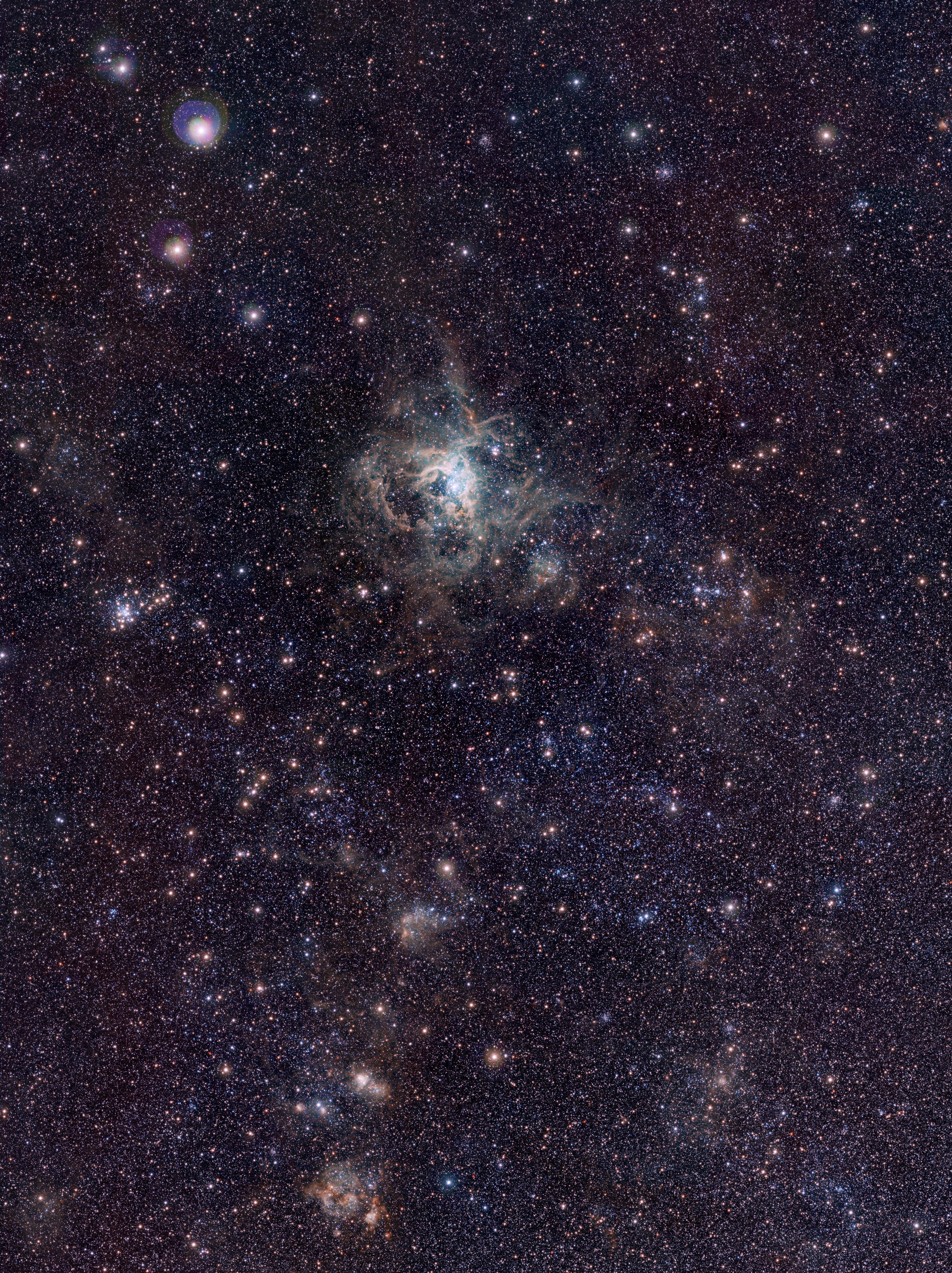
Ever wanted to see a Tarantula up close? Up really close? Here’s your chance!

[Click to hugely enarachnidate, or grab the atomically-mutated, 130 Mb, 9000 x 12000 pixel megaspider version here. But be ye fairly warned, says I: you'll lose your afternoon looking at it.]

That is a new image of the Tarantula Nebula (ha! Got you!) from the European Southern Observatory’s VISTA survey telescope in Chile. The telescope can see in the near-infrared, just outside the range of our human vision, and is being used to map a big chunk of the southern sky.

The Tarantula is a sprawling star-forming region in the Large Magellanic Cloud, a small companion galaxy to our own Milky Way Galaxy. Of course, "small" is a matter of perspective; the LMC is still tens of thousands of light years across and has several billion stars in it. From its distance of 180,000 light years, the LMC appears as a smudge in the sky to the unaided eyes of southern observers.

In astronomy terms the image above is huge; it covers a square degree of sky, several times the area of the full Moon! However, in real terms, if you lived in the southern hemisphere and went outside on a clear night, you could block out the entire region of the picture with the tip of one finger held at arm’s length.

But VISTA’s 4-meter mirror has fine vision, and the image is crammed with detail. It’s hard to see in the embedded image above because I had to compress it wildly to have any hope of letting y’all see it here. The higher-resolution images, however, are simply spectacular! Here’s a taste; I cropped out a small portion:

Wow! Mind you, this is from the medium resolution image! It’s a section to the right and a bit below the nebula proper. And while it’s crammed with stars, gas, and dust, I didn’t pick it randomly. It has one other object in it of note: Supernova 1987A, an exploded star whose light reached us on February 23, 1987. It was, for a few shining moments, among the brightest objects in the entire Universe… but now is lost in a sea of stars, in a small section of one image of a small galaxy.

The Tarantula Nebula is a forbidding object. It’s well over 600 light years across, has millions of times the Sun’s mass worth of gas jammed into it, and is forming stars so furiously that astronomers think it may actually be creating a globular cluster, a spherical ball of hundreds of thousands of stars. You may have heard of the Orion Nebula, one of the largest and brightest of all nebulae in the Milky Way. Well, the Tarantula is thousands of times more luminous; if it were as far away as the Orion Nebula, the Tarantula would be bright enough to cast shadows on the ground!

VISTA will eventually map out 184 square degrees of the sky, which is truly an enormous swath of the sky at this resolution. It will guide astronomers for years to come, giving us a highly-detailed and, yes, beautiful map of stars, galaxies, and nebulae… and best of all, stuff we’re not even aware of yet. Big surveys always help us piece things together, put the details into perspective.

But oh, sometimes, the details themselves are worth gawking at.

ESO/M.-R. Cioni/VISTA Magellanic Cloud survey. Acknowledgment: Cambridge Astronomical Survey Unit


Related posts:

- Hubble sees spectacular star birth and death
- The Orion VISTA
- Incredible VISTA of the cosmos
- Touring the Tarantula
- This Tarantula is definitely deadly