Lust & Love Apps: Playboy Tames Down, Imaginary Girlfriend Steps Up | Discoblog

virtual-girlfriendThose subscribing to the iPad version of Playboy really will be reading it for the articles: The magazine has announced that it will forgo the naked women photos to conform to Apple’s stance against all apps deemed (pdf) obscene and pornographic.

The Telegraph reports that a “tasteful headshot” will greet iPad readers in place of the full glory of a playmate of the month, for example. Covering up (or cropping out) the skin will keep Playboy from that ever-growing list of app rejects, which formerly included one from a Pulitzer Prize-winning cartoonist.

Another app that escaped the banned list is My Virtual Girlfriend, which we found on the blog Neatorama. The game allows players to advance twenty “relationship levels” and apparently has a heart meter that you fill by engaging in activities like virtual hand-holding and virtual kissing. You can also thrill your virtual material girl by buying her shoes–she sounds like a real catch.

Though the Virtual Girlfriend disclaimer warns that the company is not responsible for any resulting marriages, we fear for anyone to whom that applies.

Related content:
Discoblog: Want to Monitor the Earth’s Magnetic Field? There’s an App for That.
Discoblog: Augmented Reality Phone App Can Identify Strangers on the Street
Discoblog: Apple App Store Backs Off Rejection of Pulitzer-Winning Political Cartoonist
Discoblog: Is Apple Taking Sexy Back? Raunchy Apps Vanish From the App Store

Image: My Virtual Girlfriend


Crazy-Looking Redbearded Monkey Turned Up in Colombia | 80beats


The good news: After decades of wondering whether this immaculately bearded monkey really existed, but not being able to confirm it because of never-ending violence in Colombia, scientists say they’ve finally found evidence of the Caqueta titi monkey. The bad news: Because of habitat destruction, the cat-sized redbeard primate is critically endangered.

The new species joins about 20 other titi monkeys known in the Amazon basin. They appear to be monogamous to a level that puts humans to shame, says expedition leader Thomas Defler, whose study (pdf) appears in Primate Conservation. The Caqueta monkey couples have about one child per year that they raise together, and that isn’t the end of their absurd adorableness.

“All of the babies purr like cats too,” Defler added. “When they feel very content they purr towards each other, and the ones we raised would purr to us” [Wired.com].

Defler got to make the trip to Colombia’s Caqueta region because violence in the area had lessened by 2008, and because he met Javier Garcia, who is from there. Garcia hopes to keep studying the monkeys for his master’s degree work—and to argue for new nature preserves to protect them and other endangered species.

It is estimated that less than 250 Caquetá titi monkeys exist — a healthy population should be in the thousands. The main reason for this small number is the degradation of the forests in the area, which have been felled for agricultural land. It is very dangerous, and sometimes impossible, for these animals to move to other patches of forest as they have to cross grassy savannah or barbed wire fences to reach them [Discovery News].

Related Content:
DISCOVER: Monkeys Show They Know What They Know
DISCOVER: On the Origin of (Amazonian) Species
80beats: 4 Messages a Pantomiming Orangutan Might Be Trying To Convey
80beats: Fossil May Reveal When Humanity’s Ancestors Split from Monkeys

Images: Javier Garcia


Ash hole on the Moon | Bad Astronomy

The Moon is a funny place. It’s literally the closest astronomical object to us in the entire Universe, but in some ways we know surprisingly little about it.

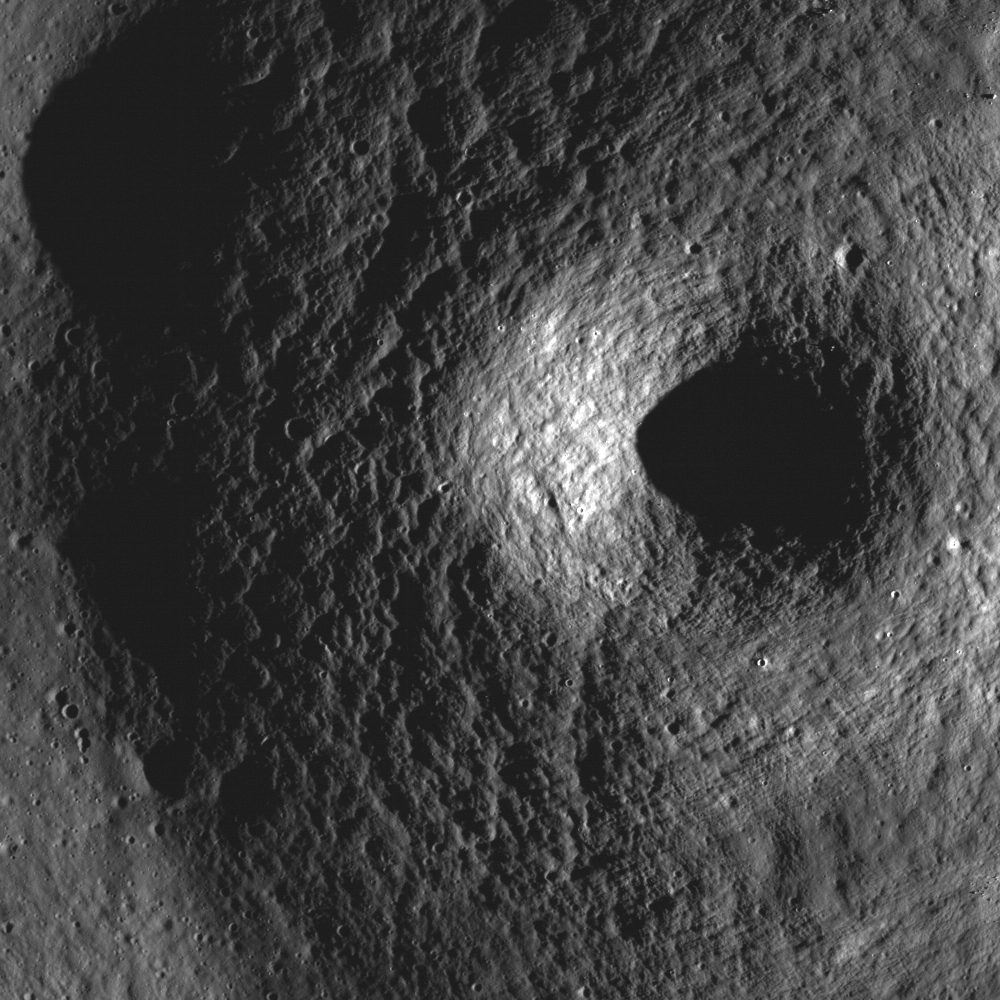
It’s literally covered in craters, but for a long time their origin was a mystery. Until the 1870s, most scientists thought they were volcanic in origin and not from impacts (it wasn’t until 1960 that Gene Shoemaker showed that some craters on Earth were impact events). That doesn’t mean that there are no volcanoes on the Moon, though. The evidence isn’t — har-de-har — rock solid, but this Lunar Reconnaissance Orbiter image is awfully tantalizing:

lro_volcano

[Click to embiggen.]

Located in Lacus Mortis — the Lake of Death! — this interesting feature certainly looks like a volcanic cinder cone. Impact craters don’t generally have such gentle sloping on the inside wall, and such a large, shallow-sloped outside wall. The entire area around the feature is wrinkled and folded, making it look like it’s been heavily flooded with erupted material as well. The crater is about 400 meters (1/4 mile) across, and the whole image 900 or so meters (0.6 miles) in width.

We do know for a fact that there was extensive vulcanism on the Moon long ago. The maria — the huge dark regions on the surface of the Moon you can see with your unaided eye — are basaltic lava floods from billions of years ago. There are also rilles: long, sinuous gullies carved by lava flow. Also, in Apollo 17 they found orange glass (scroll down to the 145:28:39 time marker at that link), proof of volcanic fire fountains on the Moon — though more than 3 billion years ago.

lro_twovolcanoesSo we know volcanoes are there, but is this mound one of them? Interestingly, the mound is near another that is also very cinder-cone-like (as shown in the picture here; you can scan the region at very high resolution on the LRO Camera page; the mounds are about 2/3 of the way down). Note the craters which have sharper rims; those are clearly impact events. In the second pit, also note the boulders lining the rim. You can see long shadows being cast by ones at the top. It’s very pretty.

There’s really only one way to know for sure if these are twin volcanoes: go there and find out! A rover might be able to do the trick, if it had the right instruments… but I still dream of a day, not too far off, when astronauts with picks and shovels will go there and examine that material with their own hands and eyes. We can learn more in a few minutes of being there than we have in all of history of looking at the Moon from 400,000 kilometers away.

LRO was 50 km (30 miles) above the surface of the Moon when it took that picture… 99.99% of the way there. But sometimes, that last 0.01% makes all the difference.

Credit: NASA/GSFC/Arizona State University


Related posts:

- Zoom in on a huge lunar bullseye
- Lunar boulder hits a hole in one
- One of the newest craters on the Moon
- LRO sees a moonslide


Three anniversaries and an open thread | Not Exactly Rocket Science

CelebrateI love anniversaries, and particularly when they coincide with one another. Today, I have three four causes for celebration:

  • Eagle-eyed readers may have noticed that Sunday’s post on the microbiome was my 800th piece for Not Exactly Rocket Science (including all full-length posts, Pocket Science write-ups and opinion pieces, and excluding re-posts and the photo safaris).
  • Today is my fourth bloggiversary – NERS was born in August 13th 2006
  • Sometime in the last week, I got my 3 millionth page view (including those from the WordPress and Scienceblogs incarnations).
  • [Updated] And apparently, I’ve written 10,000 tweets! Thanks to Chris Rowan for the tip.

Woo, and I might add, hoo.

So in a tradition I started when I wrote my 600th post, this is an open thread. Feel free to ask/talk about anything you want. I’ll do my best to reply, time pending.

Cheers, and thanks for reading,

Ed

Twitter.jpg Facebook.jpg Feed.jpg Book.jpg

NCBI ROFL: An electrophysiologic study of female ejaculation. | Discoblog

electricity“Opinions vary over whether female ejaculation exists or not. We investigated the hypothesis that female orgasm is not associated with ejaculation. Thirty-eight healthy women were studied. The study comprised of glans clitoris electrovibration with simultaneous recording of vaginal and uterine pressures as well as electromyography of corpus cavernous and ischio- and bulbo-cavernosus muscles. Glans clitoris electrovibration was continued until and throughout orgasm. Upon glans clitoris electrovibration, vaginal and uterine pressures as well as corpus cavernous electromyography diminished until a full erection occurred when the silent cavernosus muscles were activated. At orgasm, the electromyography of ischio-and bulbo-cavernosus muscles increased intermittently. The female orgasm was not associated with the appearance of fluid coming out of the vagina or urethra.”

An electrophysiologic study of female ejaculation

Photo: flickr/Nathan Lanier

Related content:
Discoblog: NCBI ROFL: Ever wonder how much electricity your penis can take?
Discoblog: NCBI ROFL: She might not be having what you think she’s having…
Discoblog: NCBI ROFL: A woman’s history of vaginal orgasm is discernible from her walk.

WTF is NCBI ROFL? Read our FAQ!


Scenes From the Future: Send Tweets From A Tattoo | Science Not Fiction

dattoo02

Tattoos are a nerd’s best friend. The Loom’s science tattoo emporium is all the proof I need. But Frog Design’s idea for Dattoos takes things to the next level:

The concept of the Dattoo arose in response to current trends towards increasing connectivity and technology as self-expression. To realize a state of constant, seamless connectivity and computability required the convergence of technology and self. The body would need to literally become the interface. Computers and communication devices require physical space, surfaces, and energy. The idea of DNA tattoos (Dattoos) is to use the body itself as hardware and interaction platform, through the use of minimally-invasive, recyclable materials.

The picture reminds me of the Buzz Lightyear/ Turanga Leela style forearm computer. That seems like a pretty practical place to put a Dattoo. I have a few other ideas:

  1. Put a Dattoo on the palm of your hand, for more interesting waving and “talk to the hand” gesturing.
  2. On the bicep, for wearing your Facebook status/latest tweet on your sleeve.
  3. Upside-down on your stomach, for the world’s most entertaining navel gazing.

Dattoos are a long, long way off — it’s currently just a concept design, not a technology plan — but I can imagine artists like Lady Gaga and Marina Abramovi? coming up with crazy ideas for installations and projects. Or, you know, it could be used to make people healthier, I guess. My daily subway commute would sure be even more colorful. Can someone make this happen, please?

Image via FrogDesign.com


Was Thinking Tonight About the Greatness of Carl Sagan | The Intersection

The opening lines of Cosmos:

The Cosmos is all that is, or ever was, or ever will be.

Our contemplations of the Cosmos stir us.

There’s a tingling in the spine, a catch in the voice…

A faint sensation, as if a distant memory of falling from a great height.

We know we are approaching the grandest of mysteries.

(Fully 30 years ago. And yes, I know that with our modern sensibilities, it feels a little bit cheesy…but still. You know you love it.)


The 2010 Perseids Meteor Shower

A Geminid meteor. Image credit: Jimmy Westlake via JPL

YAY! My second favorite meteor show of the year is coming up this week. The Perseids shower comes to us compliments of the Comet 109P/Swift-Tuttle. The shower peaks on August 12 – 13, it’s a must see.

The shower seems to radiate from the constellation Perseus, which will be rising in the Northeastern Sky by 9 pm (your local time). I’ve heard predictions of up to 50 meteors per hour because the debris trail is especially favorable this year. PLUS!! The moon will be setting early on ensuring dark skies.

Don’t worry too much about being able to spot the constellation Perseus (here’s a little chart all the same), just look up. Several years ago I was coming home from a class learning how to start IV’s on poor Bram (he is now a college professor), anyway I was riding in the back seat of a hatchback at about 9:30 to 10 pm and had my head back so I was looking straight up out of the back of the car, I saw all kinds of meteors. So as long as you don’t have too many clouds (oh please-please-please no clouds for me), you will be able to see the bits of comet strike our atmosphere at 38 miles per second (61 km/sec). What actually happens is a little more complicated than what you might think:

This explanation from the US National Weather Service:

What we actually see “burning up” in our atmosphere is the air undergoing a compaction and compression ahead of the fast-moving meteoroid called incandescence. Compression is a heating process and the air ahead of a meteoroid glows brightly as the meteoroid moves quickly through our atmosphere, most of the time at speeds greater than 10 miles per second. This is why our spacecraft have to have heat shields upon re-entering our Earth’s atmosphere. Without the heat shields, the spacecraft would vaporize due to temperatures approaching several thousand degrees F.

If all goes really well I might try and get some images, that great one at the top of this post by Jimmy Westlake is on the JPL site: How to See the Best Meteor Showers of the Year: Tools, Tips and ‘Save the Dates’. Be sure to check it out!  BTW, they have a larger version of Mr. Westlake’s picture too.

My favorite shower? The Orinoids in October. Why? FIREBALLS!!

BTW Rob reminded me of this:

We have the opportunity to help out an effort to spatially analyze the Perseids meteor shower….No wait!

This is:
Easy
Costs nothing
Only requires a laptop and your eyes
It’s a fun geeky thing to do!

Check out the Perseid Project.

I’ll be participating clouds permitting.  (please-please-please no clouds!)

NCBI ROFL: What’s in a name? Part III: Why Dennis is a dentist. | Discoblog

seashellsWhy Susie sells seashells by the seashore: implicit egotism and major life decisions.

“Because most people possess positive associations about themselves, most people prefer things that are connected to the self (e.g., the letters in one’s name). The authors refer to such preferences as implicit egotism. Ten studies assessed the role of implicit egotism in 2 major life decisions: where people choose to live and what people choose to do for a living. Studies 1-5 showed that people are disproportionately likely to live in places whose names resemble their own first or last names (e.g., people named Louis are disproportionately likely to live in St. Louis). Study 6 extended this finding to birthday number preferences. People were disproportionately likely to live in cities whose names began with their birthday numbers (e.g., Two Harbors, MN). Studies 7-10 suggested that people disproportionately choose careers whose labels resemble their names (e.g., people named Dennis or Denise are overrepresented among dentists). Implicit egotism appears to influence major life decisions. This idea stands in sharp contrast to many models of rational choice and attests to the importance of understanding implicit beliefs.”

Bonus table:
table1

seashells

Photo: flickr/geishaboy500

Related content:
Discoblog: NCBI ROFL: What’s in a name? Part I: U.G.H. you’re going to D.I.E.
Discoblog: NCBI ROFL: What’s in a name? Part II: Why Kevin Kouzmanoff strikes out so much.
Discoblog: NCBI ROFL: Beauty week: Better choose that baby name wisely!

WTF is NCBI ROFL? Read our FAQ!


Damn You Einstein, You Liberal You | The Intersection

Joe Romm has found and had a massive amount of fun with the Conservapedia entry denouncing relativity as a liberal plot. Go read his post. I’ll just quote a bit:

I don’t see how that story of Jesus healing somebody proves action at a distance instantaneously…. Silly conservatives. You would need to demonstrate that the healing took place exactly when Jesus spoke to disapprove the special theory of relativity – rather than say a fraction of a second later.

Warning: If you read Romm’s post or the Conservapedia entry on which it is based, you will be entering a true bizarro world–one in which fidelity to biblical literalism not only leads to the rejection of everything we know, but further, to the generation of extraordinarily wacky scientific-sounding psuedo-arguments.

Just as it does on evolution, actually.


The dog’s world of large effect QTLs | Gene Expression

Szusza_pekingeseA major issue in human genomics over the past few years has been the case of the “missing heritability“. Roughly, we know that for many traits, such as height, most of the variation in the trait within the population is controlled by variation in the genes of the population. The height of your parents is an extremely good predictor of your height in a developed nation. If you’re adopted, the height of your biological parents is an extremely good predictor of your height in a developed nation, not the height of your adoptive parents. Though a new paper claims to have resolved some of the difficulty, one of the major issues in human height genetics has been the lack of large effect quantitative trait locus. In plain English, a gene which can explain a lot of the variation in the trait. Rather, many have posited that continuous quantitative traits like height are controlled by variation in innumerable common genes of small effect size, or, by innumerable rare genes of large effect size. The same may be an issue with personality genetics, or so is claimed by a recent paper unable to find common variants (though an eminent geneticist pointed out in the comments some problems with the paper itself).

ResearchBlogging.orgOne would assume that the same problem would crop up across the tree of life. But a geneticist once told me that he considered biology the science where all rules have exceptions. Many exceptions. A new paper in PLoS Biology paints a fundamentally different picture of the genetic architecture of many morphological traits in the domestic dog, A Simple Genetic Architecture Underlies Morphological Variation in Dogs:

Dogs offer a unique system for the study of genes controlling morphology. DNA from 915 dogs from 80 domestic breeds, as well as a set of feral dogs, was tested at over 60,000 points of variation and the dataset analyzed using novel methods to find loci regulating body size, head shape, leg length, ear position, and a host of other traits. Because each dog breed has undergone strong selection by breeders to have a particular appearance, there is a strong footprint of selection in regions of the genome that are important for controlling traits that define each breed. These analyses identified new regions of the genome, or loci, that are important in controlling body size and shape. Our results, which feature the largest number of domestic dogs studied at such a high level of genetic detail, demonstrate the power of the dog as a model for finding genes that control the body plan of mammals. Further, we show that the remarkable diversity of form in the dog, in contrast to some other species studied to date, appears to have a simple genetic basis dominated by genes of major effect.

The paper uses powerful statistical and computational techniques, but the main results are relatively straightforward (assuming you don’t get stressed out by terms such as “random effect in the linear mixed model”). First, they delved a little into the evolutionary history and the general topography of the genomics of various dog breeds, wolves, as well as stray “village dogs” (I assume these are simply these are like the “pariah dogs” of India). Though village dogs had domestic ancestors they’ve gone feral, so they’re an interesting contrast with the new breeds created since the 19th century, as well as the wild ancestors of all dogs, wolves.

Three statistics were used to explore demographic history: linkage disequilibrium (LD), runs of homozygosity (ROH), and haplotype diversity. Inbred individuals have many ROH. They may have one individual show up relatively recently in their ancestry over and over, so it makes sense that they’d have many loci where both copies of the gene are identical by descent and state. Obviously purebred dogs have high ROH. They also have low haplotype diversity. Even the average person on the street is familiar with the freakish inbreeding which goes into the production of many purebred canine lineages, and their lower life expectancy vis a vis the maligned “mutt.” LD decayed much more quickly in wolves than in the dogs, village and purebred. Remember that LD indicates correlations of alleles across loci. It can be caused by selection at a SNP, which rises in frequency so quickly that huge swaths of the adjacent genome of that particular SNP “hitchhike” along before recombination can break up the association to too great an extent. Admixture between very distinctive populations can also produce LD, which again will decay with time due to recombination. Finally, another way LD can occur is through bottlenecks, which like positive selection can increase particular gene frequencies and their associated genomic regions rather rapidly through stochastic processes. It is the last dynamic which probably applies to all dogs: they went through a major population bottleneck during the domestication process, so the genomic pattern spans village and purebred lineages since it is an echo of their common history. Finally haplotype diversity is simply ascertaining the diversity of haplotypes across particular genomic windows. An interesting find in these results is that village dogs actually have lower ROH and higher haplotype diversity than wolves. That suggests that the wolves in this sample went through a major population bottleneck, while village dogs have maintained a larger effective population.

A general finding from the aforementioned examination is that different breeds tended to be genetically rather distinct. This follows naturally from the origin of modern purebreds as tight and distinct inbred lineages. This genome-wide distinctiveness though is a perfect background condition to test for similarities within the genome which correlate with specific morphological similarities across the breeds. And they did find quite a bit:

We searched for the strongest signals of allelic sharing by scanning for extreme values of Wright’s population differentiation statistic FST…cross the breeds. The 11 most extreme FST regions of the dog genome contained SNPs with FST?0.57 and minor allele frequency (MAF [major allele frequency -Razib])?0.15 (Table 1). Six of these regions are strongly linked to genetic variants known to affect canine morphology: the 167 bp insertion in RSPO2 associated with the fur growth and texture…an IGF1 haplotype associated with reduced body size…an inserted retrogene (fgf4) associated with short-leggedness…and three genes known to affect coat color in dogs (ASIP, MC1R, and MITF…Two other high FST regions correspond to CFA10.11465975 and CFA1.97045173, which were associated with body weight and snout proportions, respectively, in previous association studies….Two known coat phenotypes (fur length and fur curl…) also exhibited extreme FST values. Only a limited number of high FST regions were not associated with a known morphological trait (Figure 2, black labels). Here, we focus on illuminating the potential targets of selection for these regions as well as identifying genomic regions that associate with skeletal and skull morphology differences among breeds.

Many of these genes are familiar to you in all likelihood because they have the same functional significance in humans. The key difference is effect size. Since the paper is open access I’ll spare you the alphabet soup of genes and their association with canine morphological traits. There are many of them that pop up by examining differences between breeds in morphology (and similarities) and their allele frequencies. The top line is the prediction of trait which can occur via just a few genes. They constructed a regression model where a set of independent variables, genes, can predict the value of a given dependent variable, the trait:

Using forward stepwise regression, we combined potential signals into a multi-SNP predictive model for each trait. In the models of body weight, ear type, and the majority of measured traits, most of the variance across breeds could typically be accounted for with three or fewer loci…Correlated traits (e.g., femur length and humerus length) yielded similar SNP associations. For the 55 traits, the mean proportion of variance explained by the top 1-, 2-, and 3-SNP models was R2 = 0.52, 0.63, and 0.67, respectively….After controlling for body size, mean proportion of variance explained by these models was still appreciable—R2 = 0.21, 0.32, and 0.4, respectively.

R2 indicates the proportion of variance in the dependent variable explained by variance in the independent variables. The values for this model are very high. By contrast, a gene for height in humans is a find if it can explain 2% in the trait value variance.

The above found SNPs which could explain variation across breeds which are inbred and highly distinctive in genes and traits. Could the same SNPs explain variance within breeds? Yes:

Most of the variance in body size was explained by the IGF1 locus where we observe a single marker with R2 = 50% and R2 = 17% of variance in breed and village dogs, respectively. The top 3-SNPs explain R2 = 38% of the variance in body weight in village dogs, although the 6-SNP model explains less. The lower R2 in non-breed dogs than breed dogs may be a consequence of lower LD observed in village dogs reducing the strength of association between these markers and the causal body size variants. Alternatively, the lower R2 may also be a consequence of non-genetic factors such as diet or measurement error affecting the observed village dog weights, the smaller range of body sizes observed in the non-breed dog sample, or perhaps to overfitting of the model based on the particular breeds included in the dataset. Nevertheless, R2 = 38% is significantly better than association scans for morphometric traits in humans utilizing denser marker arrays….

Dogs and humans have a long history together. But some of these dogs have a very short history. As noted in the discussion many canine lineages which are purebred are products of Victorian era breeding crazes, and were selected for strange characteristics which were transmitted in a discrete fashion. The recency of the lineages combined with the peculiarities of the breeding programs of this era and dog fanciers generally may explain some of the genetic architecture of canines. The authors note that domestic animals subject to more gradual selection may not, and do not, exhibit the same tendency. Perhaps humans are more like goats or wheat, and less like dogs? The authors note the contrast in loci which exhibit population wide variation:

In humans, high-FST regions are associated with hair and pigmentation phenotypes, disease resistance, and metabolic adaptations…In contrast, the strongest signals of diversifying selection in dogs are all associated with either body size/shape or hair/pigmentation traits, and therefore are unlikely to have been under selection for disease resistance, metabolic adaptations, or behavior. In total, the 11 highest FST regions identified across purebred dogs are all associated with body size/shape or hair phenotypes, including three genomic regions that had not been detected in previous association studies.

The rationale for this study is the utility of dogs as model organisms for humans. They’re taxonomically rather close to us, so their genetics may give us insight into human conditions. The main worry though for me is that the best models here are inbred dogs, where the markers adduced are most valid, but it seems possible they’re the least promising set of models because they have all sorts of genetic peculiarities. But all practicality aside, a fascinating paper.

Image Credit: Jon Radoff and Angela Bull in 2002

Citation: Boyko AR, Quignon P, Li L, Schoenebeck JJ, Degenhardt JD, & et al. (2010). A Simple Genetic Architecture Underlies Morphological Variation in Dogs PLoS Biology : 10.1371/journal.pbio.1000451


Inception and the Neuroscience of Sleep | Science Not Fiction

sleepingChristopher Nolan’s Inception is a film about a time when we have the power to enter into each other’s dreams, and actively steer the dream’s course to implant an idea in the dreamer.

The film raises the issue of how much we understand about the neuroscience of dreams. Due to its need for invasive experiments, neuroscience typically works with non-human animals, which raises a significant difficulty: how do you know that a rat is dreaming? You can’t wake it up from REM sleep and ask. (Well, you can, but don’t expect a cogent response.) There’s no accepted objective indicator that a person or animal is having a dream, as opposed to sleeping. But, we can still learn something useful by looking at the neuroscience of sleep.

The neuroscience of sleep has told us a few important things over the years. For example, we know that our pattern of sleep and wakefulness (the “circadian rhythm”) has much of its basis in the activity of the suprachiasmatic nucleus, a rice-grained-sized group of cells just above where the optic nerves from our eyes crossover. We know that our free running rhythm—what we go to if we are completely in the dark, with no indicator of solar activity—is slightly over 24 hours, and that the length of the rhythm can be affected by things like cannabinoids found in pot. We know that the brain activity of a person dreaming is very similar to that of an awake person—were it not for the fact that our body is paralyzed during dreaming, we’d probably do a lot of things we’d regret.

While we’ve made a lot of progress in understanding sleep, we’ve a long way to go to understand dreaming. What makes it a challenge, perhaps as big a challenge as understanding consciousness itself, is the subjective aspect of dreaming. For example, we know that vivid dreaming occurs during REM sleep in humans. We also know that other animals have REM sleep. Do they also dream? How can we know, since, as I mentioned above, we can’t wake them during REM sleep and ask (the way we determined this fact with humans)? How we can go from objective facts like the presence of REM sleep to subjective ones, like a dream of a pink elephant bouncing down along a high tension power line (from one of my own dreams) is as unclear as how we get from neurons firing to awareness. Nonetheless, significant work has occurred on some of the neuronal correlates of REM sleeping in rodents and songbirds.

The most intriguing result from recent work is that during sleeping, the brain appears to “play back” patterns of activity that occurred during the day. For example, Matt Wilson and colleagues have found that patterns of “place cell” activity — brain cells that light up, like crumbs left on Hansel and Gretel’s path in the woods, corresponding to a specific path that the animal (in these experiments, a rodent) took during the day — and this playback seems to be integral to the animal learning the path it took. In birdsong, from work by Dan Margoliash and others, we’ve learned that birds playback patterns of activity almost identical to singing while they sleep, and again, it seems to be integral to the bird learning its large repertoire of over a million syllables. Why does the brain play back patterns of daytime activity at night? It isn’t completely understood, but some backstory on memory research helps motivate one hypothesis.

It’s been known for some time that a structure called the hippocampus is responsible for acquisition of new memories. Without it, we still have our memories, but anything new that happens is completely lost (think of the movie Memento, one of Christpher Nolan’s previous films) — we are stuck in the continual present. Real-life patient HM taught us this many years ago, after he had this structure removed as part of an experimental operation to cure his epilepsy. He, and many similar cases, lose all memory but for those events that happened some time before the loss of their hippocampus, typically a few months. Over time, the idea has emerged that perhaps the hippocampus “trains” the neural networks in other regions of the brain to store memories through repeated playback during sleep. Like crickets trying to attract females in the night, in the world of memory nothing succeeds like persistent repetition.

So if in REM sleep the brain is repeating patterns of activity from periods of wakefulness, perhaps that process helps the brain to remember, over the long term, the items that are temporarily stored in the hippocampus.

What is not understood from these studies, which were done in rodents and song birds after all, is the basis of all the strange subjective aspects of dreaming — such as how or why in our dreaming we seem to borrow from real experience while adding a good dollop of stuff from elsewhere. This aspect of dreaming seems like it would be crucial in order to have any hope of building a dream experience a la Inception. There is not a whole lot of creative potential in simply regurgitating the day’s brain patterns.

Until these and many other mysteries of dreaming are solved, what the research is showing is that the best way to architect a dream is to architect the experience you have during wakefulness, since dreaming appears to be a lot about learning patterns you were exposed to while awake. Our understanding of the coupling is not clear enough to think about designing dreams by structuring our awake behavior, but perhaps with further research we will come to that point where we can do inception of ideas into our own heads.

Image: Midlands Rat Club
Corrections: Aug 11, 2010: “…neuroscience typically works with animals, rather than humans…” adjusted to “…neuroscience typically works with non-human animals.” Reference to length of circadian rhythm also adjusted.


How to Bring Armageddon the Right Way | Science Not Fiction

Science fiction without science is merely fiction. There are gray levels in how well the science is portrayed in television and cinema, however. For the third straight year, Discover Magazine and the National Academy’s Science and Enterainment Exchange hosted a science-of-science-fiction panel at San Diego Comic-Con, and this year’s theme was “Abusing Science in Science Fiction.” Each panelist provided two video clips from sci-fi television or cinema: one of science done right, and one where the science, well, wasn’t done right.

I’ve always maintained that in science fiction TV and cinema good science should be jettisoned in deference to drama as a last resort only–and then when you have all your other ducks in a row. If the science is solid in the large bulk of your work, we’ll make the leap with you when you get a bit more… speculative. Some works stick to grounded science well, some do not.

Therefore, for my clips, I chose two instances of the same type of event–the impact of a comet/asteroid with Earth — one done well (Deep Impact), one that could have been done better (Armageddon).

Since Deep Impact’s science is fairly solid, and their science advisor (they actually had one!)Armageddon once told me “We pretty much get our mistakes out of the way in the first five minutes”, there’s little to say. There’s plenty to say with the Armageddon clip I chose — which was the first 40 seconds of the movie. The opening of Armageddon purports to show what is called the K/T Event — the asteroid or comet impact 65 million years ago that caused most of life on Earth, including the dinosaurs, to meet extinction.

The opening narration, done by Charlton Heston doing his best Moses voice, starts out:

It hit with the force of 10,000 nuclear weapons.

Here’s where getting the science right would have improved the drama. To be more correct, Charlton Heston wouild have said:

It hit with the force of over 19 million 1 megaton nuclear weapons.

Or

It hit with a force almost 1.5 billion times the atomic bomb dropped on Hiroshima.

While Charlton narrates, the video shows the impact, and a blast wave traveling over the entire planet. While normally willing to suspend disbelief happily, from a science standpoint this movie lost me in the first 30 seconds when I first saw it in the theatre. The blast would not have traveled that far. What the video could have shown, and Charlton could have described in his best “The Dinosaurs Have Been Smote” voice was the several-hundred-foot-high tsunami that raced away from the impact. Or the chunks of impactor and target rock that fell back to Earth as secondary impacts, setting most of the world’s forests on fire.

What Charlton says instead is:

A trillion tons of dirt and rock hurtled into the atmosphere.

That’s about 1/10 the mass of the impactor (assuming it was an asteroid), so that number isn’t too bad, but, where’s the drama? What is the result of this? He continues with:

…creating a suffocating blanket of dust the sun was powerless to penetrate for a thousand years.

Probably not that long, the dust probably settled out faster than that — without the sun’s life-giving radiation, it would not have taken long for Earth’s ecosystem to collapse.

It happened before. It will happen again.

Yay! They got something right! It’s clear that had the folks who made Armageddon stuck to known science, they could have made this scene simultaneously more realistic and more dramatic.

If you missed the panel, weren’t able to attend Comic-Con, or were turned away at the door because the room was packed, here’s the video:

The “Science of Science Fiction” panel will be back at San Diego Comic-Con again next year — hopefully in a much larger space (and hopefully it will still be in San Diego).


Books nerds like | Gene Expression

The Less Wrong community is having a book discussion and offering up recommendations. I’m currently reading Lives of Confucius: Civilization’s Greatest Sage Through the Ages (long time readers will know that I’m a particular fan of Xun Zi though). It is revising my view of the “received orthodoxy” as to the development of state sponsored Confucianism during the Han dynasty. A good complement to The Authentic Confucius, which is less a historical work and more a religio-philosophical exegesis of the sage’s life. I did finish Empires of the Word, but I will review it at some point so I won’t say more than I would recommend it, though with a critical eye.

Tropical Depression 5 Forms, Headed for the Gulf Coast | The Intersection

TD5 Aug 10The good news is that nobody expects it to strengthen much due to environmental conditions.

The bad news is that it is a tropical storm system in the Gulf of Mexico. Period.

That means we’ll have to watch this one closely, and now that storm season is picking up, let me recommend a few blogs to keep track of for hurricane stuff: Eric Berger’s SciGuy, and Jeff Masters’ Wunderblog.

They’re already following the storm and will have more soon, as will I.


The beautifully brutal life of gulls | The Loom

GullbandingThis week I’m on the Island of Science Writing. Today we wandered rocky coves with Tufts University biologist Julie Ellis, an expert on gulls. She showed us how to catch and band juvenile herring gulls–and how to recognize the matted remains of juvenile herring gulls coughed up by their great black-backed gulls predators. Life here is pretty, and yet not so pretty. But always interesting for writing about.


Brainless slime mould makes decisions like humans | Not Exactly Rocket Science

Physarum

A couple arrive at a fancy restaurant and they’re offered the wine list. This establishment only has two bottles on offer, one costing £5 and the other costing £25. The second bottle seems too expensive and the diners select the cheaper one. The next week, they return. Now, there’s a third bottle on the list but it’s a vintage, priced at a staggering £1,000. Suddenly, the £25 bottle doesn’t seem all that expensive, and this time, the diners choose it instead.

Businesses use this tactic all the time – an extremely expensive option is used to make mid-range ones suddenly seem like attractive buys. The strategy only works because humans like to compare our options, rather than paying attention to their absolute values. In the wine example, the existence of the third bottle shouldn’t matter – the £25 option costs the same amount either way, but in one scenario it looks like a rip-off and in another, it looks like a steal. The simple fact is that to us, a thing’s value depends on the things around it. Economists often refer to this as “irrational”.

But if that’s the case, we’re not alone in our folly. Other animals, from birds to bees, make choices in the same way. Now, Tanya Latty and Madeleine Beekman from the University of Sydney, have found the same style of decision-making in a creature that’s completely unlike any of these animals – the slime mould, Physarum polycephalum. It’s a single-celled, amoeba-like creature that doesn’t have a brain.

Physarum spends most of its life as a large mat called a ‘plasmodium’, which is a single cell that contains many nuclei. The plasmodium searches for food by moving along like an amoeba and sending out a network of tendrils. Its search patterns are very sophisticated for a brainless organism. A Japanese group found that if they placed the mould among food sources arranged like Tokyo’s urban centres, it created a network that closely resembled Tokyo’s actual railway system. The slimy network was optimised to transport nutrients to the main plasmodium.

Scientists have long since discovered that you can run simple decision-making experiments with Physarum by presenting it with several food sources and seeing how it behaves. Typically, the plasmodium touches all the potential meals and then either ‘decides’ to move towards one, or splits itself among many.

Latty and Beekman did one such test using two food sources – one containing 3% oatmeal and covered in darkness (known as 3D), and another with 5% oatmeal that was brightly lit (5L). Bright light easily damages Physarum, so it had to choose between a heftier but more irritating food source, and a smaller but more pleasant one. With no clear winner, it’s not surprising that the slime mould had no preference – it oozed towards each option just as often as the other.

But things changed when Latty and Beekman added a third option into the mix – a food source containing 1% oatmeal and shrouded in shadow (1D). This third alternative is clearly the inferior one, and Physarum had little time for it. However, its presence changed the mould’s attitude toward the previous two options. Now, 80% of the plasmodia headed towards the 3D source, while around 20% chose the brightly-lit 5L one.

These results strongly suggest that, like humans, Physarum doesn’t attach any intrinsic value to the options that are available to it. Instead, it compares its alternatives. Add something new into the mix, and its decisions change. The presence of the 1D option made the 3D one more attractive by comparison, even though the 3D and 5L alternatives were fundamentally unchanged.

This style of ‘comparative valuation’ may seem uncannily human, but it’s also one that’s shared by hummingbirds, starlings, honeybees and many other animals. In fact, Latty and Beekman think that it’s a “common feature of biological decision-making”. Certainly, it’s a much easier process – comparing two nearby options is less “computationally intensive” than making absolute judgments about each of them.

But how does Physarum make decisions at all without a brain? The answer is deceptively simple – it does so by committee. Every plasmodium is basically a big sac of fluid, where each part rhythmically contracts and expands, pushing the fluid inside back-and-forth. The rate of the contractions depends on what neighbouring parts of the sac are doing, and by the local environment. They happen faster when the plasmodium touches something attractive like food, and they slow down when repellent things like sunlight are nearby.

Despite being a single cell, each part of the plasmodium acts like a tiny individual, reacting to information from its environment. By combining these reactions, the entire plasmodium flows towards things it likes and away from things it doesn’t, all without a single conscious thought. It’s the ultimate in collective decision-making and it allows Physarum to perform remarkable feats of “intelligence”, including simulating Tokyo’s transport network, solving mazes, and even driving robots.

Reference: Proc Roy Soc B http://dx.doi.org/10.1098/rspb.2010.1045

Image by Johnna Gott

More on Physarum: Slime mould attacks simulates Tokyo rail network

If the citation link isn’t working, read why here


Twitter.jpg Facebook.jpg Feed.jpg Book.jpg

PCA, Razib around the world (a little) | Gene Expression

price_fig1I have put up a few posts warning readers to be careful of confusing PCA plots with real genetic variation. PCA plots are just ways to capture variation in large data sets and extract out the independent dimensions. Its great at detecting population substructure because the largest components of variation often track between population differences, which consist of sets of correlated allele frequencies. Remeber that PCA plots usually are constructed from the two largest dimensions of variation, so they will be drawn from just these correlated allele frequency differences between populations which emerge from historical separation and evolutionary events. Observe that African Americans are distributed along an axis between Europeans and West Africans. Since we know that these are the two parental populations this makes total sense; the between population differences (e.g., SLC24A5 and Duffy) are the raw material from which independent dimensions can pop out. But on a finer scale one has to be cautious because the distribution of elements on the plot as a function of principal components is sensitive to the variation you input to generate the dimensions in the first place.

I can give you a concrete example: me. I showed you my 23andMe ancestry painting yesterday. I didn’t show you my position on the HGDP data set because I’ve shared genes with others and I don’t want to take the step of displaying other peoples’ genetic data, even if at a remove. But, I have reedited some “demo” screenshots and placed where I am on the plot to illustrate what I’m talking about above. The first shot is my position on the two-dimensional plot of first and second principal components of genetic variation from the HGDP data set.


gsa-lillymendel-worldNo surprise that I’m in the Central/South Asian cluster. But what may surprise you is that I’m not in the South Asian cluster, I’m in the Central Asian cluster. In the Central Asian cluster are Uyghurs and Hazaras. These are two hybrid populations, a mixture of West and East Eurasian elements. The Uyghurs are likely the outcome of a process of admixture between the Iranian and Tocharian Indo-European populations of the cities of the Tarim basin, and later Turkic speaking settlers who arrived in the wake of the expansion and later collapse of the first Uyghur Empire (the historical connection between the current Uyghurs and ancient Uyghurs is tenuous at best, and complicated). The Hazaras are a more recent population, likely emerging as the product of intermarriages between Mongol soldiers who arrived in the 13th century, and indigenous women, Persians, Turks, and assorted Indo-Iranian groups between the Zagros and Khyber Pass. It is somewhat ironic that I’m on the edge of the Hazara cluster since they are almost certainly in part descended from Genghis Khan’s family, and my own surname is Khan. But I know that my Y chromosomal lineage is R1a1, very common across Central and Southern Eurasia, and not a Mongolian one at all.

23andmepcazoomZoom! Now we’ve constrained the input data set to the Central/South Asian groups. First, look at the Kalash. They’re strange, which is no surprise, they’re an inbred mountain group in Pakistan who have not adopted Islam. The Pakistani Taliban looks to be ending them as we speak. I really would prefer that they were just thrown out of the data set for this zoom view, because on this fine grained scale I don’t think they add much at all. They’re just an example of what long term endogamy can do to your allele frequencies. The bigger picture is the axis between the populations of Pakistan, and those of Central Asia. Observe that I’ve changed position. Whereas when taking world wide genetic variation into account I clustered with Central Asians, now I’m 2/3 of the way to the South Asian cluster. I will tell you that I’ve shared “genes” with around 50 South Asians now, from various parts of the subcontinent, and in the 23andMe plot they overlay the South Asians nearly perfectly. I’ve put labels at the approximate ethno-linguistic position. I’m an outlier. 23andMe tells me that I’m 43% “East Asian.” The typical South Asian is in the 10-30% range. My first assumption was that I have a lot of ancient South Indian, which just shows up as East Asian in their algorithm. With this in mind I tried sharing with a lot of South and East Indians, and found out two interesting points. First, South Indians seem no higher than 30-35% East Asian. Bengalis on the other hand are more East Asian, with Bangladeshis more East Asian than West Bengalis. My sample size for Bengalis is small, so take that with caution. Second, the PCA plots put the South Indians firmly in the South Asian cluster, but the Bengalis trail out toward my own position. This indicates again that different methods are telling you slightly different things. The PCA is only a thin slice of variation, but it’s highly informative of between population differences. A Bengali and a South Indian with the same “East Asian” fraction in the ancestry painting nevertheless have consistently different positions on the PCA, with Bengalis closer to the East Asians. Additionally, there’s an ethnic Persian in this zoom plot that I’m describing, and they are positioned near the Balochi. But on the world wide plot they’re on the margins of the European cluster. Another illustration that position of an element is sensitive to the input data because of how the dimensions are generated.

Blaine Bettinger, who inspired me to post this, told a story with his ancestry painting which was plausible. What can I say? First, I have less than 1% African ancestry. This could be noise. But, I do observe that the South Asians with Muslim names are enriched in the set of those who I’ve shared genes with and who have less than 1%, but not 0%, African ancestry. Just as Muslim South Asians have non-trivial West Asian ancestry, I suspect that many of us have Sub-Saharan African ancestry through the same dynamic. Sub-Saharan African soldiers were prominent across South Asia with the arrival of Muslims. Bengal even has a period of rule by Abyssinian rulers. But the bigger issue for me is the East Asian component. Here is a figure from a paper published 4 years ago:

journal.pgen.0020215.g005

The figure is showing Fst value comparing Indian Americans with Europeans and East Asians. Fst measures between population differences in allele frequency, in this case the alleles being 207 indels. Take a look at the Bengalis. These are West Bengalis, who I believe have a lesser East Asian component, but even there the allele frequency difference to East Asians is near that of Europeans. The Assamese, who speak a language very close to Bengali, are similar. Assam was ruled by a Tibeto-Burman people for nearly 600 years. The Oriya speakers, from the southwest of Bengal, are more distant from East Asians. As one goes south and east, and west and north, the distance from East Asians increases. This shouldn’t be that surprising, but nice to confirm. The fact that the genetic distance increases as one goes south means that for northeast South Asia you need to complexify the model from a two-way admixture with “ancient North Indians” and “ancient South Indians.” Set next to these two is an East Asian element, which is also clear in the Indo-Aryan peoples of Nepal.

Sheikh Hasina, Khaleda ZiaOf course anyone who knows Bengalis won’t be totally surprised by an East Asian component to their ancestry. To the left are head shots of the two women who have dominated Bangladeshi politics for the past two decades, Khaleda Zia and Sheik Hasina. They’re both Bengalis, but they do look different, and I know many people who look like one or the other (or a combination). My family is from one of most easternmost districts of Bengali, next to Tripura. In fact my late maternal grandmother lived in Tripura for some of her childhood (she was almost trampled to death by the Maharani of Tripura’s insane elephant as a young girl!). When I was a young child I once saw a black and white photo from my father’s college days, and I was curious who the Asiatic looking young man in the middle of the photograph was. Turns out it was my father! Sometimes our expectations affect how we perceive people. I have never perceived my father to have an Asian cast to his features as a more mature man, but others have told me that he does still exhibit them.

There is still the question of how Bengalis came to have this particular admixture. I think the most plausible scenario probably synthesizes conventional village-to-village intermarriage and isolation-by-distance, along with some component of migrationism. Tribes such as the Chakma have left Burma in historical time. The Chakma of Bangladesh now speak a dialect of Bengali, not their ancestral Sino-Tibetan tongue. I believe that a non-trivial portion of Bengalis have ancestors who were tribal people who shifted their religious identity to that of Hinduism or Islam (from Theravada Buddhism in the case of the Chakma, or animism in the case of the Garos before their Christianization). But eastern South Asia is adjacent to mainland Southeast Asia, and it stands to reason that continuous gene flow would over time would also have introduced East Asian alleles into the Bengali gene pool.

Image Credit: TopNews.in

LHC – First Inverse Picobarn! | Cosmic Variance

Back in May, I gave a talk at the annual Phenomenology Symposium at UW Madison, showing some of the first physics results from the CMS experiment. At that point we had a data sample of proton-proton collisions corresponding to 1 inverse nanobarn.

This past weekend the LHC crossed a major threshold: 1 inverse picobarn delivered to the experiments – a factor of a thousand more collisions. By late next year we are all hoping to have recorded another factor of a thousand, for a total of 1 inverse femtobarn.

In an earlier post I explained these funny units, inverse whatever-barns. The point here, though, is that as we record exponentially greater numbers of collision events, with the proton beam energy 3.5 times greater than that at the Tevatron at Fermilab we will begin to really probe an unexplored mass scale in the search for new particles. What lies there is completely unknown.

So far the LHC experiments CMS and ATLAS have presented results on about a quarter of the data sample recorded so far, at the biennial International Conference on High Energy Physics, held this year in Paris. To sum it up in a sentence, both experiments have rediscovered our familiar standard model friends, among which the W and Z bosons and the top quark are the most massive.

The W and Z are both produced in proton-proton collisions by the collision of quarks with antiquarks. You should visualize the incoming beam protons as being composed not just of two “up” quarks (charge +2/3) and one “down quark (charge -1/3), but as sort of seething, roiling mass of quarks, antiquarks, and gluons. When the protons collide any two of these constituents, if they have enough energy, can annihilate to form a a W or Z boson.

The W and Z are the “carriers” of the weak force in the standard model. For commonplace processes like nuclear decay (like cesium-137, for example) it’s the weak force which allows it to happen. We describe the process as involving a “virtual” W boson which exists fleetingly, by grace of the uncertainty principle, with a mass thousands of times less than its true mass of 80 GeV. It’s this virtuality that makes the weak force weak, in fact, for nuclear processes.

But at the energies of the incoming proton constituents, there is plenty to make real W bosons, and also Z bosons. (We don’t ordinarily see the effects of Z bosons in nuclear processes, because Z’s can only couple a particle to its own antiparticle…) Now, if you have a real W or Z boson sitting there, it will decay in about 10-23 seconds to a quark and an antiquark or to leptons. In the case of the W, which has electric charge +1 or -1, it decays to a charged lepton and its associated neutrino about 33% of the time, and the rest of the time to quark-antiquark pairs. A Z boson will decay to a charged lepton (e, mu, or tau) and antilepton about 10% of the time, or to a pair of neutrinos about 20% of the time, and the rest of the time to a quark-antiquark pair.

The LHC experiments cannot really see the quark-antiquark decays of the W and Z – there is just too much background from quark-quark, quark-gluon, and gluon-gluon scattering giving two outgoing quarks or gluons. When a quark or gluon emerges sideways from one of these collisions it sort of shatters into a collimated spray of high energy particles that we call a jet. This all is governed by the strong force, which, being stronger than the weak force, has much higher rate than the W- and Z-producing processes.

But, ah, the leptonic decays of the W and Z! The sweetest is the lepton-antilepton decay of the Z. About 7% of the time a Z will decay to an electron-positron pair or a muon-antimuon pair. These particles come screaming out of the collision region into the detector carrying about half the Z’s total mass-energy of 91.2 GeV. This makes them readily identifiable and reconstructible. High energy electrons and muons leave a very straight track in our charged particle tracking system. Electrons then lose all their energy in the dense calorimeter surrounding the tracker. Muons, being 200 times more massive, tend to sail on through the calorimeter and magnet coil out to the muon tracking system that forms the true bulk of the CMS experiment. Here is a cool display of one of the first such events recorded in CMS:

Zmumu

In fact, the astute reader who knows the size of an atomic nucleus will conclude that the muons in the picture above must have traveled straight through quite a number of nuclei to reach the outer parts of the detector! This is because muons interact only via the weak and electromagnetic forces with nuclear matter, and, those forces are quite weak compared with the strong force.

With two muons, one can calculate the mass of the parent particle from which they came, using relativistic formulae. And by ICHEP the CMS experiment had recorded enough muon pair events to make the following beautiful graph showing the spectrum of masses from which opposite sign muon pairs arose. In the plot, at the far right end, the peak from the Z boson at 91.2 GeV is clear as a bell:

mumu

At lower masses one can see the peaks from the upsilon (Y), which is a bound state of a bottom and an antibottom quark, the J/psi which is a bound state of charm-anticharm, and lighter resonances. The broad smear of “continuum” muon pair production comes from virtual photons – the electromagnetic interaction.

These data, and similar data from eletron-positron pairs, is extremely important for calibrating the experiment. By measuring the position of the Z peak we can see whether we have properly calibrated our charge particle momentum scale, and then use that to calibrate the calorimeters via the Z to ee signal. The Z is our standard candle here, but as the saying goes, in high energy physics yesterday’s sensation is today’s calibration (and tomorrow’s background).

All these results and more are there for the world to see at the ICHEP web site. There are plenty more results, including the first glimpse of top-antitop events, and the results of some searches for new phenomena.

Nothing startling has come out yet, and we are eagerly awaiting the exponentially growing samples to analyze, with which we will push past the Tevatron sensitivity in a number of areas. But don’t count the Tevatron out just yet! The CDF and Dzero experiments have recorded thousands of times more collisions and results are still pouring out. And, oops, it’s time for me to go to that CDF analysis meeting now…


I am interviewed in a hot tub | Bad Astronomy

That was not a typo. My friend/part-time stalker Ashley Paramore interviewed me at TAM 8 during the "Skeptics in the Tub" after-hours get-together. So yeah, we’re in swimsuits, and she interviews me. It was my first time being interviewed in a hot tub, so that all by itself is rather exciting to me. For you, seeing me partially naked may curb that somewhat. YMMV.

The background audio is a bit loud, but it’s not too hard to hear us. The red color is due to low light conditions plus the weird lighting outside at the casino.

As usual when someone interviews me, I’m a smartass for the first few minutes, but then we get down to business: my tattoo, Bad Universe, Universe Today, Pamela Gay, and skepticism. I listened to the interview, and I have to say I pontificate an awful lot for a guy standing around in swim trunks. Still, I’m glad I got a chance to say some of that stuff. The last three minutes or so are actually rather important… they’re important issues to me, but also, I think, to the skeptic community at large. And I’ll have more to say on that subject hopefully soon.