Perigee “Super Moon” Beauty Shots

Did you get a chance to look at the rising “super moon”?  From what I’ve seen, it’s definitely living up to its expectation.  Take a look at this NASA image, shot as the moon was rising beside the Lincoln Memorial:

NASA full perigee moon over Washington DC - the Lincoln Memorial

Now, if  THAT didn’t make your jaw drop, these next two surely will:

Full perigee moon - Harry Mason, all rights reserved (image used with permission) - great enlargement, too


Full moon superimposed over perigee full moon - Harry Mason, all rights reserved, (image used with permission) - check out the enlargement

These images are courtesy of their author, Harry Mason.  That gorgeous full moon shot was taken 03/19/11 at 12:51am, and the earlier full moon used to show the difference in sizes was taken 01/18/11 at about 6pm.  Both shots were taken with Harry’s hand-held Cannon SX200IS.  I spent a lot of time on Harry’s website, looking at the world through his eyes.  I’d recommend the trip.

Thanks for letting me use the images, Harry.  I’m seriously impressed, and looking forward to your future work.

Testing Curiosity

Click here to view the embedded video.


Hope everybody got to see the moon last night or this morning!  We had clear skies on both ends, I’ve still got to get batteries to pull the pictures off the camera as I ran the thing flat last night.  Too bad too I think the pictures would have been better this morning.

Using the scope and it’s camera is still out of the question because rolling the roof off the observatory is still beyond my limits.  Not that it would have mattered too much, it would have been pretty meaningless to image the moon with them, there’s no scale and due to trees the east horizon is out and I can’t see to the west.

Lot’s of people got pictures though.  I am happy so many took the opportunity to check it out!!

Did you watch the video?  Curiosity is a good sized rover!

You can watch the construction of the actual Mars-bound rover that will be launched this autumn.

Video

The Mere Existence of Whales: The Scientists Answer Your Questions | The Loom

Recently I blogged about how the mere existence of whales might be an important clue to treating cancer. That post has drawn many readers, and many questions in the comment thread.

Happily, the authors of the review I described–Carlo Maley of the University of California, San Francisco, and Aleah Caulin of the University of Pennsylvania–have joined the thread. They’ve answered the first set of reader questions and promise to come back to respond to the rest. Further proof of the majesty of blogs…


Friday Fluff – March 25th, 2011 | Gene Expression

FF3

1) First, a post from the past: 10 questions for Jim Crow. Arguably the doyen of modern population geneticists. Take a look at who he’s had as graduate students or post-docs, and there’s a high probability there is someone you know of, you’ve met, or you know of by reputation (at least if you have some association with pop gen).

2) Weird search query of the week: “hot arab ass.”

3) Comment of the week, in response to “Puzzling the odds of disease risk”:

What would be interesting (and very simple) to see is this:

Take DNA of all the dead people with good medical history and see if aggregate of all the various risks predicts time and/or cause of death with any reliability. $200K buys N=2,000 which is not unreasonable for entities that have access to lots of dead peoples’ DNA.

4) And finally, your weekly fluff fix:

NCBI ROFL: Men’s Preferences for Women’s Breast Morphology in New Zealand, Samoa, and Papua New Guinea. | Discoblog

“Sexual selection via mate choice may have influenced the evolution of women’s breast morphology. We conducted an image-based questionnaire quantifying and comparing the preferences of men from Papua New Guinea (PNG), Samoa, and New Zealand (NZ) for images of women’s breast size, breast symmetry, areola size, and areolar pigmentation. Results showed that men from PNG preferred larger breasts to a greater extent than men from Samoa and NZ, providing some support for the hypothesis that men from subsistence living cultures have a greater preference for morphological cues indicative of caloric reserves. Symmetrical breasts were most attractive to men in each culture. However, preferences were highest among NZ men, followed by men from Samoa, and were lowest among men from PNG. These results did not support the hypothesis that people living in higher pathogen environments have a greater preference for traits indicative of pathogen resistance and developmental stability. Large areolae were preferred among men from PNG, and to a lesser extent in Samoa, while in NZ men preferred medium-sized areolae. Thus, men’s preferences for women’s areolar size appear to be highly culturally specific. Darkly pigmented areolae were most attractive to men ...


New Archeology Find Buries Theory on First Americans, Re-Opening a Gaping Mystery | 80beats

What’s the News: Archeologists have discovered thousands of stone tools in Texas that are over 15,000 years old. The find is important because it is over 2,000 years older than the so-called Clovis culture, which had previously thought to be the first human culture in North America. As Texas A&M University anthropologist Michael Waters says, “This is almost like a baseball bat to the side of the head of the archaeological community to wake up and say, ‘hey, there are pre-Clovis people here, that we have to stop quibbling and we need to develop a new model for peopling of the Americas’.”

How the Heck:

At a site on Buttermilk Creek in central Texas, Archeologists discovered 15,528 items, ranging from chert flakes to blades and chisels.
The first indication that the tools were older than anything previous seen on North America came from their stratigraphic horizon: The excavated layer was underneath a layer of classic Clovis tools. (The sediments showed no indication of mixing after the tools were dropped.)
The most conclusive evidence came from a dating technique called optically stimulated luminescence (OSL) ...


KaBLAMBLAMBLAM! | Bad Astronomy

What the heck hit Mars and made this?

[Click to barsoomenate.]

This image is from my favorite Red Planet paparazzo, the HiRISE camera on Mars Reconnaissance Orbiter. It shows three craters, each about 1.5 to 2 km (0.9 to 1.2 miles) across… and they all formed at the same time!

How can I tell? Well, for one thing, if this were a coincidence, with three impacts happening at very different times, then you’d see overlap in the crater rims; the earliest crater would be partially obscured by the later crater, and that in turn by the most recent impact. But that’s not the case here, since the rims aren’t overlaying each other. In fact, the straight walls between them are exactly what you’d expect if you have impact explosions happening simultaneously: the expanding shock waves smack into each other and create a linear feature.

Not only that, but let your eye follow the straight lines between craters up and down, above and below the craters themselves and onto the landscape. You can see that the hellish expanding wall of fire etched itself onto the Martian ...


Darwin, hey? | Gene Expression

At The Intersection Sheril Kirshenbaum posts some rather stark data from Gallup and a Canadian outfit on the differences in attitudes toward evolution between Americans and Canadians. Those Tories are different! The answers seem very similar to those on offer for the General Social Survey’s “CREATION” question. I thought I’d compare Canadians to various American demographics. The question was asked in 2004 of over 1,400 Americans. I find it somewhat ironic in that I think there has been some question as to the Prime Minister of Canada, Stephen Harper, and his attitude toward evolution. Harper is a member of the Evangelical Protestant Christian and Missionary Alliance (and apparently has appointed known Creationists to various government positions, something controversial or notable in Canada). In contrast, Barack Hussein Obama is famously more grounded in evolution than angels.

Humans… Were created by God in the last 10,000 years
Evolved through natural selection
Evolved over time through divine guidance
DK/NR Canada, 2011
14
58
19
8 USA, 2010
40
16
38
6 God created man
Man has evolved
Man has evolved, but god guided
Other USA, 2004
43
12
42
4 Demographics Male
38
14
44
4 Female
47
11
40
3 Age 18-34
38
11
48
3 Age 35-64
43
13
40
4 Age 64-
49
13
37
2 No diploma
47
13
36
4 HS diploma
49
10
38
3 College degree
32
15
50
4 Graduate degree
21
26
49
4 Protestant
55
6
37
3 Catholic
37
8
52
3 No Religion
20
32
43
6 Democrat
37
17
44
2 Independent
44
11
41
5 Republican
48
7
40
5 White
41
14
42
3 Black
57
6
34
4 New England
25
15
51
10 Mid-Atlantic
32
15
50
3 E. North Central
42
10
46
2 W. North Central
37
15
46
2 South Atlantic
55
12
28
5 E. South Central
52
6
41
2 W. South Central
53
6
38
3 Mountain
43
13
42
2 Pacific
30
18
46
6

Image Credit: Yosemite

Quantum Smell | Cosmic Variance

Over on the Facebooks, Matt Strassler points to a BBC story about the role of quantum mechanics in explaining our sense of smell. There aren’t any equations in the article, and I haven’t read the research papers, but the idea seems to be that electrons move from one part of a protein to another part via quantum tunneling. The potential that allows this to happen is only set up if you have the right chemical involved, which is how the protein purportedly “smells” the existence of this chemical. The resulting mechanism is just absurdly sensitive — apparently fruit flies can smell the difference between hydrogen and deuterium (chemically identical, but tiny differences in atomic energy levels from having an extra neutron in the nucleus).

It’s still a controversial theory, but apparently not crackpotty. The question of how important quantum mechanics (as opposed to just its classical limit) is for biological processes was brought up in our earlier post on quantum photosynthesis. Which reminds me in turn of this worthwhile talk by Seth Lloyd, on the basic topic of “quantum life” and photosynthesis in particular. In between learning about how quantum phenomena might remain relevant in the hot, warm environment of a plant, you can enjoy Lloyd’s principled stance not to use PowerPoint under any circumstances.


To Boldly Grow Where No Sperm Has Grown Before: in a Petri Dish | 80beats

What’s the News: For the first time in medical history, scientists have successfully grown mouse sperm in a laboratory. As Northwestern University cell biologist Erwin Goldberg told New Scientist, “People have been trying to do this for years.” It’s hoped that being able to grow sperm outside the testes will lead to improved fertility treatments for men.

How the Heck:

The concept is simple: Combine the right dosage of chemicals that will provide nourishment to testes in a petri dish. Actually finding the magic amount is a tedious process of trial and error.
First, the team genetically engineered mice “so that a protein only present in fully grown sperm would fluoresce green.”
Next, the scientists extracted germ cells (which produce sperm) from the newborn mice testes, and put them in a bath of agarose gel, fetal bovine serum, testosterone, and other chemicals.
After about a month, they discovered that virtually half of the lab-grown sperm were glowing, indicating that they were fully grown.
They then used in vitro fertilization to impregnate female mice, who eventually gave birth to fertile mice themselves.

Context:

Past attempts at lab-grown sperm weren’t very successful. Many of ...


How to Protect World Cup Crowds From Blazing Sun? Carbon-Fiber Flying-Saucer Clouds | Discoblog

Picturing yourself at the 2022 World Cup, surrounded by Qatar’s (as-yet-to-be-built) state-of-the-art stadium sounds like a soccer-fan’s dream, but there’s one problem: In the summer, when the event is traditionally held, this desert country’s temperatures can easily top 115 degrees Fahrenheit. It’s hard to enjoy soccer when you’re suffering a heat stroke, which is why engineers are developing a flying-saucer-like carbon-fiber cloud that will float above soccer-eyed spectators and automatically reposition itself to block the sun, cooling them from the sizzling heat.

As Saud Ghani, head of Qatar University’s Mechanical and Industrial Engineering group, told CNN, this giant iPhone-shaped robotic cloud could potentially drop temperatures by 10 degrees Fahrenheit. It does this by shielding the pitch from sunlight (a simple-enough concept). So how does it stay aloft, and stay in the right place to block the sun?

“Artificial clouds will move by remote control, [be] made of 100 percent light carbonic materials, fueled by four solar-powered engines and will fly high to protect direct and indirect sun rays to control temperatures at the open playgrounds,” Ghani said in a statement. Pockets ...


The Valley of the Teenagers: My new brain column for Discover | The Loom

When you’re a teenager, it seems like nobody understands you. And once you’re finished being a teenager and get to observe them as an adult, you have to wonder what on Earth is going through their heads. In my new column for Discover, I gingerly step into the teenage mind, exploring what neuroscientists are learning about how their brains work. Teenagers may do things that seem crazy and/or stupid, but that doesn’t mean they themselves are crazy or stupid. The teen years turn out to be a unique phase of mental life, when we tally up the rewards and costs of our choices with a kind of math that you won’t find in the heads of children or grownups. Check it out.


The Little-Known 2007 Energy Law That May Have a Big Effect on Oil Consumption | 80beats

What’s the News: In a much-ignored speech last week (not ignored by Grist), Sen. Jeff Bingaman (D-N.M.) argued that the U.S. could become less vulnerable to spiking oil prices if we used less of it (surprise!). The crux of the talk was a graph he showed of our country’s estimated petroleum imports, and specifically, the significant change inprojection between 2008 and 2011 (blue and red lines above). Our now-declining gas and oil imports are in part a result of the Energy Independence and Security Act of 2007.

How the Heck:

Our petroleum imports are projected to decline because the Energy Act included strategic changes to biofuel and fuel efficiency policies. For example, automakers are required to increase fleetwide gas mileage to 35 miles per gallon by 2020 and more money is being funneled into biofuel production.
As Bingaman said in his speech, the act will save the U.S. billions of oil barrels—more than the 23 billion that we now have in U.S. proven oil reserves.
The bottom line is that by including more biofuels into our gasoline and supporting alternative energies, we’ll require less petroleum and thereby rely less on the petrostates. The ...


Beetle turns itself into a wheel (that’s how it rolls) | Not Exactly Rocket Science

The southern beaches of Cumberland Island, off the coast of Georgia, USA, are part of a national park. To protect the area, only residents and staff are allowed to drive their vehicles on the sands. But there are plenty of wheels nonetheless – small, living ones.

The beaches are home to the beautiful coastal tiger beetle (Cicindela dorsalis media). Tiger beetles are among the fastest of insect runners, but their larvae are slow and worm-like. If they’re exposed and threatened, running isn’t an option. Instead, they turn themselves into living wheels. They leap into the air, coil their bodies into a loop, and hit the ground spinning. The wind carries them to safety.

The fact that a long, worm-like animal can jump and roll is amazing in its own right. The ability is even more remarkable because the tiger beetle is “one of the best-studied insect species in North America” and until a few years ago, no one had ever seen it doing this. Alan Harvey and Sarah Zukoff were the first. They write, “[Sarah] was walking through some unusually loose sandy drifts on Cumberland Island and happened to kick up ...

Blast site blastocyte | Bad Astronomy

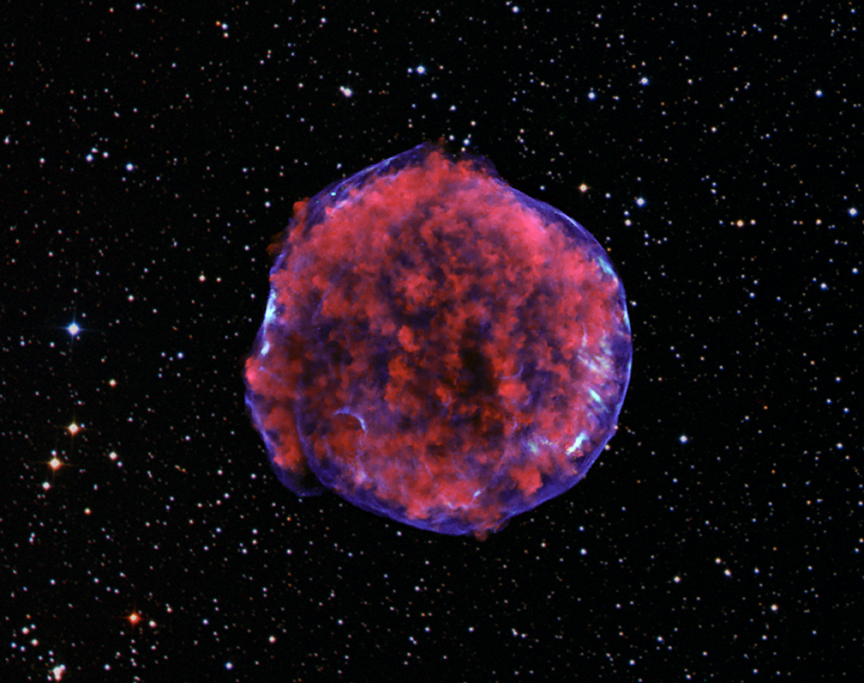
If you follow me on Twitter you may have figured out I’m otherwise occupied for right now, and have spotty internet access. But I happened to have a connection for a few minutes, and got a press release from the folks at Rutgers and the Chandra X-Ray Center about a supernova remnant, and the picture of this old exploded star was simply too cool not to share right away:

Pretty freaky, eh? [Click to ensupernovenate.]

The science involved is pretty interesting (see the Chandra page about it), but basically, this shows high-energy X-rays (in blue) and lower energy X-rays (in red) emitted by extremely hot gas in the supernova (the entire image is superposed on the correct background from the Digitized Sky Survey to show the positions of stars). This emission traces the magnetic fields in the gas (which is actually ionized and therefore a plasma), and this in turn has yielded some surprises for the scientists. Again read the page for the details, which are cool.

But in the meantime, the image itself gives an almost three-dimensional feel to the supernova remnant, doesn’t it? ...


Truth and the Oped Pages | The Intersection

I’ve got a new post up at DeSmogBlog, airing some of my outrage over this exchange in the Minneapolis Star Tribune. It’s between a climate denier and John Abraham, and while Abraham gets the better of things factually and intellectually (of course) I don’t think oped pages ought to be printing columns that, essentially, misinform:

A few posts back I highlighted new research suggesting that “on the one hand, on the other hand” coverage of fact-based political divides leaves citizens in a postmodern funk, uncertain what the truth is and whether they are capable of discerning it. It’s yet another reason why journalists have a responsibility to serve as arbiters of factual disputes—rather than thinking their job is done if they let one side say the sky is pink, but then provide a counter-quote from an expert saying that in fact it’s blue.

What goes for journalists ought to go for op-ed pages. While it might be more difficult to design a study to test the effect on readers of an exchange like that in the Star Tribune, I would guess it is the same—making them feel helpless about discerning where the truth lies.

You can read the full DeSmogBlog post here.


Islam, creationism, and anti-modernism | Gene Expression

The other day I was listening to NPR and they were discussing at length the upheavals in the Arab world. Offhand I noted how the discussants would occasionally shift between “the Arab world” and “the Muslim world,” and naturally they all took for granted the central role that Islam would play in the Egyptian polity (and likely the Libyan one). There was nothing shocking about any of this, but imagine you engaged in some substitution. Switching from “Western world” to “Christian world” would sound old-fashioned and anachronistic. The European Union famously omitted mention of Christianity in its constitution several years back, from which erupted a controversy between its more religious and secular member nations (e.g., Poland vs. France). Western societies may still have Christianity as the dominant religion, but in most cultures it does not have the same relationship to the broader culture that it once did.

This is in part due to some radicals on this continent. As outlined in The Godless Constitution the United States of America was founded with a federal government which did not operate under the explicit umbrella of a religious institution. Nor did that federal government engage in any subsidy toward religion. This was ...