Human population genetics & identity politics | Gene Expression

Joshua Lipson has a column up in the Harvard Political Review, DNA and the New Identity Politics. I’m generally very keen on spreading insights from the biological sciences into other domains; not as an imperialist, but as a intellectual entrepreneur. There are few assertions Joshua makes which I would quibble with in the details, but it’s a good sign that assertions are being made in the first place. Just don’t tell everyone!

Right now the new human population genomics is robust and informative in phylogeny. In terms of function, not so much. But that will probably change at some point. Lipson states:

Fortunately, this discipline of science has little to say about important social or psychological differences between ethnic groups and races: as a result, access to new information about the genetic landscape of humanity has not prompted a spooky stir of neo-eugenics….

There may come a time in the very near future where we’ll know more about how populations differ in terms of average psychological dispositions. I pointed to a simple reason for possible differences already this week. But perhaps in a more novel vein, how about how parents and siblings will relate to each ...

The genetic world in 3-D | Gene Expression

When Zack first mooted the idea of the Harappa Ancestry Project I had no idea what was coming down the pipe. I wonder if his daughter and wife are curious as to what’s happened to their computer! Since collecting the first wave of participants he’s been a result generating machine. Today he produced a fascinating three dimensional PCA (modifying Doug McDonald’s Javascript) using his “Reference 1″ data set. He rescaled the dimensions appropriately so that they reflect how much of the genetic variance they explain. The largest principal component of variance is naturally Africa vs. non-Africa, the second is west to east in Eurasia, and the third is a north to south Eurasian axis.

I decided to be a thief and take Zack’s Javascript and resize it a bit to fit the width of my blog, blow up the font size, as well as change the background color and aspects of positioning. All to suit my perverse taste. You see the classic “L” shaped distribution familiar from the two-dimensional plots, but observe the “pucker” in the third dimension of South Asian, and to a lesser extent Southeast Asian, populations.

The the topology of the first three independent dimensions of ...

Twins: Brazil edition | Gene Expression

A few years ago a story came out about a town populated by Germans in Brazil which exhibited a tendency toward twinning. The combination of Germans, Brazil, and twins, naturally meant that Josef Mengele came into the picture. A more prosaic explanation for the twinning, favored by locals, was that it was something environmental, like their water. The oddity warranted coverage by National Geographic, and you can imagine what the British press did with the story. At first I thought I saw references to elevated frequencies of identical (monozygotic) twins, which would have have been strange indeed. Twinning varies across populations and families, but that variance tends to be of the fraternal (dizygotic) variety. Some of this is heritable, but some of it is clearly due to environment. Specifically, nutritional inputs that increase levels of insulin-like growth factor, which is found in milk and meat (I suspect this explains the higher twinning rate in Northern Europe vis-a-vis Southern Europe). This doesn’t even go into other factors brought on by modernity, such as delayed childbearing and fertility technology.

But in any case, it turned out that the Brazilian twins were ...

NCBI ROFL: If I could date myself, I would. | Discoblog

How do I love thee? Let me count the Js: implicit egotism and interpersonal attraction.

“From the perspective of implicit egotism people should gravitate toward others who resemble them because similar others activate people’s positive, automatic associations about themselves. Four archival studies and 3 experiments supported this hypothesis. Studies 1-4 showed that people are disproportionately likely to marry others whose first or last names resemble their own. Studies 5-7 provided experimental support for implicit egotism. Participants were more attracted than usual to people (a) whose arbitrary experimental code numbers resembled their own birthday numbers, (b) whose surnames shared letters with their own surnames, and (c) whose jersey number had been paired, subliminally, with their own names. Discussion focuses on implications for implicit egotism, similarity, and interpersonal attraction.”

Photo: flickr/VJ_fliks

Related content:
Discoblog: NCBI ROFL: A rose by any other name: would it smell as sweet?
Discoblog: NCBI ROFL: What’s in a name? Part I: U.G.H. you’re going to D.I.E.
Discoblog: NCBI ROFL: What’s in a name? Part II: Why Kevin Kouzmanoff strikes out so much.
Discoblog: NCBI ROFL: Beauty week: ...


Busted | Cosmic Variance

Loyal reader Mandeep Gill points out that I wrote “prevarication” when I clearly meant “equivocation” in the consciousness post. It’s now corrected. Very annoying, as I do like to use words to mean what they’re supposed to mean. I think I have a pretty good track record with “begging the question.”

While I have your attention, fellow loyal reader Richard O’Connell points us to a poem relevant to that post: Robert Browning’s Caliban upon Setebos. It begins:

‘Will sprawl, now that the heat of day is best,
Flat on his belly in the pit’s much mire,
With elbows wide, fists clenched to prop his chin.
And, while he kicks both feet in the cool slush,
And feels about his spine small eft-things course,
Run in and out each arm, and make him laugh:

There’s a lot more.

Also! Flip Tanedo points out that Brian Hill’s transcription of Sidney Coleman’s lectures on quantum field theory have finally been LaTeXed (pdf). Thanks to Bryan Gin-ge Chen and Ting Yuan Sen for undertaking this thankless task. I took that course a couple years after the notes were made, and every student in the class had a photocopy. Yes, Sidney did gripe a bit that nobody laughed at his jokes any more because they had all read them in the notes.

That’s all I got right now. Just trying to lower the bar so our co-bloggers will be encouraged to contribute more frivolous posts.


Sex Increases Risk of Heart Attack by 2.7X—Significantly Less Than Its Fun Multiplier | Discoblog

There are certain things you’re not supposed to do during sex and having a heart attack is one of them. We’ve known for a while that bursts of moderate to intense physical activity—including sex—increase heart attack risk, but a few scientists have now put number on that risk. And especially for out-of-shape folks, the diagnosis doesn’t look good (unless you’re aiming for death by sex, of course).

Studying death and sex is a tricky subject: Scientists can’t just round up volunteers, watch them make love, and then note which ones die. So instead they analyzed data from 14 different studies to single out connections between sex, exercise, and the risk of cardiac death or heart attacks.

As the researchers wrote in the Journal of the American Medical Association, “Acute cardiac events were significantly associated with … sexual activity.” When exercising, you’re 3.5 times more likely to get a heart attack, and when having sex (or immediately after sex), you’re 2.7 times more likely.

The main take-home message is not that you should give up sex, but that you should get more regular exercise. That’s because they also discovered that your likelihood of ...


NASA wants smart high school kids | Bad Astronomy

NASA is looking for U.S. high school students to participate in their INSPIRES program: Interdisciplinary National Science Program Incorporating Research Experience. Students who get in will get access to all kinds of cool stuff:

The selected students and their parents will participate in an online learning community with opportunities to interact with peers, NASA engineers and scientists. The online community also provides appropriate grade-level educational activities, discussion boards and chat rooms for participants to gain exposure to careers and opportunities available at NASA.

That’s nice, but the real deal is this part:

Students selected for the program also will have the option to compete for unique grade-appropriate experiences during the summer of 2012 at NASA facilities and participating universities. The summer experience provides students with a hands-on opportunity to investigate education and careers in the STEM disciplines.

Man, I would’ve killed for that opportunity when I was in high school! So if you’re a teacher with some good students, a parent, or a high school kid yourself, check out the program. And if it looks good to you, apply! The deadline for applications is June 30.

Hey. Sometimes, it is ...


The shadow of the Emishi | Gene Expression

Randy McDonald just pointed me to a 2008 paper in AJHG, Japanese Population Structure, Based on SNP Genotypes from 7003 Individuals Compared to Other Ethnic Groups: Effects on Population-Based Association Studies. It speaks to an issue I brought up earlier in my post, Sons of the farmers, the story of Japan, which describes the ethnogenesis of the Japanese modern people from the Yayoi culture. The Yayoi presumably brought rice from the Asian mainland, probably from what is today southern Korea. But the Japanese islands were not uninhabited before this period. Japan was home to the Jomon culture, which has a rather storied history in the annals of archaeology. The Jomon seem to have been a predominantly hunter-gatherer population which was also sedentary, and engaged in the production of objects such as pottery which are normally associated with more advanced farming societies. I have a difficult time crediting the ~13,000 year period of continuous development which is attributed to the Jomon, but, it does seem likely that the period between 2,000 and 2,500 years before the present did mark a sharp cultural discontinuity in the ...

Scientists Use Bird-O-Vision to Learn Why Some Cuckoos Are Expert Counterfeiters | 80beats

What’s the News: The reproductive life of a cuckoo is both easy—it lays its eggs in others birds’ nests, and lets them feed the young—and difficult: cuckoos are involved in an “evolutionary arms race” with other birds, finds a new study. Even as cuckoos improve their counterfeiting skills—producing eggs that look more like others birds’—the host birds get better and better at identifying the forged eggs.

How the Heck:

Knowing that birds have four types of color-sensitive cone cells in their eyes, allowing them to see ultraviolet wavelengths, researchers used a spectroscope to measure the amount of light reflected from hundreds of cuckoo and host-bird eggs. They then fed this data into models to produce images showing how birds see the different types of eggs.
They discovered that while cuckoo and redstart eggs have a high degree of color overlap, cuckoo eggs targeted for dunnock nests did not.
Here’s the kicker: Redstarts and dunnocks don’t spot forgeries equally. Redstarts are more discerning of foreign eggs and readily kick out cuckoo forgeries, while the dumb dunnocks accept even the most mismatched eggs. So these findings suggest that cuckoos targeting redstarts evolved the ...


Nuclear power as the “shark attacks” of energy | Gene Expression


Image Credit: Stefan Kuhn

I was at a coffee shop recently and a SWPL couple (woman had dreads to boot!) a number of tables away were reading a newspaper, and the husband expressed worry about the Fukushima disaster. The wife responded that “now other people will understand how dangerous nuclear power is,” with a sage nod. They then launched into twenty minutes of loud righteous gibberish about chemicals (I had a hard time making sense of it, despite the fact that I learned a lot about chemicals in the past due to my biochemistry background). Because they’d irritated me I was curious and I tailed them as they left. Naturally they had driven to get coffee in a S.U.V. of some sort (albeit, a modestly sized one which looked like it was more outfitted for the outdoors’ activities common in the Pacific Northwest; they’d probably done their cost vs. benefit about those chemicals!).

In terms of radiation fears, I suspect that if more people just automatically knew the inverse-square law in relation to the drop off of its effects we’d be in a whole lot less ...

Crafting a Hubble galaxy in two minutes | Bad Astronomy

Have you ever wondered how those gorgeous Hubble pictures of distant cosmic objects are made?

Well, lucky you! My old pal Tiffany Borders alerted me to a video she and some other folks at the Space Telescope Science Institute put together. It’s a delightful whirlwind tour of how they go from digital data to stunning shots, using screenshots tied together into a two-minute frenetic animation:

How cool is that? I’ll note that when astronomers actually do science with the images, they use the raw data which is processed very carefully to maintain the data’s integrity. The beautiful pictures made the way shown in the video are for show… but I’ve found that they can help guide the eye to features you might miss in the individual images, too. So this isn’t just Photoshop trickery!

The galaxy in the video is the spectacular spiral NGC 3982, which I described in a little more detail when this image came out last year. Coincidentally, in that post I focused more on how the image was constructed than the science in it (though I have links there ...


The Radio Spectrum | Cosmic Variance

At every point in space, there is something we call the “electric field.” It’s a tiny vector, a quantity with a magnitude and a direction. If you want to measure it, just put an electron at rest at that point, and watch it start moving. The direction and size of its acceleration (over and above what we get from gravity) is proportional to the electric field. Typically, if you watch closely enough, you’ll see our little electron jiggle back and forth like mad. That’s because the electric field doesn’t just sit there; we are surrounded by an extraordinary superposition of all kinds of electromagnetic waves, pushing by us with different amplitudes and directions and frequencies. If you build the right type of gizmo with an appropriate collection of electrons, you can pick out just a single wavelength from amidst the cacophony. Voila! You are listening in on the electromagnetic spectrum.

In the modern world, there are an awful lot of devices out there communicating by shooting electromagnetic waves at each other. In particular in the radio frequency range (roughly between 10 kHz and 300 GHz), which has the nice property that its waves aren’t blocked by annoying things like walls or air. This means that everyone building such devices wants to produce waves at some part of the spectrum, and that in turn means that the right to do so is an extraordinarily valuable commodity. In the US, the Federal Communications Commission gets to decide who can do what at various different radio frequencies.

This state of affairs has come into the news once again, as wireless carrier AT&T has swallowed competitor T-Mobile; many people would be unsurprised if Verizon counters by swallowing Sprint, leaving us with a duopoly and possibly giving consumers the squeeze. Currently big chunk of spectrum is allocated to broadcast TV, which some are arguing is a waste, since you could stick a lot of mobile data devices in there and everyone has cable anyway.

All very fascinating, but somewhat over my head. I’m more of a theoretical kind of guy. I just wanted an excuse to link to this gorgeous chart (pdf), showing how the spectrum is currently allocated.

Click for much bigger and more legible pdf version. There’s a lot going on here; see the zoom-in of a tiny region near 30 GHz:

Nice to see that there is space carved out for scientific research, including radio astronomy. Those jiggling electrons have a lot of work to do, let’s hope they can keep everything straight.


Nerve Cells Reach Out and Touch Someone: Electronic Components | 80beats

What’s the News: Scientists have discovered a new technique for linking semiconducting tubes with mouse nerve cell tendrils: They let the cells do the work for them. After creating biologically friendly semiconductor tubes, they found that nerve cells’ tendril-like axons didn’t shy away. “They seem to like the tubes,” University of Wisconsin-Madison biomedical engineer Justin Williams told Science News. This represents a step toward new technology involving computer-brain networks.

How the Heck: The trick was to create tubes of layered germanium and silicone (which insulate the nerve’s electrical signals) that were big enough for the nerve cell’s threadlike projections to enter but too small for the cell body: When seeded with live mouse nerve cells, the only way the cells could interact with the tubes was be sending tendrils into it—which is just what they did.

What’s the Context:

This research builds upon some work done in previous studies, where researchers actively connected nerves to semiconductors.
Science Not Fiction and 80beats have covered other methods of connecting neurons and electronics.
Which shouldn’t be confused with the development of a brain-like chip. Or the ...


Lawrence Krauss’s Feynman Biography Now Available | The Intersection

I just did a fun interview with Lawrence Krauss for Point of Inquiry–airing Monday–and to prepare, I got to read his new scientific biography of Richard Feynman, Quantum Man.

Being a non-physics wonk, I can’t say that I fully understood *everything* that Feynman accomplished, but that didn’t make the book any less illuminating in its depiction of this fascinating, and brilliant, scientific character.

It’s not that no one has written on Feynman before–it’s just that having a top physicist do a scientific biography of Feynman’s accomplishments is something pretty unique.

In advance of the show, then, I want to recommend the book–it just went on sale this week. Check it out here.


Is that a double helix round your neck or are you just pleased to see me? | Not Exactly Rocket Science

In which we take a break from our regularly scheduled programming to celebrate… a scarf. At first glance, it looks like an ordinary strip of black and grey wool, but if you look down its length, an iconic hidden pattern emerges (see below).

Yes, thanks to this present from my awesome friend Alice Bell, I now get to wind an illusory double helix around my neck. There’s probably a joke about histones to be made.

The DNA illusion scarf is Alice’s own design (video here). In her own words:

DNA and illusion knitting seemed to be made for one another. The ladders of the striping pattern twist round those of the helix as purls and knit-stitches collect to display a regular shape. I also like that you have know how to look at the scarf to really see the pattern. There’s an “OH!” moment when you spot it. Symbolic of the science it reflects, the pattern isn’t self-evident.

If you’re not already doing so, you can and should read Alice’s sharp musings on science communication at Through the Looking Glass, and on knitting at Slipped Stitch

<img class="aligncenter size-full wp-image-4151"

WISE shuts its eye | Bad Astronomy

One of my favorite space astronomy missions, WISE, has shut its eye for the last time.

This wasn’t unexpected, though! The Wide-field Infrared Survey Explorer was meant to be a short mission, mapping the sky in far-infrared light for a year or so. It needed coolant to chill its detectors, and that ran out last year. On February 1, 2011, it took this one, final image:

[Click to infrareddenate.]

That’s a shot of the constellation Perseus, which is along the plane of the Milky Way Galaxy and is thus littered with stars and dust. It’s very much like millions of other images WISE took in its time in space. Below are links to some of my favorite images from WISE, and you really should take a look. They are eerily beautiful, and tell us a lot about the Universe that our eyes cannot perceive.

My congratulations to all my friends at WISE on an amazingly successful mission!

Image Credit: NASA/JPL-Caltech/UCLA

Related posts:

- Shocking star is shocking. Shocking, I say!
- In galactic collisions, might makes right
- A WISE view of a small neighbor
-

Genetic paternalism & the F.D.A. | Gene Expression

It’s been over a week since I’ve addressed the “F.D.A. D.T.C.” controversy. I plan on getting back to the issue in more detail later, but right now I thought I’d point you to Robert Verbruggen’s article in National Review. It’s titled ‘The FDA’s Genetic Paternalism’. Robert contacted me for my take on the issue, and you get a few choice quotes from yours truly. It being National Review you can guess the general tenor of the objections from that quarter. Over the past few weeks tracking inbound links and Twitter mentions it does look as if the coming possible restrictions on direct-to-consumer personal genomics have triggered more suspicion and opposition from the political Right. Even with that said, my friends Michelle and Zack, who I think are accurately characterized as on the political Left, also both expressed great reservations about the thrust of Jeffrey Shuren’s comments. Nor do I think that the Genomes Unzipped crowd are all Right-libertarians. Even those who assert the need for regulation and some intermediation between genomic results and the patient/consumer are unhappy with the way the government and some pro-regulation activists have been approaching the matter.

Overall ...

A giraffe’s shocking neck | Bad Astronomy

NASA’s Wide-field Infrared Survey Explorer took its last image of the sky in February, 2011. But while it was active it surveyed the entire sky several times in the far infrared, so its data archive is a vast treasure trove just waiting to be dug into (hmmm, I should try to squeeze another metaphor into there).

Anyway, lookee what the astronomers found:

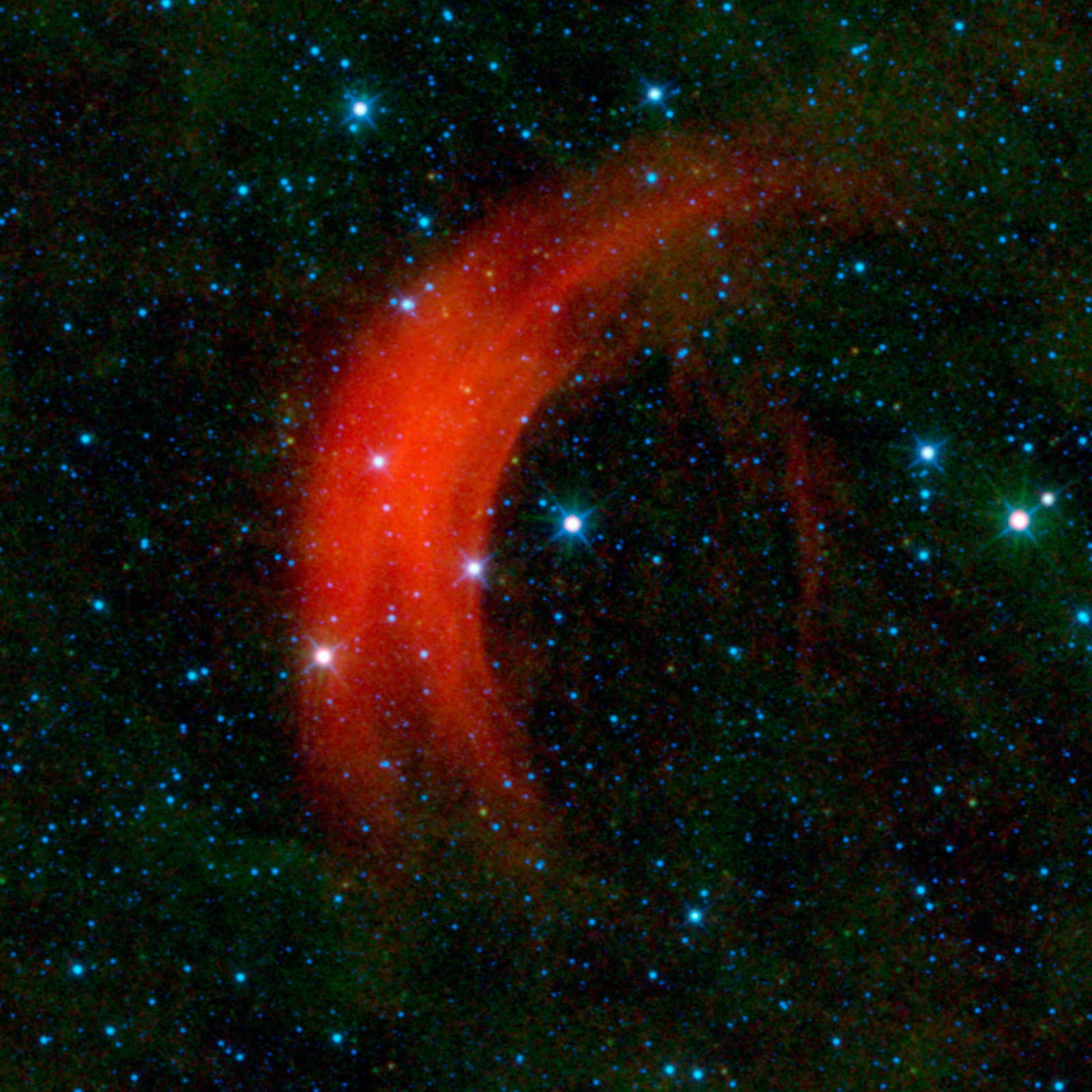
Cooool. Literally! That’s dust surrounding the star Alpha Camelopardalis, what appears as a fairly non-descript star in a faint, non-descript constellation. At least, to the eye. When seen in the IR, you get this shocking view. Also literally.

Alpha Cam is a massive, luminous star: 50 times as hefty as our Sun, and blasting out perhaps a million times as much energy. But it’s far away (3000 light years, maybe, the distance is not well-known) and behind a lot of dust, dimming our view. It’s barreling through space at a pretty good clip, and emitting a wind of subatomic particles as it does. This wind expands, slams into the surrounding dust, and sculpting it into this giant bow shock formation.

In this false color ...


Guest posts @ Sepia Mutiny | Gene Expression

Since it doesn’t show up in my total content aggregator (RSS), and I don’t know how to author filter Movable Type posts easily, I thought I would point to my guest posts over at the Sepia Mutiny weblog:

Speaking of a demonstration in Pakistan….

The decline of Hindi among American brown folk

A civilization of regions

Do that Guju you do!

The undersampled 1 billion (genetically that is)

If you don’t know about the blog, here’s the Wikipedia entry. I’ve been commenting on that site since its inception in the summer of 2004, as two friends were co-founders.

Addendum: I push all the stuff in my total content aggregator to my twitter account, Gene Expression Facebook page (though this includes GNXP.com posts not by me), and my Facebook page. I’ve also got a NetworkedBlogs page which you can subscribe to or something. Probably other things I’ve forgotten about to be honest (e.g., here’s my Talk Islam author page. Don’t contribute there anymore). Also, I should mention that Razib on Books has its own domain, razibkhanbooks.com. Everything posted there is pushed into the total content aggregator, and the “posts” will ...