The Human Lake | The Loom

I went recently to San Francisco to give a talk to a conference of scientists. The scientists were experts in gathering together mountains of biological data—genome sequences, results of experiments and clinical trials—and figuring out how to make them useful: turning them into new diagnostic tests, for example, or a drug for cancer. The invitation was an honor, but a nerve-wracking one. As a journalist, I had no genome scan to offer the audience.

We science writers do have one ace in the hole, though. Instead of being lashed to a lab bench for years, carrying out experiments to illuminate one particular fold in one particular protein, we get to play the field. We travel between different departments, different universities, different countries, and—most important of all—different disciplines. And sometimes we see links between different kinds of science that scientists themselves have missed. Which is why, when I arrived in San Francisco, walked up to the podium, and switched on my computer, I presented my audience with this photograph of a lake.

For the next hour, I tried to convince them that their bodies are a lot like that lake, and ...

The Earth’s lumpy gravity | Bad Astronomy

Most people think of the Earth as being a sphere. For most purposes that’s close enough, but it’s actually a spheroid, something close to but not precisely a perfect sphere. It bulges in the middle (as so many of us do) due to its spin, the Moon’s gravity warps it, the continents and oceans distort the shape. And the surface gravity changes with all this too; it’s different on top of the highest mountain, for example, compared to its strength in Death Valley.

So if you could map out the average shape of the Earth’s gravity, a shape where the gravity is the same no matter where you stood on it, what would it look like?

It would look like this:

That is a (somewhat exaggerated for easy viewing) map of the Earth’s geoid, produced by the European Space Agency’s GOCE satellite. A good way to think of the geoid is the shape a global ocean would take if it were governed only by gravity, and not currents or tides or anything else. If the Earth’s gravity were a little stronger in one place, water would flow toward it, and if it were weaker water would ...


How Much Does Your Phone Company Know About Your Life? | Cosmic Variance

Let’s just round up and say “everything.” In Germany they are currently debating rules on what data companies can keep and analyze, vs. what they must throw away. To make a point, Green Party politician Malte Spitz went to court to force Deutsche Telekom to share the data they had collected about him, just from his mobile phone. What is revealed, basically, is where he was essentially at every moment of the day. Spitz handed the information over to Zeit Online, who combined it with information he revealed himself via Twitter and his blog, to make a scarily detailed chronological map of his daily activities. (Via FlowingData.com.)

Check it out, they have a great animated reconstruction of Spitz’s daily movings, combined with a sidebar display saying how many phone conversations he was having and how many text messages. There’s even a spreadsheet so you can play with the data yourself if you are so inclined. They removed the actual phone numbers with which he was communicating, but of course the phone company has those.

People can decide for themselves whether this is intrusive or benign; more than a few people put nearly as much information online anyway, without thinking twice. But you should know that it’s out there.


Watch the House Climate Science Fight Now! | The Intersection

They’re streaming live from the Science Committee right now….MIT’s Kerry Emanuel is the scientist on the panel who will be defending the mainstream scientific view that it’s warming out there, thanks to homo sapiens. Several other witnesses are far more “skeptical.”

My take on the hearing is here. Short quote:

This sort of thing has been going on in the US Congress for a long time—for over a decade. So in a sense, one more doubt-mongering hearing doesn’t move the cultural confusion needle much.

The real problem, for me, is that our culture’s outrage meter seems similarly calibrated.

P.S. John Christy just said “hide the decline.” Heh heh.

P.P.S.: Kerry Emanuel really laid down the gauntlet on the non-scandal of “ClimateGate,” and also on the poor process that Congress is engaged in when it makes “mascots of mavericks,” as Emanuel put it–with some nice alliteration.


The Public is “Scientifically Illiterate.” But Do Scientists Have “Public Literacy”? | The Intersection

Sociologist Barry Glassner, the president of Lewis & Clark College in Portland, agrees with my “Do Scientists Understand the Public” paper, written for the American Academy of Arts and Sciences. Writing in USA Today recently, Glassner argued that

Were hard data and cold logic all that mattered, any number of common personal behaviors would be long gone by now, from smoking to overeating. As any skilled public relations practitioner will attest, successful communication meets people on their own turf — by means that address emotions, fears and values.

I do not mean to suggest that scientists transform themselves into Don Draper-style Mad Men and embark on a course of Madison Avenue-style spin. But scientists who want members of the public to better understand their work ought to start by understanding them.

Glassner, certainly, is not so, um, ignorant as to think that public ignorance is the problem. Instead, he calls for scientists to invest in “public literacy”:

Scientists and their advocates need to become more knowledgeable about how people come to their beliefs — who they rely on for scientific information, what they hear, and through which filters they hear it.

Amen to that. It is not like scientific information travels in a vacuum, after all. It travels through minds and through media, both of which can have quite the distorting effect.

Thankfully, the new trend in the scientific community today is to understand these problems of information transmission and translation–encoding and decoding, as a communications nerd might put it–rather than acting as though they don’t matter.

They most emphatically do.


Pocket Science – wasps airlift ants away from food | Not Exactly Rocket Science

It’s not a very fair fight. In one corner is a tiny ant. In the other is a large wasp, two hundred times heavier and capable of flying. If the two of them compete for the same piece of food, there ought to be no contest. But sometimes the wasp doesn’t even give the ant the honour of stepping into the ring. It picks up the smaller insect in its jaws, flies it to a distant site and drops it from a height, dazed but unharmed.

Julien Grangier and Philip Lester observed these ignominious defeats by pitting native New Zealand ants (Prolasius advenus) against the common wasp (Vespula vulgaris). The insects competed over open cans of tuna while the scientists filmed them.

Their videos revealed that ants would sometimes aggressively defend their food by rushing, biting and spraying them with acid. But typically, they were docile and tolerated the competing wasp. Generally, the wasp was similarly passive but on occasion, it picked up the offending ant and dropped it several centimetres away. In human terms, this would be like being catapulted half the length of a football field.

The wasps ...

When beauty and science collide | Bad Astronomy

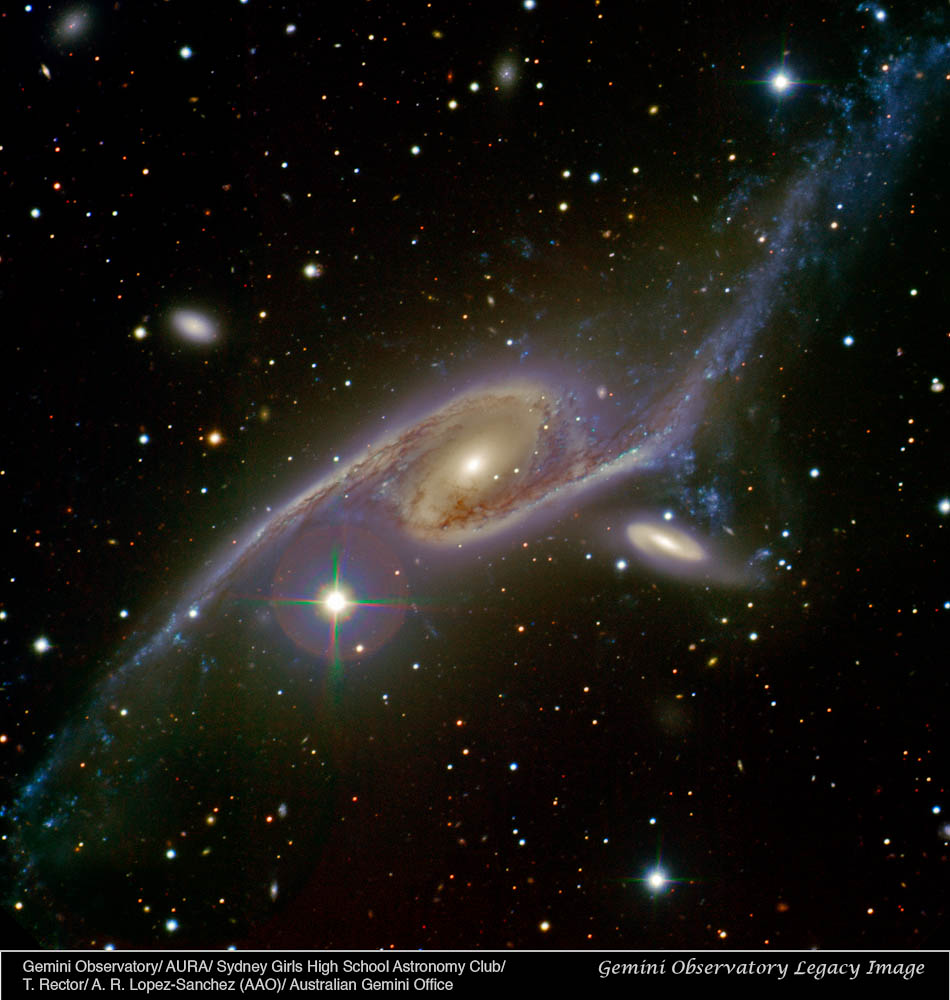
I’ve been posting a lot of nice astronomical images lately, but sometimes one comes along and blows me completely away. How fantastically gorgeous is this?

Holy Haleakala! [Click to galactinate.]

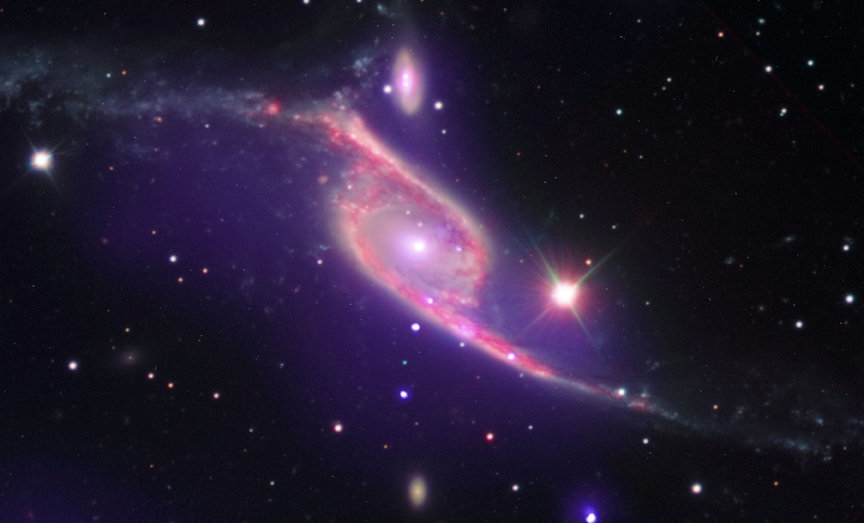
That spiral galaxy is NGC 6872, and as you can see in this image from the Gemini South telescope it’s getting its clock cleaned by the littler spiral — IC 4970 — just to the right. The two are undergoing a galactic collision, a colossal event playing out over hundreds of millions of years. NGC 6872 is currently the victim here; its spiral arms are clearly distorted and being flung wide by the gravitational interaction. However, the smaller IC 4970 will be the ultimate loser in this battle: it will fall into the bigger galaxy, be torn apart, and eventually consumed in its entirety, becoming a part of NGC 6872. Bigger galaxies do this to smaller ones all the time; the Milky Way is in the process of eating several small galaxies even as you read this (I have details in articles linked below; see Related Posts).


A History of Comet Collisions Is Inscribed in Saturn & Jupiter’s Rings | 80beats

What’s the News: Looking at images of odd undulations in the rings of Saturn and Jupiter, astronomers have discovered that comets are to blame. The finding means that a planet’s rings act as a historical record of passing comets, possibly leading to a better understanding of comet populations. “We now know that collisions into the rings are very common—a few times per decade for Jupiter and a few times per century for Saturn,” Mark Showalter, from the SETI Institute in Mountain View, California, told the Daily Mail. “Now scientists know that the rings record these impacts like grooves in a vinyl record, and we can play back their history later.”

How the Heck:

When a comet passes by the rings of a planet, its high-speed debris impacts the ring material and “changes the inclination of the particles’ orbits,” Bad Astronomer Phil Plait told me. “It’s like a cosmic shotgun blast.”
With the ring particles knocked out of alignment, they bob up and down as they orbit the planets—a phenomenon that looks in telescope images (see animation above) like ripples in a pond or corrugated metal.
The particles undulate up and down as they slowly gradually come back ...


The Genetical Theory of Natural Selection, free! | Gene Expression

Long time readers are aware that one of my favorite books is R. A. Fisher’s The Genetical Theory of Natural Selection. It’s a touch on the spendy side for a slim, though dense, book. But looking for stuff that’s public domain for my Kindle I noticed that you can get the 1930 version free. And it’s not just in Kindle formats, you can get it in PDF as well and read it on your computer. I think of TGTNG as somewhat like the Critique of Pure Reason of evolutionary genetics; even if your inclination is to rubbish it, it’s an importance place to begin.

A New, Effective Treatment for Restless Leg Syndrome: Masturbation | Discoblog

Spasms. Burning sensations. Sleep deprivation. To those suffering with restless leg syndrome (RLS), these are nightly afflictions. New research suggests that orgasm by masturbation may be a great way to treat the condition.

RLS is a neurological disorder that afflicts upwards of 10% of people in the U.S. and Europe: As RLS-sufferers try to sleep, their legs experience burning, tickling, aching, and itching sensations; these uncomfortable feelings build up until the leg spasms out of control. This cycle repeats throughout the night, writes news.com.au Technology Editor Peter Farquhar, and “it’s not unusual for people who suffer RLS … to describe it as torturous.”

So why do some people’s legs do this? According to the NIH, “in most cases, the cause of RLS is unknown,” though “it may have a genetic component.” Nevertheless, experts do have some inkling of the cause, as the NIH reports on their website:

Considerable evidence suggests that RLS is related to a dysfunction in the brain’s basal ganglia circuits that use the neurotransmitter ...


YAY! It’s A Riddle!

UPDATE:  SOLVED by Dwight at 12:41 CDT

I cannot believe it’s already Saturday.  I’m still working on Monday.  I tell you what; the hurrider I go, the behinder I get.  We’re already here at a new riddle, and I still owe a post on the LAST riddle.  Ever have weeks like that?  I try to take one day at a time, but sometimes several days attack me at once.  This whole week has been that way.  Don’t give up on me, Jerry.  I’m still working on your post.

Moving right along, I have a nice little riddle for you this week.  You’ll be looking for an object found in the real world…

Really cool image from Till Credner, http://www.AllTheSky.com

…of course, it also figures prominently in fiction.

While today’s object was known to our ancestors, it has a close companion which was only discovered in the 19th century.

In addition to its place in fiction, this object was a star with ancient cultures, too.  You could say it was royalty.

The Fallen Angel by Ricardo Bellver - 1877. Displayed at the Paris Exposition, 1878 -- image by Alvaro Ibanez

Today’s object gets its name as a comparison to something with which it has very little in common.

You’ll find this object’s hauntingly beautiful name attached to many things in modern life, not the least of which are some honking big boats and a heavy metal band.

This thing is located in our neighborhood, but it’s commonly mistaken for something in our back yard.

Image found on PhotoBucket- posted by Zaramire

Beautiful as it may be, astronomers expect this object to really put on a show anytime in the immediate or near (or relatively near) future.

It is rumored that Clark Kent has a connection to this object.

Ni-i-i-i-i-i-i-ice

What do you think?  Ready to jump right in with the answer?  Well, you know where to find me… all alone… waiting for someone to come talk to me…  Anyway, you know very well I shouldn’t be left alone and unsupervised.


It's called "karma"

I’ve got your missing links right here (2 April 2011) | Not Exactly Rocket Science

Egyptian cobra by Michael Ransburg

Top twelve picks

This, my friends, is how it’s done. Carl Zimmer on “The Human Lake“. If you read one post this month…

Inspired. Craig McClain draws parallels between a 1st century Germanic chieftain and a baby coral

I loved the Bronx Zoo Cobra story. It was a wonderful break from a month of depressing news. I loved this line: “The case of the missing [cobra] has yielded much interest… What It has not yielded is the snake.” I loved the @Bronxzooscobra Twitter feed, and the @Bronxcobrawife one too. I loved the exclusive interview in the NYT.

An amazing story that starts with an egg sandwich, continues with a weird bag of blue powder, and ends with mass radiation poisoning. By Sally Adee

A touching look at the people on Fukushima’s frontline. “My town is gone… My parents are still missing… I still have to work…”

Mark Peplow of Nature News visits Chernobyl. What lessons does it hold for Fukushima?

Unbeleafable! Scientists create artificial leaf, 10x more efficient than the real deal.

Bugs vs drugs: Maryn McKenna, writing about ...

Ingenious Geological Sleuthing Reveals the Shapes of Ancient Mountains | 80beats

Fiordland National Park
Fiordland National Park in New Zealand, the location of the study

What’s the News: Researchers have mapped out the detailed geological history of a 300-square-mile chunk of New Zealand, from 2.5 million years ago to the present day. The study showed how glaciers carved out the area’s distinctive valleys using a little-known technique called thermochronometry, which involves shooting proton beams onto rocks and making note of what happens—along with some impressive analytical skills.

How the Heck: Thermochronometry, as the name implies, is a way to measure both temperature and time. The general principle is that the deeper something is below the Earth’s surface, the warmer it is; thus, tracking a rock’s temperature over millions of years reveals how deep the rock was as it cooled.

This study used a particular version of the method called helium-4/helium-3 thermochronometry, first developed by a member of the research team in 2005. This technique lets you track the time and temperature for apatite, a mineral found in rocks like granite that solidify from liquid magma far beneath the surface. Two chemical elements in apatite—uranium and thorium—are radioactive. As they decay over millions of years, ...


Has Birtherism Evolved? | The Intersection

Donald Trump isn’t stupid. And Donald Trump is a birther–at least of the “I have doubts” variety. Writes David Wiegel at Slate:

Trump—whose campaign may qualify as a massive, “I’m Still Here” publicity stunt—is responsible for the sudden acceptability of the question. On The View, he reminded viewers that he went to “the best schools,” so he knew that documents are forged all the time, and he didn’t trust what he’d heard about Obama. Even after Tuesday, when he finally released a scan of his 1946 birth certificate to ABC News, that claim hung in the air. It echoed what some birthers still say; it gave them wider uncritical media exposure than they’d gotten since Lou Dobbs left CNN.

One reason Trump has been able to do this is that two schools of birtherism have developed since 2008, and one of them has become a surprisingly comfortable place for conservatives to lounge. There have always been Orthodox Birthers. They start with the belief that Obama cannot be eligible for the presidency. They trust evidence they find online—an erroneous report about “Obama’s grandmother” saying he was born in Kenya, for example—which stays online forever, just like amateur diagnostic reports of how crashing planes couldn’t possibly have brought down the Twin Towers. If that evidence is challenged, they look to theories about what the founders thought “natural born citizenship” meant. Phil Berg, the attorney who filed the first birther lawsuits and who held a “March on Washington” in 2010, says Obama lost his citizenship because a school form from Indonesia calls him Indonesian. Another theory says Obama can’t be president because his father was Kenyan and that made his son a British citizen by default. (This theory would disqualify Trump, whose mother was Scottish.)

What Trump is embracing, and Corsi is selling, is Reform Birtherism. It’s deductive. “There’s something on that birth certificate that he doesn’t like,” said Trump last week. “I don’t know what is on the document,” said Corsi in 2009. The truth is unknowable, because Obama is hiding something about his birth documents.

I think it may be too rational to judge the two forms of birtherism as truly distinct. At bottom, both “start with a belief” and then come up with arguments to make the belief sound most plausible. From the outside, a new set of arguments may look like goalpost shifting–but to birthers, it will seem like nothing of the kind. Those new arguments will just further reinforce their preconceptions.

If anything, what I suspect is happening here is that smarter birthers like Trump–those more conversant with the respectable boundaries of mainstream political discourse–will tend to make more sophisticated arguments, and make them more convincingly. With birtherism–as is often the case–the more sophisticated arguments tend to be doubt mongering arguments.

But it’s still a belief system, just one with smoother, slicker advocates–not unlike the transition from young-Earth creationism to intelligent design.


Trolling the Moon | Bad Astronomy

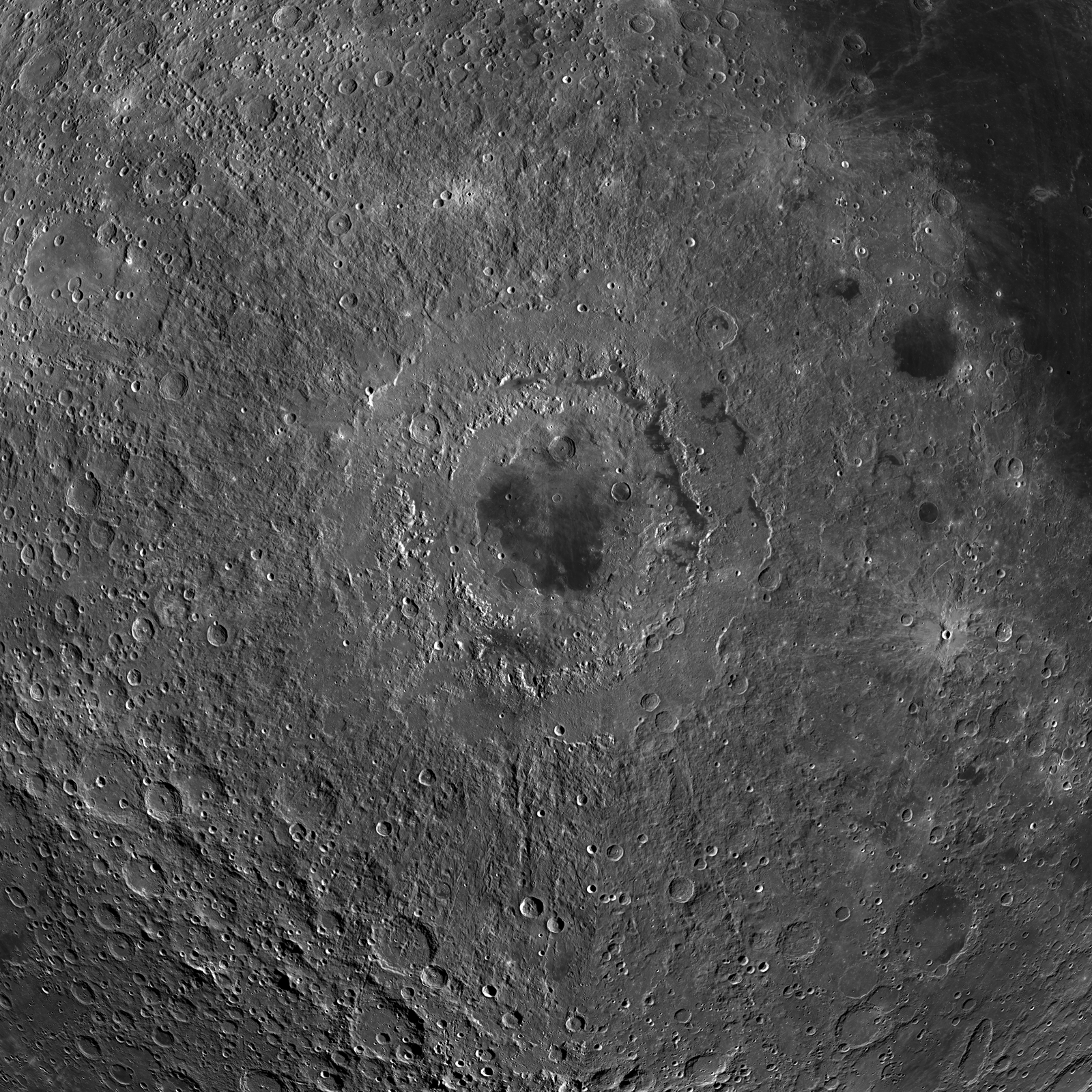
A long time ago, something really, really, really BIG hit the Moon. Hard. The explosion was huge beyond human grasp, and when it was all done, the hole it left on the Moon was 900 km (600 miles) across!

Behold, Mare Orientale:

This image was taken by the Lunar Reconnaissance Orbiter’s Wide Angle Camera, and shows the entire basin. It’s located just over the edge of the Moon as seen from Earth, so we can only get hints of it when we look from home. LRO can see it in all its neck-hair-raising glory.

See all those radial features emanating outward from it? Those are crater chains: secondary impact events as huge chunks of debris hundreds of meters or even kilometers across were thrown hundreds of kilometers away by the force of the impact!

Yegads. You can see these better in an interactive pan-and-scan image that allows you to zoom in to scales of 100 meters per pixel. It’s incredible.

But looking at the central part itself, I got a funny familiar feeling. I read reddit, after all. Was the Moon… trolling us?


Looking Down The Barrel Of A Loaded Gun?

In 1867, two astronomers working with the 40 cm Foucault telescope at the Paris observatory discovered three new stars in the constellation Cygnus.  These stars were showing emission bands along the spectrum where they were “supposed to be” showing absorption bands.  The astronomers were Charles Wolf and Georges Rayet, and they had found an enigma which they named Wolf-Rayet stars.

NASA/JPL Cal-Tech the Baby Boom Galaxy, known as a Wolf-Rayet Galaxy due to its massive activity

Now, very quickly; Wolf-Rayet stars are not a type of star so much as the evolutionary stage of a type of star.  Did that make sense?  The type of star likely to evolve into a Wolf-Rayet must have a mass in excess of 20 solar, stellar winds in speeds up to 2,000 km/s, and be very hot — surface temperatures in the neighborhood of 25,000 K to 50,000  K.  Wolf-Rayet stars have the potential to supernova to a black hole, releasing gamma ray bursts from their poles in the process.

Wolf-Rayet 104 diagram, Dr. Peter Tuthill, University of Sydney, School of Physics

That takes care of the background, now enter Wolf-Rayet 104.  Discovered in 1998, WR104 is a dynamic binary system about 8,000 ly from Earth.  As the Wolf-Rayet star spins around its class OB companion it releases matter into the interstellar medium, giving it one of its nicknames:  A smoking chimney.

NASA/Kepler Dr. Peter Tuthill, University of Sydney

WR104 is extremely luminous.  A side-by-side comparison of WR104 to Sol is about the same as a side-by-side comparison of Sol and Luna.

When you look at the Keck images of WR104, you are looking down on one of its poles watching matter get flung away into that spiral shape, like looking down on a water sprinkler.  That’s really cool, except for one small detail:  Wolf-Rayet stars tend to produce gamma ray bursts when they collapse down into black holes, and gamma ray bursts (GRB) are emitted from the poles.

Hmmmmm.

James Bond as portrayed by Pierce Brosnan

As you can imagine, a lot of astronomers are looking at WR104.  More intensive studies seem to indicate that we aren’t going to be “spot on”, but off as much as 16 degrees.  That helps, but those same studies are showing WR104 may be as close as 5,000 ly.

Hmmmmm.

Whatever happens, WR104 and its massive companion are going to supernova, and soon (astronomically speaking).  Were it to form a gamma ray burst when it happens, and were the Earth right in its sights, that’s the end of the story.  We’ve talked about GRBs before.

Now, if we’re NOT right on the bull’s eye but far enough away to stay safe, that would be some kind of cosmic event… and we would have front row seats.  Whichever, WR104 has all the mystery, suspense, and action of an “A-List” thriller.

Got that popcorn ready?

I Love a Parade . . .

Ok maybe it’s not a parade. Still it’s good stuff even if at least some of these people are about to collect unemployment. It appears the “hope and change” is working, just not like some thought it would. Ah well, you know the old saying: be careful what you wish for.  :mrgreen:


Click here to view the embedded video.


This time-lapse video shows employees at NASA’s Kennedy Space Center, Fla., taking a few moments to assemble for a historic aerial photo outside the Vehicle Assembly Building. Thousands of workers stood side-by-side to form an outline of a space shuttle. The event was organized in honor of the Space Shuttle Program’s 30-year legacy.

Video

Know What This Is?

Starfield from Dawn, 21 Mar 11. Image credit: NASA/JPL-Caltech/UCLA/MPS/DLR/IDA


It’s a starfield! This is a great picture and was taken by the Dawn spacecraft’s framing camera.  The camera was powered up for a test after a six month hibernation along with some of the other instruments on board.

Back to trying to find this view on my planetarium software, easier said than done with no targeting data.  Actually if you’ve ever done the matching thing, it can be very challenging even when you know the area.

Oh, if you have a planetarium program or better yet your own pictures of starfields and want to try mapping them out OR you just want to see targeted parts of the sky or objects like M57 say, give The Aladin Sky Atlas a try (I use the JAVA applet on the right), you will find the manual useful.  Note: you may get a security certificate notice, always have, probably always will, I’ve never had a problem and I’ve been going there for years.   Also this is for deep sky objects so stick to galaxies, nebulae and the like.