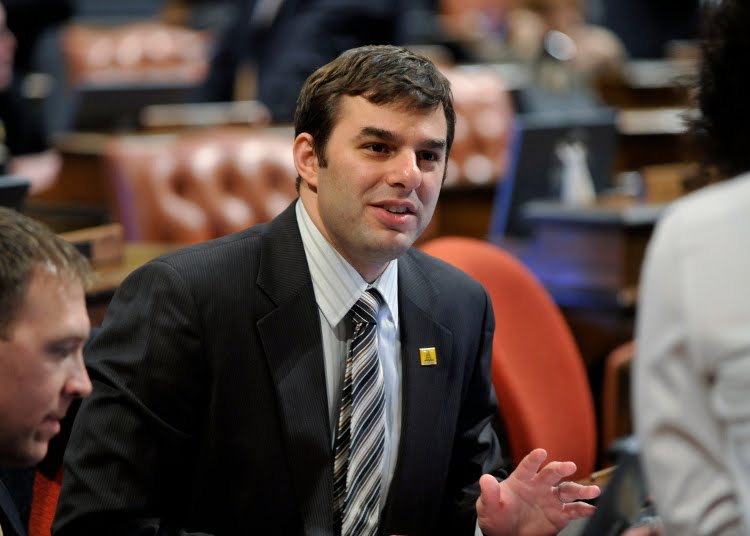
Libertarian Republican takes lead in Michigan CD 3

Opponents say he's a "libertarian ideologue"

From Eric Dondero:

Justin Amash is a young first-term State Legislator representing a Western Michigan district. A son or immigrant parents, Amash is of Christian Lebanese descent. He is a friend of Libertarian Republican former State Rep. Leon Drolet and a frequent attendee of meetings of the Michigan Republican Liberty Caucus. He is also an active Tea Partyer, and Tax Fighter, involved with the Michigan Tea Party Alliance, and the MI Taxpayer's Association.

Amash is a Pro-Defense Libertarian. From his website:

The full force of our armed forces should be unleashed when presented with genuine threats to our safety, such as active foreign aggression or invasion... I share former President George W. Bush's vision... Israel's borders must be secure, recognized, and defensible...

Amash has been one of several candidates battling for the top spot on the Republican side for the seat of retiring Congressman Vern Ehlers. Now in a welcome development for the Libertarian Republican movement, Amash has pulled slightly ahead.

From MLive.com, Aug. 1:

Upstart Justin Amash builds support in outlying areas of 3rd Congressional District but remains within reach of rivals, Press poll shows State Rep. Justin Amash has opened a small lead over his two chief rivals in the 3rd Congressional District Republican primary, a Press poll finds.

The Cascade Township Republican is favored by 28 percent, followed by state Sen. Bill Hardiman at 23 percent and former Kent County Commission chairman Steve Heacock at 17 percent, according to the poll by Practical Political Consulting.

"An independent-minded Conservative"

Amash is being supported with TV ads by the economic libertarian group Club for Growth. He also has backing from the powerful economic libertarian DeVos family of Michigan. Continuing:

Amash could counter with endorsements from Amway co-founder Richard DeVos and GOP power couple Dick and Betsy DeVos.

But Amash is perhaps betting more he can best ride this year’s tide of voter unrest, appealing to tea party types and independents.

Hardiman and Heacock have chipped away at Amash as a libertarian ideologue who would be a poor representative.

They point to Amash’s “no” votes on bills that toughened penalties for human trafficking, that would have prevented utilities from shutting off power to elderly customers and that allow military personnel who are deployed overseas to get out of their cell phone contracts.

Amash responded by calling himself “an independent-minded conservative.”

National LP: On Civil Liberties, Obama is Worse than Bush

By Wes Benedict, National Libertarian Party Executive Director
Last week it was reported that the Obama Administration wants to give the FBI power to force internet companies to reveal information about their users’ internet activities: things like who they send email to, times and dates of emails, and maybe also information about [...]

Why This Libertarian Supports the Indy Water Transfer

By Matt Wittlief
This past Monday, the City-County Council voted to approve the transfer of water and wastewater utilities to Citizen’s Energy Group. The deal is very complex and convoluted – perhaps by design, perhaps by necessity. My opinions on the deal have varied, but in the end, I support the transfer, [...]

Asia Transpacific Journeys Suggests “Eat, Pray, Love” in India and Indonesia – PR-USA.net (press release)


E! Online (blog)
Asia Transpacific Journeys Suggests “Eat, Pray, Love” in India and Indonesia
PR-USA.net (press release)
... Pray, Love can embark on their own quest for worldly pleasure, spiritual enlightenment and meaning in life by traveling to India and Indonesia, ...
Eat Pray Love Shop: Consumer blitz for film about inner peaceCanada.com
Movie to set off memento madnessRegina Leader-Post

all 41 news articles »

NASA Lightning Research Happens in a Flash

Lightning's connection to hurricane intensification has eluded researchers for decades, and for a riveting 40 days this summer, NASA lightning researchers will peer inside storms in a way they never have before.

Earth scientists and engineers at NASA's Marshall Space Flight Center in Huntsville, Ala., will soon fly the Lightning Instrument Package, or LIP, a flight instrument designed to track and document lightning as hurricanes develop and intensify. In August and September, LIP will fly on a remotely piloted Global Hawk airplane over the Gulf of Mexico and Atlantic Ocean at an altitude of 60,000 feet. LIP will be part of a NASA hurricane study called Genesis and Rapid Intensification Processes, or GRIP for short. The study involves three storm chaser planes mounted with 15 instruments. LIP and the other instruments will work together to create the most complete view of hurricanes to date.

"We're now putting LIP on an aircraft that can stay in the air for 30 hours," said Richard Blakeslee LIP principal investigator and Earth scientist at the the Marshall Center. "That’s unprecedented. We typically fly on airplanes that fly over a storm for a period of 10-15 minutes. But this plane can stay with a storm for hours."

"We'll be able to see a storm in a way we’ve never seen it before," he added. "We'll see how the storm develops over the long term, and how lightning varies with all the other things going on inside a hurricane. It's the difference between a single photograph and a full-length movie. That’s quite a paradigm shift."

While scientists know an increase in lightning means the storm is changing, it remains a mystery as to whether that increase signifies strengthening or weakening. Though scientists have quite a few ideas, they lack the data to firmly establish a concrete relationship. Researchers hope LIP's upcoming flights will change that. If scientists can figure out the ties between lightning and hurricane severity, meteorologists may be able to greatly improve their short-term forecasts. Researchers have connected lightning to everything from strong winds to flooding to tornadoes, and a few extra minutes of warning time can save lives each year.

"We can use lightning as a natural sensing tool to see into the heart of a storm," said Blakeslee. "Lightning allows us to get at rain and other processes going on within a storm."

For Blakeslee and the rest of the LIP team, the hurricane study this fall presents a tremendous opportunity. In its nearly 15-year lifespan, LIP has flown nearly 100 missions in 10 major field campaigns, soaring over more than 800 storms. That's unparalleled for a lightning instrument, according to Blakeslee, and LIP researchers hope it will continue its long tradition of successful research.

The Guts of the Lightning Instrument Package

LIP's instruments may look simple, but they're surprisingly complex. To measure the electric field in a storm, the instrument relies on electric field mills, devices that allow scientists to measure the amount of lightning a storm produces. Originally developed at NASA, the mills look like big cans -- each about a foot long and approximately 8 inches across. As the instrument flies through the air, a plate covering each can rotates, covering and uncovering four metal disks housed inside. Uncover a disk and electricity from the storm rushes in. Cover the disk and it rushes back out. The whole process converts the electrical current from DC to AC and back to DC, allowing scientists to measure how strong a storm's electric field is, and how prone to lightning it might be. A sudden shift in the strength of the electrical field allows scientists to determine that a lightning strike has occurred.

In addition, a conductivity probe reveals how easily electrical current can flow through the storm to the upper part of the atmosphere. The probe is a small nose-cone shaped device with two sensor tubes attached to each side. As the plane flies near a hurricane, small electrical particles called ions rush through the tube, allowing the team to count them.

The LIP team uses all that data to determine how much lightning a hurricane produces and where it originates within the storm. By combining that data with wind speed, rainfall rate and other information, researchers can connect how lightning relates to hurricane intensification. And because Blakeslee and his team get their data real time, they can redirect the plane as needed to improve the likelihood of quality results.

After the summer hurricane study ends in September, the team will analyze, evaluate, and eventually release the data, a process which should take several months. Following that, the Lightning Instrument Package will continue to fly in hurricane and storm studies in hopes of collecting more data. The more data, the better the forecasts, Blakeslee said -- and the nearer scientists move to understanding these powerful storms.

The Long Journey of LIP

Of course, Blakeslee and the rest of the LIP team have had to overcome their fair share of challenges.

"When we first started out, we didn’t even know if what we do now was possible," Blakeslee said. "One of my colleagues told me, 'You won’t be able to make current measurements over storms.' But I said, 'Yes we can.' And now we do."

"It's a pretty rewarding feeling," he said. "The biggest challenge now is that there’s always more to study than we possibly can. We've got to pick and choose, and sometimes that can be frustrating."

But for Blakeslee, there's nothing else he'd rather do.

"Lightning is just cool," he laughed. "I've always enjoyed hands-on science, and everything about lightning measurements is hands-on science. You build the instruments. You put them on airplanes. You go out and fly them. You get back the data. And then there's the satisfaction that it’s not all abstract -- we can actually apply what we're learning to real people, real situations and real problem-solving."

For now, the LIP team looks forward with anticipation to sending their instrument out on an unprecedented journey -- hopefully one that will bring scientists one step closer to solving one of science’s biggest mysteries.

For more information visit http://www.nasa.gov/mission_pages/hurricanes/missions/grip/news/lightning.html

No real difference seen in quality of care from foreign-trained docs – ModernHealthcare.com


OpEdNews
No real difference seen in quality of care from foreign-trained docs
ModernHealthcare.com
About one-quarter of all physicians practicing in the US graduated from an international medical school, and a study in Health Affairs ...
Foreign-Trained Doctors As Good As US-Trained CounterpartsBusinessWeek
US vs. Foreign Med School Grads: No Difference in Patient CareWall Street Journal (blog)
Letter to Congress: Physicians and Hospitals Need Protection TooHuffington Post (blog)
New York Times -Bloomberg -AOL News
all 36 news articles »

Brain Changes in Obese Kids With Diabetes Hinder Learning – WebMD


HealthJockey.com
Brain Changes in Obese Kids With Diabetes Hinder Learning
WebMD
... in the section on behavioral and mental health at the Joslin Diabetes Center and an instructor in psychiatry at Harvard Medical School in Boston. ...
Type 2 Diabetic Teens Show Brain AbnormalitiesMedPage Today
Could type 2 diabetes damage a young brain?CNN (blog)
Teens with type 2 diabetes have brain abnormalitiesOneindia

all 26 news articles »

Credulity about acupuncture infiltrates the New England Journal of Medicine

One of the things that disturbs me the most about where medicine is going is the infiltration of quackery into academic medicine. So prevalent is this unfortunate phenomenon that Doctor RW even coined a truly apt term for it: Quackademic medicine. In essence, pseudoscientific and even prescientific ideas are rapidly being “integrated” with science-based medicine, or, as I tend to view it, quackery is being “integrated” with scientific medicine, to the gradual erosion of scientific standards in medicine. No quackery is too quacky, it seems. Even homeopathy and naturopathy can seemingly find their way into academic medical centers.

Probably the most common form of pseudoscience to wend its way into what should be bastions of scientific medicine is acupuncture. Harvard, Stanford, Yale, M. D. Anderson, and many others, they’ve all fallen under the sway of the idea that somehow sticking thin little needles into points that bear no relationship to any known anatomic structure and that supposedly “unblock” the flow of some sort of “life energy” that can’t be detected by any means that science has. Most recently, as I described, studies that seek to “prove that acupuncture works” have found their way into high quality, high impact journals whose editors should know better but apparently can’t recognize that the evidence in the study doesn’t actually show what the authors claim it shows. Even so, there are some journals that I didn’t expect to see this sort of infiltration of quackademic medicine. Granted, I never expected it to show itself in one of the Nature journals, as it did in the study I just mentioned. I also never expected it to show up in that flagship of clinical journals, a journal that is one of the highest impact and most read medical journals that exists. I’m talking the New England Journal of Medicine, and, unfortunately, I’m also talking an unfortunately credulous article from Dr. Brian M. Berman, who is the founder of the Center for Integrative Medicine, University of Maryland School of Medicine and the holder of multiple NCCAM center grants, and other institutions, entitled Acupuncture for Chronic Low Back Pain.

The article appeared under the section of the NEJM known as Clinical Therapeutics. Articles published in this section begin:

…with a case vignette that includes a therapeutic recommendation. A discussion of the clinical problem and the mechanism of benefit of this form of therapy follows. Major clinical studies, the clinical use of this therapy, and potential adverse effects are reviewed. Relevant formal guidelines, if they exist, are presented. The article ends with the authors’ clinical recommendations.

And this is the clinical vignette:

A 45-year-old construction worker with a 7-year history of intermittent low back pain is seen by his family physician. The pain has gradually increased over the past 4 months, despite pain medications, physical therapy, and two epidural corticosteroid injections. The pain is described as a dull ache in the lumbosacral area with episodic aching in the posterior aspect of both thighs; it worsens with prolonged standing and sitting. He is concerned about losing his job, while at the same time worried that continuing to work could cause further pain. The results of a neurologic examination and a straight-leg–raising test are normal. Magnetic resonance imaging (MRI) shows evidence of moderate degenerative disk disease at the L4–L5 and L5–S1 levels and a small midline disk herniation at L5–S1 without frank nerve impingement. The patient wonders whether acupuncture would be beneficial and asks for a referral to a licensed acupuncturist.

Berman et al begins with a simple discussion of low back pain, which, as he correctly notes, is an incredibly common clinical problem. He also points out that most of the really bad causes of low back pain (tumors, infection, or inflammatory disorders) are seen relatively infrequently in common practice. The most common cause of low back pain is the dreaded “I” or “N” word: idiopathic or nonspecific, both of which basically mean that we don’t know what causes it. So far, fair enough. Berman et al even produce a fairly good discussion of the pathophysiology of low back pain, including the role of the central nervous system, behavioral elements, and musculoskeletal contributions, among others. Then, unfortunately, the authors go off the deep end:

Traditional Chinese medicine espouses an ancient physiological system (not based on Western scientific empiricism) in which health is seen as the result of harmony among bodily functions and between body and nature. Internal disharmony is believed to cause blockage of the body’s vital energy, known as qi, which flows along 12 primary and 8 secondary meridians (Figure 1). Blockage of qi is thought to be manifested as tenderness on palpation. The insertion of acupuncture needles at specific points along the meridians is supposed to restore the proper flow of qi.

They even include a figure of acupuncture points

It was at this point that I wondered whether I was reading the NEJM or a quackademic medical journal such as the Journal of Alternative and Complementary Medicine. Here was an actual discussion of qi as though it might actually exist and as though meridians and qi were anything other than the result of prescientific concepts about how the body works and disease develops. One wonders if, for its next trick, the NEJM will publish Clinical Therapeutics articles touting the wonders of the humoral theory of disease and how the four humors must be balanced. Or maybe the miasma theory. That was a good one, and quite in accord with the modern day obsession with contamination and “detoxification.”

My expectation to see greater woo appearing in the NEJM notwithstanding, as most CAM advocates do, Berman et al next try to justify acupuncture, starting with the belief that it works and then working backwards to cherry pick studies that they believe to support the hypothesis that acupuncture works for low back pain as anything other than a placebo effect. They begin with several inconclusive and conflicting animal studies, concluding by mentioning the study that I blogged so extensively about two months ago without noting that it didn’t show what the authors thought it showed, nor did it demonstrate that adenosine mediates the effects of acupuncture. As I pointed out, what really irritated me about the adenosine study was that it was relatively interesting science but it was yoked into the service of trying to justify acupuncture with an animal model that had very little to do with acupuncture.

Next, Berman et al decide to delve into the clinical evidence for acupuncture:

A number of clinical trials have evaluated the efficacy of acupuncture for chronic low back pain. A meta-analysis in 2008, which involved a total of 6359 patients,44 showed that real acupuncture treatments were no more effective than sham acupuncture treatments. There was nevertheless evidence that both real acupuncture and sham acupuncture were more effective than no treatment and that acupuncture can be a useful supplement to other forms of conventional therapy for low back pain.

At least Berman’s honest about this one in admitting that the meta-analysis showed that real acupuncture is no more effective than sham acupuncture, something that regular readers of this blog know. Then Berman tries to do what acupuncture apologists do every time they encounter studies that show that “true” acupuncture performs no better than the acupuncture control. Rather than simply admitting that acupuncture doesn’t work and that acupuncture effects are placebo effects, they try to spin the results by pointing out that both sham and “real” acupuncture “work” and therefore are useful! In other words, they argue for placebo medicine without calling it placebo medicine. They then do it again for a German trial. Unfortunately for them, it’s a study in which, as is the case with many acupuncture studies, the results didn’t mean what the authors claimed they mean. Once again, Berman tries to represent the finding that sham acupuncture was just as effective as “real” acupuncture. In any randomized clinical trial of a conventional therapy, such a result would lead to the conclusion that the therapy doesn’t work, but not in acupuncture. If both the placebo control and the treatment are indistinguishable from each other, then that means acupuncture must work.

The third study that Berman chooses is a so-called “pragmatic” trial. Basically, it’s a mixed randomized trial with a non-randomized cohort. Let me quote one small passage from the trial that demonstrates why it is an utterly useless study:

In this study, neither providers nor patients were blinded to treatment. Therefore, a bias due to unblinding cannot be ruled out.

That’s putting it mildly. Basically, the study is utterly worthless because it can’t account for the rather large placebo effect that is common in intervention studies for back pain. In fact, it’s fairly amazing that the peer reviewers at the NEJM let that pass. Be that as it may, Berman et al next write an amazing series of statements, beginning with:

Acupuncture is considered to be a form of alternative or complementary medicine, and as noted above, it has not been established to be superior to sham acupuncture for the relief of symptoms of low back pain.

In other words, acupuncture does not work. Even so:

However, since extensive clinical trials have suggested that acupuncture may be more effective than usual care, it is not unreasonable to consider acupuncture before or together with conventional treatments, such as physical therapy, pain medication, and exercise. Many pain specialists incorporate acupuncture into a multidisciplinary approach to the management of chronic low back pain.

In other words, even though acupuncture does not work, we should use it anyway because there are enough practitioners who believe it works and use it even though extensive clinical trials have shown that acupuncture is no better than sham acupuncture, and neither are better than placebo effects.

Even though:

As noted above, the most recent well-powered clinical trials of acupuncture for chronic low back pain showed that sham acupuncture was as effective as real acupuncture. The simplest explanation of such findings is that the specific therapeutic effects of acupuncture, if present, are small, whereas its clinically relevant benefits are mostly attributable to contextual and psychosocial factors, such as patients’ beliefs and expectations, attention from the acupuncturist, and highly focused, spatially directed attention on the part of the patient.34,65 These studies also seem to indicate that needles do not need to stimulate the traditionally identified acupuncture points or actually penetrate the skin to produce the anticipated effect.

In other words, acupuncture does not work.

Let’s put it this way. Berman concedes that “true acupuncture” doesn’t work any better than sham acupuncture for low back pain. He concedes that it doesn’t matter where you stick the needles. It makes no difference; the effect is the same. He concedes that any perceived benefit from acupuncture in low back pain is due to nonspecific factors, in particular psychosocial factors, patient’s expectations, and the attention paid to the patient by the acupuncturist. What, I ask, do we call such a treatment, a treatment that is no better than placebo control and whose efficacy depends on beliefs and expectations, attention from the provider, and contextual factors.

We call it a placebo, and placebo is just what Berman is recommending to this patient in the clinical vignette that started out this post. In fact, his recommendation that the patient go to a licensed acupuncturist with “adequate training” doesn’t even jibe with his findings in his review article. After all, if it doesn’t mater where you place the needles, then it doesn’t matter if the acupuncturist is trained.

As Steve Novella points out, what Berman is doing in this article in the NEJM is the same thing that CAM advocates in general and acupuncture apologists in particular have a maddening tendency to do. They either cherry pick studies that appear to indicate that their favored woo works. When, as Berman et al were, they are forced to admit that well-designed studies with lots of patients show that their woo is no better than a valid placebo control, they then shift to embracing the placebo, to owning it, so to speak, all without actually calling it placebo.

What I find so disturbing about this NEJM article is not so much that Berman et al pulled these usual CAM tricks. I expect that. I see it all the time in CAM journals and sometimes in unsuspecting legitimate medical or scientific journals. What I find so disturbing about this NEJM article is that the peer reviewers did not spot the obvious CAM abuses of language designed to obscure the fact that acupuncture is no better than placebo. The editors of the NEJM should be ashamed of themselves. The peer reviewers who reviewed this article should be ashamed of themselves. Those of us who rely on the NEJM for evidence-based findings and assessments of various treatments should be afraid.

After all, if quackademic medicine can infiltrate the NEJM, there’s nowhere it can’t go.


[Slashdot]
[Digg]
[Reddit]
[del.icio.us]
[Facebook]
[Technorati]
[Google]
[StumbleUpon]

Libertarian Party’s First Presidential Candidate comes out against Ground Zero Mosque

MY RESPONSE TO WAYNE ALLYN ROOT’S EDITORIAL: “NO MOSQUE AT 911 GROUND ZERO SITE”

by John Hospers

A few days ago I read an editorial from Libertarian Vice Presidential nominee Wayne Allyn Root regarding his objection to the proposed building of a mosque near 911 Ground Zero. Root says such a building has nothing to do with ‘religious freedom’ or ‘property rights’ – but everything to do with America bowing to sworn enemies (something the current President seems to have a penchant for doing).

As one of the founders of the Libertarian Party and its first Presidential candidate, the party that stands for State’s Rights, Individual Freedom and a limited central government, I strongly agree with Root’s assessment of this issue when he says that this building is an affront to our culture and basic beliefs as a free people. I agree there is nothing political about this, that it is a matter of common sense. Root’s position is absolutely on target, and I’m sure Ayn Rand would also agree.

If this structure is allowed to overshadow the 911 site –it further weakens us as a nation worthy of respect from others. In fact, it could provide the nails in the coffin of America, because it will inspire further attacks. I assume that is what Root means as using our ‘Common Sense’.

I suggest to all who treasure their independence and dwindling freedoms as guaranteed by the Constitution, UNITE, circle the wagons so to speak and do it quickly because we are being attacked on very nearly every front, foreign and domestic. To stop the ravages of war and the spilling of free and innocent blood, we, as free people, must first take our country back from the treachery of a purposefully planned diabolical national debt and an increasingly power- mad dictatorship metastasizing from Washington like a political cancer.

A passage from the ‘Socialism and Liberty” chapter in my book ‘LIBERTARIANISM”:

“Productive men have always tried to advance man’s conquest of nature. And always, other men have tried to widen the scope of political power in order to seize for themselves the fruits of that conquest. Political power is the power of man over man—that is why we should minimize it and reduce it to nothing if possible; economic power is the power of man over nature.

“History is a race between the two kinds of power. The power of capitalism and the free market lies in an ever-increasing standard of living resulting from the conquest of nature. The re-ascendance of power over man, the political power, is what reduces us again to the level of savages.”

What I am saying is some among us believe we are guilty, that we should try to equalize incomes all over the world – that others are starving because we are too stingy. And if we act on that advice, that political belief, we will finally starve ourselves in a vain attempt to keep others from starving.

So, too, the building of a mosque at the attack site where thousands of our own perished in an act of war – must not be allowed.

Otherwise, we will stifle the very spirit of freedom and starve our own beliefs. That conclusion, in my opinion, is just common sense. JH.

Editor's Note - Dr. Hospers was the first Libertarian candidate for President in 1972. He and running mate Toni Nathan appeared on two ballots - Washington State and Colorado, and as a write-in in California. They garnered 10,000 votes and one vote in the electoral college. Hospers has been a friend of the Republican Liberty Caucus since its inception, and was the Honorary Chairman of "Libertarians for Bush" which I chaired, in 2004. (H/t IPR)

Libertarian for Governor Bruce Olsen wants to bring National Guard troops home to Protect Arizona border

In a release dated July 27, Libertarian candidate for Governor of Arizona Bruce Olsen stated the following:

Bruce Olsen is fighting for a balanced budget for the state of Arizona and the federal government, to reduce the size of state government by 60%, to secure our southern border and work with California, New Mexico and Texas to secure theirs as well...

Olsen also wants to:

deport all illegal aliens [and] make English the official Language of the state of Arizona.

Later in the release:

Olsen advocates what most Libertarians don’t, that is, to de-nationalize the Guard units of the Army , Navy, Marine, Air Force, or National Guard. Olsen wants to allow no state guard troops to be deployed to foreign shores unless Congress has declared war and, we are under eminent threat.

Jonathan Raof bruceolsen4gov.com

Republican for Congress Beth Ann Rankin gets a big endorsement from a libertarian-leaning Fox News contributor

From Eric Dondero:

Dick Morris in Hot Springs for a fundraiser for the libertarian group Americans For Prosperity, endorsed Republican candidate for Congress Beth Anne Rankin. In a release (via conservativenews):

He said he sees her race as one of the 45 “swing” elections that could go either way. Morris said he plans to appeal to his 450,000 supporters who receive his political columns by e-mail to financially support Rankin’s campaign.

On Fox, Morris has often described himself as a "libertarian Republican."

For her part, Rankin is endorsed by the Ron Paul/Tea Party group ArkansasforLiberty. She also has the official endorsement of libertarian-leaning GOPer Sarah Palin.

Though, Rankin is currently behind in the polls, 54 to 35% against incumbent "Blue Dog" Rep. Mike Ross. The District stretches from the southwestern outskirts of Little Rock to Texarkana.

Rankin is a former gospel singer, who has performed in Branson, Missouri. She is also a former Miss Arkansas.

On National Security, from her campaign website:

It is absolutely essential that America dedicates the resources necessary to be sure our armed forces are strong and our borders are secure. America faces enemies today who are dedicated to destroying our way of life, and we must be vigilant and determined in our defense of freedom and liberty.

Hardline Communist columnist David Corn calls Rand Paul a "libertarian extremist"

From Eric Dondero:

Former writer for the communist The Nation magazine, currently with the hard Left Politics Daily David Corn accuses Rand Paul this morning of being an "extremist libertarian." He slams Paul for taking a laissez faire approach to the coal mining industry. From Politics Daily - Deep Background, "Rand Paul in Kentucky: Campaign 2010's Most Important Senate Contest":

As reported by Details magazine, Paul, while campaigning recently in Kentucky's coal country, maintained that there should be no federal regulation of the mining industry: "If you don't live here, it's none of your business." Asked about the Big Branch mining disaster in West Virginia, where an explosion killed 29 miners last April, Paul said,

Is there a certain amount of accidents and unfortunate things that do happen, no matter what the regulations are? The bottom line is I'm not an expert, so don't give me the power in Washington to be making rules. You live here, and you have to work in the mines. You'd try to make good rules to protect your people here. If you don't, I'm thinking that no one will apply for those jobs.

Then Corn calls Paul's pro-freedom views "outlandish."

In Nevada, Sharron Angle, who has called for abolishing the departments of Energy and Education and the EPA, appears to be losing credibility and is slipping in the polls. But Rand is running strong--despite his libertarian extremism and steady string of outlandish remarks. That makes the race in Kentucky the most significant Senate face-off of this electoral season. If he wins, it will signal the power of know-nothing tea partyism.

NeoCon Fareed Zakaria blames Bush Tax Cuts, Wars in Iraq, Afghanistan for huge Budget Deficit

Urges Repeal of Middle Class Tax Relief

In a explicit rant, self-proclaimed "NeoCon" and foreign-born Editor for NewsWeek Fareed Zakaria calls out in a new column, "Raise My Taxes, Mr. President! We can’t afford the Bush cuts anymore." Zakaria even blamed the Wars in Iraq and Afghanistan for the deficit.

The Bush tax cuts remain the single largest cause of America’s structural deficit—that is, the deficit not caused by the collapse in tax revenues when the economy goes into recession. The Bush administration inherited budget surpluses from the Clinton administration. What turned these into deficits, even before the recession? There were three fundamental new costs—the tax cuts, the prescription-drug bill, and post-9/11 security spending (including the Iraq and Afghanistan wars). Of these the tax cuts were by far the largest, adding up to $2.3 trillion over 10 years. According to the Congressional Budget Office, nearly half the cost of all legislation enacted from 2001 to 2007 can be attributed to the tax cuts.

UCF opens doors to new medical school – WDBO Radio


Central Florida News 13
UCF opens doors to new medical school
WDBO Radio
... University of Central Florida opened the doors to its brand new medical school at Lake Nona Monday, holding a white coat ceremony for 60 new students. ...
UCF Medical School Officially OpensWFTV Orlando
UCF Opens New Med School Facility at Lake NonaWMFE
UCF Medical Facility Could Bring Billions To EconomyWESH Orlando
Central Florida News 13
all 6 news articles »

New Medical School Officially Opens – WDBJ7.com


Roanoke Times
New Medical School Officially Opens
WDBJ7.com
It's the first day of classes for the new Virginia Tech Carilion School of Medicine, or VTC for short. It is located in Carilion's new Riverside Center near ...
Classes Underway at New School of MedicineWSET
Virginia Tech, Carilion get ready for first day of medical schoolRoanoke Times
VIRGINIA TECH CARILION SCHOOL OF MEDICINE WELCOMES CHARTER CLASSCisionWire (press release)
WSLS.com -WSLS.com
all 9 news articles »