Furan and Furfural?

After I read some papers related to the transformers aging, I found two terms that make me confused is Furan and Furfural. What is the difference of two terms, and what unit they use?

Definiens Tissue Studio™ 2.0 Supports Tumor Profiling, Multiplexing and Biomarker Translational Research

Definiens continues to push the envelope in the area of image analysis for digital pathology.  The robust yet ease of use of their products make their products suitable for clinical use and can be highly customized as needed for research and clinical trials.

Definiens Introduces New Version of its Digital Pathology Image Analysis Software

Definiens (yesterday) announced the introduction of Definiens Tissue Studio™ 2.0, the latest version of the company's leading image analysis software for digital pathology.

Along with improved processing speed, the second iteration of Definiens Tissue Studio now includes a full range of functionality for the analysis of immunofluorescence tissue stains. With its "learn-by-example" format, users train the software to identify representative regions of interest, and configure the software to automatically identify cells and sub-cellular objects. Beside the analysis of whole virtual slides, Definiens Tissue Studio 2.0 also provides full support to process tissue micro arrays.  Pathologists do not need prior computer programming, and can develop customized image analysis solutions in as little as 20 minutes.

"The fantastic reception to Definiens Tissue Studio over the last year has demonstrated the growing need among pathologists for accurate biomarker detection and quantification tools," said Martin Baatz, Ph.D. Vice President of Marketing at Definiens. "With Definiens Tissue Studio 2.0, we are providing an increased level of accuracy and speed while preserving the accessible interface and workflow that has been embraced by our customers."

Definiens Tissue Studio 2.0 is able to quantify localized biomarker expression as well as more than 50 morphological features. The rapid and accurate results provided by the software reveal underlying biological insights required for successful oncology translational research; supporting retrospective studies, diagnostics development, and early decision support in Phase I and Phase II clinical trials.

About Definiens

Definiens supports biopharmaceutical companies, clinical service organizations, and academic research institutions by automating image analysis - from drug discovery to diagnostics. The company's image analysis software enables the interpretation of vast numbers of digital images accurately and consistently. Definiens software for digital pathology and radiology images reveals biologically relevant insights for the advancement of translational research and personalized medicine. Definiens provides organizations with faster image analysis results, allowing deeper insights enabling better business decisions. The company is headquartered in Munich, Germany, and has offices throughout the United States. Further information is available at: http://www.definiens.com


Pakasuchus – the crocodile that’s trying to be a mammal | Not Exactly Rocket Science

The browser you are currently using does not support the Discover photo galleries. Supported browsers include recent versions of Mozilla Firefox, Microsoft Internet Explorer (version 7 or later), Google Chrome, and Apple Safari.

If you have any questions or feedback, please email webmaster@discovermagazine.com. Thank you for reading Discover, and we apologize for the inconvenience.

<em>Pakasuchus lived during the Cretaceous period in the Southern Hemisphere, where small crocodiles were fulfilling the same roles that small mammals. And they did so using similar body shapes and adaptations. Credit: Mark Witton</em><em>Patrick O'Connor stares at white fragments of exposed bone. These bones are actually part of the most complete specimen of Pakasuchus kapilimai, which O'Connor would later free from the rock. Credit: J.P. Cavigelli</em><em>The skull of Pakasuchus, encased in its original red sandstone. As you can see, the animal’s mouth was tightly shut when it died, so O’Connor used a medical scanner to study the details of its unusual jaws and teeth. Credit: John Sattler</em><em>Pakasuchus's teeth are its most unique feature. They include large stabbing canines and flatter grinding molars. The molars fit together extremely well, aided by a mobile jaw. Credit: Zina Deretsky</em><em>All modern crocs have a skull that resembles this Nile crocodile - a long snout, full of conical teeth that all look the same and nostrils on top. Credit: Nancy J. Stevens</em><em>Modern crocodiles all attack by snapping at their prey with a powerful bite, as this saltwater crocodile demonstrates. The victims (or dismembered parts of the victims) are swallowing whole, without any chewing. Pakasuchus's diverse teeth and short jaws suggest that it ate its prey in a very different way. Credit: me, taken in Kakadu National Park, Australia</em><em>A specimen of Pakasuchus lies embedded in sandstone. It's only partially exposed and you can't see the skull. The animal's backbone runs from the bottom-left of the block to the top-right, where you can see its hips and two legs coming off it. The tail runs from the top-right across the top of the block. The twin rows of plates are called osteoderms - bony pieces of armour. Virtually all crocodiles have osteoderms all over their body but in Pakasuchus, they're only found in the tail. Credit: Patrick M. O'Connor</em><em>The late Saidi Kapilima was one of the leaders of the Rukwa Rift Basin Project. Pakasuchus kapilimai was named in his honour. Credit: Patrick M. O'Connor</em>What do you get if you cross a crocodile and a cat? A crocodile...

Around 105 million years ago, Tanzania was home to a very strange creature. It was about the size of a cat and had features that wouldn’t look out of place on a mammal – a slender frame, long legs, a short skull and a variety of teeth for cutting and grinding its food. But this was no mammal – it was a crocodile.

The newly discovered Pakasuchus has many trademark features that clearly mark it out as a crocodilian – the group that includes modern crocs and alligators. But it was very different to these living relatives, and some of its features were so mammal-like that its name even means “cat crocodile”.

Consider its skull. All modern crocs have a snout full of consistently conical teeth. They snap at their prey with a powerful bite, before swallowing them whole. But Pakasuchus had a diverse set of chompers including piercing canines and grinding molars. It even had shearing teeth like those of cats and other meat-eating mammals. This ancient croc clearly ate its prey in a very different way. It’s dramatic proof that living crocodiles are just a thin branch of what was once an incredibly varied lineage, which came in many shapes, sizes and lifestyles.

Pakasuchus lived in the mid-Cretaceous period, when the gigantic supercontinent called Pangaea has begun to split up into separate land masses. In the Northern Hemisphere, small mammals were on the rise, exploiting all sorts of fresh ecological opportunities while dinosaurs loomed overhead. But in the Southern Hemisphere, small mammals were relatively rare and crocodiles came to fulfil the same roles using very similar adaptations.

Patrick O’Connor from Ohio University led a team that unearthed the little crocodile at Tanzania’s Rukwa Rift Basin. He named it Pakasuchus kapilimai after the Kiswahili word for ‘cat’, the Greek word for ‘crocodile’, and the late Professor Saidi Kapilima, who was an important part of the excavation. The team found several specimens of Pakasuchus but one in particular was in stunning condition.

The animal’s mouth was tightly shut when it died, so O’Connor used a medical scanner to study the details of its unusual jaws and teeth. The scans revealed that Pakasuchus only had 13 teeth, far fewer than its modern relatives. The teeth were very diverse, as the movie below show. And its molars fit together extremely well, and could grind and shear food with the aid of a mobile jaw. These traits are a standard part of a mammal’s hardware but they’re completely unprecedented in crocodiles.

Pakasuchus bizarre features don’t end in its mouth. It had long slender legs and nostrils on the front end of its snout, which suggests that it lived on land. Modern crocodiles, which primarily hunt in water, have short legs (they use their tails to swim) and their nostrils are on the top of their snout to allow them to breathe more easily at the surface.

Pakasuchus also lacks the heavy bony plates, or ‘osteoderms’, that are found on virtually all other crocs, whether living or extinct. Its tail is the only place that retains this body armour. O’Connor thinks that this species was an active hunter that sacrificed its cumbersome protection in favour of agility and speed.

By comparing Pakasuchus’s entire skeleton to those of several other crocodilians, O’Connor discovered that it belongs to a large extinct group called the notosuchians. This lineage is famed for its diversity. Pakasuchus was the only one with molars that met, but the others had their own weird adaptations. They included plant-eating Chimaerasuchus; Notosuchus with a possible pig-like snout and fleshy cheeks; Armadillosuchus with its banded, armadillo-like body armour; the bizarre, rabbit-toothed Yacarerani; and Anatosuchus with a broad, duck-like snout.

All of these species were medium-sized land-living creatures with features and habits that are decidedly unlike the typical crocodile. They were a highly successful part of the Cretaceous ecosystem, eking out lifestyles that mammals were sharing in the opposite hemisphere. Perhaps the eventual coming of mammalian competitors, or a significant environmental change, sealed the fate of these bizarre crocs. Whatever the case, it’s clear that today’s species are just the very tip of a once-diverse lineage.

Reference: Nature http://dx.doi.org/10.1038/nature09061

More on crocodiles:

If the citation link isn’t working, read why here


Twitter.jpg Facebook.jpg Feed.jpg Book.jpg

Where Do We Go From Here?

As Space Priorities Shift, Orbiting Station Takes On a Central Role, NY Times

"NASA's Moon program, known as Constellation, has been hamstrung. Although pieces of it could survive in bills under consideration in Congress, it remains unclear what rockets NASA is to build, what their destinations would be and how long it would take to get there. Without the space station, NASA's financing of commercial rockets to take crew and cargo there would almost certainly evaporate. And without government financing, companies would be unlikely to invest billions of dollars to pursue a speculative market."

Help!!

Hello Guys, im here again to ask for your help.. attached here is th problem! hope to here for your suggestion!!

Drakozoon in 3D! Scientists Take a Look at an Ancient Sea Blob | Discoblog

DrakozoonThe Silurian Period, 425 million years ago: As volcanic ash rained down on proto-England, a sea blob named Drakozoon gave its last. Now, using a computer model, scientists have finally witnessed what the soft-bodied ancient looked like in 3D.

Researchers first found a Drakozoon fossil six years ago in Herefordshire Lagerstätte, home to England’s mother-load of soft-bodied fossils. Such fossils are rare since most of these creatures decompose before a fossil can form.To capitalize on the find, a team chopped the Drakozoon fossil into 200 pieces, photographed those slices, and used a computer to construct a rotatable image of the old softy.

They found that Drakozoon, which was little more than a tenth of an inch long, had a hood that it wrapped around itself to ward off predators, and had tentacles for snaring microscopic food bits out of neighboring water. The researchers also noted that Drakozoon had eight ridges on the sides of its body, what they believe could be vestiges of an evolutionary step up from creatures with repeating body segments, similar to modern-day caterpillars. The critter was described in the journal Biology Letters.

Mark Sutton, from the Imperial College London’s earth science and engineering department, said in a college press release:

“Excitingly, our 3D model brings back to life a creature that until recently no one knew even existed. . .”

Related content:
Discoblog: The Curious Case of the Immortal Jellyfish
Discoblog: Stem Cell-Powered Worm Doesn’t Age, Can Grow a New Head
Discoblog: Military Blob-bot to Ooze Its Way Past Enemy Lines
Discoblog: Weekly News Roundup: Giant Sea Blobs Attack!

Image: Imperial College London


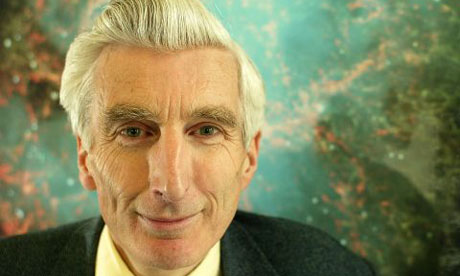
Martin Rees on our posthuman future—and avoiding catastophe

Thomas McCabe, writing for Kurzweil AI, recently reported on Sir Martin Rees's address to the Long Now Foundation. McCabe notes,

Over the truly long term, our posthuman descendants will become — not just second-generation intelligences — but thousand-generation or million-generation intelligences. He quoted Darwin on how no species can pass its likeness into the distant future unaltered; in a billion years of biological evolution, we’ve gone from bugs to humans, and technological evolution is a lot faster than biological. Our distant descendants will be not just strange, but completely alien to us.

According to Rees, we not only have unprecedented opportunity, but unprecedented responsibility. If the new technologies we build have a high chance of causing civilization-wide catastrophe for the first time in history, we are responsible for actively preventing that from happening, not just trying to predict it or understand it.

Link.

Solar PV Structural

Does anyone know the status of published code requirements for the calculation of wind loads on photovoltaic panels. Has there been a standard developed that recommends whether or not C&amp;C or MWFRS loads are used. Some of my research indicates that MWFRS loads would be used for net uplift design

Small Scale Parabolic Trough

In my back yard I want to build a [250m receiver] small scale parabolic trough plan combined with steam gas turbines or else hoping to produce 50 kw/h electricity. Reading for some months now I have an idea about the subject but still to many gaps, new field, diferent subject (geologist). Big green

“Anti-Laser” Would Absorb the Light a Laser Shoots out | 80beats

800px-Laser_playSure, a laser can shine finely-tuned light to do anything from scanning your barcodes to correcting your vision, but soon that precise hero may meet its match: Physicists have recently imagined a device that can absorb light of certain frequencies, an “anti-laser.”

Absorbing light may not seem all that impressive, since after all, anything that appears black works as an absorber. Your driveway, however, is not the anti-laser. A paper in the Physical Review Letters lays out the plans for this device which can absorb light wave clones (same frequency, phase, and polarization) that some lasers emit. The pickiness of this theoretical light absorber is part of what would make the device unique, just as an important part of what separates a laser from a flashlight is the precision of the light a laser emits.

Instead of amplifying light into coherent pulses, as a laser does, an antilaser absorbs light beams zapped into it. It can be “tuned” to work at specific wavelengths of light, allowing researchers to turn a dial and cause the device to start and then stop absorbing light. “By just tinkering with the phases of the beams, magically it turns ‘black’ in this narrow wavelength range,” says team member A. Douglas Stone, a physicist at Yale University. “It’s an amazing trick.” [Science News]

The Yale University team has gone through the numbers for such a choosy absorber, which works partly by switching the material that reflects light in a laser with material that instead absorbs it. The paper describes a theoretical device using silicon.

A paper-thin slice of silicon would normally absorb about 20 per cent of the incoming light, but the team showed that in this set-up it would cancel nearly all of the light at 945 nanometres, in the near infrared…. So far the effect exists only on paper, but team member Douglas Stone says “ongoing experiments are extremely promising, and I have total confidence it can be realised”. [New Scientist]

Given the specificity of the light that this absorber requires it is unlikely, a Physics review says, to find future employment as part of a solar panel or stealth cloak (shielding a ship for example from radar). Instead, such a device could likely appear in pairs with lasers forming “optical switches” in circuits–and perhaps as the weapon of choice for science fiction foes.

Related content:
80beats: Video: Navy’s New Laser Weapon Shoots Down Drones
80beats: NASA Satellites Use Lasers to Map the World’s Tallest Forests
80beats: Tattoo-Removing Lasers Also Remove Grime From Classic Works of Art
80beats: Found on the Moon: A Soviet Laser Reflector That Was Lost for 40 Years

Image: Wikimedia / Jeff Keyzer


Summated Overcurrent Protection

Hello friends,

Can somebody explain me the principle and working of summated overcurrent protection used as an cheap alternative for bus-zone differential protection. It's like if to a 2-section bus bar 2 transformers are feeding with bus coupler always closed, the summation of

King Tutankhamun's "Tutmobile" Rolls into NYC

From Telstar Logistics:

It doesn't have bulletproof armor, flat-screen TVs, air conditioning, or a built-in wet bar stocked with Courvoisier, but this chariot was nevertheless fit for a Pharaoh. Used by King Tutankhamun -- aka King Tut -- around 1300 BCE, it's now on display in

Dog Breeders’ Tinkering Produced Breeds With Reorganized Brains | 80beats

English_pointerHounds, pointers, and other dogs bred for their excellent abilities to pick up a scent tend to have longer snouts—but it’s not just that a bigger nose is a better one. Researchers have found that human domestication of dogs has shifted the structure and alignment of some dogs’ brains. And in those varieties with shorter snouts—which humans bred for other reasons, like appearance—the olfactory brain region rotated to a different part of their skull, leaving scientists to question whether we’ve crossed up their smelling abilities (and perhaps more).

Since the first wolf was domesticated an estimated 12,000 years ago, “selective breeding has produced a lot of [anatomical] variation, but probably the most dramatic is in terms of skull shape,” said study co-author Michael Valenzuela [National Geographic].

For this study, which appears in the open-access journal PLoS One, Valenzuela and colleagues examined the brains of 11 dog breeds and found great variation in the size and shape of their skulls. The breeds with shorter snouts had brains that rotated forward by as much as 15 degrees over the generations, the scientists say. That means that the olfactory lobe, as well as other parts of these dogs‘ brains, has shifted position and shape because humans guided their evolution through domestication.

Valenzuela says that in particular humans might have altered the dogs’ rostral migratory stream, or RMS, a connection in the brain that’s important for the sense of smell.

“The RMS starts very deep in the middle of the brain and traces a very predictable path to the olfactory bulb…. Since the olfactory bulb has moved in brachycephalic [short-snouted] dogs, you’d expect to see a change in the course of the RMS, or it may be disregulated” [National Geographic].

The researchers don’t know yet how much the brain changes affect the dogs and their world of smell. But they say the differences in brain size are another surprise showing how diverse dogs can be.

As Dr. Valanzuela explains, the most astounding thing is that dogs’ brains can actually handle such huge differences in the shapes of the skulls that house them. Dogs have already shown unprecedented levels of variety in their different physical breeds, but the variation in brain organization is an even more fundamental and thus more incredible form of diversity across the species [io9].

Related Content:
DISCOVER: Ascent of the Dog
80beats: Dogs Think Like Babies, While Wolves Think for Themselves
80beats: CSI Canine: Dog DNA Can Help Cops Nab Dog-Fight Criminals
80beats: Men & Dogs First Became Best Friends in the Middle East
80beats: Revealed: The Genetic Secret of the Dachshund’s Stubby Legs
80beats: Hairless Dogs Give up the Genetic Secret of Their Bald Glory

Image: Wikimedia Commons


"Bugging Out," Cityscape Radio Show, WFUV


They’re all around us…in our homes, in our places of work, in our backyards, and in the air…what are we talking about? Insects. On this week's Cityscape, we're exploring the world of bugs. We'll talk with the author of a new book called Insectopedia, visit a Manhattan eatery that serves grasshoppers (and eat them too), talk with a Brooklyn artist who dabbles in insect photography and meet a pair of professional "insect-pinners" in SoHo.

The recent Cityscapes radio show "Bugging Out" plumbs the fascinating world of insects, as described above; one segment--that about the "Brooklyn artist who dabbles in insect photography"--features an interview with me about my insect photographs as shown in the recent Entomologia exhibition at Observatory.

You can give the show--which is interesting from start to finish!-- a listen by clicking here. You can find out more by clicking here. All images are mine, from Observatory's recent Entomologia exhibition; you can find out more about the show, which was brilliantly curated by Michelle Enemark, by clicking here. More about the book Insectopedia by clicking here.

Please note: The photographs you see above from the Entomologia exhibition are still available for sale; if interested, please contact me.