Frans de Waal: Morals without God?

Hieronymus Bosch’s “Garden of Earthly Delights” depicts
hundreds of erotic naked figures carrying or eating fruits,
but is also full of references to alchemy, the forerunner of chemistry
 The figures on the right are embedded in glass tubes typical
of a bain-marie, while the two birds supposedly symbolize vapors.

Frans de Waal, in a recent NYT OpEd, argues that we don't need God to create morals:

Perhaps it is just me, but I am wary of anyone whose belief system is the only thing standing between them and repulsive behavior. Why not assume that our humanity, including the self-control needed for livable societies, is built into us? Does anyone truly believe that our ancestors lacked social norms before they had religion? Did they never assist others in need, or complain about an unfair deal? Humans must have worried about the functioning of their communities well before the current religions arose, which is only a few thousand years ago. Not that religion is irrelevant — I will get to this — but it is an add-on rather than the wellspring of morality.

Deep down, creationists realize they will never win factual arguments with science. This is why they have construed their own science-like universe, known as Intelligent Design, and eagerly jump on every tidbit of information that seems to go their way. The most recent opportunity arose with the Hauser affair. A Harvard colleague, Marc Hauser, has been accused of eight counts of scientific misconduct, including making up his own data. Since Hauser studied primate behavior and wrote about morality, Christian Web sites were eager to claim that “all that people like Hauser are left with are unsubstantiated propositions that are contradicted by millennia of human experience” (Chuck Colson, Sept. 8, 2010). A major newspaper asked “Would it be such a bad thing if Hausergate resulted in some intellectual humility among the new scientists of morality?” (Eric Felten, Aug. 27, 2010). Even a linguist could not resist this occasion to reaffirm the gap between human and animal by warning against “naive evolutionary presuppositions.”

These are rearguard battles, however. Whether creationists jump on this scientific scandal or linguists and psychologists keep selling human exceptionalism does not really matter. Fraud has occurred in many fields of science, from epidemiology to physics, all of which are still around. In the field of cognition, the march towards continuity between human and animal has been inexorable — one misconduct case won’t make a difference. True, humanity never runs out of claims of what sets it apart, but it is a rare uniqueness claim that holds up for over a decade. This is why we don’t hear anymore that only humans make tools, imitate, think ahead, have culture, are self-aware, or adopt another’s point of view.

Read the entire article.


Body sensing armband

Quantified-self junkies, rejoice: BodyMedia recently announced that its armband sensors will be able to communicate wirelessly with smartphones via Bluetooth. Its health sensors will be one of the first devices, other than ear buds, that link to smartphones with Bluetooth short-range communications.

The device is poised to allows users to monitor a collection of nearly 9,000 variables—physical activity, calories burned, body heat, sleep efficiency and others—collected by the sensors in a BodyMedia armband in real-time, as the day goes by.

The Bluetooth-enabled armband will cost $249 and the BodyMedia data service will cost $7 a month. The device is scheduled go on sale this coming November. In the past, BodyMedia users had to consult personal data downloaded to a Web site or observe a few measurements on a special watchband display, sold for $100.


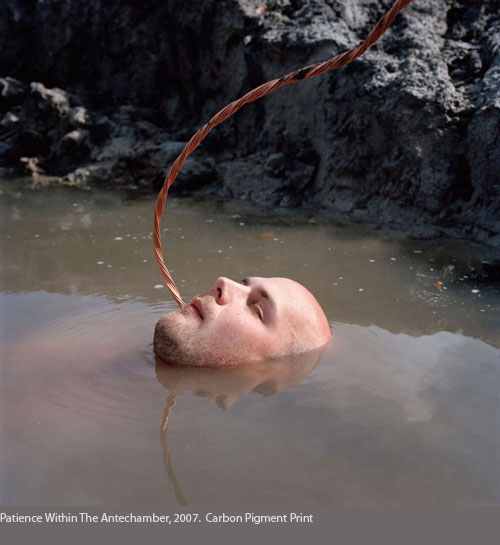
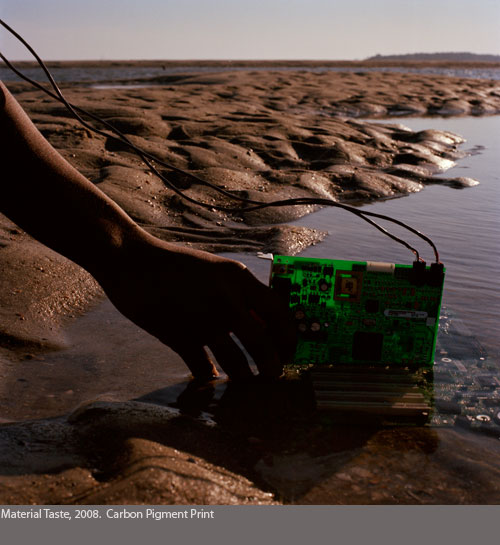
The art of Patrick Millard

Patrick Millard is Pittsburgh-based artist whose work in photography, new media, and sound has resulted in a diversified portfolio that addresses ideas about media, digital culture, technology and the interactions that human beings have within their own synthetic environment. His work has been exhibited nationally and internationally and continues to gain recognition.

In 2008, Patrick began to show his work inside the virtual simulation world Second Life; exhibitions that advance beyond two-dimension work and expand his ideas of simulation, virtual reality, and the synthetic future where the physical object gives way to its virtual counterpart and its presence is valued entirely for its idea rather than its place in space.

In 2009, shortly after becoming a regular exhibitor in the virtual environment, Patrick embarked upon his first photographic series that used the environment and society of Second Life as its subject matter and conceptual theme. Virtual Lens is an artistic and anthropological investigation into the life of the avatar, landscape of the sim environment, and experience of the virtual world. Patrick continues to photograph and exhibit his portfolios as well as spend time with fellow avatars in Second Life.

He currently works as Assistant Professor of Photography at Point Park University in Pittsburgh.

During the month of June, 2010 Patrick will be artist in residence at the Biosphere 2. During his time in residence he will be working on photographic, sound, and digital media portfolios.


Recent papers and articles of interest

Check these out:


Future of Electric Cars Like the Leaf

This summer, a guy named Dan Gray submitted a video to Planet Forward about the Nissan Leaf and because of that, he got to test drive the newest electric car.  This Thursday, Oct 21, the “Nightly Business Report” on PBS stations will feature Dan’s video and the test drive. In the video below you can see  the Nissan Leaf, a “pure zero emission” car.  It doesn’t even have a tailpipe, and it raises the “cool” factor of an electric car to a new high.  See it on the Nissan site here.

Interested in a new Leaf EV? I sure am. It looks like a fantastic car. Reportedly, there are big government incentives to buy an electric car right now. I don’t know the details, but according to the video, it would cost you about $25,000 in the end. Do electric cars make sense to buy? Yes, if people invest in this technology, and they become more affordable, and that will happen.  We can’t keep using oil and gas. (That’s obvious, since it’s already running out.) Here is a preview of the car.

You can see more on Thursday, October 21 on PBS.

Below is a related story from Yale’s e360:

Rising Hopes that Electric Cars  Can Play a Key Role on the Grid

Will electric cars one day become part of a network of rechargeable batteries that can help smooth out the intermittent nature of wind and solar power? Many experts believe so, pointing to programs in Europe and the U.S. that demonstrate the promise of vehicle-to-grid technology.

Yale e360 article by dave levitan

The United States now has more than 35,000 megawatts of installed wind energy, enough to power close to 10 million homes. Close on the heels of this ongoing renewable energy revolution is another green technology: By next year tens of thousands of Nissan LEAFs, Chevy Volts, and other electric vehicles will start rolling off assembly lines.

The electricity generation and transportation sectors may seem like two disparate pieces of a puzzle, but in fact they may end up being intimately related. The connection comes in the form of the vehicle-to-grid concept, in which a large electric vehicle (EV) fleet — essentially a group of rechargeable batteries that spend most of their time sitting in driveways and garages — might be used to store excess power when demand is low and feed it back to the grid when demand is high. Utilities and electricity wholesalers would pay the EV owners for providing that power.

Vehicle-to-grid, or V2G, is not a new idea. In fact, it’s been floating around environmental and green tech circles for a decade at least. But it has always had the tough-to-shed image of a utopian technology. Now, though, V2G — as well as simpler schemes based on smart-timed charging of the vehicles — is slowly becoming reality, evolving in quiet synergy with the worldwide push for renewable energy….

Those generators can handle [...]

BP Oil Still Haunts the Gulf of Mexico

“When I asked him what has stayed in his mind most . . . . he  said that when they were burning the oil off the surface of the sea, he remembers on the edge of the flames seeing a pod of dolphins, side by side by side by side, watching, simply watching the ocean burn.”

It’s been six months since the BP Deepwater Horizon oil platform explosion in the Gulf of Mexico.  This morning I heard a shocking episode of the DemocracyNow show, which included an interview with Terry Tempest Williams, who had a lot to say about the condition of the water and wildlife in the Gulf of Mexico.

After the BP oil leak stopped, the Obama administration was quick to claim that most of the oil was “gone” and in the process of being cleaned up by some magic natural process.   They were not being honest, to say the least.  The DemocracyNow report today contained the information that there are no fish in the water there for the fishermen, an entire fishing industry is disappearing, whales and dolphins have died in large numbers and been hacked up to hide their bodies; and more.  Illnesses from the chemicals and from the oil are being reported, including pneumonia. Whether that will get worse or better is anyone’s guess.  The point of the story is that though the oil is no longer leaking, the danger from toxic chemicals to people is far from over. This is still a public health hazard and it’s a very serious problem, as is the fact that so much of the wildlife and megafauna (like whales) have just disappeared.

The Gulf has been declared “open for business” by people in the government.  But there is very little media coverage of this, except the kind that emphasizes the positive, the “recovery” of the Gulf, while ignoring the deep and lasting wound this oil leak has inflicted on the area.  So leave it up to DemocracyNow to report on this from a totally different angle and tell the truth about the current conditions of the Gulf:  on life support.  No one knows if the fish will return. No one knows if the way of life of anyone on the Gulf Coast will return.  The environmental damage cannot be measured — teams of workers are still removing large amounts of oil from the beaches at night so the media doesn’t notice.   It’s really disgusting how this is being covered up.  And while this is ongoing, the Obama administration lifted the moratorium on deep-water OIL drilling, so this can all happen again some day.

Here is a large excerpt from the story today at DemocracyNow.  If you want to watch the video, it’s here.  This was an interview with activist and author/writer Terry Tempest Williams.  Her latest article on the BP Oil Leak can be found at Orion Magazine.  Her main question is, “Where is the outrage?”  I’d like to know that, too.

JUAN GONZALEZ: Well, Terry Tempest Williams, this [...]

Progress on Climate Talks and China’s Green Energy

On the final day of the Tianjin meeting, (October 9 2010) UNFCCC Executive Secretary, Christiana Figueres, and Mexican Foreign Minister, Patricia Espinosa, gave a joint press conference where they stated that governments have made progress in defining what can be achieved at the UN Climate Change Conference in Cancun. Ms Figueres pointed out the critical importance of “turning dry texts into a set of keys that unlock a new level of climate action – among rich and poor, business and consumers, governments and citizens.” Minister Espinosa said that “the outcomes of this year’s conferences can truly be the start of a new era of cooperative global climate action.” She added that Cancun can and should be a very significant step forward.

See the entire webcast here.

There is no reason to give up on Cancun’s upcoming climate meeting yet. As this video illustrates, they are making progress, even if it’s very very slow.  As Figueres says, they are closer to a set of agreements for Cancun. The possible results of a Cancun outcome was well-received by the involved parties and is being revised in light of further progress.  She also said the governments have discussed each element in the lists and have commented on what is “doable”.  That should be interesting.  She enumerates the list of what needs to be done and agreed upon as:

1) A long-term shared vision
2) Adaptation
3)  Mitigation and the key operational elements of finance
4) Technology and capacity-building in addition to the future of the Kyoto Protocol.

Below is part of an article about what China is up to lately with green energy.

Scaling up. Solar and wind power are making huge strides in China. CREDIT: XINHUA/LANDOV

Climate Talks Still at Impasse, China Buffs Its Green Reputation

by Richard Stone , Science Magazine

TIANJIN, CHINA—Delegates to a United Nations meeting here last week made scant headway on a global strategy for reining in greenhouse gas emissions. But amid the pessimism and recriminations, one nation won praise from observers for its efforts to boost energy efficiency and invest in green technologies: the host,China.

Negotiators from 177 countries came to this port city near Beijing with low expectations for progress on a deal that could slow global warming, and thick smog that blanketed Tianjin further dampened spirits. Last week’s U.N. Framework Convention on Climate Change meeting was a preparatory session for a summit next month in Cancun, Mexico, where countries will resume the Sisyphean task of crafting a successor to the Kyoto Protocol, in which 39 industrialized nations and the European Union committed to reducing greenhouse gas emissions several percent from 1990 levels by 2012. According to the 1997 accord’s principle of “common but differentiated responsibilities,” developing nations, including China, have pledged to take voluntary steps to rein in carbon emissions.

. . .

With any progress toward a new accord elusive, the two biggest greenhouse gas emitters—China and the United States—fired broadsides at each other. The lead U.S. negotiator in Tianjin, Jonathan Pershing, criticized China and other [...]

Growing Towards a More Poisoned Environment

'Either capitalism lives or Mother Earth lives' ... delegates wave flags at the World People's Conference on Climate Change and the Rights of Mother Earth, near Cochabamba, Bolivia, on 20 April 2010. These guys get it. by Dado Galdieri/AP

It’s hard not to feel bad for the people who live in the Gulf of Mexico.  Not only has Big Oil lured them into environment-destroying jobs, thus crushing their souls, but the BP oil leak’s lingering effects is still harming the fishing industry in the area.  In 20 years the entire Gulf coast could be deserted except for the tourism businesses that remain. But what will tourists go there to visit?

Worst of all, it’s still dangerous to peoples’ health, in a big way, to live near that Gulf of Mexico water.

(Newser) – Researchers have detected a 40-fold increase in potentially cancer-causing polycyclic aromatic hydrocarbons off the coast of Louisiana’s Grande Isle. The study is especially scary because it only measured PAHs that could seep through a biological membrane, the Huffington Post explains. “This is a measure of what would enter into an organism,” says one professor, “and that means they can essentially be uptaken by organisms throughout the food chain.”

A 40X increase in cancer-causing chemicals!  How is that acceptable? It’s “acceptable” because so few people know about it.

People need to make a connection between their environment and fossil fuel use and the dangers involved.  It goes beyond mere “pollution” that we generally think of as more of a nuisance than anything else.  Abusing the environment and over-dependence on fossil fuels by large corporations is leading to life-threatening situations all over the world.  The media needs to cover all of this much better than they are. If there is mercury in the lakes and rivers, and cancer-causing chemicals in ocean water, where are we supposed to turn for safe, clean water?  These are big issues the public needs to be aware of, to weigh in on.

Sometimes we do need governments to protect the basics of life, and that’s why EPA action on regulating CO2 from coal-powered power plants is so necessary.  This is scheduled to happen early next year.  But nothing will change until we change our fundamental economic system that is based on growth, consumption, and waste. What steps are governments taking?

“Six weeks from now, in Cancun, Mexico, the world’s nations will gather under the auspices of the United Nations (the UNFCCC) to again discuss how to alleviate climate change. They’ll try to pick up the broken pieces from last December in Copenhagen, where we witnessed tortured dances by government leaders trying to avoid the realities of our time, and the profound conundrums we face as a society. They accomplished nothing, and may reprise that performance in Cancun.

Take the case of President Obama. He generally signals a serious desire to address climate issues, but, like the leaders of all the developed industrial nations, has been caught in a terrible dilemma. [...]