Europe’s VSE

Building Europe's vision for space exploration

"Europe's vision for launching astronauts and robot explorers out into the Solar System will come into sharper focus on 21 October when the ministers responsible for space activities meet in Brussels to discuss Europe's goals for space exploration. Events can be followed live on the web. Ministers from the 29 ESA and EU states will rendezvous in Brussels this week for their second International Conference on Space Exploration as the next step towards creating a future European exploration strategy. The ministers will build on the debate begun a year ago in Prague during the first high-level conference dedicated to the topic."

Unplugged: How Long Can You Last?

From BBC News - Technology:

Could you survive for 24 hours without television, radio, the internet or any other form of media? Students at Bournemouth University have been doing just that, as part of a global experiment called Unplugged. The aim is to find out just how addicted

Five Contributions of Nickel in Alloy Steel

When present in substantial amounts, Nickel provides a number of benefits to steel.

And it's money, too!

Nickel's main contribution to steels is making them more forgiving of heat treatment variations. Think of it as the Heat Treater's Friend.

Nickel lowers the critical temperatu

Electric Vehicle Battery Breakthrough?

A company called Planar Energy has developed a solid-state electrolyte for lithium batteries which is inexpensive to produce and is intended to replace the less stable liquid electrolytes currently in use. This technology also yields extended capacity, which translates into extended range for

Commercial Spaceflight Federation Congratulates Winners of First-Ever Spaceport Infrastructure Grants Awarded by FAA

Washington, D.C. – The Commercial Spaceflight Federation welcomes the recent announcement by the FAA’s Office of Commercial Space Transportation that several U.S. spaceports have received funds under the inaugural round of the Space Transportation Infrastructure Matching Grants (STIM-Grants) program.

Several Commercial Spaceflight Federation member spaceports received grants as part of the first-year’s $500,000 total allocation, including:

* The New Mexico Spaceport Authority; to provide an Automated Weather Observing System;
* The East Kern Airport District in Mojave, California; for an emergency response vehicle; and
* The Jacksonville Airport Authority in Florida; to develop a Spaceport Master Plan for Cecil Field Spaceport.

CSF Executive Director John Gedmark stated, “The FAA’s Spaceport Grants program has been a major policy priority for the Commercial Spaceflight Federation. We see this program as essential to improving safety and maintaining the economic competitiveness of U.S. spaceports. This is the first year the program has received funds from the U.S. Congress, and we are pleased to see that FAA has moved promptly to award the funds so that spaceport infrastructure improvements can begin immediately. We look forward to seeing this program continue and grow.”

The press release issued by the FAA is available at http://www.faa.gov/news/press_releases/news_story.cfm?newsId=11919 .

About the Commercial Spaceflight Federation
The mission of the Commercial Spaceflight Federation (CSF) is to promote the development of commercial human spaceflight, pursue ever-higher levels of safety, and share best practices and expertise throughout the industry. The Commercial Spaceflight Federation’s member companies, which include commercial spaceflight developers, operators, spaceports, suppliers, and service providers, are creating thousands of high- tech jobs nationwide, working to preserve American leadership in aerospace through technology innovation, and inspiring young people to pursue careers in science and engineering. For more information please visit http://www.commercialspaceflight.org or contact Executive Director John Gedmark at john@commercialspaceflight.org or at 202.349.1121.

Space.com Reports Strong International Interest in Use of Bigelow Aerospace Private Space Stations

Washington, D.C. – Underscoring the growth of the market for commercial spaceflight, agreements have been signed with national space agencies, companies, and governmental entities located in Japan, the Netherlands, Singapore, Sweden, Australia and the United Kingdom expressing interest in Bigelow Aerospace’s commercial orbital complexes slated for launch later this decade. These agreements, in the form of memorandums of understanding (“MoUs”), were reported by the space media site Space.com earlier this week.

Mr. Robert T. Bigelow, founder and President of Bigelow Aerospace, has invested approximately $200 million as the company prepares the world’s first private sector space stations for use by domestic and international clients. Space media site Space.com reports that Bigelow Aerospace “has found a robust international market.”

The full Space.com article is available at http://www.space.com/businesstechnology/private-space-station-first-clients-101019.html.

A little extra at the Spaceport America dedication

WK2 and SS2 over Spaceport America

WhiteKnightTwo and SpaceShipTwo soar above the crowd at Spaceport America on Friday. (credit: J. Foust)

Friday’s events at Spaceport America went off pretty much as planned. There were the speeches by dignitaries (including Richard Branson, New Mexico Gov. Bill Richardson, and NASA deputy administrator Lori Garver), followed by the flyover by WhiteKnightTwo with SpaceShipTwo attached. After the two vehicles completed several passes and appeared to fly off, Branson and the others started a press conference.

However, a short time into the press conference Branson interrupted the Q&A. “I rang the pilot of the spaceship and said, ‘Look, we’ve got a runway here. Why are you going back to Mojave? Why can’t you come and sort of show it off?’ I’m not sure I managed to persuade him, but maybe we could all sort of put some vibes up in the sky.” What followed was the odd spectacle of several hundred people shaking their hands, clapping, and stomping their feet, all at the insistence of Branson, to try and get WK2 and SS2 to return.

“What’s the point of having a spaceport if you don’t land at a spaceport?” Branson asked. The first time around this didn’t get the vehicles to return, but several minutes later he interrupted the press conference again to get people to do the same thing. And this time, it “worked”: WK2 and SS2 reappeared in the skies over the spaceport and landed on the runway, which during the ceremony had been renamed the Bill Richardson Spaceway. The vehicles became the backdrop for photo opportunities and the like for the remainder of the event.

Branson and Richardson

Sir Richard Branson and New Mexico Gov. Bill Richardson pose in front of WhiteKnightTwo and SpaceShipTwo at Spaceport America. (credit: J. Foust)

Besides the unexpected (albeit rumored in the days leading up to the event) landing, there were only a few other announcements or other newsworthy items at the event. In his speech Virgin Galatic CEO George Whitesides announced a new program called “Galactic Unite”, an initiative designed to support STEM (science, technology, engineering, and mathematics) education. That program is being done in cooperation with Virgin Unite, the Virgin Group’s non-profit arm, and the New Mexico Space Grant Consortium.

Virgin officials did not talk too much about other aspects of the spaceport or vehicle development. “We saw the latest successful major test fire of our rocket motor” being developed by Scaled Composites and Sierra Nevada Corporation, Whitesides said, but didn’t mention when that test took place other than the test is “moving us well along the way to an ambitious upcoming test schedule.” Later, Virgin Galactic president Will Whitehorn said that for the hybrid rocket motor they were looking at replacing the rubber used as the solid fuel with “basically recycled nylon” that would have a lower carbon output than the conventional motor. It wasn’t clear from those statements what fuel they’re using for the rocket motor in the current tests (I was next up to ask a question along those lines when Branson interrupted again just before the return of WK2 and SS2.)

Also during the press conference Branson was asked about orbital vehicle development. That is a long-term goal of the company, but Branson suggested they would try to find ways to accelerate it. “Obviously we want to move on to orbital after we’ve got suborbital under our belts, and maybe even before that,” he said, then mentioned NASA’s commercial crew development program and its request for proposals in the coming months. “Virgin Galactic is going to put forward proposals, and we plan to start work on an orbital program quite quickly.” Branson declined to provide any details on Virgin’s orbital vehicle plans, but said the company would say more in the next three to four months.

WK2 and SS2 over terminal

WhiteKnightTwo and SpaceShipTwo fly over the Terminal Hangar Facility under construction at Spaceport America. (credit: J. Foust)

Highlights from day 1 of ISPCS

Wednesday was the first of two days of the International Symposium for Personal and Commercial Spaceflight in Las Cruces, New Mexico. The conference, now in its sixth year, started as an opening act for the X PRIZE Cup, but has now not only continued after the end of the Cup, but has grown into one of the major commercial spaceflight conferences. Wednesday’s sessions didn’t provide any major breaking developments, but here are a few highlights and other interesting tidbits:

  • In a session titled “Closing the credibility gap”, speakers from Virgin Galactic, XCOR Aerospace, and Armadillo Aerospace discussed the importance of testing to demonstrate to customers, investors, regulators, and others that their ventures are, in fact, credible. During her presentation Virgin Galactic operations manager Julia Tizard mentioned that “full scale hot firing” of the rocket motors for SpaceShipTwo is underway in preparation for powered flight tests next year. (It should be noted that the log of RocketMotorTwo test firings was last updated in August.)
  • Neil Milburn of Armadillo Aerospace said in another panel that the company plans to bring out two vehicles, Super Mod and the “tube vehicle”, to Spaceport America by the end of this year for test flights under NASA’s CRuSR program, pending FAA approval. Super Mod will be able to fly to at least 40 kilometers, and perhaps as high as 60 kilometers, while the tube vehicle (Milburn admitted that vehicle needs a better name) could go all the way to 100 kilometers.
  • Earlier, Milburn said that Project M, a low-profile NASA project Armadillo had been associated with, has changed its name to Project Morpheus. The project had originally sought to land a humanoid rover (based on the Robonaut that will be going to the ISS on the next shuttle mission) on the Moon within 1,000 days (hence M, the Roman numeral for 1,000). The name change reflects a change in focus on the program for more terrestrial technology development.
  • Tim Pickens, the founder or Orion Propulsion who now works for Dynetics, said Dynetics’s role in projects like the Rocket City Space Pioneers Google Lunar X PRIZE team is part of an internal investment by the company to become one known for building space hardware. He added that in “the next few weeks” you would see some major investments by the company along those lines.
  • Bigelow Aerospace’s Robert Bigelow said despite the ongoing construction of a 185,000-square-foot factory in Las Vegas devoted to the production of expandable modules, he still considered the company to be in R&D mode. The company is looking for customers, and recently signed several memoranda of understanding with countries interested in leasing modules, but he said the company would not take any money from customers until at least 2012, pending the state of crew transportation development. (The company has a considerable presence at the conference; more on that in a later post.)

Highlights from ISPCS day 2

The International Symposium for Personal and Commercial Spaceflight in Las Cruces, New Mexico, wrapped up yesterday with another series of panels after an opening keynote by NASA deputy administrator Lori Garver. In her speech, Garver talked about the importance of the recent passage of the NASA authorization bill, which, while not everything the administration wanted, did open the door to further commercial participation in the agency’s efforts, primarily with commercial crew. She also cited other recent efforts, such as NASA contracts issued last week to several Google Lunar X PRIZE teams for data from those missions, if and when they fly. “This really has to be a true partnership” between the agency and commercial entities, she said.

Some other notes of interest from the conference sessions:

  • In a session on the microgravity research market, Andrew Nelson of XCOR said that he believes that, by 2016, there will be an annual market for suborbital flight services of $3.3 billion. Only $800 million of that will be flying people (primarily for tourism), with $1.1 billion for flying payloads and $1.4 billion for launching smallsats.
  • In a panel on orbital crew capsules, Robert Bigelow said Bigelow Aerospace had been in discussions with Lockheed Martin back in 2004-2005 on crew transportation systems, and even awarded the company a million-dollar contract to design an “Orion Lite” version that would be a scaled-down version of the Orion spacecraft for NASA. However, asked later what he thought of the potential competition between Orion and commercially-developed systems for ISS crew transportation, Bigelow said bluntly that “I think Orion is unnecessary”: commercial systems could handle access to LEO while spacecraft larger than Orion should be developed for deep-space exploration.
  • On that same panel Lockheed’s Kenneth Reightler defended the development of Orion, but also indicated that the company had attracted “quite a bit of interest” from other customers, and that Lockheed had “invested a lot of out corporate money” into the program.
  • In a panel late in the day on spaceports, Rick Homans of the New Mexico Spaceport Authority said that the development of Spaceport America is now in a “very complex” phase, as it transitions from construction to operations over the next year. The authority will soon issue a series of RFPs for operational-related activities, from security to visitor services, and is actively seeking a deputy director who will be responsible for spaceport operations.
  • Stu Witt of Mojave Air and Space Port, on the same panel, advised Homans and others running spaceports to be ready to deal with both “normal and abnormal” operations, citing from his own experience in Mojave events ranging from plane crashes to the SpaceShipTwo engine development accident in 2007 that killed three people to even the windstorm that prematurely ended the SS2 rollout event last December and toppled tents—after everyone had been evacuated, fortunately. “You’ve got to be planning and planning and planning,” Witt advised.

On Friday the big event, of course, is the dedication of the runway at Spaceport America, which will feature appearances by Sir Richard Branson and New Mexico governor Bill Richardson as well as a flyover by WhiteKnightTwo and SpaceShipTwo.

LRO Supports Historic Lunar Impact Mission

The lunar rocks brought back to the Earth by the Apollo astronauts were found to have very little water, and to be much drier than rocks on Earth. An explanation for this was that the Moon formed billions of years ago in the solar system's turbulent youth, when a Mars-sized planet crashed into Earth. The impact stripped away our planet's outer layer, sending it into orbit. The pieces later coalesced under their own gravity to form our Moon. Heat from all this mayhem vaporized most of the water in the lunar material, so the water was lost to space.

However, there was still a chance that water might be found in special places on the Moon. Due to the Moon's orientation to the Sun, scientists theorized that deep craters at the lunar poles would be in permanent shadow and thus extremely cold and able to trap volatile material like water as ice perhaps delivered there by comet impacts or chemical reactions with hydrogen carried by the solar wind.

Last year on October 9, NASA's LCROSS (Lunar Crater Remote Observation and Sensing Satellite) intentionally crashed its companion Centaur upper stage into the Cabeus crater near the lunar south pole. The idea was to kick up debris from the bottom of the crater so its composition could be analyzed. The Centaur hit at over 5,600 miles per hour, sending up a plume of material over 12 miles high.

"Seeing mostly pure water ice grains in the plume means water ice was somehow delivered or chemical processes are causing ice to accumulate in large quantities," said Anthony Colaprete, LCROSS project scientist and principal investigator at NASA's Ames Research Center, Moffett Field, Calif. "Furthermore, the diversity and abundance of certain materials called volatiles in the plume, suggest a variety of sources, like comets and asteroids, and an active water cycle within the lunar shadows."

LCROSS was a companion mission to NASA's Lunar Reconnaissance Orbiter (LRO) mission.

The two missions were designed to work together, and support from LRO was critical to the success of LCROSS. During impact, LRO, which is normally looking at the lunar surface, was tilted toward the horizon so it could observe the plume. Shortly after the Centaur hit the Moon, LRO flew past debris and gas from the impact while its instruments collected data.

"LRO assisted LCROSS in two primary ways -- selecting the impact site and confirming the LCROSS observations," said Gordon Chin of NASA's Goddard Space Flight Center, Greenbelt, Md., LRO associate project scientist.

"Since observatories on Earth were also planning to view the impact, there were a lot of constraints on the location -- the impact plume had to rise out of the crater and into sunlight, and it had to be visible from Earth," said Chin.

Prior to the impact, LRO's instruments worked together to map and provide details on the polar regions, according to Chin. For example, LRO's Lunar Orbiter Laser Altimeter (LOLA) instrument built up three-dimensional (topographic) maps of the surface. This data was plugged into computer simulations to see how shadows change as the Moon moves in its orbit, so that regions in permanent shadow could be identified. The Lunar Reconnaissance Orbiter Camera (LROC) helped by making images of the actual regions of light and shade, which were used to verify the simulation's accuracy. Finally, LOLA measured the depths of polar craters to find areas where the impact could still be seen from Earth.

Since hydrogen is a component of water, maps of lunar hydrogen deposits are useful for finding areas that might hold water. Preliminary hydrogen maps were provided by the spacecraft's Lunar Exploration Neutron Detector (LEND) instrument. Regions that had relatively high amounts of hydrogen were identified as the most promising for the impact.

"Over a year ago, we formally suggested Cabeus to the LCROSS principal investigator," said LEND principal investigator, Igor Mitrofanov of the Institute for Space Research, Moscow. "According to our current data, the regolith within the Cabeus impact crater may have the highest content of water anywhere on the Moon, perhaps up 4.0 percent weight."

"Originally, the LCROSS team was going with a site further north than the Cabeus crater, because it was better for Earth visibility," said Chin. "However, LEND revealed that the area did not have a high hydrogen concentration, but Cabeus did. Also, Diviner showed that Cabeus was one of the coldest sites, and LOLA indicated it was in permanent shadow. So, we were able to inform the decision to aim for Cabeus further south -- while it was a little less visible from Earth, Cabeus was ultimately better for what we were trying to find."

Temperature maps from LRO's Diviner instrument were also crucial to identify where the coldest places were.

David Paige, principal Investigator of the Diviner instrument from the University of California, Los Angeles, used temperature measurements of the lunar south pole obtained by Diviner to model the stability of water ice both at and near the surface.

"The temperatures inside these permanently shadowed craters are even colder than we had expected. Our model results indicate that in these extreme cold conditions, surface deposits of water ice would almost certainly be stable," said Paige, "but perhaps more significantly, these areas are surrounded by much larger permafrost regions where ice could be stable just beneath the surface."

"We conclude that large areas of the lunar south pole are cold enough to trap not only water ice, but other volatile compounds (substances with low boiling points) such as sulfur dioxide, carbon dioxide, formaldehyde, ammonia, methanol, mercury and sodium," Paige added.

UCLA graduate student and Diviner team member, Paul Hayne, was monitoring the data in real-time as it was sent back from Diviner.

"During the fly-by 90 seconds after impact, all seven of Diviner's infrared channels measured an enhanced thermal signal from the crater. The more sensitive of its two solar channels also measured the thermal signal, along with reflected sunlight from the impact plume. Two hours later, the three longest wavelength channels picked up the signal, and after four hours only one channel detected anything above the background temperature."

Scientists were able to learn two things from these measurements: first, they were able to constrain the mass of material that was ejected outwards into space from the impact crater; second, they were able to infer the initial temperature and make estimates about the effects of ice in the soil on the observed cooling behavior.

Another LRO instrument, the Lyman-Alpha Mapping Project (LAMP), used data on the gas cloud to confirm the presence of the molecular hydrogen, carbon monoxide and atomic mercury, along with smaller amounts of calcium and magnesium, all in gaseous form.

"We had hints from Apollo soils and models that the volatiles we see in the impact plume have been long collecting near the Moon’s polar regions," said Randy Gladstone, LAMP acting principal investigator, of Southwest Research Institute (SwRI) in San Antonio, Texas. "Now we have confirmation."

"The detection of mercury in the soil was the biggest surprise, especially that it’s in about the same abundance as the water detected by LCROSS," said Kurt Retherford, LAMP team member, also of SwRI.

"The observations by the suite of LRO and LCROSS instruments demonstrate the moon has a complex environment that experiences intriguing chemical processes," said Richard Vondrak, LRO project scientist at NASA Goddard. "This knowledge can open doors to new areas of research and exploration."

LCROSS launched with LRO aboard an Atlas V rocket from Cape Canaveral, Fla., on June 18, 2009.

The research was funded by NASA's Exploration Systems Missions Directorate at NASA Headquarters in Washington. LRO was built and is managed by NASA's Goddard Space Flight Center in Greenbelt, Md. LCROSS is managed by NASA's Ames Research Center, Moffett Field, Calif. LAMP was developed by the Southwest Research Institute in San Antonio, Texas; LOLA was built by NASA Goddard; LROC was provided by Arizona State University, Tempe; LEND was provided by Institute for Space Research, Moscow; The Diviner instrument was built and is managed by NASA’s Jet Propulsion Laboratory in Pasadena, Calif. UCLA is the home institution of Diviner’s principal investigator.

For more information visit http://www.nasa.gov/mission_pages/LRO/news/lro-lcross-impact.html

Pyrocumulonimbus: The Fire-Breathing Dragon of Clouds

Pyrocumulonimbus is the fire-breathing dragon of clouds.

A cumulonimbus without the "pyre" part is imposing enough -- a massive, anvil-shaped tower of power reaching five miles (8 km) high, hurling thunderbolts, wind and rain.

Add smoke and fire to the mix and you have pyrocumulonimbus, an explosive storm cloud actually created by the smoke and heat from fire, and which can ravage tens of thousands of acres. And in the process, "pyroCb" storms funnel their smoke like a chimney into Earth's stratosphere, with lingering ill effects.

Global Impact

Researchers believe these intense storms may be the source of what previously was believed to have been volcanic particles in the stratosphere. They also suggest pyroCbs happen more often than thought, and say they're responsible for a huge volume of pollutants trapped in the upper atmosphere.

"An individual pyroCb can inject particles into the lower stratosphere as high as 10 miles," says Dr. Glenn K. Yue, an atmospheric scientist at NASA Langley Research Center in Hampton, Va.

Yue is one of eight authors of a paper on pyrocumulonimbus in the September 2010 Bulletin of the American Meteorological Society (BAMS) titled "The Untold Story of Pyrocumulonimbus."

The paper reevaluates previous data to conclude that many stratospheric pollution events erroneously have been attributed to particles from volcanic eruptions.

Three "mystery cloud phenomena" were cited as examples that were actually the result of pyrocumulonimbus storms, including one initially attributed to the 1991 eruption of Mount Pinatubo in the Philippines. The plume thought to have been from Pinatubo was, it turns out, from a pyrocumulonimbus storm in Canada.

One reason for the misinterpretation, Yue said, is that scientists believed nothing less energetic than a volcanic eruption could penetrate Earth's "tropopause" in so short a period of time. The tropopause is the barrier between the lower atmosphere and stratosphere.

"At the time, the thinking was that it was unlikely," said Yue.

SAGE II Data

Yue reevaluated data he'd analyzed years earlier from NASA Langley's SAGE II instrument on the Earth Radiation Budget Satellite. SAGE II was launched in 1984 and turned off in 2005.

"Our paper also shows that pyroCbs happen more often than people realize," Yue added. In 2002, for example, various sensing instruments detected 17 distinct pyrocumulonimbus events in North America alone.

Humans have been responsible for many pyrocumulonimbus storms, says Mike Fromm, lead author on the BAMS paper.

The worst fire in Colorado history was set by a forestry officer "and within 24 hours there was a pyrocumulonimbus storm," says Fromm, a meteorologist at the Naval Research Laboratory in Washington, D.C. Whipped by the storm it had sparked, the 2002 fire swept across 138,000 acres (558.5 sq km) in four counties, drove more than 5,000 from their homes and killed six people.

Whether human actions influence pyrocumulonimbus activity enough to significantly impact the global climate is an open question. Human activity is believed to cause climate warming that leads to more wildfires.

"It's a compelling story line. We don't know enough now to say if there's enough supporting evidence of that," says Fromm.

"There's lots of fairly convincing evidence that under a warming climate, there are forest areas of Siberia and Canada that will be under more heat stress than before. And it's reasonable to think that there will be more fires."

For more informations visit http://www.nasa.gov/topics/earth/features/pyrocb.html

Sunspot 1112 Crackling with Solar Flares

View larger
On Saturday, October 16, NASA’s Solar Dynamics Observatory captured this stunning image of one of the most intense, solar flares seen in the past few months. So far there have been no reports of energetic particles from this M-class flare interfering with NASA spacecraft or making their way to Earth.

Fast-growing sunspot 1112 is crackling with solar flares. The three strongest of this 24 hour period: an M3-flare at 1910 UT on Oct. 16th, a C1-flare at 0900 UT and another C1-flare at 1740 UT on Oct. 17th. So far, none of the blasts has hurled a substantial CME toward Earth.

In addition, a vast filament of magnetism is cutting across the sun's southern hemisphere, measuring about 400,000 km. A bright 'hot spot' just north of the filament's midpoint is UV radiation from sunspot 1112. The proximity is no coincidence; the filament appears to be rooted in the sunspot below. If the sunspot flares, it could cause the entire structure to erupt. But so far, none of the flares has destabilized the filament.

View larger
View full disk image
A 400,000 km filament of magnetism stretches across the sun's southern hemisphere.

It’s Raining Pieces of Halley’s Comet!

The most famous of all comets, Comet Halley is noted for producing spectacular displays when it passes near Earth on its 76-year trip around the sun. However, you don't have to wait until 2061 to see a piece of the comet -- you can do it this very week!

Halley's Comet leaves bits of itself behind -- in the form of small conglomerates of dust and ice called meteoroids -- as it moves in its orbit, which the Earth approaches in early May and mid-October. When it does, it collides with these bits of ice and dust, producing a meteor shower as the particles ablate -- or burn up -- many miles above our heads. The May shower is called the Eta Aquarids, as the meteors appear to come from the constellation Aquarius. The October shower has meteors that appear to come from the well-known constellation of Orion the Hunter, hence the name: Orionids.

Orionids move very fast, at a speed of 147,300 miles per hour. At such an enormous speed, the meteors don't last long, burning up very high in the atmosphere. Last year, the NASA allsky cameras at Marshall Space Flight Center in Huntsville, Ala., and in Chickamauga, Ga., recorded 43 definite Orionid meteors. Most of these appeared at an altitude of 68 miles and completely burned up by the time they were 60 miles above the ground, seen in the graph at right.

Even though the peak isn't until October 21, the shower is going on now. The NASA camera systems saw their first Orionid on Oct. 15. Unfortunately, the light from the nearly full moon will wash out the fainter meteors, so expect to see fewer than the 30-per-hour rate you might see under completely dark skies.

The good news is that watching Orionids is easy. Go out into a clear, dark sky after 11 p.m. at night -- your local time -- and lie on a sleeping bag or lawn chair. Look straight up. After a few minutes, your eyes will become dark-adapted, you'll start to see meteors. Any of these that appear to come from Orion will be an Orionid, and therefore represent a piece of Halley's Comet doing its death dive into our atmosphere.

Most folks would consider seeing one or two of these a fair exchange for an hour or so of time. 🙂

Chandra: What Lies Beneath? Magnetar Enigma Deepens


Observations with NASA’s Chandra, Swift and Rossi X-ray observatories, Fermi Gamma-ray Space Telescope and ESA’s XMM-Newton have revealed that a slowly rotating neutron star with an ordinary surface magnetic field is giving off bursts of X-rays and gamma rays. This discovery may indicate the presence of an internal magnetic field much more intense than the surface magnetic field, with implications for how the most powerful magnets in the cosmos evolve.

The neutron star, SGR 0418+5729, was discovered on June 5, 2009, when the Fermi Gamma-ray Space Telescope detected bursts of gamma-rays from this object. Follow-up observations four days later with the Rossi X-Ray Timing Explorer (RXTE) showed that, in addition to sporadic X-ray bursts, the neutron star exhibits persistent X-ray emission with regular pulsations that indicate that the star has a rotational period of 9.1 seconds. RXTE was able to monitor this activity for about 100 days. This behavior is similar to a class of neutron stars called magnetars, which have strong to extreme magnetic fields 20 to 1000 times above the average of the galactic radio pulsars.

As neutron stars rotate, the radiation of low frequency electromagnetic waves -- or winds of high-energy particles -- carry energy away from the star, causing the rotation rate of the star to gradually decrease. Careful monitoring of SGR 0418 was possible because Chandra and XMM-Newton were able to measure its pulsation period even though it faded by a factor of 10 after the initial detection. What sets SGR 0418 apart from other magnetars is that careful monitoring over a span of 490 days has revealed no detectable decrease in its rotation rate.

The lack of rotational slowing implies that the radiation of low frequency waves must be weak, and hence the surface magnetic field must be much weaker than normal. But this raises another question: Where does the energy come from to power bursts and the persistent X-ray emission from the source?

The generally accepted answer for magnetars is that the energy to power the X-ray and gamma-ray emission comes from an internal magnetic field that has been twisted and amplified in the turbulent interior of the neutron star. Theoretical studies indicate that if the internal field becomes about ten or more times stronger than the surface field, the decay or untwisting of the field can lead to the production of steady and bursting X-ray emission through the heating of the neutron star crust or the acceleration of particles.

A crucial question is how large an imbalance can be maintained between the surface and interior fields. SGR 0418 represents an important test case. The observations already imply an imbalance of between 50 and 100. If further observations by Chandra push the surface magnetic field limit lower, then theorists may have to dig deeper for an explanation of this enigmatic object.

This discovery is the result of an international teamwork from CSIC-IEEC, INAF, University of Padua, MSSL-UCL, CEA-Saclay, Sabanci University and NASA’s Marshall Space Flight Center in Huntsville, Ala. These results appear in the Oct. 14 issue of Science Express, which provides electronic publication of selected science papers in advance of print.

The Marshall Center manages the Chandra program for NASA's Science Mission Directorate in Washington. The Smithsonian Astrophysical Observatory controls Chandra's science and flight operations from Cambridge, Mass.

For More Information visit http://www.nasa.gov/mission_pages/chandra/news/10-137.html

The Royal Society’s top popular science books of 2010

The short list and winner of the 2010 Royal Society Prize for Science books has been announced:

A World Without Ice by Henry Pollack (Avery Books, Penguin Group)
Explores the relationship between ice and people – the impact of ice on Earth, its climate, and its human residents, as well as the reciprocal impact that people are now having on ice and the climate.

The judges said: “A thoughtful and refreshing book that brings ice to life. Well researched and with a personal feel this book is an excellent alternative route into understanding the issues around climate change. Fascinating, accessible and very powerful.”

Everyday Practice of Science: Where Intuition and Passion Meet Objectivity and Logic by Frederick Grinnell (Oxford University Press)
An insiders’ view of real-life scientific practice describing how scientists bring their own interests and passions to their work and illustrating the dynamics between researchers and the research community.

The judges said: “How is science done? This book looks behind the scenes and tells the story of what makes scientific minds tick and how scientific theories are made. A fascinating, personal account – essential reading for anyone with an interest in science, from pupil to politician.”

God’s Philosophers: How the medieval world laid the foundations of modern science by James Hannam (Icon Books)
Revives the forgotten philosophers, scientists, scholars and inventors of medieval Europe, revealing the Medieval Age to be responsible for inventions and ideas that would change the world forever.

The judges said: “A vibrant insight into the medieval approach to science, full of wonderful anecdotes and personalities. Dispelling common myths about the ‘dark ages’, this is a very readable book about a neglected era in the history of science. It very much fills a gap, making you realise that the great scientific achievements of the Renaissance are in debt to the "philosophers" prepared to sacrifice long held beliefs and frequently their lives for their ideas.”

Life Ascending by Nick Lane (Profile Books)
Charts the history of life on Earth by describing the ten greatest inventions of life, based on their historical impact, their importance in living organisms and their iconic power.

The judges said: “An elegant and adventurous step-by-step guide to what makes life the way it is. With a pleasing overarching structure, it is a beautifully written book and an extremely rewarding read.”

We Need To Talk About Kelvin by Marcus Chown (Faber and Faber)
Takes familiar features of the world we know and shows how they can be used to explain profound truths about the ultimate nature of reality.

The judges said: “Your everyday world will never look the same again after reading this inspiring book. Reflections in the window, the warm rays of the sun – all are used to explain ideas of advanced physics, from the atom to the big bang, and show how physics forms part of our everyday world.”

Why Does E=mc2? by Brian Cox and Jeff Forshaw (Da Capo Press, Perseus Books Group)
An illuminating journey to the frontier of 21st century science to consider the real meaning behind Einstein’s most famous equation, E = mc2.

The judges said: “This book takes the world’s most famous equation apart and puts it back together again in a way that is lively and understandable. We were delighted to find our knowledge of equations - long forgotten since leaving school for some of us – reinvigorated and felt ourselves rediscovering our enjoyment of mathematics.”

The winner: Life Ascending by Nick Lane.

As an aside, I will soon be receiving all six of these books compliments of New Scientist. I won a contest in which readers were asked to name the most underrated science book written for a general audience. My pick of K. Eric Drexler's Engines of Creation was my choice.


Anderson & Anderson: Robot Be Good

Michael and Susan Anderson have published an article on Machine Ethics (ME) in the October issue of Scientific American. In the article, Robot Be Good: A Call for Ethical Autonomous Machines, they introduce both ME and their recent work programming ethical principles in Nao, a humanoid robot which was developed by the French company Aldebaran Robotics.

Their findings in brief:

  • Robots that make autonomous decisions, such as those being designed to assist the elderly, may face ethical dilemmas even in seemingly everyday situations.
  • One way to ensure ethical behavior in robots that interact with humans is to program general ethical principles into them and let them use those principles to make decisions on a case-by-case basis.
  • Artificial-intelligence techniques can produce the principles themselves by abstracting them from specific cases of ethically acceptable behavior using logic.
  • The authors have followed this approach and for the first time programmed a robot to act based on an ethical principle.


25 years later: Donna Haraway’s "A Cyborg Manifesto"

It has been 25 years since Donna Haraway published her seminal essay, "A Cyborg Manifesto: Science, Technology, and Socialist-Feminism in the Late Twentieth Century."While largely intended as metaphorical discourse, a number of feminists and futurists, including myself, were inspired by a more literal and technoprogressive interpretation of Haraway's message. The piece was a major influence on my conception of postgenderist theory, inspiring such articles as "Overcoming Gender" and "Postgenderism: Beyond the Gender Binary" (PDF) (the latter of which I co-authored with James Hughes).

In "A Cyborg Manifesto," Haraway issued a challenge to feminists to engage in a politics beyond naturalism and essentialism. She used the concept of the cyborg to offer a political strategy for the seemingly disparate interests of socialism and feminism, writing, "We are all chimeras, theorized and fabricated hybrids of machine and organism; in short, we are cyborgs." Her paper was also an attemnpt to break away from Oedipal narratives and Christian origin myths like Genesis. She writes, "The cyborg does not dream of community on the model of the organic family, this time without the oedipal project. The cyborg would not recognize the Garden of Eden; it is not made of mud and cannot dream of returning to dust."

From another angle, "A Cyborg Manifesto" can be interpreted as a critique of ecofeminism. She argued it was in the eroding boundary between human beings and machines, in the integration of women and machines in particular, that we can find liberation from old patriarchal dualisms. Haraway concludes “I would rather be a cyborg than a goddess,” and suggested that the cyborg serves as a more appropriate liberatory mythos for women.

Now, 25 years later, "A Cyborg Manifesto" can be seen as the inspiration for the emergence of 'cyborgology' and 'cyberfeminism,' subdisciplines made up of culture critics who used the cyborg metaphor and the postmodernist questions Haraway posed to explore the woman-machine interface. And as mentioned earlier, it also brought transhumanists into the discussion, who integrated and re-interpreted Haraway's ideas, resulting in the emergence of postgenderist theory—the suggestion that both females and males should look to be liberated from gendered constraints through the application of advanced biotechnologies.


Satellogic

Founded in 2010 by Emiliano Kargieman and Andrew Fursma, graduates of the NASA Ames based Singularity University’s Graduate Studies Program, Satellogic specializes in the creation and management of off-earth network infrastructure.

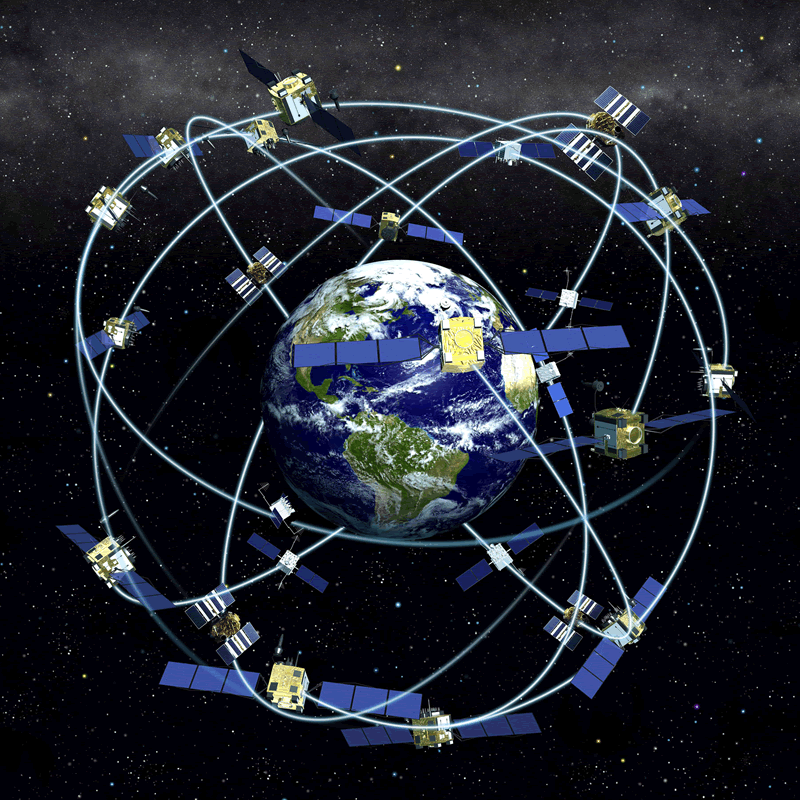
The company is developing the airborne communications backbone necessary to open realtime satellite data to the masses. By creating a globally accessible nano-satellite based mesh network in low earth orbit, Satellogic can serve as a virtual ground station for traditional satellites while providing earth observation data recorded by the constellation.

Learn more.