Rand Paul distances himself from his Father’s foreign policy

Radical Islam is "a worldwide threat"

Pull out Quote from Hugh Hewitt radio interview with US Senate Rand Paul of Kentucky, Oct. 5 (via Breitbart TV):

We've done a pretty good job over the last few years of cutting off the searpant's head so to speak [of Al Qaeda]. We've done, you know, a pretty good job of disrupting them. And that's another thing that's sometimes lost even on my father, that you know, he did vote to go into Afghanistan. So, he did say we can't be attacked on 9/11 without repercussions... So, I think we have done a pretty good job at disrupting their bases in Afghanistan... I don't think there's a nation-state at this point that is accepting Al Qaeda. I mean Iran may be debatable.

I think an argument can be made that the threat from Al Qaeda is no longer an isolated threat, that it's a worldwide threat, and that having a mobile military that can react at a moment's notice anywhere's in the globe, is the defense rather than land war or nation building.

Editor's note - This website agreess completely and wholeheartedly with the foreign policy views expressed above by Senator Paul. Photo h/t RedDog report

Liberal-run city of Portland, OR moves ahead with ban on Beer sales downtown

City leaders want to clean up downtown

From Eric Dondero:

It's still waiting final approval by the Oregon Liquor Control Commission. But the city is already making plans to expand the coverage area to other neighborhoods beyond downtown.

From KATU.com "Downtown Portland beer ban stalls, but it's still in the works" Oct. 3:

The City Council already voted for the ban late last year but the crackdown on sales hasn't officially begun. That's because the Oregon Liquor Control Commission (OLCC) still has to give the city's petition a final seal of approval.

If the OLCC gives the city the green light, stores would not be able to sell single containers of malt liquor or domestic beer over 22 ounces, or malt liquor or domestic beer with more than 5.75 percent alcohol. They also wouldn't be able to sell wine with more than 14 percent.

And this:

Originally, the target area included Old Town, Goose Hollow and the downtown core but now the OLCC is now looking at adding the Pearl District and Northwest 23rd Avenue to the roster

Note - The Portland city council is entirely Democrat. Additionally, the Mayor Sam Adams (yes, that's his real name) is also a Democrat.

Christian owned alcohol shops in southern Lebanon receive threats from Muslim groups

Shops forced to re-locate to safer areas

From ansamedinfo.news Lebanon: threats against vendors of alcohol in South Sept. 30:

Protests have been made and threats issued over recent months against Christian-run shops that sell alcoholic beverages in the South of Lebanon, a 'feudal' territory 'belonging' to the Shiite Islamic Hezbollah movement and its militias.

In the latest case reported by the Marakaziya agency, a young tradesperson received anonymous threats in the post with a warning that they should close down their shop in Kferwe', in the Nabatiyeh region. The young man has now moved to Kferwe' after closing another shop in Nabatiyeh after a demonstration was organised against him in that town.

Over the past few days, another shopkeeper selling alcoholic products in Houla, in the province of Marjeyoun, saw his shop being targeted by a group of unknown persons throwing empty beer bottles. (ANSAmed).

Photo credit - Onislam.net

Wisconsin judge rules Farmers no longer have the right to drink Milk from a Cow that they own

"no, Plaintiffs do not have a fundamental right to consume the milk from their own cow" -- Judge Patrick J. Fielder (via TheCompletePatient.com)

From Eric Dondero:

Yet another American tradition being destroyed by liberal judges. Take special note of ruling #4, which reads like something straight out of a George Orwell novel. (State "police powers" über alles).

The court ruling is the work of Democrat-appointed Dane County Circuit Court Judge Patrick J. Fiedler:

On September 9, Judge Fiedler issued his decision on the motion, stating that the court’s August 12 denial of plaintiffs’ motion for judgment meant the following:

(1) Plaintiffs do not have a fundamental right to own and use a dairy cow or a dairy herd;

(2) Plaintiffs do not have a fundamental right to consume the milk from their own cow;

(3) Plaintiffs do not have a fundamental right to board their cow at the farm of a farmer;

(4) The Zinniker Plaintiffs’ private contract does not fall outside the scope of the States’ police power;

(5) Plaintiffs do not have a fundamental right to produce and consume the foods of their choice

Property Rights tossed out the barn door

Food Freedom blog (Decentralize, Grow your Own, Buy Local) explains further:

In his opinion the Judge rejected out of hand the Zinniker plaintiffs’ argument that they had a fundamental right to possess, use and enjoy their property (including “a fundamental right to own a cow, and to use their cows in a manner that does not cause harm a third party”); he stated this claim was “wholly without merit.”

Fmr. Democrat Gov. had vetoed the legalization bill; Republican legislators, Gov. Scott Walker may save the day

Farmtoconsumer.org reports:

Last spring over 700 people came to Eau Claire to speak at the public hearing for the Raw Milk bill. Over 600 of these people were there because they were in favor of legalizing the sale of raw milk in Wisconsin. The legislators listened all day long and into the evening and they went back to their colleagues in the legislature and said this bill is what the people want and will be good for the state of Wisconsin in many ways. The Senate and Assembly voted overwhelming in favor of the Raw Milk Bill. The last step needed was Governor Doyle's signature. Due to pressure from the corporate dairy industry and a few medical associations, Governor Doyle [a Democrat] vetoed the bill to prevent it from becoming law.

Wisconsin Republicans now have a majority in both chambers. And the Governor of Wisconsin Scott Walker is a Republican. Gov. Walker during his campaign and more recently, has indicated support for Food Freedom.

More info on the benefits of drinking raw milk RawMilkTruth.com

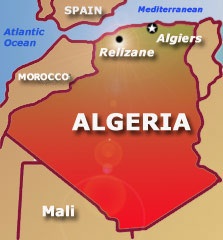
Algeria on the verge of closing down all Bars, banning all Alcohol

Muslim Prohibitionists winning over government leaders

From mychristianbloodspirit.com "2 Algerian Islamists call for bars to close" Oct. 5:

The two, Hachemi Sahnouni, who helped found the Islamic Salvation Front, and Abderazak Zeraoui Hamadache, said that alcohol is "perverting our youth and destroying our religious morals."

The call to close all bars recalls the period referred to as the "black decade" in the 1990s when extremists imposed their will on many villages and cities.

"We call on neighborhood committees to demand the definitive closing of bars and shops selling alcoholic beverages, forbidden by the religion of the prophet," the two said.

Reflecting the sensitivity of the situation, Prime Minister Ahmed Ouyahia ducked a question Friday about the growing fear of those selling alcoholic beverages, saying only that alcohol causes health problems.

Editor's note - Advancing worldwide prohibitionism from Muslims continues to receive zero coverage from so called "libertarian" media.

Immigrant groups in Switzerland push to abolish the Swiss flag: Offended by the Cross

Swiss libertarians say Hölle keine! (Hell No!)

Ivica Petrusic is vice president of Secondos Plus, one of the largest pro-immigrant organization in Switzerland. Petrusic is being quoted in the Swiss press calling for the replacement of the Swiss flag with a flag more representative of diversity.

From The Local, Switzerland News in English, Sept. 20, "SVP to immigrants: Don’t mess with the Swiss flag"

He said that the old tricolour “represented a progressive Switzerland, open to the world,” as opposed to the current banner which “no longer corresponds with today’s multicultural Switzerland” because the country “has great religious and cultural diversity.”

On rightist lawmaker, herself an immigrant from Slovokia expressed outrage at the proposal.

Yvette Estermann, an SVP lawmaker, said the statement made by Petrusic shows “disrespect” towards Switzerland. She wondered “if the next thing will be to abolish Christian churches” in the country.

“It is unacceptable that immigrants give orders to their host country on what it has to do,” she told The Local.

The Swiss Peoples' Party (SVP) is the right-libertarian party in Switzerland headed by Oskar Freysinger. The Party akin to the UK Independence Party, is pro-tax cuts, pro-Swiss sovereignty, and for shutting down immigration from countries whose values conflict with Swiss tolerance.

Swiss libertarians SVP.ch

Dear Steve, I am and many more like me are your one more thing.

Dear Steve,

I am and many more like me are your one more thing.

Rob from the nuclear medicine and molecular medicine podcast

We are rapidly moving to make neuro-endocrine pancreatic cancer a...

This podcast is for nuclear medicine professionals and PET professionals This is one of the worlds longest running medical podcasts. Direct link to itunes itunes link Please email suggestions for topics, offers of interviews, bouquets and brickbats. nucmedpodcast@gmail.com


Nice Vesta Anaglyph

Anaglyph image of the mountain/central complex in the south polar region. Click for larger. Image Credit: NASA/ JPL-Caltech/ UCLA/ MPS/ DLR/ IDA

This is a great image of Vesta’s south pole region!! You’ll need 3D glasses to really appreciate it though. The full sized image is available at the link below.

From the Dawn website:

This anaglyph image shows the topography of the mountain/ central complex in Vesta’s south polar region. When viewed correctly this image shows a 3D view of Vesta’s surface. This effect was achieved by superimposing two differently colored images with an offset to create depth. To view this image in 3D use red-green, or red-blue, glasses (left eye: red; right eye: green/ blue). The depth effect/ topography differences in this image were calculated from the shape model of Vesta. This image is centered on the south polar mountain/ central complex, which is a roughly circular topographic mound that is approximately 200km in diameter and has approximately 20km of relief from its base. Surrounding the mountain/ central complex is the south polar depression; the relationship between these structures, two of the most prominent Vestan features, is key to understanding the evolution of Vesta as a whole. Also well defined in this image is a large scarp roughly in the center of mountain/ central complex.

The framing camera (FC) instrument aboard NASA’s Dawn spacecraft obtained the images used to make this anaglyph on 17th and 20th August 2011. The distance from Dawn to the surface of Vesta was 2740km at this time. This image has a resolution of about 260 meters per pixel.
The Dawn mission to Vesta and Ceres is managed by NASA’s Jet Propulsion Laboratory, a division of the California Institute of Technology in Pasadena, for NASA’s Science Mission Directorate, Washington D.C.. UCLA is responsible for overall Dawn mission science. The Dawn framing cameras have been developed and built under the leadership of the Max Planck Institute for Solar System Research, Katlenburg-Lindau, Germany, with significant contributions by DLR German Aerospace Center, Institute of Planetary Research, Berlin, and in coordination with the Institute of Computer and Communication Network Engineering, Braunschweig. The Framing Camera project is funded by the Max Planck Society, DLR, and NASA/JPL.

ALMA’s First Light

ALMA looks at the Antennae Galaxies. Click for larger. Image: ESOGrat

The Antennae galaxies are a great choice for a first light picture.  I’ve been patiently waiting on this one and it looks like it was worth the wait.

Here’s the ESO press release (get larger versions of the image here too):

ALMA, the Atacama Large Millimetre/sub-millimetre Array), the most complex ground based telescope in existence, is officially open to astronomers and has produced its first image. This comes after more than a decade of design and construction involving technological and scientific expertise from countries across four continents, including the UK. The project is technologically state-of-the-art, with numerous individual components from all over the globe having been brought together to make ‘first science’ possible. The scale of this achievement is demonstrated by the fact that the number of observing proposals on ALMA has outweighed availability nine times over already setting a record for a telescope. In return for the UK’s investment in the project, UK scientists have access to ALMA through STFC’s subscription to the European Southern Observatory and the project has seen the UK’s technical capabilities and expertise strengthen both within academia and industry.

ALMA is a huge high-frequency observatory that will eventually comprise 66 individual telescopes that are combined electronically to simulate a telescope diameter of up to ’6km more than a thousand times the diameter of a single individual telescope within the array. It reveals a view of the Universe that cannot be seen at all by visible-light and infrared telescopes. It observes OElight’ emitted in the millimetre and submillimetre wavelength range, roughly one thousand times longer than visible-light wavelengths. Using these longer wavelengths allows astronomers to study extremely cold and visibly opaque objects in space — such as the dense clouds of cosmic dust and gas from which stars and planets form — as well as very distant objects from the early Universe.

“Even in this very early phase ALMA already outperforms all other submillimetre arrays. Reaching this milestone is a tribute to the impressive efforts of the many scientists and engineers in the ALMA partner regions around the world who made it possible,” said Tim de Zeeuw, Director General of ESO, the European partner in ALMA.

“I am not at all surprised to see the huge number of proposals to use ALMA which have been written by astronomers in the UK and throughout the world astronomical community. ALMA brings a completely new of the Universe and will revolutionise our understanding of our celestial origins. The excitement begins now!” said John Richer, UK Project Scientist for ALMA, based at the University of Cambridge.

UK involvement in ALMA includes STFC’s Rutherford Appleton Laboratory and UK Astronomy Technology Centre, the Cavendish Laboratory at the University of Cambridge, the University of Manchester and the University of Kent, all of whom played key roles in the design and construction of ALMA.

Science Minister David Willetts said, “The ALMA telescope is an incredibly impressive feat of science and engineering, and it’s fantastic that the UK has played such a significant role in its design and construction. Our involvement has ensured our leading researchers have access to the most state-of-the-art observation technology, keeping us at the cutting edge of astronomy research.”

John Richer said: “ALMA is an awe-inspiring piece of engineering: every aspect of it is state-of-the-art. For example, the antennas use innovative carbon fibre designs to keep their shapes precise to only a few microns, less than the width or a human hair, even in hostile weather conditions. The superconducting receivers have to amplify very high-frequency radio signals without adding too much noise. The central correlation computer has to process vast volumes of digital data from the receivers, a data rate that exceeds total internet traffic of the UK. And finally this all has to be done on a very remote site, deprived of oxygen due to its very ’7,000-feet altitude.”

Brian Ellison, UK Project Manager for ALMA said: “First science is a fantastic achievement for the project and also for UK scientists and technologists. The benefit to the UK is highly significant with the UK making major contributions to key ALMA infrastructure through the provision of services, hardware and software. What’s more, the technological expertise gained from ALMA construction is already proving hugely valuable in other areas of application such as Earth observation and imaging”.

The ALMA team has been busy testing the observatory’s systems over the past few months, in preparation for the first round of scientific observations, known as Early Science. One outcome is the first image published from ALMA, albeit from what is still very much a growing telescope. Most of the observations used to create this image of the Antennae Galaxies were made using only twelve antennas < far fewer than will be used for the first science observations < and with the antennas much closer together. Both of these factors make the new image just a taste of what is to come. As the observatory grows, the sharpness, speed, and quality of its observations will increase dramatically as more antennas become available and the array grows in size.

Gary Fuller, Principal Investigator at the UK ALMA Regional Centre Node, based at The University of Manchester added: “Projects like ALMA require an enormous amount of patience – many of us have been working on this for more than a decade. There have been many obstacles to be overcome, but I’ve no doubt that it will all be worth it – it’s great to see the first scientific observations beginning for astronomers from the UK and around the world.”

ALMA could accept only about a hundred or so projects for this first nine-month phase of Early Science. Nevertheless, over the last few months, keen astronomers from around the world have submitted over 900 proposals for observations. The successful projects were selected by international peer review involving 50 of the world’s leading astronomers.

What a Phone Can Do These Days

A couple of readers sent me links to a couple of different videos in past few days.  I’ll take them in order, one today and I think I’ll save the other until Sunday.

This one shows shows what a team of people including astrophysicist Dr. Joshua Peek can make a Sony Ericsson Xperia phone do when working in a collaborative way.  It’s just a a phone and to think not so long ago I had to actually DIAL a number and not only that if I had to DIAL a number on the same exchange I could just dial the last four digits.  How things have changed,  check it out:

Click here to view the embedded video.

Draconids Meteor Shower on Saturday

Comet 21P/Giacobini-Zinner from Kitt Peak. Image via NASA.

Wanted to give everybody a heads up about the Draconid meteor shower set to peak on October 8, 2011.

Every 6.6 years the inner solar system is visited by Comet 21P/Giacobini-Zinner and it looks like this year we could pass though the dust it leaves behind.

It looks like viewers in Europe are going to be best position as the best outbursts should be between 1900 and 2100 UTC (3:00 to 5:00 pm EDT) and the counts could be as high as 750 meteors per hour!!

Now while North America isn’t position extrodinarly well for the show, I would expect to see at least some activity in the dark hours before and after the peak predicted hours.  I will be outside watching under clear skies (YAY!) at around 04:00 and after 00:00 EDT.  I’ll let you know via an update to this post one way or another.

Click this NASA link for mroe details.

So, Who Wants To Be An Astronaut?

Guess who’s hiring for the next round of astronauts?  NASA, that’s who.  Take a look at this:

NASA To Seek Applicants For Next Astronaut Candidate Class

HOUSTON — In early November, NASA will seek applicants for its next class of astronaut candidates who will support long-duration missions to the International Space Station and future deep space exploration activities.

“For scientists, engineers and other professionals who have always dreamed of experiencing spaceflight, this is an exciting time to join the astronaut corps,” said Janet Kavandi, director of flight crew operations at the Johnson Space Center in Houston. “This next class will support missions to the station and will arrive via transportation systems now in development. They also will have the opportunity to participate in NASA’s continuing exploration programs that will include missions beyond low Earth orbit.”


Is that cool, or what?  Interested?

For more information, visit:

http://astronauts.nasa.gov/

A bachelor’s degree in engineering, science or math and three years of relevant professional experience are required in order to be considered. Typically, successful applicants have significant qualifications in engineering or science, or extensive experience flying high-performance jet-aircraft.

After applicant interviews and evaluations, NASA expects to announce the final selections in 2013, and training to begin that August.

Additional information about the Astronaut Candidate Program is available by calling the Astronaut Selection Office at 281-483-5907.


Haven’t you always wanted to be an astronaut?

NASA - Astronaut Bruce McCandless 02/28/84, during STS 41B

Can Naturalists Believe in Meaning? | Cosmic Variance

I have my answer (“yes, but not by finding meaning `out there’ in the world”), which I hope to write about more soon. In the meantime, listen to a great conversation between philosophers Owen Flanagan and Alex Rosenberg from Philosophy TV. “What there is, and all there is, are bosons and fermions.”

Both discussants have written really good books. Rosenberg recently came out with The Atheist’s Guide to Reality: Enjoying Life Without Illusions, while I very much enjoyed Flanagan’s earlier book The Really Hard Problem: Meaning in a Natural World.

Empirically, of course, naturalists often lead very enjoying and fulfilled lives. Here’s a great profile of newly minted Laureate Brian Schmidt, in his capacity as a cook and winemaker as well as an astronomer. And here’s Bob Kirshner, writing to the NYT from Friendship, Maine, about the meaning of dark energy.


Followup on the WSJ climate denial OpEd | Bad Astronomy

Yesterday, I wrote about an embarrassingly bad OpEd piece published in the Wall Street Journal, the purpose of which was to try to sow doubt and confusion over the reality of climate change. One of the writer’s main points was that if we can doubt Einstein (due to the recent much-argued-over faster-than-light neutrino experiment) we can doubt global warming.

Needless to say, this analogy was such a howler that many, many people besides just me took fingers to keyboard to lambaste Robert Bryce, the author of that OpEd. I think my favorite is by cartoonist Maki Naro, the first panel of which is here (click it to see the rest, which is great). Andrew Revkin, from the somewhat more trustworthy Gotham paper The New York Times, also weighed in, making several fair points about the piece.

This nonsense also started a wonderful Twitter hashtag, #WSJscience, which I am quite enjoying perusing. So much so that I even submitted my own:

If serious scientists can question relativity, then a fatally flawed WSJ OpEd implies the written word doesn’t exist. #WSJscience

See? False equivalancies are fun!

Tip o’ the retreating glacier to JenLucPiquant.


Jupiter and Ganymede in exquisite detail | Bad Astronomy

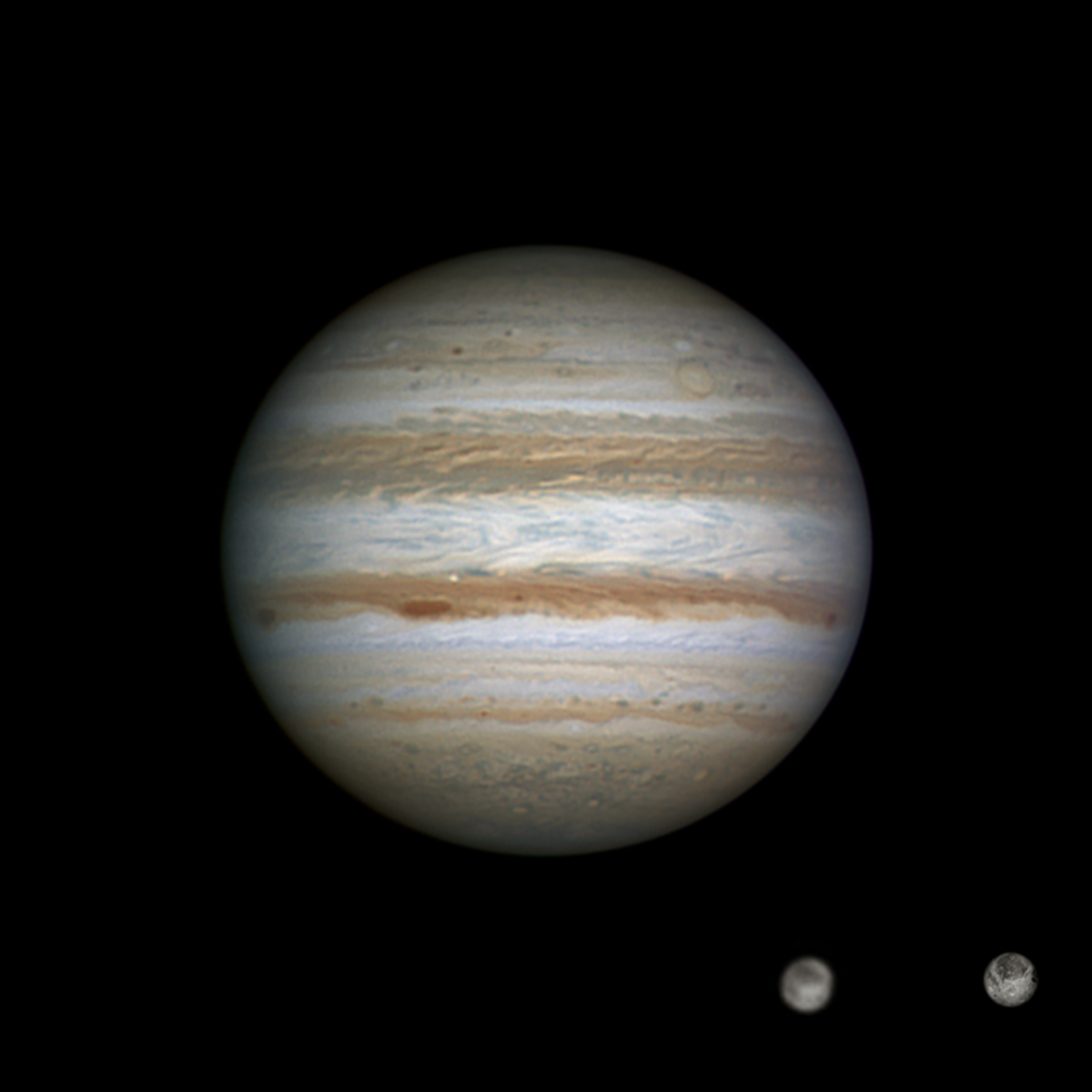
If you go outside shortly after sunset and face east, you’ll see a brilliant white "star" madly shining down on you. That’s no star: it’s Jupiter, king of the planets, the brightest object in the sky right now after the Sun and the Moon. Now is the best time to observe it, since the Earth is placed directly between the giant planet and the Sun, meaning we’re as close to it as we’ll get all year.

"Amateur" astronomer Emil Kraaikamp took advantage of the situation, and, with his friend Rik ter Horst — who crafted his own 40 cm (16") mirror telescope — took this amazing shot of Jupiter:

[Click to enjovianate.]

I found this image on the Astron/Jive image of the day page (you should really subscribe to their RSS feed), and Emil gave me permission to use it here. Isn’t it lovely? The level of detail is quite incredible, about as good as you can possibly get with a 40 cm ‘scope. They used a video camera to capture a lot of frames, and then pick the best ones to add together. Earth’s atmosphere roils and shifts, causing images to blur out, so this technique compensates for that — and Jupiter obliges by being very bright, allowing for lots of short exposures in rapid succession.

The little guy below Jupiter and to the right is the moon Ganymede, which, if Jupiter weren’t there, would be considered a planet in its own right. It’s the biggest moon in the solar system, and actually comfortably larger than Mercury — though also much less massive, because Mercury has lots of iron, while Ganymede is mostly rock and ice. It’s incredible that advances in technology have made it possible to capture such detail on an object 600 million km (360 million miles) away! The image on the right of Ganymede is a NASA map of the moon based on space probe images, showing that those features Emil and Rik captured are real.

Emil tells me it’s been cloudy where he is lately, which is too bad. It’s been touch-and-go here with the weather, but seeing this is making me think of hauling out my own ‘scope and taking a look. I should get on that before the snow starts to fall here in Boulder…

In the meantime, check out the Related posts links below to see more of Emil’s amazing work.


Related posts:

- Jupiter rolls into view
- Saturn rages from a billion kilometers away
- The blue clouds of the red planet [Must see animation of clouds on Mars!]


Jobs Lived 8 Years with Pancreatic Cancer, Steinman for 4, But It Was Steinman Who Beat the Odds. Here’s Why. | 80beats

spacing is important

Steve Jobs and new Nobelist Ralph Steinman both died of pancreatic cancer, a killer that’s hard to spot until it’s very far advanced. But fundamental differences in their diseases made Steinman’s survival more miraculous than Jobs’. Katherine Harmon at Scientific American has a great explanation of this, starting with the fact that the pancreas is made up of two different kinds of cells:

The pancreas itself is essentially two different organs, which means two distinct kinds of tissue—and two very different types of cancer, points out [Leonard Saltz, acting chief of the gastrointestinal oncology service at Memorial Sloan-Kettering Cancer Center]. The most common kind of pancreatic cancer[s] [the kind Steinman had] originate in what is known as the exocrine portion of the pancreas. This is the main mass of the organ, which makes digestive enzymes that get shuttled to the gastrointestinal tract via specialized ducts.

“Scattered in that larger organ are thousands of tiny islands,” Satlz explains. “These are islands of endocrine tissue,” which makes hormones that are secreted into the blood. It was a cancer of these islet cells that Jobs had.

For people with Jobs’ cancer, which is quite rare, survival is measured in years. For those with Steinman’s cancer, it’s measured in months.

Steinman’s survival for four years after diagnosis may be due in part to his use of experimental immunotherapies, which were being developed by his colleagues and sometimes incorporated Steinman’s own discoveries. Jobs’ liver transplant to replace an organ riddled with metastases, on the other hand, may or may not have helped him, says Saltz—having to take immunosuppressants to prevent rejection of the new organ weakens the immune system’s abilities to fight off the cancer.

Read more at Scientific American.

Images courtesy of mattbuchanan / flickr and Rockefeller University


A Fold in the Brain is Linked to Keeping Reality and Imagination Separate, Study Finds | 80beats

What’s the News: One of memory’s big jobs is to keep straight what actually happened versus what we imagined: whether we said something out loud or to ourselves, whether we locked the door behind us or just thought about locking the door. That ability, a new study found, is linked to the presence of a small fold in the front of the brain, which some people have and others don’t—a finding that could help researchers better understand not only healthy memory, but disorders like schizophrenia in which the line between the real and the imagined is blurred.


Scans of a brain with a distinctive paracingulate sulcus (left, marked by arrow) and without one (right)

How the Heck:

  • The researchers looked at MRI brain scans of a large group of healthy adults. In particular, they were looking for the paracingulate sulcus (PCS), a fold near the front of the brain. There’s a lot of variability in the PCS: some people have quite distinctive folds, others have barely any. It’s in a part of the brain known to be important in keeping track of reality, which is why the researchers chose to study it. Of the 53 people selected for the study, some had this fold on both sides of their brain, some had it on one side, and some had no fold.
  • The participants saw some full well-known word pairs (“Jekyll and Hyde”) and some half pairs (“Jekyll and ?”). If they only saw half of a pair, they were asked to imagine the other half (“Hyde”). After each pair or half pair, either the participant or the experimenter said the whole pair aloud.
  • Once they’d seen all the pairs, the participants were asked two questions about each phrase: Did you see both words of the pair, or just one? And who said the phrase aloud, you or the experimenter?
  • People who didn’t have the fold on either side of their brains did worse on both questions—remembering if something was real or imagined, and remembering who’d done something—than people whose brains had the fold. But they felt as confident in their answers, meaning they didn’t realize they’d been mixing up internal and external events.

What’s the Context:

  • Poor reality monitoring—not clearly remembering whether something was real or imagined—could play a role in diseases such as schizophrenia. Schizophrenics often report hallucinations, like hearing a voice when no one’s speaking. ”Difficulty distinguishing real from imagined information might be an explanation for such hallucinations. For example, the person might imagine the voice but misattribute it as being real,” explained lead researcher Jon Simons in a prepared statement.
  • Earlier studies have shown that people with schizophrenia frequently have smaller or no PCS, suggesting a lack of this brain structure—and the associated difficulties with reality monitoring—could play a role in the disease, Simons said.

Not So Fast: The study only shows that the PCS and reality monitoring are linked, not that the presence or absence of the PCS is what causes some people to be better than others at this sort of memory task. It could be that another factor in brain development causes both small PCS and poor reality monitoring, for instance.

The Future Holds: The research team is now planning to study whether these findings hold true for people suffering with schizophrenia, by looking at whether schizophrenics with little to no fold have more hallucinations that participants with a clear fold.

Reference: Marie Buda, Alex Fornito, Zara M. Bergström, and Jon S. Simons. “A Specific Brain Structural Basis for Individual Differences in Reality Monitoring.” Journal of Neuroscience, October 5, 2011. DOI: 10.1523/JNEUROSCI.3595-11.2011

Image: Journal of Neuroscience, Buda et al.