FREE CAP PHC Webinar Today: Validating Whole Slide Imaging Systems for Diagnostic Use in Pathology

This is your last chance to sign up for today’ free webinar in the Personalized Health Care (PHC) series: Validating Whole Slide Imaging Systems for Diagnostic Use in Pathology. If you’ve already registered, please pass this along to a colleague!

Validating Whole Slide Imaging Systems for Diagnostic Use in Pathology
FREE PHC Webinar
Wednesday, October 12, 2011
11:00 AM – Noon (CDT)
Speaker: Liron Pantanowitz MD, FCAP

Validation of WSI is crucial to ensure that diagnostic performance based on digitized slides is at least equivalent to that of glass slides and light microscopy. The CAP Pathology and Laboratory Quality Center convened a non-vendor panel from North America with expertise in digital pathology in order to develop recommendations for validating WSI systems.

This webinar will cover the background rationale and supporting data used to develop 13 recommendations formulated by the panel. The final result of this effort is intended to improve the clinical use of WSI technology in pathology by providing assurance that these digital tools are being properly used for their intended clinical use, thereby reducing the potential risk of misdiagnosis attributed to this technology.

Register now!


Source:
http://feeds.feedburner.com/DigitalPathologyBlog

Definiens Releases Pioneering Product Portfolio for Quantitative Digital Pathology and Biomarker Research

Munich, Germany, October 12, 2011 / B3C newswire / - Definiens®, the leading Health Image Intelligence™ company, today announced the release of its new Quantitative Digital Pathology portfolio, designed to advance translational research in pathology, specifically in biomarker development. The new portfolio will offer updated versions of Definiens Tissue Studio®, Definiens Developer XD™ as well as the introduction of a novel component, Definiens Image Miner™.

The technology in Definiens’ recently released product suite will provide high accuracy in automatically identifying relevant structures of interest and specific morphology in histology, resulting in a detailed phenotypic fingerprint and biomarker expression profile on a cell-by-cell basis. The large set of descriptors can be correlated against therapy response or patient outcome with the goal of identifying new types of biomarkers of predictive or prognostic value.

Definiens Image Miner™ 1, the novel technology component in this product portfolio, closely integrates data mining with image analysis to accelerate biomarker research. The data mining functionality is based on the same revolutionary Cognition Network Technology used in Definiens’ well-established image analysis solutions. Definiens Image Miner™ 1 provides a substantial productivity increase when profiling tissue probes for clinically or diagnostically relevant differences in morphology or biomarker expression. Development and quality control are supported by seamless links between data points and the visual inspections of associated regions in the tissue.

“We expect the tight integration of our new data-mining engine with the significantly updated image analysis solutions to substantially increase productivity and assay quality in tissue-based biomarker development,” says Dr. Martin Baatz, Vice President of Marketing at Definiens. “We consider this a major step on the way to turning pathology into a quantitative discipline.”

Also included in the new portfolio is Definiens Developer XD™ 2, the most powerful development environment for automated image analysis that addresses a wide scope of functions in biomedical image analysis with unprecedented depth and accuracy. Developer XD™ 2 will be the solution of choice for highly advanced or customized analysis tasks of digital tissue slides. This updated version addresses a series of requirements suggested by the user community including very large data processing and machine learning functionality.

The highly popular product of the suite is Definiens Tissue Studio® 3, which is an updated version of the company’s leading Image Analysis Solution for Quantitative Digital Pathology. It combines highly detailed quantification of tissue specimen with a straightforward and fast out-of-the-box configuration workflow. New features include an improved detection of regions of interest, classification of nuclear morphology and an angiogenesis module.

After exploring the new Definiens Tissue Studio® 3 during the early access program, Mark Lloyd, Supervisor of Analytical Microscopy Core Facility at Moffitt Cancer Center, says: “I can be difficult to please regarding image analysis of histological samples, but this is the best commercial product I have used to date. This includes workflow and usability, as well as function and flexibility.” And Dr. Tom Nifong, VP CLIA Services at Metamark Genetics, adds: “The Composer Technology for automatic detection of regions of interest performed great. It was able to identify tumor, stroma and artifacts in my fluorescence samples. I was really impressed by the improvement in accuracy and speed of the nucleus detection. Fantastic job!”

For more information about the new products, please visit quantitative-digital-pathology.definiens.com or register for the launch webinar. The products will also be presented at the upcoming International Definiens Symposium at the Moffitt Cancer Center, FL, Oct. 17 and 18.


Link to the press release


  Tweet this press release (URL will be shortened by Twitter)


Source:
http://feeds.feedburner.com/DigitalPathologyBlog

HistoRx Earns Two Additional Patents on Standardization of Results from Digital Pathology Instruments

BRANFORD, Conn., Oct. 6, 2011 /PRNewswire/ -- HistoRx, the leader in quantitative immunohistochemistry, advances its proprietary position in digital pathology through the recent issuance of US patents covering key features necessary for achievement of reproducible, standardized image analysis results.  The U.S. Patent and Trademark Office has granted two new patents protecting the company's methods for standardization of digital microscopy instruments, methods required to generate high-quality reproducible clinical diagnostic data that precisely relates to biomarker concentrations in tissue sections.

For patient tissue specimens stained for a biomarker such as HER2, HistoRx believes that physicians and patients expect the same quantitative result regardless of the digital microscopy instrument used.  To achieve this, HistoRx evaluated sources of variability in digital scanning microscopy instrumentation that affect results.  One source of variability is the light source; a second is the path traveled by the light through each instrument.  By correcting for each of these, HistoRx achieved exceptionally high levels of reproducibility for an assay previously thought to be incapable of true standardization: with AQUA® technology, the same slide of breast cancer specimens stained for HER2 analyzed across five instruments standardized by this method attained a coefficient of variance of less than 5% (where typical variances are ~20%).

"These patents reinforce the value of HistoRx's unique approach to achieving objectivity and reproducibility in anatomic pathology," said Mark Gustavson, Ph.D., Director of Operations at HistoRx and one of the inventors.  "You cannot have clinical accuracy without analytical precision."

US Patent 7,978,258, issued to HistoRx on July 12, 2011, is entitled "Automatic Exposure Time Selection for Imaging Tissue" and pertains to methods for determining appropriate exposure time for acquiring digital images intended for image analysis to generate quantitative results.  Exposure times are most commonly determined to optimize contrast and visual appeal of the image, and may be determined 'by eye.'  The human eye is a poor judge of intensity, and images generated by conventionally determined exposure times are commonly too overexposed for generating quantitative results.  The patented methods automatically determine the appropriate exposure time to maximize for a broad range of pixel intensities in the image, thereby maximizing the dynamic range of quantitative measurements achievable from subsequent image analysis.

US Patent 8,027,030, issued to HistoRx on September 26, 2011, is entitled "Methods and System for Standardizing Microscope Systems," and pertains to hardware that can be inserted into the digital imaging fluorescent microscopy system, similar to filter cubes used in fluorescence microscopy, and provides for the monitoring of the light source and its fluctuation.  

AQUA technology is an automated, quantitative IHC testing method that enables measurement of protein biomarkers in tissue as an aid to a pathologist's diagnosis.  Such precise determination of first, the location within the tumor cell and second, the amount in each location is not possible with conventional testing methods, such as standard immunohistochemistry (IHC).  AQUA analysis is used in cancer research by twenty leading academic centers worldwide, is part of the clinical development plans for more than ten drug candidates from major pharma companies, and has been cited in more than 90 peer-reviewed publications.  The first use of AQUA technology in the clinical diagnostic setting occurred in 2010 with the launch by Genoptix Inc. of diagnostic tests based on AQUA technology licensed from HistoRx.  AQUA technology is currently available on the ScanScope FL™ from Aperio and will be available later this year on the Vectra™ system from Caliper Life Sciences.

About HistoRx, Inc.

HistoRx, Inc. is the leader in quantitative immunohistochemistry and a leading developer of tissue-based diagnostic solutions to advance individualized patient care.  The company's products and services are based on proprietary analysis of tissue biomarkers using AQUA® technology.  AQUA® technology is the only platform capable of precisely measuring protein biomarker concentration with sub-cellular resolution in tissue sections, enabling fully objective, standardized, reproducible, and automated analysis to guide drug development and therapeutic decision-making.  HistoRx is commercializing a pipeline of proprietary diagnostic products targeting improved treatment decision-making and patient outcomes in cancer care.  For more information, please visit http://www.historx.com.


SOURCE HistoRx, Inc.


Source:
http://feeds.feedburner.com/DigitalPathologyBlog

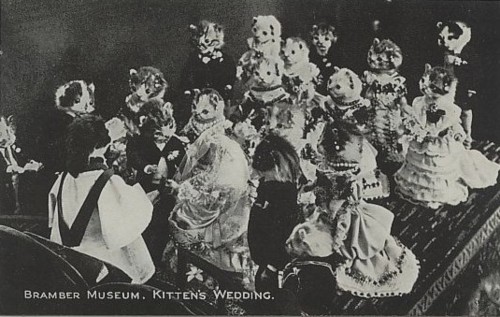
Postcards of the Taxidermic Tableaux of Walter Potter


3 postcards of the taxidermic tableaux of Herr Walter Potter, found on the Wunderkammer Tumblr.

On a related note, Morbid Anatomy now has in stock several more copies of Pat Morris' definitive illustrated books on Walter Potter and the history of taxidermy. More on those books here; you can order copies of them by clicking here.

Source:
http://morbidanatomy.blogspot.com/feeds/posts/default?alt=rss

"The Wellcome at 75," Financial Times Magazine, Article and Slide Shows


...you can’t grasp the Wellcome collection unless you can see the poetry in it. But until quite recently, the irrepressible curiosities and juxtapositions that make the collection captivating were regarded as an irrelevance, an embarrassment and a confounded nuisance to the people charged with putting it in order. When Henry Wellcome displayed his collection for the first time, he decreed that the museum should be “strictly professional and scientific in character”. His collection has resisted successfully ever since...

From the article "The Wellcome at 75" by Marek Kohn in the Financial Times magazine. You can read the full article--from which the above was excerpted--by clicking here. You can view the complete slideshows--from which the above images are drawn--by clicking here and here. Click on images to see much larger images.

Thanks to the afore mentioned Ross Macfarlane for bringing this article to my attention!

Image captions top to bottom:

  1. Models of human skulls in ivory, silver and wood
  2. A pair of phrenological busts, 1821
  3. Tattoos. Wellcome acquired 300 tattoos collected by a Paris surgeon who was active in the late 19th century. They are kept in boxes for fear that they were treated with toxic chemicals
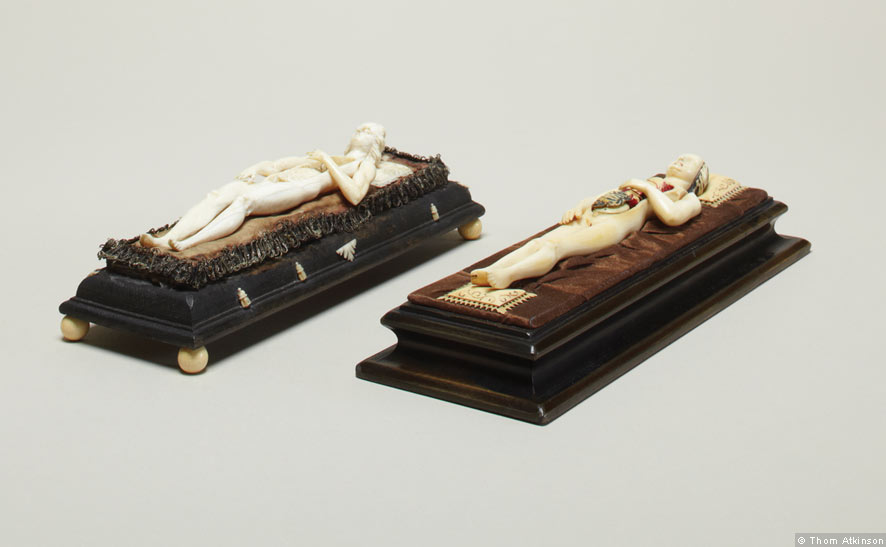
  4. Ivory anatomical figures, 17th-18th century
  5. Roman votives. Romans would offer models of afflicted body parts to a god to beg or give thanks for cures. The model on the left is also Roman but was not one of these votive offerings. It came from Pompeii, where it may have adorned a shop front
  6. Wax model of decomposing body in coffin, Italian, late 1700s
  7. Plaster death mask of Victorian murderer James Bloomfield Rush
  8. Stuffed coiled snake, 1897
  9. Chinese porcelain fruit containing couple in sexual foreplay

Source:
http://morbidanatomy.blogspot.com/feeds/posts/default?alt=rss

"From Blue Beads to Hair Sandwiches: Edward Lovett's Folklore Collection," Lecture by Ross MacFarlane, The Wellcome Collection, November 10


Oh, if only I lived in London... November 10th at The Wellcome Collection:

From Blue Beads to Hair Sandwiches: Edward Lovett's Folklore Collection
Speaker: Ross MacFarlane, Research Officer, Wellcome Library.
Date: 10 November 2011, 15.00 - 16.00
Cost: This event is FREE. Reserve 90 minutes prior to start.

Explore the world of Edward Lovett, whose collection of amulets and curious objects lies at the heart of the 'Charmed Life' exhibition, through the Wellcome Library's archives.

You can pick up your free ticket for this event from the Information Point from 13.30 on the day. Tickets are issued on a first-come, first-served basis.

Please put coats and bags in the cloakroom to the rear of the foyer before meeting your guide, on the third floor, ten minutes before the event begins.

You can find out more by clicking here.

Source:
http://morbidanatomy.blogspot.com/feeds/posts/default?alt=rss

Morbid Anatomy Library and Observatory, Open Studios, This Weekend 12-6!


This weekend, October 15th and 16th, please join the Morbid Anatomy Library and Observatory as we join dozens of other Gowanus-based galleries and artist studios in opening our spaces to the public for the Gowanus Artists Studio Tour, or "A.G.A.S.T."

Following are the full details: Hope to see you there!

Gowanus Artists Studio Tour (A.G.A.S.T.)
Saturday October 15th and Sunday October 16th 12-6
543 Union Street at Nevins, Brooklyn
Free and Open to the Public

Directions: Enter the Morbid Anatomy Library and Observatory via Proteus Gowanus Gallery

R or M train to Union Street in Brooklyn: Walk two long blocks on Union (towards the Gowanus Canal) to Nevins Street. 543 Union Street is the large red brick building on right. Go right on Nevins and left down alley through large black gates. Gallery is the second door on the left.

F or G train to Carroll Street: Walk one block to Union. Turn right, walk two long blocks on Union towards the Gowanus Canal, cross the bridge, take left on Nevins, go down the alley to the second door on the left.

You can find out more information about A.G.A.S.T., and get a full list of participants, by clicking here. You can find out more about Observatory and the exhibition now on view by clicking here.

Photo of The Morbid Anatomy Library by Shannon Taggart.

Source:
http://morbidanatomy.blogspot.com/feeds/posts/default?alt=rss

The Midnight Archive Episode 4: The Automata

The Midnight Archive--the new web-based video documentary series "centered around the esoteric and always exotic personalities that spring from Observatory"--has just launched a fantastic new episode, this one based the amazing Guinness Collection of Automata at the Morris Museum; you can view it above by clicking play.

Here is what Ronni Thomas, the film maker behind the series, has to say about this particular episode:

Tucked away, in a quiet and pleasant suberb of New Jersey, there exists one of the most fascinating collections of artistic engineering ever collected. The collection belonged to Murtogh Guinness, of the Guinness brewing company. Its contents are, what I can only describe as the early days of robotics, engineered for our ancestor’s entertainment. Dolls that perform incredible tasks, full orchestras in the middle of your parlor, and my favorite of course, a banjo that plays itself. The collection is maintained and managed by Jere Ryder who began his interest at a very early age. He is now entrusted to the collection at the Morris Museum located in Morristown New Jersey. Keep your eyes on the Brooklyn Observatory as they occasionally take a field trip out. The museum is located at 6 Normandy Heights Road Morristown, NJ and well worth the trip if you are nearby - Jere is not only very knowledgeable on the subject but also a fantastic tour guide... Thanks a ton, Mr. Ryder, we’ll see you soon no doubt!

For more on the series, to see former episodes, or to sign up for the mailing list so as to be alerted to future uploads, visit The Midnight Archive website by clicking here. You can also "like" it on Facebook--and thus be alerted--by clicking here. To find out more about Observatory, click here. To find out more about the Guinness collection at the Morris Museum, click here. There is also a wonderful, highly illustrated catalog for this exhibition, which Morbid Anatomy distributes. More on that here.

PS. To see brand new episodes of The Midnight Archive on the big screen and to meet the filmmaker, please come to the Observatory Halloween/Day of the Dead/Screening party! Click here for more on that.

Source:
http://morbidanatomy.blogspot.com/feeds/posts/default?alt=rss

Wellcome Object of the Month: Hair Mourning Jewelry

It is easy to miss these four little brooches, tucked away as they are in the far corner of Medicine Man alongside Egyptian canopic jars, mortuary crosses and even a shrunken head. But these examples of European mourning jewellery demonstrate an ambiguity at the heart of Henry Wellcome’s collection – the potential for the human subject to become material object after death.

Medicine Man is full of curios serving as literal or metaphorical extensions of the human body, and, like most medical collections, also features artefacts formerly part of the body itself. These brooches are no exception, each containing samples of human hair, neatly arranged and set behind glass.

Hair is certainly a material that occupies the narrow ground between person and thing – in life as much as death. Although it is ‘dead’ matter (as only the follicle contains living cells), once separated from the body, our hair is capable of outlasting us. These qualities of durability, alongside the fact that it is easily removed from the body and can be manipulated into almost any shape, led to the widespread use of hair in the 18th and 19th centuries as a tangible way to remember an absent loved one. Encased in a locket, ring or brooch, a lock of hair stood in for the recently departed, whose memory, it was hoped, would endure for as long as the jewellery itself.

But detached hair, alienated from its natural location on the body, can also provoke disgust – a reaction any of us who have found a stray hair in our food can identify with. The anthropologist Mary Douglas proposed that any ‘matter out of place’, including hair, becomes dirt, posing the threat of chaos and disorder unless carefully gathered and contained (1966)...

Read the full story from which the above image and text are excerpted on the Wellcome Collection blog by clicking here.

Image: Mourning brooches containing the hair of a deceased relative. Wellcome Images

Source:
http://morbidanatomy.blogspot.com/feeds/posts/default?alt=rss

"The Empire of Death: Spectacular Ossuaries and Relics in the 16th and 17th Centuries," Lecture and Book Signing: This Thursday at Observatory!


This Thursday at Observatory! Hope very much to see you there,.

The Empire of Death: Spectacular Ossuaries and Relics in the 16th and 17th Centuries
Lecture and book signing with Dr. Paul Koudounaris, author of The Empire of Death
Date: This Thursday, October 13
Time: 8:00 PM
Admission: $5
Presented by Morbid Anatomy and Atlas Obscura
** Books will be available for sale and signing

For five years, Dr. Paul Koudounaris has traveled the world to document a largely overlooked history: the decoration of religious shrines with human bones and remains in the sixteenth and seventeenth centuries. His newly published book The Empire of Death (Thames and Hudson) presents a collection of Koudounaris' photographs and texts chronicling these incredible sites, many of which are not open to the public and have never before been photographed.

The research for this unique book took the author to over 70 preserved charnel houses and skeletal shrines on four continents to document the once common use of human remains for the veneration of the dead in Christian culture. Among other tribulations, in the course of completing his research, the author was pursued by malevolent spirits, handcuffed to a table in a striptease bar by a prurient monk, forced to undergo a religious pilgrimage and exorcism, and arrested by the Austrian police.

Tonight, join Dr. Koudounarishis for an illustrated talk in which he will provide historical insights into the sites and people who created these marvelous objects and spaces, a discussion of the veneration of the dead in Christian culture, and fantastical travel anecdotes, all illustrated by his breathtaking photographs of these unforgettable artifacts.

Paul Koudounaris received a PhD in Art History from UCLA in 2006, which a specialty in the Baroque. He has taught at major universities in the Los Angeles area, and has written for dozens of magazines and newspapers in several countries, specializing in articles about veneration of the dead.

You can find out more--and get directions to Observatory--by clicking here. To find out more about the beautifully designed and richly illustrated book--and order a copy for yourself!--click here.

All Photo: © Dr. Paul Koudounaris, from his book The Empire of Death

Source:
http://morbidanatomy.blogspot.com/feeds/posts/default?alt=rss

Successful stars talk dead stars | Bad Astronomy

I somehow missed it when it came out, but the folks at IRrelevant Astronomy have a great video about how stars die, and it has Sean Astin (Samwise!) and Sandeep Parikh (Zaboo!).

IRrelevant Astronomy is a very funny web series about infrared astronomy put together by folks at Spitzer Space Telescope, and they’re all pretty good. This one is a followup for great video about galaxies featuring Felicia Day. They also have a couple with a guy named Wil Wheaton. Never heard of him myself, but he has promise as an actor, I think.

If you have the time, you should watch ‘em all. They’re funny, and well done, and you just might learn something.

Tip o’ the beryllium mirror to Jennifer Ouellette on Google+.


Related posts:

- Felicia Day collides galaxies
- Astronomy Veronica anemone
- IRrelevant Astronomy: Dr. Wheaton edition
- Robot Wil Wheaton takes over the Universe


Wisconsin man hit in the head with a tire iron for "insulting" Islam

LR FOLLOW-UP

From Eric Dondero:

The Blaze has further details on a story we first linked to last week here at LR.

One witness told a Wausau Daily Herald reporter that he saw the suspect pull up in his vehicle, get out of the car and then accuse the victim of criticizing his Islamic faith. According to the witness, when approached, the victim denied the charge. Unfortunately, that did little to stop the assailant from unleashing his fury.

The suspect purportedly grabbed a tire iron, hit the man in the head, punched him, then hopped back into his vehicle and sped off. A second witness, Bakonn Jackson, confirms these claims. In describing the scenario, Jackson said, ”it is unusual when an argument ends with the use of a tire iron, but it’s not unheard of.”

The perpetrator is still at large.

Photo credit - Wassau Daily Herald