The high cost of healthcare in America (infographic)

The high cost of healthcare in America (infographic) - click on the image to see the larger-size file. The site hosting the infographic, MedicalBillingandCoding.org, is one of the URL-grabbing portals that redirects to other sites, so be careful what you click there once you go beyond the image.

Why Your Stitches Cost $1,500 - Part One

Posted at Clinical Cases and Images. Stay updated and subscribe, follow us on Twitter and connect on Facebook.


Statins slightly increase risk of cataracts, liver dysfunction, kidney failure and muscle weakness

Statins do NOT prevent a long list of diseases

Statins were not significantly associated with risk of Parkinson’s disease, rheumatoid arthritis, venous thromboembolism, dementia, osteoporotic fracture, gastric cancer, colon cancer, lung cancer, melanoma, renal cancer, breast cancer, or prostate cancer.

Statins may decrease risk of esophageal cancer

Statin use was associated with decreased risks of oesophageal cancer.

Statins slightly increase the risk of liver dysfunction, kidney failure, muscle weakness and cataracts

Statin use was associated with increased risks of moderate or serious liver dysfunction, acute renal failure, moderate or serious myopathy, and cataract.

Is the risk the same with all statins?

Adverse effects were similar across statin types for each outcome except liver dysfunction where risks were highest for fluvastatin.

A dose-response effect was apparent for acute renal failure and liver dysfunction. All increased risks persisted during treatment and were highest in the first year.

How long does the risk last?

After stopping treatment the risk of cataract returned to normal within a year in men and women. Risk of acute renal failure returned to normal within 1-3 years in men and women, and liver dysfunction within 1-3 years in women and from three years in men.

What was the NNT and NNH?

Based on the 20% threshold for cardiovascular risk, for women the NNT with any statin to prevent one case of cardiovascular disease over five years was 37 and for oesophageal cancer was 1266 and for men the respective values were 33 and 1082.

In women the NNH for an additional case of acute renal failure over five years was 434, of moderate or severe myopathy was 259, of moderate or severe liver dysfunction was 136, and of cataract was 33. Overall, the NNHs and NNTs for men were similar to those for women, except for myopathy where the NNH was 91.

Conclusion

Claims of unintended benefits of statins, except for oesophageal cancer, remain unsubstantiated, although potential adverse effects at population level were confirmed and quantified.

Interestingly, the BMJ abstract did not mention increased diabetes risk that was reported in a previous study published in The Lancet.

References:
Balancing the intended and unintended effects of statins. BMJ 2010; 340:c2240 doi: 10.1136/bmj.c2240 (Published 20 May 2010).
Image source: Simvastatin. Wikipedia, public domain.

Posted at Clinical Cases and Images. Stay updated and subscribe, follow us on Twitter and connect on Facebook.


Effect of deployment on mental health of soldiers: common disorders and alcohol misuse more frequent than PTSD

This Lancet study examined the consequences of deployment to Iraq and Afghanistan on the mental health of UK armed forces from 2003 to 2009.

9990 (56%) participants completed the study questionnaire (roughly 8000 regulars, 1700 reservists).

The prevalence was:

- 19·7% for symptoms of common mental disorders
- 13% for alcohol misuse
- 4% for post-traumatic stress disorder (PTSD)

Deployment to Iraq or Afghanistan was significantly associated with alcohol misuse for regulars (odds ratio 1·22) and with post-traumatic stress disorder (PTSD) for reservists (2·83)

Symptoms of common mental disorders and alcohol misuse remain the most frequently reported mental disorders in UK armed forces personnel, whereas the prevalence of post-traumatic stress disorder (PTSD) was low.

References:
Image source: The Los Angeles Times.

Posted at Clinical Cases and Images. Stay updated and subscribe, follow us on Twitter and connect on Facebook.


Effect of 16-Hour Duty Periods on Patient Care and Resident Education

Dr. Amy Oxentenko details a study appearing in the March 2011 issue of Mayo Clinic Proceedings (available at: http://www.mayoclinicproceedings.com) that looked at the effects of 16-hour duty periods for residents, and the impact of reduced shift length on:

- patient care metrics
- education
- transitions of care
- work hours
- resident satisfaction

Posted at Clinical Cases and Images. Stay updated and subscribe, follow us on Twitter and connect on Facebook.


Decompression illness – Lancet review

Decompression illness is caused by intravascular or extravascular bubbles that are formed as a result of reduction in environmental pressure (decompression).

Types of decompression illness

The term decompression illness covers 2 entities:

- arterial gas embolism, in which alveolar gas or venous gas emboli (via cardiac shunts or via pulmonary vessels) are introduced into the arterial circulation

- decompression sickness, which is caused by in-situ bubble formation from dissolved inert gas

Both syndromes can occur in divers, compressed air workers, aviators, and astronauts, but arterial gas embolism also arises from iatrogenic causes unrelated to decompression.

Risk of decompression illness is affected by immersion, exercise, and heat or cold.

Clinical features of decompression illness

Manifestations of this condition include a wide range of symptoms and signs:

- itching and minor pain
- neurological symptoms
- cardiac collapse
- death

Treatment of decompression illness

First-aid treatment is 100% oxygen. Definitive treatment is recompression to increased pressure, breathing 100% oxygen.

Adjunctive treatments include fluid administration and prophylaxis against venous thromboembolism in paralysed patients.

Prognosis of decompression illness

Treatment is effective in most cases although residual deficits can remain in serious cases, even after several recompressions.

References:
Decompression illness. The Lancet, Volume 377, Issue 9760, Pages 153 - 164, 8 January 2011.
Image source: OpenClipArt.org, public domain.

Posted at Clinical Cases and Images. Stay updated and subscribe, follow us on Twitter and connect on Facebook.


Aspirin 75 mg daily reduces incidence and mortality due to colorectal cancer

High-dose aspirin (?500 mg daily) reduces long-term incidence of colorectal cancer, but adverse effects (bleeding) might limit its potential for long-term prevention. The long-term effectiveness of lower doses (75-300 mg daily) is unknown. This study in The Lancet assessed the effects of aspirin on incidence and mortality due to colorectal cancer over 20 years.

In the four trials of aspirin versus control (mean duration of treatment 6 years), 2·8% of 14,000 patients had colorectal cancer during a follow-up of 18 years.

Aspirin reduced the 20-year risk of colon cancer (incidence hazard ratio [HR] 0·76, but not rectal cancer (0·90).

Where subsite data were available, aspirin reduced risk of cancer of the proximal colon (0·45), but not the distal colon (1·10). Benefit increased with duration of treatment - aspirin taken for 5 years or longer reduced risk of proximal colon cancer by 70% and also reduced risk of rectal cancer (0·58).

There was no increase in benefit at doses of aspirin greater than 75 mg daily. However, risk of fatal colorectal cancer was higher on 30 mg versus 283 mg daily.

Aspirin taken for several years at doses of at least 75 mg daily reduced long-term incidence and mortality due to colorectal cancer. Benefit was greatest for cancers of the proximal colon, which are not otherwise prevented effectively by screening with sigmoidoscopy or colonoscopy.

References:
Long-term effect of aspirin on colorectal cancer incidence and mortality: 20-year follow-up of five randomised trials. The Lancet, Volume 376, Issue 9754, Pages 1741 - 1750, 20 November 2010.

Image source: Colon (anatomy), Wikipedia, public domain.

Posted at Clinical Cases and Images. Stay updated and subscribe, follow us on Twitter and connect on Facebook.


10 Ways to Increase Your Physical Activity

Some helpful tips from one of the PLoS blogs, Obesity Panacea:

1. Take the stairs as often as possible.
2. Drink plenty of water.
3. Park as far from the front door as possible.
4. Clean your home regularly.
5. Gardening and yardwork.
6. Disconnect your cable for the summer.
7. Buy a pedometer.
8. Use active transportation and public transit.
9. Have “walk-meetings”.
10. Go for a family walk after dinner.

"Health Promotion" video: Benefits of exercise:

Telomeres are the chromosome tips which shorten each time a cell divides, making them a possible marker of aging. Exercise delays telomere shortening, and potentially slows the aging process in humans. A study of 2400 twins showed that physically active people had longer telomeres than sedentary people. According to the authors, this provides a powerful message that could be used by clinicians to promote the potentially antiaging effect of regular exercise.


Human chromosomes (grey) capped by telomeres (white). Image source: Wikipedia, public

domain.

Posted at Clinical Cases and Images. Stay updated and subscribe, follow us on Twitter and connect on Facebook.


Gout update: New drugs for an old disease

Febuxostat is a non-purine-analogue inhibitor of xanthine oxidase that opened a new era in the treatment of gout.

Modified uricases

The use of modified uricases to rapidly reduce serum urate concentrations in patients with otherwise untreatable gout is progressing. Pegloticase, a pegylated uricase, is in development.

Drugs in development
Transport of uric acid in the renal proximal tubule and the inflammatory response to monosodium urate crystals (shown above) are targets for potential new treatments.

Several pipeline drugs for gout related to the targets above include:

- selective uricosuric drug RDEA594
- various interleukin-1 inhibitors

References:
Gout therapeutics: new drugs for an old disease. The Lancet, Volume 377, Issue 9760, Pages 165 - 177, 8 January 2011.

Image source: Spiked rods of uric acid (MSU) crystals from a synovial fluid sample photographed under a microscope with polarized light. Wikipedia, public domain.

Posted at Clinical Cases and Images. Stay updated and subscribe, follow us on Twitter and connect on Facebook.


Managing fever of unknown origin in adults – BMJ review

Few clinical problems generate such a wide differential diagnosis as pyrexia (fever) of unknown origin. The initial definition proposed by Petersdorf and Beeson in 1961 was later revised. Essentially the term refers to a prolonged febrile illness without an obvious cause despite reasonable evaluation and diagnostic testing.

Definition

Classic adult fever of unknown origin (FUO) is fever of 38.3°C (101°F) or greater for at least 3 weeks with no identified cause after 3 days of hospital evaluation or 3 outpatient visits
Causes of FUO
Common causes of FUO are infections, neoplasms, and connective tissue disorders.

Investigations almost always include imaging studies. Serological tests may be indicated

Treatment of FUO

Empirical antibiotics are warranted only for individuals who are clinically unstable or neutropenic. In stable patients empirical treatment is discouraged, although NSAIDs may be used after investigations are complete. Empirical corticosteroid therapy is discouraged.

References:

Investigating and managing pyrexia of unknown origin in adults. BMJ 2010; 341:c5470 doi: 10.1136/bmj.c5470 (Published 15 October 2010).
Image source: Wikipedia, public domain.

Posted at Clinical Cases and Images. Stay updated and subscribe, follow us on Twitter and connect on Facebook.


Average time patients spend waiting to see a health-care provider is 22 minutes

The average time patients spend waiting to see a health-care provider is 22 minutes. Orthopedists have the longest waits, at 29 minutes; dermatologists the shortest, at 20.

Patient satisfaction dropped significantly with each 5 minutes of waiting time. Even the term "waiting room" has a bad connotation. Many offices prefer "reception area" instead.

"I live my life in seven-minute intervals," says Laurie Green, a obstetrician-gynecologist in San Francisco who delivers 400 to 500 babies a year and says she needs to bring in $70 every 15 minutes just to meet her office overhead.

Measures the health-care industry is trying to minimize waiting time include:

- "Open-access" scheduling
- Minimize office visits
- Advance preparation
- Huddling up: "Mr. Jones is in a 15-minute slot, but we know he's a 45-minute guy"
- Teamwork
- Cutting "cycle time"
- Keep patients informed
- Survey patients

References:

Image source: OpenClipArt.org, public domain.

Posted at Clinical Cases and Images. Stay updated and subscribe, follow us on Twitter and connect on Facebook.


What to look for when buying sunglasses?

From the NYTimes:

Unprotected exposure to sunlight can cause significant damage to the eyes
Sunlight can burn the surface of the eye, causing a temporary and painful condition known as photokeratitis. Over time, unprotected exposure can contribute to cataracts, as well as cancer of the eyelids and the skin around the eyes.

UV exposure also may increase the risk of macular degeneration, the leading cause of blindness in people over age 65.

What to look for when buying sunglasses?
Look for labels indicating at least “98 percent UV protection” or that it “blocks 98 percent of UVA and UVB rays.” If there is no label, or it says something vague like “UV absorbing” or “blocks most UV light,” don’t buy them.

For the best defense, look for sunglasses that “block all UV radiation up to 400 nanometers,” which is equivalent to blocking 100 percent of UV rays

Sunglasses should cover the sides of your eyes to prevent stray light from entering. Wraparound lenses are best. Look for close-fitting glasses with wide lenses. Avoid models with small lenses, such as "John Lennon-style" sunglasses.

UV protection is not related to how dark the lens is. Sunglasses tinted green, amber, red and gray may offer the same protection as dark lenses.

Polarized lenses block the horizontal light waves that create glare. But remember, polarization in itself will not block UV light.

You should be able to find a pair of drugstore sunglasses for $10 to $20 that provide all the protection you need.

References:
Let the Sunshine in, but Not the Harmful Rays. NYTimes, 2011.

Image source: OpenClipArt.org, public domain.

Posted at Clinical Cases and Images. Stay updated and subscribe, follow us on Twitter and connect on Facebook.


Only 62% of referring PCPs received consultation results from specialists

Communication between primary care physicians (PCPs) and specialists regarding referrals and consultations is often inadequate, with negative consequences for patients.

A study found that perceptions of communication regarding referrals and consultations differed.

For example, 69% of PCPs reported "always" or "most of the time" sending notification of a patient's history and reason for consultation to specialists, but only 34.8% of specialists said they "always" or "most of the time" received such notification.
Similarly, 80.6% of specialists said they "always" or "most of the time" send consultation results to the referring PCP, but only 62% of PCPs said they received such information.
The 3 practice characteristics associated with PCPs and specialists reporting good communication regarding referrals and consultations were:
- "adequate" visit time with patients
- receipt of quality reports regarding patients with chronic conditions
- nurse support for monitoring patients with chronic conditions
Twitter comments:
@westr: Case for EHRs...
@Kind4Kids: but then the inpatient and outpatient EHR need to "communicate".
@GruntDoc: 0% of ED docs... -- Only 62% of referring PCPs received consultation results from specialists
References:
Referral and Consultation Communication Between Primary Care and Specialist Physicians. Arch Intern Med. 2011;171(1):56-65. doi:10.1001/archinternmed.2010.480

Posted at Clinical Cases and Images. Stay updated and subscribe, follow us on Twitter and connect on Facebook.


"How to Conquer Your Fear of Doctors"

The term "content farm" describes a company that employs large numbers of often freelance writers to generate large amounts of textual and/or video content which is specifically designed to satisfy algorithms for maximal retrieval by search engines. Their main goal is to generate advertising revenue through attracting reader page views (source: Wikipedia).
This is what the content farms are producing nowadays:
How to Conquer Your Fear of Doctors (HowCast video). A mix of good and bad advice, don't take it seriously:

"How to Live to Be 100" (HowCast video). Some tips in the video may fall in the category "Do not try this at home":

Posted at Clinical Cases and Images. Stay updated and subscribe, follow us on Twitter and connect on Facebook.


86% of Australian doctors report high rates of job satisfaction – see why

More than 80% of Australian doctors are moderately or very satisfied with their jobs, a national survey has found.

The survey, of 10?498 doctors, 19% of those who were contacted and eligible, found that 86% were moderately or very satisfied with their jobs, with no significant differences between GPs, specialists, and specialists in training. Hospital non-specialists were less satisfied.
The predictors of high professional satisfaction included:
- a good support network
- a household with a high income
- patients with realistic expectations w
- being able to take time off
- being younger or close to retirement
- having good self reported health.
Female GPs earn an average 25% less than their male counterparts and that GPs on average earn 32% less than specialists. The average annual pretax personal earnings of GPs and specialists were $US 180?000 and $US 316?570, respectively.
With Australia in the throes of national health reform, the researchers said that their findings set an important baseline for examining the effects of policy changes on doctors’ job satisfaction.
The survey was conducted between June and November 2008, before the Australian government announced its national health reform agenda.
The survey findings were published in the 3 January edition of the Medical Journal of Australia.
Twitter comments:
@gastromom (Meenakshi Budhraja): What are comparative figures in the US - 80% of Australian doctors report high rates of job satisfaction http://goo.gl/mchQT”
@PMillerMD (Philip Miller): 80% of Australian doctors report high rates of job satisfaction. / What is it in US? And if lower, why? I suspect payment morass.
@cotterj1 80% of Australian doctors report high rates of job satisfaction http://goo.gl/mchQT -> Explains why half the HSE docs are gone!
References:
Australian doctors report high rates of job satisfaction. BMJ 2011; 342:d119 doi: 10.1136/bmj.d119 (Published 10 January 2011)
Image source: Wikipedia, public domain.

Posted at Clinical Cases and Images. Stay updated and subscribe, follow us on Twitter and connect on Facebook.


Microsoft software to "replace" radiologists – recognizes organs and structures in medical images

Microsoft Research, Mar 8, 2011: InnerEye focuses on the analysis of patient scans using machine learning techniques for automatic detection and segmentation of healthy anatomy as well as anomalies:

Antonio Criminisi is the the researcher shown in the video above.

The InnerEye research project focuses on the automatic analysis of patients' scans by using machine learning techniques for:
- Automatic detection and segmentation of healthy anatomy, as well as anomalies
- Semantic navigation and visualization
Microsoft Research methods aim to combine medical expertise and modern machine learning theory in the design of tools for computer-aided diagnosis, personalized medicine, and natural user interfaces for surgical intervention.
The InnerEye project has a host of famous collaborators, including Johns Hopkins Medical Institute, The University of Oxford, Cornell Medical School, Massachusetts General Hospital, the University of Washington, Kings College London, and Cambridge University Hospitals.

High-Performance Cancer Screening: See how a high--performance, 3-D rendering engine can be transformed into a real-world, life-saving medical application:

References:

Comments from Twitter:
@doctorwhitecoat (Vamsi Balakrishnan): Definitely not a replacement... but cool tool in development.
@DrVes: Well, of course it's not a replacement... 🙂 Just as "Watson" supercomputer won't replace PCPs/specialists...
@ILoveOrthopedix (Orthopaedic Resident): MS Radiology! very interesting - the ECG machines recognise patterns & give diagnoses, but all the doctors make their own diagnosis.

Posted at Clinical Cases and Images. Stay updated and subscribe, follow us on Twitter and connect on Facebook.


What drug to add to maximal metformin therapy for diabetes?

Metformin is the recommended initial drug therapy for patients with type 2 diabetes mellitus (DM). However, the optimal second-line drug when metformin monotherapy fails is unclear.

All noninsulin antidiabetic drugs were associated with similar HbA1c reductions but differed in their associations with weight gain and risk of hypoglycemia.

The different classes of drugs were associated with similar HbA1c reductions (range, 0.64%-0.97%) compared with placebo.

Noninsulin antidiabetic drugs and their effect on body weight:
- thiazolidinediones, sulfonylureas, and glinides were associated with weight gain (range, 1.77-2.08 kg)
- glucagon-like peptide-1 analogs, alpha-glucosidase inhibitors, and dipeptidyl peptidase-4 inhibitors were associated with weight loss or no weight change
Sulfonylureas and glinides were associated with higher rates of hypoglycemia than with placebo.
References:
Image source: Metformin. Wikipedia, public domain.

Posted at Clinical Cases and Images. Stay updated and subscribe, follow us on Twitter and connect on Facebook.


When physicians prescribe a new medication… confusion ensues

According to a 2006 study of physician-patient communication during primary care visits, when physicians prescribed a new medication they:

- did not tell the patient the name of the new medication in 26% of the cases (the other way to look at the data is that the physicians stated the specific medication name for 74% of new prescriptions)

- did not explain the purpose of the medication to patients in 13% of cases (explained the purpose of the medication for 87%)
- did not tell patient about adverse side effects of the medication in 65% of cases
- did not describe to patients how long to take the medication in 66% of cases
- did not tell patients the number of pills to take in 45% of cases
- did not tell patients about medication dosing and timing in 42% of cases
References:
Physician Communication When Prescribing New Medications. Arch Intern Med. 2006;166:1855-1862.
Image source: Wikipedia, public domain.

Posted at Clinical Cases and Images. Stay updated and subscribe, follow us on Twitter and connect on Facebook.


Collecting family history predicts cancer risk better than 23andMe genetic testing

Collecting family history predicts cancer risk better than 23andMe genetic testing, according to a recent study from the Cleveland Clinic:

As you're sharing fond family memories, don't forget to bring up family health history -- it's the best gift you can give. Dr. Charis Eng comments on a study she led looking at the important role of family history in predicting future disease risk.
Related reading
Beware the fortune tellers peddling genetic tests - BMJ http://goo.gl/F0DQt
FDA panel: genetic testing should not be available directly to consumers without what amounts to a "prescription". WebMD, 2011.
Comments from Twitter
@23andMe: See our perspective of Cleveland Clinic study - http://bit.ly/c373aj - bottom line is 2 aren't the same, so can't compare h2h. Also, we agree that family history is a very important piece, and believe it complements detailed genetic info.

Posted at Clinical Cases and Images. Stay updated and subscribe, follow us on Twitter and connect on Facebook.


Investigating easy bruising in a child

From BMJ:

In a child, unusual bruising or bleeding out of proportion to the injury sustained should be investigated.

All children under investigation for easy bruising or a bleeding tendency should have:

- full blood count
- blood film (peripheral smear)
- coagulation screen including a thrombin time, in addition to a Von Willebrand factor assay and assays of factors VIII and IX

This is to ensure that mild forms of haemophilia are excluded even if the activated partial thromboplastin time is normal

In 30% of cases of haemophilia, there is no family history: it arises secondary to new genetic mutations


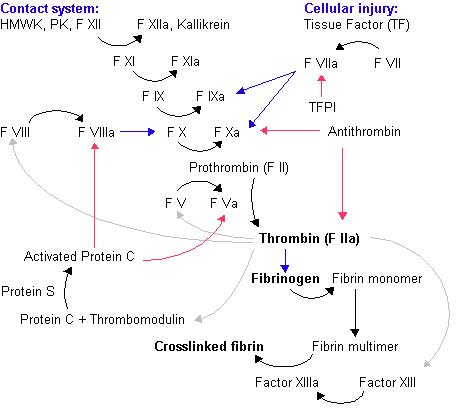
The coagulation cascade. Black arrow - conversion/activation of factor. Red arrows - action of inhibitors. Blue arrows - reactions catalysed by activated factor. Grey arrow - various functions of thrombin. Image source: Wikipedia

References:
Investigating easy bruising in a child. Anderson and Thomas 341, BMJ.

Posted at Clinical Cases and Images. Stay updated and subscribe, follow us on Twitter and connect on Facebook.