Newspace 2010

Keith's note: You can watch Newspace 2010 live at Spacevidcast. You can follow it on here on Twitter as well. One interesting comment this morning from NASA HQ's Charles Miller: "NASA admits that it is not a reliable customer".

Alas, these panels are almost exclusively composed of white males in their late 40's/early 50's. No females and rarely a darker shade of skin are to be found. I know these folks, so this is most certainly not a matter of discrimination by any means. Rather, it is evidence of a total lack of imagination in terms of outreach, mentoring, and trying to embrace the real world within which space commerce is but a miniscule part. I have watched/attended these Space Frontier Foundation things year after year. Without fail, its always the same people talking about the same stuff. Lots of arm waving - but rarely any concrete solutions.

NASA is always cast as simultaneously being the enemy and the source of funds for everyone's pet project. Same thing goes for Congress. No attempt is made to get outside the box and try and be relevant to the real world and the economic, societal, and political forces that make things work. The Space Frontier Foundation used to have some radical thinking. Now it has all evaporated away. All that's left is what you see on these panels - old thinking.

If your new business idea depends on government handouts and/or favoritism then you don't have the right product or the right business plan. You are just chasing after a new flavor of pork.

Kepler Co-Investigator Spills The Beans: Lots of Earth-like Planets

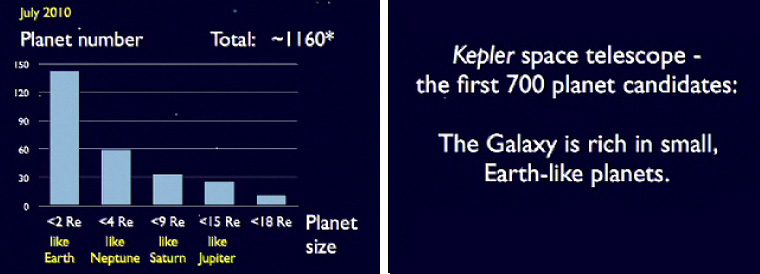
Reader note: "These articles were sparked by a talk that was given by Harvard's Dimitar Sasselov at TEDGlobal at Oxford this month. It was posted to the TED site last week and picked up by various sites: link. The smoking gun is the slide in the background at about 8:15 in the talk."

Keith's note: Here is the slides - plus another. Now I see where the story had is origin - so Fox and the other papers are off the hook - although they did manage to scramble things a bit. I think Sasselov's use of English is at fault here. Also, my original comments about the Kepler team's PR skills have been underscored by this fumbled release of stunning news.


Click on image to enlarge

How odd that this venue was chosen - one where you have to pay thousands of dollars to get in - in a foreign country - as the place where this announcement is made by Kepler Co-Investigator Dimitar Sasselov. What is really annoying is that the Kepler folks were complaining about releasing information since they wanted more time to analyze it before making any announcements. And then the project's Co-I goes off and spills the beans before an exclusive audience - offshore. We only find out about it when the video gets quietly posted weeks later.

If Dimitar Sasselov is allowed to give an exclusive update to a high-priced, hand-picked audience in the UK, then the Kepler project should seek to give the rest of us here back in the U.S. an update on the amazing discoveries Kepler has made. Not to do so - immediately - will call into question the agency's avowed intent to be open and transparent to the very people who pay the bills for these missions. Indeed, a disclosure such as Sasselov's already makes the Kepler mission team's rationale for not releasing data sound hollow.

This is amazing, paradigm-shifting, stuff, NASA. Everyone wants to know more. Set the Kepler data free.

More plus video, partial transcript, and earlier post below.

Here is what Sasselov said (transcript reflects his less than perfect use of English): "What the new telescope Kepler has been able to tell us in the past few weeks - and lo and behold - we are back to the harmony and to fulfilling the dreams of Copernicus. You can see here [Chart] - small planets dominate the picture. The planets which are marked "like Earth" - definitely more than any of the other planets that we see. Now for the first time we can say that. There is a lot more work we need to do with this. Most of these are candidates and in the next few years - we will confirm them - but the statistical result is loud and clear - and the statistical result is that planets like our own Earth are out there. [Chart] Our Milky Way galaxy is rich in this kind of planet. So the question is what do we do next? Well we can study them now. We know where they are. And we can find those that we call "habitable" meaning that they have similar conditions to what experience here on Earth and where a lot of complex chemistry can happen ..."

Earlier post

NASA's Deep Space Camera Locates Host of 'Earths', Fox

"Scientists celebrated Sunday after finding more than 700 suspected new planets -- including up to 140 similar in size to Earth -- in just six weeks of using a powerful new space observatory. Early results from NASA's Kepler Mission, a small satellite observing deep space, suggested planets like Earth were far more common than previously thought."

Space probe locates 'Earth-like' planets, The Australian

"Buried in the deluge of data sent back by the probe are clear signs that at least five of the 150,000-plus stars it has studied may have two or more planets in orbit around them. Some appear similar in size to Earth. These results emerged from the first six weeks of Kepler's mission, meaning the probe has had a chance to spot only fast-moving planets with particularly rapid orbits."

Prospect of life in deep space as Nasa probe finds hundreds of new planets, Daily Mail

"Hundreds of new planets have been discovered by Nasa's new space probe, sparking new hope of life outside our solar system. Up to 140 of the newly-found planets are rocky and Earth-like containing both land and water, conditions which could allow simple lifeforms to develop."

Keith's note: Looks like Fox News, The Australian, and the Daily Mail have jumped the gun again. To read their headlines and their short stories, you'd think that a bunch of Earthlike planets have been confirmed circling other stars with "both land and water" - and that this is how NASA has been characterizing the Kepler results. Alas this is not what NASA has been saying - at least not publicly.

Here's one of the papers I think these websites are referring to: "Five Kepler target stars that show multiple transiting exoplanet candidates" which says: "We present
five planetary candidate systems where the transits of multiple objects can be seen in the first quarter of photometric data (a 33.5-day data segment from May 13 to June 15 UT, 2009) from the Kepler spacecraft. While not confirmed planet discoveries, these systems have passed several important tests that eliminate false-positive signals. If all were ultimately shown to be planets, then these systems would contain four planets with radii smaller than three Earth radii (the smallest being two Earth radii), at least two pairs of planets in or very near a low-order mean-motion resonance (MMR), and one system with at least three distinct transiting planets."

This paper also seems to be referenced: Characteristics of Kepler Planetary Candidates Based on the First Data Set: The Majority are Found to be Neptune-Size and Smaller which says: "On 15 June 2010 the Kepler Mission released data on all but 400 of the ~156,000 planetary target stars to the public. At the time of this publication, 706 targets from this first data set have viable exoplanet candidates with sizes as small as that of the Earth to larger than that of Jupiter."

Nowhere can I find anything in either paper - or anything else that the Kepler team has released - that would support this sentence from the Daily Mail: "Up to 140 of the newly-found planets are rocky and Earth-like containing both land and water, conditions which could allow simple lifeforms to develop."

Unless the Kepler team is off talking to media without NASA PAO present, I have yet to see anything totally confirmed in terms of Earth-sized, and "Earthlike" extrasolar planets. All the Kepler folks have released are "candidates". According to NASA: "Without the additional information, candidates that are actual planets cannot be distinguished from false alarms, such as binary stars -- two stars that orbit each other. The size of the planetary candidates also can be only approximated until the size of the stars they orbit is determined from additional spectroscopic observations made by ground-based telescopes."

On one hand this is sloppy reporting with one paper feeding off of the fumes of another paper's imaginary story. Yet on the other hand, this should be a wake up call and a preview of just how people around the world will react if (when) confirmation of extrasolar worlds similar to our own is finally released. I do not get the impression that the Kepler folks or NASA PAO quite has this figured out yet.


The Cape Week in Review – Next F9 Launch Announced, Discovery Prepped for STS-133

Space Exploration Technologies (SpaceX) announced this week that they would shoot for a September launch for the next flight of their Falcon 9 rocket. Space Florida announced it had signed an agreement with a United Kingdom group to help further international commercial space cooperation. Over at OPF-3, Discovery was being readied for what could be her final flight. This week also marks the anniversary of rockets exploring the heavens from Cape Canaveral.

SpaceX Announces September Launch of Second Falcon 9 Rocket

Building on the test flight of their Falcon 9 rocket on June 4, 2010 - Space Exploration Technologies (SpaceX) is planning to launch their next test flight of the Falcon 9 on Sept. 2, 2010. The private space company is required to fly three test flights before it can begin the nine supply missions to the International Space Station (ISS) scheduled under the $1.6 billion Commercial Orbital Transportation Services (COTS) contract the company has with NASA.

The Falcon 9 launch vehicle is half of the overall package that SpaceX will use to fulfill the COTS contract. The other half, SpaceX's Dragon Spacecraft, will send supplies to the space station and may one day be used to ferry astronauts to and from the station.

On June 4, 2010 SpaceX launched the first Falcon 9 rocket with a prototype of the Dragon spacecraft perched atop. This launch served to test the viability of the rocket's design. While there were minor issues with this flight the mission accomplished all of its primary objectives and SpaceX's engineers are working to correct what anomalies did occur. If all goes well with the next two test flights SpaceX could fly the first supply mission as early as next year.

Space Florida Announces Partnership with UK Trade and Investment Team

The State of Florida's space research and investment organization, Space Florida, signed a Memorandum of Understanding (MOU) with UK Trade & Investment (UKTI) to encourage mutually beneficial commercial space opportunities between the United Kingdom and the Florida.

Space Florida is responsible for maintaining Florida's aerospace industry where UKTI assists UK-based companies succeed in their international efforts. The MOU signed by the two is designed to assist both Florida and the UK's space ventures by forming a pipeline between these two markets.

"Strategic, international partnerships are critical to the viability and growth of future U.S. commercial space programs," said Space Florida President Frank DiBello. "Today's event marks a significant step forward toward ensuring Florida's numerous space assets - both physical and intellectual - are leveraged by the global space marketplace."

Under this MOU both Space Florida and UKTI will work to identify and share potential commercial opportunities of interest to both groups. They would also introduce or arrange networking opportunities with possible partners and more importantly - investors. This could greatly benefit Space Florida's and the UK's constituents.

Discovery Prepped for Flight

Technicians at Kennedy Space Center (KSC) prepared space shuttle Discovery's orbital maneuvering system for the orbiter's scheduled Nov. 1 flight. At Orbiter Processing Facility 3 (OPF-3) Discovery's propellant lines and cross feed valves were connected and checked as the orbiter has its systems prepared for what may be its final mission. These systems route either fuel or oxidizer to steering jets in the shuttle's nose and tail.

Things on the communications side of the house were not going quite as well. The S-Band ran into cabling issues after Discovery's last flight this past April. The cable has been replaced several times with the first replacement failing tests and three other replacement cables being too short.

Although the details are far from clear it now appears that a third shuttle mission will be taking place. Recent efforts by Rep. Suzanne Kosmas, D-New Smyrna Beach, whose district includes the Kennedy Space Center to have an additional flight included in the manifest have apparently been successful. If so, either Atlantis or Discovery will fly this final mission - STS-135.

Space Wing's Commander gets First Star

The commander of Patrick Air Force Base's 45th Space Wing got a little boost Friday, July 23 - from colonel to brigadier general. Burke "Ed" Wilson was promoted during a 30-minute ceremony held at the base's Shark Center.

Wilson became the U.S. Air Force's 139th brigadier general. He credited four things that had helped him in his career, faith, family, friends and freedom.

The stars that were pinned to his epaulets were given to him after they had made a very special journey of their own - into space aboard space shuttle Atlantis in 2000.

Wilson has been in the Air Force since 1985 having graduated from the U.S. Air Force Academy with a bachelor of science. All of Wilson's positions have been space-related; one of these was with the National Reconnaissance Office (NRO). Wilson has been in command of the 45th Space Wing since this February.

This week in Cape History

July 24, 1950: General Electric and NASA's Jet Propulsion Laboratory (JPL) launched the Bumper - 8 rocket. It was the first rocket launched from the recently established Long Range Proving Ground at NASA's Kennedy Space Center (KSC), Fla. The purpose of the flight was to test staging methods while a rocket is flying horizontal. The mission was a failure however, just lasting two minutes.

July 25, 1990: NASA launched the Combined Release and Radiation Effects Satellite (CRRES) aboard an Atlas rocket from Kennedy Space Center to study the Earth's ionosphere and magnetosphere. The Air Force Geophysics Laboratory's SPACERAD (Space Radiation Effects) project, along with other magnetospheric, ionospheric and cosmic ray experiments were also onboard CRRES.

Klaus Heiss

Keith's note: According to his family: "Dr. Klaus Peter Heiss passed away peacefully on July 24, 2010 in his hometown Brixen/South Tyrol after an extended illness that he met with grace and quiet determination. Funeral will be held Tuesday July 27, 2010 in the Pfarrkirche Brixen/South Tyrol. Memorial service in the Deutschordenskirche in Vienna, Singerstrasse 7, in September. Dr. Heiss was bearer of several awards like Goldenes Ehrenzeichen der Auslandsoesterreicher, NASA Distinguished Public Service Medal, and Ehrenzeichen der Stadt Brixen." - The Heiss and the Kuen family Brixen/South Tyrol and Hinterbruehl/Austria.

Original notice in English and German (PDF)

Signing From Orbit

NASA Astronaut Sends First Signed Message from Orbit

"The number of languages used on the International Space Station has recently increased. In addition to those spoken in the 15 countries that have had representatives aboard the space station, American Sign Language, or ASL, is now included. NASA astronaut Tracy Caldwell Dyson has sent a message in ASL from the station to the deaf community."

Keith's note: As a former professional Sign Language interepreter myself (mid-70s to early 80s), stories like this certainly get my attention. As such, I do not mean to detract from this but, this is not the first time that an astronaut has signed a message in space for use back on Earth. It may well be the first video downlinked live with signing, however. According to Bill Readdy, he signed a short message on STS-42 back in 1992 (see YouTube video from CollectSpace below). The was not downlinked live but It was recorded and later appeared on a Gallaudet University's TV show "Deaf Mosaic". Bill still remembers some of the signs to this day. That said, this recent video is cool and is exactly the sort of thing NASA should be encouraged to do in the future so as to broaden its ability to interact with all citizens.

Faith and Personal Responsibility

In the past, NASA has been a great source of inspiration, innovation and technological advancement.  Even today, NASA embodies those ideals.  Over the past few months there has been debate about the path that NASA will take.  The debate has been a source of great divide in the NASA community and has motivated many at NASA to hail the end of America’s leadership in space.  Recently, the Senate came up with a compromise between the Constellation Program and the Obama Plan which hopefully will end the debate and allow NASA to move forward.

The point of this blog isn’t to talk about the debate in Congress, the point is that regardless of the decisions that are made by the politicians of this country, we will not propel space exploration forward unless we believe that we will end up victorious.  Mohandas Gandhi once said that “a small body of determined spirits fired by an unquenchable faith in their mission can alter the course of history”.  Well I am here to tell you that this paradigm can have both positive and negative impacts.   We are at a cross road in NASA’s history, and where NASA goes from here will not be decided by Congress, but by the dedicated men and women that work at NASA.  If we believe that the end of America’s leadership in space is over, then no amount of money will help us keep that leadership.

Leadership begins with oneself….

Responsibility begins here….

We can not always choose our environment, but we can always choose to do our best.  If NASA is to remain a leader in space and be a source of inspiration to the world, we must stop looking up for leadership and we must start leading up.  We ALL have the capacity to influence our environment for the better, and if we are to remain a leader in space we must take every opportunity to make things better.

That means, that we must end the CYA paradigm that plagues NASA, and replace it with paradigm of personal responsibility.

Imagine how great NASA would be if everyone at NASA took personal responsibility for the quality and safety of the work they did, instead of separate groups being tasked to police the work of others.

Imagine how great NASA would be if when a group’s utility was no longer needed, the leader’s first inclination was not to invent reasons to keep the group alive, but to help those in the group transition to other opportunities that would safely allow the group to be eliminated.

Imagine how great NASA would be if instead of trying to save a dime to do more mission, NASA invested in those who execute the mission so that they can handle more mission.

Imagine how great NASA would be if instead of us pointing the finger at others, we pointed the fingers at ourselves and took the time to see the good in others.

Do the negative things I implied above happen?  Yes.  Do I think they are bad?  No!  I think they are human.  Failure is not only an option, failure is imminent, because we are human.  The question is how do we succeed in an imperfect world where failure is a fact of life?  We do it by remembering that leadership begins with oneself, and that responsibility begins here.  We do it by accepting that NASA’s fate is in our hands, not in the hands of those above us or in the hands of those far away.

We can all help NASA be better, and each of us knows best how we can help.  I encourage everyone to search deep in oneself to find your personal way of helping NASA be better, and I have faith that we will all have the courage to do so when the opportunities present themselves.  The path forward will not be easy, but I have no doubt that we will not only remain leaders in space, we will inspire the world with as much vigor as days gone by.

Here We Go Again: Do More With Less

Senate compromise may be setting up NASA for another failure, Orlando Sentinel

"The plan orders NASA to build a heavy-lift rocket and capsule capable of reaching the International Space Station by 2016. But it budgets less money for the new spacecraft - roughly $11 billion over three years, with $3 billion next year -- than what the troubled Constellation program would have received. That - plus the short deadline -- has set off alarms. Days before the compromise was announced, NASA chief Charlie Bolden and Deputy Lori Garver told its two champions -- U.S. Sens. Bill Nelson, D-Florida and Kay Bailey Hutchison, R-Texas -- that NASA could not finish the proposed new rocket before 2020, according to three sources present at the meetings. When asked about the conversation, Nelson spokesman Dan McLaughlin said the NASA officials were responding to lower dollar figures than what Congress ultimately approved. NASA spokesman Michael Cabbage said it "would not be appropriate to discuss private conversations between NASA and members of Congress."

Webb Team Has CR Worries

Keith's note: Word has it that there are big worries at NASA and Northrop Grumman with regard to Webb Space Telescope. If NASA ends up operating under a Continuing Resolution - one that does not provide the increased funds that Webb requires - there is a fear that large layoffs may be in the near-term forecast. Stay tuned.

STS-135 Is Almost A Certainty

Kosmas Successful in Fight for Additional Shuttle Mission

"Today, Congresswoman Suzanne Kosmas (FL-24), during a meeting of the House Science & Technology Committee, successfully amended the House NASA Reauthorization Bill to add an additional Shuttle mission to the current manifest, minimizing the spaceflight gap by extending the life of the Shuttle program through at least June of 2011. Kosmas' action will help ease the transition for the Space Coast and slow the loss of jobs in order to protect the highly skilled workforce."

California Reps Support White House Space Plan

Letter From California House Members to Rep. Bart Gordon Regarding NASA's FY 2011 Budget

"The President's NASA budget replaces an over-budget and behind-schedule Constellation Program with a sustainable architecture that will take the Agency in a new direction enabling NASA to explore more of our universe. It offers a serious plan to reduce the cost of access to the International Space Station, without exporting that responsibility to other nations. We believe this new direction is good for the country and that California's NASA centers and those across the country can help take NASA to new and exciting destinations. We hope to work with you as you move this important legislation forward."

Which "Compromise" Will Prevail?

House NASA Bill Puts Brakes on Commercial Crew Initiative, Space News

"According to the bill text, commercial crew programs would get just $50 million annually through 2015 and another $500 million over that same time period via direct government loans or loan guarantees. Although the bill fully funds the $4.2 billion sought for routine commercial cargo resupply runs to the space station starting in 2011, it reduces the president's $312 million request for NASA's Commercial Orbital Transportation Service (COTS) program next year to just $14 million. The Senate version provided $300 million for the agency's COTS providers in 2011."

House, Senate have different ideas for NASA's future, Florida Today

"There is no additional shuttle flight, funding would be slashed for commercial rockets and NASA would be told to "restructure" the Constellation program that Obama wanted to kill. The bill diverges significantly from a measure approved by a Senate panel last week, which the White House supports. The differences threaten to delay consensus on the space agency's policy. "We are facing tough economic times that demand tough choices," said Rep. Bart Gordon, D-Tenn., chairman of the House Science and Technology Committee."

NASA Legislation Embraced by Appropriations Committee Presents Unified Senate Position on Space

"Senator Kay Bailey Hutchison (R-Texas), Ranking Member on the Senate Commerce, Science, and Transportation Committee, said the approval of the Commerce, Science, Justice Appropriations legislation by the Senate Appropriations Committee today presents a unified Senate position on NASA and the future of America's human spaceflight programs."

Keith's note: There may come a point where the White House says that they cannot support this "compromise". It all seems to hinge on whether the "compromise" that the White House got with the Senate prevails over the "compromise" that the House wants - one that the White House has been silent about thus far. Either way, Congress has thrown the original White House proposal back in OMB/OSTP's face in a form that more or less brings Constellation back to life (minus the name) albeit without Ares 1 or Altair. Ares V simply has a new name. And the commerical aspirations inherent in the White House plans? They are reduced (depending on which "compromise" you look at) to the point of being window dressing - if not outright irrelevant.

The fact that the White House has yielded to Congressional pressure can be seen a number of ways. You could just say that they are being pragmatic and realistic with regard to what can be realistically accomplished. But given the way in which they initially hurled the policy out with near zero pre-coordination, and then brought the President in for a quick fix when it flopped, you have to wonder if they even planned things in advance or considered the long term strategic issues that they'd need to address. And now they show little if any spine when Congress repudiates the entire package. This makes you wonder if the White House ever actually had serious interest in this policy in the first place. Indeed, this entire process has been composed of several sudden spikes of activity by the White House followed by long periods of disinterest and/or silence.

The fix is in for the time being, it would seem. But you all know that we'll all be revisiting this situation in 18-24 months when costs start to rise and an election amplifies the political rhetoric once again.

Is this any way to explore the solar system?

A Missed Opportunity (Update)

How Obama Let Down Mr. Spock

"Even some in Mr. Nelson's home state of Florida begin to doubt the senator's priorities, suspecting they have more to gain from a thriving private market in affordable space travel than from another NASA budgetary blowout that leaves nothing sustainable in its wake. NASA's tragedy is that it never recovered from the success of Apollo. But unless these dissenting voices start to be heard, two things are certain: Taxpayers will shell out a lot of money that will end up wasted when the next NASA funding crisis calls forth the next Augustine Commission. The other certainty is that the space entrepreneurs had better start scrambling for fresh capital and private customers if they want to keep their dreams alive."

Keith's note: I am sorry for linking to this article. When I orignally linked to it the entire text was available for free access. Alas, in keeping with an annoying habit, wherein the Wall Street Journal takes popular articles and denies full access after they have become popular, you can't read the whole thing at the original link. The portion that I quoted is from the part of the article that you (or I) can no longer read - unless we give them money. This is why I have stopped linking to WS Journal articles. It just annoys people when they do this. The only way to circumvent this is to use this Google search for the article by title and then click on the link that shows up - but that link only works once.

Showing NASA Some Love in the House

Congress to NASA: "Help is on the way", Houston Chronicle

"And what's the message for Johnson Space Center? "The first message is we love you," [Rep.] Olson said. "We think about what these men and women are doing right now with all this uncertainty about their future. They're remaining focused on their mission. And my message to them is that help is on the way. The House and Senate are hard at work to ensure that we have a viable space program."

House Takes Steps to Preserve Ares Rocket and Manned Space Flight, Rep. Bishop

"It is extremely encouraging that both the House and Senate, in a bipartisan manner, have recognized the importance of maintaining solid rocket motor technologies, such as the Ares 1 rocket. The draft House version of this bill is a strong repudiation of the President's flawed proposal - stronger even than the good developments we saw last week out of the Senate Committee on Commerce, Science and Transportation."

The New Moon– absolutely still in the picture

The New Moon: That was the title of Andy Chaikin’s public talk this week at the 3rd annual Lunar Science Forum, held at NASA Ames Research Center and hosted by the NASA Lunar Science Institute (NLSI).  He claims the title was not inspired by recent pop culture… phenomenon… but that is besides the point.

Some say NASA is abandoning the Moon.  The future of manned spaceflight is unclear right now, and many are experiencing losses of jobs, but I want to look at something else:  Who cares about the beauty of real scientific exploration?  Judging by participation in the Lunar Science Forum this year, I would say a lot of people.  Is the Moon ‘dead’?  A resounding NO, judging from the highest attendance yet for the meeting, the amazing science results, and the many young faces of the Next Generation of Lunar Scientists and Engineers interested in the Moon.  They are not going anywhere, and that message is loud and clear!

Forked impact melt. Credit: NASA/GSFC/Arizona State University

I guess I should give the disclaimer that I work at the NLSI :) but also that I used to be a Mars person.  Mars is still exciting, of course, but  in the past few years the Moon really has become a whole new Moon, most obviously with the discovery of water in amounts different than expected (a simple statement with many scientific papers enveloped in it).

One of the highlights from the meeting for me was hearing that there are craters in the polar regions of the Moon that are estimated to have high levels of water available… less than 50 km from areas with near constant availability of sunlight.  All the recent science about the Moon greatly informs human exploration… and what is better than having science and exploration walk hand in hand?

If you want to know more about the lunar science shared at the Forum, go to http://lunarscience2010.arc.nasa.gov/agenda; the talks will be posted there shortly.

In the meantime, keep dreaming about all the undiscovered secrets of the Moon:  lava tubes, pockets of water, and combining awesome LROC image data with mini-RF data (really really cool insights!)

And it is only fitting that the Lunar Science Forum is being followed up by a NewSpace Conference.  A New Moon indeed!

Keeping Our Eyes On The Prize

What will inspire tomorrow's rocket scientists?, CNN

"President Barack Obama's NASA proposal currently being scrutinized by Congress focuses on researching propulsion for deep space and asteroid landings. It scraps the Constellation Project, which was launched six years ago with the aim of sending humans to Mars and back to the moon. The proposal would also halt NASA shuttle launches to the International Space Station. Instead, federal funds would be used to help send U.S. commercial shuttles to the station. Clark Moody, who remembers watching NASA videos with his dad in the 1980s, is a graduate student in aerospace engineering at Texas A&M University. He worries that NASA's other feats could be lost on the general public without the highly visible human spaceflight endeavors."

The Senate NASA compromise may be our best chance

As an engineer, my first reaction upon reading the proposed Senate authorization bill for NASA was incredulity.  I remain unconvinced of the technical need for a heavy lift rocket and was appalled to see space technology research and development, which I think is essential for developing a true in-space infrastructure, slashed in funding.

I had the opportunity yesterday, though, to sit down with some friends who have a little more insight into what’s really been going on up in DC.  Plain and simple, Senators Hutchison and Nelson quietly formed an alliance in the Senate and even more quietly pre-coordinated with the White House to come up with something that everyone can live with.

For all the suggestions of his inability to lead, it was NASA Administrator Charlie Bolden who made the case for a heavy-lift vehicle and that was the carrot Hutchison and Nelson used to get the support from expected intransigents like Sen. Shelby, who just earned a rather ignominious distinction from Citizens Against Government Waste.

There is an important clause in the language on heavy lift that leaves NASA an escape if it finds shuttle-derived components are impracticable.  Thus, the staffers that helped put this bill together say that NASA is not technically constrained by the Senate language.  The authorization committee also accepted amendments to provide more funding for tech R&D and robotic precursor missions.

At this point, it’s a matter of making the trades in the budget lines to come to an amicable conclusion that funds one more Shuttle flight, ISS continuation, exploration and space technology research, and a human exploration program beyond Earth orbit.  While commercial crew development is constrained in FY2011, I hear that was intended to actually provide commercial developers cover for moving out strong in FY2012 and beyond.

In any event, the Senate appropriations committee just approved the full $19 billion the President and the Senate authorization committee asked for.  This is a bonafide example of how the system really is supposed to work.  Senators, staffers, and the White House set aside partisan politics to develop a plan that we can move forward on, even while acknowledging that it isn’t perfect.

By contrast, the House legislation is a scattershot proposal, with its only clear goal being the restoration of the status quo.  Forty-three – yes, 43 – amendments were submitted against it, even as the House committee meeting was ongoing.

Our own Rep. Pete Olson filed an “emergency” amendment intended to short-circuit their own priority queue to immediately fund the Constellation spacesuit project.  Other Representatives squabbled over the $15 million CRuSR program to sponsor suborbital science research and whether NASA should foster the growth of commercial space industry at all.  (Note: The Space Act explicitly directs NASA to help grow American industry in space.  It doesn’t actually say anything about flying people in space.)  Towards the end of the day, it was silly season on display.

Senator Hutchison is showing some real leadership here and has done good work for our state and our space program.  I hope Rep. Olson and his colleagues in the House will learn from her example and stop tilting at windmills.  Rep. Kosmas from Florida submitted an amendment calling on the House to follow the Senate’s approach, so at least one person in that chamber gets it.

If the Senate’s strategy is adopted by the House and emerges from conference committee intact, we could have a bill that he will sign on the President’s desk before October and avoid a continuing resolution – which would keep NASA in limbo perhaps as long as another year.

This would be a more evolutionary change for NASA, as opposed to the revolutionary approach outlined in the President’s FY2011 budget.  Even so, NASA still gets an overall increase in its budget and breathing room for needed investments in commercial space services and technology R&D.  JSC, in particular, will have plenty of work to do.

As long as NASA retains the freedom to make appropriate technical decisions within the budget and schedule provided, I think we can make this work.

Cross-posted at A World With No Boundaries

Photo Tour of Lunar Orbiter Image Recovery Project

Four decades later, recovering lunar images (photos), CNET

"Around 2005, space entrepreneur Dennis Wingo and Keith Cowing of NASA Watch learned of prior attempts at restoring the images. With a renewed interest from NASA in moon exploration and the Lunar Reconnaissance Orbiter set to go to the moon in 2009. Wingo and Cowing became more and more motivated to work towards restoring the tapes."

Lunar Orbiter Image Recovery Project

House Wants To Kill CRuSR

Full Draft Text of House NASA Authorization Legislation

Keith's note: One thing that the House version of the NASA Authorization Act does is to cut further into proposed commercial activity - specifically, CRuSR (Commercial Reusable Suborbital Research).

In this draft House Legislation, funding for CRuSR is cut in FY 2011 and FY 2012 from the President's and Senate's mark at $15M per year year down to just $1M per year, with funding unspecified in later years. In addition, according to the draft language, CRuSR's funding in FY 2011 may not be used to buy flights or build payloads. Instead it can be used only to fund studies.

If you look at Sec. 906 (page 94) you will see that this proposed draft adds onerous restrictions before NASA can spend money on CRuSR, using identical language to restrictions placed on Commercial Crew in the same legislation, e.g., NASA may not proceed with a CRuSR RFP until all indemnification and liability issues are settled and a report has been sent to Congress.

More than 300 researchers and educators, specializing in fields ranging from microgravity and life sciences to astronomy and atmospheric sciences, from all over the U.S. showed up at a conference in February wanting to use this program. It would seem that anti-suborbital research and anti-commercial forces from within and outside of the agency are at work once again. SMD AA Ed Weiler has long been opposed to suborbital research and has clearly been working behind the scenes to take yet another run at killing this sort of activity. Just look where the CRuSR money is going (if the House gets its way): sounding rockets launched out of Wallops.