Do Cell Phones Prevent Alzheimer’s?

Scientific studies are not meant to be amusing, but I laughed out loud when I heard about this one. After all the concern about possible adverse health effects from cell phone use, this study tells us cell phone use can prevent Alzheimer’s, treat Alzheimer’s, and even improve cognitive function in healthy users.

They studied transgenic mice programmed by their genes to develop Alzheimer’s-like cognitive impairment; they used a group of non-transgenic littermates as controls. For an hour twice daily over several months they exposed the entire mouse cage to EMF comparable to what is emitted by cell phones. They tested cognitive function with maze tests and other tasks that are thought to measure the same things as human tests of cognitive function. The authors claim to have found striking evidence for both protective and disease-reversing effects.

EMF exposure was found to have cognitive-protective and cognitive-enhancing effects in both the normal mice and the Alzheimer’s-prone mice compared to non-EMF-exposed controls. EMF exposure raised body temperature and brain temperature by about one degree Centigrade. It also reduced the deposition of beta amyloid in the brain. Beta amyloid deposits are a pathognomonic finding in Alzheimer’s, although it is not clear whether they are a cause or a result of the disease. EMF exposure also increases cerebral blood flow and glucose utilization. It does not appear to increase oxidative stress.

This doesn’t mean we will all be smarter if we spend more time talking on our cell phones. It is a small preliminary trial that has no clinical implications as yet. It has not been replicated… although there is one intriguing epidemiologic study associating heavy cell phone use with better performance on a word interference test. Mice and humans may respond differently. Whole body exposure may not be comparable to exposure from typical cell phone use. I question whether typical cell phone use would raise brain temperature that much.

If temperature is important, are patients with elevated temperatures from other causes less susceptible to Alzheimer’s? Could supplying heat by other means work as well? Are sauna users less likely to develop Alzheimer’s? Would an electric blanket have a greater effect than a cell phone?

As cell phone use goes up in a community, does the prevalence of Alzheimer’s drop? Is the overall prevalence of Alzheimer’s greater today than it was before the invention of cell phones? If we found that cell phone users were less likely to have Alzheimer’s, that might only mean that demented people are not as capable of understanding how to use cell phones.

It’s way too early to speculate. Nevertheless, this study could be very useful as an arguing point. When technophobes and Luddites worry about possible dangers of cell phones, we can point to this as evidence of health benefits. Even if cell phones did cause a slight increase in brain cancers (the current weight of evidence indicates they don’t), at least some brain cancers are curable; Alzheimer’s is not.

Cell phone advertisers might want to incorporate these findings into new commercials. “Can you hear me now?” “Can you remember who I am?”


[Slashdot]
[Digg]
[Reddit]
[del.icio.us]
[Facebook]
[Technorati]
[Google]
[StumbleUpon]

Success in the fight against childhood diarrhea

Rotavirus is the world’s most common cause of severe childhood diarrhea.  In the U.S. alone, rotavirus disease leads to around 70,000 hospitalizations, 3/4 million ER visits, and nearly half-a-million doctor office visits yearly.  But it rarely causes death.

The same is not true for the developing world.  Rotavirus disease is estimated to kill around a half-million children a year world wide.   Finding a way to mitigate this is an active public health concern, with the World Health Organization specifically recommending rotavirus vaccinations in areas where the virus has a significant public health impact.

Rotavirus causes a severe diarrheal illness. It is passed via a fecal-oral route, meaning that contaminated food, surfaces, and water can all be sources.   In developed countries like the US, rotavirus disease is unpleasant and inconvenient.  Since rotavirus spreads more readily in areas without access to clean water and medical care, it takes a greater toll in these areas, and children afflicted are at risk of death due to dehydration.  The US has seen a decline in rotavirus disease in the last few years, an effect that appears to be due to increased vaccination and a herd immunity effect.

Given the large number of pediatric rotavirus deaths in developing countries, the World Health Organization (WHO) has made vaccination a priority. Two articles in this week’s New England Journal of Medicine report on the progress of the fight against rotavirus.

The first article looked at the affect of the vaccine in  Africa.  It was a randomized, placebo-controlled trial of several thousand infants (the ethics of such trials in developing nations has been discussed at length elsewhere, including here).  It found a very significant reduction in severe diarrhea during the first year of life, with a vaccine-attributable reduction in severe rotavirus gastroenteritis of 5.0 cases per 100 infant-years.  This study did not specifically study mortality.

The next study specifically assessed mortality, but using an “ecologic assessment”.  The authors looked at deaths from diarrhea over a several year period which included a period before and after the regular use of rotavirus vaccine.  They found that:

Among infants who were 11 months of age or younger, diarrhea-related mortality fell from 61.5 deaths per 100,000 children at baseline to 36.0 per 100,000 children in 2008 (rate reduction, 41%; 95% CI, 36 to 47; P<0.001)

This type of study has certain limitations, but the seasonal peak of rotavirus deaths was found to be significantly blunted since the introduction of the vaccine.

The final piece in the Journal was a case series. It looked at three infants who appeared to have developed rotavirus infection from the vaccine itself.  The two available rotavirus vaccines are live attenuated viruses.  They should not cause disease under normal circumstances, and in these three cases, the circumstances were not normal.  All three children had severe combined immunodeficiency (SCID).   Immune diseases are a relative contraindication to vaccination. In the African experience, where HIV is endemic, children were vaccinated independent of HIV status and HIV rates were similar in all groups.  Despite this, there was still a reduction in severe diarrheal disease.

The two currently available rotavirus vaccines are not associated with intussusception as a previous vaccine was, and appear to be safe, effective at preventing severe diarrhea in small children, and effective at reducing deaths in small children.  These vaccines appear to be effective across geographic and economic regions, although the magnitude of the effect was greatest in hardest-hit areas.

This puts a very heavy  burden on those who would choose to fight the introduction of these vaccines.  Rotavirus vaccine appears to be a safe, effective measure for preventing one of the world’s most common causes of childhood mortality.

References

Madhi, S., Cunliffe, N., Steele, D., Witte, D., Kirsten, M., Louw, C., Ngwira, B., Victor, J., Gillard, P., Cheuvart, B., Han, H., & Neuzil, K. (2010). Effect of Human Rotavirus Vaccine on Severe Diarrhea in African Infants New England Journal of Medicine, 362 (4), 289-298 DOI: 10.1056/NEJMoa0904797

Richardson, V., Hernandez-Pichardo, J., Quintanar-Solares, M., Esparza-Aguilar, M., Johnson, B., Gomez-Altamirano, C., Parashar, U., & Patel, M. (2010). Effect of Rotavirus Vaccination on Death from Childhood Diarrhea in Mexico New England Journal of Medicine, 362 (4), 299-305 DOI: 10.1056/NEJMoa0905211

Patel, N., Hertel, P., Estes, M., de la Morena, M., Petru, A., Noroski, L., Revell, P., Hanson, I., Paul, M., Rosenblatt, H., & Abramson, S. (2010). Vaccine-Acquired Rotavirus in Infants with Severe Combined Immunodeficiency New England Journal of Medicine, 362 (4), 314-319 DOI: 10.1056/NEJMoa0904485


[Slashdot]
[Digg]
[Reddit]
[del.icio.us]
[Facebook]
[Technorati]
[Google]
[StumbleUpon]

The Tamiflu Spin

I will start, for those of you who are new to the blog, with two disclaimers.

First, I am an infectious disease doctor. It is a simple job: Me find bug. Me kill bug. Me go home. I spend all day taking care of patients with infections. My income comes from treating and preventing infections. So I must have some sort of bias, the main one being I like to do everything I can to cure my patients.

Second, in 25 years I have, to my knowledge, accepted one thing from a drug company. The Unisin (that’s how I spell it) rep, upon transfer from my hospital, sent me a Fleet enema with a Unisin sticker on it. I show it proudly to all who enter my office. I do not even eat the drug company pizza at conference, and I cannot begin to tell you painful that is.

As we leave (I hope) the H1N1 season and enter seasonal flu season, there has been a flurry of articles, originating in the British Medical Journal , questioning whether oseltamivir is effective in treating influenza. The specific complaint at issue is whether or not oseltamivir prevents secondary complications of influenza like hospitalization and pneumonia. Although you wouldn’t guess that was at issue from the reporting.  As always, there is what the data says, what the abstract says, what the conclusion says, and what other people say it says.  Reading the medical literature is all about blind men and elephants.

There is, evidently, going to be an investigation by the European Union Council of Europe  into whether or not the H1N1 pandemic was faked to sell more oseltamivir. Sigh.

Is oseltamivir effective against flu? Lets start with background. What do I want to know about an antiviral to help determine its efficacy?

I would like a mechanism of action that would prevent replication of the virus. I can’t kill a virus, as I can a bacteria, but at least I can stop if from reproducing.

I would like the antiviral to be effective in the test tube at physiologically achievable concentrations.

I would like the antiviral to be effective in an animal model.

I would like the antiviral to be effective clinically: on challenge studies if ethical and in the real world.

There is the virulence of the organism, and there can be strain to stain variation in the virulence. Some influenza strains are better at spreading or killing than other strains. Everyone seems to have forgotten that when H1N1 started in Mexico it apparently had a horrific mortality rate in hospitalized patients.

” By 60 days, 24 patients had died (41.4%; 95% confidence interval, 28.9%-55.0%).”

The worry was that there was going to be a repeat of the 1919 influenza pandemic. Fortunately the subsequent mortality rate was much less as it swept the world. H1N1 turned out to be a highly infectious, low virulence strain of flu. This time. But I would still fret that one-day there will be another repeat of the 1919 pandemic. The current bird flu has a 66% mortality rate, but is not spread human to human. Maybe someday it will gain that ability.  But at the beginning no one knew what mortality of H1N1 or bird flu was going to be and they prepared accordingly. Of course public health officials are always in a no-win situation. They are either going to over-prepare or under-prepare, and as a result at best look a fool and at worst look evil. Next time they may err on the side of under-preparing so they are not accused of faking a pandemic.

There is the hosts ability to respond to the infection. Just as there is variability in the virulence of the pathogen, there is variability in the hosts ability to control the infection. It is often the case that whether you live or die from an infection may be due to the immune system with which you are born. Pubmed ‘toll like receptor’ ‘polymorphism’ and ‘infection’ for further information that is beyond the scope of this entry. There may be an inherited predisposition to dying from influenza.

In the H1N1 pandemic, mild as it was overall, caused disproportionately relatively high mortality in children

“Between May and July 2009, a total of 251 children were hospitalized with 2009 H1N1 influenza. Rates of hospitalization were double those for seasonal influenza in 2008. Of the children who were hospitalized, 47 (19%) were admitted to an intensive care unit, 42 (17%) required mechanical ventilation, and 13 (5%) died. The overall rate of death was 1.1 per 100,000 children, as compared with 0.1 per 100,000 children for seasonal influenza in 2007. (No pediatric deaths associated with seasonal influenza were reported in 2008.) “

and pregnant women

“Data were reported for 94 pregnant women, 8 postpartum women, and 137 nonpregnant women of reproductive age who were hospitalized with 2009 H1N1 influenza… In all, 18 pregnant women and 4 postpartum women (total, 22 of 102 [22%]) required intensive care, and 8 (8%) died.”

Who gets the disease may be, depending on the organism, more important than the strain of infection.

There is how strong or powerful (meaningless terms to an ID doc, but part of the popular language of medicine) the antibiotic is. Antivirals are not that effective because they do not kill viruses, they only halt their replication. Given the prodigious replicative capacity of viruses, it is going to be impossible to shut down every virus from replicating with an antiviral. With HIV it took the combination of three different anti-retrovirals to (almost?) completely shut down viral replication. As those without immune systems prove with depressing regularity, no antibiotic will work for long if the host’s immune system cannot help control the infection.

Finally, there is promptness of therapy. For serious infections even a day in the delay of appropriate antibiotics can dramatically increase mortality. So the later you begin therapy, the less effect one should expect. This is one of the issues with a disease with a very rapid onset like influenza and why the challenge studies, where you give the medication right after exposing the subject to influenza, show better effect. Viral replication will often rapidly outstrip the available antiviral.

What would I expect from an influenza medication?

Prevent disease after exposure?
Decrease the severity of the infection?
Prevent death in all cases? Prevent death in the more severe cases? Decrease the odds of dying?
Decrease complications of the disease?
Some combination of the above?

All good endpoints. As a rule, I expect antivirals for to lessen the severity of disease if given early in the disease.

So what can we say for oseltamivir?

Does it have a mechanism of action that would interfere with viral replication? Yes. Oseltamivir blocks the activity of the viral neuraminidase enzyme, preventing new viral particles from being released by infected cells. Not a thrilling mechanism of action. The virus can multiply all it wants if it infects a cell, and since no drug is 100% effective, one would expect it would slow down the disease, not stop it.
Sometimes, as we shall see, that may be enough to make the difference between life and death.

Does oseltamivir work in the test tube? Yes. In animal models? Yeah. In human clinical trials? Yes.

It is in human clinical trials and the choice of efficacy endpoints where the current brouhaha starts.

LA times headline reads

“British medical journal questions efficacy of Tamiflu for swine flu — or any flu.”

The Atlantic , which has now supplanted the Natural News for the worst medical coverage, has a headline that reads

“The Truth About Tamiflu”

followed by the opening paragraphs.

“Two months ago, we pointed out in our story on flu in The Atlantic that the antiviral drug Tamiflu might not be as effective or safe as many patients, doctors, and governments think. The drug has been widely prescribed since the first cases of H1N1 flu surfaced last spring, and the U.S. government has spent more than $1.5 billion stockpiling it since 2005 as part of the nation’s pandemic preparedness plan.

Now it looks as if our concerns were correct, and the nation may have put more than a billion dollars into the medical equivalent of a mirage. This week, the British medical journal BMJ published a multi-part investigation that confirms that the scientific evidence just isn’t there to show that Tamiflu prevents serious complications, hospitalization, or death in people that have the flu. The BMJ goes further to suggest that Roche, the Swiss company that manufactures and markets Tamiflu, may have misled governments and physicians. In its defense, Roche stated that the company “has never concealed (or had the intention to conceal) any pertinent data.”

The medical equivalent of a mirage. Hmmm. And death? The Cochrane review, upon which the whole controversy revolves, does not comment of prevention of death nor does the BMJ feature or editorial on the topic. Into the second paragraph and already they are apparently making things up. I remember when I trusted the Atlantic. Interestingly, the Atlantic never quotes the results of the Cochran review. They suggest that the review demonstrates that oseltamivir is worthless.

Does it? Start with the methods section.

They looked for randomized, placebo controlled trials. Cochran gold.

“We excluded experimental influenza challenge studies as their generalizability and comparability with field studies is uncertain.”

Which is a shame, as the challenge studies always show efficacy. But they are not representative of the real world as they have the best case for treating with an antiviral: you can start the medication right when the disease may start.

They screened 1416 articles and ended up with 29 studies, 10 for effectiveness, the cream of the crop. 1416 articles is a lot of articles. I know they are not the crème de la crème, and is why I am not a fan on just relying on meta-analysis alone. That is a lot of ignored information. And their results?

Here is the conclusion in the abstract:

“Neuraminidase inhibitors have modest effectiveness against the symptoms of influenza in otherwise healthy adults. The drugs are effective postexposure against laboratory confirmed influenza, but this is a small component of influenza-like illness, so for this outcome neuraminidase inhibitors are not effective. Neuraminidase inhibitors might be regarded as optional for reducing the symptoms of seasonal influenza. Paucity of good data has undermined previous findings for oseltamivir’s prevention of complications from influenza. Independent randomized trials to resolve these uncertainties are needed.”

I am already confused.

“The drugs are effective postexposure against laboratory confirmed influenza, but this is a small component of influenza-like illness, so for this outcome neuraminidase inhibitors are not effective.”

They are effective but they are not. But the abstract suggests in normal people, oseltamivir has modest efficacy.

Later, there is the Take Home message box, which says

“WHAT IS ALREADY KNOWN ON THIS TOPIC

Neuraminidase inhibitors (especially oseltamivir) have become global public health drugs for influenza
They prevent symptoms and shorten the duration of illness by about one day if taken within 48 hours of the onset of symptoms
Toxicity and the effects on complications have been debated

WHAT THIS STUDY ADDS

Neuraminidase inhibitors reduce the symptoms of influenza modestly
Neuraminidase inhibitors reduce the chance of people exposed to influenza developing laboratory confirmed influenza but not influenza-like illness
Evidence for or against their benefit for preventing complications of influenza is insufficient
Evidence for or against serious adverse events is lacking, although oseltamivir causes nausea”

To me the take home message suggests some efficacy. Lets move on to the results and the discussion. Perhaps it will clarify the situation.

“The data suggest that neuraminidase inhibitors are effective at reducing the symptoms of influenza. The evidence is of modest benefit—reduction of illness by about one day. “

Which is what I would expect in a population of healthy, mostly young people with seasonal flu of low virulence.
Note the caveats. Young, healtyh people and influenza of low virulence.
Every season we have new strains of influenza and the ability of influenza to kill people varies from year to year.

“This benefit has been generalized to assume benefits for very ill people in hospital. This seems reasonable, although it is worth remembering that we have no data to support this, and it is unlikely that ethics committees would allow a trial of no treatment for people with influenza who have life threatening disease.”

Yeah. We will probably not have randomized controlled trials in the seriously ill. While we do not have randomized, controlled, clinical trials, we do have data to support the use of oseltamivir in ill patients. Not no data.

In the Mexican experience with H1N1 mentioned above,

“After adjusting for a reduced opportunity of patients dying early to receive neuraminidase inhibitors, neuraminidase inhibitor treatment (vs no treatment) was associated with improved survival (odds ratio, 8.5; 95% confidence interval, 1.2-62.8).”

And in pregnant women with H1N1 mentioned above

“As compared with early antiviral treatment (administered 2 days after symptom onset) in pregnant women, later treatment was associated with admission to an intensive care unit (ICU) or death (relative risk, 4.3).”

Or this experience with H1N1

“Of the 268 patients for whom data were available regarding the use of antiviral drugs, such therapy was initiated in 200 patients (75%) at a median of 3 days after the onset of illness. Data suggest that the use of antiviral drugs was beneficial in hospitalized patients, especially when such therapy was initiated early.”

And what about seasonal flu?

“No randomized trials of neuraminidase-inhibitor treatment of hospitalized influenza patients have been conducted. However, three observational studies suggest that oseltamivir treatment of hospitalized patients with seasonal influenza may reduce mortality. In one prospective Canadian study among hospitalized patients with seasonal influenza, (N=327; mean age, 77 years), in which 71% began oseltamivir treatment >48 hours after illness onset, oseltamivir treatment was significantly associated with a reduced risk of death (OR, 0.21; P=0.03) within 15 days after hospitalization as compared with untreated patients.7 In a subanalysis, in a Hong Kong study of hospitalized seasonal influenza patients (N=356; mean age, 70.2 years), oseltamivir treatment initiated within <96 hours after illness onset was independently associated with decreased mortality as compared with untreated patients (OR, 0.26; P=0.001).8 A retrospective chart review of hospitalized seasonal influenza patients in Thailand (N=445; mean age, 22 years), including 35% with radiographically confirmed pneumonia, reported that any oseltamivir treatment was significantly associated with survival (OR, 0.11; 95% CI, 0.04 – 0.30) as compared with untreated patients.”

In the seriously ill, people who are going to die from influenza, taking oseltamivir appears to decrease the odds of dying. Remember that the authors of the Atlantic article said olsetamivir didn’t prevent death. Maybe their firewall blocks access to Pubmed and Google. Or maybe they are no good at evaluating elephants.

So what would you do if you were in charge of public health policy and confronted with a new strain of influenza, be it H1N1 or bird flu, with a potentially catastrophic mortality rate? Ignore it? Or get as much oseltamivir and vaccine as you could lay your hands on?

Maybe not the highest quality studies, but we have a biologic mechanism, we have test tube and animal studies, we have challenge studies, we retrospective studies that show efficacy. We have a lot of data to support efficacy of antivirals in some patient populations.

The question is not whether oseltamivir is effective, but in what population the medication will be effective and for what strains of influenza. Certainly I am not going to withhold oseltamivir from a hospitalized pregnant female with presumptive H1N1 given an 8% mortality rate. Does a 45 yo with H1N1 or seasonal flu need oseltamivir? No. An 85 year old with multiple medical problems? Probably. Nuance. Subtlety. Understanding the breadth and depth of a topic no longer seems to be part of the Atlantic medical reporting. I originally typed  the last sentence as the Atlantis medical reporting. Pity I have to change it; it seemed much more accurate the first time.

The Cochran review states, “Because of the moderate effectiveness of neuraminidase inhibitors, we believe they should not be used in routine control of seasonal influenza.” The first half of statement is a fact, the second half is opinion.  The ‘we’ evidently being “Tom Jefferson, researcher, Mark Jones, statistician, Peter Doshi, doctoral student, Chris Del Mar, dean; coordinating editor of Cochrane Acute Respiratory Infections Group.” It is not a ‘we’ that I would use for deciding medical treatment. It is one thing to say that in healthy people from age 14 to 65 treatment is modestly effective, quite another to extrapolate that information to everyone, young and old, healthy and ill, pregnant or not.
If large populations are ill one less day during widespread disease, the positive effects of people returning to school and work can be enormous. Whether olsetamivir is worth the cost and the breeding of resistance requires a complicated cost-effective analysis that I will never understand.

In the Atlantic article they confuse the treatment of seasonal flu in studies in young(er) patients when there is some vaccine immunity and relatively low virulence with preparing for a new pandemic strain with no vaccine, and what appeared at first to be an fearsome mortality rate. In hindsight, now that we know the virulence of H1N1, we did not need to stockpile the oseltamivir for H1N1. If it had continued with the high mortality rate and, based on the studies mentioned above, we would be glad they stockpliled. And if avian flu becomes infectious while maintaining virulence, well, lets just say I am practicing not inhaling for a year.

Does oseltamivir prevent complications? Maybe. But that is not a primary endpoint in treating infections. You want to cure the patient, shorten the illness and prevent death. Oseltamivir does this. If it prevents complications, so much the better, but if it doesn’t I, and my patients, can live with that.

The Atlantic article partly concludes:

“There are a couple of take-home messages here. One is pretty obvious: Tamiflu may not be doing much good for patients with the flu who take it, and it might be causing harm.”

So disingenuous since this is not the conclusion of the Cochrane review. It depends on who you are treating and what strain. It seems that understanding nuance is not part of the Atlantic’s oeuvre. Or even reading the primary sources.

The other part of the Tamiflu kerfuffle is more difficult to discuss because it concerns information we do not have.

As the Cochran review alluded to the fact that they wanted to get original data about the ability of olsetamavir to prevent secondary complications of influenza but the company would not release the information.  Note. Secondary complications. Pneumonia increases the risk of heart attack.  Treating the pneumonia with penicillin does not prevent the heart attack, but that does not make the treatment of pneumonia less beneficial.  Only living people can get a heart attack anyway.

“Attempts to deal with these shortcomings were unsuccessful: although three of five first authors of studies on oseltamivir treatment responded to our contact, none had original data and referred us to the manufacturer (Roche), which was not able to unconditionally provide the information as quickly as we needed it to update this review.”

But the Atlantic was more, well, descriptive

“The dog ate my homework
But when the Cochrane team, led by Chris Del Mar, from Bond University in Australia, re-examined the studies they had previously used in 2006, they found some discrepancies. It turned out that only two of the ten studies had ever been published in medical journals, and those two showed the drug had very little effect on complications compared to a dummy pill, or placebo. So the Cochrane reviewers decided to look at the data for themselves.

First they went to the lead authors of the published studies—the researchers who were supposed to have access to all of the data. One author said he had lost track of the data when he moved offices and the files appeared to have been discarded. The other said he’d never actually seen the data himself, and directed the Cochrane team to go directly to the company.

Four months and multiple requests later, the Cochrane researchers had a hodgepodge of data from the company, including two studies that showed the drug was ineffective, but which the company had never published. Roche also provided data from a third study, which involved 1,447 adults and adolescents aged 13-80, the largest study of the drug ever conducted. Yet the company never published that one either. (A summary of this and other studies is available at http://www.roche-trials.com). But with only partial data, the Cochrane team couldn’t even figure out what the study had been intended to measure.”

That is a problem.

One of things I have learned in blogging and podcasting is how limited and unimpressive meta-analysis and structured reviews are. They do pool the best studies. But often it seems that the process of choosing the studies, much important and relevant information is not considered. Most of infectious diseases is not based on randomized, placebo controlled trials and does not need to be.  After reading the influenza Cochrane reviews I am starting to  understand the point behind another BMJ meta-analysis.  One would have to be a wackaloon at the most bizarre fringes of medicine to demand that I treat endocarditis or meningitis on the basis of such a trial. Other diseases? Not so much.

There is a bit of irony in the whole process. The first Cochrane review of oseltamivir that suggested benefit from oseltamivir was published in 2005.
One would have thought they knew what they were doing since the lead author is touted by the Atlantic as the master of the influenza literature.
Subsequently, a Japanese physician wanted to know more about the details of effect of oseltamivir on complications. Part of the data to demonstrate that oseltamivir is effective is from an article entitled “Impact of oseltamivir treatment on influenza-related lower respiratory tract complications and hospitalizations.” which was a summary of 10 unpublished trials done by the makers of olsetamivir. The review suggested that oseltamivir halved hospitalization.

The Cochrane review, which had used the published data in an earlier meta analysis, decided that they needed to be more rigorous this time. Why they didn’t bother, with their alleged mastery of the literature, to be this rigorous the first time I am uncertain, and it casts a sliver of doubt in my mind as to the rigorousness of the influenza vaccine meta-analysis, so touted in another Atlantic article discussed on this blog.

Turns out Roche tried their best to not release all the data. First they asked for the Cochrane reviewers to sign a non-disclosure contract, then said they were giving the information to another group instead. Why the majority of the studies were unpublished were explained by  lame excuses.

“It begged the question: why were so many of the trials still unpublished and not easily accessible?
When the BMJ expressed concern to Roche that eight of 10 treatment trials were unpublished and therefore unverifiable by the general medical community, Roche said that the additional studies “provided little new information and would therefore be unlikely to be accepted for publication by most reputable journals.”
They also added that now it is standard practice for Roche to publish all its clinical trial data, but this was not standard policy within Roche or elsewhere within the industry seven to 10 years ago. “At the time, it was considered that the studies that were published (2 abstracts and 2 full manuscripts) reflected accurately the benefits of the drug,” they said.”

Good questions. Given the history of pharmaceutical companies hiding and obfuscating important data about their drugs, it would be nice if they released the data. Most drug studies are funded by pharmaceutical companies. Does that invalidate the study? No. A drug company study can be just as well done as one funded by an NIH grant. That outcomes will be slightly tilted in favor of the drug if it is funded by the company as compared to non drug company funded studies is recognized. Some studies are well done, some studies are little better than infomercials. In the end you have to read the literature, not the reviews. So I can’t comment on the validity of olsetamivir to prevent complications.  Neither can the Cochrane review.  Just the Atlantic, who concludes that it is all a mirage.  So much sound and fury, signifying nothing.

Then, for each study, there is what the results of the study are, there is the spin put in the discussion, and finally the spin that the drug company reps put on the study when they show it to a doctor.

Kind of like a Cochrane review, huh?

The review says Tamiflu is modestly effective.
Yep.
The conclusion says “Because of the moderate effectiveness of neuraminidase inhibitors, we believe they should not be used in routine control of seasonal influenza.”
Fact, then Spin.
And the drug rep, er, I mean Atlantic says it is nearly worthless.
Lots of unjustified spin.
Remember the conclusion of the review, “Evidence for or against their benefit for preventing complications of influenza is insufficient.”
Pretty mild. The BMJ has an nice discussion on the information, as such as can be determined, from the studies on prevention. By themselves they showed no efficacy but did (may be) when combined. But with no access to the data, there remains uncertainty.

Do drug companies hide and spin important information? Do drug companies inflict bias into studies? Do drug companies influence doctors prescribing habits? Is homeopathy nothing but water?
Yes. It is why you need to consider the entire medical literature.

But to quote the ever helpful Dr. Hill

“All scientific work is incomplete, whether it be observational or experimental. All scientific work is liable to be upset or modified by advancing knowledge. That does not confer upon us a freedom to ignore the knowledge we already have, or to postpone the action that it appears to demand at a given time.”

Like evolution, there are multiple lines of evidence to demonstrate oseltamivir efficacy against influenza. When it should be used to get the most bang for the buck depends on the strain of influenza and the patient being treated. And when (not if) we get a pandemic influenza that is both highly infections and highly virulent, I hope we will have a drug like olsetamivir. It will not be a panacea, like penicillin for syphilis. But it will keep some people alive who would otherwise die. The Atlantic concludes

“The more important issue, however, involves the need for trust in science and medicine. Governments, public health agencies, and international bodies such as the World Health Organization, have all based their decisions to recommend and stockpile Tamiflu on studies that had seemed independent, but had in fact been funded by the company and were authored almost entirely by Roche employees or paid academic consultants. So did the Cochrane Collaboration, at least in its earlier assessments of Tamiflu. Millions of flu patients have taken the drug as a result.”

We also need the 4th estate to write and publish quality articles on science and medicine and not go for the easy story of good and bad and obscure importance detail in inflammatory prose. It would be nice if the 4th estate took the time to, oh, maybe actually understand the nuances involved in influenza prevention and treatment. The Atlantic is 0 for 2 with their reporting on influenza. At least I get a topic to write about, and, like their spiritual colleagues Dr. Mercola and The Natural News, the worse the reporting, the better the blog.


[Slashdot]
[Digg]
[Reddit]
[del.icio.us]
[Facebook]
[Technorati]
[Google]
[StumbleUpon]

Reflexive doubt

Those of us who study, practice and write about medicine cherish the hope that explaining the science behind medicine (or the lack of science behind “alternative” treatments) will promote a better understanding of medicine. Certainly, I would not bother to write about medical topics if I did not believe that promoting science based medicine would lead to increased understanding of medical recommendations and decreased gullibility in regard to “alternative” remedies. Nonetheless, lack of scientific knowledge is not the only reason for the current popularity of “alternative health. Indeed, many advocates and purveyors of “alternative” health are impervious to the scientific evidence. What else might be going on?

Belief in “alternative” medicine is a complex social phenomenon. Like any complex social phenomenon, the explanation cannot be reduced to a simple answer. But I would argue that there is an important philosophical component, developed by and promoted by advocates of “alternative” health. That philosophical component is the rise of reflexive doubt. Simply put, among a significant segment of society, it has become a badge of honor to question authority.

As an obstetrician, I am most familiar with its expression among childbirth activists. They recognize that many people hold the common sense belief that modern obstetrical practice has made birth safer, and have worked ceaseless at undermining this common sense view. Craig Thompson, a professor of marketing, has examines this tactic in his paper What Happens to Health Risk Perceptions When Consumers Really Do Question Authority?:

…[U]sing the natural childbirth community as a context … helps us understand how groups of people come to deeply believe in anti-establishment risk norms… Natural childbirth activists believe that low-tech midwifery … provides the best labor outcomes, except for in a small percentage of high risk cases. They also believe that the medical practices of childbirth pose a host of unnecessary and avoidable risks…

…Childbirth reformers interpret … innovations … as unnecessary intrusions whose primary function was enabling physicians to display technical skill…

… During the past 50 yr., many obstetric interventions that were once deemed to enhance the safety of birth or to improve postpartum outcomes—shaving of the women’s pubic region; mandatory intravenous drips … enemas …have all been discarded as ineffective, unnecessary, and in some cases, potentially harmful. The natural childbirth community invokes this historical legacy to argue that many contemporary obstetric interventions are likely to meet a similar fate.

In other words, the apparent success of modern obstetrics is illusory. Innovations were unneeded and developed simply to enrich physicians. Moreover, obstetrics has been mistaken in the past so no one should trust it in the present. Therefore, questioning the claims of physicians, and reflexively doubting explanations is not merely necessary, but is the mark of and “educated” and “empowered” consumer of health care.

Such tactics may have originated with the “natural” childbirth movement, but they have arguably reached their apogee with the vaccine rejectionists. That’s why millions of parents consider take former Playboy Playmate Jenny McCarthy a reliable source on vaccination. No one argues that she has any formal training in immunology or even that she understands the science behind vaccination. That’s not necessary. She is admired by a community that has come to believe that reflexive doubt is a sign of sophistication and education.

As Hobson-West explains in Trusting blindly can be the biggest risk of all’: organised resistance to childhood vaccination in the UK, vaccine rejectionists generally ignore the actual scientific data, focusing instead on whether parents agree with health professionals or refuse to trust them. Agreement with doctors is viewed as a negative and refusal to trust is viewed as a positive cultural attribute:

Clear dichotomies are constructed between blind faith and active resistance and uncritical following and critical thinking. Non-vaccinators or those who question aspects of vaccination policy are not described in terms of class, gender, location or politics, but are ‘free thinkers’ who have escaped from the disempowerment that is seen to characterise vaccination…

This characterization of vaccine rejectionists can be unpacked even further; not surprisingly, vaccine rejectionists are portrayed as laudatory and other parents are denigrated.

… instead of good and bad parent categories being a function of compliance or non-compliance with vaccination advice … the good parent becomes one who spends the time to become informed and educated about vaccination…

… [vaccine rejectionists] construct trust in others as passive and the easy option. Rather than trust in experts, the alternative scenario is of a parent who becomes the expert themselves, through a difficult process of personal education and empowerment…

The ultimate goal is to become “empowered”:

Finally, the moral imperative to become informed is part of a broader shift, evident in the new public health, for which some kind of empowerment, personal responsibility and participation are expressed in highly positive terms.

So vaccine rejectionism, like most forms of “alternative” health is about the believers and how they would like to see themselves, not about vaccines and not about children. In the socially constructed world of vaccine rejectionists, risks can never be quantified and are always “unknown”. Parents are divided into those (inferior) people who are passive and blindly trust authority figures and (superior) rejectionists who are “educated” and “empowered” by taking “personal responsibility”.

As Prof. Thompson notes in regard to believers in “natural” childbirth:

Importantly, their beliefs are far more than an abstract system of thoughts. The natural childbirth model shapes childbirth choices by being accepted as a structure of feeling…

…The risks singled out by the natural birth model express cultural anxieties over the unintended and dehumanizing consequences of technology; the loss of individual independence through the workings of complex ‘expert’ systems; and a political project of supporting midwifery over the socially-accepted knowledge of the medical establishment.

Similarly, the purported “risks” of vaccination express cultural anxieties over unintended or dehumanizing consequences of technology, expert systems, and supporting self “education” over the accepted knowledge of the medical community.

In counseling patients about the claims and remedies of “alternative” health, we may need to do more than simply explain the  underlying science (or lack thereof). We may need to  address the philosophical beliefs about the value of reflexive doubt. Reflexive doubt is not laudatory in and of itself and it certainly is not a sign of being “educated.” It is just a mindless rejection of authority, with potentially devastating consequences.


[Slashdot]
[Digg]
[Reddit]
[del.icio.us]
[Facebook]
[Technorati]
[Google]
[StumbleUpon]

Faith Healing

Faith healing is based on belief and is about as far as you can get from science-based medicine, but it is not exempt from science. If it really worked, science would be able to document its cures and would be the only reliable way to validate its effectiveness. Miraculous cures continue to be reported on a regular basis: what are we to make of them? In the Healing Rooms Ministry of Bethel Church in Redding, California, people regularly claim to be healed of cancer, broken bones, multiple sclerosis and many other ailments. Page after page of testimonials of cures are listed on their website. Are these cures real? If not, what is going on?

Amanda Winters, a journalist doing a series of articles on Bethel Church, interviewed me for a scientific view of these faith healings. She asked me some very incisive questions and understood my answers. She wrote what I thought was a balanced article, quoting me fairly and at more length than reporters usually allow.

Her article features a patient who believed his flat feet would be healed (bones would crack and form an arch). Healers poked him, blew a shofar at his feet, and covered him with a blanket when he collapsed on the floor. When he got up, his feet were unchanged. But

his faith was not shaken, he said, because he felt so loved and maybe the physical healing was secondary to the spiritual experience he had.

Multiple Sclerosis Healed

One impressive testimonial was of a woman who had had multiple sclerosis for 30 years and whose symptoms and impairments apparently vanished during a healing session. The reporter asked me what I thought of the situation and the testimony. What medical, scientific explanations could there be for the perceived healing?

In the first place, stories like these are notoriously unreliable. They are layman’s testimonials that amount to nothing but hearsay. How can we know they were not invented, exaggerated, misunderstood, or otherwise misrepresented? They fall far short of the kind of case reports that are published in medical journals with x-ray, lab and other documentation and the opportunity for peer review.

In the second place, multiple sclerosis is a notorious quack magnet because its symptoms come and go erratically. It is a disease with a wide variety of symptoms. It is characterized by remissions and exacerbations: to make the diagnosis you have to show that the symptoms go away and come back over time. It is very difficult to tell if any treatment has “worked” or if the disease was simply following its natural course and happened to be improving on its own at that time. We don’t have any objective report from a doctor about this patient’s condition before and after the “healing” episode. Some of the improvement could have been because she was trying harder: muscle strength is particularly effort-dependent. We don’t know what happened after the “healing” or how long the improvement lasted.

There are many, many similar reports where follow-up found the patients still just as sick or worse off. Patients who “get up and walk” may not be healed. In one unfortunate case a woman was encouraged to get up out of her wheelchair and discard her braces at church. The faith healer proclaimed her “healed.” Unfortunately her cancer of the spine had weakened her bones, and the activity caused bones in her spine to collapse; she died not long after. The faith healing hastened her death and caused her unnecessary agony. For the faith healer and the witnesses at church and for the patient herself that day, it appeared to be a miraculous healing: they couldn’t have been more wrong! Incidentally, many of the faith healing patients who get up out of a wheelchair and walk had actually walked into church and had been offered wheelchairs they didn’t really need.

Cancer Cures

The reporter asked me about a woman with brain cancer who was healed and a subsequent doctor’s visit showed the brain cancer was gone. Are there cases of cancer where it simply goes away?

There are cases of spontaneous remission but they are rare. There are other explanations that are more likely. Many “cancer cure” claims involve cases that were never proven to be cancer by biopsy. This story is particularly unbelievable because the “healing” supposedly relieved her tunnel vision and then produced a discharge from the ear. The vision and ear parts of the brain are in different locations — where was her tumor supposed to be? One report I saw on the website (not sure if it was the same patient) reported that the size of the tumor had decreased but it had not gone away. Release of liquid and a lesion that became smaller sounds more like some kind of cyst or abscess might have spontaneously drained. Where are the medical reports? Where are the x-rays? Why was this case not written up in a medical journal? What happened to the patient afterwards? There are too many unanswered questions for anyone to even make an educated guess.

Many years ago the Journal of the American Medical Association used to have a regular feature where there would be a testimonial on one page describing how a patient was cured of cancer. On the opposite page, they would print the patient’s death certificate showing that he had died of that cancer shortly after providing the testimonial.

The explanations for most alleged cancer cures are:

  1. The patient never had cancer. (Was a biopsy done?)
  2. A cancer was cured or put into remission by proven therapy, but questionable therapy was also used and erroneously credited for the beneficial result.
  3. The cancer is progressing but is erroneously represented as slowed or cured.
  4. The patient has died as a result of the cancer (or is lost to follow-up) but is represented as cured.
  5. The patient had a spontaneous remission (very rare) or slow-growing cancer that is publicized as a cure.

Raising the Dead?

Bethel even reports resurrections: one patient began to move shortly after she was declared dead, and she made a full recovery. This is uncritically accepted as a triumph of prayer and faith healing, without even considering other possible explanations. Which is more likely: that the doctor who declared her dead made a mistake or that a dead person returned to life? I know which I would bet on.

One of their students has formed a Dead Raising Team that is attempting to help the police in Mason County, Washington in cases of accident or fatality. The manager of the county Department of Emergency Management reports there have been no resurrections so far.

Bethel is part of a larger movement known as the Word of Faith movement, which teaches that faith is a force through which anything can be done. They believe they can train people in the supernatural ministry and they can go out and heal people and raise the dead. Other Christian denominations condemn this as a false teaching, because in the Bible healing ability was limited to Jesus and the apostles.

Their questionable claims are not limited to healing. They say angel feathers have floated down into their church. Ornithologists identified these as common bird feathers. They say diamonds and gold dust have also mysteriously appeared.

The Evidence for Faith Healing

There are lots of reports describing the emperor’s new clothes, but investigations consistently show he is naked. There is a good review of faith healing on Quackwatch. When faith healings have been diligently investigated by qualified doctors, they have found no evidence that the patients were actually helped in any objective sense. Even at Lourdes, the Catholic Church has only recognized 4 cures since 1978, out of 5 million people who seek healing there every year.

There simply is no evidence that faith healing heals. Not what science considers evidence. And the true believers don’t value evidence or the scientific method: for them, belief is enough.

The Psychology of Belief

Winters asked about healers who “feel someone else’s pain” and are led to a patient because God tells them words like “baby” and “blue” and “foot” and they use those correlations to find a baby with a foot problem and some association with the color blue who needs healing. What could cause someone to feel a pain they believe isn’t theirs? Are there neurological reasons why someone could think they hear prophetic words that are from God?

People have wonderful imaginations, and they are great at finding patterns, real and unreal. They can find ways to connect words to a patient, just as they can see the Virgin Mary on a toasted cheese sandwich, just as numerologists can find imaginary connections everywhere. People can convince themselves of almost anything if they want to believe. There are neurologic conditions that make people hyper-religious. Temporal lobe epilepsy can present as a religious experience. Experiments with magnets have created religious-like experiences of a higher presence. And hallucinations are not uncommon even in normal people. According to one study, 39% of people report having experienced hallucinations when they were neither sick nor on drugs. There are even mass hallucinations where one or a few people insist they are seeing something that is not there and they get a whole group of people to believe they can see it too.

These faith healings are never documented properly or investigated, because the people involved want to believe, need to believe. If you challenge the pastor to participate in a formal study to establish that these healings are really occurring, you will get lots of rationalizations and backpedalling with no understanding of how science can go about testing for the truth of a claim. They have no interest in finding out if the healing is “real” because they already “know” it is real for them. (Winters’ article confirmed my prediction: she says the pastor “doesn’t feel he needs to provide any documentation or hard evidence to inquiring minds. He also said he doesn’t check up on people who come to Bethel for healing – he doesn’t have the time.”) Some people who have had recurrences of cancer after faith healing have continued to claim that they were “healed” in some nebulous psychological or spiritual sense even though they know they are dying.

For more insight into the psychology behind faith healing, see this article from the Skeptic’s Dictionary.

Faith healers run the gamut from cynical con artists to well-intentioned but self-deluded true believers, with some in the middle who know they are cheating but whose exposure to grateful patients allows them to convince themselves there is something happening beyond the con. “Healing” may not mean objective cure of physical disease; it may mean a subjective feeling of wellbeing or a coming to terms with a disease.

Faith healing can comfort, but it can also cause suffering if patients believe a failure to heal was their fault due to insufficient faith. It can be deadly when patients are led to believe they don’t need conventional medical treatment.


[Slashdot]
[Digg]
[Reddit]
[del.icio.us]
[Facebook]
[Technorati]
[Google]
[StumbleUpon]

Evolution in Medicine

A recent series of article in the Proceedings of the National Academy of Sciences (PNAS) discusses the role of evolutionary biology in modern medicine. The authors collectively make a forceful point – medicine is an applied science. It is based upon a number of basic sciences, and one of those basic sciences is evolution.

The most obvious example is bacterial antibiotic resistance. Antibiotics place a selective pressure on a bacterial population, often resulting in the emergence of resistant strains. Understanding this “evolutionary arms race” between bacteria and antibiotics allows us to develop strategies for minimizing resistance.

But there are less obvious ways in which evolutionary principles apply to infectious diseases. It has been known for a long time that sickle-cell trait provides resistance to malaria (the blood cells are less hospitable to the P. falciparum bacteria that is one cause of malaria). This explains the persistence of sickle cell disease in populations where malaria is endemic.

Evolutionary principles may also improve our vaccine strategy. Vaccines are another way to create selective pressures on infectious organisms. We may inadvertently target vaccines against proteins that select out less virulent strains, selecting for the more virulent or infectious strains. Understanding of this allows us to instead target vaccines against virulence without targeting less deadly strains.

An example given is the following:

The diphtheria toxoid vaccine selects against toxin production, which is what causes disease, rather than other features of Corynebacterium. Thus, diphtheria infections and clinical isolations still occur, but the extant strains lack toxin production.

The authors also provide examples of how evolutionary principles can direct future research. They reference new research looking into the role of intestinal parasites and autoimmune diseases. The research is based upon the premise that humans co-evolved not only with our intestinal flora, but with certain parasites, such as intestinal worms. Now we live in a largely hygienic environment, and have even taken steps to eliminate parasites. This may have unintentionally deprived our immune systems of needed stimulation, resulting in poor immune regulation, and subsequent increase in auto-immune diseases like asthma and multiple sclerosis.

The authors also point out that the incidence of lactose intolerance inversely correlates with the duration of dairy farming in various populations. Populations that have consumed dairy products for thousands of years have evolved the ability to produce lactase even into adulthood, while populations without dairy farming have not.

Knowledge of common descent and cladistic patterns (evolutionary relationships) also allows for the targeting of drugs at genes and gene products that are present in certain pests and parasites but not in the crops or animals they infect.

Conclusion

There  are more examples, and collective they provide a compelling case that evolutionary principles are important to understanding populations, genetics, infectious diseasease, diet, and other issues of public health – in diagnosis, treatment, and research. Therefore, the authors argue, evolution is an important topic for medical professionals to understand, and I completely agree.

In the press release for this special issue of PNAS, they report:

Their ideas may be gaining ground. This past summer, the American Association of Medical Colleges (AAMC) and the Howard Hughes Medical Institute (HHMI) published a joint report, titled Scientific Foundations for Future Physicians. The report calls for ambitious changes in the science content in the premedical curriculum and on the Medical College Admission Test (MCAT), including increased emphasis on evolution. “For the first time, the AAMC and HHMI are recommending that evolution be one of the basic sciences students learn before they come to medical school,” Nesse explained.

(Randolph Nesse is an author on the final paper in the series.)

Increasing the basic science standards for medical students can only help the goals of science-based medicine, and I am glad to see that evolutionary biology is being recognized as the core basic science that it is.

This recognition is also not new. There is already a journal of evolution in medicine, available online as the Evolution and Medicine Review. Some of the current PNAS authors have also written about the topic previously, including this 2006 editorial in Science titled Medicine Needs Evolution.

The PNAS series is an indicator that their views are indeed taken seriously.


[Slashdot]
[Digg]
[Reddit]
[del.icio.us]
[Facebook]
[Technorati]
[Google]
[StumbleUpon]

On the “individualization” of treatments in “alternative medicine”

One of the claims most frequently made by “alternative medicine” advocates regarding why alt-med is supposedly superior (or at least equal) to “conventional” medicine and should not be dismissed, regardless of how scientifically improbable any individual alt-med modality may be, is that the treatments are, if you believe many of the practitioners touting them, highly “individualized.” In other words, the “entire patient” is taken into account with what is frequently referred to as a “holistic approach” that looks at “every aspect” of the patient, with the result that every patient requires a different treatment, sometimes even for the exact same disease of very close to the same severity. Indeed, as I have described before, a variant of this claim, often laden with meaningless pseudoscientific babble about “emergent systems,” is sometimes used to claim that the standard methods of science- and evidence-based medicine are not appropriate to studying the efficacy of alternative medicine. Of course, this is, in nearly all cases, simply an excuse to dismiss scientific studies that fail to find efficacy for various “alt-med” modalities, but, even so, it is a claim that irritates me to no end, because it is so clearly nonsense. As Harriet Hall pointed out, alt-med “practitioners” frequently ascribe One True Cause to All Disease, which is about as far from “individualization” as you can get, when you come right down to it. More on that later.

A couple of years ago, before I became involved with this blog, I was surprised to learn that even some advocates of alt-med have their doubts that “individualization” is such a great strength. I had never realized that this might be the case until I came across a post by naturopath Travis Elliott, who runs a pro-alt-med blog, Dr. Travis Elliott and the Two-Sided Coin, entitled The Single Most Frustrating Thing About (Most) Alternative Medicine. In this article, Elliott referred to a case written up by a fellow naturopath, who used an anecdote about the evaluation and treatment plan by a naturopath of a pregnant woman with nausea to show what is supposedly the “unique power of our medicine.” Unexpectedly (to me at least at the time), Elliott did not quite see it that way:

The physician who wrote the article is a chiropractor and naturopath whose practice is nearly 100% musculoskeletal issues. He said that he nearly always refers patients out for other issues, but this case was a woman who requested that he treat her pregnancy-related nausea.

This physician tried, in a series of appointments: ginger root, raspberry tea, pre-natal vitamins, a blood-type diet, acupuncture, acupressure, and spinal manipulation. None of these treatments worked, but the patient persevered.

Finally, the physician reached further in to his toolbox and prescribed a homeopathic remedy that cured her on the spot. The physician noted, “we are so fortunate as naturopathic physicians to be trained in many modalities. … This case reminded me that [we can treat on a much more personalized level] when we are equipped with so many different tools.”

This particular aspect of alt-med reminded me of a disparaging parody of the various nonsense to which many alt-med practitioners subscribe, namely:

If you try bazillions of cures until symptoms go away, then declare the last one to be a cure, you might be an alt-med believer or practitioner.

Which is most likely what happened in the case described, particularly since the last “remedy” tried was homeopathy, arguably the most utterly ridiculous and scientifically implausibly risible “treatment” ever conceived by a human mind. Most likely, what happened is that this patient’s symptoms either regressed to the mean or resolved on their own through the natural course of the condition, and this improvement just so happened to correspond with the trial of a homeopathic remedy. Be that as it may, however, Elliott brought up an interesting point, one that I’ve never heard an alt-med practitioner or promoter bring up before:

This case can certainly be hailed as a success, since the patient was healed and no harm was done by the initial treatments that didn’t work. But I can’t help but feel badly for the woman for having to go through so much trial and error to get results. I mean, it probably cost a significant amount of money to keep returning to this physician for his next guess.

This is exactly the kind of situation that frustrated me when I practiced naturopathic medicine. How did I know what would work for a patient? (I didn’t.) And just like this physician, I didn’t think that there was any way to know, either. I could try and learn from each patient and apply that knowledge to the next one with similar symptoms, but each patient was so unique that what cured one person might have no effect on the next.

Meanwhile, patients are forced to try treatment after treatment, doctor after doctor in search of a solution that works.

Of course, I can’t help but marvel at the irony here. Indeed, the above passage fried my irony meter until nothing was left but a smoldering, smoking, quivering blob of metal and rubber crying out feebly, “¡No mas, no mas!” If such a patient went to a conventional doctor (or to multiple conventional doctors) with a complaint of nausea, and various remedies were tried and didn’t work, just imagine the reaction of various defenders of alt-med to that! This same case, if it had been handled by “conventional medicine” would be cited by alternative medicine aficionados as “evidence” of how ineffective “conventional medicine” is or how it can’t deal with common problems! Indeed, how many times have you heard “testimonials” that begin with a patient describing a trek from doctor to doctor, all of whom were unable to diagnose the problem or find an adequate treatment to relieve the patient’s symptoms? I can just hear it now: The sarcastic commentary about how poorly conventional medicine does with problems such as nausea in pregnancy and how superior “alternative medicine” is in dealing with such complaints. Yet, here we have a case being presented by a naturopath in which the hapless patient was forced to try remedy after remedy, none of which worked until the end, in which it is not clear whether the “homeopathic” remedy actually did anything (chances are, for obvious reasons, that it did not) or the nausea simply resolved on its own thanks to the tincture of time, as nearly all nausea and vomiting during early pregnancy does. Indeed, this problem will resolve in 90% of women by the 20th week of gestation. (How many weeks did this woman try naturopathic remedy after naturopathic remedy?) And this case is presented as a success! Now that I think about it, hanging around the alt-med Usenet newsgroups years ago, I heard similar stories time and time again. If you lurk on the CureZone message boards, you’ll find hardcore alt-med believers discussing trying various remedy after remedy, touting some and dismissing others contemptuously, all on the basis of little or no evidence.

After praising some sort of alternative medicine diagnostic modality called the BodyTalk system, which, supposedly greatly decreases this extensive “trial and error” approach, Elliott concluded:

Two years ago, I would have wholeheartedly agreed this case of nausea was a great success. But now that I know better, I see it as another sign of how far alternative medicine needs to go.

Yes, “individualization” of treatments is touted as the greatest strength of alternative medicine. Who can argue that this is a wonderful thing?

I can, at least to a point.

Here’s the problem with “individualized” treatments. Taken to an extreme, as many alternative medicine practitioners do, “individualization” becomes in essence an excuse to do whatever the heck the practitioner feels like and not to have to list diagnostic criteria or show actual efficacy of their treatments in a way that others can replicate. Look at Dr. Elliott’s statement: “Each patient was so unique that what cured one person might have no effect on the next.” Certainly, organisms such as humans can and do show considerable variability in their biology and response to treatment, but rarely so much that what “cures” one person will have no effect on the next. Such extreme emphasis of “individualization” is virtually custom-designed to lead to exactly the sort of marathon trial-and-error treatment histories he described.

Let’s compare and contrast. In “alternative medicine,” it is very frequent that consultations by different practitioners for the same patient with the same symptoms will result in completely different diagnoses and courses of treatment. In contrast, although there can certainly be disagreement among conventional doctors about the diagnosis and/or treatment for an individual, at least in cases that are atypical or represent uncommon diseases or conditions, such disagreements tend to occur within a much narrower range of possibilities. That is because science-based practitioners will have more standardized diagnostic criteria based on scientific evidence, rather than the individual idiosyncrasies and beliefs of different practitioners. In essence, science-based medicine, through clinical trials and research, has done a lot of the trial-and-error work already, so that individual practitioners don’t have to. The result is protocols that work for a majority of patients. Even when those protocols do not produce the desired results, the choices for “individualization” of therapy are much narrower and based on science and evidence gleaned from clinical trials of large numbers of patients. True, one danger is that this can devolve into “cookbook medicine,” but in reality, as long as the protocols are not too rigid, the good of such protocol-based medicine very likely outweighs the bad. In alt-med, however, what is tried first depends almost entirely on the individual practitioner, as does what is tried next — and next and next and next. There is no standardization and no scientific basis on which to choose treatments.

This emphasis on “individualization” in alternative medicine is particularly ironic when we consider certain specific alternative medicine practitioners, in whose practice disease causation all too often devolves into ludicrous commonalities in which there is claimed to be a single cause for many diseases. For example, the late Hulda Clark used to claim that “all cancer” is caused by intestinal flukes and that “the cure for all cancers” is in essence the same for everyone, a degree of standardization that even the most dogmatic practitioners of evidence-based medicine would find hard to swallow. (It should also be noted that, in an amazing bit of irony, Hulda Clark died of multiple myeloma; i.e., cancer.) After all, no practitioner of science-based medicine who actually knows something about cancer would ever claim that “all cancer” has a single cause. Similarly, Clark claimed to have the cure for AIDS based on similar principles, even though the causes of AIDS and various cancers are clearly different. Meanwhile reiki therapy, acupuncture, and a wide variety of other alternative medicine modalities claim that all disease is due to an “imbalance” in your life energy (qi) or a blockage in the flow of qi that needs to be eliminated; the only way that they differ is in the methods that they use to alter the flow of qi in order to cure. Or consider the case of the frequent alt-med claim that some therapy or other “boosts the immune system,” as if that were always a good thing and there were no such things as autoimmune disorders due to the excessive or in appropriate activation of the immune system. Truly, Harriet was right on target when she lampooned the tendency of different “disciplines” of alt-med to ascribe One True Cause to all disease.

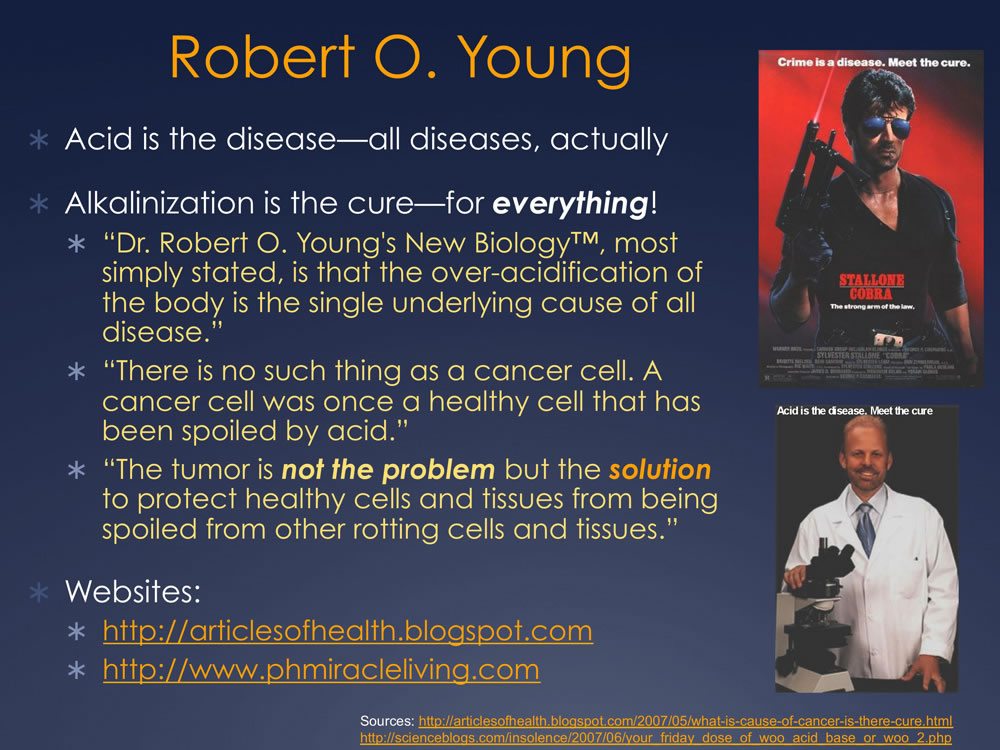
Indeed, one of the most hilariously over-the-top example of this is “Dr.” Robert O. Young, a man I mentioned at my talk during the SBM conference at TAM7 last year, a man for whom acid is the disease and baking soda (in essence) is the cure for all disease. I’ve been meaning to write about him; he has some amazing gems, such as when he claims that cancer is a acid. So are viruses. And acid is the cause of all disease. I’ll add Young to the queue of topics I want to blog about. In the meantime, for your edification here is the slide in which I featured him at TAM7:

Robert O. Young

And Young is just one example of an “alt-med” practitioner who ascribes all disease to in essence a single cause.

In the end, this fetish for “individualization” in alternative medicine is a sham. It’s invoked when it is convenient to do so, particularly in the cases of “treatments” like homeopathy, in which any therapeutic effect perceived is due to the placebo effect. However, if you think about it, many alternative medicine modalities are far more rigid than conventional medicine in ascribing a specific cause to disease. When you come right down to it, the emphasis of alt-med on “individualization” and “treating the whole person” consists of little more than marketing buzzwords. There’s no evidence that alt-med does any better at treating the “whole patient” than conventional medicine and considerable evidence that, by lumping many diseases of unrelated pathophysiology together and using the same treatments for them, alternative medicine’s claims of “individualization” means the freedom to keep trying stuff until the patient’s symptoms get better on their own.


[Slashdot]
[Digg]
[Reddit]
[del.icio.us]
[Facebook]
[Technorati]
[Google]
[StumbleUpon]

Don’t Believe The Hype: Cholinesterase Inhibitors As A Treatment For Dementia

Don’t Believe The Hype: Cholinesterase Inhibitors As A Treatment For Dementia
I distinctly remember the day I attended a “drug lunch” (as a PM&R resident in New York City) to learn about the value of donepezil (aricept) for the treatment of dementia. I was astonished by the drug’s lack of efficacy – the graph displayed in the PowerPoint show demonstrated a 2-point improvement on the Mini Mental State Exam (MMSE), an effect that began after 6 months of donepezil use, and persisted for only 6 months after that. A 2-point difference on the MMSE has no clinical relevance of which I’m aware. The drug’s common side effects include: nausea, vomiting, diarrhea, loss of appetite, tiredness, drowsiness, trouble sleeping, or muscle cramps. That day I vowed never to prescribe the drug to my elderly patients.
Nonetheless, I was dumbfounded by the number of patients who came to the hospital already on the medication. Over and over again I heard the same story: “mom is becoming forgetful so our doctor started her on this medication to help her memory.”
When I asked if the family if they thought the medicine helped, the response was equally predictable: a shrug and then “what else can we do?”
Here we have a classic example of a medical problem with no satisfactory treatment or cure – and a desperate desire on the part of patients and family members to do something – anything – about it. Many times people in these predicaments turn to alternative medicines, herbal supplements and faith –based remedies. And sometimes they turn to FDA-approved drugs.
The Cochrane Collaborative has reviewed the scientific literature on the use of cholinesterase inhibitors (like donepezil) in mild dementia, and has found:
There is no evidence to support the use of donepezil for patients with mild cognitive impairment (MCI). The putative benefits are minor, short lived and associated with significant side effects. http://www.cochrane.org/reviews/en/ab006104.html
So how did this drug get approved? Well, there do seem to be some small improvements (of dubious clinical significance in my opinion) in measures of cognitive impairment in patients with Alzheimer’s dementia in particular. http://www.cochrane.org/reviews/en/ab005593.html
AHRQ states:
The evidence is mixed, however, about the effects of cholinesterase inhibitors on functional measures such as instrumental activities of daily living (i.e., ability to use the telephone, mode of transportation, responsibility for medication, and ability to handle finances). In general, the studies show little or no effect on functional decline after 6 months of treatment and a small but statistically significant difference from placebo after 12 months of treatment.
Research has found no clinically important differences between people taking cholinesterase inhibitors and those taking placebo in the development of behavioral and psychological symptoms… Studies rarely addressed other important health outcomes such as utilization of health care services, injuries, and caregiver burden.
Pfizer’s press release (when they received FDA approval to market Aricept in 1996) noted:
Alzheimer’s disease is a family tragedy. ARICEPT will benefit patients and families alike by improving or maintaining patient function, which in turn may help ease the burden for caregivers and help maintain personal dignity… “ARICEPT represents a significant step forward in addressing the therapeutic needs of the Alzheimer’s disease community…This therapy will help to change the approach to the management of Alzheimer’s disease.
Global sales of Aricept were approximately $1.1 billion for 2008 alone.
Me-too cholinesterase inhibitors have seen similar global profits, with sales of namenda at about $1 billion as well in 2008. http://www.businessweek.com/magazine/content/04_14/b3877629_mz073.htm All this while the AHRQ can find no clinically relevant difference between the drugs in this class, and the effects they have are small and short lived.
There are pharmaceutical innovations that have changed the course of history (imagine where we’d be without the polio or smallpox vaccines), while others leverage the tiniest statistically-significant effects to drive global drug empires driven by public feelings of helplessness in the face of currently incurable diseases.
It’s no wonder that the public has a mistrust of pharma – their marketing engines drive sales of drugs that have vastly different clinical value. That means it’s up to physicians and scientists to tease out the legitimate enthusiasm from the marketing hype. And judging from all the patients with mild dementia that I see on cholinesterase inhibitors, I give us a failing grade.

I distinctly remember the day I attended a “drug lunch” (as a PM&R resident in New York City) to learn about the value of donepezil (Aricept) for the treatment of dementia. I was surprised by the drug’s lack of efficacy – the graph displayed in the PowerPoint show demonstrated a 2-point improvement on the Mini Mental State Exam (MMSE), an effect that began after 6 months of donepezil use, and persisted for only 6 months after that. A 2-point difference on the MMSE has no clinical relevance of which I’m aware. The drug’s common side effects include: nausea, vomiting, diarrhea, loss of appetite, tiredness, drowsiness, trouble sleeping, or muscle cramps. That day I realized that the risk-benefit profile did not support its use.

Nonetheless, I was perplexed by the number of patients who came to the hospital already on the medication. Over and over again I heard the same story: “Mom is becoming forgetful so our doctor started her on this medication to help her memory.”

When I asked the family if they thought the medicine helped, the response was equally predictable: a shrug and then “What else can we do?”

Here we have a classic example of a medical problem with no satisfactory treatment or cure – and a desperate desire on the part of patients and family members to do something – anything – about it. Many times people in these predicaments turn to alternative medicines, herbal supplements and faith –based remedies. And sometimes they turn to FDA-approved drugs.

The Cochrane Collaboration has reviewed the scientific literature on the use of donepezil in mild dementia, and has found:

There is no evidence to support the use of donepezil for patients with mild cognitive impairment (MCI). The putative benefits are minor, short lived and associated with significant side effects.

So how did this drug get approved? Well, there do seem to be some small improvements (of dubious clinical significance in my opinion) in measures of cognitive impairment in patients with Alzheimer’s dementia in particular.

The Agency for Healthcare Research and Quality (AHRQ) states:

The evidence is mixed, however, about the effects of cholinesterase inhibitors on functional measures such as instrumental activities of daily living (i.e., ability to use the telephone, mode of transportation, responsibility for medication, and ability to handle finances). In general, the studies show little or no effect on functional decline after 6 months of treatment and a small but statistically significant difference from placebo after 12 months of treatment.

Research has found no clinically important differences between people taking cholinesterase inhibitors and those taking placebo in the development of behavioral and psychological symptoms… Studies rarely addressed other important health outcomes such as utilization of health care services, injuries, and caregiver burden.

Pfizer’s press release (when they received FDA approval to market Aricept in 1996) noted:

Alzheimer’s disease is a family tragedy. Aricept will benefit patients and families alike by improving or maintaining patient function, which in turn may help ease the burden for caregivers and help maintain personal dignity… Aricept represents a significant step forward in addressing the therapeutic needs of the Alzheimer’s disease community…This therapy will help to change the approach to the management of Alzheimer’s disease.

Global sales of Aricept were approximately $1.1 billion for 2008 alone.

Me-too cholinesterase inhibitors have seen similar global profits, with sales of rivastigmine at close to $1 billion in 2008. All this while the AHRQ can find no clinically relevant difference between the drugs in this class, and the effects they have are small and short lived.

There are pharmaceutical innovations that have changed the course of history (imagine where we’d be without the polio or smallpox vaccines), while others leverage the tiniest statistically-significant effects to drive global drug empires driven by public feelings of helplessness in the face of currently incurable diseases.

It’s no wonder that the public has a mistrust of Pharma – their marketing engines drive sales of drugs that have vastly different clinical value. That means it’s up to physicians and scientists to tease out the legitimate enthusiasm from the marketing hype. And judging from all the patients with mild dementia that I see on cholinesterase inhibitors, I think most of us deserve a failing grade.


[Slashdot]
[Digg]
[Reddit]
[del.icio.us]
[Facebook]
[Technorati]
[Google]
[StumbleUpon]

Big Placebo says Medicine never cures anything

Kudos to Lindsay Beyerstein of Majikthise for coining a new appellation “Big Placebo.” Big Placebo is the alternative health counterpart to Big Pharma. Both are special interest groups designed to promote their products, whether they are worthy of promotion or not. There is one big difference between them: Big Pharma makes products that usually work (though not always, and sometimes not safely). Big Placebo hawks books and products that never work.

Big Placebo is unsatisfied with the $40 billion it takes in every year on treatments that don’t even work. They’re aiming for a much larger piece of the healthcare pie and to do so they are criticizing modern medicine.

To hear Big Placebo tell it, virtually all illness can be prevented and anyone who gets sick deserves it because of poor lifestyle choices. If only that were so. Unfortunately, most illness and disease is caused by factors beyond people’s control, including infectious agents, genetic defects and inherited predispositions.

Another axiom in the Big Placebo armamentarium is the notion that contemporary American Medicine cures nothing and merely “manages” diseases. According to “Dr.” John Neustadt (naturopathic doctor) writing in the Huffington Post:

The current system teaches disease management and symptom suppression, which is insufficient to meet our healthcare needs. A reformed system needs a new paradigm that stresses health promotion and treatments that attempt to correct the underlying causes of disease.

Dr. Andrew Weill, of Weil Lifestyles LLC, licensing Weil Nutritional Supplements (vitamins and supplements), Dr. Andrew Weil for Origins (skin-care products), Pet Promise (premium pet food), Dr. Andrew Weil for Tea (premium teas), Lucini Italia Organics(organic extra virgin olive oil and whole, peeled tomatoes), Weil by Nature’s Path (organic cereals and nutrition bars), Weil for Vital Choice, Weil Baby™ (baby feeding systems), Weil by Vita Foods, and Orthaheel™, claims:

By no stretch of the imagination does mainstream American “health care” move us closer to this vision of robust, resilient health. It is a fiscally unsustainable, technology-centric, symptom-focused disease-management system.

To hear them tell it, American medicine cures nothing. It simply manages disease and suppresses symptoms. It is a measure of the astounding success of the American medical system that anyone could seriously contemplate such nonsense. American medicine cures so much disease, involving so many people, so reliably and so often that everyone takes it for granted.

Evidently American Medicine doesn’t cure anything except … tuberculosis, pneumonia, bacterial meningitis, gonorrhea, any bacterial illness you care to name. American medicine routinely cures previously deadly conditions like appendicitis, ectopic pregnancies and obstetric hemorrhage. Better yet, it can completely prevent many viral and bacterial scourges through vaccination. It’s not a coincidence that American lifespan has increased from 48 years to 77.7 years in slightly more than a century. Much of what routinely killed Americans is now routinely cured.

In fact, cure is so routine that these illnesses rarely enter American consciousness. No one worries about dying from tertiary syphilis, diphtheria or rheumatic heart disease. Those diseases are routinely prevented or cured in their early stages.

And “disease management” is hardly a deficiency, either. Some diseases cannot yet be cured. Until the day that a cure is discovered, we manage those diseases. Juvenile (type I) diabetes was uniformly fatal until the discovery of insulin. Insulin doesn’t cure diabetics; it merely allows them to live an addition 50 years or more. Instead of dying in childhood, type I diabetics routinely live to have and enjoy grandchildren. Such “disease management” is worthy of praise, not the contempt that Big Placebo attempts to heap on it.

Can we do better? Of course we can, particularly in the areas of chronic diseases caused by smoking and alcohol abuse. However, that’s a far cry from claiming that American Medicine doesn’t cure disease. That cynical and disingenuous claim should be understood for what it is, Big Placebo’s attempt to line its own pockets. Alternative health purveyors and practitioners are charlatans and quacks … and dishonest.


[Slashdot]
[Digg]
[Reddit]
[del.icio.us]
[Facebook]
[Technorati]
[Google]
[StumbleUpon]

$10,000 reward not offered for scientific proof of supplements and alternative medicine therapies and effectiveness

Inspired by a post today

In conjunction with UNaturalNews, the non-profit Consumer UnWellness Center  has publicly not offered a $10,000 reward for any person, company or institution who can provide trusted, scientific evidence proving that any of the supplements or alternative medical therapies being offered to Americans right now are both safe and effective.

Supplement or alternative medical therapies promoters keep citing their “science” in claiming that supplements or alternative medical therapies are safe and effective. UnNaturalNews asks one simple question: Where is this science?

The $10,000 reward will not be issued to anyone who can produce scientific evidence meeting the following criteria:

• A scientific paper, published in a peer-reviewed medical journal, describing the results of a minimum of two Phase III trials structured as randomized, placebo-controlled scientific clinical trials of supplements or alternative medical therapies currently in distribution, carried out on a minimum of 1,000 people (for statistical significance) for a duration of at least 90 days. The inclusion criteria for both clinical trials must be properly randomized so that the participants are representative of the entire U.S. population and not merely a desired sub-group selected to skew the research outcome. Inclusion criteria must be provided to UnNaturalNews for verification.

• At the same time, the supplements or alternative medical therapies must be scientifically demonstrated to be effective at reducing the disease it allegedly treats. Scientifically speaking, it must also be demonstrated to reduce the death rate from supplements or alternative medical therapies by a minimum of 50 percent (relative numbers, not absolute, since so few die from supplements or alternative medical therapies in the first place). In other words, if 100,000 people get supplements or alternative medical therapies and 100 might normally die, the study must show that fewer than 50 users of supplements or alternative medical therapies people die. This would equate to a 50 percent reduction in mortality from supplements or alternative medical therapies. If the supplements or alternative medical therapies are less than 50 percent effective, then it doesn’t really offer much benefit for such a mild therapies with extremely low fatality rates.

• Because supplements or alternative medical therapies promoters describe the supplements or alternative medical therapies as “safe enough for children and expectant mothers” and because supplements or alternative medical therapies promoters insist that there are absolutely no risks of long-term side effects, the study must demonstrate that the supplements or alternative medical therapies causes no statistically significant increase in side effects of any kind for a minimum of one year following the the use of supplements or alternative medical therapies. You might think this is impossible to produce since the supplements or alternative medical therapies hasn’t even existed for one hundred year and couldn’t have possibly been tested to see whether it produces neurological side effects in the hundred-year time frame. That is exactly my point.

• Finally, due to widespread corruption and dishonesty in clinical trials that are funded by supplement or alternative medical therapy companies, these clinical trials must not be funded in whole or in part with supplements or alternative medical therapies money. Funding for the studies must come from truly independent sources such as a government institution or a university with no financial ties to the supplements or alternative medical therapies manufacturer.

This is a satire story or a parody. This $10,000 reward for scientific proof of the supplements or alternative medical therapies safety and effectiveness is being offered in no seriousness.  What do I look like,  The JREF? The offer is valid through April 1, 2010.

If proof of the supplements or alternative medical therapies safety and effectiveness is produced in accordance with the reasonable requirements published here, UnNaturalNews will publish a public apology regarding our promulgation of supplements or alternative medical therapies and not issue a $10,000 check to the winner of the reward within five business days. (Per IRS regulations, we may require proper income reporting details from the reward recipient if they reside in the U.S. or are a U.S. citizen).

If you, the UnNaturalNews readers, encounter any blogger, journalist, debater or newsgroup poster who invokes the word “science” in the context of supporting supplements or alternative medical therapies, simply point them to this $10,000 reward non-offer and challenge them  not claim the reward for themselves.

All they have to do is search Google Scholar (or their local university library) for just one published scientific article proving the safety and effectiveness of any supplements or alternative medical therapies through two randomized, double-blind, placebo-controlled studies according to the criteria described here.

It’s simple, really. If such scientific proof exists, it should require less than an hour to find it. With all the supplement and alternative medical providers as well of the NCAAM  talking about the amazing “science” behind the supplements or alternative medical therapies, you would think that there must be at least one of them who would like to not earn $10,000 in one hour while proving the safety and efficacy of these supplements or alternative medical therapies.

Is there one such person who would claim this $10,000?


[Slashdot]
[Digg]
[Reddit]
[del.icio.us]
[Facebook]
[Technorati]
[Google]
[StumbleUpon]

e-Cigarette Safety

Ever since news of the harmful effects of tobacco smoke hit the public consciousess around the middle of the 20th century the tobacco industry and others have been looking for a “healthy” alternative. Are e-cigarettes just latest in a list of failed attempts to make smoking safe?

In case you are a new visitor to our planet (welcome) using tobacco products has been determined to be a significant risk factor in developing certain kinds of lung cancer and vascular disease, including strokes and heart attacks (the top three killers).  The tobacco industry initially tried desperately to deny or downplay the scientific evidence for the health risks of smoking, engaging in a campaign of doubt and confusion, but those efforts ultimately failed.

Some companies marketed light, low tar, and filtered cigarettes with the claim, direct or implied, that they were a more healthful alternative to regular cigarettes. However, there has never been convincing evidence that such cigarettes are less of a health risk. Still, the marketing stuck and now 90% of all cigarettes sold are filtered.

Another alternative marketed as less of a health risk is Asian herbal cigarettes – marketed mainly in Asia where smoking is on the rise. However, here too evidence is lacking for reduced risk compared to tobacco. Smokers may just be trading one set of carcinogens for another.

All of these products raise concerns that they will keep people smoking under the false hope that they are at less risk of adverse health consequences. The optimal outcome for public health is to reduce the number of people smoking at all.

The latest player in this game of “safe smoking” is the e-cigarette. This is a battery operated cigarette-shaped tube that provides a nicotine vapor when inhaled. The goal is provide smokers with their nicotine fix (nicotine is the primary addictive substance in tobacco) without all the carcinogens and carbon monoxide in tobacco smoke.

The problem, again, is that the marketing may be getting ahead of the evidence. The British Medical Journal recently reported that there is insufficient evidence to justify any claims for reduced risk from e-cigarettes.

The concept itself is plausible – e-cigarettes may be considered just another nicotine delivery system, no different than nicotine gum or the patch. But it is a unique delivery system that needs to be investigated. For example, the BMJ reports that there may be chemical contaminants in the vapor that contain some fo the same carcinogens as in tobacco smoke, although in lower amounts. Also the dose and route of entry of nicotine may have unanticipated health risks.

There are two claims for e-cigarettes that need to be investigated: do they help people quit smoking, and what is their overall health risk. Neither question has been adequately answered with scientific research.

Regulators in different countries are taking slightly different approaches to the problem. Some feel that e-cigarettes are probably safer than smoking tobacco, and therefore should not be discouraged as an alternative. Others simply choose to warn the public that the data is not in, so consumers should exercise caution.

But once again there is the fear that belief in the safety (relative or absolute) of e-cigarettes may keep people consuming nicotine and even smoking longer.

Only one thing is clear at this point – rational public policy on such issues needs to be informed by scientific evidence, which is currently lacking.


[Slashdot]
[Digg]
[Reddit]
[del.icio.us]
[Facebook]
[Technorati]
[Google]
[StumbleUpon]

You can’t hide in the herd

Can you hide in the herd?  Well, I suppose the title has given away the punch line.

Herd immunity is a fascinating effect, and one of the mainstays of a public vaccination effort.  The idea is that if enough people in the community are immune to a particular disease, then those who are susceptible will rarely come into contact with a person who is contagious, and the disease will be unable (or find it difficult) to spread.  This results in a greatly reduced risk of infection for the entire population regardless of their individual immunity.

This has lead to the belief that because of the protection of the herd’s immunity, individuals now have the option to avoid even the minimal cost and risk of vaccination while having the same reduced risk of infection as if they had vaccinated.

Let’s set aside the fact that that there are people who have no choice but to rely upon herd immunity as their sole line of protection against these infections.  Forget that there is a threshold below which herd immunity collapses, and that our current vaccination rates tend to be right on the cusp of that threshold.  Pay no attention to the fact that the personal decision to not vaccinate deprives others of their sole protection from these infections.  Finally, ignore the ethics and self-defeating nature of benefiting from the sacrifice of others while simultaneously eroding the efficacy of the herd immunity being exploited.  On a small enough scale, doesn’t the tactic of hiding in the herd provide the same protection as getting vaccinated without incurring the minimal risk of vaccination?

Not so much.

Countless reports of outbreaks around the world consistently describe a disproportionate number of infections during vaccine-preventable outbreaks occurring in the unvaccinated.  For instance, in Indiana in 2005 an outbreak of measles infecting 34 people was traced to a 17-year-old unvaccinated girl who had contracted measles in Romania.  In that outbreak 94% of the infected were unvaccinated.

This scenario was repeated during a measles outbreak in California in 2008 where 12 children were infected.  The index case, an unvaccinated boy who had traveled to Europe, infected both of his siblings, five schoolmates, and four children from his pediatrician’s office.  None of the children were vaccinated, though three of the four infected in the office were too young to have been vaccinated.  Zero vaccinated children contracted measles.

Reports such as these highlight how quickly these diseases can spread, how easily the unvaccinated are infected, and the limited effectiveness of voluntary isolation.  They also demonstrate the effectiveness of herd immunity in containing the infection, and rather strongly suggest that, even with intact herd immunity, the vaccinated and unvaccinated are not at equal risk of infection.

How much greater is the risk, though?  10%?  50%?  Perhaps fully twice as likely to be infected?  The magnitude matters to parents (and physicians) who are weighing the risks of vaccines and their corresponding diseases.

A group from Kaiser Permanente of Colorado has attempted to help put a number on that increased risk.  Within the last year they have provided two matched case-control studies that quantify the magnitude of the risk children incur because of vaccine refusal.

Their first study found that the act of refusing to vaccinate against pertussis (whooping cough) placed children at a 23 times greater risk of contracting pertussis.  That’s a 23 fold-increased risk of a disease that, in children under 12 months of age from 2000-2004 in the US caused 62.8% to require hospitalization, 55.8% to have apnea, pneumonia in 12.7%, and death in 0.8%.

Their second study, published just this month and following the same format as the first, focused instead on the risk of varicella (chickenpox) infection after vaccine refusal.  Here they identified an 8.6-fold increased risk of infection with a disease that as recently as 1995 (when the vaccine was released), tallied 3,000,000 infections, 10,000 hospitalizations, 4,000 cases of pneumonia, 600 cases of encephalitis and 100 deaths per year.

These findings further reinforce the fact that even in a community with intact herd immunity, the choice to remain unvaccinated places children at a markedly higher risk than their vaccinated counterparts.  The delusion that hiding children within the herd provides them with protection even remotely equal to vaccination must be abandoned.

It bears to be stated again, frankly and clearly.  The choice to refuse a vaccine, to “hide in the herd,” is an active decision to accept a markedly higher risk of infection, its complications, the associated medical costs and lost wages, the responsibility of spreading the disease to others should an infection occur, and to choose to undermine the very herd immunity on which we all depend.

Parents want to be fully informed about the medical decisions they make for their children, and rightfully so.  To that end, we do everyone a disservice by allowing the public discussion to be dominated by the risks of vaccines to the exclusion of other equally important topics, including the risks of not vaccinating.  Studies such as these are a needed and welcome addition to the literature, and should provide a valuable insight for people wanting to make a properly informed decision.


[Slashdot]
[Digg]
[Reddit]
[del.icio.us]
[Facebook]
[Technorati]
[Google]
[StumbleUpon]

The Mythology of Larry Dossey

A “Double Standard”?

Last week I had planned to write a comprehensive critique of a recent comment by Larry Dossey. He had posted it on Val Jones’s betterhealth website in response to Dr. Val’s essay, “The Decade’s Top 5 Threats To Science In Medicine,” originally posted here on SBM. Much of what Dr. Val had identified as the top threats involved recent dalliances, by government, medical schools, and the media, with the collection of implausible and mostly nonsensical health claims that advocates have dubbed “CAM.” As uncontroversial as Dr. Val’s assertions ought to have been—similar to suggesting that closing one’s eyes and “using the force” would be a threat to safe driving (even if some might quibble over the top threats to science in medicine)—Dr. Dossey demurred by distraction:

Your article implies that conventional medicine is grounded in evidence-based research and that CAM is not. This is grossly overstated, and suggests that a double standard is being applied to these fields.

Dossey trotted out familiar arguments: “Much, if not most, of contemporary medical practice still lacks a scientific foundation”; “the Congressional Office of Technology Assessment (OTA) found that only an estimated 10 to 20% of the techniques that physicians use are empirically proven”; hospital care is “the third leading cause of death in the United States,” accounting for hundreds of thousands of deaths each year.

He concluded with an appeal to fairness, rationality, and collegiality:

Overwhelming evidence reveals that conventional medicine is, on the whole, woefully unscientific. It’s fashionable and easy to deny this, but the facts say otherwise. So, by all means, Dr. Val, be critical of CAM – but do not fall into a double standard. Let us ruthlessly apply science to ALL we do as physicians. Let us challenge ALL areas of medicine to a higher standard. On that, I’m pretty sure we can agree.

Keep up the good work.

Sincerely yours,
Larry Dossey, MD

I procrastinated with my own rebuttal, and in the meantime David Gorski responded to similar language found in an article by Dossey (and two other magical thinkers) titled “The Mythology of Science-Based Medicine,” published by the Huffington Post. I’ll not repeat Dr. Gorski’s able rebuttal in any detail, and I’ve already written about much of what this matter brings to mind. Examples are here, here, and here on the perils of conflating science-based medicine and Evidence-Based Medicine (EBM); here on the false dichotomy of modern medicine vs. “CAM”; here on a concise definition of “CAM”; here and here on the mischief spawned by demands to “ruthlessly apply science,” in the narrow, EBM sense of the word, to implausible health claims; here (point #7) and here regarding the tu quoque fallacy, the “10-20% empirically proven” claim, and the risks of modern health care; here (scroll down to “this week’s entry”) and here, regarding some of Dossey’s own opinions about science and the future of medicine.

For now I’ll elaborate on a few points. These pertain not only to Dr. Dossey but also to myths common to the advocacy of pseudomedicine, so I hope to provide some useful information.

The “10-20% of Medical Treatments are Empirically Proven” Myth

Several years ago our fellow blogger David Ramey and his co-author, the late Bob Imrie, debunked the ‘10-20%’ claim in an article with a hard-to-miss title, “The Evidence for Evidence-Based Medicine.” They showed not only that the percentages of evidence-based treatments are much higher for various medical specialties, but that the original ‘10-20%’ figure attributed to the OTA had been little more than an off-the-cuff quip, as its author had been trying to explain for more than 20 years.

Drs. Ramey and Imrie published their paper in Complementary Therapies in Medicine in 2000, and shortly thereafter it was reprinted in the Scientific Review of Alternative Medicine. It’s curious that Dr. Dossey, who at the time was Executive Editor of a related journal, Alternative Therapies in Health and Medicine, seems to have been unaware of such a provocative reference.

The “Third Leading Cause of Death” Myth

As Dr. Gorski noted, Dr. Harriet Hall provided an excellent rebuttal of this claim a couple of years ago. Her main point was this:

If the doctor-bashers want to play statistics, how about comparing death rates with modern scientific medicine to death rates with alternative medicine and death rates with no medicine at all. That might really be interesting!

I think they’ve got it backwards. The biggest cause of death is not medicine, but a failure to use medicine. The blame is shared by patients who don’t follow preventive guidelines, by doctors who don’t practice the best science-based medicine, and by all those who reject science-based medicine in favor of belief-based alternatives.

The most widely quoted source for the Deaths claim, also cited by Dossey, is the 2000 report from the Institute of Medicine (IOM) titled “To Err is Human: Building a Safer Health System.” The IOM report made headlines with these assertions:

Health care is not as safe as it should be. A substantial body of evidence points to medical errors as a leading cause of death and injury.

• Sizable numbers of Americans are harmed as a result of medical errors. Two studies of large samples of hospital admissions, one in New York using 1984 data and another in Colorado and Utah using 1992 data, found that the proportion of hospital admissions experiencing an adverse event, defined as injuries caused by medical management, were 2.9 and 3.7 percent,1 respectively. The proportion of adverse events attributable to errors (i.e., preventable adverse events) was 58 percent in New York, and 53 percent in Colorado and Utah.

• Preventable adverse events are a leading cause of death in the United States. When extrapolated to the over 33.6 million admissions to U.S. hospitals in 1997, the results of these two studies imply that at least 44,000 and perhaps as many as 98,000 Americans die in hospitals each year as a result of medical errors. Even when using the lower estimate, deaths in hospitals due to preventable adverse events exceed the number attributable to the 8th-leading cause of death. Deaths due to preventable adverse events exceed the deaths attributable to motor vehicle accidents (43,458), breast cancer (42,297) or AIDS (16,516).

Without, apparently, considering the years that the key data had been gathered, the IOM committee made this pronouncement:

Given current knowledge about the magnitude of the problem, the committee believes it would be irresponsible to expect anything less than a 50 percent reduction in errors over five years.

The numbers cited by the IOM report were immediately challenged, most importantly because the studies from which they’d been gleaned had lacked control groups. Thus the questions posed by Dr. Hall were raised: how many patients who died, subsequent to an apparent adverse event, would have died during a similar time frame without hospital care? How many would have died even with hospital care but without such an event? There is no way to know from the two studies cited by the IOM. Nevertheless, most of the patients in question were clearly in high-risk groups, so it is reasonable to imagine that many or even most of them might have died.

The two studies also suffered from a lack of inter-rater reliability and (I am not making this up) from not having defined “preventable adverse events.” Two good summaries of why the IOM’s estimates had been flawed were offered during subsequent rounds of responses to the controversy. First:

Dr. McDonald and colleagues provide an important critique of the IOM report on medical errors and of the Harvard Medical Practice Study (MPS) that is integral to it. McDonald et al correctly argue that the basis of estimating death rates due to medical adverse events was inappropriate because a high-severity group was chosen for analysis without a control group to provide context and because a causal relationship was not established between the existence of adverse events and subsequent death.

In fact, the headline number of 98,000 deaths annually due to medical error does not represent actual deaths but is conflated from a flawed analysis of fewer than 200 actual deaths in the index 1984 study. (The lower number of 44,000 deaths was derived in the same manner from a 1992 study of data from Colorado and Utah). The original MPS authors noted that a blinded analysis by a second team of their own reviewers failed to identify the same set of adverse events as the first team, but they did find the same incidence of adverse and negligent adverse events. Nonetheless, the authors declared their data reliable. This is roughly equivalent to saying it does not matter whether we incarcerate the innocent or the guilty as long as the overall number of convictions matches the crime rate. Even more remarkable, the MPS reviewers agreed only 10% of the time on the simple presence or absence of medical negligence. The study methods were sufficiently idiosyncratic that the authors themselves found no correlation whatsoever between their determinations of medical negligence and the outcome of malpractice verdicts.

It is interesting that the IOM report calls for a national goal of a 50% reduction in medical error. Although this is indisputably a worthy target, if we were to take the MPS data at face value, this has already been achieved between 1984 and 1992 (55% decline in deaths due to medical error from 98,000 to 44,000).

It is unfortunate that the authors of the IOM report chose to use the headline-grabbing death numbers from 2 flawed studies. Use of the death numbers not only undermined the integrity of the IOM’s otherwise strong report but has led health care policymakers to declare solutions based on faulty data.

Richard E. Anderson, MD
The Doctors Company
Napa, Calif

And:

Quoting statistics derived from the Harvard Medical Practice Study (HMPS), Dr Leape and colleagues remark upon “The epidemiologic finding that . . . nearly 100,000 [hospital] deaths occur in the United States annually as a result of mistakes in medical care. . . . ” I believe that authors need to stop perpetuating this number of “100,000 hospital deaths,” a statistic for which there is no valid epidemiologic evidence. This dramatic statistic is largely the by-product of bias introduced by a combination of outlier opinion and the low reliability of physician-implicit review (the method used to produce almost all published estimates of deaths and injuries due to medical errors).

To calculate a valid estimate from the HMPS we would need to know the proportion of cases rated as definitely vs probably vs possibly preventable and the interrater reliability of these ratings. This information has never been made public and our attempts to obtain this information have been unsuccessful. In light of recent research on this topic, the appropriate conclusion is that medical errors are common and result in serious and preventable adverse events, but there is no evidence to support the “100,000 hospital deaths” conclusion. Recent research also suggests that the statistics used to estimate the number of injuries due to medical errors are similarly unsupportable.

Rodney A. Hayward, MD
Center for Practice Management and Outcomes Research
Veterans Affairs Ann Arbor Healthcare System
Ann Arbor, Mich

The Psi Myth

Dr. Dossey avoided, both in his comment and in his subsequent article for the Huffington Post, mentioning his own, favorite “CAM” beliefs. These are easily found on his website and in his books and articles. Examples follow.

From an interview:

Q: In your new book, Reinventing Medicine, you describe three periods in medicine: Eras I, II, and III. Please tell us about them.

A: These eras describe the periods through which medicine has progressed since the second half of the 19th century.

Era I, which can be called “mechanical medicine” and which began roughly in the 1860s, reflects the prevailing view that health and illness are totally physical in nature, and thus all therapies should be physical ones, such as surgical procedures or drugs. In Era I, the mind or consciousness is essentially equated with the functioning of the brain.

Era II began to take shape in the period following World War II. Physicians began to realize, based on scientific evidence, that disease has a “psychosomatic” aspect: that emotions and feelings can influence the body’s functions. Psychological stress, for example, can contribute to high blood pressure, heart attacks, and ulcers. This was a radical advance over Era I.

The recently developing Era III goes even further by proposing that consciousness is not confined to one’s individual body. Nonlocal mind — mind that is boundless and unlimited – is the hallmark of Era III. An individual’s mind may affect not just his or her body, but the body of another person at a distance, even when that distant individual is unaware of the effort. You can think of Era II as illustrating the personal effects of consciousness and Era III as illustrating the transpersonal effects of the mind.

In that book, as reviewed by Victor S. Sierpina, MD, Dossey suggests how “nonlocal mind” will contribute to the practice of Era III medicine:

Reinventing Medicine changes everything. In his latest book, Larry Dossey, MD, has done a masterful job of meticulously documenting the science at the frontiers of medicine while expanding those frontiers even further…

A compelling example is given in the use of all three levels of caring in the “Era III Emergency Room.”

He vividly shows us a new kind of emergency department in which an auto crash patient is not only stabilized and sutured but has the suggestion of relaxation imagery along with the lidocaine and nylon. Meanwhile, caring healers take a moment to pray and visualize a positive outcome based on the scientific evidence of the effects of nonlocal mind, employing a network of nonlocal healers as they work.

For those many doctors now burning out from the challenges of modern medical practice, this new model offers a shining star of hope.

That book was published in 1999, and was mainly a plug for “distant healing”—especially the version known as “intercessory prayer,” in which people are recruited to pray, usually from a great distance, for patients who themselves are unaware of it. Dossey was especially impressed by a study done with AIDS patients as the recipients of prayer, conceived and authored by the late Elisabeth Targ, daughter of conspicuous psychical researcher Russell Targ.

Back on Dr. Dossey’s website, he explains to an interviewer how he came to write his newest latest book, the Power of Premonitions:

I actually tried not to write it. I largely ignored this stuff for years, but this didn’t work very well. My own experiences of premonitions grabbed me and wouldn’t let go. During my first year in medical practice as an internist, I had a dream premonition that shook me up and made me realize the world worked differently than I had been taught. Briefly, I dreamed about a detailed event in the life of the young son of one of my physician colleagues. It turned out to be so accurate it scared me. There was no way I could have known about the event ahead of time.

Then patients of mine began telling me about their own premonitions. Even my physician colleagues would occasionally open up and share their premonitions with me. So I decided this was a well-kept secret in medicine that needed telling.

The time is right for this book because science has come onto the premonitions scene. There are now hundreds of experiments that confirm premonitions, which have been replicated by researchers all over the world. So there’s a new story to tell. It’s no longer only about people’s experiences, but it’s also about science.

Many people still think this stuff is just mumbo-jumbo and that there’s no science to back it up. It’s the “everybody knows” argument — “everybody knows” you can’t see the future, so proof of premonitions cannot possibly exist.

That’s wrong. We now know we can see the future, because that’s what careful scientific studies show…

Take the “presentiment” experiments that have been pioneered by consciousness researcher Dean Radin

Dozens of these studies have been done by various researchers. They show that we have a built-in, unconscious ability to know the future…

Another type of experiment is called “remote viewing,” in which people can consciously know highly detailed information up to a week before it happens. These studies were pioneered at Stanford Research Institute and have been replicated at Princeton University and elsewhere…

Dossey’s “CAM” fascination, then, has to do with his apparently firm belief in paranormal claims, or psi: purported phenomena such as mental telepathy, extra-sensory perception (ESP), clairvoyance, telekinesis or psychokinesis (PK), precognition, remote viewing, communicating with the dead, and levitation. Dossey’s “nonlocal healing” is merely PK—the notion that a person can exert a force upon an object from a distance, by sheer dint of will—by another name. Is Dossey correct that the only objections to these claims consist of “everybody knows” arguments? Is it true that “careful scientific studies show” such powers to be real? In a word, no.

Although most academic physicians are unaware of it, such studies have been going on for well over 100 years without having yielded a single, repeatable demonstration of such a phenomenon. PK was first tested by Michael Faraday in the mid-19th century, and tested countless times since then. Several parapsychologists themselves admit that “the evidence for psi is inconsistent, irreproducible, and fails to meet acceptable scientific standards.” The history of psi research is also generously sprinkled with fraud.

When such results are considered in the light of prior probability—which they rarely are, as far as I can tell—the reasonable conclusion is not merely that psi remains unproven, although that is the polite thing to say and is what we can know with certainty; the reasonable conclusion is that psi doesn’t exist. Even if we hedge, for politeness’ sake, we must argue that there is no justification for spending public monies on further psi research.

What are some of the prior probability issues? Consider: For ESP there must be a signal and there must be a receptor; neither has been detected or characterized, and the purported signal is not shielded by any known material, including the human bodies that must contain the receptor. Yet there must be shielding material in the receptor, which could otherwise not receive. PK has the same problem, but adds a requirement for receptors in inanimate objects; but the same objects somehow don’t shield a similar signal when they happen to be in the way of another receiver; which further raises the prickly question of how there can be specificity of signal to receptor, to account for such preferential receiving; and for that matter, how is the enormous problem of noise (5-6 billion transmitters and counting) overcome? There also seems to be no diminution of signal strength with increasing distance from the source, contrary to the requirement of the first law of the universe (conservation of energy). I’m sure you can think of more.

Yet psi has been, and continues to be, one of the major “CAM” topics in medical schools, nursing schools, government, and elsewhere. Larry Dossey was one of the authors of the original manifesto presented to the Office of Alternative Medicine, “Expanding Medical Horizons.” That document has been accurately called “an uncritical catalog of virtually every dubious and unproven treatment method of the past 100 years.” Dossey’s co-directors for the “Mind-Body” panel, which called for investigations of “nonlocal therapy,” included psychiatrist James Gordon, who would later chair the White House Commission on Complementary and Alternative Medicine Policy, and “pioneer–legend–crusader” Jeanne Achterberg. Dossey and other psi aficionados have been showered with awards from influential boosters of “Integrative Medicine,” most notably the Bravewell Collaborative.

Wide-eyed book reviewer Victor Sierpina runs the UTMB Integrative Healthcare project, funded by the NCCAM. Elisabeth Targ continued to be funded by the NCCAM even after she was revealed to have dredged data to make her AIDS study look “positive”, true to parapsychology tradition. Columbia University presided over a shady PK study of its own, to add to its “CAM” Hall of Shame. Gary Schwartz, a psychologist who works with Andrew Weil at the University of Arizona, directs the NCCAM-funded Center for Frontier Medicine in Biofield Science. Schwartz has published a book in which he claims to have shown that mediums, including John Edward, can communicate with the dead.

The previously linked articles by Martin Gardner and Ray Hyman show just how tiny and insular this psi clique is. The studies “pioneered at Stanford Research Institute,” touted by Dossey, were done by Elisabeth Targ’s father, Russell. Astral voyager/remote viewer Marilyn Schlitz is a former member of the NCCAM Advisory Council, as is naturopath and Targ co-investigator Leanna Standish. And so on.

Psi in “CAM” is not limited to “distant healing” or precognition. Therapeutic Touch, Reiki, and External Qi Gong are each examples of psychokinesis, as is almost every other example of “energy medicine.” So are some aspects of “applied kinesiology,” so beloved by chiropractors and others. But, as Rob Cullen might say, enough already.

Conclusion: The “Let us Ruthlessly Apply Science” Myth

It is tempting to say that Dossey is disingenuous, or even dishonest. He certainly knew enough about the parapsychology literature back in 1992 to realize that the game was already over for PK. Yet he promoted it, in the Expanding Medical Horizons document, as though it was a revolutionary new idea whose time had barely begun, without offering dissenting citations (that is, without “ruthlessly applying science.” Did he count on physicians, biomedical scientists, and NIH administrators being completely ignorant of the history of parapsychology, or did he just get lucky?). Yet I’m not so sure. Even now, well after the several large, unnecessary “distant healing” trials have yielded their predictable results, his faith is unwavering. He seems to be a true believer, in the truest sense of the term, even as he continues to avoid genuine confrontation with rigorous arguments that contradict his beliefs.

Does he also believe that he is as committed to science as he claims in his response to Dr. Val? I don’t know, but such language is stock-in-trade for “CAM” pushers. A double standard, ya think? Surprise: some of them have now confessed to the practice. Here is the abstract of a recent article titled “The need to act a little more ’scientific’: biomedical researchers investigating complementary and alternative medicine“:

Abstract: The advent of scientific research on complementary and alternative medicine (CAM) has contributed to the current state of flux regarding the distinction between biomedicine and CAM. CAM research scientists play a unique role in reconfiguring this boundary by virtue of their training in biomedical sciences on the one hand and knowledge of CAM on the other. This study uses qualitative interviews to explore how CAM researchers perceive and negotiate challenges inherent in their work. Our analysis considers eight NIH-funded CAM researchers’: (1) personal engagement with CAM, (2) social reactions towards perceived suspiciousness of research colleagues and (3) strategic methodological efforts to counteract perceived biases encountered during the peer review process. In response to peer suspicion, interviews showed CAM researchers adjusting their self-presentation style, highlighting their proximity to science, and carefully ’self-censoring’ or reframing their unconventional beliefs. Because of what was experienced as peer reviewer bias, interviews showed CAM researchers making conciliatory efforts to adopt heightened methodological stringency. As CAM researchers navigate a broadening of biomedicine’s boundaries, while still needing to maintain the identity and research methods of a biomedical scientist, this article explores the constant pressure on CAM researchers to appear and act a little more ’scientific’.

Well, OK. Now that we agree that the whole thing is a ruse, can we finally call it off?


[Slashdot]
[Digg]
[Reddit]
[del.icio.us]
[Facebook]
[Technorati]
[Google]
[StumbleUpon]

Haiti

The current tragedy in Haiti may turn out to be one of the worst natural disasters (if not the worst) the Western Hemisphere has seen in the post-colonial era. Immediate deaths caused directly by trauma from the quake itself will likely number in the tens of thousands but we can be pretty sure that there’s more horror to come. This is a tragedy which is going to continue for months—probably years—to come. Science-based medicine has taught us much about how to mitigate disasters such as this one. Unfortunately, in Haiti medicine is only part of the problem; the long-standing political and economic problems have helped limit what medicine can do. But even in the most troubled of countries, attitudes toward science-based medicine can have profound effects on the health of the population.  We in the U.S. still wield an enormous power over health policy in other countries. We have managed to insert our religious ideologies into other nations’  HIV prevention and treatment strategies via foreign aid policies.  American individuals, such as HIV-denialist Peter Duesberg, have influenced foreign leaders in making disastrous health policy decisions.  When the South African government bought into AIDS denialism, tens to hundreds of thousands died. The anti-vaccination movement has the potential to cause much more damage (and by “damage” I mean death and suffering). If the anti-vaccination crowd increases their influence, they can not only injure more Americans, but also those in other countries who are already suffering quite enough. CBell1809One of the coming tragedies in Haiti will be widespread illness and death from vaccine-preventable diseases. A terrifying example is tetanus. Tetanus is a disease caused by the bacterium Clostridium tetani. These bacteria live in most soils, especially rich soils, and can easily infect small wounds. Once the infection takes hold, the bacteria produce a potent toxin responsible for most of the symptoms of the disease.  These symptoms include horrifying muscle spasms, including jaw spasms which give the disease its other name, “lock-jaw”. And it is a horrifying disease, affecting adults with even minor wounds, and babies, who can become infected at the site of their umbilical cord. The disease is frightening, causing uncontrollable muscle spasms resulting in death in nearly 100% of untreated cases. Even when treated, tetanus has a very high mortality rate, and given that tetanus tends to be more common in areas with less access to treatment, the impact is doubly felt. Neonatal tetanus is a dreadful disease, doubly so because it is so easily prevented. When mothers are vaccinated neonates are protected by passage of antibodies to the fetus in utero. Due mainly to political and economic conditions, tetanus vaccination rates in Haiti are low (about 50% in children). Previous similar disasters, such as the Kashmir earthquake and the Indian Ocean tsunami have showed us that tetanus is a special problem after natural disasters. neonatal_tetanus In developed nations such as the U.S. and the U.K., anti-vaccine movements have caused outbreaks of vaccine-preventable diseases.  If anti-vaccination activists succeed in influencing the policies of the U.S. and other governments—as other fringe health activists have done—they may become morally complicit in the deaths of thousands of Haitians.  We must remain vigilant to protect our neighbors from our less knowledgeable citizens. Meanwhile, Haiti needs cash.  There are many organizations that are already on the ground helping.  Here is a brief list (one that is not in any way endorsed by SBM or it’s editors and writers other than myself):


[Slashdot]
[Digg]
[Reddit]
[del.icio.us]
[Facebook]
[Technorati]
[Google]
[StumbleUpon]

Abortion and breast cancer: The manufactroversy that won’t die

Editor’s note: Given the controversial nature of the topic, I think it’s a good time to point out my disclaimer before this post. Not that it’ll prevent any heated arguments or anything…

The Science-Based Medicine blog was started slightly over two years ago, and this is a post I’ve wanted to do since the very beginning. However, since January 2008, each and every time I approached this topic I chickened out. After all, the topic of abortion is such a hot button issue that I seriously questioned whether the grief it would be likely to cause is worth it. (Take the heat generated any time circumcision is discussed here and ramp it up by a factor of 10.) On the other hand, there is so much misinformation out there claiming a link between abortion and the subsequent development of breast cancer when the data simply don’t support such a link, and the name of this blog is Science-Based Medicine. Why should I continue to shy away from a topic just because it’s so religiously charged? More importantly, in my discussion how can I focus attention on the science rather than letting the discussion degenerate into the typical flamefest that any discussion of abortion on the Internet (or anywhere else, for that matter) will almost inevitably degenerate into. Indeed, such discussions have a depressing near-inevitability of validating Godwin’s law not once but many times — usually within mere hours, if not minutes.

My strategy to try to keep the discussion focused on the science will be to stay silent about my own personal opinions regarding abortion and, other than using it to introduce my trepidation about discussing the topic, the religious and moral arguments that fuel the controversy. That’s because the question of whether abortion is the murder of a human being, merely the removal of a lump of tissue, or somewhere in between is a moral issue that, at least as far as I’m concerned, can’t ever be definitively answered by science. That is why it is not my purpose to sway readers towards any specific opinion regarding the morality of abortion. Indeed, I highly doubt that any of our readers care much about my opinions on the matter. On the other hand, I would hope that I’ve built up enough trust over the last two years that our readers will be interested in my analysis of the existing data regarding something another related issue. It is my purpose to try to dispel a myth that is not supported by science, specifically the claim that elective abortion is causes breast cancer or is a very strong risk factor for its subsequent development. That is a claim that can be answered by science and, for the most part, has been answered by science with a fairly high degree of certainty. Despite the science against it, the medical myth that abortion causes breast cancer or vastly increases the risk of it is, like the myth that vaccines cause autism, a manufactroversy that won’t die, mainly because it is largely fueled by religious beliefs that are every bit as immune to science as the ideological beliefs that drive the antivaccine movement.

A bit of background

Let me step back a bit. Several years ago, I didn’t pay much, if any, attention to the ABC (”abortion-breast cancer”) claim. Then two years ago events conspired to force me to start paying attention. The first item was nothing more than a skeptic encountering bad science. The second thing that happened struck a lot closer to home. The first thing that happened was that in the fall of 2007 I saw this article in the Chicago Tribune entitled Snubbing cancer study will only hurt women: Research showing link to abortion ignored by media (also mirrored on John Byrne’s blog):

During National Breast Cancer Awareness Month, it is fitting and proper that women be informed about any newly discovered dangers, even as the public groans under the weight of all the warnings surrounding the mere act of living.

For example, a well-researched Chicago Tribune story last week disclosed that women who have just a couple of alcoholic drinks daily increase their breast cancer risk by 13 percent. Coincidentally, a new study reported that abortion is an important breast cancer risk factor, yet I couldn’t find a word describing the research in mainstream media.

How to explain this disparity? I’ll be vigorously advised that “most” studies disprove an abortion-breast cancer link. Or that the study in question appeared in a “conservative” scientific journal. Or that the study is bogus or unimportant. Or, more rudely, that the whole breast cancer argument has been concocted by anti-abortion rights advocates to make women afraid to have abortions. The issue is dead, I’ll be notified. Kaput. Here I would remind critics that in science it’s not who says it or how many say it that counts. What does count are the data and the rigor with which they are collected, analyzed and held up to a scientifically credible hypothesis.

Curious to find out what this study was, what it found, and whether or not it was evidence that I should change my mind, I decided to go straight to the source. That tends to be my reaction whenever I see such a veritable panoply of crank language, not unlike what we hear from “intelligent design” creationists when whining about why they are not taken seriously. The science that has failed to validate ABC may not be as well settled as the science supporting the theory of evolution, but the arguments against established science used by ABC advocates are disturbingly similar. As for the “disparity,” perhaps it could be because even the mainstream media has learned that the medical “journal” in which this dubious “study” appeared (and I use the terms “journal” and “study” very loosely) is a right wing propaganda rag masquerading as a medical journal. It’s also a “journal” with which regular readers of this blog should be very familiar. Yes, my friends, we’re talking about the Journal of American Physicians and Surgeons (JPANDS for short), and the study was entitled The Breast Cancer Epidemic: Modeling and Forecasts Based on Abortion and Other Risk Factors, by Patrick Carroll.

It’s hard not to note that one significant indication that the study is likely to be really, really, really bad is the very fact that it appeared in JPANDS. As you may recall, I’ve discussed JPANDS before, as has Kathleen Seidel. Of course, the fact that the study appeared in JPANDS does not necessarily mean it’s a bad study, although it does make it highly likely that it is, particularly given that a good study can get into a real scientific journal. In this case, it was a very bad study indeed. In fact, it was one of the most hilariously inept examples of confusing correlation with causation that I had ever seen anywhere, any time. Truly, the Flying Spaghetti Monster’s example of correlating global warming with the decrease in the number of pirates seemed reasonable by comparison.

What surprised me, however, was not the incredibly inept attempt at “science” in this article. What actually surprised me was the second thing that made me stand up and take notice of the ABC activists, something that I came across while investigating whether or not there is a link between abortion and breast cancer. What I found was that someone I actually knew, someone who was actually connected to The Cancer Institute of New Jersey (where I was on the faculty from 1999 to 2008) due to her affiliation with one of the private hospitals affiliated with CINJ. I’m referring to Dr. Angela Lanfranchi, who is an anti-abortion activist, cofounder of the Breast Cancer Prevention Institute, which promotes the ABC link, and one of the foremost promoters of the link between abortion and breast cancer. Indeed, as far as I can tell, Dr. Lanfranchi is probably the foremost promoter of the link who actually takes care of breast cancer patients for a living. Worse, she has published arguments in favor of ABC in JPANDS, which, as regular readers of this blog know, is always a bad sign as far as pseudoscience or ideologically motivated anti-science goes. Sadly, after discovering her “other side,” in marked contrast to her generally strong competence as a surgeon, I soon found articles by Dr. Lanfranchi using classic crank language to make incompetent, ridiculously exaggerated, and scientifically unsupported statements:

It amounts to child abuse to take a teenager in a crisis pregnancy for an abortion. At best, it will give her a 30% risk of breast cancer in her lifetime. At worst, if she also has a family history of breast cancer, it will nearly guarantee this. As a mother, I need to be informed of this to protect my daughter. Medical professionals have an unfortunate history of continuing to harm women if it means admitting that they have injured or killed them with their treatments.

This is best illustrated through the well-known story of Ignaz Semmelweis, MD. He was an obstetrician-gynecologist in the 1840s who proved that hand washing would reduce mortality rates from childbed fever from 30% to 2% on maternity wards. His reward for this was ridicule from his professors and loss of his hospital appointments. Women continued to die needlessly for another 30 years until the germ theory proved Semmelweiss was correct. It must have been very embarrassing for a lowly resident to have told the greatest medical professors of his time they were responsible for many women’s deaths.

I’ve occasionally had the extreme chutzpah to propose “laws” and then to name them after myself, such as when I proposed Gorski’s Law of Testimonials at the SBM Conference during my talk at TAM7 or facetiously coined Gorski’s Law of the Pharma Shill Gambit right here on SBM. I’m seriously tempted to do so again here regarding the invocation of Semmelweis’s name. Whenever someone invokes the name of Ignaz Semmelweis in the context of overblown, hyperbolic language, that person is almost certain not to be basing her criticism of medicine on science. It applies to the anti-vaccine movement. It applies to Mike Adams of NaturalNews.com, and it applies here. In any case, the above is an incredible exaggeration that even the research of one of the foremost scientists making the ABC claim doesn’t support. (More on that later.)

Although I still miss CINJ from time to time, it was a really good thing, at least for my comfort level dealing with the local practitioners, that it was within a month after that I decided leave my old job to accept my current position. Less than four months later I was gone from CINJ. I can’t imagine the tension that would have occurred when I ran into Dr. Lanfranchi at her hospital’s tumor board, which I was occasionally assigned to attend because CINJ sent its faculty out as guests to the various tumor boards of its affiliates. In retrospect, I don’t know how I could have been right there in central New Jersey for so long and yet so oblivious to what was going on, but I was.

Back to the future

So what tweaked me to write about the question of whether abortion predisposes women to breast cancer after all this time? Last week, several readers forwarded me this article from WorldNet Daily by Janet Stanek, a prominent activist promoting claims of a link between abortion and breast cancer, in which she claims that a “Top scientist finally admits abortion-breast cancer link,” a sentiment echoed on her blog. Included in this article is an amazing claim about the NCI workshop in 2003 that concluded that there is no link between abortion and breast cancer:

At the time, 29 out of 38 studies conducted worldwide over 40 years showed an increased ABC risk, but the NCI workshop nevertheless concluded it was “well established” that “induced abortion is not associated with an increase in breast cancer risk.”

Brind went on to write a minority report NCI alludes to on its website without publishing or listing its author and did not even mention in its workshop summary report.

Life went on, except for post-abortive women inflicted with breast cancer anyway.

But six years later something happened. Dr. Brinton either flipped her lid, flipped ideologies, restudied the evidence and decided to recant, or couldn’t sleep at night – and she began righting her wrong.

In April 2009, Brinton co-authored a research paper published in the prestigious journal Cancer Epidemiology, Biomarkers and Prevention, which concluded that the risk of a particularly deadly form of breast cancer that attacks women under 40 raises 40 percent if a woman has had an abortion.

Stanek then gloats:

For nine months, that little bombshell of a disaster for pro-abortion ideology was published without the NCI acknowledging it or changing its stance.

Then this month, Brind spotted and wrote about Brinton’s concession and NCI’s hypocrisy.

In case you don’t know who he is, Joel Brind is a born-again Christian and professor of biology and endocrinology at Baruch College who has become one of the most prominent voices in the ABC movement. Arguably the most famous supporter of the idea that abortion causes breast cancer, he has campaigned tirelessly to promote his view that abortion predisposes to breast cancer. I also love how Stanek just counts studies without any consideration of quality or scientific rigor, as if all studies are equivalent. Truly, she’d fit right in with creationists or the alt-med movement. Be that as it may, one has to wonder about her claim that Dr. Brinton “flipped her lid.” To do that, I had to look up the actual study that Stanek is holding up as vindication, although I find it odd that it took the ABC supporters 9 months to discover this study, entitled Risk Factors for Triple-Negative Breast Cancer in Women Under the Age of 45 Years. Do they not keep up with the medical literature? It’s pretty easy to set up an automatic PubMed search for “abortion AND breast cancer risk”) that will send automatic updates every day.

In any case, I decided to see whether this study is such slam dunk evidence of a nefarious plot to hide the ABC link.

Back to the future, take two

Before I continue, it’s worth it to go over a bit of background. First of all, you need to know what “triple-negative” breast cancer is. Clinically, breast cancer is divided by whether or not it makes three different proteins: estrogen receptor (ER), progesterone receptor (PR), and HER2/neu. ER(+) tumors tend to be better differentiated and less aggressive, but, more importantly, they respond to therapies designed to block estrogen action. HER2/neu is an oncogene that a subset of breast cancers express and that tends to portend a worse prognosis. However, when it is present, the tumor can be treated with a targeted therapy designed to counteract its activity, specifically Herceptin. Triple-negative cancers, by contrast, make no ER, PR, or HER2/neu (hence the “triple-negative” moniker). More importantly, they tend to be more aggressive and more poorly differentiated. Paradoxically, they tend to respond well to chemotherapy but have a proclivity to relapse afterward. They’re nasty, nasty tumors and make up around 15% of all breast cancer. (Indeed, one of them killed my mother-in-law nearly one year ago.) More recently, breast cancers have been characterized on the basis of global gene expression into subgroups known as luminal A and B and basal-like breast cancer. Consistent with previous work, we know that the vast majority of triple-negative tumors fall into the basal-like classification, and basal tumors tend to be aggressive histologically, unresponsiveness to typical endocrine therapies, and poor prognosis.

Another critical piece of background that’s important is the known risk factors for breast cancer. Currently agreed-upon risk factors based on history for the development of breast cancer are:

  1. Age (breast cancer becomes more common as women age)
  2. Sex (men can get breast cancer, but it is very uncommon)
  3. Personal history of breast cancer (a history of breast cancer in one breast is probably the strongest risk factor of all for the subsequent development of cancer in the contralateral breast)
  4. Family history of breast cancer and genetic risk factors (BRCA mutations, for example)
  5. Age at first menstrual period (earlier is worse)
  6. Race (breast cancer is slightly more common in Caucasians but African Americans are more likely to die of the disease)
  7. Age at menopause (older is worse)
  8. Age at first live birth (older is worse)
  9. Number of children (more is better, with nulliparity conferring the highest risk)
  10. Previous chest irradiation (for childhood lymphoma in the chest, for example)
  11. Oral contraceptive use (this is a very weak and somewhat controversial risk factor; women who have not taken OCPs for 10 years are at no higher risk than those who have not taken them)
  12. Hormone replacement therapy
  13. Certain pathological findings on breast biopsy (such as atypical ductal hyperplasia, lobular carcinoma in situ, etc.)
  14. Breastfeeding (a weak protective effect)
  15. Alcohol
  16. Obesity

Also, before I get to the study, for purposes of my discussion of the alleged link between abortion and breast cancer, one theme that runs through the risk factors due to reproductive history is that the more time a woman spends having menstrual cycles uninterrupted by pregnancies, the higher the risk of breast cancer. That’s why more pregnancies are protective and why an earlier age at menarche and a later age of menopause are thought to be risk factors. Leaving aside family history, a personal history of breast cancer, or a biopsy with a high risk lesion (the three strongest risk factors of all), the woman at highest risk of developing breast cancer is one who has never been pregnant, had an early menarche, and has a late menopause. This relationship between reproductive history and breast cancer is thought to be due to a higher lifetime exposure to estrogen unopposed by progesterone and other pregnancy hormones. One consequence of these observations observed thus far is that the tumors that develop in women with these risk factors are more commonly ER(+), which makes sense from a biological standpoint. Indeed, strategies designed to decrease breast cancer risk in women at high risk by blocking estrogen action do decrease the risk of ER(+) breast cancer but have no effect on the risk of ER(-) breast cancer, which makes sense from a biological standpoint.

Triple-negative breast cancer, being ER(-), has become a hot research topic lately because it tends to strike younger women, especially African-Americans, and it tends to be deadlier than other forms. Worse, because it does not make ER or HER2/neu, there are no targeted treatments for it. Tamoxifen and aromatase inhibitors (which block the action of estrogen) don’t work; neither does Herceptin (which blocks the action of HER2/neu). All that leaves is chemotherapy. Paradoxically, triple-negative tumors tend to respond well initially to chemotherapy, but they have a high propensity to recur after an apparently good initial response. No doubt much of the impetus for this study were these well-known facts, coupled with how little is known about the risk factors for triple-negative breast cancer as opposed to other more common subtypes

Another thing that you need to know about the ABC claim is that the evidence is quite conclusive that spontaneous early miscarriages neither protect against nor decrease the risk of breast cancer. Other than possibly for women who have suffered more than three spontaneous miscarriages (the data are equivocal), pregnancy loss appears to be more or less neutral with respect to influencing breast cancer risk, neither increasing nor decreasing it. These observations are fairly strong suggestive evidence that an elective abortion would probably not behave any differently than a spontaneous miscarriage at the same point in pregnancy from a biological standpoint. These data are not enough to dismiss the ABC link in and of themselves, but they do lessen the biological plausibility of such a link. Not enough to reject further study, but enough to cast a skeptical eye on the retrospective studies that exist.

The final thing you need to know is about this study itself, specifically that it is not really a new study at all. Rather, it is a reanalysis of existing data from two studies of women from the 1980s and 1990s, as the methods section shows:

The cases included in this study were originally ascertained for two previous studies through the population-based Seattle–Puget Sound Surveillance, Epidemiology, and End Results cancer registry. Eligible cases from the first study population included all primary invasive breast cancers within the three-county Seattle metropolitan area, diagnosed between January 1, 1983, and April 30, 1990 (ages, 21-45 y). The methods for this study have been described elsewhere (17, 18). The study was confined to Caucasians because of the small representation of minorities in the region.

And:

The second population included the Seattle site participants of the multicenter Women’s Interview Study of Health, the methods for which have been described (19). Eligible cases included women in the Seattle area diagnosed with invasive breast cancer between May 1, 1990, and December 31, 1992 (ages 21-44 y).

References 17 and 18 are:

White E, Malone KE, Weiss NS, Daling JR. Breast cancer among young U.S. women in relation to oral contraceptive use. J Natl Cancer Inst. 1994 Apr 6;86(7):505-14.

Daling JR, Malone KE, Voigt LF, White E, Weiss NS. Risk of breast cancer among young women: relationship to induced abortion.J Natl Cancer Inst. 1994 Nov 2;86(21):1584-92.

And reference 19 is:

Brinton LA, Daling JR, Liff JM, Schoenberg JB, Malone KE, Stanford JL, Coates RJ, Gammon MD, Hanson L, Hoover RN. Oral contraceptives and breast cancer risk among younger women. J Natl Cancer Inst. 1995 Jun 7;87(11):827-35.

For two out of the three studies, the purpose was to ascertain whether oral contraceptives pose a risk for breast cancer. In the current study, pooling the two studies ended up with subjects that included 897 women who had developed breast cancer before age 45 and 1,569 controls. These studies were all retrospective, with all the potentials for confounding factors to which retrospective studies are prone. Moreover, it was a study based on interviews, in which women were interviewed about their health history and known and suspected causes of breast cancer. Recall bias is a well-known confounding factor that plagues studies of abortion. One reason is that, because of the social stigma associated with abortion, women tend not to tell everything about their history when it comes to abortions, either not admitting to the procedure or, if they’ve had more than one, not admitting to all of them. This may have been particularly true for older studies, when abortion had even more of a stigma attached to it. The other reason is that women with breast cancer who have had an abortion in the past tend to be more likely to admit to having had an abortion they think it might be a cause of their predicament. It’s very hard to evaluate the significance of recall or response bias and how much they might have affected the results of individual studies. In any case, such problems are why prospective studies are less likely to produce spurious associations. Also, many of the cases of breast cancer in these studies occurred before one of the commonly used markers that we test all new breast cancers for, HER2/neu, was routinely tested for, meaning that the investigators had to locate the pathology specimens and have them tested for HER2/neu, because separating triple-negative tumors from the rest depends upon it.

Now, on to the study. Here’s what Malek and Brind are crowing about. It’s part of the “money table” that summarizes the results:

ncitable1

Note the yellow at the bottom pointing out the line referring to abortion, thanks to Colby Cosh. According to the table, the odds ratio (OR) for breast cancer in women who have had one or more abortions is 1.4 (95% confidence interval 1.1 to 1.8), a barely statistically significant result. One thing that leapt right out at me and bothered me was not so much this result. For one thing, the original study (18) of the group that looked at this question found an OR = 1.5 (95% CI = 1.2 to 1.9). I would have been shocked if the odds ratio was significantly different in this study. In any case, it’s barely statistically significant and comes from a pooled retrospective study where the most recent cases date back to the early 1990s, both factors that make it very prone to bias or spurious results. More recent research done prospectively should have (and does have) greater weight.

Stranger still is an odd consistency in the data on abortion and breast cancer in this study when they broke down the numbers into triple-negative versus non-triple-negative breast cancers. For all potential breakdowns (all cancers, triple-negative cancers, non-triple-negative cancers), the OR is the same, 1.4. That struck me as quite odd. Under either of the common biological justifications posited by advocates of the ABC concept, there should be a difference. If it’s estrogen overexposure unopposed by progesterone, then we would predict that abortions would result in more ER(+) tumors than ER(-) (including triple-negative) tumors if abortion is truly a risk factor for breast cancer. If it’s the newer straws that the ABC movement is grasping at, namely stem cells, one might hypothesize that abortion would increase the risk of ER(-) or triple-negative tumors, since stem cells don’t make ER. True, there weren’t that many triple-negative tumors in this study (187); so who knows? But it’s still rather odd that the numbers are basically identical. It tends to suggest more of a statistical fluke than a specific biological mechanism.

What also makes this OR of 1.4 less convincing is that, if you look at the 1,569 controls, they broke down pretty similarly between having had one or more abortions and never having had one; i.e., 27.1% of controls had an abortion and between 32% and 35.5% of women with breast cancer had one or more. Nowhere is it analyzed whether that difference is statistically significant, but even if it is it’s not a huge difference. Moreover, this study only addressed breast cancer risk in women under 45. This is a relatively small fraction of the total cases of breast cancer; so even if this study did show a “40%” increased rate of breast cancer, it would only apply to a relatively small portion of the population. Given the problems with the study and in light of data gathered over the 15 years since the last of the three studies whose subjects make up this reanalysis was completed, I am completely underwhelmed with this study as any sort of strong evidence for an ABC link.

Finally, an OR = 1.4 is not a large odds ratio, particularly in a retrospective study. Colby Cash is not correct when he dismisses any OR under 2.0 as being insignificant, but small odds ratios do require multiple replications from different groups in different populations all converging around similar numbers before epidemiologists take them seriously. That’s what it took before secondhand smoke exposure, which routinely results in odds ratios around 1.3 for heart disease and lung cancer, was accepted as significant risk for health problems. Other aspects that might make ABC more credible would be if there were a “dose-response” effect, in which more abortions would increase the risk even more, or some apparently biological specificity for certain subtypes of cancer. Neither of these exist, and this study sure doesn’t provide such evidence. In light of that, more than likely this is simply a spurious result that has been refuted by later studies. Certainly it doesn’t even approach slam-dunk evidence that an ABC link exists, much less is being “covered up.”

The evidence

Here’s what the American Cancer Society says about the ABC link:

The Collaborative Group on Hormonal Factors in Breast Cancer, based out of Oxford University in England, recently put together the results from 53 separate studies conducted in 16 different countries. These studies included about 83,000 women with breast cancer. After combining and reviewing the results from these studies, the researchers concluded that “the totality of worldwide epidemiological evidence indicates that pregnancies ending as either spontaneous or induced abortions do not have adverse effects on women’s subsequent risk of developing breast cancer.”

And here’s what the National Cancer Institute says about it:

The relationship between induced and spontaneous abortion and breast cancer risk has been the subject of extensive research beginning in the late 1950s. Until the mid-1990s, the evidence was inconsistent. Findings from some studies suggested there was no increase in risk of breast cancer among women who had an abortion, while findings from other studies suggested there was an increased risk. Most of these studies, however, were flawed in a number of ways that can lead to unreliable results. Only a small number of women were included in many of these studies, and for most, the data were collected only after breast cancer had been diagnosed, and women’s histories of miscarriage and abortion were based on their “self-report” rather than on their medical records. Since then, better-designed studies have been conducted. These newer studies examined large numbers of women, collected data before breast cancer was found, and gathered medical history information from medical records rather than simply from self-reports, thereby generating more reliable findings. The newer studies consistently showed no association between induced and spontaneous abortions and breast cancer risk.

And here’s what the American College of Obstetrics and Gynecology said about it in 2009:

The relationship between induced abortion and the subsequent development of breast cancer has been the subject of a substantial amount of epidemiologic study. Early case-control studies that reported an association between induced abortion and subsequent development of breast cancer had significant methodological problems, most notably reliance on retrospective reporting of abortion history. A key methodological consideration in interpreting the evidence for any relationship between abortion and breast cancer risk is the sensitive nature of abortion, which could affect the accuracy in retrospective studies that rely on participant reports of having had an abortion.

[...]

Early studies of the relationship between prior induced abortion and breast cancer risk were methodologically flawed. More rigorous recent studies demonstrate no causal relationship between induced abortion and a subsequent increase in breast cancer risk.

A few of the most recent studies that have failed to find an ABC link include the California Teacher’s study, a large, prospective cohort study with detailed pregnancy history data; the Nurse’s Health Study II, which included over 100,000 women; and the EPIC Study, which included over 250,000 women. Numerous studies (including some of the above) that failed to support an ABC link are linked to here1, 2, 3, 4, 5, 6, 7, 8, 9, 10, 11, 12, 13, 14, 15, 16, 17.

Given the preponderance of evidence, although it is still possible that there may be a link between abortion and breast cancer, it is unlikely that there is, and, if there is, it’s likely to be very, very small, given that numerous epidemiological studies have failed to uncover it. In this, the evidence for the ABC link is not unlike the state of evidence regarding vaccines and autism. Early studies, not as large, well-designed, or rigorous, suggested that there might be an association, but the larger and better-designed the study, the smaller the OR became until it converged on 1.0. Current evidence does not support the ABC link, and there are enough studies to allow us to conclude either that there probably is none or that it’s very small. That’s as good as it gets in epidemiological studies, which, unfortunately, can never entirely eliminate the possibility of a correlation. They can only conclude that the chance of a significant correlation is very, very low. Moreover, contrary to the inflated claims of some activists, even Joel Brind’s own infamous meta-analysis from 2003 does not show a 30% risk of breast cancer if a young woman has an abortion before the age of 18, much less a virtual certainty that she’ll develop breast cancer if she has a strong family history as well. In fact, Brind’s own work, which is held up as “proof” of an ABC link, only suggests at the most an OR = 1.3 to 1.5, which is nowhere near high enough to produce the 30% lifetime risk of breast cancers claimed by overwrought activists like Dr. Lanfranchi.

Despite the evidence, however, if you do a Google search for “abortion and breast cancer” what you will find is a preponderance of websites pushing a link that is not scientifically supported. The purpose of trying to push a link between breast cancer and abortion, as far as ideologues go, is clearly to frighten women about abortion. However, ABC is also being pushed to make physicians who perform abortion fearful of malpractice lawsuits by women who have abortions and later develop breast cancer, which, given how common breast cancer and abortion are, there are many by chance alone. The grounds for suing being advocated by ABC promoters is an alleged failure to inform women of the increased risk of breast cancer due to an abortion. In other words, if scaring women won’t work, then maybe threatening doctors with malpractice suits will.

Whatever you think of abortion, whether it’s murder, a necessary evil that’s not murder, a morally neutral surgical procedure, or a moral good (the last of which to me is going too far), I would hope that we could all manage to agree that attributing risks to the procedure that are not supported by strong science and epidemiology does not contribute anything to the debate other than confusion and fear. Of course, that’s exactly what such claims are meant to place in the minds of women of reproductive age: confusion and fear. They serve primarily as a means of frightening women with the specter of breast cancer if they consider the option of terminating a pregnancy. Indeed, dubious studies such as the Carroll study and putting dubious spins on studies that are not themselves dubious (like the study Stanek made such hay over) are a transparent attempt to abuse epidemiology to find a link between abortion and breast cancer that probably does not exist. They only serve to obfuscate the issue.

It’s one thing for anti-abortion activists to consider abortion to be evil and to lobby and demonstrate to have it outlawed. That is their religious belief, and the First Amendment guarantees that they can believe what they want and say nearly anything they want. However, it’s quite another to spread misinformation about an ABC link based on either horrifically bad science or on putting a deceptive spin on existing studies. If anti-abortion activists think that abortion is morally wrong because of their religion, then they should argue that. If they have any actual evidence that the procedure causes serious harm, they have every right to present that evidence. However, when they spin and distort science, behaving just like every other denialist, be it a creationist, a 9/11 Truther, an alt-med believer, or whatever, they should expect to be called on it.


[Slashdot]
[Digg]
[Reddit]
[del.icio.us]
[Facebook]
[Technorati]
[Google]
[StumbleUpon]

Is breech vaginal delivery safe?

Between 3-4% of babies begin labor in the breech (bottom first) position, increasing the risk of neonatal morbidity and mortality. Pre-emptive C-section has become the preferred method of delivery for breech babies, but now some are questioning this recommendation. The controversy is fueled by differing appraisals of the danger and by differing assessments of the whether any risk of neonatal death can be justified in the age of the safe Cesarean.

The best conducted and most important study comparing breech vaginal delivery with elective C-section is the Term Breech Trial (TBT) conducted by Mary Hannah and colleagues. It is the only randomized control trial of its kind.

… [W]e found that the fetuses of women allocated planned caesarean section were significantly less likely to die or to experience poor outcomes in the immediate neonatal period than the fetuses of women allocated planned vaginal birth. Although some of the deaths in the planned vaginal birth group were related to difficulty with vaginal breech delivery, others were clearly associated with problems during labour. Thus the avoidance of labour and vaginal breech delivery could have contributed to better outcomes with planned caesarean section…

A more recent trial, the PREMODA (PREsentation et MODe d’Accouchement: presentation and mode of delivery) study produced different findings and as a result, some obstetricians have been calling for a re-evaluation of the standard recommendation for C-section delivery of a breech baby.

The groups [planned vaginal delivery vs. planned C-section] did not differ significantly for the combined outcome of fetal or neonatal mortality or serious morbidity (odds ratio [OR] = 1.10, 95% CI [0.75-1.61]. Of the criteria included in this combined variable, only a 5-minute Apgar score less than 4 was significantly more frequent in the planned vaginal group (n = 4 vs n = 1, OR = 8.9, 95% CI [1.00-79.8]). Of the other individual outcomes, the following were significantly more frequent in the planned vaginal than in the planned cesarean group: 5-minute Apgar score less than 7 (OR = 3.2, 95% CI [1.9-5.3]), total injuries (OR = 3.9, 95% CI [2.4-6.3]), and intubation (OR = 1.8, 95% CI [1.08-3.1]).

The authors of the PREMODA study acknowledge that their trial was not randomized and that the results must applied with caution. Nonetheless, the authors concluded:

In centers where planned vaginal delivery remains a widespread practice and in complying with rigorous conditions before and during labor, we did not find a significant excess risk associated with planned vaginal delivery compared with planned cesarean for women with a singleton fetus in breech presentation at term. There may be a slightly higher neonatal risk associated with planned vaginal delivery but it is very different from that reported in the only published large randomized trial….

In light of the PREMODA study, some obstetricians have been calling for a return to breech vaginal delivery. The NNT to prevent neonatal death from breech is 111. That translates to 110 unnecessary (in retrospect) C-sections for every baby saved. What are the risks of those C-sections? They include hemorrhage, transfusion and possible hysterectomy. Maternal mortality after elective C-section is so rare that many contemporary studies of C-section focus exclusively on morbidity.

So why not simply explain the controversy to patients, as well as the differing findings and let them choose? Putting aside the issue of the magnitude of the risk, are patients capable of giving informed consent to a procedure that will, if widely offered, lead to preventable neonatal deaths? Obviously consent ultimately rests with the patient, but can it be truly informed consent?

Let’s assume for the moment that The Term Breech Trial is correct and the excess risk of neonatal mortality in breech vaginal delivery is 9/1000. That sounds like a small number and many women will reason that the number is so small that they need not worry that their babies will die.

However, 9/1000 means that approximately 9 babies per 1000 WILL die. In the US approximately 140,000 babies each year present as breech at the onset of labor. Not all will meet the eligibility criteria for vaginal delivery (approximately 35% of breech babies are in an unfavorable position for vaginal delivery, and others will exceed the weight criteria or have other contraindications), but even if only half were eligible, that would mean 70,000 attempted breech vaginal deliveries. At an excess rate of neonatal mortality of 9/1000, we could expect that 630 babies would die from preventable neonatal deaths each year.

This is a relatively small number. Indeed, it would barely impact overall neonatal mortality figures (approximately 18,000 neonatal deaths per year), since the bulk of neonatal mortality is due to prematurity and congenital anomalies. On the other hand, that is quadruple the number of deaths we would expect in an otherwise low risk group. Most importantly, that number represents 630 sets of bereaved parents who would have had a healthy baby had they opted for elective C-section. Would those parents accept a preventable death philosophically, or would they be shocked and bewildered that the baby actually died? Would they simply try again or will they look for someone to blame?

Can the excess risk of neonatal mortality can be reduced somewhat by making the eligibility criteria more strict as the authors of the PREMODA study suggest? Only a randomized trial can provide that information, and unless the excess neonatal mortality rate could be reduced dramatically, we would still anticipate the preventable death of hundreds of babies per year.

C-section is not a trivial procedure, but it is an extremely safe surgery, reducing risk to the baby and only slightly elevating risk to the mother. Even though the risk of breech vaginal delivery is small, the outcome can be catastrophic. A lot of unnecessary (in retrospect) C-sections are being done. Do we think that is too high a price to pay to save several hundred babies each year?


[Slashdot]
[Digg]
[Reddit]
[del.icio.us]
[Facebook]
[Technorati]
[Google]
[StumbleUpon]

The War on Salt

The problem with the Western diet is not one of deficiency, but one of excess. We get too much of a good thing – too many calories, too much of the wrong kind of fat, and too much salt. As a result obesity, diabetes, and hypertension are growing health problems.

There also does not appear to be an easy solution – voluntary diets founded primarily on will power are notoriously ineffective in the long term. Add to that is the marketplace of misinformation that makes it challenging for the average person to even know where to apply their (largely ineffective) will power.

It can be argued that this is partly a failure, or an unintended consequence, of market forces. Food products that provide cheap calories and are tasty (sweet, fatty, or salty) sell well and provide market incentives to sell such products. Consumers then get spoiled by the cheap abundance of tempting foods, even to the point that our perspective on appropriate portion sizes have been super-sized.

It may be counter argued that there is a market for healthful foods, but it seems that this creates the incentive to claim that food is healthful with marketing gimmicks rather than to make food for which there is good scientific evidence that they improve health.

And so the public is faced with claims that products are “all natural” when this term is not regulated and there is no evidence to support this notion that “natural” by any definition is necessarily healthful. Low fat foods are made palatable by adding sugars, and low sugar foods are kept tasty by adding fat.

All of this has led to the conclusion that systemic fixes are necessary to address what is becoming and increasing public health problem of diet-related diseases. The first round of regulations dealt with transparency – providing the consumer with accurate and complete information on food labels so that they cna make informed choices. If we gauge success by public health outcomes, this strategy has not succeeded.

So governments, who are also increasingly conscious of the cost of health care, are experimenting with other options. New York City has famously declared War on Fat and has passed laws to limit the use of trans fat. Now the Big Apple has added salt to their 10 most wanted list.

According to the New York City Department of Health:

The New York City Health Department is coordinating a nationwide effort to prevent heart attacks and strokes by reducing the amount of salt in packaged and restaurant foods. Americans consume roughly twice the recommended limit of salt each day – causing widespread high blood pressure and placing millions at risk of heart attack and stroke. This is not a matter of choice. Only 11% of the sodium in our diets comes from our own saltshakers; nearly 80% is added to foods before they are sold.

How do these claims hold up to the evidence. I found a reference that states that over 75% of salt intake is from processes food and restaurants – which is close to the 80% figure quoted above.

Do Americans really get twice the recommended salt intake? Here is a comprehensive review of salt intake around the world, suggesting that Americans get close to three times the daily recommended about (which is about 65 mmol/day or 1.5 grams – Americans get about 165 mmol per day).

What about the core claim – that salt intake causes increased risk of hypertension, cardiovascular disease, and stroke? Well, this is a trickier question – as are all epidemiological questions. My review of reviews suggests that there is a growing consensus that increased salt intake does correlate with an increased risk of vascular disease. However, increased salt intake also correlates with obesity, which may be at least partly responsible for this increase.

The more important question, however, is this – does reducing salt intake reduce high blood pressure and/or the risk of vascular disease? Here the answer seems to be a qualified yes. Salt reduction reduces blood pressure, but only a little. However, most of these studies are short term. Longer term studies are still needed. Some reviews claims that salt reduction – with or without a reduction in blood pressure, in hypertensive and normotensive people – reduces cardiovascular risk. Meanwhile, other reviews claim the evidence is inconclusive on long term effects.

Conclusion

As usual, the medical and regulatory communities are tasked with making sense out of chaos – with implementing bottom-line recommendations in the face of inconclusive evidence. While there remains legitimate dissent on the role of salt in vascular health, the current consensus is something like this:

- Most of the world, including Americans and those in industrialized nations, consume more salt than appears to be necessary.

- In the US most of that salt comes from processed or restaurant food (while in other countries, like Japan, most salt intake is added while cooking).

- There is a plausible connection between excess salt intake, hypertension, strokes and heart attacks.

- There is evidence to suggest that reducing overall salt intake will reduce the incidence of these health problems, but the evidence is not yet conclusive and longer term and sub-population data is needed.

Given all this it seems reasonable (from a scientific point of view – and ignoring the role of political ideology) to take steps to reduce the amount of salt in processed and restaurant food, while continuing to study the impact of such measures. But we also have to consider unintended consequences. Part of the reason salt is added to processed food is because it helps preserve it – give it a longer shelf life. People also develop a taste for salty food, and a sudden decrease in salt content may be unsatisfying, leading people to seek out higher salt foods. But these are technical problems that can be addressed.

It should also be noted that salt requirements and tolerance may vary considerably from individual to individual – based upon genetics, and certainly underlying diseases. Therefore recommendations from one’s doctor should supercede any general recommendations for the population.

In any case it seems that the War on Salt has begun. I only hope this is a war we choose to fight with science.


[Slashdot]
[Digg]
[Reddit]
[del.icio.us]
[Facebook]
[Technorati]
[Google]
[StumbleUpon]

You. You. Who are you calling a You You?

The YOU Docs, for those of you (YOU?) who are unaware, are Doctors Mehmet Oz and Mike Rolzen, authors of books about YOU and a weekly newspaper column called The YOU Docs. It’s all about YOU.

There are two areas of the knowledge where I have more than passing understanding: infectious diseases and SCAM’s. It always concerns me when I read nonsense in the few areas where I have some expertise. I have to wonder about the validity of other information in the paper like war and the economy. You know, important stuff. It could probably be argued that since the YOU Docs is in the “How We Live” section, the same section that carries horoscopes, the movie and TV reviews, the weather report — the fiction section — it should not taken seriously. After all, it is usually adjacent to the People’s Pharmacist, and my father always told me that you can judge a person by the company they keep.

The YOU Docs had a column with the headline: “Research backs acupuncture for a range of ills“. More fiction? Research backs acupuncture? News to me, but they are, after all, YOU Docs, and therefore may have information not accessible to mere docs with a small ‘d’. I grant up front to the authors that it is hard to be rigorous, or even coherent, in a 452 word essay. I am over 3,200 words for this entry. There are also no references, so I have to assume I found the correct research mentioned by the hints in the text.

They start with the usual appeal to antiquity:

Acupuncture has been around a long, long time: Archeologists have unearthed 5,000-year-old stone needles in Inner Mongolia.

If it is old, it must be efficacious. People would not use ineffective treatments for centuries, would they? This, of course, assumes that the Chinese, and other ancient healing modalities, had at their disposal an organized, consistent way to keep track of data to judge the efficacy of a therapy. While the use of acupuncture may stretch into antiquity, clinical and epidemiologic studies from ancient times are non-existent. The ancients only had anecdotes to guide them, and if there is no other lesson to be learned from SBM, the three most dangerous words in medicine remain “in my experience.”

One indirect way to evaluate the benefits of acupuncture and Chinese medicine in general is life expectancy. In 1900 it was 30 years. Good job traditional Chinese medicine. Now life expectancy is 71. Why?

“This can be attributed to the advancement of science and technology, especially in medical science,” said Zhao Baohua, vice-director of China Association for Aged People.

Goodness gracious. Reductionist Western Medicine more than doubling life expectancy. If only they had relied on acupuncture, perhaps population control would not have become such an important issue in the Peoples Republic.

As an aside, I cannot find anything but secondary references about the 5,000-year-old stone needles used for acupuncture. How it is ascertained that these needles were not used for sewing and were in fact used for acupuncture I cannot discover. A 5000-year-old package insert? I find one argument that these 5,000-year-old needles were used as scalpels and not for acupuncture.

The YOU Docs proceed to

But we like this popular form of energy medicine because it’s backed by an impressive body of 21st-century research. Energy medicine? Yes, it seems to change the electric currents or nerve impulses in your body.

That is what is nice about alternative medicine, a lack of consistency in terminology. Usually the term ‘Energy Therapy’ refers to energies that no one has ever measured, not altering nerve conduction. The NCCAM definitions are as good as any:

Energy Medicine

Energy therapies involve the use of energy fields. They are of two types:

Biofield therapies are intended to affect energy fields that purportedly surround and penetrate the human body. The existence of such fields has not yet been scientifically proven. Some forms of energy therapy manipulate biofields by applying pressure and/or manipulating the body by placing the hands in, or through, these fields. Examples include qi gong, Reiki, and Therapeutic Touch.

Bioelectromagnetic-based therapies involve the unconventional use of electromagnetic fields, such as pulsed fields, magnetic fields, or alternating-current or direct-current fields.

Usually I do not think of nerve impulses as being part of energy therapy, but that just may be me.

So as I am given to understand the YOU Docs, the mechanism of action of acupuncture is to alter nerve impulses. It would also suggest, then, that the cause of the diseases treated by acupuncture is due to altered nerve impulses, or perhaps the acupuncturist is only treating symptoms and not the underlying disease. All those diseases treated by one intervention that alters nerve conduction. And I thought aspirin was the wonder drug that works wonders. The YOU Docs have a different understanding of physiology than I learned at school.

What is the data to support the effect of acupuncture on diseases and symptoms by altering nerve conduction? It would be simple enough. Pick a disease or symptom. Nerve impulse measured before treatment. Acupuncture. Resolution of disease or symptom. Nerve impulse altered.

There is one study, small (which I could not get before the post went up), that demonstrates this effect in diabetic neuropathy. There are studies that show alterations in nerve function in rats and MRI studies that show CNS changes with acupuncture. But the simple temporal relationship that would suggest a cause and effect does not exist for any other process treated by acupuncture.

BTW: electroacupuncture doesn’t count as acupuncture for the purpose of this discussion. That is not acupuncture as defined in the article. To the best of my understanding the ancient Chinese lacked electricity.

This therapy involves inserting hair-thin needles into specific points on the body to treat countless problems, ranging from easing chronic pain and insomnia to reducing the side effects of cancer treatments and helping smokers quit.

Note “specific points.” A consistent result of recent acupuncture studies is that the effects of acupuncture do not depend on where the needles are placed or even if the needles break the skin. I realize that it is a short article, but we are only a few paragraphs in and it appears the YOU Docs lack a good command of the literature concerning acupuncture. I may be picky, but precision of understanding is important in medicine. You wouldn’t want your, oh, I don’t know, heart surgeon to say, “We are going to bypass one of your arteries, somewhere there in your chest.”

As to smoking cessation? Not so much.

The significant short-term effect was lost with the random-effects model for pooling, or by removing the outlying study that led to heterogeneity. The long-term result shows no effect of acupuncture compared with sham acupuncture. There was no consistent evidence that acupuncture is superior to no treatment, and no evidence that the effect of acupuncture was different from that of other anti-smoking interventions, or that any particular acupuncture technique is superior to other techniques.

The YOU Docs go on to give specific examples of acupuncture efficacy, managing, with awesome consistency, to get it wrong every time. I come to this with a slightly unforgiving attitude. I am a specialist. What defines a specialist is, in part, is mastery, or an attempt at mastery, of the relevant medical literature. I also work in a teaching hospital. I expect my residents and medical students, when reading a paper, to get the basic concepts of the paper correct and understand some the nuance of the papers they read. It is expected that the teaching attendings, when quoting the literature, will get it right, understand the nuance of the medical literature, and not cherry pick.

Just months ago, a Hong Kong University study of 60 insomniacs found those who got acupuncture fell asleep faster and were more likely to stay that way than those who got a fake version of the treatment.

I guess they are referring to “Electroacupuncture for primary insomnia: a randomized controlled trial” which, while not being acupuncture, does meet the criteria as mentioned for being the correct reference.

The authors conclusion of the study?

MEASUREMENTS AND RESULTS: Self-reported questionnaires, 1-week sleep diaries, and 3-day actigraphy were collected at baseline and 1 week after treatment. The Insomnia Severity Index was used as the primary outcome measure. Both groups showed significant improvement compared with the pretreatment baseline. One-way analysis of covariance adjusted for baseline scores showed that there were significantly greater improvements in sleep efficiency by sleep diary and actigraphy in the electroacupuncture group. However, no significant between-group differences were observed in the Insomnia Severity Index and other outcome measures. The proportions of subjects having less than 30 minutes of wake after sleep onset and a sleep efficiency of at least 85% at the posttreatment visit were significantly higher in the electroacupuncture group. All adverse events were mild in severity.

CONCLUSION: We found a slight advantage of electroacupuncture over placebo acupuncture in the short-term treatment of primary insomnia. Because of some limitations of the current study, further studies are necessary to verify the effectiveness of acupuncture for insomnia.

Not exactly a ringing endorsement of acupuncture for insomnia.

Of interest there is another acupuncture study for insomnia that used sham acupuncture and it was equally unimpressive.

RESULTS: No statistically significant differences were observed between the groups relating to parameters associated with the definition of insomnia. The treatment group experienced that it was easier to wake up in the morning compared with the control group (repeated-measures analysis of variance, p = 0.04). Both groups showed a statistically significant recovery in subjective sleep parameters during the study period (weeks 1-6) compared with baseline values (week 0).

CONCLUSIONS: Only modest evidence was found supporting the hypothesis that AAT may have an effect on insomnia. Least improvements were found in total sleep time and number of awakenings, 2 parameters directly associated with the definition of insomnia. AAT may have a role in the treatment of insomnia, especially in combination with other treatments such as cognitive behavioral therapy. This study provides an example of how to perform studies using alternative therapies for sleep disorders.

Funny. The treatment group woke up easier and that was a benefit for those suffering from insomnia how?

One difference between the two insomnia studies was that the second study used auricular acupuncture. They stuck the needles in the ear. So what nerve or nerves associated with sleep would warrant sticking needles in the ear in one study and sticking them in another site in a different study. According to the YOU Docs the needles were supposed to be placed in ’specific sites’. What anatomy and physiology could the two study have in common? Maybe in this context specific refers to anywhere on the patient. Or I am I trying to find a logical consistency with tooth fairy science?

And, as a final note, a Cochrane review of acupuncture and insomnia says

The small number of randomized controlled trials, together with the poor methodological quality and significant clinical heterogeneity, means that the current evidence is not sufficiently extensive or rigorous to support the use of any form of acupuncture for the treatment of insomnia.

The YOU Docs say “We like this popular form of energy medicine because it’s backed by an impressive body of 21st-century research.”

I guess it doesn’t take much to impress the YOU Docs. Actually, the totality of acupuncture studies are impressive in the same way a large pig farm can be impressive.

The YOU Docs continue.

Arthritis relief: British researchers who analyzed five well-designed studies of 1,334 people with bum knees have confirmed that acupuncture relieves debilitating joint pain related to arthritis.

What made these studies ‘well designed’? If the authors considered the acupuncture to be adequate it was well designed:

we defined acupuncture as ‘adequate’ if it consisted of at least six treatments, at least one per week, with at least four points needled for each painful knee for at least 20 min, and either needle sensation (de qi) achieved in manual acupuncture, or electrical stimulation of sufficient intensity to produce more than minimal sensation.

The definition was, it seems, mostly based on the authors’ opinion. The references do not suggest the definition is derived from rigorous testing. There is, by the way, no interest in whether the same specific points are used, just that a sufficiency of needles were used. There is more to a well-defined study than the authors opinion as to what constitutes adequacy of a clinical trial. How about sample size, blinding, etc.? Multiple needles would lead to one adequate outcome.

How good was the pain control? As the authors state in the discussion,

The size of the effect on pain was not dramatic: recalculating the data as standardized mean difference, the effect size compared to sham acupuncture is 0.4 which is considered ‘moderate’

Another ringing endorsement for the efficacy of acupuncture.

The Annals of Internal Medicine meta-analysis of acupuncture for knee pain comes to an alternative conclusion.

Sham-controlled trials show clinically irrelevant short-term benefits of acupuncture for treating knee osteoarthritis. Waiting list-controlled trials suggest clinically relevant benefits, some of which may be due to placebo or expectation.

Given the great heterogeneity in the studies of acupuncture and arthritis one can probably come to any conclusion you desire if you pick the right subsets of studies. Another group of British scientists (they call themselves Oxford Scientists) did a systemic review of systemic reviews of acupuncture and concluded:

Qualified support for acupuncture was originally reported in 12 out of 35 systematic reviews, and strong support was found in another six. Applying stricter inclusion criteria, however, showed that none of the 35 reviews supported acupuncture, predominantly because there were too few patients in the randomized, double blind studies. Six reviews with more than 200 patients in randomized, double blind studies had good evidence of no benefit. Systematic reviews of acupuncture have overstated effectiveness by including studies likely to be biased. They provide no robust evidence that acupuncture works for any indication.

I guess the Oxford Scientists don’t know an adequate trial when they see one.

The YOU Docs continue:

Squelching pain: In a landmark German study of 1,162 back-pain sufferers, twice as many got relief from acupuncture as from conventional fixes such as drugs or physical therapy. Acupuncture also has been proved at least as effective as pain drugs not only for treating migraines, but for preventing them, too.

This refers to the Archives of Internal Medicine where back pain patients had ‘real’ acupuncture, fake acupuncture or standard care. The sham acupuncture was twirling a toothpick on the skin. Really.

The ‘real’ acupuncture (both individualized and standardized placement of needles, that pesky need for ’specific’ acupuncture points keeps disappearing) and the toothpick had the same improvement in pain.

Would you conclude that this is a landmark study showing the efficacy of acupuncture or conclude that whatever lead to the pain improvement, it was not specific to acupuncture? Or do twirled toothpicks alter nerve conduction? If treatment and placebo have the same effect, one usually concludes that the treatment doth not work. Unless you never bothered to read past the press release.

Also, in the landmark study

Rates of adverse experiences differed by treatment group: 6 of 157 participants for individualized acupuncture, 6 of 158 for standardized acupuncture, and 0 of 162 for simulated acupuncture.

So if you were an ethical doctor who reads the literature carefully, if offered two treatments of equal efficacy but one treatment had no side effects, would you not choose the treatment with the least side effects? If you are going to offer advice based on a landmark study, and want to maximize efficacy and minimize side effects, how could you not recommend twirled toothpicks as the acupuncture modality of choice?

Migraines? The Cochrane review, if you want to believe them, demonstrated

Fourteen trials compared a ‘true’ acupuncture intervention with a variety of sham interventions. Pooled analyses did not show a statistically significant superiority for true acupuncture for any outcome in any of the time windows, but the results of single trials varied considerably. Four trials compared acupuncture to proven prophylactic drug treatment. Overall in these trials acupuncture was associated with slightly better outcomes and fewer adverse effects than prophylactic drug treatment.

When compared to sham acupuncture, ‘real’ acupuncture is no better for migraines. Do you get the impression that acupuncture is no more than an elaborate, nonspecific placebo effect and only has results with subjective endpoints and only clinically irrelevant short-term benefits?

The YOU Docs go on (with an increasing lack of confidence in the authors. If I can find so much in error in a few short paragraphs, why bother to read on? I do it for you. But not YOU. My caps lock is not stuck.

Reducing treatment side effects: Dozens of studies show acupuncture helps quell pain, nausea, fatigue, hot flashes and dry mouth in cancer patients undergoing chemotherapy, radiation or both.

And dozens do not.

Three RCTs compared the effects of manual acupuncture with sham acupuncture. One RCT showed favorable effects of acupuncture in reducing hot flash frequency, while other two RCTs failed to do so.

or

There was no difference between combined acupuncture and acupressure treatment at P6 and at the sham point for the nausea score.

Just where is this “impressive body of 21st-century research” supporting acupuncture? Acupuncture research is mostly a collection of poorly done studies that demonstrate marginal effect and a few definitive studies that show no efficacy. The body of 21st century research does not support acupuncture, at least if you bother to acquaint yourself with the details of the studies. As a rule of thumb, when there are multiple studies hovering around efficacious, some showing benefit and others not, it is unlikely that any clinically relevant effect is occurring.

“How can one therapy do so much?”

Well, because they don’t.

Eastern and Western medical philosophies merge when a licensed acupuncturist inserts those sterile, disposable needles into your skin.

The needles may be sterile, but the photographs all too often show the bare fingers right at the insertion site. Search Google images of acupuncture. If you like sterile technique, the photos will give you the heebe jebees. Looking at Google images it is not surprising that there was at least one reported outbreak of MRSA due to poor technique. Acupuncture technique evidently doesn’t bother itself with the impressive body of 21st-century research on germ theory and infection control.

The YOU Docs conclude

You don’t have to believe in it for acupuncture to work. Case in point: Veterinarians know that acupuncture often helps ailing horses, goats, cats and dogs (including Titan, the world’s biggest Great Dane) in measurable ways, such as being able to walk and run again. With animals, there’s no placebo effect. It either works or it doesn’t. Same for people. Many skeptical people who’ve tried acupuncture as a last resort become believers when they see results.

I am not as well versed in veterinary literature, although I cannot imagine that acupuncture should be any less effective in animals than it is in humans. As one review suggests “on the basis of the findings of this systematic review, there is no compelling evidence to recommend or reject acupuncture for any condition in domestic animals.” Why he lack of a firm conclusion? “The methodologic quality of these trials was variable but, on average, was low.”

I guess only the YOU Docs find the veterinary research part of an “impressive body of 21st-century research. The authors of the review did not. I will refer you Dr. Ramey for reviews on animal acupuncture and animal placebo for a more expert evaluation.

“It either works or it doesn’t. Same for people.” For acupuncture, it’s the later. That statement, from the YOU Docs, is as simple a dismissal of evidence and scientific based medicine I have ever read. Anecdote rules!

In the end I am left wondering.

Did the YOU Docs read the references and not understand them?

Did the YOU Docs read the references and choose to interpret them in an original way to ensure that the conclusion ‘acupuncture works’?

“You keep using that phrase. I do not think it means what you think it means.” – Inigo Montoya.

Did the YOU Docs not read the references and relied on second hand reports?

It is a good thing the YOU Docs are not rotating on my service this month. Such scholarship would be difficult to award a passing grade, even for a 452 word essay, since it was wrong about almost every specific. However, I am one of the grumpy, old school docs who expect MD’s to get it right, even if limited to 452 words.

Addendum

I am ever so proud that I made no L. Frank Baum references for this entry. But allow me to recommend Wicked, the Life and Times of the Wicked Witch of the West. I read it right after I having read the Wizard of Oz to my eldest. The sequels are awful and the musical is worse, but Wicked is a wonderful book.


[Slashdot]
[Digg]
[Reddit]
[del.icio.us]
[Facebook]
[Technorati]
[Google]
[StumbleUpon]

Be careful what you wish for, Dr. Dossey, you just might get it

If there’s one thing about the so-called “complementary and alternative medicine” (CAM) movement that I’ve emphasized time and time again, it’s that its adherents have a definite love-hate relationship with science. They hate it because it is the single greatest threat to their beliefs system and the pseudoscience that underlies it. At the same time, they crave the legitimacy that science confers. They crave it not because they have any great love for it. Quite the contrary. It is simply that they recognize that science delivers the goods. They believe that they deliver the goods, too, but they come to this belief not through science but rather through all the cognitive shortcomings and biases to which humans are prone, such as confusing correlation with causation, confirmation bias, not recognizing regression to the mean, and being fooled by the placebo effect. Whether it’s through a misunderstanding of science or less innocent reasons, they go to great lengths to torture it into superficially appearing to support their claims through a combination of cherry-picking of studies that seem to support them and misrepresenting ones that don’t, discussions of which abound right here in this very blog.

The other thing I’ve emphasized about the CAM movement is that, even more than scientific credibility, they crave legitimacy. To them, however, science is but one pathway to legitimacy, because, unlike practitioners of science-based medicine, they are more than willing to bypass science to obtain the legitimacy–or at least the appearance of the legitimacy–they so crave. If it means doing an end run around science by trying to hijack the Obama health insurance reform bill that is currently being negotiated to resolve the differences between the Senate and House versions, so be it. Indeed, earlier this year, I described how Senator Tom Harkin has tried to promote CAM through the National Center for Complementary and Alternative Medicine (NCCAM) and trying to insert provisions into the bill that would mandate that government-subsidized insurance exchanges pay for CAM. Meanwhile, prominent CAM advocates have been carpet-bombing the media with dubious arguments in support of CAM, as in when Deepak Chopra, Rustum Roy, Dean Ornish, and Andrew Weil teamed up in different combinations to promote the idea that CAM is all about “prevention” and that science-based medicine, in all its reductionistic evil, is nothing more than pushing pills.

They’re at it again.

This time around, Deepak Chopra and Rustum Roy have apparently ditched Andrew Weil, but their replacement, although not nearly as famous as Weil, is more than capable of holding up his part of the woo. I can only speculate that Andrew Weil, who is clearly one of the cleverest CAM advocates, recognized a loser argument when he saw it and declined to participate. No problem. They managed to sign up Dr. Larry Dossey, and the hostility towards science-based medicine flows apace without interruption. In fact, Dr. Dossey is more than “qualified” for this honor:

Dr. Larry Dossey is a former physician of internal medicine and former Chief of Staff of Medical City Dallas Hospital. He received his M. D. degree from Southwestern Medical School (Dallas), and trained in internal medicine at Parkland and the VA hospitals in Dallas. Dossey has lectured at medical schools and hospitals throughout the United States and abroad. In 1988 he delivered the annual Mahatma Gandhi Memorial Lecture in New Delhi, India, the only physician ever invited to do so. He is the author of ten books dealing with consciousness, spirituality, and healing, including the New York Times bestseller HEALING WORDS: THE POWER OF PRAYER AND THE PRACTICE OF MEDICINE, most recently THE POWER OF PREMONITIONS. Dr. Dossey is the former co-chairman of the Panel on Mind/Body Interventions, National Center for Complementary and Alternative Medicine, National Institutes of Health. He is the executive editor of the peer-reviewed journal EXPLORE: The Journal of Science and Healing. Dr. Dossey lectures around the world. He lives in Santa Fe with his wife Barbara, who is a nurse-consultant and the author of several award-winning books.

So Dossey’s the executive editor of EXPLORE? Truly, the woo is strong in this one. Remember, EXPLORE is the “journal” that publishes allegedly scientific papers on topics such as “distant healing” in cancer patients and, even more hilariously, imbuing chocolate with “intent.” His editorial standards, suffice it to say, do not impress me. However, he’s just the man for the job of helping Deepak Chopra and Rustum Roy launch what is nothing more than an all-out attack on science-based medicine in an article that is breathtaking in its concentration of logical fallacies and its naked hostility towards science-based medicine entitled The Mythology Of Science-Based Medicine (crossposted on Deepak Chopra’s very own Intent Blog). It appears in that repository of quackery, woo, and pseudoscience, The Huffington Post. This article is depressingly similar to an article that was published in the Wall Street Journal almost exactly a year ago, even recycling some of the same dubious arguments.

The article is an exercise that combines cherry-picking, logical fallacies, and whining, raising the last of these almost to an art form. It begins with a false dichotomy:

The current healthcare debate has brought up basic questions about how medicine should work. On one hand we have the medical establishment with its enormous cadre of M.D.s, medical schools, big pharma, and incredibly expensive hospital care. On the other we have the semi-condoned field of alternative medicine that attracts millions of patients a year and embraces literally thousands of treatment modalities not taught in medical school.

Note the dichotomy. To Dossey, Chopra, and Roy, it’s all “big pharma” and incredibly expensive hospital care versus the “thousands of treatment modalities not taught in medical school”; i.e., big medicine, big pharma, and technology versus “natural cures.” If there’s one thing boosters of unscientific and pseudoscientific treatments want, it’s to be viewed as on par with science-based medicine, as an “alternative” but equal system. Framing the issue this way from the first paragraph is likely an intentional strategy to implant right from the beginning in the reader’s brain that there really is a dichotomy. Actually, I’ve argued time and time again that the entire concept of “alternative medicine” versus science-based medicine is a false dichotomy. There is no such thing as “alternative medicine.” Well, actually, there is, but by definition “alternative” medicine is medicine that either hasn’t been scientifically validated and shown to work or medicine that has been shown not to work. “Alternative medicine” that is shown to be effective and safe through science ceases to be “alternative” and becomes just “medicine.” If Dossey, Chopra, and Roy could show that their preferred nostrums work through science, I’d happily add them to the armamentarium of science-based medicine. In fact, they’d become science-based medicine! That brings me to another issue, the massive straw man behind this article:

When scientific minds turn to tackling the complex business of healing the sick, they simultaneously warn us that it’s dangerous and foolish to look at integrative medicine, complementary and alternative medicine, or God forbid, indigenous medicine for answers. Because these other modalities are enormously popular, mainstream medicine has made a few grudging concessions to the placebo effect, natural herbal remedies, and acupuncture over the years. But M.D.s are still taught that other approaches are risky and inferior to their own training; they insist, year after year, that all we need are science-based procedures and the huge spectrum of drugs upon which modern medicine depends.

If a pill or surgery won’t do the trick, most patients are sent home to await their fate. There is an implied faith here that if a new drug manufacturer has paid for the research for FDA approval, then it is scientifically proven to be effective. As it turns out, this belief is by no means fully justified.

I like the bit about “grudging concession to placebo effect.” In reality, I think that’s a huge case of projection. CAM relies almost exclusively on the placebo effect, and only recently has grudgingly started to attempt to include placebo controls. The plethora of acupuncture studies with sham acupuncture where the results show that sham acupuncture is just as effective as “real” acupuncture are more than enough evidence of that. Acupuncturists don’t like it, though, because they don’t like being shown that their woo is no more effective than a placebo, and they certainly don’t like being shown that it doesn’t matter where you stick the needles (making the acupuncture concept of “meridians” meaningless) or that it doesn’t even matter whether needles pierce the skin. The bottom line is that science-based medicine has incorporated placebos into its clinical trials for decades now. It’s CAM that’s late to the game, and its practitioners don’t much like how, when valid placebo controls are included, almost inevitably it’s found that the vast majority of CAM procedures don’t do any better than a placebo.

Then there’s the straw man. Dossey et al seem to be claiming that science-based medicine practitioners show disdain for “alternative” medicine. In any case, note the subtle use of the word “procedures.” Not “treatments.” Not “medicines.” Not “therapies.” Procedures. Note how that is then juxtaposed against “alternative medicine” or “indigenous medicine.” This framing intentionally makes another false dichotomy: Between “procedures” of science-based medicine and the nice, fuzzy, happy “treatments” of alt-med. And, of course, they’re “enormously popular,” leading to the classic logical fallacy of argumentum ad populum.

More annoying is Dr.Dossey’s nonsense about medicine being unrelentingly hostile to alt-med. In fact, in a case of being so open-minded that its brains are falling out, academic medicine is embracing woo wholesale. How many times have I complained about just that right here on this blog, be it about NCCAM wasting $120 million of taxpayer money every year studying woo or the infiltration of woo into academic medical centers? The problem isn’t that “mainstream medicine” is hostile to alt-med. It used to be, but no more. The problem is that, at the same time mainstream medicine is promoting “evidence-based” medicine, it is also embracing non-evidence-based medicine. It is embracing a “more fluid concept of evidence” in order to allow CAM to obtain legitimacy.

The next part of the article consists of a whole lot of special pleading, topped off with some serious cherry-picking and deception by omission. First up, Dossey et al make a huge deal out of the British Medical Journal’s attempt to evaluate mainstream medical treatments and determine which ones have solid evidence to support them. Unfortunately, I do not have access to the website, and neither does my institution; so I can’t evaluate much of it. From what I could evaluate, Dossey et al make much of the observation that 46% of treatments were “unknown” in their effectiveness or that, if you believe BMJ’s analysis, only 36% are likely to help. Even if this were true, I notice one glaring omission. Notice how Dossey et al don’t mention comparable numbers for their treatments. Even if scientific medicine performed this poorly, it’s virtually certain that alt-med performs far more poorly. Moreover, I’d be willing to bet that the evidence base in favor of the woo that Dr. Dossey favors is pathetic in comparison to that supporting science-based medicine. In other words, this is a massive case of the pot calling the kettle black, except that the kettle isn’t even black in this case.

I also notice another glaring omission in this statement:

This left the largest category, 46 percent, as unknown in their effectiveness. In other words, when you take your sick child to the hospital or clinic, there is only a 36 percent chance that he will receive a treatment that has been scientifically demonstrated to be either beneficial or likely to be beneficial. This is remarkably similar to the results Dr. Brian Berman found in his analysis of completed Cochrane reviews of conventional medical practices. There, 38 percent of treatments were positive and 62 percent were negative or showed “no evidence of effect.”

There’s a huge and deceptive assumption behind this rather amazing claim. Can you see what it is? It’s the assumption that all these treatments are equivalent in terms of how common they are and how common the diseases and conditions for which each therapy is designed are. If that were true, then one could conclude what Dossey et al just concluded. But it’s not. Some conditions are far more common than others and are far more studied than others. If, for instance, a child is brought to the ER with the classic history, symptoms, and signs of appendicitis, it’s far more than a 36% chance that the intervention (an appendectomy) will take care of the problem. In fact, it’s close to 100%.

Dossey et al then start to get sloppy with their claims:

We all marvel at the technological advances in materials and techniques that allow doctors to perform quadruple bypass surgeries and angioplasties without marveling that recent studies indicate that coronary bypass surgery will extend life expectancy in only about three percent of cases. For angioplasty that figure sinks to zero percent. Those numbers might be close to what you could expect from a witch doctor, one difference being that witch doctors don’t submit bills in the tens of thousands of dollars.

Wow! Dossey compared us practitioners of science-based medicine to witch doctors. The wag in me can’t resist pointing out that the CAM crowd includes actual witch doctors in its ranks.

In any case, this is the study to which Dossey is referring. However, it is not exactly as Dossey represents it, as you can see if you read the abstract. I’ll paraphrase what I said before about it the last time Deepak Chopra and his merry band of woo-meisters abused this study for their ends. What this particular study did was to compare one science-based percutaneous coronary intervention (PCI, otherwise known as angioplasty) with another science-based medical therapy, namely optimal medical therapy plus PCI. Again, let me hammer home the point that both sets of interventions are science-based and not in any way “alternative.” The study concluded that adding PCI to medical therapy with drugs and diet only provided 3% additional benefit in terms of survival. Also note how Dossey et al, as Deepak Chopra did last year, misrepresents one conclusion of the study by claiming that coronary artery bypass graft (CABG) surgery prolongs life in only 3% of those who receive it as though that was a conclusion of the study. It wasn’t, and, as Chopra didn’t cite his source last time, Dossey et al don’t cite their source this time. (That this error is repeated makes me think that Chopra probably wrote this section of this article.) In any case, what Dossey et al also fail to mention was that patients in the PCI plus medical intervention group required fewer procedures (32% of the medical therapy required additional revascularization procedures to 21.1% of the PCI/medical therapy group at 4.6 years) and a higher likelihood of being free from angina, albeit modest (42% versus 36% at 5 years). Moreover, Dossey et al conveniently forget to mention that these results were derived from studying patients with stable coronary artery disease, not with unstable angina. They are not in any way blanket evidence that “angioplasty and CABG don’t prolong life.”

Dossey et al do a bit of similar prestidigitation by citing a meta-analysis and characterizing it as concluding that antidepressants don’t work:

The theory behind standard antidepression medication is that the disease is caused by low levels of key brain chemicals like serotonin, dopamine, and norepinephrine, and thus by manipulating those imbalanced neurotransmitters, a patient’s depression will be reversed or at least alleviated.

This turns out to be another myth. Prof. Eva Redei of Northwestern University, a leading depression researcher, has discovered that depressed individuals have no depletion of the genes that produce these key neurotransmitters compared to people who are not depressed. This would help explain why an estimated 50 percent of patients don’t respond to antidepressants, and why Dr. Irving Kirsch’s meta-analysis of antidepressants in England showed no significant difference in effectiveness between them and placebos.

Dr. Dossey needs to learn proper scientific terminology. It’s breathtakingly sad that an the journal editor of an allegedly scientific journal would confuse genes, which are the DNA that codes for proteins, with the gene products (namely the proteins themselves) so carelessly. You can’t “deplete” genes, at least not in humans. (Knockout mice are another issue, but that takes genetically engineering and breeding a new mouse strain.) You can deplete gene products, but not genes. Dossey et al thus show a complete lack of understanding of how cDNA microarray studies are performed and analyzed, which hardly gives me much confidence in the rest of their analysis. In any case, I find it curious how Dossey characterizes the Kirsch meta-analysis as saying just that “antidepressants don’t work.” There may be evidence that this is true for patients with mild to moderate depression, for severe depression even the meta-analysis cited supports the efficacy of anti-depressants, albeit more weakly than previously believed.

Finally, of course, the ever popular “medicine kills lots and lots of people” claim, so beloved of quacks like Gary Null and discussed by our very own Harriet Hall in 2008, rears its ugly head. (I loved how Harriet compared the “death by medicine” claims to “death by food.”) First, there’s the claim that “Dr. Barbara Starfield, writing in the Journal of the American Medical Association, estimated that between 230,000 and 284,000 deaths occur each year in the US due to iatrogenic causes, or physician error, making this number three in the leading causes of death for all Americans.” Quite frankly, this figure has actually always bothered me, as it’s clearly the highest of the usual apocalyptic estimates for how many people doctors supposedly kill through error or negligence, and the reason is simple math. Each and every year in the U.S., approximately 2.5 million people die. If Dr. Starfield is to be believed, approximately 10% of all deaths are from iatrogenic causes, which would make iatrogenic death the third leading cause of deaths in the U.S. after heart disease and cancer.

Patients in hospitals tend to be sick and more prone to complications, otherwise they wouldn’t be in the hospital, and hospitals do have systemic problems. For instance, Starfield counts 80,000 deaths from nosocomial infections in hospitals. Nosocomial infections (hospital-acquired infections) are a big problem, no doubt, but lumping them in with medical error is rather questionable. Many nosocomial infections can’t be prevented easily and are not the fault of the physicians treating the patient. (Many can be, however, the most striking example of which is a recent study showing how a checklist before inserting a central line leading the physician through careful, sterile technique can dramatically decrease the number of catheter-associated infections.)

Similar considerations apply to non-error adverse reactions, which are said to claim 100,000 deaths a year. Remember, these were not medicines given in error. They were medicines given for correct clinical indications that happened to produce an adverse reaction. Again, in very ill hospitalized patients on multiple powerful medications, the likelihood of this happening increases. Consider the example of aminoglycoside antibiotics. These are used for very serious infections, but they produce a risk of renal failure, and renal failure can be life-threatening, particularly if added onto other organ system failures. Yet, if a critically ill patient has a serious infections, sometimes you have to bite the bullet and give them Tobramycin or Gentamycin. At least, we didn’t back when I was a resident. Fortunately today, thanks to science-based medicine, there are less toxic alternatives. The point remains, however. Consider another example: Cytotoxic chemotherapy. If a patient comes in with acute leukemia, he is likely to die if not treated. However, the medicines used to treat acute leukemia are toxic and can cause complications that will kill the patient, such as severe neutropenia and its attendant immunosuppression. Yet the patient will surely die without treatment, and the drugs save far more people than they kill; so the benefits outweigh the risks and we treat with these drugs — and, these days, we do it with careful informed consent. In other words, to compare these apocalyptic numbers honestly, you have to look at them in comparison to the number of lives saved every year by scientific medicine. In other words, as Peter Lipson put it, you have to compare the risks versus the benefits:

But there is a more important fact that should keep you from being scared away from real medicine.

Advances in the treatment of coronary artery disease, the number one killer of Americans, reduced the number of deaths by over 340,000 in 2000 alone. And that’s just one disease.

So, in one year, medical errors may cause a few tens of thousands of deaths (and these are preventable deaths), but real medicine, in one disease alone, saves an order of magnitude more.

And, as Harriet Hall put it:

Drug reactions? All effective drugs also have side effects. It’s meaningless to count the side effects without counting the benefits. An insulin reaction counts as an adverse drug reaction, but if the patient weren’t taking insulin he probably wouldn’t be alive to have a reaction. Some of the counted drug reactions are transient minor annoyances like a rash. People have iatrogenic infections in the hospital, for instance post-op infections; but without hospitalization and surgery they might have been dead instead of infected.

Iatrogenic deaths? How many of those were of people who would have died many years earlier without modern medical care? How many of those iatrogenic causes were high-risk treatments in high-risk patients who had no other option?

Let’s take another example. I’m a surgeon. Although I haven’t taken general surgery call for over a decade now and have subspecialized, I did used to do trauma and general surgery call, however, and as recently as two years ago I did surgical oncology call in a hospital where the medical oncologists didn’t call the general surgeons whenever general surgery problems cropped up in their cancer patients. They called us. The effect, as I used to joke, was that when I was called for a patient with a hot gallbladder, it wouldn’t be the straightforward patient with cholecystitis; it would inevitably be a septic patient in the bone marrow transplant unit on a ventilator with no white blood cells and no platelets — in other words, very high risk patients. If I operated on such a patient and he died within 30 days or before getting out of the hospital, that counts as a postoperative mortality; i.e., an “iatrogenic” death. Yet, that patient would surely have died without surgery; surgery would be his only chance of survival. Moreover, going upstream to the patient’s original chemotherapy, which is what likely rendered his bone marrow so suppressed, the patient would surely die without chemotherapy. Chemotherapy, which has the risk of fatal bone marrow suppression, is his only chance at survival, contrary to what certain cancer quacks I’ve lambasted on this blog may say. None of the statistics cited by Dossey et al take any of this into consideration; without that information we’re left with large numbers whose significance is unclear. Moreover, when criticized for these lapses with regard to the Starfield article and the selective representation of two studies in their original blog post, they posted a follow-up in which they basically regurgitated the same points about the Starfield article and completely ignored the criticisms of how they misused the angioplasty study and the antidepressant meta-analysis.

Don’t get me wrong. We ought to be doing everything we can to decrease complications and death due to medical errors. The Institute of Medicine suggests the number may be from 44,000 to 98,000. By any measure this is far too many, but remember this: it wasn’t Chopra, Dossey, Roy, or any of the other celebrity physicians promoting alternative medicine or the promoters of alt-med who did the studies to derive these estimates. It was science-based physicians trying to improve the practice of medicine, and there is nothing even coming close to a similar data set maintained by alt-med practitioners.

Dossey and pals then finish up with a heaping helping of straw man, trying to outdo our previous pyromaniac in a field of straw men with this claim:

You have a right to be shocked by these findings and by the overall picture of a system that benefits far fewer patients than it claims. The sad fact is that a disturbing percentage of the medicine we subject ourselves to isn’t based on hard science, and another percentage is risky or outright harmful. Obviously, every patient deserves medical care that is evidence-based, not just based on an illusory reputation that is promoted in contrast to alternative medicine.

Do I detect the scent of burning martyr here?

Promoters of science-based medicine do not deny that there is a disturbingly high proportion of medicine practiced that is not based on firm science and evidence. It’s not as high a percentage as woo promoters like Dossey like to exaggerate it to be, but it is too high. In fact, that’s one of the very reasons we promote science-based medicine, because we believe, based on what we think is good evidence, that more SBM will decrease those complication rates and rates of iatrogenic injury and death while increasing the likelihood of doing good. In other words, we’d like to shrink that percentage to as close to zero as is feasible.

Of course, another element to this highly disingenuous response is, I suspect, that Dr. Dossey is conflating dismissing a treatment based on prior scientific probability as being so incredibly unlikely to work that it is not worth testing anymore (homeopathy, of course, comes to mind right away as one of the best examples) with “dismissing out of hand.” A commenter by the ‘nym “anxiousmedic” put it well in the comments of a follow-up post when he pointed out that “the interventions used in modern medicine are not practiced because doctors saw them in a dream one night” and that “physiology, genetics, the germ theory etc. all point to interventions which are more plausible than others.” Indeed, there is a pathway to discovering what “works” in medicine that begins with basic science. Let’s take the example of homeopathy again. For homeopathy to “work,” our understanding of huge swaths of well-established science in physics, chemistry, and biochemistry would have to be shown not just to be in error, but in massive error. For remedies diluted and succussed to the point that not even a single molecule is likely to remain, water would have to have a magical “memory” that remembered the remedy and, as Tim Minchin so brilliantly put it, forgets all the poo that it’s been in contact with. To overcome such massive amounts of evidence and science and lead scientists to start to think that the principles of homeopathy might have something to them would require compelling evidence at least somewhere within an order of magnitude in quality and quantity of the evidence showing that homeopathy can’t work. Dubious studies in cells and occasional clinical trials showing effects barely distinguishable from placebo responses that could easily be due to random chance alone do not qualify as being sufficient in quantity or quality to overturn the two hundred years of physics and chemistry since Samuel Hahnemann first conceived the idea of homeopathy.

Dossey et al then conclude with a statement that I can totally agree with, just not in the way they think:

We are not suggesting that Americans adopt any and all alternative practices simply because they are alternative. These, too, must demonstrate their effectiveness through objective testing. But alternative modalities should not be dismissed out of hand in favor of expensive and unnecessary procedures that have been shown to benefit no one absolutely except corporate stockholders.

This, too, is a straw man. We do not “dismiss out of hand” alt-med modalities, nor has the criticism of CAMsters like Dr. Dossey based on thinking that they are “suggesting that Americans adopt any and all alternative practices because they are alternative.” In fact, as has been documented on this very blog time and time again, NCCAM spends $120 million a year studying and — yes, promoting — these modalities. Hospitals are rushing to add “integrative” and CAM programs to their portfolios. Given how little evidence supports these modalities, I’m sure that The Cherrypickers Three would be happy to join me in condemning this push to fund useless studies that waste taxpayer money and as yet have produced nothing of value, to teach non-evidence-based woo in medical schools (even Harvard) and residency, and to offer non-science-based (at this time) treatments. (I won’t hold my breath waiting.)

I also find it highly disingenuous of Dr. Dossey to claim that they are not promoting any particular alternative therapies. Deepak Chopra is most definitely promoting his “quantum consciousnessnonsense and many CAM modalities, and Rustum Roy promotes homeopathy every chance he gets (hence my choice of homeopathy as an example of a therapy with nearly zero prior probability). Dr. Dossey himself in his books promotes something he calls “Era III medicine (nonlocal medicine),” which “incorporates all the benefits and warnings we have gleaned from intensified understanding of the effects of prayer and intention,” as well as “distant healing.”

Let’s put it this way. If a reader knew nothing about Dossey, Chopra, and Roy, that reader might believe their claims that they aren’t promoting any particular “alt-med” treatment. But this reader does know a bit about these three, and he can Google. In context, we have three people who elsewhere are actively promoting “alternative” medicine modalities teaming up to write an article attacking promoters of science-based medicine for dismissing CAM based on science. Moreover, the article’s entire argument can be boiled down to: “Science-based medicine has a lot of problems and does a lot of harm; so don’t dismiss our woo as being ‘unscientific.’” Sorry, but that’s a non sequitur. Whether SBM has problems and even if the apocalyptic figures cited by Dossey et al were exactly correct, that SBM is not sufficiently science-based does not mean that any of the alt-med modalities promoted by Dossey and his merry band are science-based. Even if the British Medical Journal estimates are correct and 46% of treatments have unknown efficacy when subjected to stringent science, I’d be willing to bet that the equivalent number for CAM modalities is south of 1%.

That’s why, if Dr. Dossey wants us to compare science-based medicine with “alternative medicine,” then I daresay that I speak for everyone here at SBM when I say, “Bring it, dude!” In fact, right here, right now, I challenge Dr. Dossey to live up to his own words in the comments:

We are not promoting any particular alternative therapy. We are promoting a level playing field for the evaluation of ALL therapies and the abandonment of the double standard that now exists, as we described. We are promoting a ruthless adherence to science and objective methods of evaluation. We are promoting an elevation of the standards of efficacy and safety for ALL treatments, whatever they may be.

All of us here at SBM have argued time and time again for a level playing field for the evaluation of all medical treatment modalities, whatever they may be and from wherever they may have been derived. Certainly, I have. The problem, of course, is that CAM is actually being given a free ride, being introduced into hospitals on the basis of nonexistent evidence or the thinnest of evidence. It’s being taught in medical schools and residency programs even though the evidence base to support doing so is just not there. Meanwhile, NCCAM spends $120 million dollars a year studying CAM not based on compelling evidence, but rather the advocacy of a woo-friendly Senator, and provisions mandating reimbursement for modalities not validated by science are being inserted into health care reform legislation, again, thanks to woo-friendly legislators.

Dr. Dossey just spent two articles whining that his beloved CAM is being treated so very, very unfairly by promoters of science-based medicine, but from my viewpoint it’s being treated more than fairly these days; it’s being given a free pass, by and large. Again, that’s why I’ll repeat it one more time. If Dr. Dossey really wants CAM to be evaluated on a truly equal scientific footing with science-based medicine, I have one thing to say to him one last time:

Bring it on!

Oh, and that Dr. Dossey might want to be careful what he wishes for. He might just get it. At least, I sincerely hope he does.


[Slashdot]
[Digg]
[Reddit]
[del.icio.us]
[Facebook]
[Technorati]
[Google]
[StumbleUpon]

The Water Cure: Another Example of Self Deception and the “Lone Genius”

A correspondent wrote:

I hear all day long on my local radio station commercials for The Water Cure, which was created by a Dr. Batmangelli (I have no idea how to spell his name) promising wonderful cures by eliminating caffeine and alcohol and drinking water and sprinkling sea salt on your food. If you REALLY want to get cured even faster, swim in the ocean everyday.

That’s Dr. Fereydoon Batmanghelidj. His Big Idea was that dehydration is the main cause of disease. It was untenable to begin with, is supported by no evidence, was debunked on Quackwatch several years ago, and Dr. Batmanghelidj died in 2004, so I was surprised to hear it was still being vigorously promoted. But not very surprised. After all, homeopathy is still around.

The Water Cure is another in a long list of alleged miracle cures discovered by “lone geniuses” who are allegedly persecuted by a resistant medical establishment. These stories follow a pattern, and I think it is worthwhile looking at this prime example to understand something of the psychology of self-deception that is involved.

How It All Started

Dr. Batmanghelidj was imprisoned for political crimes in Tehran’s infamous Evin prison. A number of his fellow prisoners had previously been diagnosed with peptic ulcer disease (PUD). Their symptoms recurred in jail and didn’t respond to Cimetidine and antacids. Dr. Batmanghelidj gave a prisoner with unbearable pain two glasses of water. The pain disappeared completely after 8 minutes.

He treated other PUD patients with remarkable success. One patient was semiconscious from pain but after drinking water he recovered in 20 minutes. (One wonders about the wisdom of making a semiconscious patient drink, since there is a risk of aspiration). Patients were advised to continue drinking 1500cc of water daily for 6 weeks, allowing time for the average ulcer to heal. Symptoms did not recur.

During treatment, urine volume increased and patients had to get up at night to pee. Dr. Batmanghelidj assumed this meant that they were losing sodium so he added salt to their treatment regimen.

It seems logical that drinking water would dilute the stomach acid and provide some temporary relief. In a majority of patients the relief of pain was preceded by eructation of gas. Hmmm… For some reason, Batmanghelidj decided that the real problem was dehydration: dehydration was the sole cause of pain so the pain was relieved by drinking water.

Dr. Batmanghelidj eventually got out of prison and came to the US, where he developed his ideas further and wrote a series of books. His philosophy expanded. Although water alone had worked for his initial patients, he added salt (without any comparison studies to show it improved outcome) and then declared that it should be sea salt to supply trace minerals (again with no comparison studies). He recommends Himalayan or Celtic sea salt (!?) Rather than adding salt to your food or water, you should let it dissolve on your tongue (Why?). If you are urinating within 2 hours of drinking water, you should eat bagels to help keep the water in your body long enough for it to work. This is referred to as “Bagel Magic.”

He spoke out against alcohol, caffeine, and anything else that might contribute to dehydration. He expanded his thinking to include acidity and immunology:

the causes of most so-called incurable diseases are nothing but symptoms of a weak immune system caused by consuming caffeine, alcohol and/or soda and lack of water and/or salt. They create an acid pH and the more acidic it is, the weaker your immune system, the worse your health becomes and the more difficult it is for your body to repair itself.

He claims the water cure will:

  1. Prevent and reverse premature aging
  2. Eliminate pain, including heartburn, back pain, arthritis, colitis, angina, and migraine headaches
  3. Cure asthma in a few days, naturally and forever
  4. Cure hypertension without diuretics or other medications
  5. Lose weight effortlessly and naturally, without strict dieting

He suggests that water is a no-cost solution to heart disease. But that’s not all! His websites include testimonials from patients who were allegedly cured of:

Terminal Cancer – Diabetes – Herniated Discs – Chronic Pain – Depression – Fibromyalgia – Suicidal Tendencies – Edema – Acid Reflux – Watering Eyes – Hiccups – Pet Arthritis – Asthma – Syncope – Migraines – Chronic Fatigue – Bronchitis – Vision – Raccoon Eyes – Energy – Skin Ailments – Dizziness – Allergies – Diabetes – Eye Edema – Herpies [sic] – Weight Loss – Leukemia

Where’s the Evidence?

The Water Cure website provides a list of scientific documents. Most of them are opinion pieces written by Batmanghelidj himself in a journal he established himself and self-published for three years (Science in Medicine Simplified) because he couldn’t get published in reputable journals.

Batmanghelidj claims to have done a lot of research, but he hasn’t. All he has done is theorize and speculate. He has only two listings in PubMed for articles published in peer-reviewed journals.

The first was published in 1983 in The Journal of Clinical Gastroenterology. It is not a scientific study, but an “editorial” that describes his experiences with patients in the prison. It is an anecdotal account that doesn’t even rise to the level of case reports or case series. He says he treated 3000 patients with PUD, and his account suggests that about a third of all prisoners had PUD, which seems a bit high even considering the stress of prison. These diagnoses were clinical diagnoses: in other words, completely unreliable. It is impossible to differentiate peptic ulcers from non-ulcer dyspepsia or other conditions without an endoscopy or an imaging procedure. He says he also successfully treated a few cases of “appendix pain” (whatever that means) and from that he concludes that “a site of pain other than epigastric may herald a clinical picture of duodenal ulcer disease.” This leaves me at a loss for words.

The second article, published in Anticancer Research in 1987, is a speculative rumination calling for a paradigm change in thinking about pain. It claims that pain is a signal system denoting free water deficiency of the cell. It is poorly written and doesn’t make sense to me. For instance, he says that this new paradigm does not apply to conditions with local tissue pathology, like cholecystitis. But peptic ulcers are local tissue pathology. Why should the water cure work for ulcers but not for cholecystitis? Bizarrely, he ends his article with an acknowledgement thanking the Almighty for his light and fine detailed guidance.

Batmanghelidj’s Other Weird Ideas

In an interview with Mike Adams he made a series of very questionable statements:

“thirst in the body can manifest itself in the form of abdominal pain to the level that the person can even become semi-conscious.”

“water shortage is actually the background to most of the health problems in our society.”

He claims that histamine regulates the water in the body and that antidepressant drugs are antihistamines, pain medications are antihistamines, and other medications are directly and indirectly antihistamines.

“the whole entire existence of the pharmaceutical industry is based on presentation of false science”

“we measure the level of cholesterol in the body in the blood we take out of the veins of the body, and nowhere in the history of medicine is there recorded one single case of cholesterol ever having blocked the veins of the body.”

“a lot of children who drink soft drinks actually become ‘stupid’, but once you take the soft drink away from them, their grades improve tremendously — C’s and F’s become A’s and B’s.”

This kind of thing is bad enough, but he really loses it when he descends into AIDS denialism:

… everyone assumes that AIDS is actually a viral disease, which is a fraudulent statement by those people who presented it, because the human body is the product of many, many years of having fought various viral diseases, and has survived. Smallpox, polio, measles, and all the other viruses that can kill very easily, and the body has an ability to mount a defense system against these hot viruses, viruses that actually very quickly can kill. But having survived those, how is it possible that the slow virus would kill us in the name of AIDS? I can’t understand it.

I have researched this topic extensively, and I have shown in fact that AIDS is a metabolic problem, when the body begins to cannibalize its own tissue because of certain missing elements in the raw materials that it receives through food or beverages, and the body of a person who gets AIDS, actually, is short of quite a number of building block amino acids. They’re short of tyrosine, they’re short of methionine, cysteine, they’re short of histidine, and they’ve got a whole lot of others in excess. So how can we expect a body that depends on the other amino acids to survive?

Elsewhere he has claimed that water is one of the main sources of energy for the brain and the entire body and that it produces “hydro-electric” energy by splitting into hydrogen and oxygen!

How Do Intelligent People Go Wrong?

Dr. Batmanghelidj follows a well-beaten path. From chiropractic to eye movement desensitization and reprocessing (EMDR), innumerable non-science-based practitioners have gone down this same slippery slope. Here is the typical progression from initial self-deception to “lone genius” woomeister status:

  1. He witnesses an unexpected improvement after a treatment.
  2. He assumes the treatment caused the improvement.
  3. He does not test this assumption or try to rule out other possible explanations.
  4. He proceeds to treat many other patients the same way, with apparent success, and allows confirmation bias to bolster his conviction.
  5. His ego is boosted by grateful patients and by the conviction that he has special knowledge.
  6. He extends the treatment to patients with other diagnoses.
  7. He exercises his imagination and speculates about a possible physiological mechanism by which the treatment might work.
  8. He generalizes, often claiming to have found the “one cause of all disease.”
  9. He tries to convince scientists by describing his anecdotal experiences.
  10. The scientists refuse to accept his untenable explanations or to publish his scientifically unacceptable papers.
  11. He accuses the scientific establishment of persecuting him and suppressing knowledge that would undermine the status quo and help many patients.
  12. He plays the lone genius card, often comparing himself to Galileo or Semmelweis.
  13. He writes books and sells things.

For Batmanghelidj the epiphany was a glass of water that apparently relieved a stomach pain. For D. D. Palmer (chiropractic) it was a back adjustment that apparently restored a deaf janitor’s hearing. For Samuel Hahnemann (homeopathy) it was the supposedly malaria-like symptoms he experienced after taking an anti-malaria drug. For Francine Shapiro (EMDR) it was the observation during a walk in a park that moving her eyes seemed to reduce the stress of disturbing memories. For Edward Bach (Bach Flower Remedies), a walk in the country revealed his intuitive psychic connection to various plants.

The initial error was the same in all cases: they failed to consider the possibility that they might be wrong. They failed to use the scientific method to test their observations. The rest of the sequence followed naturally from human psychology. The Water Cure is nonsense, but its story provides a cautionary tale. The most important thing a scientist can say is “I could be wrong.”


[Slashdot]
[Digg]
[Reddit]
[del.icio.us]
[Facebook]
[Technorati]
[Google]
[StumbleUpon]