A Dragon in the Clouds

A dragon in the clouds. Click for a larger version. Credit: Jeff Schmaltz MODIS Land Rapid Response Team, NASA GSFC

NASA’s MODIS website captures some intriguing images of the Earth; this one is one of my recent favorites from the TERRA satellite.

The caption from the MODIS website (you can get different sizes of this image), explore it too they have lots of good stuff:

Creating a striking design which looks a bit like a serpent swimming through clouds, curling patterns of eddies are formed as air flows around and over the island of Tristan de Cunha in the South Atlantic. This image was captured by MODIS on the Terra satellite on July 14, 2010.

The island can be seen as a small circle of green at the far left of the image, at the tip of a dark blue triangle of ocean. To the southeast a string of ocean-blue circles are surrounded by rings of bright white cloud, illustrating the symmetric and swirling pattern of airflow on the leeward side of the island. These spiraling cloud patterns, caused when prevailing ocean winds encounter an island, are known as von Karman vortices or “vortex streets”.

Just like the swirls that can be seen in the wake of airplane wings, these vortex streets result from the separation of flow around an immobile body – in this case the island – causing neighboring areas of flow to circulate in alternating clockwise and counter-clockwise directions.

Home to about 275 people, Tristan de Cunha is considered to be the most remote inhabited island in the world, lying 2,816 km (1,750 mi) from South Africa, the nearest land, and 3,360 km (1,510 mi) from South America. The landmass is quite small, measuring 6 m (10 miles) wide, with a total area of 38 sq. m (98 sq. km). However, the terrain is very steep. Queen Mary’s Peak, an active volcano, rises to 2,062 m (6,765 feet) above sea level.

Earth-like Planets – Not Yet

I’ve been seeing reports of the Earth-like planets found by Kepler and perhaps you have too.

The following press release was issued form the Ames Research Center:

The following NASA statement was sent to Dr. S. Pete Worden, Director, NASA Ames Research Center from the Kepler Science Council on Aug. 2, 2010.

“Recently there have been reports to the effect that Kepler has discovered many Earth-like planets. This is not the case. Analysis of the current Kepler data does not support the assertion that Kepler has found any Earth-like planets.

Kepler is producing excellent results and is on a path to achieving all its mission requirements and actually determining the frequency of Earth-size planets, especially in habitable zones. We will announce our results when they become available and are confirmed.”

Signed,

Edward W. Dunham, Kepler Science Team Lead
Thomas N. Gautier, Kepler Project Scientist
William J. Borucki, Kepler Principal Investigator

for the Kepler Science Council

Information explosion & transparent society | Gene Expression

No anonymity on future web says Google CEO:

“There was five exabytes [five billion gigabytes] of information created between the dawn of civilization through 2003,” he said. “But that much information is now created every two days, and the pace is increasing… People aren’t ready for the technology revolution that’s going to happen to them.

The bulk of that information, Schmidt explained, comes in the form of user-generated data. Every digital interaction throws up information, he said. And that information can be used to minutely analyse and predict human behaviour.

Schmidt told delegates at the conference that the availability of information increased convenience, and enabled society to more effectively combat anti-social and criminal behaviour – but his talk raised some unsettling issues.

He said that addressing issues such as identity theft, for instance, required “true transparency and no anonymity”.

NCBI ROFL: Beauty week: Better choose that baby name wisely! | Discoblog

helloFirst names and perceptions of physical attractiveness.

“I examined the impact of first names on ratings of physical attractiveness as judged by British undergraduate subjects using male and female full-face pictures presented on photographic slides. The photographs were identified with attractive names, unattractive names, or without any name indicated. Subjects rated the stimulus figures for physical attractiveness. Names accounted for approximately 6% of the variance in subjects’ ratings of physical attractiveness. This effect was highly significant for pictures of women (p < .001), but nonsignificant for pictures of men (p > .05).”

Bonus quote from the materials and methods:
“The stimulus names were selected from a list of 160 names that had been rated for attractiveness by 10 male and 10 female subjects on a 7-point scale. Male and female names of approximately the same level of attractiveness were selected. One attractive and one unattractive name was used for each sex. The attractive female name was Danielle (M = 4.70) and the attractive male name was Alexander (M = 4.85). The unattractive female name was Tracey (M = 1.2) and the unattractive male name was Kenneth (M = 1. 15).”

first names

Characteristics attributed to individuals on the basis of their first names.

“Characteristics connoted by first names were explored in 7 studies. Four factors were identified: Ethical Caring, Popular Fun, Successful, and Masculine-Feminine (Study 1, N = 165). Men’s names connoted more masculine characteristics, less ethical caring, and more successful characteristics than did women’s names (Study 2, N = 274). Nicknames connoted less successful characteristics, more popular fun, and less ethical caring characteristics than did given names (Study 3, N = 289). Androgynous names connoted more popular fun and less masculine characteristics for men and more popular fun, less ethical caring, and more masculine characteristics for women than did gender-specific names (Study 4, N = 378). Less conventionally spelled names connoted uniformly less attractive characteristics (Study 5, N = 145). For men only, longer names connoted more ethical caring, less popular fun, more successful, and less masculine characteristics (Study 6, N = 620). More anxiety and neuroticism were attributed to those with less common names and more exuberance was attributed to those with more attractive names (Study 7, N = 137).”

beautiful_names

Related content:
Discoblog: NCBI ROFL: He’s a rock climber? Then he definitely has the clap.
Discoblog: NCBI ROFL: Effect of manipulated prestige-car ownership on both sex attractiveness ratings.
Discoblog: NCBI ROFL: Gee, I wonder why guys don’t like lipstick?

WTF is NCBI ROFL? Read our FAQ!


This Poop Mobile Could Get All Its Energy From 70 Homes’ Worth of Methane | Discoblog

bugbehindLast week, we discussed a poop-powered rocket. Now a new car promises we’ll see human waste’s potential closer to home–or further from home, but not as far as space. The Bio-Bug, a modified Volkswagen Beetle, can run on fuel made from raw sewage.

Biogas upgrading” has allowed GENeco, Bio-Bug’s developer and part of the British waste-processing companies that make up Wessex Water, to create methane from human waste.

The process starts with anaerobic digestion: Microbes eat through waste in an airtight, oxygen-free container. They leave behind only digestate, which works as a fertilizer, and a gas mixture that is mostly carbon dioxide and methane. Methane is combustible in the modified car’s engine. So, after removing the carbon dioxide, the company has poop power.

Mohammed Saddiq, GENeco’s general manager, says on the company’s site, that human waste is only the beginning.

“Waste flushed down the toilets in homes in the city provides power for the Bio-Bug, but it won’t be long before further energy is produced when food waste is recycled at our sewage works. . . It will mean that both human waste and food waste will be put to good use . . .”

The company told the BBC that Bio-Bug operates (and smells) the same as the fossil fuel-burning alternative, and that waste from 70 homes could generate enough methane to drive the car, assuming it drives about 10,000 miles a year.

Related content:
Discoblog: Finally! A Self-Sustaining, Sewage-Processing, Poop-Powered Rocket
Discoblog: Buzz Aldrin Explains: How to Take a Whiz on the Moon
Discoblog: A Novel Geoengineering Idea: Increase the Ocean’s Quotient of Whale Poop
Discoblog: The Coolest Carnivorous Plant/Toilet Plant You’ll See This Week

Image: flickr / Stephen Sullivan Sr.


Geoengineering: The Most Important Technology Nobody’s Heard Of | The Intersection

geoengineeringIn a breakout session here at Techonomy, David Keith of the University of Calgary and Margaret Leinen of the Climate Response Fund led a discussion of the prospect of geoengineering the climate—in other words, engaging in some type of deliberate intervention to alter the planet and thereby counteract global warming.

The reason scientists and policymakers are increasingly thinking about geoengineering is clear: Major climate change now looks increasingly unstoppable. As Leinen put it, even if the proposals on the table at Copenhagen had been adopted, we’d still end the century with an atmospheric carbon dioxide of 700 parts per million–more than enough to cause climate upheaval, raise seas dramatically, and so forth.

So it seems clear that if we can’t cut emissions, at some point we’ll be forced to consider a more radical alternative, at least if we want to preserve a planet anything like the one our species evolved on.

And as it happens, geoengineering does indeed appear to be on offer. According to Keith, the most popular and prominent idea for doing it—injecting sulfur particles into the stratosphere that would reflect sunlight away from the Earth, thereby causing a global cooling—could be begun almost immediately. “You could do this with current technology now,” Keith said, and he estimates that moreover, you could do so for about $ 1 billion a year. “Venice could pay to do it based solely on real estate prices,” said Keith. Read on….


Here’s Your Awesomely Trippy Math Video of the Week | Discoblog

If you’ve ever caught yourself fantasizing about infinite series of irrational numbers while out in the woods, this video is for you. Or if you just like cool graphics.

Cristobal Vila’s Nature by Numbers:

As you may’ve noticed, an important motif in the video is the Fibonacci Sequence. The series starts with 0 and 1. After those first two, you can calculate each subsequent number in the series by adding the previous two: 0 + 1 = 1, 1 + 1 = 2, 1 + 2 = 3, 2 + 3 = 5 . . . Thus 0, 1, 1, 2, 3, 5 . . .

Among other things, the series is good for making a Fibonacci Spiral (from squares with side lengths defined by each number in the sequence) which sort of matches a Golden Spiral, which sort of matches a Nautilus shell. The complete explanation of the numbers behind the nature is available on the Vila’s website, here.

Related content:
Discoblog: Hunting Sharks Are the Mathematicians of the Seas
Discoblog: Alien Math Shows Why Grad Student Doesn’t Have a Girlfriend
Discoblog: Danger! Car Salesmen Now in Possession of “Perfect Handshake” Equation
Discoblog: The OK Go Video: Playing With the Speed of Time
Discoblog: The Mother of all Rube Goldberg Machines!

Video: Cristobal Vila Nature by Numbers


Body-Scanners in Courthouses Have Stored Thousands of Rather Personal Images | 80beats

securityIt’s official: a full-body security scanner can theoretically store your blurry nude picture. After a Freedom of Information Act request from the advocacy group Electronic Privacy Information Center, the U.S. Marshals Service released 100 of 35,314 stored images taken by a scanner at an Orlando, Florida, courthouse. Though airport security scanners use similar radio wave technology to get a hazy peek under your clothes, whether these scanners can store your image still seems unclear.

Publications such as CNET question if these images mean a change in federal officials’ statement that the scanners cannot store images:

For the last few years, federal agencies have defended body scanning by insisting that all images will be discarded as soon as they’re viewed. The Transportation Security Administration claimed last summer, for instance, that “scanned images cannot be stored or recorded.” [CNET]

The Transportation Security Administration responds on their blog that they stick by that original statement. Though the recently released images prove that the Marshal Service stores scanned images, the Marshal Service is not the TSA. The first falls under the Department of Justice, the second under the Department of Homeland Security.

As we’ve stated from the beginning, TSA has not, will not and the machines cannot store images of passengers at airports. The equipment sent by the manufacturer to airports cannot store, transmit or print images and operators at airports do not have the capability to activate any such function. [TSA]

Part of the reason for the now viral story is that the scanner images appearance comes just after a late-July announcement that the TSA will deploy additional “advanced imagining technology” at 28 airports.

The revelation comes at a tense time. Two weeks ago, when Homeland Security Secretary Janet Napolitano said such scanners would appear in every major airport, privacy advocates such as the Electronic Privacy Information Center in Washington D.C. filed a lawsuit to stop the device rollout. [MSNBC.com]

The scanners employ a millimeter wave radiometer which uses radio frequency waves to image visitors. In a letter published on the Electronic Privacy Information Center site, the acting administrator of the TSA responds to the chairman of Homeland Security: it seems that though the machines at airports are manufactured with the capability to store images, but that capability is used in “testing mode” only–and not at airports. The letter also says that security officers cannot put the machines into this storage mode.

Still, the Center filed a lawsuit last month to suspend the deployment of body scanners at US airports, saying that the scanning program violates the Privacy Act, Administrative Procedure Act, Religious Freedom Restoration Act, and the Fourth Amendment.

The TSA is looking to modify the machines further to protect passengers’ privacy, for example by replacing the somewhat realistic nude image with a “paper-doll-like figure,” The Boston Globe reports, but the Center isn’t satisfied.

This will not solve the privacy issues, said Marc Rotenberg, executive director of the Electronic Privacy Information Center, because the images of travelers’ naked bodies are still being captured by the machine. “We think the privacy safeguards are mostly fiction,’’ said Rotenberg, adding that a congressional investigation is underway to review the scanners. [Boston Globe]

Related content:
80beats: TSA Threatens Bloggers Who Published Security Info, Then Backs Off
80beats: Editing Goof Puts TSA Airport Screening Secrets on the Web
80beats: Are Digital Strip Searchers Coming Soon to Every Airport Near You?
80beats: Computer Glitch Delays Airline Flights Around the Country
DISCOVER: A Wing and a Prayer: The U.S.’s Crumbling Air-Travel Infrastructure

Image: flickr / an opportunity for identity


Lovin’ Energy Efficiency | The Intersection

amory.lovins.500Amory Lovins bursts with so many ideas that if you blink you miss ten of them. Speaking at Techonomy today, he outlined an agenda he called Reinventing Fire–nothing less than obliterating all oil and gas usage by 2050. “We do transformation, not incrementalism,” Lovins explained. Yeah.

You can read some of the details of Lovins’ agenda here, and much of the arguments from his talk can also be found in this CNN.com piece.The basic argument is that we can entirely slash oil usage first through increasing efficiency—particularly for vehicles–and then secondarily by replacing it with natural gas and biofuels.

Some of Lovins most striking ideas concern remaking our vehicle fleet…READ ON.


Mud from “Static Kill” Has Stopped BP’s Leak; Concrete Coming Today | 80beats

gulfspill511The BP oil spill isn’t over. But, as CNN says, we could be at the beginning of the end.

The first part of BP’s “static kill,” in which it used mud to try to plug the leak, appears to have worked well and stemmed the flow of oil. Last night National Incident Commander Thad Allen gave the OK for the second part: pumping concrete. That could begin today.

BP’s “static kill” operation finished ahead of schedule. It took eight hours to fill the 13,000-foot well pipe with heavy drill mud, holding back the oil with its weight. … Now, the column of mud ensures that oil will never be released from the well again, officials say. A permanent cement plug will be put in place later this month [ABC News].

This business of pumping mud probably sounds familiar. That’s because it’s basically the same thing BP tried to do many weeks ago with its “top kill” maneuver. This time, though, the mud seems to be working, probably because the temporary cap BP put on the leak in July made it easier to smother the oil flow.

Hopefully their optimism isn’t misplaced, but it’s nice to see some hope on the horizon. While BP continues work on this plug, the relief wells near their target. They should intersect the well sometime later this month.

Now more attention turns to the other side of the disaster—cleaning it up. This week the U.S. government issued a report that sounded like good news, that it has accounted for most of the reported 5 million barrels of oil from the leak. Not everyone, though, was convinced by this rosy declaration.

The government was met with skepticism about its report that three-quarters of the oil from the well had evaporated, or had been removed in controlled burns, collected or dispersed. Critics accused the panel of government, industry and academic scientists who authored the report of being at best vague about how it reached its conclusions and at worst deliberately downplaying the environmental impact of the biggest oil spill in U.S. history [Houston Chronicle].

As we’ve seen over and over during the hundred-plus days of the BP oil spill, getting accurate figures is tricky. The first few guesses of the amount of oil leaking per day were wildly underestimated, and oceanographer Ian MacDonald tells Discovery News that the government’s announcement is based on more guesswork, not direct measurement.

Related Content:
80beats: BP Prepares for “Static Kill” Operation To Permanently Seal Leaking Well
80beats: One Cap Off, One Cap On: BP Tries Another Plan To Catch Leaking Oil
80beats: BP Oil Update: Tar Balls in Texas & Lake Pontchartrain
80beats: Gulf Coast Turtle News: No More Fiery Death; Relocating 70,000 Eggs

Image: U.S. Coast Guard


4 Reasons Why Folks Didn’t Like Google Wave | 80beats

Yesterday, Google announced on their official blog that they’re pulling the plug on Google Wave–an emailing, instant messaging, and picture-sharing progeny, that allowed users to communicate real-time to share documents, videos, and what they had for lunch. If you haven’t heard of Google Wave, first announced last May, you’re not alone. That’s one reason Urs Hölzle, Google Senior Vice President for Operations, cites for the Wave’s demise:

Wave has not seen the user adoption we would have liked. [Google]

But why didn’t more folks ride the Wave? We’ve gathered some opinions.

Reason: It Wasn’t Forced on Us

Google Buzz–a more instant-message-like version of Wave that allows users to share where they’re browsing–seems to be doing well, reportedly having tens of millions of users. Some say that’s because Buzz just appeared as a kind of a growth on Gmail, and some “users” don’t even know they’re using.

It’s hard to say how many of those people are in fact unwittingly signed into Buzz, which Google stealthily slotted into Gmail at the start of this year without first testing it as a separate product. But bolting Buzz directly onto Gmail was always going to give the Web2.0 tool a head start in terms of usage, no matter how many complaints from privacy watchdogs that stacked up in the process. [The Register]

Reason: It Was Before Its Time

Combining all that functionality, may have confused users more comfortable with different software for different purposes:

Although many in the technology industry had long believed Google Wave was underperforming, the news that Google was ending support for one of its most innovative new products came as a surprise to most. “Maybe it was just ahead of its time, or maybe there were just too many features to ever allow it to be defined properly,” said Michael Arrington, editor of influential industry website TechCrunch. [The Telegraph]

Reason: It Was Too Late

Maybe the functionality was just redundant. Sure Google Wave could allow character by character communication in real time, but Wave’s immediacy wasn’t enough to lure users away from already successful and very similar collaboration tools, some already in the Google line, such as Gmail for email, Gchat for messaging, and Google Docs for collaboration.

Sure, Wave let you collaborate with several people at once on documents, share photos with multiple recipients, and it created a searchable, editable stream of pure information. But there are already a raft of tools to do these things–it’s easy enough to use Google Docs to collaborate on documents, there are plenty of photo sharing services users are already invested in, and the search and chat tools inside Gmail are well above par. Wave just seemed a bit too crowded with information–it was e-mail, chat, media sharing and document editing all rolled into one (admittedly busy) interface–and the fucntionality too redundant. [Wired]

Reason: It Was Just One Step

Google CEO Eric Schmidt said in comments to reporters at this week’s Techonomy conference that instead of a stand-alone tool, Wave’s advances might fit better as part of another Google program. PC World questions if we might see echoes of Wave in Google’s rumored Facebook competitor: Google Me.

“We liked the (user interface) and we liked a lot of the new features in it (but) didn’t get enough traction, so we are taking those technologies and applying them to new technologies that are not announced. We’ll get the benefit of Google Wave but it won’t be as a separate product.”[CNET]

Related content:
80beats: Scientists Use Google Earth to Spot a Meteor Crater in Egypt
80beats: Google Exposes a Cyber Attack on Vietnamese Activists
80beats: Google Buzz: The Search Giant’s Attempt at a Facebook-Killer
80beats: Google TV Is Coming Soon to a Living Room Near You


The Non-Radical Environmentalist | The Intersection

stewart-brandYesterday at Techonomy–before the fun started–we heard from Stewart Brand, famed founder of the Whole Earth Catalog and author most recently of Whole Earth Discipline: An Ecopragmatist Manifesto. With his latest book, Brand is pioneering a new brand of environmentalism that discards some of the movement’s anti-technology habits, and reacquaints the green impulse with an openness to innovations that may be the key to solving our biggest problem—climate change.

According to Brand, environmentalism has a “legacy resistance” to nuclear power, and to transgenic crops or GMOs. In other words, the resistance isn’t really based on strong evidence of dangers, so much as an instinctive distrust of certain types of meddling with “nature.”…READ ON.


Darwinius versus blog power: A look back | The Loom

Brian Switek, one of the junior members of the science-blogging-whippersnapper brigade, has written a detailed look back at the saga of Darwinius, the primate fossil that held Mayor Bloomberg captive at a press conference. It was just published in the journal Evolution: Education and Outreach and is free for the taking. Switek has kind things to say about the impact of the Loom’s coverage of the subject, although I’m pretty sure this blog–and the many others that hopped on this crazy story–won’t stop this sort of fiasco from happening again. All we can do is help set the record straight.


The ugliness that is Proposition 8 is struck down | Bad Astronomy

Yesterday, a judge ruled that California’s Proposition 8 — which banned same sex marriage — is unconstitutional. He’s quite correct.

If you think letting gay people marry is somehow a threat to your marriage, you’re quite wrong.

Do yourself a favor: go look at these pictures. They may bother you, or even disgust you. But do you know what they show? People in love.

And who are we to say they cannot express that love? I’ll tell you who: nobody.


Gasp! My new article on global warming and oxygen | The Loom

gasping fish440It’s becoming increasingly clear that global warming may trigger many changes beyond the obvious change in temperature. Earlier this year I wrote about how rising carbon dioxide is driving down the pH of the oceans, with some potentially devastating consequences. Today in Yale Environment 360 I look at a potential change that’s also starting to get scientists very worried: a drop in the oxygen dissolved in the world’s oceans. Check it out.

[Image: Christopher Sebela on Flickr]


The Sci-Fi Explanation of Why Gay People Must Be Allowed to Marry | Science Not Fiction

In many of the sci-fi futures that we know and love, racism, sexism, and homophobia are often scrubbed out of existence. Caprica/BSG, Star Trek, Torchwood, Mass Effect, even less thoughtful fare like Starship Troopers, depict residents of the future who are less interested in the permutations of human identity and more interested in the qualities of a person’s mind and spirit. Even Futurama’s “Proposition Infinity,” concerning the fake-contentious “robosexual marriage” controversy, spoofs this tendency.

800px-George_Takei_Chicago_Gay_&_Lesbian_Pride_2006Yesterday, US District Court Judge Vaughn Walker helped us move the rights needle a little further toward that future. In a heavily disputed decision, Walker overturned the barbarous Proposition 8 on the grounds it was unconstitutional under California law. His ruling was unequivocal and exhaustive: same-sex marriage is and should be equal to opposite-sex marriage. No doubt the case will move to the Supreme Court, where Obama and Congress’ collective feet-dragging on DOMA and DADT will finally be confronted. Until then, same-sex marriage is forbidden in most states in the USA and, regardless of the Supreme Court decision, will remain so in most countries in the world.

What is astounding is that for all the value we place in “human rights,” we are very good at not giving rights to humans. As I mentioned in my “Yes, We Should Clone Neanderthals” post, we regularly restrict human rights in those who are mentally un- or under-developed. Many who argued for the rights of Neanderthals based their arguments on the fact that the Neanderthal is “mostly human” or has very similar DNA and biology to a human being. While I agree the Neanderthal clone should have the same rights as a human being, I agree for a reason entirely other than biology. Rights have nothing to do with being human.

Our species’ history is and remains one largely built around the ever extending circle of those who have “rights” and what “rights” they have. Pick any great expansion in the rights of humanity, from the advent of democracy to the Nineteenth Amendment to yesterday’s decision, and I doubt you will find DNA at the philosophical core of the change. So what is it? When we, the human civilization, recognize the rights of those who have been oppressed or ignored, what is it we are recognizing? Their humanity! you may answer. But what does that mean? Surely a baby and a corpse are as human as an adult Homo sapiens is, but only the adult can vote. Why?

In a word: personhood.

This realization gets to a central tenet of the philosophy of transhumanism: that rights are not derived from being human but from being a person. Consider the shows listed above, particularly Mass Effect and Star Trek, and ask if Worf or Liara or Data have “human rights.” Of course they don’t. But they do have rights. The rights are derived from their being sentient, sapient beings capable of autonomous, reflexive, symbolic, ethical, and willful thought. That is, they are persons — and persons have rights.

The brilliance of personhood as a foundation for rights is that it exists independent of biology, even of physical substrate. You already know about personhood because you’ve seen it in your favorite movies. The Iron Giant, District 9, Blade Runner, A.L.F., E.T., Monsters Inc. and Ratatouille are about personhood. The eponymous hero of The Iron Giant demonstrates his personhood by willfully not being a gun and saving the day; Remy does so less on a smaller scale but no less movingly in Ratatouille by cooking a gourmet meal that triggers a Proustian flashback in Paris’ toughest food critic. Personhood is what you discover when you stop trying to figure out what makes humans human and instead try to understand how we recognize another sentient mind. A mind imbued with rights.

Personhood is, as simply as I can put it, the degree to which an entity exhibits a combination of aspects of the mind and consciousness, such as sentiencecreativityintelligencesapienceself-awareness, and intentionality. One great way to look at the question comes from Steven Wise’s Drawing the Line: Science and the Case for Animal Rights, in which he argues that would-be persons can be ranked from “stimulus-response machines” at 0.0 up through fully functioning, rational adult humans at 1.0. The critical note here is that humans themselves can be placed on the scale, with a blastocyst ranking at 0.0 and 5-year-old somewhere in the range of 0.8. An example of a creature that may benefit from this personhood scale would be the former student of Irene Pepperberg, Alex, an especially bright grey parrot, who would fall above the 0.7 intelligence threshold for “limited personhood.”

If an artificial intelligence system or “uplifted” animal (e.g., Dug from Up!) were capable of achieving the same level of reason and mature reflection as an adult human, then it would be granted the same rights as an adult human. If you were to chart degrees of personhood against degrees of rights, it might look like this example taken from James Hughes’ Citizen Cyborg:

Personhood

The reason all of this matters is that human beings have never been granted rights because they are merely human. Rights come from a demonstration not of DNA or taxonomy, but of mental and moral ability. The reason Judge Walker’s decision is not only correct now, but will be vindicated by history, is that it recognizes the right of two consenting persons to marry. If we did bring a Neanderthal back, his or her rights would be founded not in the similarity to human DNA but in the rational and moral mind, the personhood, that the clone would have.

The battle for the right of same-sex couples to be married is, in the extremely long view, a fight for recognition as persons. Whether aliens, robots, uplifted animals, or cloned Neanderthals will be the first non-humans to demand rights, I don’t know; however, I do know that it is not a matter of if, but when. I just hope by then we have moved beyond mere human rights.

- Image via Wikipedia


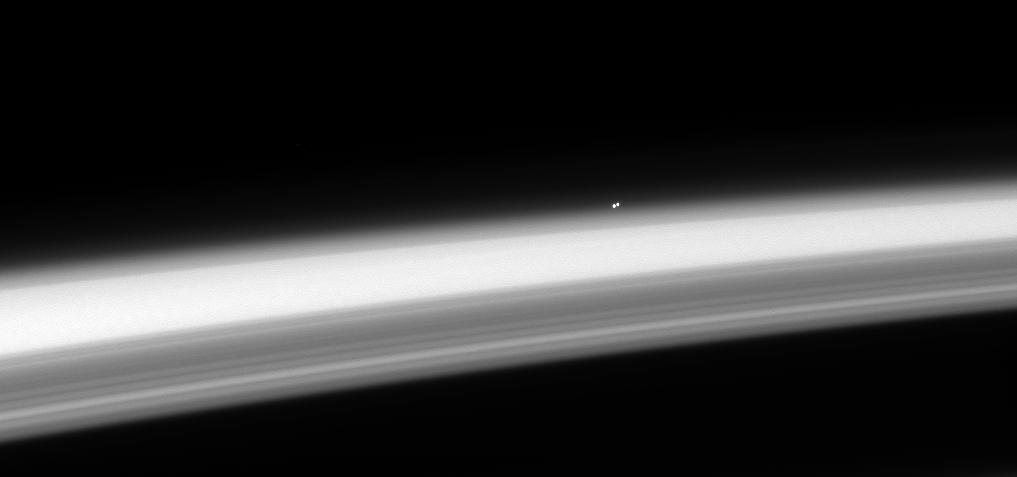
Saturn and the nearest star | Bad Astronomy

The Cassini probe is orbiting Saturn, taking devastatingly beautiful pictures all the time. But sometimes one comes along, and while at first glance it looks like just another routine shot, when you look more closely you realizing you’re gazing into awesomeness.

Cassini_alpcentauri

This picture [click to enjovianate] looks like just another shot of the edge of the planet, doesn’t it? You can see the layering of the atmosphere, which is cool, but it’s otherwise unremarkable. But wait! What’s that weird double blip above the horizon?

That’s Alpha Centauri, the nearest star system to the Sun!

How freaking cool is that? Cassini was about 530,000 km (330,000 miles) from Saturn when it took this shot, but those two stars were 80 million times farther away!

Cassini_alpcentauri2That picture is no accident. One thing scientists like to do is watch bright stars go behind the planet Saturn itself. As the planet’s atmosphere dims and eventually blocks the star’s light, astronomers can determine all sorts of things about Saturn’s air: its composition, distribution and density with height, and much more… so they tracked the famous duo as they passed behind the planet itself.

I had the privilege of seeing Alpha Centauri two years ago this month, on my trip to the Galapagos. It was an amazing experience. I had read about that star system all my life, but to actually see it, to have photons that traveled all that distance fall into my eyes, be interpreted by my brain directly… well. It was very touching, and to me, very poetic.

I feel the same way to see this image, too, even though those photons weren’t seen by me directly. But they were detected by our robotic proxy orbiting the solar system’s most beautiful planet a billion kilometers away. And that may seem like a distance most terrible and remote, but it’s practically a warm hug compared to the emptiness that lies between us and this nearest, yet still so forbiddingly distant, star system.

Tip o’ the Zefram Cochrane to Gavin O’Brien. Image credit: NASA/JPL/Space Science Institute


Google Wave is dead | Gene Expression

Did you notice that Google Wave was put out of its misery? I didn’t. I guess that says something about Wave’s impact. By the end of last year my main association with Wave was that it was a way for people I was trying to avoid in other ways to recontact me. So what’s happening with Google Buzz? Is anyone using it? I never did.

Google has some great web apps. I especially love the public data explorer, which I keep meaning to utilize for social science related posts in the near future. And I use Google Docs as my “lite” quick & dirty option often. But nothing compares to what Google did to search, transforming the act of searching into “googling.” There are many large companies out there who have piles of cash (Microsoft?). Innovation which changes lives is obviously hard. Perhaps lighting just struck, and the next game-changer is not going to be from a known firm.

From Connective-Tissue Cells to Heart Cells With No Stops In Between | 80beats

fibroblastsIn January, we discussed a biotech first–a transformation from skin cell to brain cell, without reverting to a more mutable stem cell in between. Today a paper in the journal Cell describes a similar direct transformation in mice, from a type of structural cell called a fibroblast to heart cells. If one day scientists can entice human cells to make a similar “direct conversion,” the researchers believe this metamorphosis may prove one way to fix heart damage that’s irreparable under the current state of medicine.

The study’s authors at the Gladstone Institute of Cardiovascular Disease at the University of California, San Francisco, once attempted to use stem cells for heart repair with little success, Nature News reports. Though the stem cells quickly turned into the beating variety, called cardiomyocytes, they remained feeble, never transforming into the strongly beating muscle cells of a healthy heart.

“I don’t know that this [direct conversion] will entirely replace stem cells,” says Deepak Srivastava [lead author on the study]… “But it will offer another strategy that might remove some of the concerns of using stem cells.” [Nature News]

The stem cell failure spurred the team to study the cardiomyocytes in more detail, searching for proteins that activate the genes responsible for making cardiomyocytes in mice embryos. They found three essential proteins and their associated genes: Gata4, Mef2c, and Tbx5. After activating these genes in adult fibroblasts and implanting them back into the mice, within a day, the cells started to transform into the coveted cardiomyocytes. Eventually 20 percent converted.

“Scientists have tried for 20 years to convert nonmuscle cells into heart muscle, but it turns out we just needed the right combination of genes at the right dose,” [study coauthor Masaki] Ieda, now at the Keio University School of Medicine in Japan, said in a statement. [Reuters]

Though Srivastava cautions that researchers must first show that human fibroblasts can use the same proteins to make the switch, he told The Telegraph that instead of removing cells, modifying them, and reintroducing them, as his team did in the mouse study, they might instead find a way to activate the conversion genes using a medication added through a tube, called a stent, in the coronary artery:

“It is ambitious, but not unreasonable, to imagine being ready for a clinical trial in the next five years.” [The Telegraph]

Related content:
80beats: A Biotech Magic Trick: Skin Cells Transformed Directly Into Brain Cells
80beats: One Step Closer To Embryo-Free (And Controversy-Free) Stem Cells
80beats: A Safer Way to Transform Skin Cells Into Stem Cells Brings Medical Trials Closer
80beats: Nanoparticles + Stem Cells = Faster Healing Wounds
80beats: Liposuction Leftovers Are a Stem Cell Bonanza

Image:Wikimedia / SubtleGuest