A banner day | Bad Astronomy

Sharp-eyed viewers may have noticed that the BA blog has a new banner! If you didn’t notice, then look up a few centimeters. See it?

All the Discover blogs got spiffy new banners to help individualize them, yet have a design theme to tie them together. If you look over on the right, at the sidebar, you’ll see the blogs linked by their banners. That’ll make it easier for you to read all the other science blogs enthralled to the Hive Overmind. If you haven’t checked them out, you should. We have quite a variety here, and they’re all really good.


Mentos Is to Diet Coke as Coffee Filter Is to Guinness?! | Discoblog

The SATs might have made you hate analogy problems, but this one sure is tasty.

That clangy thing taking up space in the bottom of your Guinness or Tetley’s can might soon be done away with and replaced by a coffee filter.

The ball inside the Guinness can, called a widget, contains a pocket of nitrogen gas held under pressure. When some lucky person opens the can, the pressure is released and the gas shoots out into the beer through a small hole and creates the foam.

You may now be thinking, Wait a minute—most beers seem to have plenty of gas bubbles even without some fancy widget. The thing is that Guinness and similar brews need the widget because nitrogen bubbles are smaller than those filled with carbon dioxide, the bubbling gas in other fizzy drinks. The small nitrogen bubbles make Guinness’ foam deliciously thick and creamy, but it’s harder to get the gas to come out of solution. The widget forces lots of excess nitrogen into the beer, setting off a well-timed bubble eruption.

But the widget is not the only way to send nitrogen bubbles cascading upward. In normal ...


NCBI ROFL: The scent of a woman. | Discoblog

Masculinity/femininity of fine fragrances affects color-odor correspondences: a case for cognitions influencing cross-modal correspondences.

“Four experiments found that the colors people choose as corresponding to the odors of fine fragrances are influenced by the perceived masculinity/femininity of those fragrances. Experiment 1 examined the colors chosen for 3 male and 3 female fragrances. The pattern of colors chosen for female fragrances differed from that for male fragrances. Experiments 2 and 3 found that colors assigned to 2 unisex fragrances depend on whether subjects thought that the fragrances were male or female fragrances. Experiment 4, by labeling unisex fragrances as male or female, showed that this difference in color selection was the result of subjects’ thinking that a fragrance is a male or female fragrance. Thinking of the masculinity/femininity of a fragrance influences the selection of colors that corresponds to these odors.”

Photo: flickr/fruity monkey

Related content:
Discoblog: NCBI ROFL: I’m a lumberjack, and I’m OK, I smell like pine and get chicks all day!
Discoblog: NCBI ROFL: Oral malodor and related factors in Japanese senior high school students.
Discoblog: NCBI ROFL: Smelly Week: ...


Hungry for solutions: science and feeding the world | The Intersection

This is a guest post composed at the NSF Science: Becoming the Messenger Workshop at the University of Nebraska, Lincoln (UNL) by Vicki Miller, Office of Research and Economic Development, University of Nebraska-Lincoln.

I grew up in rural Nebraska amid friends and family who tilled the soil, grew crops and raised livestock. Low farm prices and over production were the pressing issues. Food was abundant and cheap. No one thought much about the whys and hows of this abundance and there was much talk on the farm about America’s so-called “cheap food policy.”

We didn’t think much about it at the time but, it turns out, this abundance was fueled by science. Agricultural research spawned improved crops and technologies that spawned the “green revolution” and expanded ag production worldwide. University of Nebraska-Lincoln agronomist Ken Cassman says that, by the late 20th century, food was plentiful and inexpensive partly because of scientific advancements made decades earlier.

Those days of plenty could become a thing of the past. Food security – producing enough food to feed a rapidly expanding population – is shaping up as one of the 21st century’s most critical challenges. Scientific research will again be at the heart of the solution.

The stakes are high and the issues are complex. As an agronomist, Cassman has spent his career working on issues related to food security. These days he keenly focused on what kinds of agricultural research will produce the most bang for the investment of time and money. He chairs a council of scientists that advises an international ag research centers – the Consultative Group on International Agricultural Research, known as CGIAR – on global agricultural research projects.

While Cassman doesn’t buy the doomsday predictions that a global food crisis is inevitable, he says science must play a leading role. And researchers must make wise choices about the most critical issues to address.

The stakes have never been higher for the next green revolution. As a former farm kid and a science communicator, I’m betting on the power of science and the ingenuity of farmers to find ways to keep food on the global table.


Is Pond Scum the New Sexy? | The Intersection

Fuels derived from biological sources, biofuels, are currently receiving a fair amount of press.One of the biggest concerns is always, are biofuels a viable option? With rising oil prices and instability in the Middle East, biofuels, especially those derived from non-food energy sources, are becoming more and more attractive possibilities.As part of an NSF-supported program, we are attempting to enhance lipid production and quantity in algae used for this purpose.These algae can be grown commercially without competition for crop land mass used for food.A beneficial side effect of this process is the inception of new start-up companies to produce these fuels.One example of this is Sapphire Energy Inc.

In a March 8, 2011, news release, Sapphire announced a strategic collaboration with the giant Monsanto Co. In crop development and crop chemical production, Monsanto is at the forefront.Monsanto has been integral in the development new crop plants and chemistry that have made billions of dollars of profit.With an investment from this company, Sapphire is obviously being taken seriously by the business community.In addition, the United States Department of Agriculture and Federal Aviation Administration have teamed up to invest in the production of renewable jet fuels.In two separate tests in January 2009, Continental and Japan Airlines flew pilot missions powered at least partially by jet fuel derived from algae.Mounting evidence attests to the viability of these fuels.

Companies like Sapphire and other new start-ups such as these will require the biological and chemical expertise of new young scientists.It is essential that we now support the education and training of bright enthusiastic students.We can invest in these students future and be at the forefront of this new technology industry or we can be left on the sidelines.It’s our choice.

Guest post by Paul Twigg


The Brain in Action: Windows into the Mysteries of Language Disorders | The Intersection

This is a guest post composed at the NSF Science: Becoming the Messenger Workshop at the University of Nebraska, Lincoln (UNL) by Autumn McIlraith.

The field of communication disorders is full of unanswered questions. We want to know why some children struggle to speak fluently, and why others have difficulty learning to read. Why are some treatments effective, but others aren’t? Research in the field of speech and language disorders has traditionally used behavioral testing to evaluate the abilities of individuals with impairments, and to measure the effectiveness of interventions. However, behavioral testing has some limitations. Often, we can see the problem, but not where in the chain the breakdown occurred. For the child struggling to speak, was it planning the motor movements that was the issue, or was it putting together the words themselves?

Brain imaging can help to answer these questions. It gives us a window into the hidden world of the brain, without actually opening up the skull and poking it. Techniques like functional Magnetic Resonance Imaging (fMRI), event-related brain potentials (ERP) and magnetoencephalography (MEG) allow us to look at brain activity, by measuring blood flow, or electrical or magnetic activity from neurons. These imaging techniques are completely noninvasive, and can be used with young children and in some cases even infants.

Through brain imaging, we can observe the brain in action. When we look at the brain scan of a child struggling to speak, we hope to be able to see whether the issues lie in areas associated with motor speech planning, language processing, or maybe somewhere else entirely. If the child underwent treatment for his or her issues and seemed to show improvement, we could compare the brain activity before or after treatment, to evaluate its effectiveness.

Speech and language researchers can benefit greatly from the expertise of brain imaging scientists. Collaboration between these areas in the future will help researchers to answer some exciting questions about the nature of speech and language impairments, and give us further insight into the marvelous complexity of the human brain.

(For more information about a language lab involved in brain imaging research, visit the here and here)


Can you hear me now? Advancing hearing loss prevention and treatment | The Intersection

This is a guest post from Dr. Heather CJ Smith of Creighton University, composed while attending the NSF Science: Becoming the Messenger workshop in Lincoln, Ne.

Hearing loss is a widely-preventable public health dilemma costing the US economy $56 billion annually. In the US alone, oral antibiotics cause approximately 120,000 people to suffer from some form of irreversible-hearing loss. Since antibiotics are essential for treating life-threatening infections, it is critically important to develop new hearing loss prevention and treatment strategies. 

With the advent of new imaging technologies, my research group has been able to make the first real-time measurements of inner ear metabolism (energy production and use). This novel technique allowed us to ‘see’ how inner ear energy production is rapidly and dramatically inhibited by specific antibiotics. Unfortunately, such decreases in metabolism lead to the production of cell-damaging free radicals which, when generated at high-rates, permanently damage cells and the inner ear. This damage leads to irreversible-hearing loss. 

I am working on expanding these novel findings by researching how and why antibiotics interfere with energy production and cause free radical generation in the inner ear. Once we understand the mechanisms controlling the production free radicals during antibiotic treatment, optimized hearing loss prevention strategies can be developed and implemented to preserve the hearing of thousands of people every year.


Fondling Swan-Butts For Science | Discoblog

Picture yourself as one of England’s majestic Bewick’s swans, about to take off on your annual long-distance flight to Arctic Russia, when out of nowhere a scientist grabs you and methodically gropes and measures your butt. It’s all for your own good: Researchers are hurriedly sizing up as many round rumps as they can lay their hands on, in a bid to understand what’s wiping out their population.

Smaller than the more common mute swans, which stay in Britain yearlong, Bewick’s swan has seen its population in Europe decline from 29,000 to 21,000 between 1995 and 2005, and researchers at UK’s Wildfowl and Wetlands Trust (WWT) in Slimbridge, Gloucestershire, are willing to fondle the birds to save them.

They’re sizing up swans to test whether changes in the their habitat are to blame for their decline: The size of swan keesters indicated whether they have enough fat to survive their over-2,000-mile journey. Basically, if the birds are plump, then that rules out the possibility that they aren’t getting enough food, and opens the playing field for other culprits, such as power line collisions, lead poisoning, and hunting.For those of you without ...


Limitless: Enhancement Will Be Great Until You Go Crazy and Die | Science Not Fiction

Limitless is one of the first movies to directly take on the idea of pharmaceutical enhancement. The trailer is here and fake viral ad for NZT is here. I’m already wary of the film based on the trailer. Not because of the acting, directing, or plot, which all look good enough. Instead, my problem is that the movie appears to take the same boring old stance on enhancement: the cost of making yourself superhuman is too high.

Limitless has a simple set-up: loser/author Bradley Cooper who lives in filth and dresses like a hobo is offered a pill that will make everything all better. The pill makes him much smarter, more creative, and more driven. Thanks to this new found brilliance, Cooper makes boatloads of money and catches the eye of evil Robert De Niro, who threatens Cooper in various menacing and shadowy ways. Then the pill starts making Cooper crazy and his world starts crumbling around him. It’s Flowers for Algernon except with bespoke suits, exotic cars and international intrigue.

The reason I’m getting an overall vibe of “meh, who cares” from Limitless is that the even though the film has ...

DTC, FDA, regulation, etc. | Gene Expression

It’s been a few days since my post on the FDA DTC hearings was linked around the blogosphere, and generated some incredibly well informed discussion. There are plenty of reactions, but there are two which I want to point to specifically. First, Mary Carmichael at Wild Type, who takes a stance more in keeping with my own. And second, Mike the Mad Biologist, who tends to be more sympathetic to the idea that regulation of DTC medical results are necessary. Over the past few days I’ve received some feedback from medical professionals too expressing worry about total laissez-faire.

In regards to Mike’s post, I will admit that I am not totally disinclined toward paternalism. I’m not a libertarian, though my sympathies in that direction are often clear. When it comes to major public health issues the wisdom gained by the professionals through experience and the scientific method needs to be determinative in terms of public policy. But I simply do not see the misinformation inadvertently fostered by DTC personal genomics as in the same kind of category as anti-vaccination paranoia or the results from HIV tests. The medical inferences one makes are generally weak to ...

Saturday Stuff – March 12th, 2011 | Gene Expression

FF3

Due to a “busy” cat-schedule, the regular Friday posting was delayed for one day. If you have a problem with it, the individual with whom you can take it up is indefinitely taking a nap. So good luck with that!

1) First, a post from the past: The Dark Age Mighty Whitey.

2) Weird search query of the week: “kristin kreuk with glasses.”

3) Comment of the week, in response to “Your genes, your rights – FDA’s Jeffrey Shuren misleading testimony under oath”, there were many good comments. But I’ll highlight this one from Dan:

Furthermore, all CLIA certified operations have to pass very stringent proficiency testing to maintain their certification. There is no such oversight for DTC operations,

Joe has already noted that 23andMe, deCODEme and Pathway are CLIA-certified. I can tell you that Navigenics is as well. You’re right that some of the scurrilous operators aren’t CLIA-licensed, and that should be stopped – but that isn’t the responsibility of the FDA.

Even those of us who oppose FDA involvement in DTC typically agree that regulation of analytic validity is important (CLIA is actually a terrible system in many ways, but there currently isn’t ...

Harappa Ancestry Project @ N ~ 50 | Gene Expression

Zack Ajmal now has over 50 participants in the Harappa Ancestry Project. This does not include the Pakistani populations in the HGDP, the HapMap Gujaratis, the Indians from the SVGP. Nevertheless, all these samples still barely cover vast heart of South Asia, the Indo-Gangetic plain. Here is the provenance of the submitted samples Zack has so far:

Punjab: 7
Iran: 7
Tamil: 6
Bengal: 5
Andhra Pradesh: 2
Bihar: 2
Karnataka: 2
Caribbean Indian: 2
Kashmir: 2
Uttar Pradesh: 2
Sri Lankan: 2
Kerala: 2
Iraqi Arab: 2
Anglo-Indian: 1
Roma: 1
Goa: 1
Rajasthan: 1
Baloch: 1
Unknown: 1
Egyptian/Iraqi Jew: 1
Maharashtra: 1

Again, note the underrepresentation of two of India’s most populous states, Uttar Pradesh, ~200 million, and Bihar, ~100 million. Nevertheless, there are already some interesting yields from the project. Below I’ve reedited Zack’s static images (though go to his website for something more dynamic) with the labels of individuals. I’ve highlighted myself and my parents with the red pointers.

To the left is a set of plots and tables which I’ve spliced together from Zack’s various posts. What you need to know is that this at K = 12, and I’ve used the labels that Zack gave the various putative “ancestral populations” which emerged out ...

I’ve got your missing links right here (12 March 2011) | Not Exactly Rocket Science

Housekeeping

My ScienceWriters Tip Jar initiative, technologically primitive though it is, is doing quite nicely. Donations are into triple figures. See here and here for more.

I’ve started a Tumblr blog, against my better judgment (I’ll probably choose between this and the Posterous one at some point). The material there will also be included in these link-fests.

Top twelve picks

“Genetic exceptionalism is the default, the state of ignorance. How do you combat ignorance? By providing knowledge. By giving people information and showing them what it means for their lives. By, say, appealing to people’s inherent curiosity about themselves, and then handing them a document that shows — that cannot help but show — that genes aren’t destiny.This is precisely the information that bad regulation would keep out of the hands of consumers.“ Mary Carmichael makes a fantastic case for why people have a right to know their own genetic information, rather than having that right regulated via doctors. Genomes Unzipped lays out the reasons why that would be a very bad idea. “How dare the government question your right to know the basic genetic building blocks of who you are?” asks Razib Khan.

Lots of people covered the story about lost DNA and penis spines and the blogosphere excelled itself by going beyond the obvious “Hurr-hurr” angle. John Hawks talks about the real “junk” DNA, Scicurious asks what penis spines actually are, and in by far the best piece on the topic, Eric Michael Johnson looks at the literature and critiques the paper.

Sigh. Life, meteorite, aliens, extraordinary claims, skeptical, yadda yadda. This is my only response to the story. I will point you to more considered takes from Phil Plait, David Dobbs and Charlie Petit (and again)

Are there evidence-based ways of increasing your intelligence? Andrew Kuszewski thinks so – read her tour de force on Scientific American

A human skull and mastodon leftovers have been found deep in Yucatan sea cave

A Discover exclusive, achieved through fact-checking (yay!) – “Most Earth-like” exoplanet isn’t actually habitable.

“If you’ve just been bitten by a venomous snake and your flesh is starting to rot and you can’t breathe, you may not be in the mood to hear how beautiful snake venom can be. But from a safe distance, it really is a marvel to behold.” Carl Zimmer on snake venom and why it can save lives.

“I’m 53. Why am I still learning things the hard way?” A gut-wrenching story of broken friendship, instigated by a slack paper submission. By Adam Marcus.

Giant Ant Hill Excavated: “The structure covers 50 square metres and goes 8 metres into the Earth.”

“This means that a person living in a metropolis of one million should generate, on average, about 15 percent more patents, and make 15 percent more money, than a person living in a city of five hundred thousand. (They should also have 15 percent more restaurants in their neighborhood and create 15 percent more trademarks.)” Jonah Lehrer on cities.

Science, Upstream: a fantastic student blogging project hosted by PLoS

Adam Wishart shows how it’s done – he provides references and lengthy back-up material for his documentary on premature babies. Salute!

News/science/writing

Did T-rex hunt or scavenge?” The debate is ancient and fossilised by now, but Brian Switek digs it up for a thorough examination.

Does a deep voice trigger infidelity jitters? Good critical reporting by Dan Vergano

There’s a new review on Wolfe-Simon’s arsenic life paper, which sticks its fingers in its ears, goes “La la la la la” and pretends the online debate didn’t happen. By Doctor Zen. Meanwhile, Wolfe-Simon wouldn’t answer her critics online, but she will talk to TED

The megamouth shark has to suck it up.

I haven’t really processed the earthquake and tsunami of yesterday so here are some assorted links: a good NYT piece on why Japan’s strict building codes saved lives; an amazing visualisation of the spread of the waves; and a ridiculous, distasteful piece from the Daily Mail (yes, I know, but this is surprising even for them). Bora’s also got a good collection of links.

What’s worse than bedbugs? Desperate overuse of pesticides, leading to poisoning/fires/explosions

A great Nature video about detailed brain mapping

Great microbiome reporting by Nicola Jones: “Are antibiotics making our kids fat?” and “Imagine a world where ‘eat sh*t’ isn’t an insult, but way to save your life.”

Why Angry Birds is so successful – a cognitive breakdown of the user experience, design and more.

Mike Taylor talks about Brontomerus, the “thunder thighs” dinosaur he discovered. This is a great insight into how scientists think

Bees were has-bee-ns long before arrival of Colony Collapse Disorder. By Alex Wild.

Why cigarette packs matter – an excellent tour of the evidence by Ben Goldacre

A brilliant post by Melody Dye on the diversification of modern language

10,000 shipping containers are lost at sea every year. What happens to them?

The physics of pruney fingers.

Do gut bacteria worsen malnourishment?

Ancient biological warfare, including Hannibal’s “snakes on a catapult” technique. By Cassandra Willyard

Imperial College in showdown with closed-access journals.

Robots that talk like cave-dwelling crickets: using silent puffs of air

“Have we passed the bottom of the uncanny valley?” No. The video makes me want to kill that thing with fire

Heh/wow/huh

This is incredible. How many metaphors can you squeeze into one lede? I like to think that this was the result of some sort of contest.

How does fire behave in zero gravity?

Brazilian wandering spider bite: severe pain + suffocation. Also raging hard-ons.

“Die, yuppie scum, die!” PZ Myers reviews David Brooks’ new book.

Onion: Scientists Baffled By Man’s Incredible Ability To Fuck Up Every Time

On genomics and quantum mechanics

Indeed.

This Power of Research game is bewildering, difficult to get into, overly complex & just a bit odd. So exactly like research

Internet/blogging/journalism/society

“The bugging of Little Bear was hardly the first time Duke had been the target of surveillance” An amazing story

NYT’s editor credits are a great idea, says Megan Garber on Nieman Lab, and I couldn’t agree more

“When referring to the offline world, we talk about “bad neighborhoods” and “angry mobs” and “obnoxious loudmouths.” But every conversation about bad online discussions seems to ascribe the failure to “the Internet” – Poynter on how to build a strong online community.

Should big PR firms that represent drug companies also run scientific societies’ media operations?” asks Ivan Oransky. I think I can guess his answer.

The Public Insight Network – an interesting project on journalistic sourcing

The ideology of journalism vs the ethics of blogs, by Paul Bradshaw

Why Angry Birds was a success

I like the “Full Disclosure: Statement of Bias” on her sidebar

Secret fears of the super-rich – yet more evidence that above a certain level, money doesn’t buy happiness.

Our Latest Blog Contest Winner: Twin Studies in Aphids | The Intersection

Last week we ran another blogging contest here at “the Intersection,” for attendees of the NSF “Science: Becoming the Messenger” workshop in Lincoln, Nebraska. As you may have noted, a flurry of posts went up on Wednesday–and the objective for the scientists involved was not just to write something good, but also to use social media tools–Facebook, Twitter, Digg, Stumble, etc–to draw eyeballs to one’s post after it went up.

After all, with so many post going up at once, it was very possible for something really good to nevertheless be missed–without the help of social media, anyway.

It’s fair to say that this time around, judging the contest winner was easy. Not only did one post get the most traffic over the two succeeding days; it was the only post where the traffic logs showed a really dominant use of social media in drawing that traffic–in this case, Facebook.

The post is “Twins with and without wings?” by Jenn Brisson, Cassia Oliveira, and Neetha NV. Congratulations to the Brisson lab for their blogging and social media feat!–and I encourage everyone to go and read their intriguing post on how we study nature and nurture in aphids.

There certainly are some honorable mentions. Krista Forrest’s “Lie to Me, Lie To You: Educating the Public About Police Deception,” was fascinating and drew eyeballs through its title alone.

My personal favorite was “Health Literacy: Are You Smarter Than a Web Page,” by Zara Risoldi Cochrane, which was fourth overall in traffic–but generated some very good comments and was, all around, a great post.

So congratulations to all–and I hope you will continue blogging.

In terms of using social media, by the way, the #nsfmessenger Twitter hashtag was also used about 190 times over the course of the conference–pretty good for a group that was not, for the most part, used to tweeting. So congrats on that front as well!


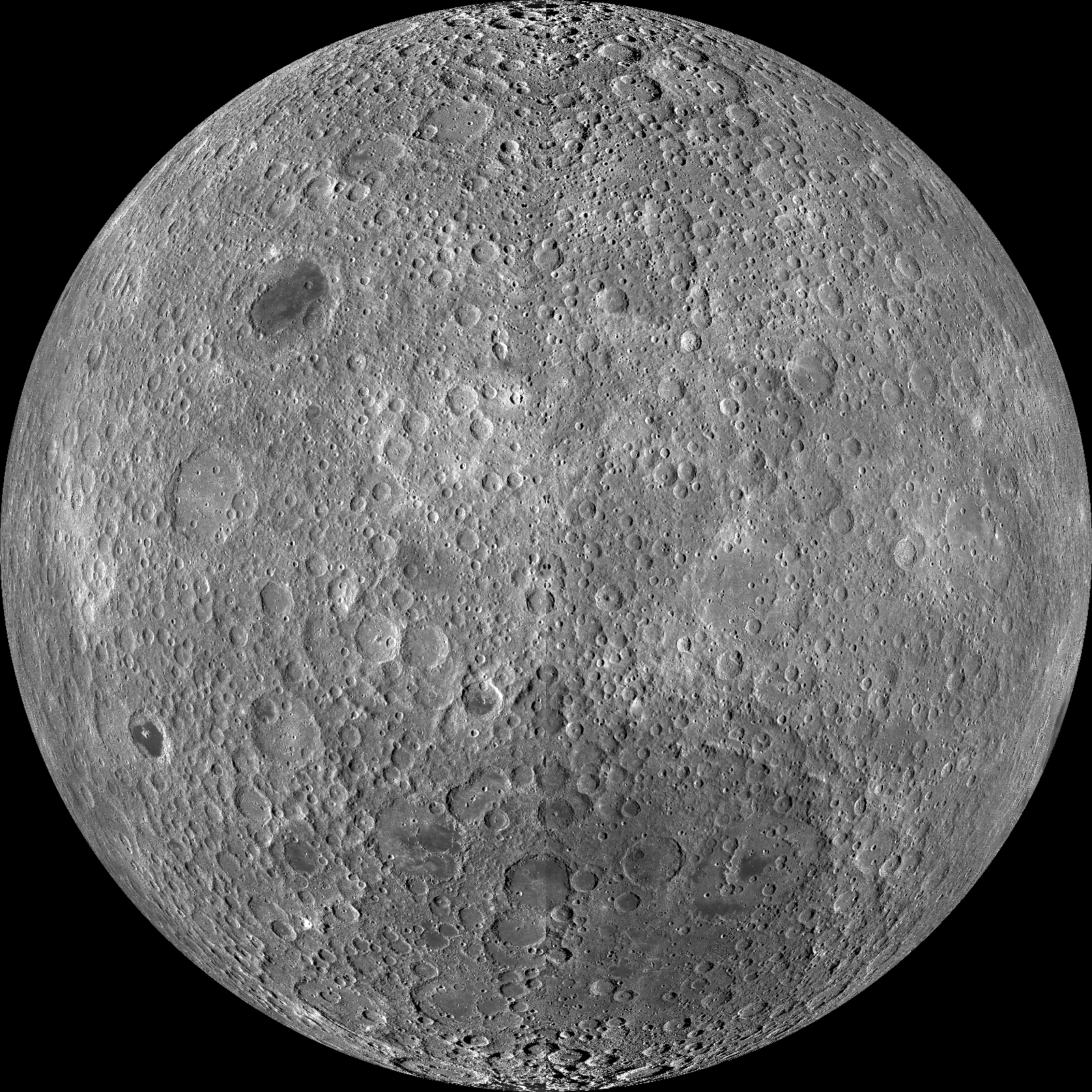
The extraordinary back of the Moon | Bad Astronomy

Remember last month when I posted that incredible super-hi-res image of the Moon’s near side? A lot of folks asked if an image of the far side were coming soon.

Ask, and ye shall receive.

Holy Selene! Click to enlunanate.

This amazing mosaic is from the Lunar Reconnaissance Orbiter, circling the Moon from a height of a mere 50 km (30 miles) and mapping that entire world. This image is comprised of a whopping 15,000 images from the Wide Angle Camera — yegads! — and shows the side of the Moon we can never see from home.

It looks really different than the near side, doesn’t it? It’s almost entirely craters, while the side we see is dominated by huge lava filled basins called maria (Latin for "seas"). Why is that? Well, it’s known that the crust on the near side is thinner, so it’s easier for big impacts to have punched holes in the crust and allowed magma to bubble up (this was billions of years ago when the inner Moon was still molten).

But why does one side have a thick crust and the ...


The One We Love

One of the most beloved, well-known, and beautiful members of the solar system is its very heart; the Sun.  You see it every day, you learn about it in school, and you know that life itself couldn’t exist on Earth without it.  We now have the STEREO spacecrafts, and can see exactly what the Sun looks like right this minute.  It’s fascinating.  Of course, I think everything about the Sun is fascinating.

For one thing, just look at it:

NASA/STEREO

Gorgeous, isn’t it?  We know a lot about our sun — as well we should.  We’ve been thinking about it every since we had the brain capacity to “think” about anything.  This near-perfect sphere accounts for over 99% of all the mass in the solar system, its spectral class is G2V (we went over that, remember?), and it generates energy through nuclear fusion.  That’s the fusion of two atomic nuclei to form one “heavier” nucleus.  It takes a lot of energy to force two nuclei close enough together for them to fuse, but the process releases more energy (in the form of “free” neutrons) than it uses (until you get to iron).  The end result is this continuous outpouring of the energy which fuels all life on Earth.

Life cycle of the Sun, by Oliver Beatson - image released to public domain by author

Our understanding of the Sun hasn’t always been so neat and scientific, of course.  The Sun was worshiped as a god by early civilized man; and probably back into prehistory.  Solar eclipses were occasions of horror.  When we gave up on the idea that the Earth was the center of the universe, the Sun was the next logical choice.

Ancient Chinese print - Chinese solar diety Tai Yang Xing Jun

Once it became clear that the Sun was a physical thing and not a deity, early man pondered the mystery of its energy source.  After figuring out that it couldn’t be a huge fire burning off in the distance (hey, it makes sense if you know next to nothing about the universe around you), it wasn’t until the 20th century that the true nature of the Sun was known.  The Pioneer spacecrafts gave us our first really good look, returning detailed information about the solar wind and magnetic field.  Now we’ve had SolarMax, SOHO, and STEREO to give us a greater understanding, and appreciation, of our parent star.

Egyptian god Ra in his solar barge

Our Sun, at 4.6 billion years old, is still a relatively young star.  It is about one-half way through its time as a main sequence star (the time it fuses hydrogen into helium).  After about 5 billion more years, it will enter a red giant phase.  Our star doesn’t have enough mass to supernova.  It will end its life as a white dwarf, slowly releasing its remaining heat into space.  The very end of its life is theorized to be as a “black dwarf”, a cold, burned-out cinder.  Such a thing is purely theoretical since the universe isn’t old enough for one to have formed yet.  Still, it makes sense.

NASA/STEREO Behind - the Sun today, March 3, 2011

The more we know about the Sun, the more fascinating and mysterious it becomes.  We have always looked to the stars in awe, and lest we forget, the Sun is a star.  In every sense of the word.

Hubble’s Look at NGC 2841

NASA's Hubble Space Telescope reveals a majestic disk of stars and dust lanes in this view of the spiral galaxy NGC 2841, which lies 46 million light-years away in the constellation of Ursa Major (The Great Bear). This image was taken in 2010 through four different filters on Hubble's Wide Field Camera 3. Wavelengths range from ultraviolet light through visible light to near-infrared light. Click for a larger version. Credit and image: NASA, ESA, and the Hubble Heritage (STScI/AURA)-ESA/Hubble Collaboration


Ursa Major, aka: the Great Bear, Big Dipper or the Plough depending on your location, to our eye is a beautiful and very well known constellation.  At first glance it appears to be devoid of structures other than the stars that create the pattern.

Nothing could be further from the truth, I’ve spent hours looking around with a telescope and it’s amazing what is really there.

Take this galaxy for example, NGC 2841, a wonderful example of a non-barred spiral galaxy – actually called a Flocculent Spiral Galaxy.  You too can see this just point your telescopes at R.A. 9h 22m 02.64s Dec. +50° 58′ 35.47″, dark skies will be required as the magnitude of this galaxy is a little over 10. Well why not? It is 46 million light-years away.

While your view won’t match this amazing Hubble image, you will still get a sense of satisfaction by seeing it for yourself.  That said, just look at this amazing image!  Click it for a larger version, even better go to Hubblesite to see the full sized versions.

A Quick Glance Back

Conceived in the late 1960′s (before Apollo 11 landed on the moon), the Space Shuttle program was launched on January 5, 1972.  Initially proposed to be completely reusable, the final design sacrificed the external tank.  The external tank was originally larger, and was to be carried into orbit and used in a future space station.

NASA - Some of these look pretty cool.

The first orbiter, Enterprise, rolled out September 17, 1976.  Of course, Enterprise was never intended to go into orbit.  It was a glider; built without engines or heat shield.  It performed test flights in the atmosphere.  It is now the property of the Smithsonian Institution.

The first true space shuttle was the Columbia, delivered March 25, 1979.  Columbia launched May12, 1981, the anniversary of Yuri Gagarin’s space flight.  The Shuttle completed 27 missions, and was destroyed at the end of its 28th.

Next was Challenger, completed in July, 1982.  It completed 9 missions, and was destroyed at the beginning of its 10th.

Discovery, November 1983, completed 38 missions, and is currently on its 39th.

Atlantis, April 1985, completed 32 missions.

Endeavor
, May 1991, completed 24 missions.

NASA - Maiden launch of the Program

The Shuttle Program is now facing mandatory retirement, as you know.  Originally, the program was to be followed by the Orion Spacecraft and the Project Constellation; however, all future plans for the US to participate in manned spaceflight are now shelved.  This gap will supposedly be filled by the private sector.

No matter how many times I write that, I just cannot come up with anything nice to say following that statement.  So-o-o-o-o-o-o-o….

Let’s look back with appreciation on all the Space Shuttle program has accomplished, including missions to SpaceLab, ISS, and MIR.  It serviced Hubble, transported equipment and crews, became a lab for experiments, and was instrumental in the success of the Galileo spacecraft and the Ulysses and Magellan probes.

Goodbye.  We’ll miss you.

NASA - Atlantis into orbit