A Very Morbid Anatomy Dia de los Muertos/Day of the Dead!


Morbid Anatomy is very excited to announce two wonderful Day of the Dead celebrations taking place this upcoming Day of the Dead and Halloween weekend!

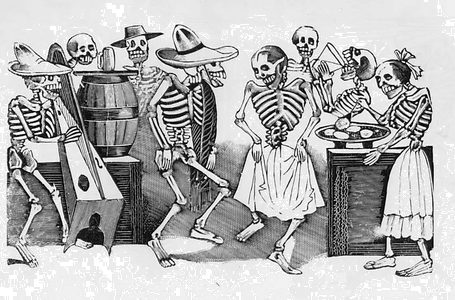
On Saturday October 30th, Philadelphia's incomparable Mütter Museum will be hosting their 3rd Annual Day of the Dead Festival, where I will be giving two lectures as keynote speaker. The very next day--Sunday October 31st, aka Halloween proper--Morbid Anatomy will be co-hosting the Second Annual Observatory Day of the Dead Party, replete with authetic Red Hook Latin food vendors, a death piñata, traditional food and drinks, sugar skulls, a José Posada (see above) inspired community altar, costumes, Negra Modelo, live music and much, much more.

Hope to see you at one or both of these fantastic events (detailed below)! But either way, Feliz Dia de Muertos from Morbid Anatomy at our favorite time of the year!

Saturday October 30th [link]
The Mütter Museum’s 3nd Annual Day of the Dead Festival

Come celebrate this traditional Mexican holiday with an all-day event at the Mütter Museum! Decorate sugar skulls, enjoy traditional food and drink, visit the Museum, hear from guest speaker, artist Joanna Ebenstein and see an exclusive show by local personality Grover Silcox!

- 10AM: Museum opens and sugar skull decorating begins
- 12PM and 4PM: Talk by Artist Joanna Ebenstein
- 5 - 6:30PM: Guided museum tour, exclusively for Friends of the Mütter
- 6:30 - 8PM: Exclusive performance by Grover Silcox

Sponsored by the Mütter Museum of The College of Physicians of Philadelphia

(NOTE: Registration is not required for daytime festivities and is free with Museum admission; registration IS required, with additional cost for admission, to Silcox production.)

Dia de Muertos (Day of the Dead) Party
Admission: $5
Date: Sunday, October 31st
Time: 5 PM - ?
Please R.S.V.P. to salvador.olguin@gmail.com for party planning purposes.

Dia de Muertos (Day of the Dead) is celebrated annually in Mexico during the last days of October and the first days of November. It is a party to honor the dearly departed by presenting offerings to them, building an altar, and inviting them to reunite with the living in a nightly feast including their favorite dishes and drinks. It has deep roots in ancient, pre-Hispanic celebrations, but it also integrates the Christian traditions brought to the country by the Spanish –the main celebration takes place on November 2nd, coinciding with All Saints Day.

On Sunday, October 31th, and for the second year in a row, Morbid Anatomy and Observatory will host a Day of the Dead party in tandem with author and scholar Salvador Olguin. This year, we will build an altar dedicated to the Economy. Traditionally, the Day of the Dead altar is dedicated to a person whose death is deeply felt by the people building it; in spite of some hopeful reports by some cheerful voices, our global Economy does not seem to be recovering quickly enough from its recent collapse. This year, we will bring her some offerings, attract her with a few bottles of tequila, and lure her back to the realm of the living with the fragrant smell of incense and marigolds. Feel free to collaborate with our altar building by bringing objects that express how deeply felt the departure of the Economy was for you and your close ones. We want to entice the ghost of the Economy to walk again among the living, to come back from the afterworld and celebrate with us, Mexican style.

Many of this year’s features are based in the art of Jose Guadalupe Posada, a Mexican printer and illustrator who worked around the time of the Mexican Revolution (1910), and who used his art to satirize prominent figures of his era. His best-known works are his calaveras (skulls), etchings depicting dancing skeletons, skulls dressed up as Revolucionarios and politicians, etc. Since this November we celebrate the 100th anniversary of the Mexican Revolution, it felt natural to honor Posada by having a live version of one of his most famous calaveras: La Catrina. Made by Posada as a depiction of the skeleton of a rich lady, La Catrina has come to represent a satirical version of Death herself in Mexico. At our party, La Catrina will mingle with our guests, and people will be able to have their picture taken with her, in front of our altar.

At this year’s Dia De Muertos party, you will also find pan de muerto, champurrado (a traditional Mexican beverage), sugar skulls, marigolds, Negra Modelo, traditional foods and crafts, a community altar, a piñata of death herself to dash to bits, live traditional music, a death themed slide show produced by Morbid Anatomy, and, of course, Redhook vendors taco truck supplying delicious and authentic foodstuffs. If you would like to dress appropriately for the occasion, you only need to take an old suit or dress, or wear the clothes of a person whose death means something for you, or simply wear your everyday clothes: everything works, as long as you add a touch of the hereafter to it –some make up to look a little pale, a skeleton suit, some dirt under your fingernails. Or you can go all the way and dress up like one of Posada’s Calaveras.

We hope you can join us! Feliz Dia de Muertos!

Salvador Olguin’s work has been published in magazines both in Mexico and in the US. He is the author of Seven Days, a multimedia theatrical piece that celebrates the convergence of traditions and hybridism that characterizes Mexico’s fascination with mortality. He has worked extensively with Mexican cultural artifacts related with death. He is currently performing research on the metaphoric uses of prostheses in literature and the visual arts, at New York University, as well as writing poems about the life of plants and the genealogy of intelligent machines. He was born in Monterrey, Mexico and is currently based in Brooklyn.

For more information on the Mütter Museum 3rd Annual Day of the Dead Festival, click here; for more information about the Observatory Dia de Muertos party, click here. To see photos from last year's Dia de Muertos Observatory Party--which will give you a sense of what you're in for--click here.

Images: Top: “Happy Dance and Wild Party of All the Skeletons,” by José Guadalupe Posada, via Radio Free Mike. Mütter image: From Anatomical Theatre Exhibition

"Parasites: A User's Guide" Screening by Radiolab Affiliate Sharon Shattuck, TONIGHT!


Radiolab's Sharon Shattuck on parasites tonight at Observatory! Full details below; hope to see you there.

Parasites: A User’s Guide
A Short Film Screening with Filmmaker and Ecologist Sharon Shattuck, Radiolab Affiliate
Date: Tuesday, October 26
Time: 8:00
Admission: $5

The word “parasite” comes with loads of vile connotations, but in nature, nothing is purely good or evil. In the 27-minute experimental documentary “Parasites: A User’s Guide,” filmmaker Sharon Shattuck embarks on a journey to decode some of the most misunderstood creatures on earth.

The dramatic rise in autoimmune diseases, asthma, and allergies since the turn of the last century has confounded scientists, but some researchers think they have uncovered the key to controlling the skyrocketing rates: tiny parasitic worms called ‘helminths.’ Using a blend of handmade and digital animation, film, and music, Sharon dives headlong into the controversial discourse surrounding ‘helminthic therapy,’ with help from scientific researchers, proactive patients and a renegade entrepreneur named Jasper Lawrence. Through the seeming oxymoron of the ‘helpful parasite,’ Sharon questions the nature of our relationship with parasites–and suggests a new paradigm for the future. “Parasites: A User’s Guide” is a film about ecology, healing, and worms.

The screening will be followed by a Q&A with the filmmaker and an active helminth patient.

Check out the film’s website for more info: http://www.parasites-film.com

Bio: Before moving to Brooklyn, Sharon Shattuck studied tropical botany, and worked as a researcher with the Field Museum and the Smithsonian Institute in Panama. Following a grad stint in documentary media, she now works as an animator with Wicked Delicate Films (producers of “King Corn,” 2007) in Brooklyn, and is a contributor to the WNYC science show ‘Radiolab.’ Now, Sharon is touring the mainstream film fest circuit with her quirky science film “Parasites: A User’s Guide,” demonstrating that science can be both informative AND entertaining.

You can find out more about this event on the Observatory website by clicking here. You can get directions to Observatory--which is next door to the Morbid Anatomy Library (more on that here)--by clicking here. You can find out more about Observatory here, join our mailing list by clicking here, and join us on Facebook by clicking here.

"Oddities," Obscura Antiques and Oddities, Discovery Channel


Yes, the rumors, bizarre as they are, are true. Obscura Antiques and Oddities--my absolute favorite store in the world, see images above--is now the base, inspiration, location, and cast-provider for "Oddities," a new reality TV show (sic) that will be shown on The Discovery Channel starting next Thursday. The show stars not only friends and friends-of-the-blog Evan Michelson (Morbid Anatomy Library scholar in residence) and Mike Zohn--the proprietors or the inimitable Obscura Antiques--but also an array of other fascinating friends and collectors who travel in their circle.

With this cast, setting, and array of possible situations, "Oddities" will doubtless make unusually compelling reality television. I, for one--and please note, I generally HATE reality TV!--can't wait to see it!

More about the show--which premieres next Thursday, November 4th--from today's New York Post (which, although it seems to miss the point somewhat, provides a good description of the action):

Manhattan's own Obscura Antiques & Oddities and its owners, Mike Zohn and Evan Michelson, are the focus of a new series, "Oddities," premiering Nov. 4 at 9:30 p.m. on Discovery Channel. It'll air Thursdays at 9 p.m. thereafter.

The shop, located at 280 East 10th (between 1st Avenue and Avenue A) has a cornucopia of just-plain-weird stuff, like human gallstones, late 19th century poison bottles and bizarre medical instruments. And Zohn and Michelson seem just as colorful (he's a "creative taxidermy" winner; she's into Victorian mourning jewelry and was in a "Goth fetish band," whatever that is).

In the first episode, Mike finds a mummified cat in the private collection of "an eccentric artist" (ya think?) but worries it might be putrefying. Yeeeccchh. He also informs a customer, who thought he had a collection of musket balls, that they're actually something else entirely. I won't spoil it for you.

The second episode finds Evan encountering a puppeteer who's looking for a prosthetic limb, and a customer who has what appears to be a dead body in the trunk of his car.

Good times.

The show premieres Nov. 4 at 9:30 p.m. on Discovery Channel; after the launch, it will air Thursdays at 9 PM. You can find out more about Obscura Antiques and Oddities by clicking here; you can see a recent MA Post on the story by clicking here.

Thanks to Lord Whimsy for alerting me to the official announcement.

Tomorrow Night at Observatory! Mark Jacobson on "The Lampshade: A Holocaust Detective Story from Buchenwald to New Orleans"


Tomorrow night at Observatory, join Mark Jacobson--author of the new book The Lampshade: A Holocaust Detective Story from Buchenwald to New Orleans--as he details the story of his journey into the world of myth, madness and history prompted by the delivery of a lampshade made of human skin upon his doorstep.

You can read an excerpt from the book (which will be available for sale and signing at the event) in New York Magazine by clicking here.

Full details follow; hope very much to see you there!

The Lampshade: A Holocaust Detective Story from Buchenwald to New Orleans
An illustrated lecture and book signing with Mark Jacobson, author

Date: Friday, October 22

Time: 8:00

Admission: $5

Books will be available for sale and signing

Few growing up in the aftermath of World War II will ever forget the horrifying reports that Nazi concentration camp doctors had removed the skin of prisoners to makes common, everyday lampshades. In The Lampshade, bestselling journalist Mark Jacobson tells the story of how he came into possession of one of these awful objects, and of his search to establish the origin, and larger meaning, of what can only be described as an icon of terror.

Jacobson’s mind-bending historical, moral, and philosophical journey into the recent past and his own soul begins in Hurricane Katrina–ravaged New Orleans. It is only months after the storm, with America’s most romantic city still in tatters, when Skip Henderson, an old friend of Jacobson’s, purchases an item at a rummage sale: a very strange looking and oddly textured lampshade. When he asks what it’s made of, the seller, a man covered with jailhouse tattoos, replies, “That’s made from the skin of Jews.” The price: $35. A few days later, Henderson sends the lampshade to Jacobson, saying, “You’re the journalist, you find out what it is.” The lampshade couldn’t possibly be real, could it? But it is. DNA analysis proves it.

This revelation sends Jacobson halfway around the world, to Yad Vashem in Jerusalem and to the Buchenwald concentration camp in Germany, where the lampshades were supposedly made on the order of the infamous “Bitch of Buchenwald,” Ilse Koch. From the time he grew up in Queens, New York, in the 1950s, Jacobson has heard stories about the human skin lampshade and knew it to be the ultimate symbol of Nazi cruelty. Now he has one of these things in his house with a DNA report to prove it, and almost everything he finds out about it is contradictory, mysterious, shot through with legend and specious information.

Through interviews with forensic experts, famous Holocaust scholars (and deniers), Buchenwald survivors and liberators, and New Orleans thieves and cops, Jacobson gradually comes to see the lampshade as a ghostly illuminator of his own existential status as a Jew, and to understand exactly what that means in the context of human responsibility.

Mark Jacobson has been a staff writer and contributing editor at the Village Voice, Esquire, Natural History, Rolling Stone. He is currently contributing editor at New York Magazine. He is the author of many books including the novels Gojiro and currently, The Lampshade: A Holocaust Detective Story From Buchenwald to New Orleans, as recently featured in a recent issue of New York Magazine. To find out more, click here.

To find out more, click here. You can get directions to Observatory--which is next door to the Morbid Anatomy Library (more on that here)--by clicking here. You can find out more about Observatory here, join our mailing list by clicking here, and join us on Facebook by clicking here.

"Hygiene, the Story of a Museum," Marres, Centre for Contemporary Culture, Maastricht, October 24-January 30


I have just been alerted by a number of friends and friends-of-the-blog about a really fascinating looking upcoming exhibition taking place later this year at an intriguing looking venue in Maastricht, The Netherlands.

The exhibition, entitled "Hygiene, the Story of a Museum,"explores, as the press release describes, "the both fascinating and dramatic background of the notion hygiene" via an investigation into the history of a particular storied institution, the Deutsche Hygiene-Museum of Dresden, founded in 1911 by a mouthwash magnate. The exhibition uses this particular and important history as a launching-off point to explore questions about how the notion of hygiene changed "from a scientific concept into a global movement" and how it was "subsequently used by the National Socialism in Nazi-Germany and the socialism of the former DDR as an essential part of both ideologies."

This exhibition will be on view from October 24th until January 30 at the Marres Centre for Contemporary Culture in Maastricht, The Netherlands, and was created in cooperation with the wonderful Dresden Hygiene Museum.

Following is the press release with the full details:

Hygiene, the story of a museum
24 October 2010 – 30 January 2011

Marres, Centre for Contemporary Culture
Capucijnenstraat 98
6211 RT Maastricht
The Netherlands
Open: Wednesday-Sunday 12-5 pm.

Marres, centre for contemporary culture presents its fifth exhibition in the context of the long-term program on the notion of the Avant-garde: Hygiene, the story of a museum.

The coming exhibition investigates the both fascinating and dramatic background of the notion hygiene. How did this word transform from a scientific concept into a global movement? How was it subsequently used by the National Socialism in Nazi-Germany and the socialism of the former DDR as an essential part of both ideologies?

Hygiene, the story of a museum approaches these questions through the history of the Hygiene Museum in Dresden. Founded in 1911 by the inventor of Odol mouthwash, this museum still represents a unique position. The museum does not necessarily collect art or design, but has actively contributed to the awareness of diseases such as TB and cancer. Primarily, this museum has a social function—from information to prevention and education—and it presents the physical results of that function in the form of casts of skin conditions, promotional films and educational material, which have been produced and presented by this museum until 'Die Wende'. The museum had the ambition to 'reveal that which had hitherto been invisible'. Developing new exhibition models to reach broader audiences has been a primary point of interest, and the use of new technologies such as film has been of big importance in that ambition.

The unique, social role of this a-historical museum and the specific attention for the exhibition as medium to make the invisible still visible makes the Hygiene Museum a fascinating subject. Especially for Marres, which has been investigating the role of the museum, the collection, the exhibition and the artist, and has attempted to address these questions through the development of new exhibition models for several years as well.

The project arose in cooperation with the Hygiene Museum, which made several unique loans available for the exhibition. An example is the so-called Glass Man (see above): admired as the symbol of the desire for a transparent body and reviled as the perverse outcome of rationalism gone too far. The exhibition consists of three so-called thoughtscapes, which through the use of several objects, films, printing material and texts approach the Hygiene Museum on three different levels:

Museum as Discourse focuses on 'making the invisible visible,' on striving towards transparency, which can be seen as a dominant ambition of the twentieth century. In Museum as Practice, the pedagogical strive for education on hygiene and the diffusion of scientific knowledge takes central place. Museum as Ideology offers insights into the meaning and the practical mission of hygiene in connection to the political and social-economical systems that characterize the Germany of the twentieth century.

Research and production: Claudia Banz, Guus Beumer, EventArchitectuur, Sandra Kassenaar and Maureen Mooren

For press information, please contact: Floor Krooi.

For more, visit the venue website by clicking here.

Image: "Glass Man in the Buffalo Museum of Science:" In 1935 the Buffalo Museum of Science purchased a “glass man” from the Deutsches Hygiene-Museum. In the late 1980s, officials at the Buffalo Museum returned it to Germany, regarding the object as tainted by its Nazi associations. German Historical Museum, Berlin; Via DMHD.

The Brothers Quay at the Mütter Museum


This just in from the New York Times: The Brothers Quay--creators of so many memorable films including "The Phantom Museum," their homage to the Wellcome Collection--are in the process of producing a "as-yet-untitled documentary on the [Mütter] museum and its adjoining 340,000-volume library!" Better yet, when it is completed, the final film will be screened as part of a symposia to be hosted in turn by the Mütter Museum, New York's Museum of Modern Art, and the incomparable Museum of Jurassic Technology.

Click here to read the entire story, entitled "Animators Amok in a Curiosity Cabinet" in today's New York Times.

Thanks, Alison, for sending this my way!

Image: Evi Numen/College of Physicians of Philadelphia, via the New York Times.

Morbid Anatomy Library on the Huffington Post's "Ten 'Cabinets of Curiosities' and Unique Collections from around the World"

Before they made a TV show about Hoarders, steadfast collectors were once held in great esteem. During the Renaissance, the "cabinet of curiosities," or wunderkammer, was a style of curation in the spirit of the sublime junk drawer, a display of weird stuff that didn't go anywhere else. A few hundred years out of fashion, they're starting to pop up again, and we've put together ten examples of our favorites, both full-fledged cabinets of curiosities and the sorts of specialized collections they might draw from. --Travis Korte, "Ten 'Cabinets of Curiosities' and Unique Collections from around the World," The Huffington Post

You can view the full story--with slideshow and special mentions for the Morbid Anatomy Library and our sister spaces Observatory, the Reanimation Library and Proteus Gowanus (pictured above)--on The Huffington Post by clicking here.

"Of Dolls and Murder," A Documentary about the “Nutshell Studies” Dollhouse Crime-Scene Dioramas


"Convict the guilty, clear the innocent, and find the truth in a nutshell." --Police Mantra in Of Dolls and Murder

Wow. Looks like there is a new documentary film--narrated by none other than John Waters and featuring a cameo by our good friend John Troyer--about the fantastic and exquisite “Nutshell Studies” Dollhouse crime-scene dioramas created by Frances Glessner Lee to serve as student aids in the 1930s and 40s.

Here is an excerpted description from the film's website:

The new documentary film, Of Dolls and Murder, explores our collective fascination with forensics while unearthing the criminal element that lurks in one particularly gruesome collection of dollhouses. Rather than reflecting an idealized version of reality, these surreal dollhouses reveal the darker, disturbing side of domestic life.

Created strictly for adults, these dollhouse dioramas are home to violent murder, prostitution, mental illness, adultery and alcohol abuse. Each dollhouse has tiny corpse dolls, representing an actual murder victim. In one bizarre case, a beautiful woman lays shot to death in her bed, her clean-cut, pajama-clad husband lies next to the bed, also fatally shot. Their sweet little baby was shot as she slept in her crib. Blood is spattered everywhere. And all the doors were locked from the inside, meaning the case is likely a double homicide/suicide. But something isn’t right. The murder weapon is nowhere near the doll corpses – instead the gun was found in another room.

Why would anyone create such macabre dollhouses? And why would anyone re-create crime scenes with such exquisite craftsmanship that artists and miniaturists from around the globe clamor (unsuccessfully) to experience this dollhouse collection in person?

Of Dolls and Murder investigates these haunting “Nutshell Studies” dollhouses and the unlikely grandmother who painstakingly created them – Frances Glessner Lee. Known as the Patron Saint of Forensics, Lee didn’t let gender biases and prescribed social behavior of a wealthy heiress keep her from pioneering the new arena of “legal medicine” in the late 1930s and 1940s.

To train investigators, Lee created 18 dioramas (20 actually, but two are missing) for detectives to study crime scenes from every angle, including the medical angle. She used only the most mysterious cases (cases that could have easily been misruled as accidents, murders, or suicides) to challenge students’ ability to interpret evidence. Almost 70 years later, Lee’s dollhouses are still relevant training tools because all the latest technological advances in forensics do not change the fact that crime scenes can be misread, and then someone will literally get away with murder. But the story does not end with Lee and her dollhouses of death.

The nation is obsessed with forensic justice television, and why? Why do we love to watch a skewed reality of crime-fighting forensics? The answer lies somewhere with the need we have to entertain ourselves with stories about our fear of untimely, brutal death. The societal truths about how loved ones often murder one another is far too wicked to face, let alone change. Instead, we prefer to escape into a safe haven where solving murders easily wraps up in under one hour.

For more about this production, visit the film's website by clicking here. You can read a post on the film by participant John Troyer--who just informed me that not only has the film been released (despite the website saying it is "still in production) but has already won Best Documentary at the Thrill Spy Film Festival in Washington, D.C.--by clicking here. For more on these amazing dioramas, check out Corinne May Botz's lush photo book The Nutshell Studies of Unexplained Death by clicking here.

Story via Laughing Squid.

Images from the NY Times slide show "Visible Proofs: Nutshell Studies of Unexplained Death;" you can see the full show by clicking here.

"Most Horrible & Shocking Murders: Murder Pamphlets in the Collection of the National Library of Medicine" Website Launch


Michael Sappol--friend of Morbid Anatomy and historian in the History of Medicine Division of the National Library of Medicine--has just alerted me to the launching of a new website based on his recent exhibition documenting the rich and quirky collection of murder pamphlets in the collection of the National Library of Medicine.

From the press release:

A new website, "Most Horrible & Shocking Murders: Murder pamphlets in the collection of the National Library of Medicine," has been launched by the National Library of Medicine (NLM), the world's largest medical library. The site features a selection of murder pamphlets from the late 1600s to the late 1800s-from a treasure trove of several hundred owned by the Library.

Ever since the invention of movable type in the mid-1400s, public appetite for tales of shocking murders-"true crime"-has been one of the most durable facts of the market for printed material. For more than five centuries, murder pamphlets have been hawked on street corners, town squares, taverns, coffeehouses, news stands, and bookshops.

These pamphlets have been a rich source for historians of medicine, crime novelists, and cultural historians, who mine them for evidence to illuminate the history of class, gender, race, the law, the city, crime, religion and other topics. The murder pamphlets in the NLM's collection address cases connected to forensic medicine, especially cases in which doctors were accused of committing-or were the victims of-murder.

You can visit the website--which I designed, in fact!--by clicking here. All of the above images are drawn from the "pamphlets" section of the website, which contains these images along with a wealth of others; click here to peruse that section. Mr. Sappol is also the author of perhaps my favorite book about anatomical illustration, the incomparable "Dream Anatomy," which you can find out more about--and order!--by clicking here.

Thanks, Mike, for doing such wonderful work, and for alerting me to its launch!

Anatomical illustrations from Edo-period Japan, 1603-1868


All of the images you see above are drawn from a simply marvelous collection of anatomical illustrations tracing the evolution of medical knowledge in Japan during the Edo period (1603-1868) as found on the Pink Tentacle website.

To see the complete set of images (well worth it, I promise!) and read more about them, check out the original piece by clicking here.

Brief captions, top to bottom:

  1. Pregnancy illustrations, circa 1860
  2. Anatomical illustrations (artist/date unknown)
  3. Kaishihen (Dissection Notes), 1772
  4. Breast cancer treatment, 1809
  5. Zoku Y?ka Hiroku (Sequel to Confidential Notes on the Treatment of Skin Growths), 1859
  6. Zoku Y?ka Hiroku (Sequel to Confidential Notes on the Treatment of Skin Growths), 1859
  7. Zoku Y?ka Hiroku (Sequel to Confidential Notes on the Treatment of Skin Growths), 1859
  8. Female dissection, 1774
  9. Female dissection, 1774
  10. Illustration from 1759 edition of Z?zu
  11. Kaishihen (Dissection Notes), 1772
  12. Seyakuin Kainan Taiz?zu (circa 1798)

"Genius or Grotesquery? The Arrestingly Strange World of Walter Potter," The Museum of Everything, Exhibition # 3


The wild and eerie Victorian world of Walter Potter, where baby rabbits go to school and weep over their blotted copybooks, and where Bullingdon Club-style squirrels puff on cigars as toads play leapfrog and rat police raid a drinking den, is being reassembled in London, seven years after his creatures were sold and scattered across the world.

The displays are being assembled at the reopened Museum of Everything, a pop-up museum in a former Victorian dairy, and later recording studio, in Primrose Hill, London...

Whilst in London last week, I had the very good fortune to attend a preview of The Museum of Everything's "Exhibition #3," a carnivalesque spree exploring all things collectory, side-show, circus, grotto, and taxidermological. One of the exhibitions more impressive achievements--and the reason I was there in the first place--was the attempt to re-stage Victorian anthropomorphic taxidermist Walter Potter's Victorian museum of curiosities, a noble feat achieved by borrowing an assortment of Potter's charming pieces from the assortment of lucky private collectors--including Damien Hirst, Sir Peter Blake, and Pat Morris--who acquired them after the museum was controversially divided at auction in 2003.

Today's Guardian has run what I hope will be only the first of many ecstatic pieces on this wonderful exhibition, and on the Potter portion in particular, entitled "Genius or grotesquery? The arrestingly strange world of Walter Potter."

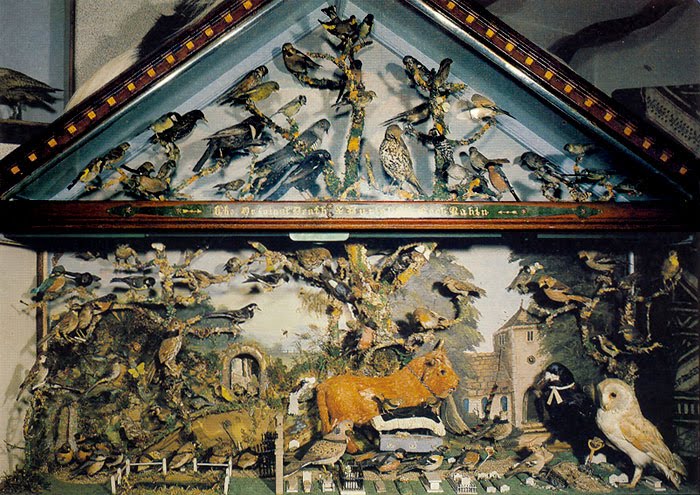
My friend Pat Morris--who spoke on Walter Potter at our recent Congress for Curious People-- loaned several of his own Potter pieces to the exhibition, most notably "The Death of Cock Robin, a truly epic tableaux depicting the funeral procession of the fabled Cock Robin as recounted in the well-known Englist nursery rhyme "Who Killed Cock Robin." This spectacular piece, as the Guardian describes, includes "more than 100 birds including a weeping robin widow and an owl gravedigger who has tumbled some tiny bones out of the soil while preparing space for the dead robin." For a visual (but please note: this image simply does not do the piece justice!), see third image down.

Besides being a collector of great proportion, Mr. Morris is also the author of the only extant book on Mr. Potter and his work, the lavishly illustrated and encyclopedic Walter Potter and His Museum of Curious Taxidermy, which you can buy in hardback or paperback by clicking here or here, respectively. You can also find out more about Potter, his work and his history by visiting the Ravishing Beast website by clicking here. You can read the full Genius or grotesquery?" article on the Guardian website by clicking here. To find out more about this exhibition--which will be on at least till Christmas--and the very curious Museum of Everything, click here.

Thanks to friend, friend-of-the-blog, and many time Observatory lecturer John Troyer for alerting me to this article!

Upcoming Observatory Event: "Swallowed and Saved: The Chevalier Jackson Foreign Body Collection and the Art it Has Inspired," Saturday, October 16


My friend Michelle Enemark is presenting the following event at Observatory this Saturday; looks like it will be a good one!

Swallowed and Saved: The Chevalier Jackson Foreign Body Collection and the Art it Has Inspired
An illustrated reading by artist Lisa Wood and author Mary Cappello
Date: Saturday, October 16th
Time: 7:00 PM
Admission: $5

An American half-dollar. An unspent matchstick. A beloved miniature swan stowed in a biscuit tin. A beaded crucifix. Tooth roots shaped like a tiny pair of pants. A padlock. Scads of peanut kernels and scores of safety pins. A porcelain doll prised from a throat. A metallic letter Z. A toy goat and tin steering wheel. Frozen twigs. Penny wafers. A Perfect Attendance Pin.

One of the most popular attractions in Philadelphia’s Mutter Museum is the Chevalier Jackson Foreign Body Collection: a beguiling set of drawers filled with thousands of items that had been swallowed or inhaled, then extracted nonsurgically by a pioneering laryngologist using rigid instruments of his own design. How do people’s mouths, lungs, and stomachs end up filled with inedible things, and what do they become once arranged in Dr. Chevalier Jackson’s aura-laden cabinet? Animating the space between interest and terror, curiosity and dread, author Mary Cappello and artist Lisa Wood will stage an illustrated reading based on two distinct but companionate projects to have emerged from Jackson’s foreign body display: Wood’s thirty-three original assemblages (The Swallowing Plates) and Cappello’s nonfiction book, Swallow: Foreign Bodies, Their Ingestion, Inspiration and the Curious Doctor Who Extracted Them (The New Press). Like Jackson’s design and deft manipulation of endoscopic instruments, like his endoscopic illustrations and his scrupulous attention to the nature of each foreign body caught, Cappello and Wood’s work excavates the relationship between corporeality, desire, and the object world. Their dossier of images and of incantatory texts promises to combine the uncanny, the beautiful, and the informative.

Note: Several of Lisa Wood’s plates will be on sale and on view, and attendees will be treated to a sneak preview of Cappello’s book which appears this January 2011, as well as details regarding the re-design and grand re-opening of the Chevalier Jackson Foreign Body Exhibit in the Mutter Museum of the College of Physicians of Philadelphia.

Does every human being have one of these Things to show for himself in his life’s hereafter?: as if to say, here is what is left of me: what’s left of me is that-which-was-once-within-me.

Mary Cappello’s books include Night Bloom; Awkward: A Detour (a booklength essay on awkwardness that was a Los Angeles Times bestseller), and Called Back (a critical cancer memoir that won a ForeWord Book of the Year Award and an Independent Publishers Prize). Some of Cappello’s recent essaying addresses Gunther von Hagens’ bodyworlds exhibits (in Salmagundi); sleep, sound and the silence of silent cinema (in Michigan Quarterly Review); the psychology of tears (in Water~stone Review); and the uncanny dimensions of parapraxis and metalepsis (in Interim). A recipient of the Dorothea Lange/Paul Taylor Prize from Duke University’s Center for Documentary Studies and the Bectel Prize for Educating the Imagination from Teachers and Writers Collaborative, Cappello is a former Fulbright lecturer at the Gorky Literary Institute (Moscow) and a professor of English and creative writing at the University of Rhode Island where she also teaches courses in Literature and Medicine. Swallow will appear in January from the New Press. Her latest book-length project on a single theme is a foray into sound and mood, tentatively titled In the Mood. For more information: http://www.awkwardness.org

Lisa Wood is a San Francisco based artist specializing in Victorian arts and crafts. Incorporating Victorian sensibilities into shadowboxes that memorialize the dead, dioramas that explore the hidden world of insects, mourning jewelry that captures the essence of the human spirit, and other curiosities that were inspired by what was collected, constructed and treasured at the time. This was an era when lingering disease and sudden death were inexplicable and everyday perils; an era when the very concepts of art and nature were challenged by technological innovations such as photography and medicine.

These fascinations join her work to the list of artists known as Victorian Revivalists.

Lisa sells her work to smaller boutiques and galleries as well as private collectors around the country. Her Swallowing Plate collection as well as her insect dioramas can be viewed at Gold Bug in Pasadena, the catalog is available at the Mutter Museum Store in Philadelphia.

For more information please visit: Lisa Wood Curiosities and Gold Bug.

To find out more, click here. You can get directions to Observatory--which is next door to the Morbid Anatomy Library (more on that here)--by clicking here. You can find out more about Observatory here, join our mailing list by clicking here, and join us on Facebook by clicking here.

"Portrait of the Professor of Medicine Jan Bleuland," Pieter Christoffel Wonder, 1808

The Romantic painters -- especially the Dutch Romantics -- were influenced by the landscapes, portraits and still-lifes of the Dutch 17th-century masters. Pieter Christoffel Wonder (1777-1852) painted a fascinating "Portrait of the Professor of Medicine Jan Bleuland" (1818), with the self-confident, bourgeois doctor standing in front of a skeleton draped with red arteries. It could have been part of Rembrandt's "Anatomy Lesson" of 1632 -- portraying the same fascination with the interior workings of the human body.

Found in a review of the exhibition "Masters of the Romantic Period -- Dutch Painting 1800-1850" at the Kunsthal on the Wall Street Journal; you can read the article by clicking here, and find out more about the exhibition by clicking here. Image found on the Collectie Utrecht website which can be seen by clicking here.

For another peek at Jan Bleuland at work, see this recent post.

Conference Report: ‘Contemporary Medical Science and Technology as a Challenge to Museums’, 15th Bi-Annual EAMHMS Congress, Copenhagen

For medical museums, whose collections are typically composed of evocative historical objects, developments in contemporary biomedicine offer a twofold challenge to collecting and exhibiting. The first challenge is the nature of contemporary biomedical equipment: large, expensive, and without immediately obvious function (think fMRI scanner). Where a display of surgeons’ tools can be both instructive and chilling, a collection of grey-box scanners and robotic surgical suites is likely to offer both historians and visitors less. The second challenge is more fundamental: medical investigation and treatment now operates beyond the limits of the visible, at the level of genes and proteins, a scale which it is hard to relate to our own bodies and lived experience. Even the beautifully-limned image of an SEMmed protein can’t offer the visceral thrill of corporeal recognition that a pickled heart in a jar does...

For the curious among you: The Wellcome Collection's Danny Birchall has written a very nice conference report--as excerpted above--about last month's ‘Contemporary Medical Science and Technology as a Challenge to Museums’ EAMHMS Congress in Copenhagen.

Click here to read full report on Danny's blog "Museum Cultures."

Image: Installation view of Medical Museion, the host institution in Copenhagen.

Lecture: "Anatomical Venuses, The Slashed Beauty, and Fetuses Dancing a Jig," University College London, Thursday October 7, 6:00 PM


For all you Londoner's out there: on Thursday, October 7th at 6:00 PM, I will be giving a free lecture at University College London about anatomical museums and their curious denizens, heavily illustrated with many photographs I have been collecting over the years, such as those seen above.

The lecture is free and open-to-the-public. Full details follow; hope to see you there!

Anatomical Venuses, The Slashed Beauty, and Fetuses Dancing a Jig:
A Journey into the Curious World of the Medical Museum

Date: Thursday, October 7th
Time:
6 PM
Location: UCL, Department of History of Art
20 Gordon Square, WC1E 6BT London, Room 3-4 (first floor)

Tonight's lecture will introduce you to the the Medical Museum and its curious denizens, from the Anatomical Venus (see above) to the Slashed Beauty, the allegorical fetal skeleton tableau to the taxidermied bearded lady, the flayed horseman of the apocalypse to the three fetuses dancing a jig. The lecture will contextualize these artifacts by situating them within their historical context via a discussion of the history of medical modeling, a survey of the great artists of the genre, and an examination of the other death-related diversions which made up the cultural landscape at the time that these objects were originally created, collected, and exhibited.

You can download an invitation to the event by clicking here.

All Images From The Secret Museum Exhibition;" Top to bottom:

  1. Anatomical Venuses," Wax Models with human hair in rosewood and Venetian glass cases,The Josephinum, Workshop of Clemente Susini of Florence circa 1780s, Vienna, Austria
  2. Wax Model of Eye Surgery, Musée Orfila, Paris. Courtesy Université Paris Descartes
  3. Fetal Skeleton Tableau, 17th Century, University Backroom, Paris

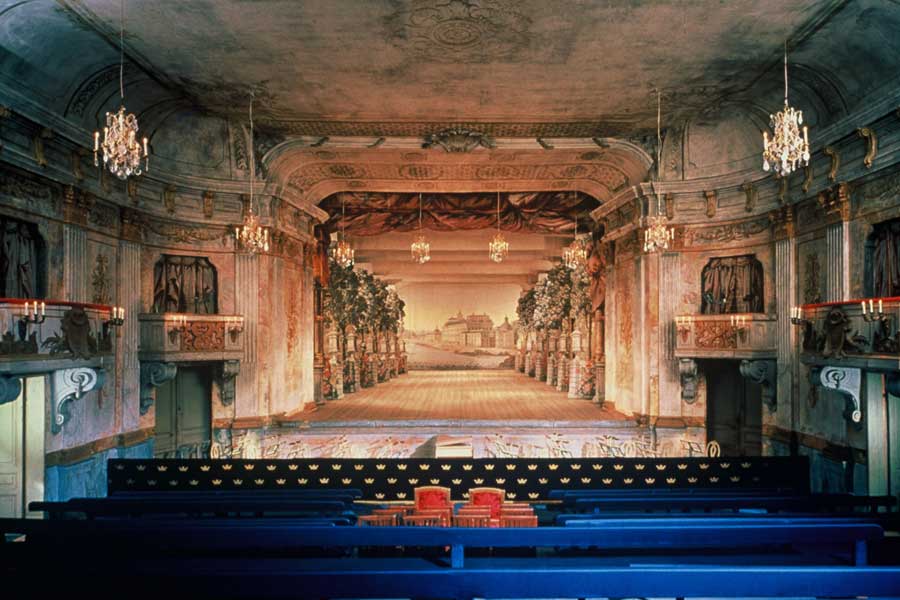
Drottningholm Court Theatre, 1764-1766, Stockholm

Today I visited one of the most incredible spaces I have ever had the honor to momentarily inhabit: the Drottningholm Court Theatre, a former royal summer theatre at the Drottningholm Royal Park, a UNESCO World Heritage site in Stockholm, Sweden.

The Drottningholm Court Theatre was described memorably by our tour guide as "an intact baroque theater unique for never having been restored." This intactness includes not just paint, chandeliers, stage, and viewing boxes but also extends--astoundingly!--to the stage machinery and special effects, which are not only original but also still used in productions! The sets and "side flats" are not original, but are utterly convincing and painstaking reproductions in canvas and wood from originals found under a meter of dust when the theatre was rediscovered in 1921. The theatre also has--and continues to use!--machinery for lowering a person from the ceiling, as in the case of a goddess descending on a cloud, as well and a trap door to be used in such cases as "drowning heroines or sudden appearances."

During the summer, the Drottningholm Court Theatre stages 18th Century operas and ballets using these replica sets and the original stage machinery to create a completely immersive 18th Century theatre experience; unfortunately for me, the productions had already ended for the season before I arrived, so I had to content myself with volunteering to operate the "gale machine" (a wooden wheel whirled around inside a tight canvas strip producing with its friction a sound remarkably like howling winds) while my volunteer-partner worked the thunder machine--a box of rocks tossed this way and that by the pull of a rope.

The video above helps give a sense of the charm and wonder of these wonderful antique sets and machineries in motion where my words fail; both the video and a visit to this really fantastic--in ever sense of the word--theatre are highly recommended! I am already fantasizing about a return trip just to see The Magic Flute in this environment.

To find out more about the Drottningholm Court Theatre, click here.

Thanks so much to friend, friend-0f-the-blog, and author of the wonderful book Death, Modernity, and the Body: Sweden 1870-1940 Eva Åhrén for telling me about this incredible place, and for all her other wonderful Sweden tips as well.

Morbid Anatomy Library and Observatory, Open Studios, This Saturday, October 2nd, 12-6


This Saturday, October 2, please join the Morbid Anatomy Library (as seen above) and sister space Observatory as we open our spaces to the public as part of the 14th annual Gowanus Artists Studio Tour, or "A.G.A.S.T." There will be snacks, beverages, art, artifacts, and, of course, books.

Following are the full details; Very much hope to see you there!

14th annual Gowanus Artists Studio Tour (A.G.A.S.T.)
Saturday October 2nd
12-6 PM
543 Union Street at Nevins, Brooklyn
Free and Open to the Public

Directions: Enter the Morbid Anatomy Library and Observatory via Proteus Gowanus Gallery

R or M train to Union Street in Brooklyn: Walk two long blocks on Union (towards the Gowanus Canal) to Nevins Street. 543 Union Street is the large red brick building on right. Go right on Nevins and left down alley through large black gates. Gallery is the second door on the left.

F or G train to Carroll Street: Walk one block to Union. Turn right, walk two long blocks on Union towards the Gowanus Canal, cross the bridge, take left on Nevins, go down the alley to the second door on the left.

For more about the Morbid Anatomy Library, click here. You can find out more information about A.G.A.S.T., and get a full list of participants, by clicking here. You can find out more about Observatory and the exhibition now on view by clicking here.

Beautiful Irish Medical Photographs, The Burns Archive, 1870s


The photographs above, dating from the 1870s, picture patients who were operated upon by 19th Century surgeon Edward Stamer O’Grady; these photos, all drawn from the incredible Burns Archive, were featured--paired with their original case histories!--in the most recent issue of Scope Medicine in Focus.
Full story can be found here; you can see a PDF of the article--with additional images--by clicking here.

All images ©2010 The Burns Archive; From top to bottom:

  1. Patient of Edward Stamer O'Grady
  2. A 50-Year-Old Laborer "MM," Admitted Feb 17, 187
  3. Once the 27 Ounce Tumor Was Removed, the Patient "Went Home Quite Well."