“Memento Mori: The Birth and Resurrection of Postmortem Photography,” Merchant's House Museum with the Burns Archive, New York, Through November 29th


The New York Times blog just ran a brief story on a new exhibit I have been dying (sic) to see: “Memento Mori: The Birth and Resurrection of Postmortem Photography,” an exhibition exploring memorial photography then and now, curated in a collaboration between Eva Ulz and the incomparable Burns Archive of New York.

The exhibition--on view at the Merchant's House Museum in lower Manhattan until November 29th--features a collection of antique memorial photography drawn from the incredible Burns Archive curated alongside similarly-themed photographs by contemporary artists such as Joel-Peter Witkin, Sally Mann, Hal Hirshorn, Marian St. Laurent and Sarah Lohman. This intriguing looking exhibition takes as its theme the role of post-mortem photographs at different cultural moments.

As the article explains:

“People dealt with death differently in the 19th century,” says Eva Ulz, the curator of “Memento Mori: The Birth and Resurrection of Postmortem Photography” at the Merchant’s House Museum. “People looked forward to a reunion in heaven. Creating portraits was considered a precursor to that heavenly reunion. They shouldn’t be thought of as creepy.”

As much as it is about religious belief, the show — which was organized in conjunction with the Burns Archive and includes some 145 postmortem images and ephemera taken between the 1840s and the early 1900s — takes as its main subject the role of photography in everyday life, then and now. As the 20th century began to unfold and photography became much more common, Ulz says, postmortem images were sapped of their ritualistic importance.

To help put that shift in context, Ulz asked five contemporary shooters, including Sally Mann, Joel-Peter Witkin, Hal Shirshorn and Sarah Lohman, to contribute their own take on the postmortem photograph. The photographer Marian St. Laurent, who created an actual coffin called “Our Darling: A Memorial of Photography,” sees the exhibit as “a remembrance of photo negatives in the digital age. As we push the limits of advanced seeing in technology, we’ve never been more blind to the power of images.”

Ulz hopes “Momento Mori” will create in viewers a deeper understanding of their relationship with photography today. “I hope they get an idea of where they and their images fit in the cycle of life,” she says. “If you had to choose, which one picture would you want to represent you for all eternity?”

The show--which celebrates the publication of the Burns Archives’ latest book Sleeping Beauty III Memorial Photography: The Children--is on view at the Merchant's House Museum until November 29; you can find out more about the exhibition by clicking here. You can find out more about the new book Sleeping Beauty III Memorial Photography: The Children--which joins its predecessors Sleeping Beauty I and II--by clicking here. To find out more about The Burns Archive, click here; to check out its new and wonderful blog, click here. You can read this NY Times Blog post in its entirety by clicking here.

Thanks to Jim Edmonson of the Dittrick Museum for drawing my attention to this article!

All images from Sleeping Beauty III Memorial Photography the Children/Stanley B. Burns, MD, as found on the article website.

"Paradiso Contrapasso," Upcoming Exhibition at Observatory, Call for Works, Deadline October 5


Hi All! Sorry for the silence; I am on the road, and the internet has been scarce!

I break the silence with an exciting announcement; the next Observatory exhibition is in the works, and the curators--Gerry Newland of Observatory along with friend of Morbid Anatomy Lord Whimsy and his wife Susan--have put out a call for works! You can find out more about the show--wonderfully entitled "Paradiso Contrapasso,"--and all the specifications for submissions below; hope to see your work in the show, or, if not, than to see you at the opening party on Thursday October 14th!

Full call for works follows:

A Call To Artists: Observatory presents: Paradiso Contrapasso

Submissions due: October 5, 2010
Pieces Due: October 11, 2010
Exhibition dates: October 14 - November 28th, 2010

To compliment the recent opening of Paradise, a year long event at Proteus Gowanus, Observatory explores the theme: Paradiso Contrapasso. In Dante's Inferno, Paradiso Contrapasso distinguishes each sinner by making his or
her punishment uniquely appropriate to the committed sin, so that every soul inhabits a Hell all its own.

For example, consider the story of Paolo and Francesca:
An unlikely marriage is proposed between the beautiful Francesca and the rich, but ugly Gianciotto. Paolo, the handsome brother of Gianciotto seduces the young bride and they become lovers. When Gianciotto discovers their indiscretion, he murders them both. In Hell, Paolo and Francesca are fused together in an eternal embrace, wishing only to be separated.

As Dante journeys through Purgatorio and Paradisio, he does not revisit this technique of contrapasso. For our event, however, Observatory encourages artists to consider divine comedic retribution in all of its possible representations, and from sources such as the Bible and religious and esoteric cosmologies, the ethical
philosophies of Aristotle and Thomas Aquinas, Symbolist poetry, the works of Roald Dahl, the Wizard of Oz, Cautionary Tales, Folklore and Fairy Stories, the Twilight Zone, Modern Dystopias, etc. The emphasis should be on "Divine" and "Comedy", and on our superstitious fear of getting what we wish for!

G.F. Newland, co-founder of Observatory Gallery, and Allen and Susan Crawford of Plankton Art Co. will co-curate.

Eligibility: All artists working in any media. (There is limited space for sculptural and free-standing works.)

Submissions: (Please include all information. Late or incomplete submissions will not be considered.)

  1. Up to 5 images. Digital file submissions will be accepted via email. Digital files must be in JPEG or PDF format, resolution set to 72 dpi. Please number images to correspond to Image List.
  2. Image list. Numbered to correspond with your image submissions. Include image #, your name, title, date of work, medium, size and price. You may also include a brief description for each image, however this isn’t required.
  3. A one page résumé. Please include a three line bio, your contact information and an email address.
  4. An artist’s statement. No longer than 300 words.

Fees: NO FEE TO ENTER

Deadline: Submissions must be received by October 5; All pieces must be received no later than October 11th, 2010.

Gallery commission for sold art: 30%

Return of Submission Materials: Include a SASE if you want your materials to be returned. Make sure there is sufficient postage. Materials without postage will not be returned.

Drop Off: Drop off of accepted artwork will be October 11th and 12th noon to 2pm. Mailed artwork must arrive by October 11th and include return shipping label/postage/etc.

Pick Up: Artists are responsible for picking up artwork on TBA. Return of mailed artwork with return postage will begin on November 28th.

Email submissions to: gfnewland@gmail.com.
By post: Observatory 543 Union St #1E, Brooklyn, NY 11215

See below for full details; for more information or to submit work, email Gerry Newland at gfnewland@gmail.com.

Image: The Souls of Paola and Francesca from Gustave Doré's Illustrations to Dante's Divine Comedy

"The Wunderkammer," Installation by Georg Laue, Me Collectors Room, Berlin


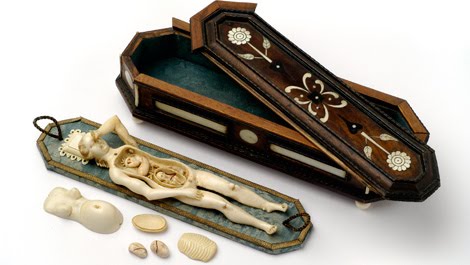
I just came across a rather interesting looking new exhibition at a gallery called the Me Collectors Room in Berlin. Entitled "The Wunderkammer," this new permanent installation is the work of antique dealer/cabinetist Georg Laue, proprietor of the famed Kunstkammer Georg Laue in Munich, Germany, and seems--as you can see in the images above--to include a pretty astounding collection of fine memento mori, ivory Anatomical Venuses, and turned ivory wonders.

From the website:

THE WUNDERKAMMER

ASTONISHMENT
The WUNDERKAMMER rekindles the tradition of the Kunst- and Wunderkammer of the Renaissance and Baroque periods. It imparts an insight into the world view and the standard of knowledge of past centuries and does just what a Wunderkammer was able to do between 200 and 500 years ago: transport the visitor into a realm of sheer astonishment — whether by means of the legendary unicorn, exposed latterly by the cognoscenti as the tusk of a narwhal, an amber mirror flooded with light, or cabinets that only reveal their mysteries to the observant viewer.

DISCOVERY
The quality of the exhibits, numbering in excess of 150, is unique and makes the WUNDERKAMMER one of the most significant private collections of its kind. The juxtaposition of works from different cultures generates its very own effect. The permanent collection places an emphasis on Vanitas (“Consider the fact that you will die”). In the Baroque period, death was already staged with a mixture of devotion, interest, and humour. The scope for interpretation of this topic is manifested by an anatomical model dating from the second half of the 17th century. The organs and the foetus of the laid out body of a pregnant woman can be removed and prompt one to indulge in a playful handling of this miniature.

UNDERSTANDING
The objects in the WUNDERKAMMER exert an incredible fascination and will captivate the curious with a vision of a small, encyclopaedic, unique universe, which ultimately contributing to a deeper understanding of the correlations between art, nature, and science.

This exhibition definitely looks worth a visit! And, for the more curious among you, theme-specific tours of the collection are also available in which, as the website explains, "existential themes such as Eros, death, and transience, as well as the genesis of the collection, form the central focus."

You can find out more about Georg Laue and his Munich shop clicking here. You can find out about more about the exhibit by clicking here.

Found via Wunderkammer. All images from the Me Collectors Room Berlin website.

Seeking Private Collections in Scandinavia, Great Britain, and Germany for "Private Cabinets" Photography Project


As alluded to in a few recent posts [1, 2], a week from tomorrow I will be embarking on a trip to Scandinavia and Great Britain with perhaps (time depending) a touch of Germany along the way.

Regular readers might recall that I currently at work on a long-term project exploring extraordinary private collectors and collections, working title: Private Cabinets (more here); while on my travels, I have scheduled to visit and photograph a few more private collections for inclusion in this series and am on the lookout for yet more.

If any Morbid Anatomy readers out there know of any private wunderkammern or extraordinary private collections featuring medical museum type artifacts, waxworks, human remains, scientific models, old natural history, carnival/circus/sideshow or marvels or curiosities of any sort in these parts of the world, or have, perhaps, such a collection of their own they would like to share, please email me at morbidanatomy@gmail.com. Museum and attraction suggestions in the same topic areas also greatly appreciated!

To find out more about the ongoing "Private Cabinet" series, click here. All images above are from the epic private collection of Tim Knox and Todd Longstaffe-Gowan Collection of London, England as featured in my recent Secret Museum exhibition. Click on images to see much larger, finer images, and click here to see the complete Secret Museum collection.

‘Contemporary Medical Science and Technology as a Challenge to Museums’, 15th Bi-Annual EAMHMS Congress, Copenhagen, September 16-18


In a few weeks--from September 16th through 18th--the 15th biannual conference of the European Association of Museums for the History of Medical Sciences--to be hosted by the Medical Museion--will be in full effect at the Medical Museion of Copenhagen, Denmark.

The topic of this year's congress--"Contemporary medical science and technology as a challenge to museums"--will be debated and discussed by a variety of museum practitioners and enthusiasts, from curators to museum directors to artists to bloggers such as myself. I will be presenting my paper--"The private, curious, and niche collection: what they can teach us about exhibiting new medicine"-- on Thursday the 16th. Other participants will include New York based artist and SVA professor Suzanne Anker, the Wellcome Collection's Ken Arnold, and friend-of-Morbid-Anatomy James Edmonson of the Dittrick Museum.

This is sure to be a thought provoking and fascinating congress. Hope very much to see you there!

Full schedule follows:

THURSDAY, 16 SEPTEMBER

  • Thomas Söderqvist: Why this conference now?
  • Kim Sawchuk: Biotourism and biomediation
  • Kerstin Hulter Åsberg: Uppsala Biomedical Center: A mirror of modern medical history – how can it be displayed?
  • Wendy Atkinson and René Mornex: A major health museum in Lyon
  • Robert Martensen: Integrating the physical and the virtual in exhibitions, archives, and historical research at the National Institutes of Health
  • Ramunas Kondratas: The use of new media in medical history museums
  • Danny Birchall: ‘Medical London’, Flickr, and the photography of everyday medicine
  • Joanna Ebenstein: The private, curious, and niche collection: what they can teach us about exhibiting new medicine

FRIDAY, 17 SEPTEMBER

  • Judy M. Chelnick: The challenges of collecting contemporary medical science and technology at the Smithsonian Institution
  • James Edmonson: Collection plan for endoscopy, documenting the period 1996-2011
  • John Durant: Preserving the material culture of contemporary life science and technology
  • Stella Mason: Medical museums, contemporary medicine and the casual visitor
  • Alex Tyrell: New voices: what can co-curation bring to a contemporary medical gallery?
  • Jan Eric Olsén: The portable clinic: healthcare gadgets for home use
  • Yin Chung Au: Seeing is communicating: possible roles of Med-Art in communicating contemporary scientific process with the general public in digital age
  • Nina Czegledy: At the intersection of art and medicine
  • Lucy Lyons: What am I looking at?
  • Henrik Treimo: Invisible World
  • Victoria Höög: The optic invasion of the body. Epistemic approaches to current biomedical images
  • Ken Arnold and Thomas Söderqvist: A manifesto for making science, technology and medicine museums

SATURDAY, 18 SEPTEMBER

  • Morten Skydsgaard: The exhibition ‘The Incomplete Child’: boundaries of the body and the guest
  • Sniff Andersen Nexø: Showing fetal realities: visibility, display, performance
  • Suzanne Anker: Inside/Out: fetal specimens through a 21st Century lens
  • Yves Thomas and Catherine Cuenca: Multimedia contributions to contemporary medical museology
  • Nurin Veis: How do we tell the story of the cochlear implant?
  • Jim Garretts: Bringing William Astbury into the 21st Century: the Thackray Museum and the Astbury Centre for Structural Molecular Biology in partnership
  • Adam Bencard: Being molecular
  • Roger Cooter and Claudia Stein: Visual things and universal meanings: aids posters, the politics of globalization, and history
  • Karen Ingham: Medicine, materiality and museology: collaborations between art, medicine and the museum space
  • Silvia Casini: Curating the biomedical archive-fever
  • Thomas Schnalke: Dissolving matters. The end of all medical museums’ games?

You can find out more about the congress by clicking here. You can read more about the Medical Museion via a few recent blog posts, the first being the Dittrick Museum's (here) and the other being that of The Sterile Eye (here).

Image: From The Sterile Eye; Caption: Copy of écorché statue by Theobald Stein. Original from 1869.

Amazing Medical Woodblock Prints, Japan, 19th Century


Just came across this really fantastic and unusual collection of 19th Century Japanese medical woodblock prints on the Pink Tentacle website, which sourced them from the extensive University of California San Francisco (UCSF) Japanese Woodblock Print Collection website.

As the UCSF website explains:

The UCSF Japanese Woodblock Print Collection consists of four hundred Japanese woodblock prints on health-related themes. Of those, more than half are colorfully illustrated in the ukiyo-e manner, the remainder being printed single-sheet texts. From the treatment and prevention of diseases like smallpox, measles, and cholera, to the stages of pregnancy and drug advertisements, these prints offer a unique window into traditional Japanese attitudes toward health and illness.

The majority of the prints date to the mid- to late nineteenth century, when Japan was opening to the West after almost two hundred and fifty years of self-imposed isolation. Thus, they provide valuable pictorial evidence for the effect of Western medical science on traditional beliefs and practices.

Five subject areas broadly define the collection. The treatment and prevention of three contagious diseases; smallpox, measles, and cholera; are topics for eighty of the prints. A related category includes prints in which Buddhist or Shinto deities intervene to ensure a cure. Pregnancy and women's health issues form a distinct theme, including several images of the stages of gestation. Because foreigners were thought to carry disease to Japan, the collection also includes several maps of Nagasaki, where the Dutch were confined during the Edo period, as well as prints depicting foreigners and their ships. Drug advertisements from the nineteenth century make up the largest category...

The woodblock prints in this collection offer a fascinating visual account of Japanese medical knowledge in the late Edo and Meiji periods. Collectively, they record a gradual shift, by the late nineteenth century, from the reliance on gods and charms for succor from disease, to the adoption of Western, scientific principles as the basis for medical knowledge. They show the introduction of imported drugs and vaccines and increased use of printed advertisements to promote new medicinal products.

You can view the entire collection on the UCSF website--arranged by the themes Contagious Disease, Drug Advertisements, Foreigners & Disease, Religion & Health and Women’s Health--by clicking here.

I HIGHLY recommend clicking on each image to view larger, richer, and more detailed image.

Image captions top to bottom:

  1. Shinto god from Izumo province for preventing measles -- Taiso Yoshitoshi, 1862
  2. Pregnancy guide -- Hamano Teisuke, 1880
  3. Illustrated guide to parental obligations -- Utagawa Yoshitora, 1880
  4. Pregnant women playing in summer heat (5 heads, 10 bodies) -- Utagawa Kunitoshi, 1881
  5. Chasing measles away -- Utagawa Yoshimori, 1862

From Pink Tentacle via Ellettrogenica.

Seeking Private, Curious, Arcane and Overlooked Scandinavian Museums, Collections, Sights and Curiosities


Greetings folks.

I am in the midst of planning a trip to Scandinavia around the upcoming Congress for the European Association of Museums for the History of Medical Sciences on the theme of ‘Contemporary medical science and technology as a challenge to museums' to be held at Medical Museion in Copenhangen, September 16-18.

More on that conference--at which I will be delivering a paper--soon (though the impatient among you can see the full line up here); for now, I mention it only as an excuse for soliciting suggestions from Morbid Anatomy readers regarding private, curious, arcane, and overlooked museums, collections, sights and curiosities that one shouldn't miss in this part of the world, of which I know frightfully little.

Any suggestions very much appreciated! Suggesters can leave comments on this post or email me at morbidanatomy@gmail.com.

Thanks so much!

Image: The Biologiska Museet, Stockholm--which is very much on my list!--from Picasa user Traci Brandon.

This Tuesday at Observatory: “Behind the Scenes and Under the Skin” or, “The Body at Blythe," with Lisa O’Sullivan, Medicine Curator of Science Museum


Next Tuesday at Observatory please join Morbid Anatomy for “Behind the Scenes and Under the Skin” or, “The Body at Blythe” an illustrated lecture by Lisa O'Sullivan, Senior Curator of Medicine at the Science Museum of London. As many of you no doubt know, the Science Museum houses the incredible collection of 100,000 or so of the artifacs amassed by Henry Wellcome, tiny glimpses of which you see above; the collection will be discussed and pictured at much greater length in Tuesday's lecture.

Hope very much to see you there.

“Behind the Scenes and Under the Skin” or, “The Body at Blythe”
An illustrated talk by Lisa O’Sullivan, Senior Curator of Medicine at the Science Museum, London
Date: Tuesday, September 7th
Time: 8:00 PM
Admission: $5
Presented by Morbid Anatomy

Join Lisa O’Sullivan, Senior Curator of Medicine at the Science Museum, London for a behind-the-scenes look at the Museum stores. As is the case for many large museums, only about 5% of the Science Museum’s objects are ever on display. This is an opportunity to see some of the other 95% - as photographed by Morbid Anatomy’s Joanna Ebenstein on a recent visit.

The Museum’s ‘small objects’, all 203,000 of them, are stored at Blythe house, an early 20th century office building (larger objects live in aircraft hangars in the West of England). Over 100,000 of these artefacts are medical, the majority from the Wellcome collection. Over 30 rooms hold objects from Roman votives to mediaeval saints, x-ray machines to. The collection displays the breadth of Henry Wellcome’s collecting, and vision of medicine.

Lisa will conduct a virtual tour of some of the rooms, highlight some of her – anatomical – favourites amongst the objects, and take questions about life ‘backstage’ at the Museum.

Lisa O’Sullivan is the Senior Curator of Medicine at the Science Museum in London, where she curates the Wellcome collections. She is responsible for the anatomical collections, and all issues relating to human remains in the museum. Lisa’s doctorate looked at the construction of nostalgia as a clinical category in nineteenth-century France. In addition she has degrees in medical anthropology, history and literature. In 2010, she is a postdoctoral fellow at the University of Sydney.

You can find out more about this presentation by clicking here. To find out more, see this recent post, from which the above images were drawn.You can get directions to Observatory--which is next door to the Morbid Anatomy Library (more on that here)--by clicking here. You can find out more about Observatory here, join our mailing list by clicking here, and join us on Facebook by clicking here.

The Edward Gorey House Museum, Yarmouth Port, Massachusetts


My boyfriend and I finally made a much-anticiated pilgrimage to the wonderful Edward Gorey Museum in Yarmouth Port, Massachusetts a few weeks ago. We were far from disappointed by what we found!

The museum (see photos above) is located in the home of the recently deceased author/illustrator/eccentric Edward Gorey. The home has, sadly, largely been cleared of Gorey's legendary clutter--though a few tantalizing fragments from his private collection can be found scattered about--and transformed into a compact house-museum dedicated to the man's life and work.

Part of me wishes they had simply left the place as it was at Gorey's death, and allowed visitors the opportunity to wander around the famously idiosyncratic environment in which the man produced so many of his iconic works. However, I was quickly won over by the museum's small-town- quirky charm, and the pretty great displays, which included original drawings and half-finished inked works, reproductions of his sketchbooks, amazing ephemera and souvenirs from Mystery and his Broadway production of Dracula, one of his raccoon fur coats, many of his Doubleday book covers, a number of his handmade stuffed animals, many coveted rare works such as his fantastic peepshow, and scores of other artifacts. The gift-shop was also seriously incredible--with scores of Gorey-themed souvenirs I had never seen before--and the folks running the museum were lovely to talk to, knowledgeable and passionately devoted to the man and his work.

In all, the museum really managed to capture the atmosphere and spirit of Edward Gorey's peculiar and alluring universe, with all its whimsy, quirkiness, and elegance; one gets the feeling that Edward Gorey himself might almost have approved, if he had been capable of approving of any museum devoted to his own life and work.

If you are a fan of Mr. Gorey, I cannot more highly recommend making a pilgrimage of your own to the Edward Gorey House Museum. You can find out more about it--including hours and directions--by clicking here; you can visit their awesome gift shop by clicking here. If you would like to make a virtual visit, you can view the full set of photos documenting my own trip--from which the sample above is drawn--by clicking here.

Tomorrow Night at Observatory: "Documenting the Invisible: Spiritualism, Lily Dale, and Talking to the Dead," Illustrated Lecture by Shannon Taggart


Tomorrow night at Observatory! Hope very much to see you there.

Documenting the Invisible: Spiritualism, Lily Dale, and Talking to the Dead
An illustrated lecture by photographer Shannon Taggart
Date: Tuesday, August 31
Time: 8:00 PM
Admission: $5
Presented by Morbid Anatomy

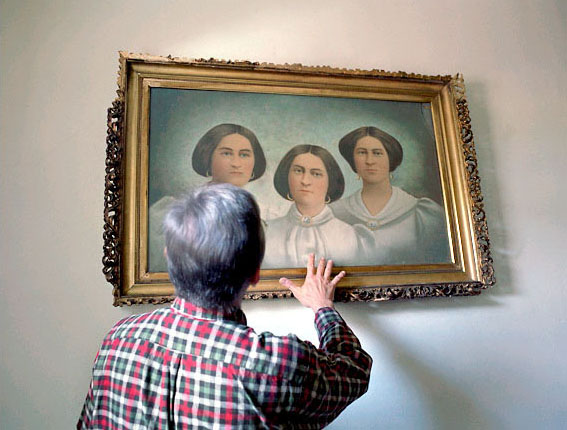
Spiritualism is a loosely organized religion based primarily on a belief in the ability to communicate with spirits of the dead. The movement began in upstate New York in 1848 when two young girls named Margaret and Kate Fox claimed to be in contact with the spirit of a dead peddler buried beneath their home. Photographer Shannon Taggart first became aware of Spiritualism as a teenager when her cousin received a reading in Lily Dale, NY, The World’s Largest Spiritualist Community. A medium there revealed a strange family secret about the death of their grandfather that proved to be true. Taggart became deeply curious about how someone could possibly know such a thing.

Thus began a five year photography project focused on Modern Spiritualism. During her image making she immersed myself in the history and philosophy of Spiritualism, had more readings than she can count, experienced spiritual healings, took part in séances, attended a psychic college and sat in a medium’s cabinet, all with her camera. Despite this exposure she finds herself no closer to any definitive answer of what it all means. She feels as if she has peered into a mystery.

Shannon Taggart is a freelance photographer based in Brooklyn, New York. She received her BFA in Applied Photography from the Rochester Institute of Technology. Her images have appeared in numerous publications including Blind Spot, Tokion, TIME and Newsweek. Her work has been recognized by the Inge Morath Foundation, American Photography, the International Photography Awards, Photo District News and the Alexia Foundation for World Peace, among others. Her photographs have been shown at Photoworks in Brighton, England, The Photographic Resource Center in Boston, Redux Pictures in New York, the Stephen Cohen Gallery in Los Angeles and most recently at FotoFest 2010 in Houston. For more about Shannon Taggart, visit http://www.shannontaggart.com.

You can find out more about this event here. You can get directions to Observatory--which is next door to the Morbid Anatomy Library (more on that here)--by clicking here. You can find out more about Observatory here, join our mailing list by clicking here, and join us on Facebook by clicking here.

Image: Ron with the Fox Sisters, Founders of Spiritualism; Lily Dale, NY © Shannon Taggart

'Skin,' Wellcome Collection, Through September 26, 2010


The last decade has revealed a burgeoning interest and fascination with human skin, particularly among philosophers, writers, artists and designers. Meanwhile, regenerative medicine has seen major advances in the development of artificial skin designed to improve the structure, function and appearance of the body surface that has been damaged by disease, injury or ageing. So there couldn't be a better time to get under the surface of this subject.--Lucy Shanahan, Wellcome Collection Curator and co-curator of 'Skin'

I have been hearing excellent reports from scores of people about the new Wellcome Collection exhibition entitled, simply, 'Skin.' Sadly, I will not be able to see it in person (as it closes on September 2th), but the images above--most drawn from the exhibition website--and the web exhibition text make it clear that the Wellcome has done it again: a thoughtful, broadly considered, and lovely investigation and survey into the science, meaning, art, and implications of the notion of 'skin.'

More about the show, from the press release:

The skin is our largest organ. It gives us a vital protective layer, is crucial for our sense of touch and provides us with a highly sensitive and visible interface between our inner body and the outside world. Spots, scars, moles, wrinkles, tans and tattoos: the look of skin can reveal much about an individual's lifestyle, health, age and personality, as well as their cultural and religious background. The skin is also remarkable for its ability to regenerate and repair itself.

The multidisciplinary exhibition 'Skin' takes a predominantly historical approach, beginning with early anatomical thought in the 16th and 17th centuries, when, for anatomists, the skin was simply something to be removed and discarded in order to study the internal organs. The story continues through the 18th and 19th centuries and approaches its conclusion in the 20th century, by which time the skin was considered to be of much greater significance and studied as an organ in its own right.

The exhibition will incorporate early medical drawings, 19th-century paintings, anatomical models and cultural artefacts juxtaposed with sculpture, photography and film works by artists including Damien Hirst, Helen Chadwick and Wim Delvoye.

The 'Skin' exhibition will be complemented by the 'Skin Lab', which features artistic responses to developments in plastic surgery, scar treatments and synthetic skin technologies, including two newly commissioned works by the artists Rhian Solomon and Gemma Anderson. Visitors are invited to participate in an interactive and sensory experience - experimenting with skin-flap models used in plastic surgery, trying on latex skin-suits or studying biological jewelery.

For more about the exhibition including hours and visiting information, visit the Wellcome Collection website by clicking here. You can visit the image galleries--from which most of the above images were pulled and which contain many more riches--by clicking here.; Credits and captions for images follow. Also, if you are, like me, a fan of the Wellcome and its work, you won't want to miss tonight's lecture at Observatory featuring Wellcome Collection curator Kate Forde; click here for more on that.

Images:

  1. Wax Model, Tiña favosa generalizada (Widespread tinea favosa), c. 1881, by Enrique Zofío Dávila, courtesy of Olavide Museum, Madrid
  2. Xteriors VIII' by Desiree Dolron, 2001-08. Reminiscent of Dutch Old Master painting, this ethereal photograph seamlessly blends the everyday with the historical and the mythical. It creates an atmosphere of melancholy associated with death, which is implied in the gaunt form and ghostly pallor of the child's skin, though the true narrative remains a mystery.
  3. Superficial blood vessels of the head and neck. Coloured mezzotint by J F Gautier d'Agoty, 1748. In some écorché drawings, the skin is only partially removed.
  4. Vertebral column with dissections of nerves and blood vessels, with skin in the background, and (left) the figure of a man representing Ecclesiastes. After Johann Georg Pintz, 1731.
  5. Vagina, perineum and anus, from 'Nouvelles Demonstrations d'Accouchemens'. Jacques-Pierre Maygrier, 1822-25.
  6. Human skin hanging in a frame. Thomas Bartholin, 1651.
  7. Démence Précoce Catatonique Dermographisme. L Trepsat, 1893. From 'Nouvelle Iconographie de la Salpêtrière', 1904. During the second hald of the 19th century, the belief spread that the phenomenon of dermatographism (or 'dermographism', or 'skin writing') was linked to hysteria and other mental or nervous disorders. Here a female patient at the Salpêtrière hospital in Paris has had her diagnosis 'Démence précoce' (dementia praecox) 'written' on
    her back.
  8. Areas of psoriasis on the back of a 30-year-old man, c. 1905.
  9. A notebook allegedly covered in human skin, c. 1770-1850. The label reads: "The cover of this book is made of Tanned skin of the Negro whose Execution caused the War of Independence". This presumably refers to Crispus Attucks, who was the only black victim of the Boston Massacre of 1770, and who was immediately celebrated as an American hero. In 1888 a memorial to him was erected on Boston Common. If authentic, this exhibit might therefore, somewhat couterintuitively, suggest an act of honour and acclaim. Close examination suggests that the cover is probably not made of human skin.
  10. A selection of tattoos on human skin. Anonymous, 1850-1920. Selected from over 300 examples of human skin collected by Henry Wellcome, these specimens are most likely to be French in origin and date from 1850 to1920. The tattoos were bought in Paris in June 1929 by Peter Johnston-Saint, one of Wellcome's purchasing agents. The seller was osteologist and anatomist, La Vallete, who had obtained some of his collection of specimens through his work at Parisian military establishments and prisons. The crude designs in this selection are mainly of nude female figures, which were often worn by prostitutes as markers of their trade, but were also popular among seamen, soldiers and prisoners as reminders of a woman left behind, or as general sexual fantasies.

Tonight at Observatory: "The W.D. Trotter Anatomy Museum – A Brief History" A virtual tour by Chris Smith, Curator of the W.D. Trotter Anatomy Museum


Tonight at Observatory! Hope to see you there.

It’s Scotland Jim, But Not As We Know it: The W.D. Trotter Anatomy Museum - A Brief History
An illustrated lecture and virtual tour by Chris Smith, Curator of the W.D. Trotter Anatomy Museum, University of Otago, Dunedin, New Zealand
Date: Friday, August 27
Time: 8:00 PM
Admission: $5
Presented by Morbid Anatomy

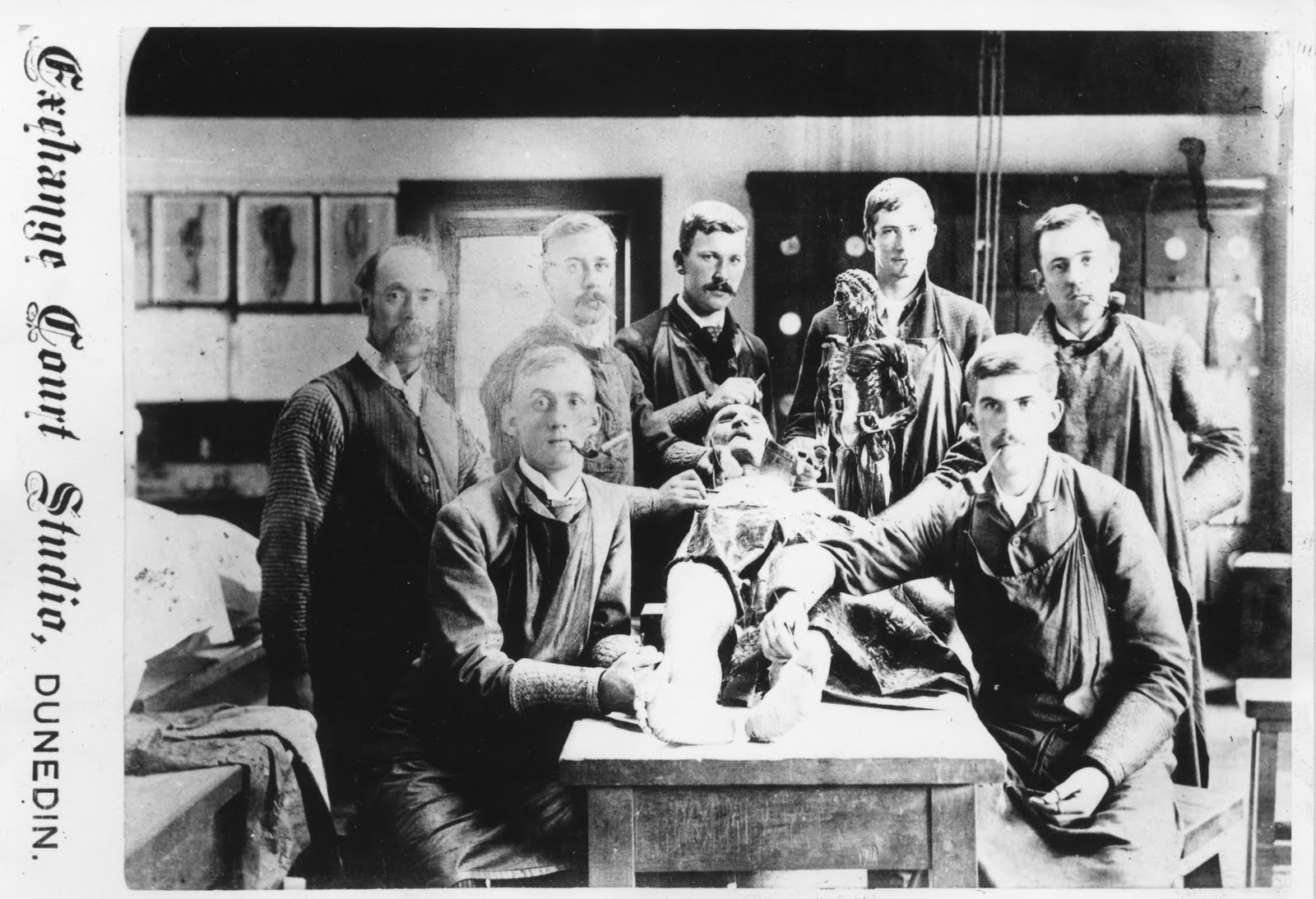
Tonight, Chris Smith, curator of the W.D. Trotter Anatomy Museum of the University of Otago in Dunedin, New Zealand, will give a brief history of the Museum, its collections and the role it plays today. As part of the southern-most Medical School in the world, this isolation can be both a hindrance as well as of benefit; but with its foundation built upon a strong Scottish heritage, the traditions of Anatomical Teaching have been sustained and continue to strengthen in this proud institution. From the early plaster, wax and papier-mâché through to todays technologies of 3D imaging and plastination, you will be given a whirlwind tour of this collection and some of the personalities responsible for its creation and development over the last 135 years.

Chris Smith is a trained Secondary School Teacher with 10 years experience in teaching and education and a passion for the collection, teaching and preservation of history. Chris changed gears in 2005 to take up the role as Anatomy Museum Curator and Anatomy Department Photographer at the University of Otago. In this role Chris has maintained and further developed the use of anatomical specimens, both historic and modern, for teaching and research, as well as increasing public awareness of the collection and the history of the museum and department. In 2007 and 2008 he traveled to Thailand as part of the Bio-archaeology team to excavate and photograph human remains at Ban Non Wat (Origins of Angkor Project), a prehistoric Neolithic to Iron Age site. He regularly attends conferences within New Zealand and neighboring Australia, visiting institutions and collections and in 2008 received a Queen Elizabeth the 2nd (QEII) Technicians’ Study Award, which enabled him to visit institutions and collections in United Kingdom and attend the European Association of Museums of the History of Medical Science Congress held that year in Edinburgh. It was at this event that he and Joanna crossed paths and as such with a visit to meet new family in the US in 2010 and making contact with Joanna, he has been put in this privileged position of being able to share a little about ‘his’ museum.

You can find out more about this presentation here. You can get directions to Observatory--which is next door to the Morbid Anatomy Library (more on that here)--by clicking here. You can find out more about Observatory here, join our mailing list by clicking here, and join us on Facebook by clicking here.
Tomorrow Night at Observatory : "Exquisite Bodies: or the Curious and Grotesque History of the Anatomical Model" with the Wellcome's Kate Forde


Tomorrow night at Observatory, join Kate Forde--curator at the amazing Wellcome Collection in London--to learn
about the rise and fall of the popular anatomical museum in 19th century Europe as detailed in The Wellcome’s recent ‘Exquisite Bodies’ exhibition. Long-time readers might recall this blog's extensive coverage of the exhibit, for which I served as curatorial adviser and designer. Images above all depict artifacts included in the exhibition.

You can find out more about the show here, here and here and see a preview of the lecture here.

Full details below; this is going to be a truly stellar event; hope to see you there!

Exquisite Bodies: or the Curious and Grotesque History of the Anatomical Model
An illustrated lecture by Wellcome Collection Curator Kate Forde
Date: Thursday, August 26
Time: 8:00 PM
Admission: $5
Presented by Morbid Anatomy

Tonight, Kate Forde of London’s Wellcome Collection will deliver an illustrated lecture detailing the rise and fall of the popular anatomical museum in 19th century Europe as detailed in The Wellcome’s recent ‘Exquisite Bodies’ exhibition.

The ‘Exquisite Bodies’ exhibition, which was curated with the assistance of Morbid Anatomy’s Joanna Ebenstein, was inspired by the craze for anatomy museums and their artifacts–particularly wax anatomical models–in 19th century Europe. In London, Paris, Brussels and Barcelona displays of wax models became popular with visitors seeking an unusual afternoon’s entertainment. The public were invited to learn about the body’s internal structure, its reproductive system and its vulnerability to disease–especially the sexually transmitted kind–through displays that combined serious science with more than a touch of prurience and horror.

At a time when scandal surrounded the practice of dissection, the medical establishment gave these collections of human surrogates a cautious welcome; yet only a few decades later they fell into disrepute, some even facing prosecution for obscenity. This talk will trace the trajectory of these museums in a highly illustrated lecture featuring many of the historical artifacts featured in the show.

To find out more about the exhibition ‘Exquisite Bodies,’ click here and here.

Kate Forde is Curator of Temporary Exhibitions at the Wellcome Collection, London. She is interested in the role of museums in the shaping of cultural memory and in the display of fine art within science-based institutions. Her current research is taking her from the great dust-heaps of Victorian London to Staten Island’s landfill Fresh Kills for an exhibition with the working title ‘Dirt’. You can see a preview of tonight's lecture by clicking here.

You can find out more about this presentation here; As mentioned above, you can find out more about the exhibition here, here and here and see a preview of the lecture here. You can get directions to Observatory--which is next door to the Morbid Anatomy Library (more on that here)--by clicking here. You can find out more about Obs
ervatory here, join our mailing list by clicking here, and join us on Facebook by clicking here.

New Exhibition at Observatory: Paradiso Contrapasso, Curated by GF Newland with Lord Whimsy and Susan Crawford, Opening Party this Thursday, Oct. 14!


Our newest Observatory exhibition "Paradiso Contrapasso"--curated by my boyfriend GF Newland along with our good friends Lord Whimsy and Susan Crawford of Plankton Art Co-- will be opening its doors this Thursday with a free reception running from 8 PM till the wine runs out.

Full details follow; very much hope to see you there!

Paradiso Contrapasso: An exhibition curated by Observatory’s G.F. Newland with Lord Whimsy and Susan Crawford of Plankton Art Co.
OPENING RECEPTION: October 14th, 8:00 PM
ON VIEW: October 14th - November 28th, 2010
HOURS: Thursdays & Fridays 3-6; Saturdays & Sundays 12-6

To compliment the recent opening of Paradise, a year long event at Proteus Gowanus, Observatory explores the theme: Paradiso Contrapasso. In Dante’s Inferno, Paradiso Contrapasso distinguishes each sinner by making his or her punishment uniquely appropriate to the committed sin, so that every soul inhabits a Hell all its own.

For example, consider the story of Paolo and Francesca:
An unlikely marriage is proposed between the beautiful Francesca and the rich, but ugly Gianciotto. Paolo, the handsome brother of Gianciotto seduces the young bride and they become lovers. When Gianciotto discovers their indiscretion, he murders them both. In Hell, Paolo and Francesca are fused together in an eternal embrace, wishing only to be separated.

As Dante journeys through Purgatorio and Paradisio, he does not revisit this technique of contrapasso. For our event, however, Observatory encourages artists to consider divine comedic retribution in all of its possible representations, and from sources such as the Bible and religious and esoteric cosmologies, the ethical philosophies of Aristotle and Thomas Aquinas, Symbolist poetry, the works of Roald Dahl, the Wizard of Oz, Cautionary Tales, Folklore and Fairy Stories, the Twilight Zone, Modern Dystopias, etc. The emphasis is on “Divine” and “Comedy”, and on our superstitious fear of getting what we wish for!

ARTISTS INCLUDE:
Martin Bland
Erich Carlle
Dennis Corrigan

Matthew Cox

Lord Whimsy / Allen Crawford
John Dilworth
Arlene Ducao
Joanna Ebenstein
Crista Grauer
Andrew Keating
Ilias Koen
Luis Locarno
Heather Masciandaro
Richard Meyer
GF Newland
Alison Overton
Herbert Pfostl
Rebecca Posner
James Prochnik
Rachel Rabhan
R. Sikoryak
Melissa Stern
Alison Termine
Friese Undine

To find out more, click here. You can get directions to Observatory--which is next door to the Morbid Anatomy Library (more on that here)--by clicking here. You can find out more about Observatory here, join our mailing list by clicking here, and join us on Facebook by clicking here.

Image: "Holiday in Hell," Denis Corrigan, Oil on Canvas

"Le Livre de Sante," Joseph Handler, 1967 (Volume 6)


All images from Joseph Handler's Le Livre de Sante (Monte Carlo: Andre Sauret, 1967)
volume 6: "La bouche et les dents. Le systeme digestif. Les reins" and found on the wonderful blog Journey Around my Skull. You can visit the full post--with additional images--by clicking here.

Images top to bottom:

  1. Dents temporaires et germes des dents permanentes, illus. Pasqualini
  2. Les levres, illus. Aslan
  3. Constitution du rein, illus. W. Hess

"Still Life: The Art of Anatomy," Dunedin Public Art Gallery, Dunedin, New Zealand, Through September 12


I just found out about an excellent looking exhibition now on in Dunedin, New Zealand; the exhibition is called "Still Life: The Art of Anatomy," and it frames a variety of historical and contemporary anatomical teaching tools held in public and private hands--including models and illustrations--as artworks in a fine art setting.

Images of the exhibition above and full details below; if you are based in New Zealand, be sure to check this out!

Still Life: The Art of Anatomy
Saturday, 10 July 2010 - 12 September 2010
Dunedin Public Art Gallery
Dunedin, New Zealand

Noted Dunedin based filmmaker and medical doctor Paul Trotman, has worked closely with the Dunedin Public Art Gallery in researching Dunedin's rich collections towards the realization of Still Life: The Art of Anatomy. This exhibition brings together an array of historical and contemporary items, such as Dr John Halliday Scott's elegant anatomical drawings and old master prints, through to porcelain and wax casts of aspects of the body and the latest interactive computer generated 3D anatomical models. Still Life provides a stunning insight into this complex subject and also reveals the important lineage that science and art shares through the analysis, distillation and depiction of the human form.

You can find out more by clicking here or here.

Evan Michelson of Obscura Antiques and Oddities, "The Culture of Curiosity," Lecture, Coney Island Museum, Sunday August 15, 4:30


Next Sunday at 4:30 PM as part of the Coney Island Museum's "Ask the Experts" Series, Evan Michelson--co-proprietor of Obscura Antiques and Oddities and Morbid Anatomy Library Scholar in Residence--will be giving a reprise of her popular "Culture of Curiosity" lecture, which some of you might have seen at Observatory last November.

If you missed it the first time, or were made curious enough [sic] about the topic to want to know more, do yourself the favor of heading down to Coney to hear Evan wax poetic [sic] in a new and expanded discussion of "the continuing appeal of curated chaos in the home."

Full details follow; very much hope to see you there!

"The Culture of Curiosity"
An illustrated lecture by Evan Michelson of Obscura Antiques and Oddities
Date: Sunday, August 15
Time: 4:30 PM
Admission: $5
Location: The Coney Island Museum

From humble parlor to Princely treasury, the Culture of Curiosity has endured for hundreds of years. In equal parts uncanny obsession, camp statement, melancholy musing, frivolous commentary and timeless metaphor, ultimately it's all about mystery.

Come and join Evan Michelson (Morbid Anatomy Scholar in Residence) in an exploration of the continuing appeal of curated chaos in the home.

Evan Michelson is an inveterate collector and museum aficionado. She has spent a lifetime obsessing over specimens, lurking in crypts, touring necropoli and gathering information on all things fading from the collective memory.

For about two decades Evan was in and out of various aggressively confrontational/decadent bands. She is currently co-owner of Obscura Antiques and Oddities, and Scholar-in-Residence at the Morbid Anatomy Library. She lives in Victorian excess with her husband, a few pets, and many esoteric and uncanny objects.

You can find out more about the event by clicking here. Hope to see you there!

The above photo is a Wax Department Store Mannequin from the Early 20th Century from Evan Michelson's incredible home collection, as seen in my recent exhibition The Secret Museum. You can find more images of her collection here.

A Strange and Macabre Collection, From Bram Stoker's "Lair of the White Worm," 1911

...He had, in Castra Regis, a large collection of curious and interesting things formed in the past by his forebears, of similar tastes to his own. There were all sorts of strange anthropological specimens, both old and new, which had been collected through various travels in strange places: ancient Egyptian relics from tombs and mummies; curios from Australia, New Zealand, and the South Seas; idols and images--from Tartar ikons to ancient Egyptian, Persian, and Indian objects of worship; objects of death and torture of American Indians; and, above all, a vast collection of lethal weapons of every kind and from every place--Chinese "high pinders," double knives, Afghan double-edged scimitars made to cut a body in two, heavy knives from all the Eastern countries, ghost daggers from Thibet, the terrible kukri of the Ghourka and other hill tribes of India, assassins' weapons from Italy and Spain, even the knife which was formerly carried by the slave-drivers of the Mississippi region. Death and pain of every kind were fully represented in that gruesome collection.

That it had a fascination for Oolanga goes without saying. He was never tired of visiting the museum in the tower, and spent endless hours in inspecting the exhibits, till he was thoroughly familiar with every detail of all of them. He asked permission to clean and polish and sharpen them--a favour which was readily granted. In addition to the above objects, there were many things of a kind to awaken human fear. Stuffed serpents of the most objectionable and horrid kind; giant insects from the tropics, fearsome in every detail; fishes and crustaceans covered with weird spikes; dried octopuses of great size. Other things, too, there were, not less deadly though seemingly innocuous--dried fungi, traps intended for birds, beasts, fishes, reptiles, and insects; machines which could produce pain of any kind and degree, and the only mercy of which was the power of producing speedy death....

This quotation is drawn from chapter 11--entitled "Mesmer's Chest"--of Bram Stoker's 1911 publication Lair of the White Worm which went on to inspire Ken Russell's suitably over-the-top film of the same name.

You can read this book in its entirety by clicking here. You can purchase a print copy by clicking here. You can find out more about the film by clicking here. You can also come visit my copy of Lair of the White Worm at the Morbid Anatomy Library, where it resides in the "gothic" section.

The image you see above is sourced from the exhibition catalog Darwin: Art and the Search for Origins which was published to accompany an exhibition held last year at the Frankfurt museum Schirn. The photo is captioned: "View into the Zoological and Anthropological section of Gabriel von Max's 'Scientific Collection,' circa 1892." To check out (and purchase) the catalog for the exhibition (highly HIGHLY recommended!) click here. To watch musician/performance artist Momus (!!!) giving a tour of the exhibition--including the installation of the von Max collection--click here. For a more traditional walk through the exhibition, click here.

Special thanks to Christine Edmonson of the Cleveland Museum of Art for turning me onto this wonderful book and exhibition.