"Hygiene, the Story of a Museum," Marres, Centre for Contemporary Culture, Maastricht, October 24-January 30


I have just been alerted by a number of friends and friends-of-the-blog about a really fascinating looking upcoming exhibition taking place later this year at an intriguing looking venue in Maastricht, The Netherlands.

The exhibition, entitled "Hygiene, the Story of a Museum,"explores, as the press release describes, "the both fascinating and dramatic background of the notion hygiene" via an investigation into the history of a particular storied institution, the Deutsche Hygiene-Museum of Dresden, founded in 1911 by a mouthwash magnate. The exhibition uses this particular and important history as a launching-off point to explore questions about how the notion of hygiene changed "from a scientific concept into a global movement" and how it was "subsequently used by the National Socialism in Nazi-Germany and the socialism of the former DDR as an essential part of both ideologies."

This exhibition will be on view from October 24th until January 30 at the Marres Centre for Contemporary Culture in Maastricht, The Netherlands, and was created in cooperation with the wonderful Dresden Hygiene Museum.

Following is the press release with the full details:

Hygiene, the story of a museum
24 October 2010 – 30 January 2011

Marres, Centre for Contemporary Culture
Capucijnenstraat 98
6211 RT Maastricht
The Netherlands
Open: Wednesday-Sunday 12-5 pm.

Marres, centre for contemporary culture presents its fifth exhibition in the context of the long-term program on the notion of the Avant-garde: Hygiene, the story of a museum.

The coming exhibition investigates the both fascinating and dramatic background of the notion hygiene. How did this word transform from a scientific concept into a global movement? How was it subsequently used by the National Socialism in Nazi-Germany and the socialism of the former DDR as an essential part of both ideologies?

Hygiene, the story of a museum approaches these questions through the history of the Hygiene Museum in Dresden. Founded in 1911 by the inventor of Odol mouthwash, this museum still represents a unique position. The museum does not necessarily collect art or design, but has actively contributed to the awareness of diseases such as TB and cancer. Primarily, this museum has a social function—from information to prevention and education—and it presents the physical results of that function in the form of casts of skin conditions, promotional films and educational material, which have been produced and presented by this museum until 'Die Wende'. The museum had the ambition to 'reveal that which had hitherto been invisible'. Developing new exhibition models to reach broader audiences has been a primary point of interest, and the use of new technologies such as film has been of big importance in that ambition.

The unique, social role of this a-historical museum and the specific attention for the exhibition as medium to make the invisible still visible makes the Hygiene Museum a fascinating subject. Especially for Marres, which has been investigating the role of the museum, the collection, the exhibition and the artist, and has attempted to address these questions through the development of new exhibition models for several years as well.

The project arose in cooperation with the Hygiene Museum, which made several unique loans available for the exhibition. An example is the so-called Glass Man (see above): admired as the symbol of the desire for a transparent body and reviled as the perverse outcome of rationalism gone too far. The exhibition consists of three so-called thoughtscapes, which through the use of several objects, films, printing material and texts approach the Hygiene Museum on three different levels:

Museum as Discourse focuses on 'making the invisible visible,' on striving towards transparency, which can be seen as a dominant ambition of the twentieth century. In Museum as Practice, the pedagogical strive for education on hygiene and the diffusion of scientific knowledge takes central place. Museum as Ideology offers insights into the meaning and the practical mission of hygiene in connection to the political and social-economical systems that characterize the Germany of the twentieth century.

Research and production: Claudia Banz, Guus Beumer, EventArchitectuur, Sandra Kassenaar and Maureen Mooren

For press information, please contact: Floor Krooi.

For more, visit the venue website by clicking here.

Image: "Glass Man in the Buffalo Museum of Science:" In 1935 the Buffalo Museum of Science purchased a “glass man” from the Deutsches Hygiene-Museum. In the late 1980s, officials at the Buffalo Museum returned it to Germany, regarding the object as tainted by its Nazi associations. German Historical Museum, Berlin; Via DMHD.

Julien Pacaud

Julien Pacaud Illustration for Best Life magazine #7, november 2007.

Julien Pacaud

Illustrations and collages by Julien Pacaud a “french illustrator, currently living in Le Mans, France. Before becoming an illustrator, I was, by turns: an astrophysician, an international snooker player, a hypnotist and an esperanto teacher. I hope i can someday have enough free time to devote myself to my real passion: time travel.”

[via Vectroave]

Let Go – The Japanese Popstars Feat. Green Velvet

The Japanese Popstars Feat. Green Velvet - Let Go music video

The Japanese Popstars Feat. Green Velvet - Let Go music video

Whoa, this video for The Japanese Popstars is fantastic. It totally blew my mind this morning, perfect to watch on this rainy day. Aside from the animation being all round totally rad and mildly creepy, the anatomy sections are particularly awesome and well done, I think. Be sure the check out the video below, you might even love the song (admittedly, pretty catchy)!

The Japanese Popstars Feat. Green Velvet – Let Go from David Wilson Creative on Vimeo.

[via designyoutrust]

"Of Dolls and Murder," A Documentary about the “Nutshell Studies” Dollhouse Crime-Scene Dioramas


"Convict the guilty, clear the innocent, and find the truth in a nutshell." --Police Mantra in Of Dolls and Murder

Wow. Looks like there is a documentary film currently in production--narrated by none other than John Waters and featuring a cameo by our good friend John Troyer--about the fantastic and exquisite “Nutshell Studies” Dollhouse crime-scene dioramas created by Frances Glessner Lee to serve as student aids in the 1930s and 40s.

Here is an excerpted description from the film's website:

The new documentary film, Of Dolls and Murder, explores our collective fascination with forensics while unearthing the criminal element that lurks in one particularly gruesome collection of dollhouses. Rather than reflecting an idealized version of reality, these surreal dollhouses reveal the darker, disturbing side of domestic life.

Created strictly for adults, these dollhouse dioramas are home to violent murder, prostitution, mental illness, adultery and alcohol abuse. Each dollhouse has tiny corpse dolls, representing an actual murder victim. In one bizarre case, a beautiful woman lays shot to death in her bed, her clean-cut, pajama-clad husband lies next to the bed, also fatally shot. Their sweet little baby was shot as she slept in her crib. Blood is spattered everywhere. And all the doors were locked from the inside, meaning the case is likely a double homicide/suicide. But something isn’t right. The murder weapon is nowhere near the doll corpses – instead the gun was found in another room.

Why would anyone create such macabre dollhouses? And why would anyone re-create crime scenes with such exquisite craftsmanship that artists and miniaturists from around the globe clamor (unsuccessfully) to experience this dollhouse collection in person?

Of Dolls and Murder investigates these haunting “Nutshell Studies” dollhouses and the unlikely grandmother who painstakingly created them – Frances Glessner Lee. Known as the Patron Saint of Forensics, Lee didn’t let gender biases and prescribed social behavior of a wealthy heiress keep her from pioneering the new arena of “legal medicine” in the late 1930s and 1940s.

To train investigators, Lee created 18 dioramas (20 actually, but two are missing) for detectives to study crime scenes from every angle, including the medical angle. She used only the most mysterious cases (cases that could have easily been misruled as accidents, murders, or suicides) to challenge students’ ability to interpret evidence. Almost 70 years later, Lee’s dollhouses are still relevant training tools because all the latest technological advances in forensics do not change the fact that crime scenes can be misread, and then someone will literally get away with murder. But the story does not end with Lee and her dollhouses of death.

The nation is obsessed with forensic justice television, and why? Why do we love to watch a skewed reality of crime-fighting forensics? The answer lies somewhere with the need we have to entertain ourselves with stories about our fear of untimely, brutal death. The societal truths about how loved ones often murder one another is far too wicked to face, let alone change. Instead, we prefer to escape into a safe haven where solving murders easily wraps up in under one hour.

For more about this production, visit the film's website by clicking here. For more on these amazing dioramas, check out Corinne May Botz's lush photo book The Nutshell Studies of Unexplained Death by clicking here.

Story via Laughing Squid.

Images from the NY Times slide show "Visible Proofs: Nutshell Studies of Unexplained Death;" you can see the full show by clicking here.

"Most Horrible & Shocking Murders: Murder Pamphlets in the Collection of the National Library of Medicine" Website Launch


Michael Sappol--friend of Morbid Anatomy and historian in the History of Medicine Division of the National Library of Medicine--has just alerted me to the launching of a new website based on his recent exhibition documenting the rich and quirky collection of murder pamphlets in the collection of the National Library of Medicine.

From the press release:

A new website, "Most Horrible & Shocking Murders: Murder pamphlets in the collection of the National Library of Medicine," has been launched by the National Library of Medicine (NLM), the world's largest medical library. The site features a selection of murder pamphlets from the late 1600s to the late 1800s-from a treasure trove of several hundred owned by the Library.

Ever since the invention of movable type in the mid-1400s, public appetite for tales of shocking murders-"true crime"-has been one of the most durable facts of the market for printed material. For more than five centuries, murder pamphlets have been hawked on street corners, town squares, taverns, coffeehouses, news stands, and bookshops.

These pamphlets have been a rich source for historians of medicine, crime novelists, and cultural historians, who mine them for evidence to illuminate the history of class, gender, race, the law, the city, crime, religion and other topics. The murder pamphlets in the NLM's collection address cases connected to forensic medicine, especially cases in which doctors were accused of committing-or were the victims of-murder.

You can visit the website--which I designed, in fact!--by clicking here. All of the above images are drawn from the "pamphlets" section of the website, which contains these images along with a wealth of others; click here to peruse that section. Mr. Sappol is also the author of perhaps my favorite book about anatomical illustration, the incomparable "Dream Anatomy," which you can find out more about--and order!--by clicking here.

Thanks, Mike, for doing such wonderful work, and for alerting me to its launch!

Morbid Anatomy Library on the Huffington Post’s "Ten ‘Cabinets of Curiosities’ and Unique Collections from around the World"

Before they made a TV show about Hoarders, steadfast collectors were once held in great esteem. During the Renaissance, the "cabinet of curiosities," or wunderkammer, was a style of curation in the spirit of the sublime junk drawer, a display of weird stuff that didn't go anywhere else. A few hundred years out of fashion, they're starting to pop up again, and we've put together ten examples of our favorites, both full-fledged cabinets of curiosities and the sorts of specialized collections they might draw from. --Travis Korte, "Ten 'Cabinets of Curiosities' and Unique Collections from around the World," The Huffington Post

You can view the full story--with slideshow and special mentions for the Morbid Anatomy Library and our sister spaces Observatory, the Reanimation Library and Proteus Gowanus (pictured above)--on The Huffington Post by clicking here.

Anatomimesis

Karolina

Karolina Klos

The above works are a collection from Karolina Klos master’s program in Anatomimesis, which is a variation of human anatomy. These were made with a lithography technique and in pen and ink. If you look at each one closely they have an interesting collage like feel with random anatomy throughout. Beautiful!

[via Behance]

Upcoming Observatory Event: "Swallowed and Saved: The Chevalier Jackson Foreign Body Collection and the Art it Has Inspired," Saturday, October 16


My friend Michelle Enemark is presenting the following event at Observatory this Saturday; looks like it will be a good one!

Swallowed and Saved: The Chevalier Jackson Foreign Body Collection and the Art it Has Inspired
An illustrated reading by artist Lisa Wood and author Mary Cappello
Date: Saturday, October 16th
Time: 7:00 PM
Admission: $5

An American half-dollar. An unspent matchstick. A beloved miniature swan stowed in a biscuit tin. A beaded crucifix. Tooth roots shaped like a tiny pair of pants. A padlock. Scads of peanut kernels and scores of safety pins. A porcelain doll prised from a throat. A metallic letter Z. A toy goat and tin steering wheel. Frozen twigs. Penny wafers. A Perfect Attendance Pin.

One of the most popular attractions in Philadelphia’s Mutter Museum is the Chevalier Jackson Foreign Body Collection: a beguiling set of drawers filled with thousands of items that had been swallowed or inhaled, then extracted nonsurgically by a pioneering laryngologist using rigid instruments of his own design. How do people’s mouths, lungs, and stomachs end up filled with inedible things, and what do they become once arranged in Dr. Chevalier Jackson’s aura-laden cabinet? Animating the space between interest and terror, curiosity and dread, author Mary Cappello and artist Lisa Wood will stage an illustrated reading based on two distinct but companionate projects to have emerged from Jackson’s foreign body display: Wood’s thirty-three original assemblages (The Swallowing Plates) and Cappello’s nonfiction book, Swallow: Foreign Bodies, Their Ingestion, Inspiration and the Curious Doctor Who Extracted Them (The New Press). Like Jackson’s design and deft manipulation of endoscopic instruments, like his endoscopic illustrations and his scrupulous attention to the nature of each foreign body caught, Cappello and Wood’s work excavates the relationship between corporeality, desire, and the object world. Their dossier of images and of incantatory texts promises to combine the uncanny, the beautiful, and the informative.

Note: Several of Lisa Wood’s plates will be on sale and on view, and attendees will be treated to a sneak preview of Cappello’s book which appears this January 2011, as well as details regarding the re-design and grand re-opening of the Chevalier Jackson Foreign Body Exhibit in the Mutter Museum of the College of Physicians of Philadelphia.

Does every human being have one of these Things to show for himself in his life’s hereafter?: as if to say, here is what is left of me: what’s left of me is that-which-was-once-within-me.

Mary Cappello’s books include Night Bloom; Awkward: A Detour (a booklength essay on awkwardness that was a Los Angeles Times bestseller), and Called Back (a critical cancer memoir that won a ForeWord Book of the Year Award and an Independent Publishers Prize). Some of Cappello’s recent essaying addresses Gunther von Hagens’ bodyworlds exhibits (in Salmagundi); sleep, sound and the silence of silent cinema (in Michigan Quarterly Review); the psychology of tears (in Water~stone Review); and the uncanny dimensions of parapraxis and metalepsis (in Interim). A recipient of the Dorothea Lange/Paul Taylor Prize from Duke University’s Center for Documentary Studies and the Bectel Prize for Educating the Imagination from Teachers and Writers Collaborative, Cappello is a former Fulbright lecturer at the Gorky Literary Institute (Moscow) and a professor of English and creative writing at the University of Rhode Island where she also teaches courses in Literature and Medicine. Swallow will appear in January from the New Press. Her latest book-length project on a single theme is a foray into sound and mood, tentatively titled In the Mood. For more information: http://www.awkwardness.org

Lisa Wood is a San Francisco based artist specializing in Victorian arts and crafts. Incorporating Victorian sensibilities into shadowboxes that memorialize the dead, dioramas that explore the hidden world of insects, mourning jewelry that captures the essence of the human spirit, and other curiosities that were inspired by what was collected, constructed and treasured at the time. This was an era when lingering disease and sudden death were inexplicable and everyday perils; an era when the very concepts of art and nature were challenged by technological innovations such as photography and medicine.

These fascinations join her work to the list of artists known as Victorian Revivalists.

Lisa sells her work to smaller boutiques and galleries as well as private collectors around the country. Her Swallowing Plate collection as well as her insect dioramas can be viewed at Gold Bug in Pasadena, the catalog is available at the Mutter Museum Store in Philadelphia.

For more information please visit: Lisa Wood Curiosities and Gold Bug.

To find out more, click here. You can get directions to Observatory--which is next door to the Morbid Anatomy Library (more on that here)--by clicking here. You can find out more about Observatory here, join our mailing list by clicking here, and join us on Facebook by clicking here.

"Genius or Grotesquery? The Arrestingly Strange World of Walter Potter," The Museum of Everything, Exhibition # 3


The wild and eerie Victorian world of Walter Potter, where baby rabbits go to school and weep over their blotted copybooks, and where Bullingdon Club-style squirrels puff on cigars as toads play leapfrog and rat police raid a drinking den, is being reassembled in London, seven years after his creatures were sold and scattered across the world.

The displays are being assembled at the reopened Museum of Everything, a pop-up museum in a former Victorian dairy, and later recording studio, in Primrose Hill, London...

Whilst in London last week, I had the very good fortune to attend a preview of The Museum of Everything's "Exhibition #3," a carnivalesque spree exploring all things collectory, side-show, circus, grotto, and taxidermological. One of the exhibitions more impressive achievements--and the reason I was there in the first place--was the attempt to re-stage Victorian anthropomorphic taxidermist Walter Potter's Victorian museum of curiosities, a noble feat achieved by borrowing an assortment of Potter's charming pieces from the assortment of lucky private collectors--including Damien Hirst, Sir Peter Blake, and Pat Morris--who acquired them after the museum was controversially divided at auction in 2003.

Today's Guardian has run what I hope will be only the first of many ecstatic pieces on this wonderful exhibition, and on the Potter portion in particular, entitled "Genius or grotesquery? The arrestingly strange world of Walter Potter."

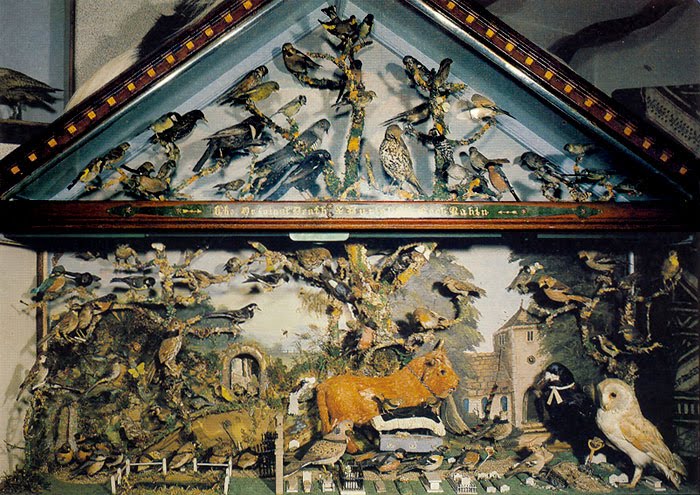
My friend Pat Morris--who spoke on Walter Potter at our recent Congress for Curious People-- loaned several of his own Potter pieces to the exhibition, most notably "The Death of Cock Robin, a truly epic tableaux depicting the funeral procession of the fabled Cock Robin as recounted in the well-known Englist nursery rhyme "Who Killed Cock Robin." This spectacular piece, as the Guardian describes, includes "more than 100 birds including a weeping robin widow and an owl gravedigger who has tumbled some tiny bones out of the soil while preparing space for the dead robin." For a visual (but please note: this image simply does not do the piece justice!), see third image down.

Besides being a collector of great proportion, Mr. Morris is also the author of the only extant book on Mr. Potter and his work, the lavishly illustrated and encyclopedic Walter Potter and His Museum of Curious Taxidermy, which you can buy in hardback or paperback by clicking here or here, respectively. You can also find out more about Potter, his work and his history by visiting the Ravishing Beast website by clicking here. You can read the full Genius or grotesquery?" article on the Guardian website by clicking here. To find out more about this exhibition--which will be on at least till Christmas--and the very curious Museum of Everything, click here.

Thanks to friend, friend-of-the-blog, and many time Observatory lecturer John Troyer for alerting me to this article!

"Portrait of the Professor of Medicine Jan Bleuland," Pieter Christoffel Wonder, 1808

The Romantic painters -- especially the Dutch Romantics -- were influenced by the landscapes, portraits and still-lifes of the Dutch 17th-century masters. Pieter Christoffel Wonder (1777-1852) painted a fascinating "Portrait of the Professor of Medicine Jan Bleuland" (1818), with the self-confident, bourgeois doctor standing in front of a skeleton draped with red arteries. It could have been part of Rembrandt's "Anatomy Lesson" of 1632 -- portraying the same fascination with the interior workings of the human body.

Found in a review of the exhibition "Masters of the Romantic Period -- Dutch Painting 1800-1850" at the Kunsthal on the Wall Street Journal; you can read the article by clicking here, and find out more about the exhibition by clicking here. Image found on the Collectie Utrecht website which can be seen by clicking here.

For another peek at Jan Bleuland at work, see this recent post.

Anatomical illustrations from Edo-period Japan, 1603-1868


All of the images you see above are drawn from a simply marvelous collection of anatomical illustrations tracing the evolution of medical knowledge in Japan during the Edo period (1603-1868) as found on the Pink Tentacle website.

To see the complete set of images (well worth it, I promise!) and read more about them, check out the original piece by clicking here.

Brief captions, top to bottom:

  1. Pregnancy illustrations, circa 1860
  2. Anatomical illustrations (artist/date unknown)
  3. Kaishihen (Dissection Notes), 1772
  4. Breast cancer treatment, 1809
  5. Zoku Y?ka Hiroku (Sequel to Confidential Notes on the Treatment of Skin Growths), 1859
  6. Zoku Y?ka Hiroku (Sequel to Confidential Notes on the Treatment of Skin Growths), 1859
  7. Zoku Y?ka Hiroku (Sequel to Confidential Notes on the Treatment of Skin Growths), 1859
  8. Female dissection, 1774
  9. Female dissection, 1774
  10. Illustration from 1759 edition of Z?zu
  11. Kaishihen (Dissection Notes), 1772
  12. Seyakuin Kainan Taiz?zu (circa 1798)

GNC Vitamin Store Commercial

GNC Vitamin Store commercial by menosunocerouno

GNC Vitamin Store commercial by menosunocerouno

GNC Vitamin Store commercial by menosunocerouno

GNC Vitamin Store commercial by menosunocerouno

Look at everything your heart does…

Give thanks to your heart.  Give thanks to your body.  Take care of it with GNC.

This wonderfully cute commercial was the creation of Mexico-based ad agency MENOSUNOCEROUNO for GNC’s Vitamin Store.  It’s amazing what our little hearts have to put up with!

Watch the full video here!

[spotted by Yany]

Alex CF

Alex CF

dragon Alex CF

Alex CF is a UK based artist and curator of the Merrylin Cryptid Collection whose specimens and illustrations take viewers to ancient and imaginative worlds.

He presents preserved bodies found in the basement of Professor Thomas Theodore Merrylin.

Dragons, fauns, werewolves, and other mythical creatures, each accompanied by a story detailing where and how they were found, are among the many specimens in Alex Cf’s collection.

You can see all of his work and purchases some on his site.

[via Super Punch]

Blood Slide Candy

Do you like Dexter? Do you like candy? If you answered yes to either, then you may love Andrea Newberry’s blood slide candy.

Newberry blood slide candy

Newberry blood slide candy

Newberry blood slide candy

Based on Dexter’s habit of keeping a drop of blood from each of his victims, Newberry came up with the idea for her treats. And hey, even if you don’t watch Dexter, it’s totally awesome.

The recipe calls for simple ingredients:

  • 1 cup sugar
  • 1/3 cup light corn syrup
  • 2 Tbs water
  • red food dye
  • bamboo skewer or tooth pic

For the full recipe you can go to Newberry’s site forkable. You can also check out her other Halloween recipes, including a brain cake.

[via Nerdist]