California Budget Slashing Misses Stem Cell Agency


The $3 billion California stem cell
agency dodged the governor's financial knife today.
This morning, Gov. Jerry Brown
announced sweeping cuts throughout California state government as he
attempted to close a new, $15.7 billion deficit. A report in the Los
Angeles Times
 said the governor was "grabbing any spare change available." But this afternoon, in response to a
query, Kevin McCormack, CIRM's spokesman, said,

"The answer is no, we won't be
affected."

The question arose because California's
financial picture is much bleaker than it was just four months ago.
And the stem cell agency's only real source of cash is money borrowed
by the state -- general obligation bonds.
Under Prop. 71, which created the
agency in 2004, the bond funds flow directly to the agency without
intervention by the legislature or the governor. However, Brown has
been chary of additional bond sales since they create an increasing
burden in the form of interest costs. Those costs must be financed
out of money that otherwise might go to the University of
California
, K-12 schools and medical help for the poor.
Under an agreement arrived at last year, CIRM has what amounts to a $225 million line of credit with the
state, which should take care of its needs until January. The cash is
coming from short-term borrowing by the state instead of bonds.

The Brown Administration has cut back
on bond borrowing and intends to cut more this fall. According to the state Department of Finance, the cost of borrowing
has declined $173 million this fiscal year, down to $5.2 billion.
CIRM's share of the debt service is more than $200,000 a day.  

Source:
http://californiastemcellreport.blogspot.com/feeds/posts/default?alt=rss

Healthcare social media #HCSM – top articles

Here are my suggestions for some of the top articles related to healthcare social media in the past 2 weeks:

Social media “likes” healthcare: From marketing to social business. Social media and health care: opportunities and obstacles - PWC 2012 report, free download http://goo.gl/GtSgE

8 Chrome Extensions that Make Blogging Easier http://goo.gl/fFKye

"News Squares" for Chrome is a new visual RSS reader http://goo.gl/ZgO7Z

CDC Social Media Guidelines and Best Practices http://goo.gl/Sw0n - Twitter guide updated in Feb 2012.

"20 Days to High-Quality, Engaged Twitter Following (in just 20 minutes a day)" http://goo.gl/8T0xL - Mixed bag of advice, some good tips

There is an allergy/immunology wiki: "AI notes" http://goo.gl/Qt1iE - Not sure who's behind it, looks useful.

Medicine, Social Media and Clinical Excellence. Let’s do it. http://goo.gl/WgRDw -- Here is one of my related blog posts: Doctors are natural communicators - social media is extension of what they do every day http://goo.gl/2FzQb

Study: There is a kernel of truth to the popular term "Facebook stalking". Introducing new terms (to me) such as: cyber obsessional pursuit (COP) and obsessive relational pursuit (ORI), which are categories of cyberstalking and stalking, resulting in three factors: Covert Provocation, Public Harassment, and Venting. http://goo.gl/sgVys

How to find RSS feeds for Twitter accounts, Facebook pages, YouTube, other SoMe sites http://goo.gl/Q6tNg

Fake tweet stops Nashville doctor's lecture, plans for cruise http://goo.gl/Lj0mO

How to Create Your Own Website using Blogger - Step-by-Step Guide for Physicians http://goo.gl/tCd37

Science blogging and self-promotion? http://goo.gl/yGUqS

How To Deal With Information Overload http://goo.gl/h4CmL and http://goo.gl/wDv5

The articles were selected from my Twitter and Google Reader streams. Please feel free to send suggestions for articles to allergycases@gmail.com and you will receive acknowledgement in the next edition of this publication.

Posted at Clinical Cases and Images. Stay updated and subscribe, follow us on Twitter and connect on Facebook.


Source:
http://feeds.feedburner.com/CasesBlog

Social media and medicine – Stanford University Grand Rounds

Graham Walker is one of the first medical bloggers. He went on a hiatus during his emergency medicine (EM) residency, and has now found new inspiration to blog as an EM attending at Stanford University medical center. This is his talk on social media and medicine at Stanford University Grand Rounds: http://youtu.be/qtkggenLmlE

Dr. Walker: This is my talk on the dissemination of medical information over time, how the internet and social networking are changing medicine, and how to use digital tools to be a better clinician at the bedside.

Here is Graham's list of Digital Tools to Improve the Specialty:
http://gmergency.tumblr.com/post/22727728700/stanford-grand-rounds-may-9-2012

Comments from Twitter:

Alice Ackerman, MD, @CloseToHomeMD: [You need to watch the video-Gr8 talk]

Posted at Clinical Cases and Images. Stay updated and subscribe, follow us on Twitter and connect on Facebook.


Source:
http://feeds.feedburner.com/CasesBlog

What it’s like to study medicine at Cambridge (video)

What is "the favorite" for medical students in the UK at the moment? Going into General Practice (at minute 2:45 of the video). They are also "very keen into going into a specialty such as pediatrics". This is a night and day difference compared to their counterparts in the U.S.

From Cambridge University YouTube channel: "At Cambridge, we offer two medicine courses - the Standard Course and the Graduate Course. With both, our aim is to educate students to become compassionate, thoughtful, skilled members - and leaders - of the medical profession.

Success in medicine requires application and hard work, both while studying and when in practice. However, it brings great rewards in terms of job satisfaction, involving as it does a combination of science and human interactions, and numerous career opportunities."

To find out more about Medicine at Cambridge, see http://study.cam.ac.uk/undergraduate/courses/medicine

Comments from Twitter:

Nick Bennett @peds_id_doc: Best medical school in the world. Seriously.

Medical School Life in Cambridge and Debrecen - @Berci compares the promotional videos http://goo.gl/BZm2w

Posted at Clinical Cases and Images. Stay updated and subscribe, follow us on Twitter and connect on Facebook.


Source:
http://feeds.feedburner.com/CasesBlog

Best of Medical Blogs – weekly review and blog carnival

The “Best of Medical Blogs - BMB weekly review and blog carnival” is a weekly summary of the best posts from medical blogs. Feel free to send your suggestions to my email at clinicalcases@gmail.com. Best of Medical Blogs (BMB) is published every Tuesday, just like the old Grand Rounds.

A Medical Educator Joins Social Media: One Year Later

Dr. Djuricich, Program Director in Medicine-Pediatrics at the Indiana University, shares what he has learned in one short year: If physicians and other health care professionals are not becoming involved in social media, they are missing out on a “place” where many of the patients already are. There is a lot of misinformation floating around on the internet. It is a duty of physicians to combat this and provide correct information. Do not let social media take over your life. The important things (family, friends, etc.) are still the important things, so don’t lose the priorities. http://goo.gl/zNfpe

What explains blogging longevity? It's easy: blog for yourself, and share with others

Dr. Centor explains his blogging longevity after 10-years of blogging. I've been blogging for 8 years, and I agreee with him: Why you should write a blog for yourself rather than for a shifting audience http://goo.gl/P8xtz

Here's Dr. Centor again: Explaining longevity is subjective. Mostly, I like blogging. Basically I blog with myself in mind, and am gratified that others find my comments interesting. Blogging is never a chore. One cannot last 10 years doing a chore. http://goo.gl/Jyl2o

Cardiologist Dr. Wes nominates the hardest to read Abstract of the Year at 2012 Heart Rhythm Society

What is the abstract that contributes the smallest amount to our field while demonstrating the worst grammar, the most bureaucratic lingo and, of course, verbosity. The sentence that clinched it? "Conclusions: The harmonization of endpoint definitions, terminology, and clinical trial design paradigms provides consistency across clinical trial studies that can facility (sic) clinician acceptance of results and the evaluation of safety and effectiveness of devices and medicines for atrial fibrillation." http://goo.gl/ZstA0

Harvard Medical School Q&A blog doctor reflects on his readers’ feedback

Dr. Komaroff from the blog Ask Doctor K.: “Since I began this column last September, I’ve received a lot of mail — both emails and “snail mail.” Mostly it’s been health questions. I can’t answer them all, but I try to answer as many as I can. However, I’ve also received complaints. Sometimes they represent an honest difference of perspective. On occasion, they reflect the fact that I’m a man.” http://goo.gl/XK3O1

A complete list of all academic medical journals available for the iPad

The omnipresent blog iMedicalApps makes a good use of Google Docs spreadsheet to list the apps of many academic medical journals available for the iPad. I still have personal preference for the open web rather than apps but that’s just me. http://goo.gl/13Gjz

What is postinfectious cough and how to treat it?

From Dr. Matthew Mintz' blog: While the cause of the postinfectious cough is not known, it has been thought to be due to the extensive damage of cells lining the lung and widespread airway inflammation of the upper and/or lower airways. The good news is that this usually goes away by itself, the bad news is that it can take weeks or even months, and can be quite disruptive to patients lives. Since symptoms are caused primarily by inflammation and hyperresponsiveness/bronchoconstriction in the lungs (which is what we see in asthma), then treatment is likely best with something that treats both inflammation and bronchoconstriction in the lungs, such as an inhaled corticosteroid/long-acting beta agonist like Advair (which is commonly used in asthma). Use of Advair for postinfectious cough may be the single most common off-label use of any prescription product. Since inflammation can persist for weeks, it is important that Advair be used for at least 4 weeks. If symptoms return, the patient should be brought back for pulmonary function testing as this may be a new presentation of asthma. http://goo.gl/RgxLb

Reality Social Media: Live Tweeting Brain Surgery. What is the downside of this marketing push? Dr. Wes explains: http://goo.gl/XbKwv

"Healthcare Going To The Dogs" - a video for training hospital administrators http://goo.gl/hv40a and http://goo.gl/xsW4J

Science blogging and self-promotion? http://goo.gl/yGUqS

Posted at Clinical Cases and Images. Stay updated and subscribe, follow us on Twitter and connect on Facebook.


Source:
http://feeds.feedburner.com/CasesBlog

Depression affects up to 9% of U.S. population – how to do effective screening?

From American Family Physician:

Depression affects up to 9% of U.S. population.

The U.S. Preventive Services Task Force recommends screening in adolescents and adults but it does not recommend screening for depression in children 7-11 years of age, or screening for suicide risk in the general population.

The Patient Health Questionnaire (PHQ)-2 and PHQ-9 are commonly used and validated screening tools.

The PHQ-2 has a 97% sensitivity and 67% specificity in adults. The PHQ-2 inquires about the frequency of depressed mood and anhedonia over the past 2 weeks, scoring each as 0 ("not at all") to 3 ("nearly every day").

PHQ-9 has a 61% sensitivity and 94% specificity in adults. The PHQ-9 depression module scores each of the 9 DSM-IV criteria as “0” (not at all) to “3” (nearly every day).

If the PHQ-2 is positive for depression, the PHQ-9 should be administered.

In older adults, the 15-item Geriatric Depression Scale is an appropriate follow-up test.

If these screening tests are positive for depression, further evaluation is needed to confirm that the patient's symptoms meet the Diagnostic and Statistical Manual of Mental Disorders' (DSM) criteria for diagnosis.

References:

Screening for depression. Maurer DM. Am Fam Physician. 2012 Jan 15;85(2):139-44.

Image source: Vincent van Gogh's 1890 painting At Eternity's Gate. Wikipedia, public domain.

Posted at Clinical Cases and Images. Stay updated and subscribe, follow us on Twitter and connect on Facebook.


Source:
http://feeds.feedburner.com/CasesBlog

Pants on fire

The LA Times features a rather interesting chemical mystery today. Rocks being collected by a woman on a beach in San Diego County reportedly caught fire in her pocket, giving her some rather nasty burns. But what on Earth were these rocks and how can anything that can spontaneously ignite have survived so long out on a beach?

Spontaneous combustion can occur naturally, but is pretty rare. A few instances are listed, such as coal seams or even large compost heaps or shipments of pistachio nuts. But these examples only tend to catch fire when they’re present in large quantities. There are plenty of pyrophoric materials out there, such as white phosphorus (one of several allotropes of the element) that gained notoriety during its use by US forces in Fallujah and tert-butyllithium, responsible for the death of Sheri Sangji. But by their very nature they don’t hang around long because they’re so unstable and combust in air. So what was it?

The Times gives some details about the rocks – one grey and marbled the other green (‘Teenage Mutant Ninja Turtle green’, apparently). Both stones were ‘streaked and flecked’ with bright orange deposits too. Tests by labs suggest that there were indeed phosphorus compounds on the rocks. The Times approached some chemists but they were stumped and couldn’t come up with an answer as to what could have caused the fire. White phosphorus can appear tinged yellow, thanks to the presence of red phosphorus but would surely burn up unless it was somehow protected – could the stones have been picked up out of a rock pool? But that wouldn’t explain how the chemical got there in the first place. Has anyone out there got any suggestions?

Patrick Walter


Digg This  Reddit This  Stumble Now!  Share on Facebook  Bookmark this on Delicious  Share on LinkedIn  Bookmark this on Technorati  Post on Twitter  Google Buzz (aka. Google Reader)  

Source:
http://prospect.rsc.org/blogs/cw/?feed=rss2

Chemistry in theatre

Chemistry in theatre – Insufficiency, phallacy or both is the title of Carl Djerassi’s latest book. 

Carl Djerassi

He is someone we’ve mentioned before in this blog as I selected him for the My Hero series but of course he is best  known as the father of the contraceptive pill. He is also an accomplished and prolific writer, who’s published, among other works, nine plays, five novels and an autobiography.

I was lucky enough to be invited to a dramatic reading of Insufficiency last night at the chemistry department, University of Cambridge, UK. It is a play that deals with actual (rather than invented) chemistry – the science of ‘bubbleology’ as applied to champagne and beer bubbles – and where, rather refreshingly,  ’chemists play key roles as chemists rather than as the proverbial nerds or Frankensteins’. According to the author, ‘even the terrain itself, locationally as well as thematically, is chemical’.

Chemists everywhere will very much enjoy the book as it dramatises issues from the world of academia that many of us will recognise and identify with. Djerassi addressed the audience ahead of the reading to encourage reflection around the tribal nature of a scientist’s behaviour and also to advise that the book has been conceived to be used primarily as reading material — as texts to be read alone or in dramatic readings — rather than emphasising performances on the stage.

The play will be premiered in September in London and those attending Euchems in Prague at the end of August will be glad to know that the play will be part of the cultural programme.

We’ve already sent the book to be reviewed for our Reviews section so keep an eye on the website. If you are interested in what our reviewers have said about some of his earlier work you can read it here and here.

Bibiana Campos-Seijo

Digg This  Reddit This  Stumble Now!  Share on Facebook  Bookmark this on Delicious  Share on LinkedIn  Bookmark this on Technorati  Post on Twitter  Google Buzz (aka. Google Reader)  

Source:
http://prospect.rsc.org/blogs/cw/?feed=rss2

Howard Carter and the case of the Google Doodle

Heading over to Google today (other search engines are available) I noticed the rather intriguing Google Doodle shown above. Now I love the way Google updates it’s logo on specific days, but I have to admit that it seems a bit odd to celebrate the 138th birthday of anyone, after all it’s not much of a round number.

Nevertheless, Carter is someone pretty special and is most well known for his discovery of Tutankhamun’s tomb in November 1922. However, Carter had actually started excavating Egyptian tombs when he was just 17, and also brought back many other finds, including goods from Pharaoh Hatshepsut’s tomb. In 2009, Anna told you about how they were going to resurrect some perfume found in that tomb, but I haven’t heard anything since and I certainly haven’t seen Eau de Hatshepsut on the high street.

Pharaoh Tutankhamun was one of the last of the 18th Dynasty and the discovery of his tomb was so significant because it was found so completely intact. What is also relevant is how well preserved the mummy of Tutankhamun was and is, and I blogged about the techniques used in mummification of the 18th Dynasty pharaohs last year.

It turns out that DNA can be extracted from these ancient and chemically altered mummies and, with careful purification, the DNA can be amplified and studied. Recent DNA analysis of Tutankhamun’s mummy has shown that he was the son of Akhenaten and one of Akhenaten’s sisters, and various investigations are still trying to conclusively prove whether the young pharaoh died from illness or from congenital problems related to being the product of a long line of incestuous breeding. Science, both ancient and modern, can be pretty cool.

Laura Howes

Digg This  Reddit This  Stumble Now!  Share on Facebook  Bookmark this on Delicious  Share on LinkedIn  Bookmark this on Technorati  Post on Twitter  Google Buzz (aka. Google Reader)  

Source:
http://prospect.rsc.org/blogs/cw/?feed=rss2

The Visible Human Project Light Paintings

Croix Gagnon Frank Schott 1231 visible human project (4)
Click to enlarge

Croix Gagnon Frank Schott 1231 visible human project (1)
Click to enlarge

Croix Gagnon Frank Schott 1231 visible human project (3)
Click to enlarge

Croix Gagnon Frank Schott 1231 visible human project (2)
Click to enlarge

In 1993, a convicted murderer was executed.  His body was given to science, segmented, and photographed for medical research.  In 2011, we used photographer to put it back together.

12:31 is a series of photographs concepted by Croix Gagnon and photographed by Frank Schott.  The process of making these haunting images is similar to creating the long-exposure light paintings we’ve all seen become popular over the past few years. The images Croix and Frank managed to capture through this process are other worldly!

The Process:
An animation of the sequence of 1,871 male cadaver slices from the Visible Human Project was created.  This animation was then played full screen on a laptop and moved through a dark environment while being photographed. The result is a series of ghostly misshapen images of the Visible Human cadaver in space.

Croix Gagnon Frank Schott 1231 visible human project (1)


View the entire 12:31 series here!


Source:
http://feeds.feedburner.com/streetanatomy/OQuC

Anatomical Illustrations by Sarah Goodreau

Sarah Goodreau anatomy illustrations kidney intestines lungs heart

Prolific and extremely talented illustrator Sarah Goodreau created this little set of organs and anatomical illustrations. Having gone to undergrad with Sarah, I always admired her use of color and texture, the above being a great example. So I’m pleased as punch to see her doing some anatomical art! She is definitely an artist to keep your eye on, head on over to her site and see what other illustrations she has cooking.


Source:
http://feeds.feedburner.com/streetanatomy/OQuC

Kyle Bean’s Anatomical Paper Heart

Kyle Bean Heart for Men's Health magazine

Kyle Bean Heart for Men's Health magazine
Photography by Owen Silverwood

There’s something fascinating to me about paper sculptures and the people who create them.  The spatial thinking, dexterity, patience, craftsmanship, etc., is what I truly admire.  England-based Kyle Bean, is a designer who specializes in creating these wonderful paper sculptures.  His work has been featured in numbers international publications, including the heart above for a Men’s Health heart disease article.  He’s also been recognized in publications for his incredible concepts and craftsmanship.

View more of Kyle’s work at kylebean.co.uk


[via NOTCOT]


Source:
http://feeds.feedburner.com/streetanatomy/OQuC

You Are Here Prints Back in Stock

Our favorite “You Are Here” letter press prints are back in stock at the Street Anatomy store for those that missed out the last time around!

You Are Here poster by Roll&Tumble press available at the Street Anatomy store


Source:
http://feeds.feedburner.com/streetanatomy/OQuC

"Drawing from the Bestiary: Animal Anatomy of Real and Imagined Creatures," Class with Artist Saul Chernick, Observatory, June 25-July 16

I am very excited to announce "Drawing from the Bestiary: Animal Anatomy of Real and Imagined Creatures, a new class developed specially for The Morbid Anatomy Art Academy by one of our favorite artists, Saul Chernick. This class will teach students--via illustrated lectures and in-class projects including paper puppets and the creation of bestiary pages--"to use observational and imaginative drawing skills in tandem to capture the essential qualities of their subject" and "learn to draw animals (real, mythic, and otherwise) with greater skill and sensitivity."

You can see some of Chernick's wonderful artworks above; you can see more of them by clicking here. The class will take place on 4 consectutive Mondays, from June 25 to July 16th. The full class description follows. Also, please note that the class size is limited to 15, so if you are interested, please RSVP as soon as possible to morbidanatomy [at] gmail.com.

Drawing from the Bestiary: Animal Anatomy of Real and Imagined Creatures with Saul Chernick
A 4-part class with Artist Saul Chernick, M.F.A., Rutgers University
Dates: Mondays June 25, July 2, July 9 and July 16th (4 consecutive Mondays)
Time: 6:30-9:00 PM
Class Fee: $120
***Class size limited to 15; Must RSVP to morbidanatomy [at] gmail.com
This class is part of The Morbid Anatomy Art Academy

Contemporary artist and arts educator Saul Chernickis renowned for gorgeous artworks featuring convincingly corporeal depictions of imaginary or mythical creatures rendered in the style of Medieval and early Renaissance woodcuts from Northern Europe. Observatory is very pleased to announce a new workshop developed by Saul Chernick specially for the Morbid Anatomy Art Academy. In this class, Chernick will teach students--via illustrated lectures and in-class projects including paper puppets and bestiary pages--"to use observational and imaginative drawing skills in tandem to capture the essential qualities of their subject" and "learn to draw animals (real, mythic, and otherwise) with greater skill and sensitivity."

Full class description follows; you can see more of Chernick's fantastic work by clicking here. Class size limited to 15; Please RSVP to morbidanatomy [at] gmail.com.

Course Description
Open to artists of all levels, the goal of this workshop is help participants learn to draw animals (real, mythic, and otherwise) with greater skill and sensitivity. Through exercises in drawing and paper puppetry, participants will gain a deeper understanding of the skeletal/muscular structures of most mammals, reptiles, and birds. Participants will also learn to use observational and imaginative drawing skills in tandem to capture the essential qualities of their subject and create works of convincing visual fiction!
What to expect

  • Participants will cull images from the web to create a dossier on the animal(s) that interest them
  • Participants will fashion movable paper puppets to understand how their chosen animal moves
  • Participants will draw studies of the skeletal and muscular structures of animals
  • Participants will use the medium of their choice to create a Bestiary page entry that depicts an animal situated in an environment

Materials
What to bring to the first class:

  • Choose 1-3 animals and gather pictures on the web. Be sure to get images of their skeletons in profile. Please print these as they may be hard to use on a phone screen.
  • 3-5 sheets of Bristol Board Paper 9" x 12" or larger
  • Pencils & erasers
  • Scissors
  • Xacto or utility knife
  • Glue

What to bring for subsequent classes:

  • White or tinted drawing paper 16" x 20" or 18" x 24"
  • Tracing paper (same size as drawing paper)
  • Mechanical and/or regular pencils (2h, hb, 2b, 4b)

Optional:

  • Markers, watercolors, gouache, ink, brushes, chalk/oil pastels, colored pencils, Caran D’Ache, collage papers, etc (we’ll discuss further in detail!)

Saul Chernick, M.F.A., Rutgers University, is a visual artist and educator. Chernick has exhibited internationally in galleries and museums including the Aldrich Museum of Contemporary Art, the Bronx Museum of Art, the Jewish Museum of Art, as well as Max Protetch and Meulensteen Galleries in New York City. He has taught art for the public school system, the 92nd Street Y, Cooper Union, Parson's School of Design, and the Museum of Modern Art. He is currently the Professional Development Coordinator for the Joan Mitchell Foundation where he coaches New York artists in teaching art to young people throughout city. His work can be seen at http://www.saulchernick.com.

All images are by Saul Chernick and include, top to bottom:

  1. Field Urchin, 2011, from a series of studies in which he attempted to impose the proportions of cherubs onto horses.
  2. Desktop 2013, 2010, Ink, Watercolor, & Opaque White on Paper
  3. Heavenly Touch , 2009, Ink, Watercolor, & Opaque White on Paper
  4. Guilty Pleasures, 2010, Ink, Watercolor, & Opaque White on Paper
  5. Ars Gratia Artis, 2010, Ink on Paper

You can found out more here. As mentioned above, class size is limited to 15, so if you are interested, please RSVP as soon as you are able to morbidanatomy [at] gmail.com.

Source:
http://morbidanatomy.blogspot.com/feeds/posts/default?alt=rss

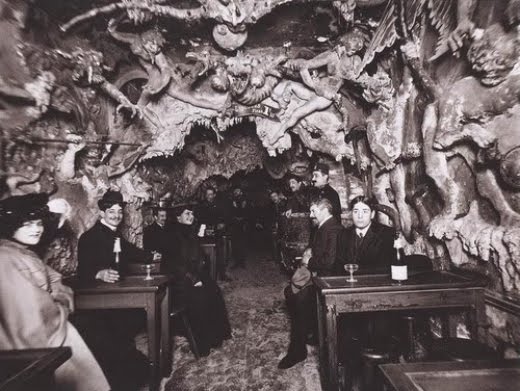
Café or Cabaret de L’Enfer (Hell’s Café), Paris, France, Late 19th Century

Good friend and Midnight Archive auteur Ronni Thomas just brought Paris's Café de L’Enfer to my attention. Between this and the equally delightful (and previously discussed) Cabaret du Néant (or Tavern of the Dead), I am becoming stronger in my conviction that fin de siècle Paris was probably the most perfect place ever.
As described on the National Geographic Website:

MARAIS
Hell's Swells

A hot spot called Hell's Café lured 19th-century Parisians to the city's Montmartre neighborhood—like the Marais—on the Right Bank of the Seine. With plaster lost souls writhing on its walls and a bug-eyed devil's head for a front door, le Café de l'Enfer may have been one of the world's first theme restaurants. According to one 1899 visitor, the café's doorman—in a Satan suit—welcomed diners with the greeting, "Enter and be damned!" Hell's waiters also dressed as devils. An order for three black coffees spiked with cognac was shrieked back to the kitchen as: "Three seething bumpers of molten sins, with a dash of brimstone intensifier!"

Found via Retronaut who sourced it from Cool Stuff in Paris; all images via Retronaut; more to be found at the original link.

Source:
http://morbidanatomy.blogspot.com/feeds/posts/default?alt=rss

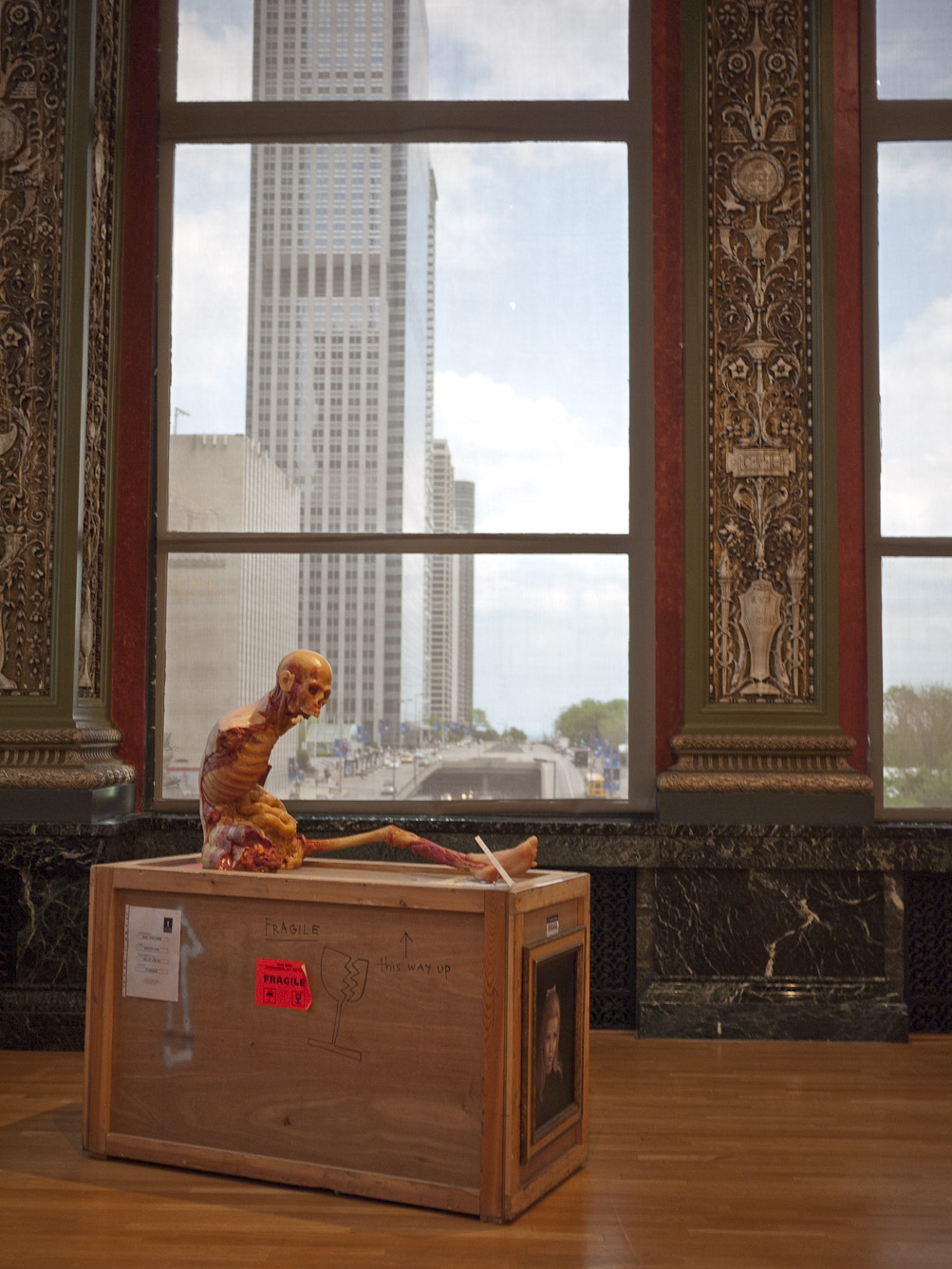
"Morbid Curiosity: The Richard Harris Collection," Through July 8, Chicago Cultural Center: Exhibition Report


I collect images of  "Death" because I am a visual person who takes in information best visually. As I have gotten older the thought of my own demise has begun to enter my conscious thoughts. The universality of "Death," with the realization that we will all die, encouraged me to begin the conversation of my mortality visually rather than talking or reading about it. I believe that there is a larger audience who might also be more comfortable beginning that discussion in a visual way, which is why I always thought of my collection in terms of a public exhibition.

--Richard Harris, the collector whose works are featured in "Morbid Curiosity: The Richard Harris Collection,"in an interview with Morbid Anatomy

Whilst in Chicago a few weeks ago, I had the good fortune to be able to spend a good two hours or so with the works in the profoundly wonderful new exhibition "Morbid Curiosity: The Richard Harris Collection," on view through July 8 at the Chicago Cultural Center. This seriously (!!!) not-to-be-missed exhibition showcases nearly 1,000 works which range from 2000 B.C.E. to the present, from fine art to ephemera, and from Mexican to Japanese to Tibetan to European artist traditions, all drawn from the astounding death-related collection of Richard Harris.

Some of my favorite pieces--featured in the photos above--included Rudolfo Villena Hernandez "A Commemoration of the Bicentennial Proclamation of the Independence of Mexico" (third from bottom); Michel de Spiegelaere's "Macabre Scene," one of the better Frederik Ruysch tableaux recreations I have had the pleasure to see (8-10 from top); a collection of macabre book plates and postcards (4th and 5th from bottom); Roger Reutimann's "Death of Venus" (seventh down), a wonderful collection of 19th Century ceramic German Dance of Death Figures (second from bottom), a carved wooden memento mori figurine from the early 17th century (third from bottom), and Jodie Carie's "In the eyes of Others plaster-cast bone chandelier bringing to mind the wonders of the  Kutná Hora ossuary (fourth down). The installation itself--expertly staged by curator Lucas Cowan--is wonderful as well, evoking the beautiful clutter of the wunderkammer but utilizing clever groupings which draw the eye and invite close investigation rather than overwhelm.

You can see more photos from the exhibition--and find out more about the works seen above--by clicking here. You can find out more on this exhibition on this recent post, on the Chicago Cultural Center website, and on Richard Harris' website. You can watch a gallery walk through and interview with Richard Harris by clicking here.

Source:
http://morbidanatomy.blogspot.com/feeds/posts/default?alt=rss

JOB OPENING: Information Services Librarian, New York Academy of Medicine, New York City

The Malloch Rare Book Room at the New York Academy of Medicine.

For all you wonderful librarians out there who also happen to be interested in the history of medicine, I have an exciting announcement to make: The New York Academy of Medicine is advertising for a new opening for Information Services Librarian!

Full details follow; Hope one of you ends up in this role!

Information Services Librarian
Center for the History of Medicine and Public Health
The New York Academy of Medicine

Mission
The New York Academy of Medicine advances the health of people in cities. An independent organization since 1847, NYAM addresses the health challenges facing the world's urban populations through interdisciplinary approaches to policy leadership, education, community engagement and innovative research.

Drawing on the expertise of diverse partners worldwide and more than 2,000 elected Fellows from across the professions, our current priorities are

  • To create environments in cities that support healthy aging
  • To strengthen systems that prevent disease and promote the public's health
  • To implement interventions that eliminate health disparities
  • Summary and Description

Summary and Description
The Center for the History of Medicine and Public Health is NYAM’s newest center and provides access to and enhances awareness of NYAM important research collections in medicine, public health and their history. The aim of the new Center is to build bridges among an interdisciplinary community of scholars, educators, clinicians, curatorial and conservation professionals and the general public.

The NYAM Research Library
The NYAM collections, which opened its to the general public in 1878, include over 500,000 volumes, 275,000 portraits and illustrations and around 400,000 pamphlets in its Research and Rare Books and Historical sections. NYAM is the only specialized research library in NYC offering access to medical and health information for members of the general public, a mission the Information Services Librarian will be critical in fulfilling.

The Research Library collection comprises monographs in medicine, public health and health policy, an extensive journal collection, grey literature, the various databases, and primary and secondary materials in the history of medicine, public health, science and other health-related disciplines. The Research Library collection is supported by an extensive reference collection of medical bibliography, biography, biographical dictionaries, dictionaries and library catalogues, as well as books on the history of books and printing.

The Research Library forms part of NYAM’s Center for the History of Medicine and Public Health. The Center is made up of the Research Library, Rare Book and Historical Collections and Conservation Laboratory. The Information Services librarian will function as the main contact person for users of the Research Library.
The Center for the History of Medicine and Public Health

In addition to the Research Library, the Center for the History of Medicine and Public Health’s  Rare Book and Historical Collections include a rare book collection of approximately 35,000 volumes, with manuscripts and archives dating from the 17th century B.C.E. to the present.  Books from the 17th and 18th centuries are another particular area of strength, as are materials related to the history of medicine in the City of New York.  Currently, the Rare Book and Historical Collections support a variety of programs, including two residential fellowships and an annual lecture series.

The Gladys Brooks Book and Paper Conservation Laboratory was established in 1982 for the express purpose of caring for the NYAM collections.  In addition to its preservation mandate, the Lab plays an important role in the training of future generations of conservators through its internship and volunteer programs and offers professional educational opportunities through a robust calendar of workshops and lectures.

Summary and Description
The NYAM Research Library is looking for a dedicated and enthusiastic librarian to provide information and reference services to NYAM Fellows and staff, members of the general public, and middle and high school students. The Information Services Librarian will be responsible for reference hours in the main reading room of the Research Library and play a central role providing users with research support. We are looking for an individual with a high level of communication and research skills, who will be proactive in helping to build the profile and activities of the Research Library.

Duties and Responsibilities
The Information Services Librarian will:

• Facilitate the use of databases and resources available in the Library, especially PubMed
• Support the research needs of staff, Fellows and corporate clients
• Assist the general public in their use of the library collections
• Provide in-depth reference searches, including searching grey literature
• Play a central role in NYAM’s Junior Fellows Program, helping middle and high school students develop and successfully complete research projects in the library
• Provide teaching and instructional sessions to Junior Fellows and participants in other NYAM programs such as EBEM (evidence-based emergency medicine) workshops
• Maintain and update Library CMS information
• Use social media to communicate Library activities and research results
• Take part in other special projects as required.

This role offers an exciting opportunity to help develop the activities and profile of a new Center dedicated to creating links between recent medicine and public health material and the history of medicine and public health. The Information Services Librarian will work closely with colleagues in the Center, and other NYAM sections. In particular s/he will collaborate with colleagues in the delivery of public services, introducing students from a variety of disciplines to the Center’s collections, and teaching research skills.

Qualifications
• MLS from an ALA-accredited institution (required)
• AHIP credentials (preferred)

Experience and/or Education
Required:

• Reference experience in an academic or research library with a focus on health sciences
• Familiarity with the databases and other reference tools necessary to answer a wide variety of questions related to public health, health policy, and medicine
• A sophisticated understanding of PubMed and an ability to teach it to a variety of different user groups
• Experience engaging with a diverse audiences, from school children, especially secondary school students, to professional
• Strong oral, written and interpersonal communication skills, with an ability to communicate complex ideas in an accessible manner
• Demonstrated commitment to public service
• Excellent computer and web skills
• Physical ability to undertake collection management duties such as movement of books and materials weighing up to 40 lbs., and work in sometimes dusty environments.

Preferred:
• At least 3-5 years reference experience in a large health sciences library
• Teaching experience, particularly with middle and high school students
• Familiarity with medical language and terminology
• Experience using social media.

To Apply
Please email
a resume and cover letter to hr@nyam.org. Please include "Information Services Librarian" in subject line.

The New York Academy of Medicine is an Affirmative Action/Equal Opportunity Employer.

For more information, visit our website: http://www.nyam.org

The New York Academy of Medicine is an Affirmative Action/Equal Opportunity Employer.

You can find out more by clicking here. Click on image to see larger, finer version; image above was sourced here.

Source:
http://morbidanatomy.blogspot.com/feeds/posts/default?alt=rss

"St. Dennistoun Mortuary" Coin-Operated Automaton, Attributed to Leonard Lee, c. 1900, Skinner Auctioneers, June 2, 2012

All I have to say is WOW: pictured above are scenes from a coin-operated automaton (which I am guessing is from the 1920s or 30s, rather than 1900 as the auctioneers claim) in which, after a coin is inserted, "doors open and the room is lighted revealing four morticians and four poor souls on embalming tables, the morticians move as if busily at work on their grisly task and mourners standing outside bob their heads as if sobbing in grief."

This object is for sale (!!!) and is estimated to go for between $4,000-$6,000 as part of an upcoming Science, Technology & Clocks auction taking place on June 2, 2012 10:00AM. Full lot description from the Skinner Auctioneers website follows:

Lot 207
"St. Dennistoun Mortuary" Coin-Operated Automaton, attributed to Leonard Lee, c. 1900, the mahogany cabinet and glazed viewing area displays a Greek Revival mortuary building with double doors and grieving mourners out front, when a coin is inserted, doors open and the room is lighted revealing four morticians and four poor souls on embalming tables, the morticians move as if busily at work on their grisly task and mourners standing outside bob their heads as if sobbing in grief, ht. 30 1/2, wd. 24, dp. 17 1/4 in.

Estimate $4,000-6,000

Brass coin plate stamped J. Dennison Leeds NO. 80

You can find out more and see the other lots--which include other automatons including an amazing automaton last supper!--by clicking here. My only plea, if any of you Morbid Anatomy readers purchase this, please (please!) invite me over to see it in action! I would certainly buy it myself if I could afford it. If the Musée Mécanique is still actively collecting, this would make a wonderful addition to their rich collection of coin-op toys depicting deaths by such means as guillotine, French execution, and English execution; yes, really. More on that here.

Thanks so much to Morbid Anatomy readers Nanette Rod and Jane Fuller for bringing this amazing object to my attention! All images sourced from the auctioneer website; click on images to see larger versions.

Source:
http://morbidanatomy.blogspot.com/feeds/posts/default?alt=rss