Washington Examiner Defends Light Bulb Misinformation… with More Misinformation | The Intersection

by Jon WinsorLight Bulbs

The Washington Examiner’s Ron Arnold is a bit perturbed that anyone is calling out the misinformation campaign about the “incandescent light bulb ban.” So he’s trying to turn the tables:

Time claims: “Philips and other manufacturers are already making more efficient incandescent bulbs.” That’s short of an outright lie but it’s way beyond hogwash. What Philips is making is halogen lamps, which are incandescent alright, but complex electronic circuit devices about as close to an ordinary incandescent lamp as a third-degree burn, which you can efficiently obtain from a halogen lamp.

To all appearances it works just like an ordinary incandescent bulb, and looks almost the same (see upper right). If there are any weird, “complex electronic circuit devices” (CECDs), you can’t tell by looking at it.

Arnold continues:

Philips’ 36-page “product information” manual, shows on page 23 that their “Clickline” halogen lamp operates at temperatures as high as 480 degrees Fahrenheit (on the contacts), and 1,650 degrees F. (on the bulb). All aren’t that hot, but not by much. By the way, aluminum melts at 1,220.58 degrees Fahrenheit.

1,650 degrees F on the bulb? Melts Aluminum? Now you’ve got me scared. Only, not:


NCBI ROFL: When it comes to penis length and economic growth, size does matter. | Discoblog

Male organ and economic growth: does size matter?

“This paper explores the link between economic development and penile length between 1960 and 1985. It estimates an augmented Solow model utilizing the Mankiw-Romer-Weil 121 country dataset. The size of male organ is found to have an inverse U-shaped relationship with the level of GDP in 1985. It can alone explain over 15% of the variation in GDP. The GDP maximizing size is around 13.5 centimetres, and a collapse in economic development is identified as the size of male organ exceeds 16 centimetres. Economic growth between 1960 and 1985 is negatively associated with the size of male organ, and it alone explains 20% of the variation in GDP growth. With due reservations it is also found to be more important determinant of GDP growth than country’s political regime type. Controlling for male organ slows convergence and mitigates the negative effect of population growth on economic development slightly. Although all evidence is suggestive at this stage, the `male organ hypothesis’ put forward here is robust to exhaustive set of controls and rests on surprisingly strong correlation”

Bonus quotes from the main text:

“Only stylized explanations ...


The shuttle as a flop (in numbers) | Gene Expression

Amos Zeeberg, the person you should pester (hopefully ineffectually!) when I’m not being nice to you in the comments, has an interesting opinion piece up lambasting the Shuttle program. Here are the numbers which jumped out at me (I knew the broad outlines, but nice to have precise numbers):

The most important thing to realize about the space shuttle program is that it is objectively a failure. The shuttle was billed as a reusable craft that could frequently, safely, and cheaply bring people and payloads to low Earth orbit. NASA originally said the shuttles could handle 65 launches per year; the most launches it actually did in a year was nine; over the life of the program, it averaged five per year. NASA predicted each shuttle launch would cost $50 million; they actually averaged $450 million. NASA administrators said the risk of catastrophic failure was around one in 100,000; NASA engineers put the number closer to one in a hundred; a more recent report from NASA said the risk on early flights was one in nine. The failure rate was two out of 135 in the tests that matter most.

To take the intangible value of human life out of ...

The fiery descent of Atlantis… in 3D! | Bad Astronomy

Well, today is certainly shaping up to be "jaw-dropping pictures of Atlantis day"! How so? Well, I already posted the stunning image of the Orbiter’s descent as seen from space, and just the other day I mentioned how I was hoping Nathanial Burton-Bradford would make more 3D images… so guess what? Get out your red/cyan glasses: here’s the plasma-lit descent of Atlantis as seen from space in 3D!

Wow! The ISS astronauts took several pictures of the Orbiter as it descended. Nathanial took two of them from NASA’s spaceflight gallery and combined them to make this anaglyph. If you click between the two original shots (here and here) you can see they were taken a few seconds apart; the motion of the stars, the Earth, and the plasma plume change a little bit (click between them rapidly and you’ll actually get a feel of the motion. Weird).

The other pictures at the NASA page are amazing as well. Funny, when I first heard of the plasma picture I poked around NASA’s site and couldn’t find any other images, but clearly I either missed them or they weren’t up ...


Newsflash: Gravity is Now a Little Weaker; Mass of Proton a Bit Smaller | 80beats

measurements
Whip out that red pen and make just a few…little…tweaks…

The physical world should feel a little more comfy now: Gravity is a little bit less than it was last Thursday. And the electromagnetic force? A smidge stronger.

Every four years, the National Institute of Science and Technology adjusts the official values of such natural constants to reflect more accurate measurements made possible by advancing technology. This week, in the latest update, the radius of a proton, the speed of light, the Planck constant, and many, many others have received facelifts that will decrease uncertainty in physics measurements. But this update will also affect units much closer to home: In October, the General Conference on Weights and Measures will vote on a measure to base the definition of a kilogram on the values of such natural constants, instead of the 130-year-old slug of platinum and iridium that currently holds the title.

For the time being, the current upgrade will likely trickle down to we armchair physicists once Google Calculator, the search giant’s handy-dandy constant provider, starts using the new numbers. Judging from its current value for the Planck constant, it’s still working ...


Dolphins Heal from Seemingly Fatal Injuries in Just Weeks | 80beats

spacing is important

Michael Zasloff, a researcher at the Georgetown University Medical Center, has discovered that bottlenose dolphins have “miraculous” healing powers: within several weeks they can heal from basketball-sized injuries, without any lasting disfigurements. Moreover, the injuries, presumably from clashes with sharks, don’t seem to cause the animals any apparent pain and don’t become visibly infected. Several abilities seem to be working together to promote healing; for example, Zasloff hypothesizes that bottlenose dolphins prevent bleeding to death by restricting blood flow to certain areas of their bodies, giving large gashes time to clot.

[Read more (and see pictures) at LiveScience.]

Image: Flickr/mattk1979


Atlantis, one last time in the Sun | Bad Astronomy

Thierry Legault has done it again!™

Thierry, an amateur astronomer from Belgium France, has had many of his amazing photographs grace this blog, and just yesterday I was wondering what he would get from the last Space Shuttle mission. As if on cue, he alerted me about his latest set of pictures, including this amazing shot of Atlantis moving across the face of the Sun:


[Click to enspaceplanenate.]

This is a combination of four images, with the position of Atlantis marked with circles. He took that shot in Germany just 21 minutes before the de-orbit burn, meaning this may be one of the last images ever taken of an Orbiter actually in orbit (the picture I posted earlier today taken from the space station shows Atlantis as it was moving through our atmosphere, when it was no longer in orbit).

A few days earlier, in the Czech Republic, Thierry captured Atlantis and the ISS less than an hour after the Orbiter had undocked:

I marked the position of the two with an arrow; again, click to embiggen. You ...


Blog Shout-out: Planet of the Apes | Cosmic Variance

Last year, friend and fine Philly science writer Faye Flam wrote a guest post for us here at Cosmic Variance, in which she chronicled her experiences writing about climate science as part of her brief at the Philadelphia Inquirer. You may recall that her articles on this hot-button topic led to quite over-the-top responses, including a death threat. And our comment section after her post was certainly lively, although relatively well-behaved.

Planet of the Apes banner

Well, now Faye is tackling a new controversial (although it shouldn’t be) topic. While continuing with her regular writing, she has, over the last few months, begun writing a blog for the Inquirer on the topic of evolution. Titled Planet of the Apes, the blog features Faye’s writing paired up with illustrations from the paper’s staff editorial cartoonist, Tony Auth.

It’s a fun read, and covers current news in evolution as well as taking on some of the questions that come up when discussing the topic with those who, for whatever reason, are resistant to this established branch of scientific knowledge. Take a look at the back catalog to see some of these.

I wish Faye the best of luck with this new endeavor, and hope that we’ll see another guest post here from her soon.


Moon wanes, Leo rises – lion attacks more common in week after a full moon | Not Exactly Rocket Science

It’s been a week since the last full moon on 15th July. During this time, the odds of being attacked by a lion are highest than at any other point in the month, which is why I’ve been walking around the neighbourhood with two guard bears and a platoon of ninjas. The fact that I live in a leafy suburb of London is inconsequential. You can never be too careful. Constant vigilance.

Of course, lion attacks are more of a problem in other parts of the world. In Tanzania, lions have attacked more than a thousand people between 1988 and 2009, and eaten around two-thirds of them. Now Craig Packer from the University of Minnesota has shown that the frequency of these attacks is tied into lunar cycles.

Texan-born Packer first visited Tanzania in 1972 to study baboons with Jane Goodall. When he returned to the country in 1978, his attention had shifted to lions and it has never left. His team expanded upon records of local lion prides that began in the 1960s, creating a massive set of data on over 5,000 individuals from the Serengeti National Park and ...

The fiery descent of Atlantis… seen from space! | Bad Astronomy

It’s a little early for me to start thinking about my annual Top Ten Astronomy Pictures, but I have a feeling this one will make the cut: the actual glowing trail of plasma left in the wake of Atlantis as it entered Earth’s atmosphere, as seen from space by astronauts aboard the space station!

Amazing! Oh yes, you want to click to embiggen.

Atlantis undocked from the International Space Station on July 19, and two days later the ISS was in position to coincidentally catch a view of the Orbiter as it made its final descent. This shot shows the plume of ionized gas left behind as Atlantis descended, as well as clouds, parts of the ISS itself, and atmospheric airglow: the faint glow of molecules and atoms high in the atmosphere as they slowly recombine with electrons and emit light.

This shot is simply spectacular. Since the stars aren’t trailed, this must be a fairly short exposure, not more than a few seconds. The trail you’re seeing is therefore not actually the Orbiter streaking across the Earth! The plasma trail behind it fades with time, so the trail is ...


A beast with human skin? | Gene Expression

I don’t give much thought to chimeras, so this editorial in Nature took me unawares (OA): The legacy of Doctor Moreau:

Innumerable mice and other animals have been engineered in past decades to express a human gene and model specific aspects of human disease. They rarely inspire disgust, because they still resemble their own species. But further advances in genetic and stem-cell technologies mean that researchers could, in theory, create animals with quintessentially human characteristics or behaviours. The sight of an animal with shiny, furless ‘human’ skin, for example — exceptionally useful for research into skin disorders — could evoke disgust similar to that created by Moreau’s beast folk, even though the animal itself might be perfectly comfortable. One of the biggest horrors — although technically unlikely — could be a self-aware monkey, a creature with human thought trapped in the body of an animal, unable to express itself.

Perception, the ‘optics,’ matters. I think there are going to be serious issues if chimeras resemble humans. It’s just too good for video not to trigger outrage. More subtle hybridizations which are less phenotypically salient though….

Asian Negritos are not one population | Gene Expression


Negrito, Philippines. Credit: Ken Ilio

In the post below I mentioned that the Malaysian and Philippine Negritos seem to be two very distinct populations. This was something I wanted to explore in more detail, so I naturally decided to poke around the Pan-Asian SNP data set. The aims are made somewhat more difficult by the fact that there are only ~56,000 markers in the data set (as opposed to ~600,000 in the HGDP and more than 1 million in the HapMap). Additionally, the intersection with other data sets is small. For example, only ~20,000 SNPs with the HGDP. With all that in mind I hazarded that something is better than nothing. Relatives and HapMap populations were removed from the data set (thanks Zack). Additionally, I beefed up the South Asian populations with the Gujaratis from the HapMap,which had an intersection of ~32,000 SNPs. After a few test runs I decided to remove the Mlabri. They always shook out very early as a separate population from many others nearby, and, their genetic distances were very high. This tribe is only numbered in the hundreds, ...

Romney Plays to His Denialist Base: “I Don’t Think Carbon Is a Pollutant” | The Intersection

by Jon Winsor

Last month we praised Mitt Romney for taking a brave stand, if not a full-throated one, supporting the overwhelming weight of climate science. He was immediately pounced on by the likes of Rush Limbaugh and Rick Santorum–while standing alone from the other GOP presidential contenders in talking seriously what scientists have said in unambigiously large numbers.

Meanwhile, the unapologetic Tea Party candidate Michele Bachmann has taken the lead in Iowa by 13 points. To be fair, Romney has decided not to compete in Iowa. But Bachmann has made a name for herself by proposing things like abolishing the EPA, and no doubt Romney has taken notice.

In a recent town hall meeting in Derry, New Hampshire, Romney took his own swipe at the EPA:

The key statement: “I don’t think carbon is a pollutant in the sense of harming our bodies.”

My favorite comeback to the “not a pollutant” argument is from Steven Chu: “water is generally very good, water in great deluges is not good.” It doesn’t matter what you call it. The question is what effect it has. And as Romney’s own Massachusetts DEP concluded, there are profound health consequences to climate change.

What Romney may be considering, though, is the term “pollutant” in the legalese of the Clean Air Act, and he may sincerely think that the EPA shouldn’t enforce this law in such a broad way. The conservative American Spectator, though, remains unimpressed:

The Romney campaign contends there is an “important distinction” between pollutants and greenhouse gases, in the context of global warming and regulation of the invisible gases… but what’s the difference? He believes they should be limited just like real pollutants, so whether or not he calls them that is irrelevant.

I tend to agree with this (although I don’t agree with much else in the American Spectator). For Romney, the EPA may be the wrong regulatory vehicle, but that doesn’t mean he’s against regulating carbon. But here’s the big problem: It’s almost impossible to tell what Romney thinks. Does he actually want a serious effort to curb carbon emissions, or is carbon for him not a “pollutant,” and has no potential to “harm our bodies”?

I doubt we’ll learn any time soon. It’s interesting to contrast Romney with his counterpart Republican governor in that other blue, high tech state on the other coast, California. Romney hedges very carefully in this 2004 Massachusetts Climate Protection Plan (slow Internet Archive PDF download here) even when his statement appears in front of pages and pages of informative discussion and plans for action. By contrast, his west coast counterpart Arnold Schwarzenegger never hedged.

Why are these two politicians so different? Romney is by nature an incredibly cautious politician (Rick Perlstein conjectures why here). And Schwarzenegger can’t be president (he wasn’t born in the US, so he’s ineligible), so Schwarzenegger never had a reason to be cautious, and never had to worry about the national Republican base. Romney on the other hand had his eye on national office early on, and needs that base’s motivated support in the primaries and beyond (and can’t afford to lose that support to Michele Bachmann). For this reason, Romney’s squirming and awkward posturing is not surprising coming from the governor who initiated the 2004 Massachusetts Climate Protection Plan…

Update: According to ThinkProgress, Romney’s administration in Massachusetts had no problem frequently referring to carbon dioxide as a “pollutant.”


A Shuttle tribute | Bad Astronomy

When I was four, humans landed on the Moon. I grew up with the Saturn V. It was my rocket.

But folks younger than me, people around 35 and younger, they’ve known the Space Shuttle as their rocket their whole lives. This video is a tribute to all of them.

It was put together by Dave Holloway and Adam Rutherford, and shows clips from all 135 Shuttle missions. I like the way they handled Columbia and Challenger, too. Very nice.

Tip of the heat shield tile to my pal Gia.


NCBI ROFL: Bionic insect cyborgs: 90% insect, 10% robot, 100% terrifying. | Discoblog

Balloon-assisted flight of radio-controlled insect biobots.

“We report on radio-controlled insect biobots by directing the flight of Manduca sexta through neuromuscular activation. Early metamorphosis insertion technology was used to implant metal wire probes into the insect brain and thorax tissue. Inserted probes were adopted by the developing tissue as a result of the metamorphic growth. A mechanically and electrically reliable interface with the insect tissue was realized with respect to the insect’s behavioral and anatomical adoption. Helium balloons were used to increase the payload capacity and flight duration of the insect biobots enabling a large number of applications. A super-regenerative receiver with a weight of 650 mg and 750 muW of power consumption was built to control the insect flight path through remotely transmitted electrical stimulation pulses. Initiation and cessation of flight, as well as yaw actuation, were obtained on freely flying balloon-assisted moths through joystick manipulation on a conventional model airplane remote controller.”

Photo: flickr/ sarihuella

Related content:
Discoblog: NCBI ROFL: Yes, dung beetles do have favorite flavors of poop.
Discoblog: NCBI ROFL: Rambling roaches require receivers to run ’round ...


Dolphins Protect Themselves With Sponges To Seek Out Bottom-Dwelling Fish | 80beats

A few years ago, scientists observed that some bottle-nosed dolphins held sponges in their beaks as they poked around the ocean floor, flushing out fish they promptly gobbled up—and that mothers taught this trick to their daughters. In a follow-up study published yesterday, the scientists shed some light on why dolphins go to all this trouble: They’re after fatty, energy-rich fish on the seafloor, and the sponges let them scare up a snack without scraping their beaks on sharp rocks or coral.

[PLoS One via ScienceNOW]


A space-age mystery to celebrate Apollo’s anniversary | Bad Astronomy

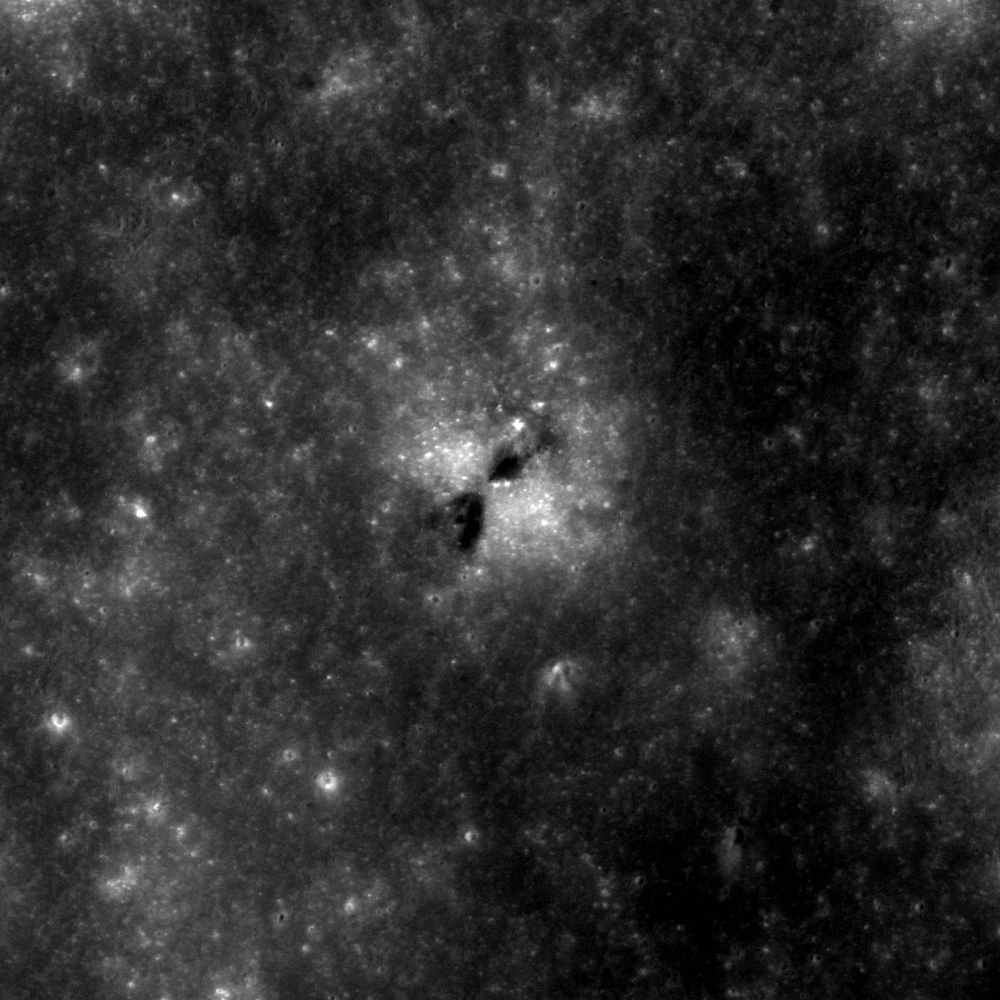
Last night, at 02:56 UTC, it was the 42nd anniversary of humans putting a bootprint on another world. Before Apollo 11 touched down on the Moon, though, NASA and the USSR sent a fleet of unmanned probes there. Since that time we’ve sent many more, including the Lunar Reconnaissance Orbiter, one of my favorite spacecraft of all time. It takes amazing high-res images of the Moon… and to celebrate today’s anniversary, they released this mysterious picture:

Cooool. Click to enlunenate.

This image is about 400 meters across, and shows an impact site with two lobes of material laid down to the sides. This butterfly-shape is a clear indication of a low-angle impact; it’s seen on many bodies in the solar system including the Moon, Mars, and even Earth (though the physics of exactly how the bi-lobed patterns form is still not well understood). Features like this are very rare… but it’s known that when a satellite orbit decays, it will impact at a low angle.

As the LRO site notes, in October 1967, the Lunar Orbiter 2 spacecraft impacted the lunar surface, possibly very near this spot. ...


House mice picked up poison resistance gene by having sex with related species | Not Exactly Rocket Science

Since 1948, people have been poisoning unwanted rats and mice with warfarin, a chemical that causes lethal internal bleeding. It’s still used, but to a lesser extent, for rodents have become increasingly resistant to warfarin ever since the 1960s. This is a common theme – humans create a fatal chemical – a pesticide or an antibiotic – and our targets evolve resistance. But this story has a twist. Ying Song from Rice University, Houston, has found that some house mice picked up the gene for warfarin resistance from a different species.

Warfarin works by acting against vitamin K. This vitamin activates a number of genes that create clots in blood, but it itself has to be activated by a protein called VKORC1. Warfarin stops VKORC1 from doing its job, thereby suppressing vitamin K. The clotting process fails, and bleeds continue to bleed.

Rodents can evolve to shrug off warfarin by tweaking their vkorc1 gene, which encodes the protein of the same name. In European house mice, scientists have found at least 10 different genetic changes (mutations) in vkorc1 that change how susceptible they are to warfarin. But only six ...

Knights in Shining Armor Probably Had Terrible BO | Discoblog

A knightly stroll, with treadmill and respiration mask

Medieval knighthood was physically grueling work: Jousting with massive lances. Charging into battle. Jogging on a treadmill in a full suit of armor. You know how it is.

It’s no surprise that beneath their shining armor, knights shimmered with sweat. Running around in up to 110 pounds of armor, or even advancing at a stately walk, would take a whole lot of effort. But, a team of scientists wondered, just how exhausting was it?

Since the researchers had missed their chance to track exertion on the jousting pitch by several hundred years, they recruited four modern volunteers, historical re-enactors from the Royal Armories in London. These guys had ample experience wearing armor, making them better proxies for knightly exertion than volunteers who wouldn’t know a culet from a cuirass. Each man donned a replica 15th-century suit of armor and hopped on a treadmill. As the volunteers walked and ran, the researchers kept tabs on their heart rate, their respiration rate, how much oxygen they used, and how long their strides were.

Sure enough, the researchers found, armor was exhausting. The men used 2.3 times as much ...