The Bantu völkerwanderung | Gene Expression


Image Credit: Mark Dingemanse

I recall years ago someone on the blog of Jonathan Edelstein, a soc.history.what-if alum as well, mentioning offhand that archaeologists had “debunked” the idea of the Bantu demographic expansion. Because, unfortunately, much of archaeology consists of ideologically contingent fashion it was certainly plausible to me that archaeologists had “debunked” the expansion of the Bantu peoples. But how to explain the clear linguistic uniformity of the Bantu dialects, from Xhosa of South Africa, up through Angola and Kenya, to Cameroon? One extreme model could be a sort of rapid cultural diffusion, perhaps mediated by a trivial demographic impact. The spread of English exhibits this hybrid dynamic. In some areas (e.g., Australia) there was a substantial, even dominant, English demographic migration coincident with the rise of Anglo culture. In other areas, such as Jamaica, by and large the crystallization of an Anglophone culture arose atop a different demographic substrate, which synthesized with the Anglo institutions (e.g., English language and Protestant religion). The United States could arguably be held up as a in-between case, with an English founding core population, around which there was an ...

Obama’s Energy Talk: New Ideas, or Same Old Song and Dance? | 80beats

What’s the News: President Obama gave a major address outlining his plan for U.S. energy security yesterday. His major goal is quite ambitious: to cut American oil imports by one-third by 2025. And towards that goal, he listed a number of initiatives that many news organizations see as a rehashing of old ideas, however good they might be. According to The Economist, “it is hard to see his recycled list of proposals as anything more than a reassurance to the environmentally minded, and to Americans fretting about rising fuel prices, that the president feels their pain.”

How the Heck: Obama cited four major tactics for decreasing oil imports:

Increase domestic production of oil
Use more natural gas and biofuels
Spur wider use of electric cars
Increase the efficiency of gasoline-powered motor vehicles

What’s the Context:

In his speech, Obama noted that “American oil production [has] reached its highest level since 2003.” As the Washington Post‘s Glenn Kessler notes, domestic oil production is higher now mostly because companies are now harvesting oil from the shale of North Dakota and other states. ...


Weight-Loss Supplement Has Teensy Potential Side Effect: You Might *Get Mad Cow Disease*! | Discoblog

Human Chorionic Gonadotropin (hGC), a hormone produced during pregnancy, is isolated from the urine of pregnant women and used to treat infertility. Since the 1950s, however, it’s also been used as a weight-loss aid—and still is, even though there’s no solid evidence showing it works.

But taking hCG could be worse than just ineffective: A new study shows that doses of the hormone can transmit prions, the misfolded proteins that cause mad cow disease and its human equivalent, Creutzfeldt-Jakob disease, an invariably fatal form of dementia that riddles the brain with holes (photo).

That’s right: There’s a potential risk of contracting deadly, brain-destroying illness by injecting yourself with proteins taken from other people’s urine—and you won’t even lose weight.

The New York Times lamely wrote earlier this month that hCG as a weight-loss regimen “has fans and skeptics”—but Travis Saunders at Obesity Panacea says that spreading mad cow is just one more reason to avoid “the most thoroughly debunked weight loss gimmick in medical history.”

No prion diseases have been transmitted through urine yet, the authors of the study say, but it is theoretically possible. And even ...


Kerry Emanuel’s Powerful Testimony on Climate | The Intersection

The defender of mainstream knowledge at the climate hearing today was MIT’s Emanuel, and here is his testimony. It is really good stuff.

Emanuel starts out by observing just how much scientific history there is behind our current understanding of climate–over 100 years. Much of it is so well established that it’s something young scientists learn today as part of their very basic training:

Today, students at MIT and elsewhere can do hand calculations or use simple models of radiative and convective heat transfer to explore climate physics, and they find climate sensitivities in the same range as those reported in the first National Academy of Sciences report on anthropogenic climate change in 1979.

All of that notwithstanding, there are many uncertainties remaining (of course)–but as Emanuel sharply points out, these could cut in either direction, and those at the hearing (like John Christy) expressing confidence that warming will be on the low end are taking quite a leap of faith:

In soliciting advice, we should be highly skeptical of any expert who claims to be certain of the outcome. I include especially those scientists who express great confidence that the outcome will be benign; the evidence before us simply does not warrant such confidence. Likewise, beware those who deride predictive science in its entirety, for they are also making a prediction: that we have nothing to worry about.

Emanuel also addresses “ClimateGate”, and pulls no punches when it comes to the ridiculous over interpretation of “hide the decline”:

I am appalled at the energetic campaign of disinformation being waged in the climate arena. I have watched good, decent, hardworking scientists savaged and whole fields of scholarship attacked without merit. Consider as an example the issues surrounding the email messages stolen from some climate scientists. I know something about this as I served on a panel appointed by the Royal Society of Great Britain, under the direction of Lord Oxburgh, to investigate allegations of scientific misconduct by the scientists working at the Climate Research Unit of the University of East Anglia. Neither we nor several other investigative panels found any evidence of misconduct. To be sure, we confirmed what was by then well known, that a handful of scientists had exercised poor judgment in constructing a figure for a non peer-reviewed publication. Rather than omitting the entire record of a particularly dubious tree-ring-based proxy, the authors of the figure only omitted that part of it that was provably false. If this was a conspiracy to deceive, though, it was exceedingly poorly conceived as anyone with the slightest interest in the subject could (and did) immediately find the whole proxy record in the peer-reviewed literature.

The true scandal here is the enormously successful attempt to elevate this single lapse of judgment on the part of a small number of scientists into a sweeping condemnation of a whole scholarly endeavor. When the history of this event is written, the efforts of those seeking to discredit climate science will be seen for what they are; why many cannot see it now is a mystery to me.

But probably not a mystery to your colleagues in the psychology department, Dr. Emanuel!

The thing that did not come up at the hearing, at least as far as I know: Emanuel is a Republican. If that doesn’t enhance his credibility in this area, it is hard to imagine what would.


Science writing I’d pay to read – April 2011 | Not Exactly Rocket Science


It’s that time of the month again – time to select ten blog posts for my Science Writer Tip-Jar initiative. For those new to this, here’s the low-down:

Throughout the blogosphere, people produce fantastic writing for free. That’s great, but I believe that good writers should get paid for good work, or at least that people should be willing to pay for good writing. I am.
Every month, I choose ten pieces that I really enjoyed and donate £3 to the author. There are no formal criteria other than I found them unusually interesting, enjoyable and/or important. Pieces where writers were paid for their work are excluded.
There are buttons on the sidebar for you to contribute too if you wish. The “Support Science Writers” button goes to the writers. At the end of April, the chosen ten will get equal shares of the pot. The “Support NERS” button goes to me; I’ll match a third of the donations and send that to the chosen writers too.

So without further ado, here are the picks:

Evelyn Mervine for her continuing series of illuminating interviews with her dad – a nuclear engineer – about the Fukushima ...

From White Dwarfs to Dark Matter Clouds, the Universe May Have Many Homes for Habitable Planets | 80beats

What’s the News: While the Kepler spacecraft is busy finding solar system-loads of new planets, other astronomers are expanding our idea where planets could potentially be found. One astronomer wants to look for habitable planets around white dwarfs, arguing that any water-bearing exoplanets orbiting these tiny, dim stars would be much easier to find than those around main-sequence stars like our Sun. Another team dispenses with stars altogether and speculates that dark matter explosions inside a planet could hypothetically make it warm enough to be habitable, even without a star. “This is a fascinating, and highly original idea,” MIT exoplanet expert Sara Seager told Wired, referring to the dark matter hypothesis. “Original ideas are becoming more and more rare in exoplanet theory.”

How the Heck:

Because white dwarfs are much smaller than our Sun, an Earth-sized planet that crossed in front of it would block more of its light, which should make these planets easier to spot. So astronomer Eric Agol suggests survey the 20,000 white dwarfs closest to Earth with ...


Blastroid | Bad Astronomy

I have a new article up on Blastr, the SyFy channel’s web site for news and info and scifi-y stuff.

The article is about asteroid impacts, and the lack of Hollywood accuracy thereof. I take a typical movie synopsis and destroy it plot device by plot device. It’s like taking all my movie reviews and condensing them down into one run-on snark.

And yes, I know that the illustration for the article (seen here) is scientifically inaccurate. I know what you’re thinking; it’s so obvious: no asteroid is actually flying saucer shaped! At least, that’s what they want you to think*.

So go over there, read the article, and leave your own complaints in the comments. I promise I will read them all and take them into consideration.

* Dear readers with an impaired sense of humor: I know that’s not really how the picture is scientifically inaccurate. Of course, the actual mistake is that you should see thousands of stars in the background.

† No I won’t.

Related posts:

- Blastr: Other than that, Spock, how was the movie?

The Human Lake | The Loom

I went recently to San Francisco to give a talk to a conference of scientists. The scientists were experts in gathering together mountains of biological data—genome sequences, results of experiments and clinical trials—and figuring out how to make them useful: turning them into new diagnostic tests, for example, or a drug for cancer. The invitation was an honor, but a nerve-wracking one. As a journalist, I had no genome scan to offer the audience.

We science writers do have one ace in the hole, though. Instead of being lashed to a lab bench for years, carrying out experiments to illuminate one particular fold in one particular protein, we get to play the field. We travel between different departments, different universities, different countries, and—most important of all—different disciplines. And sometimes we see links between different kinds of science that scientists themselves have missed. Which is why, when I arrived in San Francisco, walked up to the podium, and switched on my computer, I presented my audience with this photograph of a lake.

For the next hour, I tried to convince them that their bodies are a lot like that lake, and ...

Economics is not a Boys Sport | The Intersection

In order to tackle conservation, energy, funding, and many more critical issues we discuss, economics will be a large part of the solutions. Yet when we hear economists in the media, I often wonder why women aren’t generally quoted and interviewed. Further, where are the women who blog about it? Answer: They simply don’t exist. UCLA economist Matthew Kahn notes:

There are 52 women who rank in the top 1000 [members of the economics profession] and 0 of them blog. Contrast that with the men. Consider the top 100 men. In this elite subset; at least 8 of them blog. Consider the men ranked between 101 and 200. At least, six of them blog. So, this isn’t very scientific but we see a 7% participation rate for excellent male economists and a 0% participation rate for excellent women. This differential looks statistically significant to me.

Kahn is curious about the reasons why and suggests that men may have more leisure time and “nerdy guys spend more time reading and writing blog posts.” Perhaps that’s part of it, but in recent years, the number of women science bloggers has exploded, despite family, teaching, and other obligations. We may not be as well represented when you account for all science blogs (or recognized as often), but our numbers are growing. Women tend to use these forums as tools to share ideas, collaborate, and facilitate discussions beyond the academic bubble where many of us reside. In fact, at ScienceOnline annual meetings, we outnumber our male colleagues. In other words, there must be more to the gender disparity in economics than time and nerdiness. (Although I am, admittedly, a nerd).

Another blogger theorized that women stay away from economics blogs because of their combative style, yet science blogs are not always a particularly friendly place either. (Any regular reader of The Intersection understands what I mean). The pissing contests that emerge do not seem to keep women from blogging. Further, even though comment threads tend to be male dominated, I receive many emails from women and kids, so it’s clear that they’re reading too.

What’s really going on? Here’s my suspicion: Rather than gender differences in attitudes, female economists are simply still not part of the economics blogging culture… yet. It’s not an activity that they consider because there are no predecessors already engaged. In other words, encouraging women to participate is more about changing social mores and cultural norms of what’s acceptable and rewarded within the economics profession. That can’t happen until women are better represented online. A bit of a chicken and egg problem, but I’m confident economics will catch up to science in this regard.

Why does this matter? Because pioneering women will bring new ideas and perspectives to the table. And Kahn is correct that it will also create more opportunities for them to get recognized in their profession. I applaud Kahn for highlighting the gender divide and challenge him and his colleagues to encourage more women to get engaged. If they have reservations, tell them to email me.


The Earth’s lumpy gravity | Bad Astronomy

Most people think of the Earth as being a sphere. For most purposes that’s close enough, but it’s actually a spheroid, something close to but not precisely a perfect sphere. It bulges in the middle (as so many of us do) due to its spin, the Moon’s gravity warps it, the continents and oceans distort the shape. And the surface gravity changes with all this too; it’s different on top of the highest mountain, for example, compared to its strength in Death Valley.

So if you could map out the average shape of the Earth’s gravity, a shape where the gravity is the same no matter where you stood on it, what would it look like?

It would look like this:

That is a (somewhat exaggerated for easy viewing) map of the Earth’s geoid, produced by the European Space Agency’s GOCE satellite. A good way to think of the geoid is the shape a global ocean would take if it were governed only by gravity, and not currents or tides or anything else. If the Earth’s gravity were a little stronger in one place, water would flow toward it, and if it were weaker water would ...


How Much Does Your Phone Company Know About Your Life? | Cosmic Variance

Let’s just round up and say “everything.” In Germany they are currently debating rules on what data companies can keep and analyze, vs. what they must throw away. To make a point, Green Party politician Malte Spitz went to court to force Deutsche Telekom to share the data they had collected about him, just from his mobile phone. What is revealed, basically, is where he was essentially at every moment of the day. Spitz handed the information over to Zeit Online, who combined it with information he revealed himself via Twitter and his blog, to make a scarily detailed chronological map of his daily activities. (Via FlowingData.com.)

Check it out, they have a great animated reconstruction of Spitz’s daily movings, combined with a sidebar display saying how many phone conversations he was having and how many text messages. There’s even a spreadsheet so you can play with the data yourself if you are so inclined. They removed the actual phone numbers with which he was communicating, but of course the phone company has those.

People can decide for themselves whether this is intrusive or benign; more than a few people put nearly as much information online anyway, without thinking twice. But you should know that it’s out there.


Watch the House Climate Science Fight Now! | The Intersection

They’re streaming live from the Science Committee right now….MIT’s Kerry Emanuel is the scientist on the panel who will be defending the mainstream scientific view that it’s warming out there, thanks to homo sapiens. Several other witnesses are far more “skeptical.”

My take on the hearing is here. Short quote:

This sort of thing has been going on in the US Congress for a long time—for over a decade. So in a sense, one more doubt-mongering hearing doesn’t move the cultural confusion needle much.

The real problem, for me, is that our culture’s outrage meter seems similarly calibrated.

P.S. John Christy just said “hide the decline.” Heh heh.

P.P.S.: Kerry Emanuel really laid down the gauntlet on the non-scandal of “ClimateGate,” and also on the poor process that Congress is engaged in when it makes “mascots of mavericks,” as Emanuel put it–with some nice alliteration.


The Public is “Scientifically Illiterate.” But Do Scientists Have “Public Literacy”? | The Intersection

Sociologist Barry Glassner, the president of Lewis & Clark College in Portland, agrees with my “Do Scientists Understand the Public” paper, written for the American Academy of Arts and Sciences. Writing in USA Today recently, Glassner argued that

Were hard data and cold logic all that mattered, any number of common personal behaviors would be long gone by now, from smoking to overeating. As any skilled public relations practitioner will attest, successful communication meets people on their own turf — by means that address emotions, fears and values.

I do not mean to suggest that scientists transform themselves into Don Draper-style Mad Men and embark on a course of Madison Avenue-style spin. But scientists who want members of the public to better understand their work ought to start by understanding them.

Glassner, certainly, is not so, um, ignorant as to think that public ignorance is the problem. Instead, he calls for scientists to invest in “public literacy”:

Scientists and their advocates need to become more knowledgeable about how people come to their beliefs — who they rely on for scientific information, what they hear, and through which filters they hear it.

Amen to that. It is not like scientific information travels in a vacuum, after all. It travels through minds and through media, both of which can have quite the distorting effect.

Thankfully, the new trend in the scientific community today is to understand these problems of information transmission and translation–encoding and decoding, as a communications nerd might put it–rather than acting as though they don’t matter.

They most emphatically do.


Pocket Science – wasps airlift ants away from food | Not Exactly Rocket Science

It’s not a very fair fight. In one corner is a tiny ant. In the other is a large wasp, two hundred times heavier and capable of flying. If the two of them compete for the same piece of food, there ought to be no contest. But sometimes the wasp doesn’t even give the ant the honour of stepping into the ring. It picks up the smaller insect in its jaws, flies it to a distant site and drops it from a height, dazed but unharmed.

Julien Grangier and Philip Lester observed these ignominious defeats by pitting native New Zealand ants (Prolasius advenus) against the common wasp (Vespula vulgaris). The insects competed over open cans of tuna while the scientists filmed them.

Their videos revealed that ants would sometimes aggressively defend their food by rushing, biting and spraying them with acid. But typically, they were docile and tolerated the competing wasp. Generally, the wasp was similarly passive but on occasion, it picked up the offending ant and dropped it several centimetres away. In human terms, this would be like being catapulted half the length of a football field.

The wasps ...

When beauty and science collide | Bad Astronomy

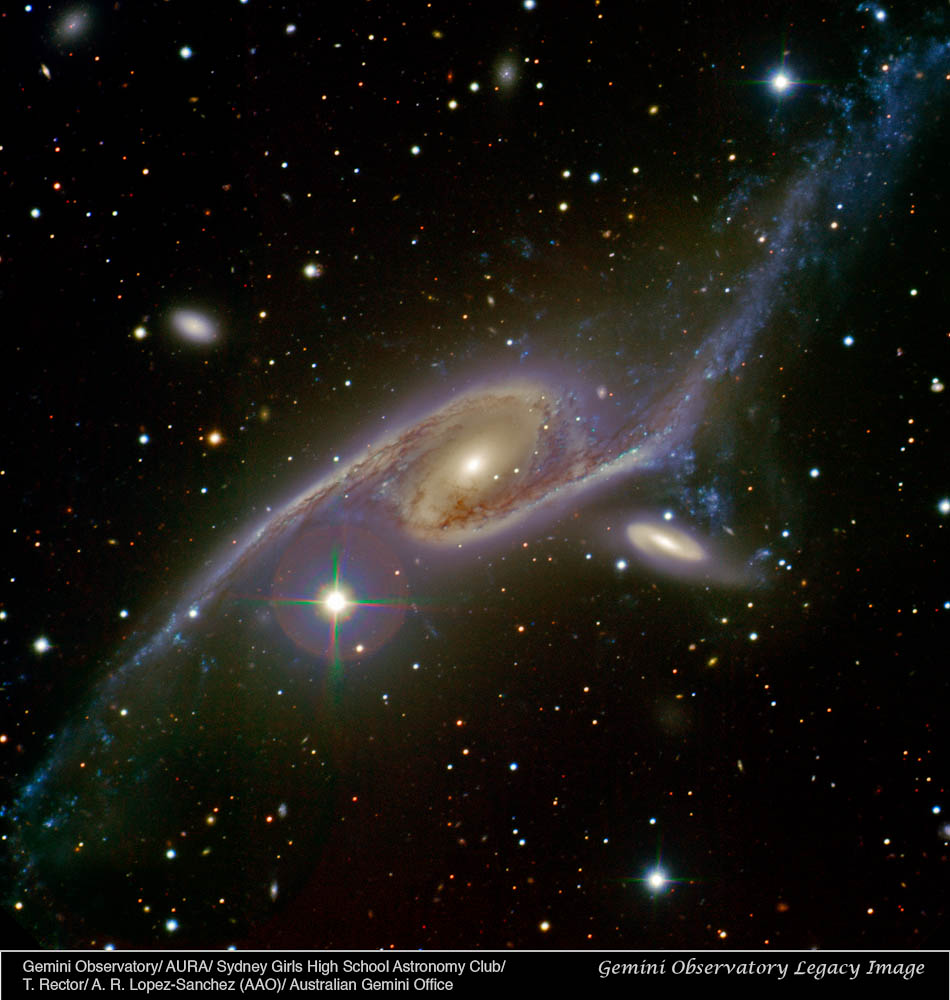
I’ve been posting a lot of nice astronomical images lately, but sometimes one comes along and blows me completely away. How fantastically gorgeous is this?

Holy Haleakala! [Click to galactinate.]

That spiral galaxy is NGC 6872, and as you can see in this image from the Gemini South telescope it’s getting its clock cleaned by the littler spiral — IC 4970 — just to the right. The two are undergoing a galactic collision, a colossal event playing out over hundreds of millions of years. NGC 6872 is currently the victim here; its spiral arms are clearly distorted and being flung wide by the gravitational interaction. However, the smaller IC 4970 will be the ultimate loser in this battle: it will fall into the bigger galaxy, be torn apart, and eventually consumed in its entirety, becoming a part of NGC 6872. Bigger galaxies do this to smaller ones all the time; the Milky Way is in the process of eating several small galaxies even as you read this (I have details in articles linked below; see Related Posts).


Let’s Push Keith Out of an Airplane

Keith's note: My friends got a little carried away with this whole April Fool's day thing. Then again, NASA Watch first went on line on April 1, 1996, so I guess I should have expected this to all go full circle some day. From what I understand there are people willing to pay big bucks to have the honor of pushing me out of an airplane somewhere over Texas -- whenever I manage to take off from that landing strip in Friendswood and jump, that is. Now I guess I have no choice but to jump since my cheap cardboard Avatar has already taken the plunge - otherwise Gwen Griffin gets to collect that cash prize by pushing my avatar out of the plane.

From what I can tell from this video, my Avatar landed in Leroy Chiao's back yard (sorry). I suppose I will have to actually re-enact this flight for real - while wearing a Keith mask - and that they will get Miles O'Brien to fly the plane (and dip it sideways so that I fall out).

Oh well, this is not the first time my Avatar has done strange things: my old NASA badge went to the summit of Mt. Everest with a picture of Gorbie the space dog (photo - that's "Doogie" Parazynski holding our pictures). Gorbie's parents live next to the hangar my Avatar drove into in the video. Maybe Gorbie will jump with me. At least dogs like me.

I am supposed to take NASTAR suborbital training in a few weeks and I am now scared of what I will find waiting for me inside the centrifuge. Durda, Stern, Conrad, and Throop are relentless. No doubt Parazynski will find some yak by-products to adorn my flight suit. I have certainly asked for it.

Visit more fun and abuse totally at my expense at KeithWatch.com.

Something "Big" at SpaceX? (Update)

SpaceX: Something Big Is Coming - Elon Musk to Hold Press Conference in Washington Tuesday (with video)

"Elon Musk, CEO and Chief Technology Officer of Space Exploration Technologies (SpaceX), will hold a press conference on Tuesday, April 5th at the National Press Club in Washington to discuss his company's latest venture."

Keith's 31 March note: SpaceX justed tweeted "Something big is coming http://www.spacex.com". If you go to their website you see that the big day is 5 April 2011 ...

Students Want A Say In Their Future’s Future

Letter from College Students regarding the Future of Human Spaceflight, Students for the Exploration and Development of Space (SEDS)

"Dear President Obama and Members of Congress: This year, as we celebrate both the fiftieth anniversary of human spaceflight and the accomplishments of the retiring Space Shuttle fleet, the exploration of space remains as critical as ever. Over the past year, many groups have offered their opinions on the best way for the US government to foster space exploration. However, one critical perspective has been missing from this conversation: that of the next generation. We, the signatories of this letter -- 280 students from universities and colleges across the nation -- are writing you today to ensure that our voice is heard in this ongoing discussion.

We are the ones who will be most affected by the decisions you make today. We are undergraduate and graduate students working hard to prepare ourselves for fulfilling careers as leaders and productive members of the civil, military, and commercial aerospace industries. We are the astronauts, engineers, scientists, and entrepreneurs of tomorrow."