
Spectacular VISTA of the Tarantula | Bad Astronomy

Ever wanted to see a Tarantula up close? Up really close? Here’s your chance!
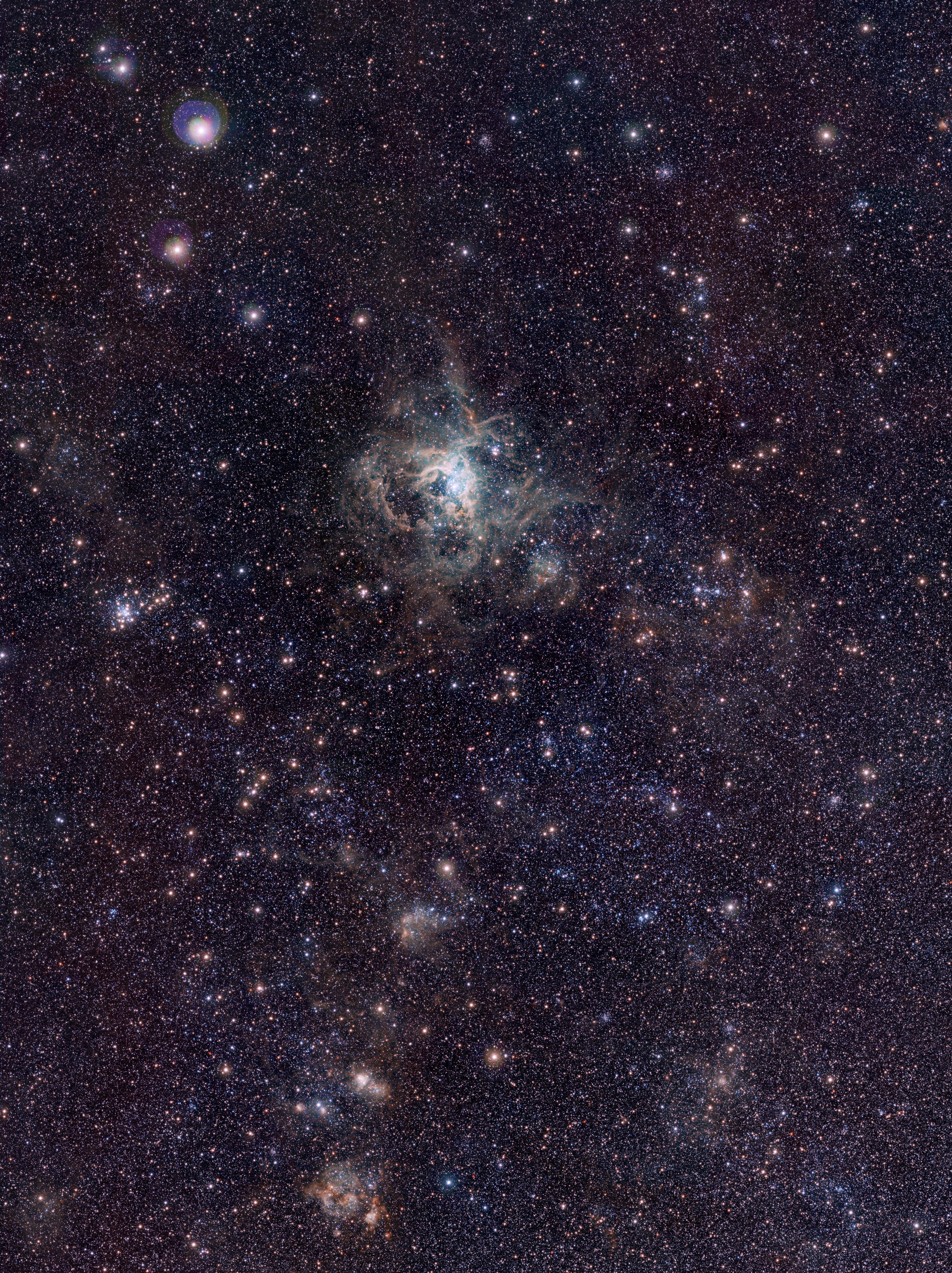
[Click to hugely enarachnidate, or grab the atomically-mutated, 130 Mb, 9000 x 12000 pixel megaspider version here. But be ye fairly warned, says I: you'll lose your afternoon looking at it.]

That is a new image of the Tarantula Nebula (ha! Got you!) from the European Southern Observatory’s VISTA survey telescope in Chile. The telescope can see in the near-infrared, just outside the range of our human vision, and is being used to map a big chunk of the southern sky.

The Tarantula is a sprawling star-forming region in the Large Magellanic Cloud, a small companion galaxy to our own Milky Way Galaxy. Of course, "small" is a matter of perspective; the LMC is still tens of thousands of light years across and has several billion stars in it. From its distance of 180,000 light years, the LMC appears as a smudge in the sky to the unaided eyes of southern observers.

In astronomy terms the image above is huge; it covers a square degree of sky, several times the area of the full Moon! However, in real terms, if you lived in the southern hemisphere and went outside on a clear night, you could block out the entire region of the picture with the tip of one finger held at arm’s length.

But VISTA’s 4-meter mirror has fine vision, and the image is crammed with detail. It’s hard to see in the embedded image above because I had to compress it wildly to have any hope of letting y’all see it here. The higher-resolution images, however, are simply spectacular! Here’s a taste; I cropped out a small portion:

Wow! Mind you, this is from the medium resolution image! It’s a section to the right and a bit below the nebula proper. And while it’s crammed with stars, gas, and dust, I didn’t pick it randomly. It has one other object in it of note: Supernova 1987A, an exploded star whose light reached us on February 23, 1987. It was, for a few shining moments, among the brightest objects in the entire Universe… but now is lost in a sea of stars, in a small section of one image of a small galaxy.

The Tarantula Nebula is a forbidding object. It’s well over 600 light years across, has millions of times the Sun’s mass worth of gas jammed into it, and is forming stars so furiously that astronomers think it may actually be creating a globular cluster, a spherical ball of hundreds of thousands of stars. You may have heard of the Orion Nebula, one of the largest and brightest of all nebulae in the Milky Way. Well, the Tarantula is thousands of times more luminous; if it were as far away as the Orion Nebula, the Tarantula would be bright enough to cast shadows on the ground!

VISTA will eventually map out 184 square degrees of the sky, which is truly an enormous swath of the sky at this resolution. It will guide astronomers for years to come, giving us a highly-detailed and, yes, beautiful map of stars, galaxies, and nebulae… and best of all, stuff we’re not even aware of yet. Big surveys always help us piece things together, put the details into perspective.

But oh, sometimes, the details themselves are worth gawking at.

ESO/M.-R. Cioni/VISTA Magellanic Cloud survey. Acknowledgment: Cambridge Astronomical Survey Unit


Related posts:

- Hubble sees spectacular star birth and death
- The Orion VISTA
- Incredible VISTA of the cosmos
- Touring the Tarantula
- This Tarantula is definitely deadly


Stephen Schneider on July 8, 2010 | The Intersection

Just days before we lost Stephen Schneider, he sat down for this interview with Climate Science Watch director Rick Piltz. Over a thoughtful and poignant conversation, they touch on climate policy, the so-called “experts” who get quoted by the media, and the anti-regulation ideologues with special interests muddying the waters of sound science and policy decisions.

From the transcript:

CSW: Last thoughts to leave us with?

Schneider: The main thing I want people to remember is that when we’re talking about expertise, we’re not talking about expertise in what to do about a problem. That is a social judgment and every person has the same right to their opinion as any person in climate. However, we are talking about the relative likelihood that there could be serious or even dangerous changes. Because before you even decide how you want to deploy resources as a hedge against a wide range of important social problems, you have to know how serious the problems are. All we’re trying to do in science is give the best estimate that honest people with a lot of evidence can, about the relative risks, so they can make wise decisions in their own lives and in who they elect about how we should deal with it.

If you have no idea about the risk, it’s very hard to rationally do risk management. And we feel that there many people deliberately muddying the risk waters because of a combination of ideology and special interest. We have every right to point out that they have weaker credentials in science than those who are convinced on the basis of the forty year record and longer that the scientific community has been successively examining, year after year after year. That is how we make decisions in medical, in health, or in business. We operate on the basis of preponderance of evidence. The same thing must be done for the planetary life support system. That’s why it’s so important to understand who’s credible.

I strongly encourage everyone to watch.


Russia’s Fires & Pakistan’s Floods: The Result of a Stagnant Jet Stream? | 80beats

Russia FiresThe fires in western Russia continue to burn. Though the overall area now ablaze has shrunk, the number of individual fires has actually risen today. The death rate in Moscow has doubled, and Russia is racing to stop the flames from spreading to areas still affected by radiation from the Chernobyl nuclear disaster a quarter-century ago.

While firefighting goes on, attention turns to the “why?” Russia’s fire explosion has people wondering if there’s a bigger reason behind it. The topic seems particularly urgent because another major natural disaster is happening not so far away: in northern Pakistan, where exceptionally heavy monsoon rains have caused crushing floods. The big question–whether global warming is responsible–is still unanswered, but scientists do agree that a large weather pattern links the events.

According to meteorologists monitoring the atmosphere above the northern hemisphere, unusual holding patterns in the jet stream are to blame. As a result, weather systems sat still. Temperatures rocketed and rainfall reached extremes [New Scientist].

You’ve probably seen diagrams of the jet stream on weather charts, where a thick band represents its air currents that surge from west to east. However, New Scientist reports, a “blocking event” caused by west-pushing Rossby waves has slowed the jet stream’s flow. This happens from time to time, and it sets the stage for extreme conditions when weather systems hover over the same area.

Says Jeff Knight, climate scientist at the U.K. Met Office:

“Circulation anomalies tend to create warm and cool anomalies: while it has been very hot in western Russia, it has been cooler than average in adjacent parts of Siberia that lie on the other side of the high pressure system where Arctic air is being drawn southwards” [BBC News].

Pakistan also got stuck with a weather system that plunked down and wouldn’t move. The problem there, though, is that it’s monsoon season, and the weird circulation worsened that.

According to Knight, you’d expect to see more such extremes in a warming Earth. Though you can’t point to any one storm, drought, or other event and say “that’s because of global warming,” Russian President Dmitry Medvedev may have been moved by seeing his country on fire. He reportedly linked Russia’s current calamity to climate change in his public comments. According to the World Wildlife Fund’s Alexey Kokorin, that’s quite a step for the nation—though it’s one that’s measured in words.

“These are not brave statements for European leaders or Obama, but for a Russian president, it’s a new statement,” said WWF’s Kokorin. Even last year, Medvedev’s speeches on climate change were more about helping other continents like Europe and Asia without really focusing on the negative and severe impacts for Russia itself, he said [The New York Times].

Related Content:
DISCOVER: Fire Storms, on the science of wildfires
80beats: NOAA’s Conclusive Repots: 2000s Were the Hottest Decade on Record
80beats: More Floods, Droughts, And Hurricanes Predicted for a Warmer World
80beats: Globe-Warming Methane Is Gushing from a Russian Ice Shelf

Image: NASA Goddard


Texting-While-Driving Coach Slightly Delays Appalling Crashes | Discoblog

drivingtestIf your car could talk, it might tell you to stop texting. At least that’s what one research team hopes: after paying young drivers to perform texting-like games while driving a simulator, they found that visual warnings from an in-car “coach” helped keep drivers’ eyes on the road.

For high-risk drivers, the warning system “more than doubled their time until a virtual crash,” a University of Washington press release says. That might not sound entirely reassuring. But the researchers say a similar system installed on a real car might help risky drivers avoid a crash altogether.

A team led by Linda Ng Boyle, an industrial and systems engineer at the University of Washington, first had a group of 53 drivers, ages 18 to 21, attempt to drive a simulator while simultaneously playing a matching game. As an incentive to take the game seriously, they paid drivers according to the correct number of matches they made. The riskiest drivers took their eyes off the road for between two and a half to three seconds, compared to moderate and low-risk drivers who would glance off the road for less than two seconds during their longest glances.

In later tests the researchers activated the driving coach, which flashed warnings on the matching game’s screen. The study noted that the coach decreased the length of high-risk drivers’ glances by an average of 0.4 seconds, decreased their longest glances by about one second compared to risky coach-less drivers, and increased high-risk drivers’ time to collision by around 8 seconds. In the press release, Ng Boyle says the research shows that driver coaching systems can work for both risky and safer drivers:

“I think that drivers are coachable…. The worst drivers can benefit the most, because we can change their behavior the most dramatically. We can also reinforce the good behavior for safer drivers.”

If future driving coaches can talk, we suggest the voice of Knight Rider’s KITT or, better yet, Obi-wan.

Related content:
Discoblog: Texting While Diving? Buoy Allows Text Messages From Submarines
Discoblog: Woman Receives First Ever PhD in Texting
Discoblog: Watch Those Thumbs Go! Champion Texter Wins $50,000
Discoblog: The New Defense Against Despotism: Text Messaging

Image: Linda Ng Boyle / University of Washington News


Lost to the Galaxy

Hypervelocity stars, such as the on referenced in Tom’s post, are stars which are moving so fast they have achieved escape velocity from the galaxy.  Sounds cool, but they’re also known as “exiled stars”, so maybe not so much.  They achieve velocity through gravity assist; by getting too close to something of high mass (like a supermassive black hole), and getting a sling-shot out of the galaxy.  The star maintains its shape and life cycle, but any planets that were around it would’ve been lost by the sling.  These are incredible forces you’re dealing with.  There is nothing gentle about the process.

Chandra image of Sgr A*, NASA/CXC/MIT/F. Baganoff, et al

We use the same process when we sling our spacecraft around planets to give them a speed-boost.  It works VERY well.

How common is such an event we don’t know.  We’ve found 16 so far.  The original companion planets of the stars may be on their way out of the galaxy, also, but since they aren’t shiny we don’t see them.  They aren’t still circling their star, that’s for certain.  They all may eventually be captured, but it won’t be in this galaxy.  They’re outta here.

Theorized in 1988 and discovered in 2005, not much yet is known about HVS.  So far, the theory runs that there may be as many as 1,000 of them in the Milky Way Galaxy.  Considering there are 100 billion stars in the Milky Way, that’s not a whole lot.  Still, they sure aren’t hanging around waiting for us to take their picture.  We could be getting new ones all the time.

Some scientists think our HVS could be stars our galaxy originally captured from an orbiting dwarf galaxy which got too close.  Some neutron stars are inferred to be at high velocity, but that’s the result of an asymmetrical supernova.  Not only did it supernova, it supernovaed messily.  An example of that would be the neutron star RX J0822-4300, which moves at 0.5% of light speed, or about 1500 km/s.  That speed doesn’t grab you?  The 125X1400mm shell fired out of a tank travels at about 1700 m/s.  Or about 6120 km/h.  Hmmm, that’s kilometers per second vs kilometers per hour.  These puppies aren’t wasting time.

The first HVS discovered is SDSS J090744.99+024506.8.  Its “other” name is The Outcast Star.  I don’t know which is worse.  One thing is for sure; there are a lot of strange, strange things in the universe.  Some of them in our own back yard.

Perseid Meteor Shower: Where & When to Catch the Sky Show | 80beats

PerseidsThis week brings the annual return of the Perseids, one of the most stunning meteor showers of the year, visible from just about anywhere.

WHAT: The height of the Perseid shower comes every August, because that’s the time our planet passes through a certain debris path.

The Perseids are created by the tiny remnants left behind by comet Swift-Tuttle. The Earth passes through this material once a year, creating a spectacular show as the cometary particles burn up in the atmosphere [Discovery News].

WHERE: Like the Orionid meteors, which come around in October, the Perseids are so named because of the constellation from which they appear to originate.

If you trace the Perseid meteor trails backward, they meet within the constellation Perseus the Hero; this is how the shower got its name [Astronomy].

WHEN: Tonight (Wednesday) through Friday night we’ll see the height of Perseid visibility once the sky reaches full darkness, from 11 p.m. to midnight wherever you might be until the first light of dawn. On Friday night the crescent moon will set before twilight ends, giving stargazers a dark sky to gaze at.

Swift-Tuttle’s debris zone is so wide, Earth spends weeks inside it. Indeed, we are in the outskirts now, and sky watchers are already reporting a trickle of late-night Perseids. The trickle could turn into a torrent between August 11th and 13th when Earth passes through the heart of the debris trail [NASA Science News].

Indeed, the opening shot of the Perseids appeared as a bright fireball over Alabama on August 3.

WHAT YOU NEED: Your two eyes, and a place away from the city lights. For more cool Perseid details, check out Astronomy’s coverage.

Follow DISCOVER on Twitter

Related Content:
80beats: Found on a Martian Field: A Whomping Big Meteorite
80beats: Study: 20-Million-Year Meteorite Shower Turned Earth Warm & Wet
80beats: Scientists Pick Up the Pieces (Literally) of an Asteroid Spotted Last October
80beats: Perseid Meteor Shower Should Dazzle Despite a Bright Moon (2009 edition)

Image: flickr / aresauburn


Hip Hop Holst? | Bad Astronomy

Rapper Dr. Dre is planning on an instrumental album based on the planets! From Vibe magazine:

DrDre_Vibe

You mentioned a hip-hop album without rapping. Will we ever hear a Dr. Dre instrumental album?

Oh yeah, that’s in the works. An instrumental album is something I’ve been wanting to do for a long time. I have the ideas for it. I want to call it The Planets. I don’t even know if I should be saying this, but [bleep] it. [Laughs.] It’s just my interpretation of what each planet sounds like. I’m gonna go off on that. Just all instrumental. I’ve been studying the planets and learning the personalities of each planet. I’ve been doing this for about two years now just in my spare time so to speak. I wanna do it in surround sound. It’ll have to be in surround sound for Saturn to work.

Hmmm, interesting. This sounds pretty cool, though I’m a little concerned with what he means by "the personalities of each planet". In today’s culture that could mean anything… but then, Gustav Holst wrote a classical suite using the same idea, and it is to this day one of the most deservedly popular pieces of music ever written. I’m usually willing to cut musicians a little slack, since it’s art and open to interpretation. And if it brings more people into the astronomical fold, then more power to him. I’ll be curious to hear it when it comes out!

Tip o’ the conductor’s baton to Ryan Gagne.


A healthy heart slows brain aging

A team of researchers from Boston University has determined that the healthier your heart is, the slower your brain ages. On the flip side, those with less-than-optimal heart health experience more rapid brain aging than those whose hearts have a more healthy blood flow.

The team evaluated 1,500 people for the study and found that, as the brain ages, it actually begins to shrink. When the heart is pumping blood at a healthy rate, the brain is able to keep "fit". But in people whose blood flow is restricted by poor cardiac function, their brains age roughly two years quicker on average.

Interestingly, it is not just old people with heart disease whose brains age quicker; otherwise healthy people in their 30s who have less-than-par blood flow to the heart experience more rapidly aging brains than those with healthy flow. Read more...

Improve your memory

US condemns Taliban killing of medical aid workers – NewsyStocks.com


Globe and Mail
US condemns Taliban killing of medical aid workers
NewsyStocks.com
... 10 medical aid workers as a " despicable act of wanton violence," saying the acts have shown that the group stands against "a future peace and freedom. ...
Six Americans on medical mission killed by Taliban, US condemns killingsNew Delhi Chronicle.com (blog)
Clinton Criticizes Aid Worker KillingsMyFox Houston
Clinton: Taliban making 'false accusations' about slain AmericansThe Hill (blog)
AFP
all 3,600 news articles »

Last Chance Before The Bonus Riddle

UPDATE:  SOLVED at 12:12 CDT by Bert

Are you ready to be frustrated today?  Of course you are!

This is your last chance before the next bonus riddle, which is Monday the 9th.  I know you’re ready, so I’ll jump right into it.  You’re looking for a thing:

This thing is generally thought of in the singular, but it’s complicated.  It is one huge thing, composed of many tiny things, which then manifests itself as two things.

This was known of by ancient man; but not understood.

It really terrified our ancestors.

We think of this as an Earthly phenomenon, although with telescopic advancements we’ve come to realize it isn’t.

This thing is not a cause; it’s an effect with a reason.

In an of itself, it is not important.  It does nothing.  It is a harmless “result”.

As unimportant as the result may be, the cause and the reason are important.

Did you get that?  I’m pretty sure you can slay this particular dragon with very little effort, so get your guesses in quickly.  You know where to find me…

Happy birthday to two important people | Bad Astronomy

Today happens to be the birthday of two people who are important to me: James Randi, and my sister Marci*.

If you don’t know Randi, that’s OK: you can get some good info on him in this interview he did with Big Think, or this talk he gave at TED, or his annoucement when he came out of the closet.

If you don’t know my sister, that’s too bad. She’s pretty cool.

Happy birthday Randi and Marci!


* I’ll let you guess who’s in the picture. Hint: I’m on the road, and I didn’t have any good pix of my sister on my laptop. Sorry, Marce.


I’ve got your missing links right here – 7th August 2010 | Not Exactly Rocket Science

News

“We’ve created a multitrillion-dollar edifice for dispensing the medical equivalent of lottery tickets—and have only the rudiments of a system to prepare patients for the near-certainty that those tickets will not win. Hope is not a plan, but hope is our plan.”The most amazing thing I read all week was this piece in the New Yorker by the incomparable Atul Gawande, talking about how people die, how doctors care for terminal patients and society’s attitudes to death. It’s long, but it’s Gawande, so you won’t feel it. Grab some tissues, find a comfy chair.

What lives in the sea? A new census of the world’s marine life gives a thorough answer, complete with 15 new papers in PLoS ONE, an incredible website, an interactive globe, timeline, image gallery, video gallery,

Mary Carmichael has written a wonderful series on Newsweek about her quest to decide whether to do a personal gene test. It’s humane, well-considered stuff and you should read all six parts.

More after the jump…

Drakazoon is an excellent Latin name for an “ancient blob-like creature of the deep”.

Vernon Asper was one of the first researchers in the Gulf of Mexico to study the oil gushing out from the BP well. But it has not all been smooth sailing, reports Mark Schrope for Nature News

Genome-wide association studies are often criticised for providing little value at great expense. But a new study clearly shows the value of this approach, reports Mark Henderson in the Times (subscription required)

Jonah Lehrer is a total class act. He even uses horrendous trolling as a vehicle for more science writing about conspiracy theories.

Some squid can escape predators by taking to the air. Alternatively, they’re doing it to distract us from their nuclear enrichment program, the sneaky gits. Ferris Jabr has the story at Scientific American.

Fossils: the result of millions of years of intense pressure. Oh, and bacteria. By Brian Switek at Dinosaur Tracking.

Much ado over nothing as the UK panics about meat and milk from cloned cows. Tom Chivers and Colin Blakemore set the fearmongers straight. Honestly, this is a country where we regularly eat Turkey Twizzlers, Monster Munch and pork scratching, and yet meat that is exactly the same as other meat makes people nauseous…

Antarctic Octopuses Discovered With Sub-Zero Venom – Jess McNally reports in Wired.

Why people think they are less influenced than others by adverts and persuasive messages, from Psyblog

The inflexibility of young children’s brains can make them better learners than adults, says Vaughan Bell in Mind Hacks.

1 in 200 men are direct descendants of Genghis Khan. Razib Khan (heh) explores the science behind Gengy’s legacy.

Meet the anti-laser, which absorbs the light a laser shoots out

A nice, if very small, study about the power of the placebo effect.

Heh/wow

“Monkeys hate flying squirrels, report monkey-annoyance experts. The research could pave the way for advanced methods of enraging monkeys.”

Penis can only take so much electricity, surgeons warn.

97% of Nature’s readers have internet access, according to a survey of Nature online readers. Er…

Meet Pandarus rhincodonicus, a parasite that lives on the lips of whale sharks

Want a social media strategy? Here you go.

Robot climbs walls, but in a slightly eerie way.

Journalism/internet/blogging

My list of science writer origins is still going strong at over 120 entries, and even got a mention at the Knight Science Journalism Tracker. If you’re a science writer and haven’t contributed yet, please do so.

Meet Scientopia – a new collective consisting of several ex-Sciblings, who have joined forces with many other excellent bloggers. Go and support the new community – it includes such favourites of mine as SciCurious, PalMD, and Adventures in Ethics and Science.

Frank Swain (Science Punk) gave a superb talk on the problems with the skeptic movement at Westminster Skeptics in the Pub. A podcast of his talk is now up, and it’s a must-listen. Noodlemaz has a good write-up too.

Gatekeeping is now a collective pursuit; we’ve become our own and each other’s editors,” says Ken Doctor at the Nieman Journalism Lab. “With social media, the serendipity that came with turning pages and suddenly discovering a gem of a story that an editor put there happens in new ways. We’re re-creating such moments ourselves, each of us?individually and collectively?as we tout stories and posts to each other.”

The Royal Society has a new blog on the history of science.

Bec Crew’s hilarious blog Save Your Breath For Running Ponies has been named Australia’s best science blog. Go and congratulate her.

Andy Revkin blogs about the increasing role for scientists in talking directly to the public. “Institutions that thrive in this world of expanding, evolving communication paths are those willing to engage the public (including critics) and to experiment with different strategies.”

Drunk with power from Embargo Watch, Ivan Oransky has launched Retraction Watch.

Posting audio interviews provides “valuable content to your audience while building relationships with the people you interview”


Twitter.jpg Facebook.jpg Feed.jpg Book.jpg

And they came from Central Asia | Gene Expression

There’s a new paper in AJHG out, Whole-Genome Genetic Diversity in a Sample of Australians with Deep Aboriginal Ancestry, which I’ll hit later. It doesn’t have anything too surprising, but in the supplements they have a figure which shows frappe and Structure plots for the HGDP populations as well as their Australian Aboriginal sample. These methods take an individual’s genome and assign elements to one of K ancestral populations. For African Americans this is highly illuminating, as K = 2 simply breaks down along European/African ancestral lines. The mean turns out to be ~20% for the minority quantum, exactly what had previously been ascertained through genealogy, classical autosomal markers (e.g., Duffy), and the average of uniparental lineages for European ancestry (African Americans tend to be enriched for European Y chromosomal markers, and have less than the expected European mtDNA markers. Again, totally intelligible in light of the history of relations in the old South).

These abstractions extract visually intelligible information out of the hundreds of thousands of concrete variant bases within human populations. They have clear and immediate utility when you have some inkling of the population history of a given sample. But when you attempt the same with populations whose histories are less clear and distinct, or who do not have such an obvious and well known genesis as African Americans, then things get murkier.


Therefore when it comes to higher values of K in many of these papers I just avoid reading too much into the results because the human mind is a pattern recognition machine, and it’s very easy to tell stories which have no way of being validated or falsified. Most of the authors of these papers tend to agree as higher K plots are usually nested in the supplements, not the main paper itself. But with all that caution entered into the record, I thought that K = 8 in the supplemental figure 1 was of some interest, and I want to focus on it just a little bit. I reedited it, removing many populations, and shifting the frappe and Structure plots at K = 8 next to each other. I also added some population labels for clarity, though if you’re familiar with the HGDP data set it’s clear what the abbreviations are.

camefromcentralasiaFirst, it seems that at K = 8 the fact that the non-indigenous ancestry of the Australian Aboriginal sample is Western European is pretty clear even without the known history (Dienekes noted this as well). The only question is distinguishing which Western Eurasian populations the contribution came from, and this is of some interest because of a possible connection between India and Australia. Many South Asians have a vague resemblance to Australian Aboriginals, and many Indian tribal groups are termed “Australoid.” More recently a very distant mtDNA link between Indian tribal groups and Aboriginals has been validated. But that’s totally expected, as all populations to the east of South Asia probably went through that region on the way out of Africa. A coalescence time on the order of 50,000 years ago seems to suggest that that is the connection, not a more recent migration as some have hypothesized, and which could give a phylogenetic causal basis to morphological similarities.

In the frappe plot, to the right, note that the South Asians are enriched for the orange shaded ancestral group. It’s residual in most Europeans, and almost absent in Australian Aboriginals. In the Structure plot, to the left, it’s the blue segment which is enriched in South Asians, and residual in Europeans. Again, it’s nearly absent in Aboriginals. That, combined with the attested presence of a high frequency of European diagnostic markers, such as the blue-eye OCA2 SNPs, should seal the deal in regards to the question of any more recent admixture from the initial settlement of the current indigenous stock with any group but Europeans.

But the reason I’m posting isn’t because of Aboriginal genetics. There are a few coarse clusters of human populations. Roughly, Amerindians, East Asians, Oceanians, West Eurasians + North Africans, and Sub-Saharan Africans. But within these clusters are further differences. Among the Mozabites (an Algerian Berber group with substantial Sub-Saharan African admixture), the Basque, and Sardinians, there seem to be an element which is nearly absent, but which increases in frequency as one goes east toward the heart of Eurasia. I am referring here to the aforementioned segments which I highlighted as the components whose lack suggests that Aboriginals received their non-indigenous ancestry from Europeans.

It makes me think about Li et al.’s argument that skewed population coverage has resulted in the omission of a major Central Eurasian ancestral population cluster between those of the west and east. If there was a major demographic pulse out of the center of Eurasia it would make sense that groups on the western fringe of the World Island, those in the western Mediterranean region, would show the least sign of it. I have no model for what such a pulse would be. Perhaps it wasn’t a pulse, but just isolation-by-distance and clinal variation which pops out in a discrete fashion if one cranks up the K’s. My initial thought is that it was the Indo-European languages, but it’s well represented in the Levant, and the Adygei (ADY) are not Indo-European anyway (though they could be distantly related to Indo-European and so exhibit some of the same genetic variation as the original population). I think there’s a good chance that here I’m confusing the analytical methods, frappe and Structure, for reality. But I thought I’d throw it out there since I’ve noticed this pattern for several years now….