Words like 'disruption' and 'destruction' usually have negative meanings, and one may strain to find any good ways in which to use the terms. But today, the accelerating rate of change ensures that more technologies alter more aspects of life at an ever-quickening rate. A little-understood dimension of this is the concept of Joseph Schumpeter's 'Creative Destruction', where the process of technological change topples existing norms and replaces them with new ones, often quite rapidly.
Technological diffusion was in a lull in 2008, as I pointed out at the time. But now, in 2010, I am happy to report that the recess has passed, and that the accelerating rate of change is rising back to the long-term exponential trendline (although it may not be fully back at the trendline until 2013, when people who have not been paying attention will be wondering why they were taken by surprise). The Impact of Computing continues to progress, infusing itself into a wider and wider swath of our lives, and speeding up the rate of change in complacently stagnant industries that never thought technology could affect them. Silicon Valley continues to be 'ground zero' for creative destruction, and complacent industries thousands of miles away could be toppled by someone working from their bedroom in Silicon Valley.
Just a few of the examples of creative destruction that is presently in process have been covered by prior articles here at The Futurist. These, along with others, are :
1) Video Conferencing is poised to disrupt not just airline and hotel industry revenues (which stand to lose tens of billions of dollars per year of business travel revenue), but the real-estate, medical, and aeronautical industries as well. Corporations will see substantial productivity gains from successful adoption of videoconferencing as a substitute for 50% or more of their travel expenses. Major mergers and acquisitions have happened in this sector in the last few months, and imminent price reductions will open the floodgates of diffusion. Skype provides a form of video telephony that is free of cost. This is described in detail in my August 2008 article on the subject, as well as in my earlier October 2006 introductory article.
2) Surface Computing, which I wrote about in July of 2008, has begun to emerge in a myriad of forms, from the handheld Apple iPad to the upcoming consumer version of the table-sized Microsoft Surface. This not only transforms human-computer interaction for the first time in decades, but the Apple 'Apps' ecosystem alters the utility of the Internet as well. All sizes between the blackboard and the iPad will soon be available, and by 2015, personal computing, and the Internet, will be quite different than they are today, with surfaces of varying sizes abundant in many homes.
3) The complete and total transformation of video games into the dominant form of home entertainment will be visible by 2012 through a combination of technologies such as realistic graphics, motion-responsive controllers, 3-D televisions, voice recognition, etc. The biggest casualty of this disruption will be television programming, which will struggle to retain viewers. Beyond this, the way in which humans process sensations of pleasure, excitement, and entertainment will irrevocably change. Thus, the way humans relate to each other will also change. I have written about this in April 2006, with a follow-up in July 2009.
4) The book-publishing industry has been stubbornly resistant to technology, as evidenced by their insistence as late as 2003 that manuscript queries be submitted by postal mail, and that a self-addressed stamped envelope be enclosed in which a reply can be sent. A completed manuscript would take a full 12 months to be printed and distributed, and the editors didn't even find this to be odd. Fortunately, two simultaneous disruptions are toppling this obsolete and unproductive industry from both ends. Print-on-demand services that greatly shorten the self-publishing process and entry-cost, such as iUniverse and Blurb, are now flexible and easy, while finished books can further avoid the paper-binding process altogether and be available to millions in e-book format for the Kindle and other e-readers. Books that cost, say, $15 to print, bind, and distribute now cost almost zero, enabling the author and reader to effectively split the money saved. When e-readers are eventually available for only $100, bookstores that sell paper books will be relegated to surviving mostly on gifts, coffee table books, and cafe revenues. This is a disruption that is happening quickly due to it being so overdue in the first place, resulting in a speedy 'catchup'. I wrote about this in more detail in December of 2009.
5) The automobile is undergoing multiple major transformations at once. Strong, light nanomaterials are entering the bodies of cars to increase fuel efficiency, engines are migrating to hybrid and electrical forms, sub-$5000 cars in India and China will lead to innovations that percolate up to lower the cost of traditional Western models, and the computational power engineered into the average car today leads to major feature jumps relative to models from just 5 years ago. The $25,000 car of 2020 will be superior to the $50,000 car of 2005 is every measurable way.
By 2016, consumer behavior will change to a mode where people consider it normal to 'upgrade' their perfectly functioning 6-year-old cars to get a newer model with better electronic features. This may seem odd, but people did not tend to replace fully functional television sets before they failed until the 2003 thin-TV disruption. The Impact of Computing pulls ever-more products into a rapid trajectory of improvement.
By 2018, self-driving cars will be readily available to the average US consumer, and will constitute a significant fraction of cars on the highway. This will revise existing assumptions about highway speeds and acceptable commute distances, and will further impede the real estate prices of expensive areas.
6) The Mobile Internet revolution, which I wrote about in October of 2009, is already transforming the way consumers in developed markets access the Internet. The bigger disruption is the entry of 1 billion new Internet users from emerging economies. While many of these people have relatively little education compared to Western Internet users, as the West shrinks as a fraction of total Internet mindshare, many Western cultural quirks that are seen as normal (such as institutionalized misandry sustained by an ever-expanding state) might be seen for the aberrations that they are. Thomas Friedman's concept of the world being 'flat' has not even begun to fully manifest.
7) The energy sector is in the midst of multiple disruptions, which will introduce competition between sectors that were previously unrelated. Electrical vehicles displace oil consumption with electricity, even while the electricity itself starts to be generated through nuclear, solar, and wind. The electrical economy will be further transformed by revolutions in lighting and batteries. Cellulostic ethanol will arrive in 2012, and further replace billions of gallons of gasoline. I wrote in October 2007 why I want oil to surpass $120/barrel and stay there (it subsequently was above that level for a mere 6-week period in 2008). This leads to why I claim that 'Peak Oil', far from being fatal for civilization, will actually be a topic few people even mention in 2020. The creative destruction in energy will extend to the geopolitical landscape, where we will see many petrotyrannies much weaker in 2020 than they are today.
8) Despite the efforts of Democrats to create a system unfavorable to advancement in healthcare and biotechnology, innovation continues on several fronts (partly due to Asian nations compensating for US shortfalls). One disruption is robotic surgery, where incisions can be narrow instead of the customary practice of making incisions large enough for the surgeon's hands, which in turn often necessitates sawing open the sternum, pelvis, etc. Intuitive Surgical is a company that already has a market cap of $14 Billion.
The biggest disruption, however, is that the globalization of technology is enabling medical tourism. In the US, about twice as much is spent on healthcare as in other OECD countries. If manufacturing and software work can be offshored, so can many aspects of healthcare, which is much more expensive than manufacturing or software engineering ever became in the US. This will correct inflated salaries in the healthcare sector, return the savings to consumers, and force innovations and systemic improvements in all OECD countries.
9) By all accounts, the cost of genome sequencing has plunged by a factor of 10,000 in just the last 4 years (it is less clear how this was accomplished, and whether the next 4 years will see a comparable drop). I tend to be skeptical about such eye-popping numbers, because if something became so much cheaper so quickly, yet it still didn't sweep over the world, then maybe it was not so valuable after all.
But it is also possible that while the raw data is now available cheaply, there is not yet enough of a community that instructs people why they should get their genome sequenced, and how to use their data. As more people sequence their genomes, networks of common genetic patterns will form, and health information will be shared. Medicine will take on a Web 2.0 flavor, and physicians that realize they need to practice medicine as an information technology will thrive, while those who still adhere to the paternalistic paradigm will be left behind. The standard medical diagnosis will be for a user to ask questions to others with the same genotype, and receive answers from multiple laypeople, and then, if necessary, take the information to a genome-savvy doctor.
10) Social media such as Facebook, Twitter, etc. are mostly inundated with the trivialities of young people, or of older people who never matured, who think they have an audience far larger than it is. However, these mediums have been used to horizontally organize interest groups and movements for political change that know no distance barriers or boundaries.
Blogs have shattered the hold that traditional media had on the release of information and opinions, and the revenues of newspapers, magazines, and network television have tumbled. The Tea Party movement in the US was started by a very small number of people, but has surged with a momentum that has reshaped the American landscape in just one year, and, irony of ironies, the Tea Party is spreading to overtaxed Britain. The next Iranian revolution will not only use Twitter and YouTube, but will have millions of collaborators outside of Iran, operating out of their own homes.
11) The financial services industry currently charges $100 Billion in fees for the $3.3 Trillion in annual credit/debit card transactions that take place in the US alone. This was the cover story of Wired Magazine for March 2010, and was a structure established in an era when computing power needed to process transactions was expensive. Today, several startups are seeking to change the way money is transacted to eliminate this cut that incumbent companies take. Major financial services companies will see shrinkages in revenue, and will have to innovate and create new value-added services, or accept a diminishment.
Aside from this effectively being a sizable 'tax cut' for the economy, this is particularly valuable as a complement to mobile Internet penetration in poorer regions, as the capacity to conduct web micro-transactions without fees will be an essential element of human development. The highly successful concept of micro-finance will be augmented when transaction fees that consumed a high percentage of these sub-$10 transactions are minimized.
12) 3-D Printing will soon be accessible to small businesses and households. This transforms everything from commodity consumer goods to the construction of buildings. An individual could download a design and print it at home, rather than be restricted to only those products that can be mass produced. It is quite possible that by 2025, construction of basic structures takes less than one-tenth the time that it does today, which, of course, will deflate the value of all existing buildings in the world at that time.
So we see there are at least 12 ways in which our daily lives will shift considerably in just the next few years. The typical process of creative destruction results in X wealth being destroyed, and 2X wealth being created instead, but by different people. For each of the 12 disruptions listed, 'X' might be as much a $1 Trillion. As a result, the US economy might be mired in a long-term situation where vanishing industries force many laid off workers to start in new industries at the entry level, for half of their previous compensation, even as new fortunes created by the new industries cause net wealth increases. The US could see a continuation of high unemployment combined with high productivity gains and corporate earnings growth for several years to come. Big paydays for entrepreneurs will make the headlines frequently, right alongside stories of people who have to accept permanent 50% pay reductions. This would be the 'new normal'.
Income diversification is the golden rule of the early 21st century. Those that fail to create and maintain multiple streams of income are imperiling themselves. The hottest career one can embark on, which will never be obsolete, is that of the serial entrepreneur.
P.S. I have waited 5 months before doing a new article to follow 'The Misandry Bubble', as I wanted that vital article to cross 100,000 visits. It indeed has breached that threshold as of 4/30/10, ending up at 116,000 visits and 165,000 pageviews as of 5/31/10. Keep an eye on the growth of issues covered in 'The Misandry Bubble'.

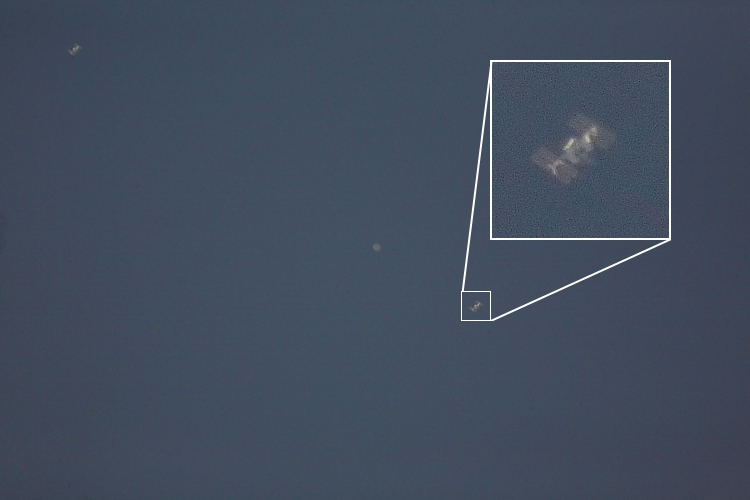
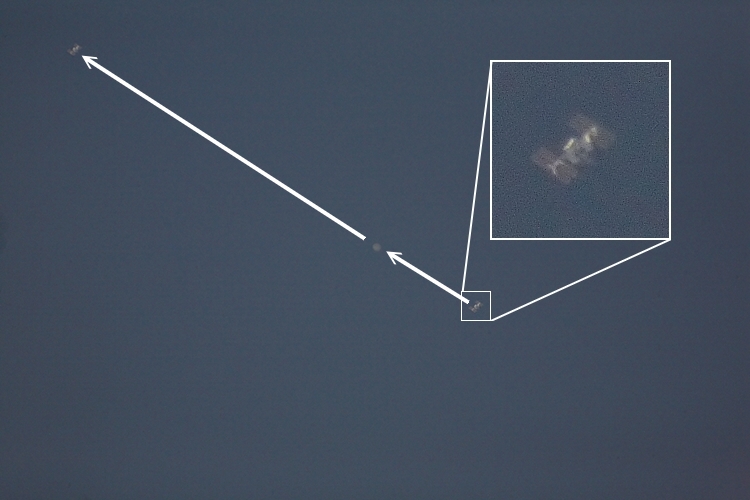 The picture on the right is the same shot, but this time he connected the two ISS images with a line. Given the size of both the ISS and Jupiter, it looks like the station flew directly in front of the planet from Anthony’s position! Had he taken that first shot literally a tenth of a second later, he would have had the picture of a lifetime. As it is, it’s still way cool.


