Mercedes-Benz’ First All-Electric Racecar Is Equipped Like a Beast

Mercedes-Benz just revealed its first all-electric racecar for the upcoming Formula E series at the 2019 Geneva Motor Show.

Silver Arrow

Mercedes-Benz just revealed its first all-electric racecar at the 2019 Geneva Motor Show.

The EQ Silver Arrow 01 will be Mercedes-Benz’ entry for the upcoming Formula E racing series at the end of this year — and it’s a beautiful vision of racing machinery beyond the age of fossil fuels.

Already in love with our Mercedes-Benz EQ Silver Arrow 01 teaser car. ? #FormulaESoonHasAMercedes #ABBFormulaE pic.twitter.com/VaKv6KWFut

— Mercedes-Benz EQ Formula E Team (@MercedesEQFE) March 4, 2019

Formula E

Formula E contenders are racecars built by automakers including Audi, BMW, Nio, Nissan, and Jaguar. German automaker Porsche is also expected to jump on board for the upcoming season.

Mercedes-Benz’ racecar has some beastly specs: 0 to 60 mph in 2.7 seconds and a total weight of nearly 2,000 pounds, largely thanks to the 52kWh battery pack. Top speed: 174 mph (280 km/h).

To put those numbers into perspective: a Formula 1 regulation racecar for the 2018 season had to have a minimum weight of 1638 pounds (734 kg). Their engines achieve close to 1000 horsepower.

A big difference between Formula E and Formula 1 is that automakers in the former are allowed to develop their own drivetrains, as The Verge points out. That’s a big deal for an EV: it means everything hooked up to the battery pack can be determined by each automaker.

Budget Racing

That’s proving to be a big draw for EV automakers: they can use the vehicles to showcase both their drivetrains and electric car offerings.

Formular E’s 2019/2020 season — the sixth so far — is set to kick off in December in Saudi Arabia’s Ad-Diriyah Street Circuit.

READ MORE: Mercedes-Benz reveals its first real all-electric racecar [The Verge]

More on Formula 1: A Guy Trained on Video Games Just Beat a Formula 1 Driver on a Real Track

The post Mercedes-Benz’ First All-Electric Racecar Is Equipped Like a Beast appeared first on Futurism.

Original post:
Mercedes-Benz’ First All-Electric Racecar Is Equipped Like a Beast

Destroying Incoming Asteroids Might Be Harder Than We Thought

Based on a new computer model, asteroids are stronger than previously expected, meaning we'd have a tougher time destroying one headed for Earth.

Armageddon 2: The Asteroid Wins

It’s a very good thing an asteroid isn’t hurtling toward the Earth right now — because our current calculations on what it would take to destroy it might be way off.

“We used to believe that the larger the object, the more easily it would break, because bigger objects are more likely to have flaws,” Charles El Mir, one of the researchers behind a new Johns Hopkins University study on asteroid collisions, said in a press release. “Our findings, however, show that asteroids are stronger than we used to think and require more energy to be completely shattered.”

Crunched Numbers

The researchers detail how they reached that conclusion in a study set for publication in the March issue of the journal Icarus.

They started by creating a new computer model to simulate what would happen if an asteroid about one kilometer (.6 miles) in diameter slammed into another, with a diameter of 25 kilometers (15.5 miles), at a speed of five kilometers per second (3.1 miles per second).

Because the Johns Hopkins team’s model took into account more smaller-scale processes than previous simulations, it was able to provide what the researchers believe is a more accurate picture of what would happen during such a collision: rather than break apart entirely, as expected by previous models, the bigger asteroid would crack only partially.

Major Threat

According to researcher K.T. Ramesh, the team’s study reveals that we need to rethink what it would take to destroy an asteroid — before we actually have to destroy one.

“We are impacted fairly often by small asteroids, such as in the Chelyabinsk event a few years ago,” Ramesh said. “It is only a matter of time before these questions go from being academic to defining our response to a major threat. We need to have a good idea of what we should do when that time comes — and scientific efforts like this one are critical to help us make those decisions.”

READ MORE: Breaking up is hard to do: Asteroids are stronger, harder to destroy than previously thought [Johns Hopkins University]

More on asteroids: Retired Astronaut: NASA Left Earth Defenseless Against Asteroids

The post Destroying Incoming Asteroids Might Be Harder Than We Thought appeared first on Futurism.

Read the rest here:
Destroying Incoming Asteroids Might Be Harder Than We Thought

Military Contractors Are Churning out New Anti-Drone Weapons

Weapons makers ranging from Boeing to Lockheed Martin are working on new anti-drone technologies — everything from laser cannons to heat-seeking missiles.

Drone Defense

The proliferation of cheap drones has given terrorists deadly new weapons, pranksters the tools to shut down major airports, and criminals the ability to scope out potential targets.

In response, according to a new story by the Wall Street Journal, weapon makers ranging from Boeing to Lockheed Martin are working on new anti-drone technologies — and they include laser cannons and heat-seeking missiles.

Gold Rush

Drones are deeply destabilizing because they’re relatively cheap, opening up strange new frontiers in security and warfare. According to the WSJ, experts estimate that anti-drone weapons will top an alarming $1.2 billion in sales next year — and $1.5 billion by 2021.

“Everyone is so preoccupied by this threat they are willing to give anything a try,” Arthur Holland Michel, the co-director of Bard College’s Center for the Study of the Drone, told the WSJ.

Buzz Off

Lockheed Martin is working on missiles to shoot down drones, according to the WSJ, and Boeing and a Chinese defense contractor are both developing laser cannons to blast them out of the sky.

A company in Singapore is working on a handheld gun that jams drones’ radio signals to take them down, the WSJ reports, and Diehl Defence is building a system that uses high-energy electronic bursts to frizzle up drones’ circuits from a distance.

Drones are “starting to become a really big problem,” Swedish defense company Saab AB executive Hakan Buskhe told the WSJ. Technology to remove drones from the sky “is something we are in discussion on with many countries and authorities around the globe.”

READ MORE: Weapon Makers Declare War on Drones [The Wall Street Journal]

More on drone warfare: The Maker of AK-47 Rifles Just Unveiled a “Suicide Drone”

The post Military Contractors Are Churning out New Anti-Drone Weapons appeared first on Futurism.

Read more here:
Military Contractors Are Churning out New Anti-Drone Weapons

Thousands of Chinese Fans Paid to See a Virtual Hologram Singer

Hologram Performance

Thousands of fans convened at Shanghai’s Mercedes-Benz arena on Saturday to see an unusual show: a virtual hologram singer named Luo Tianyi, accompanied by world famous Chinese pianist Lang Lang.

But rather than basing the holographic performance on a particular human performer’s movement and voice — the way holograms of Michael Jackson and Tupac have “performed” on stage over the last decade — Tianyi’s performance is the result of six months of hard work by roughly 200 production staff, as the South China Morning Post (SCMP) reports.

Virtual Celebrity

Because she doesn’t exist as a real person, Tianyi is an intriguing vision of the future of entertainment.

Her voice and personality are created through sophisticated tech, including motion capture and 3D modelling. A backstage voice dubber and motion-capture actress even allowed Tianyi to interact with Lang Lang in real-time.

DIY Superstar

Luo isn’t the only virtual idol out there. In Japan — where the trend caught on first — Yamaha Vocaloid-based idols such as Hatsune Miku have turned the trend into a billion dollar market.

“Luo Tianyi is perfect,” Kit Cheung Jie, a 17-year-old senior high school student in Hong Kong told the South China Morning Post. “She is not a real person so she can be whatever you want her to be. It’s like a customized idol that only belongs to you.”

READ MORE: China’s virtual idols meet their fans at the intersection of entertainment and technology [SCMP]

More on holograms: Spinning Rods Create Stunning Holograms

The post Thousands of Chinese Fans Paid to See a Virtual Hologram Singer appeared first on Futurism.

Excerpt from:
Thousands of Chinese Fans Paid to See a Virtual Hologram Singer

Freedom of Speech by Norman Rockwell – Facts about the …

Freedom of Speech was the first in a series of four paintings which depict examples of the four basic freedoms of Americans. Freedom of Speech depicts a young man who appears to be of the American working class, given his plain clothing over which he wears a plain, brown jacket. Protruding from a front pocket of the jacket is a folded document that appears to bear importance in the matter at hand.

This main character of the painting is standing in the midst of a meeting of importance to the locality in which he lives and/or works. He is surrounded by older gentlemen, wearing traditional suits and ties, but who are looking at him with a degree of curiosity mixed with consideration for the young mans oratory. The young man appears to be unfazed by his modest attire in the midst of formality, focusing instead on the subject matter that concerned him to the extent that he felt it necessary to attend this meeting and speak his mind.

Freedom of Speech was painted by renowned American artist, humorist, and painter, Norman Rockwell. The inspiration for the painting came from the State of the Union address, delivered in January of 1941 by President Franklin D. Roosevelt, in which he set forth the four basic freedoms that Americans have the right to enjoy. This painting was the first of the series and appeared on the cover of The Saturday Evening Posts February 20th issue.

Mr. Rockwell, in his usual style, includes discreet inferences in this painting which may not be immediately obvious upon initial viewing. For instance, the bench immediately in front of the young man is conspicuously empty. This has been viewed by some as an invitation to the viewer to attend the meeting as well. Others see the empty bench as a portrayal of the fact that someone did not feel compelled to attend the meeting.

Another interesting fact behind this painting is Mr. Rockwells inclusion of the faces of people he knows in his work.

And, finally, the manner in which he pointedly signs his own name in the dark background of the painting depicts his own humility in the face of such a powerful message.

See more here:

Freedom of Speech by Norman Rockwell - Facts about the ...

SEC options to rein in Elon Musk include leaning on Tesla and …

The Securities and Exchange Commission is between a rock and a hard place, experts say, in deciding what to do about what it told a judge on Tuesday is Elon Musks violation of the clear and unambiguous terms of a legal settlement the Tesla CEO made in October.

You cant stop Tweeting Elon from tweeting, but that might not be such a big problem if he exercised good judgement, Matt Kelly, editor of the Radical Compliance newsletter and a long-time observer of corporate governance and compliance issues, told MarketWatch. Instead, he repeatedly displays a deliberate, open and defiant attitude towards the role of the SEC in protecting investors from his recklessness.

SEC Chairman Jay Clayton argued at the time of the original October settlement that taking Musk out of Tesla may also harm investors, since he is so important to the company. That would be anathema to the regulators mission to protect investors.

The October settlement with the SEC resolved a fraud charge resulting from tweets Musk made about a potential Tesla take-private transaction. The SEC said in its legal filing that the requirement was necessary to prevent Musk from recklessly sending out false or inaccurate information ever again. Musk and Tesla TSLA, -3.20% had promised the SEC that the CEO would start getting pre-approval for any communications, including tweets, that might contain information material to Tesla or its shareholders.

But four months later, on Feb 19, Musk tweeted out a forecast of automobile production that was not consistent with what the company had reported in its recent earnings release and conference call.

The companys attorney, Brad Bondi, confirmed to the SEC that Musk had not sought or received pre-approval for the inaccurate tweet that was sent out to his 24 million Twitter followers.

On Tuesday U.S. District Judge Alison Nathan ordered Musk to explain by March 11 why he should not be held in contempt for violating the settlement agreement.

The SEC enforcement action was ultimately settled not just against Musk but also against Tesla, Kevin LaCroix, an attorney and executive vice president at RT ProExec, an insurance intermediary focused exclusively on officer and director liability issues, told MarketWatch.

I would think the SEC has the right to return to court to reopen the matter as to the company, too. The settlement with the company agreed to a number of measures regarding the companys board (Musk to step down as chairman, independent directors to be appointed). The SEC could say that the companys boards is falling short on supervising Musk and that violate the purposes and intent of the agreement, LaCroix told MarketWatch.

Read: Tesla finally launches $35,000 Model 3, and moves all sales online

See: Opinion: Elon Musk thinks layoffs will keep Tesla profitable as $35,000 Model 3 arrives

Tesla, the company, also agreed to adopt a senior executives communication policy that would spell out who would approve Musks communications and how that process would work. The policy, dated Dec 11, 2018, says that the board would appoint its general counsel and disclosure counsel, or in the case of unavailability, its CFO, to be the ones who could pre-approve Musks utterances.

Neither Tesla nor Bondi responded to whether the board appointed Jonathan Chang, the companys new general counsel, and Zach Kirkhorn, the companys new CFO to be Musks tweet-minders.

The SEC also required Tesla to add two new independent board members as part of the settlement. Oracle founder Larry Ellison and Kathleen Wilson-Thompson, who spent 17 years as an executive at the Kellogg Company, and currently serves as the executive vice president and global chief human resources officer of the Walgreens Boots Alliance, joined the Tesla board.

Ellison disclosed he owns 3 million shares in Tesla and has also admitted he and Musk are close friends.

The SEC has more power to force change than it lets on, Kelly told MarketWatch. It wasnt that long ago that the SEC forced Elizabeth Holmes to relinquish her control of Theranos, as settlement for fraud allegations. The board has the power to rein in Musk, even fire him. The SEC could use its enforcement leverage against Telsas independent directors to force more discipline.

The SEC can inform the board they want them to take a more active role in reigning in Musks tweets and other social media activity, said Betsy Atkins, a leading public company director serving on the board of Wynn Resorts WYNN, +0.36% , Schneider Electric SBGSY, +0.48% and Volvo Cars.

However, if I were the regulator, I would leverage Musks desire to stay on as CEO and a board member. I suspect hed be very unhappy with a 5-year ban on serving on a public company board, including Tesla.

Thats one of the SECs potential remedies, she said.

Atkins believes that market forces will cause the correction needed before any regulatory sanction, even a bigger fine for Musk, does. If I were on that board, I would be very concerned and want the company to buy additional liability insurance for directors, Atkins told MarketWatch. Plaintiffs attorneys are already circling and at some point the current directors and officers insurance carrier may become fatigued and potentially unwilling to immunize the board from the public and private litigation.

See also: Tesla makes record $920 million payment for convertible bond

Read: Even if guilty of contempt, Teslas Elon Musk unlikely to get harsh penalty, experts say

Want news about Asia delivered to your inbox? Subscribe to MarketWatch's free Asia Daily newsletter. Sign up here.

Continued here:

SEC options to rein in Elon Musk include leaning on Tesla and ...

The Zeitgeist Movement UK

Reserve your free ticket here: https://zdaylondon2019.eventbrite.co.uk The Zeitgeist Movement is a global sustainability advocacy group working through education & explicitly non-violent means to bring the world together for the common goal of human and environmental sustainability. Please join us in London to hear us & as always Z-Day gives members the opportunity to socialise, make []

Read More

The Zeitgeist Movement is a global sustainability advocacy group working through education & explicitly non-violent means to bring the world together for the common goal of human and environmental sustainability. Please join us in London to hear us & as always Z-Day gives members the opportunity to socialise, make new friends, discuss & hopefully put []

Read More

Zeitgeist Day, or Zday for short is an annual global educational symposium that works to amplify a context upon which existing/emerging scientific findings may find a concerted social imperative aiming to create a more truly responsible, sustainable, peaceful, global society. This years theme in London is based heavily on activism, what a person can set []

Read More

Hi everybody! Count down to ZDAY London 2016. Have a look at the program for the day. Theres still tickets available, so make sure you have got them as soon as possible, if youd like to guarantee your seat. Click on program image to zoom in, please. TICKETS here:https://www.eventbrite.co.uk/e/z-day-london-2016-tickets-21680330452 Thank you! And see you on []

Read More

Were glad to announce that Barb Jacobson from Basic Income UK will be speaking! She has been active in community organising since 1982, a co-ordinator of Basic Income UK and on the board of Unconditional Basic Income Europe, a network of organisations and activists in 25 countries. Basic Income UK is a collective promoting unconditional []

Read More

See the original post here:

The Zeitgeist Movement UK

KNOPPIX 8.1.0 – Linux Live System – knopper.net

KNOPPIX 8.1.0 Public Release

Also see article about the older Knoppix 8.0/CeBIT Edition on --> Golem.de

A lot of thanks for intense testing, hints and bugreports go to the participants of the Austrian Knoppix Days 2017 and the Linux User Group Hamburg Team, your feedback and bugfixes have been integrated into the public 8.1 release!

With the new Hybrid layout of the ISO file, the file can be copied directly to USB flash disk, either using standard Linux tools like dd or cp, or programs like Win32 DIsk Imager. In this case, the first partition is read-only because of the iso9660 file system. Because od that, boot options cannot be changed permanently.

A better way of installing, is using --> flash-knoppix, which will create the simpler and writable layout with one FAT32 and one Linux partition on USB flash pen. Optionally, a personal remastering can be chosen in version 8.1.

KNOPPIX 8.1 generally supports booting in UEFI and Secure Boot after installation on USB flash disk. But in order to use this feature, an entry in the UEFI firmware is necessary at first boot attempt. --> Find quick instructions here.

A.D.R.I.A.N.E. (Audio Desktop Reference Implementation And Networking Environment) is a talking menu system, which is supposed to make work and internet access easier for computer beginners, even if they have no sight contact to the computers monitor. A graphical environment with also talking programs and arbitrary magnification using compiz, is another option.

In order to create a bootable USB-medium (memory flashdisk, SD-card, digital camera with USB connector, cellphone with microSD, ...), the program flash-knoppix can be started from a running KNOPPIX system. This program installs all needed KNOPPIX files onto the FAT-formatted flashdisk, and creates a boot record for it. If desired, the target medium can be partitioned and formatted, or left in its inistal state, so that existing files stay intact. The KNOPPIX Live System starts and runs about factor 5 faster from USB flash disk than from CD or DVD!

After having copied the system to flash, using the persistent KNOPPIX image (overlay feature) or an additional Linux partition, it is possible to also store files permanently in live mode. That way, personal settings and additionally installed programs survive a reboot.

The flash-knoppix script since Knoppix 7.4.0 supports on-the-fly conversion of a DVD ISO image for direct flashing of a USB pendrive or disk. By using this, the intermediate step of burning a DVD and booting from it, can be skipped. For burning a CD or DVD, only one single .iso file matching your language and version choice, is sufficient.For using this feature, just add the name of the .iso file as commandline parameter to flash-knoppix like this:flash-knoppix KNOPPIX_V8.1DVD-2017-09-05-EN.iso

Overview of the most important functions. A complete description and listing of shortcuts can be found in the configurations of sbl, orca and compiz.

Boot options like "adriane" can easily be preset by changing syslinux.cfg after having copied the CD to a bootable memorystick using "flash-knoppix":

DEFAULT auto

to:

DEFAULT adriane

for automatically starting ADRIANE on boot. This is already default in all ADRIANE iso files.

KNOPPIX 8.1 / ADRIANE 1.7 is availablefor download via Bittorrent and from the usual KNOPPIX mirror sites.

Knopper.Net is not responsible for the content of external web pages

See the original post here:

KNOPPIX 8.1.0 - Linux Live System - knopper.net

Parts Suppliers Are Boycotting Russia’s Pistol-Shooting Android

Android Gunslinger

Russia’s gun toting robot has hit a major snag: it’s scrambling for parts after foreign suppliers cut off sales, Defense One reports.

In 2017, videos went viral of the Terminator-like android dubbed FEDOR (Final Experimental Demonstration Object Research) firing handguns at a variety of targets. Apparently foreign suppliers weren’t impressed — leaving the robot’s maker, Android Technology, scrambling for parts.

“After some of our partners… saw that the robot ‘FEDOR’ had learned to shoot, we were denied supplies,” technical director of the robot company Evgeny Dudorov told state media RIA in an interview, as interpreted by Google Translate.

Made in Russia

According to Dudorov, 40 percent of FEDOR’s components are made in Russia. But the company is aiming for a higher proportion.

“Russia will develop its own systems as a result of this export ban, but that may take some time,” Dudorov told RIA. “This announcement also demonstrates that despite the sanctions, the Russian high-tech industry was still able to get what it needed.”

According to the interview, FEDOR cost “much less” to develop than the $18 million that Boston Dynamics spent on its own humanoid, parkour-performing robot Atlas.

Space Terminator

The second iteration of FEDOR might also end up going to space on board a Russian spacecraft in the near future, Sputnik News reported back in March 2018. The so-called Federatsiya spacecraft is meant to carry astronauts to low earth orbit along with FEDOR-2 — but when or if the launch will take place is still uncertain.

When asked if Fedor could one day travel on board a Soyuz to the ISS, Dudorov did not have a clear answer.

“This issue is in discussion,” Dudorov told RIA. “If a decision is made within Roscosmos to conduct such a flight and a technical possibility appears for its implementation, then, in principle, we are ready to fulfill this task.”

READ MORE: Russia’s Pistol-Packing Robot Is Scrambling for Parts [Defense One]

More on FEDOR: FEDOR Is a Gunslinging Robot That’s Just a Skin Suit Away From Westworld

The post Parts Suppliers Are Boycotting Russia’s Pistol-Shooting Android appeared first on Futurism.

Visit link:
Parts Suppliers Are Boycotting Russia’s Pistol-Shooting Android

Energizer’s Brick-Like New Phone Has a Battery That Lasts 50 Days

A newly unveiled Energizer smartphone supposedly contains

Wish Granted

More than anything else, adult smartphone users in the U.S. wish their devices had longer battery lives.

Avenir Telecom appears to have had that desire in mind while developing the Power Max P18K Pop smartphone for Energizer.

The French telecom company unveiled the new phone at the 2019 Mobile World Congress (MWC) this week, and it’s an absolute beast of a device, containing what Avenir claims in a press release is “the highest capacity battery ever seen in a smartphone” — but don’t expect it to fit in the pocket of your skinny jeans.

Keeps Going and Going…

According to Avenir, the Energizer smartphone features an 18,000 mAh battery, enough to last for 50 days in stand-by mode. The iPhone X contains a 2,716 mAh battery, for comparison — giving the P18K Pop more than six times the capacity.

If you want to actually use the P18K Pop, you could spend 90 hours making calls, listen to 100 hours of music, and watch 48 hours of videos on just one charge, according to Avenir.

Beyond this long-lasting battery, the phone also includes 6 GB of RAM, 128 GB of storage, and five cameras, two of which are front-facing.

It’s Chonky

The trade-off for all of the P18K Pop’s battery life comes in its size — the phone is a whopping 18 millimeters thick. That’s well over double the thickness of the iPhone X, which is 7.7 millimeters.

Still, if you’re willing to forgo some form for function, the new Energizer smartphone could be worth keeping an eye on, and according to Avenir, it’ll be taking orders for the device at MWC with plans to begin deliveries this summer.

However, before you get your heart set on owning a P18K Pop, keep in mind that Avenir promised to release an Energizer smartphone with a 16,000 mAh battery in September — and that device was seemingly cancelled before it could hit the market.

READ MORE: Energizer ‘thick boi’ phone gives 50 days of battery life [BBC]

More on phone batteries: This Graphene Sticker Can Increase Your Phone’s Battery Life

The post Energizer’s Brick-Like New Phone Has a Battery That Lasts 50 Days appeared first on Futurism.

More here:
Energizer’s Brick-Like New Phone Has a Battery That Lasts 50 Days

See MIT’s Robot Land a Perfect Backflip — and Mangle Many Others

MIT's mini cheetah robot is the first four-legged bot to execute a perfect backflip — and watching it learn that skill is incredible entertaining.

Mini Cheetah

Kudos to researchers from the Massachusetts Institute of Technology for having a sense of humor.

On Thursday, a team from the illustrious tech school released a video showcasing the abilities of its latest robot creation: a 20-pound Mini Cheetah capable of executing perfect backflips — the first four-legged robot to demonstrate that skill.

But the best part of the video isn’t seeing the bot expertly backflip, spin in circles, or pronk — it’s watching all its failed attempts along the way.

Backflipping Out

The entire video is worth watching, but if you need a laugh to get you through your Friday, skip ahead to the 1:26-minute mark. That’s when MIT starts showing off the “mistakes” it made while developing the Mini Cheetah robot.

The bloopers include several failed backflip attempts and a quick scene in which the bot skitters across a floor like it’s being electrocuted. A personal favorite occurs at 1:34 when a team member gently tosses Mini Cheetah to the floor and it crumples on impact.

Now that the MIT team has worked out the kinks, maybe it can reach out to Boston Dynamics to set up a play date between Mini Cheetah and the company’s SpotMini robo-dog. Who wouldn’t want to see what sort of hijinks those two could get into?

READ MORE: MIT’s backflipping Mini Cheetah robot is too cute to fear [CNET]

More on robots: Watch the Boston Dynamics Robodog Twerk and Moonwalk to “Uptown Funk”

The post See MIT’s Robot Land a Perfect Backflip — and Mangle Many Others appeared first on Futurism.

Follow this link:
See MIT’s Robot Land a Perfect Backflip — and Mangle Many Others

North America Put More Robots to Work in 2018 Than Ever Before

The number of robot workers to join the North American workforce increased by 7 percent in 2018, according to the Association for Advancing Automation.

Auto Bots

Automation’s not just for the automotive industry anymore.

According to new statistics released by the Association for Advancing Automation (A3), an industry group promoting automation, the North American automotive industry added 12 percent fewer robots to its workforce in 2018 than in 2017.

However, a slew of other industries picked up the slack — making 2018 a record-breaking year for new robot workers.

Robot Revolution

According to A3, robot manufacturers shipped a total of 35,880 robots to customers in 2018, which is 7 percent more than in 2017. Of those, 19,178 robot workers went to automotive customers, down from 21,732 in 2017.

Many other industries saw significant increases in the number of robots added to the work force, though — food and consumer goods, life sciences, and electronics saw increases of 48 percent, 31 percent, and 22 percent, respectively.

“While the automotive industry has always led the way in implementing robotics here in North America, we are quite pleased to see other industries continuing to realize the benefits of automation,” A3 president Jeff Burnstein said in a press release.

“And as we’ve heard from our members and at shows such as Automate, these sales and shipments aren’t just to large, multinational companies anymore,” he continued. “Small and medium-sized companies are using robots to solve real-world challenges, which is helping them be more competitive on a global scale.”

Better Bots

Rob Atkinson, president of the Information Technology and Innovation Foundation, an organization focused on the intersection of tech innovation and public policy, wasn’t surprised by A3’s findings on the increases in robot workers.

“Robots are getting better, cheaper, and more versatile,” he told Axios, “and therefore can be used more effectively in more industries.”

Still, expected on not, these figures are a concrete sign that automation is spreading throughout the North American workforce — and nations need to start preparing now for the impact that will have on the future.

READ MORE: The big American robot push [Axios]

More on automation: Here’s Proof That Automation Is Transforming Every Aspect of Our Society

The post North America Put More Robots to Work in 2018 Than Ever Before appeared first on Futurism.

Read more here:
North America Put More Robots to Work in 2018 Than Ever Before

Canada Commits $150 Million to NASA’s Moon-Orbiting Space Station

Canada agrees to invest C$150 million in the U.S.'s Lunar Gateway, becoming the nation's first international partner in the ambitious space program.

Lunar Invite

In November, NASA Administrator Jim Bridenstine asked Canada to join the United States’ Lunar Gateway, an outpost it hopes to have orbiting the Moon by 2024.

“We can’t achieve what we want to achieve in space if any of us goes alone,” he said during a Canadian aerospace conference. “We want you [Canada] involved in our return to the Moon in a big way.”

It took three months, but Canada is now ready to commit to the program — and to space exploration more broadly.

Team of Two

On Thursday, Canadian Prime Minister Justin Trudeau announced that Canada would join the Lunar Gateway — committing more than $150 million Canadian dollars toward the program over the next five years.

“NASA is thrilled that Canada is the first international partner for the Gateway lunar outpost,” Bridenstine said in a press release following Trudeau’s announcement. “Space exploration is in Canada’s DNA… Our new collaboration on Gateway will enable our broader international partnership to get to the Moon and eventually to Mars.”

Space Spending

The Lunar Gateway is just one part of Canada’s future space plans — in total, Trudeau said the nation will invest more than $2 billion Canadian dollars in its space program over the next 24 years.

“Canada’s historic investment will create good jobs for Canadians, keep our astronaut program running and our aerospace industry strong and growing,” Trudeau said, “while opening up a new realm of possibilities for Canadian research and innovation.”

READ MORE: Canada’s heading to the moon: A look at the Lunar Gateway [CBC]

More on the Lunar Gateway: NASA Head: “This Time, When We Go to the Moon, We Will Stay.”

The post Canada Commits $150 Million to NASA’s Moon-Orbiting Space Station appeared first on Futurism.

Read more:
Canada Commits $150 Million to NASA’s Moon-Orbiting Space Station

New Startup Is Selling the Building Blocks of Fake Meat

Motif Ingredients is providing the building blocks of fake meat, taking complex R&D out of the hands of creatives bring meat alternatives to market.

Building Blocks

Whether you’re a vigilant vegan or a consistent carnivore, Americans are increasingly hungry for meat alternatives — and a new startup says it’s poised to make the lab-to-shelf transition easier than ever.

After a Thanksgiving filled with Tofurky and Field Roasts, Americans have gotten a taste of fake meat and the data suggests that many are taking a liking to it — even McDonalds is considering a meatless burger. But whether a business is a small startup or a mega-corporation like McDonalds, developing the technology behind new meat-alternative products is so complex that it can take years.

Now, a Ginkgo Bioworks-owned startup called Motif Ingredients says that making the building blocks of meat alternatives available to innovators will free them from hard lab work and empower them to dream up the dishes of the future, according to a new feature in Fast Company.

“We’ll put these ingredients in people’s hands and they can be creative,” Jason Kelly, CEO and cofounder of Ginkgo Bioworks told the magazine. “They can launch products; it’s not that expensive to launch a new branded product. It’s expensive to go do a giant R&D project up front.”

Painting the Pattern

New startups bringing meat alternatives to the market face the daunting task of synthesizing proteins and ingredients. Motif Ingredients wants to outsource the research and development work, which can be a challenge to even established food brands, and which it says would let alt-meat startups focus on branding, marketing, and selling their wares.

Using an automated process, Motif will work alongside its parent company, Ginkgo Bioworks, to rapidly sequence genomes and produce ingredients from microbes. After identifying vitamins and proteins in meat and animal byproducts, Motif can reproduce them using engineered yeast and bacteria in a process similar to brewing beer. The end result, it says, is a host of ingredients vital to a healthy human diet which companies producing meat-alternatives can use to create new products.

Let Them Eat Meat

By providing ingredients to the general market, Motif hopes to speed up a technical process for both startups and established food brands — because, Kelly says, feeding a hungry world will require this sort of innovative approach to sourcing food.

“There are going to 10 billion people on the planet,” Kelly said, “we just need a lot more protein than we have right now, period, from just a global nutrition standpoint.”

READ MORE: This food tech startup just raised $90 million to make it easier to invent new plant-based meats [FastCompany]

More on Meat: In the Future, the Meat You Eat Won’t Come From Living Organisms

The post New Startup Is Selling the Building Blocks of Fake Meat appeared first on Futurism.

Read this article:
New Startup Is Selling the Building Blocks of Fake Meat

DNA Ancestry Startups Have a New Target Market: The Long-Dead

Startups that sequence your DNA have a new target market, according to a new story in The Atlantic: your long-dead ancestors.

Dance With the Dead

Startups that sequence your DNA to help piece together your ancestry have a new target market, according to a story in The Atlantic: your long-dead ancestors, who may have inadvertently left behind genetic material when they licked stamps and envelopes.

“Maybe our ancestors did not realize it,” MyHeritage founder Gilad Japhet said at an industry conference last year, according to The Atlantic, but “when they were licking those stamps and the envelope flats, they were sealing their precious DNA for you forever.”

Mausoleum

MyHeritage, which is the thirdlargest DNA testing company behind 23andMe and AncestryDNA, is one of several companies interested in mining genetic data from the long dead — an intriguing yet vaguely troubling example of how big data stands to pick apart the past as well as the present.

Japhet has even said that the DNA of famous historical figures, including Winston Churchill and Albert Einstein, “is coming to MyHeritage very, very soon,” according to The Atlantic — though a spokesperson for the company declined to comment to the magazine on when those historical figures’ profiles will be available on the site.

DNA-Okay

Analyzing old DNA is much more complex than a fresh swab, according to The Atlantic — meaning that not every old envelope can be mined for genetic material.

“We have to improve our results if it’s something we can commercially sustain,” Joscelyn McBain, the founder of Totheletter DNA, another company experimenting with the service, told The Atlantic.

READ MORE: Is DNA Left on Envelopes Fair Game for Testing? [The Atlantic]

More on DNA testing: This DNA Testing Company Gave Its Data to the FBI

The post DNA Ancestry Startups Have a New Target Market: The Long-Dead appeared first on Futurism.

See the original post here:
DNA Ancestry Startups Have a New Target Market: The Long-Dead

Journalists Reported a News Story Using Machine Learning

An experiment about reporting news stories with machine learning just released its first effort — a deep dive into Lyft's IPO.

Machine Journalism

In November, the news website Quartz unveiled a bold idea: a studio, funded by the Knight Foundation, dedicated to reporting the news using machine learning techniques.

Today, the Quartz AI Studio’s first story dropped — and it’s an intriguing peek at how advancements in artificial intelligence could provide journalists with new tools for digging into public documents.

Face Lyft

For the story, Quartz reporters trained an algorithm to examine the section of ride-hailing app Lyft’s Initial Public Offering (IPO) that lists risks the company anticipates — and to identify the most “distinctive,” or unusual, things that rattle Lyft’s executives.

The resulting list of Lyft’s unusual concerns range from the fairly obvious to the moderately surprising. In addition to having concerns about “public perception,” the company’s leaders are also worried about how healthcare privacy laws will affect customers who use its service to catch rides to medical appointments. They’re also sweating whether cyberattacks could affect Amazon Web Services, which runs its platform.

Data Journalism

Quartz’s Lyft story isn’t the most groundbreaking work of journalism in the world, but it’s an interesting proof of concept about how reporters can leverage new tools to pull interesting takeaways from otherwise dry public records — and, perhaps, a preview of things to come.

“This is taking [data journalism] to the next level where we’re trying to get journalists comfortable using computers to do some of this pattern matching, sorting, grouping, anomaly detection — really working with especially large data sets,” John Keefe, Quartz’s technical architect for bots and machine learning, told Digiday back when the Quartz AI Studio first launched.

READ MORE: Here’s what Lyft talks about as risk factors that other companies don’t [Quartz]

More on machine learning: Statistician: Machine Learning Is Causing A “Crisis in Science”

The post Journalists Reported a News Story Using Machine Learning appeared first on Futurism.

More:
Journalists Reported a News Story Using Machine Learning

Looking For the Best CBD Products in a Budding Market? These Earn The Highest Marks

Lately, you’ve probably heard a lot about CBD products. Over the past few months, they’ve exploded in popularity to the point where they can be found almost everywhere, and are being used in everything from coffee to lotions to face masks. But do you actually know what CBD is? And with all the choices available, do you know how to separate the best CBD products from the rest?

CBD, or cannabidiol, is just one of over 100 different cannabinoid compounds found in cannabis plants. Historically, the most famous cannabinoid was THC – the one responsible for getting people high. However, in recent years, as the movement to legalize cannabis gained steam, it was discovered that CBD provides many of the positive benefits of THC, but without the psychoactive effects, making it more practical for everyday use.

Though there hasn’t been enough clinical research to make any definitive medical claims, many healthcare professionals are convinced CBD is effective for fighting chronic pain, inflammation, anxiety, and sleeplessness, among other aliments. CBD has also been shown to be effective in treating epilepsy, especially in children.

Today, thanks to recently passed legislation, CBD is now legal in all 50 states. However, it is not yet regulated by the FDA. As a result, some companies are making a lot of unfounded claims about what CBD can do, and are putting out some pretty questionable products. This makes it difficult for consumers to find a brand they can trust. But that’s not to say trustworthy brands don’t exist.

Mellowment: The Best CBD Products And Supplements

If you’re considering taking the plunge and trying CBD for yourself, one brand to check out is Mellowment. Their supplements are designed to “promote comfort by reducing pain, inflammation, anxiety, and sleeplessness,” allowing you to be your best self. And while that may sound new-agey, don’t let the lingo fool you. Mellowment claims to produce the most advanced, meticulously-engineered CBD supplements on the market. And Mellowment’s relationship with the most sought-after and specialized suppliers in the cannabidiol industry allows the company to continually develop innovative products, both for general comfort and more specific needs.

So if you’re interested in trying the best CBD products for yourself, here’s a complete rundown of all Mellowment has to offer:

Mellowment Low Impact

Mellowment.com

CBD has been observed to reduce stress and anxiety, and thus may be useful in treating generalized anxiety and social anxiety disorder, and possibly even post-traumatic stress disorder. Mellowment Low Impact is a full-spectrum hemp oil supplement designed to help users relieve nervous energy. It contains 10mg of CBD per capsule, derived from high-grade industrial hemp with 0.00% THC. Its small doses are intended to provide relief from stress without the side-effect of fatigue. However, you can take up to four capsules per day as needed.

Mellowment High Impact 1.0

Mellowment.com

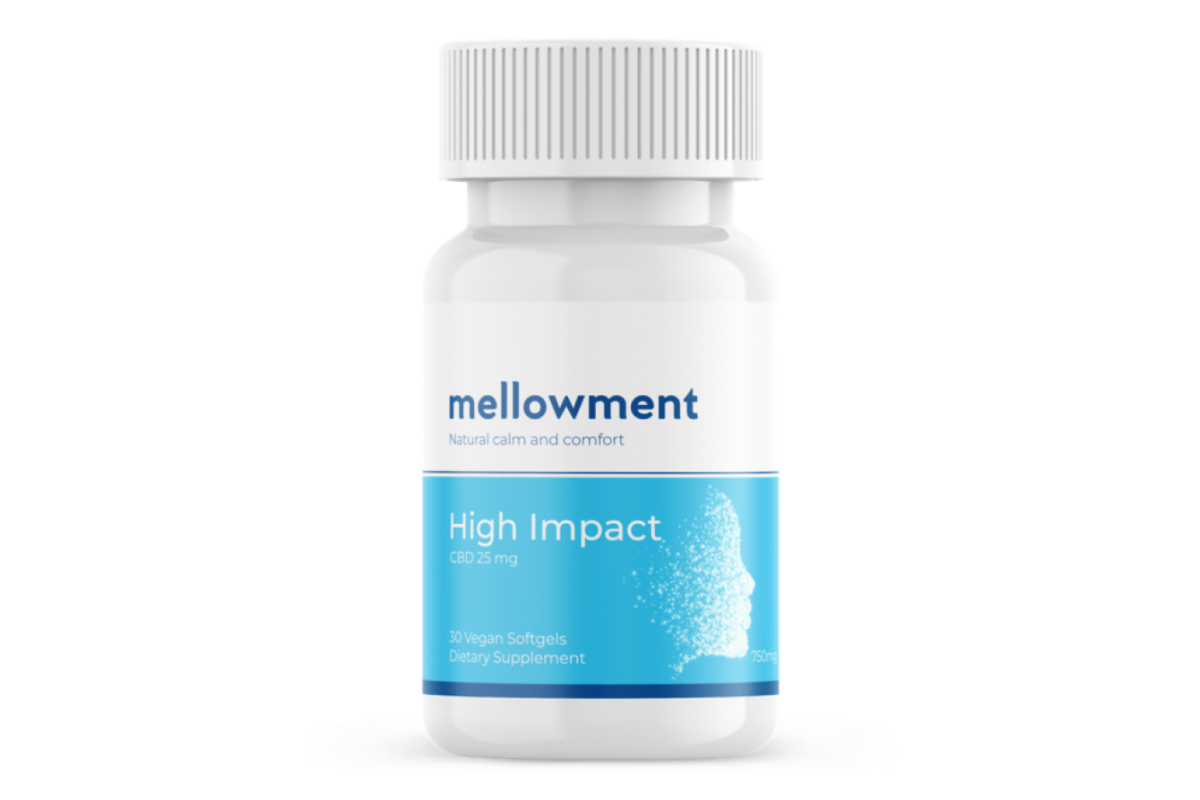
High Impact 1.0 is Mellowment’s original full strength, full-spectrum supplement. Each softgel capsule contains 25mg of full-spectrum CBD emulsified in 100% vegan coconut oil. Its formula is designed to reduce pain and inflammation, and “has been shown to help some people who suffer from chronic back pain and arthritis.” Like all Mellowment products, High Impact 1.0 contains 0.00% THC, which means it won’t make you high or fail a drug test.

Mellowment High Impact PCR

Mellowment.com

Mellowment has created some of the best CBD products on the market. But in particular, High Impact PCR is the company’s most advanced general purpose CBD supplement. It uses emulsified PCR, or phytocannabinoid-rich hemp oil, which has a higher surface area than ordinary CBD oil. That means it gets absorbed into the blood stream faster so you experience its effects sooner. Each softgel capsule contains 25mg of high-grade CBD oil. Some High Impact PCR users say they prefer this product to Mellowment Low Impact for treatment of anxiety. However, the more potent formula can cause drowsiness in some.

Mellowment High Impact PCR for Inflammation

Mellowment High Impact PCR is one of the best CBD products on the market.
Mellowment.com

This supplement is just like the Mellowment High Impact PCR, but with the addition of curcumin. Curcumin is a chemical compound found in turmeric that has been shown to decrease swelling, and has proved successful in treating conditions involving inflammation. Each softgel capsule contains 25mb of emulsified PCR CBD and 10mg of curcumin, with 0.00% THC.

A non-editorial team at Futurism has partnered with Mellowment to create this article, and we may receive a percentage of sales from this post. This supplement has not been evaluated by the FDA, and is not intended to cure or treat any ailments. Do not take CBD products if you are allergic to any of the ingredients in the product you are consuming. Tell your doctor about all medicines you may be on before consuming CBD to avoid negative reactions. Tell your doctor about all medical conditions. Tell your doctor about all the medicines you take, including prescription and nonprescription medicines, vitamins and herbal products. Other side effects of CBD include: dry mouth, cloudy thoughts, and wakefulness. You are encouraged to report negative side effects of any drugs to the FDA. Visit http://www.fda.gov/medwatch, or call 1-800-FDA-1088.

The post Looking For the Best CBD Products in a Budding Market? These Earn The Highest Marks appeared first on Futurism.

View original post here:
Looking For the Best CBD Products in a Budding Market? These Earn The Highest Marks

SpaceX Launches First U.S. Private Passenger Spacecraft to ISS

SpaceX successfully launched its (uncrewed) Crew Dragon spacecraft on a Falcon 9 rocket from NASA's Kennedy Space Center at 2:49 am EST this morning.

A Historic Launch

SpaceX successfully launched its Crew Dragon spacecraft on a Falcon 9 rocket from historic Launch Complex 39A at NASA’s Kennedy Space Center in Florida at 2:49 am EST this morning. Main engine cutoff and stage separation were confirmed by SpaceX at 2:52 am EST. First stage successfully landed on the drone ship platform Of Course I Still Love You at 3:00 am EST.

The Crew Dragon is scheduled to dock with the International Space Station early Sunday morning. It will spend about five days docked to the station before returning to Earth and splashing down in the Atlantic.

The launch marks the first time a private American rocket and spacecraft built for human passengers has ever launched to travel to the space station. An upcoming crewed mission, Demonstration Mission 2, is scheduled for July.

SpaceX and @NASA have completed thousands of hours of tests, analyses, and reviews in preparation for Crew Dragon’s first test flight to the @space_station pic.twitter.com/JvJqeoLKVy

— SpaceX (@SpaceX) February 28, 2019

There are no human astronauts on board. It does carry “Ripley,” a SpaceX dummy that will collect valuable information — using sensors all over its body — about what the experience will be like for human astronauts.

A previous version of SpaceX’s Dragon capsule built solely for cargo became the first commercial spacecraft to deliver cargo to the ISS and safely return cargo back down to Earth back in 2012.

Since then, SpaceX has flown 16 successful cargo missions to the space station on behalf of NASA using the Dragon spacecraft.

Ready to Dock

If all goes well, the Crew Dragon will rendezvous with the International Space Station at around 6:00 am EST Sunday morning to dock autonomously.

But the docking procedure is quite different this time when compared to previous Dragon missions: “Dragon was basically hovering under the ISS,” said Hans Koenigsmann, vice president of mission assurance at SpaceX during a pre-launch briefing on Thursday. “You can see how it moves back and forth and then the [Canadarm] takes it to a berthing bay.”

In contrast, the Crew Dragon’s docking system is active, he said: “it will plant itself in front of the station and use a docking port on its own, no docking arm required.”

READ MORE: Crew Demo-1 Mission [SpaceX]

More on the launch: Meet “Ripley,” the Dummy SpaceX Is Sending to the Space Station

The post SpaceX Launches First U.S. Private Passenger Spacecraft to ISS appeared first on Futurism.

More:
SpaceX Launches First U.S. Private Passenger Spacecraft to ISS

Self-Powered Sensor Helps Track Firefighters in Burning Buildings

A sensor the size of a watch battery could help track firefighters and those in dangerous working conditions.

Heated Situation

No bigger than an ordinary watch battery, adding this little sensor to firefighter’s gear could help save lives.

Researchers from McMaster University in Hamilton, Ontario announced on Friday they had created a fireproof, self-powered sensor that could be used to track people working in high-risk environments, such as firefighters, steelworkers, and miners. The research team – from McMaster, UCLA, and University of Chemistry and Technology Prague – published their work in the journal Nano Energy.

Cool Gadget

The self-powered sensor is embedded in the sole of a boot or under the arm of a jacket, areas where frequent motion can be registered by the device. The friction of motion generated in these areas charges the sensor, similar to the static charge you sometimes generate by sliding your socks on the carpet. If motion stops, the device alerts someone outside the hazardous area so help can be sent.

“If somebody is unconscious and you are unable to find them, this could be very useful,” said Ravi Selvaganapathy, a professor of mechanical engineering who oversaw the project. “The nice thing is that because it is self-powered, you don’t have to do anything. It scavenges power from the environment.”

High heat environments have posed a challenge to similar sensors. The new sensor is self-charging, since most batteries breakdown in hot environments, and thanks to its key material, a new carbon aerogel nanocomposite, it successfully withstood temperatures up to 300° Celsius (572° Fahrenheit), around the temperature most wood starts to burn.

Stayin’ Alive

The research team is hoping to connect with a commercial pattern to help make the device more accessible to a larger market. Such a device could make a world of difference to those working in hostile environments and particularly to local fire departments.

“It’s exciting to develop something that could save someone’s life in the future,” said co-author Islam Hassan, a McMaster PhD student in mechanical engineering. “If firefighters use our technology and we can save someone’s life, that would be great.”

READ MORE: Tracking firefighters in burning buildings [EurekAlert]

More on Firefighting Tech: How Machine Learning Could Help California Fight Wildfires

The post Self-Powered Sensor Helps Track Firefighters in Burning Buildings appeared first on Futurism.

See the original post:
Self-Powered Sensor Helps Track Firefighters in Burning Buildings

Why Cellphone Carriers Are Dreaming of a World Without Wi-Fi

Networked

Once relegated to coffee shops, by 2020 there will be more than 549 million global public and cable company-run Wi-Fi hot spots. As we strive to browse more, stream more, and download more, our networks will need to scale up to meet consumer demands. Enter two different visions on how companies plan to fulfill that need. While cellphone carries can’t quit Wi-Fi just yet, that doesn’t mean they aren’t eyeing the exit. Developing 5G cellular networks will increase competition between cellular network providers and Wi-Fi connection providers, according to a new analysis from the Wall Street Journal.

Two Houses

Wi-Fi and cellular networks are similar in that both will enable you to stream Netflix’s Black Mirror, or whichever show you’re streaming at present. The major differences are that cellular networks provide coverage over a large area through cellphone carriers like AT&T and Verizon, while Wi-Fi covers a more localized area and delivers a connection to the internet from Internet Service Providers.

5G networks promise to more cheaply link multiple devices to cellphone networks which network providers would love as it means more traffic and more revenue. Ronan Dunne, head of Verizon Communications Inc.’s new consumer-focused unit, told the WSJ that many customers should be able to get rid of Wi-Fi at home once 5G is rolled out and new technologies spread its signal throughout homes. But to see a world without Wi-Fi, device manufacturers would need to replace almost all the internet-connected machines on the market, adding the cost of a cellular chip to gadgets currently without one.

Wi-Fi networks are also growing into a new generation of their own. A trade group of companies which provide Wi-Fi connectivity called the Wi-Fi Alliance recently announced Wi-Fi 6 as the industry designation for its own next generation. Wi-Fi 6 boasts faster download speed, faster even than early 5G spec, although it will depend on the capabilities of your home router.

Next Wave

Both Wi-Fi and cell network providers are in a race to offer the best connection in a bid to win over consumers. While the jury is still out on whether or not 5G connectivity will be beneficial to consumers the Federal Communications Commission is taking the first step in opening up the bandwidth of radio frequencies both forms of next-gen networks will depend on. Impressive strides are being made in an attempt to demonstrate the feasibility of new networks, such as the first 5G-powered surgical telementoring. Whether consumers are ready or not, new networks are coming.

READ MORE: Cellphone Carriers Envision World Without Wi-Fi [Wall Street Journal]

More on 5G: Welcome to the Age of 5G. No One Can Agree On Whether That’s A Good Thing.

The post Why Cellphone Carriers Are Dreaming of a World Without Wi-Fi appeared first on Futurism.

Follow this link:
Why Cellphone Carriers Are Dreaming of a World Without Wi-Fi