Tentacle Robot Can Use Its Gangly Grippers To Pick Up Fragile Cargo

Who needs robot claws or imitations of the human hand when you can just throw a bunch of tentacles at a problem and see what sticks instead?

Knotty Knotty

Robotic hand and claw-like grippers haven't been able to achieve anything close to a human-like dexterity, making them a clumsy choice to pick up delicate or oddly shaped objects.

Now, researchers at Harvard's engineering school are working on an ingenious alternative: why not throw a bunch of grippy tentacles at an object and see what sticks?

Inspired by how jellyfish ensnare their prey, the tentacle gripper looks more like an unnatural creature out of a Cronenberg movie than something pulled from nature, incidentally right on time for Halloween. And hell, the tentacles are effective, according to the researchers' findings recently published in the Proceedings of the National Academy of Sciences. 

"This new approach to robotic grasping complements existing solutions by replacing simple, traditional grippers that require complex control strategies with extremely compliant, and morphologically complex filaments that can operate with very simple control," said Robert Wood, professor of engineering and applied sciences at SEAS, in a press release about the work.

Chaos Science

The tentacles, or filaments, are made of rubber and aren't very strong individually. But working together, the slithy appendages can start to grapple some pretty heavy objects. Since each individual tentacle doesn't grip strongly, even delicate cargo like plants can be ensnared without risking damage.

And there's not a lot of fancy science involved, either. No special sensors or feedback and whatnot, just some limp, gangly tentacles that are thicker on one side so when you pump them full of air, they start to curl up. When it's time to set an object down, all it takes is releasing the pressure of that inflation. Of course, the curling is pretty random and isn't always going to entangle, but with enough tentacles and enough tries, it should stick.

While there's still some more fine tuning to be done, the tentacle gripper is already a promising prototype. And the researchers envision plenty of useful applications for the technology, like retrieving fragile artifacts on the ocean floor to moving fruits and vegetables in agricultural distribution.

More on weird grippers: Scientists Turn Dead Spiders Into "Necrobotic" Arachnoborgs

The post Tentacle Robot Can Use Its Gangly Grippers To Pick Up Fragile Cargo appeared first on Futurism.

Go here to read the rest:
Tentacle Robot Can Use Its Gangly Grippers To Pick Up Fragile Cargo

Assistant Sheriff Expresses Concern About People 3D Printing Guns for Firearm Buyback Programs

An upstate New York sheriff is irked that people around the US are 3D printing firearms to turn into gun buyback programs for cold, hard cash. 

Buy It Back

An upstate New York lawman is expressing concern that people around the US are 3D printing firearms to turn into gun buyback programs for cold, hard cash.

"I know in Utica, New York, Houston, Texas, and Spartanburg, South Carolina that 3D printed guns were submitted to the gun buyback program," Robert Swenszkowski, the assistant sheriff of New York's Oneida County and, strangely, a professor at Utica University, told Spectrum News 1.

He appeared to be referring to several stories that emerged this summer, in which people in Texas, South Carolina and New York did indeed sell back guns they 3D printed at home to local authorities as part of state gun buyback programs. One man, who identified himself only as "Kem," admitted that he 3D printed more than 100 guns to turn into New York State's gun buyback program. He was awarded $21,000 for his efforts, which was paid out to him in $500 gift cards.

Regulatory Nightmare

The NY state attorney general's office confirmed that the man known as Kem had indeed exploited the program — and as Swenszkowski noted, it's unclear what to do about the loophole, given that others are doing the same in other parts of the country.

"From a public safety perspective," the Utica assistant sheriff said, "getting any gun off the street if it has the potential to harm someone may be just as effective [as buying back traditionally-manufactured guns] so there’s certainly considerations that need to be given."

"You can’t guarantee that those guns will never be used to harm someone or never be used unlawfully," Swenszkowski added in his interview with the Utica-based Spectrum News 1.

To the assistant sheriff's mind, people like Kem should be held accountable for fraud — but he admits that changing the language of these buyback programs, which currently operate on a no-questions-asked basis, may hurt their efficacy.

"It’s a catch-22," Swenszkowski said — and it's hard to argue, given the gravity of gun violence in the US today.

Updated to correct Swenszkowski's title and more accurately reflect his outlook.

More next-gen weaponry: Drama Engulfs Plan to Zap School Shooters With Taser-Toting Drones

The post Assistant Sheriff Expresses Concern About People 3D Printing Guns for Firearm Buyback Programs appeared first on Futurism.

See the original post here:
Assistant Sheriff Expresses Concern About People 3D Printing Guns for Firearm Buyback Programs

Tech Guy Shocked That Uber From NYC to Philly Is Expensive

A tech entrepreneur was shocked not only to find that he was charged crazy Uber fees for taking a car between cities, but also that he went viral for it.

Mythical Beast

Most people know better than to try to take an Uber between cities that are 100 miles apart — and as one tech guy learned in a now-viral post, people have very little sympathy for how much he got charged.

"I just took an Uber from Manhattan to Philadelphia," self-proclaimed "five-time unicorn founder" Martin Varsavsky tweeted. "In one hour and 45 minutes, different governments charged me $140 in various tolls and taxes."

The tweet was immediately met with ridicule, with Twitter users arguing those who chose to drive should foot the bill for maintaining the roads they use every day.

I just took an Uber from Manhattan to Philadelphia. In one hour and 45 minutes different governments charged me $140 in various tolls and taxes. pic.twitter.com/4ObTXtV9TK

— Martin Varsavsky ?? (@martinvars) October 24, 2022

Zoomin'

A screenshot of his partial bill shows that Varsavsky did indeed get repeatedly charged by the governments of New York, Delaware, New Jersey, and Pennsylvania, for everything from various bridge charges to highway tolls. Uber also charged him $35 for an "Out of Town Surcharge."

The tech entrepreneur argued that he didn't take the train, which he claims is his usual move when traveling between the neighboring metropolises, because he "had to be on zooms [sic] along the way" — but that excuse didn't seem to cut it for those who responded to his tweet.

"That's their way of telling you that you shouldn't be using Uber to go from Manhattan to Philadelphia," Lee Carter, a former Virginia state delegate, said. "That's what trains are for."

Climate reporter Kendra Pierre-Louis had an even more choice take. "You guys love to tout personal responsibility but roadways [don't] pay for themselves," she tweeted. "So which is it? You wanna cover the cost of bridge and tunnels or nah?"

Triggered

Varsavsky defended himself after the post went viral.

"How can people be so triggered by something like this?" he tweeted — a response which itself garnered even more responses.

"It’s because in the US we overinvest in car infrastructure and under invest in public transportation," Michael Schneider, the founder of transit advocacy group Streets for All, responded. "For example, we subsidize the cost of driving at the expense of good trains. So when you were complaining about tolls it felt tone deaf to those that are trying to change things."

We couldn't have put it better ourselves.

More infrastructure week: Europe Plots High Speed Rail So Fast It Could Replace Airlines

The post Tech Guy Shocked That Uber From NYC to Philly Is Expensive appeared first on Futurism.

Here is the original post:
Tech Guy Shocked That Uber From NYC to Philly Is Expensive

There’s a Fascinating Reason These Astronauts’ Eyes Look So Strange

Onlookers have been puzzled by the weird look in the eyes of the astronauts selected for SpaceX's Polaris Dawn mission, and there's a cool reason why.

Do Not Avert

Now that's an unnerving gaze.

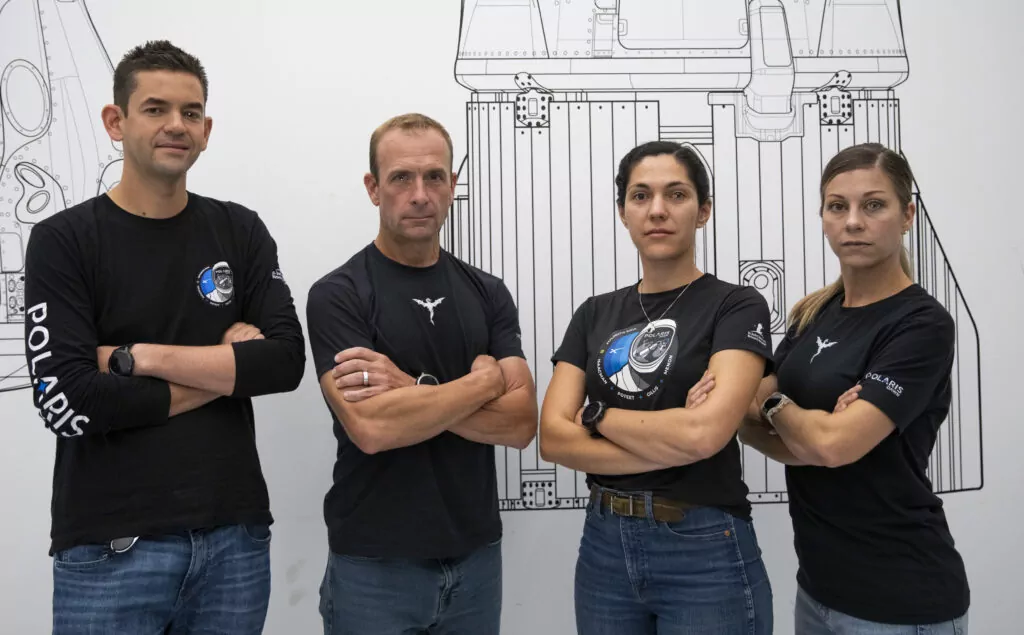
Astronauts gearing up for SpaceX's private Polaris Dawn mission have recently puzzled netizens with their strange, almost creepy eyes that look straight out of "Minority Report."

"What's with the weird Photoshop in each Polaris Dawn crew member's eye?" asked one confused Redditor.

And no, these astronauts don't owe their uncanny looks to a bad Photoshop job, but something way cooler: high tech contact lenses.

Eye Spy

Anna Menon, one of the mission's astronauts and lead space operations engineer at SpaceX, took to Twitter to provide a clear close up of the cyberpunk-looking contacts. In the video, you can see a halo-like ring of light that outlines the inside of her pupils, with a noticeable but small white rectangle reflecting brightly within it, in what's likely responsible for the white speck in the eye in pictures from afar.

"Eye will be back… for research," Menon tweeted, with the "Terminator 2: Judgment Day" theme blaring in the video to boot.

Eye will be back…for research. Polaris Dawn will carry with us on our mission 38 experiments from 23 partner institutions, including this device that measures intraocular pressure through a contact lens. See https://t.co/VHKqpel7BB for more! pic.twitter.com/QBGqziW4Ij

— Anna Menon (@annawmenon) October 24, 2022

Sans Solution

According to Menon, the specialized contact lenses will be worn by all the astronauts to measure intraocular pressure. It's part of a University of Colorado Boulder study into the recently discovered affliction called spaceflight associated neuro-ocular syndrome.

SANS, as it's more readily known, causes swelling of the optic nerve, changes in the eye's shape and structure, and as a result of all that, can blur astronauts' vision. Its long term effects aren't well known, nor are its causes, but by having the astronauts wear the micro-sensor equipped "smart" contact lenses, scientists hope to measure how the eye adapts once it enters microgravity.

The current theory maintains that fluid shifts in the eye and brain are responsible for SANS symptoms, which the scientists believe could be confirmed from the contact lenses' data.

And if the data doesn't pan out, the contact lenses at least make a unique piece of astronaut fashion.

More on SpaceX: Billionaire Buys SpaceX Moon Trip For Him and His Wife

The post There's a Fascinating Reason These Astronauts' Eyes Look So Strange appeared first on Futurism.

Read more from the original source:
There's a Fascinating Reason These Astronauts' Eyes Look So Strange

Developers are Transforming the Fyre Fest Island Into an Exclusive Colony for Crypto Millionaires, Because of Course They Are

The Fyre Fest island has reached its only natural next form: a luxury real estate colony for the crypto elite, where homes will be bought and sold via NFTs.

Scammer's Paradise

The Fyre Fest island — yup, the Bahamas locale where convicted felon Billy McFarland "hosted" the wretched music festival that never was in 2017 — has reached its natural next form: a luxury real estate colony for the crypto elite, where "60 ultra-luxe pavilions and villas" will be bought and sold exclusively by way of NFTs.

That's right. A developing group called AGIA International claims to have snagged a 60-acre slice of cursed paradise and plans to sell multimillion dollar homes via crypto wallet. Intrigued? If you want to get on the ground floor, the developers will let you on an "allowlist" for a cool $10,000. Sounds... safe.

"This is the first time an entire real estate development has been exclusively for sale on the blockchain," Matthew Salnick, AGIA's blockchain developer, said in a statement. "There's never been a 100 percent tokenized resort-style community."

Extremely Opaque

Shockingly, there's a not a lot of transparency regarding how the process actually works.

While buying an NFT might sound simple enough, buying and owning deeded, real-world properties is a lot more complicated than scooping up an expensive JPEG. And though the developers do make the vague claim that their system offers "easily traceable ownership" and "faster buying-selling across borders," NFT trading is notoriously rife with scams and hacks — what happens if someone hacks into your wallet and, uh, steals your luxe villa?

That being said, shadiness — and, to that point, offshore banking — seems to be part of the whole pitch, with developing partner and Unchained Partners CEO Hunter Williams claiming that "among other benefits," perspective buyers will have access to "Bahamian residency and access to its sophisticated offshore banking system."

On that note, it's not terribly surprising to see the first so-called community of this kind being built in the Bahamas. Earlier this year, the country's PM, Philip E. Davis, gave any and all crypto operations the green light to set up shop.

"If the world of cryptocurrency is where you see your possibilities," Davis said back in April," then the Bahamas has a place for you."

Are there a lot of details missing here? Sure. Could this be Fyre Fest times actual millions? Definitely. But hey, according to AGIA, they just saw an opportunity. After all, one man's trash is another's offshore treasure.

"We bought this property because we saw its future," Erik Sanderson, an AGIA International co-founder, said in a statement, "not its past."

READ MORE: Fyre Festival's Island Is Being Turned Into an Enclave for Crypto Millionaires

More on NFT houses: This $7.7 Million Miami Mansion Comes With a Metaverse "Twin"

The post Developers are Transforming the Fyre Fest Island Into an Exclusive Colony for Crypto Millionaires, Because of Course They Are appeared first on Futurism.

See the rest here:
Developers are Transforming the Fyre Fest Island Into an Exclusive Colony for Crypto Millionaires, Because of Course They Are

Scientists Discover That Cats Simply Do Not Give a Crap

Every cat person has suspected that their cats are ignoring them — and now, researchers seem to have proven that they're right. 

Meow Mix

Every cat person has suspected that their cats are ignoring them — and now, new research seems to support that hunch.

As a new study published in the journal Animal Cognition details, feline researchers have demonstrated that cats do appear to know when their owners are talking to them, but that sometimes, they choose to ignore it.

The researchers sat with 16 cat-people pairs who lived in studio apartments, and playing them recordings of the pair interacting, followed by recordings of the humans saying the same words they use when baby-talking their cats, but in a voice register similar to that which they'd use to speak to other humans. The researchers also played them recordings of other humans speaking to them as well, which the cats didn't respond much to at all.

To the shock of no one who's ever tried repeatedly to get their cat's attention, the felines seemed to be able to differentiate between the tone of voice used when their humans were speaking to them versus that which humans use to speak to each other. In other words, cats seem to know who's talking to them and if they're being spoken to — even if they act like they don't.

I Cat Even

The most interesting — and funniest — finding in the study, which was conducted by researchers at the Paris Nanterre University, was that some of the cats only indicated that they'd heard their person speaking to them in the baby-talk register by twitching their ears and otherwise seeming completely disinterested in the recordings.

In other instances, some of the cats would look towards the sound of their owner's kitten-babble and meow, pause its activities, or otherwise respond.

"Our results highlight the importance of one-to-one relationships for indoor companion cats," the researchers wrote in the paper, "who do not seem to generalize the communication developed with one human to all human interlocutors."

Translation: cats seem to know when their own people are talking to them — but that doesn't mean they care.

More on cats: Can Cats Infect You With a Psychosis-Inducing Brain Parasite? The Answer Is Complicated

The post Scientists Discover That Cats Simply Do Not Give a Crap appeared first on Futurism.

More:
Scientists Discover That Cats Simply Do Not Give a Crap

Scientists Say They’ve Figured Out a Way to Read Thoughts Using an MRI Machine

Researchers claim to have built a

Researchers at the University of Texas claim to have built a "decoder" algorithm that can reconstruct what somebody is thinking just by monitoring their brain activity using an ordinary fMRI scanner, The Scientist reports.

The yet-to-be-peer-reviewed research could lay the groundwork for much more capable brain-computer interfaces designed to better help those can't speak or type.

In an experiment, the researchers used MRI machines to measure the changes in blood flow — not the firing of individual neurons, which is infamously "noisy" and difficult to decrypt — to decode the broader sentiment or semantics of what three study subjects were thinking while listening to 16 hours of podcasts and radio stories.

They used this data to train an algorithm that they say can associate these blood flow changes with what the subjects were currently listening to.

The results were promising, with the decoder being able to deduce meaning "pretty well," as University of Texas neuroscientist and coauthor Alexander Huth told The Scientist.

However, the system had some shortcomings. For instance, the decoder often mixed up who said what in the radio and podcast recordings. In other words, the algorithm "knows what’s happening pretty accurately, but not who is doing the things, " Huth explained.

The algorithm was also not able to use what it had learned from one participant's brain scans semantics and apply that to another's scans, intriguingly.

Despite these shortcomings, the decoder was even able to deduce a story when participants watched a silent film, meaning that it's not limited to spoken language, either. That suggests these findings could also help us understand the functions of different regions of the brain and how they overlap in making sense of the world.

Other neuroscientists, who were not directly involved, were impressed. Sam Nastase, a researcher and lecturer at the Princeton Neuroscience Institute, called the research "mind blowing," telling The Scientist that "if you have a smart enough modeling framework, you can actually pull out a surprising amount of information" from these kinds of recordings.

Yukiyasu Kamitani, a computational neuroscientist at Kyoto University, agreed, telling The Scientist that the study "sets a solid ground for [brain-computer interface] applications."

READ MORE: Researchers Report Decoding Thoughts from fMRI Data [The Scientist]

More on reading brains: Neuralink Cofounder Leaves as Brain Company Descends Into Chaos

The post Scientists Say They've Figured Out a Way to Read Thoughts Using an MRI Machine appeared first on Futurism.

Link:
Scientists Say They've Figured Out a Way to Read Thoughts Using an MRI Machine

Companies Are Deepfaking Celebs Into Ads Without Their Permission

The likes of Elon Musk, Tom Cruise, and Leonardo DiCaprio are among some of the biggest names on the planet who are getting deepfaked into ads.

Deepening Issue

As if there weren't enough of them going around already, deepfakes are coming to advertising too, flaunting ghastly imitations of your favorite celebrities — with or without their permission.

Earlier this fall, Bruce Willis's representatives shut down reports that the actor signed a deal to get deepfaked into future productions. A year before, a Russian telecom company deepfaked the action star into a TV commercial (with permission), and the Pandora's box has been open ever since.

Now, the Wall Street Journal reports that agencies are injecting simulacra of A-listers including Tom Cruise, Leonardo DiCaprio, and Elon Musk into ads. The most worrying part, according to the WSJ? None of the last three celebrities ever agreed to appear.

Lagging Lawmaking

Sure, in most cases the uses of the deepfakes are clearly meant to be just fake enough to be funny, but the implications of the technology's use to impersonate celebs, authorized or not, is no laughing matter.

"We're having a hard enough time with fake information," Ari Lightman, a professor of digital media and marketing at Carnegie Mellon University, told the WSJ. "Now we have deepfakes, which look ever more convincing."

And US law hasn't really caught up either, especially in regards to using deepfakes in commercials. While some of the companies reportedly consulted with lawyers and/or included disclaimers, it doesn't change the fact that they're taking advantage of an extremely gray legal area. Generally speaking, the benefits of the attention gained from using the deepfakes — be it negative or positive — outweigh the risk of getting sued by such massive celebrities.

"A lot of these companies purposefully get as close to the line as possible in order to almost troll the celebrities they're targeting," explained Aaron Moss, chair of the litigation department at the law firm Greenberg Glusker, to the WSJ.

Even if a celebrity wanted to go after these companies, the ubiquity and ease of using deepfakes could make it impossible to target them all.

Unrivaled Production

What's worse is that experts believe that old contracts written before deepfake technology took off could allow advertisers to use their existing footage of a celebrity to create deepfakes of them.

And the temptation to do that is extremely strong.

"In six months, we made 10 completely different creatives and concepts with digital Bruce Willis working with different directors," said a spokesperson for Deepcake, the firm responsible for deepfaking Willis into the telecom ad, to WSJ.

"It is difficult to imagine such a production with a real actor."

More on deepfakes: This Keanu Reeves Deepfake Is Giving Us Shivers

The post Companies Are Deepfaking Celebs Into Ads Without Their Permission appeared first on Futurism.

Here is the original post:
Companies Are Deepfaking Celebs Into Ads Without Their Permission

Scientists Managed to Transmit as Much Data as the Entire Internet’s Bandwidth

Scientists have destroyed the previous data transmission record by achieving a speed of 1.84 petabits per second using only a single light source.

Blazing Speeds

The world wide web is not enough, because scientists have managed to transmit data at a staggering 1.84 petabits per second — nearly twice the amount of global internet traffic in the same interval.

That blows the previous record for data transmission using a single light source and optical chip of one petabit per second out the water. And to put that ridiculous amount into perspective, a petabit is equal to one million gigabits. A single gigabit, or 1,000 megabits, is about the fastest download speed money can buy for most households.

To achieve the astonishing feat, researchers from the Technical University of Denmark (DTU) and Chalmers University of Technology used a custom optical chip that can make use of a single infrared light by splitting it into hundreds of different frequencies that are evenly spaced apart. Collectively, they're known as a frequency comb. Each frequency on the comb can discretely hold data by modulating the wave properties of light, allowing scientists to transmit far more bits than conventional methods.

Chip on the Shoulder

In a study about the work published in the journal Nature Photonics, the scientists describe how they transmitted the 1.84 petabits per second worth of "dummy" data over 4.9 miles of optical fiber while using 223 wavelength channels in the frequency comb. According to the scientists, to transmit data at those kinds of speeds using commercial equipment would require over one thousand lasers. This experiment, using a cutting edge chip, only needed one.

"What is special about this chip is that it produces a frequency comb with ideal characteristics for fiber-optical communications," said Victor Torres Company, head of the research group and a professor at Chalmers, in a press release. "It has high optical power and covers a broad bandwidth within the spectral region that is interesting for advanced optical communications.

Scaling Up

As dizzyingly fast as the new record breaking speed is, the researchers say they're just getting started and believe speeds of up to 100 petabits per second are possible.

"The reason for this is that our solution is scalable," explained study lead author and DTU professor Leif Katsuo Oxenløwe. "Both in terms of creating many frequencies and in terms of splitting the frequency comb into many spatial copies and then optically amplifying them, and using them as parallel sources with which we can transmit data."

While the researchers' efforts have shown it's possible, it still needs to be proven to be practical. But Oxenløwe believes that his team's solution can make data transmission much more efficient, thereby leaving "a smaller climate footprint."

More on data transmission: SpaceX Has a Major Problem With Its Starlink Internet Connections

The post Scientists Managed to Transmit as Much Data as the Entire Internet's Bandwidth appeared first on Futurism.

Link:
Scientists Managed to Transmit as Much Data as the Entire Internet's Bandwidth

Research Confirms TikTok Is a Cesspool of Misinformation

According to a new report, TikTok is absolutely terrible at filtering out harmful misinformation and disinformation regarding elections and politics.

Another election cycle, another social media platform threatening democracy.

According to a new report from Global Witness and NYU's Cybersecurity for Democracy team, TikTok is absolutely terrible at filtering out harmful misinformation regarding elections and politics.

The report actually tested TikTok, Facebook, and YouTube, all of which performed pretty poorly at detecting and removing misinformation-laden advertising content uploaded by researchers. Out of those, TikTok proved to be the worst. After uploading droves of ill-informed, potentially-dangerous advertisements for approval, the researchers found that 90 percent of those fake ads were ultimately approved by the popular video app.

Although the report is still preliminary, that's an alarming figure — especially considering how quickly TikTok's growth has outpaced that of other platforms in recent years, not to mention how wildly popular it is with younger people.

"This year is going to be much worse as we near the midterms," Olivia Little, a coauthor of the report, told The Guardian. "There has been an exponential increase in users, which only means there will be more misinformation TikTok needs to proactively work to stop or we risk facing another crisis."

Per the report, the fake advertisements ranged in what might be considered severity. Some, for example, contained misleading details like incorrect election dates; some included misleading or false voting requirements; others still used language that outright discouraged citizens from voting in the midterms at all.

And while a failure to filter out that much false — and therefore, inherently dangerous — material is a bad look for any platform, it seems especially so for one that's prided itself on its policies regarding election content and political advertisements. TikTok's loudly made clear that its policies don't allow for any paid political ads; any verified political accounts are automatically disqualified from using pay-to-play tools available to influencers, and just this past August, midterms in sight, the platform announced new-and-improved policy changes designed to tackle the misinformation threat.

"At TikTok, we take our responsibility to protect the integrity of our platform — particularly around elections — with the utmost seriousness," Erik Han, the app's head of US safety, wrote in an August blog post. "To bolster our response to emerging threats, TikTok partners with independent intelligence firms and regularly engages with others across the industry, civil society organizations, and other experts."

It's worth noting that this is the second time that TikTok has very explicitly come under fire for, um, threatening American democracy in recent days. On Thursday — the same day that this report was officially released — it was revealed that TikTok's parent company, ByteDance, had been planning on using the app's location data to spy on the physical locations of specific US citizens. (It's still unclear if they actually got around to it or not.)

As the Guardian points out, the app's remarkably tailored algorithm is inextricably linked to its misinformation failures. Like any of the platform's popular dance trends, misinformation can go very viral, very quickly, as was recorded in a report from the nonprofit Mozilla during Kenya's contentious August elections.

That being said, though, TikTok's virality-happy algorithm is central to app's success. And if that's how it keeps eyeballs on its pages, it's unlikely the company will make any serious changes that jeopardize that business reality — even if, at the same time, it's struggling to keep up with the spread of mis- and disinformation.

"If the TikToks of the world really want to fight fake news, they could do it," Helen Lee Bouygue, who heads a media literacy platform called Reboot Foundation, told the Guardian. "But as long as their financial model is keeping eyes on the page, they have no incentive to do so. That's where policymaking needs to come into play."

The post Research Confirms TikTok Is a Cesspool of Misinformation appeared first on Futurism.

More:
Research Confirms TikTok Is a Cesspool of Misinformation

Creepy Deepfake Shows Biden Sing the "National Anthem": Baby Shark

Someone made an amazing, horrific deepfake of President Joe Biden singing

Doo Doo Doo Doo

Someone deepfaked a video of President Joe Biden singing "Baby Shark" and calling it our "national anthem" — and as scary as that precedent is, the video itself is pretty amazing.

"Ladies and gentlemen, and now, our great national anthem," the president is heard saying in the video before busting out into a rendition of the worst children's song earworm since "Do You Want to Build a Snowman?"

Concern Quotient

Shortly after the edited video began circulating — with right-wingers claiming alongside it, of course, that it was evidence that Biden was suffering from dementia — the Associated Press debunked the disinformation associated with the video and confirmed that it was, indeed, a deepfake.

The concept that bad actors could morph footage to make anyone say anything they want is, in a word, terrifying. When applied to a figure as powerful as an American president, those issues go from concerning to alarming, with fears that phony videos could have long-lasting repercussions or be used to control public people a la "Black Mirror."

Feats of Tech

In spite of the high creepiness factor, however, it's worth taking a moment to recognize how impressive this technology is.

While it's fairly clear that the president's voice and mouth have been edited in this specific example, an untrained eye or a cursory glance — such as on TikTok, where the video also circulated heavily — might not catch that it's a fake. That, in an of itself, is a huge feat of technology that has only just begun being perfected.

We've entered a brave new world of AI — and it's able to make creepy, hilarious, and alarming videos of the president singing children's songs and calling them the national anthem.

More AI: People Can't Stop Feeding Their Selfies Into a Super Mean AI

The post Creepy Deepfake Shows Biden Sing the "National Anthem": Baby Shark appeared first on Futurism.

Visit link:
Creepy Deepfake Shows Biden Sing the "National Anthem": Baby Shark

France Discovers Ominous Cracks in Dozens of Nuclear Reactors

Dozens of France's nuclear reactors remain offline following a series of troubling outages believed to be caused by stress-induced pipe corrosion.

Bad Reaction

Europe's energy crisis may have just gotten worse.

The Wall Street Journal reports that dozens of France's nuclear reactors — which, amid Russia's devastating stranglehold on the continent's natural gas supply, are essential to the nation's energy security — remain offline following a series of troubling outages believed to be caused by stress-induced pipe corrosion. Fixes are reportedly taking longer than anticipated, but for a struggling continent on the brink of winter, those fixes can't come quickly enough.

"It's important that this work restarts as soon as possible," Emmanuelle Wargon, head of France's energy regulator, told the WSJ. "If not, the risk of not having electricity rises."

High Pressure

The nuclear fleet in question, owned by the energy provider EDF, is comprised of 56 reactors, of which 26 are currently out for the count.

According to the WSJ, the pipe problems trace back to late last year, when a crack was discovered in a high-pressure pipe close to the reactor's core at the nation's youngest nuclear plant. Other plants, which then launched their own investigations, discovered their own stress corrosion issues shortly thereafter.

"It is only possible to identify [stress corrosion's] presence once cracking has begun," read a note from France's Institute for Radioprotection and Nuclear Safety, the WSJ reports. "Regular inspections of the pipes can only identify the phenomenon once a fault is present."

Importantly, these aren't simple fixes. Because the majority of the cracks are so close to the reactor core, radioactivity is a very real threat for technicians, whose exposure has to be limited.

And given how complicated the repairs are, French power experts are reportedly quite pessimistic about the EDF's ability to get their reactors back online for the winter, especially given that, per the WSJ's sources, the timelines for several reactor fixes have already been pushed back by at least six weeks.

Beyond the Border

These outages are clearly terrible for France, but they're just as bad for the rest of Europe, too.

Natural gas prices have skyrocketed as a result of the Russian invasion of Ukraine, which sparred a barrage of Western sanctions and Russia's subsequent retaliation by way of natural gas restriction. Nations are asking a lot of their citizens, and the continent needs any ounce of energy that it can scavenge to at least somewhat comfortably — let alone safely — get through the winter.

READ MORE: France's Nuclear Reactors Malfunction as Energy Crisis Bites [The Wall Street Journal]

More on Europe's energy crisis: Europe's Energy Crisis Is so Bad It May Have to Idle Cern's Large Hadron Collider

The post France Discovers Ominous Cracks in Dozens of Nuclear Reactors appeared first on Futurism.

See the rest here:
France Discovers Ominous Cracks in Dozens of Nuclear Reactors

Scientists Grow Superpowered THC Substance Inside Bioreactors

Israeli biotech company BioHarvest claims to have grown a powerful THC substance inside a bioreactor that is 12 times more potent.

Israeli biotech company BioHarvest claims to have grown a substance that features all the active ingredients of cannabis inside a bioreactor — and it's 12 times more potent than nature's best, The Times of Israel reports.

The company is heralding the invention as a breakthrough that could make medical cannabis cheaper and more environmentally friendly as well, since it doesn't need nearly as much water or any fertilizer at all.

"We don’t grow the plant at all," BioHarvest CEO Ilan Sobel told The Times of Israel, explaining that cells from the hemp plant are cultivated inside massive bioreactors in a lab.

The process is surprisingly quick as well.

"We grow them in huge bioreactors in just three weeks — while regular cannabis takes 14 to 23 weeks," he added. "Our tech can also significantly increase the levels of active ingredients, as a percent of the weight, versus what is found normally in the plant."

In other words, the resulting THC substance can be extremely potent — but it doesn't necessarily have to be.

"By adjusting specific conditions to which the cells are exposed, we can create different desired compositions of active ingredients, meaning we can dial up and down the various cannabinoids [compounds]," Sobel told the newspaper.

The substance also doesn't require any genetic modification and perfectly replicates all the CBD, THC, and "minor cannabinoid" compounds found in naturally grown weed, he said.

According to BioHarvest's calculations, it only needs one gallon of water to produce the same amount of material that it'd take 54 gallons to grow in plant form — and in 90 percent less space.

So what's the drawback? While the company has applied for licenses to sell its product in both the US and Israel for medical purposes, it will likely be a long and drawn-out process.

Then there's the question if people will actually be open to try it. BioHarvest claims its substance can be smoked, taken in pill or drop form, or used in chewing gum — but that's not a guarantee that consumers will embrace the new option.

Nonetheless, it's a fascinating look at a burgeoning industry. BioHarvest is even planning to test its products out in outer space, after partnering with retired Canadian astronaut Chris Hadfield.

Perhaps one day, space travelers will be able to still enjoy some recreational marijuana — without the need of maintaining an entire orbital greenhouse.

READ MORE: Cloned cannabis cells with 12 times more potency are grown in Israeli bioreactor [The Times of Israel]

More on BioHarvest: Former Astronaut Details Quest to Grow Cannabinoids in Space

The post Scientists Grow Superpowered THC Substance Inside Bioreactors appeared first on Futurism.

See the original post:
Scientists Grow Superpowered THC Substance Inside Bioreactors

Elon Musk Spotted Carrying Sink Into Twitter Headquarters

Tesla CEO Elon Musk has shared a video of himself carrying what appears to be a ceramic bathroom sink into the lobby of Twitter HQ in San Francisco.

Let That Sink In

Tesla CEO Elon Musk has shared a video of himself carrying what appears to be a ceramic bathroom sink into the lobby of Twitter HQ in San Francisco.

"Entering Twitter HQ — let that sink in!" the enigmatic billionaire wrote in the caption, clearly amused by his own dad joke.

Musk appears to be imminently ready to close the deal to buy the social media company, news that comes on the heels of months of chaotic negotiations, drama in the courts, and Musk's repeated and increasingly desperate attempts to get out of the $44 billion deal he signed with Twitter back in April.

Entering Twitter HQ – let that sink in! pic.twitter.com/D68z4K2wq7

— Elon Musk (@elonmusk) October 26, 2022

Say Hi

Employees only got very short notice of Musk's impromptu visit. According to a shared screenshot of an email reportedly sent out to staff, "Elon is in the SF office this week meeting with folks, walking the halls, and continuing to dive in on the important work you all do."

"If you're in SF and see him around, say hi!" the email reads. "For everyone else, this is just the beginning of many meetings and conversations with Elon, and you'll hear directly from him on Friday," referring to the date Musk is rumored to close the deal.

Earlier this week, Musk notified co-investors that he will close his acquisition deal on Friday. Shares jumped following the news, nearing the original acquisition price of $54,20, Reuters reports.

A lot is at stake for Twitter. The Washington Post reported last week that Musk is planning to gut the company, firing up to 75 percent of staff.

In short, Twitter employees only have days for a new reality to "sink in" — the company almost certainly has some rocky weeks and months ahead of it.

More on the debacle: Investors in Elon Musk's Twitter Deal Horrified It Might Actually Go Through

The post Elon Musk Spotted Carrying Sink Into Twitter Headquarters appeared first on Futurism.

See the original post:
Elon Musk Spotted Carrying Sink Into Twitter Headquarters

Scientists Identify Exact Number of Burgers You Can Eat Without Destroying the Earth

According to a new report, those who live in the developed world can still eat your delicious burgers and not destroy the Earth — just not too many.

Burger Kings

Rejoice, burger lovers! According to a new report from the World Resource Institute (WRI), those who live in the developed world can still eat delicious burgers and not entirely destroy the planet— as long as they make sure to cap consumption at about two normal-sized patties per week.

One catch, though: those two burgers will have to be the only meat you eat at all that week. So, uh, maybe tone down the celebration just a little.

Bunbelievable

This revelation, among many others, was found in the WRI's annual State of Climate Action report, the latest installment of which was published earlier today by the global nonprofit. For the report, researchers examined exactly how much — or, rather, how little — progress was made in 40 different key climate indicators, ranging from transport to renewable energies to, yes, meat consumption and more.

Burgers aside, we aren't exactly doing so hot in any of the categories.

Per the report, if humans are to avoid the worst of climate catastrophes, we'll have to do a lot of difficult things a lot faster than we're doing them today. Among other very tall tasks, coal will need to be phased out six times more quickly than is being done so today; the amount of available public transport has to expand, also at rates six times faster. Deforestation rates, too, must drop dramatically, while a rapid increase in the use of fossil fuels is cause for alarm as well.

"The world has seen the devastation wrought by just 1.1 [Celsius] of warming," Ani Dasgupta, the chief executive of the World Resources Institute, told The Guardian. "Every fraction of a degree matters in the fight to protect people and the planet."

Eat Your Veggies

As far as limiting meat goes, the researchers, like many others, cite agricultural emissions — a phenomenon that's been well on the rise since the dawn of the industry's industrialization — as a main cause for concern within the sector.

That being said, for cholesterol's sake, you probably shouldn't eat more than two burgers a week anyway. In any case, though, maybe this week, in the spirit of the State of Climate Action 2022, sub at least one meaty meal — burger or otherwise — for a vegetable dish instead.

"We are seeing important advances in the fight against climate change," Dasgupta continued to the Guardian, "but we are still not winning in any sector."

READ MORE: Cut meat consumption to two burgers a week to save planet, study suggests [The Guardian]

More on meat consumption: Scientists Cook Comically Tiny Lab-Grown Hamburger

The post Scientists Identify Exact Number of Burgers You Can Eat Without Destroying the Earth appeared first on Futurism.

Original post:
Scientists Identify Exact Number of Burgers You Can Eat Without Destroying the Earth

Tesla Reportedly Under Criminal Investigation for Claiming Its Cars Can Drive Themselves

Tesla is reportedly under criminal investigation by the Justice Department over its misleading marketing of its driver assisatence system Autopilot.

Death Drive

Tesla is reportedly under criminal investigation by the Justice Department over misleading marketing of its driver assistance system called Autopilot, Reuters reports.

According to Reuter's sources, the department launched an undisclosed probe last year, investigating more than a dozen crashes involving Tesla's notorious driver assistance feature, some fatal.

While we've heard of other regulators such as the National Highway Traffic Safety Administration (NHTSA) also investigating the company over the same issue, a criminal probe could signify an even higher level of scrutiny for the electric car company.

Take the Wheel

The news also comes a week after Musk announced during an earnings call that an upcoming version of the company's dubiously-named "Full Self-Driving" feature would allow owners to drive "to your work, your friend’s house, to the grocery store without you touching the wheel."

Musk also said that "it won't have regulatory approval at that time," adding that he hopes to eventually convince regulators that it is indeed safe.

It sounds like the DOJ investigation is looking at Autopilot rather than Full Self-Driving, but autonomous vehicles are clearly part of his vision — which means this probe represents a threat.

READ MORE: Exclusive: Tesla faces U.S. criminal probe over self-driving claims [Reuters]

More on Autopilot: Overwhelming Majority of Automated Driving Deaths Caused By Tesla Vehicles

The post Tesla Reportedly Under Criminal Investigation for Claiming Its Cars Can Drive Themselves appeared first on Futurism.

The rest is here:
Tesla Reportedly Under Criminal Investigation for Claiming Its Cars Can Drive Themselves

What Does White Christian Nationalism Even Mean, Anyway?

After the Jan. 6 insurrection, many wanted to understand how signs declaring Jesus Saves mixed with gallows and chants of hang Mike Pence! The answer, according to some sociologists and political analysts, was Christian nationalism.

Ever since Jan. 6, 2021, the term Christian nationalism has proliferated in discourse, but the precise definition is up for debate. Is Christian nationalism only applicable to those who welcome the label, like Georgia Republican Rep. Marjorie Taylor Greene, who sells Proud Christian nationalist t-shirts, and Southern Baptist Theological Seminary president Al Mohler, who said he wasnt going to runfrom Christian nationalism on a recent podcast episode? Or can it be applied to hanging images of Jesusin congressional offices and the post-rapture book and movie series Left Behind?

In their latest book, The Flag and the Cross, sociologists Samuel L. Perry and Philip Gorski explain Christian nationalism as a constellation of beliefs that the founding of the United States was divinely inspired or that God is invested in the success of the U.S. that manifest in political goals.

Christian nationalism, they write, exists on a spectrum, measured by agreement with statements like, The federal government should declare the United States a Christian nation, or The federal government should allow the display of religious symbols in public spaces.

Strong agreement with these Christian nationalist statements, however, does not immediately manifest in the political goals that are a threat to democracy and pluralism; Gorski and Perry specifically identify white Christian nationalism as the threat. Christian nationalist beliefs alongside white racial identity creates the political vision that seeks hegemonic power for white people.

Gorski and Perry spoke with Sojourners associate news editor Mitchell Atencio to discuss critiques of their work, debates over terminology, and whether white Christian nationalism is solely a conservative ideology.

This interview has been edited for length and clarity.

Mitchell Atencio, Sojourners: What is the importance of the term white Christian nationalism? Why not use more historically popular terms like white supremacy or Christo-fascism?

Philip Gorski: This is a question thats very much on Sams and my mind: Is white Christian nationalism just another way of saying fascism, American-style? Theres a quote, often misattributed to Sinclair Lewis, that If fascism ever comes to America, it will come draped in the flag and carrying the cross.

If you look at white supremacism historically, we tend to think of the Ku Klux Klan as an anti-Black organization which, of course, it was but it was also antisemitic, anti-Catholic, nativist. It was a white Christian nationalist organization. So its really tricky to think about this both analytically and politically. How should we talk about that? I dont have a settled opinion.

I do think that the one benefit of calling it white Christian nationalism has been that it has stimulated some productive and healthy debate among American Christians, connecting it to their faith traditions and making them think about whether or not there are assumptions theyve been carrying around or a pair of political glasses that theyve had on and helping them to maybe see that and reflect on that a little bit. I think that has been productive, but it still leaves a lot of open questions.

Samuel L. Perry: Im with Phil. I dont have a settled strong opinion on [the term] or some kind of stake in keeping the terminology as it is.

I think I have liked white Christian nationalism in that it allows these views to be considered as a spectrum of allegiance to this ideology that America is for people like us, meaning ethnically or culturally white conservative Christians.

I think people throw around the term, Christo-fascism, which, in my opinion, is rather unwieldy. Christo-fascism sounds ugly, and even broaching the topic of fascism is an immediate conversation stopper; it evokes the idea of literal Nazis. To try to ask somebody whether their political views or their cultural views approach fascism is a little bit different than saying white Christian nationalism can exist on a spectrum, and the more we move right on this spectrum of Christian nationalism, the more we approach something that we could call a nascent or proto fascism in that it links religion and nation and ethnicity in a very extreme way. I dont necessarily think we need to jettison the terminology yet, but Im not so wedded to it.

Early in the book you write that, White Christian nationalism is one of the oldest and most powerful currents in American politics. But until the insurrection, it was invisible to most Americans. As the term has become more visible, more popular, and more politicized, how do you hear folks misuse or abuse the term?

Samuel L. Perry: I think about this all the time. We have tried our best, honestly, to try to prevent [misuse.] We do this in a couple of ways.

First, I dont really like calling people Christian nationalists; I prefer to talk about the ideology itself, and somebody could be more or less adherent to it. Calling somebody a Christian nationalist is like calling somebody a racist or a fascist maybe its appropriate, and yet, at the same time, you better be ready for the conversation to stop there.

Ryan Burge, a political scientist, was bouncing around this tweetthe other day, looking at the popularity of the term. Since Marjorie Taylor Greene referenced it, searches for the term have gone up.

If youre left of center and you think anything on the right that smacks of authoritarianism or Christianity in politics is now Christian nationalism or white Christian nationalism, I think thats dangerous.

We have tried our best to indicate that it is something concrete, its not a slur to throw at people we disagree with, it is something that is actually influencing peoples beliefs, and it is embedded in the system in some ways.

[Abuse of the term] is a real danger. We are trying our best to make sure we are specific when we use that term and encouraging other people to do that as well.

Philip Gorski: Theres two dangers. The first danger is conceptual overreach, that it turns into an umbrella insult that you hurl at people you dont like like [how the right uses] socialism or woke.

The other danger is that the term gets used too narrowly, that it gets reserved for only the most extreme manifestation.

So you say, Christian nationalism, thats Doug Mastriano. Yes, but that is an extreme version of it. And, as Samuel emphasized, it is a spectrum. There are folks who might not hold views as extreme as Mastriano who are nevertheless nodding along when they hear him talking. If one danger is exaggerating the threat, the other is minimizing the threat.

Going forward not just for academic reasons, but for political reasons its gonna become important to start talking about kindred ideologies that are similar, but not identical to, Christian nationalism so that it doesnt become this catchall term for every variety of conservatism that a secular progressive doesnt like.

Is white Christian nationalism always conservative?

Philip Gorski: One of the interesting things that I discovered doing the research for this for [my previous book] American Covenant and The Flag and the Cross was that the big cheerleaders for Christian nationalism in the United States 100 to 150 years ago were not conservative Protestants; they were liberal Protestants.

I was reading about some of the debates within American Protestant denominations about Americas entry into World War I, and discovered that Shailer Mathews a prominent liberal Protestant theologian in the interwar years and dean of the University of Chicago Divinity School for several decades was on a barnstorming tour on behalf of Woodrow Wilson talking up American entry into the war. By the same token, some of the most vocal opponents of American engagement in World War I were conservative white evangelicals from the South, folks who were also proponents of the fundamentalist project that emerged during that period. So its not the case that [white Christian nationalism] has always been a conservative white evangelical thing.

Another kind of interesting figure in this regard is William Jennings Bryan, the three-time unsuccessful Democratic candidate for president who many also remember as the person who was a prosecution witness in the Scopes Monkey Trials. He was somebody who had very conservative theological beliefs, which we would now think of as fundamentalist or evangelical. And yet he was very progressive on many things with the very important exception of race.

How does that all get reshuffled in a way that Christian nationalism becomes not a liberal Protestant thing, but a conservative Protestant thing? How do conservative evangelicals become cheerleaders for America? How do they then reconcile that role with open support for white supremacism and Jim Crow and racial segregation?

Samuel L. Perry: We do find, in survey after survey, that Black Americans usually score just as high, if not sometimes higher, than white Americans on our indicators for Christian nationalism. But one of the things that is obvious as soon as you dig into the data is that those questions are interpreted differently for Black Americans compared to white Americans.

Black Americans tend to read questions on Christian nationalism through the lens of civil religion an aspirational ideal, a wouldnt it be great if America actually lived up to its professed values to be this kind of Christian nation. The kind of language, frankly, that you hear from Rev. Martin Luther King Jr. or Frederick Douglass. The aspirational language is accountability.

White Americans hear the language of Christian nationalism Christian nation, Christian heritage, or Christian values and they perceive a nostalgia, or it makes them think nostalgically for when people like us, held political and cultural influence. They think, Wouldnt it be great if we could go back to America as we knew it? It evokes this kind of idea that the right culture is losing and on the defensive and that we need to take something back to gain something that was lost. As far as the data suggests, I think theres a powerful difference between Christian nationalism as we see it manifested in historically disadvantaged minority groups versus in white Americans.

I dont like throwing around the term nationalism in a positive way because in most peoples minds it means our nation above all the others but there are positive manifestations of nationalism when it means people are advocating for their own liberty, freedom, and sovereignty over their own personhood.

Christian nationalism within a context of historically disadvantaged minority groups is more of that positive nationalism. Whereas, with white Americans, its more of an ethno-nationalism that is illiberal.

Part of what I hear you saying is that historically marginalized groups wouldnt see the Christian nationalist statements as about returning to a time where they had less rights, but rather as an aspiration.

Samuel L. Perry: Spot on. And Ill give you an example. My colleague Cyrus Schleifer and I were looking at some data that asked Americans if we should support our country even when its wrong.

And we found that the more white Americans subscribe to Christian nationalist ideology, the more likely they are to affirm that statement. So for them, Christian nationalism is about a country that is morally pure, sacred, and something that you defend as good. It has to be good because its our country.

African Americans and Latinos though, when they affirm Christian nationalist ideology, it doesnt make them any more likely to say we should support the country when its wrong. African Americans and Latinos/Hispanics dont equate Christian nationalism with the idea that my country has always been good, has always been a force for good, or always been on the side of good. They know thats not the case.

Are there any particularly good critiques of your work or of the book?

Samuel L. Perry: None that I can think of Im just kidding! This is a great thing to talk about. Academic books arent supposed to be Bibles where theyre the last word on a subject. Ideally academic works especially works of sociology are based in the best data that we have available, the best construction of concepts and arrangement of variables, and so on. And sometimes we get better data. Sometimes we get better measures. So I think its really important to acknowledge that we are watching change before our eyes. People are discussing this. We are going to look back at that book and say, Gosh, I wish we had given more attention to this or that. So thats a blanket statement I would say over any academic work.

Philip Gorski: The one point thats been raised to me a couple of times, most insightfully by Joseph Lowndes at the University of Oregon, of what to do with figures like Sen. Tim Scott (R-S.C.). [Lowndes has asked,] In what sense is white Christian nationalism white? Are you really sure that youve nailed that? Maybe its becoming something other than white.

Some believe white is people who identify as white and people who would be identified by others as white. And then, at the other end of the spectrum, there is thinking about whiteness as a culture or ideology. In that line of thought, a person of color could be white culturally; I dont think we really thought through that carefully enough.

I also wish we could gather more data on how the racial order is in flux right now. One question thats really on my mind is about Latinos particularly evangelical and Pentecostal Latinos. Latino itself is already a kind of problematic category because people come from all different countries, some peoples ancestors have been here 250 years, some have been here two and a half years, so why should we expect all those people to think the same? These questions are about whiteness and in what sense it is changing. Is Christian nationalism becoming color blind?

Samuel L. Perry: Another thing we would expand on, and this is something Im now turning my own work toward, is white Christian nationalism as a political strategy.

For example, Donald Trump wouldnt consider himself a white Christian nationalist in that he really believes those kinds of things. I dont think Trump believes in anything except winners and losers, victory, and ratings, but he sure as heck knows that white Christian nationalism is an effective strategy. He knows the rhetoric of Christian nationalism and a lot of Trump surrogates and copycat Republican progeny have embraced that rhetoric and language.

Often people are wondering, Hey, is this white Christian nationalism? when [politicians] seize upon religious rhetoric in a political context. And thats not exactly what we mean by white Christian nationalism. Were referring to the use of us versus them language to make a claim about a country that once was ours, that were trying to take back, that rightfully belongs to people like us.

All of that is to say: Its unfair, a mischaracterization, and really a dodge to look at the Black church and say, Oh, they do Christian nationalism all the time. Thats not really how were describing it. [The Black church] is not trying to go back to a time that they feel nostalgia for, a time where the right people were in power and they wanna take it back. They actually just want the country to live up to its supposed founding ideals. I dont think thats really in the proximate range of any kind of Christian nationalism.

Read the original post:

What Does White Christian Nationalism Even Mean, Anyway?

Jews, White Supremacism, and White Nationalism | National Vanguard

by David Sims

I LIKE TO ANSWER QUESTIONS that seekers ask on Quora, a widely read Web site. Here are some I have answered recently.

When did the Jews become so powerful?

Jews have been disproportionately influential since ancient times. A Roman lawyer once urged the judges he was speaking to to speak more quietly, lest the Jews overhear and begin making trouble.

Jews usually batten on White people with some sort of parasitism. They arent welfare bums, though. Oh no. Jews are elite parasites. They ran much of the slave trade in antiquity, following the Roman legions around and scooping up the wives and children of the defeated Germanic and Celtic tribes. Indeed, all (or almost all) of the shipping companies that engaged in the African slave trade to the Western Hemisphere were owned by Jews. White people were hired to work on the slave ships, but it was Jews who called the shots. And as far as owning slaves in the antebellum US, a much higher proportion of Jews than Whites owned slaves. (For that matter, a higher percentage of free Blacks also owned slaves, as compared with free Whites.)

But slavery wasnt the Jews only method for parasitism. Another was usury. It began when Jewish goldsmiths (in the Middle Ages) began lending gold entrusted to them by White nobles, and charging interest on the loans. The Jews werent supposed to do that, but they got away with it. They got so rich by doing it that they began having leverage over the governments of Europe. The Jews would agitate for war, and then theyd lend money (gold that they didnt even own) to both sides, so that each side could pay their soldiers and buy them horses and weapons and such. Usury plus war is why the history of Europe was so violent for so long. And theyre still doing it today.

What are politicians opinions on White nationalism?

Politicians in the West (Europe, UK, USA, and their satellites) are under constant pressure from Jewish groups, such as the ADL, to proclaim hatred for White nationalism. Often, they confuse it with White supremacism, which mostly does not exist today. White nationalism is the desire for White people to have a homeland for themselves alone, a place where they dont have to live with the ills and the dangers of racial diversity, a place where they can speak as they please, without being fired from a job or attacked on the street.

Jews have Israel. Whites, really, have nothing. Japan can be for the Japanese, and thats OK with the Jews but White countries (and only White countries) are, they say, for everybody, and White people can have no special claim to any territory whatsoever.

But Jews have power and money, so they get away with the obvious hypocrisy of this double standard, day after day, decade after decade.

Why does White supremacy exist?

First ask: What is White supremacism?

Supremacism is an ideology in which the supremacist believes his group has the right to rule all other human groups. The globalists, the political and financial elite that presently runs Western world affairs, is a supremacist group. It just isnt a racial one. There is a strong supremacist element in Zionism, which would make Israel the master of all other states.

White supremacism is a set of social ideas under which states that White people should rule all other human groups. That desire to rule other groups is the defining characteristic of supremacism, just the same in this case as it is for all other types of supremacism.

Prior to the American Civil War of the mid-19th century, lots of White Americans were supremacists. There were also white supremacists in the British Empire when it was at the height of its power. For the most part, these supremacists were relatively benign, intending to rule Africans and other savage folk for their own good, to raise them up, to educate them, to discourage them from killing each other so much as they did, to provide them with goods and services that they could not provide for themselves. But even this good-hearted supremacism was a moral error. The African Blacks did not deserve the benefit of being enslaved by Whites. However, it was not yet recognized that this was the true reason for the immorality of any attempt to uplift Africans, whether by slavery or by pushing them into dependence with humanitarian aid.

However, today there arent many White supremacists in the world. Todays White racialists are nationalists, and they are decidedly not supremacists. The Jewish-run leftist media continue to use the term White supremacist erroneously, and, further, they know that they are using it falsely. These media are in the business of dispensing propaganda more than information. A nationalist wants a homeland for his people, a place where they can be with each other without the unpleasant experience of having outsiders nearby. White nationalists dont want to enslave other groups. They basically just want to be left alone.

* * *

Source: Author

Excerpt from:

Jews, White Supremacism, and White Nationalism | National Vanguard

White Christian Nationalism and the Mid-Term Elections, Hosted by the …

Event description:

ISPS COSPONSORED WEBINAR CONFERENCE EVENT

What is the relationship between Christian Nationalism and other ideologies? How is the Christian Nationalist movement organized? What role will it play in the mid-term elections this November? How big a threat is it to American democracy? How does it compare to kindred movements in other parts of the world? This conference brings together scholars and journalists to discuss these and other issues.

Yale Sociology welcomes you to join us for our upcoming conference, White Christian Nationalism and the Midterm Elections. This is a 2-day conference which will be taking place at the Humanities Quadrangle, (HQ), located at 320 York Street on Friday, September 30, 2022 from 9AM-5PM in Room HQ276; and on Saturday, October 1, 2022 from 8:30AM-12PM in Room L02. The conference will be simultaneously live streamed via Zoom.

LINK HERE to register to watch the conference and type your questions via Zoom.

This event is being hosted by Philip Gorski, Professor and Chair of the Department of Sociology, with generous support from the Institution for Social & Policy Studies, the MacMillan Center, and the Faculty of Arts and Sciences (FAS) Deans Office at Yale University.

Original post:

White Christian Nationalism and the Mid-Term Elections, Hosted by the ...

Christian Nationalism Is Biblical And America-First, But Not White

If you want to know what the establishments all-seeing eye is maniacally fixated on, the amount of energy the corporate media orcs spend bludgeoning Christian nationalists provides a clue. Over the past 48 months, there have been dozens of hit jobs on the terror of Christian nationalism; there have been about a score of these smear pieces just this past month alone.

Their Pavlovian function is to condition Americans to associate the term with a bunch of extremists and racists who pose a Hitleresque threat to this countrys democratic institutions so that they will dutifully freak out. These articles rely on the same tactics: straw man arguments that misrepresent both Christianity and nationalism, and phony attempts to depict the movement as white.

Christian Nationalism is an un-Christian concept, opines the New York Times. The Christian right is beginning to part with democratic norms, laments NPR. Christian nationalism has a long dark history of white supremacy, bigotry and ties to the Nazi party, warns MSNBC. The movement uses Christian language to cloak sexism and hostility to Black people and non-White immigrants in its quest to create a White Christian America, explains CNN.

The trusted media sources who sold you Russiagate, the Hunter Biden laptop Russian disinformation hoax, and transitory inflation, are at least this time right about one thing: Christian nationalism is real, and its gaining traction. Its biblical, its America First, but its not white. Its not about a white supremacist Christian Taliban installing a theocracy, idolizing the nation, or in any way rewriting this countrys great Republican constitutional model.

In fact, Christian nationalism is entirely consistent with that model. The Declaration of Independence vests the sovereign power with the people, on loan to the government, and entrusts the state with the responsibility of safeguarding the individuals Creator-endowed rights. In asserting that the United Colonies are and ought to be Free and Independent States, the signers appealed to the Supreme Judge of the world for the rectitude of [their] intentions and committed themselves to the protection of Divine Providence. If nationalists believe that government should prioritize the interests of the country and the people, Christian nationalists believe, as did the Founders, they should do so under the banner of God.

The United States isnt special because its a nation chosen by God; its special because its a nation that chose God. The implications are entirely biblical. Holy Scripture invites individuals from every race, tribe, nation, and language to freely enter into a personal relationship with the Savior, to live by His commandments, and worship Him as King.

It also envisages, from Genesis to Isaiah, from the Gospels to the Book of Revelation, the conversion of whole nations or peoples, and warns of the inevitable harm of instead embracing a culture of idolatry, depravity, and deceit. Hence, we read in Proverbs that a nation without Gods guidance is a nation without order.

The biblical message of rightly ordered praise, an objective standard of morality, and free will is a steadying hand, tempering the self-interest of nationalism and the reactionary tendencies of its close cousin populism. When, on the other hand, generic nationalism is shaped by the coercive and unobstructed power of a godless, behemoth administrative state, grave problems arise.

This was the story of early 20th-century Germany. Hitler was not a Christian nationalist but an illiberal, anti-capitalist, anti-religious national socialist. Hitlers New Order was the culmination of a decades-long counter-Renaissance revolution in Germany. The enemy one they shared with communists was the essence of Western civilization: liberal democracy, the individual man qua man, and the majesty of God.

In his 1944 book Road to Serfdom, the Viennese Nobel Prize-winner Friedrich von Hayek warned not to repeat Germanys fate by implementing the same policies of big government, central planning, collectivism, social engineering, and the subjugation of the individual to the will of the omnipotent state. Hayeks concern was not Hitlers nationalism per se, but his socialism.

Pulitzer Prize-winning journalist Walter Lippman similarly warned about the cult of the Providential state. He wrote that a generation no longer looking confidently to God for the regulation of human affairs is now realizing what happens when men retreat from freedom to a coercive organization of their affairs.

Today, Americans are reaching the same conclusion, with evidence indicating a collapse in support for the Democrats socialist, America-last agenda. Economically, Americans recognize that the manipulation of the energy sector in the name of the bogus Green New Deal is driving up gas prices. Theyre also blaming Bidens economic mismanagement for record high inflation, a crisis the administration is now exploiting to expand the IRS by more than six times its current annual budget. Voters are losing interest in spending billions to protect Ukraines sovereignty when the U.S.s own southern border is being overrun by human and drug traffickers, sex offenders, and violent criminals.

Socially, Americans are trending toward family policies that reflect a conservative, Judeo-Christian worldview: honoring the nuclear family and parental rights, ensuring medical freedom, and fiercely protecting the innocence of children.

As much as the left fetishizes skin color, none of this is about race, although different racial groups are feeling the pain in various ways. The Biden administrations war on fossil fuels is affecting both the Native Americans whose resource-rich tribal lands bring wealth and employment to Native communities, and the predominately white Americans employed in mining, oil, and gas extraction.

Hispanics, more than any other ethnic or racial group, want the southern border closed and are registering their disapproval by flipping former Democrat strongholds on the southern border red. And with an exponential increase in business ownership to approximately 12 percent of the 27.6 million total U.S. businesses, theyre understandably not impressed by Bidens economic performance, an assessment 60 percent of black voters agree with. Parents across all racial groups overwhelmingly favor initiatives such as school vouchers and education savings accounts.

Not surprisingly then, elections in North Carolina, Virginia, Pennsylvania, Maryland, Arizona, and Michigan, reveal a gravitation toward populist candidates united not by their race or gender but by their Christian, America First principles. The message is one of decency, not degeneracy, prosperity, not pauperdom, and self-determination, not serfdom.

Its this love of God, country, and freedom trifecta that has the enemy screeching like theres no tomorrow. But its a winning formula, and the establishment fears it, which is why its hordes in the press keep militantly pounding away at those racist white supremacists every chance they get.

Carina Benton is a dual citizen of Australia and Italy and a permanent resident of the United States. A recent West Coast migr, she is now helping to repopulate the countrys interior. She holds a masters degree in education and has taught languages, literature, and writing for many years in Catholic and Christian, as well as secular institutions. She is a practicing Catholic and a mother of two young children.

Read more:

Christian Nationalism Is Biblical And America-First, But Not White