Danny Quirk – Self-Dissections

Danny Quirk skinned neck

Danny Quirk back dissection

Danny Quirk neck dissection

Danny Quirk self dissecction

Gorgeous watercolors by Massachusetts-based artist and aspiring medical illustrator, Danny Quirk.  Does this remind anyone else of Netter’s painterly style?

Danny says of his work,

My anatomical works combine classic poses, in dramatic chiaroscuro lighting, with a very contemporary twist… illustrating what’s underneath the skin, and the portrayed figure dissects a region of their body to show the structures that lay beneath.

Aspiring to become a medical illustrator, these works were done in my senior year at Pratt Institute. Always having been interested in anatomy/the body, decided to do a series of paintings combining Classical aesthetics with a surreal approach. I plan to work on this series for about another 6 months while I am taking prerequisite courses for graduate school requirements, where I intend to become a medical illustrator.

See all of Danny’s anatomical watercolors on his Behance portfolio.


Source:
http://feeds.feedburner.com/streetanatomy/OQuC

Taylor White – Dissection Deck

Taylor White Dissection Deck

Taylor White Dissection Deck

Taylor White Dissection Deck

Artist Taylor White is clearly a master at what she does and I just can’t get enough of her loose, yet precise, style.  This is her most recent work, titled Dissection, that was created for the Board exhibition currently on display at the NGV Studio in Melbourne, Australia.

Taylor says that Dissection is about “humanity, physicality and vulnerability.”

What I wouldn’t give to have this piece be part of the Street Anatomy collection!

View more of Taylor’s fantastic work on her site, taylor-white.com and her Behance portfolio.


Source:
http://feeds.feedburner.com/streetanatomy/OQuC

"Human Zoos: The Invention of the Savage," Exhibition, Musée du Quai Branly, Paris, Through June 2012


Half-naked Africans made to gnaw bones and presented as "cannibals" as they shivered in a mock tribal village in northern France; Native American children displayed at fairgrounds; families from Asia and the South Pacific behind railings in European zoos and dancing Zulus on the London stage.

Paris's most talked-about exhibition of the winter opened on Tuesday with shock and soul-searching over the history of colonial subjects used in human zoos, circuses and stage shows, which flourished until as late as 1958...

--Paris show unveils life in human zoo, The Guardian, Tuesday 29 November 2011

Wow. Finally. The exhibition I have long been waiting to see (and which just might inspire a pilgrimage!)

"Human Zoos: The Invention of the Savage," now on view at the Musée du Quai Branly in Paris through June 2012, "brings together hundreds of bizarre and shocking artefacts, ranging from posters for 'Male and Female Australian Cannibals' in London... to documentation for mock villages of 'Arabs' and 'Sengalese'" in the recounting of the under-discussed history of "exotic" humans on display from the 19th through the mid 20th Century. These kinds of display were prevalent not only abroad but also here in the United States, where they could be seen at sites ranging from World's Fairs to museums to Coney Island, as explored in the exhibit The Great Coney Island Spectacularium (on view through this summer).

More about the exhibit, from the museum website:

HUMAN ZOOS, The invention of the savage unveils the history of women, men and children brought from Africa, Asia, Oceania and America to be exhibited in the Western world in circus numbers, theatre or cabaret performances, fairs, zoos, parades, reconstructed villages or international and colonial fairs. The practice started in the 16th Century royal courts and continued to increase until the mid-20th Century in Europe, America and Japan.

A wide array of paintings, sculptures, posters, postcards, movies, photographs, mouldings, dioramas, miniatures and costumes provide insight on the scope of the phenomenon and on the success of the exotic performance industry, which captivated over a billion spectators who, between 1800 and 1958, marvelled at more than 35,000 individuals throughout the world.

Through 600 items and the screening of many film archives, the exhibition shows how this type of performance, when used as propaganda and entertainment, has fashioned the Western perspective and deeply influenced a certain perception of the Other for nearly five centuries.

The exhibition explores the sometimes fine lines between exotic individuals and freaks, science and voyeurism, exhibitionism and spectacle. It also questions visitors on their own contemporary biases.

While the exhibitions gradually disappear in the 30s, they have by then already had their effect, of setting a boundary between the exhibited and the spectators. Which begs the question: does that line still remain today?

Exhibition Path
Human zoos, The invention of the savage aims at giving back their name to women, men and children used as extras, circus freaks, actors and dancers, by telling their diverse and forgotten stories.

Based on research started over ten years ago (Pascal Blanchard, Human zoos: Science and Spectacle in the Age of Empire, Liverpool University Press, 2008), a corpus of several thousand documents from over 200 international museums and private collections (including the Prado Museum, the Paris Musée des Arts Décoratifs, the British Library, the Victoria & Albert Museum, the National Portrait Gallery, the Muséum d'Histoire Naturelle, the Frankfurt historical museum, the musée du quai Branly and the private collection gathered by the Achac research group), and cross cooperation with over thirty countries, this is the first major exhibition to internationally approach what has been called the ‘human zoos’.

In a scenography inspired by the world of theatre, the exhibition historically and thematically approaches the staging of so-called ‘exotics’ or ‘freaks’, as well as the reactions to these popular scientific or avant-garde shows throughout the world. In an audio guide, Lilian Thuram provides his comments to visitors as they walk through the exhibition to view posters, photographs, sculptures and other items, putting them in their specific context.

ACT 1 - DISCOVERING THE OTHER: REPORT, COLLECT, PRESENT

The first Act features the 15th and 18th Century arrival of exotic people in Europe, and their consideration as ‘strange foreigners’, categorized in four archetypes throughout the exhibition: the savage, the artist, the freak and the exotic ambassador.

Various media reported on the parade of Brazil’s Tupinamba ‘savages’ for the royal entrance of King Henri II in 1550 in Rouen, on the arrival of Siamese ambassadors at the Court of Versailles in 1686, on the 1654 presentation of Inuits to King Frederik II in Copenhagen and on the return of Captain James Cook to England with Tahitian ‘Noble Savage’ Omai in 1774. The latter inspired a play that was presented in Paris and London for many years…

The exhibition also features a famous portrait of Antonietta Gonsalvus painted by Lavinia Fontana (1585), depicting one of the Gonsalvus children, a family of the Canary Islands known in the 16th Century for its legendary hairiness.

ACT 2 – FREAKS & EXOTICS: OBSERVE, CLASSIFY, CATEGORIZE

The early 19th Century brings the emergence of a new genre: ethnic shows. They first develop in theater cafés before spreading to larger and larger venues and being included in exhibitions and circuses.

This process of staging the difference blurs the difference between the deformed and the foreign: physical, psychological and geographical abnormalities are first staged, and then become the focus of performances.

The first ethnic and freak shows add a new dimension to popular culture by more and more regularly bringing together exotic people alongside freaks. Case in point: Saartje Baartman, nicknamed the “Hottentot Venus”, exhibited in London and Paris in the early 19th Century. She represents a new phase of the exhibition process.

The first sho
ws fashion and structure the Western view on otherness, specifically from regions such as the various regions Europe hopes to conquer or in the process of colonizing.

In the early stages of imperial colonization, theories arise on the classification and organization of humanity and on the concept of race: an academic way of thinking that marked humanities throughout the 19th century.

ACT 3 – THE SPECTACLE OF DIFFERENCE: RECRUIT, EXHIBIT, SHARE

Between 1870 and WWII, many venues start specializing in ethnic performance as the Crystal Palace, Barnum and Bailey in Madison Square, the Paris Folies Bergères or the famous Panoptikum in Berlin. It is the time of the professionalization of the activity, and exotic performance morphs into mass entertainment.

Visitors are introduced to “actors of savageness” who become true genre professionals: Aboriginals, ‘lip-plate women’, Amazons, snake charmers, Japanese tightrope walkers or oriental belly dancers, but also the first black clown in France called “Chocolat” and drawn by Toulouse-Lautrec and legendary Buffalo Bill, whose show revolves on the native American Indian archetype, which forever brands the Far West imagery.

Unbeknownst to them, audiences encounter made-up ‘savages’. Generally paid, the exhibited actively participate in building the imagery.

ACT 4 – STAGING: EXHIBIT, MEASURE, PROFILE

Reconstructed ethnic villages, zoos, colonial and international fairs, science and spectacle merge in multiple places. Exotic peoples and physical strangeness are brought together on stage as if they both equally represented the realm of abnormality.

Excess, grandeur and ephemeral reconstructions characterize this section of the exhibition with posters and painted dioramas, film ,screenings, photographs, automates and postcards.

The practice starts in public gardens, following the one in Paris which, in 1877, is the first in Europe to exhibit tribes and groups. Such exhibitions lead to the invention of travelling Villages, like Carl Hagenbeck’s. Major tours start in 1874, and in 1878 until the 30s, international and colonial fairs include an exotic dimension to their programs.

While this trend primarily hits Europe, it also reaches America, Japan and the colonies themselves (Australia, India and Indochina), and attracts hundreds of million visitors.

You can also read the entire article from which the introductory quote was drawn by clicking here. More can be found on the museum website by clicking here. For more on The Great Coney Island Spectacularium, click here.

Thanks so much to my buddy John Troyer for sending this along.

Bottom two images from News.com.au. Captions: Top: Nineteenth century models of heads of Botoduco men on display in Human Zoos: The invention of the savage. Picture: AFP; Bottom: Busts of an English man, a Chinese man, an Algerian man and a Brazilian man as part of Human zoos, The invention of the savage. Picture: AFP

Source:
http://morbidanatomy.blogspot.com/feeds/posts/default?alt=rss

One Night Only! An Evening of Victorian Variety, Macabre Merriment, and Horror Live on Stage! The Grand Guignol Spectacular Tickets Now Available!


Tickets for my Grand Guignol Birthday Spectacular on December 10th at The Coney Island Museum are now available for purchase here. And, just to whet your whistle, I post above a sketch of the specially commissioned set by NYU’s Chris Muller which will frame this unforgettable evening of "Victorian Variety, Macabre Merriment, and Horror Live on Stage" (click on image to see larger, more detailed version.) If you are interested in attending, we urge you to to purchase tickets soon, as they are sure to sell out!

Full info for the event follows. Hope very much to see you there!

Grand Guignol Variety Show at The Coney Island Museum
Featuring classic Grand Guignol performances, film, toy theatre, song, dance, film and more, followed by a DJed after-party
Date: Saturday, December 10th
Time: 8:00 (doors at 7)
Admission: $25 (tickets available here)
Location: The Coney Island Museum, 1208 Surf Avenue, Brooklyn
Presented by Morbid Anatomy, Atlas Obscura and The Coney Island Museum and curated by Joanna Ebenstein & John Del Gaudio

From turn-of-the-century Paris through the 1960s, the Theatre of the Grand Guignol gleefully celebrated horror, sex, and fear with infamous productions featuring innocent victims, mangled beauty, insanity, mutilation, humour, sex, and monstrous depravity in a heady mix that attracted throngs of thrill-seekers from all echelons of society, making it the progenitor of today’s blood-spilling, eye-gouging, and limb-hacking “splatter” films.

Join us on December 10th at the Coney Island Museum for a one-night-only ode to The Grand Guignol and its legacy. Our evening of variety theatre was developed in conversation with Mel Gordon, author of Grand Guiginol: Theatre of Fear and Terror; Participants will include Doll Parts, Meg Moseley, Robert Munn, GF Newland, Melissa Roth, Shannon Taggart, Alison Termine, Ronni Thomas, and Kathleen Kennedy Tobin with a newly commissioned set by NYU’s Chris Muller (seen above) and the role of Master or Ceremonies filled by Lord Whimsy. Projects include stagings of two classic Grand Guignol plays, a toy theater version of Bryusov’s “The Sisters,” a harmonious and creepy rendition of “Dry Bones,” and more, all followed by an after-party with music and Hendrick’s Gin cocktails courtesy of Friese Undine.

Tickets available here.

Source:
http://morbidanatomy.blogspot.com/feeds/posts/default?alt=rss

"Dissection as Studio Practice" Illustrated Lecture and Studio Art Class with Artist Laura Splan at Observatory


I am super excited to be announcing the upcoming class "Dissection as Studio Practice" at Observatory on Sunday, January 8th. I met the teacher--Laura Splan--at a conference many years back now. Since then, I have been a big fan of her work, a few examples of which can be seen above, including--top to bottom-- an installation view of her current solo show Reformulations; a blood-on-watercolor composition entitled "Elaborative Encoding"; and 3 images from her "Doilies"series of 2004, a set of computer machine embroidered doilies with the design of each doily based on a different viral structure; pictured here, top to bottom: Herpes, Sars, and Influenza.

This class--open to all experience levels--will "survey the use of dissection in contemporary art practice through an illustrated lecture, discussion and collaborative art project"; it will also provide a terrific opportunity to work with an accomplished and sophisticated conceptual artist while gaining insight into process and method behind the creation of iconic and powerful works dealing with dissection and the body. I, for one, simply cannot wait!

Full description of the class follows. Class size is limited; if interested, be sure to RSVP via email to morbidanatomy[at]gmail.com. You can see more of Laura Splan's work by clicking here. Hope very much to see you there!

CLASS: Dissection as Studio Practice
Lecture and Studio Art Class with artist Laura Splan
Date: Sunday, January 8th
Time: 1-4 PM
Fee: $60
*** Class size is limited to 20; please RSVP to morbidanatomy[at]gmail.com

This class will survey the use of dissection in contemporary art practice through an illustrated lecture, discussion and collaborative art project. We will examine the conceptual and cultural significance of cutting, excavating, disassembling, labeling, observing and displaying “bodies.” The lecture will present a brief history of dissection as well as work by contemporary artists exploring imagery, tropes and methods of dissection. The collaborative project will be a fun and lively hands on exploration of the meaning of dissection in a work of art. Participants should bring an object, artifact or specimen to “dissect” for the group exercise. Additional supplies, tools and materials will be provided. No prior art training is required.

Laura Splan is a Brooklyn based visual artist. Her mixed media work explores historical and cultural ambivalence towards the human body. She was recently a Visiting Lecturer at Stanford University where she taught “Art and Biology” in the Art & Art History Department. She has been a Visiting Artist at the New York Academy of Sciences, California College of Art, San Francisco Art Institute, Maryland Institute College of Art, and Cal Arts. She curates the visual portal DomesticatedViscera.com. Images of her artwork can be found on her website: LauraSplan.com.

You can contact Laura through her website with any questions about the class by clicking here.

If you are interested in signing up for this class, please email me at morbidanatomy[at]gmail.com. To see more of Laura Splan's fantastic work, click here. This class is one of the newest installments in the series newly termed The Morbid Anatomy Artist Academy; to find out more about that--including a full class list thus far--click here.

Source:
http://morbidanatomy.blogspot.com/feeds/posts/default?alt=rss

Call for Work for 2nd Annual Morbid Anatomy Holiday Fair, December 17th and 18th


This year, Morbid Anatomy will be teaming up with our sister spaces Observatory and Proteus Gowanus to host a 2-day holiday fair over the weekend of December 17th and 18th, from 12-6. If any of you local artists, craftspeople, photographers and/or makers of macabre, uncanny or unusual objects, artifacts, or curiosa out there are interested in selling work, please contact us at morbidanatomy [at] gmail.com for more details. Please note: in order to participate, must be able to man your own table for the duration of the event.

Image: Crocheted Skulls by Dewey Decimal Crafts, a featured seller at last year's fair. More of her work can be found here.

Source:
http://morbidanatomy.blogspot.com/feeds/posts/default?alt=rss

Four Open Slots for Tonight’s Anthropomorphic Mouse Taxidermy Class!


Four slots have just opened up for tonight's anthropomorphic mouse taxidermy class with Susan Jeiven class at Observatory! Full details follow; if interested in attending, please email me ASAP at morbidanatomy [at] gmail.com. Emails will be considered in the order received.

Anthropomorphic Mouse Taxidermy Class with Susan Jeiven: Back by Popular Demand
Date: TONIGHT Tuesday, November 29th
Time: 7 PM-11 PM
Admission: $60
Presented by Morbid Anatomy

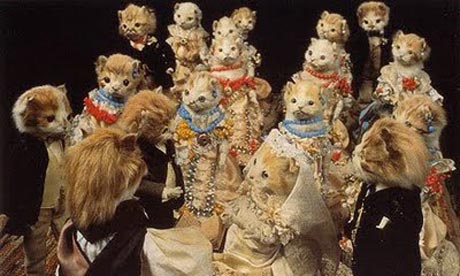
Anthropomorphic taxidermy–the practice of mounting and displaying taxidermied animals as if they were humans or engaged in human activities–was a popular art form during the Victorian and Edwardian eras. The best known practitioner of the art form is British taxidermist Walter Potter who displayed his pieces–which included such elaborate tableaux as The Death of Cock Robin, The Kitten Wedding, and The Kitten Tea Party–in his own museum of curiosities.

Tonight, please join Morbid Anatomy and taxidermist, tattoo artist and educator Susan Jeiven for a beginners class in anthropomorphic taxidermy. All materials–including a mouse for each student–will be provided, and each class member will leave at the end of the day with their own anthropomorphic taxidermied mouse. Students are invited to bring any miniature items with which they might like to dress or decorate their new friend; some props and miniature clothing will also be provided by the teacher. A wide variety of sizes and colors of mice will be available.

No former taxidermy experience is required.

Also, some technical notes:

  • We use NO harsh or dangerous chemicals.
  • Everyone will be provided with gloves.
  • All animals are disease free.
  • Although there will not be a lot of blood or gore, a strong constitution is necessary; taxidermy is not for everyone.
  • All animals were already dead, nothing was killed for this class. All mice used are feeder animals for snakes and lizards and would literally be discarded if not sold.
  • Please do not bring any dead animals with you to the class

More information can be found here. Mouse shown above was created in our last class, created by attendee Ronni Ascagni. More mice from that class can be found here.

Source:
http://morbidanatomy.blogspot.com/feeds/posts/default?alt=rss

William Cheselden Giving an Anatomical Demonstration to Six Spectators in the Anatomy-theatre of the Barber-Surgeons’ Company, London, Circa 1730/1740

In Cheselden’s time, surgeons trained through an apprenticeship during which, they would attend private anatomy lessons. Before the Anatomy Act of 1832, the only legal supply of bodies for anatomical purposes where those of criminals condemned by the courts. The Barber-Surgeons’ Company kept scrupulous control over the use of bodies dissected in their hall, with the macabre ritual of often later displaying the dissected bodies of executed criminals in niches around the walls. Cheselden himself was fined by the Company in 1714 for carrying out dissections without permission, which drew away audience members from regular lectures at the Company. With students having little opportunity to take part in dissections themselves, teachers would rely on models or anatomical preparations for class...

Image and text from The Wellcome Collection blog; you can learn more about this fabulous painting--and read the text in its entirety--by clicking here.

Full image credit: William Cheselden giving an anatomical demonstration to six spectators in the anatomy-theatre of the Barber-Surgeons' Company, London. Oil painting, ca. 1730/1740. Wellcome Images.

Source:
http://morbidanatomy.blogspot.com/feeds/posts/default?alt=rss

Grand Guignol Spectacular: Tickets Now Available, Fundrasing Drive, and Film of Final Performance!

Above is a narrated scene from the final performance--circa 1962--of the Grand Guignol, a Parisian theatre infamous from its opening in 1897 until it final performance in 1962 for naturalistic theatrical productions merging horror and elegance, sex and death, fear and humor.

To celebrate my 40th birthday this year, my friend John Del Gaudio and I are putting together a Grand Guignol-inspired variety show that will take place at The Coney Island Museum in Brooklyn this December 10th at 8:00 PM. Tickets are $25 and include not only a night of horror variety theatre, but also a masquerade after party and complementary Hendricks Gin Cocktails prepared by Friese Undine.

The evening was developed in conversation with UC Berkeley's Mel Gordon, author of Grand Guiginol: Theatre of Fear and Terror and will feature a newly commissioned set by NYU’s Chris Muller, stagings of classic Grand Guignol plays, a toy theater version of Bryusov’s “The Sisters,” short films, song and dance, WWI 3D glass plate projection with theremin accompaniment, and more.

We are in the process of trying to raise funds with which to pay all participators a modest stipend and expenses. If you are interested in contributing to this campaign--and/or in finding out more about the evening, including the full lineup thus far--click here. Donations of $100 or more earn contributers a free ticket to the festivities, while donations of lesser amounts earn you a listing in the program; donations of any amount will earn our deepest and heartfelt gratitude!

Whether you are able to contribute or not, I would love to see you at the event! Tickets for the event have just gone on sale, so if you are interested in attending, please click here to purchase.

Thanks so much, and hope to ring in a new decade with you at Coney Island!

Source:
http://morbidanatomy.blogspot.com/feeds/posts/default?alt=rss

Thom Atkinson: Wellcome Collection

Thom Atkinson votive offerings

Assorted Roman Votive Offerings - photo by Thom Atkinson

Thom Atkinson wax head

Wax head - photo by Thom Atkinson

Thom Atkinson tattoos

Preserved Tattoos, 19th century - photo by Thom Atkinson

Thom Atkinson glass eyes

Glass eyes, c1890 - photo by Thom Atkinson

Thom Atkinson decomposition

Wax model of decomposing body, c1780 - photo by Thom Atkinson

Thom Atkinson Darwin walking stick

Charles Darwin's walking stick - photo by Thom Atkinson

The Wellcome Collection if filled with some of the most interesting medical artifacts you will ever see.  Seriously, Henry Wellcome collected some weird objects, just try and picture what an anti-masturbation device looks like for a man—yes it involves spikes.

Photographer Thom Atkinson captured some of the Wellcome Collection artifacts beautifully, pulling them out of the cabinet of curiosity-type environment and showcasing them on stark backgrounds.  Thus, inviting you to take in every detail without being distracted by the fruit containing erotic scenes, what?

View all of Thom’s Wellcome photos on his portfolio site, thomatkinson.com.


[spotted by the agency I secretly want to work at, Dentsu London]


Source:
http://feeds.feedburner.com/streetanatomy/OQuC

Candace Couse: Sick/Malade

The last time we posted Calgary-based mixed media artist, Candace Couse’s knitted anatomical work, she told us that she was finishing up a film that took the viewer inside a knitted body that is “violently disrupted by the discovery of a malignant malady.  The film has finally been released to the public.  Enjoy!


The body is a magnificent system. But its harmony can be interrupted, sometimes by subversive agents within. Sick uses stop motion to bring to life a knitted body in a fanciful journey through the pulsating organs and dark recesses of the human body.

View more of Candace’s knitted anatomy on her site, candacecouse.com and on her blog, landlocked-art.blogspot.com.


Source:
http://feeds.feedburner.com/streetanatomy/OQuC

Judit Fritz Female Curiosity

Judit Fritz

Judit Fritz

Judit Fritz

Judit Fritz

We’ve posted the work of Swedish artist, Judit Fritz, before on Street anatomy and recently she told us about some of her new, more sensual, pieces.

The last time you published me, my paintings were a lot about the outter beauty of the human body. I recently started to move more and more into the body with my paintings, which probably is even more suiting for your [site].  The pics here are from a series of paintings about female curiosity of the human body, from a perspective of erotic and love.

View more of Judit’s work on her portfolio site, juditfritz.n.nu.


Source:
http://feeds.feedburner.com/streetanatomy/OQuC

SARO Street Art Sale

Last chance to purchase these unique skeletal pieces from Chicago street artist SARO in our gallery store!

SARO SkullXbones at Street Anatomy
SkullXbones – Shiny gold skull and cross bones on worn wood.
On sale for $55 at the Street Anatomy store.


SARO Dead Romance at Street Anatomy
Dead Romance – Signature cyclops skull on canva. 
On sale for $100 at the Street Anatomy store.


SARO Piggy crossed plexi glass at Street Anatomy
Crossed Piggy Plexi – Pig anatomy reverse painted on plexiglass.
On sale for $40 at the Street Anatomy store.


SARO Cyclops plexi glass at Street Anatomy

Dotted Cyclops – Signature cyclops skull reverse painted on plexiglass.

On sale for $40 at the Street Anatomy store.


Follow SARO on his Facebook page for updates on his street art around Chicago!


Source:
http://feeds.feedburner.com/streetanatomy/OQuC

Anthropomorphic Taxidermy Classes! Powerpoint Film! The Occult in Art! Upcoming Events at Observatory

Anthropomorphic taxidermy! Powerpoint films! The occult in art! Hope to see you at one or more of these great upcoming events at Observatory.

Also, please note: although the next two mouse taxidermy classes are now sold out, there are newly scheduled classes taking place on Tuesdays January 10, January 24, February 14 (special Valentine's Day edition!) and February 21. There is also a very special Holiday-themed Anthropomorphic Chick Taxidermy Class on the first night of Hanukkah, December 20 (click here for more). If interested, please send number of party and first and second date choice to morbidanatomy [at] gmail.com. Please note: these classes tend to sell out VERY quickly, sp email me as soon as possible!

taxidermy_yellow
Anthropomorphic Mouse Taxidermy Class with Susan Jeiven: Back by Popular Demand
Date: Tuesday, November 15th
Time: 7 PM-11 PM
Admission: $60
Presented by Morbid Anatomy
***
SOLD OUT

Anthropomorphic taxidermy–the practice of mounting and displaying taxidermied animals as if they were humans or engaged in human activities–was a popular art form during the Victorian and Edwardian eras. The best known practitioner of the art form is British taxidermist Walter Potter who displayed his pieces–which included such elaborate tableaux as The Death of Cock Robin, The Kitten Wedding, and The Kitten Tea Party–in his own museum of curiosities.

On Tuesday November 15th, please join Morbid Anatomy and taxidermist, tattoo artist and educator Susan Jeiven for a beginners class in anthropomorphic taxidermy. All materials–including a mouse for each student–will be provided, and each class member will leave at the end of the day with their own anthropomorphic taxidermied mouse. Students are invited to bring any miniature items with which they might like to dress or decorate their new friend; some props and miniature clothing will also be provided by the teacher. A wide variety of sizes and colors of mice will be available.

No former taxidermy experience is required.

Also, some technical notes:

  • We use NO harsh or dangerous chemicals.
  • Everyone will be provided with gloves.
  • All animals are disease free.
  • Although there will not be a lot of blood or gore, a strong constitution is necessary; taxidermy is not for everyone.
  • All animals were already dead, nothing was killed for this class. All mice used are feeder animals for snakes and lizards and would literally be discarded if not sold.
  • Please do not bring any dead animals with you to the clas

You can contact Sue with any more questions by clicking here.

Leonora Carrington  "La maja del tarot"  1965

The Occult in Modern Art 101
An illustrated lecture by Pam Grossman
Date: Friday, November 18th
Time: 8pm
Admission: $8
Presented by: Phantasmaphile

Though few history books make mention of it, many of our most lauded artists — Picasso, Kandinsky, Mondrian, Duchamp, to name but a few — were deeply influenced by the occult. The imagery and tenets of arcane traditions including alchemy, Spiritualism, Theosophy, and shamanism have infused the work of artists through the ages. Beginning with the Symbolists, then spiraling through such periods as Cubism, Dada, Surrealism (with its wonderfully witchy women), Abstract Expressionism, and the visionary art of today, this evening’s lecture will be a visual primer on the existence of magic in our museums and galleries.

Pam Grossman is an independent curator and lifelong student of magical practice and history. She is the creator of Phantasmaphile, a blog which specializes in art and culture with an esoteric or fantastical bent. Her group art shows, Fata Morgana: The New Female Fantasists, VISION QUEST, and Alchemically Yours have been featured by such outlets as Boing Boing, CREATIVE TIME, Time Out New York, Juxtapoz, Arthur, 20×200, UrbanOutfitters.com, and Neil Gaiman’s Twitter. She is a co-founder of Observatory, where her programming aims to explore mysticism via a scholarly yet accessible approach. By day, she is the Creative Planning Manager for Getty Images North America.

Image: Leonora Carrington "La maja del tarot" 1965


poster-no-comp-is-island1
“No Computer Is An Island” : PowerPoint Film with Live Musical Accompaniment
Film by James Bell and music by Paul Deuth (a.k.a. Meteorologeist)
Runtime approx 1 hr.
Date: Saturday, November 19th
Time: 8:00 PM
Admission: $5

Presented by Morbid Anatomy

“No Computer Is An Island” is a silent movie animated entirely in PowerPoint and accompanied by electronic music, mixed live during the presentation. Utilizing inventive music and limited animation presets, a depressing world of office life, shallow relationships and adult responsibility is presented in 256 colors. The presentation follows a day in the life of one workflow shape, appropriately named Bubbles, as he goes about the business of being a detached thought bubble. Other workflow characters overlap and interrupt his story, creating images that exploit the constraints of PowerPoint as an animation tool by using the conventions of silent film. “No Computer Is An Island” engages the timeless need for narrative, inviting the viewer to create meaning slide by slide.

James E. P. Bell regularly makes PowerPoint presentations in an office building in midtown Manhattan. A founding member of the interactive performance group PowerPoint, James has explored the aesthetic potential of MicroSoft Office applications in productions such as “Introduction to Change Management” (1999), “Violence in the Workplace” (2003), and now “No Computer Is An Island” (2010).

Paul Deuth is an electronic musician/composer/producer (A.K.A. Meteoro
logeist) and director of photography. With an extensive career in television, Paul most enjoys expressing himself in multi-media artistic ventures including projects with PowerPoint, Fire and Ice, Hold Please, and the Prospects. You can experience some of Paul’s music at http://www.myspace.com/meteorologeist

Onwards and Upwards:

Tuesday, November 29:

Anthropomorphic Mouse Taxidermy Class with Susan Jeiven: Back by Popular Demand. 7-11pm/$60 *** SOLD OUT

Monday, December 5: Photographing the Dead: The History of Postmortem Photography from The Burns Collection and Archive: Illustrated Lecture and book signing with Stanley B. Burns, MD, FACS 8pm/$5

Saturday, December 10: Grand Guignol Variety Show at The Coney Island Museum: Featuring classic Grand Guignol performances, antique 3D stereoscopic slides, puppet and toy theatre, song, dance, film and more, followed by after-party with cocktails courtesy of Hendrick’s Gin; support this project on IndieGoGo by clicking here 8pm/$25

Tuesday, December 13: The Missing Dimension: A Cultural History of 3D Images - Anaglyphs, Stereographs, View-Masters, Holograms, and Flaming Arrows Coming Right at You!: Illustrated lecture on and in 3D (glasses provided) by artist and NYU Professor Chris Muller 8pm/$5

Saturday, December 17: “Oddities” Marathon and Season Launch Party: Screening of TV’s “Oddities” followed by after party with MC Lord Whimsy, giveaways, special drinks, and DJ 8pm/$8

Tuesday, December 20: Anthropomorphic Chick Taxidermy Class with Susan Jeiven: Limited class size; must RSVP to morbidanatomy [at] gmail.com 7-11pm/$60

Sunday, January 8: CLASS: Dissection as Studio Practice: Lecture and Studio Art Class with artist Laura Splan *** Class size is limited; Must RSVP to morbidanatomy[at]gmail.com 1-4pm/$60

Thursday, January 26: The Search for Granny-Dump Mountain: Illustrated lecture by Journalist Justin Nobel 8pm/$5

Sunday, January 29: Class: Mummification: Learn the art and ritual of animal mummification with instructor Sorceress Cagliastro *** Limited Class Size; Please RSVP to morbidanatomy [at] gmail.com 1-4pm/$65

Thursday, February 2: PERFORMANCE: Buried Alive! A Matchbox Theatre: A matchbox theatre performance by Deborah Kaufmann 8pm/$12

Friday, February 3: PERFORMANCE: Buried Alive! A Matchbox Theatre: A matchbox theatre performance by Deborah Kaufmann 8pm/$12

More on Observatory can be found here. To sign up for events on Facebook, join our group by clicking here. To sign up for our weekly mailer, click here.

Source:
http://morbidanatomy.blogspot.com/feeds/posts/default?alt=rss