Seeing The Littlest, Cutest Voltron Of Them All Made Me Melt [Image Cache]

If I ever have a daughter, I'm letting her wear any costume she wants. But—in the name of all that is sweet, sugary, and adorable—I hope she wants a Voltron one like this. Update: Now with how-it-was-made pictures!

I wonder what this little girl is thinking in that picture—aside from "Thanks, dad!" [Albotas via Kotaku]

Update: Thanks to Twitter user Nelson, we've found pictures of how this costume was put together by "Grim Hammer," this cutie's dad:

More photos and comments on how the costume was made can be found here.


Why Can’t My Xbox Be A Windows 7 PC And Vice Versa: Industry Insiders (And A Gizmodo Writer) on Windows’ Future [Microsoft]

How can Microsoft keep Windows relevant? Technologizer decided to approach journalists, bloggers, and industry insiders to discuss just what they think needs to happen in future versions of the operating system.

Hit up the link to see what Kara Swisher of All Things D, Microsoft Employee #77, tech columnist Ed Baig, our own Matt Buchanan, and others had to say. [Technologizer]


MSI Wind U160 Netbook Claims Aggressive 15-Hour One-Charge Power [Msi]

MSI has updated their netbook line once again. While the U130 and U135 already packed Intel's latest Pine Trail processor, the U160 is throwing down the battery gauntlet. Fifteen hours on one charge? That's nuts.

Of course, it's not really fifteen hours, since actual battery life is never anywhere close to listed. And the claim only applies to when the netbook is in "Eco" mode, which undoubtedly requires a significant performance trade-off. But even if the U160 can achieve 60% of its claim during normal usage, that's as impressive a netbook battery life as we've seen.

The $380 price tag also includes a 10-inch LED display (1024x600), the Pine Trail's standard 1GB RAM, and and Windows 7 Starter. But you'll have to make do with a 160GB HD and an island-style keyboard, which on a netbook doesn't leave a lot of room for error. But—especially if the battery life claim holds up—you could certainly do worse for more money.

MSI North America Announces Availability of the 2010 iF Product Design Award Winning Wind U160
Stylish new netbook features Pine Trail Platform, 15-Hour Battery Life, and Windows 7

CITY OF INDUSTRY, CA – March 08, 2010 – MSI Computer, a leading manufacturer of computer hardware products and solutions, is proud to announce the availability of the 2010 iF Product Design Award Winning Wind U160. The U160, MSI's second netbook to feature the new Pine Trail platform, is powered by the Intel® Atom N450™ Processor. The incredibly efficient and Energy Star compliant U160 boosts a 15 hour battery life when running in MSI's exclusive ECO mode. This allows users to get through a full day of work or school without having to bring their adapter.

Abandoning the traditional clamshell form, the Wind U160 ushers in a new era of netbook design. From the illuminated MSI logo on the netbook's outer surface to the power button placed on the U160's cylindrical hinge, the newest Wind model sports a slim new footprint. Just 0.98 inches at its widest point, the U160 is the thinnest Wind model to date.

The units' raised chiclet keyboard and seamless wide touchpad increase both accuracy and comfort while typing. The U160 is available in a fashionable sparkling gold or a more formal black, and its Color Film Print finish gives it a sleek stylish new look.

The newest edition to the Wind family will also ships with 10-inch backlit LED display, 1 GB of DDR2 memory, a 160GB hard drive, a 6-cell battery, Bluetooth connectivity and Microsoft's Windows 7 Starter. MSI also included its user friendly EasyFace facial recognition security software to help U160 users protect their information.

The MSI Wind U160 costs just $379.99 and is available now at Fry's (Fry's product number L1600) and online at Newegg and Buy.com.


Nanotubes + Waves of Heat = A Brand New Way to Make Electricity | 80beats

nanotubesCarbon nanotubes have shown the potential to help us take better x-ray images, make cheaper hydrogen fuel cells, and replace silicon in computer chips. Add another possibility onto the pile: MIT researchers report this week in Nature Materials that they’ve used carbon nanotubes to create thermopower waves, a system they say could put out 100 times more energy than a lithium-ion battery.

Michael Strano’s team coated the tubes, which are only billionths of a meter across, with a fuel. This fuel was then ignited at one end of the nanotube using either a laser beam or a high-voltage spark, and the result was a fast-moving thermal wave traveling along the length of the carbon nanotube like a flame speeding along the length of a lit fuse [Environmental News Service]. That wave travels 10,000 times the typical speed of this chemical reaction, and the heat blasts electrons down the tubes. Voila, electric current.

This previously unknown phenomenon opens up an entirely new area of energy research, Strano says, and the technology’s potential applications are exciting. Strano envisions thermopower waves that could enable ultra-small electronic devices, no larger than a grain of rice, perhaps a sensor or treatment device that could be injected into the body. Or they might be used in “environmental sensors that could be scattered like dust in the air,” he says [Environmental News Service].

In Strano’s experiments, the process actually created more electricity than their calculations predicted, probably because the system creates the phenomenon called electron entrainment. The thermal wave, he explains, appears to be entraining the electrical charge carriers, either electrons or electron holes, just as an ocean wave can pick up and carry a collection of debris along the surface [Environmental News Service].

That could make thermopower waves extremely useful in the future. Densely packed nanotubes could also lead to ultracapacitors capable of storing far more power than today’s capacitors [Greentech Media]. Strano says it might also be possible to make the wave oscillate, producing the kind of alternating current used in so many modern technologies. For now, though, the team is focused on making the waves more efficient by reducing the amount of energy lost as heat and light.

Related Content:
DISCOVER: Future Tech: The Carbon Nanotube Grows Up
80beats: Carbon Nanotubes Could Replace Platinum And Lead to Affordable Hydrogen Cars
80beats: Nanotubes Could Provide the Key to Flexible Electronics
80beats: Unzip a Carbon Nanotube, Get a Nanoribbon, Revolutionize Electronics?

Image: iStockphoto


AT&T Doesn’t Allow Non-Market Apps On Android-Based Motorola Backflip [Motorola]

Apparently AT&T is struggling a bit with the whole idea of Android, a somewhat open mobile OS. Instead of embracing it and giving users a full experience, they've decided to cripple it and not allow the installation of non-market apps.

From the sounds of it, the Android OS allows for the installation of apps "purchased on alternative markets and beta apps like Swype" by default. It's a bit of a mystery why AT&T would choose to take this option away from users, but it certainly makes AT&T's first Android-based phone even more of a letdown. [XDA Developers via Android and Me via Engadget]


Redshift – for Bill

You hear the terms “redshift” and “blue shift” in astronomy talking about the velocity and direction of travel of celestial bodies.  This isn’t a difficult basic concept to understand, but it’s a little bulky to explain.  Also, like everything else in science, it gets more difficult as you go along.  The least difficult is the Doppler redshift.

You know about the Doppler shift in sound as an object approaches you or moves away from you.  The pitch of a train whistle seems to change as it approaches and passes you.  You know the sound doesn’t actually change in pitch at the source (the train), but due to the movement of the train the sound waves are compressed or lengthened, changing the pitch you hear.  In Doppler redshift, the visible light waves are compressed or lengthened depending on the velocity and direction of the source relative to you.  I say “relative to you” because if the source is moving away from you, the visible light shifts to red.  If it’s moving toward you, the visible light shifts to blue.

Doppler redshift - Image Ales Tosovsky, All Rights Reserved

That, in a nutshell, is Doppler redshift.

From there it gets more complicated and bulkier to explain.  For example, you have cosmological redshift (or Hubble redshift) which deals with the expansion of the universe; the relativistic Doppler effect, which deals with time dilation of objects traveling at near light speed; the gravitational redshift (or Einstein redshift) which handles redshift in a gravitational well (i.e., near a black hole).  Each “complication” tells you something new, exciting, and different.  For example, the Hubble redshift applies to objects far, far away – in the neighborhood of 13 billion light years away.  That’s creeping up on the time of the Big Bang.  Anyway, scientists know these objects are that far away because the Hubble redshift tells us that the further away an object is, the larger the redshift.

Red and Blue Shifting - Image, WikiPedia user Anynobody, All Rights Reserved

Redshifting tells us how far away an object is, how fast it’s moving, in what direction it’s moving.  It gives us ideas about what the object is and how old it is.  We get information about black holes, exoplanets, and the nature of the universe itself.

Pretty great, right?  Also, when you get caught speeding on radar… you can blame Doppler redshift.

Swiss Cows Won’t Lawyer Up: Voters Nix State-Funded Lawyers for Animals | Discoblog

Swiss_CowBetween the beautiful scenery and legally mandated good treatment, animals have it pretty good in Switzerland. They could have had it even better, but over the weekend the country’s people decided that the country’s animals didn’t need their own state-funded lawyers.

Yes, Switzerland is so animal-friendly that this question actually came to a vote. The courts in Zurich already have a representative, Antoine Goetschel, who is responsible for taking up the cases of cats and horses and sheep. And this weekend the Swiss voted on a referendum that would have expanded this system to cover the entire nation. However, 70 percent of people voted no.

It seems that worries over costs to taxpayers, as well as the objections from farmers, convinced the Swiss that their existing animal rights laws were good enough. From BBC News:

Switzerland already has some of the strictest animal welfare legislation in the world.

Pigs, budgies, goldfish and other social animals cannot be kept alone; horses and cows must have regular exercise outside in summer and winter; and dog owners have to take training courses to learn how to care for their pets.

And let’s not forget that the Alpine nation recently mandated that researchers who want to work with genetically engineered plants must first explain to an ethics panel why the work won’t destroy the plants’ dignity.

Related Content:
80beats: University, Fearing Animal Rights Violence, Axes Baboon Study
80beats: After a Firebombing, “Pro-Test” Rallies in Support of Animal Research
80beats: Great Apes Have the Right to Life and Liberty, Spain Say

Image: Wikimedia Commons / Chris Hartford


Air Video, the Best iPhone Video Streamer $3 Can Buy [Lifechanger]

Media streamers aren't exactly new, but there's another entrant to the field that works so simply and easily it should be nearly mandatory for any iPhone user. It's called Air Video—and it's only three bucks.

Here's the scenario: I've got a NAS with about a terabyte or so of video sitting on my network. Some torrented files, a lot of DVD rips I made myself, a fair amount of random Xvid and MKV files I've kept for years, and quite a few h.264 MPGs that I encoded of my own work.

Now, getting videos to an iPhone is relatively easy—if you want to convert them to h.264. Toss the file into Handbrake, fiddle with a few settings, and copy the converted file into iTunes to be synced to your iPhone.

Problem is, you've got to wait for the video to be converted. Then wait for it to copy to your phone. Then hope you have enough space to store it. Then delete it when you're done.

The natural solution, of course, is streaming. And several nice applications have been written that make that possible, including Orb and (which will also stream live TV if your PC has a tuner), Tversity (which can also stream to Xbox, PS3, and even DirecTV boxes). But Orb is $10; TVersity Pro is $40.

Air Video is $3. And it's so dead simple to set up that I didn't quite believe it had actually worked.

I downloaded the Air Video server software to my first-generation unibody MacBook Pro, pointed it at a local folder full of video, and activated it. (It's also available for Windows.) Then I opened up the Air Video iPhone app to find a simple directory listing. Within about three minutes from first discovering Air Video I was watching a 720p episode of a television program on my iPhone, streaming over my local Wi-Fi network.

Then I pointed the Air Video server at my NAS, suspecting that something would snag. My laptop wouldn't have the CPU power to convert the video in time. My 801.11N network would get clogged. But nope—Air Video happily chugged away, sending a real-time stream of my videos right to my phone.

I even tried watching a 13GB 1080p rip from the NAS. (Of a Blu-ray I own, thank you very much.) It worked—mostly. Air Video lost the stream occasionally, pushing the stream back in chunks as it rebuffered. Considering my laptop chokes on that file even when it's sitting on its own hard disk, I am not surprised.

Perhaps it shouldn't impress me as much as it does, but it completely changed the way I think about my media library and my iPhone. I already sleep with my iPhone at my side. And when the iPad arrives, I suspect it'll be on the nightstand, too. Now every movie or television show I have sitting around will be ready to watch in just about ten seconds.

Air Video manages to be both extremely simple to use, while extremely powerful for the settings tweaker.

If a video is encoded in h.264, a format which the iPhone can play natively, Air Video simply streams it. If not, you can "Play with Live Conversion", which uses the ffmpeg library on your Mac or PC to convert the file in real-time. (Provided your machine is fast enough. Most newer computers should be able to handle that just fine.) You can also tell Air Video to do a permanent conversion of the file to a h.264, although the real-time streaming works so well I can't imagine you'd find the need to do so very often.

There are tons of conversion settings that can be fiddled with, as well as different bit rates for streaming. But the default settings and guesstimates made by Air Video work so well, I haven't yet felt the need to touch them.

You can even stream outside your network if you turn on the "experimental" Remote setting. Air Video will generate a ten-digit PIN that you punch into the iPhone app which allows it to communicate with the Air Video server even when you're away from your home network. (I suspect it is doing some sort of simple DNS-like passing of your external IP to the company's servers, although I have not investigated this.) The takeaway is that you can watch all your movies even away from home, even over 3G. Again, this isn't a brand new idea, but to have it all work so effortlessly in a $3 app is. (There is also a free version that won't display all your files at once that works perfectly, should you want to test it first.)

I've been toying with the idea of selling my HDTV for a while. I use it, but could live without it. I've barely been playing console games at all over the last few months, using the TV mostly as a giant monitor connected to a Mac Mini that serves as a home theater PC. I'd been considering replacing it with an iPad, as silly as that might seem, simply because I live alone and rarely watch movies and such with guests.

I don't know if I'll sell the TV and the Mac Mini or not, but Air Video has made me realize that if I wanted to, I could get the same functionality on an iPad. I'll never be without my video library again. Not bad for three bucks. [iTunes]


Restraing Slope for Differential Relays

Hi,

do anybody know that how can I set restraint slope for AREVA MICOM P642 and P643 Differantial Relays? We protect the power transformer. I will be very happy, if anybody can send me a setting file for AREVA MICOM Differential relay.

Thank for your attention.

Best wishes

A nutritional approach to the treatment of HIV infection—same old woo?

I get all sorts of mail. I get mail from whining Scientologists, suffering patients, angry quacks—and I get lots of promotional material. I get letters from publishers wanting me to review books, letters from pseudo-bloggers wanting me to plug their advertiblog—really, just about anything you can imagine.

Most of the time I just hit “delete”; it’s obvious that they’ve never read my blog and they’re just casting a wide net for some link love. But a recent email from a PR firm piqued my interest: (it’s a long letter, and I won’t be offended if you simply reference it rather than read the whole thing now):

Hi Dr. Lipson,

My name is N. and I am reaching out to you on behalf of Dr. Jon Kaiser, an esteemed HIV/AIDS and nutrition specialist who specializes in supporting immune system function with nutrition.

I recently read your blog post titled “Will Congress Finally Reform Supplement Laws” and thought you might be interested in Dr. Jon Kaiser’s perspective on the role of nutritional supplementation in medicine.

Dr. Kaiser is well-known in the global AIDS/HIV community.  In the 1980’s, Kaiser pioneered the use of nutritional supplements in HIV/AIDS patients to help them build stronger immune systems; his research showed that conventional drug treatments were more effective if the patient’s immune system were strong.  Today, many AIDS and HIV patients around the world follow this treatment paradigm.

As a physician, Dr. Kaiser is well-known in the global AIDS/HIV community.  In the 1980’s, Kaiser pioneered the use of nutritional supplements in HIV/AIDS patients to help them build stronger immune systems; his research showed that conventional drug treatments were more effective if the patient’s immune system were strong.  Today, many AIDS and HIV patients around the world follow this treatment paradigm.  Building upon his success in HIV patients, Dr. Kaiser is applying the lessons learnt in HIV to patients with cancer, Chronic Fatigue Syndrome and other chronic diseases, general health and the elderly.

Dr. Kaiser is very passionate about advocating nutritional supplementation and views it integral to successful disease and general health management.   He would more than like to share and engage in a discussion about the supplements and the impact of the proposed reforms to supplement laws.

I’ve included more information on Dr. Kaiser and K-PAX and I have pasted links to a 2001 double-blind, placebo-controlled study funded by Bristol-Myers Squibb that demonstrated an increase in the number of CD4 lymphocytes in HIV-infected patients who were taking Dr. Kaiser’s natural immune support formula compared to patients taking a placebo (in addition to standard HIV medications). This formula has been refined over 15 years and is now in clinical trials with the goal of receiving FDA approval.  If successful, Dr. Kaiser will be one of the first nutritional suppliers to gain FDA approval for  the use of a nutritional supplement as an adjunctive therapy for disease management.

I’ve never heard of Kaiser, and the only K-PAX is know is home to Prot. So I looked it all up.

Before I assume anything about a doctor, I always check to make sure they’re really a doctor.  Jon Kaiser is an M.D. in northern California. He graduated from a real medical school where he apparently performed well.  According to the state medical board, his license is current and he has no official actions against him. He has reported to the state board that he is not board certified in any specialty, but claims non-boarded specialty status in internal medicine and infectious disease. He reported to the board and listed on his CV that he has one year of post-graduate training.  I’m not sure how one can claim to be an internist without specialty training, but he does.

To specialize in internal medicine requires three years post-graduate training, and to specialize in infectious diseases generally requires an additional 1-3 years of post-graduate training. It’s not unheard of for older HIV specialists to not have formal infectious disease training—many of them were internists who invented the field of HIV medicine out of necessity when the epidemic first appeared. But to practice internal medicine or infectious disease with only one year of post-graduate training (an internship probably) is very, very unusual.  My state currently requires completion of two years of post-graduate training in a certified program, although since two year programs are vanishingly rare, most licensed physicians will have at least three years.   In the old days, a doctor could finish an internship and hang up a shingle as a family doc.   But even back in the 80s, internal medicine had become far too complex to rely on just an internship.  Hell, my dad graduated from medical school in 1949 and even then internists were expected to compete a full residency program.

This doesn’t mean Kaiser isn’t a good doctor, but it raises the bar on any claims he makes.  If I know that someone is a boarded internist and infectious disease specialist, and is published in her fields of specialty, I’m likely to require a bit less as far as proving his or her credibility. Someone who completed a brief course of post-graduate training and declares themselves to be an expert will require a lot more to convince me of their expert status.

Most HIV specialists are infectious disease specialists first, and if they belong to a professional organization it is usually the IDSA or the HIVMA. His CV lists him as a member of the American Academy of HIV Medicine.  I’m not familiar with their work, but their website has some useful information. Included is a verification engine to see if a doctor is a member: Kaiser  is not listed on their verification site. He lists himself as being on multiple boards, so I’m assuming this is a glitch in the system.  He also lists himself as a founding member of the California Academy of HIV Medicine, an organization I cannot yet find on the web.  I asked his publicist about this and this was Dr. Kaiser’s response:

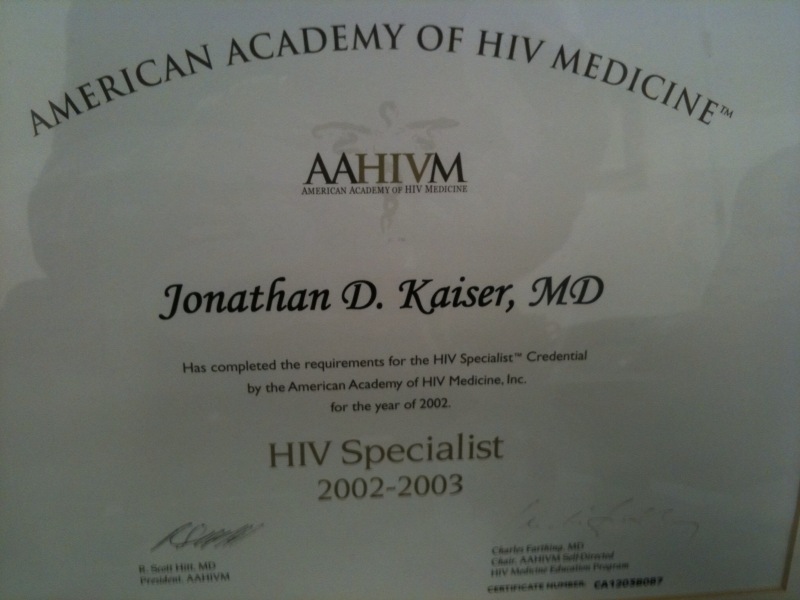
As a founding member of the American Academy of HIV Medicine, I was intimately involved in setting policy objectives for the organization in its early development phase beginning in 2000. I formed the Academy’s Reimbursement Committee in 2000, and was quoted in the attached AAHIVM newsletter (see middle column, paragraph #2). I have also been certified as an HIV Specialist by the organization on two separate occasions (see attached). It appears my membership to the national organization and California chapter inadvertently lapsed when I moved offices. This has been corrected and my membership is now currently active.

Well, I guess that explains the discrepancy between his CV and the professional organization he claims membership and leadership experience in.  Unfortunately they didn’t find me a link to the CAAHIVM.  Perhaps they don’t have a website.

Anyway, I was curious about the publicist’s claim that Kaiser is a major player in the HIV community, so I did a PubMed search. It turned up three references.  I guess one can be a respected HIV clinician rather than a researcher, and that would certainly not show up in PubMed.  But that leads to another problem.

Kaiser bills himself as “combining the best of natural and standard therapies” for HIV disease.  I have no reason to doubt this, but since his approach is unorthodox and he isn’t an active researcher I’m not sure how he knows that his treatment is so good.  He does claim some pretty spectacular results:

Though long term stability in my patients has always been the rule, I can now definitely say that the progression of HIV disease in my practice is an extremely rare event. This experience, which has encompassed the care of over 500 HIV(+) patients during the past five years, allows me to make the following statements: Not one patient who has come to me during the past six years with a CD4 count of greater than 300 cells/mm3 has progressed to below that level. Not one patient who has come to me during the past six years with a CD4 count of greater than 50 cells/mm3 has become seriously ill or died from an HIV-related illness. This extraordinary level of good health and stability does not come without hard work. My patients follow an aggressive program of natural therapies to support their immune systems. They have also benefited tremendously from the new drugs, lab tests, and other recently released treatment options. What a difference a few years has made!

That seems pretty impressive to me, for a few reasons. In many circumstances, someone who has gathered this much favorable data would have published it.  Without seeing the data in a peer-reviewed journal, there’s no way to verify the validity of these claims, or the reason for them.  If the data are accurate, perhaps he attracts a very medically-adherent population.  At many of the HIV centers I’m familiar with, patients often have financial, social, and psychiatric barriers to care, and results aren’t so rosy.  So what’s this guy’s secret?  Does he have a really, really compliant set of patients, or is he doing something different, something not yet well-represented in the HIV literature?

According to him, the secret is his “comprehensive” approach:

I define a comprehensive approach as one which adds a program of aggressive natural therapies and emotional healing techniques to the standard medical treatment of an illness or condition. An aggressive natural therapies program includes a combination of diet therapy, vitamins, herbs, exercise, and stress reduction. Emotional healing encompasses a proactive program of psychological healing techniques that ideally includes a spiritually-oriented practice (prayer, meditation, yoga, etc.) combined with a significant level of social support.

That’s a bold statement.  He claims extraordinary results, and claims that a raft of disproved therapies are the answer. If, as he claims, this approach is especially beneficial to those who cannot tolerate proven therapy with anti-retroviral drugs, he really should be working off data, data that show that his approach is safe and effective.
And that brings us back to the original letter from his publicist.  In the letter, they claim that K-PAX (the supplement, not the planet) significantly increased CD4 counts compared to placebo in patients taking usual therapy.
Whether CD4 cell count is a useful measure in this setting is debatable.  Viral load is an important measure of HIV activity, and CD4 count varies from moment to moment.  Also, above a certain level, it’s not clear that CD4 cell count is a marker of clinical risk.  Important outcomes other than CD4 cell count and viral load include prevention of opportunistic infection.
In Kaiser’s study, published as a “rapid communication”, he measured many parameters in addition to CD4 count.  This was a very small study (40 patients) with a very brief follow up period (12 weeks).  In the results section, the author notes that there were differences in the characteristics between the test and control groups, and that these differences were not statistically significant:

(1) the micronutrient group had a lower CD4 count at baseline when compared with the placebo group (CD4: 357 ± 154 cells/?L vs. 467 ± 262 cells/?L, P = 0.13), (2) the participants in the micronutrient treatment group reported a greater number of months of neuropathy symptoms preceding enrollment than those in the control group (means: 21.4 months vs. 12.2 months, P = 0.14; medians: 14.2 months vs. 2.5 months), and (3) the micronutrient treatment group contained 3 patients with diabetes mellitus compared with zero in the placebo group (P = 0.09).

It is technically correct that most of these differences were not statistically significant, but, look at the results:

The mean absolute CD4 count increased significantly by an average of 65 cells in the micronutrient group versus a 6-cell decline in the placebo group at 12 weeks (P = 0.029)

CD4 counts vary quite a bit, and are an imperfect measure of disease activity and immune function.  As we can see from his groups, there was a very large range of CD4 counts in each group at the start.  An average change in CD4 count of 65 seems anemic at best. Kaiser is more optimistic:

This study demonstrates that a micronutrient supplement administered to HIV-infected patients taking stable HAART significantly enhances CD4 lymphocyte reconstitution. Our findings support the potential for a broad-spectrum micronutrient supplement to be used as adjuvant therapy in combination with HAART to provide patients with a more robust CD4 cell rebound after initiating antiretroviral treatment.

I find the data from this pilot study entirely unconvincing.  His conclusions are hyperbolic and premature.  That’s not unusual, though.  Researchers sometimes get a bit excited about their work, and as an inexperienced author, perhaps he can be forgiven for a little unrestrained enthusiasm.
But it gets a bit more interesting that that.  In a letter to the editor, a careful reader noted something unusual. A patient showed him a brochure claiming that K-PAX could raise CD4 counts by 26%.  K-PAX, it seems, is the same product used in Kaiser’s study. The writer was concerned:

Most disturbingly, the first author on the paper, Jon D. Kaiser, MD, seems to be the same person mentioned in the brochure as the developer of K-Pax Vitamins.

[...]

Given the recent controversies at other medical journals about the failure of authors to disclose potential conflicts of interest, I am sure that this article would not have been published without disclosure (or at all) if the Editors had been aware of the conflicts of interest in this case.

There is a long, sordid history of conflicts of interest in published research.  Some drug companies have gone so far as to print their own faux-journals containing only favorable studies.  That is why most journals have strict disclosure rules for conflicts of interest. A study being sponsored by a drug manufacturer does not invalidate it, but failure to disclose this connection is unethical and problematic on many levels.
Kaiser was (correctly) allowed to respond:

After reporting the improved immune reconstitution of patients taking the micronutrients plus highly active antiretroviral therapy (HAART) to the Bristol-Myers Squibb team, I anticipated that they would show interest in pursuing the development of a therapy that had the potential to act as a safe and beneficial immune modulator.

On learning that they had no interest in pursuing the development of this compound, I chose to form a company, K-PAX, Inc., to keep the micronutrient supplement in production and make it available for sale while I worked to get the study results published.

I neglected to inform the Editors of this journal of this conflict of interest and any potential bias that existed during the paper’s submission and publication process. Nor did I inform the other authors on the paper of my financial interest in the company. They received no personal compensation for their efforts.

In other words, he is the guy who makes and sells K-PAX, and he owned up to failing to disclose this profound conflict of interest. I asked Kaiser through his publicist about this. His response was less conciliatory:

This research study was performed before there ever was a company or financial interest in a product (2001-2003). The data were analyzed by an independent Data Analysis Firm selected by Bristol-Myers Squibb in 2001. The JAIDS editorial board performed a thorough evaluation after Dr. Smith raised his concerns and found no evidence that either the data analysis or study conclusions were inaccurate.

I’m unimpressed by this response.
As I’ve said many times in this space, being wrong is not a moral failing—being deceptive is.  Many doctors who offer unproven therapies are genuine in their beliefs that they are doing good.  This doesn’t change the fact that promoting unproved treatments is a bad thing.  A doctor should know better than to use hyperbolic language to convince HIV patients that he somehow has the answer to their disease, an answer that no other specialist has.  Of course, most doctors have a lot more formal training that Dr. Kaiser, so perhaps he can be forgiven for his hyperbolic promotion of a single pilot study as a major breakthrough in HIV treatment.
Right?


[Slashdot]
[Digg]
[Reddit]
[del.icio.us]
[Facebook]
[Technorati]
[Google]
[StumbleUpon]

Am I a Geek Dad? | Bad Astronomy

Am I a Geek Dad? Well, I’m a geek, and a dad.

But in this case, I’m talking about the cool website Geek Dad. To celebrate their third anniversary they’re opening up voting for their Geek Dad Awards, with categories like Best Actor/Actress, Best Gadget, and so on.

Geekdad bannerOf particular interest to me are the categories of Best Social Media Star and Best Geek Celebrity (overall). That’s because, for some reason, they put me on those lists.

Now, I love Geek Dad, don’t get me wrong! But I’m up against folks like My Close Personal Friend Adam Savage™ and My Not Quite As Close But Still A Friend Felicia Day, so my odds of winning are smaller than the gap between the time a tribble is born and when it gets pregnant.

See what I did there? Yeah, I deserve to win a geek award, but I’m guessing it won’t be this one given the competition. And worse, Fwhil Fwheaton is in both categories, and I can’t in good conscience ask you to vote for me thousands of times at the expense of my mancrush. No-names like Neil Gaimon and J. J. Abrams, sure. But Wil?

So if you care to, go to Geek Dad and vote your own conscience. And I won’t ask the couple of folks I know at GD to send me the lists of IP addresses of the voters so that I can exact my revenge as necessary. Seriously. I won’t. At all.

But hurry! Voting ends at 8:00 p.m. EST on March 14th. If I win, I’ll give everyone who voted for me a unicorn*.


*But not really.