NASA Procurement Pays Gourmet Prices for Hotel Snack Food

NASA Pays Sky-High $66 a Person for Seminar Snacks, AP

"The nation's space agency paid the out-of-this-world price of $66 a person a day for bagels, cookies and juice at a conference, a new report found. The subject of the NASA conference? It was a training session for its procurement officials -- the people who do the buying with taxpayer funds. During the three-day conference, the 317 attendees snacked on "light refreshments" of soda, coffee, fruit, bagels and cookies at a cost of $62,611, according to a NASA Inspector General report. That's $66 a day per person. And that wasn't the only problem. The NASA financial watchdog criticized the financially strapped space agency's spending on conferences in general. The inspector general said NASA didn't price shop to get cheaper locations for conferences and that NASA's spending on food and drinks was "excessive."

Keith's note: Of course, the procurement folks on travel to this meeting also put meals on their travel expenses too, right? Hmm, seeing their travel vouchers for this meeting would be a fascinating FOIA exercise ... "do as I say - not as I do", eh?

Final Memorandum on the Analysis of Fiscal Year 2009 NASA-Sponsored Conferences, NASA OIG

Looking Backward – Not Forward

House panel vows to save Constellation, Orlando Sentinel

"To emphasize its doubt, the subcommittee asked Thomas Young, a former Lockheed Martin executive, to testify. He flatly told the committee that the White House plan was untenable and said that NASA should not rely on commercial rockets to transport astronauts. "In my view, this is a risk too high and not a responsible course. The commercial crew option should not be approved," he said, adding that the best policy would continue a longstanding partnership between NASA and the aerospace industry because the U.S. needs NASA's space expertise."

Keith's note: As I Twittered yesterday: "Tom Young has his gaze firmly affixed on the past not the future and thinks of ways of how not to do things rather than how to do them. FAIL"

Worst Science Article of The Week: Facebook Causes Syphilis | Discoblog

2114874155_b660780928Here’s what we know about the social networking site, Facebook. It can mysteriously suck away large portions of your day, and make you sneaky, nosy, and narcissistic. It can also, in some extreme cases, cause carpal tunnel syndrome from clicking through the bazillion vacation pictures you posted online. But does Facebook cause syphilis? The short answer is “no.” The longer one is “Are you nuts?”

But that didn’t stop British tabloid The Sun from cranking up its imagination and posting an article titled “Sex diseases soaring due to Facebook romps.”

The piece was based on a British National Health Service (NHS) report that noted that syphilis cases in the Teesside region, an area of northeast England, were up four fold. It said casual sex in the area had spiked and as a result of people not using condoms, a surprising number of women had contracted syphilis. So, from fewer than ten cases in 2008, the number had now gone up to 30.

The Sun quotes Professor Peter Kelly, director of Public Health for NHS Tees:

“I don’t get the names of people affected, just figures. And I saw that several of the people had met sexual partners through these sites…. Social networking sites are making it easier for people to meet up for casual sex. There is a rise in syphilis because people are having more sexual partners than 20 years ago and often do not use condoms.”

So the professor is stating what’s in the report: More people are finding dates online and are having casual sex, which leads, in some cases, to syphilis. From his quote above, it’s clear that he makes no specific mention of Facebook, nor is he saying that people who meet sexual partners on Facebook–rather than in bars, through friends, or via online dating sites–are more likely to wind up with an STD.

But here is how The Sun sums up what the professor said:

And an NHS trust chief said Facebook and similar sites were to blame for a shocking rise in cases of potentially-lethal syphilis in the region.

Once The Sun was on the story, other tabloids followed suit, starting with The Telegraph’s article “Facebook Linked to Rise in Syphilis” and The Independent’sInternet Casual Sex is Blamed For Rise in Syphilis.” The BBC states that while Facebook is Britain’s favorite social networking site, it wasn’t entirely unreasonable to make that connection, but to literally put words in the professor’s mouth was inaccurate and misleading.

Edward Kunonga, Professor Kelly’s colleague told the BBC:

Our press release was simply trying to highlight the risks of casual sex. We did not make the claim that social networking sites are causing the rise in the incidence of syphilis.”

Gawker meanwhile ran a quote by a Facebook spokesperson, who scoffed at the false reporting:

While it makes for interesting headlines, the assertions made in newspaper reports that Facebook is responsible for the transmission of STDs are ridiculous, exaggerate the comments made by the professor, and ignore the difference between correlation and causation. As Facebook’s more than 400 million users know, our Web site is not a place to meet people for casual sex – it’s a place for friends, family and coworkers to connect and share.

Most readers, luckily, recognize that using Facebook and practicing safe sex are two completely different things. But that hasn’t stopped the Internet from tittering about the latest story; as one person commented on The Telegraph’s article: “My suggestion, practice ’safe social networking,’ wear a condom when on Facebook.”

Related Content:
Discoblog: Worst Science Article of the Week: The CIA Dosed a French Town With LSD!
Discoblog: Worst Science Article of the Day: Climate Denialism in The Daily Beast
Discoblog: Worst Science Article of the Week: Lab-Grown Meat Debuts (Again)
Discoblog: Worst Science Article of the Week: The “Dark Side” of Darwin

Image: Flickr/benstein

From GM: A 2-Wheeled, Electric, Networked Urban People Mover | 80beats

wheels-EN-V-red-blogSpanWhat looks like a giant helmet, can potentially zip through congested city streets, has eco-friendly bona fides, and can “talk” with other vehicles on the road? It’s the new 2-person EN-V, an “Electric Networked Vehicle” from GM–a concept car that the company hopes will change the way people in crowded cities drive in the future.

GM unveiled several models of the helmet-shaped concept vehicle in Shanghai. The 2-wheeled vehicles, built in collaboration with Segway and GM’s Chinese partner S.A.I.C., are powered by electric motors and can travel up to 25 miles on a single charge. The two-seater EN-V is also a third of the length of a regular car at 1.5 meters [about 5 feet]. It will be equipped with wireless communication and GPS-based navigation that will help it avoid accidents and pick the fastest routes based on real-time traffic conditions, GM says [The Wall Street Journal]. A driver could either control the car manually or could put it into the more relaxing autonomous mode.

Says GM executive Kevin Wale: “It provides an ideal solution for urban mobility that enables future driving to be free from petroleum and emissions, free from congestion and accidents, and more fun and fashionable than ever before” [The New York Times].

But don’t expect to see the EN-V on roads anytime soon. GM says the concept car is meant to showcase “what might be possible by 2030,” when infrastructure for networked vehicles might be in place. The company says that if the EN-V is eventually put into production, it will cost less than a small car but more than a moped.

GM’s decision to unveil the EN-V in Shanghai underscores China’s importance for GM’s future plans. It is GM’s second-largest market after the United States and a strategic battleground for all foreign automakers, with the likes of Volkswagen AG (VOWG.DE) and Toyota fighting fiercely for bigger market share [Reuters]. The country also has some of the most congested cities in the world, making it well-suited for tiny cars like GM’s EN-V.

The EN-V, however is not GM’s first eco-friendly offering. Its Chevrolet Volt plug-in hybrid is slated to hit showrooms later this year.

Here’s a closer look at the new EN-V in action.

Related Content:
80beats: In the Commute of the Future, Drivers Can Let a Pro Take the Wheel
80beats: An Electric-Car Highway in California, But Just for Tesla
80beats: How Would You Like Your Green Car: Hydrogen-Powered, or With a Unicycle on the Side?
80beats: What Does GM’s Bankruptcy Mean for Its Much-Hyped Electric Car?
DISCOVER: 6 Blue-Sky Ideas for Revolutionizing the Automobile (photo gallery)
DISCOVER: The Next Source of Green Energy: Your Car Itself

Image: General Motors

Texas Tech offers quicker degrees to family docs – The Associated Press

Texas Tech offers quicker degrees to family docs
The Associated Press
LUBBOCK, Texas — Texas Tech University's medical school will soon become the first in the US to offer aspiring family doctors a three-year degree at half ...
Texas Tech to offer quicker degrees to family docsHouston Chronicle
FREE Daily News AlertsInside Higher Ed
Texas Tech School of Medicine announces three-year medical degreeMyWestTexas.com
ConnectAmarillo.com powered by KVII -The Daily Toreador (registration) -LubbockOnline.com
all 192 news articles »

Mount Sinai Shows Interest in St. Vincent’s Hospital – New York Times


National Post
Mount Sinai Shows Interest in St. Vincent's Hospital
New York Times
Representatives of Mount Sinai Medical Center have taken an interest in St. Vincent's Hospital Manhattan, the struggling Greenwich ...
Hospital Volume and 30-Day Mortality for Three Common Medical ConditionsNew England Journal of Medicine (subscription)
Hospital Size and Volume ImportanteMaxHealth
Fewer Deaths in Larger, Busier HospitalsBusinessWeek
Reuters -Crain's New York Business -Newsday (subscription)
all 73 news articles »

Nebula Continues to Expand

NASA's Nebula rolls out in the cloud, Federal News Radio

"Nebula is 18 months old and is literally rolling along. Agencies across the federal government are exploring cloud computing, but NASA's work in the area could be become the poster child for its use. Their Nebula Cloud Computing Platform at the Ames Research Center in California is being touted as a possible model for others. Chris Kemp, chief information officer of NASA Ames, explains the benefits of Nebula. "The real thrust of the project was making it easier for NASA to make its data accessible on the Web. NASA started using the Internet long ago, and, as a result, we have thousands of public-facing Web sites, and in today's environment, that's expensive to operate. It's also a large attack surface from a security perspective. We're trying to make it easier and more secure for NASA data to be accessed by our partners and the public."

Phoenix Curiosity

Here we have an image of the Phoenix Lander and surrounding area taken on February 25, 2010.

The Phoenix Lander succumbed to the cold of the Martian winter. Keep in mind Phoenix was not intended to last the winter; yet mission managers are hoping beyond hope that it might have made it through.

The northern winter on Mars is subsiding and you just never know so the Mars Odyssey orbiter is listening for any tell tale signal the increasing sunlight may have warmed the lander enough to revive.  There has been two listening periods so far, one in January and one in February.  The geometry of the orbits allowed for 60 passes in four days in February.  So far – nothing.  The next set of passes is in April and it sounds like if nothing is heard at that point, then mission managers will call it over.

Out with the old and in with the new I suppose.

There is a new Mars rover being built, the Mars Science Laboratory, named Curiosity, being built.  The builders recently put the robotic arm through a series of tests to be sure not only that it functions but as they put it: “plays nice with the rest of the system”.  Apparently the tests went well and the arm will be affixed to the Curiosity later this year.

I would imagine the work load stress is just starting to be felt in earnest as the September 2011 launch date is approaching.  Sounds like a long time but I bet it’s not.

For a larger version of Curiosity’s arm, click here.   Sorry there isn’t one for the Phoenix picture, but here’s the press release.

Images:  NASA/JPL-Caltech/University of Arizona (Phoenix) and NASA/JPL-Caltech (Curiosity)

Astronaut Scholarship Foundation to host Apollo 13 40th Anniversary event

The Astronaut Scholarship Foundation, (ASF) will be hosting the Apollo 13 40th anniversary on Apr. 9, 2010. This celebration will be a great opportunity for both space buffs and those with only a passing interest in the topic to meet giants in manned space flight history. Attendees will also be treated to spectacular tours and gourmet meals as NASA's Kennedy Space Center, (KSC) plays host to this historic event.

When one visits the Visitor Complex at KSC one normally has a tour guide explain what they are seeing and its historical significance. In the case of the Apollo 13 40th Anniversary the guides will be two of the astronauts who flew the mission, Jim Lovell and Fred Haise as well as Gene "Flight" Kranz, the man who made the famous quote, that "Failure is not an option." They will tell you what they experienced first hand.

The ticket price also includes a look into a mock-up of the firing room and a gourmet dinner underneath the massive Saturn V rocket that is on display inside an expansive building at KSC. During all this you will hear first hand accounts from Lovell, Haise and Kranz as well as "Pad Fuehrer" Geunter Wendt, NASA Project Engineer Bob Sieck and other key astronauts and personnel who were involved with the mission.

Tickets also include a photo opportunity and proceeds will go to the Astronaut Scholarship Foundation. The ASF is a non-profit, [501(c) (3)] group established by the original Mercury astronauts to give scholarships to students seeking engineering and science degrees.

For More Info:

Tiny Island, Fought Over by India & Bangladesh, Vanishes Into the Sea | 80beats

Bay_of_bengalRemember that time you and your sibling couldn’t stop fighting over a toy, so your mom wouldn’t let either one of you have it? It seems the same thing happens to unhappy neighboring countries and Mother Nature.

The island in the Bay of Bengal that Bangladesh called South Talpatti and India called New Moore or Purbasha appeared after a devastating cyclone, and it appeared right near the territorial boundary between the two. Decades of fighting over the uninhabited speck of land led to no political resolution. But now there’s a perfectly clear geographical resolution: The sea has reclaimed the island, scientists say.

According to oceanographer Sugata Hazra, the island was never very big, peaking at around 1.3 miles by 1.1 miles. The island began shrinking in the 1990s, part of an 81-square-mile decline in land mass in the Bay of Bengal’s Sunderbans mudflats over the last 40 years, Hazra said. And 27 square miles more has been lost to erosion. In the 1990s, the island was only 2 meters above sea level [Los Angeles Times]. Some experts say that in addition to erosion, rising sea levels caused by global warming are also to blame. Oceanographer Sugata Hazra, who discovered the island’s disappearance while looking at satellite photos, argues that sea-level rise caused by climate change was ‘’surely” a factor in the island’s inundation…. ‘The rate of sea-level rise in this part of the northern Bay of Bengal is definitely attributable to climate change,” he said [Sydney Morning Herald].

And this island is hardly alone in its shrinkage; people have already abandoned other isles in the bay. The island of Lohachara was abandoned in 1996, while 48 per cent of Ghoramara is reportedly underwater. Thousands of so-called climate-change refugees have already fled. At least 10 other islands are said to be immediately at risk [The Independent].

So why did the two nations spend so much time fighting over a tiny island with no future? Location, location, location. It sits right in the mouth of the Hariabhanga River, the boundary between India and Bangladesh. Technically, possession of the island depends on which side of the island the main channel of the river flows. That has never been agreed by the two countries [The Independent]. The island’s strategic importance, then, has led to some unusual gambits. In 1981 India dispatched navy ships to plant its flag on the island and try to cement its claim. Says Sanjoy Hazarika, a policy analyst based in New Delhi, “This didn’t go down as a great moment of Indian diplomacy” [Los Angeles Times].

The rising seas in the Bay of Bengal are cause for concern, especially with the low-lying Bangladesh mainland home to so many people. But with South Talpatti/New Moore, it’s hard not to feel at least a small satisfaction at seeing the hubris of nations earn its just reward: nothing.

Related Content:
DISCOVER: A Perfect Storm Forecast, looking at the Bay of Bengal
80beats: “Catastrophic” Sea Level Rise Is a Real Threat, Coral Records Suggest
80beats: A Rising Tide Swamps All Coasts: New Estimates of Sea Level Rise Spell Global Trouble
80beats: Maldives President Says His Country Must Save Up for a New Homeland

Image: Wikimedia Commons / Nafis Ahmed Kuntal

Is the Mysterious Siberian “X-Woman” a New Hominid Species? | 80beats

Denisova_cave_exterior_smIn 2008, archeologists working at the Denisova Cave in Siberia’s Altai Mountains discovered a tiny piece of a finger bone, believed to be a pinky, buried with ornaments in the cave. Scientists extracted the mitochondrial DNA (genetic material from the mother’s side) from the ancient bone and checked to see if its genetic code matched with the other two known forms of early hominids–Neanderthals and the ancestors of modern humans. What they found was a real surprise. The team, led by geneticist Svaante Paabo of the Max Planck Institute, discovered that the mtDNA from the finger bone matched neither–suggesting there might have been an entirely different hominid species that roamed the planet about 50,000 years ago.

Looking back at the region and the cave, where scientists earlier discovered artifacts from humans and Neanderthals, Paabo thinks that it is possible that all the three species (modern humans, Neanderthals and the mystery hominids) could have possibly met and interacted with each other. The findings, which were published in journal Nature, present an unexpected twist in the story of human evolution and migration.

Scientists say the DNA analysis also suggests that this hominid left Africa one million years ago, in a previously unsuspected migration. Anthropologists generally believe that the exodus from Africa took place in waves, starting with Homo erectus leaving 1.9 million years ago, followed by the Neanderthals between 500,000 and 300,000 years ago, and then by the modern humans who exited about 50,000 years ago. With X-woman, as the Denisova specimen has been nicknamed, the divergence date of one million years is too young to have descended from Homo erectus and too old to have been a descendant of Homo heidelbergensis, another ancient human thought to have originated around 650,000 [BBC]. Paabo and his team are now working to extract nuclear DNA from the Denisova fossil to verify their suspicion that X-woman is indeed from another species.

Physical anthropologist Ian Tattersall, who was not involved in the research, called the Denisova hominid a “significant addition” to our understanding of human evolution. “We are the only hominin around today, so we tend to think that’s how it’s always been. But the evidence is accumulating that the human evolutionary tree is quite luxuriantly branching. There were multiple species that competed in the evolutionary arena, rather than a single lineage that was honed from primitiveness to perfection” [Time].

For an in-depth look at the science and the implications of this discovery, check out Carl Zimmer’s post on the DISCOVER blog, The Loom.

Related Content:
The Loom: The X-Woman’s Fingerbone
DISCOVER: Out of Africa, All of Us
80beats:A Fossil Named Ardi Shakes Up Humanity’s Family Tree
The Loom: Ardipithecus: We Meet At Last
80beats: Did a Strangely Human-Like Primate Give Rise to Monkeys, Apes, and Us?
DISCOVER: The 2% Difference examines what sets us apart from chimpanzees

Image: Johannes Krause


Health Care Lies Will Last for Years | The Intersection

Brendan Nyhan, an old friend of mine who's now at the University of Michigan, has a must-read oped in theNew York Times today:
For Democrats nervous about political fallout from the bill in the November midterm elections, it’s reassuring to imagine that the myths about the legislation — that it provides free coverage to illegal immigrants, uses taxpayer money to subsidize abortions and mandates end-of-life counseling for the elderly — will be dispelled by its passage.
But public knowledge of the plan’s contents may not improve as quickly as Democrats hope. While some of the more outlandish rumors may dissipate, it is likely that misperceptions will linger for years, hindering substantive debate over the merits of the country’s new health care system. The reasons are rooted in human psychology. Nyhan goes on to talk about how we ideologically filter information to support our political presuppositions--e.g., conservatives will hold on to lies about "death panels" long after the bill's passage. It's a great piece, but it is missing, I think, an important angle. I believe the Internet makes this problem of misinformation and ideological filtering a lot, a lot worse. I wonder what Nyhan would say to that. Furthermore, we know well around here which blogs ...

The Milky Way erupts with cold dust | Bad Astronomy

One of my favorite things about astronomy is that it opens our eyes to things those eyes literally cannot see.

I have been to dark sites countless times and gazed up at the Milky Way; that dim and fuzzy path of light that represents the combined glow of billions of stars, gas clouds, and dust. To my eyes, it’s bright enough to see some details, and it’s lovely… but what we see is a facade, the barest skin draped thinly over depth and grandeur we can hardly perceive.

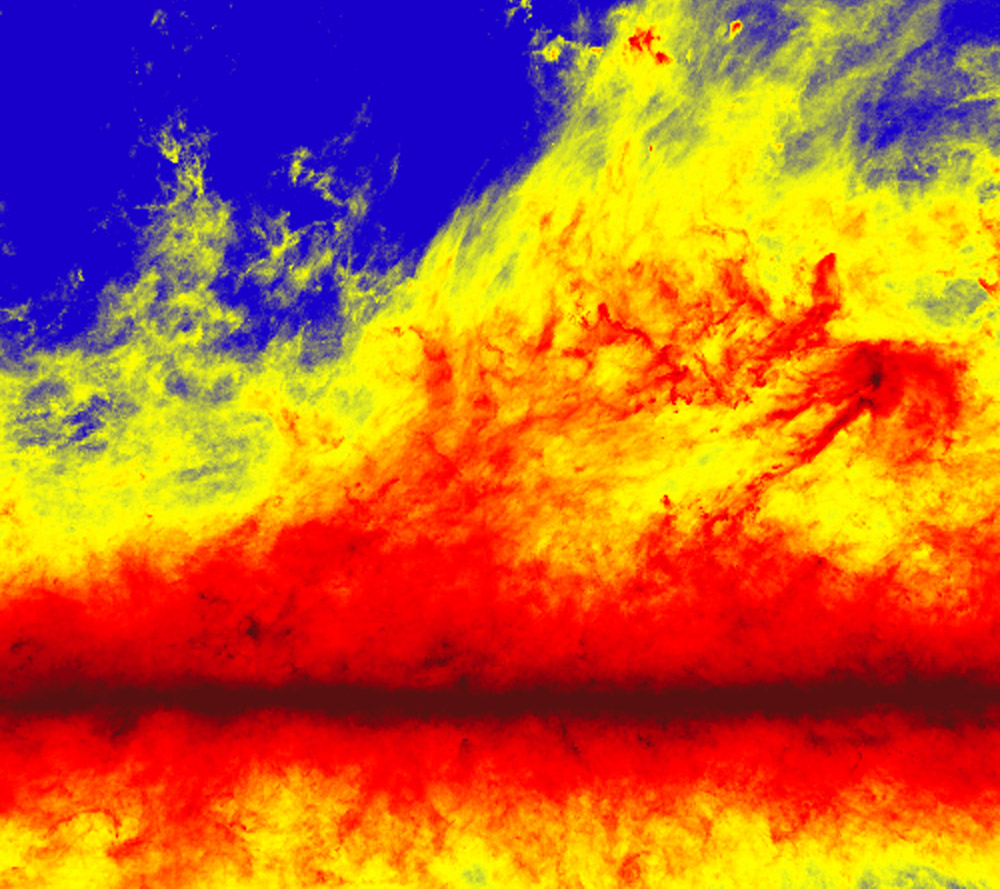
That is, until we look at our galaxy with new eyes: ones tuned to the far, far infrared. Then we see magnificence on a scale so breathtaking we can hardly comprehend it. Behold!

planck_milkyway

That is what lurks beneath the dim view our eyes collect! It’s what the European Space Agency’s Planck observatory sees when it looks at the Milky Way.

Wow! This image is a whopping 55 square degrees of sky — 280 times the area of the full Moon on the sky — centered near the constellation of Aquila the Eagle. The resolution of the data is about 5 arcminutes, meaning objects as small as 1/6th the size of the Moon on the sky can be distinguished; that’s very high-res for images in this region of the electromagnetic spectrum. And as an astronomer who is pretty familiar with the night sky, I have to say it’s very weird to see an image like this and have almost no idea what’s in it.

I mean, I know a lot of what I’m seeing in general, but specific objects are totally impossible to identify. That’s because this image is hugely removed from visible light. It’s a three-color image composed of separate shots in the wavelengths (think of them as colors) of 100, 350, and 540 microns. For comparison, the longest wavelength of light our eyes can see is about 0.7 microns or so; these Planck images are therefore way the heck and gone in the infrared.

What we’re seeing is very cold dust, and by very cold I mean very cold: much of it is a frigid 12 Celsius above absolute zero. In Fahrenheit, that’s -438°. Yes, four hundred thirty eight degrees below zero.

This represents dust far away from the warming light of stars, dust that is sitting in deep space, radiating away feebly in the far infrared. Mapping this dust tells us much about it, like how stars make dust and fling it into space, and how the dust behaves when it’s out there.

See that bright line right down the middle? That’s the dust located in the disk of the Milky Way galaxy itself. Our galaxy is a flat disk 100,000 light years across, but maybe only 1% of that in thickness. We’re located inside that disk, so that when we look in that direction we see it projected as a line across the sky. That’s where most of the gas and stars in the galaxy are located, so that’s where most of the dust is as well.

But I’m fascinated by the structure of the dust above the galactic plane. There are swoops and swirls, filaments and ribbons. I’m drawn to the long thin line on the right that must be dozens or hundreds of light years long; it appears to end in a swirl of dust. What the heck could be causing that? I’m not sure. There’s so much going on here that it’ll be some time before astronomers can sort it all out.

planck_milkyway_350micronsOne thing I want to point out is the one component of that image taken at 350 microns, seen here on the left. This is extremely cold dust, and as a major geek I can’t help wonder if the structure seen here was diverted by Malcolm McDowell to swing past Veridian III.

And if you’re looking for irony, you’ve found it: Planck is designed to investigate the Cosmic Microwave Background, the faint glow leftover from the Big Bang. As far as Planck is concerned, the Milky Way is a foreground object blocking the view! It has to map our local space very carefully so that emission can be removed from the actual target data, and reveal what the far more distant background Universe can tell us.

It’s true in astronomy as well as so many other aspects of life: what’s signal to one is noise to another.

Credit: ESA and the HFI Consortium


Coal is a Killer, so Why Use It?

How many people die each year from the use of coal?  At least 24,000 just from the particulate matter, (according to the two doctors quoted below).   That is more than from traffic accidents and murders each year.   What form of life does coal not manage to damage or kill?  Maybe cockroaches, but not many other living things can thrive in dirty polluted air or in the filth left behind when coal is used.  It’s even killing cows and dogs.  And amazingly, they put coal ash in toothpaste.

“Elisa Young says she has lost at least six neighbors to cancer in the last ten years.

“I’ve lost neighbors to lung cancer who have never smoked,” she said. “I’ve lost them to brain cancer, breast, throat, colon, multiple myeloma, pre-leukemia. When my son, who’s in his 20s, came home to visit, he said, ‘Mom, is it normal for your mouth to taste like metal?’ We pulled over and he coughed until he got sick.”

Young has no doubt about what she believes is causing all the cancer: coal. For the past 10 years she’s lived in Meigs County, Ohio, the center of the second largest concentration of coal plants in the nation, and has become an environmental activist.

“There isn’t a house on this road that hasn’t been touched by cancer… I had melanoma and I currently have two more precancerous conditions for breast and thyroid cancer, none of which are in my family,” said Young, 47. “My dog died of cancer, my best friend’s dog died of lymphoma. I just gave up a dog because I couldn’t afford to take him into the vet. He was getting lumps on him.”

Each year, coal-burning power plants release nearly 100 million tons of toxic fly ash into wet ponds, rivers and landfills, according to a 2009 report by Earthjustice, an environmental legal advocacy organization. A 2007 risk assessment by the Environmental Protection Agency found that people who live near one of these coal ash waste sites have as high as a 1 in 50 chance of developing cancer, as well as an increased risk of damage to the lungs, kidneys, liver and other organs as a result of exposure to toxic metals. Further, says the report, the danger to wildlife and ecosystems is “off the charts.” Linking exposure to specific diseases can be difficult to prove scientifically — it has not been definitely proven that exposure to toxic fly ash caused the sicknesses in Meigs County.

Despite these findings, the Environmental Protection Agency has deemed coal ash a “non-hazardous waste” since 1988, a classification that allows fly ash to be dumped into ponds with no protective liner and re-used as pavement, building materials, fertilizer, potting soil and even toothpaste.

In October of 2009, the EPA finally re-evaluated the dangers of toxic coal ash and proposed new rules to regulate coal waste disposal, but the proposed regulations have been stalled for five months at the White [...]

Senate Budget Hearing Postponed

Keith's note: The NASA-related hearing scheduled for today at 10 a.m. in 192 Dirksen Bldg. Has been postponed. The intent was to discuss the FY 2011 Commerce-Justice-Science Appropriations. Scheduled witnesses: Charles Bolden; Paul K. Martin, inspector general, NASA; and John Frost, member, Aerospace Safety Advisory Panel. Word has it that the new target date is 22 April.