
Does anybody have a symptom/fault chart for pneumatic DP cell?
One of the newest craters on the Moon | Bad Astronomy
On April 14th, 1970, a new crater was carved into the surface of the Moon:
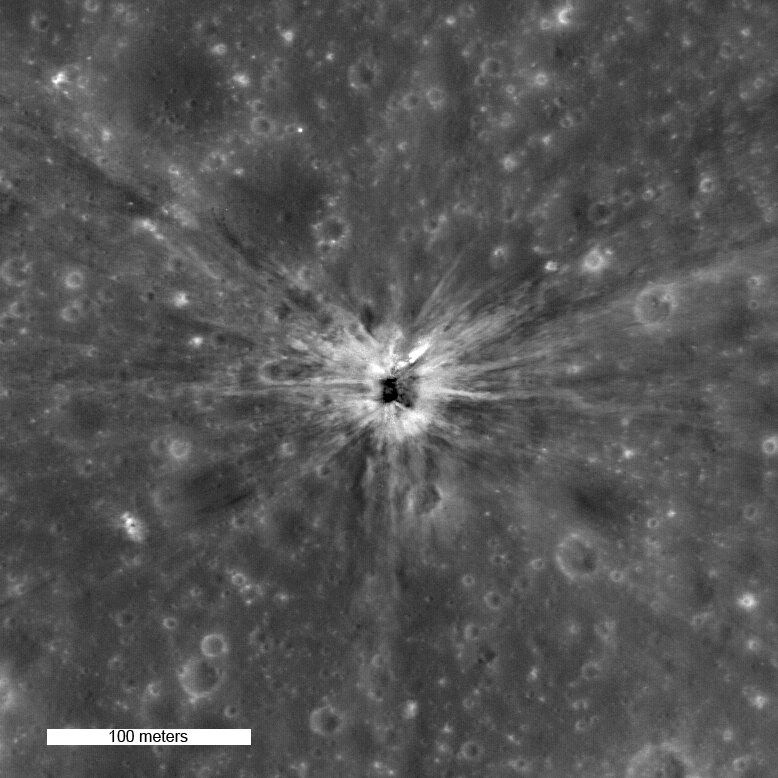
How do we know it’s new? Because we made it.
That’s the impact scar of the third stage of the Saturn V rocket (technically designated S-IVB) that carried Apollo 13 to — but sadly, not on — the Moon. Earlier missions had placed seismic instruments on the lunar surface to measure if the Moon had any activity. They found it did, and in fact several moonquakes were big enough that had you been standing there, you would have felt them quite strongly (and probably been knocked on your spacesuit’s backside).
 The S-IVB upper stage accelerated the astronauts to the Moon from Earth orbit. Once that was done, they had one final mission: in Apollos 13 – 17 the stages were aimed at the Moon itself, and impacted a few days later. The impacts were detected by the seismometers and could be used to determine how seismic waves travel through the lunar surface, a trick that’s been used on Earth for a long time. This information can be used to figure out what the lunar subsurface structure is like.
The crater image above is from the Lunar Reconnaissance Orbiter, and shows the Apollo 13 booster impact. The crater itself is a few dozen meters across, and the material ejected forms a blanket around it for many meters more. The bright material indicates this is a fresh crater; note how gray the more distant undisturbed material around the crater is.
The impact site looks obvious in that picture, doesn’t it? But try finding it in the original full-resolution image returned from LRO and see if you can locate it, then! I found it relatively quickly starting at the top, and was shocked at how far I could trace the rays — the linear ejected debris features around the crater — from the impact site. One of them is clearly about a kilometer long… that’s over half a mile! Those rays are from plumes of material ejected from the impact site, a common feature. They also indicate the crater’s youth: over time, cosmic rays, the solar wind, and even thermal stress from the Moon’s day/night cycle slowly erase the rays. Any crater with such extensive rays has to be young.
Some of the other S-IVB impact sites have been identified; the LRO blog has an image of the Apollo 14 S-IVB crater, for example. Knowing where these impact sites are helps scientists understand the Moon better, since it a more precise location means the data from the old Apollo missions can be interpreted more clearly. I wonder if future colonists may visit those sites the way we do Plymouth Rock, or Jamestown, or other early exploration and colony sites on Earth?
Credit: NASA, NASA/GSFC/Arizona State University


Thread Galling and Materials
Are ther any rules of thumb/best practices "in print" for mating threaded fasteners to prevent cross threading/galling?
New Horizons On The Way To Pluto
Launched on January 19, 2006, New Horizons robotic spacecraft left the Earth at the fastest launch speed ever recorded for a man-made object – 58,536 km/h (36,373 mph). It will reach Pluto July 14, 2015. How fast is New Horizons going? It took only 9 hours to reach the moon. Let me rephrase that… IT TOOK ONLY NINE HOURS TO REACH THE MOON. That’s called hauling the mail. Yeah, I know what else it’s hauling, but this is a family site. It’s not the fastest spacecraft ever launched (that would be Voyager I), but it did blaze off the Earth the fastest of any ever launched.

New Horizons Liftoff, Image NASA/KSC
So… New Horizons will fly by and take pictures of Pluto, right? Well, sure, but it’ll do more than that. Considering it’ll have only one fly by, then head into the Kuiper Belt, I think the mission objectives are pretty great. Straight from the New Horizons web site:
New Horizons: Mission Objectives
- Map surface composition of Pluto and Charon
- Characterize geology and morphology (“the look”) of Pluto and Charon
- Characterize the neutral atmosphere of Pluto and its escape rate
- Search for an atmosphere around Charon
- Map surface temperatures on Pluto and Charon
- Search for rings and additional satellites around Pluto
- PLUS… conduct similar investigations of one or more Kuiper Belt Objects
By the way, there’s been a lot of talk recently about the cost of these NASA missions; our glorious politicians say it “just isn’t worth it”, and the money could be spent elsewhere. Okay, the cost of the mission ($700 million), divided by the US population at launch, spread out over a ten year period, comes to a cost of 20 cents per person per year. Even if you have to pay that all at once, it’s only $2.00 per person. Oh, wow. That puts my yearly budget right on into the red, let me tell you.
Good grief.

New Horizons, Image NASA/JPL
Anyway, New Horizons carries some cultural artifacts in addition to all the really cool scientific equipment on board. It has an American flag, a Florida state quarter, a disk with over 400,000 names (remember waaaaay back before launch when NASA had the “Send Your Name To Pluto” publicity drive?), and some of Clyde Tombaugh’s ashes (he discovered Pluto).

New Horizons, Location on March 29, 2010 credit NASA/New Horizons web site
Right now, New Horizons is a little more than half way to Pluto. It did receive a gravity boost from Jupiter (and took some really cool images on the way). Take some time and cruise through the New Horizons web site. There’s an education section that will tell you everything you ever thought you wanted to know about Pluto. It’s great.
I’m looking forward to 2015 when New Horizons reaches Pluto. I think it’ll be awesome.
Luna Lift
Dr. Michiu Kako, an American Quantum Physicist believed that someday we may be able to build a Lift linking Earth and Moon, thus making our journey to and from the moon an easy and economic affair.
How viable and possible do you think this concept is ?
Funny But Not Entirely Chu
Ceding US Offshore Oil to Foreign Firms OK Says Chu
US Secretary of Energy Steven Chu says he is not troubled by the prospect that potential sources of energy near US coastal waters may be tapped by foreign firms from China and Russia.
“The joke is on them,” Chu insisted. “They will remain hooked on oil with all its downsides. While they’re polluting their air burning gasoline and diesel we will be shifting to clean wind and solar power.”
Chu maintains that the prospect of oil shortages and higher prices for fuel will be “positives for our nation’s future. We will learn to do with less, weaning ourselves from the materialism that has poisoned our culture. We will live more in tune with nature. When it is cold outside we will huddle together inside. When it is hot outside we will shed our clothing and allow our bodies to be cooled by evaporating perspiration. We will be forced to refrain from frivolous travel. I see no negatives from our decision to forego any claim on offshore deposits.”
Why did I laugh a little bit when I read this? Because it’s a joke — It’s Semi-News — A Satirical Look at Recent News.
If this were true, though, he’d be 100% right. I wish he had said it. There is no downside to foregoing claims on offshore fossil fuels, but Republican gas and oil addicts want us to think there is. We can still get power from renewable sources in order to not work in buildings that are 120 degrees F, but sweating works too.
Finite Element Analysis (FEA) of Plate Heat Exchangers
hi all,
I am doing finite element analysis of plate heat exchangers.
I want to know, how to apply the wind load to plate heat exchanger.
Is it at the CG of the heat exchanger , connceting all the nodes in the horizontal dimetric plane to the cg.
Please tell me the
Leadership, Vision, and Space Exploration
 NASA chief on new space strategy, Achenblog, Washington Post
"Q. Is Obama going to offer any sweeteners when he goes to central Florida [for April 15 space conference]? The fact that the President is taking time to visit Florida to discuss the future of America's space program demonstrates his commitment to NASA, and our robust exploration vision. I think people will see firsthand what I see - his passionate commitment to a bold future in space which is at the heart of the decision to add an additional $6 billion to NASA's budget."
Unused NASA tower epitomizes brewing fight over space budget, The Hill
"Our greatest accomplishment in human space flight were gained because President Kennedy said we will land a man on the moon and return him safely to earth by the end of this decade," Sen. David Vitter (R-La.) said in February. "President Kennedy didn't say, 'We're going to spend a few billion dollars on some really unique research and development.'"
Imagination may be casualty of loss of space program, Deseret News
"Five years ago, I wrote in favor of privatizing the space program, mainly because of costs. I was wrong. The race to the moon never was a competition to see whether capitalism or communism was superior. The U.S. space program was just as dependent on the public treasury as was the Soviets'. It was, rather, a matter of pride and national security. Maybe we've lost that vision because our chief enemies these days, fanatical Middle Eastern terrorists, don't have a space program. But the price of becoming "a second-rate space country" is just as unthinkable as it was 40 years ago."

Selecting a Floating Roof
On what basis we have to decide type of floating roof. On of my client is asking a single deck floating roof with open to atm. the size of tank is 19m x 14m ht.
Steel Industry
Dear Sir
I would like to know how to calculate theoretically Different sizes(Equal) angle bars weight calculation.
Flange and Gasket
What is the purpose of Raise face at gasket setting area ?
Transient Phenomena of Fault in 230-KV Transmission Line
Dear all ,
I would be highly obliged, if you explain the following please :
When a fault is fed from two opposite sources in transmission line ( 230 KV ), what would be the transient phenomena with respect to voltage parameter.
Regards.
Rashid
How to Find Total Kwh for a Month
How to calculate the total Kwh generated per month by a diesel generator using Kw. Kw of the generator is taken every hour. Shoud I add all these values to get total Kwh for the month?
Power Transformer
There are two 11Kv/415V , 1000KVA Power Transforemers to cater the factory load of around 800KVA. I want to run one transformer alterantely in every 15 days keeping the other completely switched off from both HT & LT side in order to save power ie no load loss of one trasformer ,considering one
Preparing Discovery for Flight

A specialized transporter brought the payload canister to Launch Pad 39A in preparation for the STS-131 mission. The canister, which is the same dimensions as the shuttle's cargo bay, held the Leonardo supply module during the move from processing to the shuttle. Leonardo will be packed inside space shuttle Discovery for launch. In this image, the payload canister holding the Leonardo supply module is hoisted to the clean room at Launch pad 39A.

Opportunity Surpasses 20 Kilometers of Total Driving

NASA's Mars Exploration Rover Opportunity today surpassed 20 kilometers (12.43 miles) of total driving since it landed on Mars 74 months ago.
The drive taking the rover past that total covered 67 meters (220 feet) southward as part of the rover's long-term trek toward Endeavour Crater to the southeast. It was on the 2,191st Martian day, or sol, of the mission and brought Opportunity's total odometry to 20.0433 kilometers. To reach Endeavour, the healthy but aging rover will need to drive about 12 kilometers (7.5 miles) farther.
Opportunity's mission on Mars was originally planned to last for three months with a driving-distance goal of 600 meters (less than half a mile).
Since landing, Opportunity has examined a series of craters on the plain of Meridiani, and the journey so far has covered a portion of the plain with negligible tilt. Now, the rover is approaching a portion tilting slightly southward. Recent images toward the southwest show the rim of a crater named Bopolu, about 65 kilometers (40 miles) away.
Meanwhile, Spirit, Opportunity's twin, is continuing minimal operations due to declining solar energy with the approach of winter in Mars' southern hemisphere. Spirit has been communicating on schedule once per week. It is expected to drop to a low-power hibernation mode soon that could prevent communications for weeks at a time during the next several months.
NASA's Jet Propulsion Laboratory, a division of the California Institute of Technology in Pasadena, manages the Mars Exploration Rover Project for the NASA Science Mission Directorate, Washington. For more information about the Mars rovers, visit http://www.nasa.gov/rovers.
View this site auto transport car shipping car transport misting systems business VoIP

Henry M. Seidel, 87, dies; pediatrician, Johns Hopkins dean – Washington Post
 Washington Post | Henry M. Seidel, 87, dies; pediatrician, Johns Hopkins dean Washington Post He joined the medical school faculty in 1950 and continued to teach and see patients well into his 80s. He received specialized pediatric training at the ... Dr. Henry M. SeidelBaltimore Sun Henry Seidel, Columbia pediatrician, dies at 87Explore Howard County Health care reform is great opportunity for young peopleCanton Repository |
Verizon Blasts ‘Outdated’ FCC Broadband Plan – NewsFactor Network
Verizon Blasts 'Outdated' FCC Broadband Plan NewsFactor Network ... least 100 million homes in the US affordable Internet access at download speeds of 100 megabits per second and upload speeds of 50 megabits per second. ... |
Etching discovery
 Etching in the ceiling
Friday 26th March comments:
Following yesterdays thick fog, we woke to clear skies but strong winds. The wind from the south had picked up during the night and it was battering the islands so we won’t going far. As part of the teams work during the first week back has been to paint the main dormitory of the Pele Tower and that led to an interesting discovery late this afternoon. New warden Tom Simon (whilst painting the ceiling) made a discovery of an etching on the ceiling which is shown above. The etching read…
“J.Buchan, Peterhead, HMT Hildina, 1940"
This has lead to much discussion amongst the team and thanks to the wonders of the Internet we have discovered a few things about the etching. HMF Hildina was a 300 ton steam fishing trawler assigned for a Navel Mine Sweeping role from 1939-1946. It appears to have survived the war and was returned to her owners in April 1946 but sank in Muckleflugga off Shetland on 1st December 1953.
Information is still limited (any help would be very much appreciated) but it appears that there were two J.Buchans from Peterhead, but sadly both lost theirs lives in 1941. Was one of these men the resident of Inner Farne who scribed his name on the ceiling? It’s raised a lot of questions and if anyone reading has any information, please drop me a line as it’s a great story from the islands history.
On the islands, very little was happening although Puffins returned despite the strong winds. Migrant birds were few and far between, although a few ‘left-overs’ lingered from yesterdays arrivals.
Highlights: Whooper Swan 11N Inner Sound, Black Redstart for second day, Wheatear 2, Fieldfare 3 and Chiffchaff 2.

Day 1.
Before I begin this account of our holiday I must preface it by reminding you that this is basically my diary. So if the detail becomes tedious please skip it. If I donrsquot write it down we shall forget it. Forgive my descriptions of our fellow voyagers. Again want to remind ourselves of who we saw and met. My intention is not to be critical we try not to do so we just enjoy the divers