
Jane E. Vennard on finding the still point within.
Sarah Palin praises America’s "libertarian streak"
 From Eric Dondero:
Sarah Palin has long been rumored to be a libertarian Republican. Her first campaign workers and manager for her races for Wasilla Mayor in the 1990s were libertarians. She was was viewed for many years as the unofficial leader of the Alaska GOP's libertarian wing. In 2005, early on in her race for Governor, her opponents on the conservative side, started a whisper campaign, "Palin is really not a Republican, she's a Libertarian." She was also criticized in the GOP primary for having once openly supported reform of marijuana laws and having defended bar and tavern owners from religious conservatives who wanted to zone them out of town.
Palin's extensive libertarian background
In 2005/06 she attended two meetings of the Libertarian Party of Alaska at the invitation of Party Secretary (and Anchorage Libertarian supper club chairman) Rob Crist. Later in the campaign 3 of the 4 Executive Committee members of the ALP endorsed Palin, including Chairman Jason Dowell (the 4th was serving in the Army stationed in Iraq at the time.)
Dowell (photo) even held a sign for her the day before the election, right by her side, for 3 hours on a busy Anchorage street corner. When he first arrived, Palin excitedly screamed to all her supporters, "The Libertarians are here... The Libertarians are here... They're backing my campaign!"
The Libertarian candidate for Governor Billy Toien officially backed Palin 3 days before the election, urging via email blast to all Alaska Libertarians "Don't vote for me; Vote for Sarah." This earned Toien a big bear hug for Palin upon her victory on election night in front of nearly 1,000 political watchers at the downtown Egan Center in Anchorage.
Very early on in the GOP primary races for President in 2007, Palin in an interview strongly hinted that she was leaning Ron Paul for President.
Early in 2008 Adam Brickly, a self-described "libertarian-conservative" along with Libertarian Republican Steve Maloney, formed Draft Sarah Palin for VP. Another self-described "libertarian" Glenn Beck was the first national Television News host to have Palin on his show as a guest.
 During the 2008 Vice-Presidential campaign, Palin was identified as a libertarian Republican for the first few days after her selection, but then the media template quickly shifted to her being a member of the religious right.
It now appears that the libertarian Palin may be back in full force.
Passionate support for libertarian Republican Rand Paul
From The Hill:
Former Alaska Gov. Sarah Palin (R) on Wednesday night hailed what she said was a "libertarian streak" in American politics.
Palin praised Rand Paul's win in a Kentucky Republican primary for Senate earlier this week, saying that candidates like him would be key in this fall's elections.
“Seeing that libertarian streak of his — that is what we need to balance out the leftist liberal overreach of government that’s in power right now," Palin said during an appearance on the Fox Business Network on Wednesday night. "Rand is going to be great.”
Rand Paul is seen as more of a libertarian Republican in the mold of his father, Rep. Ron Paul (R-Texas), who was also the Libertarian Party's candidate for president in 1988.
 Radical for Capitalism
Later in the piece Palin emphasizes her hard-line free market philosopy:
“There’s no accountability [in government]," Palin said. "And that’s why people want to fire those people and bring in new people with a greater sense of what the free-market principles should be.”
Some have questioned Palin's libertarian credentials over the years. Purist libertarians, most assuredly those from the antiwar faction of the libertarian movement, have been particularly vitriolic in attacking Palin as "not really a libertarian" due to her pro-national security, pro-military stance.
This despite her extensive background as a movement libertarian.
Even so, her passionate support for Rand Paul's candidacy, and her most recent comments praising libertarians as published by The Hill, may now finally silence even the most hardened Palin critics in the movement.
Photo above Sarah Palin waving signs with supporters in Anchorage during the 2006 race for Governor.

LPIN leader Ryan Liedtky announces the publication of his book, Wisdom: A Prelude to Liberty
Libertarian Party of Indiana Central Committee District 2 member, Ryan Liedtky, announces the publication of his book, Wisdom: A Prelude to Liberty.
Wisdom investigates hot-button political issues such as The War on Terror, education reform, justice, taxation, health care, and many more. “The working title was Think,” Liedtky said, “because the [...]
Another endorsement by Sarah Palin – former Washington Redskins star Clint Didier for US Senate, Washington State
 by Josh Painter
In a new post on her Facebook Notes page Thursday, Sarah Palin endorsed former NFL player Clint Didier, who won two Super Bowl rings as a member of the Washington Redskins:
The Right Game Plan for Victory in America with #86
I’m proud to support Clint Didier as he willingly puts it all on the line to serve Washington state in the U.S. Senate for all the right reasons! This selfless, inspiring commonsense constitutional conservative will help put our country on the right track.
Please visit Clint’s website here, and follow him on Facebook and Twitter.
Let’s get behind #86!
- Sarah Palin
 Didier's pro football career spanned much of the decade of the 1980s. He was a tight end for the Skins for six seasons, and also played one season with the Green Bay Packers. He now shares head coaching duties with Wayne Riner at Connell High School in Connell, Washington, where the two led the Eagles to the finals four times, winning the state championship in 2002 and 2009, and taking runners-up honors in 2006 and 2007.
Didier, a Tea Party candidate and libertarian Republican, seeks to dethrone incumbent Democrat Patty Murray from the U.S. Senate. When he's not coaching football and campaigning for the U.S. Senate, Didier runs the family farm he came home to work after the end of his NFL career.
Editor's Note - Josh is Publisher of Texans4Palin. Regular readers of LR may remember Josh as taking the lead in the investigations on the GM/Chrysler bail-outs last Spring.

Allen West takes the lead in key Florida Congressional battle
 Dave Weigel, and on-again/off-again friend of the libertarian movement, and Columnist for the Washington Post, reports:
The campaign of Col. Allen West (ret.), probably the 2010 congressional candidate with the biggest Republican fan base, releases an internal survey that has him leading by 2 points, 44 to 42 percent, over Rep. Ron Klein (D-Fla.). West ran in 2008 and got 45 percent of the vote, boosted by support from national conservatives but lacking real backing from the national party. This time he's got the support of the NRCC; this should be one of the 40 seats Republicans win if they take control of the House in November.
The District includes parts of Broward County (Ft. Lauderdale.) West is supported by prominent friends of liberty such as Ayn Randist Pamela Geller of Atlas Shrugs.
West has been labeled a "right-wing libertarian" (Crooks & Liars) for his staunch opposition to Islamo-Fascism and support for free market capitalism.

Book Excerpt: The Book of Language
Kabir Helminski on recognizing beauty as something that draws us into relationship with the Divine.
Wayne Root wins endorsement of Indianapolis City Councilman Ed Coleman for Libertarian Party Chair
 Root's Big Tent Libertarianism gets bigger
From Eric Dondero:
The Libertarian Party will hold its national convention in St. Louis, Missouri over Memorial Day weekend. Thousands of delegates from all over the Nation are expected to attend. At main issue is the race for National Chairman. Bill Redpath will be stepping down after two terms. Candidates for Chair include Wayne Allyn Root of Nevada, Mark Hinkle of California and George Phillies of Massachusetts. Root appears to be garnering the greatest amount of support among the party faithful. He released an impressive list of endorsers yesterday which included former LP Presidential candidates Dr. John Hospers, Bob Barr, and State Chairmen for 8 different Libertarian Chapters including: Ohio, Louisiana, Mississippi, Indiana, Illinois, Wisconsin, Kentucky, and Nevada. The list also includes two prominent Libertarian Party members who have been featured in the past here at Libertarian Republican: Edward M. Gonzalez, Libertarian and Republican candidate for US Congress in California, and Lex Green, Libertarian candidate for Governor of Illinois.
 Root garnered some current elected office holders as well. Among them, an individual who is arguably the highest elected public officeholder in the Libertarian Party. (Though, Dan Halloran on the NYC City Council may also hold that title.)
"As an elected Libertarian officeholder in the 12th largest city in the nation, I understand what it takes to get elected, so I am enthusiastically supporting Wayne Root for LP National Chair. Wayne is the BIG TENT Libertarian leader, spokesman, rainmaker and CEO we so desperately need. I believe Wayne Root has the passion, vision and game plan to lead us to lead a Libertarian citizen revolution. We can elect Libertarians to office under Wayne's leadership. Therefore, I ask that you join me in voting for Wayne Root for LP Chair at this years National Convention"??
-Ed Coleman, Indianapolis City-County Councilman,
Highest-Elected Libertarian Officeholder in U.S.A.
Note - Coleman switched from Republican to Libertarian a year and a half ago. He is best known for successfully fighting a proposed city-side smoking ban in Indianapolis. He is also rumored to be a potential Libertarian candidate for President in 2012. Nationwide over 200 Libertarians hold elective office, another 200 or so hold appointive office.

Arizona border controversy becomes issue in Ohio’s Senate race
 Columbus Mayor Michael Coleman is a close friend and ally of current Democrat for Senate frontrunner Lt. Governor Lee Fisher. They're so close in fact, that Fisher got Coleman's wife a cushy job in the Ohio Dept. of Development, which she later had to resign from for rampant absenteeism. Some called it cronyism. Coleman has since enthusiastically backed Fisher's candidacy saying "[he] is exactly the kind of leader Ohio needs in the U.S. Senate."
Now according to Libertarian Republican blogger Nate Nelson at PitbullPatriots.com
Coleman on Wednesday banned all travel to Arizona funded by the City of Columbus. Apparently like the liberals in California (AKA the “Left Coast”) and Chicago, Coleman thinks Arizonans are racist for enforcing federal law on illegal immigration. And he is prepared to do what he can to hurt the Arizona economy in an effort to punish Arizonans. According to Mayor Coleman, respecting and enforcing the rule of law “is not the American way.”
I think there’s one simple question that Ohioans should expect Lee Fisher to answer, given his relationship with Michael Coleman and given that he wants to be our next U.S. senator.
Candidate Fisher, do you hate the rule of law, too?
Fisher is being challenged by Republican Rob Portman.

Cheap Manhoods: Blumenthal stains an otherwise Honorable Service Record
 And gentlemen in England now-a-bed
Shall think themselves accurs'd they were not here,
And hold their manhoods cheap whiles any speaks
That fought with us upon Saint Crispin's day
William Shakespeare, Henry V, circa 1699
By Clifford F. Thies
Connecticut Attorney General Richard Blumenthal, a candidate for the U.S. Senate, has been caught in a lie. He said he served “in” Vietnam, when he did not. He says he meant to say “during,” and that he did not intend to mislead people as to whether he was a combat veteran.
I, like Blumenthal, was “during” but not “in.” Being a tad younger, I was not subject to Selective Service. I did not have to go through the process of seeking deferments, which he did five times, because of college enrollment or whatever. I notice that a lot of members of one or the other political party criticize members of the opposite party who sought deferments, but excuse members of their own party. Not me. They were merely doing what was allowed by the law.
Being a Republican and opposing the government making life and death decisions for law-abiding persons, I supported the replacement of Selective Service first by the Lottery and later by the voluntary military. Instead of the government deciding who would be drafted and who deferred based on its idea of each person’s expendability, upon the change to the Lottery, each person was given a draft number according to his birth day. My draft number was 365. But, as I was born in a leap year, I wasn’t as lucky as that might appear.
 In 1973, President Nixon signed the All-Volunteer Military Act and, on the day he signed the act, I signed up for Army ROTC. Two years later, I took my commission. But, as things turned out, sometime before I graduated from Infantry Officer Basic School, the war was “Vietnamized.” I served in places like Texas and Germany, not Viet Nam.
Roll the clock forward a few years. The first time I was recognized for my military service was at a Pow-Wow. The Chief said his tribe was proud of its warrior heritage. He said his two sons were among the greatest warriors in the world, one a Marine and the other an Army Ranger. Then he invited all the warriors in the audience to join the warriors of his tribe in a war dance. First, he called for the combat veterans, then all who had served or were serving on active duty or in the Guard or the Reserves. I wondered what I was doing among the combat veterans. You see, I had held my manhood cheap for avoiding serving “in” Viet Nam. And, more than that, I had been judgmental of others who had avoided serving “during” Viet Nam, differentiating between degrees of avoiding.
Blumenthal certainly deserves to be criticized for his embellishing his military service. In these days of resume enhancement, cheating in school, marital infidelity, corporate scandal and political corruption, we must take a stand against all forms and degrees of dishonesty. But, the punishment must fit the crime.
Conversely, in these days of a voluntary military, all who wear the uniform should be recognized for their freely-made decision to stand between us and the enemies of our country. Nobody can, today, question their manhood.
Dr. Thies, now a professor of economics at Shenandoah Univ. in Virginia, was a Captain in the US Army. He is also one of the original members of the Libertarian Defense Caucus from the 1970s.

Ring Shadows

A ring shadow from Cassini. Click for larger. Image: NASA/JPL/Space Science Institute
I went looking for information on the recent Enceladus and Titan flyby, but they don’t have anything up on it yet. Cassini was to fly to 270 miles of the moon. They did have an image showing what must be the jets from about 9,300 miles, it’s not calibrated or anything and I can’t say as I totally understand it, but it is interesting, click here to see it.
They did have the image above on the site. I like it, the low sun – ring – planet angle affords some very nice pictures this is one of them. The planet is purposely overexposed to highlight the shadows. The “C” ring detail is also very nice.
You can see it here at the Cassini site too.
BREAKING: Republicans derail the COMPETES act | Bad Astronomy
In a 261-148 vote that went almost exactly along party lines, the America COMPETES act was defeated. Over $40 billion dollars was designated in that bill to go toward science and technology innovation, and to provide a lot of jobs to meet our nation’s needs for the future.
As I wrote earlier, Representative Ralph Hall (R-TX) added language to the bill basically forcing Democrats to withdraw — by adding a provision that punishes people who used government computers to view pornography. The Democrats backed down, putting the bill back in Committee, which accepted the new language and further compromised with the Republicans by cutting back funding from five years down to three… which was on top of already cutting back spending about 10%. The cutback by two years dropped the funding from about $85B down to $47B, but apparently even that wasn’t enough.
Every Democrat in the House voted for the bill, but only 15 Republicans (fewer than 10%) joined them. The bill got a simple majority, but needed to get a 2/3 majority to pass — that was a gamble by the Democrats; it was the only way to bring it to a vote without having the Republicans change the language yet again. After acquiescing to the demands of the Republicans I imagine it seemed like a fair bet.
It wasn’t. And the Republicans defeated an important and necessary authorization of funding.
Lest you think I’m not being fair, here is a quote from the House Science Committee page:
Over 750 organizations endorsed reauthorization of COMPETES, including the U.S. Chamber of Commerce, the National Association of Manufacturers, the Business Roundtable, the Council on Competitiveness, the Association of American Universities, the Association of Public and Land-grant Universities, the National Venture Capital Association, TechAmerica, the Biotechnology Industry Organization, the American Chemical Society, and others, including nearly 100 universities and colleges.
There is still some hope, though. According to the AP (via Talking Points Memo):
House Majority Leader Steny Hoyer, D-Md., said in a statement that he was "extremely disappointed Republicans continued to play political games, voting against a job-creating measure that had bipartisan support." He said he planned to bring the bill back to the floor soon under normal rules requiring only a majority for passage.
I am not sure how that can be done once a measure has been voted down, and unfortunately Congressional offices on the east coast are closed as I write this. I’ll see if I can find out more on Thursday (unless someone knows how and can comment below).
I have friends who were (are? I can still hope it’s "are") depending on this funding to continue to educate the next generation of scientists. I certainly hope the House Democrats find a way to get this bill back to the Floor, get it passed so that funding is reauthorized, and in this way make sure our country has a chance to continue to stand tall in the world when it comes to our scientific capabilities.


Something smells fishy | Bad Astronomy
 Speaking of comics to mock pseudoscience… today’s Calamities of Nature pretty much nails it. Not much to add here.
Tip o’ the ecliptic to Scott Romanowski.


NCBI ROFL: Meta-geek: a geek who builds his own radio to broadcast geek-group announcements. | Discoblog
Geeks, meta-Geeks, and gender trouble: activism, identity, and low-power FM radio. "In this paper, I consider the activities of a group of individuals who tinker with and build radio hardware in an informal setting called 'Geek Group'. They conceive of Geek Group as a radical pedagogical activity, which constitutes an aspect of activism surrounding citizen access to low-power FM radio. They are also concerned with combating the gendered nature of hardware skills, yet in spite of their efforts men tend to have more skill and familiarity with radio hardware than women. Radio tinkering has a long history as a masculine undertaking and a site of masculine identity construction. I argue that this case represents an interplay between geek, activist, and gendered identities, all of which are salient for this group, but which do not occur together without some tension." Photo: flikr/Extra Ketchup Related content:
Discoblog: NCBI ROFL: Napoleon Dynamite: Asperger's disorder or just a geek?
Discoblog: NCBI ROFL: Times New Roman may be funnier than Arial, but why does Comic Sans make me want to kill myself?
Discoblog: NCBI ROFL: How extraverted is honey.bunny77@hotmail.de? Inferring personality from e-mail addresses. WTF is NCBI ROFL? Read our FAQ!

Advertising Fail: CEO Who Publicized His SSN Gets His Identity Stolen | Discoblog
Gap cards and cell phones and, quite possibly, kittens. These are a few of Todd Davis’s favorite things. Actually, not. These are the favorite things of the thirteen criminals who stole Davis’s identity and used it to apply for credit cards and cell phone accounts. Davis’s true delight is plastering billboards with his social security number to demonstrate his confidence in his identity theft protection company, LifeLock. Obviously, his company's services leave a little something to be desired. On Tuesday the Federal Trade Commission promised Davis that he’ll be doing more than blushing—LifeLock must pay twelve million dollars for deceptive advertising and for failing to secure customer data.
Wired reports: “In truth, the protection they provided left such a large hole … that you could drive that truck through it,” said FTC Chairman Jon Leibowitz, referring to a LifeLock TV ad showing a truck painted with Davis’s Social Security number driving around city streets.
For only ten dollars per month, LifeLock's first services consisted of placing fraud alerts on consumers' personal credit files every ninety days—something that anyone with a phone or a computer could do, for free. As covered extensively by the Phoenix NewTimes, the U.S. District Judge Andrew Guilford ruled last May that this ...


Fundamentalists have a smaller vocabulary | Gene Expression
In the comments below a question was asked in regards to “fundamentalist” vs. agnostic Jews. I put the quotations around fundamentalist because the term means different things in different religions. As for the idea of an agnostic Jew, remember that Jews are a nation (ethnicity) as well as a religion, and that religious belief has traditionally been less explicitly emphasized than religious practice.
It wasn’t too hard to find some answers in the GSS. I used the somewhat crude “BIBLE” variable again. Remember that BIBLE asks if the respondent believes that the Bible is the literal and inerrant Word of God, the inspired Word of God, or a book of fables. I reclassified these as Fundamentalist, Moderate, and Liberal, respectively. There are two variables I used in the first chart, JEW and RELIG. The former looks just as Jews, and breaks down by Orthodox, Conservative and Reform. The latter I combined with BIBLE to bracket out Fundamentalists, Moderates and Liberals of each religious group. The vocabulary test scores are from WORDSUM. Remember that they correlate 0.71 with adult IQ. Because the sample size for Jews was so small I included 95% intervals so you can modulate confidence appropriately. I limited the sample to whites.

Jewish readers can correct me if I’m wrong, but I am to understand that the gap between Conservative and Reform is actually not very large in terms of belief and practice today, as it may have been in earlier decades. In fact the two movements emerge as much from cultural differences between earlier German Jewish immigrants and the later Eastern European migration. And Orthodoxy and a Protestant understanding of “fundamentalism” do not necessarily overlap. It is notable that for the other groups the Fundamentalist segment had smaller vocabularies. This probably aligns with our intuition. But I was curious, is the pattern among Protestants a regional effect? It isn’t. When I controlled for region the same pattern exists. So rather than plotting that chart, I decided to look at the combination of educational attainment and Fundamentalist orientation for white Protestants only (the sample sizes here are large).

To some extent the pattern is as you’d expect. Those with less education have smaller vocabularies. But notice the step-wise pattern. Fundamentalists with a greater level of education than religious liberals do not necessarily have much larger vocabularies. That’s interesting to know.

Pacemakers of Tomorrow Could Be Powered by the Sugar in Your Body | 80beats
 The implants of the future will be powered by the energy sources already inside your body. Last week we saw scientists take a step toward this vision by developing a transistor that used the fuel from our cells (a molecule called ATP). And now, a French team has announced the development of a fuel cell that can use the glucose (sugar) inside an animal to produce electricity. Their paper is available free at the journal PLoS One.
The team surgically implanted the device in the abdominal cavity of two rats. The maximum power of the device was 6.5 microwatts, which approaches the 10 microwatts required by pacemakers [Technology Review].
Philippe Cinquin and his team created the cell, in which graphite electrodes are coated with enzymes that oxidize glucose to produce energy. Then connectors carry the electricity from the cell to whatever it’s powering.
Unfortunately, the enzymes used in past glucose biofuel cells were not suitable for implants, because they either required highly acidic conditions to work or were inhibited by a variety of ions found in the body. The newly developed devices lack these constraints and are the first functional implantable glucose biofuel cells, with prototypes in rats stably generating power for at least three months [Scientific American].
The great benefit of these systems would be that they are long-lasting and self-sufficient: Who wants to sit around while a pacemaker recharges, or be cut open so its battery can be replaced? That kind of durability, however, remains a ways away for these biofuel cells.
The technology could be used for a range of applications, such as neural and bone-growth stimulators, drug delivery devices, insulin pumps, and biosensors, says Eileen Yu, a chemical engineer at Newcastle University. But whether enzymes remain stable for a long period of time is a concern, she says [Technology Review].
Related Content:
80beats: Scientists Craft Tiny Transistor Powered By Your Own Cellular Fuel
80beats: Ubiquitous Electronic Chips Can Interfere with Pacemakers & Ventilators
80beats: A Penny-Sized Nuclear Battery Could Keep Going, And Going…
DISCOVER: Wirehaired Bacteria
Image: Wikimedia Commons


A comic takedown of antivax icon Andrew Wakefield | Bad Astronomy
I’ve written about the misdeeds of Andrew Wakefield, the founder of the modern antivax movement, in the past — the links in this post will give you an idea of this guy. But I’m smart enough to know that I can write until I’m blue in the face about him, and the poison antivaxxers spread will still be accepted by people.
That’s why I’m glad there are different ways of getting the truth out there. One of them is in the form of comics; somehow, adding art to the discussion makes it easier to understand, and easier to absorb.

On his LiveJournal page, Tallguywrites has created a comic book style deconstruction of the Wakefield affair. I urge you to read the whole thing, and keep it in mind when some mouthpiece like Jenny McCarthy praises what Wakefield has done. What they tend not to mention is what the antivax movement has really done: erode deserved confidence in the medical system, help cause outbreaks of measles and pertussis, and put us all in danger of contracting preventable diseases.
Tip o’ the syringe to sydk.


Newborn Babies Learn While They’re Asleep | 80beats
 Don’t be deceived by the peaceful look of a newborn baby asleep in a crib–that little tyke may actually be hard at work, soaking up information about the world. A new study has found that newborns are capable of a rudimentary form of learning while they’re asleep, which may be an important process, considering that infants spend between 16 to 18 hours a day in the land of Nod.
Researchers recruited one- and two-day-old infants for the study, published in the Proceedings of the National Academy of Sciences. With each sleeping baby, the researchers played a musical tone and followed that by a puff of air to the eyes, a mild annoyance that caused the infant to automatically scrunch up its eyes. As this sequence of events was repeated, the sleeping babies learned to associate the air puff with the tone, and soon began to to tighten their eyelids as soon as they heard the musical note, even if the air puff didn’t follow. Electrodes stuck to their scalps also showed activity in the prefrontal cortex, which is involved in memory.
“It’s surprising how quickly they learned — the study took 30 minutes, but I think they actually learned this in half that time,” said researcher William Fifer, a developmental neuroscientist at Columbia University in New York. “We knew that a baby’s job is to be an information gatherer, a data sponge, but I don’t think we realized this also happens when they’re sound asleep.”
This research is reminiscent of another experiment done by a different set of researchers last year, which found that some coma patients are capable of the same learned response (associating a tone with a puff of air to the eye). Neuroscientist Tristan Bekinschtein, who conducted the study on coma patients, says the work on infants suggests that there may be more gradations of consciousness than we understand.
Unlike adults, who are unconscious when they sleep, he suggests that sleeping babies may be in a semi-conscious state, allowing them to learn. “We do not know much about sleep in babies but it does not look like sleep in adults,” he says [New Scientist].
Related Content:
80beats: Vegetative Coma Patients Can Still Learn–a Tiny Bit
80beats: Mother Tongue, Indeed: Newborn’s Cries Mimic Mama’s Accent
80beats: Even Newborn Infants Can Feel the Beat
Image: Eve Vagg


The heat and the light of a dusty galaxy | Bad Astronomy
The European Southern Observatory just released a new image of the spiral galaxy M83, and it’s a pretty cool shot:
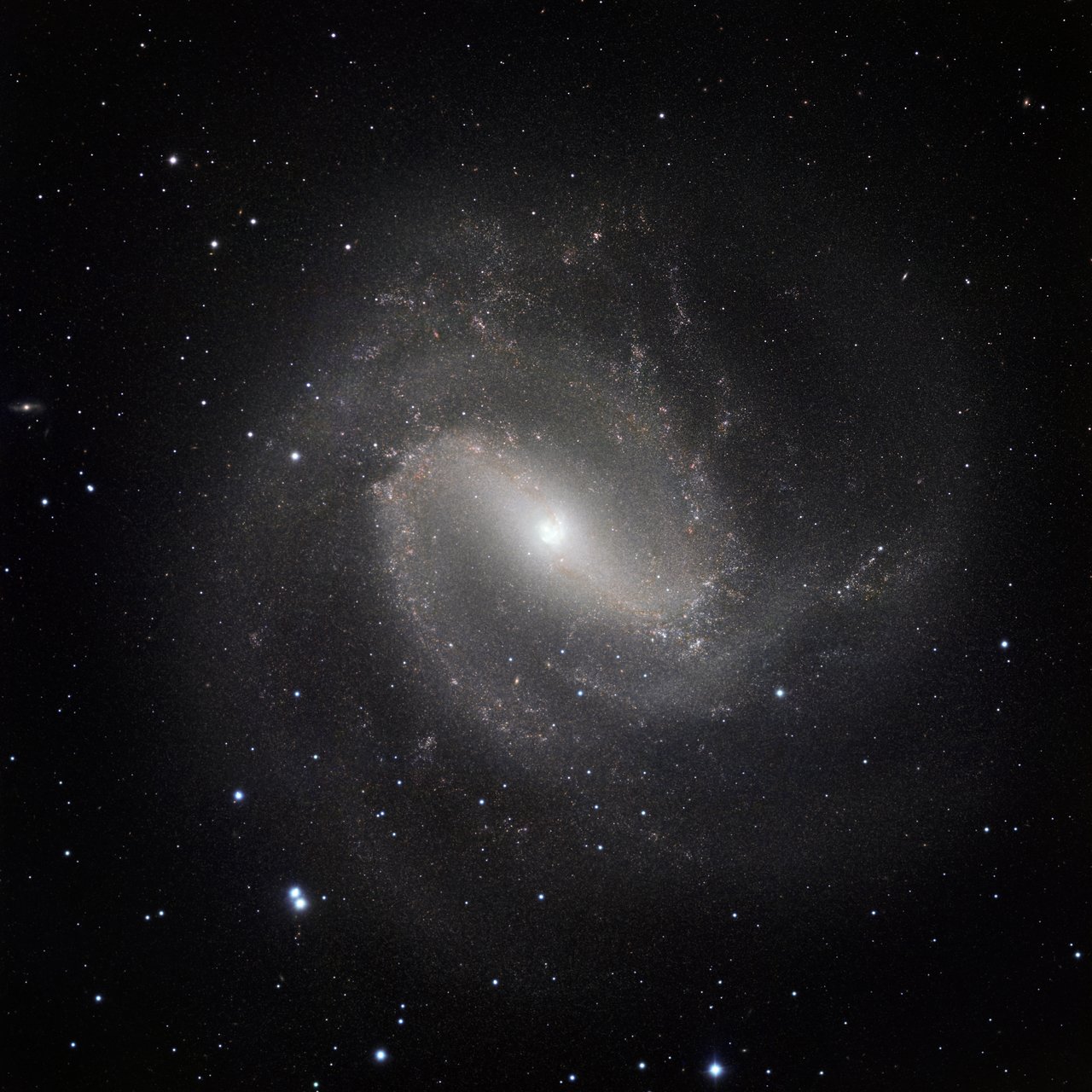
[Click to embiggen, or go here to get access to monstrously bigger images, including wallpapers.]
M83 is pretty close to us, if you happen to think 15 million light years is close. I’m an astronomer, so yeah, I consider 150 quintillion kilometers — that’s 150,000,000,000,000,000,000 kilometers, or 90 quintillion miles — practically next door in galactic terms.
This image is fascinating. It was taken with the ridiculously huge 8 meter Very Large Telescope in Chile, and is in the infrared at a wavelength of 2.2 microns, about three times the wavelength of the reddest light your eye can see. That turns out to be important! Galaxies like M83, and our Milky Way for that matter, are littered with huge clouds of dust. These aren’t like the clumpy bunnies you find under your sofa when you accidentally drop some M&Ms under there while gaming and realize you haven’t vacuumed in a couple of months. Say.
No, this dust is actually composed of complex organic molecules, and they are opaque to visible light. A cloud of dust a few light years across might as well be a concrete wall if you’re trying to look past it with a telescope. Whatever’s behind it is hidden.
But infrared light has a longer wavelength than visible light, and it passes through that dust. So an image of a galaxy in IR can look a lot different than one taken in visible light. When I first saw the picture above, I didn’t even recognize the galaxy! Mind you, I am a vastly huge astronomy dork, and can recognize dozens of galaxies at a glance (that would sound like bragging if the topic were any different). So to be stumped, even for a moment, when seeing such a picture is disturbing. Here’s a side-by-side shot to show you the difference:

[Again, click to enspiralate, and to get much huger pix.]
See why I was confused? They look pretty different, and not just due to the colors. In the visible light image on the right, the spiral arms are lit up by really hot stars (some many times hotter than the Sun), and the glowy pink and red parts are clouds of gas where stars are being born. The hydrogen in the clouds gets heated up (astronomers call that being "excited", a gentle reminder that we’re dorks) and emits a lot of light, making them very showy and obvious. Those regions are punctuated by long streamers of darkness, the dust clouds scattered along the arms. They are essentially gone from the IR image on the left! The star forming regions are hard to see as well; they don’t emit nearly as much IR as visible light, so they fade into the background.
I’ll note that just because these images are in the infrared doesn’t mean they’re tracking heat; at least, not like what you normally think of when you think "infrared". A lot of folks equate IR with heat, but that’s not really the case. When you see images from a thermal camera (like in those awful ghost hunting shows) those are way way farther out than what your eye sees, like at 10 – 20 microns. Objects at human body temperature glow at those wavelengths. The picture of M83 was at 2.2 microns, which is where objects at about 1000°C (1800° F) glow. So in a sense we’re still seeing heat, but from objects much hotter than even an oven set to broil — this IR light is from red stars, like giants and supergiants near the ends of their lives.
Looking in the IR tells us a lot about galaxies, more than we’d know otherwise just looking in the visible part of the spectrum. And while the image from the VLT is pretty cool, I have to admit I like the one in visible light better aesthetically. It’s prettier. And it just goes to show you: we need our dark side. It provides contrast against which to see our warmer side.
Image credits: ESO/M. Gieles. Acknowledgment: Mischa Schirmer


Old Charles Darwin Had A Farm… | The Loom
 In my new podcast I take a look at Darwinian agriculture–how farmers can improve their crops by taking advantage of evolutionary history. I talk to Ford Denison of the University of Minnesota, who has done fascinating work plants such as soybeans and the bacteria that live in their roots and supply them with essential nitrogen. It’s a complicated relationship, full of cooperation, conflict, cheating, and punishment. Check it out.


