
Sadly I wasn't familiar with mathematician and science writer Martin Gardner's work. Fortunately, although he passed away this weekend at age 95, he's left a huge body of work to absorb; this show is a fine place to start. [Vimeo] More »



Sadly I wasn't familiar with mathematician and science writer Martin Gardner's work. Fortunately, although he passed away this weekend at age 95, he's left a huge body of work to absorb; this show is a fine place to start. [Vimeo] More »
The Mars Phoenix lander touched down near the Red Planet’s north pole in May of 2008. It was designed to investigate the history of water on Mars, digging into the surface soil and examining the chemistry there. It had a limited design lifetime of only a few months, since the onset of Martian winter in the north made weather conditions too severe to continue operations.
The hope was that NASA would be able to revive the lander once spring had sprung. Many such attempts have failed, and we may now know why: new images show the lander may be damaged.
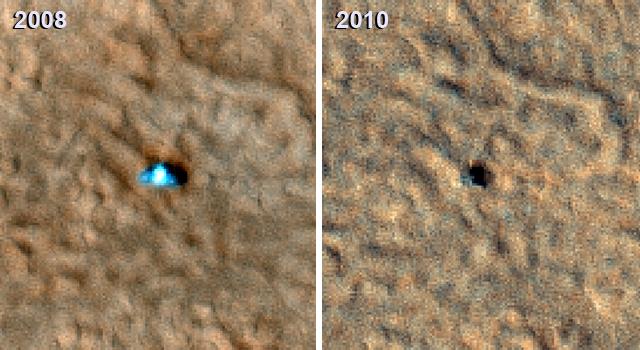
The image on the left was taken in July 2008 with the HiRISE camera on the Mars Reconnaissance Orbiter, and shows the lander in blue. The image on the right was taken just a few days ago, on May 7, 2010. The illumination is similar in the two shots — note the landscapes are very similar looking — but the shadow cast by the lander looks different now. My first thought was that dust built up on the lander, making it look different, but scientists have shown this not to be the case.
More likely, carbon dioxide buildup on the solar panels bent or even broke one of the panels. There were predictions that this might happen, so while this isn’t a total surprise, it’s disappointing. This means that Phoenix will not be able to soak up enough solar energy to restart its operations, which in turn, sadly, means it really is dead.
The good news is it did a tremendous job in its mission, returning important data about the properties of the Martian surface. Although it appears the mission is now over, it was a raging success and I’m happy for the team.
It’s funny: Mars missions tend to fail catastrophically before they even get there, or they get to Mars and seem to last forever. Spirit and Opportunity have long outlasted their warranties, and we have several orbiters still going strong. And even though Phoenix made it down to the surface and exceeded its planned lifetime, it’s still a little weird to find out it’s dead. It shows me that we get used to ESA, NASA, and JPL’s superhuman efforts when it comes to their missions.
Space exploration is hard, damn hard. But we continue to do it, and we continue to get better at it. So while this specific news is disappointing, it’s also a reminder that we can’t take anything for granted. My hat’s off to the scientists and engineers who made Phoenix work, and work beyond expectations.
Image Credit: NASA/JPL-Caltech/University of Arizona

When we're not using the Large Hadron Collider to smash particle beams together or daydream about time travel, we might as well turn it into a musical instrument right? Great! Except that its tunes are purely hellspawn. More »


 “There are lions and cheetahs and leopards out there, my dear. You’d be better off staying here with me.”
This is how male topi antelope lie for sex.
The area of Kenya where they live, Masai Mara National Reserve, is indeed filled with large predators that find antelopes to be just delicious, and so the topi have developed warning calls that they sound when it’s time to scurry away or else be eaten. But, according to an American Naturalist study, the devious topi males have figured out how to use their calls to fake the threat of immediate danger and keep females around, according to research leader Jakob Bro-Jørgensen.
From February to March, male topi hold small territories through which receptive females pass to assess each male’s mating potential. The authors noticed that, while a female in estrus was on a male’s territory, the male would sometimes emit alarm calls, even in the complete absence of a predator. These false alarms are acoustically indistinguishable from true alarm snorts [Ars Technica].
The motivation is easy to see: Normally, during the one day a year that a female topi is sexually receptive, she’ll have sex 11 times with four separate males, on average. However, if a male cries “wolf”—or in this case, perhaps “hyena”—she might stick around his territory, which improves his reproductive odds. Indeed, the researchers found that the males almost never made false predator calls unless there was a lady around and he didn’t want her to wander.
“In fact, males quite frequently pull the trick on females in heat and one may ask why females keep responding to alarms at all,” Bro-Jørgensen said. “The answer seems to be that females are better off erring on the side of caution, because failing to react to a true alarm could easily mean death in a place like the Masai Mara, where it’s literally crawling with large predators” [MSNBC].
The mating game is full of liars and cheaters, or course—just check out DISCOVER’s gallery of the worst offenders. Because their prevarication employs the fear of death, topi are among the most successful, too. After a fake snort of alarm the males, on average, got to have sex nearly three more times. So expect the lying to continue.
Check out DISCOVER’s page on Facebook.
Related Content:
Not Exactly Rocket Science: Eland Antelopes Click Their Heels To Prove Their Dominance
DISCOVER: The Best Ways To Sell Sex
DISCOVER: The Mating Game’s Biggest Cheaters (photo gallery)
Image: Wikimedia Commons


I've installed a swimming pool pump and a booster pump in series . the two pumps are getting hot in a way that I can't keep my hand on the pump for more than 1 minute. I don't know why !!?? can I leave them like this or I have to do some thing ?? they are working 8 hours every day.
note : all t
I have a low power.. (about 20W per ch.) car stereo that uses a pair of small 4" speaker drivers.. A couple of small fans and a few led lights powered off of a BIG car battery.
I want to upgrade this system for better efficiency so that it will still sound good but require fewer battery swaps d

Digital photography is clear, convenient and remarkably predictable. But film, particularly loaded into a pinhole camera, can be rough, murky and inherently retrospective. The 22 results of this Shooting Challenge are an excellent homage to the quirks of the medium. More »


The World Science Festival is running a blog in conjunction with this year’s festivities. Today I’ve written a post about one of the sessions, where scientists will talk about how we can understand our own minds by studying animal minds. Check it out here or here.
From Popular Science - New Technology, Science News, The Future Now:
For two years, Charles Okeke, 43, was just another patient confined to a hospital while awaiting a human heart transplant. Now, he's the country's first test subject for a battery-operated, backpack-sized console,
Appearing more like detached bits of the Milky Way, the Large and Small Magellanic Clouds are irregular dwarf galaxies thought to be orbiting the Milky Way. Members of our Local Group, the Clouds are being pulled and distorted by the Milky Way.

The Atlas of the Universe - Richard Powell
The Large Magellanic Cloud (LMC) is about 1/10th as large as the Milky Way, and about 160,000 ly away. It’s the fourth largest galaxy in the Local Group, and home to the Tarantula Nebula. Visible to the unaided eye as a faint “cloud” in the southern hemisphere, it straddles the border between the constellations Dorado and Mensa.

Large Magellanic Cloud - NASA/JPL
The Small Magellanic Cloud (SMC), at a distance of about 200,000 ly away, is one of the most distant objects visible with the unaided eye. Seen only from the southern hemisphere and lower latitudes of the northern hemisphere, it appears as a light “hazy” patch in the constellation Tucana. The SMC is roughly one-half the size of the LMC.

Small Magellanic Cloud - NASA/ESA, Hubble ST
In comparison with the Milky Way, the Magellanic Cloud galaxies are gas-rich and metal-poor. Noted for vigorous stellar growth and formation, the Clouds also host ancient objects. The LMC was the host galaxy to SN1987a. You remember that show-stopper:

SN1987a NASA/ESA/U. Colorado, CHANDRA/HUBBLE
The Clouds share a neutral hydrogen envelope, itself active in star formation, indicating they have been bound together by gravity for a long time. Known as astronomical treasure-houses, the Clouds have something for everybody.
You can’t go without seeing our most famous satellite galaxies together in the night sky:

Large and Small Magellanic Clouds - ESO (great enlargement)
Am looking for an industry standard for a 2.5mm Diameter 6-Pole Audio Plug.

Last Saturday, on the United Nation’s International Day for Biodiversity, an open letter from hundreds of British organisations warned of the importance of our rapidly eroding biodiversity, while a UN report discussed the economic consequences of this erosion. The general principle of conserving biodiversity has inarguable value but there’s much more debate about how best to do it.
Take national parks and reserves –these protected areas save wildlife but they stop local people from using the land for farming and from using its resources. The argument that such limitations prioritise “cuddly animals” over “poor people” is particularly sharp in developing countries, where rural communities are said to bear the costs of protected areas without reaping their benefits.
But a new study in Costa Rica and Thailand says that such objections are unfounded. By actually comparing similar communities on a small scale, Kwaw Andam from Washington’s International Food Policy Research Institute has shown that protected areas actually help to alleviate poverty.
In 2003, the so-called Durban Accord from the World Congress on Protected Areas urged commitments to “protected area management that strives to reduce, and in no way exacerbates, poverty”. Well and easily said, but studying the link between poverty and protection is quite difficult. The two seem to go hand in hand, but protected areas are often set up in far-flung areas where poverty if rife. How can you actually tell if they worsen the situation?
Andam did it by focusing on protected areas in Costa Rica and Thailand. These developing nations have very different cultures and histories but they are both hotspots of biodiversity that set up protected areas a long time ago. And importantly, they both have good sources national statistics.
Using these data, Andam’s team compared communities where at least 10% of the land had been protected with those where less than 1% had been. This difference aside, they compared like for like, matching the various communities in terms of their forest cover, their access to transportation, the productivity of their land, and how poor they were before protected zones were set up. The analysis was very detailed, zooming in at a fine regional level and taking data about poverty from household surveys. The team also focused on protected areas that had been around for 15 years or more, to get a sense of their long-term impact.
On the surface, the link between poverty and protection seemed clear. As with many other countries, the Costa Rican and Thai communities with high levels of protected biodiversity were much poorer than those with little protection. But these areas were already among the poorest parts of the two countries before the protected zones were set up.
Taking this into account, Andam’s matched comparisons revealed that protected areas don’t exacerbate the economic shortfalls of local communities. If anything, they actually make things better. Put it another way, if the protected areas hadn’t been set up, the local people would probably be even worse off than they actually are.

Could there be other explanations? Certainly, but Andam systematically ruled them out. Andam showed that the genesis of the protected areas didn’t affect the population growth of the relevant areas, which shows that poor people weren’t being pushed out into neighbouring regions. Andam also considered the possibility that the costs of protected areas were spilling over into neighbouring communities, affecting a far wider catchment area than he suspected. But when he left out control regions that were within 10km of a protected area and re-ran his analysis, he got the same result.
This is an important study, which provides some much needed evidence in the area of conservation policy. It’s also very encouraging. Previously, Andam has shown that the networks of protected areas have slowed the pace of deforestation and his latest results show that this success hasn’t come at the cost of local development. If anything, things have improved for local people as a result. It’s not clear how, but it could be that protected areas bring opportunities from business and investments, promote tourism, or improve local infrastructure.
However, Andam is rightly cautious. He notes that his results present an average trend over several decades. In the short term, things may get worse before they get better, and not all districts would benefit equally. Poverty is also only one aspect of a community’s wellbeing and there’s no data on their ability to maintain their cultural traditions, or to feel in control of their fates.
And, obviously, Costa Rica and Thailand are but two countries. Both have enjoyed a lot of investment in their protected areas and in eco-tourism so the same trends may not apply in other parts of the world. (Andam also writes that they had “relatively stable political systems” but the current Thai situation probably doesn’t support that statement!)
Andam calls for other researchers to do a similar analysis in other parts of the world to get a global picture of the impact of protected areas. For now, we have a restricted view of this picture, albeit a positive one. As he writes, “Our results… suggest that protecting biodiversity can contribute to both environmental sustainability and poverty alleviation, two of the United Nations Millennium Development Goals.”
Reference: PNAS http://dx.doi.org/10.1073/pnas.0914177107 If this link isn’t working, read why here
Image: by Haakon S. Krohn
More on conservation:


Our solar system is pretty neat and orderly. Yeah, it has some issues, but in general we can make some broad statements about it: the planets all orbit the Sun in the same direction, for one thing, and they also orbit pretty much in the same plane. If you look at the system from the side, the orbits would all look flat, like a DVD seen from the side.
That’s left over from the formation of the solar system itself, which happened when a cloud of dust and gas collapsed into a disk. The planets formed from that disk, so they all orbit in roughly the same plane. We see other systems forming in the same way, so we assume that when we look at those planets, they’ll also have all their planets in a plane.
Oops. Maybe not so much. Astronomers have just announced that they’ve confirmed a system where the planets are not all aligned this way, and in fact the planets are titled relative to each other by as much as 30°!

Ironically, the parent star is Upsilon Andromedae — that made me chuckle, because it was one of the very first stars found to have planets orbiting it, back in 1996. It’s actually a binary star, two stars orbiting each other; one is a star slightly more massive and hotter than the Sun, and the other a dinky red dwarf orbiting pretty far out (well outside the frame of that illustration of the system above). Three planets (called Upsilon Andromedae b, c, and d) at least are known to orbit the primary star. The planets were initially detected by their gravitational pull on the star; as they orbit they move the star in a mutual tug-of-war. We can’t (usually) see that motion directly, but it can be detected as a Doppler shift in the star’s light.
Due to the physics of the situation, that method only gives us a minimum mass for a planet. The actual mass might be much higher. It also doesn’t tell us the tilt of the orbit of the planet, or of any of the other planets in the system.
 What’s new here is that astronomers used telescopes on Hubble called the Fine Guidance Sensors, which are incredibly accurate and highly precise. The FGSs are so accurate that they could see the physical motion of the star on the sky, the wobbling as the planets tugged on it this way and that. Think of it like a harried parent at a mall with two little kids holding her hand. As the kids see one store or another they want to visit, they pull on her in different directions as she walks with them, so her path down the mall corridor shifts left and right.
Combining the new Hubble data with the older Doppler data has revealed a wealth of information about the planets in that system. For one thing, it nailed the masses. Instead of lower limits, we now have accurate masses for planets: Ups And c is 14 times the mass of Jupiter, and Ups And d is 10 times Jupiter’s mass*. Mind you, Jupiter is a bit of a bruiser, so these are hefty planets. These masses are far larger than thought before, so the new observations really changed our thinking here.
But the amazing thing is that it looks like Ups And c and d are in wildly different orbits: instead of being almost exactly in the same plane as expected, they are tilted relative to one another by 30°! The illustration on the right compared those orbits with those of planets in our own solar system, and you can see how weird this is.
But does this mean astronomers are wrong about how planets form?
Probably not. We’re pretty sure we understand how planets form, at least in general terms. What this does mean is that something happened to the planets after they formed, something that tossed one or both of these planets into different orbits than the ones they were born in.
This isn’t a huge surprise. Pluto may or may not be a planet by your definition, but it orbits the Sun at an angle of 17° with respect to the Earth. Sedna, an object about the same size as Pluto in the outer solar system, also has a large tilt. We know there is some mechanism that can change the orbits of big objects in the solar system, so why not in other systems, too?
In the case of Upsilon Andromedae, we have some culprits. The data hint that there may be a fourth planet orbiting the star. It’s not clear if it’s there or not, but if it has an elliptical orbit it could gravitationally affect the inner planets. There’s also the red dwarf star orbiting farther out. Far more massive than a planet, its gravity may have some effect on the system as well. It’s also certainly possible that there are other influences we haven’t seen or thought of yet. [Update: I just got off the phone with the team who did this research, and Rory Barnes told me that a strong possibility as well is that there were more planets in the system initially. They would have interacted via gravity, and affected each others' orbits. A likely scenario is that a planet with about ten times the mass of Jupiter could have messed up the orbits of the other two, then been ejected out of the system. This is a common outcome when you have lots of massive objects in one system.]
The point here is that in general, our theories of how planets form is pretty good. As we study more of these systems, we’ll get more and more data under our belts that will help us catalog and understand where these systems follow our theories, and where they seem to diverge. That’s all good news! Theories only go so far in explaining everything, and as we observe more we modify those ideas, add to them, so they better represent the Universe around us. That’s how science works, and that’s how we learn.
Related posts:
Wrong way planets screw up our perfectly good theories
A tiny wobble reveals a massive planet
Image credit: NASA, ESA, and A. Feild (STScI)
From NPR Topics: News:
Another season, another sprout recall. The Food and Drug Administration said today that Caldwell Fresh Foods of California is recalling packages of alfalfa sprouts that have reportedly made up to 22 people sick in 10 states. The government says there ha
From BBC News | Science & Environment | UK Edition:
BP has pledged $500m (£346m) to study the impact on the Gulf of Mexico of the oil spill, as top US officials flew over the area to assess BP's response. A BP official said a bid to plug the leaking well with heavy mud and cemen
From PopularMechanics.com Automotive - RSS Feed:
It's the Great American Ritual-washing the car. You get your bucket of soapy water and a sponge, fire up the garden hose and go to work. Your neighbor in the adjoining driveway does the same. But he's assembled a whole array of car c
I've been asked to come up with a design for a crematorium for local construction - that is, the investors do not want to buy a packaged crematory furnace and ship it here from another continent. I've been able to find some information on-line, sometimes in odd places, but I wonder whether any CR4 s

Here's the bottom line on the first speed tests of Android 2.2: without Flash 10.1, its browser handily beats all comers. But with Flash? It drops to the bottom of the heap. Ruh roh. More »


The Phoenix Wright franchise deserves a lot of credit for sticking to one of the least appealing-sounding concepts in game history. So anyway, here goes: Phoenix Wright, the comedic litigation game, is in the App Store for $5. Oh dear. More »


Hello to everyone who joins this forum...can anyone help me in knowing the use of PIR in circuit breaker?


