It’s Time To Get Behind Peter Schiff

SPECIAL GUEST EDITORIAL

by Josiah Schmidt

Those of you following Connecticut's Republican Senate race are aware that, last week, one of the two establishment candidates bowed out, leaving only the establishment-endorsed Linda McMahon and the Tea Party-endorsed Peter Schiff.

As libertarian Republicans, we ought to be aware of some of the distinctions between Schiff and McMahon:

Peter Schiff opposes all bailouts. Linda McMahon does not oppose all bailouts. Peter Schiff is against TARP. Linda McMahon "supported TARP in its original form."

Peter Schiff is against cap-and-trade. Linda McMahon claims to oppose cap-and-trade, but only "in its current form," meaning she would be open to compromising on it and supporting
it.

Peter Schiff wants Roe V Wade overturned. Linda McMahon supports Roe V Wade.

Peter Schiff will devote all his time in the US Senate to forcing an immediate end to deficit spending, by leading a filibuster of the raising of the national debt ceiling and fighting every big spending bill that comes across the Senate floor. Linda McMahon does not want to go to Washington to really make a difference. She has said she would have voted to go along with raising the national debt ceiling by $3 trillion.

Peter Schiff is a millionaire with wide and deep support, who energizes the grassroots. Linda McMahon is just a millionaire.

Peter Schiff has been endorsed by all the Tea Party organizations in CT, as well as the 9 largest CT-based conservative grassroots organizations. Linda McMahon was endorsed by the establishment. Peter Schiff is a committed Republican.

Linda McMahon has donated to many Democratic politicans (including Rahm Emanuel) and was speaking at Democratic events for quite some time before deciding to run in the Republican primary. In fact, the organization who has received the most money from McMahon is the DCCC.

Peter Schiff is incredibly intelligent, is an expert on the biggest issue of the day (the economy) who predicted the 2008 recession in great detail, and can make Richard Blumenthal look like a fool in the debates. Linda McMahon has little-to-no detailed knowledge of any issues and will not be able to hold her own in an indepth debate with Blumenthal.

But I'm not touting Peter Schiff only because he is more in line with our issue positions than Linda McMahon is. I'm touting Peter Schiff, because I have come to the sincere conclusion that he is the only one with the knowledge, the credibility, the persuasiveness, the forcefulness, the courage, and the convictions necessary to get our country back on the right track.

There are very few politicians who I actually believe, when they say that they want to "bring change to government," or "shake up Washington." Even Ron and Rand Paul, who I have nothing but respect for, do not seem to me to be the type of politician that wants to be a powerful force for revolutionizing the way things are done in government. Most free marketeer politicians want to "set an example," or "encourage debate" regarding lofty, esoteric, philosophical issues. Peter Schiff, on the other hand, wants to use every tool at his disposal, to actively bring the big government machine in Washington to a grinding, screeching halt. While I have no doubt that a Senator Schiff would spark some very healthy debates over public policy and leave behind a sterling voting record, Schiff really wants to do battle with the federal government. For instance, one of his main goals is to lead a filibuster of the raising of the national debt ceiling. In the past, when Republicans have threatened to do so, the Democrats cry that such a thing would cause the federal government to have to be shut down. Peter's response? "Let them shut it down, because if we don't shut the government down, the government is going to shut the country down." Peter understands that only if we cut off the funding to the beast, will the beast be forced to start living within its means and making meaningful cuts.

Why do we need a free market warrior in Congress right now, more than we need a free market philospher? Because if policies continue on their current trajectory, this country is headed for a disaster of unprecedented magnitude. Mountains of malinvestments have amassed within our economy as a result of the ongoing attempts to keep bad businesses afloat with an unending stream of ridiculously cheap credit. When these malinvestments meet the fiery reality of consumer demand, this will result in massive bankruptcies, job losses, and credit restrictions (yes, even more). The Federal Reserve is spewing new money with reckless abandon, and when the dam of Chinese/Japanese/Saudi lending bursts, demand for the dollar crashes, and the value of our money plummets, prices will skyrocket and economic pandemonium will break loose. Somebody needs to be in the US Senate, not merely to sit back and make well-intentioned speeches, warning the government not to do the wrong thing in response to this disaster, but to stand up and use every legislative tactic and tool to force the government not to do the wrong thing in response to this disaster. And not only that, but somebody needs to be in the US Senate with the relentless persuasiveness and credibility needed to convince other Congressmen and Senators to do the right thing as well.

With all due respect to Linda McMahon, who would be nowhere near as bad a Senator as Richard Blumenthal, I don't see how anyone can believe, by any stretch of the imagination, that a Senator Linda who would fight tooth and nail to stop the raising of the national debt ceiling (which she has already said she would have voted to raise), or the next wave of bailouts (when she already said she would have supported the first wave of bailouts), or the horrible government policies that threaten to make our situation so much worse (when her
website is littered with promises to make all the same mistakes that got us into this mess in the first place). Even if Linda McMahon had the loyalty to free market principles that Peter Schiff has, I simply couldn't see her going from door to door down the corridor of Senator offices, and hammering each of them with raw logic over and over until they agree do the right thing.

Perhaps some years ago, before the size and severity of the coming crisis had been made clear, I wouldn't have fought so fervently against nominating someone like Linda McMahon. But the nature of our problem is now so grave, that we must take a chance at trying to
nominate the one person who will truly fight, day and night, for us in Washington--Peter Schiff. Schiff is aware that the average Senator spends 40% of her time trying to get re-elected (and in a blue state like Connecticut, a Republican Senator would have to spend a lot more than just 40% of their time securing re-election), which is why Schiff has pledged only one term. That means all of his time will be devoted to working for us. The fact that McMahon wants a healthy twelve years in the Senate means that she won't have the time to do the fighting Peter Schiff can do, and it shows that she doesn't understand the fact that this country's economy, as we know it, likely doesn't have more than six years left.

Peter Schiff can win the nomination, if we put all our efforts behind him, and he can make Dick Blumenthal look like a dunce on the biggest and most pressing issues of the day. But this election is about more than just denying a lowlife like Blumy a Senate seat. This election is our key to mitigating an enormous amount of the damage that the government will undoubtedly try to do, when the economy implodes and the Dollar collapses. It's time to get behind Peter Schiff.


Ayn Randian challenges extremist liberal Russ Feingold Wisconsin Senate

Who is Ron Johnson?

George Will's latest column highlights the candidacy of Ron Johnson, leading Republican challenger to incumbent ultra-liberal Democrat Sen. Russ Feingold in Wisconsin. Tommy Thompson opted out of a run for the seat. Johnson has since emerged.

Excerpts from Will, "Running Not Shrugging" at RCP:

MILWAUKEE -- Before what he calls "the jaw-dropping" events of the last 19 months -- TARP, the stimulus, Government Motors, the mistreatment of Chrysler's creditors, Obamacare, etc. -- the idea of running for office never crossed Ron Johnson's mind. He was, however, dry tinder -- he calls Ayn Rand's "Atlas Shrugged" his "foundational book" -- and now is ablaze, in an understated, upper-Midwestern way. This 55-year-old manufacturer of plastic products from Oshkosh is what the tea party looks like.

He is trim, gray-haired and suddenly gray-suited. For years he has worn jeans and running shoes to his office, but now, under spousal duress, he is trying to look senatorial -- "My wife upgraded me to brown shoes." He has been endorsed by the state party and will almost certainly win the September primary for the Republican nomination to run against Russ Feingold, who is seeking a fourth term in a year in which incumbency is considered a character flaw.

Later in the piece:

The theme of his campaign, the genesis of which was an invitation to address a tea party rally, is: "First of all, freedom."

"The most basic right," Johnson says, "is the right to keep your property." Remembering the golden age when, thanks to Ronald Reagan, the top income tax rate was 28 percent, Johnson says: "For a brief moment we were 72 percent free."

Finally:

What Samuel Johnson said of Milton's "Paradise Lost" -- "None ever wished it longer than it is" -- some readers have said of "Atlas Shrugged." Not Johnson, who thinks it is "too short" at 1,088 pages. Noting that Massachusetts "is requiring insurance companies to write polices at a loss," he says, "We're living it," referring to the novel's dystopian world in which society's producers are weighed down by parasitic non-producers.

From 2000 through 2008, sales of "Atlas Shrugged," which was published in 1957, averaged a remarkable 166,000 a year. Since Barack Obama took office, more than 600,000 copies have been sold. The novel's famous opening words -- "Who is John Galt?" -- refer to a creative capitalist, Rand's symbol of society's self-sufficient people who, weary of carrying on their shoulders the burden of dependent people, shrug. Ron Johnson would rather run.

The latest poll numbers from Rasmussen (via Rightosphere):

Rasmussen Wisconsin Senatorial Survey

•Russ Feingold (D) 46%
•Ron Johnson (R) 44%

Editor's note - Graph of painting depiction of John Galt not Ron Johnson. Any resemblence is purely coincidental.

The Aurora

Click here to view the embedded video.

The sun is getting active again so it’s time to be watching for the aurora.  Yesterday I was all excited because conditions were right to be able to see an aurora from here.  That was until it got dark and the conditions went to the devil.  Oh well, at least there is progress.

Oops, almost forgot the source.

A biological basis for acupuncture, or more evidence for a placebo effect? | Not Exactly Rocket Science

Acupuncture

In the past, I have criticised science journalists for not providing enough background in their reports. Both news stories and scientific papers obviously focus on new events and achievements, but they do so in the knowledge that new discoveries stand on giant shoulders. For this reason, when I cover new papers for this blog, I try to describe some of the research that led up to it, a tactic that fits with the growing cries for more context in modern journalism.

And yet, it’s perhaps churlish to expect this to be a routine part of science journalism when many scientists themselves don’t take up the practice. I bring this up in the light of a new paper, published today in Nature Neuroscience, about the controversial topic of acupuncture. I was going to do this as a straight write-up but actually the omissions in the paper are probably just as interesting than the science within it.

The gist is this: Nanna Goldman from the University of Rochester Medical Center claims to have found a biological explanation for the pain-relieving effects of acupuncture. She worked with mice that had inflamed paws, and managed to alleviate their pain by using a needle to pierce a traditional acupuncture point near the knee. This painkilling effect only happened when she rotated the needles after insertion.

This effect depended on a chemical called adenosine, which typically surges in concentration after any stress or injury. Adenosine works by docking at a protein called the adenosine A1 receptor, which has well established roles in suppressing pain and is found on neurons that transmit pain signals. Indeed, other chemicals that stimulated this protein had the same pain-relieving effects as acupuncture. Drugs that prevent the body from breaking down adenosine led to even more potent pain relief. And mice that lacked the A1 receptor altogether experienced no pain relief from the needles.

Taken on its own merits, this is a nice piece of biochemistry. But what does it really tell us about acupuncture? Does it actually validate this ancient method as a way of relieving pain? After reading the paper, you might walk away with that idea that we’re one step closer to understanding how a treatment with real medical benefits really works. It’s littered with statements like “A1 receptor activation is both necessary and sufficient for the clinical benefits of acupuncture” and “medications that interfere with A1 recep­tors or adenosine metabolism may improve the clinical benefit of acupuncture”. In the study’s press release, lead scientist Maiken Nedergaard even says, “The new findings add to the scientific heft underlying acupuncture.”

But these results have to be considered in the light of those that came before it. As mentioned above, new scientific discoveries stand on the shoulders of giants and in the case of acupuncture – one of the most well-researched of all “alternative therapies” – those shoulders are particularly large.

Many trials have demonstrated that acupuncture does have some pain-relieving effects – that is not in doubt. And as Steven Novella notes, unlike things like homeopathy or reiki, with acupuncture “something physical is actually happening… so it is therefore not impossible that a physiological response is happening”. But the big questions are whether this effect is genuine of nothing more than a placebo.

To answer that, clinical trials have used sophisticated methods, including “sham needles”, where the needle’s point retracts back into the shaft like the blade of a movie knife. It never breaks the skin, but patients can’t tell the difference from a real, penetrating needle. Last year, one such trial (which was widely misreported) found that acupuncture does help to relieve chronic back pain and outperformed “usual care”. However, it didn’t matter whether the needles actually pierce the skin, because sham needles were just as effective. Nor did it matter where the needles were placed, contrary to what acupuncturists would have us believe.

Other trials have found similar results. Going beyond individual studies and looking at all of the available evidence doesn’t much change the verdict. Last year, scientists from the Nordic Cochrane review centre did an analysis of the available evidence and after considering the 13 trials that met their stringent quality criteria, they concluded:

“A small analgesic effect of acupuncture was found, which seems to lack clinical relevance and cannot be clearly distinguished from bias… Our findings question both the traditional foundation of acupuncture, which is based on the existence of meridians and Qi sensations, and the prevailing hypothesis that acupuncture has an important effect on pain in general. If this hypothesis is wrong, and our results point to that, then acupuncture would seem to be unlikely to have an effect on pain related only to certain conditions, but further studies may examine this question.”

Goldman doesn’t really address any of these points. The introduction to her paper focuses on acupuncture’s popularity, mentioning endorsements by the WHO, the NIH and, strangely, the US Internal Revenue Service. As to the bigger question about whether it is effective, there is no sign of the recent trials or reviews that I mentioned. Instead, she briefly says that the pain-killing effects of acupuncture are “well-documented” and that “Western medicine has treated acupuncture with considerable skepticism”, citing only an editorial published in 1972.

As I’ve said, this is not an area that’s lacking in earlier research to refer to or consider. The discussion is a bit better in that it at least references one trial which showed that acupuncture has no advantage over placebo sham-needle treatments. And if anything, the results seem entirely consistent with the idea of acupuncture as an elaborate placebo.

The tissue damage inflicted by the rotating needle triggers a local flood of adenosine. If the needle is stuck in the right general area, the extra adenosine reaches the receptors on the pain-transmitting neurons and shuts down their activity. There is no need to invoke ‘qi’ flowing through ‘meridians’. Indeed, all sorts of injuries and stresses will lead to a burst of adenosine. And Goldman even says that sham needles, by stimulating but not breaking the skin, could still trigger a burst of adenosine, leading to the same pain-killing effects.

There has been so much previous work in this area that the question “How does acupuncture work?” is better replaced by “Why are acupuncture’s effects largely indistinguishable from those of sham treatments?” The new study suggests some answers but it seems unfortunate to me that Goldman didn’t include any sham-needle controls in her experiments.

Brian Berman, who has been involved in previous Cochrane reviews of acupuncture, agrees. He described the study a “very interesting” but said that “some sort of a placebo control is needed”. Edzard Ernst, former professor of complementary medicine at the University of Exeter, has written extensively about acupuncture also concurs. He told me, “It’s an interesting study but it proves nothing. We need independent replication, better controls and studies in humans.”

This is the most frustrating part of what could have been a really fascinating study. Without building on the massive amount of work that’s already been done on acupuncture, it is hard to know what to make the new and admittedly interesting results. I also wonder whether your average health journalist will know how this study fits into the bigger picture – whether it vindicates the use of acupuncture or whether it actually fits with a skeptical stance. But I suspect we won’t have to wait long to find out.

PS: The paper notes that the authors have no competing financial interests that might have affected their work. However, it is worth noting that one of the co-authors, Jurgen Schnermann, is married to one Josephine Briggs. Briggs is the director of the National Center for Complementary and Alternative Medicine, an institute that has had its fair share of controversy in the past.

Update: Yeah, the mainstream media aren’t really covering themselves in glory here. See Stuff and Nonsense for a summary. The Times probably has the best piece, in that it actually mentions previous trial data and has some great commentary from Edzard Ernst.

Reference: Nature Neuroscience http://dx.doi.org/10.1038/nn.2562

More on pain:

Twitter.jpg Facebook.jpg Feed.jpg Book.jpg

Geoengineering on NPR: “A Bad Idea Whose Time Has Come” | The Intersection

Eli Kintisch, Point of Inquiry guest (listen) and the author of Hack the Planet, was on "All Things Considered" yesterday. Here's an excerpt from the show transcript:
Another scientist is taking a different approach to geoengineering. Instead of looking to the sky for solutions, he's looking to the ocean. Victor Smetacek, a German oceanographer, is trying to cool the planet by growing carbon-absorbing gardens in parts of the ocean with little life. In 2009, Smetacek and a team of Indian and German scientists added 6 tons of iron into a section of the Southern Ocean, which rings Antarctica, to see if they could get a massive bloom of algae to flourish. Algae growing in the ocean cools the planet by sucking in carbon dioxide. The team did get algae to grow, but it was the wrong kind of algae. The 10-week experiment, called project LOHAFEX, is the world's largest geoengineering project to date, and, like many other geoengineering attempts, was controversial. Greenpeace and other environmental organizations demanded that LOHAFEX be stopped from the start, saying that pouring iron into the ocean amounted to pollution and violated international agreements. Some scientists feared the unintended side effects of the project. "In the case of fertilizing the ...


Amazing shot of ISS and Jupiter… during daytime! | Bad Astronomy

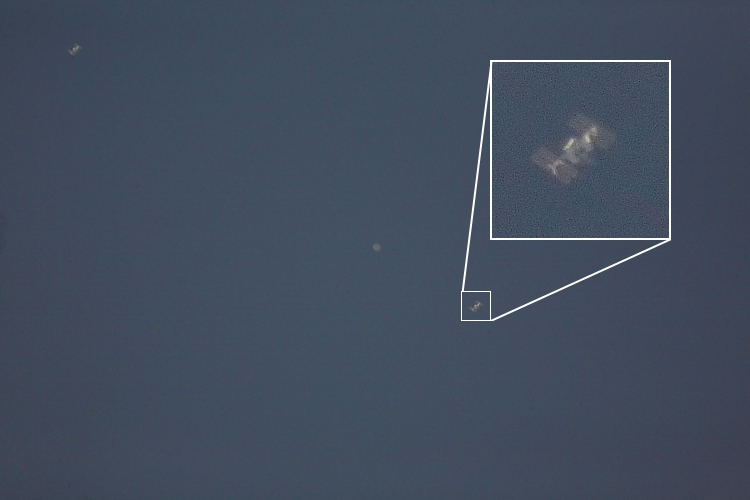
The amazing pictures of the space station taken by ground-based amateur astronomers keeps on coming. On May 29th, Anthony Ayiomamitis used a 16 cm (6″) telescope to capture a phenomenal image of the International Space Station passing Jupiter… in broad daylight!

ayiomamitis_iss_jupiter

Wow! Note the color of the sky; it was about 9:00 a.m. local time when he took this shot, with the Sun well above the horizon. This is actually two images added together; the first shows the ISS to the lower right, and in the second shot it had moved to the upper left. Jupiter shows its disk near the center of the frame, it being easily bright enough to be seen using a telescope in daylight.

What an incredible picture! But it gets cooler…

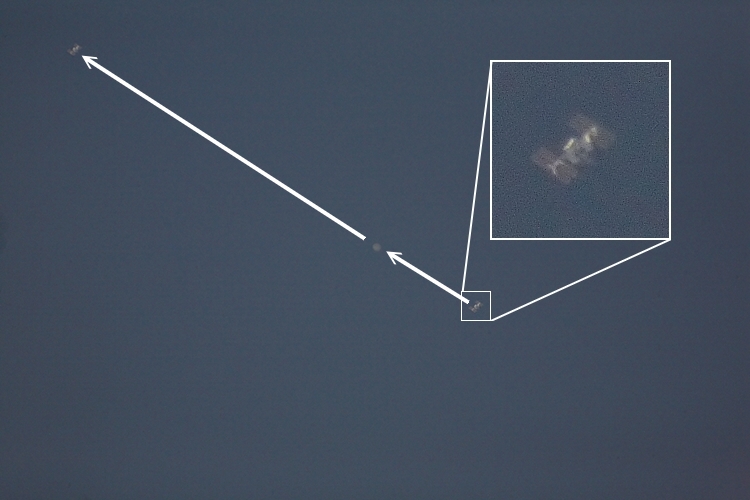
ayiomamitis_iss_jupiter2The picture on the right is the same shot, but this time he connected the two ISS images with a line. Given the size of both the ISS and Jupiter, it looks like the station flew directly in front of the planet from Anthony’s position! Had he taken that first shot literally a tenth of a second later, he would have had the picture of a lifetime. As it is, it’s still way cool.

Want more? I got more.

Robert Vanderbei, at Princeton University, took this picture of Jupiter, also in daylight. You can see the moons!

vanderbei_jupiter_daytime

The picture has the moons labeled. Ganymede and Europa are faint, but visible. For an added coolness, Io was poised right on the limb of the planet’s disk. You can see the Red Spot, and also how the southern equatorial belt of Jupiter is missing (it should be at about the same latitude as the Red Spot). To get this Robert used a 9 cm (3.5″) Questar ’scope, which is small but has very nice optics.

And one more, but it’s a link: Universe Today is reporting that an amateur got shots of the Air Force X37-B in orbit!

All this goes to show that the word "amateur", as I’ve been saying for years, is losing its meaning. Like everything in nature, when you get near the boundary between two entities, the lines get blurry. I know lots of so-called amateurs who have a far keener grasp of the sky and the objects in it than some professionals. Astronomy is one of the few sciences where someone with even modest equipment can do phenomenal work in the field. I love it, and it’s a great time to be an astronomer!

Image credits: Anthony Ayiomamitis, Robert Vanderbei, used by permission.


Impact Of Space Policy Changes Becoming Clear

Keep the shuttle flying, editorial, Houston Chronicle

"The demise of the shuttle is reminiscent of the last time the U.S. space program reached a technological pinnacle with the Apollo spacecraft and its launch rocket, the Saturn V. Having created the mightiest rocket in history, budgetary considerations brought on by the Vietnam War led to the termination of the moon missions, scattering its work force. The Johnson Space Center wound up with a Saturn for public display, much like various facilities are now vying for one of the decommissioned shuttles."

NASA future still a vast unknown, editorial, Huntsville Times

"Hundreds of jobs could be at stake in Huntsville, and many more nationwide, depending on the outcome. Before the administration can proceed along that track, Congress must formally approve scrapping Constellation, for which $9 billion has already been spent in the early development of Constellation's Ares rocket. Alabama's congressional delegation and congressional representatives from other NASA states are fighting to protect Constellation along with pushing for a more focused space policy."

NASA Langley's building plan in doubt, Daiy Press

"NASA Langley Research Center started modernizing its aging campus, but there's no guarantee it'll finish the job. In fact, a retired Langley administrator said the odds are "pretty darn grim" given the recession and political infighting surrounding President Barack Obama's plan to scrap NASA's return mission to the moon. The plan, dubbed New Town, is a 10-year, $200 million building project that would centralize the campus by replacing sprawling World War II-era structures with a cluster of environmentally friendly offices and laboratories."

KSC role in launches not required in draft plan, Florida Today

"Private companies flying astronauts to the International Space Station won't be required to launch from Kennedy Space Center, NASA said Tuesday. "It's basically up to commercial entities to define what makes sense for them," said Doug Cooke, the associate administrator in charge of exploration programs. Unless one of those companies chooses to fly from KSC, the center's traditional role as the launching point for U.S. missions could be dramatically reduced for years after the shuttle program's retirement."

Bubble Heads?

A Scottish entrepreneur has invented a plastic bubble, the Social Sphere, to wear on your head in noisy bars to make it easier to have a conversation. Should we be wearing them on the streets, too? Are bubble heads the wave of the future? Is the Social Sphere helmet the only way to drown out the din

Sailing: Newsletter Challenge (06/01/10)

This month's Challenge Question:

You are in a sailing race on a very wide river. On land there is no wind; it is a dead calm. The race is 10 Km downstream, and the river is running 5 Km/ hr. Your opponents decide that to make the best time, they will streamline their boats to the wind and

Meet the Moderator: yamdankee

yamdankee is a Web Content Technologist at GlobalSpec. He went to school for Electrical Engineering Technology and Semiconductor Manufacturing Technology. He also enjoys repairing electronics as a hobby, including cell phones, laptops, gaming systems, TVs, and much more. He also spends his

Long Live the Stick Shift

I remember sitting in a friend's kitchen one day, talking. He lived on a short steep hill with a stop light at the bottom. A car passed by — I didn't notice, but my friend stopped in the middle of what he was saying, a smile of appreciation crossing his face. "That guy shifted three times befo

How Much Safety?

Most people agree that "better safe than sorry" is the most prudent policy for governing air traffic. Travelers and the airlines industry have second guessed decisions to cancel flights due to the volcanic eruptions in Iceland. Are their complaints justified, or should they keep quiet and abide by t