
 NPR’s Jon Hamilton has a nice piece on Einstein’s brain, and what might have made it special. The difference doesn’t seem to have to do with its neurons, but with the other cells of the brain, the glia. I wrote about the glia–what I called the dark matter of the brain–in this Discover column last fall.


PLC and Functional Safety Certification
I have been asked to find the requirements for safety certification for PLC based systems. Unfortunately i continue to run into a brick wall. Can anyone point me in the right direction. thank you
Center for Inquiry Needs Help | Cosmic Variance
The Center for Inquiry is a great organization — their mission is to “foster a secular society based on science, reason, freedom of inquiry, and humanist values,” which sounds like a good idea to me. They sponsor a number of activities including lectures, education, conferences, and research. I’ve given talks at the local branch, and it’s a great thrill to meet with such an engaged and enthusiastic audience.
And they’re in a bit of trouble. As a non-profit, they rely on donations, and their major donor seems to have mysteriously disappeared. About $800,000 of their annual operating budget is suddenly gone.
We’re not going to make up for that with a few appeals on the internet, but we can help them adapt during a tough time. Consider donating, even if it’s just a few bucks.


Dying of the Television Light | Visual Science

Photographer Kirk Crippens created this image of the speck of light that persists after the television is turned off. After a lot of trial and error, Crippens was able to catch the speck in the middle of the frame, at at magnification of about 5x, on an RCA solid-state black-and-white television.
When the TV is on, electrons firing at its phosphor-coated screen cause the screen to emit light, creating the image. Electromagnets guide the beam and direct it to scan repeatedly across the screen. When the set is shut down, the electromagnets deactivate and the remnant beam from the electron gun defaults momentarily to the center of the screen before dying out—but not always in the same spot, as Crippens discovered. The blue and yellow colors here result from electrons exciting the two types of phosphor common in older TVs.
Crippens: “This photo is part of the ‘Pre-Pixel’ portion of Pixel Nation—it is the stepping off point to pixelization. I show magnified photographs featuring a nixie tube, an oscilloscope screen, an amber computer monitor and then this black-and-white TV as ‘Pre-Pixels’ before moving into the depth and variety of pixels created through the years.”

Recreating The RCA Photophone
From Retro Thing:
The pallophotophone was an early audio recorder created by GE researcher Charles Hoxie (seated in the photo) in 1922. Rather than using magnetic wire or lacquer disks, the device captured audio waveforms on sprocketless 35 mm film as a series of 12 parallel track
NPSH for the submersible pump
I need to purchase submersible pump at a platform where the depth of water is 4 mtr there is no vessel or tanks just i need to install the pump in this depth some of vendors have advised that NPSH req of their offered pump is 20 feet and it would be greater than depth of water while some of them ha
Hubble Captures Surprising Star Motions
From Wired Top Stories:
Using images of a star cluster taken ten years apart, astronomers detected young stars moving in somewhat surprising ways. The Hubble Space Telescope imaged the core cluster of the extremely dense star-forming region NGC 3603 in 1997 and again in 2007 (ab
Video View of Guatemala Sinkhole
From NYT > Science:
Just in case anyone had doubts about the reality of the extraordinary sinkhole that formed in a crowded district of Guatemala City — following a similar incident in the city in 2007 — this Associated Press video report closes the case.
Wat
Rehabilitation & Upgrade of 33/132KV and 132/330KV Transmission Substations
I need a referal to companies that do undertake the rehabilitation and Upgrade of 33/132KV and 132/330KV Transmission Substations. I have some substations rehabilitation and upgrade work to perform and I would need the help of these companies. Work station is Nigeria.
Thank you.
Patrick Ob
Earth, Wind and Hydro
...Who's fooling who: here's the FIRE (Deepwater Horizon style).
Click image at right to stream a CBC Radio report I heard this past weekend emphasizing the use of protective respirators in the cleanup. -->
Wish I could disconnect what's currently going on in the Gulf of Mexico from thi
Does Anyone Else Have a Moon Rock at Home?
 TV Station Finds Missing Moon Rock, 7 News
"The station decided to call former Gov. John Vanderhoof to find out if he remembered what happened to the plaque presented to him by NASA astronaut Jack Lousma on Jan. 9, 1974. "Well, governor, what do you know about these moon rocks? Where are they?" a reporter asked. "They're in my house, in my display of things," he said. Vanderhoof, 88, said he didn't know what to do with the display once he left office so he simply decided to take it with him. He said he did not know it was worth $5 million on the black market."

Connecting Three Generators In Series
Dear All,
Please I have a little challenge here.
I have Three (3) different rated generators (11oKVA, 200KVA and 500KVA) Gen sets to be connected in series using ABB EK Series block contractors. The Generators will be selected using a 3-way Rotary switch.
Please can anyone
Take a moment to just soak in a beautiful spiral | Bad Astronomy
The way I see it, every now and again you just need to look at a beautiful image of a spiral galaxy:
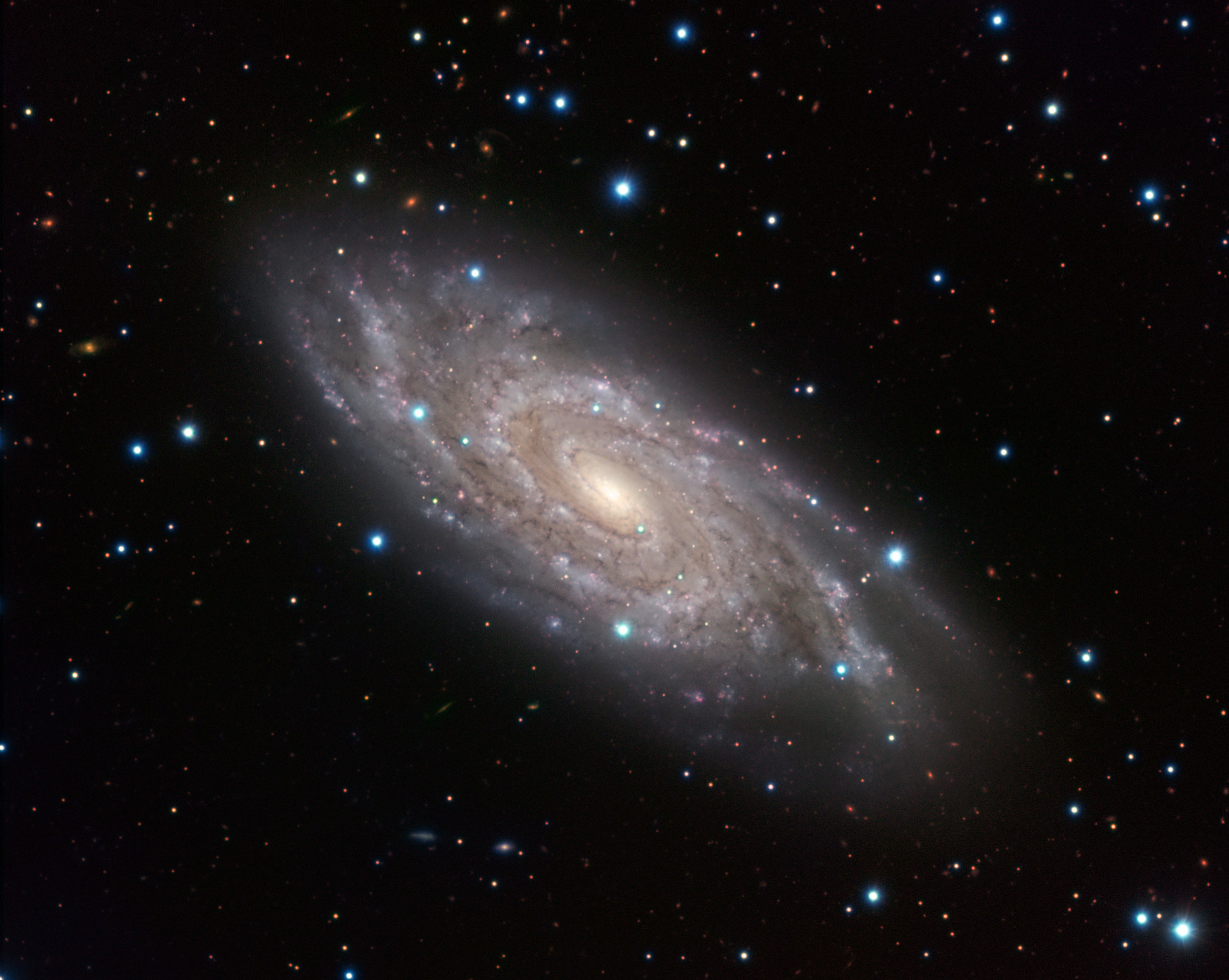
Oh yes, you want to click that image.
That’s NGC 6118 as seen by the European Southern Observatory’s 8-meter wide Very Large Telescope in this newly-released image. The VLT’s 500,000 square centimeters (78,000 square inches) of mirror really suck down the light, giving us a stunning near-true-color view of this spiral. Even from 80 million light years away we can trace the positions of pinkish star factories, the dark dust lanes, and see the reddish-yellow glow of old stars in the galactic hub.
I was drawn to how tightly wound the galaxy is, and how long the arms are. Starting at the nucleus you can trace the two major arms all the way around more than once. The galaxy is tilted severely, so it’s hard to say what’s going on at the lower right; does the arm split there? That sort of thing is called a "spur", and they can form as the gas in the galaxy interacts with the arms.
All the stars you see in the picture are in the foreground, in our galaxy. It’s like looking out a dirty window at a tree outside; the spots are close by, the tree much farther. But you can also see dozens of small galaxies, too, which are not small at all, but in reality other majestic and grand objects diminished by their even greater distance.
NGC 6118 is about 100,000 light years across, making it the same size as our own galaxy. And when I see something like this, I always ask myself the same thing I did when I was just a kid: is someone else out there looking back at us, and marveling at the beauty of the Milky Way?
Image credit: ESO
Related posts:
- Ten Things You Don’t Know About the Milky Way
- Barred for life (explains why galaxies have spiral arms)
- Spiral harms


Astronomers Identify the Mystery Meteor That Inspired Walt Whitman | Discoblog

It’s not often that an English professor co-authors an article in Sky and Telescope, but it’s not everyday that astronomers set out to uncover a poet’s muse. Researchers believe they have found the astronomical inspiration for the “strange huge meteor procession” in the poem “Year of Meteors. (1859-60.)” published in Walt Whitman’s Leaves of Grass.
The investigators have determined that Whitman was waxing poetic about a rare event called an Earth-grazing meteor procession. An Earth-grazing meteor never hits our planet; as its name implies, it just visits, slicing through our atmosphere on its path. On this voyage, pieces of the meteor crumble off and head generally in the same direction (the “procession”), burning as they go and making a show to awe and inspire.
Texas State physics professors Donald Olson and Russell Doescher, English professor Marilynn Olson, and student Ava Pope have discounted previous suspects for the poem’s inspiration: an 1833 Leonid meteor storm, the 1858 Leonids, and a fireball in 1859. The dates are wrong for the first two and the fireball happened during the day whereas Whitman described a night event.
Instead, they found the answer in another creative work, a Fredric Church painting “The Meteor of 1860” that looked like the scene Whitman’s poem portrays. With some more sleuthing, they discovered that the painting described a meteor procession that occurred on July, 20, 1860, and found reports from newspapers describing an event sounding very similar to Whitman’s poem and Church’s painting.
As reported in a Texas State University press release:
“From all the observations in towns up and down the Hudson River Valley, we’re able to determine the meteor’s appearance down to the hour and minute,” Olson said. “Church observed it at 9:49 p.m. when the meteor passed overhead, and Walt Whitman would’ve seen it at the same time, give or take one minute.”
This is not the first time Donald Olson has tracked down a piece art using astronomy. Using similar detective work he believes he has also tracked down astronomical underpinnings in the works of Ansel Adams and Edvard Munch.
Related Content:
80beats: Solar Sleuthing Suggests When Odysseus Got Home: April 16, 1178 B.C.
80beats: The DNA of Medieval Manuscripts May Reveal Their History
Image: Judith Filenbaum Hernstadt


Photo safari – clownfish | Not Exactly Rocket Science


Federal Judge: Brain Scans Not Welcome as Lie-Detecting Evidence | 80beats
 A federal judge overseeing a case in Tennessee has rejected the use of functional MRI brain scans as evidence of a person’s veracity in court proceedings. As DISCOVER noted before, the Tennessee case follows one in Brooklyn where the judge also said no under New York State law. Together, the two rulings mean it could be a long time before lawyers can admit brain scans as evidence of truth-telling in courts.
Lorne Semrau was seeking to include the results of scans as part of his defense in a Medicare and Medicaid fraud case being heard in a federal court in Tennessee. But while Judge Pham agreed that the technique had been subject to testing and peer review, it flunked on the other two points suggested by the Supreme Court to weigh cases like this one: the test of proven accuracy and general acceptance by scientists [ScienceNOW].
Proponents of fMRI lie detection claim that monitoring a suspect’s brain while he answers questions about his behavior and the allegations against him can reveal whether he’s answering honestly or lying. But while the utility of fMRI brain scans is accepted in many areas of brain research, most neuroscientists say their usefulness as lie detectors is still an open question.
Wide acceptance among scientists is also a part of the New York standard with which Judge Robert H. Miller rejected fMRI as evidence in the Brooklyn case. So while fMRI lie detection experiments continue to undergo peer review, the technique likely won’t become admissible evidence anywhere until the scientific community begins to accept that such scans really could identify honesty at a reasonable level of confidence.
Besides the so-called “Daubert” standard for admitting scientific evidence, Judge Pham also included in the Tennessee decision a more damning dismissal of the brain scans that the defense had tried to introduce to bolster its client’s credibility:
Rule 403 of the Federal Rules of Evidence provides for the exclusion of evidence “on Grounds of Prejudice, Confusion, or Waste of Time.” In applying rule 403 to this case, Pham compared Semrau’s situation to the case law surrounding polygraphs that are obtained by defendants unilaterally, saying they presented “similar issues.” In those cases, courts did not look kindly on tests performed solely to bolster the credibility of the witness without both prosecution and defense having been involved [Wired.com].
In addition, Cephos—the company that did the fMRI scans in both cases—did three scans in the Tennessee case and got one scan that disagreed with the other two. That didn’t exactly bolster the credibility of the evidence.
Judge’s Pham ruling isn’t binding on other cases; other judges will have the opportunity to consider fMRI as lawyers continue to try to introduce it. But with this stiff rejection at the federal level providing legal precedent to say “no,” it could be a while before any judge says “yes.”
However, even Pham says that day could come. He writes in his opinion:
“In the future, should fMRI-based lie detection undergo further testing, development, and peer review, improve upon standards controlling the technique’s operation, and gain acceptance by the scientific community for use in the real world, this methodology may be found to be admissible even if the error rate is not able to be quantified in a real world setting.”
Related Content:
80beats: Neuroscience Goes To Court: Can Brain Scans Be Used As Lie Detectors?
80beats: Shiny New Neuroscience Technique (Optogenetics) Verifies a Familiar Method (fMRI)
Discoblog: Mind-Reading Machine Puts Woman in Jail For Murder
Discoblog: I’m Telling the Truth, Your Honor. Just Look at This Brain Scan!
Image: flickr / zoom zoom


Motor Insulation Class
A Industrial Plants Ambient Temperature is 50 Deg C
A motor with Insulation Class F with Temperature Class Limited to Class B is to be procured
Is it correct to procure the same
Line Monitoring
What are the most commonly used line monitoring schemes?
Are Bonobos Altruistic? | The Intersection
This is a guest post from Vanessa Woods, author of the new book, Bonobo Handshake. Vanessa is a Research Scientist in Evolutionary Anthropology at Duke University and studies the cognition of chimpanzees and bonobos in Congo. In my new book Bonobo Handshake, I talk about a bonobo called Mimi who throws herself over the dead body of another bonobo. Lipopo was a seven year old bonobo who was new to the group. Mimi wasn't particularly fond of him, she just kindof ignored him most of the time. When Lipopo died, Mimi stood over the body and wouldn't let the keepers take him. The keepers turned up with long poles to take the body away, a scary sight for any bonobo - they are usually quite shy. But Mimi would not give up the body. She pushed at the poles and she held on to the body. She just kept grooming his face and trying to keep the flies away. It was as though she was mourning his death but still felt she had to protect him. The body was in a tight space, near the tunnel. She must have been afraid but she wouldn’t let him go. Then Crispin the vet turned up with the ...

Video: South Park Review of Obama’s NASA Plan
