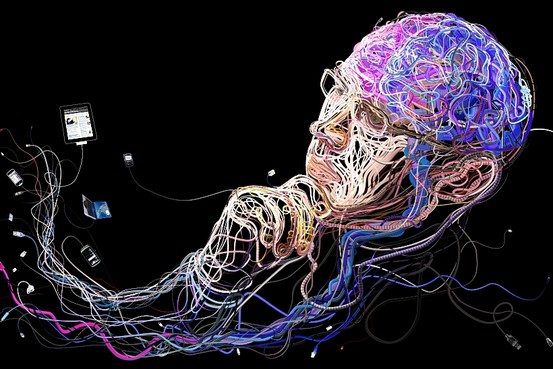
Kate Ray’s semantic web mini-documentary

Kate Ray's Web 3.0 mini-doc explores the potential for the semantic web.

Web 3.0 from Kate Ray on Vimeo.

This documentary offers some interesting insights into how difficult it is to both develop and predict the next iteration of the Web. I can't help but feel, however, that human cognition is missing from the discussion; in my mind, the next iteration of the web has to be further conceptualized as a part of the exosomatic brain. Anything we can do to better streamline the process of accessing and processing information will be a step in this direction. Put another way, how can we blur the divide and reduce the friction that currently separates the human mind from the internet?

Maybe that's Web 4.0 stuff....

Singer: Should this be the last generation?

Philosopher and ethicist Peter Singer asks, is a world with people in it better than one without?

Excerpt:

Put aside what we do to other species — that’s a different issue. Let’s assume that the choice is between a world like ours and one with no sentient beings in it at all. And assume, too — here we have to get fictitious, as philosophers often do — that if we choose to bring about the world with no sentient beings at all, everyone will agree to do that. No one’s rights will be violated — at least, not the rights of any existing people. Can non-existent people have a right to come into existence?

I do think it would be wrong to choose the non-sentient universe. In my judgment, for most people, life is worth living. Even if that is not yet the case, I am enough of an optimist to believe that, should humans survive for another century or two, we will learn from our past mistakes and bring about a world in which there is far less suffering than there is now. But justifying that choice forces us to reconsider the deep issues with which I began. Is life worth living? Are the interests of a future child a reason for bringing that child into existence? And is the continuance of our species justifiable in the face of our knowledge that it will certainly bring suffering to innocent future human beings?

Clay Shirky: The Internet Makes You Smarter

New book: Cognitive Surplus: Creativity and Generosity in a Connected Age in which Clay Shirky argues that, amid the silly videos and spam, are the roots of a new reading and writing culture.

Excerpt from the WSJ review:

The case for digitally-driven stupidity assumes we'll fail to integrate digital freedoms into society as well as we integrated literacy. This assumption in turn rests on three beliefs: that the recent past was a glorious and irreplaceable high-water mark of intellectual attainment; that the present is only characterized by the silly stuff and not by the noble experiments; and that this generation of young people will fail to invent cultural norms that do for the Internet's abundance what the intellectuals of the 17th century did for print culture. There are likewise three reasons to think that the Internet will fuel the intellectual achievements of 21st-century society.

First, the rosy past of the pessimists was not, on closer examination, so rosy. The decade the pessimists want to return us to is the 1980s, the last period before society had any significant digital freedoms. Despite frequent genuflection to European novels, we actually spent a lot more time watching "Diff'rent Strokes" than reading Proust, prior to the Internet's spread. The Net, in fact, restores reading and writing as central activities in our culture.

The present is, as noted, characterized by lots of throwaway cultural artifacts, but the nice thing about throwaway material is that it gets thrown away. This issue isn't whether there's lots of dumb stuff online—there is, just as there is lots of dumb stuff in bookstores. The issue is whether there are any ideas so good today that they will survive into the future. Several early uses of our cognitive surplus, like open source software, look like they will pass that test.

Evolution: Too much reliance on memory is bad

Why good memory may be bad for you: The counterintuitive finding that too good a memory makes foragers inefficient reveals a glimpse of the forces that govern the evolution of intelligence.

From the article:

It's easy to imagine that a good memory would confer significant benefits to a foraging animal.

But it's not quite so straightforward, say Denis Boyer at Universite Paul Sabatier in France and Peter Walsh at the Universidad Nacional Autonoma de Mexico in Mexico.

These guys have created one of the first computer models to take into account a creature's ability to remember the locations of past foraging successes and revisit them.

Their model shows that in a changing environment, revisiting old haunts on a regular basis is not the best strategy for a forager.

It turns out instead that a better approach strategy is to inject an element of randomness into a regular foraging pattern. This improves foraging efficiency by a factor of up to 7, say Boyer and Walsh.

Clearly, creatures of habit are not as successful as their opportunistic cousins.

What the internet is doing to our brains

New book: The Shallows by Nicholas Carr on how the internet is changing the way we think.

Excerpt from the NYT review:

For Carr, the analogy is obvious: The modern mind is like the fictional computer. "I can feel it too," he writes. "Over the last few years, I've had an uncomfortable sense that someone, or something, has been tinkering with my brain, remapping the neural circuitry, reprogramming the memory." While HAL was silenced by its human users, Carr argues that we are sabotaging ourselves, trading away the seriousness of sustained attention for the frantic superficiality of the Internet. As Carr first observed in his much discussed 2008 article in The Atlantic, "Is Google Making Us Stupid?," the mere existence of the online world has made it much harder (at least for him) to engage with difficult texts and complex ideas. "Once I was a scuba diver in a sea of words," Carr writes, with typical eloquence. "Now I zip along the surface like a guy on a Jet Ski."

This is a measured manifesto. Even as Carr bemoans his vanishing attention span, he's careful to note the usefulness of the Internet, which provides us with access to a near infinitude of information. We might be consigned to the intellectual shallows, but these shallows are as wide as a vast ocean.

Nevertheless, Carr insists that the negative side effects of the Internet outweigh its efficiencies. Consider, for instance, the search engine, which Carr believes has fragmented our knowledge. "We don't see the forest when we search the Web," he writes. "We don't even see the trees. We see twigs and leaves." One of Carr's most convincing pieces of evidence comes from a 2008 study that reviewed 34 million academic articles published between 1945 and 2005. While the digitization of journals made it far easier to find this information, it also coincided with a narrowing of citations, with scholars citing fewer previous articles and focusing more heavily on recent publications. Why is it that in a world in which everything is available we all end up reading the same thing?

MV Rachel Corrie: From Dundalk to the Gaza Strip – The New York Irish Emgirant


CBC.ca
MV Rachel Corrie: From Dundalk to the Gaza Strip
The New York Irish Emgirant
Israel's violent storming of the 'Freedom Flotilla' headed towards blockaded Gaza seems to have finally sparked international outrage ...
Aid ship Rachel Corrie seized by Israel, passengers 'unharmed'Seattle Post Global
As MV Rachel Corrie draws nearer, Israel mulls easing Gaza blockadeChristian Science Monitor
Freedom Flotilla's MV Rachel Corrie Spotted Off Gaza CoastlineSalem-News.Com
Press TV -Herald.ie -Seven Sided Cube
all 3,907 news articles »

Rahm Emanuel and that BP Adviser ‘rent free’ D.C. Apartment


by the Left Coast Rebel

Another window into the lackadaisical attitude of Barack Obama and company in regards to the BP oil spill. This particular window has shutters that open to D.C. - L.A. Times (of all places):

In case you were tempted to buy the faux Washington outrage at BP and its gulf oil spill in recent days, here's a story that reveals a little-known corporate political connection and the quiet way the inner political circles intersect, protect and care for one another in the nation's capital. And Chicago.

Now, we learn the details of a connection of Rahm Emanuel, the Chicago mayoral wannabe, current Obama chief of staff, ex-representative, ex-Clinton money man and ex-Windy City political machine go-fer.

Shortly after Obama's happy inaugural, eyebrows rose slightly upon word that, as a House member, Emanuel had lived the last five years rent-free in a D.C. apartment of Democratic colleague Rep. Rosa DeLauro of Connecticut and her husband, Stanley Greenberg.

Greenberg's consulting firm was a prime architect of BP's recent rebranding drive as a green petroleum company, down to green signs and the slogan "Beyond Petroleum."

Greenberg's company is also closely tied to a sister Democratic outfit -- GCS, named for the last initials of Greenberg, James Carville, another Clinton advisor, and Bob Shrum, John Kerry's 2004 campaign manager.

Fox Nation also has more on this story. Discussion at Protein Wisdom and RedState (Moe Lane connects the dots of past behavior) as well over at Memeorandum.

Corporatism: Never let a crisis (or cozy corporate-sponsored apartment) go to waste.....

Cross-posted to LCR, Rational Nation and Proof Positive.