From Gizmodo:
Military researchers have poured blood, sweat, tears and taxpayer dollars into all sorts of wacky experiments. There are plenty of reasons that they are willing to take a take a chance on just about anything.
Read the whole article

From Gizmodo:
Military researchers have poured blood, sweat, tears and taxpayer dollars into all sorts of wacky experiments. There are plenty of reasons that they are willing to take a take a chance on just about anything.
Read the whole article
From Gizmodo:
Built with the blue-laser diode of a dismantled Casio Green Slim projector, the $200 Spyder III is the world's most powerful portable laser. It can permanently blind you and set your skin—or anything else, really—on fire almost instantly.
Read th

Comet McNaught on May 15, 2010 Credit: Michael Jager via aerith.net
There is a viewable comet out there as I mentioned yesterday. It is named C/2009 R1 (McNaught) or as I called it here plain Comet McNaught. For the sticklers out there I know there is more than one with the same “name” but for here and now I am referring to C/2009 R1.
I did mention Seiichi Yoshida had this at a mag. 5.5 and you might wonder why you would need a pair of binoculars (at least) and dark skies. I have found the magnitude of a comet is about 2 magnitudes higher than an equivalent star. So if they talk about a 5.5 magnitude comet, that would equate to a 7.5 star. Could be it owes to the diffuse nature of a comet and this is just my observation.
So this is nice looking green colored comet (not sure why), located off the end of Pegasus. The comet rises in the northeastern sky at about 01:00 AM your local time and I hate to tell you this but I think the best time to see it is going to be about 03:30 AM. What really rots for me is I might not get a great look at it due to the mountains and a nearby Maple tree. The comet isn’t all that far from the Sun so by the time it gets high enough for me daylight might be breaking. So you know it’s not going to be real high in the sky anyways.
My saving grace is going to be putting my little scope in the car and go to a spot west of here to get a better look in that direction. I also have to beat the clouds.
This comet is going to be around for a little bit and it could be a naked eye object pretty soon, I will let you know
Here is a finders chart for 0330 AM. This should be valid for your local time zone. You can see the Great Square of Pegasus on the right, and the comet to the left of it. Find M34 and you will have find the comet.
Someone recently filed a motion to change the Seal of the State of Washington into an image of a tapeworm in a three-piece suit surrounded by the words, "Committed to sucking the life blood out of each and every taxpayer."
I, for one, welcome our new tapeworm overlords.

 Sure, when blood hits the water, sharks know exactly where to go. But how do they hunt for less-obvious meals? New research says they use math.
How exactly the sharks move seems to vary with how much food is around.
Imagine yourself in a Walgreens, picking up a few necessities on your way home from work. You might make short movements, darting between aisles, crossing and recrossing your path as you debate between generic and name-brand. Apparently, sharks do the same thing when they have a lot of food in one area. Scientists even suggest their pattern is Brownian, no more intelligent than the aimless sway of microscopic particles buffeted by water molecules.
But in the vast expanses of a Walmart on a Saturday afternoon, your hunt might look a little different. After picking up a few items in one section of the store, you make a long traverse to another section, rolling your blue cart ahead of you. In food-sparse environments, the researchers argue that sharks also seem to make these long journeys. Here, the sharks appear to use Lévy flight search patterns, long suspected by mathematicians as the most effective way to hunt, but never before successfully traced to an animal’s actual search patterns.
The research team, including David W. Sims of the Marine Biological Association of the United Kingdom, used radio tags to study the hunting patterns of fourteen species of open-ocean predatory fish, including sharks, tuna, billfish, and ocean sunfish.
Though other studies have been quick to call animals’ motions Lévy-like, such as an investigation of albatross travels in 1996, previous scientists didn’t have enough data to fit the motion with the mathematical pattern. Sims’ team gathered more than 12 million data points over 5,700 days. He told Science News that this research is “the strongest evidence yet that these Lévy patterns are exhibited by wild animals.”
Related content:
Discoblog: Sea Section: Shark Bites Shark & 4 Babies Pop Out
Discoblog: New Shark Has “Retractable Sex Appendage” on Its Forehead
80beats: Rare Discovery About Mysterious, Giant-Mouthed Shark: Where It Winters
80beats: Female Shark Gets Pregnant on Her Own, No Male Required
80beats: Ancient “Big Tooth” Shark Had the Mightiest Bite in History
Image: Wikimedia / Levy Flight / flickr / Jeff Kubina
Dear All,
i have been working on 1000t/hr MCR boiler and we have been facing boiler tube failures. one thing which is being observed in these failures is that most of the failures are occuring on left side of the boiler although the boiler is symetric.
there are 81 panel total of f

When dinosaurs ruled the land, other groups of prehistoric reptiles dominated the waters. Their bones have also fossilised and they reveal much about how these ‘sea dragons’ lived. They tell us about the shape of their bodies, the things they ate and even how they determined their sex. And according to Aurélien Bernard from the University of Lyon, they can tell us whether these reptiles could control their body temperature.
The majority of reptiles are ‘cold-blooded’. Unlike mammals and birds, they can’t generate and retain their own heat, and their body temperature depends on their surroundings. But Bernard thinks that at three groups of marine reptiles – the dolphin-shaped ichthyosaurs, the crocodile-shaped mosasaurs, and the the paddle-flippered plesiosaurs – bucked this trend. Whether in tropical or cold waters, they could maintain a constant body temperature that reached as high as 35-39 degrees Celsius.
Bernard estimated the body temperature of these ocean-going predators by studying their teeth. He took samples from 40 plesiosaurs, ichthyosaurs and mosasaurs as well as several prehistoric fish. The specimens came from five continents, and a range of periods from the Triassic to the Cretaceous. In every tooth, he measured the amount of different oxygen isotopes, a value that depends on the animal’s body temperature and the composition of the water it swallows.
The data from the fish helped to calibrate the reptile data. By and large, fish body temperatures reflect the temperatures of the surrounding seawater. If the reptiles’ teeth had the same composition of oxygen isotopes as those of the fish, their bodies were also similarly as warm as their surroundings and they were probably cold-blooded. Any differences reflect a different means of regulating body heat.

Using a mathematical model, Bernard calculated that both ichthyosaurs and plesiosaurs managed to keep a constant balmy body temperature from around 24-35°C, even when swimming through waters as cold as 12°C. The abilities of mosasaurs were less clear, but it seems that they had at least some control over their body temperature.
These results fit with the portraits of ichthyosaurs and plesiosaurs as active, fast-swimming hunters, which needed warm bodies for their fast chases and deep dives. Likewise, the ambiguity around the body temperature of mosasaurs is consistent with the idea that they were ambush predators, whose sit-and-wait strategies wouldn’t have demanded such high metabolisms.
Other lines of evidence support Bernard’s conclusion. In an earlier study, Ryosuke Motani from the Royal Ontario Museum suggested that the ichthyosaur Stenopterygius had a cruising speed and metabolic rate similar to today’s tuna. Other scientists noted that ichthyosaurs grew incredibly quickly after birth, another sign of a high metabolic rate. And finally, fossils that probably came from plesiosaurs and ichthyosaurs have been recovered from southeastern Australia, a region that would have been bitterly cold when these animals were swimming about.
However, it’s still unclear how these giant reptiles managed their body heat. Today, the giant leatherback turtle is sort of warm-blooded – its massive size allows it to retain heat more effectively than its smaller cousins, an ability known as gigantothermy. If leatherbacks can pull of this trick, it’s entirely likely that even bigger animals like the mosasaur Tylosaurus did something similar.
Modern fish, including some of the ocean’s top predators, use different tricks to warm their blood. Swordfish can temporarily raise the temperature of their brains and eyes, which gives it an edge when hunting fast-moving prey.
Tuna go one step further. Like all fish, its hard-working muscles heat up the blood that flows through them. In other fish, that heat would be lost as the blood returns to the gills for a fresh load of oxygen. But the tuna’s blood vessels are arranged so that the warm blood flowing from the muscles travels past, and heats up, cold blood coming in from the gills. This set-up keeps the heat generated by the tuna’s muscles inside its own body. Some sharks rely on a similar heat exchanger; perhaps plesiosaurs and ichthyosaurs did the same.
Reference: Science http://dx.doi.org/10.1126/science.1187443
Photos by Captmondo, Sebastian Bergmann and Piotrus
More on prehistoric marine reptiles:
How prehistoric sea monsters sorted males from females
This is extremely cool news: astronomers have, for the first time, directly seen an exoplanet orbiting its star from one side to the other!
Here’s the incredible picture:
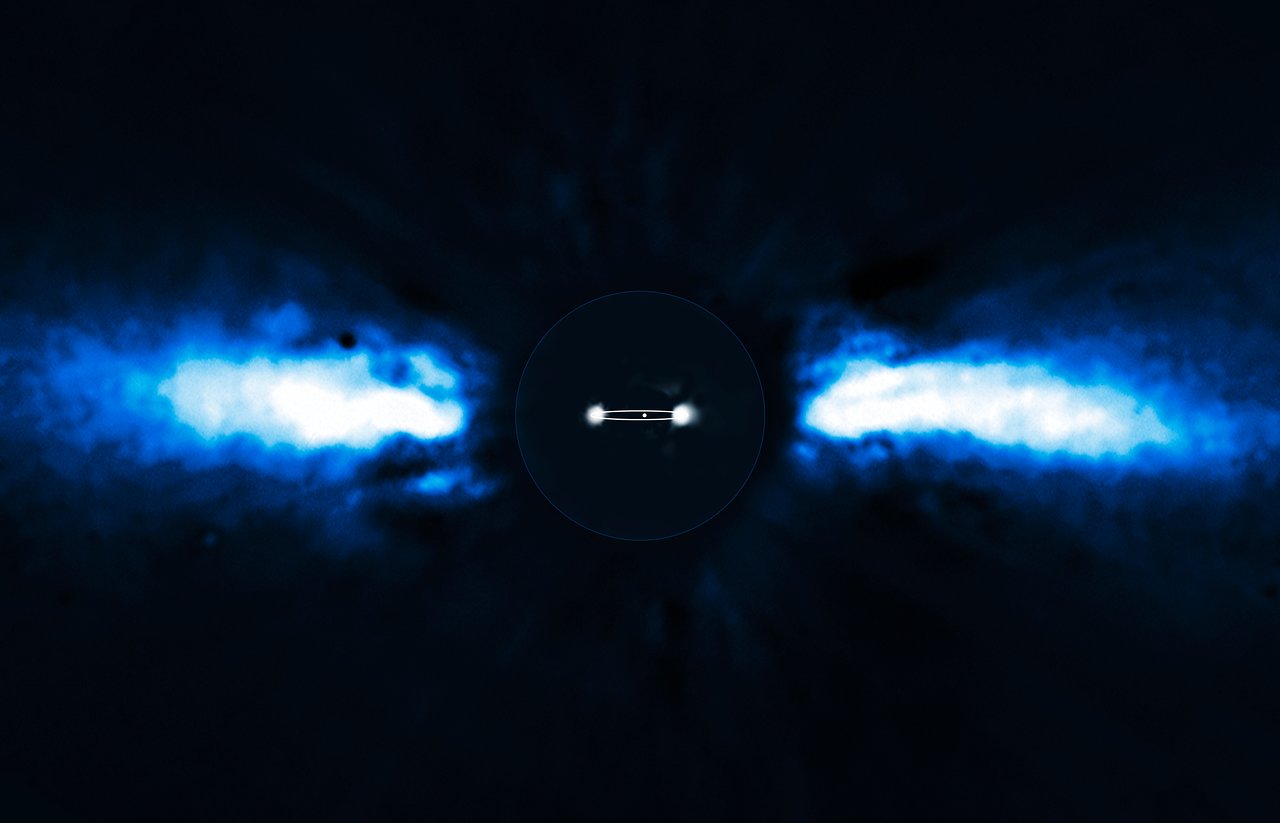
This makes me happy scientifically, of course, but also for personal reasons. Let me tell you a story. Two, in fact…
1) [Story the First] Beta Pic: the star, the planet, the disk
The star in question is Beta Pictoris (or just Beta Pic to its friends), a very young star — it’s only a few million years old, compared to the Sun’s advanced age of 4.56 billion — with about twice the Sun’s mass and 9 times its brightness. As stars go, Beta Pix is pretty close, just 63 light years away, and is easily bright enough to be seen with the unaided eye from the southern hemisphere.
In the above picture, taken using one of the European Southern Observatory’s ginormous 8.2 meter units of the Very Large Telescope, Beta Pic is represented by the dot in the center. The star is so bright its light swamps everything around it, so the star itself has been blocked by a piece of metal inside the camera that took the shot (that’s the reason for the dark circle in the center of the picture). This allows us to see much fainter stuff near the star.
This picture is actually a composite of three separate observations. The outer part with the blue fuzzy stuff was observed in 1996, and I’ll get back to that in a sec. The good stuff is in the center: two images of the planet, called Beta Pic b, are superposed in the picture; it was observed in 2003 (left blob), then again in late 2009 (right blob). Observations taken just months before in 2008 and 2009 observation didn’t show the blob at all — it must have been too close to the star to be seen clearly — indicating this really is a planet orbiting the star, and not just some background object like a star or galaxy. In other words, astronomers have captured the motion of the planet as it physically moved from one side of the star to the other!
 Very cool. Using these observations, the orbit of the planet has been roughly estimated and is shown in the picture as well, though the tilt of it has been exaggerated for clarity. In reality, we see the orbit almost exactly edge-on. But we can see right away the orbit is not circular! The planet is clearly farther from the star on the left than on the right, meaning its orbit is pretty elliptical. In fact, it varies in distance from one billion to 2 billion kilometers from Beta Pic — roughly the distance of the Sun to Saturn and Uranus, respectively. That’s a huge variation. If this planet were in our solar system, there would be chaos as its gravity disturbed the orbits of all the outer planets.
Now, back to the weird wing-like things sticking out of either side. Those are from a 1996 observation, and what you’re seeing there is the actual disk of dust and junk from which that planet (and star) formed. Back in the 1980s, it was first determined that Beta Pic was blasting out a lot more infrared light than would be expected for its type of star. Astronomers took a better look, and found that bright disk you see in the picture. We see the disk almost exactly edge-on, so it looks like a thick, fuzzy line.
 Over the years, more observations showed more detail. See how the disk is warped, bent, twisting up on the left side and down on the right? The false-colored rainbow-hued image here shows observations of the disk using my old camera STIS (bottom; on top is an earlier WFPC2 image) on board Hubble, and the bumps and wiggles in the inner disk are easy to see. That sort of thing can happen if a planet in the disk is tugging on the material as it orbits the star. Lots of other observations tantalizingly hinted at a planet buried in that mess, but unfortunately technology wasn’t up to the task of teasing out a faint planet from the bright star and disk.
But that’s changed now.
2) [Story the Second] Planets, disks, Hubble, and me
And that’s why this is such a personal story for me. When I was a kid, there were 9 planets, and that was it. In 1992 the first planets were detected around other stars, and in 1995 the first planets were detected around sun-like stars. But the disk around Beta Pic was first seen in the 1980s, when I was just starting out in college as a young astronomy major. It’s important to note that Beta Pic was the very first star to be seen surrounded by such a disk, basically confirming for the first time that stars formed from disks of material. Seeing the early pictures were fascinating, but maddening: they hinted at a planet being there, but we just didn’t have the tech to see it!
Finding a planet orbiting another star was one of the most fundamentally important and exciting goals of astronomy at the time. Every time a new image came out, we were just barely squeaking closer to that goal. I would read every new journal paper, every new popular level article that came out, and every time the conclusion was the same: we’re just a few more years away from finding other planets.
Arrrg! It was like an itch that couldn’t be scratched, except this itch was a combination of poison ivy, poison oak, and a thousand mosquito bites. Maddening!
 Over the years I was tangentially involved with Beta Pic; I didn’t directly work on the rainbow STIS image of it above, but my boss Don Lindler did. I remember sitting around the office with Don and Sally Heap (the woman who made that STIS observation), talking about those images, trying to figure out how best to squeeze information and detail out of them. I also worked extensively with other astronomers who had observations of stars surrounded by disks.
Of all the work I did on Hubble, those were my favorite observations, and the ones I most enjoyed working on. I got to know them really well, like friends: AB Aurigae (pictured above), HD 163296, HD 100546, and others. These all had spectacular and beautiful disks of material swirling around them, all had the ingredients necessary to make planets. But no planets were to be seen.
That’s all changed now. We’ve seen and confirmed a planet around the grand-daddy of all these stars, Beta Pic. And, as we had hoped, the newly-discovered planet has the right location and the right mass to explain the warping of the disk. Astronomers were right all along!
And now, finally, after all those years, we’ve finally been able to scratch that itch. Ahhhhhhhhhhhhh.
Beta Pic Image credits: ESO/A.-M. Lagrange; L. Calçada. Hubble image credits: Al Schultz (CSC/STScI, and NASA), Sally Heap (GSFC/NASA); C.A. Grady (National Optical Astronomy Observatories, NASA Goddard Space Flight Center), B. Woodgate (NASA Goddard Space Flight Center), F. Bruhweiler and A. Boggess (Catholic University of America), P. Plait (hey!) and D. Lindler (ACC, Inc., Goddard Space Flight Center), M. Clampin (Space Telescope Science Institute), and NASA.
Related posts:
- Another exoplanet imaged
- Huge exoplanet news: pictures!
- Planet imaged around a sunlike star?!
Dear All,
i have to measure the flow rate of air in an existing piping of SS ND 8" the only thing in the piping is a tapping point that is of 1/2".
i cannot do much to the piping since it is live piping .
thanks
 South Korea’s attempt to jump into the space race met with disaster today. A little more than two minutes after takeoff today, the nation’s Naro rocket exploded. It had been carrying a satellite, and South Korea was vying to become the tenth country to put a satellite in orbit with rockets assembled at home.
South Korea has invested more than 500 billion won (400 million dollars) and much national pride in the 140-ton Naro-1. The liquid-fuelled first stage of the rocket was made in Russia, while the second stage was built domestically, as was the satellite [AFP].
In Japan, meanwhile, happier news: Last month its space agency, JAXA, launched a batch of new missions into space that included its solar sail project, called Ikaros. Today it unfurled the sail, seen above in the blinding light of the sun.
After separating from Akatsuki [a separate probe going on to Venus], Ikaros began unfolding four panels that, when fully unfurled, should look like a square kite measuring 66 feet (20 meters) along its diagonal. Pictures sent back by a camera mounted on the spacecraft’s hub show the extension of four booms holding the panels, plus the unfurling of sail material. This is the “primary deployment” of the sail. During the secondary stage of deployment, the sail is stretched out to its full extent [MSNBC].
The sail works in two ways, as we noted in previous coverage: It can ride the physical pressure of sunlight as a sailboat rides the wind, or it can use photovoltaic cells to produce solar electricity that powers thrusters.
And another plucky spacecraft from Japan is almost home. When we last saw the damaged and travel-weary Hayabusa, which attempted to gather samples from the surface of an asteroid, it was limping home under the power of a single remaining engine and some JAXA scientists warned that it might not make it. Now things look brighter, and it could arrive back on its home planet on Sunday.
When Hayabusa (“falcon” in Japanese) reaches an altitude of 190,000 feet, its heat shield will reach temperatures of more than 5,000 degrees Fahrenheit, while the gas surrounding the capsule will reach 13,000 degrees Fahrenheit – hotter than the surface of the sun, NASA says. It is planned to fall over a large unpopulated area of Australia called the Woomera Prohibited Area [Popular Science].
Check out DISCOVER on Facebook!
Related Content:
DISCOVER: Japan Stakes Its Claim in Space, on the Hayabusa mission
80beats: Japan’s Damaged Asteroid Probe Could Limp Back to Earth in June
80beats: Japan’s Venus-Bound Probe Will Hunt Volcanoes And Study Violent Storms
80beats: Japan’s “Solar Yacht” Is Ready to Ride Sunbeams Through Space
Image: JAXA


all
friends I am working on atmel microcontroller. I make a software for at89c52 in keil software. Now I am working on serial eprom and ds1307 but I have litel bit problem to interface these serial devices. Please help me to interface these devices.
PETA to crash NASA's Star Trek Live opening, Orlano Sentinel
"Intruder alert! PETA protesters are planning to crash the opening of NASA's Star Trek Live event tomorrow morning. PETA protesters are planning to greet visitors entering Kennedy Space Center and hold up signs in protest of NASA's planned radiation experiment on monkeys."
How We can Select pipe Size for compressible flow
Can any one give me the reference international standards of design of burner control system.
Regards,
Karthick.
 Letter From Charles Bolden to Sen. Shelby Regarding Constellation
"Current estimates for potential termination liability under Constellation contracts total $994 million. Once these termination liability estimates are accounted for, the overall Constellation program is confronting a total estimated shortfall of $991 million for continued program effort for the balance of the year, compared with the revised FY 2010 plan. Given this estimated shortfall, the Constellation program cannot continue all of its planned FY 2010 program activities within the resources available. Under the Anti-Deficiency Act (ADA), NASA has no choice but to correct this situation. Consequently, the Constellation program has formulated an updated funding plan for the balance of FY 2010, consistent with the following principles:"
Click on the map to watch CNN's time-lapse video Now go read Nicholas Kristof's related Op-Ed in the NYTimes:
The national campaign to get President Obama to emote, throw crockery at oil executives and jump up and down in fury has failed. But here’s a long-term solution: Let’s anoint a king and queen. ....
[It] would give President Obama time to devise actual clean-up policies. He might then also be able to concentrate on eliminating absurd government policies that make these disasters more likely (such as the $75 million cap on economic damages when an oil rig is responsible for a spill). Our president is stuck with too many ceremonial duties as head of state, such as greeting ambassadors and holding tedious state dinners, that divert attention from solving problems. You can preside over America or you can address its problems, but it’s difficult to find time to do both.
Exactly. * Update: You can now vote for king and queen of America at Vanity Fair. *
 Three jaw-less heads and one really old shoe. These aren’t the clues in a Law and Order episode; they’re findings from a limestone cave in Armenia. As described in a paper published yesterday in PLoS ONE, archaeologists believe they have found the world’s oldest leather shoe: it’s 5,500 years old.
“It’s pretty weird,” said lead author Ron Pinhasi to CNN regarding the disembodied heads and the placement of the well-preserved shoe. The ancient sneaker was stuffed with grass, though archaeologists can’t say whether the grass was intended as insulation or whether it helped maintain the shoe’s shape.
“We thought originally it could be a discard, but at the same time, it’s very strange, because we have only one shoe, and it’s in very good shape,” Pinhasi said. “It looks like it was more than likely deliberately placed in this way.” [CNN]
The right-footed shoe–which looks a bit like a baked potato–has some features that might entice even modern buyers: for one, its maker fashioned it from a single piece of cow leather (like a pricey pair of today’s “whole cut” footwear), and it has leather laces. It’s about a women’s size seven, but, researchers say, it might have graced a small-footed man.
The shoe was discovered by Armenian PhD student, Ms Diana Zardaryan, of the Institute of Archaeology, Armenia, in a pit that also included a broken pot and sheep’s horns. “I was amazed to find that even the shoe-laces were preserved,” she recalled. [PLos ONE release]
Scientists determined the shoe’s age by cutting two small samples of the leather and sending it to radioactive dating centers at the Oxford Radiocarbon Accelerator Unit at the University of Oxford and the University of California–Irvine Accelerator Mass Spectrometry Facility. Others have discovered older sandals–the oldest are about 7,000 to 7,500 years old and were found in the Arnold Research Cave in Missouri–but this is the oldest full shoe ever discovered.
Fashion shoe designer, Manolo Blahnik, was impressed by how much the shoe looked like today’s models. He suspects that even 5,500 years ago, wearers wanted to look chic:
“The shoe’s function was obviously to protect the foot, but I am in no doubt that a certain appearance of a shoe meant belonging to a particular tribe,” Blahnik said. “I am sure it was part of the outfit which a specific tribe wore to distinguish their identity from another.” [National Geographic]
Preservation went well beyond the modern shoebox. The limestone cave itself had relatively stable temperatures and little humidity, and the shoe was covered in layers of sheep dung.
“We thought initially that the shoe and other objects were about 600-700 years old because they were in such good condition,” Pinhasi said. “It was only when the material was dated that we realized that the shoe was older by a few hundred years than the shoes worn by Oetzi, the Iceman,” he added, referring to Europe’s oldest natural human mummy, which dates back 5,300 years. [Discovery News]
Pinhasi is now waiting, metaphorically, for the other shoe to drop: He will return to explore another nearby cave this Friday and told CNN that he believes that his team has uncovered only two percent of the area’s findings.
Related content:
80beats: No Shoes, No Problem? Barefoot Runners Put Far Less Stress on Their Feet
80beats: “Pornographic” Statue Could Be World’s Oldest Piece of Figurative Art
80beats: World’s Oldest Flute Shows First Europeans Were a Musical Bunch
Discoblog: World’s Oldest Bible, Now Available on Your Laptop
DISCOVER: Archaeologists Find the World’s Oldest Arrowheads
Image: University of College, Cork — Media and Communications


From Popular Science - New Technology, Science News, The Future Now:
The Federal Aviation Administration wants you to fly the robot-friendly skies, 1but the regulatory overseer has more than a few challenges to overcome before it can extend that invitation in earnest. The FAA today
 NASA Sued for Refusing to Release Contracting Data on United Space Alliance, American Small Business League
"On Tuesday, June 8, the American Small Business League (ASBL) filed suit against the National Aeronautics and Space Administration (NASA) in Federal District Court, Northern District of California. The case was filed under the Freedom of Information Act (FOIA) after NASA repeatedly refused to release subcontracting reports for contracts issued to United Space Alliance, LLC, a joint venture between defense giants Lockheed Martin and Boeing."
Hello friends . I want to organize a solar power system for water pump. Pump for a agricultural field, it is 10KW. This pump motor works 4 hours for a day. 2 hours running then waiting 3-4 hours. after runs 2 hours again. How much KW power of Solar panel and battery do I choose?


