What the Average American Consumes in a Year

american-average-food-consumption

Average size

The average American is 36.6 years old and eats 1,996.3 lbs. of food per year. The average man is 5’9” and weighs 190 lbs. The average woman is 5’4” and weighs 164 lbs.

Meat consumption

Each year, Americans eat 85.5 lbs. of fats and oils. They eat 110 lbs. of red meat, including 62.4 lbs. of beef and 46.5 lbs. of pork. They eat 16.1 lbs. of fish and shellfish and 32.7 lbs. of eggs.

Americans eat 31.4 lbs. of cheese each year and 600.5 lbs. of non-cheese dairy products. They drink 181 lbs. of beverage milks. They eat 141.6 lbs. of caloric sweeteners, including 42 lbs. of corn syrup.

Fruit and vegetables

Americans consume 56 lbs. of corn each year and eat 415.4 lbs. of vegetables. Americans eat 273.2 lbs. of fruit each year.

Coffee

Every year, Americans consume 24 lbs. of coffee, cocoa and nuts. Americans consume 0.2 lbs. of caffeine each year, about 90,700 mg.

Fast food

The foods include 29 lbs. of French fries, 23 lbs. of pizza and 24 lbs. of ice cream. Americans drink 53 gallons of soda each year, averaging about one gallon each week.

They eat an average of 2,700 calories each day.

Salt

Americans consume 2.736 lbs. of sodium, which is 47 percent more than recommended.

References:
Food Consumption in America - VisualEconomics.com.

Posted at Clinical Cases and Images. Stay updated and subscribe, follow us on Twitter and connect on Facebook.


What’s new in nephrology and hypertension

35% of UpToDate topics are updated every four months. The editors select a small number of the most important updates and share them via "What's new" page. I selected the brief excerpts below from What's new in nephrology and hypertension:

Glomerulonephritis

In idiopathic membranous nephropathy, among patients with protein excretion less than 8 grams/day, treatment with an ACE inhibitor or ARB increased the probability of remission.

Hypertension

There was no difference in the rate of myocardial infarction, stroke or death from cardiovascular causes between the intensive versus standard hypertension therapy groups, nor in the all-cause mortality rate. ('ACCORD BP trial'). Intensive therapy included goal systolic blood pressure less than 120 mmHg, standard therapy included goal systolic blood pressure less than 140 mmHg.

Hyponatremia

Tolvaptan is a vasopressin receptor antagonists. The long-term administration of tolvaptan appears to be safe and effective among patients with chronic hyponatremia. Responses were similar in heart failure and SIADH, and more modest in cirrhosis.

Transplantation

An increased incidence of angioedema has been noted in patients administered angiotensin-converting enzyme (ACE) inhibitors plus either sirolimus or everolimus.

Autosomal dominant polycystic kidney disease (ADPKD)

Activation of the mammalian target of rapamycin (mTOR) protein may contribute to cyst growth in autosomal dominant polycystic kidney disease (ADPKD). The inhibition of mTOR with rapamycin preserved renal function and inhibits epithelial cell proliferation and fibrosis in a mouse model of ADPKD. In a human trial, cyst volume was stable on rapamycin.

The long-acting somatostatin octreotide decreased liver volume by 5% in patients with autosomal dominant polycystic liver disease.

References:
What's new in nephrology and hypertension. UpToDate.

Twitter comments:

@kidney_boy (Joel Topf): UpToDate seems to be misrepresenting the ADPKD mTOR data. See my interpretation here: More ADPKD and sirolimus data: More definitive; less encouraging

Posted at Clinical Cases and Images. Stay updated and subscribe, follow us on Twitter and connect on Facebook.


Marathon-associated ailments: “too hot,” “too cold,” “too dry,” “too wet” and “wobble and fall down”

According to the NYTimes, the most common and potentially life-threatening marathon-associated ailments are “too hot,” “too cold,” “too dry,” “too wet” and “wobble and fall down”. These translate into heat stroke, hypothermia, dehydration, low blood sodium and collapse, respectively.

The medical professionals at this year's NYC marathon had ice-water dunk tanks to treat runners who developed high fevers. Handheld i-Stat machines enabled them to analyze the chemistry of the runners’ blood, then dispense the right amounts of intravenous fluids, salts and sugar.

Understanding the Heart Hazards of Marathon Running - Video - TIME.com.

References:
Doctor Prepared for the Worst at Marathon. NYTimes.
Faces at the Finish - Interactive Feature - NYTimes.
Running With the Elites - Slide Show - NYTimes.

Posted at Clinical Cases and Images. Stay updated and subscribe, follow us on Twitter and connect on Facebook.


Happiest people were 22% less likely to develop heart disease

From WebMD:

Happiest people were 22% less likely to develop heart disease over the 10 years of follow-up than people who fell in the middle of the negative-positive emotion scale.

People with the most negative emotions had the highest risk for heart disease and people who scored highest for happiness had the lowest risk.

Possible explanations for how happiness may protect the heart:

- Healthier lifestyle: Happy people tend to sleep better, eat better, smoke less, and get more exercise.
- Physiological impact: Happiness may produce a host of positive chemical changes -- such a reduction in stress hormones.
- Genetic influences: It could be that people who are predisposed to happiness are also predisposed to have fewer heart attacks.

Devote 15-20 minutes a day to doing something enjoyable and relaxing.

Strategies that could help naturally negative people become happier:

- Express gratitude on a regular basis.
- Practice being optimistic.
- Engage in frequent acts of kindness.
- Visualize one's best self.
- Savor joyful events.
- Practice forgiveness.

Regular exercise, sexual activity and good sleep are associated with increased self-reported happiness.

References:

Study: Happiness Good for the Heart. WebMD.
Image source: OpenClipArt.org, public domain.

Posted at Clinical Cases and Images. Stay updated and subscribe, follow us on Twitter and connect on Facebook.


In-flight exercises

Prolonged immobilization can cause circulatory stasis which is one of the predisposing factors for DVT described by Virchow in his famous triad: endothelial injury, stasis and hypercoagulability.

In a trial of previously healthy patients who traveled at least 8 hours per flight (median duration 24 hours), duplex ultrasound showed an asymptomatic DVT in 10 % of participants. In other studies, the reported risk of symptomatic DVT after flights of more than 12 hours was 0.5%. According to a 2006 Lancet study, activation of coagulation occurs in some individuals after an 8-hour flight.

This Chicago Tribune article lists some useful in-flight exercises:

In-flight exercises for beginners

- Shoulder shrugs, shoulder rolls. Ten each.
- Short sets of bending and straightening the elbows and knees.
- Walk through the plane every two hours.
- March your knees up and down in your seat.
- Lift and lower your feet on tiptoes to work the calves.

Advanced In-flight exercises

- Neck stretches; hold on each side for 15 to 20 seconds.
- If you can find space (near an exit), work the core with yoga stretches. Pigeon pose — an intermediate move of folding one leg under the body while stretching the back leg out — is an in-flight favorite of hers.
- In your seat, lift your arms over your head, grip your hands together and lean from side to side for a few seconds on each side. Repeat.
- Walk the length of the plane every hour, incorporating deep lunges. Unless you want air marshals on your case, it might be wise to notify a flight attendant.
- Put a small flight pillow in small of back to keep posture upright.

References:
Midair exercise makes for happier landings. Chicago Tribune, 10/2010.

Posted at Clinical Cases and Images. Stay updated and subscribe, follow us on Twitter and connect on Facebook.


Liraglutide (Victoza) superior to sitagliptin (Januvia) for reduction of HbA1c in diabetics


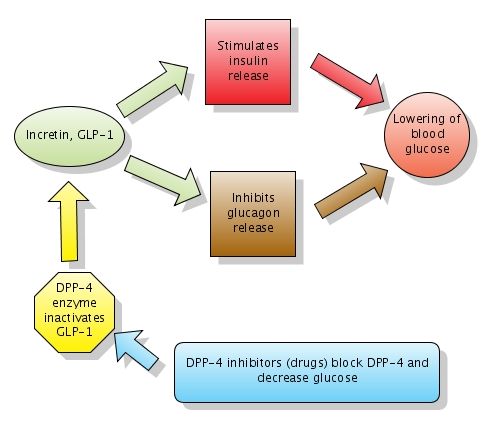
Action of DPP-4 inhibitors. Note that DPP-4 normally inactivates GLP-1. DPP-4 inhibitors block DPP-4 which in turn leaves GLP-1 active. Click to enlarge the figure. Created with Gliffy.

What is Glucagon-like peptide-1 (GLP-1)?

Glucagon-like peptide-1 (GLP-1) is a GI peptide that stimulates insulin secretion (similar to sulfonylureas). GLP-1 also inhibits glucagon release, gastric emptying and food absorption. GLP-1 and another similar peptide are called incretins. As noted above, incretins have a dual action which leads to lowering blood glucose:

1. Stimulate insulin release
2. Inhibit glucagon release

Exenatide (Byetta) is a GLP-1 receptor agonist approved for adjunctive therapy for patients with DM 2 who are not well controlled on oral agents. It is available only as injections and has to be administered twice daily.

DPP-4 inhibitors, or gliptins, increase GLP-1 levels by blocking the enzyme which inactivates GLP-1. The enzyme is called DPP-4 (dipeptidyl peptidase-4). They act similarly to Byetta (see figure above) but have the big advantage to be available in oral form (pills). Gliptins used for treatment of DM2 include sitagliptin (Januvia) and vildagliptin (Galvus).

What is Liraglutide?

Liraglutide (Victoza) is a long-acting glucagon-like peptide-1 (GLP-1) analog that was developed by Novo Nordisk for the treatment of type 2 diabetes. Liraglutide has a half-life after subcutaneous injection of 11–15 hours, making it suitable for once-daily dosing (in contrast to Byetta's twice daily).


Liraglutide. Image source: Wikipedia, public domain.

Liraglutide (Victoza) superior to sitagliptin (Januvia) for reduction of HbA1c in diabetics
This Lancet study assessed the efficacy and safety of the human GLP-1 analogue liraglutide versus the DPP-4 inhibitor sitagliptin, as adjunct treatments to metformin, in individuals with type 2 diabetes who did not achieve adequate glycaemic control with metformin alone.

More than 600 participants (aged 18—80 years) with type 2 diabetes mellitus who had inadequate glycaemic control (glycosylated haemoglobin [HbA1c] 7·5—10·0%) on metformin (more than 1500 mg daily) were enrolled.

Participants were randomly allocated to receive 26 weeks' treatment with 1·2 mg or 1·8 mg subcutaneous liraglutide once daily, or 100 mg oral sitagliptin once daily.

Greater lowering of mean HbA1c (8·5% at baseline) was achieved with 1·8 mg liraglutide (?1·50%) and 1·2 mg liraglutide (?1·24%) than with sitagliptin (?0·90%).

Nausea was more common with liraglutide (27%) on 1·8 mg. Minor hypoglycaemia was recorded in about 5% of participants in each treatment group.

Liraglutide was superior to sitagliptin for reduction of HbA1c, and was well tolerated with minimum risk of hypoglycaemia. These findings support the use of liraglutide as an effective GLP-1 agent to add to metformin.

References:

Posted at Clinical Cases and Images. Stay updated and subscribe, follow us on Twitter and connect on Facebook.


"Talk to Frank" – British government website for drug abuse prevention and treatment

Talk to Frank" is a British government-funded website for drug abuse prevention and treatment tips for the general public available at http://www.talktofrank.com

"A to Z" list of substances explains appearance and use, effects, chances of getting hooked, health risks and the UK law. It also includes information on peer pressure, etc.

Posted at Clinical Cases and Images. Stay updated and subscribe, follow us on Twitter and connect on Facebook.


What’s new in gastroenterology and hepatology from UpToDate

35% of UpToDate topics are updated every four months. The editors select a small number of the most important updates and share them via "What's new" page. I selected the brief excerpts below from What's new in gastroenterology and hepatology:

Hepatitis C virus (HCV) infection

Peginterferon alfa-2a was superior to peginterferon alfa-2b with regard to virologic response rates in patients with chronic hepatitis C virus infection, genotypes 1, 2, 3, or 4. Patients being treated for chronic hepatitis C virus infection should receive peginterferon alfa-2a rather than peginterferon alfa-2b.

72 weeks of therapy with peginterferon alfa-2a plus ribavirin in patients with HCV genotype 1 or 4 was not better than 48 weeks.

Chronic use of proton pump inhibitors (PPIs)

Chronic use of proton pump inhibitors (PPIs) may lead to an increased risk of fractures. FDA recommends that healthcare professionals who prescribe proton pump inhibitors should consider whether a lower dose or shorter duration of therapy would adequately treat the patient's condition.

Ulcerative colitis

Once daily dosing of delayed-release mesalamine (Asacol 400 mg tablets) 1.6 to 2.4 g/day was as effective as twice daily dosing for maintenance of clinical remission in patients with ulcerative colitis. Remission rates were 85% in both groups.

Crohn's disease

Capsule endoscopy was not a cost-effective third test for establishing the diagnosis of Crohn's disease after a negative ileocolonoscopy and either a CT enterography or small bowel follow-through x-ray.

Azathioprine in combination with infliximab or infliximab alone had a higher rate of glucocorticoid-free clinical remission than those treated with azathioprine alone. Combination therapy and infliximab monotherapy led to significantly more complete bowel healing than azathioprine alone.

Obscure gastrointestinal bleeding

Double balloon enteroscopy (DBE) detected bleeding sources in 78% of patients with obscure gastrointestinal bleeding. Small intestinal ulcers and erosions were the most common findings.

References:
What's new in gastroenterology and hepatology. UpToDate.

Posted at Clinical Cases and Images. Stay updated and subscribe, follow us on Twitter and connect on Facebook.


Stelara (ustekinumab) and Remicade (infliximab) are effective if Enbrel (etanercept) stops working in psoriasis

About 7.5 million Americans suffer from psoriasis, a lifelong disorder characterized by inflammation of skin and, often, the joints.

Stelara, Remicade, and Enbrel are all biologics -- drugs made of genetically engineered proteins -- that are generally used to treat patients who aren't responding to traditional therapies such as light therapy and methotrexate.

Remicade and Enbrel both block tumor necrosis factor-alpha (TNF-alpha), a chemical produced by immune cells that fuels inflammation, much like gas on a fire. Stelara targets two proteins, interleukin 12 and interleukin 23, that also drive the inflammatory process.

References:
Study Shows Stelara and Remicade Are Both Effective if Enbrel Stops Working. WebMD, 2010.

Image source: Crystal structure of human IL-12, Wikipedia, public domain.

Posted at Clinical Cases and Images. Stay updated and subscribe, follow us on Twitter and connect on Facebook.


What’s new in obstetrics and gynecology from UpToDate

35% of UpToDate topics are updated every four months. The editors select a small number of the most important updates and share them via "What's new" page. I selected the brief excerpts below from What's new in obstetrics and gynecology:

Obstetrics

Influenza vaccination with inactivated vaccine is recommended for pregnant women, regardless of the stage of pregnancy. The 2010-2011 influenza vaccine is trivalent and includes antigens from both the 2009 pandemic H1N1 influenza virus and seasonal influenza viruses.

Use of acetaminophen during pregnancy was associated with a reduction in neural tube defects, as well as cleft lip/palate and gastroschisis. These data support the safety of acetaminophen for relief of fever and pain.

Gynecology

Like CA 125, human epididymal secretory protein E4 (HE4) is a promising biomarker for ovarian cancer. In contrast to CA 125, HE4 levels do not appear to be elevated in women with endometriosis, and thus can be useful to rule out ovarian cancer in patients with endometriosis and a pelvic mass suspected to be an endometrioma.

Sterilization does not impact sexual function. Sexual function appears to be unchanged or improved in women following tubal sterilization.

Botulinum toxin may be useful for overactive bladder syndrome (onabotulinumtoxinA, Botox®). Detrusor injection of botulinum toxin (BoNT) had a transient effect. The average time between injections was 8 to 12 months.

References:
What's new in obstetrics and gynecology. UpToDate.

Image source: Wikipedia, GNU Free Documentation License.

Posted at Clinical Cases and Images. Stay updated and subscribe, follow us on Twitter and connect on Facebook.


Statins Use in Presence of Elevated Liver Enzymes: What to Do?

The beneficial role of statins in primary and secondary prevention of coronary heart disease has resulted in their frequent use in clinical practice.

However, safety concerns, especially regarding hepatotoxicity, have driven multiple trials, which have demonstrated the low incidence of statin-related hepatic adverse effects. The most commonly reported hepatic adverse effect is the phenomenon known as transaminitis, in which liver enzyme levels are elevated in the absence of proven hepatotoxicity.

"Ttransaminitis" is usually asymptomatic, reversible, and dose-related.


Lovastatin, a compound isolated from Aspergillus terreus, was the first statin to be marketed for lowering cholesterol. Image source: Wikipedia, public domain.

The increasing incidence of chronic liver diseases, including nonalcoholic fatty liver disease and hepatitis C, has created a new challenge when initiating statin treatment. These diseases result in abnormally high liver biochemistry values, discouraging statin use.

A PubMed/MEDLINE search of the literature (1994-2008) was performed for this Mayo Clinic Proceedings review. The review supports the use of statin treatment in patients with high cardiovascular risk whose elevated aminotransferase levels have no clinical relevance or are attributable to known stable chronic liver conditions.

References:
Statins in the Treatment of Dyslipidemia in the Presence of Elevated Liver Aminotransferase Levels: A Therapeutic Dilemma. Rossana M. Calderon, MD, Luigi X. Cubeddu, MD, Ronald B. Goldberg, MD and Eugene R. Schiff, MD. Mayo Clinic Proceedings April 2010 vol. 85 no. 4 349-356.

Posted at Clinical Cases and Images. Stay updated and subscribe, follow us on Twitter and connect on Facebook.


Tom Jones at 70: "I will sing as long as I possibly can. My enemy is time"

He's sold over 150 million records, but Sir Tom Jones has confessed that he dreads the day that he can no longer sing.

The 70-year-old veteran -- whose latest album 'Praise and Blame' is a meditative collection of gospel and blues songs dealing with spirituality and mortality -- was speaking to CBS News when he revealed his fear.

"I dread the day. Time is my enemy. Time will catch up with me vocally. And I dread that,' he said. "I dread to think about life without singing because I can express myself, it's a great release, it's a wonderful feeling to get on stage and pour all this stuff out and for people to go, 'Yeah!'''

From the comments on the YouTube video:

catcando75: I grew up listening to this man who belted out a song like no other & always did it in skin tight pants! His voice was clear & crisp yet deep & raspy.? When you watched him you knew he loved every note because he wore it like a banner on his? face. He pushed tv limits without a pause, his charisma was strong. This is a man so in love with music he knows no boundaries...

References:
Tom Jones: Time Is My Enemy. CBS.
'Time is my enemy': Tom Jones confesses to US TV network CBS that he 'dreads' the thought of retirement. Daily Mail.

Tom Jones: 'I Want to Live Forever' (video) http://goo.gl/UZ2jX

Posted at Clinical Cases and Images. Stay updated and subscribe, follow us on Twitter and connect on Facebook.


In Adolescents, Gratitude Leads to More Success Than Materialism

Materialistic youth seem to be languishing while grateful youth seem to be flourishing.

In this study, 1,000 high school students completed measures of materialism, gratitude, academic functioning, envy, depression, life satisfaction, social integration, and absorption.

Gratitude, controlling for materialism, predicted all outcomes considered: higher grade point average, life satisfaction, social integration, and absorption, as well as lower envy and depression.

In contrast, materialism, controlling for gratitude, uniquely predicts three of the six outcomes: lower grade point average, as well as higher envy and life satisfaction.

References:
Gratitude and the Reduced Costs of Materialism in Adolescents. Jeffrey J. Froh1 , Robert A. Emmons2, Noel A. Card3, Giacomo Bono4 and Jennifer A. Wilson1. Journal of Happiness Studies, 2010.
http://www.springerlink.com/content/21616624m5621673/

Comments from Twitter:

@drjohnm RT @DrVes: In Adolescents, Gratitude Leads to More Success Than Materialism >>It also much better for the heart.

Posted at Clinical Cases and Images. Stay updated and subscribe, follow us on Twitter and connect on Facebook.


Physicians as a group are leaner, fitter and live longer than average Americans

From the WSJ:

Physicians as a group are leaner, fitter and live longer than average Americans. Male physicians keep their cholesterol and blood pressure lower.

However, doctors are less likely to have their own primary care physician—and more apt to abuse prescription drugs.

Lifestyle habits

Exercise: Many physicians say they "embed" it into their lives, making it a non-negotiable part of their daily routine, often early in the morning before demands pile on. One doctor says he gets up at 4:45 a.m. virtually every morning to train for marathons he runs. "But by 8:30 at night, I have the IQ of a zucchini," he says.

Smoking: Only 2% to 4% of physicians smoke cigarettes, compared to roughly 24% of the U.S. population.

Stress: For all their good habits, it's no secret that doctors are under enormous pressure.

References:
What Patients Can Learn from the Ways Physicians Take Care of Themselves. WSJ.

Image source: OpenClipart.org, public domain.

Posted at Clinical Cases and Images. Stay updated and subscribe, follow us on Twitter and connect on Facebook.


What’s new in endocrinology from UpToDate

35% of UpToDate topics are updated every four months. The editors select a small number of the most important updates and share them via "What's new" page. I selected the brief excerpts below from What's new in endocrinology:

Osteoporosis
Denosumab (Prolia)
Denosumab is a fully human monoclonal antibody that specifically targets a ligand known as RANKL (that binds to a receptor known as RANK) which is a key mediator of osteoclast formation, function, and survival. Denosumab was approved for the treatment of postmenopausal women with osteoporosis at high risk for fracture (history of osteoporotic fracture, multiple risk factors for fracture) or patients who have failed or are intolerant of other available osteoporosis therapies. Denosumab inhibits the formation, function, and survival of osteoclasts. It decreases bone resorption, increases bone mineral density (BMD), and reduces the risk of fracture.
Teriparatide (Forteo)

Teriparatide (parathyroid hormone) did not accelerate fracture healing in postmenopausal women with distal radial fractures.

Transdermal teriparatide patch worked as well as teriparatide injection in postmenopausal women with osteoporosis.

Orlistat (Xenical, Alli) in obesity

Severe liver injury has been reported rarely with the use of orlistat (13 reports). Over the ten year period of the review, an estimated 40 million people worldwide used orlistat.

References:
What's new in endocrinology and diabetes mellitus. UpToDate.

Image source: Flickr, Creative Commons license.

Posted at Clinical Cases and Images. Stay updated and subscribe, follow us on Twitter and connect on Facebook.


Free Medical Education Resources by the Association of American Medical Colleges (AAMC)

Head, Neck and Oral Cancer Examination

This 40-minute video is intended for practitioners of dentistry, medicine, nursing and public health who are responsible for diagnosing and referring patients with head and neck and oral cancer.

Emergency Medicine Ultrasound Simulation (U/SS) Case Scenario Package

This resource consisit of a modular package containing 5 high-fidelity full-body simulation case scenarios with supplemental bedside Emergency Department Ultrasound videos (de-identified) to assist in EM decision-making training.
Disclosing Medical Errors To Patients

This is a standardized patient case, which has been used to assess the communication skills of radiology residents when disclosing a medical error to a patient. The case content can be modified for use in other specialties. The checklist for the standardized patient and the self-evaluation checklist for the resident can be used without modification by all residencies.

Introduction to Effective Communication Skills

This PowerPoint with audio program covers the relevance and basic concepts of communication and interpersonal skills as they apply to general dentistry.

The Study Skills Workshop

The Study Skills Workshop was introduced to guide and promote 1st year Medical Students towards effective ways of learning in medicine. It is hoped that through the workshop the students are able to identify their individual learning styles and approaches. Thus they can find out self-improvement strategies to enhance their learning in medicine.

Image source: OpenClipArt.org, public domain.

Posted at Clinical Cases and Images. Stay updated and subscribe, follow us on Twitter and connect on Facebook.


Stereotypes in medical photographs

From BMJ:

If you search "medicine" on Google Images, you get a hundred million photographs.

The most common image is a stethoscope. The next is a bottle of pills (or, sometimes, red and black capsules). The next is a surgeon, masked and gowned, slicing skin with a scalpel.

Try "patient" and you will find lots of people in stripy pyjamas, lying obediently in bed, often with a spotty rash or a leg strung up in an orthopaedic hoist.

New images are needed to break the century-old stereotypes in medical photographs.

References:
New images needed: stereotypes in medical photographs. BMJ 2010;340:c1524.

Posted at Clinical Cases and Images. Stay updated and subscribe, follow us on Twitter and connect on Facebook.

New CPR Guidelines – Hands Only – Use "CAB" Instead of "ABC" While Singing "Stayin’ Alive"

The American Heart Association is adopting new cardiopulmonary Resuscitation (CPR) guidelines that do away with mouth to mouth resuscitation and focus on chest compressions. Do fast, forceful compressions; the beat of "Stayin' Alive" is the right pace - 100 beats per minute. Queen's "Another one bites the dust" was rejected as an alternative song choice.

Currently, this recommendation only applies to laymen CPR. The professional rescuers (EMTs, doctors, etc.) should use the previous approach with a compression-breathing (ventilation) ratio of 30:2.

However, “chest compression only” CPR is recommended if the rescuer is not trained (for example, in dispatcher assisted CPR) or is not willing to give rescue breaths. The aim is now to compress the chest to a depth of 5-6 cm (rather than 4-5 cm). This recommendation is based on several studies showing that deeper compressions were associated with improved short term outcomes.

Dr. Sanjay Gupta shows Matthew McConaughey the new way of doing CPR on Larry King Live.

Bee Gees - Stayin' Alive (1977).

References:
New CPR is spelled C-A-B. CNN.
New international guidelines on resuscitation. BMJ, 2010.

Updated: 10/27/2010

Posted at Clinical Cases and Images. Stay updated and subscribe, follow us on Twitter and connect on Facebook.


10 risk factors are associated with 90% of the risk of stroke

The Lancet reported that in 3000 patients with stroke (78%, with ischaemic stroke; 22%, with intracerebral haemorrhagic stroke) and 3000 controls, significant risk factors for all types of stroke were:

- history of hypertension (OR 2·64)
- current smoking (2·09)
- waist-to-hip ratio (1·65)
- diet risk score (1·35)
- regular physical activity (0·69)
- diabetes mellitus (1·36)
- alcohol intake (1·51)
- psychosocial stress (1·30)
- depression (1·35)
- cardiac causes (2·38)
- ratio of apolipoproteins B to A1 (1·89)
Collectively, these risk factors accounted for 88·1% of the PAR for all strokes. When an alternate definition of hypertension was used (history of hypertension or blood pressure higher than 160/90 mm Hg), the combined PAR was 90·3% (85·3—93·7) for all stroke.
These risk factors were all significant for ischaemic stroke, whereas hypertension, smoking, waist-to-hip ratio, diet, and alcohol intake were significant risk factors for intracerebral haemorrhagic stroke.

Ten risk factors are associated with 90% of the risk of stroke. Targeted interventions that reduce blood pressure and smoking, and promote physical activity and a healthy diet, could substantially reduce the burden of stroke.

References:
Stroke Risk Calculator http://goo.gl/elmc
Image source: BP device used for measuring arterial pressure. Wikipedia, GNU Free Documentation License.

Posted at Clinical Cases and Images. Stay updated and subscribe, follow us on Twitter and connect on Facebook.


Gonorrhea Getting Harder to Treat – Antibiotic Resistance Pushing Gonorrhea Toward Superbug Status

Gonorrhea is a common sexually transmitted bacterial infection. If left untreated, gonorrhea can lead to pelvic inflammatory disease, ectopic pregnancy, and infertility in women. Treatment for gonorrhea usually consists of a single dose of one of two antibiotics, cefixime or ceftriaxone.

The current drugs of choice, ceftriaxone and cefixime, are still very effective but there are signs that resistance, particularly to cefixime, is emerging and soon these drugs may not be a good choice.

Only one remaining class of antibiotics is recommended for the treatment of gonorrhea - cephalosporins. Historically, gonorrhea has progressively developed resistance to the antibiotic drugs prescribed to treat it. Thus, it is critical to continuously monitor antibiotic resistance in Neisseria gonorrhoeae.

As a side note that highlights the prevalence of the problem, there are at least 10 songs titled "Gonorrhea" by various artists in the Amazon.com MP3 music store.

CDCStreamingHealth | April 16, 2010: This video, produced by Be Smart. Be Well., raises awareness of Sexually Transmitted Diseases (STDs): 1) What are they? 2) Why they matter? and, 3) What can I do about them? Footage courtesy of Be Smart. Be Well. http://www.besmartbewell.com, featuring CDC's Dr. John Douglas, Division of Sexually Transmitted Disease Prevention.

References:

Posted at Clinical Cases and Images. Stay updated and subscribe, follow us on Twitter and connect on Facebook.