
A vast, cosmic cloudy brain looms in a nearby galaxy | Bad Astronomy

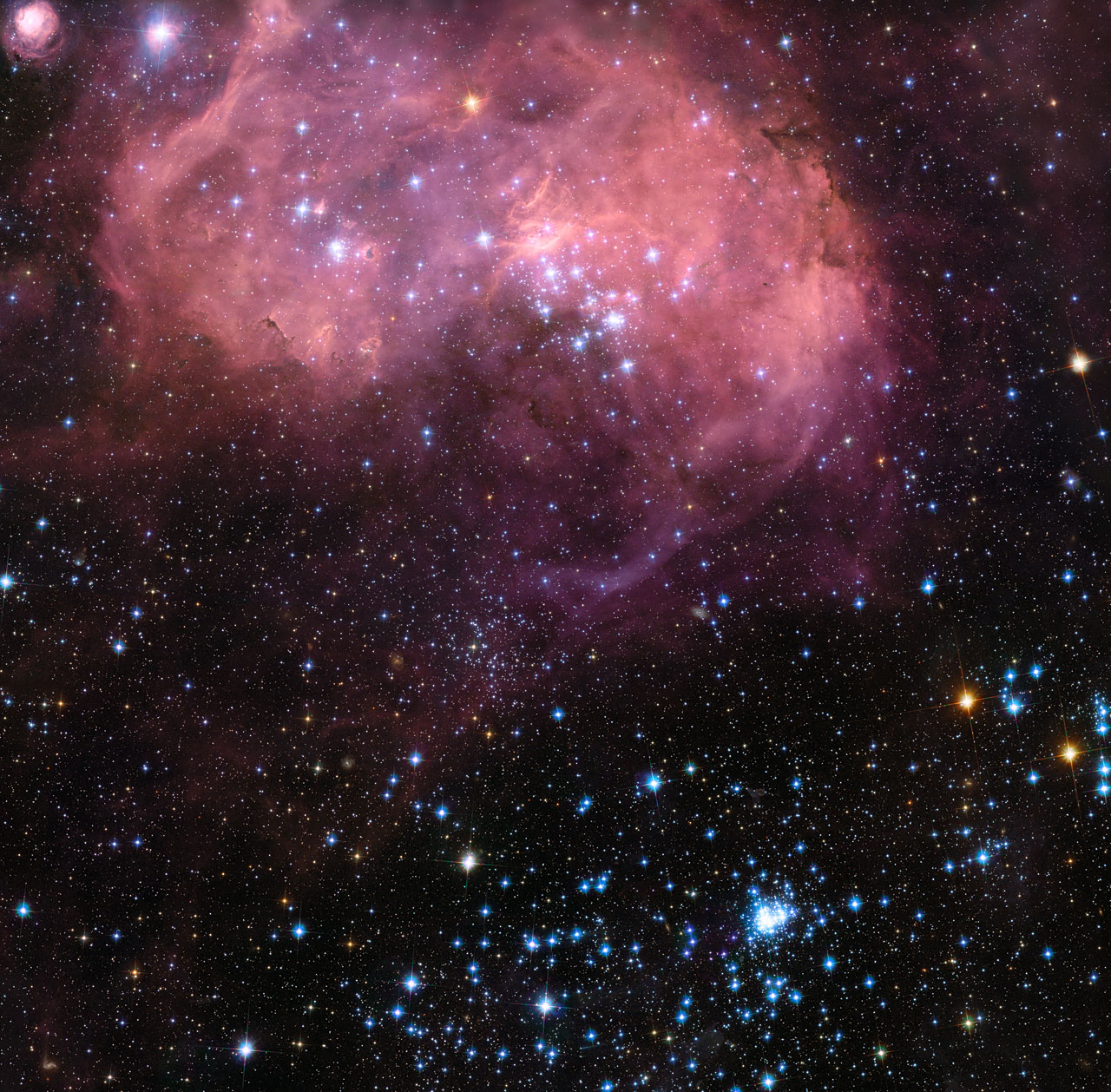
Deep inside the Milky Way’s companion galaxy called the Large Magellanic Cloud lies a vast complex of stars, gas, and dust. From our vantage point, 170,000 light years away, we see it as a softly-glowing pinkish brain-shaped cloud studded with stars — a description that grossly underdescribes the tremendous beauty of the newly-released Hubble view of it:
hst_n11

Oh, my. Click it to get a bigger version, or go here to get a 26 Mb 4000×4000 pixel version.

hst_n11_bluestarsWhat a staggeringly lovely image! And so much to see. More than you’d expect… but that’s part of a surprise I’ll have for you at the end of this post. Bear with me, it’s worth it.

Until then, let me show you a thing or two…

LHA 120-N 11B, as this object is formally called (or just N11B for short), is a giant cloud of star-forming gas, containing as much as 100,000 times the mass of the Sun in gas alone! Inside the cloud, to the lower right, you can see dozens of brilliant blue stars. These are newly-born, massive stars. They burn fiercely hot, blasting the space around them with ultraviolet light and expelling strong winds of gas from their surfaces. Together, these twin waves slam into surrounding material, heating and compressing it. To the upper left of that group of stars you can see what looks like a weather front as the shock waves move through the gas. If this gas is dense enough, it too will collapse and form more stars.

hst_n11_superstarTo the extreme upper left of the image is another case of this, but this time from what appears to be a single star. It’s the brightest star in the image, so it’s most likely at the top end of the mass scale for stars, and its heat, light, and wind commensurately stronger. It’s brutal enough to be slamming a region of the cloud light years across! Right around the star itself is more gas, which is most likely left over from the star’s formation itself: a star that massive cannot live for long, and so there hasn’t been time for it to totally blast away its environment. Take a good look at this while you can: in probably less than a million years this star — like almost every other blue star in this entire image — will explode in a titanic supernova event. It will be easily visible to the naked eye, in fact… if you’re fortunate enough to live in the southern hemisphere.

hst_n11_bokAnother fascinating region of the cloud is to the lower left. You can see dark splotches dotting the area; these are dense clouds of gas mixed with dust, a complex opaque molecule formed in both star birth and death. These are the precise spots where stars are being born, collapsing from that material. We see these in almost every gas cloud actively forming stars… and 4.6 billion years ago, our own Sun almost certainly formed in just such a cocoon.

Amazingly, astronomers studying this cloud have found the population consists of three separate generations of stars. The ones in those blobs are merely the youngest, but the most aged stars are only a few million years older. Even the most decrepit of stars in this cloud is only a thousandth as old as the Sun!

Now it’s time for the surprise I promised.

In that first image at the top of this post, turn your attention to the lower right, outside the cloud. In what looks like clear space is a cluster of thousands of jewel-like stars. However, that space is not clear, and, in fact, hints that I’ve been holding out on you. You see, the Hubble image above actually only sees a tiny portion of the entire complex of gas and dust! Check out this much wider field-of-view picture from the Curtis Schmidt 0.6 meter telescope in Chile:

noao_lmc_n11

Aha! This object is much, much larger than I’ve been leading you to believe. The brain-shaped region in the Hubble image is actually just that one small part of the far bigger complex called LHA 120-N 11. What we’ve been looking at, N11B, is the region just above the center. The cluster of brilliant stars in the lower right of the Hubble image is actually a massive cluster of newly-born stars occupying the center of the much larger complex. The combined might of those stars is carving out a bubble, a cavity in the middle. The cluster is about 3.5 million years old, and soon stars in it will start exploding as they reach the ends of their lives. What will that do to the gas in that cluster, I wonder?

Incredibly, with all the detail visible in the Hubble image, it’s really only a small fraction of the activity going on in this enormous object. I’ll admit, I was rather stunned when I found that last image. I could tell that the Hubble image was incomplete, and must be part of a larger object, but even so the scale of this amazed me. To see such incredibly fine detail, to see where individual stars are being born and where others are affecting their surroundings… and then to zoom out and see that this must be happening everywhere, all over that vast region. The entire object is several hundred light years across: that’s several quadrillion kilometers, hundreds of trillions of miles. There must be thousands of stars forming in all those clouds, tens of thousands. It’s a stellar factory, churning out baby stars at a ferocious rate.

And yet, with all that, it’s still only the second most massive such object in the Large Magellanic Cloud; the Tarantula Nebula is comfortably heftier.

When I see images like this, I’m reminded quite strongly that the Universe is incredibly complex, beautiful, and — my favorite of all — surprising. The more we look, the more there is to see.

Picture credits: NASA, ESA and Jesús Maíz Apellániz (Instituto de Astrofísica de Andalucía, Spain) and C. Aguilera, C. Smith and S. Points/NOAO/AURA/NSF


Solar Panel Spacing

Greetings All,

I'm trying to build a 1.5Mw solar farm, PV, fixed ground mount, and the engineers say that as a rule of thumb they just space the rows 2-3 times the max height of the panel (because of the shadow). I did the math and found I could space them 7 feet apart without causing shading,

Stem Cell Society to Get Tough on “Charlatans” & Unproven Treatments | 80beats

test tubesThe International Society for Stem Cell Research has had enough. When the organization of stem cell scientists met last week in San Francisco, its leaders promised to get serious about unregulated stem cell treatments.

First, society president Irving Weissman declared his intention to “smoke out the charlatans,” New Scientist reported. The ISSCR is investigating its members who provide advice to clinics that offer experimental stem cell treatments (no such treatments have yet received FDA approval).

At a press briefing on 17 June, he revealed that these members are being told to explain their connections with such clinics. Expulsion from the society was a possibility for members who continue to associate themselves with unproven “therapies”, added Sean Morrison of the University of Michigan in Ann Arbor, a member of the ISSCR board of directors [New Scientist].

Also this month, the society debuted its website aimed to inform people about stem cell treatments (and fraudulent claims). Says Weissman:

“Stem cells do hold tremendous promise for the treatment of many serious diseases. Yet there are organizations out there that are preying on patients’ hopes, offering stem cell treatments – often for large sums of money – for conditions where the current science simply does not support its benefit or safety” [Milwaukee Journal Sentinel].

Authorities are putting the clamps on stem cells treatments abroad, too. Earlier this month Costa Rica shut down the stem cell treatments offered by a top clinic there that was run by an American. Stem cell tourists still have other countries they could flock to for unregulated treatments. But they might think twice after the news last week that a woman died from an experimental kidney treatment in Thailand.

Suffering patients may lose their patience at the slow pace of stem cell research, but Weissman says it’s critical to put a stop to quack treatments when the science is still so young:

“Probably 90 percent of what you hear at this conference won’t be even close to trials” [San Francisco Chronicle].

Related Content:
80beats: Stem Cell Tourists Denied: Costa Rica Stops Treatments at Top Clinic
80beats: Danger, Stem Cell Tourists: Patient in Thailand Dies from Treatment
80beats: FDA Approves the First Clinical Trials Using Embryonic Stem Cells
DISCOVER: Stem Cell Science Takes Off

Image: iStockphoto


Lucy’s New Relative, “Big Man,” May Push Back the Origin of Walking | 80beats

kadanuumuuNo offense, Lucy, but at three feet, six inches you were kind of short. Your diminutive, 3.2 million-year-old bones made it difficult to tell whether your species could even walk like us. Fortunately, researchers in Ethiopia have uncovered an older, bigger relative. As described in Proceedings of the National Academy of Sciences, some researchers believe that these new bones show that members of Lucy’s species, Australopithecus afarensis, could walk like modern humans. 

The paper’s authors call him Kadanuumuu (kah-dah-nuu-muu)–”big man” in the Afar language. Big Man still isn’t really that big by today’s standard: His 3.6 million-year-old bones show that he stood at around five feet.

The fossilized remains don’t include a head, but Big Man has many of the same bones as Lucy, and also others previously missing: a shoulder blade and a rib cage bits. Lead researcher Yohannes Haile-Selassie argues that Big Man’s skeleton upends previous beliefs about Lucy’s love of tree climbing and more primitive walk.

“This individual was fully bipedal and had the ability to walk almost like modern humans,” said Haile-Selassie. “As a result of this discovery, we can now confidently say that ‘Lucy’ and her relatives were almost as proficient walking on two legs as we are, and that the elongation of our legs came earlier in our evolution that previously thought.” [Cleveland Museum of Natural History]

Haile-Selassie argues that Lucy’s stubby legs mislead researchers into thinking that she wasn’t fully adapted to upright walking. He says that if she had been as tall as Big Man, she would have a similar stance.

Others researchers argue that the skeleton adds little new information.

Fossil hominid skeletons as complete as Big Man “are few and far between,” says anthropologist William Jungers of Stony Brook University in New York. But the new find mostly confirms what was already known about Lucy, he asserts. Lucy’s kind, including Big Man, were decent tree climbers, even if they couldn’t hang from branches or swing from limb to limb as chimpanzees do, he says. “Riddle me this,” asks Jungers in considering Hailie-Selassie’s [sic] emphasis on a ground-dwelling A. afarensis. “Where did they sleep? Did they wait for fruit to fall to the ground? Where did they go to escape predators?” [Discovery News]

Even if Big Man can’t settle the walking debate, he does give researchers some new clues about past hominids and even some close living relatives.

Carol Ward of the University of Missouri at Columbia agrees that the debate over exactly how A. afarensis walked is likely to continue. Still, Big Man does add important information about the evolution of the upper body of hominids, she notes. The shoulder blade, or scapula, is the oldest hominid scapula discovered, and an adult one, which allows for a proper comparison to other species. [Nature News]

This shoulder blade is very different from that of chimpanzees, our closest living relative, as described in a Cleveland Museum of Natural History release, meaning that chimpanzees have evolved quite a bit since we shared a last common ancestor.

Beautiful bone footage available, here.

Related Content:
DISCOVER: Was Lucy a Brutal Brawler?
DISCOVER: How Loyal Was Lucy?
80beats: Scientist Smackdown: Did “Ardi” Change the Story of Human Evolution?
80beats: 9-Year-Old Kid Literally Stumbled on Stunning Fossils of a New Hominid
80beats: 1.5 Million Years Ago, Homo Erectus Walked a Lot Like Us

Image: Yohannes Haile-Selassie, Liz Russell, Cleveland Museum of Natural History.


Dr. Walter Block to Speak in Indiana

(Editor’s Note: A group of Indiana libertarian college students are bringing libertarian economist Dr. Walter Block to speak in Indiana. This is a message from the organizer, George Edwards.)
Going to college is quite an experience for most young people. They are
exploring themselves within the realm of ideas and challenging the
sacrosanct conventions of their youth. When [...]

LPIN Podcast: Ryan Liedtky, Author

Ryan Liedtky is the 2nd District Representative to the Central Committee of the Libertarian Party of Indiana, and now, he’s also a published author. The book is titled, “Wisdom: A Prelude To Liberty”.
In this special edition of the podcast, Liedtky discusses his pragmatic approach to causing readers to think about problem solving with libertarian solutions, [...]

Devastating Floods Wash Over Brazil

From Discovery News - Top Stories:

Floods after days of driving rain have killed at least 39 people in northeastern Brazil, and left 1,000 unaccounted for and another 100,000 people homeless, authorities said. President Luiz Inacio Lula da Silva has called a crisis cabinet meeti

Science Sizes Up 'Ghost Particle'

From BBC News | Science & Environment | UK Edition:

Scientists have made their most accurate measurement yet of the mass of a mysterious neutrino particle. Neutrinos are sometimes known as "ghost particles" because they interact so weakly with other forms of matter. Previous

Study: C-Section Babies Miss Out on a Dose of Beneficial Bacteria | 80beats

baby hand parentDNA may dictate your development, but you also wouldn’t be you without the unique mix of bacteria that make their home on your body. This week in the Proceedings of the National Academy of Sciences, researchers say that the very moment of your birth can decide for a lifetime what kind bacteria live in your body, and even whether you’ll be at a higher risk for conditions like asthma.

The uterus is a sterile environment. So, in the womb, babies don’t have any bacteria to call their own. It’s only once they enter the world that they begin to collect the microbes that will colonize their bodies and help shape their immunity [Scientific American].

How babies enter the world is the key, the team says. The studied surveyed the bacterial colonies of 10 mothers just before birth; four of those women gave birth traditionally and six did through cesarean section. When the scientists then checked up on the bacteria living in the newborns, they found that the difference in birth method decided what microbes the baby would get. Those born vaginally tended to pick up the bacteria from their mother’s vagina, while those born via C-section harbored bacterial colonies that tend to come from skin.

Dr Noah Fierer, one of the study leaders from the University of Colorado at Boulder, US, said: “In a sense the skin of newborn infants is like freshly tilled soil that is awaiting seeds for planting – in this case, bacterial communities. The microbial communities that cluster on newborns essentially act as their first inoculation.” He added: “In C-sections, the bacterial communities of infants could come from the first person to handle the baby, perhaps the father” [UK Press Association].

While C-sections have shot up in popularity and can be a life-saving procedure for the mother, this study suggests that the birth method can skew those “bacterial communities.” And the mix of skin bacteria that C-section babies pick up may not be as effective an inoculation.

Previous research suggests that babies born via C-section are more likely to develop allergies, asthma and other immune system–related troubles than are babies born the traditional way [Science News].

Related Content:
DISCOVER: Vital Signs: End-of-term complications almost kill a mother
Not Exactly Rocket Science: Gut bacteria reflect diet and evolutionary past
80beats: Scientists Sequence DNA From the Teeming Bacterial Universe in Your Guts
80beats: Special Seaweed-Chomping Bacteria Found in the Guts of Japanese Diners

Image: iStockphoto


Commercial Space Supporters Respond

Open Letter To Congress On Commercial Space

"We, the undersigned space leaders, are strong supporters of human spaceflight. We are writing to urge you to both (1) fully fund the commercial crew to Space Station program proposed in the President's FY2011 budget request for NASA, and (2) accelerate the pace and funding of NASA's human space exploration projects beyond Earth orbit."

Letter: Commercial rockets are 'fundamental' to space exploration, Orlando Sentinel

"The war of words over President Barack Obama's new plan for NASA continued this week when more than 50 ex-astronauts, aerospace businessmen and scientists signed a letter supporting his proposal to replace the space shuttle with commercial rockets."

Generator Problem

I have a 7.5 kw single phase air cooled gen set kirloskar make, the engine is running fine but the alternator is not giving any output.the set is 6 yearsold.

Game

Does anyone remember that little rocketship game on the G-spec homepage where you try to bounce the balls to make the ship launch. I'd like to get that back if anyone knows the link. Thanks.

Rebirth Of The First Sinclair Computer

From Retro Thing:

Robin writes, "I attended the Vintage Computer Fair in Bletchley Park, England this weekend. Colin Phillips has rebuilt a Sinclair Mk14 with the prospect of them being for sale later in the year. I think this is great news well worth sharing!" Introduced in 197