I Contact: Contact lens mouse

I love this: The contact lens mouse:


Via Yanko Design:

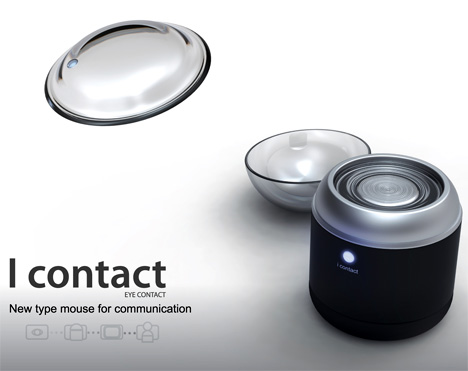
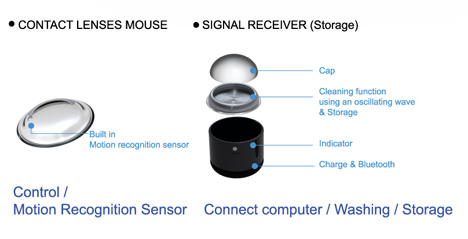
This one’s kinda hard to swallow so take a deep breath, open your minds, and pretend it’s 2100. I CONTACT is essentially a mouse fitted to your eyeball. The lens is inserted like any other normal contact lens except it’s laced with sensors to track eye movement, relaying that position to a receiver connected to your computer. Theoretically that should give you full control over a mouse cursor. I’d imagine holding a blink correlates to mouse clicks.

The idea was originally created for people with disabilities but anyone could use it. Those of us too lazy to use a mouse now have a free hand to do whatever it is people do when they sit at the computer for endless hours. I love the idea but there is a caveat. How is the lens powered? Perhaps in the future, electrical power can be harnessed from the human body, just not in a Matrix creepy-like way.

Economist: Humanity is about to confront its true nature

Noting the tenth anniversary of the reading of the human genome, The Economist issues a call to action, but not without warning:

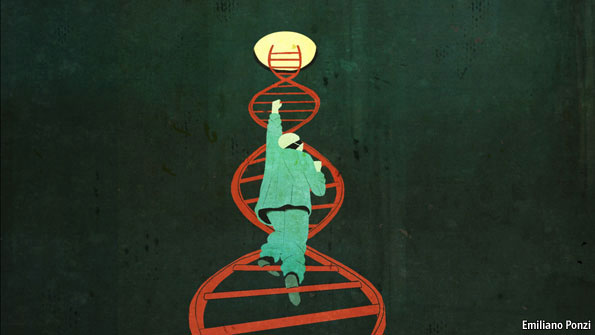
Humanity’s foibles will be laid bare. The species’s history, from its tentative beginning in north-east Africa to its current imperial dominion, has already been revealed, just through being able to read the genome. It is now possible, too, to compare Homo sapiens with his closest relative—not the living chimpanzee, with whom he parted company perhaps 5m years ago, but the extinct Neanderthal, a true human. That will do what philosophers have dreamed of, but none has yet accomplished: show just what it is that makes Homo sapiens unique. The genome will answer, too, the age-old question of original sin. By showing what is nature, it will reveal what is nurture—and thus just how flexible and perfectible the human animal really is.
...
Genomics may reveal that humans really are brothers and sisters under the skin. The species is young, so there has been little time for differences to evolve. Politically, that would be good news. It may turn out, however, that some differences both between and within groups are quite marked. If those differences are in sensitive traits like personality or intelligence, real trouble could ensue.

People must be prepared for this possibility, and ready to resist the excesses of racialism, nationalism and eugenics that some are bound to propose in response. That will not be easy. The liberal answer is to respect people as individuals, regardless of the genetic hand that they have been dealt. Genetic knowledge, however awkward, does not change that.

Cracking Down on Stem Cell Tourism

The International Society for Stem Cell Research (ISSCR) is a professional organization of stem cell researchers. I am happy to see that they see it as their responsibility to respond to the growth of dubious stem cell clinics offering unproven treatments to desperate patients.

In a recently published handbook for patients, they write:

The International Society for Stem Cell Research (ISSCR) is very concerned that stem cell therapies are being sold around the world before they have been proven safe and effective.
Stem cell therapies are nearly all new and experimental. In these early stages, they may not work, and there may be downsides. Make sure you understand what to look out for before considering a stem cell therapy.
Remember, most medical discoveries are based on years of research performed at universities and companies. There is a long process that shows first in laboratory studies and then in clinical research that something is safe and will work. Like a new drug, stem cell therapies must be assessed and meet certain standards before receiving approval from national regulatory bodies to be used to treat people.

This is good advice for any new treatment.

The problem with dubious stem cell clinics has been growing in recent years. In China, Mexico, India and elsewhere clinics promise “cutting edge” stem cell transplants for a long list of fatal or incurable diseases, like ALS, spinal cord injury, or stroke. They seem to be deliberately targeting affluent Westerners – although many of their victims have to raise money or mortgage their house to pay for the travel and cost of the treatment. The cost is often in the 10s of thousands of dollars, at time more than 100k dollars.

Such clinics typically advertise for customers over the internet. A survey of such sites indicates that most present their stem cell treatments not as experimental, but as “routine.” They offer testimonials to support their treatments, rather than published research.

These clinics are not doing proper science – publishing rigorous research and treating patients only with proper experimental protocols and informed consent. They are exploiting the public’s interest in a potential future therapy to prey on the desperate.

Such clinics are allowed to practice because of lax regulations in the countries in which they reside. Because of some bad press, Costa Rica, India and other countries are starting to take a look at such clinics – but official efforts to regulate them has been half-hearted at best.

It is therefore most welcome that professional and research organizations are seeing it as part of their mission to educate the public and directly address the misleading claims of snake oil peddlers. We need much more of this. Engaging with the public about misinformation and especially dubious health claims and products should be considered a core mission of medical professional societies.


[Slashdot]
[Digg]
[Reddit]
[del.icio.us]
[Facebook]
[Technorati]
[Google]
[StumbleUpon]