Guest Post: Eugene Lim on Calculus in Haiti | Cosmic Variance

A little while back we advertised that Eugene Lim had volunteered to visit Haiti to teach in a university there over the summer, and would be reporting back about the experience. Here’s Eugene’s write-up — a powerful and affecting look into conditions there, and the spirit of the students.

———-

I noticed a puzzled look on Vicky’s face — she was squinting at the blackboard filled with equations describing how the subtitution rule in integral calculus works. She is one of my better students whom I know to be following my lectures well. I took it as a cue that I have not made a point clear, and I knew I must fallen back into speaking as though as my students are native English speakers. They are not — they speak Haitian Creole, and I was trying to teach them basic intro to mathematics in English and and a smattering of Creole.

Hello from Fondwa, Haiti, elevation 850m, Population 8000. For the past twenty days, I have been teaching a group of enthusiastic Haitian university students at the University of Fondwa. As I mentioned in my previous post, the university lost all its buildings during the Jan 12 quake. At the moment, we are using an abandoned warehouse as a temporary campus. It has no roof, so we put a tin roof over to keep the rain out. We use tarps (thank you USAID) for our windows to keep the rain out. There are 3 classrooms and an office. Some of the students have lost their homes in the Jan 12 earthquake, so the university allowed them to stay inside the warehouse.

unifwarehouse

We have no running water and a few solar panels for power. Water is obtained from wells, from a spring (about 15 minutes walk up hill), and from the regular rain showers we have been getting — hurricane season is upon us after all. This often led to me wondering whether I should be wishing for rain so we can fill up our water tank, or for the sun so we can charge up our batteries.

Many of the students are extremely enthusiastic. In my first full day, when I was just waiting for a teaching assignment, Deb, Vicky and Everest approached me and asked me in halting English what I would be teaching. I told them I would probably be teaching them math, and they said they have not had a math professor for the entire semester, and oh would you help us with some of these problems. So I ended up working with them right there and then. Turns out that these vanguard of students have been trying to teach themselves math from some books. They have had some confusion with concepts that one would expect from being self-taught, but they were sharp and intelligent. I found it a joy to work with them. Deb in particular, is especially strong and spoke some English, so I hired him as my Teaching Assistant who can also translate for me. Given his mathematical acumen, I started teaching him more advanced topics in a special class.

deb1

I was assigned to teach two classes in four weeks — an Intro to mathematics (for first years) and the vaguely titled “Business Mathematics” class to the 4th years. After a quick evaluation of the students’ ability, I ended up deciding that I am going to teach the first years differential and integral calculus — useful things to know whether you are going to be an agronomist or a manager. For the “business math” class, I chose to teach them some basic statistics — with the goal that they should be able to deal with frequency and probability distribution functions when completed.

English is not a widely spoken language in Haiti, so it was a challenge to teach the classes. However, I find that we can make a lot of headway with a mixture of my rudimentary Creole and the combined English knowledge of my students, assisted by a dictionary. The classes understandably proceed slower than usual, but that is not always a bad thing in pedagogy. After a hesitant start, we settled on a good system where some of the more capable English speakers would translate for the other students in real time. Sometimes, some of the more advanced students would volunteer to teach a difficult concept which they have grasped to the class in Creole. The students are generally attentive, and eager — I am often asked to teach extra classes.

teach1

When classes are not in session, I am kept busy with students who wanted to learn more, or have questions about math or English. I find these impromptu discussion sessions the most rewarding — I can teach the students at the pace at which they are learning. As a personal bonus, I have the luxury of having the students teach *me* Creole. Although I am assigned a very good Creole teacher, I learned most of my Creole from such constant interaction with the students.

kids2

Living conditions in Fondwa are rough. I am staying in a semi-collapsed building with a couple of volunteers from the US (Rohan Mahy and Reuben Grandon), and a rotating roster of Haitian teachers, most who live outside Fondwa : unfortunately qualified teachers and lecturers are extremely scarce in Haiti. Our quake damaged building has no running water, no power, and red “X” marks on parts of the buildings that are unstable — a non-trivial indicator since we are still experiencing aftershocks (I personally felt three so far). On the other hand, we have a great view — on a clear day, we can see distant Leogane northward and the Gulf of Mexico, 80 km away.

Nevertheless, our humble abode is a palace compared to the conditions that most Haitians live in. Many of them have lost homes in the quake; some of hem are still living in tents. Ironically, many of the stone buildings collapsed, while the wooden ones survived. I visited one of the tent cities of Port-au-Prince — they are hot, dusty, crowded and so incredibly unsanitary that they seems like epidemic timebombs waiting to go off. Every single building left standing suffered some form of damage from the quake — sometimes looking past the intact facade will reveal a completely collapsed back portion of the house. This does not stop Haitians from living in them. There is a strong sense of communal spirit among rural Haitians, more than once, I was told by the tenants that their house was “kraze” (destroyed) in the gudu-gudu (quake) and they are living in that “kind madame’s” house. Our neighbouring house, a wooden structure no bigger than the size of a school bus, is home to thirty men, women and children.

The Haitians are very friendly. After getting past the initial bemusement (and amusement) of being called “blan” (white man) in the first few days, I find the Haitians incredibly hospitable, and resilient in the face of such hardship. Wherever I go, it is easy to smile and call out a “bonjou” or “bonswa”, or “komen ou ye” (how are you?) to people passing me or just doing chores in front of their houses. I have a special love for the Haitian children — they are the most energetic and playful bunch of kids I have ever met. A group of them would show up at our house from time to time, screaming the names of us *blan* volunteers, and we would end up playing with them until we are exhausted. It is poignant for me to know that some of them have lost siblings and parents in the quake.

I will be leaving Haiti in a few days. Personally, I found the teaching experience and my interactions with the Haitians incredibly fulfilling and rewarding. But it was also very sobering to see the damage, destruction and human misery caused by the quake. There is a lingering sense of not having done enough, and that there is so much more left to be done. I do plan to come back again, and perhaps learn enough Creole to teach in it next time.


What’s happening with accreditation of foreign health professional schools? – VIN News Service

What's happening with accreditation of foreign health professional schools?
VIN News Service
Dr. Dan Hunt, senior director of accreditation services for the undergraduate medical school accrediting body, the LCME, said ACGME's foray into the ...
Veterinarians question AVMA's role in international accreditationVIN News Service

all 2 news articles »

Machines: A beginning – Part II

Now we can get into the fun part of machines; the ones we use today for the exploration of space.  Don’t cheat, go back and read yesterday’s post for the history primer.  I’ll wait.

Okay, you done?  Great.

Obviously, we talk a lot about some of the machines commonly used today on the blog.  We talk about telescopes past and present, about the rovers, the Voyager crafts, Cassini, Messenger, even Mariner 10.  But mostly we talk about the results, not the machines themselves.  Unless you want a 10-part series in this, I’ll have to just give you a fast over-view of the machines we know so well today, so buckle up.

NASA/ESA - Space Shuttle Discovery Launches at start of STS-120

Starting with the Space Shuttles, did you ever stop to think that our astronauts are sitting in a very complicated machine, strapped to a rocket?  A rocket is nothing but a sustained explosion which happens in one direction (we hope).  There they are, sitting on top of a rocket, getting shot into space at 17,000 mph+.  As I’ve mentioned before, I bet they don’t get many solicitors from insurance companies knocking on their doors.  Can you imagine filling out the questionnaire?  “How far do you travel to your work site?”   The Shuttle itself is a vehicle, but it’s also a science lab, an environment, and a home.  It must carry everything with it; not the least its fuel and the oxygen needed for combustion.  It must have a place for food, water, oxygen, equipment, even clothing for the passengers.  The Shuttle is a machine that takes a human from a place where they can survive to a place where they cannot without some seriously expensive equipment.  It keeps them alive, then returns them safely through the hazard of reentry (usually).

The Mars Rovers are vehicles which we designed to work for us, far away from us, in a place where again we cannot yet survive.  They are also little mobile science labs.  They collect and analyze data, then broadcast the information back to us.  When something goes wrong, they are designed to analyze themselves and try to correct the problem, or broadcast to us what’s wrong.  Into an environment about which we knew comparatively little at the time, we had no assurances that the rovers would even be able to function.  We were pretty sure, but not certain.  Now we are certain.

NASA - Mariner 10, now circling the sun

Being so far from us that we have no hope of ever recovering them, the Voyager space crafts are still sending scientific data back to us.  Voyager also is designed to detect problems with itself.  If something happens, Voyager severs contact with us and begins diagnostic analysis.  If possible, it will correct whatever problem has arisen, reestablish contact, and continue on.  As you can imagine, we wouldn’t be much use to the little space crafts if anything happened to them, like getting middled by an asteroid.  By the time we knew it was about to get hit, it would have been hit.

The International Space Station is an amazing machine which also functions as a home, a workplace, a laboratory, a total environment, and an entertainment center.  One thing it’s not is a vehicle.  If it malfunctions catastrophically, the people on board don’t have anywhere to go.  It is one of those machines which must be kept functioning at all costs.  It is designed to provide for the physical and psychological needs of its passengers.  You know, if all you have is work, sleep, eat, and nowhere to go, some serious distraction must be provided or the human psyche will become strange.  Okay, it’ll become stranger.  You cannot have anyone going psychotic on the ISS.  I would think catastrophic failure of the ISS and the human psyche are two of the major concerns aboard the station.  And again, if they get middled by an asteroid there isn’t much we can do except watch and hope.  The issues of waste disposal alone are phenomenal.

NASA/ESA JPL The ISS after STS132 undocks.

The computer technology which has exploded into our lives is unbelievable.  If you grew up using computers, lucky you.  They were something which entered my life after I was an adult; the home computers, anyway.  When we mention computers, we have to mention the Internet.  Now THAT is something.  You have the accumulated knowledge of our species at your fingertips.  I defy you to find a subject not addressed somewhere on the Internet.  In fact, the usual problem is “too much”, instead of “not enough”.  It’s there, all you have to do is ask for it.  Today’s computers practically spoon feed it to you.  I can’t wait to see the next generation; already being developed.

Of course, we’ve all benefited from the advancements made in space exploration (in addition to war and greed, remember Part I).  Not just by the computer sitting in front of you, but in medicine, terrestrial vehicles, the service machines you have in your home (like your dishwasher), education… the list is enormous.  It’s impacted every area of our lives, including socially.  Each step we take brings us only to another step.  We will never reach “the end” of advancements.

I’ve heard many people complain about the speed at which our technology is advancing.  I’m never sure how to answer, but I’m certain they wouldn’t want to go back to a time when we didn’t have it.  Get sick, and tell your doctor you’d rather he bled you with leaches than order the medicine you need?  There is no going back, there is only forward… or fall into stagnation.  When any species falls into stagnation, it gets edited out.  You know what that means, you don’t need me to explain it to you.

Just in case you missed it.

We are only at the beginning.  There are so many things ahead, so much to discover, and our machines will be with us.  This was Trudy’s post.

EBay Sued For $3.8 Billion (!!!) [Lawsuits]

Yes, that is a totally ginormous sum, and you are reading it right: XPRT Ventures has filed a $3.8 billion suit against EBay Inc, along with affiliates PayPal, Bill Me Later, Shopping.Com and StubHub, for infringing on six patents related to PayPal and other payment systems. Not only did EBay use XPRT's technology, the suit claims, but knowingly implemented it in their own patent application, "Method and System to Automate Payment for a Commerce Transaction." Also, remember when you used to buy a bunch of stuff on eBay? [Reuters via Business Insider] More »


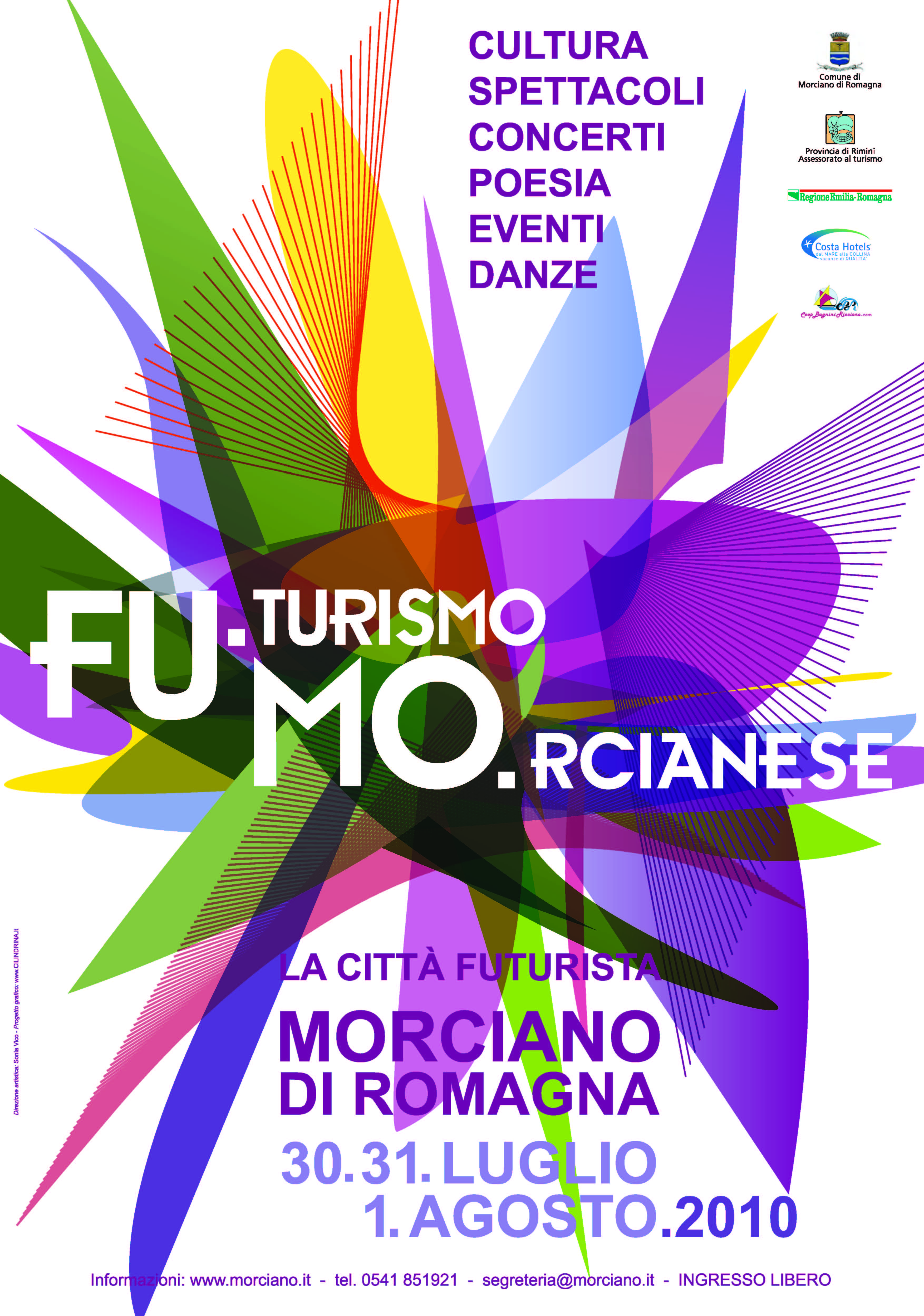
Morciano, home of Boccioni’s parents, celebrates Futurism with Summer Festival

FU.MO, Fu.Turismo Mo.rcianese

July 30 – August 1, 2010
Morciano (RI)

open PDF of full schedule

more info

Raffaele Boccioni and Cecilia Forlani, parents of the artist Umberto Boccioni, hailed from Morciano. The Futurist painter, though born in 1882 in Reggio Calabria, acquired family traditions, culture and speech of the morcianesi and remained unchanged in him, despite long periods spent in various Italian cities.

This city-wide festival will create a synergy incorporating performances, poetry, music and dance with its shops, bakeries, restaurants and hairdressers.

Share/Bookmark

Ice-Loving Bacteria Could Give Humans a Vaccine Assist | 80beats

ColwelliaSome like it hot. The bacteria Francisella tularensis is among them. It likes to live at the temperatures present inside human bodies, and give us the disease tularaemia. But Barry Duplantis figured out a way to make the body an unattractive destination for the bacteria: He injected it with the genes of a cold-lover.

In a study in this week’s Proceedings of the National Academy of Sciences, Duplantis brought in Colwellia psycherythraea, a bacteria that can survive in the icy temperatures of the Arctic, but would die at a temperature like the nearly 100 degrees inside our bodies. By transferring genes responsible for that temperature sensitivity into F. tularensis, he created versions of that bacteria with lower heat tolerances.

When he injected these microbes into mice, they couldn’t migrate to warm areas like the lungs and do damage. Plus, the presence of the incapacitated bacteria acted as a sort of vaccine, putting the animals’ immune systems at the ready. When the researchers later gave the mice large exposures to unaltered F. tularensis, they didn’t get as sick as control mice.

For plenty more on this study, check out Ed Yong’s post at Not Exactly Rocket Science.

Check out DISCOVER on Facebook.

Related Content:
Not Exactly Rocket Science: Genes from Arctic Bacteria Used To Create New Vaccines
80beats: In Mice, Breast Cancer “Vaccine” Trains the Body To Fight Cancerous Cells
80beats: Non-Lethal Antibiotics Could Fight Superbugs

Image: Richard Finkelstein


Launch Pad Puts the “Sci” in Sci-Fi Storytellers | Science Not Fiction

Where do budding, even experienced, science-fiction writers learn about the science behind the science fiction? Going back to school and getting a university degree in a scientific discipline is an option, but that’s going to take quite a while. You could short-circuit the process by spending a week at Launch Pad at the University of Wyoming!

Launchpad 2010 Attendees
Launch Pad 2010 Attendees

Launch Pad is a free, NASA-funded workshop for established writers held in beautiful high-altitude Laramie, Wyoming. Launch Pad aims to provide a “crash course” for the attendees in modern astronomy science through guest lectures, and observation through the University of Wyoming’s professional telescopes.

The workshop’s mission is to:

…teach writers of all types about modern science, primarily astronomy, and in turn reach their audiences. We hope to both educate the public and reach the next generation of scientists.

The person who runs Launch Pad, Mike Brotherton, is a wizard at using sci-fi as a vehicle to teach actual science (or, in his own words, he’s a wizard at funding his own science-fiction habit). A few years ago he received NSF funding to compile ”Diamonds in the Sky” — an anthology of hard science-fiction stories that also can be used by physics and astronomy teachers as a vehicle to teach real science. Some of the stories are quite good and worth the read. Perhaps we’ll see “Diamonds in the Sky II” in the not-too-distant future, populated with stories from former Launch Pad attendees!

Launch Pad 2011 and 2012 are funded, and there’s still time to apply for next year!

Launchpad_Logo


Bushing for Wire Rope

Hello all,

We have ~80 blocks mounted to our ceiling over each of which 7 runs of 1/4" aircraft cable pass. I am trying to resolve a set of interconnected issues we are having with these blocks. This is a theatrical counterweight fly system with an 80'+ ceiling.

The first (and cl

Study: A Death Star Named Nemesis Isn’t to Blame for Mass Extinctions | 80beats

earthcollideIn the 1980s, fossil record research showed a curious cycle: Every 27 million years, Earth hosted a mass extinction. Some scientists suggested that a dim star dubbed Nemesis was in a deadly dance with our sun, periodically kicking comets out of the distant Oort Cloud to shower our planet with destruction. Morbidly fascinating as it may be, the authors of a new study argue that this “death star” theory doesn’t hold up.

The cyclical extinctions do make a solid pattern, say Adrian Melott of the University of Kansas and Richard Bambach of Smithsonian Institution Museum of Natural History, whose paper is available through arXiv.org. The two have gone back in the record to 500 million years ago, further than any other researchers, and have confirmed the 27 million year cycle at a 99 percent confidence.

According to Bambach, there’s no doubt at all that every 27 million years-odd, huge numbers of species suddenly become extinct. He says this is confirmed by “two modern, greatly improved paleontological datasets of fossil biodiversity” and that “an excess of extinction events are associated with this periodicity at 99% confidence”. This regular mass slaughter has apparently taken place around 18 times, back into the remote past of half a billion years ago. [The Register]

The problem, Nemesis fans, is that the cycle is too precise, the researchers say. If these extinctions result from a dance between our sun and Nemesis, the researchers note, the period of these mass extinctions would change as other stars buffeted the pair and changed the courses of Nemesis’s orbit around the sun.

But the data indicates that the extinctions occur every 27 million years, as regular as clockwork. “Fossil data, which motivated the idea of Nemesis, now militate against it,” say Melott and Bambuch.That means something else must be responsible. It’s not easy to imagine a process in our chaotic interstellar environment that could have such a regular heart beat; perhaps the answer is closer to home. [Technology Review]

Some scientists say that the sharply-defined periodicity isn’t enough to rule out Nemesis. Richard Muller, an author of the original Nemesis paper, told Wired.com that there is still hope for a dark star.

“I would agree with most of what he says, but I think he is overestimating the accuracy of the geologic timescale,” he said. The geological record gives only an approximate sense of when major extinctions happened. “You get them in the right order, but it’s really difficult to get an actual date,” he said. In light of that uncertainty, “I would say the Nemesis hypothesis is still alive.” [Wired]

Luckily, given the precision of this death cycle, we can count on having time (i.e. 16 million years) to settle the debate.

There is a smidgeon of good news. The last extinction event in this chain happened 11 million years ago so, in theory at least, we have plenty of time to work out where the next catastrophe is coming from. [Technology Review]

Related content:
80beats: Is a Distant Dust Cloud Wreckage From a Cataclysmic Planetary Collision?
80beats: A Hidden Cosmic Neighbor: Cool Brown Dwarf Found Lurking Near Our Solar System
80beats: A Newly Discovered Comet Brings Tidings From the Oort Cloud
80beats: When the Sun Was Young, Did It Steal Comets From Other Stars?

Image: flcikr / Adhar Shanny Acosta Rocha


Tonight at Observatory: "Radical Detectives: Forensic Photography and the Aesthetics of Aftermath in Contemporary Art," with Luke Turner

Tonight at Observatory! Hope to see you there!

Radical Detectives: Forensic Photography and the Aesthetics of Aftermath in Contemporary Art
An illustrated lecture by artist and former forensic photographer Luke Turner
Date: Tuesday, July 13

Time: 8:00 PM

Admission: $5

Presented by Morbid Anatomy

Forensic autopsy, crime, and death scene photographs hold a strong fascination in culture. These specific types of photographs present to the viewer a mediated confrontation with horror. In the context of a courtroom, there is a presupposition that the scientific or analytic use value assigned to the photograph will function to shift the viewer’s position from voyeur to detached collector of facts relevant to the legal system. Yet neither position is stable, and the psyche must contend with a complexity of vision that exceeds either classification.

In this slide show, artist and former forensic photographer Luke Tuner will present images from the history of forensic photography, slides from cases that he has photographed, and documentation of modern and contemporary art works that engage the viewer in the reconstruction process. Some relevant concepts explored by artists are crime scene reconstruction in Pierre Huyghe’s “Third Memory”, entropy in the work of Robert Smithson, accumulation in Barry LeVa’s pieces, the logic of sensation in the painting of Francis Bacon, something about that guy that had himself shot in a gallery, and many more. He will also discuss the curatorial work of Ralph Rugoff, and Luc Sante who have both made important connections between art and the forensic image.

Thoughts by philosophers of the abject/scientific, such as Julia Kristeva, Georges Bataille, Paul Feyerabend, Paul Virilio, and others, will be brought into play with the visual presentation. We will explore strategies of resistance to an “official” culture that attempts to legitimize a fixed methodology for the interpretation of evidence. As we emerge from art and philosophical tangents, the lecture will conclude with an argument for why the characters of Agent Dale Cooper from Twin Peaks and Laurent, the protagonist of Alain Robbe-Grillet’s The Erasers, personify two notions of the radical detective through their unconventional approaches to the interpretation of evidence.

Luke Turner is an artist / writer / gallery preparator, who previously worked for three years as a forensic photographer for various Medical Examiner and Coroner’s Offices. Luke has lectured at Glendale Community College in Los Angeles and at California College of the Arts in San Francisco. He is the recent founder of the art blog Anti-EstablishmentIntellectualLOL!.

You can find out more about the presentation here. You can get directions to Observatory--which is next door to the Morbid Anatomy Library (more on that here)--by clicking here. You can find out more about Observatory here, join our mailing list by clicking here, and join us on Facebook by clicking here.

Image: "Car accident" 1940 - Photograph by Weegee, found here.

Stormwater Recharge (Perk Ponds)

Several developments near my home use perk ponds to force stormwater below ground level. Now, my basement has flooded several time a year and during the rainy months my septic is inundated with water. What can be done?