
Diabetes drug injected once a week gets F.D.A. approval: Bydureon (long-acting exenatide)

From the NYTimes:

The FDA twice declined to approve long-acting exenatide (Bydureon) in 2010, with its most serious concern being that the drug might contribute to heart rhythm abnormalities. There are safety concerns involving thyroid cancer and pancreatitis.

Bydureon is a longer-lasting version of Amylin’s existing drug Byetta, which is injected twice a day. Another company, Alkermes, supplied the technology that slowly releases Bydureon inside the body.

Bydureon, Byetta and Victoza are drugs called GLP-1 receptor agonists, which mimic the effect of glucagonlike peptide- 1, a hormone that increases insulin production when blood sugar is high.
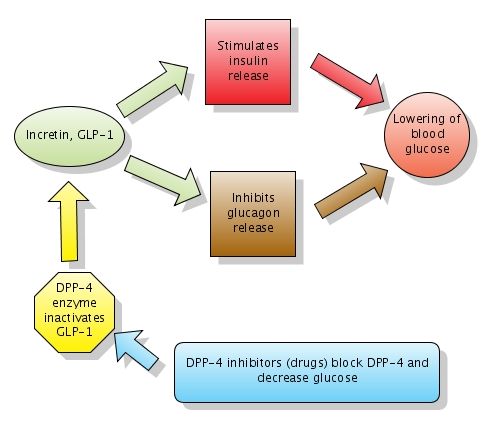

Figure: Action of DPP-4 inhibitors. Note that DPP-4 normally inactivates GLP-1. DPP-4 inhibitors block DPP-4 which in turn leaves GLP-1 active. Click to enlarge the figure. I made the figure with Gliffy in 2006 . The diagram Action of DPP-4 inhibitors is now widely used in many articles on Wikipedia, with my permission.

The main ingredient in both Bydureon and Byetta is exenatide, a hormone derived from the saliva of the Gila monster, a poisonous lizard found in the Southwestern United States and Mexico.

Wholesale price of Bydureon would be $323 for 4 doses, or about $4,200 a year. That is between the roughly $3,400 for the low dose of Victoza and $5,000 for the high dose.

References:

Diabetes Drug Injected Weekly Wins F.D.A. Approval. NYTimes.

Comments from Twitter:

Vaughn Eyvazian @Vaughnsays: Increase that pt compliance!

Reinaldo B. @basanezrx: but nobody stays in the lowest dose of Victoza in my experience, and that's why most ins companies pay for Byetta instead. A shame 🙁

Posted at Clinical Cases and Images. Stay updated and subscribe, follow us on Twitter and connect on Facebook.


Source:
http://feeds.feedburner.com/CasesBlog

Eating more berries may reduce cognitive decline in the elderly

Public release date: 26-Apr-2012 [ | E-mail | Share ]

Contact: Dawn Peters healthnews@wiley.com 781-388-8408 Wiley-Blackwell

Blueberries and strawberries, which are high in flavonoids, appear to reduce cognitive decline in older adults according to a new study published today in Annals of Neurology, a journal of the American Neurological Association and Child Neurology Society. The study results suggest that cognitive aging could be delayed by up to 2.5 years in elderly who consume greater amounts of the flavonoid-rich berries.

Flavonoids are compounds found in plants that generally have powerful antioxidant and anti-inflammatory properties. Experts believe that stress and inflammation contribute to cognitive impairment and that increasing consumption of flavonoids could mitigate the harmful effects. Previous studies of the positive effects of flavonoids, particularly anthocyanidins, are limited to animal models or very small trials in older persons, but have shown greater consumption of foods with these compounds improve cognitive function.

According to the 2010 U.S. Census, elderly Americansthose 65 years of age and olderincreased by 15% between 2000 and 2010, faster than the total U.S. population, which saw a 9.7% increase during the same time period. "As the U.S. population ages, understanding the health issues facing this group becomes increasingly important," said Dr. Elizabeth Devore with Brigham and Women's Hospital and Harvard Medical School in Boston, Mass. "Our study examined whether greater intake of berries could slow rates of cognitive decline."

The research team used data from the Nurses' Health Studya cohort of 121,700 female, registered nurses between the ages of 30 and 55 who completed health and lifestyle questionnaires beginning in 1976. Since 1980 participants were surveyed every four years regarding their frequency of food consumption. Between 1995 and 2001, cognitive function was measured in 16,010 subjects over the age of 70 years, at 2-year intervals. Women included in the present study had a mean age of 74 and mean body mass index of 26.

Findings show that increased consumption of blueberries and strawberries appear to slow cognitive decline in older women. A greater intake of anthocyanidins and total flavonoids was also associated with reduce cognitive degeneration. Researchers observed that women who had higher berry intake delayed cognitive aging by up to 2.5 years. The authors caution that while they did control for other health factors in the modeling, they cannot rule out the possibility that the preserved cognition in those who eat more berries may be also influenced by other lifestyle choices, such as exercising more.

"We provide the first epidemiologic evidence that berries may slow progression of cognitive decline in elderly women," notes Dr. Devore. "Our findings have significant public health implications as increasing berry intake is a fairly simple dietary modification to test cognition protection in older adults."

###

This study is published in Annals of Neurology. Media wishing to receive a PDF of this article may contact healthnews@wiley.com.

View original post here:
Eating more berries may reduce cognitive decline in the elderly

Unfaithfulness in men may be associated with higher risk of cardiovascular events

The authors of this study from Italy performed an extensive Medline search for “unfaithfulness,”“extramarital affairs,”“infidelity,” and “men.”

How common is unfaithfulness in men?

As expected the results were variable. Some surveys reported that 1.5–4% of married men had extramarital coitus in any given year, others that 23.2% of men have cheated during their current relationship.

Lifetime prevalence of unfaithfulness was between 15% and 50%.

What are the factors related to unfaithfulness?

Men with extramarital affairs more frequently have a dysfunctional primary relationship.

Parenthood and conflicts within the family are associated with a higher risk of having an affair.

Unfaithful men display a higher androgenization, larger testis volume, higher sexual desire, and better sexual functioning.

What are the clinical implications of unfaithfulness in men?

Some studies have suggested that having an extramarital affair could have a negative impact on cardiac morbidity and mortality. Unfaithfulness in men seems to be associated with a higher risk of major cardiovascular events.

References

Fisher AD, Bandini E, Rastrelli G, Corona G, Monami M, Mannucci E, and Maggi M. Sexual and cardiovascular correlates of male unfaithfulness. J Sex Med, 2012.

Image source: OpenClipart.org, public domain.

Posted at Clinical Cases and Images. Stay updated and subscribe, follow us on Twitter and connect on Facebook.


Source:
http://feeds.feedburner.com/CasesBlog

Children’s ability to "roam" has been destroyed, and they congregate on social media sites

From the the NYTimes:

Danah Boyd, a senior researcher at Microsoft and an assistant professor at New York University: “Children’s ability to roam has basically been destroyed. Letting your child out to bike around the neighborhood is seen as terrifying now, even though by all measures, life is safer for kids today.”

Children naturally congregate on social media sites for the relatively unsupervised conversations, flirtations, immature humor and social exchanges that are the normal stuff of teenage hanging-out, she said.

Moreover, grown-ups’ panic about teenage online behavior distracts from the potential benefits.

Let kids be kids - unstructured play time may be more important than homework, suggests a childhood psychologist. "Children have lost 8 hours per week of free, unstructured, and spontaneous play over the last 2 decades due to homework. Decrease in unstructured play time is in part responsible for slowing kids’ cognitive and emotional development. Today’s 5-year-olds had the self-regulation capability of a 3-year-old in the 1940s; the critical factor seems to have been not discipline, but play."

Video: A life cycle in 90 seconds:

References:

Cracking Teenagers’ Online Codes. NYTimes, 2012.

Image source: OpenClipArt.org, public domain.

Posted at Clinical Cases and Images. Stay updated and subscribe, follow us on Twitter and connect on Facebook.


Source:
http://feeds.feedburner.com/CasesBlog

American Academy of Neurology Foundation is Now the American Brain Foundation

Aims to Become World Leader in Supporting Research to Cure Brain Disease

Newswise NEW ORLEANS The American Academy of Neurology Foundation is now the American Brain Foundation. The name change is part of an overall re-branding campaign as the organization repositions itself to become the worlds leader in raising money for research to cure brain diseases, such as Alzheimers disease, stroke, Parkinsons disease, autism, and epilepsy. Todays re-branding announcement was made at the American Academy of Neurologys 64th Annual Meeting in New Orleans and on http://www.CureBrainDisease.org.

"Today is an exciting chapter in our organization's 20-year history as we aim to become the leader in funding research to cure brain disease, which affects more than 50 million Americans in the United States alone," said John Mazziotta, MD, PhD, Chair of the American Brain Foundation's Board of Trustees and Professor and Chair of UCLA's Department of Neurology and Brain Mapping Center in Los Angeles. "Brain disease is in the news every day, yet research funding is flat. We're in a perfect storm; but it is also a perfect opportunity. In the face of flat research funding, we have tremendous treatments on the horizon and a more knowledgeable and concerned public to help us in this fight to cure brain disease once and for all."

The re-branding campaign includes a new look for the Foundation as well as new ads to educate neurologists, patients, caregivers and the public about the need to donate money to research to cure brain disease. Since 1993, the Foundation has raised more than $16 million dollars for research into brain disease.

"Whether you are a patient, caregiver, neurologist, researcher, or someone who cares deeply about our cause, we are counting on you to join us in this fight now to cure brain disease by making a donation today at http://www.CureBrainDisease.org," said Mazziotta.

The American Brain Foundation, the foundation of the American Academy of Neurology, supports vital research & education to discover causes, improved treatments, and cures for brain and other nervous system diseases. Learn more at http://www.CureBrainDisease.org or find us on Facebook.

The American Academy of Neurology, an association of more than 25,000 neurologists and neuroscience professionals, is dedicated to promoting the highest quality patient-centered neurologic care. A neurologist is a doctor with specialized training in diagnosing, treating and managing disorders of the brain and nervous system such as Alzheimers disease, stroke, migraine, multiple sclerosis, brain injury, Parkinsons disease and epilepsy.

For more information about the American Academy of Neurology, visit http://www.aan.com or find us on Facebook, Twitter, Google+ and YouTube.

Go here to read the rest:
American Academy of Neurology Foundation is Now the American Brain Foundation

Phase 3 Results for GE Healthcare Imaging Agent Flutemetamol Presented at American Academy of Neurology Meeting

NEW ORLEANS--(BUSINESS WIRE)--

GE Healthcare today announced results from four pooled brain biopsy studies, as well as key results from a brain autopsy study, of the investigational PET amyloid imaging agent, [18F]flutemetamol.1 The data showed that both biopsy and autopsy study images had high sensitivity and specificity, and that strong concordance exists between [18F]flutemetamol PET images and Alzheimers disease-associated beta amyloid brain pathology. The data confirm the potential of [18F]flutemetamol as an imaging agent to detect beta amyloid plaque, a pathology associated with Alzheimers disease (AD), in living patients.

These data are being presented as part of the Emerging Science Program (formerly known as Late-Breaking Science) at the American Academy of Neurologys 64th Annual Meeting in New Orleans, April 21 to April 28, 2012, and support an application for regulatory approval of [18F]flutemetamol, which is intended to be filed later this year. [18F]flutemetamol is a GE Healthcare PET imaging agent in development for the detection of beta amyloid.

Currently, the standard for definitively confirming AD is through detection of pathology, including amyloid plaque in the brain during autopsy, said David Wolk, MD, Assistant Professor of Neurology in the Cognitive Neurology Division, Department of Neurology, University of Pennsylvania, presenter and lead investigator for the biopsy study. Because accurate detection of brain amyloid in vivo can help physicians make a more accurate clinical diagnosis and potentially enhance patient management, we were particularly pleased to see that flutemetamol performed in a similar manner in both the autopsy and biopsy studies.

The study to be presented at AAN pooled analysis from four studies of 49 patients receiving [18F]flutemetamol before or after brain biopsy during shunt placement or intracranial pressure measurement and 68 autopsy subjects to determine the presence of brain amyloid pathology. For patients with biopsy tissue samples, the study found that [18F]flutemetamol detected beta-amyloid with a pooled sensitivity of 93 percent and pooled specificity of 100 percent. In autopsied subjects, [18F]flutemetamol showed the ability to detect beta-amyloid with a sensitivity of 86 percent and specificity of 92 percent. Sensitivity is the percentage of amyloid-positive brains that are correctly identified by [18F]flutemetamol image readers as positive and corresponding to abnormal amyloid pathology. Specificity refers to the percentage of amyloid-negative brains that are correctly identified via [18F]flutemetamol images as negative, corresponding to normal pathology, by image readers.

The accumulation of beta amyloid in the brain is believed to play a role in the degeneration of neurons in AD and is one of several pathological characteristics implicated in its development. Currently, AD is confirmed by histopathological identification of core features, including beta amyloid plaques, in post-mortem brain samples.2Targeted amyloid imaging agents are being studied to determine their ability to help physicians detect amyloid deposition in living humans.

We know that AD-related pathological markers such as amyloid plaques may appear decades before clinical symptoms are observed, and these studies show flutemetamol images may prove to be a clinically valuable component of a broader diagnostic workup that neurologists conduct when assessing patients with cognitive impairments who may have AD, said Jonathan Allis, General Manager, PET, GE Healthcare Medical Diagnostics. Additionally, the ability to help rule out AD by reliably showing an absence of amyloid deposits in the brain could assist physicians in making appropriate disease management decisions. The results from these studies are encouraging in that they demonstrate the potential of flutemetamol imaging in living patients.

[18F]Flutemetamol is one component of a broad portfolio of diagnostic solutions that GE Healthcare is currently developing in the Alzheimers field. GE Healthcare is taking a comprehensive approach to understanding AD through its ongoing research to uncover the causes, risks and physical effects of the disease. For example, the company is partnering with pharma to identify a biosignature, or biological indicator, that may help physicians diagnose AD before the onset of clinical symptoms.

GE Healthcare offers a broad portfolio of imaging resources, that support accurate visualization of the signs of neurodegenerative diseases via state-of-the-art scanners - including MRI, PET, and CT - that deliver clear visualization of the brain. In addition, an expanding portfolio of imaging agents is being developed to enhance visual evidence of disease and innovative software applications that can aid physicians in image interpretation and determination of disease management.More specifically, our portfolio today includes cyclotrons and chemistry systems to manufacture PET imaging agents, PET and MR scanners to scan patients, and image analysis software to interpret the results.

GE Healthcare has been a key contributor to the Alzheimers Disease Neuroimaging Initiative (ADNI) since its inception. GE Healthcare also plays a key role in PredictAD, an EU-funded research project to develop solutions to enable earlier diagnosis of AD, and in the Coalition Against Major Diseases (CAMD).

Continued here:
Phase 3 Results for GE Healthcare Imaging Agent Flutemetamol Presented at American Academy of Neurology Meeting

"You take what you need and you leave the rest, But they should never have taken the very best"

"You take what you need and you leave the rest, But they should never have taken the very best" is a refrain from The Night They Drove Old Dixie Down, one of the best known songs of The Band.

Levon Helm, the revered drummer and singer of group the Band who kept the band's heart for more than three decades, died "peacefully" on April 19.

From CNN:

Born in Elaine, Arkansas, in 1940, the son of a cotton farmer, Helm rose to fame in the late 1960s and 1970s as a member of The Band, a folk rock group.

His soulful, drawling vocals highlighted many of the group's hit recordings, such as "The Weight," "The Night They Drove Old Dixie Down," and "Up on Cripple Creek."

Helm, 71, was diagnosed with throat cancer in 1998. He fell on hard times as cancer took his voice and medical bills threatened his house.

"You got to pick one -- pay your medical bills or pay the mortgage. Most people can't do both, and I'm not different," he told CNN in 2010.

So The Barn, as the residence is known around Helm's adopted hometown of Woodstock, New York, became the setting for what he called a "last celebration." Not quite. Instead, The Barn became the center of an unlikely and unrivaled rock 'n' roll revival.

It was there that Helm regularly hosted the Midnight Ramble, weekly concerts that attracted sell-out crowds and all-star support. The result not only paid the bills but also led to a creative resurgence for Helm, with his collaborations producing back-to-back Grammy-winning albums: 2007's "Dirt Farmer" and 2009's "Electric Dirt."

"If I had my way about it, we'd probably do it every night," Helm said. "I never get tired of it."

From Wikipedia:

Helm remained with "The Band" until their 1976 farewell performance, The Last Waltz, which was recorded in a documentary film by director Martin Scorsese (an excerpt is embedded above). Many music enthusiasts know Helm through his appearance in the concert film, a performance remarkable for the fact that Helm's vocal tracks appear substantially as he sang them during a grueling concert.

In the late 1990s, Helm was diagnosed with throat cancer suffering hoarseness. Advised to undergo a laryngectomy, Helm instead underwent an arduous regimen of radiation treatments at Memorial Sloan–Kettering Cancer Center in New York City. Although the tumor was then successfully removed, Helm's vocal cords were damaged, and his clear, powerful tenor voice was replaced by a quiet rasp. Initially Helm only played drums and relied on guest vocalists at the Rambles, but Helm's singing voice grew stronger. On January 10, 2004, he sang again of his Ramble Sessions. In 2007, during production of Dirt Farmer, Helm estimated that his singing voice was 80% recovered.

The Midnight Ramble was an outgrowth of an idea Helm explained to Martin Scorsese in The Last Waltz. Earlier in the 20th century, Helm explained, traveling medicine shows and music shows such as F.S. Walcott Rabbit's Foot Minstrels, featuring African-American blues singers and dancers, would put on titillating performances in rural areas. This was also turned into a song by the Band, "The W.S. Walcott Medicine Show," with the name altered so the lyric was easier to sing.

"After the finale, they'd have the midnight ramble," Helm told Scorsese. With young children off the premises, the show resumed: "The songs would get a little bit juicier. The jokes would get a little funnier and the prettiest dancer would really get down and shake it a few times. A lot of the rock and roll duck walks and moves came from that."

Helm has refused to play The Night They Drove Old Dixie Down since 1976 even though he continued to hold "Midnight Rambles" concerts several times a month at his private residence in Woodstock, New York.

References:

Fans remember Levon Helm as he faces final stages of cancer. CNN.
Levon Helm, co-founder of The Band, dead at 71. CNN.
Levon Helm, icon of Americana music, 'in the final stages of cancer'. Guardian.
Fauquier ENT Blog: Levon Helm, Singer/Drummer for The Band, Dies of Throat Cancer  http://goo.gl/tDgxL
Levon Helm. Wikipedia.

Posted at Clinical Cases and Images. Stay updated and subscribe, follow us on Twitter and connect on Facebook.


Source:
http://feeds.feedburner.com/CasesBlog

Mayo Clinic Offers Dietary Supplements, Stress Management, Massage and Acupuncture in the Mall of America

Cleveland Clinic has a Wellness Institute. In another push to the realm of wellness, Mayo Clinic now offers one-on-one consults with Complementary and Integrative Medicine physicians on campus and where the customers are - right in the Mall of the America. See this 3-part video series below:

Brent A. Bauer, M.D. Dr. Bauer is a physician in the Department of General Internal Medicine and supervisor of the Complementary and Integrative Medicine Research program at Mayo Clinic.

Nancy Drackley, a physical therapist, massage therapist, and supervisor of massage therapy at Mayo Clinic.

Tony Chon, M.D, a physician in the Department of General Internal Medicine and a member of the Complementary and Integrative Medicine team at Mayo Clinic, discusses acupuncture.

Posted at Clinical Cases and Images. Stay updated and subscribe, follow us on Twitter and connect on Facebook.


Source:
http://feeds.feedburner.com/CasesBlog

Ross University School of Medicine Student Lands Competitive Neurology Residency with Renowned Canadian Teaching …

NORTH BRUNSWICK, N.J.--(BUSINESS WIRE)--

Vanessa Doyle was a practicing nurse in her native Canada, but what she really wanted was to become a doctorit was a lifelong dream. Doyle hoped that her nursing training would make her a strong candidate for entry into a Canadian medical school.

When Doyle learned that a seat would not immediately be open to her, she decided that waiting would only postpone her dream longer. As a result, she applied and was accepted to Ross University School of Medicine (RUSM). Now she has been accepted into a highly prized neurology residency program at the renowned University of Ottawa. The position was one of only five neurology appointments in the country available to IMGs in the first iteration.

Each year, thousands of fourth-year medical students in North America wait to hear the results of the U.S. National Residency Matching Program and its Canadian equivalent, the Canadian Resident Matching Service (CaRMS). Plain white envelopesand these days, online notification systemshold the keys to new careers in medicine. Doyle, who grew up in the rural town of New Ferolle (about 100) in the province of Newfoundland and Labrador, was elated to learn that shed landed the prized appointment.

I must have looked at my computer screen a dozen times, just to confirm the result. This program was my first choice, she said.

Doyles interest in neurology developed during her second semester at RUSM, and peaked during her clinical rotation in internal medicine at Griffin Hospital in Connecticut. There she felt herself drawn to the neurology cases and participated in case discussions and treatment planning with the neurology residents. Her neurology elective at Memorial University of Newfoundland solidified her desire to pursue a career in neurology.

The field of neurology stresses the importance of the doctor-patient relationship, as many of the cases are not curative, but focused rather on management of the disease. The skills of taking a history, performing the physical exam, and tying it all together are very importantand challenging, said Doyle. Many of the diseases are degenerative or debilitating diseases, affecting the whole family. The neurologist has to recognize the significant psychosocial aspect of these diseases and provide a supportive role not only to the patient, but to the family as well.

Doyle applied to RUSM after hearing about the program from a student who was completing a family medicine elective with her family doctor. She has no doubt that she made the right choice.

I think Ross prepares you to be an independent learner, which is extremely important in the field of medicine, she said. The school provides an avenue to achieve ones goal of becoming a doctorwhat you do with that opportunity is entirely up to you. I knew what I wanted from day one at Ross and I wasnt going to stop until I got it.

About Ross University School of Medicine

Read the original here:
Ross University School of Medicine Student Lands Competitive Neurology Residency with Renowned Canadian Teaching ...

Understanding Healthcare Power of Attorney – Cleveland Clinic video

This is very important: Advance directives are legal documents that provide instructions about who should oversee your medical treatment and what your end-of-life wishes are, in case you are unable to speak for yourself.

Advance directives include:

- Health Care Power of Attorney
- Living Will

Everyone over the age of 18 should consider assigning Health Care Power of Attorney to someone.

Posted at Clinical Cases and Images. Stay updated and subscribe, follow us on Twitter and connect on Facebook.


Source:
http://feeds.feedburner.com/CasesBlog

The 21 genetic conditions that should be reported by patients if found incidentally during whole-genome sequencing


Illustration: DNA associates with histone proteins to form chromatin. Image source: Wikipedia.

There are no established guidelines on which genetic variants should be presented to physicians as incidental findings from whole-genome sequencing. A recent study showed that genetic specialists agreed that pathogenic mutations for 21 common genetic conditions should be disclosed by patients.

For adult patients

APC-associated polyposis
Fabry disease
Familial hypercholesterolemia
Galactosemia
Gaucher disease
Glycogen storage disease type IA
Hereditary breast and ovarian cancer
Homocystinuria
Li-Fraumeni syndrome
Lynch syndrome
Multiple endocrine neoplasia type 1
Multiple endocrine neoplasia type 2
MYH-associated polyposis
Phenylketonuria
Pompe disease
PTEN hamartoma tumor syndrome
Retinoblastoma
Romano-Ward (long QT syndrome)
Tyrosinemia type 1
Von Hippel-Lindau disease
Wilson disease

For pediatric patients (child)

PTEN hamartoma tumor syndrome
Retinoblastoma
Romano-Ward (long QT syndrome)
Von Hippel-Lindau disease

Collecting family history predicts cancer risk better than 23andMe genetic testing, according to a recent study from the Cleveland Clinic:

References

Exploring concordance and discordance for return of incidental findings from clinical sequencing. Green RC, Berg JS, Berry GT, Biesecker LG, Dimmock DP, Evans JP, Grody WW, Hegde MR, Kalia S, Korf BR, Krantz I, McGuire AL, Miller DT, Murray MF, Nussbaum RL, Plon SE, Rehm HL, Jacob HJ. Genet Med. 2012 Apr;14(4):405-10. doi: 10.1038/gim.2012.21. Epub 2012 Mar 15.

Genome sequencing to add new twist to doctor-patient talks. American Medical Association, 2012.

Posted at Clinical Cases and Images. Stay updated and subscribe, follow us on Twitter and connect on Facebook.


Source:
http://feeds.feedburner.com/CasesBlog

Clinical Trial at Evergreen Healthcare Shows Intestinal Gel Reduces Symptoms of Advanced Parkinson's Disease

KIRKLAND, Wash., April 20, 2012 /PRNewswire/ -- A recent clinical trial conducted at Evergreen Healthcare shows that a new form of a common drug used to treat Parkinson's Disease greatly improves the quality of life for patients and reduces the affects of symptoms such as tremors, slowness, stiffness and difficulty walking.

Evergreen was the only site in the Pacific Northwest to hold the trial, which was led by Dr. C. Warren Olanow, a Fellow of the American Academy of Neurology and Professor of Neurology and Neuroscience at the Mount Sinai School of Medicine in New York.

The trial tested standard oral dosages of a Parkinson's drug against the newer levodopa-carbidopa intestinal gel (LCIG) and found that the intestinal treatments gave patients an average of two extra hours per day of reduced symptoms and improved movement.

"We have been involved in the trials since 2008," said Dr. Alida Griffith, principal investigator for the trial at Evergreen's Booth Gardner Parkinson's Care Center. "Levodopa is the 'gold standard' treatment for Parkinson's disease."

The intestinal gel contains levodopa and carbidopa, two drugs commonly prescribed for Parkinson's, and is infused through a portable pump connected to a tube implanted in the intestine.

In the three-month, double-blind trial, 71 participants were randomized to receive either the continuous infusion of LCIG and dummy pills or a dummy intestinal gel and pills that contained levodopa and carbidopa. At the start of the study, the average person had Parkinson's disease for about 11 years and experienced 6.6 hours of symptomatic behavior per day. A total of 93 percent of participants completed the study.

The results of the study are set to be presented as part of the Emerging Science program (formerly known as Late-Breaking Science) at the American Academy of Neurology's 64th Annual Meeting in New Orleans from April 21 to April 28, 2012.

The study was supported by Abbott.

Learn more about Parkinson's disease at http://www.aan.com/patients.

To learn more about the Evergreen Neuroscience Institute, visit http://www.evergreenhealthcare.org/parkinsons or call the Evergreen Healthline 425.899.3000.

Read more:
Clinical Trial at Evergreen Healthcare Shows Intestinal Gel Reduces Symptoms of Advanced Parkinson's Disease

Battling depression with "battery-powered brains" – CNN report on deep brain stimulation (DBS)

CNN reports on treating severe depression with electrodes inside the brain:

The procedure -- called deep brain stimulation, or DBS -- targets a small brain structure known as Area 25, the "ringleader" for the brain circuits that control our moods.

Area 25 is relatively overactive in depressed patients. One hypothesis is that in patients who do not improve with treatments for depression, Area 25 is somehow stuck in overdrive.

DBS had been used since 1997 as a treatment for movement disorders, including essential tremor, Parkinson's disease and dystonia.

References:

Treating depression with electrodes inside the brain. CNN, 2012.

Posted at Clinical Cases and Images. Stay updated and subscribe, follow us on Twitter and connect on Facebook.


Source:
http://feeds.feedburner.com/CasesBlog

Top articles in medicine in April 2012

Here are my suggestions for some of the top articles in medicine in April 2012 so far:

Dr. Breslow, Who Tied Good Habits to Longevity, Dies at 97 - NYTimes http://goo.gl/ftRDR - It certainly worked for him. His recommendations: do not smoke; drink in moderation; sleep seven to eight hours; exercise at least moderately; eat regular meals; maintain a moderate weight; eat breakfast. Dr. Breslow found that a 60-year-old who followed the seven recommended behaviors would be as healthy as a 30-year-old who followed fewer than three.

Activation of free fatty acid receptor 1 (FFAR1) by experimental drug TAK-875 offers hope as new diabetes therapy j.mp/IQTDnd

Vitamin D Doesn't Improve Academic Performance in Children (study) http://j.mp/ICZpyu - It also doesn't help patients with pneumonia

Phthalates May Double Diabetes Risk - Phthalates are chemicals found in cosmetics, scented candles, plastics http://j.mp/ICZ5j7

Endangered species found in Chinese herbal medications... http://j.mp/HF001J

Google starts ranking journals http://j.mp/HBGIez -- using Google Scholar Metrics for Publications http://j.mp/HBGK6f. Google ranks the top 100 journals and NEJM is no more the "top dog" http://j.mp/HBGYKB according to G Scholar Metrics for Publications. The most cited NEJM article is "Vitamin D Deficiency" followed by "CT - An Increasing Source of Radiation Exposure" http://j.mp/HBHsAi

NEJM now has 17 Interactive Medical Cases - free full text online http://j.mp/Hw5F59

12-Word Social Media Policy by Mayo Clinic: Don’t Lie, Don’t Pry, Don’t Cheat, Can’t Delete, Don’t Steal, Don’t Reveal http://bit.ly/Hr8c1E

Chinese herbal medicines made from Aristolochia plants might be responsible for urinary tract cancer - BMJ http://j.mp/I1pCD5

5 Futures for Academic Medicine. "Drivers of Change in Academic Medicine: “Big hungry buyers” demanding more from health care" - PLoS Medicine http://j.mp/Hw07t4

FDA Approves "Alzheimer's PET scan" by Eli Lilly - radioactive agent florbetapir tags clumps of sticky amyloid in brain http://goo.gl/VbQi7

The articles were selected from my Twitter and Google Reader streams.

Posted at Clinical Cases and Images. Stay updated and subscribe, follow us on Twitter and connect on Facebook.


Source:
http://feeds.feedburner.com/CasesBlog

Neurology Now Magazine

For example, in their current April/May 2012 issue, I found information about neuropathy and Neuropathy Awareness Week that was relevant to me. One of their feature articles this month, Too Rare for Research? , highlighted the problems that most of us with neuromuscular disease experience in receiving an accurate diagnosis and effective treatment. A companion article provided links useful links regarding rare disease.

The Neurology Now website (see Resources below for web address) offers the ability to search for articles of interest from past issues. A search of their archives found articles on many other neuromuscular diseases, including muscular dystrophy, amyotrophic lateral sclerosis, motor neuron disease, myasthenia gravis, and Freidreichs ataxia. I also found useful articles on other topics of interest to those with neuromuscular disease such as coping with pain, living well with neurological disease, alternative and complementary medicine, and caregiver burnout.

Subscription to Neurology Now can be obtained on their website (see Resources below for address). This magazine offers free print subscriptions to individuals in the U.S. coping with neurological disease, including patients and their families, friends, and caregivers. The Neurology Now website also offers other services, including subscriptions to podcasts and the ability to view the website on internet-enabled mobile devices.

Give Neurology Now a try for reliable, accurate, and easy to understand articles about a variety of neurological disorders including neuromuscular disease. Both the print magazine and the resources available on line provide valuable information from a trustworthy source at no cost to the neuromuscular disease community.

Resources:

Neurology Now website, (2012). Home Page. http://journals.lww.com/neurologynow/pages/default.aspx . Retrieved 4/20/12.

Neurology Now website, (2012). Subscription Services. http://journals.lww.com/neurologynow/Pages/subscriptionservices.aspx . Retrieved 4/20/12.

FTC Disclosure Statement: The magazine reviewed in this article was received by the author as a free subscription. Free subscriptions are available to any individual with a neurological disease residing in the U.S.

Read the original:
Neurology Now Magazine

Early Use of High Drug Dosage Might Slow MS

Early use of the multiple sclerosis drug interferon beta-1a might slow and even stop progression of the disease, according to new research from the American Academy of Neurology.

Patients who received interferon soon after their first disease symptoms were less likely to see the disease progress into "clinically definite" multiple sclerosis, which is categorized as having had two separate attacks along with two separate lesions.

Multiple sclerosis is an autoimmune disease that affects the brain and spinal cord. The disease attacks the myelin sheath, a protective covering that surrounds nerve cells.

The disease is degenerative, and symptoms can vary. Patients suffer attacks that can last days, weeks or months. Symptoms affect the muscles, bowel function, vision, numbness, sexual function and personality.

"While we've known it's beneficial to start MS drugs as soon as possible, this is the first trial to show a benefit of early injections of interferon beta-1a treatment at three years," Dr. Mark Freedman of the University of Ottawa in Ontario and a fellow of the American Academy of Neurology said in a statement.

The three-year trial involved 517 people who had experienced their first MS symptoms, which includes tingling, numbness, muscle weakness or balance problems. The participants also showed at least two lesions on their brain that were detected through MRI scans.

One-third of the patients received injections of the drug three times each week, one-third received the injections once a week, and one-third received a placebo. After two years, the patients who received the placebo were then given a three-times-per-week dose of the drug for another year.

Researchers found that those who received the once-a-week dosage or three-times-per-week dosage were less likely to experience a second demyelinating attack three years after the study's start.

Experts said the preliminary study results reinforce the benefits of diagnosing and beginning treatment early for patients with MS.

"Early on, there are few MS lesions, little brain damage, and much better ability of the brain to repair the damage remyelination," said Dr. Anthony Reder, a neurologist and multiple sclerosis expert at the University of Chicago. "The repair process is helped by MS therapies."

Read more:
Early Use of High Drug Dosage Might Slow MS

iPad App for Education of Heart Patients After Surgery – Mayo Clinic Video

From Mayo Clinic YouTube channel: "Being in the hospital after major surgery is no fun. On top of dealing with pain, patients have uncertainty. They also have to worry about getting all the information they need to support their recovery. That's not always easy in the hospital; things happen quickly and doctors and hospital staff are often really busy. Doctors at Mayo Clinic may have a solution to this issue. They're giving iPads to heart surgery patients to see if a new iPad app can make hospital stays easier and more satisfying."

Our research presented during the 2011 ACAAI meeting showed that 95% patients thought the iPad was helpful for coming to understanding of their condition:

PATIENT PERCEPTION OF A POINT-OF-CARE TABLET COMPUTER (IPAD™) BEING USED FOR PATIENT EDUCATION - P318

A. Nickels*, V. Dimov, V. Press, R.Wolf, Chicago, IL.

Background:

During the fall of 2010, the Internal Medicine/Pediatrics program at University of Chicago introduced Point-of-Care Tablet Computers (iPad™) for clinical use. iPads™ are intended to improve access to EMR, work flow, resident and patient education, and access to electronic clinical tools. The graphic display and ease of interface makes the iPad™ a potentially powerful tool to achieve these goals. This pilot study is designed to gauge the initial patient perception of the iPad™ when used for patient education.

Methods:

8 questions, physician administered, patient survey of Allergy Immunology patients or their parents. Preloaded iPads™ with education materials (“mind map” diagrams, clinical pictures) into the photo software were used to clinically education the patients. Simple percentages and Fisher’s exact non-parametric test were used for statistical analysis. Results: 20 patients surveyed (11 resident/9 attending). For those survey items without 100% agreement, there was no statistically significant difference in responses based on level of training (p?0.45). 100% [0.861, 1] of participants liked the iPad™ being used to help explain their children’s condition, 95% [0.783, 0.997] of participants did not find it distracting. 100% [0.8601, 1] found it helpful. 100% [0.861, 1] would like it to be used again to help explain medical information. 95% [0.784, 0.9974386] thought the iPad™ was helpful for coming to understanding of their condition. Limitations of this study include a convenient sample, physician-administered survey, and observer bias.

Conclusion:

Patient perception was very positive toward the use of a Point-of-Care Tablet Computer (iPad™) in a clinical setting. While limited to only two operators, level of training did not have an effect on patient perception. Confirmation of the results may be required before wider implementation.

Source:  Patient Perception of a Point-of-Care Tablet Computer (iPad) Being Used for Patient Education. A. Nickels, V. Dimov, V. Press, R. Wolf. American College of Allergy, Asthma & Immunology (ACAAI) 2011 Annual Meeting.

http://www.annallergy.org/supplements

Posted at Clinical Cases and Images. Stay updated and subscribe, follow us on Twitter and connect on Facebook.


Source:
http://feeds.feedburner.com/CasesBlog

New method may help detect marker for Alzheimer's disease earlier

Public release date: 15-Apr-2012 [ | E-mail | Share ]

Contact: Rachel Seroka rseroka@aan.com 651-695-2738 American Academy of Neurology

NEW ORLEANS Use of a new drug to detect the beta-amyloid plaques in the brain that are hallmark signs of Alzheimer's disease may help doctors diagnose the disease earlier, according to research that will be presented as part of the Emerging Science program (formerly known as Late-Breaking Science) at the American Academy of Neurology's 64th Annual Meeting in New Orleans April 21 to April 28, 2012.

Currently, Alzheimer's disease can only be definitively confirmed through the detection of amyloid plaques and/or tangles in the brain during autopsy after death or with a brain tissue biopsy. The new method uses the drug florbetaben as a tracer during a PET scan of the brain to visualize amyloid plaques during life.

In order to prove that the florbetaben PET scan detects beta-amyloid in the brain, the global phase III study directly compared brain regions in the PET scan to respective brain regions after death during autopsy.

For the study, more than 200 participants nearing death (including both participants with suspected Alzheimer's disease and those without known dementia) and who were willing to donate their brain underwent MRI and florbetaben PET scan. The amount of plaque found in the 31 participants who reached autopsy was then compared to the results of the scans. A total of 186 brain regions from these donors were analyzed along with 60 brain regions from healthy volunteers. Based on these 246 brain regions the study found florbetaben to detect beta-amyloid with a sensitivity of 77 percent and a specificity of 94 percent.

Comparison of the visual assessment method proposed for florbetaben for clinical practice with the post mortem diagnosis revealed a sensitivity of 100 percent and a specificity of 92 percent. Sensitivity is the percentage of actual positives that are correctly identified as positive, and specificity is the percentage of negatives that are correctly identified.

"These results confirm that florbetaben is able to detect beta-amyloid plaques in the brain during life with great accuracy and is a suitable biomarker," said study author Marwan Sabbagh, MD, director of Banner Sun Health Research Institute in Sun City, Ariz., and a Fellow of the American Academy of Neurology. "This is an easy, non-invasive way to assist an Alzheimer's diagnosis at an early stage. Also exciting is the possibility of using florbetaben as tool in future therapeutic clinical research studies where therapy goals focus on reducing levels of beta-amyloid in the brain."

###

The study was supported by Bayer Healthcare Berlin.

Original post:
New method may help detect marker for Alzheimer's disease earlier

87% of people older than 50 took one or more drug, according to Australian survey

A postal survey included a random sample of 4,500 Australians aged ? 50 years between in 2009-2010 and the response rate was 37%.

Medications use was very common, 87% of participants took one or more drug (called medicines in Australia) and 43% took five or more in the previous 24 hours.

Complementary medicines were used by 46% of participants.

The most commonly used medications were:

- antihypertensive agents, 43% of participants
- natural marine and animal products including fish oil and glucosamine, 32%
- lipid-lowering agents, 30%

Doctors recommended 79% of all medications and 93% of conventional medications.

Much medicines use was to prevent future disease by influencing risk factors.

In a 2011 study, 4 medication classes were linked to 67% of drug-related hospitalizations:

- warfarin, 33%
- insulins, 14%
- oral antiplatelet agents, 13%
- oral hypoglycemic agents, 11%

High-risk medications were implicated in only 1.2% of hospitalizations.

50% of these hospitalizations were among adults 80 years of age or older. 65% of hospitalizations were due to unintentional overdoses.

Classification of adverse reactions to drugs: "SOAP III" mnemonic (click to enlarge the image):

Adverse drug reactions (ADRs) affect 10–20% of hospitalized patients and 25% of outpatients.

Rule of 10s in ADR:

10% of patients develop ADR
10% of these are due to allergy
10% of these lead to anaphylaxis
10% of these lead to death

References:

A national census of medicines use: a 24-hour snapshot of Australians aged 50 years and older. Tessa K Morgan, Margaret Williamson, Marie Pirotta, Kay Stewart, Stephen P Myers and Joanne Barnes. MJA 2012; 196 (1): 50-53, doi: 10.5694/mja11.10698

4 medication classes linked to 67% of drug-related hospitalizations

Image source: Wikipedia, public domain.

Posted at Clinical Cases and Images. Stay updated and subscribe, follow us on Twitter and connect on Facebook.


Source:
http://feeds.feedburner.com/CasesBlog

Will traditional scientific journals follow newspapers into oblivion, asks former BMJ editor

Richard Smith is a former editor of the BMJ and chief executive of the BMJ Publishing Group. He is well-known for provocative editorials. Here is an excerpt from one, published recently in The Scientist:

"Elsevier, the world’s largest publisher of scientific journals, has seen broadly stable revenues (€2,236 million in 2006, €2,370 million in 2010) but growing profits (€683 million in 2006, €847 million in 2010).

Scientific journals remain very profitable. Few industries manage a profit margin of 35.7% (that for Elsevier in 2010), but then few industries are given their raw material—in this case, scientific studies—not only for free, but also in a form that needs minimal processing."

It is nice to see that the current and a former editor of the two most famous British medical journals, The Lancet and BMJ, are now on Twitter:

Why has the Cochrane Collaboration never quite taken off in the US?

— richard horton (@richardhorton1) April 5, 2012

Any symptom in an elderly person should be considered to be a drug side effect until proved otherwise. Jerry Avern

— Richard Smith (@Richard56) April 2, 2012

References:

Reading Into the Future | The Scientist, 2012.

Posted at Clinical Cases and Images. Stay updated and subscribe, follow us on Twitter and connect on Facebook.


Source:
http://feeds.feedburner.com/CasesBlog