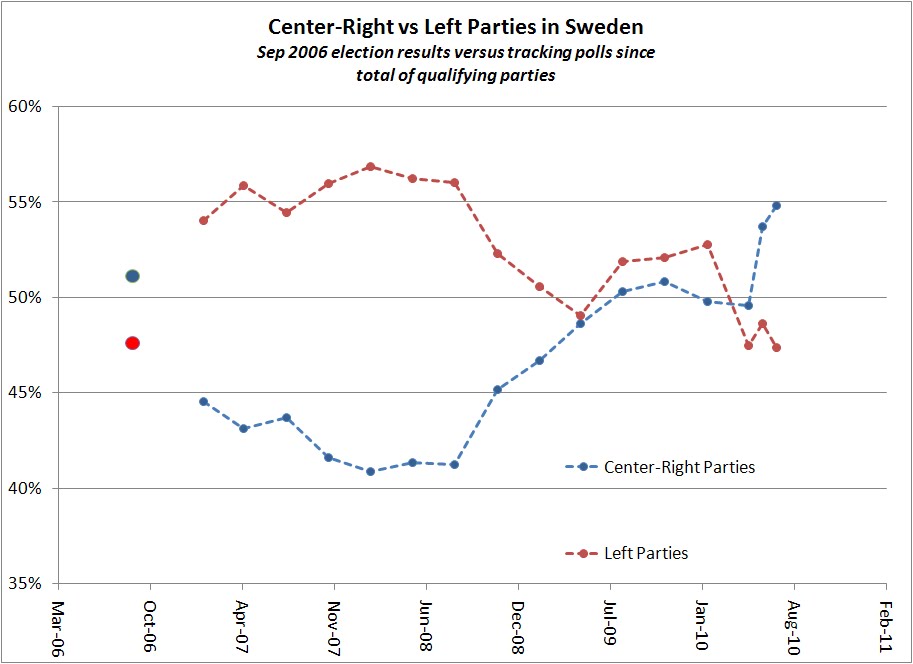
Center-Right Parties surge to lead in Sweden

Swedish Democrats look to enter Parliament

By Clifford F. Thies

In 2006, a four-party, center-right coalition achieved a wafer thin majority in the Swedish national parliament. Almost immediately, the Social Democrats and their erstwhile coalition partners - the Left Party and the Greens - surged to a lead in opinions polls. Progress in restoring the Swedish economy to a market-orientation appeared to be in jeopardy.

According to the Wall Street Journal / Heritage Foundation index of economic freedom, the Swedish economy had dramatically improved from 61 in 1995 to 70 in 2005. During the most recent years, it has improved further, to 72 in the latest assessment. In contrast, the United States economy, which had improved from 77 in 1995 to 79 in 2001, and, further improved to 81 in 2009, fell back to 78 after the first year of the new Obama Administration. With even more regulations and tax increases enacted this year, the economic freedom rating of the U.S. is sure to fall even further in the next assessment. Would the socialist left accomplish in Sweden what it is accomplishing in the United States in terms of rolling back market-oriented reforms and ruining the economy? Or, would the center-right parties rebound so as to be able, after this September’s election, to continue to advance the reform agenda, possibility to overtake the emerging USSA (United Socialist States of America)?

As the accompanying chart shows, the parties of the center-right in Sweden, now to include the Democratic Party, have jumped ahead of the parties of the left. These parties include the four parties currently forming the ruling coalition (the Christian Democrats and the Center, Moderate and Peoples parties), as well as the Democrats. The largest party of these five is the Moderate Party. This party is a neo-liberal party, i.e., a fusion of market-liberalism and conservatism. It refers to itself as the “New Moderates” because its aim is to revive the market as well as other social-intermediating institutions of a free society within a country that had become famous not only for democratic-socialism, but for the breakdown of the economic vibrancy, family and community life previously associated with the Swedish people.

Among the potential problems for organizing a five-party coalition is the issue of immigration. The Center Party, which was formerly a party representing agrarian interests, has evolved into something of a libertarian party, representing small business interests as well as small landholders. It is also a green party, being favorably disposed to issuing green cards to immigrants. The Peoples Party, a market liberal party, has also evolved into something of a libertarian party, and favors the integration of immigrants into Swedish life, including establishing language and work requirements. The Democrats, on the other hand, come across as opposing immigration. It may be possible to reconcile these divergent viewpoints; but, as the Dutch are showing us, it may be difficult.

Ayn Rand a prime inspiration for Republican Budget Proposal

From Eric Dondero:

Steven Benen of the far left Washington Monthly gives a snarky yet somewhat accurate description of House Budget Comm. ranking Republican member Rep. Paul Ryan's proposal.

From the Washington Monthly, "ARE REPUBLICANS ON BOARD WITH RYAN'S RADICAL ROADMAP?....":

I'm inclined to give Paul Ryan, a devoted fan of Ayn Rand's novels, at least some credit for putting his beliefs on paper, and subjecting them to public scrutiny. He has a plan to radically transform governmental institutions and Americans' way of life, and he's not afraid to say so.

Indeed, many on the right are on board with the radical Ryan plan. Jonah Goldberg loves it, and when it comes to deficit reduction, House Minority Leader John Boehner (R-Ohio) described Ryan's proposed $1.3 trillion in potential cuts as "a pretty good list of options."

it privatizes Social Security; it eliminates Medicare, the Children's Health Insurance Program, and most of Medicaid; and it wouldn't actually get rid of the deficit anyway. The whole plan offers a breathtaking vision of how the government would operate in the 21st century if conservative Republicans had their way.

DNC Chair accuses Republican Party of turning into the Libertarian Party

Privatize Social Security... end Medicare... shut down government agencies

From Eric Dondero:

Some hardened Libertarians might be a bit surprised by the new description of the Republican Party by Democrat National Committee Chairman Tom Kaine.

From the AP "Dems election strategy: Equate GOP and tea party" July 27:

"The Republican Party agenda has become the tea party agenda, and vice versa," Kaine said.

If the GOP were to retake the House and Senate, they would try to privatize Social Security, end Medicare and shutter those two federal agencies, he said.

"We're determined to make sure Americans understand this," Kaine said.

The 2008 outburst in the young stellar system Z CMa*

Authors: M. Benisty, F. Malbet, C. Dougados, A. Natta, J. B. Le Bouquin, F. Massi, M. Bonnefoy, J. Bouvier, G. Chauvin, O. Chesneau, P. J. V. Garcia, K. Grankin, A. Isella, T. Ratzka, E. Tatulli, L. Testi, G. Weigelt and E. T. Whelan.<br />Astronomy and Astrophysics Vol. 517 , page L3<br />Published online: 30/07/2010<br />
Keywords:
circumstellar matter ; stars: variables: T Tauri ; herbig Ae/Be ; stars: winds ; outflows ; methods: obsevational ; stars: individual: Z CMa ; techniques: interferometric .

Astronomical identification of CN-, the smallest observed molecular anion ***

Authors: M. Agúndez, J. Cernicharo, M. Guélin, C. Kahane, E. Roueff, J. K?os, F. J. Aoiz, F. Lique, N. Marcelino, J. R. Goicoechea, M. González García, C. A. Gottlieb, M. C. McCarthy and P. Thaddeus.<br />Astronomy and Astrophysics Vol. 517 , page L2<br />Published online: 30/07/2010<br />
Keywords:
astrochemistry ; line: identification ; molecular
processes ; stars: AGB and post-AGB ; circumstellar matter ;
stars: individual: IRC +10216.

Small Reactors and Decentralized Grids

Tiny modular nuclear reactor

The Sierra Club is working on a Beyond Coal campaign and they are sending groups out to educate the public on the dangers of coal.  The group came to my city and their presentation was worth hearing.   Coal is incredibly toxic and dangerous, and it will never be “clean,” so we have to get off coal as soon as possible.  I’ll write more about this presentation later, but one thing we all discussed was decentralizing the power grid.  Spreading the grid all over with “modules” of power generation would be beneficial for many reasons, and one is that it would prevent major blackouts.  A centralized power grid, which we have now, with large power stations,  means that if it fails, big segments of the country will find themselves without power.  It’s also a large target for terrorists.  Can you imagine a terrorist attack on a large coal ash waste pond?  It could disperse toxins and cancer-causing elements to a very big area.

Getting rid of coal plants, which we eventually have to do,  will mean we have to replace them with various types of power, an “all of the above” answer to energy.  All of the above will mean solar, wind power, geothermal, hydroelectric and probably nuclear — but not fossil fuels.  Unlike huge coal plants, the new nuclear plants can be small, or modular.  One type of small nuclear plant is discussed below, for people who are new to this idea.  The beauty of small reactors is that they can power just a city block, or a large building, or an industrial park.

The article below is an opinion piece that recently appeared in a local newspaper, and it’s unusually informative for an article like this.  From the title, it seems as though the author wants to beat wind, but I think he meant that nuclear power can outperform wind power and can even come in less expensive in the long run.  And to nuclear detractors, I’d tell them that yes, companies are investing in nuclear power. Not the giant nuclear plants of the old days but new, smaller, modular nuclear reactors.

Small reactors can beat wind

“The U.S. wind power market broke records in 2009 with 9.8 gigawatts of new projects, bringing U.S. total wind name plate capacity to 35 GW — the equivalent of 35 large coal or nuclear power plants.

But in 2009, variable winds meant that wind turbines produced an average of 27 percent of name plate power (or capacity factor) to the electric grid. Off-shore wind farms with better wind should gradually raise that capacity factor to 30 percent by 2020.

By comparison, our 104 U.S. nuclear power plants in 2010 have a total name plate capacity of 100 GW, with a capacity factor of 90 percent, providing an effective 90 GW today.

Most forecasts predict continued strong worldwide wind power growth, especially from offshore with its more consistent wind. The Department of Energy projects U.S. [...]

Anna Maria City Pier: Where Past and Present Collide

I’ve been enjoying the Anna Maria City Pier since I was a kid in the early 1960’s. But even in those days the pier was something of a relic from another era. According to the Anna Maria Island Historical Society, the pier was originally a dock constructed in 1911 to attract wealthy people from Tampa [...]

around the world on a toilet

post thumbnail

Nick was a paramedic in Canada. Lianna, a travel agent in Ireland. They both left their careers behind, crammed a bunch of necessary stuff into backpacks and ventured off to Asia for eight months. Guess what, whether together or separately, they haven’t stopped traveling yet. (One question… where is the toilet?)


© Gretchen for TravelBlogs, 2010. |
around the world on a toilet |
No comment |

Post categories: Blogs
Post tags: , , , , , , ,

Pulling out of Afghanistan as leftwing Libertarians are proposing, a Human Rights catastrophe

by Eric Dondero

Time Magazine is running a shocking photo on its front cover for this week's edition. As the editors explain:

Our cover image this week is powerful, shocking and disturbing. It is a portrait of Aisha, a shy 18-year-old Afghan woman who was sentenced by a Taliban commander to have her nose and ears cut off for fleeing her abusive in-laws. Aisha posed for the picture and says she wants the world to see the effect a Taliban resurgence would have on the women of Afghanistan, many of whom have flourished in the past few years. Her picture is accompanied by a powerful story by our own Aryn Baker on how Afghan women have embraced the freedoms that have come from the defeat of the Taliban — and how they fear a Taliban revival.

The non-interventionist wing of the libertarian movement wants an immediate pull-out of Afghanistan. The Ron Paul movement, Lew Rockwell and his followers, Justin Raimondo and Eric Garris at AntiWar.com, most Libertarian Party members, even many at Reason and Cato, all ignore the human rights catastrophe that would undoubtably follow.

As Raimondo has explained:

This war in Afghanistan has no convincing rationale, and no one can explain it – its goals, or what “victory” means, except as a) a war of retribution against enemies who have long since fled the scene, or b) a means of surrounding the Iranians, and a pretext for extending US influence into Central Asia.

Human Rights does not fit the leftwing libertarian template. It's an inconvenience to their carefully crafted philosphy. Historical events such as the Jewish Holocaust in Europe, Stalin's mass starvation of the Ukrainiuns in the 1930s, the Armenian genocide by the Islamist Turks, Mao's murderous agrarian revolution, and the killing fields of Pol Pot and the Khmer Rouge, are ignored by the non-interventionists. All instances where American pacifism and non-intervention helped to cause murder on a scale never before seen in human history.

No doubt, the non-interventionists will similarly ignore the threat of the Taliban to Afghani citizens, with an American pull-out.

To the non-interventionists, protecting the rights of young women from having their ears and noses cut off is not enough of a "rationale" for keeping our troops in this war-torn South Asia country.

(H/t HotAir)