Electric Fish “Plug in” and Turn Their Zapping Into Music | Science Not Fiction

Screen shot 2010-10-22 at [Oct 22] 01.48.07 PMI’ve been on a short hiatus from blogging as my laboratory gets set to go to Eindhoven, Holland, for the STRP Festival, one of the largest art and technology fairs in Europe. We are putting the finishing touches on scale, an interactive bio-art collaboration between myself, visual/conceptual artist Marlena Novak, and composer/sound designer Jay Alan Yim, who together form localStyle.

As is often done in biological work, my research at Northwestern University focuses on one specific type of animal—an electric fish from the Amazon jungle—which is ideally suited to uncover the answers to our research questions. These questions are chiefly in the area of how we take in information through our various sensory systems and control movement. We build biologically inspired robots based on what we find. These robots feature novel ways to sense and move that could be very useful for new highly agile underwater robots to help with things like monitoring the health of coral reefs or fixing an underwater oil spill.

Our Amazon jungle fish are called “weakly electric fish.” These fish have evolved the remarkable ability to sense the objects around their body through a self-generated weak electric field (about a thousandth of a flashlight battery near the body). Think of them as underwater bats—like bats, they hunt at night, but instead of using sonar, they use electric fields.

PerErikSviland_2_straight_colortweak

A surprising demonstration of this ability is very easy to get with nothing more than a cheap powered speaker, like the type you would connect to your computer. By just dangling the input lead into a tank with one of these fish, you’ll hear a nearly pure tone (something like a tuning fork). The pitch of the tone that you hear depends on the species. Across the 180 or so species that exist, the tone frequency varies from about 30-1200 Hz, approximating the lowest B-natural on a piano to the D- sharp six octaves higher.

In our interactive exhibit, twelve different species of these fish comprise a “choir” whose sonified electrical fields provide the source tones for an immersive audiovisual environment. Each fish is in its own tank with advanced filtration and water quality control, on tall frames that are arranged in semicircle around the podium. Using a modified Nintendo Wii-mote, participants can select the members of their choir, and then use a touch pad system to add real-time digital effects, generating a unique musical experience.

We hope to foster wider public awareness of their valuable attributes and the fragility of their natural environment via this interspecies artwork. You can hear some of the tones that scale will generate from this short segment from Chicago NPR affiliate WBEZ.


DIY Jeep CJ5 Lift Kit

In this episode, Chris Duke from Motorz shows you how to remove an old 2-inch lift kit from his 1968 Jeep CJ project vehicle, "Blue Dog", and install a new 2-inch suspension lift kit from Skyjacker. This change-out sets the stage for a future episode, when Chris completes a spring-over-axle co

Libertarian Candidate for U.S. House District 5 Chard Reid Wins Indy Star Endorsement

Chard Reid, Libertarian Candidate for U.S. House District 5, has been endorsed by the Indianapolis Star. The state’s largest newspaper gave praise to both third party candidates, but ultimately decided to endorse Reid. “Reid, a young economics teacher at Plainfield High School, has taken the fight to Burton on taxes and the deficit. He maintains [...]

Northern Two Cayes Island

sandbore-northern-1Among Beilizes’ best qualities are it’s beaches and it’s diving, making owning a private island a dream! Fortunately for prospective buyers there is often a number of islands to choose from at a variety of price points. One of the newest and higher end islands to come on the market is Northern Two Cayes Island.

Just a two hour flight from Miami this tropical island is within easy reach of the US. Sandbore Caye and Northern Caye are collectively known as Northern Two Cayes and comprise a pair of beautiful sister islandsin the clear blue waters of the Western Caribbean.

Northern Two Cayes sits on Lighthouse Reef — one of only five atolls in the entire Atlantic system, just 40 miles off mainland Belize. Lighthouse Reef is home to famed dive site, the Great Blue Hole.

With the irresistible charm of a Polynesian atoll, this stunning island duo is ready to become either the ultimate private island retreat or a South Pacific-style world-class private island resort. The property’s existing airstrip and former 11-room dive resort provide the basic infrastructure from which to construct a legacy private retreat or a substantial 100-room+ luxurious resort.

For more information visit Private Islands Online.

Watch engineers build a Mars rover! | Bad Astronomy

The folks at JPL have installed a live webcam in a balcony overlooking the clean room where the next Mars rover, Curiosity, is being built. So you can watch smart NASA and Caltech people build a rover that’s going to Mars!

[Update: Sigh. Of course I post this on a Saturday morning when no one is working. But check back every now and again; I was watching on Friday afternoon and it was busy! And make sure you note the size of the rover; it's far, far larger than the previous ones.]

There’s no audio, so don’t bother with sound. But on the UStream page linked above there’s a chat room.

If memory serves, what you’re seeing is the same clean room where Spirit and Opportunity were built; I visited JPL a few years back and saw them both being put together there. It’s amazing to look down on hardware you know is going to another planet.

Yay smart people!


Continuous Operation of Fire-Booster Pump

I am facing problem with a fire jockey pump that operates continuous 24 hours due to not meeting the main header system pressure setting of 140 psi. the jockey pump is set up to cut in at 140 psi while the main header pressure cannot go above 120 psi.

The jockey pump actual discharge pressu

How Well Do You Work and Play with Others?

Building effective project teams requires assembling people with diverse skills and conflicting opinions. Yet somehow those differences must be synthesized into an effective result. An unchallenged consensus would forego consideration of alternate — and possibly superior — problem-solvin

Education Gap in Packaging?

It's the conundrum of our electronic age: today machine operators have more help running automated systems than ever before. User-friendly human-machine interface (HMI) panels make the operation simple to runpack. Just watch the control panel screen and do what it tells you to do. So why then is the

How Bad is the Employment Situation – Really?

Unemployment is the highest in decades, and there's not much sign of a turnaround in employment anytime soon. But against this background, a number of employers are reporting trouble filling open positions. True, many companies are getting deluged with applicants, but others are finding it surprisin

Safeguard Against Cyber Attacks

According to a new Symantec survey, the number of politically motivated cyber attacks are increasing. Are you prepared? If not, then you are not alone. Only one-third of critical infrastructure providers feel extremely prepared against all types of attacks and 31% felt less than somewhat prepared. S

Requirement of Generator Circuit Breaker

What is the requirement of generator circuit breaker in power plant? Can't generator be tripped directly by switchyard bay breaker? In my previous company there was not GCB, generator was directly connected to grid with GT + switchyard breaker. While, in my present company, there is a Generator + GC

The future is now, but more so | Gene Expression

If you have some time to kill, the Paleo-Future weblog is really awesome. It shows what people thought the future was going to be like (often around the year 2000) from the 1870s through every decade of the 20th century. As usual with this sort of thing it tells you more about the salient aspects of a given time period, as people have a tendency of projecting contemporary fashions, technologies, and trends, rather than being able to anticipate innovation and changes of kind. Here’s a depiction of flying machines which dates to between 1900 and 1910:

circa 1900 harry grant dart crop paleo-future

It’s Pucker Time: Looking good for Republicans all across the Country

With a couple exceptions here and there

by Clifford F. Thies

With less than two weeks to go, the true battleground states of this year’s election are being revealed. Last week, the national organizations left the Florida Senate race. This week, they are leaving the Missouri Senate race. They are shifting resources such as ad buys to remaining battlegrounds. Let’s take a quick look at the top-of-the-ticket contests:

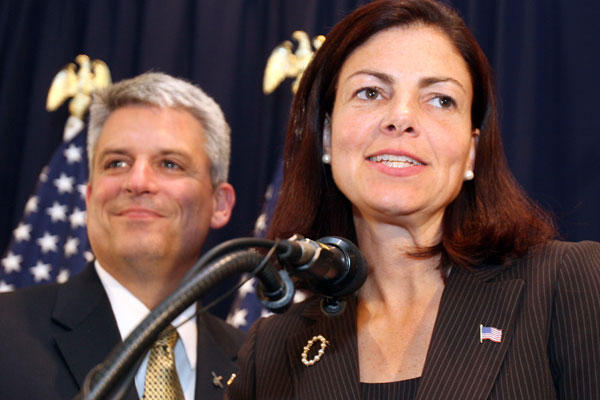
In New England: Kelly Ayotte has now pulled out to a commanding lead in New Hampshire’s Senate race and Linda McMahon remains in contention in Connecticut’s Senate race. And, five of the six Governor contests are going down to the wire (all but New Hampshire).

In the Mid-Atlantic: The Pennsylvania Senate race has tightened up and the Delaware Senate race has not. For Governor, the Republican is slightly ahead in Pennsylvania and slightly behind in Maryland.

In the South: It’s all Republican, except for Governor in Arkansas, with the qualification that the leads are small for Rand Paul and John Rease in the Kentucky and West Virginia Senate races and Rick Scott in the Florida Governor race.

In the Mid-west: Indiana, Ohio, Michigan and Wisconsin are all looking Republican, although we do not expect Senator Feingold to give up easily. Illinois appears to be breaking Republican; but, there are still a lot of undecideds. Minnesota is close and susceptible to last-minute shifts by voters continuing to indicate that their first choice is a third-party candidate who is now sure to lose.

In the Rocky Mountain states: It’s all Republican, except for Governor of Colorado. Even so, third-party candidate Tom Tancredo can be elected if half of those still indicating a preference for the disgraced nominee of the Republican Party shift to him. Sharon Angle and Ken Buck have small leads in the Colorado and Nevada Senate races. Susanna Martinez now has a significant lead in the New Mexico Governor race.

In the Pacific region: Almost every race is a toss-up. Dino Rossi in the Washington Senate race, and Duke Aiona and Chris Dudley in the Hawaii and Oregon Governor races are neck-and-neck with their Democratic rivals. In California, Carly Fiorina and Meg Whitman are only slightly behind in the Senate and Governor races. In Alaska, Joe Miller and Lisa Murkowski have turned the general election into Round II of the Republican primary.

To comment briefly on House and state legislative races: Things are looking very good for the Republicans all across the country. There will be many “surprises” on election day, even in places like Massachusetts and New York where the Republican Party has fallen on hard times in recent years. Republicans will continue to consolidate their position in the rural districts, revive in the suburban districts, emerge as competitive with Hispanic and Asian voters and breakthrough with African-American voters. The Gender Gap is now history. We continue to anticipate a net pick up of 60 to 80 seats in the House and, to put a number to it, 400 seats in state legislatures.

In many states, early voting is underway and it is clear that, where they don’t have to wait, Republicans aren’t waiting for election day to cast their ballot. Democrats, on the other hand, are just hoping that they can hold on to the Senate and that – for the first time in history – socialism will work so that the economy will recover in time for the 2012 election.

Editor's Note - I will be in southern New Hampshire today campaigning for the GOP ticket.

Libertarian-Conservative group begins drive to De-fund NPR

ALG Launches DefundPublicBroadcasting.org Petition

October 22nd, 2010, Fairfax, VA—Americans for Limited Government (ALG) launched a petition drive to defund public broadcasting in the wake of National Public Radio's firing of Juan Williams earlier this week.

ALG President Bill Wilson announced the move stating, "It is outrageous that taxpayers are forced to fund the Corporation for Public Broadcasting's hard left agenda. It is time for Congress to save $400 million a year by cutting off their funding."

The petition is at: http://www.defundpublicbroadcasting.org.