Statins – The Cochrane Review

A recent Cochrane review of the use of cholesterol-lowering statin drugs in primary prevention has sparked some controversy.  The controversy is not so much over what the data says, but in what conclusions to draw from the data.

Statin drugs have been surrounded by controversy for a number of reasons. On the one hand they demonstrably lower cholesterol, and the evidence has shown that they also reduce the incidence of heart attacks and strokes. The data on whether or not they reduce mortality has been less clear, although this latest data actually supports that claim. However, statins have also been blockbuster drugs for pharmaceutical companies and this has spawned concerns (some might say paranoia) that drug companies are pushing billions of dollars worth of marginally effective drugs onto the public.

So are statins a savior or a scam? Life does not always provide nice clean answers to such simple dichotomies. The evidence clearly shows that statins work and are safe. However, pharmaceutical companies do like to present their data in the best light possible, and they need to be watched closely for this. The recent review does call them on some practices that might tend to exaggerate the utility of statins. Finally, the real question comes down to – where should we draw the line in terms of cost-benefit of a preventive measure like statins.

Let’s look as this recent review of the data to see what it actually shows.

First, for context, this Cochrane review looked specifically at statins for primary prevention – prevention of vascular events (mainly heart attacks, strokes, and overall mortality) in those who are at low risk for heart disease and who have not already had any vascular event. The evidence for statins for secondary prevention, after a heart attack, is more robust – decreasing risk of a second heart attack by about one-third. This makes sense, and is generally what we see. The higher the risk of disease the greater the potential benefit for any preventive measure, and the easier it is to measure this benefit in clinical trials.

Further, as the risk of the disease becomes smaller, the risk-benefit ratio and cost-benefit ratio of preventive measures goes down. At some point the side effects from the treatment become greater than the risk of the disease being prevented. Generally clinical trials divide risk into two broad categories – primary prevention and secondary prevention. However, in reality there is a spectrum of risk. A person without a history of a vascular event may still be at high risk if they have a lot of risk factors – hypertension, age, high cholesterol, diabetes, and smoking. And of course, since statins are cholesterol lowering agents, high cholesterol at baseline is a reasonable marker for the potential of benefit from statins.

Statins also have to be compared to other measures – like diet and exercise – for relative effectiveness and cost-effectiveness. No one doubts that it would be best if every patient had a healthy diet and weight and exercised regularly. Some argue that statins should be reserved for those who fail these lifestyle interventions, or who have genetically high cholesterol refractory to diet and exercise. The reality is that it is very difficult to get individual patients to change their behavior. In fact, a recent Cochrane review concluded:

Interventions using counselling and education aimed at behaviour change do not reduce total or CHD mortality or clinical events in general populations but may be effective in reducing mortality in high-risk hypertensive and diabetic populations. Risk factor declines were modest but owing to marked unexplained heterogeneity between trials, the pooled estimates are of dubious validity. Evidence suggests that health promotion interventions have limited use in general populations.

This is not very encouraging. Clearly we need to work on societal interventions and improving patient interventions to achieve a healthier lifestyle as a society. But also it is clear that lifestyle intervention is not a quick or easy fix, and so there will continue to be a role for medical intervention in vascular prevention.

Statins for Primary Prevention

When the Cochrane reviewers looked at the evidence for primary prevention they found that many trials included patients at high risk, or did not measure LDL levels. Essentially they felt that the data was contaminated in such a way as to exaggerate the benefit for primary prevention. Their review sought to correct those biases. They reviewed the data from 14 trials involving 34 272 patients. What they found was that total mortality had a relative risk reduction of 17%, risk of heart attacks was reduced by 28%, and strokes by 22%. In low risk patients the number needed to treat in order to prevent one death per year was 1000. The review also did not show any additional adverse events in those treated vs placebo groups.

The authors do not challenge the legitimacy of these results. The data is fairly robust – there is a reduction in risk of death and vascular events from statins in primary prevention. Study author, Dr. Shah Ebrahim, is quoted by Heartwire as saying:

“If you look at the hard end points of all deaths and coronary deaths, the effects are consistent with both benefit and with the play of chance. But importantly, the absolute benefits are really rather small—1000 people have to be treated for one year to prevent one death. It is probably a real effect, but it means a lot of people have to be treated to gain this small benefit. As we don’t know the harms, it seems wrong-minded to me to treat everyone with a statin. In these circumstances, lifestyle changes and stopping smoking would be far preferable.”

And that is where the controversy comes in. Other researchers think the authors are making conclusions that go beyond their own evidence. Heartwire also quoted Dr. Colin Baigent, a clinical researcher from Oxford, as saying:

“I object to the conclusions they have drawn from their review. They say there is not good evidence of benefit, but their own data show significant reductions in deaths and cardiac events. They didn’t show any increase in adverse events in their review, but they then say the benefit is not worth the risk. That doesn’t make sense.”

This does make for an interesting science-based medicine conversation. In this case the two sides largely agree on the data, but differ in terms of how to apply that data to the practice of medicine. This, I feel, can be a very constructive controversy. This is exactly the kind of question that should be agonized over by experts. While I think the Cochrane reviewers are displaying a negative bias against statins, they do provide balance to the pro-statin bias of pharmaceutical companies who sell statins. In the end, the data is out there and practitioners and patients will be better informed in making decisions about statin use. I am concerned about media reporting of this issue. It is easy to oversimplify the take-home message as “statins do not work” and I have already read commentaries quoting this study to support that position.

My read of this evidence is that there is solid evidence that statins have a real benefit for primary prevention. This benefit is small, which is exactly what I would predict for a preventive measure in a low-risk population. The data also show that statins are safe. The major risk is for the development of an inflammatory muscle disease, but that is very rare. For interventions that prevent death – that lower mortality – I think even small benefits are worthwhile. Further, having a heart attack or stroke, even if it is not a fatal event, has a very negative effect on quality of life. Taken together, one person per year out of several hundred taking statins for primary prevention will avoid a heart attack, stroke, or death. From a purely medical point of view, that sound pretty good to me.

What seems reasonable is to use statins for primary prevention in those who have some risk factors for vascular disease, in patients with genetically high cholesterol, and in those with high cholesterol or significant risk factors in whom lifestyle counseling has not yielded adequate results. Try diet and exercise first – and always in conjunction with medication, but statins are a reasonable choice in selected patients, even for primary prevention. We could use more studies to better delineate where to draw that line, but that will be difficult as any difference in outcome is likely to be slight and therefore massive trials will be needed to get statistically significant results.

Cost effectiveness is a tougher issue, because we then have to arbitrarily decide what a human life is worth in terms of medical expense. This issue has become more acute as health-care costs rise and everyone is looking for ways to cut back. What I have not seen is a calculation of the cost of statins for primary prevention vs the cost savings from reduced vascular events. Having a stroke or heart attack is expensive, and pays for a lot of prevention. The question is – exactly where is the line crossed in terms of the vascular risks of the population being treated.

The good news is that many statins are now becoming available as generics, with a marked reduction in cost. There is already a Spanish analysis showing that the availability of generics is making statin treatment more cost effective.

Conclusion

This recent Cochrane review of statin use for primary prevention supports the conclusion that statins are safe and effective in reducing vascular events and overall mortality even in primary prevention. The benefits are statistically small, which is expected for a preventive measure in a low risk population. It is still unclear where to draw the line in terms of which patients should receive statins, but these data will help practitioners and patients make individualized decisions about cholesterol management and vascular prophylaxis.

Because this is ultimately a judgment call, the results of this study can be spun to a variety of conclusions. The study authors chose to present an overall negative conclusion – that the effect size is too small to be worth it. While other experts, looking at the same data, have come to the opposite conclusion – that statins are worth it. It is important to emphasize that the debate is not about whether or not statins have a real effect – they do, but about the cost-benefit of statins as an intervention for primary prevention.

One could also argue that Cochrane reviewers, given that their purpose is to provide objective and thorough reviews of existing evidence for specific clinical questions, should take a more neutral approach to interpreting the data. This is not the first Cochrane review discussed on SBM that can be criticized for taking a decidedly biased approach to the evidence in their conclusions. This should prompt some soul-searching, in my opinion, on the pat of the Cochrane collaboration.

Facebook Google Buzz Digg LinkedIn StumbleUpon LiveJournal Share

One Hump or Two? Camel’s Milk as a New Alternative Medicine

I wasn’t really surprised to learn that camel milk is being promoted as a medicine. I long ago realized that the human power of belief is inexhaustible. The news did make me laugh, probably because camels are rather funny-looking animals, because I am easily amused, because it reminded me of some of my favorite camel jokes, and because it wouldn’t do any good to cry.

Camel milk has been claimed to cure or benefit patients with diabetes, tuberculosis, stomach ulcers, gastroenteritis, cancer, allergies, infections, parasites, autism, even AIDS.  This isn’t really quite as silly as it might sound.  PubMed does list several studies showing health benefits from camel milk. A handful of studies have suggested that camel milk improves control of blood sugar in diabetes, but they are preliminary studies that typically compare standard treatment to standard treatment plus camel milk rather than using a blinded control. There are also a few small, poor quality studies suggesting a possible benefit in allergies, in peptic ulcers, in infections such as hepatitis, and in schistosomiasis. All in all, the research doesn’t amount to much. Camel milk can only be classed as experimental treatment. The existing studies justify doing more (and better quality) research, but they don’t justify prescribing it to treat patients.

Among other properties, camel’s milk is high in vitamin C, low in vitamin A, and low in fat compared to cow’s milk, and it is tolerated by those who are lactose intolerant. It is different from cow’s milk in many other ways that I won’t attempt to list, but the clinical significance of those differences is not clear.

A couple of studies suggested reasons for caution. A study in Saudi Arabia, where brucellosis is endemic, showed that the main source of brucellosis infection was unpasteurized camel milk  and there is a report of anaphylaxis to camel’s milk in a child with atopy.

The founder of the American Camel Coalition, Millie Hinkle, ND, says

The high levels of insulin in camel’s milk and the antibodies, which are much simpler in structure than human milk antibodies, enable it to penetrate deeper into the human tissue and cells [whaat?], which means that the milk has the potential to serve as a major weapon against many human illnesses.

She thinks that studies done in other countries on autism, diabetes, cancer, heart disease, Crohn’s, Parkinson’s, food allergies and a variety of other illnesses have been “impressive.” I couldn’t locate the studies she cites for some of these claims, and I didn’t think the ones I did find were “impressive.”  The one she cites for autism is not original research but just a speculative rumination that includes brief, unconvincing reports of three patient observations and talks about highly controversial and disproven hypotheses as if they were proven facts. She wants to repeat previous studies using pasteurized camel milk; obviously pasteurization is a wise move, but rather than repeating previous studies, why not do better designed, controlled studies?

I didn’t know what to make of one study I found on PubMed. Its abstract said

Camels’ milk, women’s milk and cows’ milk were kept at 30 degrees C and refrigerated at 4 degrees C. This explains the necessity to immediately freeze milk if it needs to be kept even for a few days. Cows’ milk remained good for days if stirred and then turned sour, enabling the making of cheeses and butter. Camels’ milk did not sour at 4 degrees C for up to 3 months. This means that camels’ milk is mainly good only for drinking, as was promised to this animal by the Prophet.

Isn’t it inappropriate to make religious comments in scientific articles? Is religious support pertinent? In Sunni Islam, the Sahih Bukhari, one of the six major Hadith collections, does include several verses where the prophet Muhammad is said to have advocated drinking camel’s milk and urine as medicine. For instance,

The climate of Medina did not suit some people, so the Prophet ordered them to follow his shepherd, i.e. his camels, and drink their milk and urine (as a medicine). So they followed the shepherd that is the camels and drank their milk and urine till their bodies became healthy. Then they killed the shepherd and drove away the camels.

The Sahih Bukhari’s medical advice is not reliable or even consistent. It also says

Healing is in three things: A gulp of honey, cupping, and branding with fire (cauterizing). But I forbid my followers to use (cauterization) branding with fire.

Does that mean Muslims shouldn’t bother with any medical treatment but honey and cupping?

I’m not just picking on Muslims. Other religious texts also give questionable medical advice.  In the Essene Gospel of Peace, Jesus gave detailed instructions for colon cleansing using river water and a long-necked gourd:

Seek, therefore, a large trailing gourd, having a stalk the length of a man; take out its inwards and fill it with water from the river which the sun has warmed. Hang it upon the branch of a tree, and kneel upon the ground before the angel of water, and suffer the end of the stalk of the trailing gourd to enter your hinder parts, that the water may flow through your bowels.

I’d rather drink camel milk than do that.

There is even a book Love Thine Enemas and Heal Thyself. One of the customer reviews on Amazon.com says “This book helps people understand the love of God, in a very intimate area.”  You can find the darnedest things on the Internet! But I digress…

There is a website, Camel Milk for Health that recounts one (only one!?) story about a young man who had an undiagnosed condition that allegedly made him “allergic to all foods…unable to eat or digest any foods, unable to absorb any food nutrients” so that he was “subsisting on a tablespoon of rice and a tablespoon of rice milk per day.” Do you believe that? His parents claim he was cured by drinking camel milk, and they tell how they had to battle the authorities to get special permits to import the milk into Canada. The website announces a symposium to be held in Vancouver BC on February 9th with 3 panelists entitled “Camel Milk: A New Alternative Medicine.” The main speaker is a retired professor of veterinary medicine from Israel who has done some of the research. The symposium is sponsored by an orthodox Jewish congregation, the oldest and largest synagogue in Vancouver. I am puzzled, because camels and camel milk are trayf (not kosher) and are forbidden to orthodox Jews.

While looking for evidence of possible health benefits, I came across some intriguing camel trivia in the Wikipedia article:

  • Camel milk can’t be made into butter by conventional churning methods.
  • The Abu Dhabi Officer’s Club serves camelburgers. Bubonic plague has been transmitted by eating camel liver.
  • The ancient Roman emperor Heliogabalus enjoyed eating camel’s heel.
  • Camel blood is consumed in Northern Kenya.
  • Camel lasagna is available in Alice Springs, Australia.

It’s nice to know these things. Forgive the digression.

If you want to try camel milk, you can’t. Selling it is illegal in the US. According to a CBS news report in July 2010,

The FDA allows people to drink camel milk, but it can’t be imported or sold in the U.S. until a test for drug residues is validated, said FDA spokesman Michael Herndon.

Could this be a conspiracy by Big Dairy to prevent competition?

The Camel Milk for Health website links to the Oasis Camel Dairy website, which is interesting and has some cool pictures. The OCD is producing camel milk but is not legally allowed to sell it. What they can and do sell is camel milk soap for $5.00 in varieties like “gold frankincense and myrrh” and “rosemary mint.” They also sell camel milk chocolate bars.

All of the research seems to be on one-hump camels. It’s not clear whether Bactrian camel milk is equally efficacious. The “one hump or two” question remains to be answered; but there’s no rush, since we can’t get either kind of milk. Jabalicious and other brands have recently come on the market in the UK, but those of us who live in the US will have to either wait for FDA approval or buy our own camel and milk it ourselves.

Facebook Google Buzz Digg LinkedIn StumbleUpon LiveJournal Share

Molecular breast imaging (MBI): A promising technology oversold in a TED Talk?

Occasionally, there are topics that our readers want — nay, demand — that I cover. This next topic, it turns out, is one of them. It’s a link to a TED Talk. I’m guessing that most of our readers have either viewed (or at least heard of) TED talks. Typically, they are 20-minute talks, with few or no slides, by various experts and thought leaders. Many of them are quite good, although as the TED phenomenon has grown I’ve noticed that, not unexpectedly, the quality of TED Talks has become much more uneven than it once was. Be that as it may, beginning shortly after it was posted, readers of both this blog and my other super-not-so-secret other blog started peppering me with links to a recent TED Talk by Dr. Deborah Rhodes at the Mayo Clinic entitled A tool that finds 3x more breast tumors, and why it’s not available to you.

At first, I resisted.

After all, I’ve written about the issues of screening mammography, the USPSTF guideline changes (here, too), the early detection of cancer (including lead time and length time bias, as well as the Will Rogers effect), and a variety of other topics related to the early detection of breast cancer, such as overdiagnosis and overtreatment. Moreover, to put it bluntly, there really isn’t anything radically new in Dr. Rhodes’ talk, at least not to anyone who’s been in the field of breast cancer for a while. Certainly, there’s no new conceptual breakthrough in breast imaging and screening described. As I will discuss in more depth later in this post, there’s an interesting application of newer, smaller, and more sensitive detectors with a much better spatial resolution. It’s cool technology applied to an old problem in breast cancer, but something radical, new, or ground-breaking? Not so much. What Dr. Rhodes describes in her talk is the sort of device that, when I read about it in a medical journal, produces a reaction along the lines of, “Nice technology. Not ready for prime time. I hope it works out for them, though. Could be good.” So it was with molecular breast imaging (MBI), which is the topic of Dr. Rhodes’ talk. So I continued to resist for about two or three weeks.

Then our very own Harriet Hall sent me the link. I cannot resist Harriet. When she suggests that perhaps I should blog about a topic, it’s rare that my response would be anything other than, “Yes, ma’am. How soon would you like that post and how many words?” I keed, of course, but only just. The best I could come up with was a wishy-washy “But this isn’t really anything all that new,” which is true enough, but the way Dr. Rhodes tried to sell the audience on the idea of her technology brings up a lot of issues important to our audience. I also thought it was important to put this technology in perspective. So here I go. First, I’ll start by describing what really set my teeth on edge about Dr. Rhodes’ talk. Then I’ll go to the primary literature (namely her brand, spankin’ new article in Radiology describing the technology) and discuss the technique itself.

The truth? You can’t handle the truth!

What irritates me about Dr. Rhodes’ TED Talk starts right at the beginning:

There are two groups of women when it comes to screening mammography — women in whom mammography works very well and has saved thousands of lives and women in whom it doesn’t work well at all. Do you know which group you’re in? If you don’t, you’re not alone. Because the breast has become a very political organ. The truth has become lost in all the rhetoric coming from the press, politicians, radiologists and medical imaging companies. I will do my best this morning to tell you what I think is the truth. But first, my disclosures. I am not a breast cancer survivor. I’m not a radiologist. I don’t have any patents, and I’ve never received any money from a medical imaging company. And I am not seeking your vote.

Later in the talk, Dr. Rhodes says:

If this technology is widely adopted, I will not benefit financially in any way. And that is very important to me, because it allows me to continue to tell you the truth.

I bet you can guess what irritates me about these statements. Actually, it’s two things. First, it’s Dr. Rhodes’ invocation of “The Truth.” Strictly speaking, there is no “truth” in science or medicine. There are hypotheses that are supported by evidence, experimentation, and, in medicine, clinical trials, and there are hypotheses that are not. Most scientific hypotheses are not black and white “true” or “false,” either. Rather, individual hypotheses fall somewhere closer to being true or false, based on the evidence, and they can move closer to or father away from being “true” as new evidence comes in. Indeed, the object of scientific investigation is to falsify hypotheses. Hypotheses that are easily falsified fall by the wayside quickly. Those that are not advance to more intense testing. Those that have withstood the most attempts to falsify them and provide highly useful explanatory and predictive value might eventually graduate to being full-fledged theories.

The next thing that irritates me is Dr. Rhodes’ implication that everyone else has an ax to grind (and is therefore probably lying to you), where as she does not because she doesn’t receive money from medical imaging companies, isn’t a breast cancer survivor, and is not a radiologist. Don’t get me wrong; financial conflicts of interest (COIs), particularly undisclosed ones, are very, very important to know about, because they can (and all too often do) warp the perspective of even the most diligent, honest, rigorous scientist. However, financial COIs are not the only COIs. Just because someone proclaims that she has no financial COIs (or professional COIs) does not mean that she does not have biases or COIs that can be just as strong as the financial COIs of scientists who stand to make a lot of money if their research results in a marketable drug, treatment, or medical device.

Before I examine Dr. Rhodes’ invention (and her claims for it) in a bit more detail, in the interests of full disclosure, I’ll point out that I actually have a non-financial interest in a competing imaging technology for the breast. Researchers at our cancer institute have developed what I consider to be a truly innovative and promising breast imaging device. It’s based on ultrasound and can produce images of the breast almost as striking as those produced by breast MRI. This device has even resulted in a startup company that was featured in our governor’s state of the state address last week. As you can see, it’s a big deal to our cancer center. Since, through some fluke of flukes, I’ve somehow managed to find myself in leadership positions within the clinical and research breast cancer programs at my cancer center (obviously, the cancer center director hasn’t realized his mistake yet), I have a stake in the success of this device. More importantly, not only do we see the chance to have a major positive impact on women’s health if this device is validated but it would bring all sorts of prominence to our institution in general and my programs in particular, just as the success of Dr. Rhodes’ MBI device would improve women’s breast screening and bring all sorts of glory to the Mayo Clinic and her programs. None of this means that either Dr. Rhodes or I are likely to be lying or stretching the truth, but we both have COIs based on our belief in our respective devices. Arguably, my COI is less intense, because this device had been developed before I accepted my current job, and I am not directly involved in its commercialization. A COI does, however, exist nonetheless, and I acknowledge it.

Another thing that bugs me about Dr. Rhodes’ talk is her implication that the radiology world is somehow closing ranks to keep her from bringing this technology to the masses. While she does have a point that some radiologists were utterly shameless in protecting their turf and launching what can only be called histrionic attacks on the new guidelines (the quote by Dr. Daniel Kopans, a very prominent breast imaging radiologist at Harvard, about the USPSTF guidelines that Dr. Rhodes cites at 2:49 in the video being an excellent example), it’s a bit of a stretch to claim that somehow radiologists are so biased against her technology that they won’t give her a fair shake. Before I explain, I mention a couple of points that Dr. Rhodes makes that are correct. First, Dr. Rhodes is correct that breast density appears to be an independent risk factor for breast cancer that has only relatively recently been appreciated as such. Unfortunately, it is in dense breasts where mammography has the biggest problem in detecting cancer. Indeed, that’s part of the reason why it’s not as good in women under 50; their breasts tend to be denser. Second, she is most likely correct that digital mammography is probably not more sensitive or specific for detecting breast cancer, particularly in women with dense breasts, although I will point out that the evidence is not as cut and dried for this assertion as Dr. Rhodes makes it out to be.

Dr. Rhodes also fails to mention that digital mammography does have some major advantages over conventional film mammography and that they are not inconsequential advantages, either. These include permanent storage and duplication of as many copies of a study as needed. In other words, if a woman goes for a second opinion, instead of taking a jacket full of films (what I was used to until relatively recently), she can take a CD and provide an exact copy of her suspicious mammogram to the consulting surgeon. In the old days, she would have to sign out her jacket or bring an inferior film copy. Lost films are a thing of the past, and instead of huge rooms full of large manila envelopes stuffed with X-ray films, the studies can now be stored on hard drives and backed up off site. Digital mammography also allows for the digital manipulation of the image, not to mention the development of image analysis algorithms that can assist the radiologist in detecting suspicious lesions. Finally, digital mammography probably requires less radiation, particularly in women with dense breasts, the very group in whom Dr. Rhodes is trying to increase sensitivity and specificity of breast cancer detection, although this benefit hasn’t been fully verified yet.

Now, I wouldn’t be all that surprised if there was some skepticism over her idea. I’ll explain why in a bit more detail in the next section. However, I really do think Dr. Rhodes goes overboard in implying in at least two parts of her talk that the radiology world and the mammography world are somehow conspiring (or at least so resistant to new ideas that the practical effect is the same as conspiring) to prevent new breast imaging technologies (like hers) from gaining a foothold. Perhaps the most egregious example is this passage, where she talks about having submitted her article to four different journals and having it rejected by each one:

After achieving what we felt were remarkable results, our manuscript was rejected by four journals. After the fourth rejection, we requested reconsideration of the manuscript, because we strongly suspected one of the reviewers who had rejected it had a financial conflict of interest in a competing technology. Our manuscript was then accepted and will be published later this month in the journal Radiology.

At least she didn’t mention Galileo or Ignaz Semmelweis. I’m grateful for small favors.

In any case, this is a highly explosive charge to make so casually, without describing the evidence that led the authors to suspect that one of the reviewers had a financial COI in a competing technology. In fact, if three journals rejected her manuscript before Radiology apparently rejected it and then reconsidered it, did it ever occur to her that perhaps her manuscript just wasn’t very novel? Actually, the manuscript that ultimately was published in Radiology was pretty decent, but there are other reasons that papers, sometimes even good papers, have trouble being published. For instance, she didn’t say which journals she tried first before settling on Radiology. For instance, if she had tried the New England Journal of Medicine, The Lancet, and the Journal of the American Medical Association (JAMA), the reason her manuscript was rejected would be fairly obvious. It’s an interesting new technology with promising preliminary results, but not interesting enough to a broad enough audience to be likely to be published in such high impact journals. None of this implies that Dr. Rhodes’ work isn’t solid work, but the reluctance of journals to publish her results doesn’t suggest that MBI is a technology “they” don’t want you to know about, either.

Everything old is new again

There is no doubt that Dr. Rhodes is charming and a very effective advocate for her preferred breast imaging technology. Nowhere is that more clear than the middle portion of her talk, where she describes the genesis of the MBI. Who wouldn’t be moved at her description of a friend who found a lump in her breast while she was pregnant (and Dr. Rhodes was pregnant as well), the fear it engendered, and how that event inspired Dr. Rhodes to wonder if there was a better way to detect breast cancer? Who didn’t find her account of serendipitously bumping into physicists, who told her about a new kind of gamma detector that was much smaller than previous generations of such devices, compelling? Who wasn’t appreciative of her description of the first device the medical physicists and Dr. Rhodes cobbled together with duct tape and those early primitive tests of its ability to detect radiotracer concentration in the breast? Certainly not me. The image of a bunch of brand new tiny gamma detectors cobbled together with duct tape was priceless. Nor do I in any way want to detract from the hard work and development that went into her MBI device. I do, however, have a small problem with how Dr. Rhodes discussed it in her TED Talk.

That problem is that scanning the breast with radiotracers as a means of looking for breast cancer is not a new technology at all. It’s been around for at least three or four decades. Go back to the 1960s, in fact, and it’s not difficult to find references to the detection of breast cancer using various injected radioisotopes. Since then, at various times such techniques been called scintimammography or sestamibi breast imaging, and they’re all based on the same concept as many nuclear medicine imaging modalities: Inject a small amount of radiotracer that is differentially taken up (or not taken up) by the cell of interest or by cells exhibiting the disease process of interest (i.e., cancerous cells), and then take pictures. Positron emission tomography (PET) scans work this way. So do MUGA scans and bone scans. About 20 years ago, 99mTechnetium sestamibi became the most commonly used radioisotope for breast cancer detection in the breast (as opposed to looking for metastatic disease).

Indeed, if you read Dr. Rhodes’ recently published study in Radiology, you’ll quickly see that what Dr. Rhodes and her team are doing is nothing more than sestamibi breast scanning. Specifically, she is using technetium (99mTc) sestamibi scanning combined with mammography. Currently, only one 99mTc sestamibi compound, Miraluma, which is manufactured by DuPont Pharmaceuticals, is FDA-approved for breast imaging in the United States, which is why such scans are sometimes referred to as Miraluma scans. The same isotope is sold for cardiac imaging under a different name (Cardiolite). The problem with the various nuclear medicine breast scans for screening purposes has always boiled down to an unacceptable lack of specificity and sensitivity. That’s why I have to wonder if the reason for the skepticism that greeted Dr. Rhodes’ results isn’t at least in part due to a collective shrug of the shoulders, as reviewers thought, “Been there, done that.” Certainly, fair or unfair, that probably would have been my initial reaction if this paper had come across my desk.

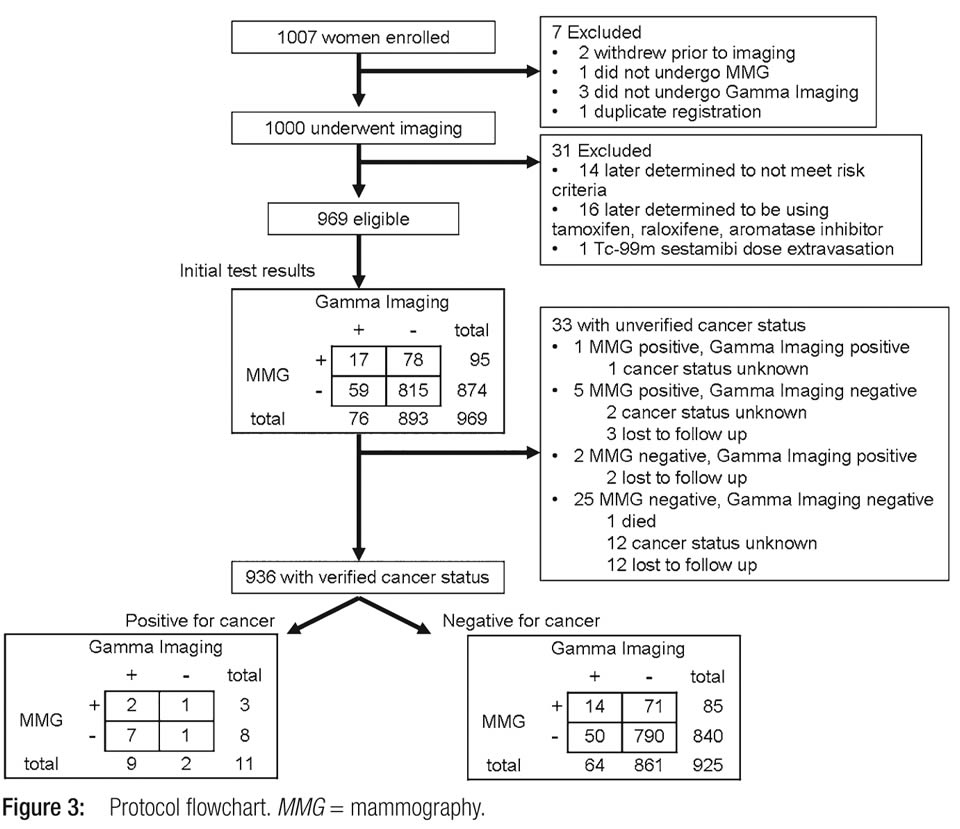
Not that it’s a bad study or a technology without promise. Neither is true. In fact, as a proof-of-principle study it’s perfectly acceptable, and that’s all it’s billed as in the paper. The findings of the paper are summarized quite well in this figure (click to enlarge):

As you can see, the study started out with 1,007 women with heterogeneously dense breasts enrolled and ended up with 936 women who completed all imaging whose data were available for analysis and whose cancer status was verified. Positive cancer status was defined as a positive biopsy showing cancer, while negative cancer status was defined as women who had a subsequent negative mammogram in the following year, a negative biopsy, or a negative prophylactic mastectomy. Reported sensitivities were 27% for mammography alone, 82% for gamma imaging (MBI) alone, and 91% for a combination of mammography and gamma imaging. The corresponding specificities were 91%, 93%, and 85%. All in all, these are good numbers, particularly when compared to mammography alone in women with dense breasts. Diagnostic yield was 3.2 per 1,000 for mammography alone, 9.6 per 1,000 for gamma imaging alone, and 10.7 per 1,000 for both. Finally, the positive predictive value (the chance of having cancer if the test is abnormal) was 3% for mammography, 12% for gamma imaging, and 8% for both. Basically, the study suggests that the addition of MBI with 99mTc sestamibi can increase the sensitivity and specificity of breast cancer detection in women with dense breasts.

Still, it has to be pointed out that there were only 11 women with breast cancer in the entire population. This is lower than one would normally expect for a typical study of mammography, likely because of the large number of younger women (as young as 25) in the population studied. The reason for this was in order to include a lot of women with dense breasts. Unfortunately, this means that it doesn’t take very much to skew the numbers one way or another. What this implies is that a much larger study is very much indicated in order to get a more precise estimate of what the sensitivity and specificity of this test is and how much it really adds to mammography. My guess is that it will add something to the mammographic screening of dense breasts, but probably not as much as this initial study suggests. Sadly, the decline effect will likely rear its ugly head.

There is another consideration here, namely the question of radiation. Dr. Rhodes touches on this issue in her talk:

So now that we knew that this technology could find three times more tumors in a dense breast, we had to solve one very important problem. We had to figure out how to lower the radiation dose. And we have spent the last three years making modifications to every aspect of the imaging system to allow this. And I’m very happy to report that we’re now using a dose of radiation that is equivalent to the effective dose from one digital mammogram. And at this low dose, we’re continuing this screening study, and this image from three weeks ago in a 67 year-old woman shows a normal digital mammogram, but an MBI image showing an uptake that proved to be a large cancer. So this is not just young women that it’s benefiting. It’s also older women with dense tissue. And we’re now routinely using one-fifth the radiation dose that’s used in any other type of gamma technology.

When I heard this, I wondered something. What is the effective total body dose? Injecting a radioisotope is a different thing than aiming an X-ray beam at the breast. 99mTc has a half-life of around six hours, which means that it takes 24 hours for the radiation levels to fall to 1/16 of the original. In this study, Dr. Rhodes administered 99mTc equivalent to 20 mCi. According to the chart included in this drug information, the estimated radiation dosimetry for a dose of 30 mCi of this tracer is 0.2 rads (approximately 0.2 cGy) to the breast, meaning that the dose used in this study was approximately 0.13 rads. Dr. Rhodes is correct that this is approximately the same amount of radiation as a single mammogram administers. However, she leaves out consideration of the dose of radiation to which other organs are exposed. For instance, 20 mCi of Miraluma results in a dose of approximately 2 rads to the small intestinal wall, 2.6 to 3.6 rads to the wall of the large intestine, 1.0 rads to the ovaries, and 0.3 rads to the bone marrow. In a single dose, these doses are not very high, but remember that we are talking about a screening test that is meant to be administered repeatedly, possibly even yearly, to women with dense breasts. Over the course of 30 years (or even more) of screening, the radiation dose to tissues other than the breast could rapidly add up, in addition to also adding to the dose of radiation to the breasts. These are not trivial concerns, particularly the potential for a significant cumulative whole body dose of ionizing radiation over decades of screening.

The return of the revenge of the Will Rogers effect

Finally, I hate to be a spoilsport, but some of the images that Dr. Rhodes displayed to me did not impress me that much. For example, she showed an image where a mass was not seen on mammography but showed up on MBI. Here’s what bugged me: It was a 5 cm tumor, and, quite frankly, the signal from MBI was not that impressive at all. I also wonder if anyone actually — oh, you know — examined the patient. Most 5 cm tumors are palpable as masses. True, I’ve seen the occasional patient where such a large tumor is difficult to detect, but these patients are relatively uncommon. In another part of the talk, Dr. Rhodes showed one slide in which the mammogram showed one lesion, but the MBI showed three, one of which was only 3 mm in diameter. Unfortunately, she did not say whether pathology of the resected tissue verified that these were indeed separate foci of cancer.

What this leads me to believe is that Dr. Rhodes either doesn’t acknowledge or doesn’t seem to understand the concept of the Will Rogers effect, more formally known as stage migration. This is the phenomenon where a new imaging modality detects tumor that couldn’t be detected before. The name is based on Will Rogers’ famous joke: “When the Okies left Oklahoma and moved to California, they raised the average intelligence level in both states.” This little joke describes very well what can happen after a new imaging modality is introduced into cancer diagnosis. Basically, the increased sensitivity of a new technique (like MBI) can result in a migration of patients from one stage to another that does the same thing for cancer prognosis that Will Rogers’ famous quip did for intelligence. For example, patients who would formerly have been classified as stage II cancer (any cancer) have additional disease or metastases detected that wouldn’t have been detected in the past, thanks to the new imaging modality. They are now, under the new conditions and using the new test, classified as stage III, even though in the past they would have been classified as stage II. This leads to a paradoxical effect in which the survival of both groups (stage II and III) appears better, even though there has not been any actual change in the overall survival of the group as a whole. This paradox comes about because the patients who “migrate” to stage III tend to have a lower volume of disease or less aggressive disease compared to the average stage III patient and thus a better prognosis. Adding them to the stage III patients from before thus improves the apparent survival of stage III patients as a group. Meanwhile, the patients who have extra disease detected by the new technology tend to be the stage II patients who would have recurred and done more poorly compared to the average patient with stage II disease; i.e., the worst prognosis stage II patients. But now, they have “migrated” to stage III, leaving behind stage II patients who truly do not have as advanced disease and thus in general have a better prognosis. Thus, the prognosis of the stage II group also ends up appearing to be better with no real change in the overall survival from this cancer.

There’s another effect, as well, an effect that was first noticed when breast MRI began to be widely used for the preoperative workup of breast cancer. Because of the greater sensitivity of MRI, frequently more disease was discovered than expected, leading to more extensive surgery. The mastectomy rate, which had been falling for decades as a result of the greater understanding among surgeons that breast conserving surgery resulted in the same survival rate as mastectomy, began to rise again. Over the last few years, evidence has been accumulating that the routine use of preoperative MRI does not improve survival rates or increase the rate of lumpectomies with negative surgical margins but does increase the rate of mastectomies (blogged here). In other words, when it comes to screening, as I have described many times before, more sensitivity is not always better. It might be better in the case of MBI because the sensitivity of mammography in women with dense breasts is pretty low, but we won’t know until we do the studies.

Which brings me to another part of this talk that irritated me:

Mammography isn’t perfect, but it’s the only test that’s been proven to reduce mortality from breast cancer. But this mortality banner is the very sword which mammography’s most ardent advocates use to deter innovation. Some women who develop breast cancer die from it many years later. And most women, thankfully, survive. So it takes 10 or more years for any screening method to demonstrate a reduction in mortality from breast cancer. Mammography’s the only one that’s been around long enough to have a chance of making that claim.

Elsewhere, on the TED Blog, Dr. Rhodes says that she thinks we should stop debating mammography:

So the problem is whenever a new technology comes around, the mammography mafia, as we call them, says, “Your test is no good, because you can’t demonstrate a mortality benefit.” Well, of course we can’t demonstrate a mortality benefit. Mammography’s been around since the 1960s; they’re the only ones who have a prayer of demonstrating a mortality benefit, because it takes that long to demonstrate.

First, we need to stop debating mammography and put our resources into developing and evaluating alternative screening techniques for women with dense breasts. MBI is certainly a very promising technique, and there are other promising techniques. Second, we need to accept an endpoint for success that is not strictly mortality-based. Although mortality is the most important outcome, there are intermediate outcomes that can serve as acceptable proxies for mortality. For example, instead of insisting that each technique must demonstrate a reduction in mortality from breast cancer, I believe it is acceptable instead to evaluate whether one technique can find tumors at an earlier stage – in other words, small tumors that have not spread to the lymph nodes.

The “mammography mafia”? Nice. I also wonder if Dr. Rhodes has considered the possibility of lead time bias and length bias in her screening test. Whatever the case, in essence, Dr. Rhodes’ argument boils down to a case of special pleading, wherein she insists that a different, more lenient, standard be applied to her favorite technology than was applied to mammography and than is applied to any other screening test. I can’t agree. MBI should be subject to the same standards as any other screening test for breast cancer. If there’s one thing we’ve learned over the last 30 years or so of mammographic screening is that it’s harder than it seems it should be to save lives with a screening test and that screening tests have unintended costs and produce unintended harms. These have to be balanced against the benefits. We will never know for sure what these risks and benefits are for MBI if we don’t do the studies, and if it takes a decade or more to find out what they are, then so be it, particularly given that there is potential for harm as well as benefit. That’s how long it will take. Also remember this: MBI subjects the entire body to radiation in order to try to save lives from breast cancer. How do we know that repeated doses of 99mTc sestamibi won’t result in the increased incidence of, for example, colorectal or ovarian cancer that cancel out any decrease in mortality observed that is attributable to better screening for breast cancer?

We don’t. And we won’t unless we do the studies.

Dr. Rhode’s MBI methodology is an example of a test that is evolutionary, not revolutionary. There is nothing whatsoever wrong with that, either. That’s how science advances, building incrementally on what has gone before. In fact, Dr. Rhodes and her coworkers are to be commended for taking a test that never caught on widely because of its low sensitivity and specificity and recognizing that the technology had developed to the point where it might be possible to overcome these limitations. I just wish she wouldn’t sell it to the general public as though it were some radical new test that the “mammography mafia” don’t want you to know about.

Facebook Google Buzz Digg LinkedIn StumbleUpon LiveJournal Share

The seven planets

[another guest post, this time at boingboing.net ]

Back in the good old days everyone knew how many planets there were, then scientists came along and screwed everything up. How could something that was always a planet suddenly not be one? It made no sense. Chaos ensued, people protested, and scientists were thrown in prison.

I'm not making up that prison part, either.

It was dangerous

How big is Pluto, anyway?

These days, a question like that is easy to answer: type it in to Google, click on the Wikipeadia entry, and read the answer: 2306 +/- 20 km. The  +/- (to be read “plus or minus”) is important here: every measurement has limitations and an often critical  part of science is correctly quantifying those limit. The correct interpretation of 2306 +/- 20 km is that 2306 km is the most likely value,

There’s something out there — part 3

In part 1 of this story I told about the discovery of Sedna, the first – and still only – body found far beyond the edge of the Kuiper belt. Part 2 described some of our early theories on how Sedna had gotten there and what it was telling us about the early history of the solar system. Here I’ll begin talking about the most recent searches for more things like Sedna and how we’re doing so far.

Mars attacks

One of the fun things about having a book coming out [TODAY, IN FACT] is that you get invited to do guest posts here and there around the web. You can, for example, watch for me from now until the solstice over at BoingBoing. One of the most fun so far was a chance to write at Babel Clash, about my take on life on other planets. Here is what I had to say:

I grew up in a universe teeming with

So is Pluto a planet after all?

The news last week that Eris might actually be a tiny bit smaller than Pluto led to the inevitable question: doesn’t this mean that Pluto should be a planet, after all?
The simple obvious answer to this question is no. Pluto was not demoted in 2006 simply because it was no longer the largest known object beyond Neptune, but because it was one of many many such small objects beyond Neptune. The

Brian Marsden, gatekeeper of the solar system

Brian Marsden, long time director of the International Astronomical Union Minor Planet Center died today. While it is easy to say “he was the nicest guy…” in this case it was simply true. Everyone who came across him has stories about Brian. My book, coming out in out a few more weeks has a few too. Just last week I autographed a copy for Brian and bookmarked the spots where he appeared. I say

The Benefits of Solar Shingles

solar shingles
It’s no secret that homeowners throughout the nation are looking for ways to cut down on their energy bills and go green. As a result, the solar technology market in the last five years has grown exponentially as homeowners install traditional solar panels on their roofs. Yet many of these households are running into problems, as their panels become the target of theft. Further, many Homeowner Associations don’t allow traditional panels on roofs because they jut up and can be seen by neighbors. This is keeping people from trying solar power, but a number of companies offer solar shingles as a solution. They are built to integrate with regular asphalt shingles, and don’t sit up on racks like traditional panels. And, since they are installed directly into the roof, they are much harder to steal. Here’s a detailed look at the more popular shingles available.

Powerhouse Shingle: Aided by $20 million in funding from the US Department of Energy and justifying their $1.5 billion annual investment in R&D, Dow CEO Andrew Liveris unveiled their Powerhouse Shingle in late 2009 and it is widely available to homeowners this year. They have received a lot of publicity since Dow's shingle uses a much more low-cost and sturdy material called Copper Indium Gallium diSelenide (CIGS) instead of the usual silicon. These shingles are meant to replace traditional roof tiles so they integrate seamlessly with the home. This means regular roofing companies can install them with an electrician connecting them to the home once installed, so homeowners don’t have to hire a separate solar installation company, which can often be very expensive. Dow’s extensive history with plastics allowed them to create an incredibly strong plastic cover to replace the glass most solar panels use, without allowing any less light through. This lets the shingles protect the roof from the elements just like a normal roof.

Sun Energy Shingles: Made by BIPV Inc, Sun Energy Shingles can provide up to 50 Watts of electricity per shingle. They are intended to sit directly over the already existing composition or asphalt roof, so they lay flat and provide a much more atheistically pleasing look than panels installed on racks. They use polycrystalline silicon, which BIPV claims makes them more efficient than other cells they produce using thin-film technology. Further, they have a Class A fire rating and a high wind and snow load rating, so they are rather durable and will continue to protect the home just like a roof is designed to do. The Sun Energy Shingles are currently available to homeowners, and have been installed on a number of homes in the western part of the country.

Other companies, like OK Solar, are also getting in on the action to help homeowners power their home by alternative energy without having to sacrifice the aesthetics of the house itself. Plus, because of their design and installation, solar shingles are a great substitute to the traditional panels, especially if dealing with theft or Homeowners Associations. If considering ways to green your lifestyle or home, solar shingles are a terrific option.

Alan Parker is a blogger based out of New York, NY who writes about alternative energy, green business, sustainability, and climate change.
Follow on Twitter @AGreenParker

Human Health is an Environmental Concern

mesothelioma
Environmental health is not limited to plants and animals – it also encompasses human well-being in relation to the natural world. Just because a substance is naturally occurring does not mean it cannot be a pollutant. Some plants give off VOCs, the same dangerous substances found in certain paints and solvents, and so should not be kept in unventilated indoor environments. Another natural material that humans have turned into a pollutant, an extremely fire-resistant mineral whose use has dire consequences for both human and environmental health.

If asked, most Americans will likely say that asbestos is dangerous, but they may mistakenly think it is no longer used in the United States. They also may or may not know that it is the main cause of mesothelioma, a rare and aggressive cancer of the lining of the chest or abdomen. Mesothelioma symptoms may take between 20 and 50 years to manifest after asbestos exposure, so we are just now seeing an upswing in the numbers of cases thanks to the ubiquity of asbestos in construction and manufacturing industries through the majority of the 20th century.

The International Ban Asbestos Secretariat routinely compiles a list of the countries that have placed a ban on the use of asbestos. The most recent list is from January of this year, and the United States isn’t on it. In 1989, the EPA issued a ban on most asbestos-containing products, but the ban was overturned by New Orleans’ Fifth Circuit Court of Appeals. Asbestos is regulated under the Clean Air Act and the Toxic Substances Control Act, but certain materials are still allowed to contain more than 1% asbestos, and the EPA does not oversee the manufacture, processing, or distribution of these products.

To see the devastation that asbestos causes, you have only to look to the vermiculite mines in the small town of Libby, Montana. Mining itself can be extremely detrimental to the environment, as the land is often stripped of vegetation and then polluted with runoff. While vermiculite is not dangerous in itself, it is often found in the same deposits as asbestos, and miners are exposed when they break up the rocks to harvest the vermiculite. Though the EPA had been aware of the asbestos-related health problems in Libby since 1978, the mine remained open until 1990 and the cleanup did not begin until 1999. To date, it is the nation’s deadliest Superfund site, with over 400 deaths directly attributable to the mines. The clean-up is ongoing, and will most likely continue for at least the next few years.

Mesothelioma symptoms, which have been documented as occurring in animals as well as humans, are serious, and the average life expectancy after diagnosis is only 9-12 months. Doubling this tragedy is the fact that approximately 80% of mesothelioma cases are preventable by avoiding exposure to asbestos. The EPA needs to use a firmer hand in regulating the toxic mineral, keeping careful track of its use until it can be phased out entirely and replaced with alternative insulating materials that are just as energy-efficient. Though asbestos itself is cheap, the cost on human and natural health is more than we can bear.

Vertical Farming – A Revolutionary Way To Grow Food In City Center

Vertical Farming Conference
MIAMI, FL (February 28, 2011) – Concise Conferences, LLC. will be hosting a Vertical Farming Conference with some of the world's best known experts in the field, (there is no registration fee).

Vertical Farming is a concept that argues that it is economically and environmentally viable to cultivate plant or animal life within skyscrapers or high rise buildings. With 60% of the world's rising population now living in urban areas, the demand to produce food efficiently and environmentally friendly has never been greater.

The organizers have recruited five of best known personalities in this space.

Hans Hassle is a pioneer in Corporate Social Responsibility and CEO of Plantagon. January 20th 2011, Plantagon signed a letter of intent with the Botkyrka municipality in Sweden for establishing a vertical greenhouse. The construction of a vertical greenhouse in Botkyrka, (Sweden) will be one of the first of its kind within the Vertical Farming concept.

Dr. Dickson Despommier, Ph.D. is a full-time professor in the Department of Environmental Health Sciences at Columbia University and arguably the best known personality within the community.

Gordon Graff is responsible for designing the Toronto Skyfarm. The Toronto Skyfarm is a self-sustaining, low impact system, equipped with its own bio-gas plant able to produce methane from its own waste which could be burned to generate its own electricity.

Nick Brustatore is a partner at Converted Organics & Owner of TerraSphere Systems LLC. Nick is an eco-entrepreneur and owner of a series of green tech and socially responsible companies. His team have rolled out several exciting initiatives that include models in waste management, energy saving technology, recycling, upcycling, and vertical farming.

Stephen Fane is the CEO of Valcent Products Inc. Stephen became a hydroponic greenhouse entrepreneur twenty years ago. In 1990, he acquired a five-acre hydroponic greenhouse operation that produced bell peppers, which he expanded to over 75 acres under glass.

This is an online conference starting at 12pm February 28th. Follow this link for more information and to register: http://bit.ly/eIK1mY

Concise Courses LLC, (Trading as Concise Conferences)
http://www.concise-conferences.com/vertical-farming.html
Media: Max Dalziel, max@concise-conferences.com
900 Biscayne Boulevard
Suite 4302
Miami, FL 33132
1.800.620.0950

Portland Startup Makes Energy Efficient Window Upgrades

Indow Windows
We here at The Environmental Blog wanted to introduce you to Indow Windows http://www.indowwindows.com, which is a new environmental product company that has recently launched in Portland this last winter. They make a thermal window insert that just presses into place on the inside of a window frame to upgrade the thermal performance of a single pane window to almost be equivalent to a standard double pane.

They are addressing a huge environmental problem with their product! Buildings are the number one consumers of energy and windows are the number one source of energy loss from Buildings. 55 million residences in the United States and about 650,000 residence in Oregon still have single pane windows.

Indow Windows has worked hard to create an easy to use, affordable, and aesthetically pleasing product that delivers huge energy savings. You can visit Indows Windows website to see how their product works.

They have done an installation at People's Yoga up on Killingsworth Avenue and they are super pleased with the increased comfort, lower energy bills, and dramatically reduced noise from trucks and busses passing in front of their studio on Killingsworth in Portland. Indow Windows reduce sound transmission by 50%, which was huge for them.

Solarize Projects Helping Portland Homeowners go Solar

Solarize Portland
Another step in the right direction towards a cleaner more sustainable Portland, Solarize North and Solarize Northwest are projects to help homeowners in Portland dive into alternative energy. The goal is to make purchasing solar power more affordable by grouping entire neighborhoods together with volume purchases - and thereby reducing costs. The projects have full support from Neighbors West- Northwest Coalition (NWNW), North Portland Neighborhood Services (NPNS), City of Portland Bureau of Planning and Sustainability, and the Energy Trust of Oregon.

North and Northwest Portland area homeowners looking to control their energy costs by using solar electricity have a new helping hand to guide them through the steps of a home installation. Solarize Northwest and Solarize North Portland are two new grassroots, community-based projects coordinated by Neighbors West -Northwest and North Portland Neighborhood Services.

With almost eight megawatts (MW) of solar power installed across the city (enough energy to power almost 700 homes) - Portlanders have helped prevent 4,000 metric tons of carbon emissions. The City of Portland is nearing its goal for installing 10 MW by 2012. There are currently 600 residential solar electric systems (also known as photovoltaics or PV), totaling 1.6 MW, installed in Portland. The growth of the local residential market has experienced a 400 percent increase in installations from 2008 to 2010.

For more information about the history of the Solarize programs, visit http://www.portlandonline.com/bps/solarize

Free workshops makes going solar easy and affordable

Solarize Portland neighborhood projects are designed to simplify the process of going solar and bring cost reductions through volume purchasing. Free workshops make the process easy to understand by covering topics such as the size of system to purchase, budgeting and financing, and how to get started.

View the schedule of free workshops in North Portland:
http://www.solarizenorth-nw.org/workshops-north

View the schedule of free workshops in Northwest Portland:
http://www.solarizenorth-nw.org/workshops

Online enrollment for both group purchase projects is now open at http://www.solarizenorth-nw.org and closes March 31, 2011.

The City of Portland Bureau of Planning and Sustainability and the nonprofit organization Energy Trust of Oregon are working together to support the launch of Solarize Northwest and North Portland, and can help any Portland neighborhood associations or groups interested in operating Solarize projects. For these two projects, the City of Portland is providing strategic assistance and coordination, and Energy Trust is providing technical assistance and cash incentives to help lower the upfront cost of the solar electric systems. Also, Solar Oregon is offering educational workshops and providing database services.

Learn About Solar Power Education

Home Solar Panels

Have you ever wanted to learn about solar power but you weren't sure how to get started? Are you worried about high costs or feasibility? If I told you their were kits that you could buy that you could purchase to assemble your own solar panels for a fraction of the cost, would that interest you?

I found this website that offers information, DIY solar kits, solar lighting, etc...they have everything you need to get started on solarizing your home for much cheaper prices than you could buy elsewhere when fully assembled. I believe we are in a changing environment where everyday people can utilize the power of the solar energy to supplement or replace their home utility bills.

If you think that doing it yourself is too much to do on your own, you can check out the solar contractors at this link that you could use a starting point for your solar project.

These kits are THE BEST way to get started in learning about green energy. The videos and books are available only here and will teach you to install solar panels, make your own, or even how to start a business in the green power industry. So what are you waiting for?!

solar education
Solar power advantages can be measured on several levels. Why go solar? Solar power systems have a great number of advantages over traditional electrical systems. Generating your own solar power is also a great way to reduce carbon footprints. Here’s what you should know if you are thinking of making the switch to solar.

Solar power is clean renewable energy. 50 years ago that might not have seemed like a big deal. But today, it’s what might save this planet.

Greenhouse gases caused by our need to fuel our homes, cars, boats and other items are accelerating climate change. Our excessive use of energy is also depleting and destroying the natural resources of the planet. So we have to find new ways to generate energy.

By harnessing the sun’s energy we can power these items but in a way that is environmentally friendly. And since the sun isn’t going anywhere, it means clean energy use for the foreseeable future.

Solar power is free. Energy from the sun costs nothing. What costs are the products needed to collect and distribute the energy. Unfortunately, prices for solar panel systems are expensive and in many cases cost-prohibitive. Even cave dwelling people in Turkey are using solar panels to generate energy and heat their water. After the initial costs are incurred the advantages of solar power become clear. Since solar systems don’t rely on electrical components, maintenance costs are minimal and a good solar system can last for up to 30 years. Generating solar power is one of the best ways to reduce carbon footprints.

Technologies in solar panels and thin film are developing more quickly now as well. At their best right now at the end of 2009, solar panel collectors are able to capture about 10 percent of the UV rays. Hopefully sometime soon, the efficiency of collectors will be improved even more and competition will bring down the price of solar power systems.

Some other solar power advantages are that many states offer tax breaks and incentives for buying solar panel systems and generating solar energy. Do a search online of solar tax breaks and discover the wide array of rebates and other incentives offered. These are often listed by state but will contain information pertaining to all available incentives in the specified area. Also check with local utilities to sign up with their programs – some offer a special rate for those who sign up to receive a block of wind energy, for example.

If your home generates more power than it uses the extra power can be sold to the power company. Solar grid tie systems automatically transfer the excess energy back into the grid helping to power other homes. On rainy days when you don’t have enough solar energy to power your home, you can tap into this grid and the extra energy that you generated on a previous day that went back to the grid will basically pay for you to receive electricity on that rainy day. Batteries also can be used to store excess energy.

Five Cost-Effective Ways to Lower your Heating Bills this Winter

gas bill
Given the recent cold snap here in the Pacific Northwest and the massive snowstorms throughout the rest of the United States, many homeowners are trying to avoid expensive heating bills by putting on a few extra sweaters. But what if you could add an extra layer of warmth to your home instead of your body, leave your thermostat at 70 and still lower your heating bills?

Here are five cost-effective steps toward a more comfortable, energy efficient and environmentally friendly home.

1. Close the gaps – Air leaking in and out of your home can be responsible for as much as 40 percent of your heating and cooling costs, according to Residential Energy by John Krigger and Chris Dorsi. By sealing up leaky areas, especially the bigger gaps found around plumbing, wiring and flues, homeowners can significantly lower their energy bills this winter. Many homeowners take on the task of caulking and weatherstripping around windows and doors themselves, but it is usually better to hire a professional to target the harder to find, and often larger, leaks located in the nooks and crannies of the home. A professional will also ensure that there is enough proper ventilation to keep the home healthy.

2. Give your home a sweater – While air sealing your home is like adding a windbreaker to reduce drafts, insulation acts like a sweater to make your home cozier by reducing the transfer of heat. Heat transferring through floorboards, ceiling and walls is even more expensive than air leakage, and in many older homes, there is little to no insulation to stop this heat flow. When it comes to choosing which area to insulate first (if you can’t afford to insulate all three at once), consider the amount of existing insulation and the installation costs. Attics, since they’re usually the most accessible, are generally the cheapest to insulate, while cutting holes in siding or drywall to install wall insulation tends to drive up the cost.

3. Seal up the ducts – Sealing and insulating ductwork will help your furnace deliver heat efficiently and evenly to the different rooms in your home. However, the importance of duct sealing depends on where the ducts are located. If they’re outside of the living space i.e. a crawlspace or attic, it’s a good idea to seal up and insulate those ducts. On the other hand, if the ducts are exposed inside of your home or they’re located inside of your walls and floor joists, not only will they be very hard to reach, but any heat they’re giving off will likely end up in the home’s living space anyway.

4. Upgrade the furnace – Installing a high efficiency heating system can be expensive. But if your furnace is highly inefficient and on it’s last leg, your best bet is to make the investment. One way to look at it is to consider the life-cycle costs because although the upfront cost of your new heater is high, it may cut your heating bills in half, which could more than cover the initial expense. Also, if the new furnace installation is combined with air sealing, insulation and duct sealing, you may be able to purchase a smaller system, which will save you even more money upfront and in the long run.

5. Revamp the water heater – Heating water uses around 20 percent of the energy consumed in the average home. The simplest ways to use less energy to heat water are to turn your water heater to 120 degrees Fahrenheit and wrap the storage tank and pipes with insulation. You can also replace your faucets and showerheads with water saving models. If you’re interested in making a larger investment to save water, energy and money, consider purchasing an ENERGY STAR dishwasher and clothes washer or replacing your tank water heater with a tankless or solar thermal water heater.

To find out which of these measures would be the most cost-effective in your home, check out EnergySavvy’s free online energy audit. It’s a quick and easy way to find out which energy saving measures will make the most sense in your home, and it will tell you how much money you may save on your utility bills by making the efficiency upgrades.

Written by Anne Maertens at EnergySavvy

Mystery bird deaths: Weather or Pollution?

blackbird deathsOn New Year's Eve thousands of red wing black birds showered a neighborhood in the small town of Bebee, AK. Wildlife officials investigating the massive bird kill believe fireworks may have startled the roosting birds and caused them to crash into power lines, trees and houses. The fireworks may have been what got them up in the air in the first place at night when they are not supposed to be flying around, but that doesn't fully explain what happened.

There are many different reasons for mass bird kills -- poisoning, a strange weather event attributed to climate change, or pollution.

Some say we are at a tipping point in the ecology of our environment. Many prophets and ancient civilizations have predicted times in the future of famine, drought, climate change, and death. Some say we may be close to that tipping point in which the entire system may come crashing before our very eyes.

The lead detective in the case of the raining birds loaded her car with boxes of the dead creatures on Monday, taking them for shipment to a national laboratory in the hope that tests would reveal why thousands of birds suddenly fell from the sky upon the small town of Beebe, Arkansas.

Early tests on the birds showed no toxic gases trapped in their feathers, though biologists found some physical trauma indicative of being hit by hail or lightning. Still, a bird die-off of this magnitude is unusual.

Beebe's blackbird population is large enough so that the US Department of Agriculture has in the past attempted large-scale scarecrow techniques to move large flocks out of the area. Outnumbered and outmaneuvered, the USDA gave up those efforts a few years ago.

In 1973, several hundred ducks dropped from the sky near Stuttgart, Ark., known as "The Duck Capital of the World," victims of a sudden storm. In another case, biologists found hundreds of what Ms. Rowe calls "perfectly good," but dead, pelicans in the middle of the woods. While the pelicans showed no outward signs of injury or singe marks, necropsies showed they'd been hit by lightning.

It's the stuff of apocalyptic novels. Scientists have not yet ruled out pollution or chemical toxins as the cause of nearly a dozen mass animal die-offs, from Arkansas to Brazil, in the last week. But as officials investigate, both the mundane and the intriguing are emerging as potential causes.

Because birds are considered indicator species that reflect the health of the surrounding environment, the news of mass deaths has unsettled many Americans.

Mass bird kills aren't uncommon. The US Geological Survey documented 90 mass deaths of birds from June to December last year. Over the past 30 years, it counts 16 events in which 1,000 birds or more suddenly died.

Testing can take time and is often inconclusive, although methods have improved in recent years, says Greg Butcher, a conservationist at the National Audubon Society. Scientists hope to have an explanation for the Arkansas bird kill within three weeks.

Nevertheless, officials in Arkansas and Louisiana call the large number of bird deaths "unusual." While the ultimate explanations may not point to broader environmental problems, "it is something we should potentially worry about," says Mr. Butcher at the National Audubon Society.

Shorepower Unveils Level II Charging Station

shorepower Public Level 2 charging station
Photo by Shorepower

On December 16th, Shorepower unveiled their new level 2 charging station at the Oregon Museum of Science and Industry. The installation was timed with the delivery of the first all electric, emission free, Nissan Leaf to a private citizen.

Since deploying its first Level 1 station in 2008, Shorepower continues to pioneer the EV infrastructure space. "This is an exciting time for electric vehicles as we deploy the first of many Level 2 stations in preparation for new cars coming to market,” said Jeff Kim, President of Shorepower.

Currently, the OMSI station provides free energy to EVs. Recharging an electric vehicle on a 240V Level 2 Charging Station can provide up to 25 miles of range for every hour of charging depending on the type of electric vehicle.

Over the coming months and years, Shorepower will retrofit existing Level 1 stations and add many new public and private plug-in stations across the country.

Shorepower is a transportation electrification infrastructure company offering simple, cost-effective solutions for connecting cars and trucks to the electrical grid including Truck Stop Electrification (TSE) and charging stations for Electric Vehicles (EVs) and Plug-in Hybrid Electric Vehicles.

Creating Life in the Desert

Desert Lake City
The Shimizu Corporation of Japan is pioneering new ways to help make life in desert regions more inhabitable. Their plan includes creating giant man-made lakes in the middle of the deserts. The lakes would be filled with seawater fed by canals reaching from the ocean. The lakes would be connected by canals to form a water network which would transform the desert regions into a climate that can support human development.

Artificial islands would then be built in the giant sea lakes to allow the water surrounding the cities to temper the harsh desert climate.

Securing the water would be the most important part of such a project:
1. Multiple seawater lakes, each surrounded by a continuous underground wall reaching all the way to the impermeable layer, are created.
2. Water is recirculated. Pumps are used to transport sea water to lakes. Gravity moves water to neighboring lakes.
3. A network of canals connects the manmade lakes.
4. Artificial islands are formed on the lakes.
5. The transportation network will incorporate both land and water systems.

To create the waterways, the core element of the system, pumps will be used to move water from the ocean to a manmade lake located at a higher elevation. Water collected in the lake will then flow down along natural slopes to many other lakes, eventually returning to the ocean. If necessary, booster pump stations will be established at several locations along the waterways. Creating very large lakes is expected to reduce extreme temperatures and increase humidity, creating a comfortable living environment characterized by mild weather on the artificial islands as well as in the areas around the lakes.

Such a cities would be extremely sustainable once built. Introducing seawater into the lakes will make it possible to cultivate and use marine resources. Seawater greenhouse agriculture, and energy production, fish farming, and Mangrove reforestation all would be possible around these cities.

The canals will be used to transport people and goods, promoting the development of nearby areas as well as the cities established on the manmade islands.

The manmade islands will represent high-tech oases in which technology and nature are harmoniously integrated.

For their energy needs, the cities established on the manmade islands will draw on photovoltaic systems to tap the abundant sunlight or on power-receiving facilities for solar power satellite (SPS) systems constructed on vast stretches of empty desert.

All in all, as our world becomes increasingly crowded, innovative and exciting solutions such as these will be explored in the future. It is certainly an interesting and futuristic concept.

Demonstration of Multi-scale Integrated Models of Ecosystem Services (MIMES) by Roel Boumans and David McNally of AFORDable Futures LLC

Date: 
Tuesday, March 15, 2011

Demonstration of Multi-scale Integrated Models of Ecosystem Services (MIMES) by Roel Boumans and David McNally of AFORDable Futures LLC (March 15, 3 pm US EDT/Noon US PDT/7 pm GMT).  The Multi-scale Integrated Models of Ecosystem Services (MIMES) is a suite of models for land use change and marine spatial planning decision making.  The models quantify the effects of land and sea use change on ecosystem services and can be run at global, regional, and local levels.  The MIMES use input data from GIS sources, time series, etc. to simulate ecosystem components at under different scenarios defined by stakeholder input.  These simulations can help stakeholders evaluate how development, management and land/sea use decisions will affect natural, human and built capital.  Building interactive databases for regional, integrated decision making is an important aspect of implementing MIMES.  MIMES has been developed in collaboration with a large international group of scientists and resources managers.  This on-going work is archived at a Google Code site.  Learn more about MIMES at http://www.uvm.edu/giee/mimes or http://www.afordablefutures.com/services/mimes.  Register for the webinar at https://www1.gotomeeting.com/register/907465801.